Blog Archives
‘After the Hunt’ Featuring Julia Roberts, Andrew Garfield @63rd NYFF
After the Hunt
Directed by Luca Guadagnino and written by Nora Garrett, After the Hunt is a complex, psychological, mystery drama with comedic/ironic flourishes that turn culture wars on their heads. Pointedly, its entangling themes never resolve into a satisfying resolution. Reflective about current social issues involving sexual abuse, gender identity, race, power dynamics, ethics and women’s career ascendance against the backdrop of Yale University in New Haven Connecticut, Guadagnino and Garrett tackle some of the themes credibly. Others they leave swinging in the winds of uncertainty.
Thanks to the incisive performances of principals Julia Roberts, Michael Stuhlbarg, Andrew Garfield and Ayo Edebiri, the film’s central mystery whether sexual abuse did or didn’t occur and why it occurred holds our interest.
However, the subtle nuances and motivations each character reveals become convoluted and incoherent at times. Is this in the service of the notion that human beings are layered, self-destructive, self-betrayers driven by their own nihilistic impulses? In a further irony, the philosophy professors Alma (Roberts) and Hank (Garfield), and their Ph.D. student Maggie (Ayo) are adept at weaponizing philosophy as a defense they use to promote their personal agendas. As a perfect foil, the most well-drawn character of rationality, Alma’s husband psychiatrist Frederick (Stuhlbarg), receives the prize for being the authentic adult in the room. Stuhlbarg’s Frederick is a perfect delight to watch and a welcome relief from the others’ Sturm and Drang.
Main Slate Section of the NYFF
Having its world premiere at the 2025 Venice International Film Festival, After the Hunt in its North American premiere opened the New York Film Festival in the Main Slate section. Interestingly, though the film takes place at Yale University in New Haven, Connecticut, Guadagnino filmed it in England. The superb set design provides the ambience for the 2020 setting and final epilogue in 2025.
In the opening scene, Guadagnino shares his first clue with a title message stating that the event happened at Yale. However, many events occur at the party Alma holds at her home for her students, colleagues and friends. First, we learn about Hank, Alma and Maggie, those closest to Alma, who briefly discuss Maggie’s dissertation on why she selected her topic, “the resurgence of virtue ethics.” Additionally, we learn that Alma and Hank compete for a tenured line professorship. Frederick asks both how they would respond if the other wins it? Do we take them at their word or do they lie?
Finally, Maggie goes to the bathroom. In searching for toilet paper, she finds a “hidden” envelope taped to the interior top of a cabinet. When Maggie opens the envelope she sees it contains an article and pictures. Maggie takes the article which we don’t see in close-up. So much for Maggie’s ethics and respect for her beloved professor’s privacy. Immediately, we note an immoral aspect of her character. We also have an indication of Alma’s character in placing an envelope with secret information where it can be found.
Initial incidents we see, a hidden incident occurs we don’t see
These initial incidents that we see, eyes wide open, take place in Alma and Frederick’s house. However, another incident that happens after the party, we don’t see. We hear about it from the victim, Maggie, who returns the next day to Alma’s. Dripping wet, bedraggled and forlorn, a waif to sorrow over, Maggie tells Alma that Hank sexually attacked her. Maggie admits she shouldn’t have allowed Hank to come over after the party where they had been drinking. Of course, he didn’t stop after she kissed him, though she said, “No.”
Somewhere in the emotional grist of this event that Alma doesn’t initially respond to with care and concern, we consider Maggie’s highly leveraging position at Yale, the antithesis of a conservative, “Red State” university. She is a Black, gay student whose wealthy parents donate heavily to Yale. Close to her professors Hank and Alma, who taught Hank, she goes to Alma for support. Maggie suggests Alma’s background will help her understand what Maggie feels. This comment short circuits Alma. Manipulatively, Maggie brings Alma into the situation and makes it personal to her. In other words, whatever Maggie read in the article she uses as leverage to manipulate Alma to help her. Confused, Alma wonders what Maggie knows about her.
Questioning Maggie’s motives
Thus, we question the wisdom of Maggie’s manipulation and wonder what information the hidden article about Alma held. Also, we question the extent to which the article influenced Maggie to invite Hank to her apartment where she kissed him and then tried to back off his advances. Did this event even occur? What underlying motives does Maggie have if It didn’t? By this point we have forgotten the ironic import of Maggie’s dissertation topic (the resurgence of virtue ethics). If virtue ethics gives weight to practical wisdom and the pursuit of a flourishing life through moral excellence, Maggie appears a hypocrite to even deal with such a topic. Taking the article about Alma doesn’t exemplify moral excellence. Neither does manipulating her with it.
Nevertheless, Maggie’s potentially heart-wrenching emotional experience of sexual assault by a close professor becomes occluded by many factors. Perhaps because of Alma’s cool response, we don’t feel sorry for Maggie or believe her. Her moral ambiguity taking the secret article also makes us question her veracity. Indeed, in the discussion of the “rape” by Alma, Hank and others, then in subsequent compelling scenes more information about the three philosophers unfolds. Against Alma’s suggestions, Maggie presses charges against Hank a surefire way to end his career at Yale.

Spiders spinning webs
As Garrett and Guadagnino spool out clues to interconnecting spider webs spun by three clever spiders with conflicting agendas and motivations, we remember Frederick’s unction about Maggie. He implies that Maggie is a mediocre student. This gives credence to Hank’s assertions that Maggie plagiarized parts of her dissertation. Apparently, her abilities falter, she can’t do the research and resorts to plagiarism. In fact Maggie’s plagiarism will disqualify her Ph.D., and possibly get her evicted from Yale, if either Hank or Alma hold her to account. How should Hank handle Maggie’s plagiarism? Does Alma, an expert in her field qualifying for tenure know Maggie plagiarized? Why don’t Alma and Hank report or correct Maggie?
To what extent do repercussions from Maggie’s wealthy donating family shut Hank and Alma’s mouths about the plagiarism? Shouldn’t they take the moral high ground and have her change her dissertation instead of ignoring it? To what extent does Maggie use the race card to her advantage? Doesn’t she understand that her behaviors play into the stereotypes about wealth, class and race? Does she even care?
Clearly, everyone’s careers are at stake, especially after Maggie accuses Hank of sexual assault. By this point morality, ethics and philosophy don’t help these philosophy professors and would-be philosophy professor. Governed by their own impulses of fight, flight, desire, need beyond intellectual thought, they founder in their own moral morass. Indeed, the irony becomes who is preying on whom? And “after the hunt,” who will be left standing and what will the carcasses look like?
Extreme complications
During the course of the film the complications become extreme when we learn that Alma and Hank had an affair which ends, perhaps prompted by Maggie’s accusation. Additionally, we learn that Maggie emulates Alma obsessively and loves her beyond a teacher student relationship. Also, we learn that Frederick knows about Hank and Alma, and understands the affair’s necessity and impermanence. Finally, we learn that Alma has some disease or pain that requires her to take pain killers or medicine that Frederick leaves on her table stand each morning. However, doctor and colleague Dr. Kim Sayers (Chloë Sevigny) also helps her out with medication.
How many more webs can Garrett and Guadagnino have their spiders spin? Well, Alma’s secrets have yet to be exposed. To what extent should truths be uncovered sooner rather than later to free individuals from wounds that govern their lives? Guadagnino and Garrett do have much to suggest about this through Alma’s revelations and Frederick’s wise love and counseling. Truly, as she says, “she doesn’t deserve him” and is fortunate that he loves her.
As an important point, this film could never take place in a part of the country that is governed by “red state” politics. Ironically, Connecticut, a blue state prides itself on listening to anyone coming forth with accusations. Safe to say that such events occur most probably in universities and colleges around the country. That the screenwriter and director set it in an Ivy League School that takes such issues seriously adds to the gravitas of the film.
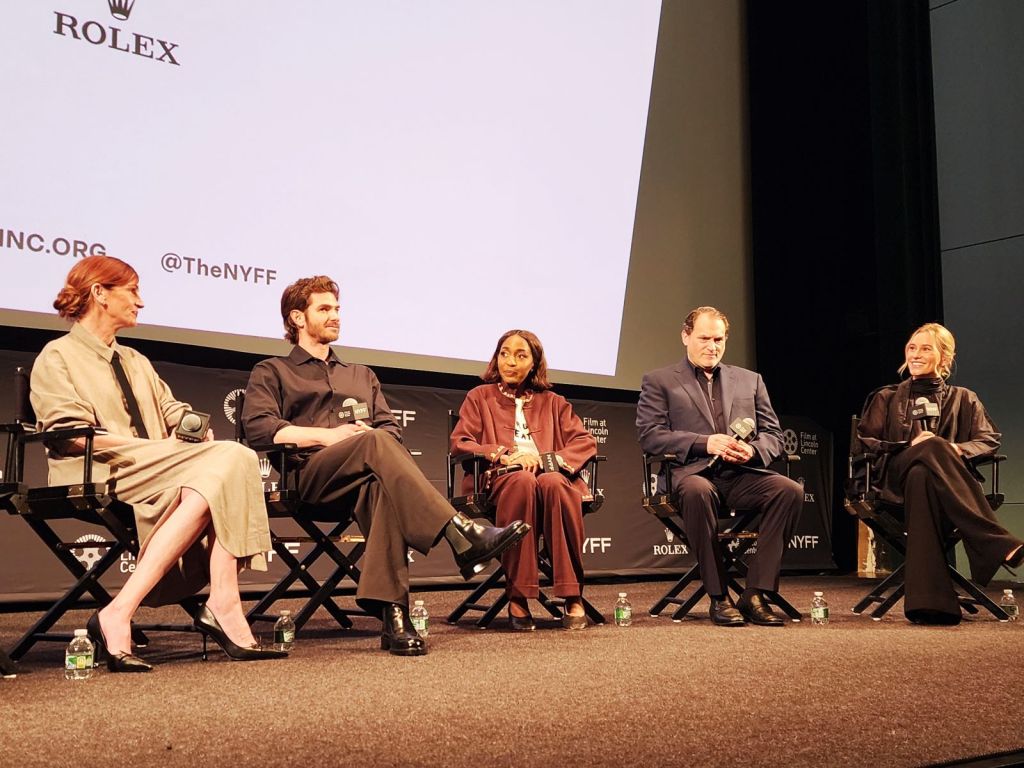
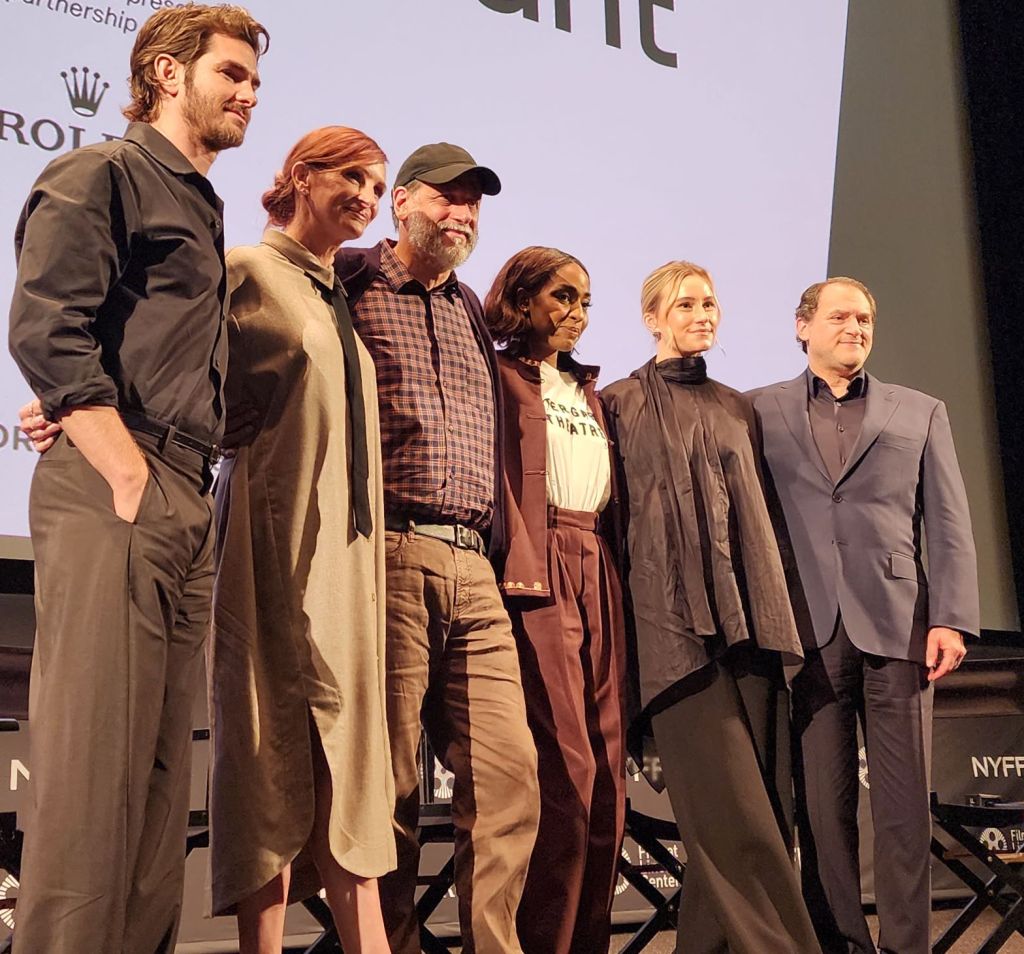
In the Q and A after the film, Guadagnino admitted he is a provocateur, but more for entertainment purposes in a positive way. Perhaps, as an iconoclastic clown, he attempts to nudge his audiences to think after unsettling them and providing no easy answers. Indeed, the main tenor of After the Hunt appears to be his wish to provoke discussion more than to present a dialectic and conclusion. Considering his cavalier voice over “cut,” then blackout to end the over two hour film, Guadagnino suggests that the characters he set in motion will continue their duplicity and self-betrayal long after it’s “lights out.”
After the Hunt will open October 10th at select theaters. For screening information for the 63rd NYFF, go to https://www.filmlinc.org/nyff/films/after-the-hunt/
‘Patriots,’ a Superb Play About the Oligarch Kingmaker Who Made Putin

After the USSR dissolved and Ukraine and various former Soviet republics established their independence, the popular Boris Yeltsin was elected as the President of Russia and remained as President from 1991-1999. Yeltsin, who attempted to transform Russia’s command economy into a capitalist market economy during a period of upheaval, allowed a small number of oligarchs to obtain a majority of national property through wheeling, dealing and manipulation. One of them was the brilliant mathematician Boris Berezovsky, portrayed in the play Patriots with lightening acumen, ferocity and humor by the phenomenal Michael Stuhlbarg.
Written by Peter Morgan (The Crown), directed by Rupert Goold, Patriots in its New York Premiere and transfer from London runs in a limited engagement at the Barrymore Theatre. A loosely inspired examination of recent Russian political history, this exceptional, riveting, new work is not to be missed.
Patriots is a tragicomedy of epic proportions that pits two enemies against one another as they vie for power, redefine what love of country means, remake and brand themselves, examine risk reward ratios, then fall back into default positions: one of fear to maintain control, the other of dismissing fear to live with courage, despite impending doom.

Morgan, inspired by events in Russian politics over the last thirty years, theatrically reconfigures the fascinating situational intrigues and power plays that may have happened during the time of Yeltsin and after his resignation. Uncertainty abounds, for there are no archived records of conversations between the former KGB agent, the nefarious Vladimir Vladimirovich Putin, and the ferociously ambitious and brilliant businessman, Boris Berezovsky. Thus, with humor and chilling currency, the playwright fills in the profiles of these men on antithetical sides of liberalism and conservative soviet autocracy.
With the assistance of Miriam Buether’s interesting multi-level, versatile set design, Jack Knowles symbolically ironic lighting design, Ash J. Woodward’s exceptional video design, Adam Cork’s sound design and music compositions, and co-costume designers Deborah Andrews and Miriam Buether, director Goold teases out Morgan’s fascinating story about how Berezovsky was Putin’s kingmaker and “krysha,” (roof or protector), until Putin turned the tables on him and seized power for himself.
Today, Putin enjoys the longest “reign” of leadership in Russia, even besting Soviet Premiere Joseph Stalin. According to Morgan, Berezovsky engineered Putin’s rise. Then Putin metaphorically stabbed Berezovsky in the eye because he was a better “patriot” than the criminal Berezovsky, who refused to heel to Putin’s power as an autocrat. That is Putin’s story to build up his pride and save face. Indeed, what is the truth? Morgan throws a monkey wrench into Putin’s branding of himself as strong man and creates an indelible portrait of an unknown mealy mouth who bows, flatters and takes orders from the mathematical genius and the most renowned oligarch at the time, Boris Berezovsky.

At the top of the play, Stuhlbarg’s Berezovsky addresses the audience for a brief moment, sharing his “patriotism,” as a man who loves his country and sees its poetic beauty in the simplicity of its natural surroundings. With this interlude, Morgan initiates a sub rosa theme the West finds difficult to believe. For Russians who have sought the West for asylum and safety, it is a much less fulfilling life and an oblivion almost worse than death, for they miss their mother country and would never leave unless forced to.
Shifting to a series of flashbacks Morgan profiles the Russian “patriot” moving into his prime as a successful billionaire. As he juggles his various business interests, interrupted with a phone call from his hysterical daughter which he pawns off to his assistant, he also speaks charmingly to a “Katya.” She is his young women of an inappropriate age, who extorts an expensive necklace from him with a remark that this birthday gift is cheaper than going to a lawyer. It is a coded message that she could financially harm him if she went public and disgraced him with a lawsuit about his taste for teenagers.

Clearly, Berezovsky is an oligarch’s oligarch who is known by everyone in Yeltsin’s Russia for his wealth, his luxuries, his power, his keen business sense, his charm and his affairs with women. He has made good on his prophecy to his math Professor Perelman (Ronald Guttman), that he would use his skills to seek opportunities. However, Boris has no time for his former research in mathematical theories with Perelman. He is too busy making money and creating more opportunities for himself and others who wish to be wealthy.
In the midst of this activity that reveals his vast influence and control, Berezovsky takes a call with the Deputy-Mayor of Saint Petersburg, and we are introduced to a diminutive Putin (the marvelous Will Keen). Putin is the soft-spoken, provincial, invisible, whose rigid, austere, conservatism and upright inflexibility, at this point in time, will not allow him to yield to Berezovsky’s offers of a Mercedes or cash bribe. However, he will exchange favor for favor, perhaps, and in the future may call on Berezovsky if he needs his help.

Using his position, Putin speeds up and smooths over arrangements for a deal Berezovsky makes adding to his rapidly accumulating wealth which allows him to purchase the number one TV station in Russia. And with the TV station in a later scene, after he recovers from a car bomb explosion assassination attempt, Berezovsky and his oligarch friends bankroll the reelection of Yeltsin. This investment allows Berezovsky to take a seat in the government and become closer to Yeltsin (the hysterical Paul Kynman), and his daughter Tatiana (Camila Cano-Flavia).
After a brief scene of Berezovsky with “The Kid,” oligarch Roman Abramovich (Luke Thallon), who needs Berezovsky’s help to expand his oil company Sibneft to one of the largest in the Russian Federation, Berezovsky meets with FSB officer Alexander Litvinenko (Alex Hurt). Litvinenko who investigates the assassination attempt suggests Boris needs protection but refuses Berezovsky’s fabulous offers to be his personal body guard. Litvinenko would rather stay as an impoverished but honorable, “patriotic” FSB officer. Interestingly, the idea of incorruptibility is aligned with the FSB, a fraud which Morgan later reveals is a hypocritical lie.
Interspersed with these scenes are flashbacks of Berezovsky with Professor Perelman. In one, Boris’ mother brings the nine-year old math prodigy to Perelman, who takes him on and asks Boris how he intends to use his mathematical talents. The precocious Berezovsky, who comes from humble means, says he wants to win a Nobel Prize because with it comes $1 million dollars. Winning the prize, he will gloat about it to others. This is another example of Morgan’s truth stretching; there is no Nobel Prize in mathematics. The rough equivalent is The Fields Medal. Nevertheless, Morgan aligns Boris’ youthful desires with his portrait of Berezovsky as an ambitious man with great pride and a taste for what money can buy.

This is further affirmed in a scene that takes place in Moscow in 1989. Stuhlbarg’s Berezovsky thanks his professor and justifies leaving the institute and his work in decision-making theory after the dissolution of the Soviet Union. There is no money in academia and research. While his professor mourns the humiliating break up of their “greatest asset” the Soviet Union, as the country embraces “‘casino capitalism’ in the hope it will make us feel whole,” Berezovsky glories in “liberation.” He embraces the movement toward Western democracy. In the ensuing chaos of economic shifting by Yeltsin, Berezovsky explains to his conservative professor that there are new opportunities that the Russian people hunger for. By employing his mathematical genius for monetary gain in the new found free expression of ideas, he will achieve possibilities that never existed in the former, closed communistic system.
By the end of Act I, Berezovsky hires Litvinenko as his security guard after the FSB officer resigns because his corrupt boss ordered him to assassinate Berezovsky without an investigation or a trial. What was Berezovsky’s crime? The conflation of politics with business; he and his oligarchs bankrolled Yeltsin. Litvinenko announces his resignation publicly decrying the FSB as corrupt. Thus, we understand how the players on both sides justify their actions as “patriotic” to “help” mother Russia for their own benefit, while accusing each other of criminal actions. However, the “austere,” “self-denying” FSB murders; Boris draws the line at using money to buy people.

Meanwhile, Putin, who lost his elected position of Deputy Mayor of Saint Petersburg and was foundering as a tax driver has been rewarded for helping Berezovsky. Boris finagles a position for him with the “Family” (Yeltsin and his daughter), as the new Director of the Federal Security Service (FSB), which displeases Putin who previously asked Boris for a political position. As FSB Director, Putin punished Litvinenko by putting him in the salt mines where he is tortured, while allowing the corrupt FSB boss who wanted Berezovsky assassinated to go free. When Boris questions Putin about this, Putin claims the FSB boss was investigated and denied the charges. Instead, for telling the truth and hinting at the inherent corruption permeating the FSB, Litvinenko is punished.
Ironically, Berezovsky who gave up studying decision-making and mathematical models, makes a terrible decision. He overlooks Putin’s “patriotism” and loyalty to the FSB, which tried to have him killed. As its director, Putin lets the boss who ordered the “hit” on Boris to go free. Clearly, the FSB and by association Putin is treacherous and acts like its own independent “hit” squad. However, Berezovsky overlooks Putin’s lies and determines him to be a soft-spoken, inconsequential, order-taking nebbish. This tragic flaw, whether blindness or pride at believing he can control all players, causes his own destruction when Boris makes another deal with Putin to give him what he wants. In exchange for freeing Litvinenko from prison, he will speak to the “Family” about a political position for Putin in the government.

For helping to reelect Yeltsin, Berezovsky has carte blanche and he asks the “Family” to help find Putin a leadership position. This is another Morgan stretch as he skips all the interim positions Putin held before he became a leader. However, Morgan uses his character Tatiana to counsel Boris. First, she reminds him that he is the third most powerful man in Russia, not the first as Berezovsky boasts he is. Astute about people, Tatiana initially rejects Putin as a possibility for their next leader, suggesting other men for a good reason. Tatiana affirms, “Those KGB guys, they’re not like us.” Agreeing with Boris that Putin is an unremarkable nobody who grew up poor, and as a liberal deputy-mayor was good at taking orders, Tatiana’s final comment is prescient. She says, “He feels little;” and little is “dangerous.” “Little, in my experience, only ever wants to be perceived as big.”
In the next scenes, Yeltsin resigns, most probably pressured to by the oligarchs. Putin meets with Berezovsky and tells him Yeltsin called and “begged him” to take his place. Berezovsky happily believes he will continue to be Putin’s krysha (protector). He assures Putin that his appointment is a tremendous opportunity for Russia and agrees with President Clinton, who told Putin in a phone call, that this is a “historic milestone” for freedom in Russia. Putin tells Boris the second phone call he received was from the Secretary-General of NATO who wanted to open conversations about Russia becoming a member. Boris’ reply, believing Putin will obey him says, “These are our friends.” “Trust them.” As Berezovsky goes for a week’s vacation of fishing, Keen’s Putin does his first official act as President. He calls a meeting of Boris’ oligarch friends, without Boris’ permission.

In Act II as the tragicomic battle for the soul of Russia explodes and Putin’s treachery manifests, events reveal Boris’ mistake ignoring Tatiana’s warnings about Putin. Indeed, Morgan’s enlightened play references the Putin FSB tactics he uses against his enemies that we see Putin use today (poisoning, plane crashes, pushing out of windows). Covering these killings up with lies, he cracks down on freedom of speech, reverses his position on liberal democracy and acts petulant with NATO, infuriated he is not treated with proper deference, bowing and scraping.
Berezovsky opposes Putin’s behavior and stands up to him. In the power shift between the two men, Putin has taken over Berezovsky’s persona, swaggering in admiration. However, he could never be the charming, effusive Boris Berezovsky. Instead, Putin mistakes Berezovsky’s confidence and inner strength of will and is still a little, puffed up nobody, albeit treacherous. He capitalizes on the ruthless evil of the FSB, harnessing them whenever possible to get what he wants. In that, Morgan’s portrait is accurate and essential; a warning to the West who didn’t see coming Putin’s war on Ukraine, starting in 2014, or his Saint Petersburg troll farms which used Social Media to divide the nation and help throw the US Presidential election to Putin’s puppet, the incompetent, derelict Donald Trump. (Read the Mueller Report, not Bill Barr’s “summary”.)
There is no spoiler. You’ll just have to see how Stuhlbarg’s Berezovsky and Keen’s Putin resolve their differences as “patriots,” uplifting Russia and its citizens with every chess move on the board.
This is one to see especially for the beautifully nuanced, humorous, brilliant performances by Keen and Stuhlbarg, Goold’s direction, the fine ensemble, and the powerfully thematic writing by Morgan which will force you to research these individuals to discover more about them.
Patriots, is in a limited engagement until June 23rd. It runs two hours with one 15 minute intermission, 243 West 27th Street between Broadway and 8th Avenue. https://patriotsbroadway.com/
 CAROLE DI TOSTI