Blog Archives
‘Archduke,’ Patrick Page and Kristine Nielsen are Not to be Missed
What is taught in history books about WWI usually references Gavrilo Princip as the spark that ignited the “war to end all wars.” Princip and his nationalist, anarchic Bosnian Serb fellows, devoted to the cause of freeing Serbia from the Austro-Hungarian empire, did finally assassinate the Archduke Franz Ferdinand and Duchess of Austria-Hungary. This occurred after they made mistakes which nearly botched their mission.
What might have happened if they didn’t murder the royals? The conclusion of Rajiv Joseph’s Archduke offers a “What if?” It’s a profound question, not to be underestimated.
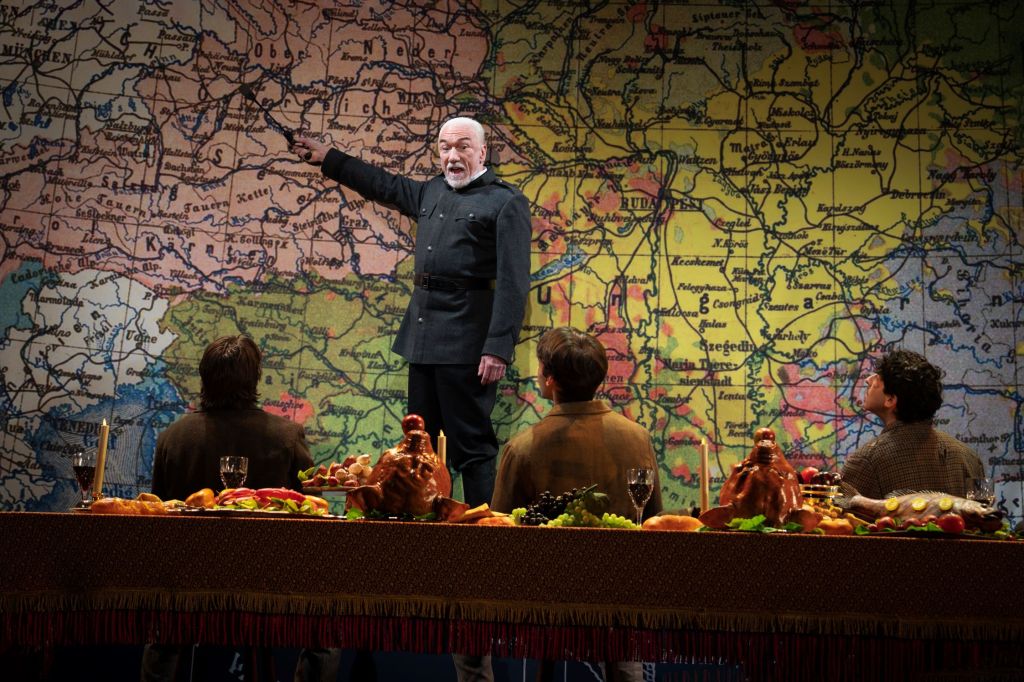
In Archduke, Rajiv Joseph (Bengal Tiger at the Baghdad Zoo), has fun with this historical moment of the Archduke’s assassination. In fact he turns it on its head. With irony he fictionalizes what some scholars think about a conspiracy. They have suggested that Serbian military officer Dragutin “Apis” Dimitrijevic (portrayed exceptionally by Patrick Page), sanctioned and helped organize the conspiracy behind the assassination. The sardonic comedy Archduke, about how youths become the pawns of elites to exact violence and chaos, currently runs at Roundabout’s Laura Pels Theater until December 21st.
Joseph’s farce propels its characters forward with dark, insinuating flourishes. The playwright re-imagines the backstory leading up to the cataclysmic assassination that changed the map of Europe after the bloodiest war in history up to that time. He mixes facts (names, people, dates, places), with fiction (dialogue, incidents, idiosyncratic characterizations, i.e. Sladjana’s time in the chapel with the young men offering them “cherries”). Indeed, he employs revisionist history to align his meta-theme with our current time. Then, as now, sinister, powerful forces radicalize desperate young men to murder for the sake of political agendas.
In order to convey his ideas Joseph compresses the time of the radicalization for dramatic purposes. Also, he laces the characterizations and events with dark humor, action and sometimes bloodcurdling descriptions of violence.
For example in “Apis'” mesmerizing description of a regicide he committed (June, 1903), for which he was proclaimed a Serbian hero, he acutely describes the act (he disemboweled them). He emphasizes the killing with specificity asking questions of those he mentors to drive the point home, so to speak. Then, Captain Dragutin “Apis” Dimitrijevic dramatically explains that he was shot three times and the bullets were never removed. Page delivers the speech with power, nuance and grit. Just terrific.
Interestingly, the fact that Dimitrijevic took three bullets that were never removed fits with historical references. Page’s anointed “Apis” relates his act of heroism to Gavrilo (the winsome, affecting Jake Berne), Nedeljko (the fiesty Jason Sanchez), and Trifko (the fine Adrien Rolet), to instruct them in bravery. The playwright teases the audience by placing factual clues throughout the play, as if he dares you to look them up.
History buffs will be entertained. Those who are indifferent will enjoy the fight sequences and Kristine Nielsen’s slapstick humor and perfect timing. They will listen raptly to Patrick Page’s fervent story and watch his slick manipulations. Director Darko Tresnjak (A Gentleman’s Guide to Love and Murder), shepherds the scenes carefully. The production and all its artistic elements benefit from his coherent vision, his superb pacing and smart staging. Set design is by Alexander Dodge, with Linda Cho’s costume design, Matthew Richards’ lighting design and Jane Shaw’s sound design.
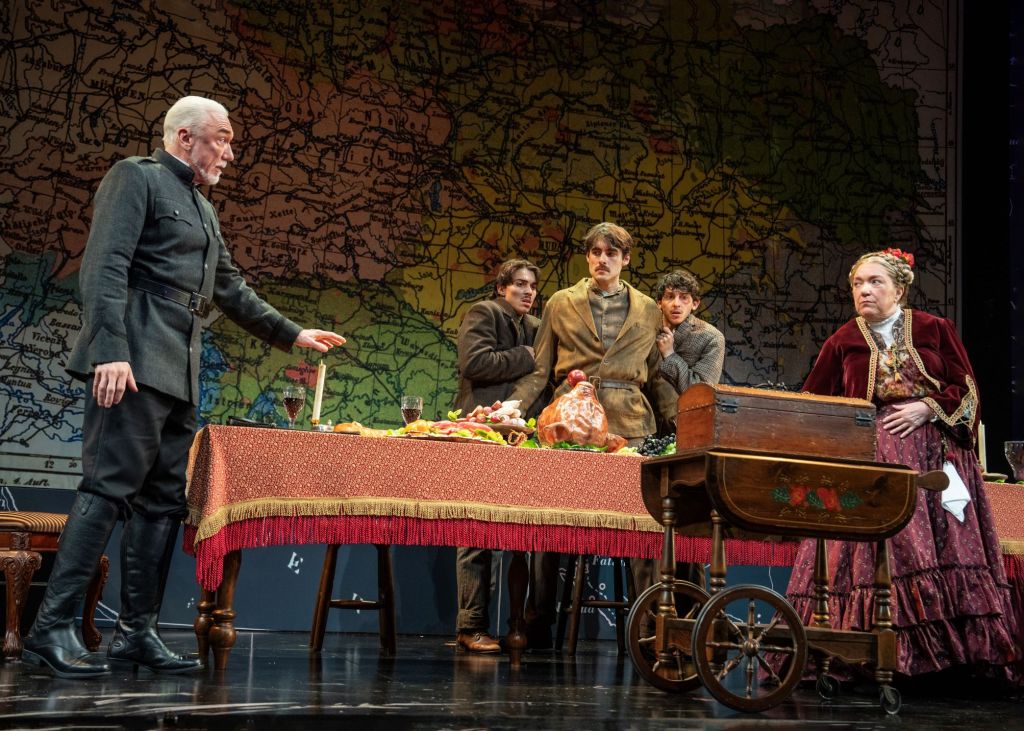
In Joseph’s re-imagining before “Apis” delivers this speech of glory and violence, the Captain has his cook stuff the starving, tubercular, young teens with a sumptuous feast. As they eat, he provides the history lessons using a pointer and an expansive map of the Austro-Hungarian empire. Like brainwashed lap dogs they agree with him when he tells them to. They are inspired by his personal story of glory and riches, and the luxurious surroundings. Notably, they become attuned to his bravery and sacrifice to Serbia, after their bellies are full, having devoured as much as possible.
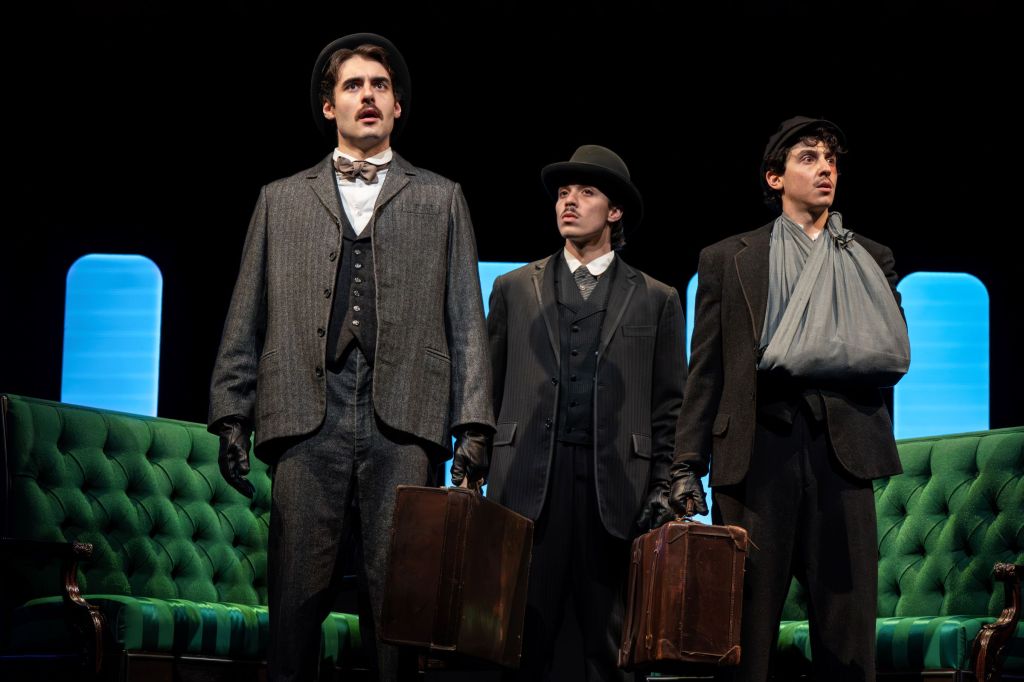
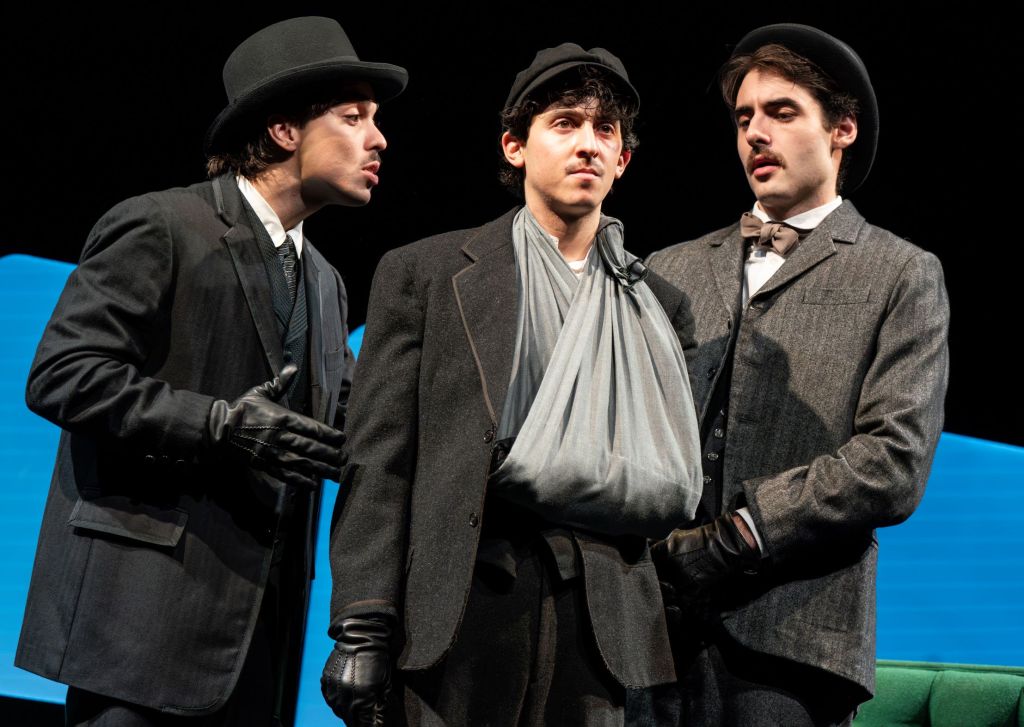
Why them and how did they get there? Joseph infers the machinations behind the “Apis'” persuasion in Scene 1, which takes place in a warehouse and serves as the linchpin of how young men become the dupes of those like the charming, well-connected Dimitrijevic. From the teens’ conversation we divine that a secret cabal cultivates and entraps desperate, dying young men. Indeed, in real life there was a secret society (The Black Hand), that Captain Dimitrijevic belonged to and that Gavrilo was affiliated with. The playwright ironically hints at these ties when the Captain gives Gavrilo and the others black gloves.
In the warehouse scene the soulful and dynamic interaction between Berne’s Gavrilo and Sanchez’s Nedeljko creates empathy. The fine actors stir our sympathy and interest. We note that the culture and society have forgotten these hapless innocents that are treated like insignificant refuse. As a result they become ready prey to be exploited. The nineteen-year-old orphans have similar backgrounds. Clearly, their poverty, purposelessness, lack of education and hunger bring them to a conspiratorial doctor they learn about because he is free and perhaps can help.
However, he gives them the bad news that they are dying and nothing can be done. As part of the plan, the doctor refers both Gavrilo and Nedeljko to “a guy” in a warehouse for a job or something useful and “meaningful.”
True to the doctor’s word, the abusive Trifko arrives expecting to see more “lungers.” After he shows them a bomb that doesn’t explode when dropped (a possible reference to the misdirected bombing during the initial attempt against the Archduke), Trifko browbeats and lures them to the Captain (“Apis”), with his reference to a “lady cook.”
Why not go? They are starving, and they “have nothing to lose.” The cook, Sladjana, turns out to be the always riotous Kristine Nielsen, who provides a good deal of the humor during the Captain’s history lessons, and the radicalization of the teens, the feast, sweets, and “special boxes” filled with surprises that she brings in and takes out. Nielsen’s antics ground Archduke in farce, and the scenes with her are imminently entertaining as she revels in the ridiculous to audience laughter.
With their needs met and their psychological and emotional manhood stoked to make their names famous, the young men throw off their religious condemnation of suicide and agree to martyr themselves and kill the Archduke to free Serbia. Enjoying the prospects of a train ride and a bed and more food, after a bit of practice, shooting the Archduke and Duchess, with “Apis” and Sladjana pretending to be royalty, they head off to Sarajevo. Since Joseph’s play is revisionist, you will just have to see how and why he spins the ending as he does with the characters imaging their own, “What if?”
The vibrantly sinister, nefarious Dragutin “Apis” Dimitrijevic, who seduces and spins polemic like a magician with convincing prestidigitation, seems relevant in light of the present day’s media propaganda. Whether mainstream, which censors information, fearful of true investigative reporting, or social media, which must be navigated carefully to avoid propaganda bots, both spin their dangerous perspectives. The more needy the individuals emotionally, physically, psychologically, the more amenable they are to propaganda. And the more desperate (consider Luigi Mangione or Shane Tamura or the suspect in the recent shooting of the National Guard in Washington, D.D.), the less they have to lose being a martyr.
Joseph’s point is well taken. In Archduke the teens were abandoned and left to survive as so much flotsam and jetsam in a dying Austro-Hungarian empire. Is his play an underhanded warning? If we don’t take care of our youth, left to their own devices, they will remind us they matter too, and take care of us. Political violence, as Joseph and history reveal, is structured by those most likely to gain. Cui bono? All the more benefit of impunity and immunity if others are persuaded to pull the trigger, cause a riotous coup, release the button, poison, etc., and take the fall for it.
Archduke runs 2 hours with one intermission at Laura Pels Theater through December 21st. roundabouttheatre.org.
‘Duke & Roya’ Review, in Love and War
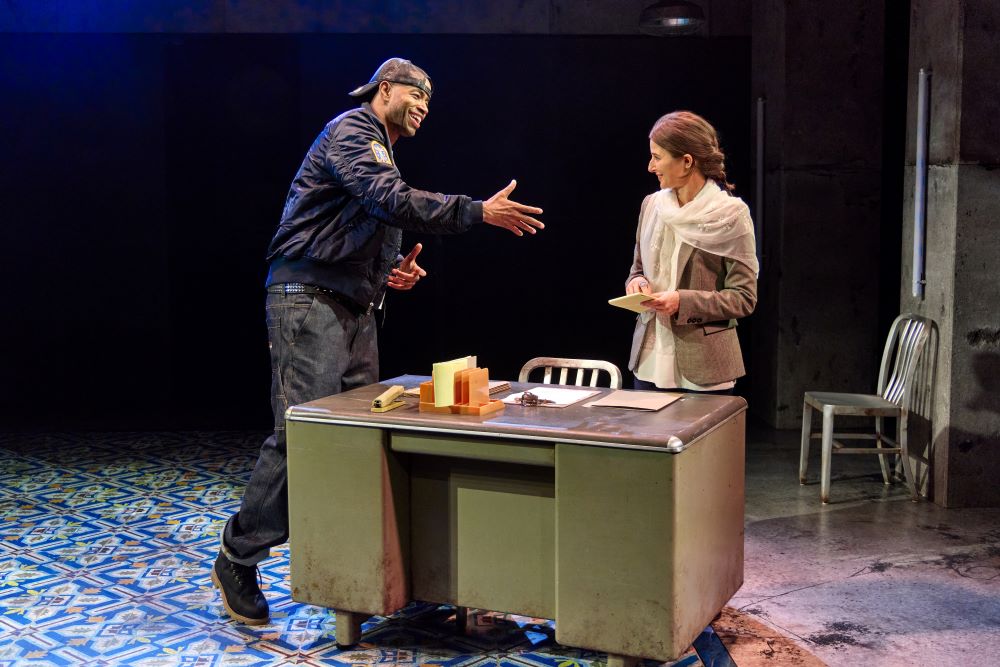
What does Hip Hop music have to do with a Muslim country whose strict religious practices frown on it? Nothing, unless an American base commander brings in a rapper to raise morale and entertain the troops stationed at Bagram Air Force base in Kabul, Afghanistan circa 2017. As unlikely as Hip Hop is to Afghanistan, so is the unlikelihood of the developing relationship between famous rapper Duke (Jay Ellis) and Afghan translator Roya (Stephanie Nur). The evolution of their love and respect for each other develops with humor and insight in Charles Randolph-Wright’s entertaining and meaningful play Duke & Roya. Currently, the hybrid comedy/drama runs at the Lucille Lortel Theatre until August 23rd.
Randolph-Wright unfolds his intriguing play through a series of flashbacks stirred by interviews and interrogations. The purpose of the interviews for the media, obviously is to entertain and titillate. On the other hand the interrogations yield information for investigators. Though we never see the questioners, the four principals, who answer the interrogators,’ questions do the heavy lifting. Through the nimble and talented actors, we form a perspective of the danger and the intrusion into their characters’ personal lives and identities. Randolph-Wright uses the “questioner” device so he can move immediately into the action and adventures between the titular characters in scenes between 2017 and 2025.
Initially, the media questions Duke about his music in the present. Then action transfers from the TV studio to his time in Kabul, Afghanistan. When Duke helicopters onto the base he meets Roya (Stephanie Nur) and her father Sayeed (Dariush Kashani), translators for the American military during the War in Afghanistan. Amiable Sayeed and cool Roya extend their hospitality as employees of the American government. Immediately, Duke shows interest and flirts with Roya, using his confident, “full-of-himself” attitude. Unsurprisingly, his approach, which most likely works on American women, falls flat with Roya.
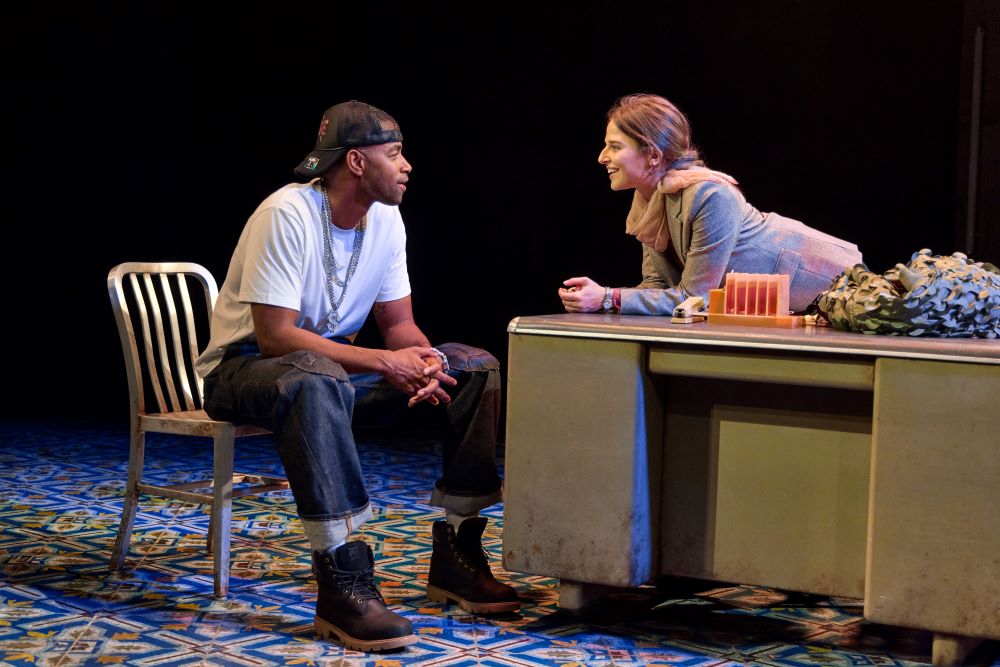
A product of her culture’s strict mores which Duke knows little about, Roya remains aloof. Because he interprets her reaction as “playing hard to get,” their acquaintance happens slowly. Influentially, Roya redirects him toward a new approach with women to encourage his respect. We recognize her brilliant balancing act. Cleverly, she resists his charms, yet lets him know he does appeal to her. So she teases and surprises him with ironic jokes. However, he eventually understands she must be her own woman.
Throughout their experiences together, this push-pull by Ellis’ Duke and Nur’s Roya plays believably. Acutely shepherded by director Warren Adams, the actors and Adams’ staging of them grounds the play in Wilson Chins’ minimal, stylistic set.
Vitally, the contrast between folkways of the west and east reflected in the lightheartedness, emotional drama and revelation of their personalities does capture our interest. For example we learn about the Afghan practice of bacha posh. Because Sayeed has many daughters, he chose the oldest Roya to live as a boy until puberty. Thus, as a boy she had the opportunity of an education. However, sometimes for purposes of safety she dons male clothing and practices bacha posh, which jeopardizes the situation for her later in the play.
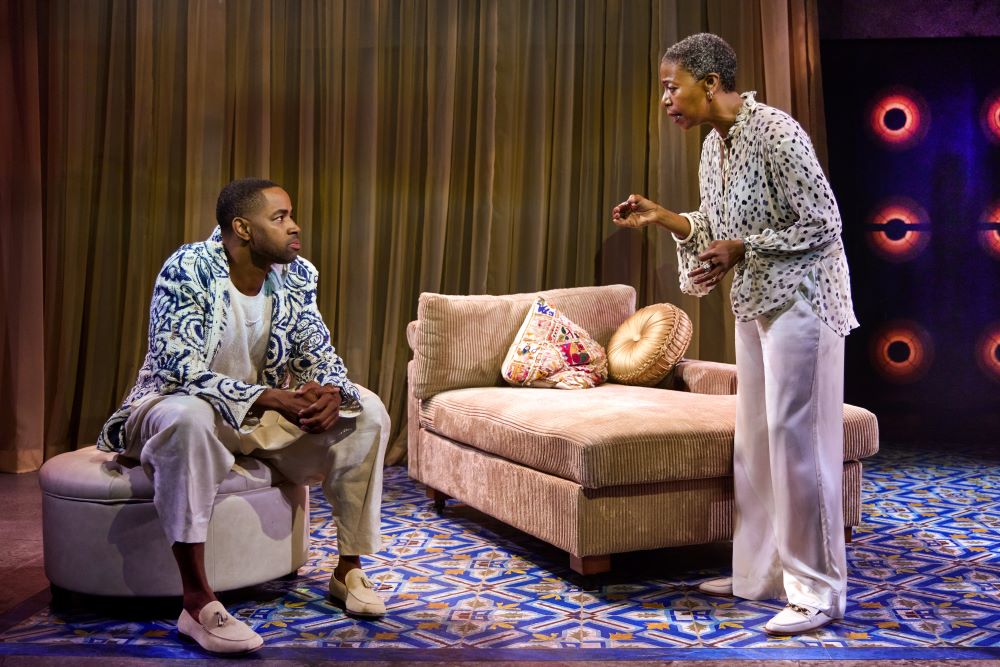
In addition to the standout performances by Ellis and Nur, Noma Dumezweni and Dariush Kashani keep us guessing as Duke’s mom and Roya’s dad. As Desiree, Dumezweni’s strong and forthright sister/mother figure, who chastises Duke when he needs it most, gains our admiration. She’s spot-on mesmerizing. The affable and charming Dariush Kashani authentically conveys the plight of Afghanis caught in an impossible situation. Not aligned with the Taliban that threatens to take over, nor with Americans who will leave the forever war, he, Roya and the family face ever-present danger. Though American visas have been promised for almost a decade, none are on the horizon, a horrific betrayal.
The complex themes sometimes get in the way of each other as the production moves toward the conclusion. Subtly, Randolph-Wright throws into the mix the perspective that Duke exploits the Black experience as a rapper, though his mother is middle upper class. However, Duke’s relationship with Roya changes his perspective and deepens his creativity. Of course the issues of religion, gender and politics come into play. Randolph-Wright intimates the strange parallel of Taliban repression to current oppression of women in the US.
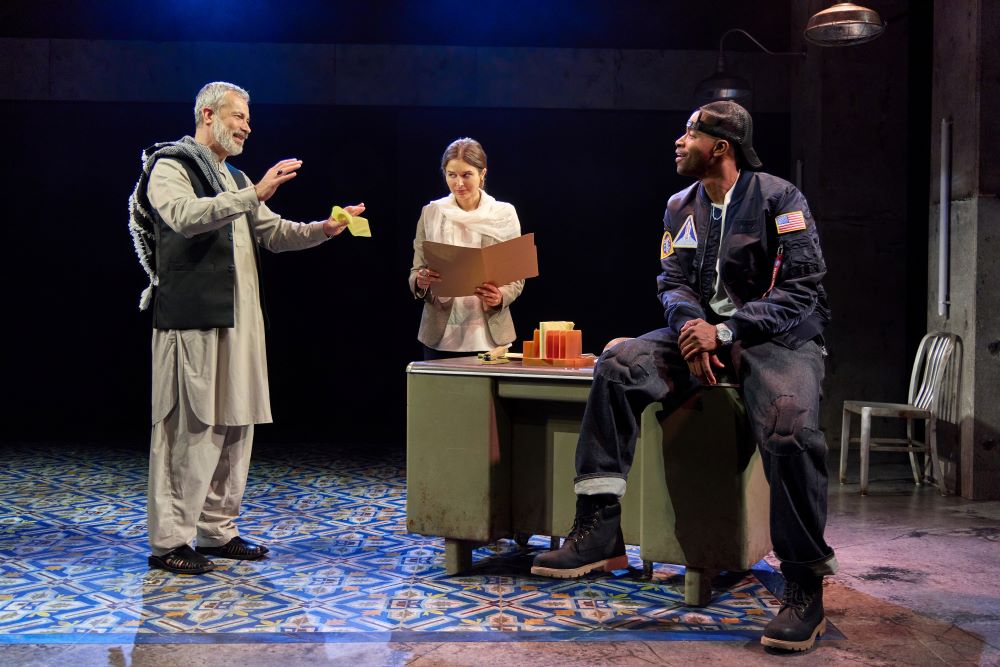
Also, in pointing out facts about the culture clashes and the Afghan war, Randolph-Wright shows the poisonous fallout when the Taliban made a peace deal with the Trump administration without the commitment of Afghan President Ghani. This led to a disastrous withdrawal of American troops and chaos, torture, imprisonment and death for Afghani/US government employees left behind. (Though it is true President Biden extended the evacuation dates, he could not delay the withdrawal indefinitely. Forced to cave to the previous administration’s pressure, he evacuated American personnel and as many of their Afghan counterparts as possible.)
As Duke and Roya mature over the 9 year period, Ellis particularly reveals his maturity during the completion of his interview at the play’s conclusion. Finally, when Duke and Roya meet up again after things become settled, we enjoy watching how their relationship continues to evolve into something profound. Whether or not they end up together is uncertain. However, they have earned their joyful moments together, especially when Ellis’ Duke sings his rhymes for Nur’s Roya with energy and pace. (Ronve O’Daniel’s original music and lyrics are easy and approachable in Ellis’ presentation.)
Amina Alexander’s lighting design, Sanowber Sabrina Spanta’s costume design, Taylor J. Williams sound design and additional music, and Caite Hevner’s projection design provide the background to enhance Chin’s minimal props and set design. These suggest an office at Bagram Air Force Base, an exterior scene in Kabul at night, a swanky hotel room in Dubai, an interrogation room and more.
As one of the more unique, nuanced offerings during this summer Off-Broadway, Duke & Roya shouldn’t be missed.
Duke & Roya runs 2 hours 20 minutes with one 15-minute intermission at the Lucille Lortel Theatre (121 Christopher Street) until August 2nd. https://dukeandroya.com/
 CAROLE DI TOSTI