Blog Archives
‘Cabaret’ Revival is an Expressionistic, Hypnotic, Smashing Must-See

Rebecca Frecknall’s darkly spirited and remarkable revival of the amazing John Kander and Fred Ebb musical Cabaret, haunts as it moves with frenzy toward increasingly frightening revelations filled with understated, metaphoric violence. With book by Joe Masteroff, Julia Cheng’s choreography, and Tom Scutt’s breathtaking scenic, theater and costume design, this latest iteration of Cabaret, which is based on the 1951 play I Am a Camera by John Van Druten, which in turn was based on the 1939 novel Goodbye to Berlin by Christopher Isherwood, is complex, riveting and unforgettable. With Jennifer Whyte as music supervisor and conductor (sensational music throughout), this revival is one for the ages in greatness, for its performances, its technical grace, its energy, its profound conceptualization and brave stylistic choices.
For Cabaret purists expecting benign, “prettified” variations on past revivals (this is the fifth), director Rebecca Frecknall’s vision will probably jars or disgust. Congratulations. It’s one point of the musical. This is especially so, if one doesn’t want to accept the musical’s messages about how one is seduced into embracing ideologies which promote dictatorships that become killing machines. As in Germany then, today, there are those who would twist the law for their own lucrative agendas. These threaten to establish a leader who is above the law and accountable to no one. Welcome to dictatorship 101, if Trump is voted in.
In light of this salient horror in our increasingly fragile democracy, Frecknall’s brilliant production indicates how such a situation may occur here, as it did in Weimar Germany to bring a genocidal killer to power, while the citizenry watched, then gradually embracing the movement’s martial power, cheered him on.To establish these unlovely, and terrifying themes, Frecknall’s creatives display efforts that are non pareil. Tom Scutt is extraordinarily gifted in his theater design and companion costuming. The August Wilson Theater has been astoundingly transformed into a happening, libertine Berlin jazz joint and cabaret, representative of those found at the twilight of the Weimar Republic in Germany, before the Nazis shuttered them for their filthy, hedonistic decadence.

The entrance to Cabaret at the Kit Kat Club reminds one of a hidden speakeasy as it leads into an eerily lit hallway of abundant, green, shiny fringe that walls off an alley of garbage bins and opens into the heady and enjoyable “Prologue.” You have arrived at the Kit Kat Club, a nesting doll arrangement of outer and inner lounges and bars serving drinks.
If one has arranged to be a part of the immersive seventy-five minute “Prologue,” one is offered a schnapps, the favored drink of Herr Schultz (Steven Skybell in a bravura performance). With schnapps in hand, one follows the crowd up and down a series of stairways into a rosy-pinkish-reddish, maroonish spacious, two-room sectioned lounge. In one section musicians (violin, piano, bass, accordion, clarinet, saxophone), in Kit Kat club costumes and make-up of the era play jazz, and vibrant melodies (Did I hear a polka?), on a raised small stage. Other Prologue dancers gyrate beyond the fringed maroon-toned curtains in the long bar lounge, where one may order drinks.
The Kit Kat Club has a variation of its own “Mayfair cocktail” (in honor of Sally Bowles who hails from Mayfair), and it is delicious. Jordan Fein is responsible for this immersive and delightfully surprising program of drinks and entertainment designed to massage you toward expectation, like a fly enticed forward into the web with promises of wild fun and surgery pleasures.

After one makes one’s way back upstairs into a smaller bar-lounge area, one may order dinner (charcuterie or a vegetable equivalent), and a bottle of champagne or wine, etc., and there is also dessert. After you order, you make your way into the Kit Kat Club theatrical space, the center of the web of intrigue. There, you find your seats at lamp lit tables close to the revolving circular stage, or at rows of seating behind the tables, on either side, where you may also order drinks. This is a surround sound event. The audience seating is on all sides, with the orchestra situated in two mezzanines on opposite sides. Additional seating is arranged in the balcony for another exquisite view of the revolving stage platform with risers that appear and disappear, chiefly transporting and featuring the powerful symbolism of the phenomenal, unparalleled Eddie Redmayne as Emcee.
Tom Scutt’s gobsmacking design is wondrous and memorable, and allows for the attractive waiters, which are NOT actors, to move up the slim paths between tables, bringing menu choices you may order (large Bavarian pretzel and a bag of spicy chips). There’s an accompanying selection of drinks at Manhattan prices, which far outstrip the value of Marks in 1929-1930 Berlin. Risque dancers mingle and mix in the audience and cast glances as they gyrate in stylistic modern dance moves, and flit up to the stage gesturing, voguing and vamping to enliven the audience.
This is not your mama’s cabaret. It reflects a cultural environment of excess and wantonness, borne out of desperation and the desire to please, to get someone to use the phone on the table to arrange a later rendezvous which will add a few more marks to a skinny wallet. Frecknall’s creative team are audience directed, striking the right ambience and mood to encourage satisfaction for a fun, boozy time of oblivion, only to be startled by an “ugly” reality.

There is a somnolent lull as the last orders are fulfilled, then patrons are awakened as the lights dim, cymbals crash and the Emcee (the breathtaking Eddie Redmayne), appears dressed in an unlikely outfit for a Master of Ceremonies: wide, knee-length leather shorts, an unremarkable tank top that looks like underwear, and a green party hat on top of red, red, red hair, which is its own costume. The Emcee crouches, hunching down his height to sing, making macabre hand gestures in long, black, thin gloves. He gains your curious trust as he leads you to the center of the web and keeps you there until the final bow and piercing realization that you’ve witnessed much of the prelude to what is going on in fragile democracies today.
Redmayne’s performance is mesmerizing, not because he is sinister, unemotional, or automatonish like other Emcees, who have gone before him. Nor is his flamboyance pushing it to the edge with star quality gay evocations. Redmayne’s sexuality is overshadowed by his stark determination and intention to be the consummate host and director of the audience’s will, which they should just give over to him obediently, like the Nazis gradually captured the will of the German people who stayed. (the fate of Fraulein Schneider, scene stealer Bebe Neuwirth, in “What Would You do”). With astounding presence, Redmayne personifies a quixotic, soul deformed character. He is internally debilitated and lost as are the Kit Kats and headliner, Sally Bowles (Gayle Rankin). Those who are most lost and broken find political movements and cults appealing and join them.

Indeed, in Frecknall’s production underneath the excess and the raucous dance numbers and “shouting,” it is clear why the soul broken, Kit Kats and Sally Bowles eventually embrace the glamor of Nazi strength and power, despite the terrifying violence behind it. This is reflected in the costume design in Act II, when the entire cast (except those who reject the Nazis), dons light brown suits reflective of fascism’s brown shirts until Hitler gained complete control and went over to the colors black and grey.
Wearing the same light brown suits, unified in belief and purpose, the Kit Kats signify they have put aside their individuality, uniqueness and inferiority, displayed in all its tawdriness and extremities in Act I, as they go around in circles on the stage singing and dancing to earn their keep. The costuming of Act II reveals they are united as part of something bigger than themselves that makes them feel empowered and confident. Sally Bowles craves such empowerment in Act I. She sings to Cliff that she was always “a loser,” and that “maybe this time I’ll win,” after agreeing to hook up with writer Clifford Bradshaw (Ato Blankson Wood). Gayle Rankin sings with soulful heart in a style appropriately different from her frenetic, zany cabaret persona.

Frechnall’s vision of the brown suits shows that the Kit Kats, Sally and the Emcee have embraced Nazi ideology and behavior. It is why the Kit Kats sing aggressively at the conclusion, losers singing for low wages in a seedy jazz joint no more. Triumphant at the “Finale,” the Emcee conducts his brown suit troop band as he sings, “the girls are beautiful.” Their beauty signifies they fit in to the “Master Race ideal. Marching as he directs them, we realize they support the fascists accepting the violent aggression against anyone who would disagree, and call that ideal “ugly” and horrible.
In Act I, all of the players we meet inside and outside the Kit Kat Club are crippled souls who are unaware, purposeless, misdirected and scrounging for their livelihood. The exceptions are Clifford Bradshaw (Ato Blankson-wood), Fraulein Schneider (Bebe Neuwirth provides the phenomenal contrast of one who is fairly whole), and Herr Schultz (the incredible Skybell is her counterpart in spiritual beauty and kindness). Clifford, a bisexual writer who comes to Berlin to finish his novel stays at Fraulein Schneider’s boarding house. Fellow traveler, Ernst Ludwig (Henry Gottfried is a friendly, sweet Nazi), introduces Cliff to racy, wild Berlin, the Kit Kat Club and Sally Bowles (“Don’t Tell Mama”). He also provides Cliff with German pupils (budding Nazis), so he can make money tutoring English.
Clifford lets Sally stay with him when her former boyfriend and club owner dumps her (“Mein Herr,” “Perfectly Marvelous”). It is a time when love is in the air. The magnificent Bebe Neuwirth as Frau Schneider is gently wooed by superb Steven Skybell’s Herr Schultz, with a sensual, delicious pineapple (“It Couldn’t Please me More”). The loving, heartfelt union they effect is a joy and pleasure to behold. These incredible on-point actors’ authenticity is a stark contrast to the twisted, grotesque, clown world of the Kit Kat Club. Likewise, Clifford develops a sexual relationship with Sally which encourages both of them for a time until events shift.
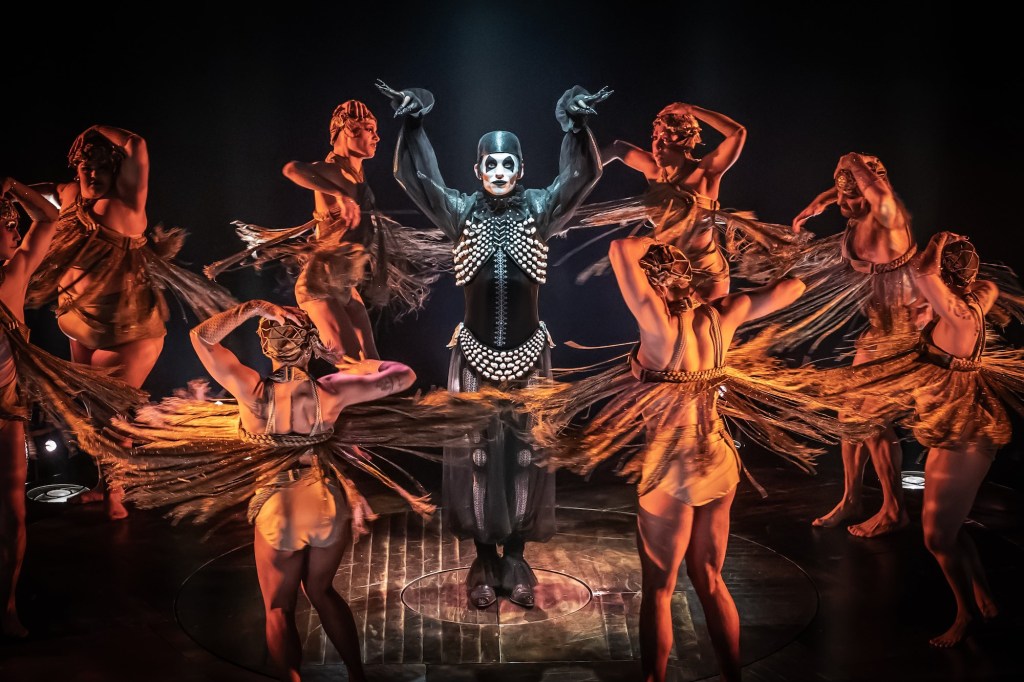
The only ones who don’t establish bonds of love are the Kit Kat performers and the Emcee, however, they are open to establishing a greater bond with a political evil spirit that is whipping through the Weimer Republic and ends up at the door of the Emcee, who uncharacteristically appears and without gestures, contortions and antic party costume, stands straight and tall, clothed in a robe. I was amazed at Redmayne’s height after his crouching, slouching postures.
Standing, no longer in the persona of the Emcee, he sings as himself-the anonymous person who portrays the Emcee-whose name we never learn. He’s obviously a representative of the “everyperson.” What he sings is more frightening than what he sings in his role as Emcee at the Kit Kat Club. But I must take a moment to elucidate Frechnall’s striking “before” and “after” and difference between the songs in Act I and Act II regarding their ambience and the behavior of the Kit Kats, Sally and the Emcee. The changes are significant and give rise to understanding why and how the “everyperson” in the Weimar Republic did nothing to stop the Nazi rise to power.
Initially, when the Kit Kats and Emcee appear for their opening song of “welcome” and “introduction to Berlin,” they perform individualistically and are their own “characters,” with stylized moves, costumes and presentations thanks to Julia Cheng’s choreography and Scutt’s costume design. Whether one describes the cabaret scenes as expressionistic or Brechtian, they are weirdly entrancing, strangely removed and objectified. They are masked with Guy Common’s make-up and Sam Cox’s excellent wigs & hair design, covering up the soul infirmities of these individuals who are scrambling for chump change in this seedy club, that can’t afford a more beautiful, divine “decadence”.
Their costumes are not “polished” or “uniform.” The Emcee is not in a tux and tails and top hat. Altogether, their appearance is one level above rag tag, thrown together with party hats. Sally’s “fur” is hardly that; it’s a dyed light turquoise-mint green, massive fluff piece. To state this club and its owner are scrambling is an understatement. But inside it is warm, and the drinks, dancing and atmosphere says “leave your troubles outside.” All the better to anesthetize you out of your money. The irony and conceit is fabulous. Eventually, the troubles in the form of Nazism will arrive and intensify, as asserted at the “Finale.”

Redmayne’s Emcee is the epitome of the Kit Kats’ leader. His gestures, his hands in black gloves are claw-like, opening and closing, pointing. His body is hunched and at times twisted. The disposition the Emcee displays in “Wilkommen” and “Welcome to Berlin” is not only Brechtian it is vampyric and beckoning. In his delivery of the opening songs and “Two Ladies,” some of the marvelous gestures reminded me of Max Schreck’s vampire Count Orlok in F.W. Murnau’s expressionistic film, Nosferatu (1922).
The crippled interior of the Emcee disappears and transforms to strength and power as he embraces fascism when he sings “Tomorrow Belongs to Me,” alone, without make-up, dressed in an unadorned robe singing of Nazi possibilities. “But gather together to greet the storm, tomorrow belongs to me.” Then in the second stanza, “But somewhere a glory awaits unseen, tomorrow belongs to me.” As he sings the Kit Kats place figures representing the tall, straight, martial Emcee on the circular stage as he finishes the song, foretelling of the Nazi’s rise to power, which has seduced him, “But soon says a whisper, arise, arise, tomorrow belongs to me.”

It’s an incredibly profound number, for we note the philosophical and interior change the Emcee goes through physically. Straight and tall he is empowered; he embraces the “positive future” the Nazis will bring to Germany. The sweetness and lyrical harmonies of the song, and Redmayne’s powerful voice and changed mien are terrifying. In the Emcee’s embrace of Nazism, we understand how the desire to identify with a movement’s promised glory can slowly take over one’s intellect and being, beyond rationality.
It is after the Emcee’s adoption of Nazi pride (“Tomorrow Belongs to Me,”), that Frecknall ties in another reason why fascism became acceptable to many citizens in the Weimar Republic in the superb Kander and Ebb song, “Money.” The Emcee arises from the trap below in a striking black outfit whose see through fabric overlays a skeleton pattern underneath. With the chest and hips embossed with metallic beading and a black fascist-looking helmet, the Emcee sings of the economics of politics between the rich and poor. Because “money answers all things,” the rich are obstacle-overcoming winners. Thus, “Money makes the world go around of that we can be sure. (—-) on being poor.”
The Emcee is an iconic figure symbolizing death, dark power and militarization which brought Germany out of its impoverishing depression as Hitler built munitions factories, employed men and built his war machine. In this scene, the simple words and “jingle” of a tune take on darker meaning. All the characters we meet are strapped in by poverty with the exception of widower and love interest Herr Schultz who owns a fruit market. But poverty breeds misery and jealousy.
At a party to celebrate Schneider’s and Schultz’s wedding, Kost (Natascia Diaz), gossips to Ludwig that Schultz is a Jew with money. Of course, Ludwig warns Frau Schneider not to marry Herr Schultz. The scenes following reveal the growing antisemitism (a brick is thrown through his shop window). Herr Schultz dismisses this as “children,” but Schneider fears Ludwig’s warning. Frechnall configures the scene stylistically with power, referencing and foreshadowing the “Night of the Broken Glass,” when every Jewish business was vandalized and shop windows broken. Herr Schultz holds on to the fantasy that he will be all right; he is a German, after all (an irony). But he moves on the opposite side of the plaza to avoid Frau Schneider.
Neuwirth and Skybell’s performances express the human tragedy of two individuals who love, but for fear’s sake break up and move on. We note that in this event alone, the Nazis have won, and love and truth have lost. This is a society and culture whose tomorrows belong to the Nazis, as Kost, Ludwig and the company sing while Cliff decides to break off his friendship with Ernst Ludwig. The writer and thinker sees the ugliness where the others ignore and dismiss it based on information from the past.

But Act II reveals, “the handwriting is on the wall. It is already too late as the Kit Kats’ “Kick Line” led by the Emcee morphs into a militaristic regimented number as they march off as if at a Nazi Rally. With the discrimination increasing (If You Could See Her”), Cliff confronts Sally about leaving. He refers to the danger of blindness and disinterest in political events, trying to get her to “wake up.” When she says the Nazis have nothing to do with them, Cliff says, “If you’re not against all this-you’re for it. Or you might as well be.” This theme that hits the bullseye for us today, is immutable.
Thus, it is no surprise that Sally has made up her mind to return to the Kit Kat Club and leave Cliff. When the Emcee characterizes her relationship with Cliff, singing the beautiful ballad to Sally with sincerity (“I Don’t Care Much” (“go or stay”), she is moved. It is then she dons the brown suit and with the other Kit Kats and Emcee embraces the Nazi’s “tomorrow.”
Rankin’s parting “Cabaret” is sung as a hellion’s frustration at the choice she’s made (the abortion and leaving Cliff), and the questionable options ahead of her. More than ever because life “isn’t a cabaret,” she will make it one with all the fury in her being and end up like Elsie (who partied hard and left a smiling corpse), perhaps, not with a smile on her face. However, Redmayne’s Emcee has a smile on his face as he directs the militaristic “Finale,” all suggestive, risque Kit Kat behavior disappeared. Dressed in the brown suits, the Kit Kats follow regimented movements. All have embraced the Nazis in a stark horrifying sameness. They’ve sacrificed their gorgeous, crippling individuality for the Nazi nationalism and the greater “good.” They’ve accepted fascism which victimizes, ridicules and scape goats the weak.
Those of the Kit Kat Club follow fascism’s hope. That hope, however, bellicose, is easier to accept than the reality of living which frustrates in a never ending wheel of misfortune going around in circles, going nowhere except into more suffering. For such individuals, embracing destruction and death found in the brutal Nazi ideology brings renewal. Older Germans like Herr Schultz and Frau Schneider accept and make excuses or allow fear to control.
Frecknall’s vision and tone are extremely dark and sardonic, heightening the original book of Cabaret and layering it for us today in a disastrous, repellent warning. Its macabre stylization is perfect as are Redmayne, Neuwirth, Skybell, the heroic Blankson-Wood and Rankin’s devastating Sally Bowles.
Cabaret at the Kit Kat Club. August Wilson Theater, West 52nd Street. Running time: 2 hours 45 minutes. 75 minute optional prologue. https://kitkat.club/cabaret-broadway/
NYTW’S ‘Sanctuary City’ at the Lucille Lortel Theatre

One of the most fascinating elements of the superb Martyna Majok’s Sanctuary City, directed by Rebecca Frecknall, is the symbolic stylization conveyed by the script. Majok’s script is a powerhouse. It is rhythmic, poetic and a rap of eternal, brief moments of brilliance in time. Majok’s layered work elucidates how relationships begin, not with long conversational pieces, but with connecting, truncated slips of thought. She suggests that relationships evolve through the power of memory and imagination, the interactions between “B” (the adorable and heartfelt Jasal Chase-Owens), and the emotionally wired “G” (the wonderful Sharlene Cruz,). These prove to be fatal, fairy wisps in the first part of the production.
Frecknall’s staging on a bare, raised platform, sans props and any theatrical spectacle, requires that the audience focus on Majok’s words which, abstracted, are short, repetitive bursts. For emphasis and effect, Frecknall follows the brief, seven word or less sentences with brilliant strobe light flashes, denoting flashbacks and changes of scene, situation and time. The intriguing lighting and set design are by Tom Scutt and Isabella Byrd with Mikaal Sulaiman’s sound design.

The effect, revealing the stress and anxiety of the characters, recalls the dislocation and alienation that characters experience in plays like Beckett’s Waiting for Godot. Such stylized dialogue brings to mind the mission of Theatre of the Absurdists, who highlighted the incapacity of language to convey emotion and heart. When human beings experience trauma, internal isolation and nihilism to a devastating extent, verbalization seems impossible.
Thus, as teenagers “B” and “G” move and re-position themselves onstage. As the portray these characters Chase-Owens and Cruz, offer fragments of memory recalling the past with intensity. Engaged, we follow intently, discovering that they are illegal aliens. “B’s” mom is fed up and intends to return to a country that her son was too young to know. “G’s” mom is oppressed and abused by the partner she lives with who also wallops “G” for good measure when she gets in the way. “G” and “B,” who are archetypes of dreamers everywhere, have parents who are single women. Hampered by fear of reprisal and intimidated by threats of deportation, the mothers are unable to make comfortable lives for their children. They struggle to do their best, but instead “B” and “G” are brought into a cold, indecent, alien world of devastation without citizenship.

We watch in the dim light and lightning-like flashes how Cruz’s “G” often climbs up the fire escape seeking “sanctuary” and help from Chase-Owens “B.” The abuse, arguments and chaos at her apartment create phenomenal stress; she must leave. “B” welcomes her and eventually she sleeps in his bed and they have sex to make a connection so they feel less alone. Both confide in each other, encourage each other at school and “dream” of better times which eventually do happen for “G.” The superb actors create a relationship dynamic that is believable and vital. Interested and invested in their prodigiously skilled portrayals, we stay with them throughout the play.
The setting is New Jersey in 2006, in a country which ill uses its immigrants because political parties have exploited the issue of citizenship as a way to consolidate power. For “B” who fears getting caught and being deported, the emotional terrors are like a war of attrition that force him and his mother to live an impoverished pressure-cooker existence. They wait daily for the explosion to occur, of their being caught and deported.

We discover through the light flashes and their circular movements on the platform, that “B” and “G” trace the chronology of their relationship in staccato bursts of memory. These lead to an apotheosis at the play’s conclusion. We empathize with “B’s” concern for his mother, who suffers abuse and bullying from her employer. She obeys his every word, and overlooks his skimping her pay. His disrespect is better than returning to the homeland, until she reaches a point of no return and decides it is enough.
Thus, Majok reminds us continually by examining the plight of “G’s” and “B’s” situation, that immigrant women are often sexually abused and beaten because they have no leverage. As in the case of “G’s” mother, orders of protection are useless because the partner can call INS (currently ICE), and have them deported, if they don’t comply sexually. Indeed, once the partner exhausts the mother, the implication is that he will come for “G.” At times “G” shows up at “B’s” bleeding and bruised by his wanton brutality.
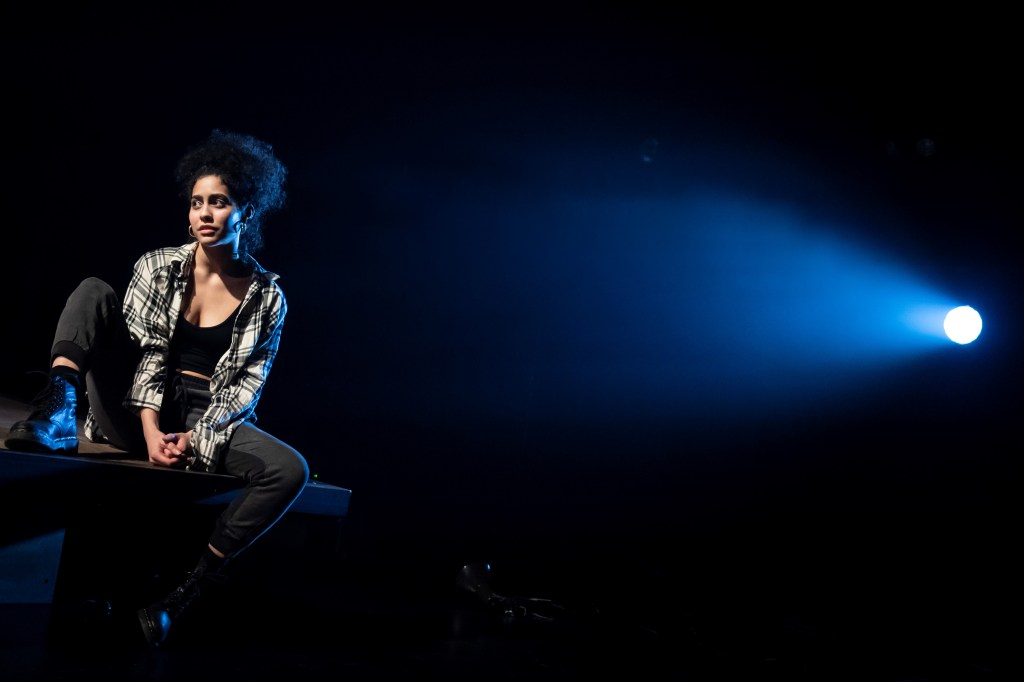
However, hope does come. And in the same stylized format of language, “G” tells “B” that her mother got her papers and miraculously, “G” is a citizen. That moment of G’s” joy causes “B’s” searing pain. While “G” no longer fears discovery and looks forward to their moving away from her mom’s monstrous partner, we note “B’s” sadness and envy. He is stuck. His mother is going back to the “homeland” and his confidante and ersatz lover has “made it” to a more superior position in the immigrant pecking order, while he must wallow in her wake, facing the shadows of fear and oppression alone.
It is at this juncture that a turning point occurs. The guilt “G” feels about her position in comparison to “B’s” situation wears on her. She forms the idea that as he has given her sanctuary, perhaps she can do the same for him. Her method is to select the way to citizenship immigrants have employed for decades. After all, she has feelings for him and is willing to risk her life offering to marry him, though, if discovered, she possibly would lose her own citizenship, be fined and jailed after he is deported.
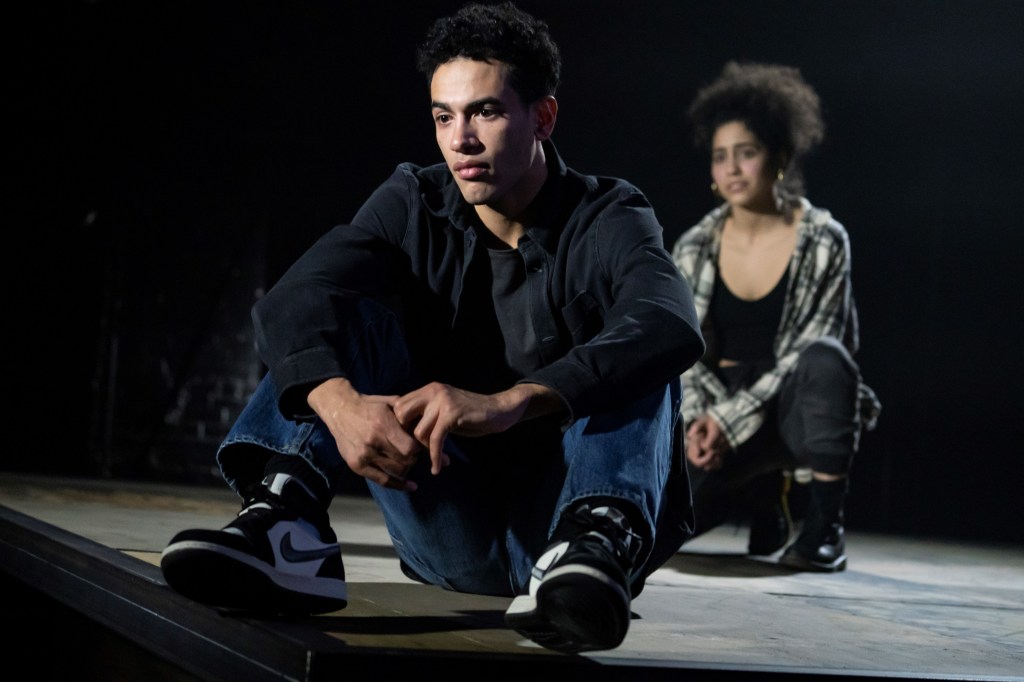
Majok’s script sags when the plans evolve for “G” to help “B.” Perhaps due to the continued flashes of light and whirl-y-gig staging, the sameness becomes tedious. However, there is the wonderful and welcome respite of their dancing and going to the prom with additional colorful lighting. The diversion from the stasis of the repetitive stagnant (the symbolism is apparent…no need to bludgeon the audience), might have come sooner.
And then comes the transformation of a three-year hiatus which Frecknall announces with sound effects and darkness both of which are symbolically ominous. Subsequently, Henry (the excellent Austin Smith) comes onto the threshold of “B’s” life to provide safety and emotional sustenance as “G” once had, until she returns, and the three clash. In this second sequence of events, all is light with no obfuscation. “B” and “G” no longer maneuver around each other. Their dynamic is straightforward. Now, it is “G” who must sink or swim in her emotional guilt while “B” makes a decision about citizenship and sacrificing love.
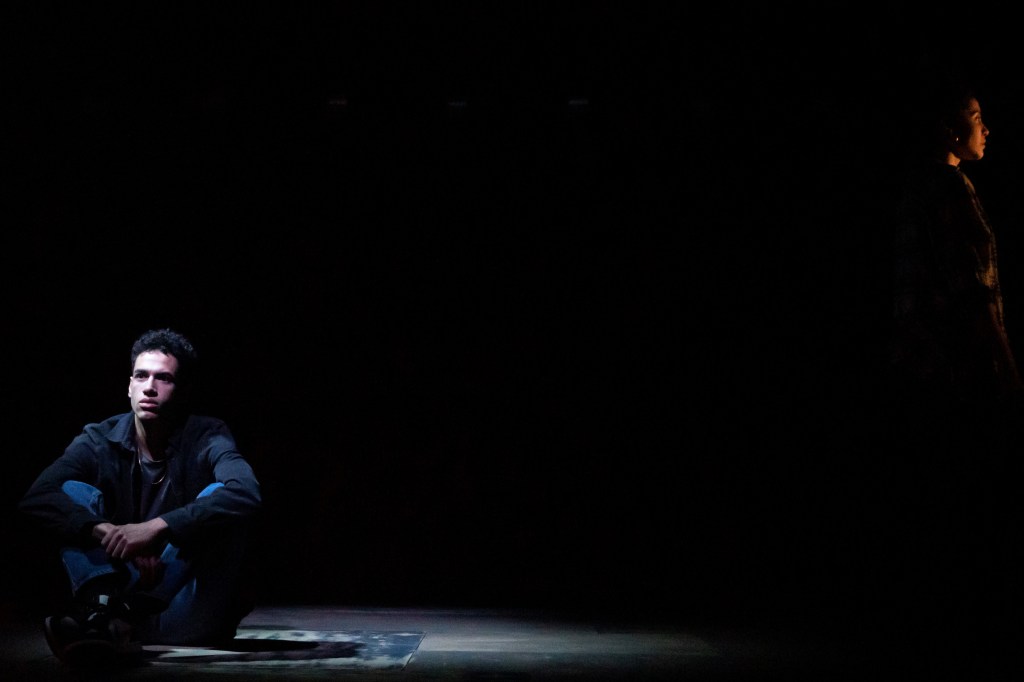
What happened to “G” and “B’s” compact, their relationship, their closeness? Majok presents the stark themes. Immigrants and illegal aliens are compelled by political forces to behave in ways counter to their altruistic good will and sense of decency. Of course, this doesn’t just pertain to those trying for citizenship. It doubly applies to citizens who have become mentally and emotionally inert and are inured to the sensitivities of others because they are weighted down by materialism and consumerism. In other words, they having forgotten “where they came from.” Ironically, the country then, no longer becomes a sanctuary, but a prison that has sucked their life force dry.
These themes are only a few of those that Majok covers in this play of antitheses: of connection and isolation, of compromise and extremism, of fear and hope, of dislocation and community, of alienation and unity.
Through various administrations, we’ve closed our borders following the need of politicians to use immigration and immigrants as playthings to boogeymen citizens and grow their political power base. Sanctuary City shines a unique light on the PTSD that arises for those who want a better life and are willing to risk their substance to dream big and/or help others who are lost in limbo between citizenship and deportation; those who wait for the light of deliverance. Majok’s writing is poetic and austere with the rhythms of immigrants’ and aliens’ voices and silences.
Kudos to the technical team that melded the elements lighting, sound, stage design, etc., to reflect the themes and sync them with the beautiful movement, and symbolism staged and directed by Frecknall. Her acute talents exceptional and show insight, precision and intuition.. If you can get down to Lucille Lortel Theatre to see Sanctuary City before it closes this weekend. you will be happy you did. For tickets and times go to their website. https://www.nytw.org/show/sanctuary-city/
 CAROLE DI TOSTI