Blog Archives
‘Our Town’ Starring Jim Parsons, Katie Holmes, Richard Thomas in a Superb, Highly Current Revival

Part of the magic of Thornton Wilder’s Our Town is its great simplicity. In Jim Parsons’ (Stage Manager), facile, relaxed, direct addresses to the audience lie the profound themes and templates of our lives. The revival of Our Town directed by Kenny Leon with a glittering cast of renowned film, TV and stage actors, reinforces the currency and vitality of Wilder’s focus on human lives, and the seconds, minutes, hours and days human beings strike fire then are extinguished forever, eventually forgotten as the universe spins away from itself. A play about the cosmic journey of stars and their particle parts in human form in a small representational town on earth, Our Town is iconic. Leon’s iteration of this must see production runs at the Ethel Barrymore Theater until January 19th.
The three act play is in its fifth Broadway revival since the play premiered in the 1930s. This most quintessential of American plays appeared on Broadway when the United States was in the tail end of the Depression during a period of isolationism, and concepts about Eugenics from American researchers had been adopted by the Third Reich to effect their legal platform for genocide. At a curious turning point in American history before a conflict to come, Wilder’s work about life and death in small town Grovers Corners in the fiercely independent state of New Hampshire represented a symbolic microcosm of life everywhere. Perhaps, the play’s themes, especially in the third act were a harbinger, and a warning. In its theme, “we must appreciate life with every breath,” was prescient because WWII was coming to remove millions in a devastation that was incalculable, noted by many as the “deadliest conflict in human history.”

Despite its stark ending and in your face “memento mori,” Wilder’s play found and finds an appreciative audience because of its universality and unabashed assertions about our mortality, walking unconsciousness, and refusal to remain “awake” to the preciousness of our lives.
Indeed, the play has continued to be widely read and performed globally in commercial theater, as well as educational institutions. Leon’s production is no less riveting than other revivals and is even more elucidating and vital in its stylistic dramatic urgency. This is especially so at this point in time, at the eve of a crucial period in our body politic, when we are deciding between two pathways. Do we want to continue to uphold the inexorable verities expressed in Wilder’s themes about living with as much equanimity as possible in a democratic nation that respects the peaceful transfer of power as Grovers Corners symbolizes in Leon’s production? Or do we jettison the rule of law, and the peaceful transfer of power in the US Constitution for a dictatorship in which not all lives are equal or valuable but one life must be bowed down to unequivocally?
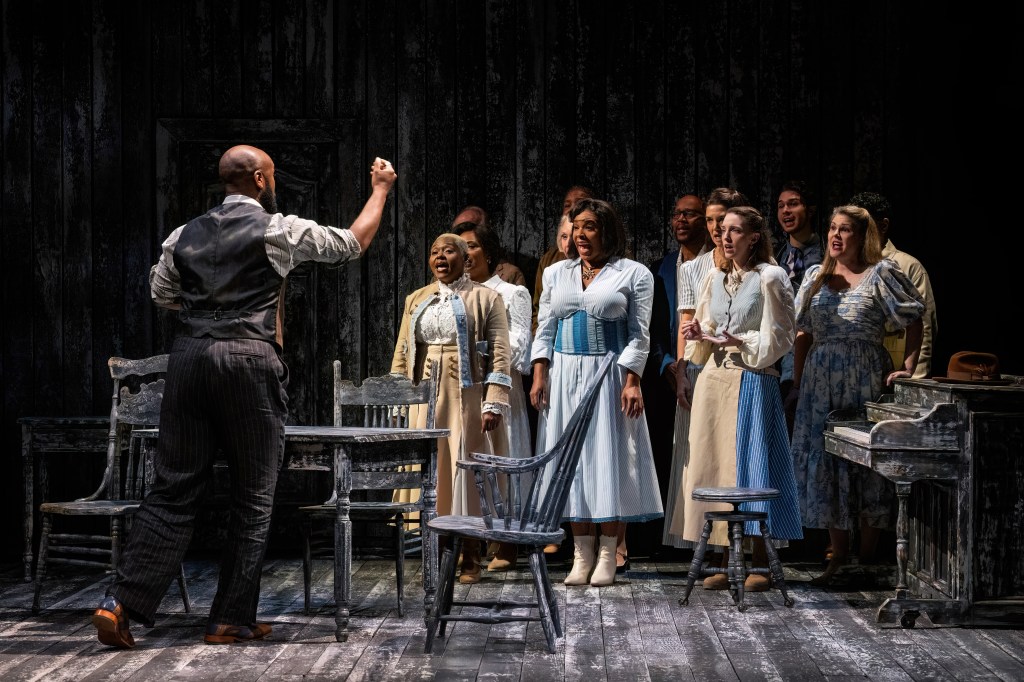
Leon’s direction stands in with the former, primarily in the production’s inclusiveness of a diverse group of actors representing Grover’s Corner’s accepting, and non judgmental townsfolk as they go about their business. The business of being human, Wilder divides into three segments (Daily Life, Love and Marriage, Death). Through the omnipotent Stage Manager, which Jim Parsons portrays with a low-key, pleasant avuncular and philosophical style, we quiver at his ironic, pointed rendering of life on this planet.
At the top of the play, the brisk, time-conscious stage manager, after detailing the ancient geological foundation of Grovers Corners, introduces us to the two families which Wilder highlights throughout the play to note their arc of development. Doc Gibbs (Billy Eugene Jones), the local physician, and Mr. Webb (Richard Thomas), the editor of the Sentinel are neighbors. At the turn of the century their wives, like most married women of the time, stay at home, do the housework and prepare meals, none of which is relieved by modern mechanical devices. We learn Mrs. Gibbs (MIchelle Wilson), and Mrs. Webb (Katie Holmes), “vote indirect,” which is to say women are considered incapable of making a rational voting decision.

However, the Stage Manager’s two words hold more weight than he seemingly intends to give them. Instead, he glides by the import of sociopolitical trends because it is unrelated to the cosmic picture alluded to by Rebecca Gibbs (Safiya Kaijya Harris), at the end of Act I. Indeed, the universal themes Wilder drives at do not focus on specific political details. Wisely, Leon takes his cues from the script having Parson’s Manager speak about the titles of the acts as dispassionately and unnuanced as possible. Importantly, Leon “gets” that the functioning of the town, symbolically rendered and opaquely stylized is how Wilder achieves the ultimate impact of the powerful conclusion about appreciating life each day we live it, as insignificant and boring as it may seem at times.
After we meet the children at a breakfast prepared by Mrs. Gibbs and Mrs. Webb via pantomime, the Stage Manager provides the locations of key places like the Post Office, the newspaper office, etc., and reminds us of the town routines, i.e. the train’s arrival and departure, milk and paper deliveries, etc. In the another part of the act, we meet the children who get hooked up in Act II, George Gibbs (Ephraim Sykes), and Emily Webb (Zoey Deutch).
Also, clarified is the town “problem,” Simon Stimpson (Donald Webber, Jr.), who we meet as the play opens when Simon Stimpson conducts the choir in a lovely song. Stimpson becomes the subject of gossip because choir members know he drinks and is drunk a good deal of the time. Mrs. Soames (Julie Halston) gossips about Stimpson and is hushed up by Mrs Gibbs, who tells a little white lie that Stimpson is getting better, then later tells her husband he is getting worse. Webber, Jr. is masterful in the small part. Clues are given about Stimpson’s future, as the character is referred by townspeople in Act I, with some questioning and not knowing “how that’ll end.” Eventually, the Stage Manager shows us how it “ends,” in Act III with Stimpson commenting about life and Mrs. Gibbs responding to him. Whose view should we accept? It, like this production, is open to interpretation.

Three years pass between Act I and Act II, and Parson’s Manager officiates at the marriage between Emily Webb and George Webb, after showing the event which reveals that these two individuals are special and their relationship which is “interesting” is grounded in being truthful to one another. The marriage scene which has been a bit tweaked and slimmed down from the original play, does include the Stage Manager philosophically discussing marriage and particularly George and Emily’s marriage when he says, in part, that he has married over two hundred couples and continues, “Do I believe in it? I don’t know. Once in a thousand times it’s interesting.” Again, we realize the profound comment and question what “interesting,” means.
In the last act which the production speeds to with no intermission as it clocks in at a spare one hour and forty-five minutes, Wilder’s vaguely spiritual metaphors are touching and poignant, despite the production’s bare bones lack of sentimentality. Warning, here is the spoiler, so don’t read the rest of the review if you are unfamiliar with Our Town.
Wilder’s third act resonates with symbols of death, as “the Dead” sit together on chairs as Parson’s unemotional Stage Manager describes the hillside cemetery. Importantly, the lack of Parsons’ emotion stirs the audience deeply. And in Leon’s production, the stylization in the previous acts makes the power of Emily’s return to see and live through her 12th birthday even more potent. Newly dead in childbirth, the Stage Manager gives Emily the privilege, which he says all the dead have, to return to a day in her life to relive it. The morning of her birthday, Emily watches herself, symbolically live without the realization that she will be dead in less than two decades later.

After commenting at how young her parents look and recognizing their love and affection, her pain at her obliviousness to life’s beauty overcomes her and she wants to leave to go back to the cemetery, a lovely spot where her brother Wally, Mrs. Gibbs, Simon Stimpson and Mrs. Soames wait for “something to come out clear.”
Emily’s dialogue is breathtaking and Deutch gets through it with less emotion and passion than is probably required for the audience to feel the reality of her words. “So all that was going on, and we never noticed.” And perhaps more emotion is needed as Emily asks the Stage Manager, “Do any human beings ever realize life while they live it? – every, every minute?” The audience in shock silently answers for itself as the Stage Manager responds.
This is the cruel and truthful heart of the play, especially experiencing it through the character of Emily and the Stage Manager’s comforting but remote words which somehow fall ironically when Parsons says, “No. The saints and poets,maybe – they do some.” However, only in death does Emily realize the suffering pain of not appreciating and being grateful for every fabulous, wondrous moment of life.
Certainly, Wilder needs to hit his audience over the head, and they walk out silently receiving the message, then days later forget it. However, for the moments when Leon, Parsons, the cast and the superb and lovely lighting and staging hold us, we “get it.” And we are grateful for teachable moments received through the actors’ fine efforts, the creative team’s craft and Leon’s minimalist stylization. And we appreciate the rich fullness of each gesture, word and grace delivered to make us get in touch with ourselves in our own Grovers Corners’ life.
Kudos to all involved in this magical production. Thornton Wilder’s Our Town runs one hour forty-five minutes without an intermission at the Ethel Barrymore Theatre (243 West 47th Street). https://www.ourtownbroadway.com/?gad_source=1&gclsrc=ds
‘The Great Society,’ by Robert Schenkkan, Starring Brian Cox, Richard Thomas, A Triumphant Reminder of an Adult President
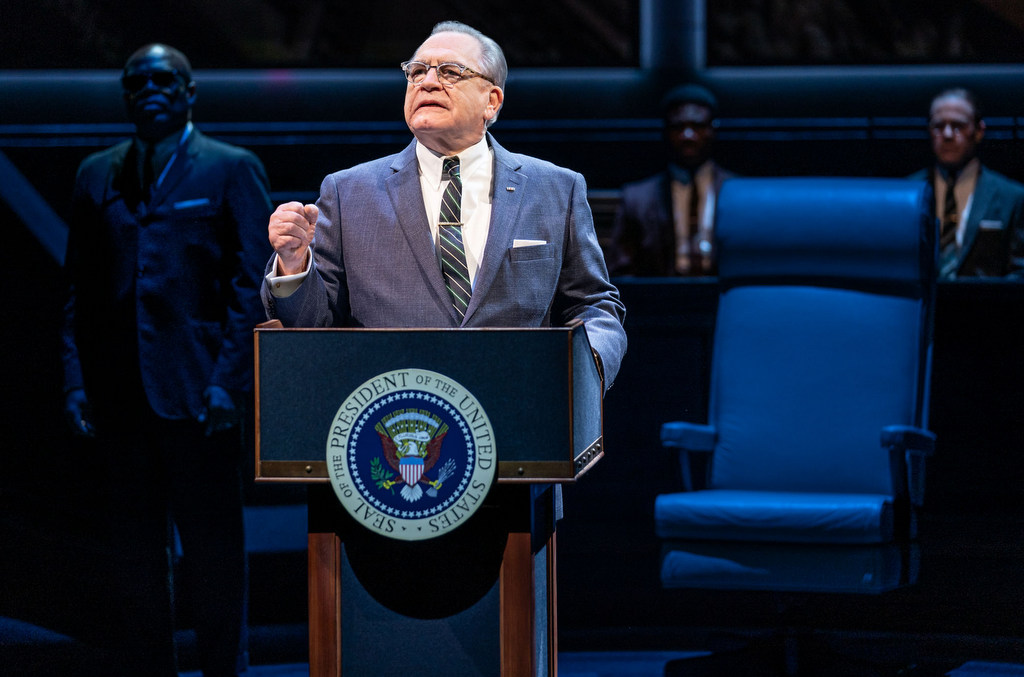
Brian Cox in ‘The Great Society,’ by Robert Schenkkan, directed by Bill Rauch (Evan Zimmerman for MurphyMade)
Lyndon Baines Johnson became president in a landslide vote in 1964. The wheeler dealer of the senate as Democratic Majority leader who could count votes and get bills passed, came from a hard scrabble childhood. He witnessed his father devastated by broken dreams. But President Johnson despite his crude ways, ferocious wit and uber competitiveness had the people of the nation at heart. Cramped and curtained as President Kennedy’s poor ‘ole boy, shunt ’em to the side Vice President, taking the reins of power after Kennedy’s death in 1963, President Johnson accomplished the impossible. He did what Kennedy hoped to do but couldn’t; he got the Civil Rights Act of 1964 passed.
In Robert Schenkkan’s Tony Award winning All The Way, LBJ is a man of destiny and reckoning. Played by Bryan Cranston who won the Tony Award for Best Actor in a Play, we follow the 36th president through passage of that iconic Civil Rights Act to his election campaigning. It was an amazing journey considering the obstacles of bigotry, racism and the obstructions by the Southern Democrats. Schenkkan’s play concludes with Johnson riding high on his success of the Civil Rights Triumph and his election win as the full term 36th president of the United States.
Directed by Bill Rauch who helmed All the Way, Schenkkan’s sequel, The Great Society is equally majestic in its revelations about Johnson as one who greatly desired to bring Franklin Roosevelt’s ideas of a more prosperous nation into being. With Johnson this was an obsession which Brian Cox realizes authoritatively and sensitively. As Cox’s Johnson lays out the policies of “the great society,” Schenkkan includes quotes from Johnson’s speeches where he affirms the principles of the constitution regarding economic equality, voting rights and other essential American freedoms.
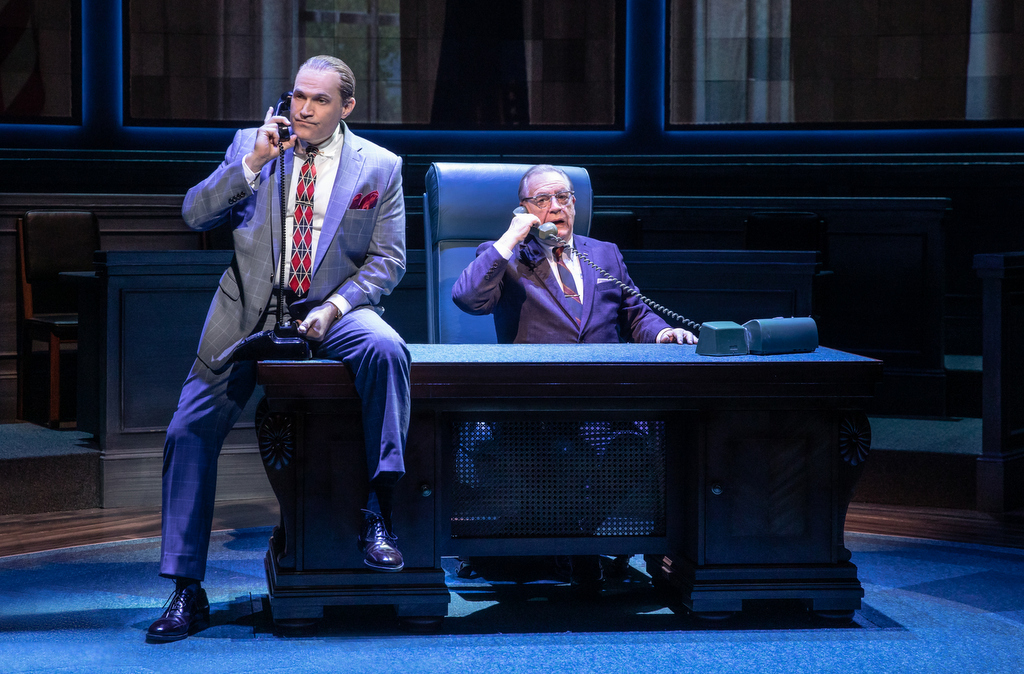
(L to R): Marc Kudisch, Brian Cox in ‘The Great Society,’ by Richard Schenkkan, directed by Bill Rauch (Evan Zimmerman for MurphyMade)
What a joy to hear Cox’s superb delivery of Johnson’s own words. This is especially so in our time when the current president has laid siege to our election freedoms, demeaned freedoms guaranteed by the Bill of Rights and abrogated checks and balances with monarchic pronouncements and behaviors that as president, he can do “anything he wants,” and lift “presidential” criminality to new heights with impunity and the assistance of William Barr head of the Department of Justice. In The Great Society, the portrayal of Cox’ Johnson is a poignant reminder that there was a time in our history, when consensus between Republicans and Democrats could be reached. The play reminds us that Johnson knew how to compromise and work toward legislation that would improve the lives of American citizens. Above all he was an adult, he cared about those who were economically disadvantaged, he loathed racism, yet understood how to get his opponents on his side.
The arc of the play’s development chronicles Johnson’s four year term during which the country roiled with upheavals and protests that represented the raging tide of times. Schenkkan unfolds events from the mountaintop of Johnson’s win to his struggles through passage and implementation of the Voting Rights Act. Schenkkan reveals Johnson’s relationships with Civil Rights leaders from Ralph Abernathy to Stokley Carmichael to Martin Luther King Jr. to conflicts with Robert Kennedy and Governor George Wallace.
The actors who portray these celebrated individuals do an excellent job. Most acute and colorful in the development of their relationships with Cox’s Johnson are Grantham Coleman as Reverend Martin Luther King Jr. and Marchant Davis as Stokely Carmichael. Some of the most dynamic segments of the play are Johnson’s confrontations with Martin Luther King Jr. and the other iconic black activists to insure that blacks would be able to register and vote without being lynched or beaten. Dynamic arguments with all the important high stakes players move like a riptide as Johnson negotiates and spars with Martin Luther King Jr. (Grantham Coleman) Stokely Carmichael (Marchant Davis) Governor George Wallace (David Garrison) Robert Kennedy (Bryce Pinkham) Senator Everett Dirksen (Frank Wood) Richard J. Daley-Mayor of Chicago (Marc Kudisch )and others. Often at his side is Hubert Humphrey (the fine Richard Thomas) who serves as a counsel to him and could be looked upon loosely as his friend, a generosity not given to Johnson by the Kennedys when he was Vice President.
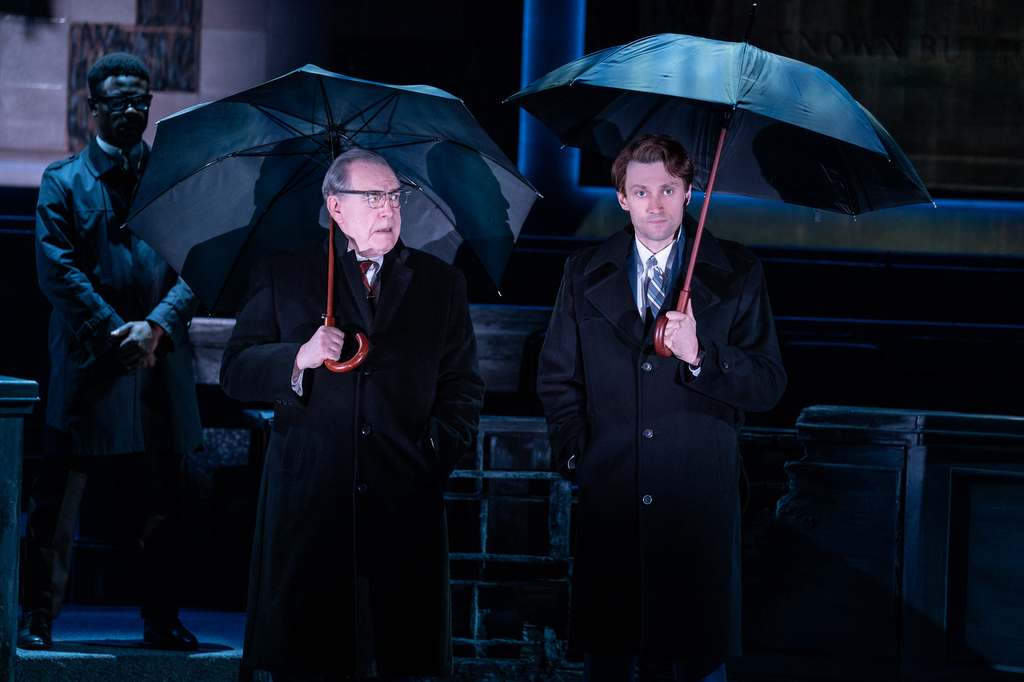
(L to R): Brian Cox, Bryce Pinkham in ‘The Great Society,’ by Richard Schenkkan, directed by Bill Rauch (Evan Zimmerman for MurphyMade)
Identifying searing events, (via video projections and archived photos, the “Bloody Sunday” march on Selma, Alabama, “Turnaround Tuesday” march, the march from Selma to Montgomery, Alabama, the Chicago protests, the Watts riots, etc.) Schenkkan reveals how Johnson attempted to balance all the invested players and handle the black – white unrest. With the Watts riots, he eventually brought in the California National Guard.
Brian Cox demonstrates Johnson’s forcefulness, vigor, passion and rationality with regard to his positions on civil rights and with regard to bringing in key influencers for other programs, like Dr. James Z. Appel (Marc Kudisch) head of the American Medical Association. Under Johnson’s term, medicare and medicaid were created and passed into law.
Interesting are his exchanges with Robert Kennedy portrayed with privileged aloofness and irony by Bryce Pinkham. The tensions between them are obvious and stem back from Johnson’s Vice Presidency. When Johnson is not surprised that Kennedy is looking to run in 1968, we understand his humorous reaction to that news. Kennedy uses Johnson as his bête noire on the war to gather support for his platform and candidacy. It is an ironic moment considering his brother was the first to send troops over to Viet Nam. The irony of this and horror of the Robert Kennedy assassination is shown representational style; Johnson’s reaction is telling.
If Johnson’s greatness as a president was in the passage of forward legislation to improve all of the citizens’ lives, Schennkan reveals the greatness is undone by his “Waterloo,” the Viet Nam War. Based on reports from Secretary of Defense Robert McNamara (Matthew Rauch) and head of U.S. forces in Viet Nam General William Westmoreland (Bryan Dykstra) Cox as Johnson shows the president’s mettle as he wrangles with the notion that the war will stop the spread of communism. Listening to them, he escalates troop deployments and engages in the bombing of North Viet Nam. These are steps on the road to the nation’s infamy.
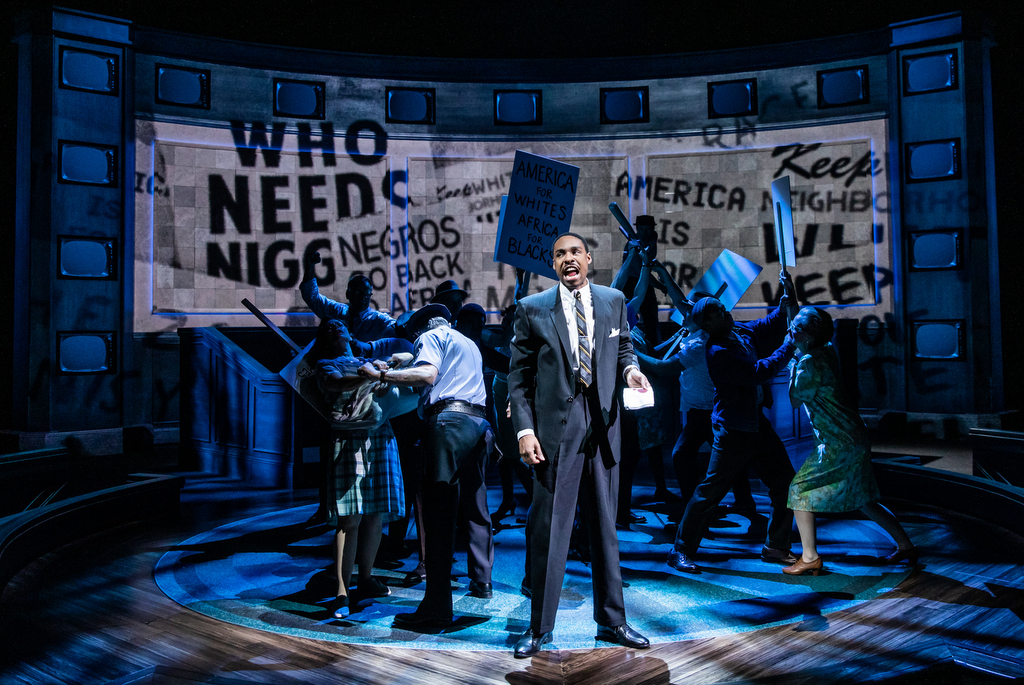
Grantham Coleman and company in ‘The Great Society,’ by Robert Schenkkan, directed by Bill Rauch (Evan Zimmerman for MurphyMade)
On a backdrop projection periodically listed are the ever increasing numbers of American dead and wounded. Indeed, as Johnson battles the two main issues of the day, civil rights and the war, we note that he, himself, is fighting his own war with himself whether more bloodshed will be useful or a travesty. We hear the rationale for escalation as we note the figures expand and rise up as protestors march and individual protestors represented by Quaker minister Norman Morrison (David Garrison) immolate themselves. (Buddhist monks also set themselves on fire to protest the war).
For those unfamiliar with this time in history, Schenkkan relays events with meticulous and accurate detail. Clearly, he identifies the seminal themes and concepts from which we still feel the impact today evidenced by the numbers of homeless Vets and suicides from that generation. We shudder as we witness Cox as Johnson be persuaded by Secretary of Defense Robert McNamara and General William Westmoreland knowing the numbers will continue to rise and behind each number is a family in mourning. Letters Johnson writes to families in condolence become a devastating scene. Schenkkan evidences Johnson’s turmoil which ironically reflects the growing divisiveness in the country. Money spent on the war and defense contractors could have been spent on his social programs which must be curtailed to make the budget. Johnson is stuck between a rock and a hard place with nowhere to go but the abyss, Schenkkan reveals.
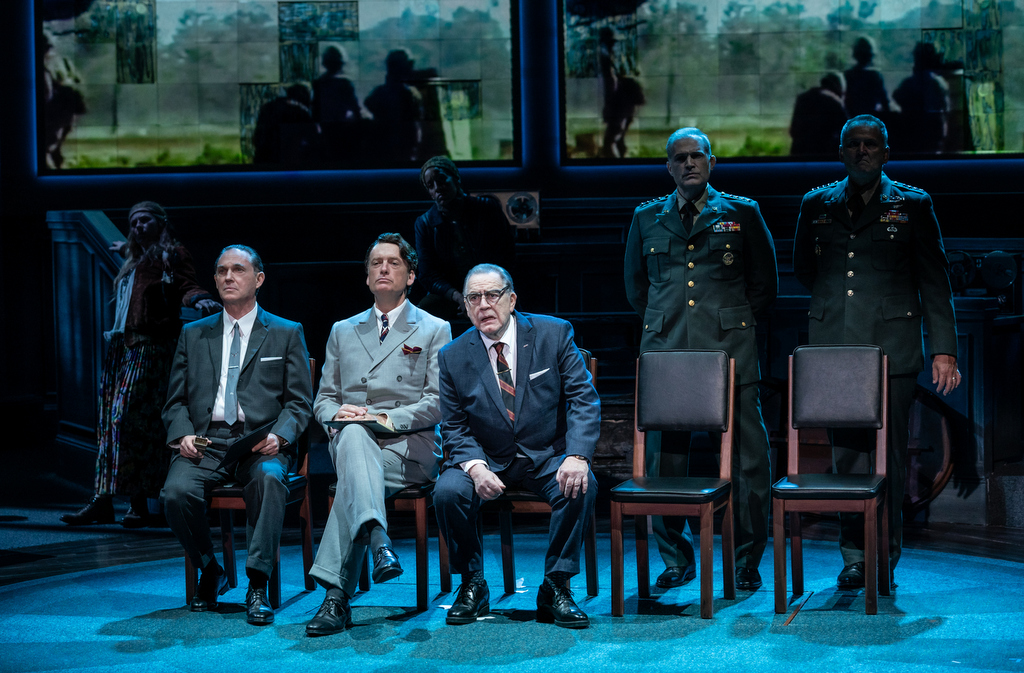
(L to R): Angela Pierce, Richard Thomas Frank Wood, Robyn Kerr, Brian Cox, Marc Kudisch, Brian Dykstra in ‘The Great Society,’ by Robert Schenkkan, directed by Bill Rauch (Evan Zimmerman for MurphyMade)
An important feature of this production is in how the playwright and the director and ensemble coalesce our history with salient, acute representational actions that become a mentorship in what an adult president can be like. This reminds us of what we do not have today. Cox’s Johnson reveals a president who had the temerity not to seek re-election but wanted to extract himself from the rat wheel of the killing fields of Southeast Asia during a horror that fomented protests, divided his country and party. And it was particularly grating for him to hear college students’ chants, “Hey, Johnson what do ya say, how many kids did you kill today?”The words hit home because he knew they were true. He bore up under it badly remembering a time when he was popular and not despised.
Rather that to be elected for four more years, which he would have won, he stops and hands the opportunity to Hubert Humphrey. We laugh at his humor and the irony of what happened next: Richard Nixon (played by David Garrison). A key point in this production, look for it, reveals Nixon’s hunger for the presidency so that he put himself before the country and our soldiers. Treasonously, deceitfully Nixon upended the ongoing negotiations for peace with North Viet Nam by making an arrangement that peace would be accomplished after he got in office. Cox’s Johnson ironically nails him for this when Nixon comes in to assert himself in the Oval Office, even before he is inaugurated. The parallel to today in how the Trumpists were making quid pro quo deals even before they took the reins of power is clear.
When Johnson stated he would not run again and posed the reasons, what many believed would be better for the country, actually was worse, especially since Nixon stalled the peace negotiations with North Viet Nam, something that Johnson had believed in throughout his bombing policy. But a worse than Johnson took office and the implication in the play is that Johnson knew this as Cox portrays ironically when Nixon comes to visit before the transfer of power. In one of the most dramatic scenes Cox pulls out all stops to deliver Johnson’s ringing words: “I do not believe that I should devote an hour or a day of my time to any personal partisan causes. . . . Accordingly, I shall not seek, and I will not accept, the nomination of my party for another term as your President.” The ramifications of this in Nixon getting in, the country has paid for ever since.
Interestingly, Schekkan, Rauch, Cox and the ensemble reinforce American values, exemplified by what Johnson attempted in his plan for “the great society.” These values which Johnson fought hard to uphold against those like Governor George Wallace, Southern Democrats and Southern law enforcement whose bigotry Johnson understood, countermanded, and decried, become reinforced as the gold standard of the nation. Johnson was capable of dialogue with those who disagreed with him. And he was capable of bringing them to his side to realize and bring us closer to the tenets of the constitution and a “more perfect union,” if even for a time until the war upended the fullness of his efforts. The production uplifts these characteristics of Johnson as a patriotic American. And it indelibly reinforces this greatness as that which we must embrace if we are to define ourselves as a nation of equal opportunity for all.
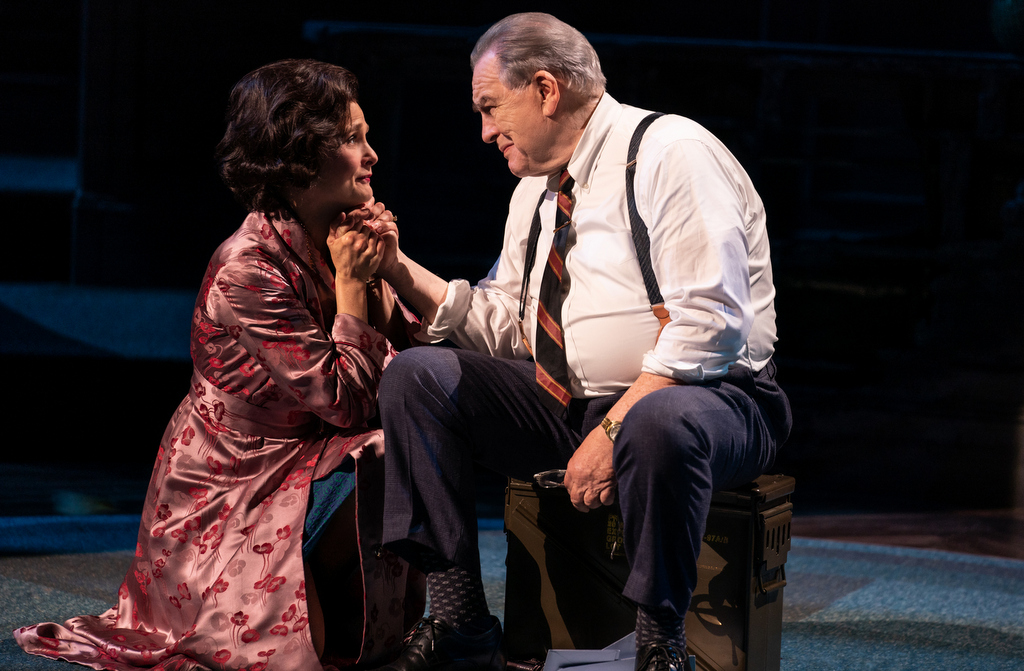
Barbara Garrick, Brian Cox, ‘The Great Society,’ by Robert Schenkkan, directed by Bill Rauch (Evan Zimmerman for MurphyMade)
Finally, The Great Society has special import for us because what Johnson attempted was actually supported in a bi-partisan effort. Johnson not only looked out for the well being of the poor and the uneducated regardless of race or creed, he had the negotiating power and skill to bring his dreams into reality. He understood congress, and with his landslide victory, was able to bring many liberal Democrats with him to establish a foundation by which his social programs could be instituted and funded. He declared a “war on poverty” and attempted to eliminate institutional racial injustice. If not for the vicissitudes of the Viet Nam War, who knows what else may have been accomplished?
With passion, ingeniousness determination and sociability, Johnson attempted the impossible and managed to push through the most sweeping civil rights legislation and other legislation that benefited whole swaths of the nation which are still in practice today though Republican white supremacists continue to erode the Voting Rights Act with gerrymandering and strictures at polling places.
Cox authentically portrays Johnson with grace, humor, vitality and power. His masterful performance is an illumination which we need especially now.
The sum total of the benefits the 36th president brought to this nation (including the 25th Amendment) is laudatory. He also was driven into a war from which it has been impossible to recover. For that and other reasons he did not want to continue as president. Again, admirable. Importantly, the play reminds us that presidents and politicians do have the ability to stand for all of the people and to push for equal opportunity for the betterment of the general good. That used to be a value of this nation, a sign of patriotism, Americanism, something to strive for. How this current administration has strayed from those values with the help of the Trumpists and big money is earth-shattering. Schenkkan’s The Great Society is a warning we must not allow this erosion of democracy to continue.
The theme of this production is an imperative, and uplifting for us in these times. For this reason, the portrayals, the historical details and the crafting of events, Schenkkan’s portrayal of Johnson, beautifully delivered by Cox as a president of cultural hope and justice is a must see.
Special kudos to the design team. The projections, the archived photos and videos were well done. the scenic design melded well with the lighting. As for the costume design, yes, that is really how folks dressed! Notice, no red ties. Calling out: David Korins (scenic design) Linda Cho (costume design) David Weiner (lighting design) Victoria Sagady (projection design) Paul James Prendergast and Marc Salzbert (sound design) Paul James Prendergast (music).
The Great Society runs with one intermission at the Vivian Beaumont Theater Lincoln Center until 30th of November. For tickets and times CLICK HERE.
 CAROLE DI TOSTI