Blog Archives
‘McNeal’ Robert Downey Jr. a Bravura Performance in a Complex Play
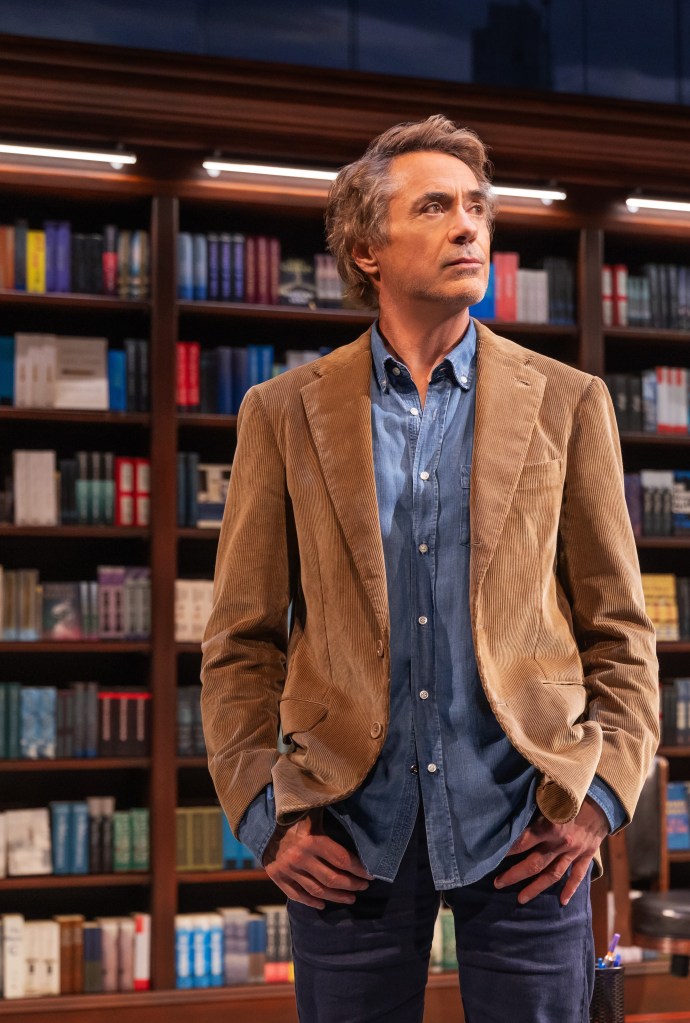
McNeal, starring Robert Downey, Jr., is currently at Lincoln Center’s Vivian Beaumont. The drama by Ayad Akhtar (Disgraced), directed by Bartlett Sher, has sardonic/comedic elements. Akhtar’s work examines the successful writer Jacob McNeal under extreme duress at the pinnacle and nadir of his career and life.
As the play opens in McNeal’s doctor’s office, Doctor Sahra Grewal (Ruthie Ann Miles), reminds McNeal his relapse into drinking is killing him. From this point on, we follow the principal character on his downward journey into the abyss, after he wins the Nobel Prize for Literature. Throughout, McNeal literally and symbolically dies piece by piece, brain cell by brain cell, deep fake digital projection by deep fake digital projection. Thanks to the technical team, the digital designs and projections pop phenomenally. Indeed, they place us in the bubble unreality of Jacob McNeal’s imagination, where emotional grist rarely resonates.
Ironically, the discipline it takes McNeal to win the Nobel Prize for literature, doesn’t apply when he attempts to control his alcoholism. Indeed, a conundrum of side effects from a drug slated to help him stop drinking himself to death makes his life untenable. Addicted, he continues to drink bringing on side effects which include hallucinations, pain and thoughts of suicide. As McNeal bounces between self-loathing and overweening pride, we follow him deep into the bowels of AI assisted writing. Ironically, this hazard removes him further from himself and serves as the last straw which figuratively breaks his back.
Akhtar/Sher present the glorious image of McNeal as prizewinner giving his speech at Stockholm City Hall using video, then having McNeal step forward in his tuxedo to speak to us, the Nobel audience. After this climax in his life comes the downhill crash. The playwright removes the soul of the prizewinner’s art and exposes the ugliness. Elucidated by the technical team’s sets and projections, McNeal’s mind-bending journey strikes us with wonder, thanks to Michael Yeargan, Jake Barton and AGBO. Finally, Downey Jr.’s keenly woven, provocative interactions with women enlighten us to McNeal’s deep-seated toxic masculinity and admitted feelings of inferiority.
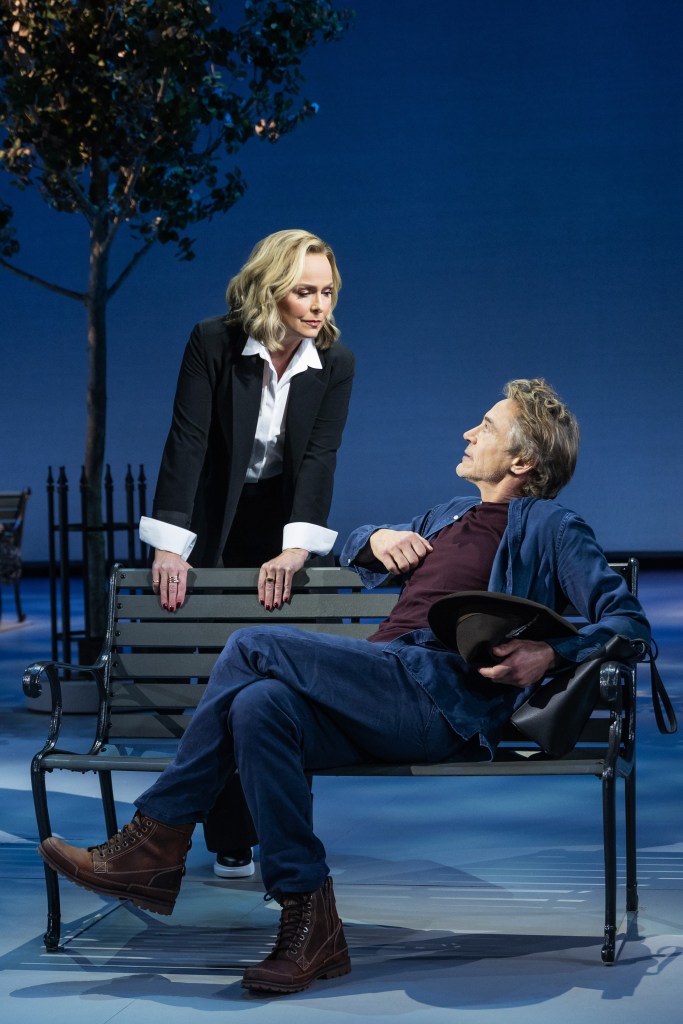
Throughout Akhtar’s interesting work, we experience McNeal’s calm, ironic self-annihilation. Numbly, we watch his digital-symbolic, self-destruction in front of witnesses/characters who don’t understand his destructive journey as they do battle with him. These include his son Harlan (Rafi Gavron), New York Times reporter, Natasha Brathwaite (Brittany Bellizeare), and his former mistress, Francine Blake (Melora Hardin). These are shadows of individuals without definition which McNeal, in a brain fog, uses to pick ax his soul. Will anything be left of him after he finishes?
With sardonic, arrogant aplomb, McNeal rationalizes and accepts himself as a fraud. During each of his interactions, he charmingly employs his antic self-loathing to dismantle himself and drive through to his core truth. Through Robert Downey, Jr.’s fine performance we understand McNeal’s disgust, his masochism and self-betrayal, masked by ego, charm and pride. McNeal may have fooled the world to give him a prestigious prize, but he knows better. He cannot fool himself. And what he seeks he eventually attains by the conclusion.
On top of McNeal’s neurotic struggle to “set things straight,” we learn in horror (the writers in the audience, anyway), about his penchant for writerly duplicity. Like a kleptomaniac (a writer’s klepto), addicted to theft, we learn through his confrontations that McNeal engaged self-destructively in plagiarism to achieve his success.
However, plagiarism increases his feelings of inferiority. And it promotes a twisted cycle of repetition. We learn through Harlan’s and Blake’s attacks that McNeal stole from his son’s friend, his wife’s bad novel, Francine Blake’s life, etc.). With these he creates his successful but basely unoriginal works. All of this occurs not without consequence. For he turns from his successes and belittles his creative talent. Ironically, the plagiarism reaches an apotheosis of fraud when he employs the inferior AI program CHAT GPT. Combined with his self-immolating interactions and the drug’s side effects, his use of the program pushes him over the edge. Jake Barton’s projections fantastically convey this as he vomits up stolen words projected on the stage floor.
Interestingly, we see how he employs CHAT GPT in an earlier sequence. Inputting literary works from Shakespeare, Ibsen, Kafka, Sophocles, Flaubert, etc., he examines concepts to explore. Then employs the program to convert these inputs to the style of Jacob McNeal. Each use of GHAT GPT increases his soul sickness.
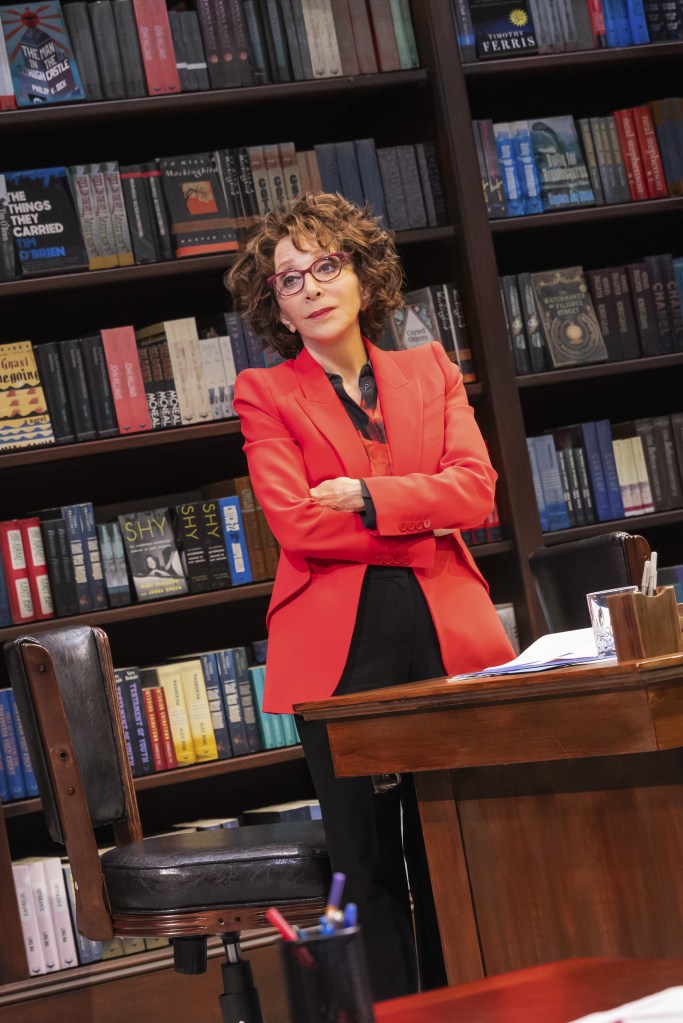
Sadly, with the exception of his doctor and his agent Stephie Banc, the always wonderful Andrea Martin, no one knows he’s dying. In a strange self-satisfaction he is comforted that the other characters, especially his son, find him as loathsome as he finds himself. Thus, they can offer little comfort which he wouldn’t accept anyway.
In the last scene, McNeal confides in his audience eloquently after striking layers of his fraudulent self against the sharp criticisms of his son, the reporter and Blake. Only then does he attempt to speak in his true voice. But once more, he applies AI, this last time inspired by Prospero in Shakespeare’s The Tempest. How can we trust his narrative? Does anyone reliably, truthfully relate their own story? Robert Downey, Jr. makes a convincing case for our straddling the fence of incredulity, then leaping into the last artifice with him.
Bartlett Sher’s integration of the digital imagery and projections to illuminate McNeal’s imagination and world is spot-on. Likewise, the ensemble, integral players in McNeal’s journey through self-torment, charges the play’s energy. Robert Downey Jr.’s sustained performance gives one pause and intrigues as Akhtar’s confounding character, McNeal.
Though the playwright uses AI as an object lesson and/or bête noire, more importantly, he reveals the kinds of writers who might employ it and why. Lastly, the tragedy becomes that McNeal separated himself from himself in alienation. AI also becomes a symbol or instrument of death, the death of creativity and originality, despite McNeal’s clever justifications for using it.
McNeal runs one hour forty minutes with no intermission at the Vivian Beaumont. It’s a pleasure to see Robert Downey Jr.’s superb performance. https://www.lct.org/shows/mcneal/
‘The Interview’ Controversy: A Chat With Hadrian Belove of Cinefamily
‘The Interview’ speaks for itself.
The media blitzkrieg surrounding The Interview appeared to be the finest hype any PR agency could fabricate. However, truth be told, the events of the last week were grounded in a frightening scenario: a foreign nation attempting to spread its hegemony of fear and repression with material threats. SONY was hacked and decided to pull the opening of the film on Christmas day fearing death, injury and litigious reprisal if bomb threats against theaters were realized as hackers said they would be. The rest is history. When smaller theaters showed their mettle and contacted SONY and after President Obama chided SONY, the company relented. Theaters screened The Interview as Google and others offered to support the film via streaming (thus far the film is SONY’s largest online earner).
Cinefamily a “non profit organization of movie lovers devoted to finding and presenting interesting and unusual programs” was waiting in the wings for a situation like the one The Interview and SONY presented. Founded in 2007 by brothers Dan and Sammy Harkham and Hadrian Belove of Cinefile Video, it is one of the few cinematiques (boutique cinemas), that clamored to screen The Interview. It’s midnight showing of The Interview was sold out and it was perhaps the premiere showing in the nation. Afterward, other theaters came on board.
I had an opportunity to speak to the current Executive Director of the Cinefamily, Hadrian Belove about the tumultuous events concerning The Interview events which have since quieted down.
Could you just tell me what it has been like the last couple of days with the screenings of The Interview?
It has been great. Attendance has been really solid and all the shows have been doing really well. The media circus has died down, so it’s just a very well done run at this point and we’ve had a lot of new people who have never come to the theater before which is nice.
When Seth Rogan and James Franco showed up, did you know they were coming?
James Franco didn’t come. It was Seth Rogan and Evan Goldberg, c0-directors of The Interview. And yes, we did know they were coming. They came twice. They came for the opening, the very first show and once the next day. They were touring on a bus to all the theaters showing The Interview to say “Hi,” to folks.
Did they introduce the film?
They introduced the film but didn’t stay for Q and As. They had a tight time line because they wanted to go to as many theaters as possible on Christmas. And on Christmas Eve our show was at 12:30 am. I think just coming out and saying “hello” was the main point. The movie didn’t end until like 3:00 am, so that was a lot.
I went to the theater in my area, a little theater that shows Indies. They were showing The Interview. The police were out front. They checked our bags and when I spoke to the employees, they said that they had received threats and that it was necessary to beef up the security.
We also did the bag checks. The police were kind enough to come every day that was Christmas Day and sort of hang out and come back. We did hire security for the opening. We did bring in professionals to make sure everybody felt safe and showing that we were doing due diligence.
Could you explain the mission of Cinefamily?
Cinefamily is a nonprofit cinematique. Part of its non profit mission is to revitalize the film going experience. We feel that exhibition has its own very special role in the health of the arts and movie going and that people should want to go to the movies. We feel that when you build a community, an audience for films, that is the best way to support the arts. So we show wild, weird, wonderful films from around the world. Overlooked, underrated, strange and beautiful things, but we put an equal emphasis in how we do it and how we cultivate our community. So the how we do it is everything from our membership system which lets people come for free so they can check out more shows to our added value events (for example Willem Dafoe stopped by on November 16 and spent an evening, discussing various and sundry about himself and his films). All of these things are carefully considered to try to create regulars, so that when we do show a film that we believe in, they listen to us. We also put an emphasis on the quality of the films we show…that every film is like a recommendation. While some nonprofits might emphasize diaspora or films they feel need to be seen, we always put it out there that we are making a promise to our audience and that we are going to deliver on our promise. For the long term, we think it’s best for the films. And there are a variety of other things like this. But our big success, you know the key ideas have been community, quality and range. And that has helped us show all kinds of movies and it’s been really great.
Love to see you expand to New York. But I can stream your films, right?
No (he laughs), but we’re working on it. Though we do think that what Cinefamily does could be appropriate online, it is really important that there is a brick and mortar location because it’s about getting people together as much as anything else.
I grew up in an age where I sat in a movie theater as a kid and I saw Lawrence of Arabia on a big screen. There’s nothing to compare with that. If I had to see All is Lost, I’d prefer to see that on a big screen rather than a mobile device, although the other is very useful, I have to say.
Well, both have their place and just are dependent upon one’s different needs.
So you’re telling me that the ticket sales are doing really well. How did you decide to show The Interview?
We decided to screen it because other theaters weren’t doing this. We felt that our mission is to support the arts. Freedom of speech is crucial as is artistic expression. Both would apply in this case. So we thought that this is a film that needed our support. As soon as we heard that other theaters weren’t going to show it, we put out the word that we wanted to. So that was pretty straightforward. And how we got it is part of the national story. We lobbied, we signed a petition along with the other art houses, we had friends of the theater write emails. These were supporters who we felt had some sway or leverage. We asked them to send direct emails to SONY on our behalf. These were guys like Phil Lord who directed the 21 Jump Street movie, or Evan Goldberg himself who co-directed The Interview, Hannah Minghella…these people sent emails on our behalf to SONY reps saying that this was an important theater for it to play at.
You know, it’s almost like this whole event was made for you guys.
(laughing) In some ways. One thing that is true is that part of our approach to the arts to keep people excited, is
that we have a big tent approach. We have a really broad range of what we call the arts. We’re very welcoming. It really wasn’t that unusual for us to show something like The Interview on the same calendar like obscure Danish documentaries or Tarkovsky films. That is very much the spirit upon which this place was founded…to not ghettoize different kinds of films, but to make it one big happy family.
Would you show a film like the Color of Pomegranites? I screened it at the New York Film Festival in its revival series and then reviewed it for Blogcritics.
I would. In fact we’ve been asking for it. I think over the holidays we’ve been having a difficult time hearing back from them, but we’re actually trying to book that film. Love it.
(December 5-8, Cinefamily held a retrospective called “Truth and Soul, Inc.: the films of Robert Downey, Sr.” Hosted variably by Robert Downey Sr. in conversation with his son, Robert Downey, Jr., Paul Thomas Anderson, Lewis C.K., with Alan Arkin also appearing, the selections included Chafed Elbows & Two Tons of Turquoise to Taos Tonight, Greaser’s Palace, Putney Swope to name a few.)
You held the Robert Downy retrospective showing his innovative, maverick work. Have you held other such retrospectives or film festivals?
We’ve done retrospectives and things like that. We’ve done small festivals. We just did an animation festival that we called “Animation Breakdown” that we put together in November. There’s the “Everything Is” festival which is kind of a found footage arts and comedy festival. The nature of the building we’re in, the size, to some extent limits us. But yeah, I would love to host and support and program film festivals as well. I love those and I think we’d be pretty darn good at it.
You show documentaries…
We love documentaries. Honestly, we’re probably the most wide-ranging cinema in the world. There is no genre or era we don’t touch. We’re all over the map. The only through line is what we think is awesome and great.
Conclusion
What is certainly a boon is that Cinefamily is bringing together film fans to experience the best that film has to offer. It is rather like taking advanced courses in cinema offering unusual and amazing cinematic experiences that join people together and offer a community to viewers of all ages and stripes. And let’s face it, The Interview was an unusual viewing experience.
This article first appeared on Blogcritics.
 CAROLE DI TOSTI