Blog Archives
‘Shit. Meet. Fan.’ Neil Patrick Harris, Debra Messing, Jane Krakowski in a Scatalogical Romp Through Coupledom

Shit. Meet. Fan.
It’s an intriguing title. Stepping into the audience seating area of the MCC Theater, what’s not to like? Clint Ramos’ scenic design sparkles as the audience gazes upon Eve (Jane Krakowski), and Rodger’s (Neil Patrick Harris), upscale condo in Dumbo, NYC, a shimmering spectacle of Manhattan lights twinkling in the distance, visible through windows on the second floor which includes a “must-have” telescope on an “elegant” terrace.
From the title Shit. Meet. Fan. to the conclusion, the production screams with sardonic hilarity. Thematically, playwright Robert O’Hara presents characters who exude the allure of security, prosperity, white privilege and “happiness,” conditions to be envied. Perhaps. However, as the evening unspools on this party night when three couples and odd-Black-man-out, Logan, (Tramell Tillman), gather and have their vicious fun, we note that prosperity without contentment, truth or happiness is anything but “all that.”

The shoe drops at the outset
The shoe drops immediately, as promised in the title, and we are startled into recognition that in the opening scene, “it” is hitting the fan, as mother Eve (Jane Krakowski), confronts daughter, Sam (Genevieve Hannelius), about a box of condoms she found that Sam glibly professes isn’t hers. Though the scene concludes with Mom’s peaceful concession and return of the box to her daughter, the screaming match which paves the daughter’s way to success, is revelatory. In their heated interaction, O’Hara, who also directs, discloses a “hip,” ribald mother and daughter, whose frank rants about having sex are “no big deal,” though mom appears to protest too much for 17 year-old-Sam’s liking.
From then on as the guests arrive, “it” grows more plentiful. The characters fan the room, drink, do cocaine and spray their increasingly toxic, chaotic, mind games and patter to the back row of the audience. By the conclusion the audience is “covered.” It is funny, but not necessarily what we’ve wished for during the 105 minute romp through a tragic waste of humanity. However, O’Hara wishes us to laugh at ourselves as much as at the characters. Their hypocrisy, toxic masculinity, feminine one-up-woman-ship, and misery may be ironically recognizable to those able to afford a ticket to this Off Broadway production.

O’Hara based Shit. Meet. Fan. on the popular 2016 Italian film Perfect Strangers
Based on the 2016 Italian film Perfect Strangers, by Paolo Genovese, in the similar development, Rodger and Eve have invited their couple friends to celebrate the eclipse. The bonds of friendship were formed in college when the four men were in the same fraternity and consider themselves “bros.” They are a hotbed of toxic masculinity, fitting all the stereotypes one loves to despise when they are “under the influence” of drugs and alcohol. The men are TV celebrity heavyweights. Besides Neil Patrick Harris, who is always spot-on in whatever role he acts, the superb actors include Brett (Garret Dillahunt), Frank (Michael Oberholtzer), and the aforementioned Tramell Tillman as Logan.
On the other hand the women are close, but ancillary to the key relationships in this comedy that has a number of thematic twists, especially in O’Hara’s version. Joining Jane Krakowski’s Eve and Genevieve Hannelius as Sam, there are Brett’s wife, Claire (Debra Messing) and Frank’s wife, Hannah (Constance Wu). All reveal comedic perfection. The women circle the wagons when attacked, questioned or prodded by their spouses whose vulgar, women-demeaning, objectifying tales and shared secrets, divide the party among gender lines.

As the eclipse presumably occurs the characters get wild and wooly
As the party progresses and the eclipse occurs, which is more symbolic than visualized since no one really watches, the teeth and nails sharpened for this occasion extend for the vicious “fun,” prompted by Eve. She suggests that they play a “game of phones,” and willfully violate each other’s privacy for each other’s amusement, by publicly reading or putting on speaker every phone text, email or call received for an hour during the evening. For one hour there are no secrets; all the dirty laundry is aired. As each unwillingly gives up their phones because no one protests, they put the “black boxes” that record their lives on a centrally located table ready for exposure and humiliation. After that, the drama and comedy intensifies.
The first to suffer the slings and arrows of shame in front of his “bros” is Frank when Rodger calls him from their unknown landline and breathes heavily into the phone. Hannah, newly married to Frank in the heat of their first year together, is ready to knife out his eye. But Rodger comes down the steps heavily breathing into the phone in a classically delivered, brilliantly funny, Neil Patrick Harris, dead pan moment. It is priceless and one of the biggest laughs in the first half of the production.

The “free-for-all” occurs after Logan receives a call
After that it becomes a free-for-all. Logan receives a phone call from his sister who insists humorously that he take her off speaker so those “white b%$ches” don’t hear “her business.” Censorship and political correctness cloaks are off; it’s expose time. Since there is no spoiler, you’ll just have to see the production to witness how each “bro” is delivered a blow and each spouse is found out to be doing numerous things other than being the sweet, loyal “wifey.”
Here are some clues. There are folks on the down low, alternate sexual preferences, affairs referenced by jewelry purchases, a proposal to throw mama in a nursing home behind sonny-boy’s back and more. O’Hara has pegged the jabbing one liners and jokes trippingly to the rapid-fire comedic rhythms which begin casually at an even pace, then pick up and race into the territory of high farce. Then, when the eclipse ends, all settles into normalcy as if nothing untoward, raw and menacing happened. Such is upscale life among the white privileged and two token persons of color. Oblivion after emergences of poisonous, festering wounds.
Meanwhile, we have the opportunity to peek into the illusions, lies and self-gaslighting of these peculiar and infantile minds that may not evolve beyond what we note as entertained watchers.
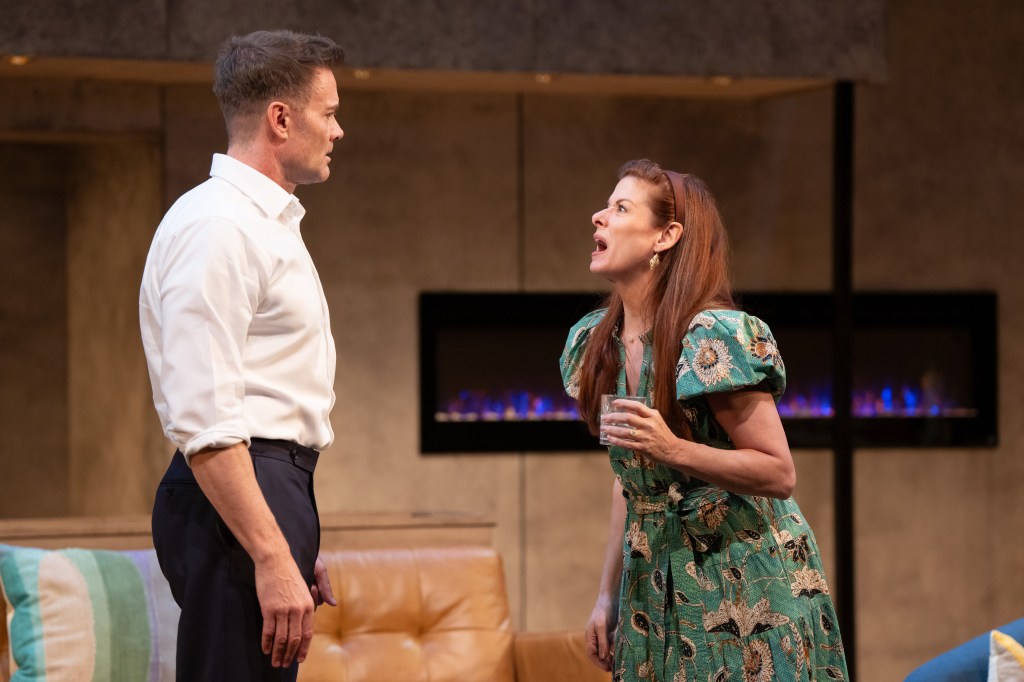
O’Hara portrays boorish, unlikable characters
Clearly, O’Hara finds these individuals boorish and craven, especially the white, toxic stereotypical males who make everywhere their preferred locker room, especially out of their wives earshot. The women are the fairer but not gentler sex. Together, we allow that this night of frolicking fun doesn’t happen often. If it did, there would be three divorces on the horizon except for one, perhaps, though Rodger loves his wife Eve, even if he dislikes who she is as they both contemplate divorce. Thematically, O’Hara proves that individuals choose the friends they deserve as they periodically are tortured and tormented by them under the guise of “fun and games” which are anything but.
O’Hara’s creative team in addition to Clint Ramos’ scenic design, includes Sarafina Bush’s costume design, Alex Jainchill’s lighting design, Palmer Hefferan’s sound design, and Cookie Jordan’s hair design. Each of these creatives assists O’Hara’s sardonic vision of these upper brow professionals in their one night of infantilism and terrorism of each other which is perhaps more well deserved than we know.
Shit. Meet. Fan. runs 1 hour forty-five minutes with no intermission at MCC Theater (511 West 52nd Street between 11th and 10th Avenue), until December 15th. See it for the celebrities who are glorious, as O’Hara intentionally tries the audience’s patience with their characters’ crass and vapid immaturity.
‘Raisin in the Sun,’ a Glorious, Triumphant Revival at the Public
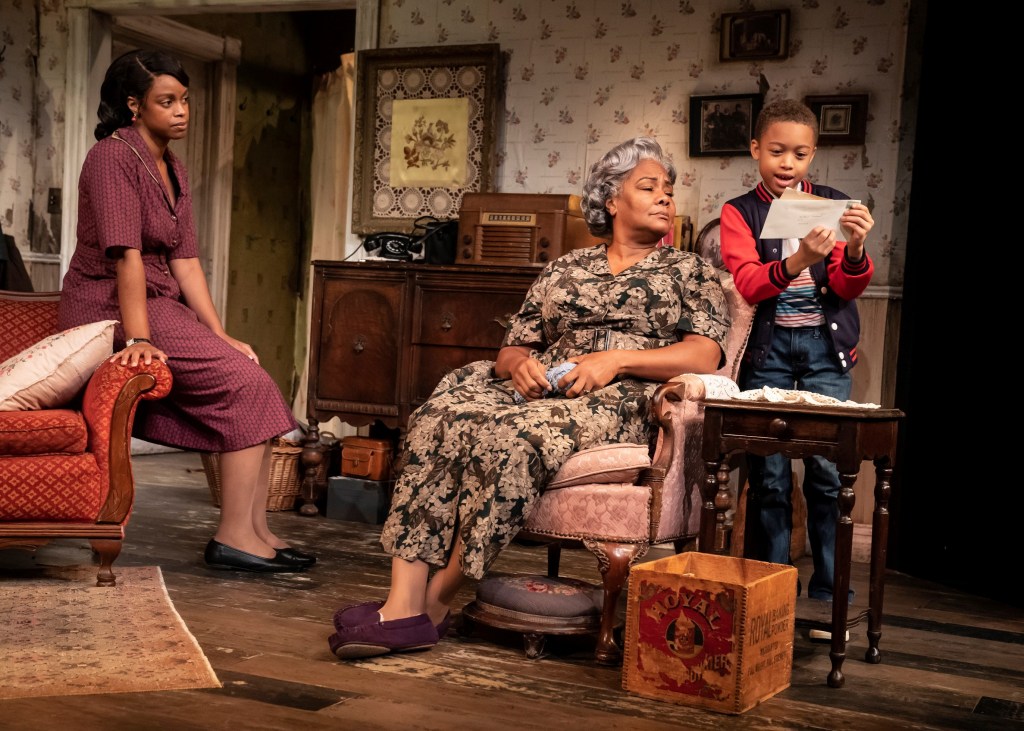
Raisin in the Sun by Lorraine Hansberry, aptly titled referencing the Langston Hughes’ poem, “A Dream Deferred,” is enjoying its fourth major New York City revival. It debuted on Broadway to great acclaim in 1959 and followed with two other Broadway showings in 2004 and in 2014 with Denzel Washington. Now at the Public Theater extended again until November 20th, director Robert O’Hara and the cast, led by Tonya Pinkins, prove that Raisin in the Sun is an immutable masterpiece. Its themes of discrimination, injustice, greed, family unity and love encompass all human experience.
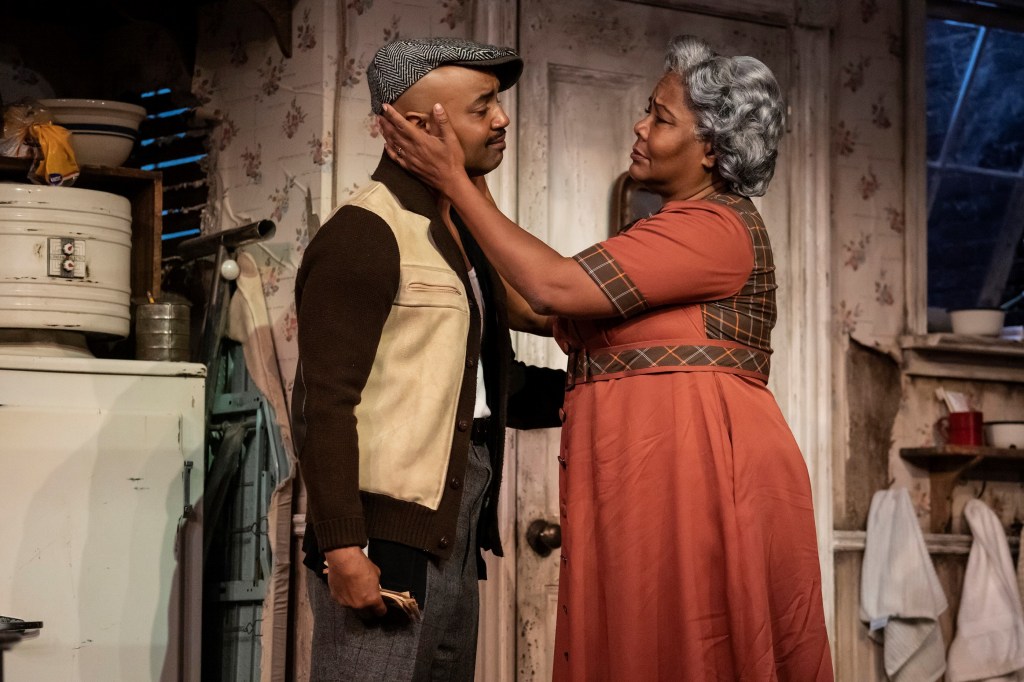
The heartfelt, moving, vibrant and electric production, which lives from moment to moment in joy, humor, sorrow, fury, wisdom and dignity, incisively honors Hansberry’s work in its showcase of Black Americans in this triumphant production. However, more than other revivals of Raisin in the Sun, this cast, creative team and director convert Hansberry’s work to the realm of timelessness. The production is an inspiration, an event of humanity which is incredibly relatable to all races, creeds and colors.
In its particularity the play is about the seminal Black experience in America during a shifting, revolutionary time of great economic and human rights change for African Americans in the 1950s. However, Hansberry’s thematic vision stretches beyond the microcosm. This magnificent play encapsulates the macrocosm with Hansberry’s genius characterizations, conflicts and themes in transcendent writing. For at its heart the play is universal in revealing the human desire to achieve, to evolve, to be empowered, to give voice to one’s soul cries for recognition, for equity, for prosperity.
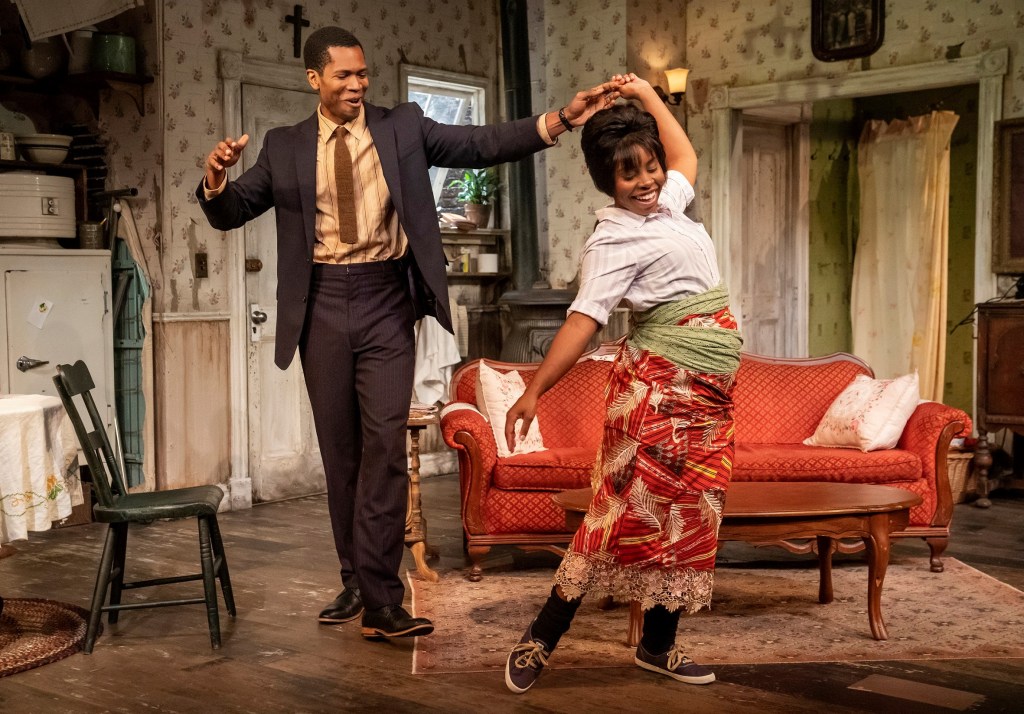
Made into two films, a musical, radio plays, a TV film and inspiring a cycle of three plays (Raisin in the Sun, Clybourne Park and Beneatha’s Place), Hansberry’s work is a classic not to be taken on lightly. However, Robert O’Hara, the cast and the creative team understand the great moment of Hansberry’s work for us today. With their incredible production at the Public, which opened October 25th, they have elucidated the heartbreak, fury, joy and beauty of Black experience as they portray how the Younger family struggles to find their place in a culture of racial oppression, stupidity and cruelty.
O’Hara’s version has additions which enhance the symbolism of Hansberry’s themes. Walter Lee Sr.’s presence materializes as a ghost (Calvin Dutton), who inhabits Lena’s thoughts and remembrances. His unobtrusive presence symbolizes Lena’s heart and love for their family. The insurance check represents the sum total of how the world credits Walter Lee Sr.’s life, an irony because for Lena, no amount of money is an equivalent to the worth of her husband. In fact the insurance check that rattles the household and puts stars in the eyes of Walter Lee Jr. (the amazing Francois Battiste), is blood money to Lena, a blasphemy that she doesn’t want to even touch when the mailman delivers it and she has Travis (Toussant Battiste), read off the number of zeros.

O’Hara’s staging is unique and vital, adding nuance and clarity to Hansberry’s dialogue and characterizations. Mindful of the play’s high-points, he stages the characters priming our focus to receive the full benefit of Hansberry’s message. This is especially so for Walter Lee’s inflammatory and raging monologue about “the takers and the taken,” in previous productions delivered to Lena, Beneatha (Paige Gilbert) and Ruth (Mandi Masden). In O’Hara’s version, Battiste’s Walter Lee stands in a spotlight and delivers the speech to the audience. It is mindblowing, reverential, brilliant, confrontational. More about this staging later.
The performances are authentic and spot-on fabulous. O’Hara’s direction is so pointed and “in-your-face,” the audience is invited to stand in the shoes of the Younger family, watching their trials with empathy. We feel for Masden’s Ruth when Lena confronts her about putting money down for an abortion. Her sobs of desperation at being driven to this because they can’t afford a child recall the past and now Republican states in the present. Considering the impact of the Supreme Court’s Dobbs decision, as a throwback to Ruth Younger’s seeking an illegal abortion, this moment in the play breaks one’s heart. Masden inhabits the character with somber beauty and layered emotion. When she must pull out the stops, sobbing her hopeless despair to Lena, she is spot-on believable.
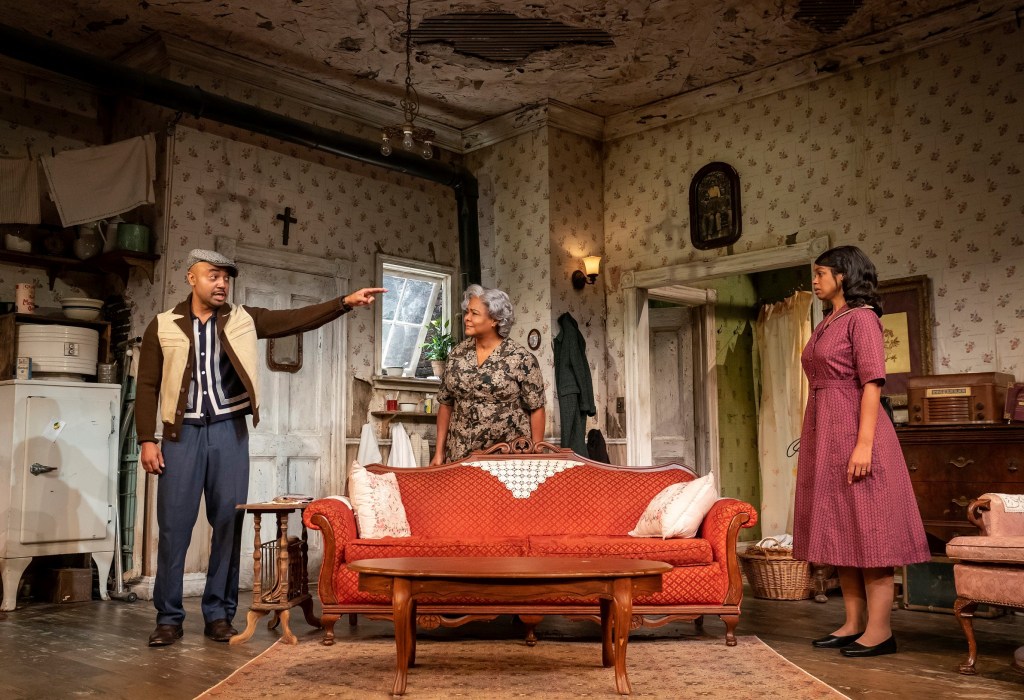
Likewise, as Gilbert’s Beneatha decides between two men and carps and riffs on brother Walter Lee, we understand she is caught between the old and the new. She represents transformation and is on the cusp of the new feminism. Accepting African influences prompted by her relationship with Joseph Asagai (the excellent John Clay III), she vies between being an assimilated Black woman for the sake of George Murchison (Mister Fitzgerald), and moving to embrace her ancestry. As the character of Beneath is the vehicle Hansberry provides with humor, Gilbert fine tunes her performance and is funny organically without pushing for laughs.

The ensemble work is seamless, showing prodigious effort as the actors live onstage. Thus, the audience cannot help but love and cheer on the family against Mr. Lindner (the excellent Jesse Pennington who reminded me of a quiet, quirky Klansman from the South, minus a Southern accent). Lindner’s assault on their dignity and chilling comment after he comes back a second time then says goodbye, in addition to his pejorative patting of Walter Lee on the shoulder as he leaves, combines all the self-satisfaction of one appointed to take a “message,” to the good “colored” folk to warn them away.
Most importantly, we grieve with them over the tragedy of Walter Lee (the incredible Francois Battiste), when his “friend” Willie absconds with the money Lena tells Walter to put in the bank. The tragedy is heightened by Tonya Pinkins’ fabulous performance as she cries out to the Lord to give her strength.

As Lena, Pinkins’ heaving call to the Lord is one for the ages. It is a dignified primal utterance which takes everything out of her, after which her hand shakes til the end of the play, for most probably, she suffered a mini stroke. In her fervency not to smash Walter Lee over the head, which he justly deserves, Lena must turn to God for help. Only He can give her the anointed love and patience to see her way through this family tragedy which threatens to swallow up her hope of moving from the “rattrap” ghetto apartment to Clybourne Park’s white neighborhood. Pinkins is riveting, her authenticity just stunning. I couldn’t take my eyes off her.
Walter Lee’s frantic action losing the insurance money, some of which is supposed to go for Beneatha’s schooling, is a bridge too far for Lena. It is no surprise in the next scene where Walter Lee confronts himself and “lays it out on the line” to explain that the culture has broken apart humanity into the takers and the taken, that a discouraged Lena questions going to Clybourne Park. Disappointed and devastated, she condemns herself for stretching out to want something better for her family. Once again Pinkins’ captures the ethos of Lena’s majesty and sorrow with perfection.
As Walter Lee, Francois Battiste seethes just below the boiling point as he builds to an emotional explosion when he realizes Willie has scammed him and Bobo. His is another stunner of a performance. Walter Lee’s abject desperation to become rich eats him alive and destroys his wisdom and circumspection, something which Lena cannot understand about her children’s generation. She notes they have forgotten how far their parents have come to achieve freedom. Pinkins’ Lena reminds her children to be satisfied with the strides their family has made. However, they ignore her wisdom and must learn through experience, a fact which every generation goes through, as Hansberry subtly suggests.

However, the bitter lesson Willie teaches Walter Lee is too heavy to bear. He has been “taken” by a black “friend,” who understands economic inequity born of white oppression, yet sticks it to another black man, exploiting “the opportunity.” Willie is as desperate as Walter Lee, perhaps more so because it forces him to steal demeaning himself and Walter Lee. They have accepted the corrupt white values, Hansberry suggests, and what they have reaped is near emotional annihilation. Willie’s betrayal symbolizes the culmination of every obstacle the family has been made to endure, including Walter Lee Sr.’s death, all thrown back in their faces by Walter Lee’s desperate act of trusting him. With superbly symbolic staging O’Hara has the family stand in the center of their living room, clinging to Lena at this nadir of their lives, as they look into the abyss, the sacrificial money gone.
It is Lena who must sustain them, but to do so, she drains herself dry of life, following in the footsteps of her husband. And the heaving event is so great, she is lamed after it. Throughout, Lena shows ambivalence about the $10,000 check that Walter Lee puts his faith in to change his life. She recalls that Walter Lee Sr. (Calvin Dutton appears at her remembrance), was drained of life trying to make his way through the work load of a low paying job that barely helped them get by. The money cannot replace the value of her husband and the love she has for him. The loss of most of it is a double slap in her face.

Perhaps the most brilliant of O’Hara’s staging occurs with Walter Lee’s speech after he acknowledges Willie has betrayed him. O’Hara has Walter Lee stand in a spotlight downstage to address the audience with a Raisin in the Sun playbill in hand, as he claims he is going to put on a show. Though he is talking about groveling to Lindner, as he receives the payoff to demean himself and not move in to the white neighborhood, he also is referring to the white audience in the theater and beyond its walls.
“The man” which stands for the patriarchy, the corporates and billionaires who demand $two trillion dollar tax cuts of the politicos and expect the little people (everyone else), to pay for it and take up their slack, surely demands Walter Lee “grin and bear” his oppression. Will he decide to take the dirty money Lindner offers for the house, trading his dignity and identity for a corrupted value system? Or will he stand up to Lindner and move into a white neighborhood, breaking down over a century of discriminatory housing?
The speech, a tour de force by Battiste, is breathtaking. It is Hansberry at her most raw, and trenchant. That O’Hara has intuited that Battiste’s Walter Lee should say this standing as if a wild prophet speaking to the audience at the crossroads of his life is just brilliant. Emotionally hitting all the notes, Battiste’s Walter Lee is priming himself for the momentous decision. Does he have the courage to take a stand? Battiste pulls out all stops genuflecting and grinning in a groveling throwback to the days of slavery from which his ancestors came. He shows the family his toady show he will use on Lindner and provokes Beneatha to refer to him as a “toothless rat.”

O’Hara’s metaphorical staging draws us in. Is there one human being who has not experienced shame, feeling demeaned or belittled and who has not internalized it? As Battiste’s Walter Lee spills his guts to the audience, O’Hara offers the opportunity to be there with Walter Lee, to suffer with him, to “get” his terrible pain and perhaps live the moment with him in this cathartic high-point.
O’Hara’ direction and Pinkins’ performance strengthen our understanding of Walter Lee and Lena’s close relationship with his inclusion of Walter Lee Sr.’s ghost who appears when Lena discusses the travails her husband experienced that physically wore him down and killed him. In his stance and posture Dutton embodies the sweat, toil, tears and exhaustion ebbing out of Walter Lee Sr.’s life, as Lena recalls it.

Interestingly, O’Hara also has the ghost appear at the conclusion of the play when the family leaves for their new home. The ghost and Lena kiss, then she leaves and he sits on the sofa of the old apartment as Travis Younger (the wonderful Toussant Battiste), comes back to retrieve his lunch box. Travis stops and considers as Walter Lee Sr. stares out into the audience and we hear a grinding noise, like that of a huge wall being torn down. The movement in the sound symbolizes the breaking of the color bar, as the old apartment and Walter Lee Sr. retreat upstage into the distant past.
As old makes way for the new, the Younger’s Clybourne Park house emerges beautiful, white and shinning. An astounded Travis turns to look at the symbol of their advancement. However, ugly graffiti appears on the house as lights dim. Indeed, as Mr. Lindner warned, the Youngers will suffer abuse at the hands of their prejudiced white neighbors. It is an intimation of the future that is still unfolding today in the present.

There is so much more in this profound reworking of Hansberry’s play, rightly considered one of the best plays ever written. Kudos to the creative team that brings this work to glorious life. They include Clint Ramos (scenic design), Karen Perry (costume design), Alex Jainchill (lighting design), Elisheba Ittoop (sound design), Brittany Bland (video design), Will Pickens (sound system design), Nikiya Mathis (hair and wig design), Rickey Tripp (movement and musical staging), Teniece Divya Johnson (intimacy & fight director), Claire M. Kavanah (prop manager).
There, I’ve said enough. For tickets and times go to their website: https://publictheater.org/productions/season/2223/a-raisin-in-the-sun/
 CAROLE DI TOSTI