Blog Archives
Dianne Wiest in ‘Scene Partners,’ a Wild, Woolly Romp Through The Reality of Imagination

How many women have dreamed of a career in Hollywood only to be dunned by everyone in their lives, except the still small voice encouraging them to try? And after they’ve reached their seventies and it’s too late and they attempt a career in the movies? WTF! Are they out of their minds? In Scene Partners, currently running at the Vineyard Theater, John J. Casewell, Jr. (Wet Brain) presents such a woman in his character Meryl Kowalski, portrayed with exceptional authenticity by Dianne Wiest in a bravura role that challenges expectations.
If Meryl’s relatives believe her packed bags, they would stop her and instead, shore up her living will and have her make final payments on her cemetery plot. Actually, they don’t have to. It’s 1985 and the entertainment industry patriarchy is in full swing, still the perfect place for abuse and rejection. After all, women in their late thirties are considered ancient and unbankable. Men and their puppet females in the industry will send Meryl to an insane asylum or to the grave toute suite, once she discovers how uncooperative they will be. Let her go to Los Angeles and make a fool of herself, a lesson she will never recover from. NOT!
the rub of John J. Casewell, Jr.’s genre-bending play is that Wiest’s enigmatic, nuanced Meryl succeeds beyond our wildest dreams. And she succeeds at a fractious time in the factory town when she should crash and burn immediately. Instead, Meryl and the acolytes she picks up along they way, unspool her anti-matter adventures that involve lift chairs and elevator shafts, and defy sense and sensibility, just for the fun of it.
Indeed! What else has a 75-year-old to do after her mouche (fly projected on a screen), husband dies and frees her from his battering abuse and emotional terrorism? Of course, she must free herself and follow the yellow brick road of her dreams sans money, sobriety and nihilism to become a movie star.
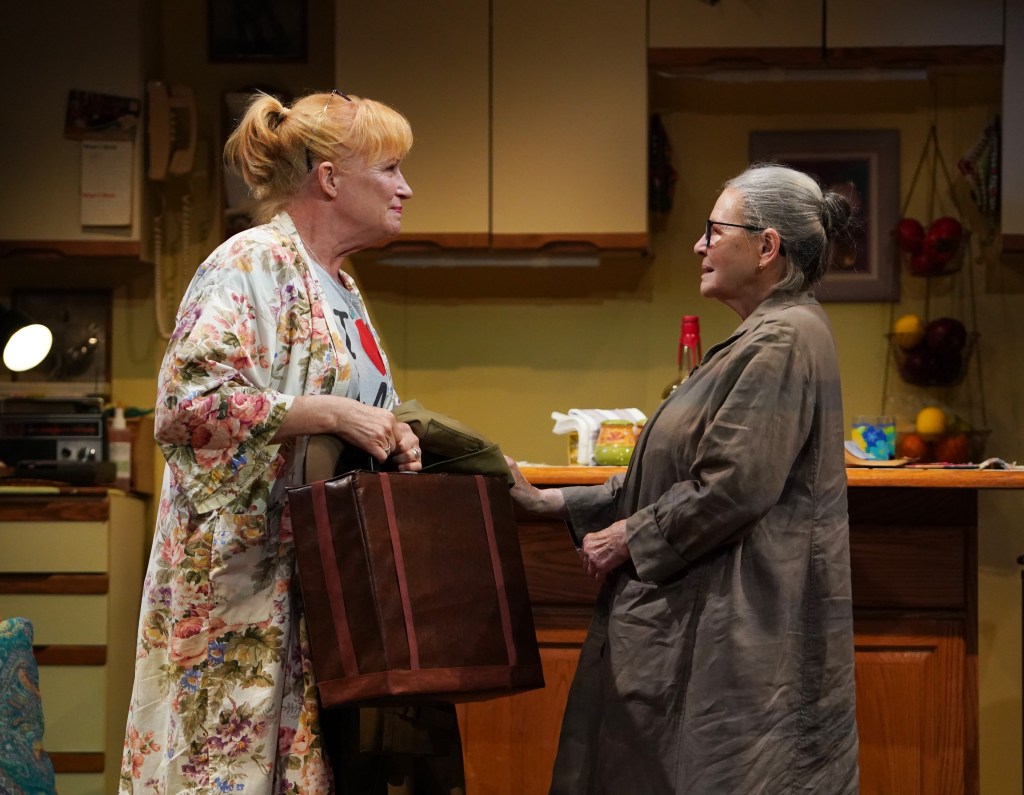
Part of the charm, humor and horror of Casewell Jr.’s Scene Partners, guided by astute director Rachel Chavkin, is that he playfully strings together scenes that appear haphazard but eventually have their own coherence, for a time. He stands familiar tropes (like logic and reality), on their heads, juxtapositioning them so that up is down, left is right. Then he turns them around again. Where is this lack of structural structure taking us, deep into the recesses of Meryl’s imagination? Or is this the stuff that dreams are made of and we all will wake UP back in Meryl’s kitchen, her bags ready to be unpacked?
This out of the box thinking is a good thing, for along the journey, we come to admire this unusual protagonist and find her humorous and adorable. Engaged, we watch as Meryl (turns out she was the first “Meryl” before the other actress), uses her determination and nimble mind, in whatever state it’s in to live in irony, freedom and her fantastic imagination. After all, what is reality anyway but quarks, particles, protons and electrons spinning beyond the speed of light so that what we think is a solid, is actually an illusion of spinning particles. What better place for Meryl to be than the land of illusions to add her own fantasies and realities to theirs! And lo and behold, she gets people out there to believe her! Could this happen as easily in New York City?
In a non-linear, fractured fashion, Meryl eventually spills the beans about her life which is being made into a film with her scene partners from acting class. Born in Los Angeles her father loved her, but her parents divorced and her mother ran away with another man, dragging her along. This stepfather fancied Meryl’s youth and expended himself on her, raping her for his good pleasure, though her mother and stepsister Charlize (the excellent Johanna Day), refused to acknowledge his sinister, sick lechery.

Masochistically continuing the abuse, instead of seeking freedom, we learn, she marries an abuser for life, named Stanley Kowalski. She explains, and we laugh, “I have no idea who’s responsible for feeding the details of my life to Mr. Williams for his little play.” Seeing her father relentlessly beat her mother, daughter Flora (Kristen Sieh), another victim, becomes an addict who depends on Meryl for food, clothing, everything.
Appalled that her mom is leaving her with no food in the house and abandoning her to confront her own addictions (principally self-destruction), Flora criticizes and insults Meryl for following her dreams. Meryl replies, “I have been acting all of my life! It’s about time I get paid for it!”
Indeed, I cannot imagine anyone else in this role, even Meryl Streep. In every breath of dialogue, Dianne Wiest appears to comprehend this victim turned hero, who is a combination of fantasist, Norman Vincent Peale practitioner and chronic traumatic encephalopathy survivor (battered brain syndrome). The power in her will to carve out her own reality out of life goal takes an inner truth and determination that Wiest so capably expresses. She has done similarly in each of the roles she performs, i.e. the sweetly accepting mother in Edward Scissorhands, the hysterical actress Helen Sinclair in Woody Allen’s Bullets Over Broadway (1994). In this ironic, wildly insentient role of Meryl, she achieves a pinnacle, if that is possible. I hope not, for she is imminently watchable and must do more stage productions.

When she points the gun at Josh Hamilton’s Herman, you believe she will shoot as she smiles at him. She’s happily dead serious. Thus, he believes her and he takes her on as his client, interested at her new approach and believability.
Additionally, at times Wiest’s Meryl is out of focus as if in medias res, in a chopped up segue which has no before and a questionable after, confused, wobbly, unsure of herself. This is especially so in the opening scene when she appears on camera (David Bengali’s video & production design), via projection. Styled with make-up and hair for her “close-up, Mr. DeMille,” her wide-eyed, silent response to the voice-over director’s, “Whenever you’re ready, sweetheart,” appears vacantly shocked. Is she amazed that she actually is where she said she would be? Or is something else going on, like a lapse in memory or identity? Wiest keeps her portrayal fresh, surprising, astounding. You can’t take your eyes off her.
Intentionally difficult to describe, Caswell, Jr.’s play hides in the shadows, as if throwing onto the stage anything that is humorous, upended and Wiest is up for. He twits our need to grasp onto something firm, like an arc of development that doesn’t involve Meryl’s strange train ride and sexual intimacies with a Russian conductor. And then there is a hop, skip and jump to “Horray for Hollywood!” and Meryl is threatening Herman Wasserman for auditions and parts with a gun. Speedily after that, she is in acting class with fellow actors.

Scene Partners succeeds because it cracks open another realm of being that is illogical and brashly, humorously defiant. It asks us to accept Meryl for who she is and what she learns about herself in her fragility, lapses, unreal realities and bits and pieces from movies that have clearly impacted her psyche. With help from a fine ensemble, Johanna Day’s grounded stepsister, John Hamilton, edgy and annoying in various roles, Kristen Sieh and others, the vignettes created and cobbled together form a life resurrected into one of purpose, joy and happiness. Does it truthfully matter if we don’t understand all elements about Meryl? Do we ever understand all elements about ourselves?
If we see through a prism the rainbow colors, some emphasized one day, others the next, maybe that’s a good thing. And if we follow dreams, even if only in our imaginations, perhaps that’s all that matters if we don’t harm anyone else. In fact, we may even bring others together pursuing the “unlikely” or the “ridiculous.”
Kudos to the creative team which includes Riccardo Hernandez (scenic design), Brenda Abbandandolo (costume design), Alan C. Edwards (lighting design), Leah Gelpe (sound design), Leah Loukas (hair, wig & makeup design), David Bengali (video & projection design) and others. And special kudos to the director, actors and Wiest, who helped to make Meryl’s world authentic in its wild and crazy configurations.
Scene Partners is a must-see for its zaniness and for Wiest’s dynamic, fascinating performance. For tickets go online https://vineyardtheatre.org/shows/scene-partners/
 CAROLE DI TOSTI