Blog Archives
‘Antigone (This Play I Read in High School)’ Review
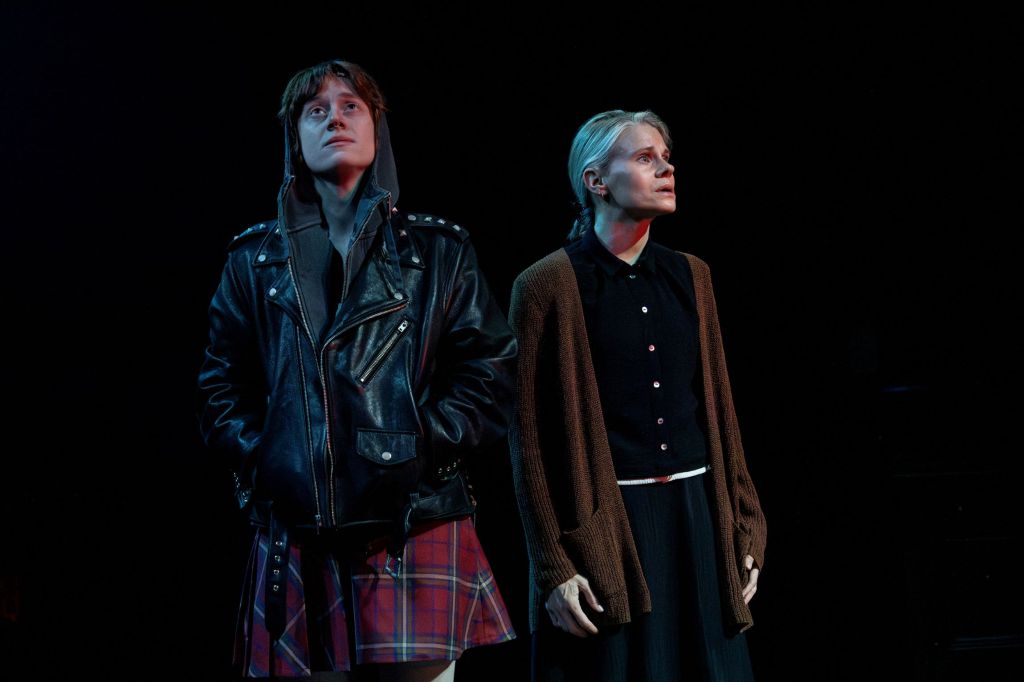
Strong performances from the leads Celia Keenan-Bolger, Susannah Perkins and Tony Shalhoub lift up Anna Ziegler’s unbalanced, convoluted feminist revision of Sophocles’ masterpiece Antigone. An irony not to be overlooked is that Antigone is a tragedy about a profoundly heroic and powerful woman who overturns the rule of the patriarchy-her Uncle Creon’s leadership-and destroys it and its future by adhering to spiritual and moral laws rather than the state’s. Ziegler gives a nod to the inherent “feminism” in Antigone in her adaptation which must be lauded for her attempt. However, its execution and rearrangements fall far short of the original. Directed by Tyne Rafaeli, Antigone (This Play I Read in High School) runs at the Public Theater until April 5, 2026.
Zigler reconfigures Antigone through the lens of Keenan-Bolger’s unnamed “Chorus/Narrator.” The playwright uses modern, feminist issues to frame and review Antigone’s heroism by having the Chorus/Narrator create her own scenario of the play she knew from high school. In effect, she imagines the Antigone/Creon conflict in a winding plot that relates to the Chorus/Narrator’s womanhood and identity.
Finding she is pregnant at an older age, the Chorus/Narrator must decide if she should keep the child or get an abortion, given who she thinks she is. However, this straightforward question comes after we witness her shadow her version of Antigone (exiled Oedipus and deceased Jocasta’s rebellious daughter) calling her up during events in the Chorus/Narrator’s life. In effect she uses Antigone to surge power into her own life over the years and help her resolve her problematic relationship with her mother, who she believes didn’t love her. The process of revisiting her own reclamation of the Antigone/Creon conflict enables her to validate her identity and her choices, and establish the power of her voice which she does by the play’s conclusion.
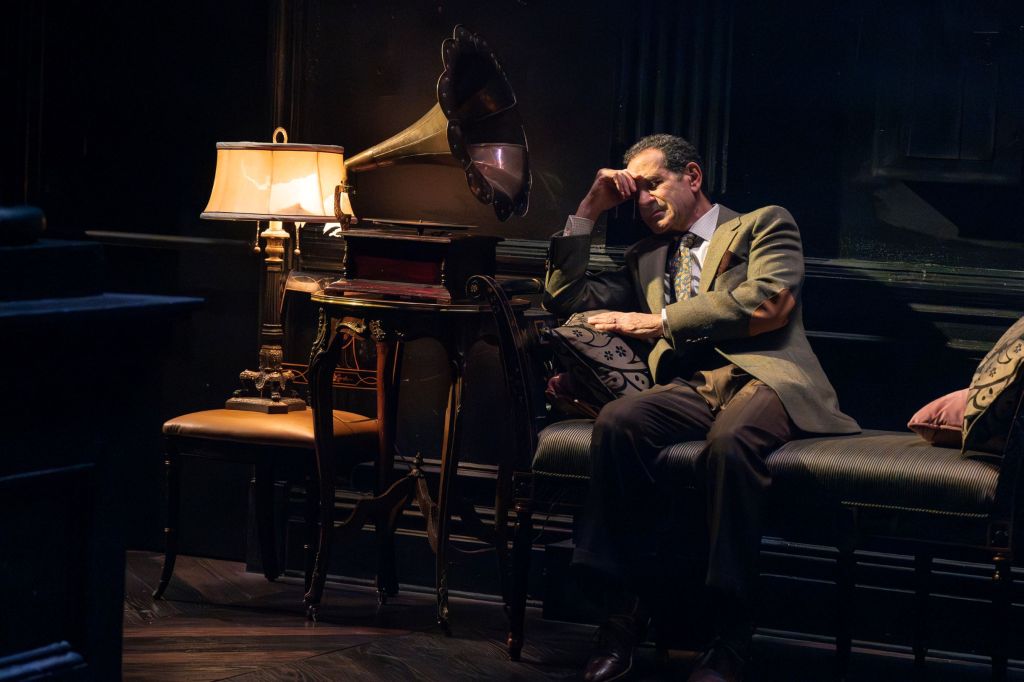
Through the Chorus/Narrator’s lens Antigone is a hip teenager with cropped hair (designers Robert Pickens, Katie Gell), wearing a black leather jacket, loosely fitting top and red plaid skirt courtesy of Ever Chakartash’s costume design. All of the characters are in modern dress, save Ismene, Antigone’s sister, who the narrator “sees” in a smock dress which she wears during her own self-imposed isolation, while Antigone makes defiant decisions. The set design (David Zinn) is minimalist mostly defined by props, for example, a lectern when Creon speaks to the crowd, a security screener at the palace entrance, a settee for Ismene’s room and more.
In the narrator’s first scenario the wild and recalcitrant, Antigone carouses in a bar and ends up with a pickup instead of going to her Uncle Creon’s coronation. She hears he’s become a hard-line politician and to keep control has established many strict laws to create order out of a chaotic Thebes. One of his laws is the banning of abortions which gives rise to illegal abortionists in the back of bodegas. Antigone eventually visits one of these after discovering her pregnancy from her love relationship with Haemon, Creon’s son, her fiance whom she has cheated on.
Key to the Chorus/Narrator’s conflict with herself is establishing her own life and identity, so scenarios especially between Creon and Antigone that she envisions help her. In the second act Antigone confronts Creon about having the illegal abortion. She tells him her body is her own and her choices are her own. They are acts of freedom. She will not be ruled by state laws or Creon’s laws, but by herself. The fact that she asserts this because she believes she can and should is a revolutionary act. The Chorus/Narrator’s view of Antigone is an independent, autonomous being beyond any laws, speaking truth to power, brave and unafraid. Her ultimate power is in ending a pregnancy, another life, if she chooses.
Creon has no power over Antigone in this context, over her reproductive rights. Thus the Chorus/Narrator imagines a dynamic scene where Antigone illustrates her act of freedom and of owning her own body to Creon. Perkins’ Antigone disrobes and points to various injuries and scars only she knows about. Naked, in full possession of herself in front of Shalhoub’s Creon, we believe in the power and determination of Perkins’ Antigone. Only she can objectify her own body, if she so chooses. Perkins makes a meal of this scene and we can identify with her argument keeping in mind how long it took for women to get to this point which was overturned federally in Dobbs after women experienced the freedom to choose via Roe v Wade for 49 years.
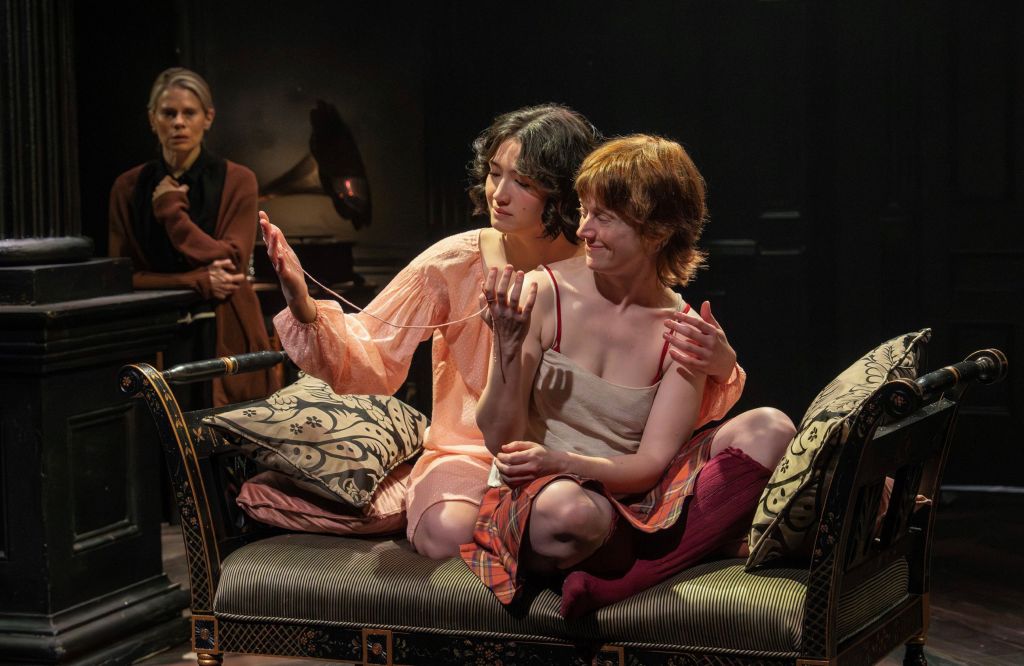
Apart from this high-point and Shalhoub’s Creon’s impassioned speech justifying why she must apologize publicly for getting the abortion, the characters don’t resonate. In Sophocles’ Antigone/Creon conflict we feel the enormity of the stakes and the depths of Antigone’s despair which prompts her decision to disobey Creon and not let her brother’s spirit wander for eternity. Unfortunately, Ziegler’s Chorus/Narrator’s inner conflict is not fully explored with grist or emotion. This prevents us from engaging with her as we look through the Chorus/Narrator lens darkly and have difficulty completely identifying with her version of Antigone.
It is an irony that Tony Shalhoub’s Creon, so expertly acted, elevates Creon. We note his character loves his son, niece and family. Unlike the more brutal tyrannical Creon of Sophocles’ original, Shalhoub’s Creon delivers the most reasoned and believable argument for his actions. Shalhoub actually humanizes Creon. Antigone’s choice to end her pregnancy, apart from her action of naked self-possession, becomes reduced from the heroic, noble Antigone in the original play to that of a willful revolutionary who does what she wants not because of any other reason, but to assert her will against the state, because she can. She refuses to apologize but her revolutionary act of facing death is not realized in Creon’s death penalty. She bleeds out from the bad abortion, the meaning of her act diminished.
Unfortunately, Ziegler’s framing structure reduces the characters’ stakes and prevents the audience from being drawn into the plight of Keean-Bolger’s Chorus/Narrator or Perkins’ Antigone to care about what happens to them. This occurs despite the acting chops both women acutely display. The structure is at fault, not their performances.
Antigone (This Play I Read in High School) runs 2 hours15 minutes through April 5 at the Public Theater https://publictheater.org/productions/season/2526/antigone-this-play-i-read-in-high-school/
Lesley Manville and Mark Strong are Mindblowing in ‘Oedipus’
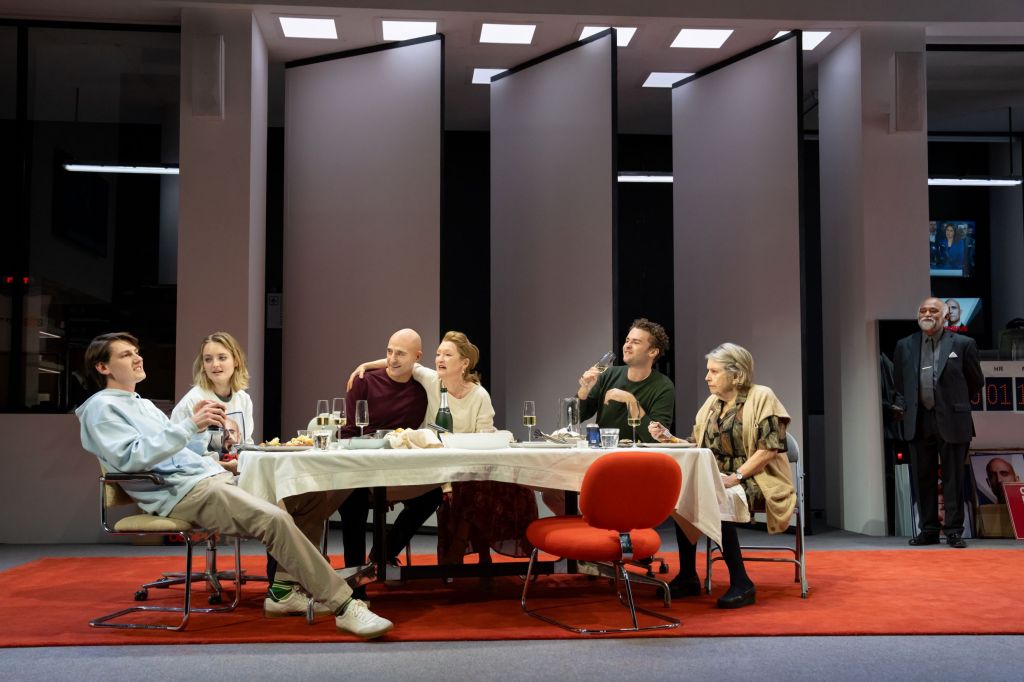
Just imagine in our time, a leader with integrity and probity, who searches out the truth, no matter what the cost to himself and his family. In Robert Icke’s magnificent reworking of Sophocles’ Oedipus, currently at Studio 54 through February 8th, Mark Strong’s powerful, dynamically truthful Oedipus presents as such a man. Likewise, Lesley Manville’s lovely, winning Jocasta presents as his steely, supportive, adoring help-meet. Who wouldn’t embrace such a graceful couple as the finest representatives to govern a nation?
Sophocles’ classic Greek tragedy, that defined the limits of the genre and imprinted on theatrical consciousness the idea that a tragic hero’s hubris causes his destruction, evokes timeless verities. In his updated version, Icke, who also directs, superbly aligns the characters and play’s elements with today’s political constructs. Icke retains the names of the ancient characters. This choice spurs our interest. How will he unravel Sophocles’ amazing Oedipus tragedy, especially the conclusion?
Cleverly, he presents Oedipus as a political campaigner of a fledgling movement that over a two-year period gains critical mass. The director reveals Oedipus’ backstory in a filmed speech to reporters on the eve of the election. The excellent video design is by Tal Yarden.
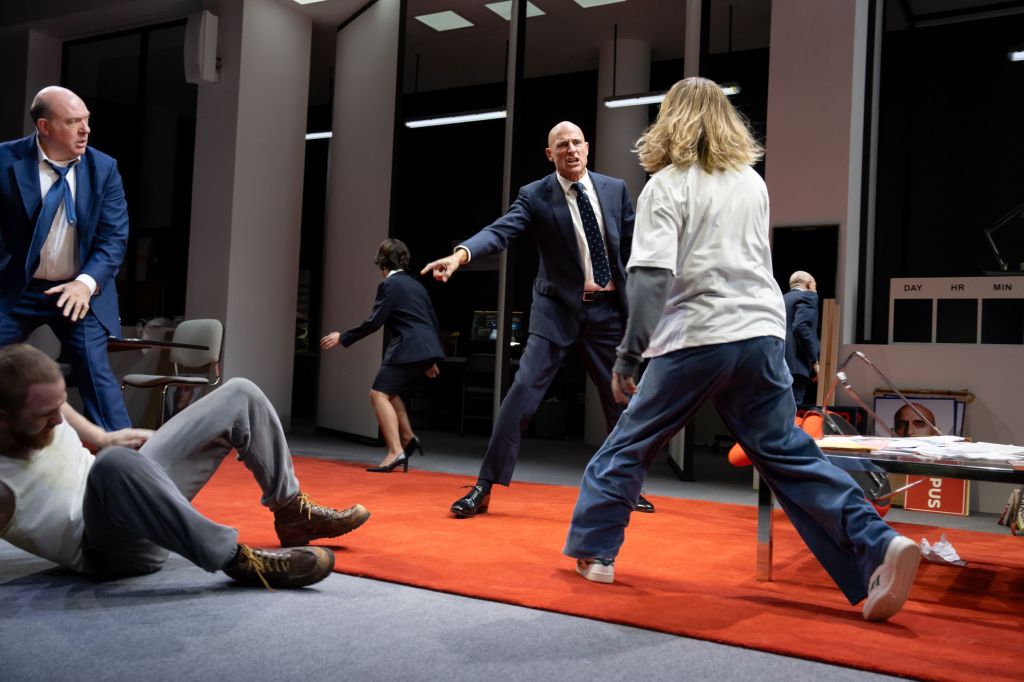
During his speech Oedipus goes off book and makes promises. Though his brother-in-law Creon (the fine John Carroll Lynch) tries to stop him, proudly Oedipus shows himself a man of his word. He galvanizes the crowd when he states he will expose the lies of his opponents. Not only will he reveal his birth certificate (an ironic reference to President Obama), he will investigate the mysterious death of Laius. The former leader from decades ago married Jocasta when she was a teenager. After Laius’ death, Oedipus meets and marries Jocasta despite their age difference. Over the years they raise three children: Antigone (Olivia Reis), Eteocles (Jordan Scowen) and Polyneices (James Wilbraham).
How has Oedipus become the people’s candidate? Without ties to the political system, he speaks a message of reform and justice. Indeed, he will override the corrupt, derelict power structure. Former leaders served their rich donors and let the other classes suffer. Oedipus runs on a mandate of equity and change.
After Oedipus’ speech, the curtain opens to reveal the campaign headquarters that staff gradually dismantles as the campaign phase ends. To signify the next phase the countdown clock, placed conspicuously in scenic designer Hildegard Bechtler’s headquarters, ticks away the seconds down to the announcement of the winner. As the clock ticks toward zero (an ironic symbol), the contents of the campaign war room are removed like the peeling of an onion to its core. As the destined announcement of the winner nears, gradually, the revelation of Oedipus’ true identity happens. Icke has synchronized both concurrently.
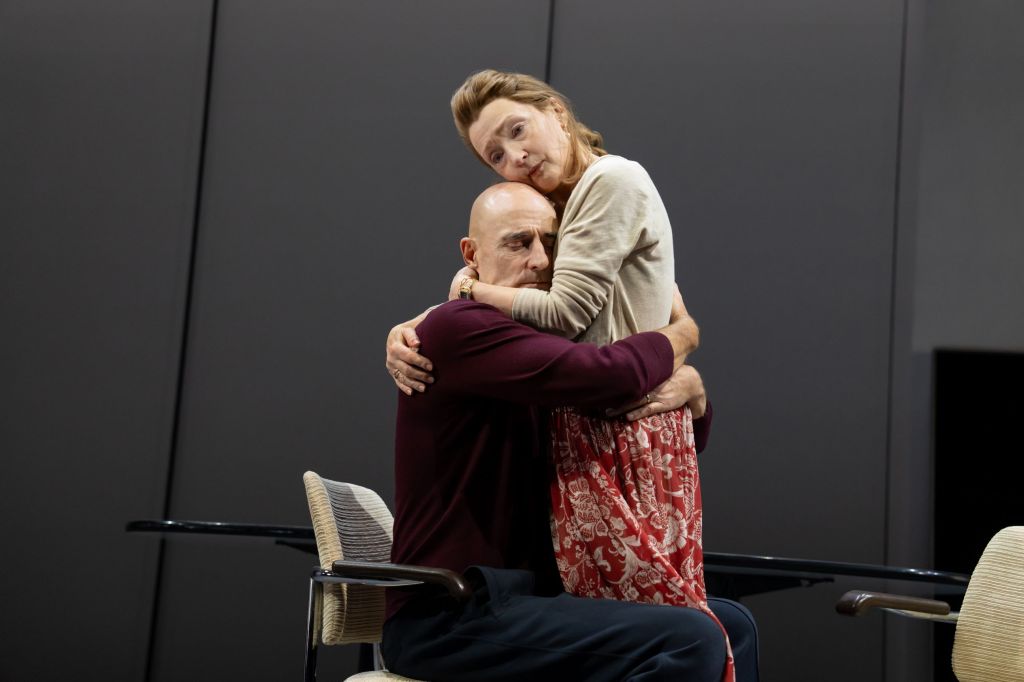
Icke’s anointed idea to shape Oedipus as a newbie politician, whose actions and words are singularly unified in honesty, resonates. He represents the iconic head of state we all yearn for and believe in, forgetting leaders are flesh and blood. Of course Icke’s flawed tragic hero, like Sophocles’ ancient one, results in Oedipus’ prideful search for the truth of his origin story and Laius’ cause of death.
Oedipus’s determination is spurred by the cultist future-teller Teiresias (the superb Samuel Brewer). His authoritative and relentless drive to prove Teiresias wrong, despite warnings from Creon and Jocasta, shows persistence and courage, positive leadership qualities. On the other hand, Oedipus doesn’t realize his search has a dark side and his persistence is stubbornness prompted by a prideful ego. This stubbornness causes his destruction. His pride leaves no way out for him but punishment.
Because the truth is so horrid, Strong’s Oedipus can’t suffer himself to cover it up. In searching to validate his true self, he discovers the flawed human that Teiresias proclaims. Indeed, he is more flawed than most. He is lurid; a man who killed his father, married his mother, and had three children born out of love, lust and incest. He can never be the leader of the nation. He must hold himself accountable after he sees his debased true self. How Mark Strong effects Oedipus’ self-punishment is symbolic genius. Clues to Jocasta’s end are sneakily tucked in earlier.
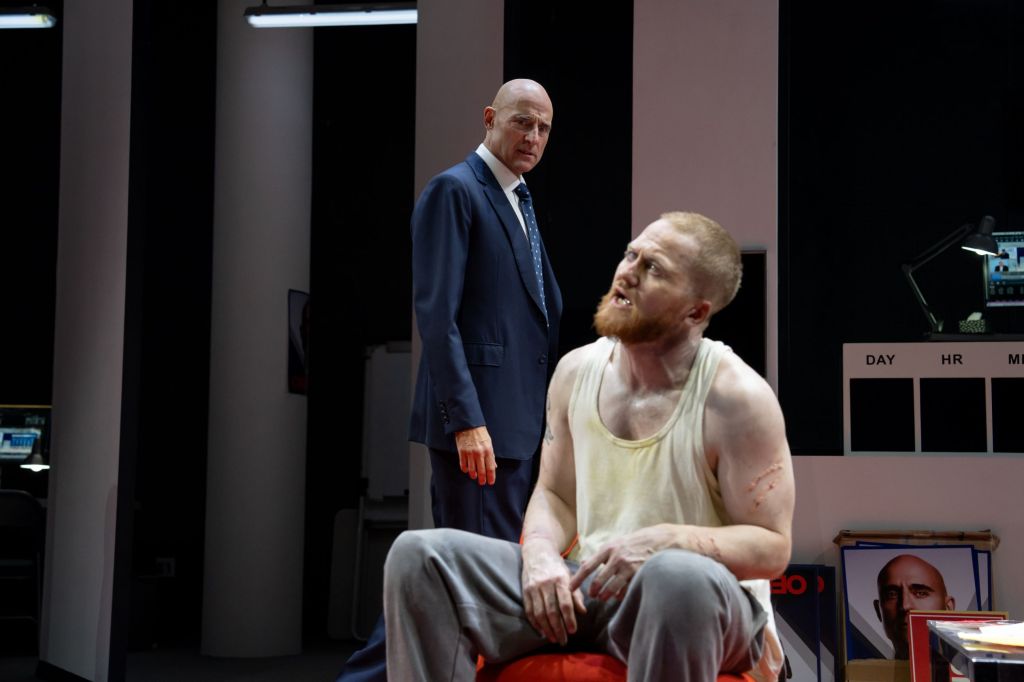
Because of Icke’s acute shepherding of the actors, and the illustrious performances of Manville, Strong and Brewer, with the cast’s assistance, we feel the impact of this tragedy. The love relationship between Jocasta and Oedipus, drawn with two passionate scenes by Manville and Strong, especially the last scene, after they acknowledge who they are with one, long, silent look, devastates and convicts.
Those who know the story feel a confluence of emotions at the irony of mother and son lustily loving and pursuing their desire for each other off stage, while Oedipus delays speaking to his mother Merope (Anne Reid). Manville and Strong are extraordinary. Both actors convey the beauty, the wildness, the uniqueness and enjoyment of their characters’ love, that is unlike any other.
In the last scene when Strong and Manville untangle from their hot grip, clinging to each other then letting go, they acknowledge their characters’ unfathomable and great loss. Manville’s Jocasta crawls away to reconcile the enormity of what she has done. In her physical act of crawling then getting up, we note that fate and their choices have diminished their majestic grace. Their sexual likeness to animals, Oedipus ironically referenced earlier with family at the celebration dinner. Through the physical staging of the final sexual scene, Icke recalls Oedipus’ earlier comparison.
As a meta-theme of his version Icke reminds us of the importance of humility. The more humanity presents its “greatness,” the more it reveals its base nature.
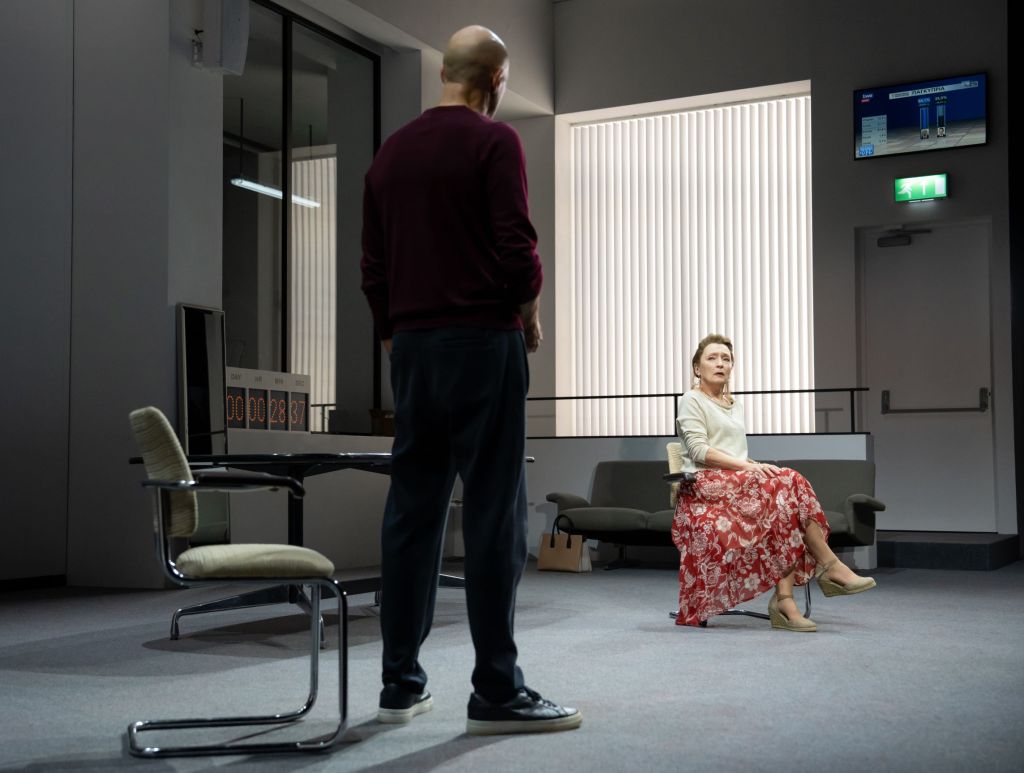
All the more tragedy for Oedipus’ supporters and the unnamed country. Because fate catches up with him and conspires with him to cut off his acceptance of the position he rightfully won, the nation loses. All the more sorrow that the truth and his honest search is what Oedipus prizes, even more than his love for Manville’s Jocasta, the brilliant, equivalent match for Strong’s Oedipus.
Rather than live covertly hiding their actions, both Oedipus and Jocasta hold themselves accountable with a fatalistic strength and nobility. Initially, we learn of her strength as Jocassta tells Oedipus about her experience with the evil Laius (a reference to current political pedophiles and rapists). We see her strength in her self-punishment. Likewise, Oedipus’ strength compels him to face his deeds where cowards would cover up the truth, step into the position and govern autocratically censoring and/or killing their opponents who would “spill the beans.” Oedipus is not such a man. It is an irony that he is a moral leader, but is unfit to lead.
Icke’s masterwork and Manville and Strong’s performances will be remembered in this great production, filled with ironic dialogue about sight, vision, blindness and comments that allude to Oedipus and Jocasta’s incestuous relationship and downfall. Those familiar with the tragedy will get lines like Jocasta’s teasing Oedipus, “You’ll be the death of me,” and her telling people she has four children: “two at 20, one at 23, and one at 52.”
Though I prefer Icke’s ending in darkness with the loud cheers of the supporters, I “get” why Icke ends Oedipus in a flashback. In the very last scene the date is 2023, the beginning of the end. We watch the excited Oedipus and Jocasta choose the rented space (the stripped stage) for their campaign headquarters. The time and place mark their disastrous decision which spools out to their destruction two years later. I groaned with Jocasta’s ironic comment, “It feels like home.”
Her comment resonates like a bomb blast. If Oedipus had not had the vision of himself as the ideal, righteous leader with truth at his core, the place where they are “at home” never would have been selected. Oedipus, a humble mortal, never would have run for high office.
Oedipus runs 2 hours with no intermission at Studio 54 though February 8. oedipustheplay.com.
 CAROLE DI TOSTI