Blog Archives
‘Kyoto,’ Climate Science vs. Oil Billionaires’ Profits as the Planet Crisps, Theater Review
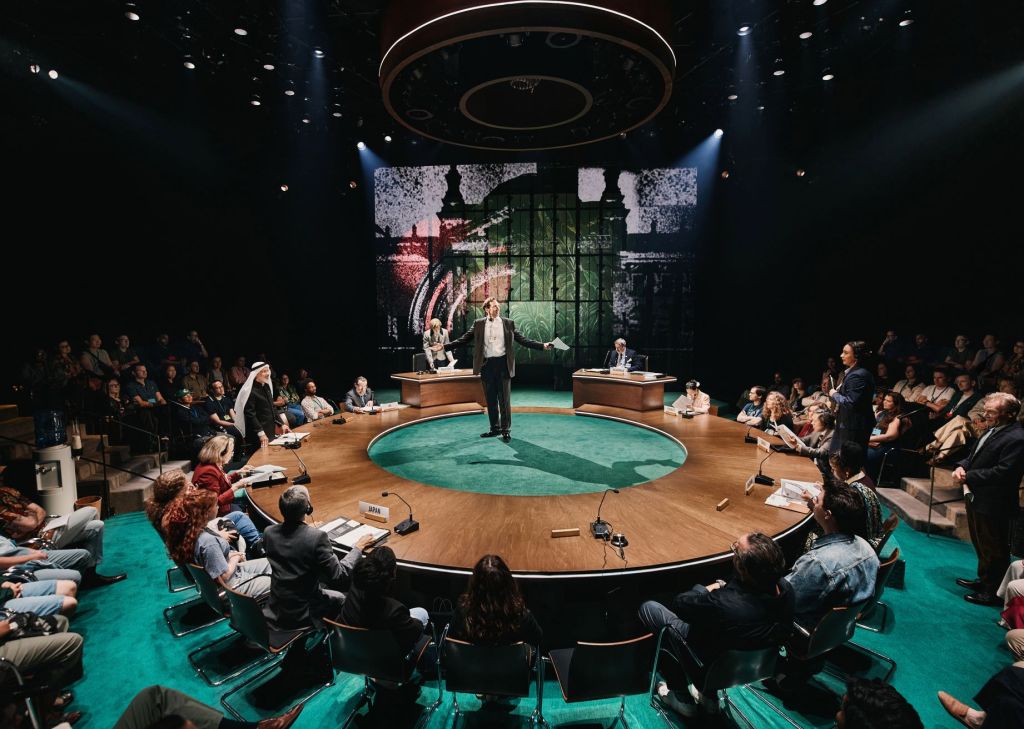
Based on events beginning in 1989 leading up to the 1997 United Nations Climate Change Conference in Kyoto, Japan, Joe Murphy and Joe Robrtson’s Kyoto explores the momentous occasion when nations agree to confront climate change. The two-act political thriller is in its US Premiere at the Lincoln Center Theater at the Mitzi E. Newhouse until November 30th. Compressing extensive detail, the playwrights reveal how representatives from 160 nations negotiated the Kyoto Protocol. The Protocol committed first world and emerging nations to limit/reduce greenhouse gasses after setting targets and timetables.
Stephen Daldry and Justin Martin co-direct Kyoto, which enjoyed its world premiere at the Swan Theatre, Stratford-upon-Avon. Due to its continued success, it transferred to London’s West End before debuting to American audiences, who don’t always relate to the ironies and humor in the play (directed at the US). Indeed, the US representative (Kate Burton), and American oil lobbyist Don Pearlman (Stephen Kunken) and the representative of Saudi Arabia (Dariush Kashani) become the objects of humor and frustration. They continually oppose any movement to pin down emissions’ timetables or support decreasing oil production.
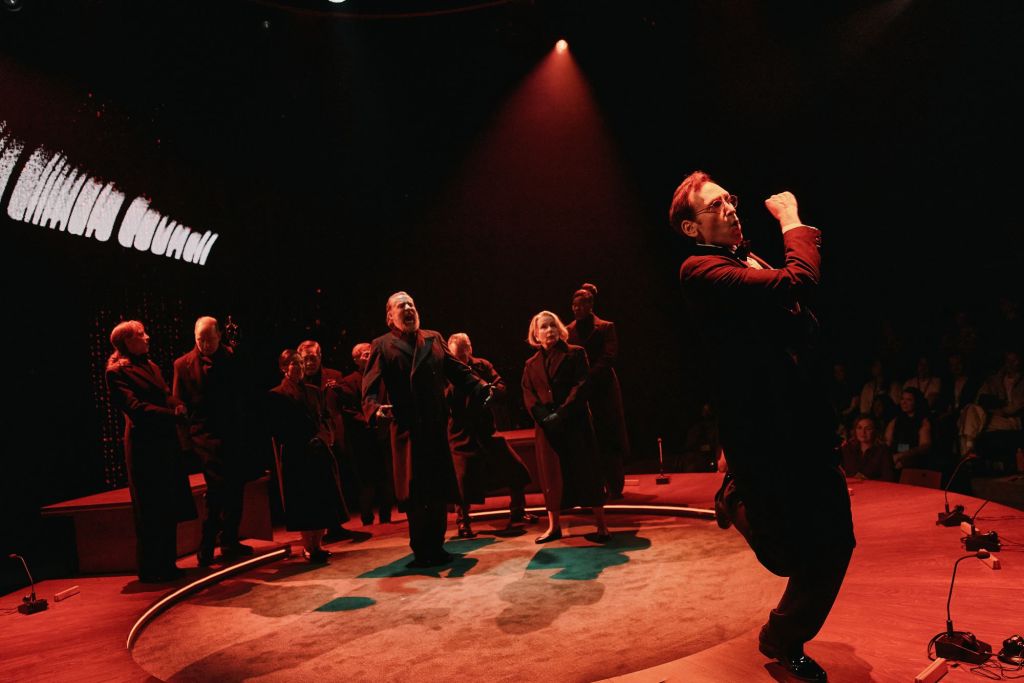
The set is a circular conference table where members sit and sometimes interact with the audience. The table serves also as a raised platform for Don Pearlman, placing him above the fray. In its design by Miriam Buether, Pearlman stands at its center and addresses the audience. Variably it becomes a private meeting area where Pearlman speaks with those opposed to any “progress” on emissions. It becomes a setting in his home, and several hotel rooms where he converses with his wife Shirley (Natalie Gold) and others. The co-directors keep the play in the realm of ideas, not material places. In one instance Shirley and Don join Raul Estrada (Jorge Bosch), the Argentinian representative for China, in a rain forest. The fluid, minimal set design forces the audience to keep up with the dialogue cues which indicate setting changes.
The playwrights have chosen the “well-meaning,” slippery lawyer Don Pearlman, as their spokesperson to reveal what happened from 1989 through1997, when nations finally achieved consensus in Kyoto. At the outset Kunken’s disarming oil lobbyist begins by discussing how the Seven Sisters (big oil, i.e, Exxon, Shell, BP) appoint him as their agent provocateur to stall and delay any UN agreement about greenhouse gas emissions.
Like Iago in Othello, Pearlman instructs the audience in his nefarious plans. Though the events happen at lightning speed, Kunken’s Pearlman slow walks us with his wise words and commentary about how to derail progress among the nations.
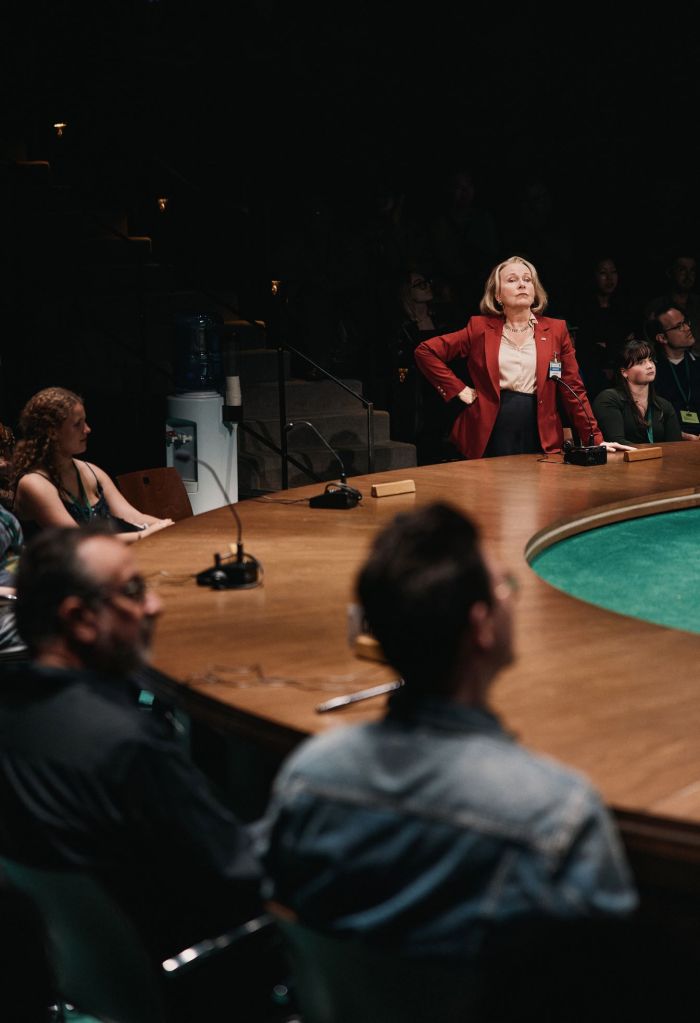
We become mesmerized as we note how he thwarts the representative countries who have different agendas than big oil conglomerates. Also, by extension we understand why little has been done to effectively curtail global warming. Without particular malice or a sinister tone, Kunken’s Pearlman humanely portrays a man who justifies his mission to support American’s “freedoms” to have a first world economy delivered by fossil fuels. Any change disrupting the oil supply, decreasing fossil fuels and harming profits must be stopped. Truly, Pearlman believes in his job and he believes in doing it well. This makes him and the Big Sisters utterly terrifying and wicked when one stops to consider the consequences.
As we follow along with the various conferences and summits beginning with the 1990 World Climate Conference in Geneva, through the Rio Earth summit, the many rounds of talks with scientists among countries, to 1995 Berlin, the First Conference of the Parties, COP-1, we see Kunken’s Pearlman enact the strategies and philosophies he first discussed with us and his wife Shirley. Without glee, with more than a soupcon of irony, Pearlman, ever the oil lobbyist, proves his genius standing up to various representatives with his knowledge about the process of negotiation, as well as his breadth of knowledge about the subject matter.
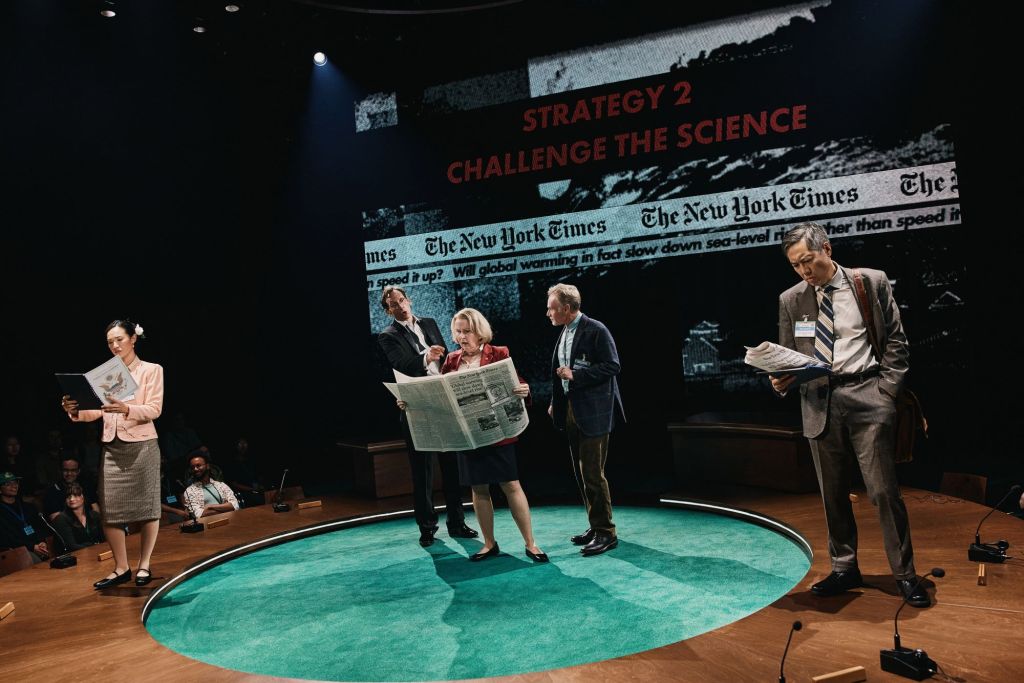
He, Burton’s US representative, Kashani’s Saudi Arabian representative for OPEC, and others dismiss the gravitas of what climate scientists have presented about global warming. However, Pearlman’s and others’ delinquence in acknowledging the looming disaster for representatives of low-lying coastal nation states comes to a screeching halt. The representative from Kiribati (Taiana Tully) joins forces with 39 other coastal nations to create a powerful negotiating bloc, The Alliance of Small Island States. They make it clear they will not allow the first world nations to marginalize and destroy them. For it is the first world nations’ oversized pollution that predominately contributes to the polar ice caps melting, and that puts the coastal nations at grave risk.
Thus, the conflict begins in earnest as the first world nations strain against the emerging nations, China having joined the coastal states. Few if any concessions are made for any collective unity as they delay for years, sea levels rise, and time runs out. However, a turning point occurs with the new appointment of Raul Estrada. Bosch’s Estrada eventually bans Pearlman from conferences, despite his being the CEO of the NGO, Climate Council (a blind to get him on the inside). Estrada knows Pearlman’s intent, and Pearlman shows no inclination to change his mission. Their war proceeds as representatives criss-cross the world in jets and add to the increasing emissions they seek to control.

Importantly, the play’s dynamism, pacing and urgency are conveyed by Kunken and Bosch’s performances and the co-directors’ staging and directed momentum. The lead actors who reprise their roles from the London production, have settled into their portrayals. As in real life, the oil lobbyist vs. the Argentinian representative to China smile and joke while warring against each other in a deadly “game” to stop big oil from holding the planet hostage.
Interestingly, the playwrights use the character of Shirley as a foil to soften and humanize Pearlman. However, when she finds out that the Seven Sisters knew about the consequences of global warming since 1959 and have kept this research under wraps, she realizes the wickedness of what her husband attempts. If she gives this information to him will it change his approach to his handlers? How can he live with himself and continue to support big oil knowing what the conglomerates have intentionally done for decades to keep profits flowing while endangering life on the planet?
At its strongest and most profound Kyoto dramatizes the tense political and scientific life and death battles that eventually result in the world’s first legally binding agreement to limit greenhouse gas emissions. That such Sturm und Drang resulted in so little is disappointing. However, in light of today’s international global divisions, to arrive at such a consensus seems miraculous and gives us pause.
Kyoto runs 2 hours 40 minutes with one intermission until Nov. 30 at the Mitzi E. Newhouse Theater, lct.org.
‘Stranger Things: The First Shadow,’ Stunning, Thrilling, High Wired

Stranger Things: The First Shadow
The ordinary and extraordinary contrast in this theatrical prequel set around 27 years before the Duffer Brothers’ Netflix series Stranger Things begins. Kate Trefry wrote the two-act supernatural, sci-fi-thriller origin story of fearsome Henry Creel’s genesis of terror. The story was originated by the Duffer Brothers, Jack Thorne (Harry Potter and the Cursed Child), along with Kate Trefry. For those familiar with the series, no introduction is needed to the theatrical presentation currently at the Marquis Theatre. The production transferred from the West End in London to Broadway where it opened on April 22nd. For an example of some of what you’ll see on Broadway, albeit with a West End cast, except for the superb Louis McCartney who reprises his role as Henry Creel, check out the 2024 West End Trailer.
For those unfamiliar with the series, the production can stand alone, though audience members must remain quick-witted to follow the rapidly paced, brief, myriad scenes directed by Stephen Daldry and co-directed by Justin Martin to catch onto the macabre identities of the wicked paranormals that struggle to inhabit the otherwise hapless Henry Creel, a victim of being in the wrong place at the wrong time. The plot development of Stranger Things: The First Shadow riffs off Season 4 of the Netflix series, which is set in 1986, and features the nefarious Vecna, the “evolved” Henry we are introduced to as a struggling victim in this Broadway production set in 1959.

However, there is another layer and flashback to WWII which is the phenomenally brilliant opening of this production. This event illuminates how all of the series’ horrific, paranormal folly began.
Trefry and the gobsmacking creative technical team take us back to a weird rumble in the space time continuum that happened in 1943 that we see live on the stage and surrounding us as photographers circle up and down the aisles of the theater to film an incalculable experiment. Trying to gain an advantage over Nazi Germany, scientists attempt to make a US battleship invisible as a new weapon to evade the German submarines patrolling the waters, yet have it capable of firing at and destroying German U boats. In the process the “invisibility” experiment fails and there is a devastating explosion which breaks into the multiverse fabric of time’s layers and results in the extraordinary and the unexplainable of “Stranger Things.”

It would seem all men onboard the U.S.S. Eldridge are lost. Hold that thought for later in Act II. One of them is alive and “the government” via mercenary scientist (conspiracy theorists will love this), Dr. Brenner (the frigid, android-like Alex Breaux), takes advantage of what happens to the body of the only remaining naval officer who survived the catastrophe. (Well, after all, the officer volunteered for the experiment-no liability lawsuits by “family” possible.)
This astounding feat of technical illusion at the top of the production is breathtaking and prepares the audience for more of the same at the directors’ fever-pitch pacing throughout. Awards will certainly go to the teams that create the supernatural horror-illusions. The visual-effects design is by Jamie Harrison and Chris Fisher (“Harry Potter and the Cursed Child”). The video design and visual effects are by the 59 company. Additionally, with Paul Arditti’s sound design and Jon Clark’s lighting, the production becomes an animated, frightening, “telekinetic” wonder.

After this terrifying, immersively staged flashback, we step forward to 1959 in boring, mundane Hawkins, Indiana, a contrasting setting and hopeful place of refuge. There, Henry moves with his parents Victor (T.R. Knight), Virginia (Rosie Benton) and younger sister Alice (Azalea Wolfe on Saturday evenings). Henry’s paranormal talents, apparently unwelcome yet alluring, have allowed him to harm someone in his previous high school during a macabre event. This prompted the “perfect” family to leave and seek peace elsewhere. However, the circumstance involving Henry upset his mother, Virginia. She counsels Henry to repeat when he becomes anxious, “It’s not real. I’m normal. I’m Henry Creel.”
Part of the enjoyment of the uncanny horribleness of it all is how Henry attempts to be “normal,” but founders miserably at it. He is so, so creepy and preternatural. McCartney is just too good as an embattled, “terrified of himself” Henry.

As an isolated and lonely individual who only feels comfortable playing his radio, Henry fortunately does meet someone in his current high school with whom he can share a bond. Patty Newby (Gabrielle Nevaeh), is adopted and is emotionally abused by her father, and insulted by the high school students. As an obvious outsider, she and Henry (McCartney’s shy, weird, strange, pale, electrically-wired persona is incredibly effected), find solace in one another. Henry uses his powers to help her imagine and then “dream-manifest” her mother, who she discovers is alive. On the other hand, Patty helps deter Henry from submitting to the encroaching evil forces by inspiring him with her affection and attention.
In a tie-in to the plot as pets are being killed and students become involved in investigating the “whodunit,” the play includes the youthful versions of the older TV characters familiar to fans of the series. Patty’s brother, Bob (Juan Carlos), is the pudgy brainiac and the founder of the Hawkins High A.V. Club, instrumental in locating the source energy where “something is going on,” and turns out to be Henry’s house where indeed, more than something is going on. The police chief’s son, James Hopper Jr. (the endearing, funny Burke Swanson), and the high-pitched, theatrical Joyce Maldonado (a frenetic Alison Jaye), also form a bond. Joyce is the director of the play that brings Henry and Patty together. Joyce and Hopper, Jr. join efforts with Bob to find the pet killer to get a $100 reward (a lot of money back in the day).

Additionally, the three help Patty discover what happened to her father, Principal Newby, after he went with Victor Creel to confirm his daughter Patty and Henry were “hanging out” (a “no-no”), at the Creel house. When Principal Newby grabs daughter Patty to take her home, the wicked being attempting to overtake Henry rises up and Vecna (what Henry evolves to later in the 4th series), thunders loudly, “She’s ours.”
As Henry struggles to reject the evil, the scene culminates with a bloody attack. Though Bob, Hopper, Jr. and Joyce believe that Victor Creel is the animal killer, we anticipate the growing malevolence is overtaking Henry, and Patty, who says she is not afraid, is in danger. This becomes especially so when the others and Patty discover her father, Principal Newby, has been savaged and no one knows quite what happened. However, after he is given “mouth-to-mouth” he proclaims, “Find the boy. Save the boy.” as his bloodied, vacant eyes stare out of blackened, emptied sockets. Like blind, prophet Tiresias out of Greek mythology, Principal Newby prophesies save Henry or doom them all. But save him from what? From whom?
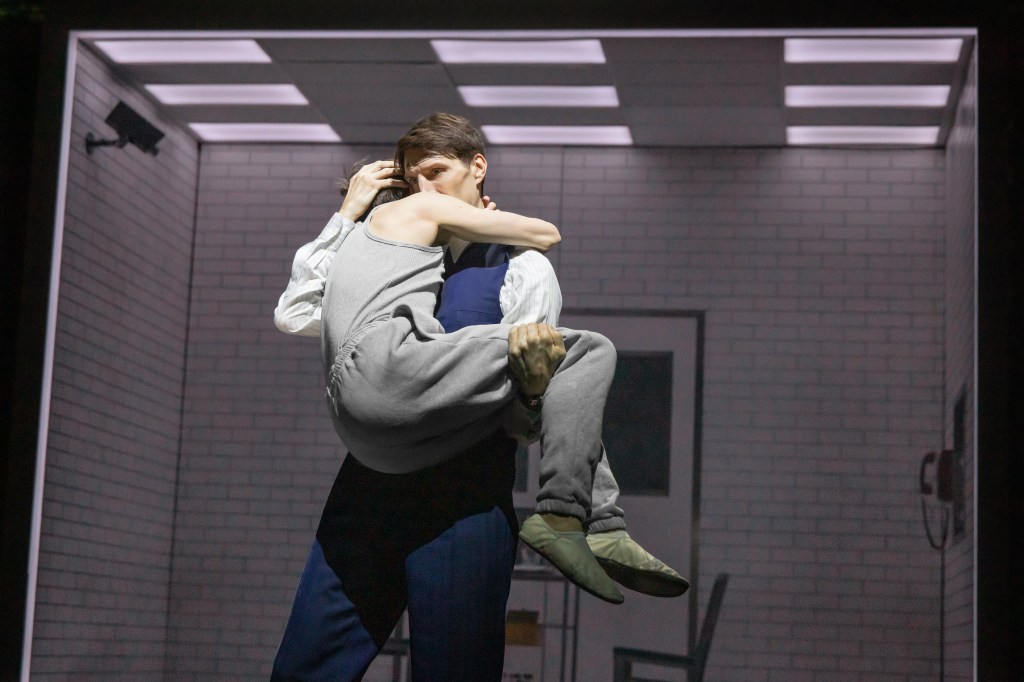
Aware that her son needs help, her husband can’t deal with his PTSD from WWII traumas and a terrible murderous event he caused, Virginia calls up specialist Dr. Brenner. He will be the one to help Henry as the good doctor takes Henry away into his care and where he conducts interesting lab tests and experiments to divine his preternatural behavior. Little does Virginia realize what Dr Brenner’s help entails and how she just made the worst decision of what is left of her life, her daughter’s life and her family’s sanctity and safety. With Dr. Brenner’s introduction, the intermission comes and the audience is stunned and exhausted wondering how Act II can be whipped up with an even greater accelerent into chaos and frightfulness.
No need to wonder. The creative team pulls out all the stops for Act II to explode and technically materialize the creatures and the themes that grace the series. By then we understand that Henry no longer exists. Like many we see today in our culture and society, he has been completely subsumed by another identity altogether. And it isn’t kind, decent, loving or generous. It is a horrible, paranormal, deplorable.

This is an incredible production which resounds visually and aurally long after you have left the Marquis Theatre. Louis McCartney steals the show as Henry. You can’t take your eyes off him expecting the best or the worst. His performance is brilliantly conceived. Gabrielle Nevaeh as his second, for a time, is empathetic and we are happy to see that she makes it through to the end. The ensemble does a fine job of tossing the ball back and forth to the one with the greatest scenes to steal. And the effects are more than breathtaking, along with the superb set design (Miriam Buether), period costume design (Brigitte Reiffenstuel), and Daldry and Martin’s staging and direction. You will be wondering how the effects were achieved, but then you also wondered in the same way when you saw Harry Potter and the Cursed Child.
Stranger Things: The First Shadow is a spectacle and in every way a credit to the series with a budget to prove it. It runs 2 hours 45 minutes with one intermission at the Marquis Theater on 46th St. between 7th and 8th. If you love the franchise don’t miss it. If you are not one for the macabre, the chill-thrill-shocker ride to hell and nightmares, see it anyway. It is a phenomenon for the technical skill displayed. As such productions like this don’t come around very often and should be appreciated for the artistry and skill to employ digital wizardry more easily accomplished in the film and TV medium than in its conversion to theatrical stagecraft. strangerthingsonstage.com.
‘The Inheritance,’ Inspired by E.M. Forester’s ‘Howard’s End’ a Chronicle of Gay Life, Poignant, Humorously Ironic, Triumphant

(L to R): Samuel H. Levine, Kyle Soller, Kyle Harris, Arturo Luis Soria, JOrdan Barbour, (foreground) Daryl Gene Daughtry Jr. in ‘The Inheritance,’ Part I, Part II, written by Matthew Lopez inspired by E.M. Forester’s ‘Howard’s End,’ directed by Stephen Daldry, design by Bob Crowley (Matthew Murphy)
How does one tell one’s story digging out the mired treasure amidst the refuse of time, personalities, relationships squandered, brilliant aphorisms and droplets of wisdom tossed away unheeded? Indeed! As most people end up doing, you don’t tell it; you live it and consign it to memory fragments which may become obliterated by dementia or Alzheimer’s. Or you move it into imagination realized, accessing a work of fiction as your inspiration and using a parallel plot platform to guide you.
Additionally, if you elicit the help of the spiritual consciousness of E. M. Forester as your literary muse employing Howard’s End as the fulcrum of evolving social mores in turn-of-the-century England (to mimic late 20th-century America) you will do as the ingenious Matthew Lopez (The Whipping Man, The Legend of Georgia McBride) did. You will write a masterwork. For Lopez is it The Inheritance. And if you are fortunate to premiere your play at London’s Young Vic with an exciting, prodigiously talented cast, it just may transfer successfully to Broadway a year later because of its sterling, award-winning particularity and emotional poignancy; this despite a few expositional plot convolutions and character snags.
The intriguing convention of materializing E.M. Forester as a professor who surfs the crest of wisdom’s waves into the shoreline consciousness of a cadre of gay writers (clever opening scene) is one of the high-points of Matthew Lopez’s The Inheritance, proudly unleashing its almost seven hours, four acts and large cast at the Ethel Barrymore Theatre.
In Lopez’s work Forester, is known by his middle name Morgan. Brilliantly portrayed by Paul Hilton, as the sensitive, focused and refined gentleman gay writer who hung in the shadows of respectability and didn’t “indulge” ’til his thirties, Hilton balances just enough loving instruction in shepherding the writers, and specifically Leo (Samuel L. Levine) in how to write their stories with sage advice exemplified in his novel. As he steers them in dramatic directions, they configure plot elements and “act” the characters in Leo’s story. Additionally, Hilton’s performance of Forester doubling as Henry Wilcox’ thirty-five year love interest Walter Poole is, bar none, glorious. John Benjamin Hickey as Wilcox is his fine counterpart.

(L to R): Jordan Barbour, Darryl Gene Daughtry Jr., Kyle Soller, Arturo Luis Soria, Kyle Harris, The Inheritance,’ directed by Stephen Daldry, designed by Bob Crowley, written by Matthew Lopez inspired by the novel ‘Howards End’ by E.M. Forster (Matthew Murphy)
Actually, the role of Forester could have been extended. Some of the business representing the cadre’s snide, material, mimed psycho-sexual behaviors and gay bitchiness in their choral presentments could have been shaved to fine points of crystal clarity without losing context or meaning. These changes may have enhanced thematic textures. Left as is, the cadre’s force is diluted and the staged movements of mimed sex which might have been acutely rendered as a dance are merely a humorous contrast to the deeper relationships in the play as well as a privileged indulgence since sexual hedonism isn’t a problem in 2018 with drugs like Truvada, PrEP and DESCOVY®. However, this superficializes the characters who are unnecessarily demeaned in what appears to be their gratuitous behavior, when they are far better than narcissistic overlords of themselves and each other.
As Forester guides his charges into how to extract the seminal moments of the story of their lives, we meet the key players who portray the protagonists and antagonists. Ironically, with authorial deification these players also get to comment on their character’s choices and the direction of their lives. Thus, in a wonderful twist, Lopez has the characters live and have their being while choosing their actions as they help Leo realize the most dramatic elements of the story.
The most humorous and finely realized manifestation of this occurs with the character of Toby Darling (the gobsmacking Andrew Burnap) whose seven year relationship with Eric crashes and burns mostly because he undoes it with careless abandon. Burnap adroitly, prodigiously walks the Toby tightrope. Representatively, Burnap’s supercharged Toby is the gay everyman of the previous generation before the AIDS epidemic: a cavalier, “full-of-himself,” gorgeous, sizzling, sexual powder-keg who masks the bleeding, soul raw, emotional victim of his own despairing gayness that writhes within.

The cast of ‘The Inheritance,’ directed by Stephen Daldry, designed by Bob Crowley, written by Matthew Lopez inspired by the novel ‘Howards End’ by E.M. Forster (Matthew Murphy)
Also, Lopez’s characterization of Toby as the successful novelist-cum Broadway playwright whose work will be made into a film, shines in a quaint “theater of the absurd” trope. Toby is the epitome of the actor searching for a character, massaging and sometimes insistently demanding the writing cadre, Forester and lead author-Leo do what he wishes. The outraged humor Burnap engenders as he attempts to write himself into a finer presentation and less painful destiny is wonderful. That he fails to influence Leo and the others to give him what he wants by the conclusion of the production is poignant, stark and even more wonderful.
His is an end which has no spiritual return because he optimizes his final choice and upends our expectations that he will die of AIDS. Lopez’s irony of and about Toby Darling is acute. As he declines, Leo ascends to a greater success, topping Toby’s spurious, specious novel (which Toby accuses himself of writing) with a powerful, truthful authenticity.
This is one of the many twists upon twists that Lopez effects that eventually is swallowed up by the themes and curiosity of paralleling Howard’s End and revealing how the cadre helps Leo tell the story of his complicated and amazing Horatio Alger-like rise. It is an evolution whose possibilities Leo inherited from the sacrifice of others who had gone before him in a long succession of gays shamed and ostracized. Lopez has his writers discuss Forester’s internalization of shame as they allude to gays of previous generations, who like Forester, had to hide in the shadows of oppression because of the social opprobrium and stench of perversion that branded gay men with the red letter F for faggot, a word that is still used to bludgeon gays today in various areas of our nation.

John Benjamin Hickey, Kyle Soller, Arturo Luis Soria, Darryl Gene Daughtry Jr., Dylan Frederik, Kyle Harris in ‘The Inheritance,’ directed by Stephen Daldry, designed by Bob Crowley, written by Matthew Lopez inspired by the novel ‘Howards End’ by E.M. Forster (Matthew Murphy)
Homosexuality was an anathema that spawned abuse, brutalization and murder until it was answered for all time by the 1969 riots at Stonewall Inn in Greenwich Village. Forester who never “came out” publicly to stand for the cause as he could have, died a year after Stonewall. He never submitted his one novel about same-sex love for publication because such love was verboten. Forester deemed Maurice not “worth” publishing for the hell it would bring him, though clearly, it would have helped thousands come to grip with their own traumatized feelings.
Interestingly, as the writer cadre discusses this, they accuse Forester of cowardice. He avers, but he, too, is a part of the inheritance that burgeons today. The Stonewallers who fomented that iconic, historic event symbolically stood for gays globally; all benefited as the gay rights movement began its march into the future light of social acceptance. And Forester’s Maurice was published in 1971, within a mere year and one-half after Stonewall.
Gradually, Lopez’s characters unravel their storied relationships and relate how the previous generation’s sacrifice paved the way for their current oblivion enjoying their Lotus-Land sense of privilege and freedom from the ponderous, fearful irrevocable death-filled virus which Lopez’s characters quaintly refer to in the past tense as “the plague” and the “war.” Their nonchalant twitting jokes and discussion about “Camp” rise to high-turned humor. Is that all there is to discuss?
With gay marriage made legal, there are very few hurdles that remain left for the gay community who are free, in most cities globally, to be whom they please. The problem is, they must reconcile themselves with the past which always looms its insanity into the present. Toby is a prime example of how, regardless of the external strides the culture makes, freedom also originates from within; we must conquer ourselves conjointly as we battle the prejudices, discrimination and hatred of individuals we may meet in society.
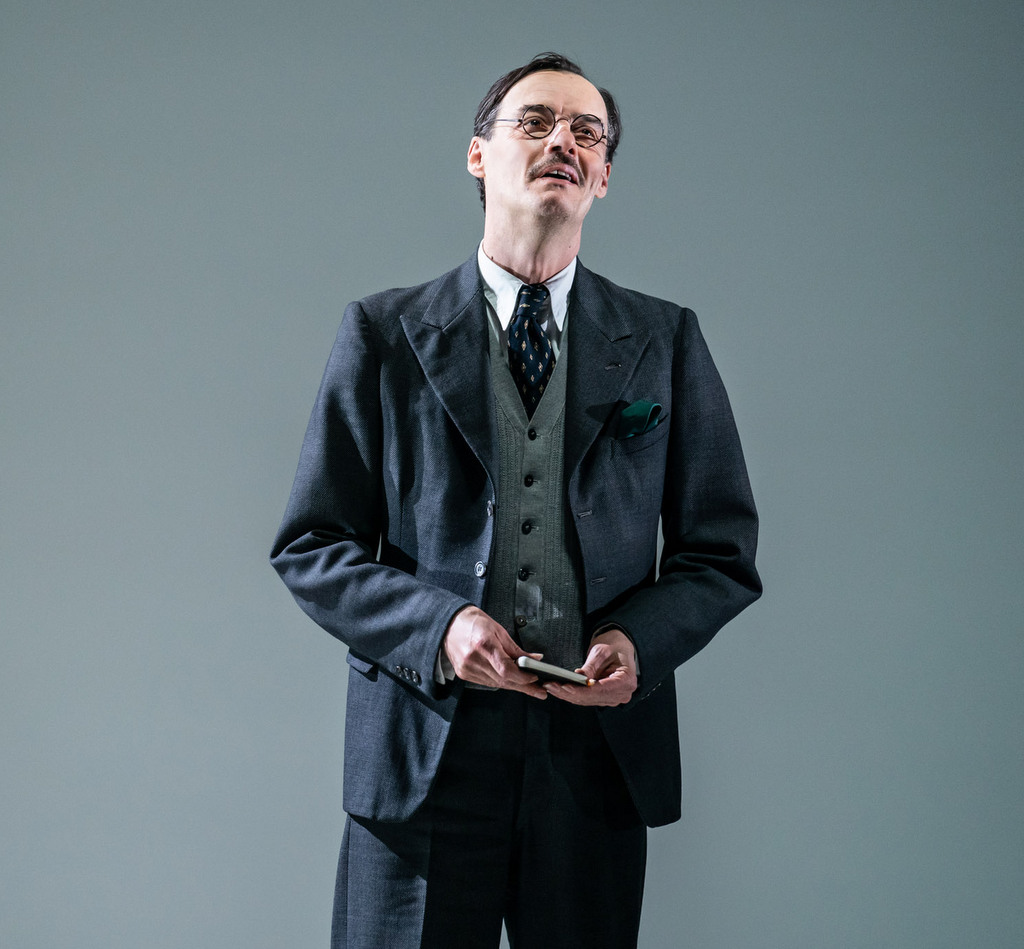
Paul Hilton in ‘The Inheritance,’ directed by Stephen Daldry, designed by Bob Crowley, written by Matthew Lopez inspired by the novel ‘Howards End’ by E.M. Forster (Matthew Murphy)
In keeping with this truism/theme of the play, we note Toby’s mismatched relationship with Eric Glass (Kyle Soller) a social activist who understands the full doom of Trump’s win and how it will impact every current policy from health care to the Paris Climate Accord to gay rights. While Toby basks in the fame of his novel’s success then prepares for the opening of his play on Broadway, he slowly disintegrates eaten inside out from trying to keep his lies suppressed. Meanwhile, Eric Glass befriends upstairs neighbor, frail Walter Poole, whose partner the robust titan of industry, Henry Wilcox has little time for.
From this foursome Lopez strikes loose parallels with Howard’s End: the Schleigel sisters (Eric and Toby) and Mr. and Mrs. Wilcox (Walter Poole and Henry Wilcox). Lopez furthers the complications with these relationships to eventually cue in Leo’s metamorphosis and Toby’s disintegration.
Henry was married with two sons; when his wife died he became enamored with Walter. They coupled and Walter lovingly raised the boys, maintaining the family dynamic while Henry often was away on business. Toby grows apart from Eric as he bathes in his success and becomes attracted to actor Adam (Samuel H. Levine) the wealthy counterpart of the homeless, uneducated, look alike hustler Leo who eventually writes the story of their lives. Toby and Eric split and Eric is devastated. Walter dies; Henry is devastated. Walter leaves a house upstate to Eric. Walter intuits that Eric spiritually can be the caretaker of the house because of his generous, charitable nature. However, Walter’s death bed wishes are not honored when Henry, motivated by his grasping sons, denies Walter’s request and burns the paper on which he wrote his “last will and testament.”

(L to R): Kyle Soller, Paul Hilton, John Benjamin Hickey in ‘The Inheritance,’ directed by Stephen Daldry, designed by Bob Crowley, written by Matthew Lopez inspired by the novel ‘Howards End’ by E.M. Forster (Matthew Murphy)
From then and there the conflict augments and we become intrigued as to how the upstate house will eventually land in Eric’s lap, for surely he is more deserving than Henry’s crass sons.
The mystery why Walter bequeaths the house to Eric (it is staged as a miniature replica colonial, back lit, opening up to reveal rooms and furniture in an adroit, beautiful, sleight-of-hand design by Bob Crowley) becomes revealed by the end of Part I. It is a stunning revelation tied in to the inheritance the previous gay generation left our writer cadre of the present. That generation was a community of which Walter was one of the last to die.
This greatest generation of the “war” from the last two decades of the 20th century experienced the scourge and crucible of fatal autoimmune deficiencies. These were the lost generation. They never came out from under the torments and tribulations of the AIDS epidemic that struck thousands of the most gifted and talented in the artistic world who often died alone, unloved, invisible, without hope, the spurned contagious lepers of their time, their blood toxic to the touch. It was only until after the gay community, celebrities, politicians and other notables joined together to pressure scientific researchers to conquer the disease with the right cocktail of medications that the AIDS war ended. Theirs was an amazing endeavor that took twenty years. But for this war generation who died, one after the other expending their blood, sweat and tears, the current writers would not be able to luxuriate in indulgent sex without concerns about contracting dreaded kaposi’s sarcoma.
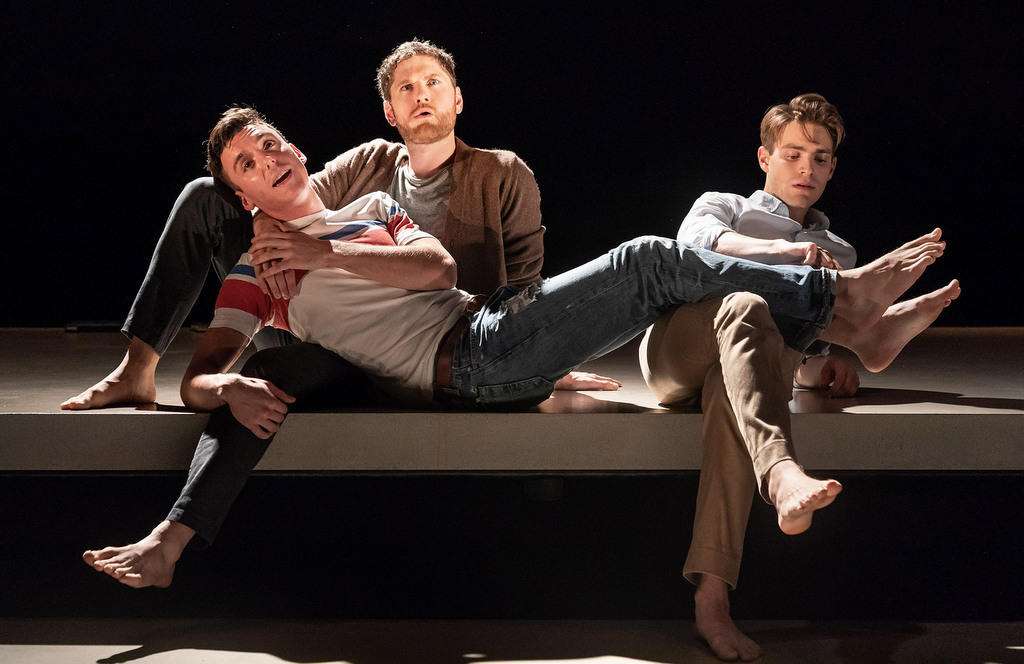
(L to R): Samuel H. Levine, Kyle Soller, Andrew Burnap in ‘The Inheritance,’ Part I, Part II, written by Matthew Lopez inspired by E.M. Forester’s ‘Howard’s End,’ directed by Stephen Daldry, design by Bob Crowley (Marc Brenner)
Walter’s loving nature inspired him to take in many of the AIDS generation who were dying. He took care of them in the upstate house, much to Henry’s great chagrin. But the moral imperative was great and he nursed the dying victims of “the war” at this serene refuge assisted by Margaret (the wonderful Lois Smith who shows up in Part II) who also lost a son to “the plague.” Thus, the dying don’t have to face the fear and darkness alone, but endure it knowing they are loved. As Eric is told the story others appear to verify the beauty and sacrifice of this war generation so that current members of the gay community might live in a greater peace, free from the noxious, soul-draining, heartbreaking physical wasting of AIDS.
As the end of Part I spools into eternity, we recognize that this is not only a play about the gay community (the tableau of them sitting around Bob Crowley’s white platform leaning on each other is fabulously akin to a famous Renaissance painting). Others were impacted by “the plague.” And they are no less important; the disease didn’t discriminate; toxic blood contamination was passed to others, male, female, straight, gay, transgender, children, elders, those of every ethnic culture. The difference is the cruel ostracism of being gay was further heightened by having AIDS. Stonewall could not answer a scourge, only medical science can, racing against death. And it did!
Finally, as Part I concludes, Lopez reminds us that while we live, we prepare a place for the next generation through our struggles, our trials and our difficulties. And it is this journey that must be told, even shouted from the rooftops to the younger generation who are our inheritors.
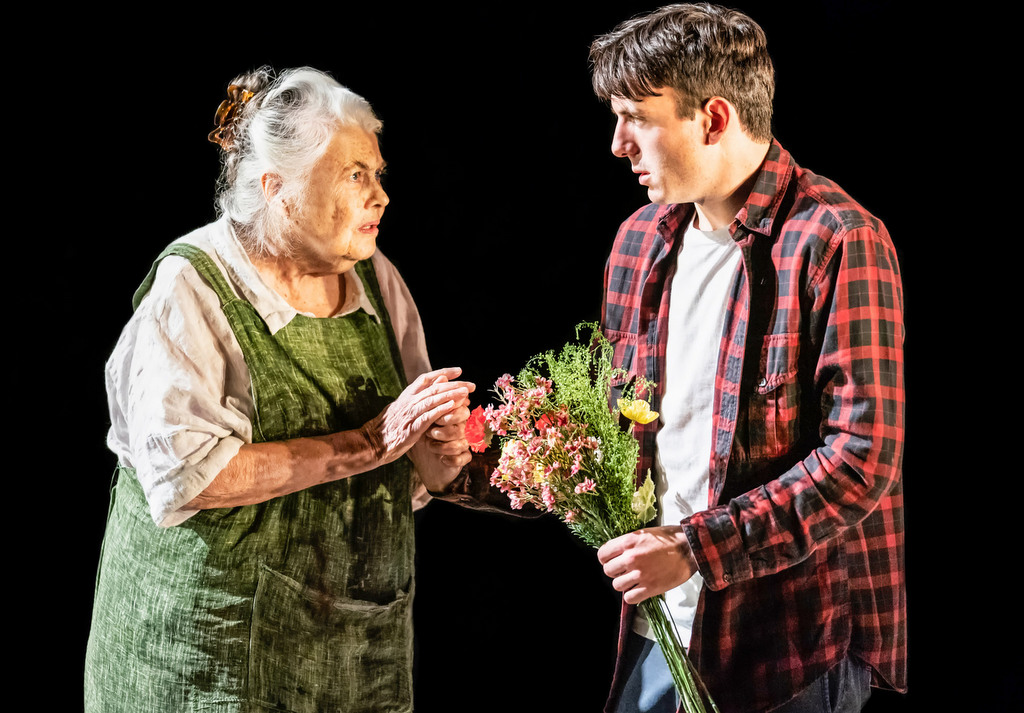
Lois Smith, Samuel H. Levine in ‘The Inheritance,’ directed by Stephen Daldry, designed by Bob Crowley, written by Matthew Lopez inspired by the novel ‘Howards End’ by E.M. Forster (Matthew Murphy)
If Part II is not as haunting and dense, it is dramatic with incredible monologues of truth delivered. Among others, Lois Smith’s Margaret shares her story and Toby revels his past as an entrance to what he will choose for his future. Both are amazing.
The cadre of friends matures, but into the scene Leo emerges picking up where wealthy Adam (Samuel L Levine) left off in Part I. In Part I before the stunning end, Lopez sets us up, as Adam and Toby confront each other, competitive wills. Adam as the star of Toby’s play is getting more acclaim than playwright Toby. Toby accuses Adam of having an easy life absent fear. In an exceptional monologue (end of Act I, Part I) Levine’s Adam describes an incident in a bath house in Europe whose impact is at first heady and divine in its allurement. But when it is over Adam’s realization converts the event to what it is, frightening and sinister in its sadomasochism and shocking realism. The sex was unprotected and there is blood, much blood. But because Adam confides in his parents, they act quickly to get the right medications. For the second time since Adam was adopted into wealth, Adam gratefully acknowledges his parents saved his life, this time from “the plague.”
Lopez provides an striking contrast in characterization between Adam and his doppleganger Leo (also portrayed by Samuel L. Levine). Levine’s portrayal of both is superbly vital. It suggests the differences between their class, education, personality, perceptions. He plays each acutely with superlative specificity. Manifested is the vast demographic of gays and their experiences. They are not always wealthy and/or educated or elite stereotypes. Indeed, sex is a tool and hustlers who may have been bisexual were caught up in the war in the last century. However, in 2018 the drugs are a salvation and the hope for changing one’s circumstances is ever-present.
As a homeless man, Leo has left a dire situation and his means of support is hustling. Of course he flirts with danger and the threat of disease hangs over him with every trick. That Toby uses Leo as a trick, then boyfriend to satisfy his lust for Adam because Leo looks exactly like Adam, becomes one of the linchpins of Part II. There is even a duplication of the scene Adam described to Toby in Part I, cruelly revived because Leo does not choose this for himself, Toby chooses it for him. In other words, Toby would have sadomasochism forced on Leo in a cruel remembrance of what Adam told him. Toby’s descent is made clear in this scene. And soon he will have no where to go but the abyss of darkness reflected in his soul.
A second linchpin is Eric’s and Henry’s relationship. Despite all of Eric’s friends’ counsel after Henry discusses why he is a Republican and supports Trump, Eric decides he will accept Henry’s proposal, though their ethics, morals and emotional impulses are antithetical. Ironically, we note that Eric is blinded by Henry’s wealth and charm and intuit Eric is headed for another disastrous relationship.
How Lopez resolves these problems using parallel elements from Howard’s End is intricate but inevitably logical. He fleshes out the characters of Toby, Eric, Henry and Leo with lustrous precision bringing each to their own resolution toward redemption, damnation or apotheosis as in the case of Leo. In Part II, Lopez emphasizes the aspect of joining past and present to build on the inheritance of what others have forged out from their earthly trials. Ultimately, because the protagonists (Eric, Margaret, Leo, Henry) have reconciled and recognized the contributions, love and sacrifice of those who have gone before them, they are able to create renewal and rejuvenation in their own lives and the lives of others. Leo’s recovery in Eric’s house (which Henry finally gives Eric) allows Leo to receive the eventual grace, education, scholarship that Henry Wilcox initiates in remembrance of his love for Walter. And thus, finally, Leo is able to tell this story of all of them of what they inherited-the love, the sacrifice so that they can bridge the present to inspire and bring hope to future generations.
Yes, the plot of The Inheritance is labyrinthine, some parts bloated. But the adroit shepherding of performances and staging by director Stephen Daldry help to tease out the actors’ performances so that overall the effort is spectacular.
This is a phenomenal work. It especially resonates in our current climate which looks to be a vast leap backward, but which in another realm of consciousness may bring out the best in those of us who prize love above hate, unity above division, truth above falsehood, a nurturing spirit above cold-heartedness. All of these contrasts Lopez’s work clarifies with a bit of redemption and remorse sprinkled along the way. Powerful, prescient, preeminent!
A special mention goes to the creative team who magnificently with minimalism and seamless charm brought Daldry’s vision into being. These include Jon Clark (lighting design) Paul Arditti & Christopher Reid, Paul Englishby (original music) Bob Crowley (design).
This is going to be an award winner as it was in the U.K. See it to be uplifted and moved. You won’t regret it. The Inheritance is currently at the Ethel Barrymore Theatre (243 West 47th Street). For tickets and times CLICK HERE.
 CAROLE DI TOSTI