Blog Archives
‘Old Friends’ the Fabulous Sondheim Revue with Bernadette Peters and Lea Salonga

Who doesn’t adore Stephen Sondheim’s mastery of the Broadway musical, mentored to him by lyricist and playwright Oscar Hammerstein II? I am loathe to admit I am late to the Sondheim party, not being familiar with all of his musicals. However, the marvelous Old Friends revue, currently running at Manhattan Theatre Club’s Samuel J. Friedman Theatre is a superb opportunity for fans old and new to celebrate Stephen Sondheim’s genius and rediscover some of his greatest songs. But don’t wait too long to get down to the Friedman. Old Friends is in a limited engagement which ends June 15th unless it receives an extension.

Who better to give tribute to Sondheim’s genius than friends who starred in Sondheim’s productions? In the current revue these include some of the cast who were most recently in the Los Angeles production of Old Friends in its North American premiere (February 13 through March 9, 2025). They reprized their roles in the Broadway transfer in March which opened on April 8th. Additionally, Peters and Salonga reprized their roles from London’s West End where Stephen Sondheim’s Old Friends played in a limited engagement at the Gielgud Theater until January 6, 2024. The history of how this production evolved is fascinating. See below snippets from the West End production to get an idea of what you’ll be seeing on Broadway.
With their voices, power and humor Bernadette Peters and Lea Salonga are perfect celebrants of the Sondheim cannon. Cameron Mackintosh wasn’t the first to come up with a revue of Sondheim’s songs. That was Hal Prince’s “Side by Side by Sondheim” in 1976. Then Cameron Mackintosh convinced Stephen Sondheim an update of his music was needed and created “Putting It Together” in 1993. “Stephen Sondheim’s Old Friends” is the third revue and the first one in over 30 years in the US after its run in London.
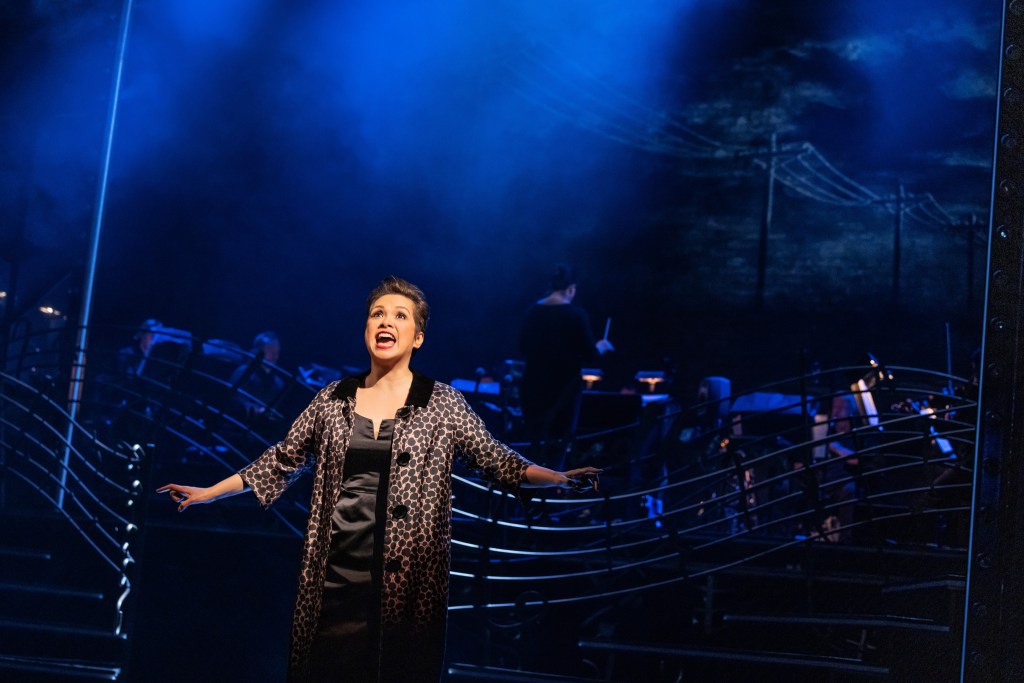
Following the typical format of revues Old Friends doesn’t stray too far, and for some, that will be a joy. However, what makes this production special is not the selection of songs (41), but who brings out new interpretations amidst a backdrop of various suggestive sets alluding to the shows, i.e. Sweeney Todd, West Side Story, Into the Woods, Sundays in the Park With George, Follies (thanks to Matt Kinley’s scenic design) and George Reeve’s projection design. Vitally, there is a segue into clips of “the man” himself and photographs which strike the heart and make one want to read everything that’s out there about Stephen Sondheim.

Jill Parker’s costume design is clever and thoughtful. For example she features Bernadette Peters in a red cape, ready to fend off Jacob Dickey’s wolf with perky ears, giving both performers the fuel to be humorous and endearing in “Hello LIttle Girl” from Into the Woods. Peters makes the most of her comedic funny bone when warranted. She is imminently watchable and mesmerizing. Though the production features Parker’s sleek and front slit gowns-a-glitter, silk jackets and tuxedos, whether show-inspired costumes or concert level TV variety show type costumes, they give off a sheen and a comfort level of old-fashioned nostalgic glamour that is soothing in these rough times heading for what many fear will be a tariff-created depression.

The production holds the emphasis on songs from “Sweeney Todd,” “Company,” “Follies” and “Into the Woods.” Actually ‘”Sweeney Todd” has the largest song selection and the most elaborate looking set design even down to the pies, oven, and barber’s chair where Sweeney slits a fellow’s throat. Stefan Musch’s wig, hair, and make-up design along with Parker’s costumes for Sweeney Todd are appropriately period grotesque making Jeremy Secomb a scary Sweeney and Lea Salonga a crazily macabre Mrs. Lovett. They do a bang up job albeit with a malevolent twist and accent on horror in “A Little Priest” that is less comical than I’ve seen performed in the latest revival in 2023, starring Josh Groban. However, considering the song is without the context, it works well by itself.

With direction and musical staging by Matthew Bourne the segues between songs run smoothly and the numbers in front of an elaborate show curtain with arches of light and lighted graduated steps when the curtain opens to see the 14-piece orchestra, provide the set for Bourne and choreographer Stephen Mear to stage the glamorous portion of the revue. With original orchestrations by Jonathan Tunick, Stephen Metcalfe’s musical arrangements soar with harmonic lyricism. Warren Letton’s lighting design and Mick Potter’s sound design are near perfect enhancing the overall technical aspect of the production.
Performing with song and dance in front of the curtain provides the time for set changes. Songs from Company, and Merrily We Roll Along are featured simply with the highlights on the performer. For example Peters and Salonga sing “Side by Side,” as the show opener with a quick segue to full stage as the curtain opens for “Comedy Tonight” by the two stars, Jason Peycooke, Gavin Lee and the Company wearing shimmering Roman-style drapes over gowns and tuxedos.
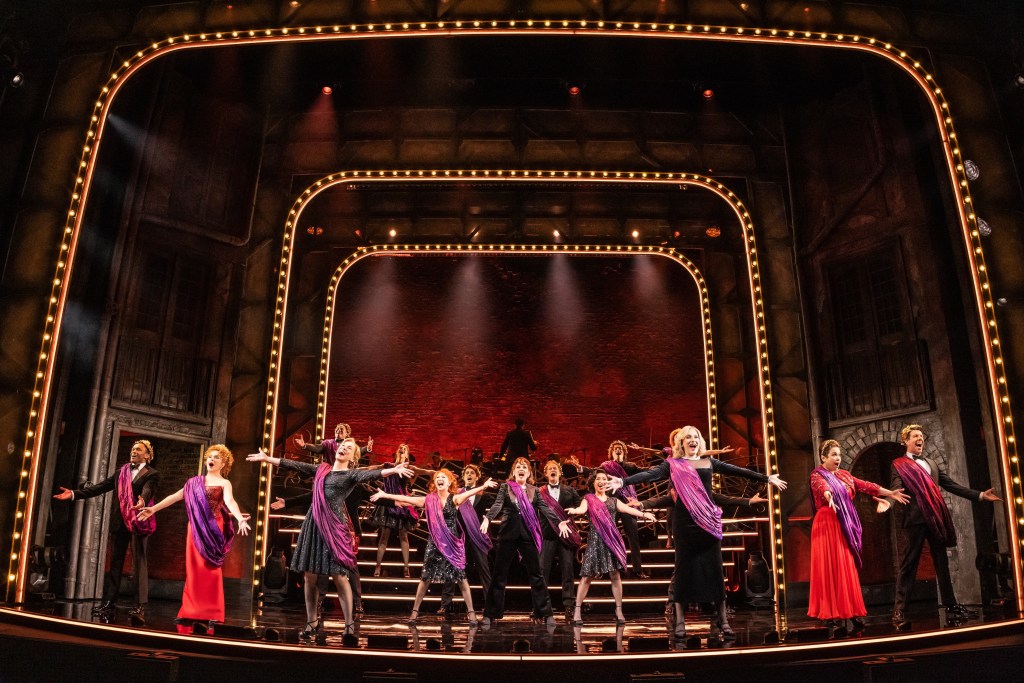
Particularly strong numbers involve the 17 cast members singing and dancing the songs “Company,” “Into the Woods,” “Comedy Tonight,” and of course “Sunday” from Sundays in the Park with George, whose scrim of the painting appears as the set piece to close Act I before the intermission. Seeing Georges Seurat’s painting is always a stunning visual effect.
Wonderful interpretations of “Send in the Clowns” by Peters,”Ladies Who Lunch,” by Beth Leavel, “I’m Still Here,” by Bonnie Langford (who does an amazing split to conclude the kick line number), and “Everything’s Coming Up Roses,” by Salonga prove the power of the music in the specific instrument and personality of the performer. “Being Alive,” then “Side by Side” as the finale are superb capstones to conclude the joyous and heartfelt evening that is a tribute to the greatness of Stephen Sondheim. Now I’m going online to order his biography by Meryle Secrest.
Old Friends runs at The Samuel J. Friedman, 2 hours and 45 minutes, including a 15-minute intermission. https://sondheimoldfriends.com/
‘Sweeney Todd,’ His Vengeful Spirit Ranges in Thomas Kail and Alex Lacamoire’s Magnificent Revival

With a nod to the original 1979 Hal Prince directed Sweeney Todd: The Demon Barber of Fleet Street, Broadway (1989, 2005), and off Broadway revivals (2017), Thomas Kail (director) and Alex Lacamoire (music supervision) achieve breathtaking majesty in this 2023 revival. Emphasizing immutable themes and character archetypes inhabited by the brilliant, sonorous Josh Groban and comically conniving, mischievous Annaleigh Ashford, Sweeney Todd’s thrilling, operatic music spins out a Jacobean revenge tragedy for our time. With music and lyrics by Stephen Sondheim and book by Hugh Wheeler, from an adaptation by Christopher Bond, audiences at the Lunt-Fontanne Theatre are having a rollicking time, gauging from their cheers and whoops, as the cast takes their bows.
The artistic team’s well-thought out choices restore the musical (more like an opera), to its epic, grand stature. The suspenseful Sweeney story is arrayed through ingeniously integrated spectacle, delivered by Nevin Steinberg’s sound design, Mimi Lien’s scenic design, Emilio Sosa’s costume design, Natasha Katz’s lighting design and Steven Hoggett’s choreography. All cohere, enhancing Kail’s acute vision of Sweeney’s obsessive need to pursue vengeance, with an assist by an avid, affectionate partner, Mrs. Lovett, who manipulates him into her embrace, using keen practicality and amoral, surreptitious duplicity.

Stephen Sondheim’s exceptional music, delivered by the twenty-six piece orchestra’s soaring sounds, is superlatively arranged by Jonathan Tunick. And under the musical supervision of Alex Lacamoire, the immensely variable score evokes the piercing macabre, the lyrical romance and the chaos of despair. Indeed, every phrase, every note resonates tonal moods of light and dark, that swirl like fateful winds directing the emotions of the lead characters. All of this creative gorgeousness unfolds in the service of displaying humanity in its full-bodied fallibility, as it plunges from grace, victimized by circumstance and the Satanic designs of others. And, as the culprits free-fall, wallowing in a surfeit of pride and sardonic delight by killing the wicked with impunity, we are drawn into lurid expectation, aroused to anticipate which corrupt victims will be sliced by Sweeney’s razor, next.
Originally taken from popular Victorian fiction known as penny dreadfuls, the name Sweeney Todd was first noted in ‘The String of Pearls.” The plot elements evolved to other genres, but the horror tale of the murderous barber slitting his victim’s throats, while Mrs. Lovett’s pies hid the ground-up fleshly bodies, was enhanced by Christopher Bond’s addition of obsessional revenge. These elements inspired Sondheim and Wheeler because of their mythic and dramatic possibilities.
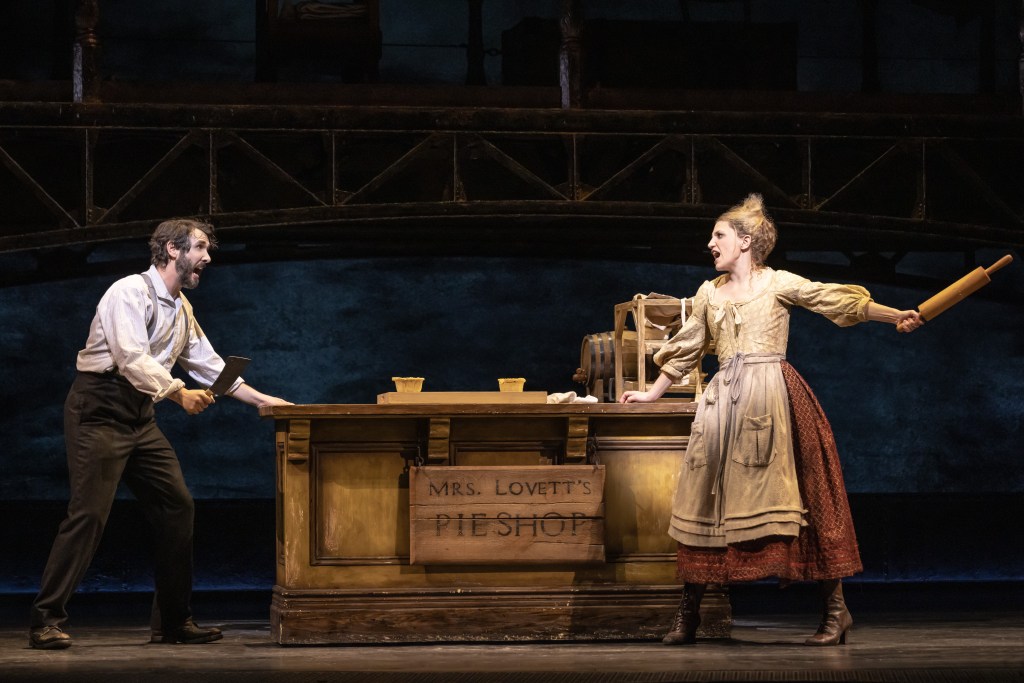
The musical begins, as the ensemble of 19th century Londoners sets the scene (“The Ballad of Sweeney Todd”). They are the Greek chorus, who sing the ballad at key moments throughout the musical, making judgments about Sweeney Todd and his relationship to the world he lives in. As they sing, Sweeney emerges from the grave looking gruff and moody to animate the Sweeney legend and receive grand applause, as the audience acknowledges Groban’s exceptional vocal gifts and acting skills. Indeed, his well conceived, profound portrayal of the demon barber is worthy of every second of applause he receives.
Thus, unfolds the story of injustice, corruption, oppression, obsession, vengeance, mayhem and murder. The latter, Sweeney justifies in the Act I song “Epiphany,” with his “novel” definition of two kinds of “men,” who comprise the entire human race which deserves to die. These are the upper class wicked, who oppress the poor, and the miserable lower class, for whom death is a relief. When he sings this, Sweeney has gone over to “the dark side,” choosing to expiate his rage and hatred on his fellow human beings, including himself, a key theme of the tragedy. However, at least Sweeney recognizes what he is, where the hypocrites he murders (especially Judge Turpin and the Beadle), pretend perfection.
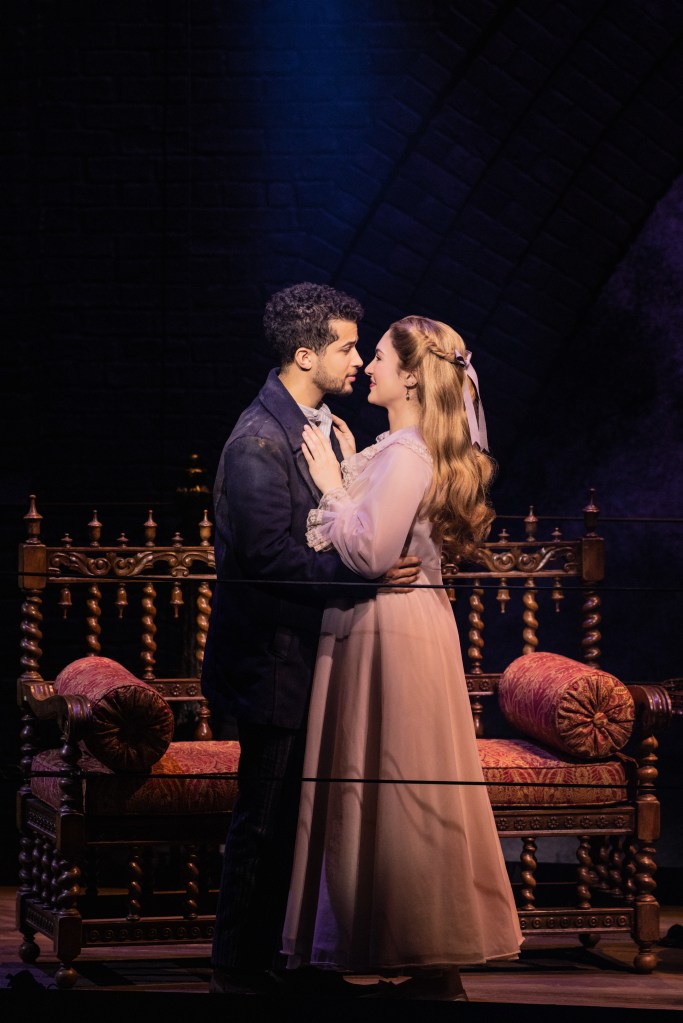
After the epilogue, the scene moves to flashback and shifts to the past, enacted by the spirits of those brought to life to evoke the tragic tale of the barber, his wife, the duplicitous paramour, a corrupt judge, his assistant and the barber’s grown-up daughter and her lover. With the exception of Johanna (Maria Bilbao) and Anthony (Jordan Fisher), all are victims of their own weakness as they succumb to a fateful destiny. Their macabre acts and the ensemble’s ballad refrain, which threads throughout, compel us to listen and learn.
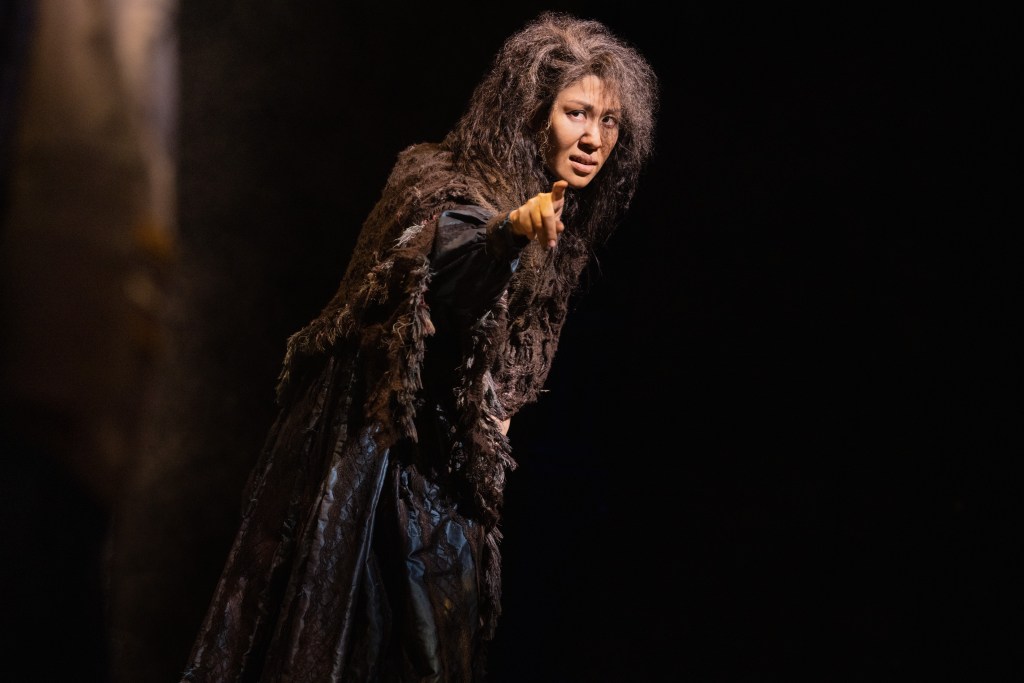
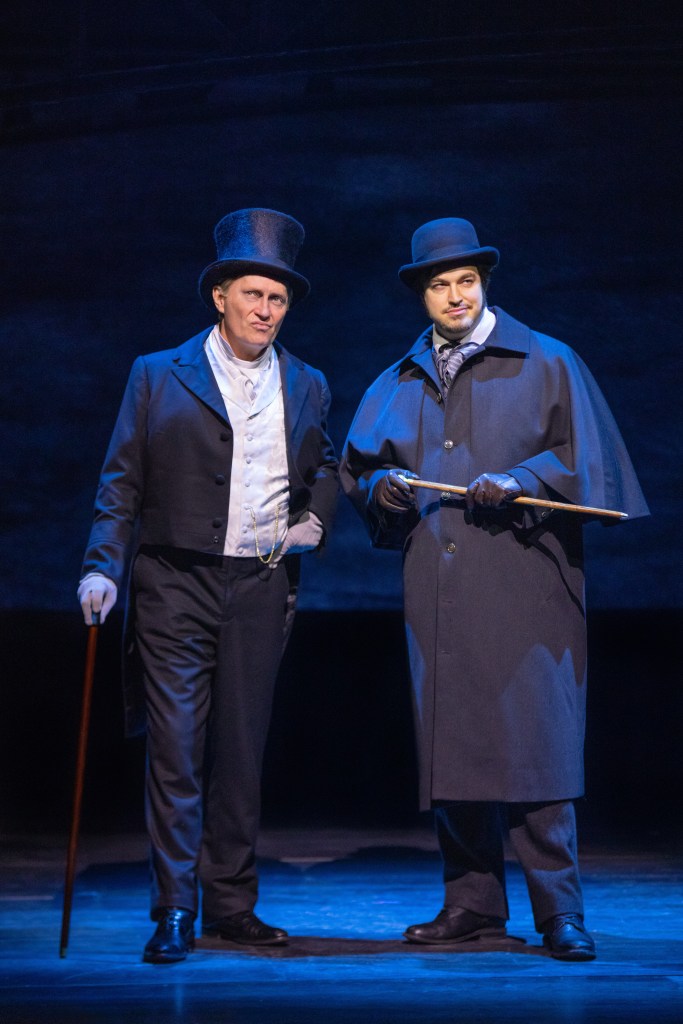
Convicted of a trumped up crime by the sinister, lascivious, Judge Turpin (the fearful and excellent Jamie Jackson), the barber is shipped off in chains to Botany Bay, Australia, to intentionally separate him from his beautiful wife Lucy, and young child, Johanna. Over a decade later we meet Sweeney, who disembarks from a ship in London with Anthony (the golden voiced Jordan Fisher), a sailor who rescued him, and to whom he sings of Turpin’s injustice (“The Barber and His Wife”). Returning to his old apartment, which is owned by the impoverished Mrs. Lovett (Annaleigh Ashford), who has a pie shop no one frequents because her pies are just crust (“The Worst Pies in London”), Sweeney learns from her that Lucy was raped by Turpin and Beadle Bamford (the fine John Rapson).
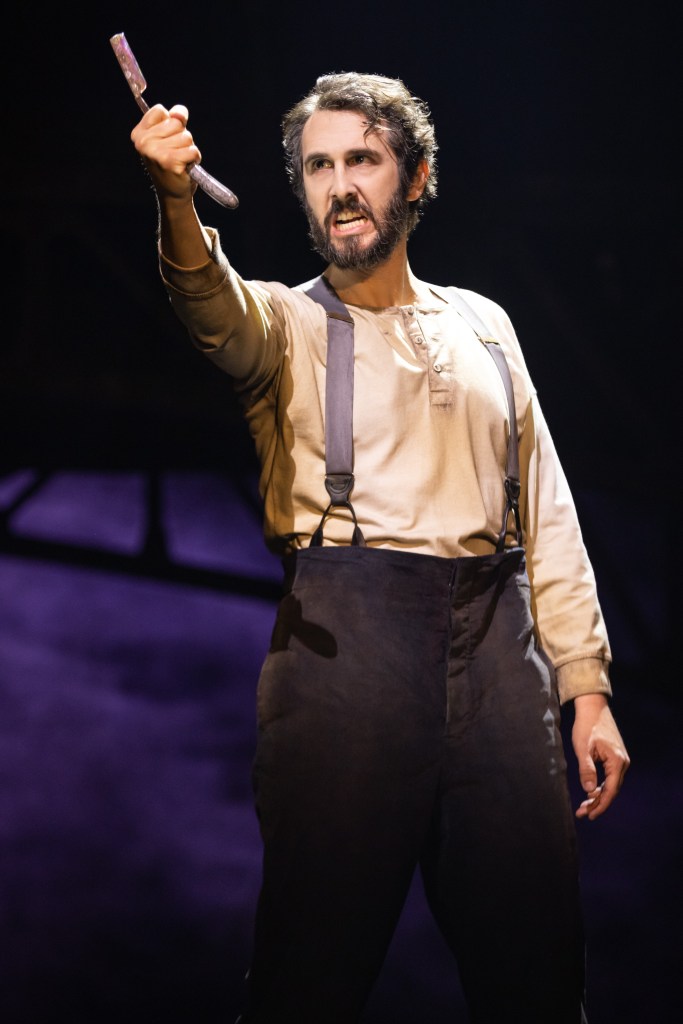
As Lovett sings (“Poor Thing”), we discover that Lucy became so demoralized and degraded, she swallowed poison. Taking pity on Johanna, Turpin adopts her as his ward and raises her under his possessive, watchful eye. Under his oppression she is like a sightless bird in a cage, who is blinded so it sings beautifully. In the following scenes we understand the bird metaphor, as it relates to Johanna imprisoned in a lovely mansion, unknowing of her past and the wicked Judge’s corrupt actions and scurrilous intentions.
Grogan’s Sweeney becomes manic with rage learning of Lucy’s plight. Consumed with painful thoughts of her sexual abuse at the hands of the powerful, “moral” judge, who cravenly destroyed their family, and who now has his Johanna, he vows revenge with the help of his razors (“My Friends”), which Mrs. Lovett kept for him. Mrs. Lovett, who always fancied Sweeney, seizes the opportunity to encourage him in his revenge, suggesting he open a barber shop above her pie-making establishment. As he works, he can wait for the opportunity to kill Turpin (“Wait”). It is there that the formerly innocent Sweeney enacts his first homicide of blackmailer Pirelli (the comical and insidious Nicholas Christopher), who threatens to expose Sweeney’s true identity and turn him over to Beadle Bamford, a death sentence.
This is the first blood-letting, the ensemble assures us in “His Hands Were Quick,” a reprise of “The Ballad of Sweeney Todd.” But it’s not the last. The fates are spinning. Mrs. Lovett distracts Pirelli’s assistant Tobias (the wonderful Gaten Matarazzo), who eventually grows close to her and believes her lies that his boss “went away.” Ironically, he becomes the instrument of karmic discovery, which brings down the killing machinery of the Todd/Lovett enterprise.
Ashford’s seduction and insinuation into Sweeney’s life, and Groban’s Sweeney, at first reluctant, then gradually swayed by her cajoling advances, are a couple made in hell, as they align in comedic malevolence. Their performances are humorously symbiotic and perfectly realized with such spontaneity and verve, we are subtly sucked into their foul deeds and initially cheer them on. Jamie Jackson’s Turpin is so goose-bump abhorrent, arrogant and hypocritical, when Sweeney finally kills him, the audience cheers.

However, it takes the appropriate time for Sweeney to avenge Turpin’s horrors. These “drive him up the wall” and push him to accept the god of vengeance and unforgiveness as his master. After Sweeney is interrupted from killing Turpin and despairs that he’s lost his chance, he appoints himself an executioner of “mankind” (two types of men), in “Epiphany.” It’s a show-stopping number and Groban is in his full, lush glory. In a profoundly clever Sondheim transition, ever the opportunist, Ashford’s Lovett soothes Sweeney’s explosive mania. She conceives of an ingenious way to dispatch the bodies of those “who deserve to die,” by baking their flesh into savory meat pies (“A Little Priest”). Forever, she elicits his gratitude and affection, which she gladly receives because she is so smitten with him and wants to supplant memories of Lucy with her love and murderous complicity. She becomes his invaluable asset for vengeance with impunity.
Sweeney’s transformation from doom and gloom to joy and laughter occurs when he “gets” how Mrs. Lovett will help rid him of the evidence of his murders. Groban’s Sweeney is absolutely mesmerizing in this scene. As the realization of her lovely idea takes over his whole being, his interior darkness shifts to light, as if a burden has been lifted. Happily, he binds himself to her in a euphoric irony of evil. Ashford’s mastery of his soul lures him and couples him to her, as they fly toward doom, too taken with their genius to be bothered by the possible consequences of their wicked amorality. Thus, together they answer the world’s corruption, emphasizing the theme of how human beings eat one another, taking the devouring from metaphor to realty.
The portrayals and performance of this clever song marries these actors in their brilliant talents and shared generosity. It is one of the most memorable moments in a production that is filled with many memorable moments. Importantly, as we are relieved to see them laugh, and laugh with them as they delightfully plot against those high born and low, who deserve to die, fate spins the tragedy of consequences and accountability in Act II.

Meanwhile, in a second feeder plot, whose action develops in conjunction with the scenes between Sweeney and Mrs. Lovett, Fisher’s Anthony comes upon the grown-up Johanna (Maria Bilbao). Bilbao aptly sings about birds that are caged (“Green Finch and Linnet Bird”). Listening to her (Bilbao’s flighty performance and lyrical singing are stunning), Fisher’s Anthony inquires her identity from a Beggar Woman (the incredible Ruthie Ann Miles), who is always near Mrs. Lovett’s or the Judge’s mansion. Anthony falls in love at first sight (“Ah, Miss,” “Johanna”). Emboldened by the Beggar Woman’s admonition that he should stay away, he pursues Johanna who is receptive to running away with him to escape marriage with Judge Turpin, her future intended. When Turpin discovers her plot with Anthony, he locks her in an asylum, waiting for her to relent.
How these characters reach the end of themselves in freedom or bondage unravels in a darkening Act II. Only then, do we realize, like Sweeney, how “kindness” and “friendship” can be exploited to deceive those weakened with unstable and desperate passions. As the emotionally seductive Mrs. Lovett, whom we and Sweeney come to delight in, then are horrified by, Annaleigh Ashford’s portrayal is sumptuous and grand. Her antithetical character is Ruthie Ann Miles’ Beggar Women, with whom Mrs. Lovett secretly is in competition. Throughout, the Beggar Woman is the key upon which events turn. Also, she is the wise Cassandra that no one listens to because they look at her outer appearance (“City on Fire”), and think her mad. This important theme is one more irony the fates spin out in this fabulous revival.
With spot-on performances by the entire cast of those who “eat” and are “eaten,” of the righteous innocent who escape, and of the hapless, beautiful, trafficked Lucy-types, who are in the “wrong place at the wrong time,” and are abused by men and women alike, all the characters “get what they deserve.” The warning is that memento mori. The same will happen to us, though it may not be at the hands of the Sweeney Todd’s of the world. If vengeance is sought, let karma deliver it. Pursuing it is its own destruction.
This Sweeney Todd affirms stylized truths that remind us of the precarious balance between justice and vengeance, love and obsession, helpfulness and selfishness. In its monumental arc where duplicity, self-deceit, betrayal and cruelty play out in the characters’ lives, the messages are profound. The characters in their impulses and desires are terrifying, not in the horror genre sense, but in their reflections of human emotions, revealing what people are capable of. Kail and the actors have teased out incomparable, believable portrayals. We have only to read the news to see their conjunction with our time, indeed, all time.
This devastatingly human Sweeney Todd, whose only hope is an escape through love, is a classic. It is a fitting revival of a masterwork that must be experienced live to feel its grandeur. For tickets go to their website or visit the Lunt-Fontanne Theatre at 205 West 46th St. https://sweeneytoddbroadway.com/
‘Into the Woods’ Review: Glorious Revival Highlights Sondheim’s Masterwork as Uproariously Funny, Sonorously Poignant
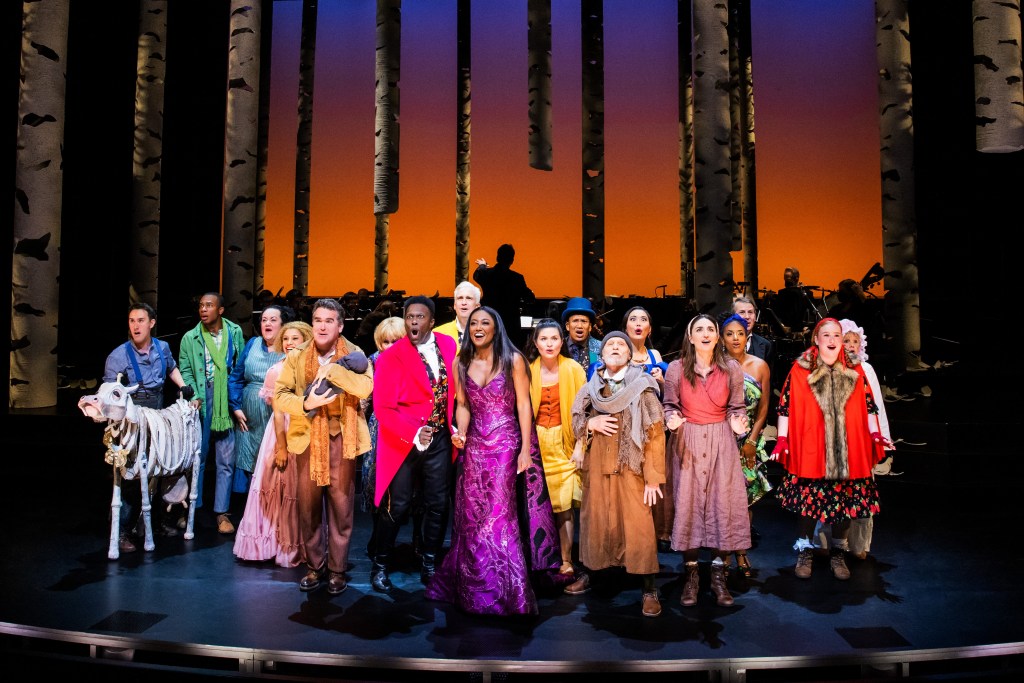
With music and lyrics by Stephen Sondheim, book by James Lapine and orchestrations by Jonathan Tunick, Into the Woods is in its brilliant fourth revival on Broadway at the St. James Theatre. This iteration magnifies the greatness of Sondheim’s iconic work with affecting power. Thanks to the cast and creative team, the production is a towering achievement.
Intricately making the complex crystal clear, the creatives have woven fantasy and magic into stylized perfection. The company conveys Sondheim’s sharply, ironic lyrics and Lapine’s clever, comedic book with campy authenticity that befits the tone of the production. All the while the cast twits their characters and performances with sheer abandon and fun.

If fairy tales embody archetypes that float in and out of our unconscious, this Into the Woods reveals how and why. Ancient folklore transfixes us because ultimately, it is immutable and intensely personal. Lapine and Sondheim have given us Into the Woods as a gift of wonder and wisdom and the amazing director (Lear deBessonet), has channeled their vision with grace and beauty that touches our souls.
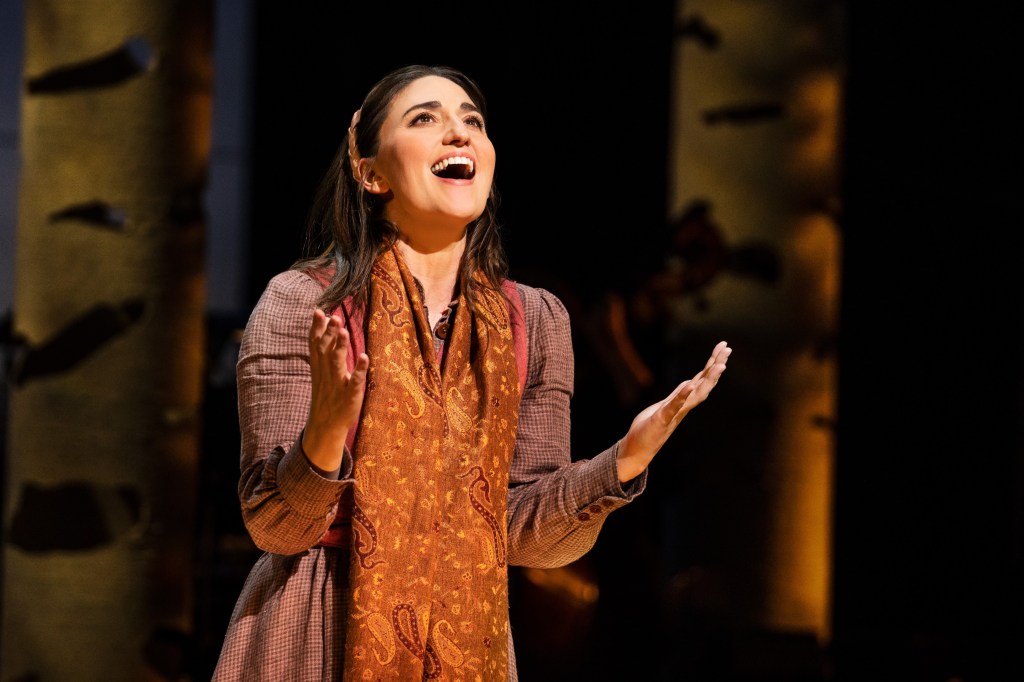
Transferring from New York City Center Encores!, deBessonet’s metaphoric, symbolic, slimmed down production continues to thrill enthusiastic audiences as it takes them on the familiar roller coaster ride of highs and lows with humor, pathos, and sterling performances by an exquisite cast. The multitalented actors with comic flair portray the indelible Little Red Riding Hood, Cinderella, the Witch, two Prince Charmings and more. They romp with delight in Act I and with the searing edginess of moment and bitterness, they shed their “happy” in Act II. The two acts encompass the whole of our life’s experience; it is satisfying yet bittersweet as illumination becomes the true prize of living.
This production is bar none fabulous and appropriate thematic fare for young and old who have encountered their share of giants, witches and adventures into dark, foreboding places. The characters’ journey quest is the linchpin to the fulfillment of their dreams, not only returning wisdom and enlightenment, but moving them from innocence to experience. And the music, Sondheim’s soaring melodies are sensational. Presented by the golden-voiced cast and accompanied by The Encores! Orchestra under Rob Berman’s fine direction, the score has staying power that remains with one long after the audience’s raucous standing ovations end at the last curtain call.

Indeed, de Bessonet’s vision of minimalist staging, pared-down scenic design (David Rockwell), spare lighting design (Tyler Micoleau), and Andrea Hood’s unpretentious costume design work beautifully. Without costly extravagances and unencumbered by visual distractions, we are totally focused on the music, lyrics, and acutely spun characterizations portrayed by the actors’ dynamic performances.
For example the settings of the three families (Cinderella’s, the Baker and his wife, Jack and his mother), are suggested with old-fashioned cut-outs of their homes, suspended above their playing area as their family interactions and conflicts unravel. Rockwell’s suspended birch tree trunks suggest the sinister forest of shadowy fears all must confront. Combined with Micoleau’s atmospheric lighting and large evocative moon that rises and falls to “light the way,” the elements summon the surreal and illusive.

Additionally, Andrea Hood’s apt color-coded costumes define each character with particularity and interest. For example she employs primary hues (bright yellow and red jackets), for the comedic, over-the-top Prince Charmings. For the earthy folk heroes with whom we identify, she fashions rosey browns for the Baker and his wife. Their grounded dream to have a baby is one couples might most identify with.
Splendid, spot-on performances by Sara Bareilles as the Baker’s Wife and Brian d’Arcy James as the Baker showcase the common folk and the experiences of marriage. As a beautifully blended husband and wife team who must confront and satisfy Patina Miller’s scary-funny witch to fulfill their baby dream, the actors are in lockstep. Their duet “It Takes Two,” knocks it out of the park. Bareilles’ interpretation of a wife who controls her husband by surreptitiously winding her way around his machismo is brilliant. The audience catches her every nuance, every shrug of the shoulders. For his part D’arcy James’ pretend bravery masking fear is so aptly humorous. And in Act II d’Arcy James “No More,” sung with David Patrick Kelly’s Mysterious Man is heartrending. Our emotions are swept up as we agree there must be an end to the seasons of pain between fathers and sons, parents and children.
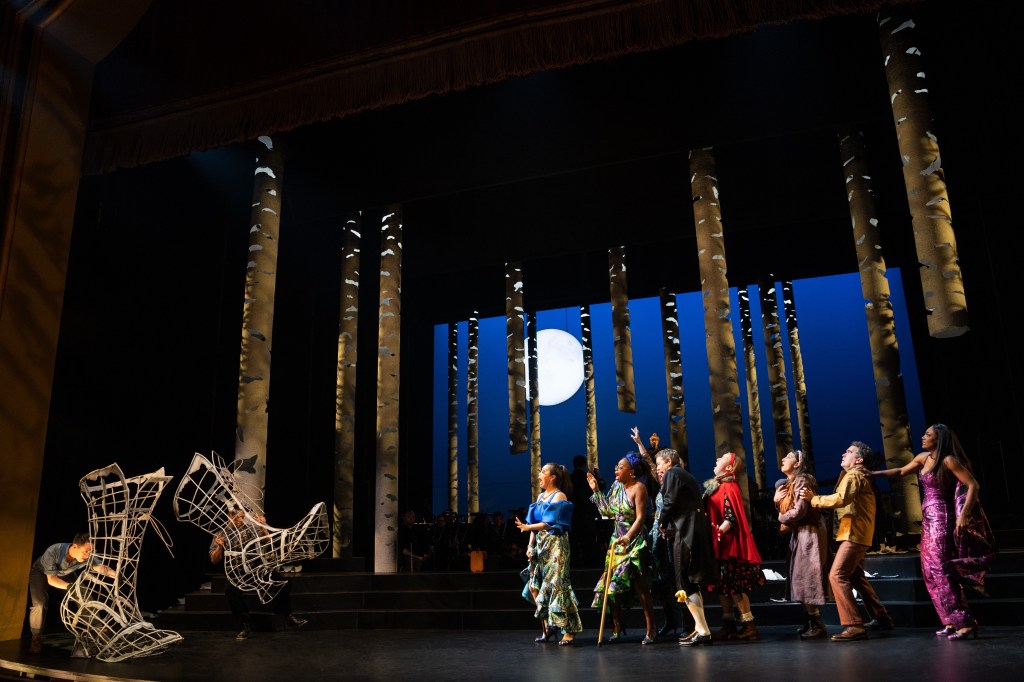
The two Prince Charmings, Gavin Creel and Joshua Henry, have choreographed their movements to represent the ineluctable adornments of seduction with verve and just enough hyperbole to make them deliciously palatable and hysterical (“Agony”). The wonderful Phillipa Soo’s dreaming Cinderella who sings her feelings with Bareilles’ Baker’s Wife resonates with beauty and humor (“A Very Nice Prince”). Soo’s awkward, klutzy Cinderella who falls every time she joins the Baker’s wife “lands.” Soo always gets a laugh as the audience appreciates the dreamy, ditzy humanity of this princess-to-be who humiliates herself. Indeed, we also appreciate that Cinderella is much more astute in Act II when the realities of her marriage to the Prince confront her full force.

Julia Lester’s Little Red Riding Hood plays to the audience, breaking the fourth wall with success as one of the most beloved of fairy-tale characters. As Little Red, Lester scarfs down all the treats before she makes it to grandma’s house. Thus, Gavin Creel’s Wolf is all the more satisfied after he scarfs her down. Their scene together is uproarious (“Hello, Little Girl”). Creel’s seducer Wolf is appropriately smarmy which Lester tweaks as the less-than-innocent Little Red, who enjoys tempting him.

Creel does double duty as seducer of the Baker’s Wife. Bareilles’ formerly faithful wife in Act I submits to the wolf Prince Charming in Act II (“Any Moment”), seeking something more. Creel pulls out all stops recalling to our remembrance the wolf metaphor in Act I. Princes and wolves are two sides of the same coin, Sondheim and Lapine intelligently note. And Bareilles’ “Moments in the Woods” is poignant and foreboding. Do Lapine and Sondheim punish the Baker’s wife’s behavior as an adulteress? Interestingly, the Prince’s wanderings receive no such comeuppance. Double standards are ever-present and especially when unlike fairy tales, Act II extends into the consequences beyond the artificial, “happily ever after.”

Jack (the superb Cole Thompson), his mother (Aymee Garcia), and the cow Milky White (the sensational puppeteer Kennedy Kanagawa), form the third household. Thompson’s heartfelt “I Guess This Is Goodbye,” and rousing “Giants in the Sky,” are beautifully rendered. The vibrant “Giants in the Sky” Jack sings to inspire himself with courage to save his family, kill the giant and attain the wealth his mother needs. As Jack, Thompson’s stirring faith and hope resound with triumph.

The Witch is the central figure that eventually brings the company together. Patina Miller lives up to the task with her extraordinary performance before and after her transformation when the curse that holds her from her true nature is broken. We understand her love for Rapunzel (Alysia Velez), in the soulful “Stay With Me,” and the tragedy of her daughter’s loss in Act II in “Witch’s Lament.” Perhaps my favorite is Sondheim’s incredible “Last Midnight,” that she sings with power and all the dynamism she can muster. Miller’s performance of the song is memorable as the claws of the giant’s wife (voiced by Annie Golden), enfold her in destruction. Indeed, also with the last song “Children Will Listen” that Miller sings with the Company, she is just stunning.
In Act II the consequences of apparently naive actions performed without thought converge on the main characters who seek to avoid blame in the wonderful “Your Fault.” However, after the death of the Witch and the Baker decrying “No More,” a bittersweet hope returns in the remaining song, “No One Is Alone,” sung by Cinderella, Little Red, the Baker and Jack, who struggle to encourage each other after their losses. Was the journey worth what it taught the seekers? “Children Will Listen,” sung by the Witch and the entire company brings back to life the spirit of those taken by the Giant’s Wife as they relate the lessons learned. We are uplifted and restored by the illumination.
Kudos and praise go to additional creatives not mentioned before. These include Lorin Latarro (choreography), Scott Lehrer and Alex Neumann (sound designers), James Ortiz (puppet designer), Cookie Jordan (hair, wigs & makeup designer), Seymour Redd Press/Kimberlee Wertz (music coordinators).
I have said enough. Go see this marvelous theatrical event which you will not be able to see again with this cast after September 4th. For tickets and times go to their website: https://intothewoodsbway.com/
‘Company’ A Sensational, Triumphant Revival

Five days before his passing on November 26th, and almost two weeks after the long awaited Broadway opening of director Marianne Elliott’s West End transfer of Company to Broadway’s Bernard B. Jacobs Theatre, Stephen Sondheim discussed the revitalization and revision of Company’s updated music and lyrics (with book by George Furman and additional dialogue taken from his work). During this time when many question the direction of theater going forward, we need to remember Sondheim’s parting words.
“What keeps theater alive is the chance always to do it differently, with not only fresh casts, but fresh viewpoints. It’s not just a matter of changing pronouns (related to the protagonist gender switch from Bobby to Bobbie) but attitudes.”
Beyond refreshing, the revival of Company is thought-provoking, expansive and groundbreaking. The female character update of Bobbie (the entrancing, adorable Katrina Lenk in a full on bravura performance) is the linchpin around which five couples revolve and have their being, conceptualized in Bobbi’s mind. As the ironic magnifier and savvy observer of her friends’ relationships, during Bobbi’s quest for herself, the shibboleths of marriage, divorce, partnerships, love and their attendant fears and isolations become exposed with LOL insights and revelations. Then, Bobbie kicks herself clear of them.

Bobbie’s “surprise” thirty-fifth birthday, which her friends hold for her at her apartment initiates the conflict and sets Bobbie musing about herself at “35,” after she listens to their phone messages “spilling the beans” about the party. These are her crazy friends, her company which has been imprinted in our minds with the neon signage “Company” vibrant against the dark before the musical begins.
As her “company” emerges from the recesses of her mind arriving with gifts “she won’t like,” as they humorously excuse their selections telling her to “return them,” they importune her. They underscore how they love her and need her in their lives, singing over and over the searing refrain “Bobbie baby, Bobbie Bubi, etc.” (the phenomenal titular song “Company”). Only when she tells them to, do they wish her “Happy Birthday,” but she can’t blow out the candles of her cake with them watching, ever.
The neon lights in the lettering and bars that swiftly form into frames around the rooms in hers or her friends’ apartments (flashback events) are symbolic and thematically clever, carrying throughout the musical. They suggest the compartments in her mind which consider the strictures binding the couples’ relationships as she reflects about who they are, what they mean to her and whether she wants to be married like them, as they insist she be.

A square neon box frames Bobbie’s grey one-room kitchen in her NYC apartment where the couples crowd in like in the Marx Brothers film, A Night at the Opera as she doesn’t make a wish for a husband and the candles don’t go out on the cake when she tries to blow them out. For some of the couples, Bobbie visits later in the musical, the neon boxes symbolically underscore that the couple has placed their lives in their own defined “box,” confined, without freedom. For Peter (Greg Hildreth) and Susan (Rashidra Scott) the definitions and ties that bind are inextricable, even after they divorce.
Thanks to Elliott’s conceptualizations effected by her technical team (Bunny Christie {scenic design} Neil Austin {lighting design} Chris Fisher {illusions}) the clever, sliding neon staging (frames, lettering) becomes the driving force/development of the musical as we realize that the frames contain Bobbie’s reflections about herself in the company of her friends who are married and who push the institution on her to be as “happy,” as they are in their quasi misery and resentment of her freedom as a single person in New York City.
Additionally, Elliott uses door frames as a set backdrop for the men she has relationships with, all of them well built and gorgeous, but of a superficial type. These include the dim flight attendant Andy (the riotous Claybourne Elder) the nice Theo (Manu Narayan) the young, hip PJ (Bobby Conte). Each get to harangue Bobbie superlatively in the “You Could Drive a Person Crazy” ironic song and dance number choreographed by Liam Steel. Interestingly, they do not see Bobbie for who she is, perhaps, because she doesn’t want to be seen for they wouldn’t accept it.
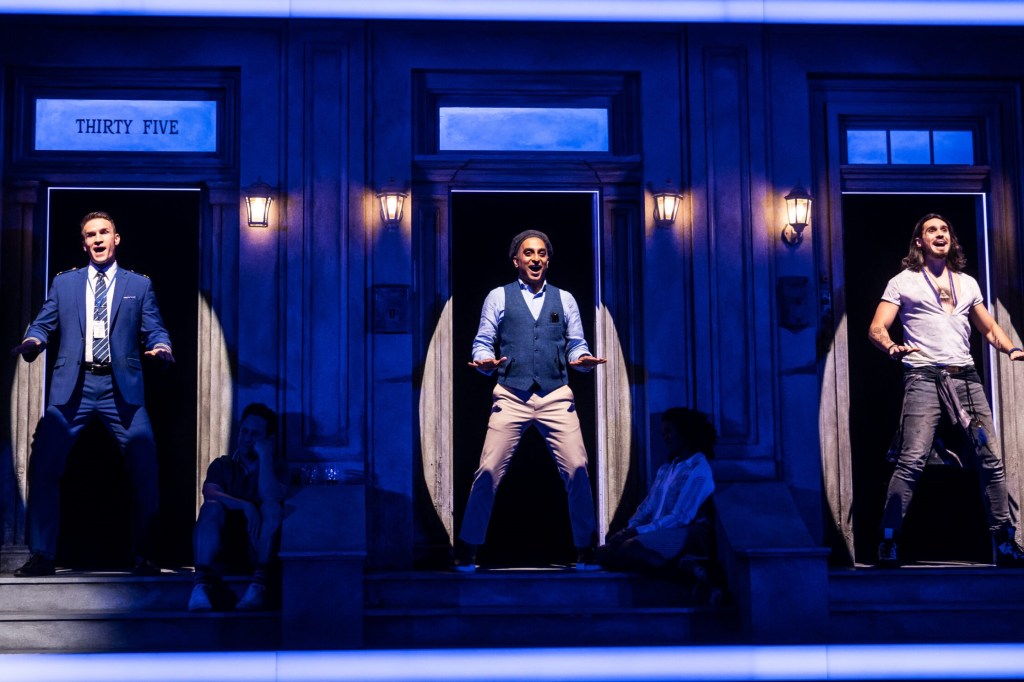
The question of safety and security in a relationship, dependence upon a man, the need to be nurturing and maternal by becoming a mother are thrown into chaotic array during Sondheim’s incredible exploration of Bobbie’s inner self, as she expresses her need to define herself beyond the traditional folkways which her friends have unequivocally embraced and expect her to as well. Importantly, we note her journey on this increasingly dire thirty-fifth birthday (check out the sinister balloon in Act 2) in flashback vignettes prompted by songs which reveal her perspective of the couples’ relationships as she questions their experiences pegged against her own choice to be single.

The songs and cast are spectacular without any dead spots to slumber the audience. Highlights occur as Bobbie visits with each couple and we find out Bobbie’s perceptions about these crazies. Indeed, they are fortunate they have her love as Lenk’s Bobbie is charismatic and sweet, though probing, traits which belie her courage, independence and questing heart for a worthy partner who will really “get her.”
With Harry and Sarah in a comfortable living room, boxed in the defined neon frame, Christopher Sieber is Harry, a “recovering” alcoholic who slides a drink down his throat when no one is looking. Jennifer Simard is Sarah who exercises on chairs and sofas to continue her weight loss regimen while scarfing a brownie or two quickly in secret openness because she’s (emotionally) “starved.” This couple’s scene reaches the height of hysteria as both compete in a wrestling match with each other, while Joanne (the unparalleled Patti Lupone) serenades their gyrations, blocks and flips, ironically singing “The Little Things You do Together” which adds “fun” to the marriage.
Lupone’s assurance about “the neighbors you annoy together, children you destroy together that keep marriage intact,” with Sieber’s and Simard’s enthusiasm for felling each other with each toppling twist more extreme than the next is well choreographed, paced and utterly priceless. As the other couples in Bobbie’s company sing their “wisdom” (“people that you hate together, bait together, date together make marriage a joy”) we note the evolution of Bobbie’s singularity and marriage avoidance. The couples’ sardonic refrain “shouting ’til you’re hoarse together, getting a divorce together that make perfect relationships,” closes out the song with a directed punchline of “kiss kiss.”

As Bobbie thanks Sarah and Harry for an “entertaining” evening, her quest bubbles up and she asks Harry about regretting his marriage. His, David’s (Christopher Fitzgerald) and Larry’s (Terence Archie’s) reply in the lovely and humorous “Sorry-Grateful” confuses Bobbie with its opaque conflicting uncertainty: “Why look for answers where none occur? You’ll always be what you always were. Which has nothing to do with, all to do with her.”
From the husbands’ perspective in their marriages, there’s terrible regret intermingled with gratefulness which puts Bobbie no closer to defining her life differently than she already has. Being single is the best selection for her at this point in her 35th year review, but she acknowledges that despite her “company” wanting to introduce her to someone in “Have I Got a Guy for You,” she must choose for herself, a combination of the men she has gone out with and the someone out there just for her, “Someone Is Waiting.”
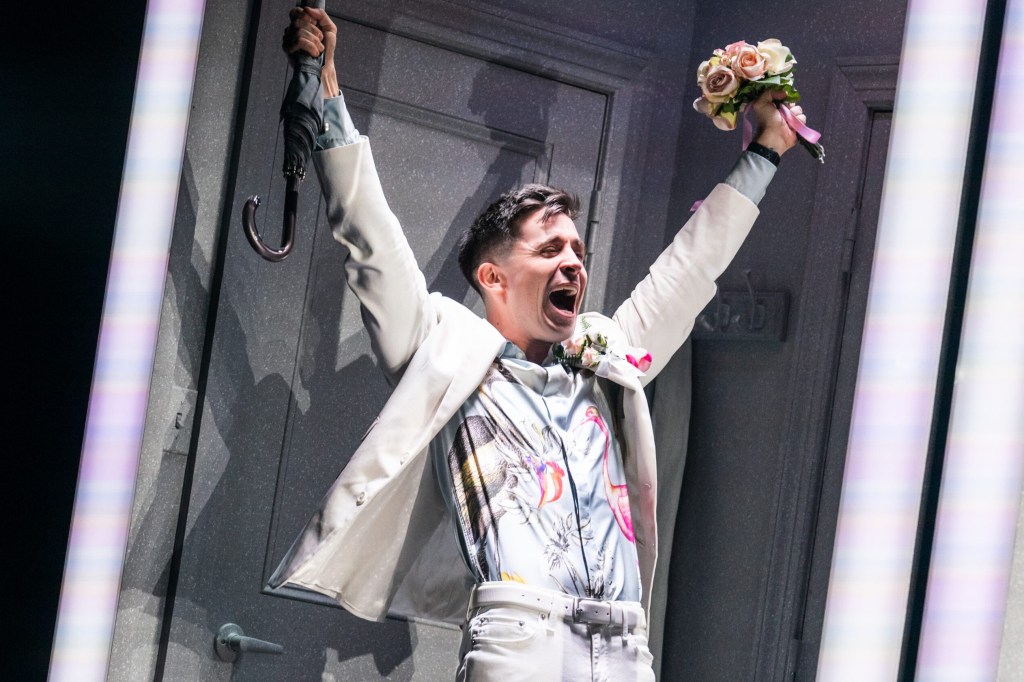
Bobbie’s fear and confusion about marriage referenced by her zany friends is paralleled with Jamie’s in the vignette of Jamie and Paul’s marriage preparations. In Jamie and Paul’s kitchen, dressed in white for their wedding, Jamie has a panic attack and refuses to go through with it. As Jamie, Matt Doyle is riotous in his lightening speed delivery, spewing out his terror to Bobbie’s listening ear.

Doyle is letter perfect, articulate, not dropping one word, making “Getting Married Today” a show stopping number that raises the stakes for Bobbie whose reply is “Marry Me a Little,” which Lenk sings with sylph-like tenderness and beauty. Her adjurations along with the couples popping out of various doors in Jamie and Paul’s kitchen appliances, another brilliantly funny feature, help stir Jamie back into Paul’s arms. Elliott has outdone herself in the direction, pacing and staging of this scene which Lenk, Doyle and the “company” perform to perfection.
By the time Act II rolls around, the balloon “35” is hugely sinister, almost crowding out Bobbie from her kitchen, and the lighting shifts to a Satanic reddish glow. As she attempts to get rid of the balloon, questions in her conflict continue: where is her life heading and who can she mentor when her friends are wacko? Jamie comments they are different,, that she is afraid of not getting married, when indeed, he has misread her; as she tells him, we feel the same about marriage. But when he marries, this, too, proves he is following in the footsteps of their friends, the coupled company. She is solo and alone. This may be a good thing, for as her company has sung, it is not that being a couple prevents alonenness, it just magnifies that in a couple one is more alone. The questions continue, who is Bobbie like and why are these individuals her “friends?”

Andy is a possible marriage partner, until after sex, she realizes what their marriage would be like. The extraordinary sequence begins with “Poor Baby” sung by the couples projecting her “deficiency” as a single person, but actually envious of her freedom to be with many partners, in this instance Andy. It ends in “Barcelona,” where Bobbie convinces Andy to stay longer delaying his trip to Barcelona. How Elliott paces the scene with humor, coordinating the triptych of action that morphs to the scene when in bed she envisions her life (“Tick Tock”) haplessly drain its vibrancy into vapidity with Andy if she marries him. “Tick Tock,” unfolds as wives standing in for Bobbie, dressed in similar red outfits, go through various robotic motions of her marriage with Andy: routines of work, children, the drudgery, housewifery, etc. And thus, with him she watches as married, her life ebbs away into nothingness. But as a love partner, he’s just fine (“Barcelona”).
To top off her understanding of what she would become, Joanne spells it out for her toasting to the squandering of her own life in the iconic song Lupone steps into with grace, “The Ladies Who Lunch.” This is another show stopper; the night I saw it, the audience cheered for about 2 minutes while Lupone waited as Joanne with wry “dissatisfaction,” because Joanne has a lot more to say and do and the clapping interfered. Lupone configures the dour, lush as part kid, part sadist, part ironist and altogether vulnerable in her sardonic snappishness. She is just grand.

As she portrays what Bobbie will become married (her fourth time) she duns the idea of Bobbie getting hitched, with some of the funniest lines that Lupone expertly delivers with wit and pace. Interestingly, Larry (Terence Archie) reveals who controls and who gets the blessing from their union by the end of the song. When Joanne suggests that Bobbie and Larry “make it” Bobbie says “make what?” Indeed, at Joanne’s control, Bobbie would “take care of Larry.” Once again, Bobbie charmingly side-steps her friend’s manipulation, as she has side-stepped all her friends’ manipulations and influence with distractions and silence. In this instance, Bobbie cleverly replies, “but who will take care of me?” Joanne replies bluntly attempting the drunk’s insult, but Bobbie proves herself a sophisticate with humor, a high emotional IQ, disarmingly, subtly. It is a fantastic scene revealing the inner character of Joanne, Larry and Bobbie which Lupone, Archie and Lenk smack down with precision.
Joanne and Larry have presented an unwittingly convincing portrait of what their marriage is like and what marriage could be like for Bobbie, however uncertain and tripped up with problems, issues and unhappiness. And after acutely watching them, she arrives at the understanding that “alone is alone, not alive.” And unbounded with just herself and the darkness behind her, outside of any neon frame of bondage, Lenk’s Bobbie opens herself: “somebody let me come through, I’ll always be there, as frightened as you, to help us survive, being alive, being alive, being alive.”

Lenk delivers an incredible moment, beautifully sung with heartfelt emotion and joy. And then it rains on her, proving it doesn’t matter what she does: it rains on the just and unjust. Though her “company” has attempted to control and influence her, her life’s decisions are wholly hers. She will be happy apart from their influence; she has that strength to know the difference and she has an incredible sense of humor which we have been watching through her flashback “frames” of neon reference.
In the end scene Bobbie leans against the proscenium outside the neon frame of her kitchen as in the first scene all her company crams in waiting and wondering “where” she is. The musical has been a reverie and an evolution toward affirming what the picture frames of her friends have shown her. She is her own person. After they wait for her, realizing the surprise party is over, they have the good sense to leave. Only then, alone, Bobbie is able to blow out the candles of her cake after making a wish, a wish that only Bobbie will ever know.

Elliott’s and Sondheim’s updated conceptualizations can be taken as far as the inner eye can see, into immutable human truths and modern trends of how women shape their being today. Unfortunately, some will not get this revival of Company which is smashing and with a female protagonist, audacious and courageous. What effrontery to show Bobbie with a smile on her face at the end when she alone blows out her candles without her “company” watching, carping and “wishing” for her. Such a simple yet profound look/gesture indicates Bobbie is satisfied with herself for being who she is. Indeed, this sly, smart, engaging protagonist might actually love herself, as she has shown throughout with her wry, ironic, humorous selection of crazy-funny portraits of her “company” “determining” her life for her. What an end stop to this wonderful, humorous treasure of a Sondheim revival.
The score with music supervision and music direction by Joel Fram soars into the heavens. Kudos to all creatives aforementioned which made this revival praiseworthy in its ethereal conceptualization of Bobbie’s interior being. For all of the cast, nothing more can be added except they seamlessly flowed as a “company,” thanks to the shepherding of their director Marianne Elliott. Company should be witnessed a number of times because all in the cast mirror “being alive” onstage. God, they are so on point!
Company should be seen at least twice. There is so much to see or to miss the first time around. Some audience members mentioned the night I was there that this was their second or third outing. That’s about right for this production which is written in the stars thanks to Sondheim’s forward thinking encouragement to revise, expand and deepen. This production should be digitally recorded. For tickets and times CLICK HERE.
‘West Side Story,’ The Brilliant Revival Stokes Profoundly Moving Revelations For Our Time
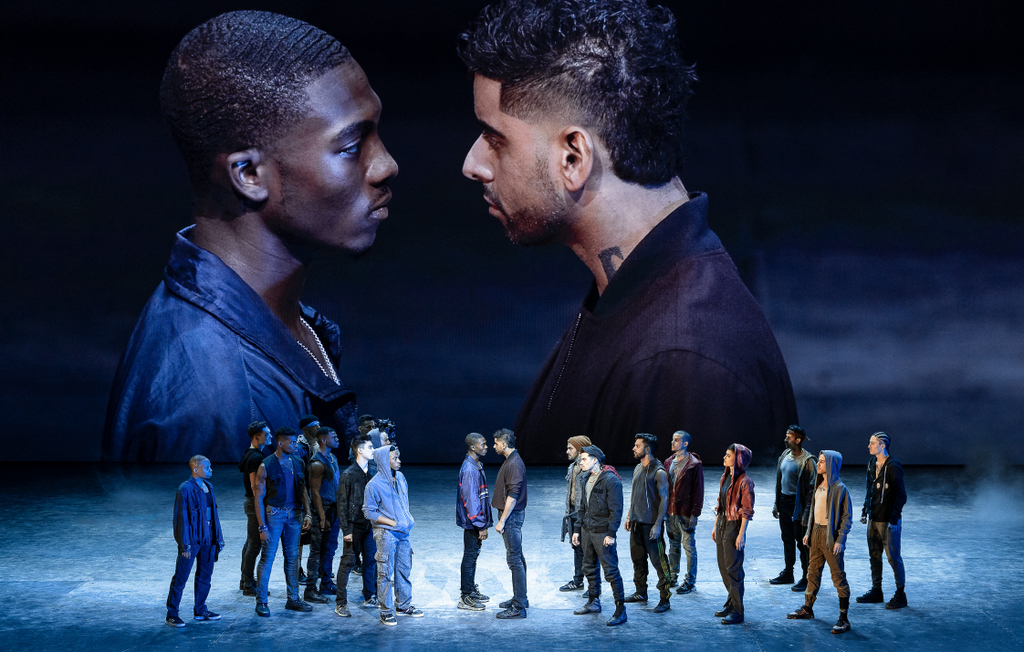
Dharon E. Jones Amar Ramasar in ‘West Side Story,’ based on a conception by Jerome Robbins, book by Arthur Laurents, music by Leonard Bernstein, lyrics by Stephen Sondheim, directed by Ivo Van Hove ( Jan Versweyveld)
West Side Story based on a conception by Jerome Robbins with book by Arthur Laurents, music by Leonard Bernstein (orchestrations by Sid Ramin, Irwin Kostal) and lyrics by Stephen Sondheim is a groundbreaking classic that garnered awards when it opened on Broadway in 1957 to a flurry of praise and glory. Its overwhelming success continued when it was made into the 1961 titular film winning 10 Academy Awards. Since then it has seen numerous global productions and has been revived on Broadway twice in 1980, and in 2009 with Spanish lyrics and dialogue weaved into the English Libretto.
Once again in revival directed by the maverick sensation Ivo Van Hove (Network, The Crucible) and choreographed by Anne Teresa De Keersmaeker, West Side Story has proven its timelessness with Van Hove highlighting its immutable themes. Van Hove’s direction sounds these thematic notes with his stylistic tuning fork to ping the deepest chords of human nature with which we must identify, as he explores the mortal boundaries of love, tribalism, power, bigotry, alienation, fear, self-loathing and hatred.

Isaac Powell in ‘West Side Story,’ based on a conception by Jerome Robbins, book by Arthur Laurents, music by Leonard Bernstein, lyrics by Stephen Sondheim, directed by Ivo Van Hove (Julieta Cervantes)
Van Hove’s modernization of West Side Story should not be underestimated. He unravels the underlying perils of “the outsider” theme that resonate with currency for us today. He gives this principal conceptualization a novel rendering by employing video projection (video design by Luke Halls) and the “close-up” to elicit an intimacy and connection with the characters not readily available before. The intimate portrayals of the Sharks and Jets (delivered by close-up) as well as their objectified view that encompasses their using the entire stage, reflects the insider and outsider viewpoint. In the intimate view these individuals are young men, hurting, afraid, alone. In the outsider view they are non-human, throw-away people who have embraced the world of criminality and violence because that gives them a rush of comfort in power and identity that the culture denies to them.
For example in the Prologue we meet in close-ups the key players: Riff (the fabulous Dharon E. Jones) of the Sharks, Bernardo (his marvelous equivalent Amar Ramasar) of the Jets, and their gang members. We note their proud and stalwart personas; they could be CEOs of a company in another time and place. We see their branding, the combat gear of their identities: their piercings, their haircuts, the intricacy of their tattoos. And beyond that as the camera pans the two tribes, we note their sneering bravado, their violence and something else behind their staring eyes-perhaps fear.
These Prologue close-ups in real time, before the tremendous opening number of the stylized, vigorous fight sequence in which a Jet is injured, humanize the erstwhile stereotyped ethnicity of the “Puerto Rican” Sharks and their urban, mixed race counterpart, the Jets. They appear interchangeable. Van Hove’s enlightened casting suggests they are not bonded by ethnicity since there are black, white, Latino members in both gangs, but by inner necessity. They cling to their tribe out of fear, isolation, alienation and the trauma of cultural self-loathing, of being outside, of being the “other.”
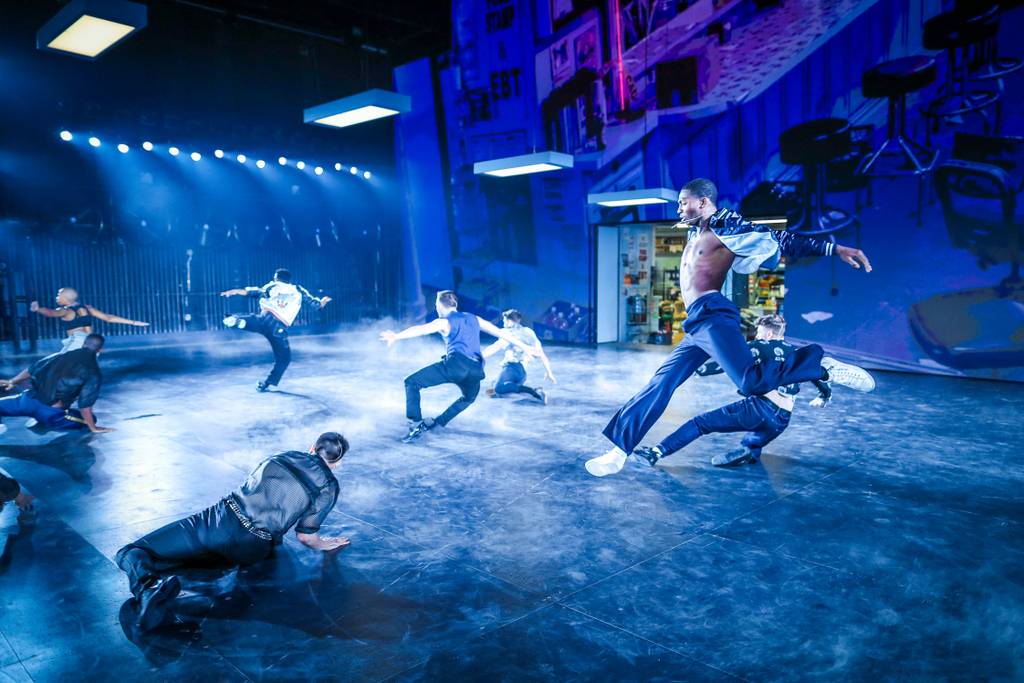
Dharon E. Jones and the cast of ‘West Side Story,’ based on a conception by Jerome Robbins, book by Arthur Laurents, music by Leonard Bernstein, lyrics by Stephen Sondheim, directed by Ivo Van Hove (Jan Versweyveld)
We especially note the need to belong in the “Jet Song” which answers the call to be a part of something “bigger” than oneself, even if it is bloodthirsty and destructive. By extension, the Sharks are mixed race and indistinguishable from the Jets except that they “came” from Puerto Rico.
With the exception of a few scenes and songs where the backdrop is black and a rainy mist falls down to perhaps symbolize the eternal/immutable/spiritual, the video design-both live and pre-recorded prevails throughout. The events are streamlined and strengthened. The arc of development moves over a two-day period and falls into the resolution we all know is coming, but still remains surprising and poignant. The song “I Feel Pretty” has been excised and the cut gives the musical an edgier, less digressive, less whimsical feel, which the song conveyed almost as an afterthought. That song in particular is off tenor with Van Hove’s dark vision of this lurid, scary world the gangs occupy, a vision which messages the nihilism of impoverished youth/citizens in this time of Trumpism, I.C.E., Black Lives Matter, The Wall, all of whose memes appear at various and pointed junctures in the production.
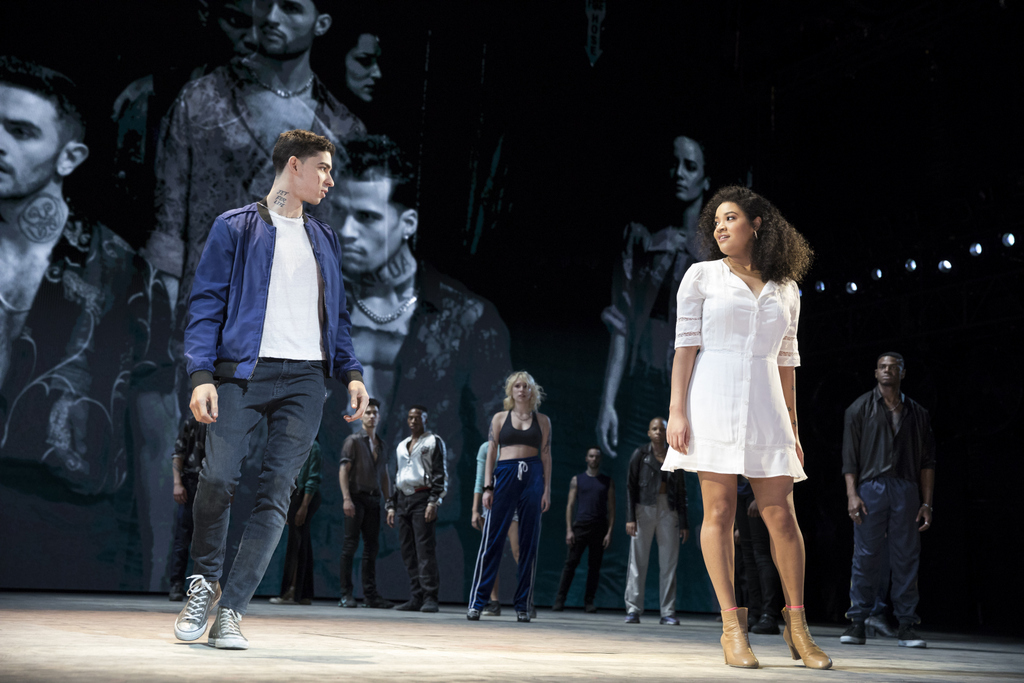
Isaac Powell and Shereen Pimentel in ‘West Side Story,’ based on a conception by Jerome Robbins, book by Arthur Laurents, music by Leonard Bernstein, lyrics by Stephen Sondheim, directed by Ivo Van Hove (Julieta Cervantes)
Thus, we note how the Sharks and Jets attempt to gain a position of power through violence to carve out a place where they can feel safe walking and being. Certainly, in the video projection of dark, lonely streets, a stylized version of the threatening landscape in each of the gang member’s minds, it is revealed that fear surrounds them and they must posture and swagger and image themselves into courage while inside they are cowering children.
For the Sharks, carving out a plot of land is acceptance in the country that views them as trash. As the cast sings “America” and the exceptional Yesenia Ayala as Anita and Amar Ramasar as Bernardo vocally duel out their positions for or against the US, Van Hove’s projections are pointed and riveting. These encompass haunting images of a damaged Puerto Rico left ripped and forgotten after the negligent response of the US to Hurricane Maria. The projections represent the truth; the dance number and song reveals the courage of Anita to hope and the realism of Bernardo to highlight the discrimination and bigotry of third and fourth generation citizens against them. Throughout, Van Hove uses the projections in juxtaposition with the staging to encourage a novel understanding of how the inner person and their outer image operates. We see the two perspectives- the truth and a presentation of the image that is hoped will help one survive in a forbidding city.

The Company, ‘West Side Story,’ based on a conception by Jerome Robbins, book by Arthur Laurents, music by Leonard Bernstein, lyrics by Stephen Sondheim, directed by Ivo Van Hove (Jan Versweyveld)
The clips of devastation of Puerto Rico are inter cut with various related video clips, one of the final ones referencing miles and miles of the wall at the southern border. The wall is the everpresent reminder that outsiders/illegals are potential thugs and criminals, regardless of their status as asylum seekers, regardless of their status as US citizens. Of course the irony, as Van Hove’s striking version indicates, through the attitudes of Lt. Shrank (Thomas Jay Ryan) and Officer Krupke (Danny Wolohan) that both Sharks and Jets are the unwanted trash, not just the Sharks. That is why they struggle against each other to maintain “face,” and identity in their gang until they are dead and the soil they have struggled over that has rejected them is forced to accept their corpses.
The one group that is missing from this production which I never realized before is missing for a great reason: the dominant social class of conservative “haves.” It is this notably absent elitist tribe that has made the country a pressure cooker of rejection, a blight and a hard climb to the top of the lower middle class for both wandering tribes. It is this group that indirectly encourages tribalism as an answer for those who have little hope for the future and are made to feel as outcasts and criminals who belong in jail (“Gee, Officer Krupke”-the projections during this number are just spot-on).

Isaac Powell and Shereen Pimentel in ‘West Side Story,’ based on a conception by Jerome Robbins, book by Arthur Laurents, music by Leonard Bernstein, lyrics by Stephen Sondheim, directed by Ivo Van Hove ( Jan Versweyveld)
The song sung terrifically by Action (Elijah A. Carter) and the Jets reveal they cannot escape from the dominant white culture’s prophecy about them as criminals. As they internalize the perspective of the dominant culture and law enforcement, their self-annihilation is a self-fulfilling prophecy. Though Action and the Jets tell the Officer to “Krup” himself, it isn’t enough. Their trajectory is fated and doomed, especially without mentors to guide them away from their self-loathing. That Tony and Maria become swept up in their misery unable to break completely free from their own posse and families is the tragedy we have come to hope against.
The director’s use of “larger-than-life” video shakes, stimulates, references and enhances the symbolism and profound human depth of the star-crossed lovers and their “posses.” The projections against the entire back wall of the stage sometimes in split screens of twenty portraits of gang members, sometimes in engaging medium shots of Doc’s drugstore (“Something’s Coming”) and the sweatshop (renamed from the bridal shop) where Maria and her friends work reveal the homely mores which Tony and Maria accept apart from the gang members’ identity and lifestyle.

Isaac Powell and Shereen Pimentel in ‘West Side Story,’ based on a conception by Jerome Robbins, book by Arthur Laurents, music by Leonard Bernstein, lyrics by Stephen Sondheim, directed by Ivo Van Hove ( Jan Versweyveld)
I particularly enjoyed how the close-ups of Maria and Tony in the intimacy of their alone time after he discovers her name worked. First, both Shereen Pimentel and Isaac Powell are vibrant, passionate and in-the-moment, practically every moment. Van Hove’s staging and Powell’s rendition of “Something’s Coming,” and “Maria” particularly shine. Powell’s voice, interpretation and movement are uplifting. In “Tonight” he appears as light as a feather; it is, a full expression of the exhilaration of his love for Maria. I have not seen anything like his performance; he is mesmerizing reaching the highs, lows and devastation of believing that Maria has been killed. He is so there, he brings us there with him. Superlative! Magnificent!
Maria is bubbling over warmth, passionate in her love scene with Powell which was a videoed close-up which made total sense and was an expression of their intimacy as they become “one” and exclude the world they were born into and have decided to leave. Pimentel’s fury after Tony is killed is so convincing, she makes you believe she will shoot all of the guilty, conferring upon herself the roles of judge, jury and executioner, thereby convicting them of his death.

Amar Ramasar, Yesenia Ayala, and the cast of ‘West Side Story,’ based on a conception by Jerome Robbins, book by Arthur Laurents, music by Leonard Bernstein, lyrics by Stephen Sondheim, directed by Ivo Van Hove ( Jan Versweyveld)
The projections carry the metaphoric journey of the outsider, the trash, the unwanted in a through-line of our time, of all time in the import of tribalism’s necessity in a culture that kicks these kids to the bottom and stands in the way of allowing others to find peace, love and happiness. This isn’t just about warring tribes; it’s about seeking power and domination, the easier, faster way out cultural hell than using intellect, logic and wisdom, the qualities amassed through experience, overcoming obstacles and time-worn trial and error.
The Sharks and the Jets, indistinguishable ethnically, are yet distinguishable through costume designer An D’Huys fine designs and color coordination. However, notable is that the Sharks and Jets are brothers of the same ethos who should be helping each other climb upward, instead of fulfilling the white culture’s perceptions of them as violent criminals. By the time we meet them in the video close-ups of the Prologue, we know it is too late. As young men and women, they have few tools at their disposal (wisdom-gained through experience) to thrive as they seek to establish who they are. After all, it is an alien society of adults who eschew them or culturally disavow what they are as tattooed, pierced, hoodlum criminals.

Dharon E. Jones and the cast of ‘West Side Story,’ (Jan Versweyveld)
Sadly, their choices to achieve are few. They can either “die young in a blaze of self-annihilating triumph and leave a good-looking corpse” or live the defeatist life of a self-quarantined, cowardly wussy to avoid the gangs. In Ivo Van Hove’s production, sociocultural economic inequality encourages these tribes toward the genocidal thing to do. That Tony and Maria find each other and love is miraculous. The scene where Van Hove and Anne Teresa De Keersmaeker stage the couples moving off together revealing love as an answer to the culturally encouraged nihilism and self-destruction is particularly touching and hopeful.
This version of West Side Story is a shining example of how structure, form, substance and profound understanding merges to make elevated art. Van Hove cleverly uses the projections and the live staging of the actors/characters in tandem; one informs the other, whether it is to enhance the symbols and themes, to emphasize the characterizations or to detail intimacy. What is communicated is remarkable and unforgettable. Coupled with the acting, singing, movement and the dance numbers by Anne Teresa De Keersmaeker are filled with athleticism that is so appropriate to the characters. All of this contributes to making the production indescribable- breathtaking, stunning, gobsmacking are an understatement. And the music is luscious, gorgeous, fabulous, thanks to Jonathan Tunick (orchestrations) and Alexander Gemignani (music supervisor & director).
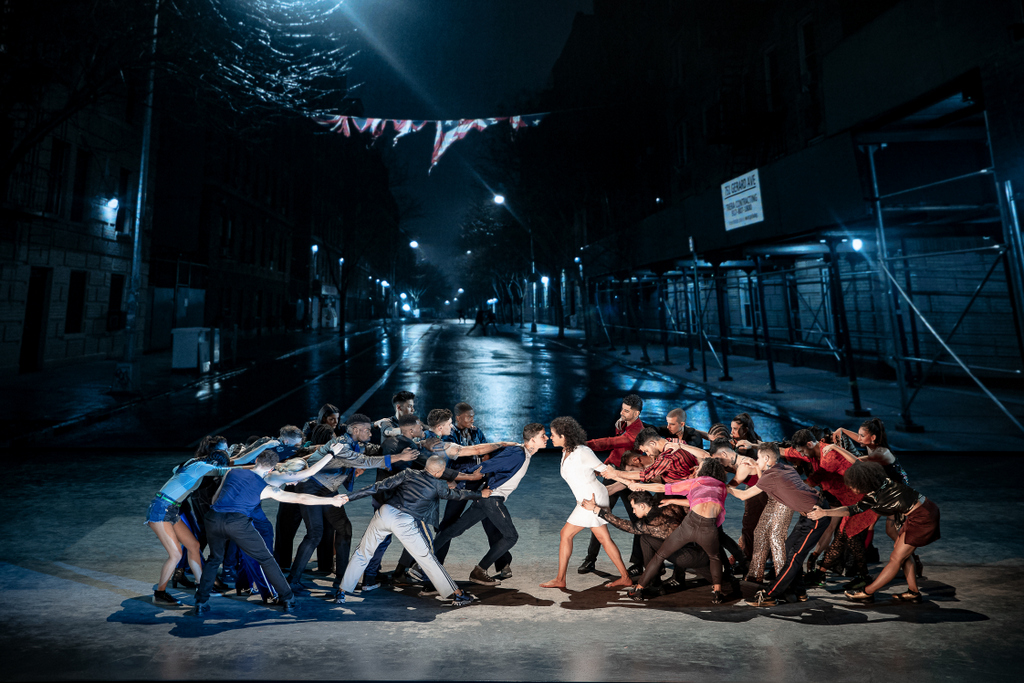
The company of ‘West Side Story,’ based on a conception by Jerome Robbins, book by Arthur Laurents, music by Leonard Bernstein, lyrics by Stephen Sondheim, directed by Ivo Van Hove (Jan Versweyveld)
There is so much more. I’ll just finish with… I also loved the staging/choreography where Maria and Tony are striving to move toward each other pulling against the need of their tribes. The piled-on movement is gripping, sinewy, a tug of war that they will defy for they love each other. Wonderful. And at the end they are pulled apart heaven and earth dividing them until…
The creative team are exceptional artists: Luke Halls (video design) Tom Gibbons (sound design) An D’Huys (costume design). Also superlative are Quinn Matthews as video director, Eric K. Yue as director of photography, Taylor Shung as video producer, Jan Versweyveld for his scenic design and lighting design.
There is nothing else to state except you must see this production. It is an event that does more than entertain. It grabs your heart and makes you understand your humanity and compassion. West Side Story is at the Broadway Theatre (1681 Broadway) running with no intermission until 6th September. For tickets and times CLICK HERE.
 CAROLE DI TOSTI