Blog Archives
‘Sweeney Todd,’ His Vengeful Spirit Ranges in Thomas Kail and Alex Lacamoire’s Magnificent Revival

With a nod to the original 1979 Hal Prince directed Sweeney Todd: The Demon Barber of Fleet Street, Broadway (1989, 2005), and off Broadway revivals (2017), Thomas Kail (director) and Alex Lacamoire (music supervision) achieve breathtaking majesty in this 2023 revival. Emphasizing immutable themes and character archetypes inhabited by the brilliant, sonorous Josh Groban and comically conniving, mischievous Annaleigh Ashford, Sweeney Todd’s thrilling, operatic music spins out a Jacobean revenge tragedy for our time. With music and lyrics by Stephen Sondheim and book by Hugh Wheeler, from an adaptation by Christopher Bond, audiences at the Lunt-Fontanne Theatre are having a rollicking time, gauging from their cheers and whoops, as the cast takes their bows.
The artistic team’s well-thought out choices restore the musical (more like an opera), to its epic, grand stature. The suspenseful Sweeney story is arrayed through ingeniously integrated spectacle, delivered by Nevin Steinberg’s sound design, Mimi Lien’s scenic design, Emilio Sosa’s costume design, Natasha Katz’s lighting design and Steven Hoggett’s choreography. All cohere, enhancing Kail’s acute vision of Sweeney’s obsessive need to pursue vengeance, with an assist by an avid, affectionate partner, Mrs. Lovett, who manipulates him into her embrace, using keen practicality and amoral, surreptitious duplicity.

Stephen Sondheim’s exceptional music, delivered by the twenty-six piece orchestra’s soaring sounds, is superlatively arranged by Jonathan Tunick. And under the musical supervision of Alex Lacamoire, the immensely variable score evokes the piercing macabre, the lyrical romance and the chaos of despair. Indeed, every phrase, every note resonates tonal moods of light and dark, that swirl like fateful winds directing the emotions of the lead characters. All of this creative gorgeousness unfolds in the service of displaying humanity in its full-bodied fallibility, as it plunges from grace, victimized by circumstance and the Satanic designs of others. And, as the culprits free-fall, wallowing in a surfeit of pride and sardonic delight by killing the wicked with impunity, we are drawn into lurid expectation, aroused to anticipate which corrupt victims will be sliced by Sweeney’s razor, next.
Originally taken from popular Victorian fiction known as penny dreadfuls, the name Sweeney Todd was first noted in ‘The String of Pearls.” The plot elements evolved to other genres, but the horror tale of the murderous barber slitting his victim’s throats, while Mrs. Lovett’s pies hid the ground-up fleshly bodies, was enhanced by Christopher Bond’s addition of obsessional revenge. These elements inspired Sondheim and Wheeler because of their mythic and dramatic possibilities.
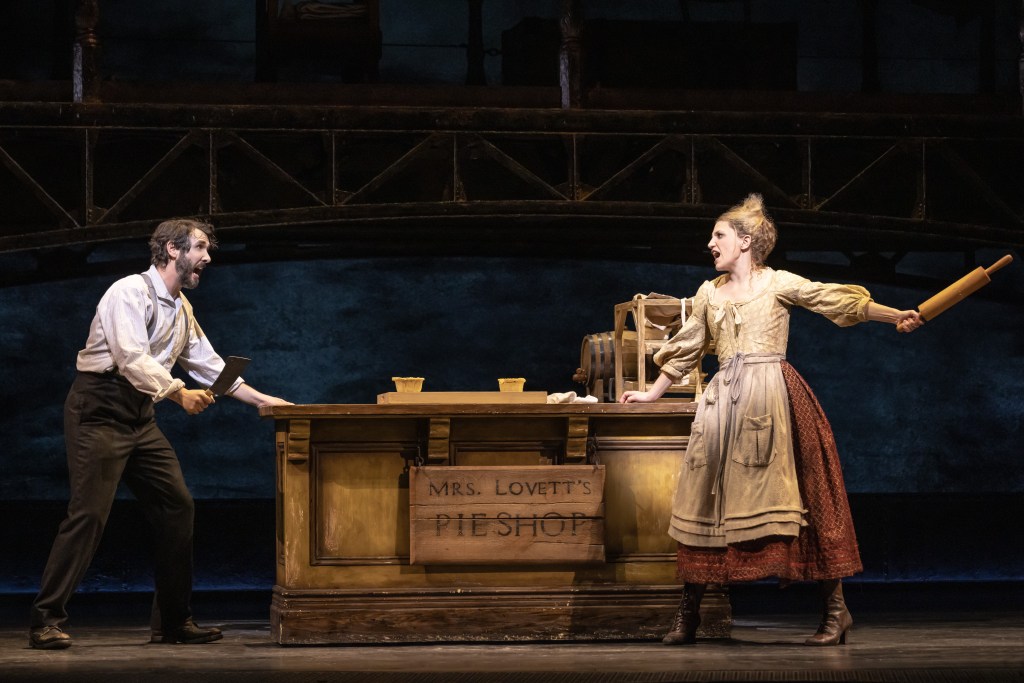
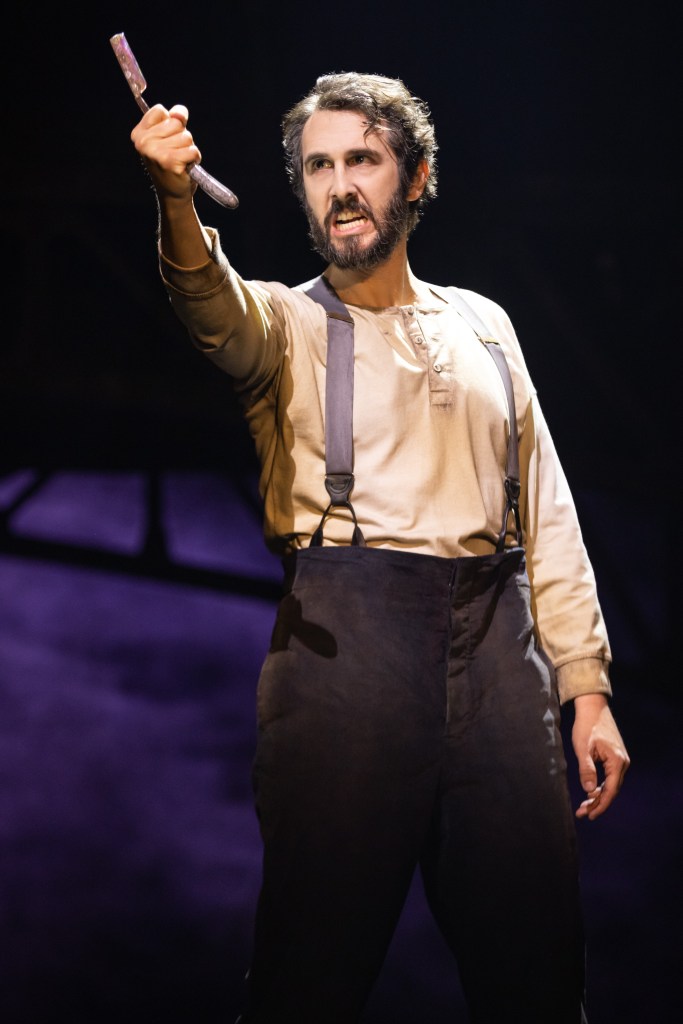
The musical begins, as the ensemble of 19th century Londoners sets the scene (“The Ballad of Sweeney Todd”). They are the Greek chorus, who sing the ballad at key moments throughout the musical, making judgments about Sweeney Todd and his relationship to the world he lives in. As they sing, Sweeney emerges from the grave looking gruff and moody to animate the Sweeney legend and receive grand applause, as the audience acknowledges Groban’s exceptional vocal gifts and acting skills. Indeed, his well conceived, profound portrayal of the demon barber is worthy of every second of applause he receives.
Thus, unfolds the story of injustice, corruption, oppression, obsession, vengeance, mayhem and murder. The latter, Sweeney justifies in the Act I song “Epiphany,” with his “novel” definition of two kinds of “men,” who comprise the entire human race which deserves to die. These are the upper class wicked, who oppress the poor, and the miserable lower class, for whom death is a relief. When he sings this, Sweeney has gone over to “the dark side,” choosing to expiate his rage and hatred on his fellow human beings, including himself, a key theme of the tragedy. However, at least Sweeney recognizes what he is, where the hypocrites he murders (especially Judge Turpin and the Beadle), pretend perfection.
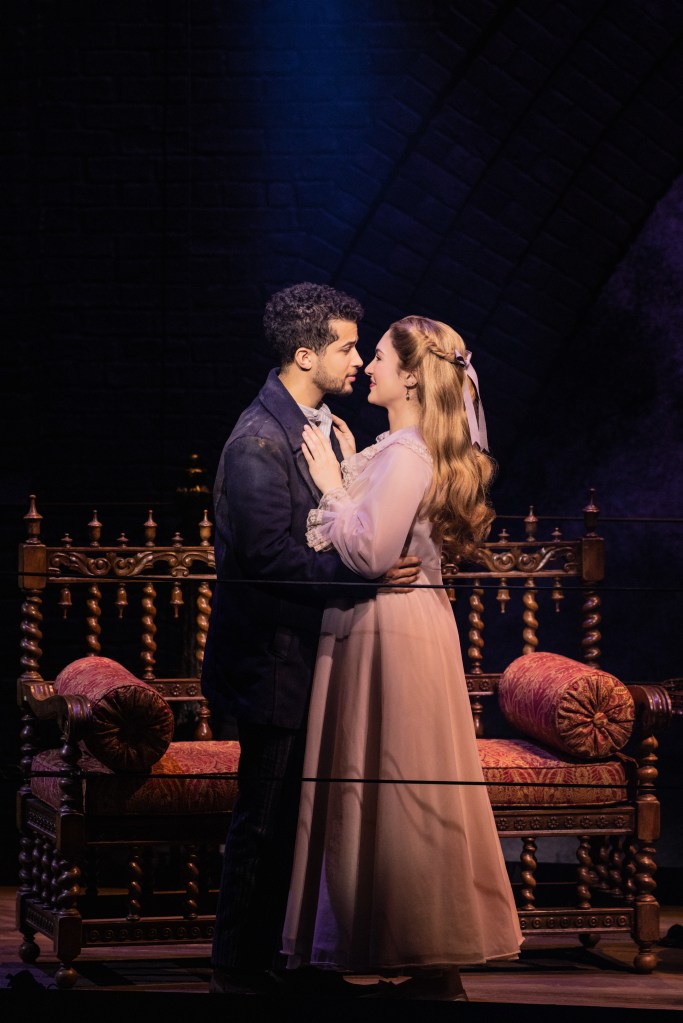
After the epilogue, the scene moves to flashback and shifts to the past, enacted by the spirits of those brought to life to evoke the tragic tale of the barber, his wife, the duplicitous paramour, a corrupt judge, his assistant and the barber’s grown-up daughter and her lover. With the exception of Johanna (Maria Bilbao) and Anthony (Jordan Fisher), all are victims of their own weakness as they succumb to a fateful destiny. Their macabre acts and the ensemble’s ballad refrain, which threads throughout, compel us to listen and learn.
Convicted of a trumped up crime by the sinister, lascivious, Judge Turpin (the fearful and excellent Jamie Jackson), the barber is shipped off in chains to Botany Bay, Australia, to intentionally separate him from his beautiful wife Lucy, and young child, Johanna. Over a decade later we meet Sweeney, who disembarks from a ship in London with Anthony (the golden voiced Jordan Fisher), a sailor who rescued him, and to whom he sings of Turpin’s injustice (“The Barber and His Wife”). Returning to his old apartment, which is owned by the impoverished Mrs. Lovett (Annaleigh Ashford), who has a pie shop no one frequents because her pies are just crust (“The Worst Pies in London”), Sweeney learns from her that Lucy was raped by Turpin and Beadle Bamford (the fine John Rapson).
As Lovett sings (“Poor Thing”), we discover that Lucy became so demoralized and degraded, she swallowed poison. Taking pity on Johanna, Turpin adopts her as his ward and raises her under his possessive, watchful eye. Under his oppression she is like a sightless bird in a cage, who is blinded so it sings beautifully. In the following scenes we understand the bird metaphor, as it relates to Johanna imprisoned in a lovely mansion, unknowing of her past and the wicked Judge’s corrupt actions and scurrilous intentions.
Grogan’s Sweeney becomes manic with rage learning of Lucy’s plight. Consumed with painful thoughts of her sexual abuse at the hands of the powerful, “moral” judge, who cravenly destroyed their family, and who now has his Johanna, he vows revenge with the help of his razors (“My Friends”), which Mrs. Lovett kept for him. Mrs. Lovett, who always fancied Sweeney, seizes the opportunity to encourage him in his revenge, suggesting he open a barber shop above her pie-making establishment. As he works, he can wait for the opportunity to kill Turpin (“Wait”). It is there that the formerly innocent Sweeney enacts his first homicide of blackmailer Pirelli (the comical and insidious Nicholas Christopher), who threatens to expose Sweeney’s true identity and turn him over to Beadle Bamford, a death sentence.
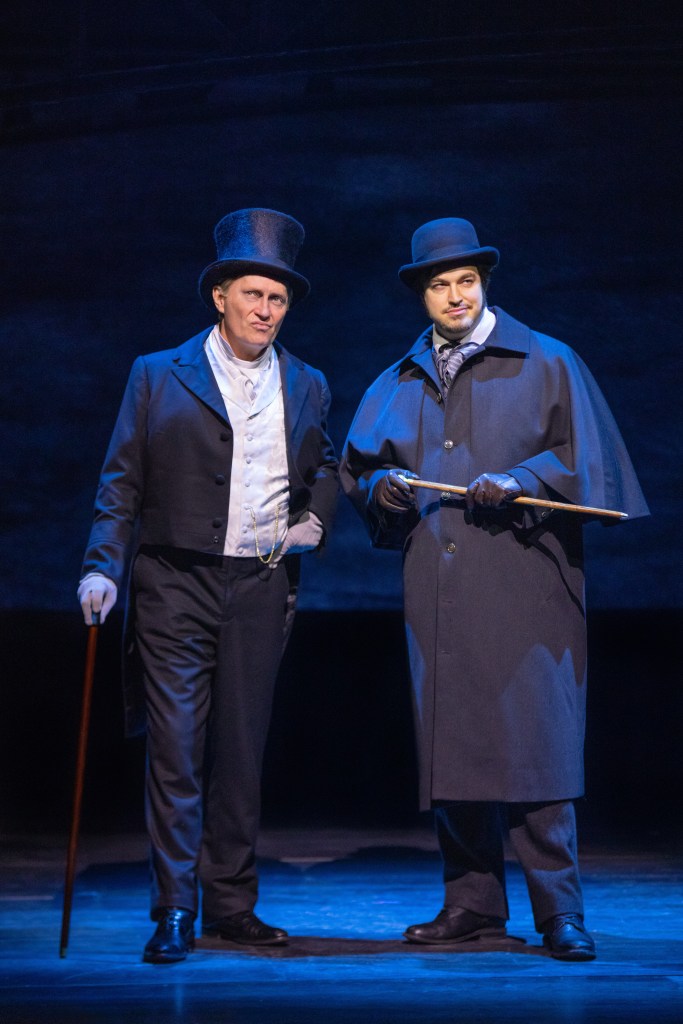
This is the first blood-letting, the ensemble assures us in “His Hands Were Quick,” a reprise of “The Ballad of Sweeney Todd.” But it’s not the last. The fates are spinning. Mrs. Lovett distracts Pirelli’s assistant Tobias (the wonderful Gaten Matarazzo), who eventually grows close to her and believes her lies that his boss “went away.” Ironically, he becomes the instrument of karmic discovery, which brings down the killing machinery of the Todd/Lovett enterprise.
Ashford’s seduction and insinuation into Sweeney’s life, and Groban’s Sweeney, at first reluctant, then gradually swayed by her cajoling advances, are a couple made in hell, as they align in comedic malevolence. Their performances are humorously symbiotic and perfectly realized with such spontaneity and verve, we are subtly sucked into their foul deeds and initially cheer them on. Jamie Jackson’s Turpin is so goose-bump abhorrent, arrogant and hypocritical, when Sweeney finally kills him, the audience cheers.

However, it takes the appropriate time for Sweeney to avenge Turpin’s horrors. These “drive him up the wall” and push him to accept the god of vengeance and unforgiveness as his master. After Sweeney is interrupted from killing Turpin and despairs that he’s lost his chance, he appoints himself an executioner of “mankind” (two types of men), in “Epiphany.” It’s a show-stopping number and Groban is in his full, lush glory. In a profoundly clever Sondheim transition, ever the opportunist, Ashford’s Lovett soothes Sweeney’s explosive mania. She conceives of an ingenious way to dispatch the bodies of those “who deserve to die,” by baking their flesh into savory meat pies (“A Little Priest”). Forever, she elicits his gratitude and affection, which she gladly receives because she is so smitten with him and wants to supplant memories of Lucy with her love and murderous complicity. She becomes his invaluable asset for vengeance with impunity.
Sweeney’s transformation from doom and gloom to joy and laughter occurs when he “gets” how Mrs. Lovett will help rid him of the evidence of his murders. Groban’s Sweeney is absolutely mesmerizing in this scene. As the realization of her lovely idea takes over his whole being, his interior darkness shifts to light, as if a burden has been lifted. Happily, he binds himself to her in a euphoric irony of evil. Ashford’s mastery of his soul lures him and couples him to her, as they fly toward doom, too taken with their genius to be bothered by the possible consequences of their wicked amorality. Thus, together they answer the world’s corruption, emphasizing the theme of how human beings eat one another, taking the devouring from metaphor to realty.
The portrayals and performance of this clever song marries these actors in their brilliant talents and shared generosity. It is one of the most memorable moments in a production that is filled with many memorable moments. Importantly, as we are relieved to see them laugh, and laugh with them as they delightfully plot against those high born and low, who deserve to die, fate spins the tragedy of consequences and accountability in Act II.

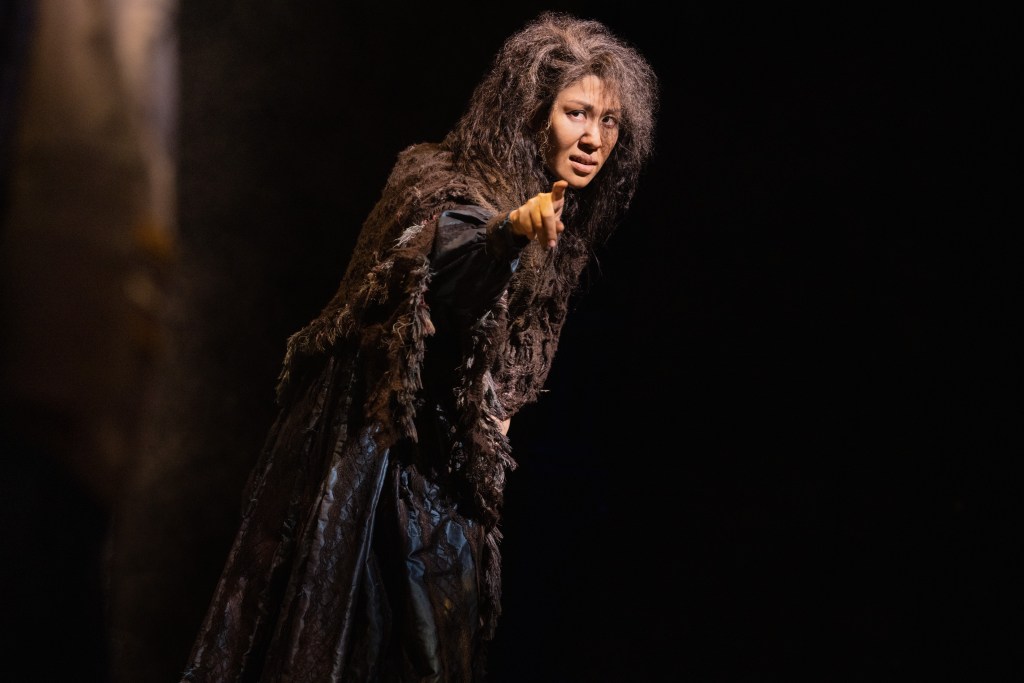
Meanwhile, in a second feeder plot, whose action develops in conjunction with the scenes between Sweeney and Mrs. Lovett, Fisher’s Anthony comes upon the grown-up Johanna (Maria Bilbao). Bilbao aptly sings about birds that are caged (“Green Finch and Linnet Bird”). Listening to her (Bilbao’s flighty performance and lyrical singing are stunning), Fisher’s Anthony inquires her identity from a Beggar Woman (the incredible Ruthie Ann Miles), who is always near Mrs. Lovett’s or the Judge’s mansion. Anthony falls in love at first sight (“Ah, Miss,” “Johanna”). Emboldened by the Beggar Woman’s admonition that he should stay away, he pursues Johanna who is receptive to running away with him to escape marriage with Judge Turpin, her future intended. When Turpin discovers her plot with Anthony, he locks her in an asylum, waiting for her to relent.
How these characters reach the end of themselves in freedom or bondage unravels in a darkening Act II. Only then, do we realize, like Sweeney, how “kindness” and “friendship” can be exploited to deceive those weakened with unstable and desperate passions. As the emotionally seductive Mrs. Lovett, whom we and Sweeney come to delight in, then are horrified by, Annaleigh Ashford’s portrayal is sumptuous and grand. Her antithetical character is Ruthie Ann Miles’ Beggar Women, with whom Mrs. Lovett secretly is in competition. Throughout, the Beggar Woman is the key upon which events turn. Also, she is the wise Cassandra that no one listens to because they look at her outer appearance (“City on Fire”), and think her mad. This important theme is one more irony the fates spin out in this fabulous revival.
With spot-on performances by the entire cast of those who “eat” and are “eaten,” of the righteous innocent who escape, and of the hapless, beautiful, trafficked Lucy-types, who are in the “wrong place at the wrong time,” and are abused by men and women alike, all the characters “get what they deserve.” The warning is that memento mori. The same will happen to us, though it may not be at the hands of the Sweeney Todd’s of the world. If vengeance is sought, let karma deliver it. Pursuing it is its own destruction.
This Sweeney Todd affirms stylized truths that remind us of the precarious balance between justice and vengeance, love and obsession, helpfulness and selfishness. In its monumental arc where duplicity, self-deceit, betrayal and cruelty play out in the characters’ lives, the messages are profound. The characters in their impulses and desires are terrifying, not in the horror genre sense, but in their reflections of human emotions, revealing what people are capable of. Kail and the actors have teased out incomparable, believable portrayals. We have only to read the news to see their conjunction with our time, indeed, all time.
This devastatingly human Sweeney Todd, whose only hope is an escape through love, is a classic. It is a fitting revival of a masterwork that must be experienced live to feel its grandeur. For tickets go to their website or visit the Lunt-Fontanne Theatre at 205 West 46th St. https://sweeneytoddbroadway.com/
‘A Beautiful Noise’ Review: The Neil Diamond Musical is a Triumph

How does one take the measure of a man toward the end of his life? Does one examine his relationships with others or does one examine the relationship he has with himself? In The Neil Diamond Musical, A Beautiful Noise, directed by Michael Mayer, currently at the Broadhurst Theatre, book writer Anthony McCarten (The Collaboration, Two Popes) approaches the question using the conceit of a therapeutic doctor/patient relationship.
To McCarten’s credit this complex bio-musical is unlike typical jukebox theater in its positioning of two protagonists: the older Neil of the present with the younger Neil in the past. Driven by this patient/therapist conceit, the musical incorporates Diamond’s songs with flashbacks centered around Diamond’s inspiration for their writing with the added heft of a hero quest. As Diamond unfolds himself to his doctor, certain topics can’t be discussed. He is keeping a part of himself in the shadows. Only through this complex journey into the past will his true identity emerge and be reconciled with his torments. Importantly, we learn through the melding of storytelling and songs why Neil Diamond was inducted in the Songwriters Hall of Fame (1984) and The Rock and Roll Hall of Fame (2011). We also learn the sacrifice that it took for him to be who he is.
The doctor/patient motif that provides a thrilling excavation into Diamond’s life and career is cleverly crafted. For weeks a psychologist (Linda Powell) has sessions with a reluctant present-day, older Neil Diamond (the superb Mark Jacoby) who goes to her so that he might examine his inability to interact with his third wife Katie and his children. They have told him that “he’s hard to live with.” Is he? Diamond doesn’t know and on some level, he doesn’t care and prefers to brood (perhaps about his Parkinson’s diagnosis). After a number of sessions (three brief scenes) during which Diamond the elder says little, the psychologist produces his songbook, The Complete Lyrics of Neil Diamond. She does this in the hope of engaging him to discuss songs which he has said reflect his life. In this way maybe a door will be opened into Diamond’s psyche to clear up the issues he is having with his family relationships and most importantly, in his relationship with himself.
Jacoby’s Diamond begins to engage with the psychologist as she reads from the book’s cover that he has 40 of the Top Forty Hits and 129 million of his albums have been sold. When she suggests that they discuss what some of the songs mean to him, he rejects her idea and humorously is piqued that she only is familiar with one of his songs out of his 39 albums. However, when she mentions that title, it strikes a sensitive nerve and he doesn’t want to discuss what it means to him. Unable to leave this “therapy” to please his wife, we understand that he chafes at being controlled, but out of love for Katie and the kids, puts up with the doctor and therapy sessions which have, thus far, proven fruitless.
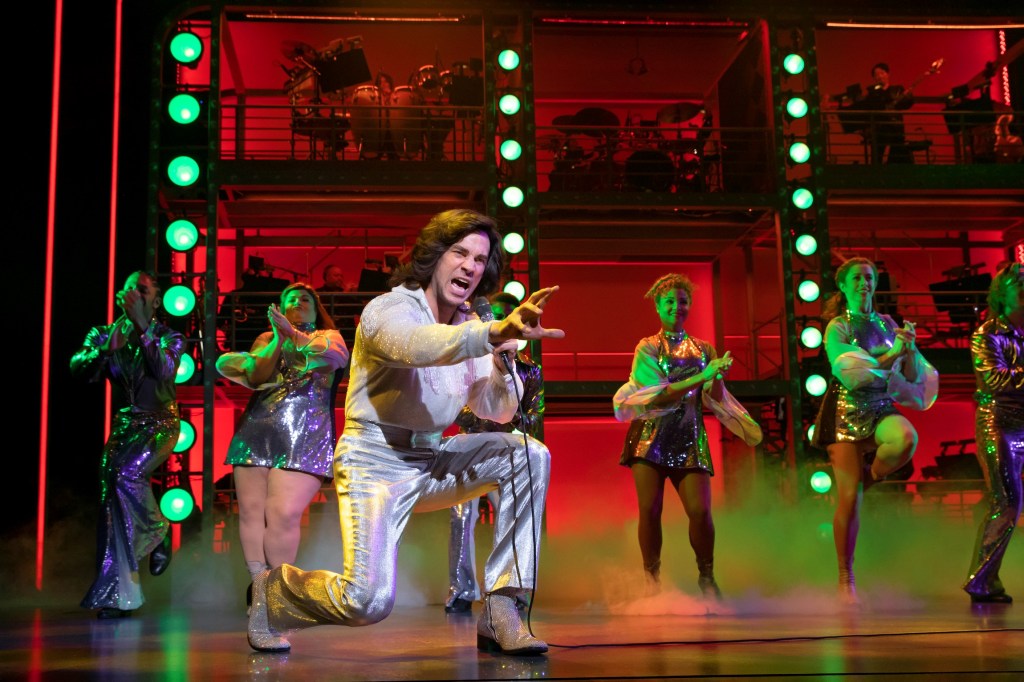
When the doctor gives him the songbook and suggests that he pick out a song and talk about it, as he rifles through the pages, he notes his proud accomplishments. We hear the “Opening Montage” of a few of his hits. It is as if a genie has been released from his memory as he peruses the book, then shuts it, perhaps because the memories of what was are too painfully overwhelming. But ambivalently, he opens the book again commenting, “what a beautiful noise.” As he remembers, a back up group sings “Beautiful Noise,” and the young Neil Diamond (Will Swenson in an exhilarating performance) appears and sings with them to a backdrop full of glorious light and sound. The song includes an overlapping combination of riffs from some of his classic hits, signature songs which Swenson’s Diamond sings with lustrous power and energy.
The singers who symbolize Diamond’s concept of “The Beautiful Noise” with this song and throughout various numbers are Paige Faure, Kalonjee Gallimore, Alex Hairston, Jess LeProtto, Tatiana Lofton, AAron James McKenzie, Mary Page Nance, Max Sangerman, MiMi Scardulla and Deandre Sevon. They sing backup and dance the journey of Neil’s life and career as the songs explore and reveal his flaws in his relationships, most importantly the one he has with himself. The “Noise” who accompany him are as diverse as the street people who Diamond writes for. It is they and their ancestors who have “Come to America” to seek the American Dream that Neil Diamond himself represents. The play is a revelation of this which we learn at the conclusion of the production, when Jacoby’s Neil discusses the loneliness and fears of his childhood. Only then is he able to reconcile his identities past and present.

After the opening musical reverie, the older Neil then returns to reality in the doctor’s office. These positive remembrances have made Jacoby’s Neil comfortable enough to answer the doctor’s questions about writing his first song in Flatbush, Brooklyn for his high school girlfriend Jaye (Jessie Fisher) who he marries. During this exchange he refers to his escape into music and how he was obsessed with writing and performing songs to “get out of Flabtush.” Ironically, we learn throughout the musical that Flatbush is the place he seems to be forever escaping, before and after he becomes famous. His reasons for running are revealed by the older Neil at the conclusion. McCarten has fashioned the reason as his quest to acknowledge his true worth which will help him achieve peace with himself, Katie and the children
McCarten’s book sets up the paradigm and structure of older Neil digging deeper into his past. As he flashes back and forth in time with younger Neil, who manifests the songs inspired by his life, The Neil Diamond Musical, A Beautiful Noise takes off. Act I showcases Diamond’s rise to fame in the 1960s. Act II follows with his touring and concert glories as his career achieves stunning heights in producing 39 albums, while his personal life after two divorces and an empty bank account are in the abyss. We are delighted to travel back and forth from present to past to present as Jacoby’s Neil frames the journey to Powell’s therapist through flashbacks, as the vibrant, Swenson’s Neil enacts the “dream” and makes it reality.

Guided by the doctor’s questions, Jacoby’s Neil relates his experiences beginning at Aldon Music where he meets Ellie Greenwich (Bri Sudia) in a humorous few scenes, getting his feet wet under her guidance. In one scene he pitches a slower version of “I’m a Believer.” She hears its possibility and voila she sells it to The Monkeys for a hit. Neil’s career is growing as he receives his first gold record. He is a success writing for the Monkeys, but it’s not enough. The older Neil illustrates the part of Neil that is never satisfied. The song is “silly,” he says. However, the doctor points out the depth in the song’s lyrics, a depth which indicates no part of Neil was ever occluded by commercialism. His own poetic voice always showed through in his songs.
Jacoby’s Neil softens with Powell’s therapist. He shares how he moved from writing songs for others to performing them. In a flashback, we note that Ellie believes he is “that good,” when he sings how “Kentucky Woman” should be performed during a “Demo Medley.” Because he needs to develop his performance skills, Sudia’s Ellie has him gain experience at the Bitter End in New York City. After singing a set (“Solitary Man,” Cracklin’ Rose”) Paul Colby (Michael McCormick) gives him $9.00 and asks the shy Neil to return. It is here that young Neil opens up to attractive fellow singer Marcia (Robyn Hurder). He tells her that he enjoys performing live for this, his first time. The uplifting experience strengthens and changes him. It allows him to express a vibrant, alive part of himself he has not acknowledged or thought himself capable of.
We understand how this turning point shapes Diamond into the dynamic performer he eventually becomes with Marcia’s encouragement. Hurder’s Marcia suggests he write more upbeat songs that everyone can identify with. In this flashback segment, she and Neil sing “Song Sung Blue” which intimates how their growing romantic relationship is forged by his need to establish himself in a fruitful career and release his poetic and musical talents to become a success.
McCarten then shifts the flashback to the present in the doctor’s office. Jacoby’s Neil doesn’t want to discuss how his involvement with Marcia while Jaye is pregnant with their second child upends his marriage. Neil fights with the doctor not to remember what is painful that is revealed in songs he wrote at that time. These include songs about being torn between his wife and his mistress. Clearly, he is overwhelmed with guilt having grown close to Marcia who assists him with his career. It is a sore point and he isn’t ready to do the emotional work looking at why he took a self-destructive turn by reviewing how this angst came out in his songs.
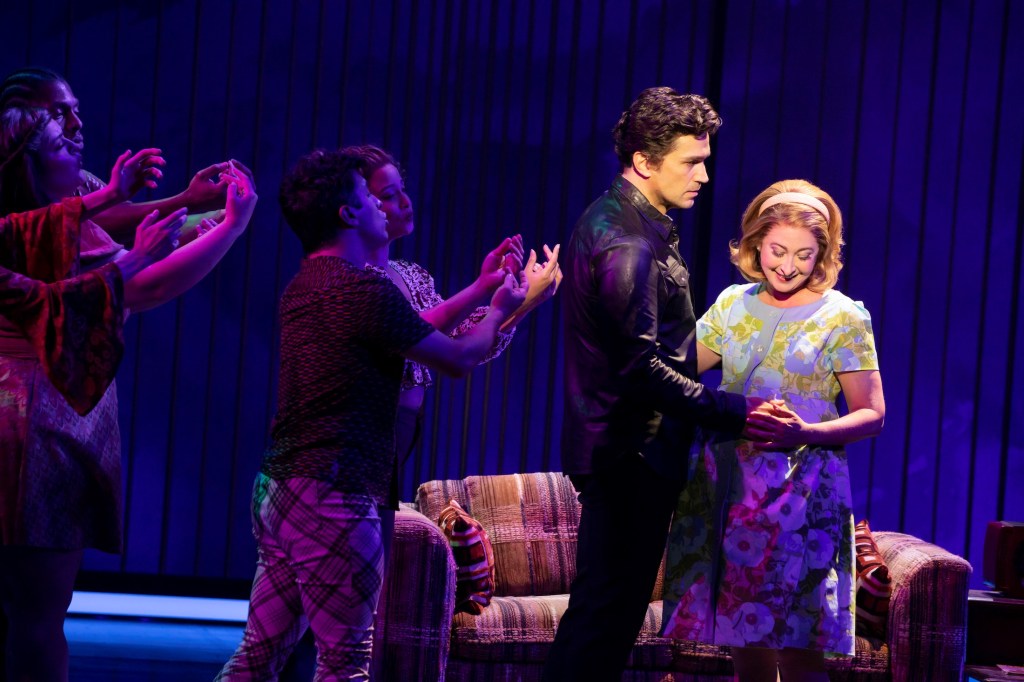
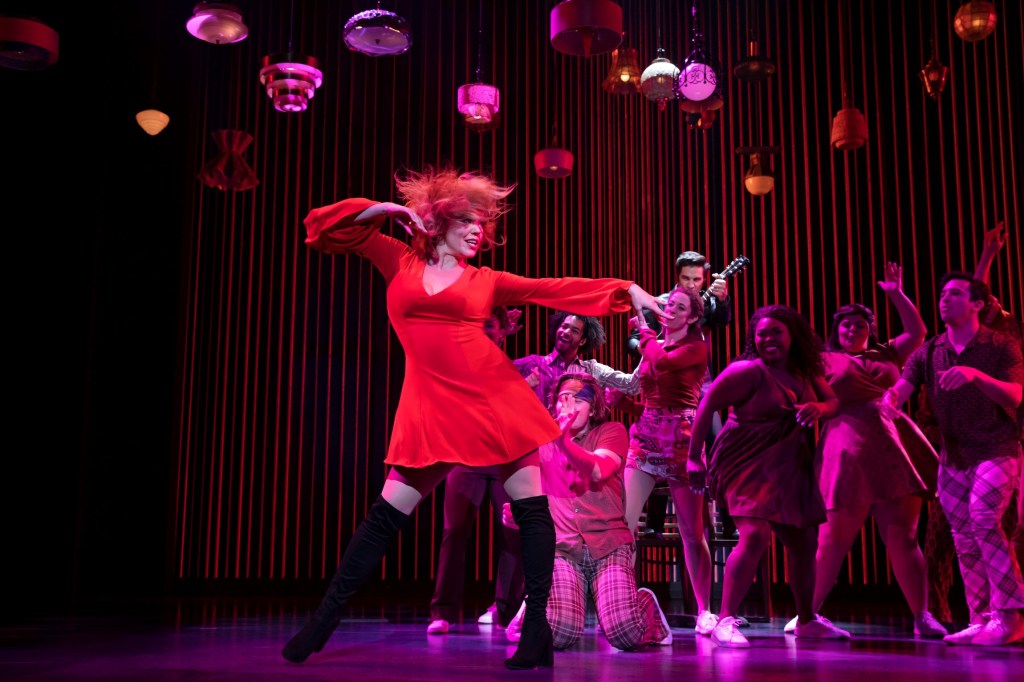
So when the doctor settles upon a classic hit created around that time, (which Robyn Hurder dances to in a bright red sexy costume when “Cherry Cherry” is performed) the older Neil jumps at the chance to talk about the creation of his song for “the mob.” These flashback scenes become the humorous high point of Act I. We are intrigued as the older Neil characterizes working with Bang Records as “the biggest mistake of my life.”
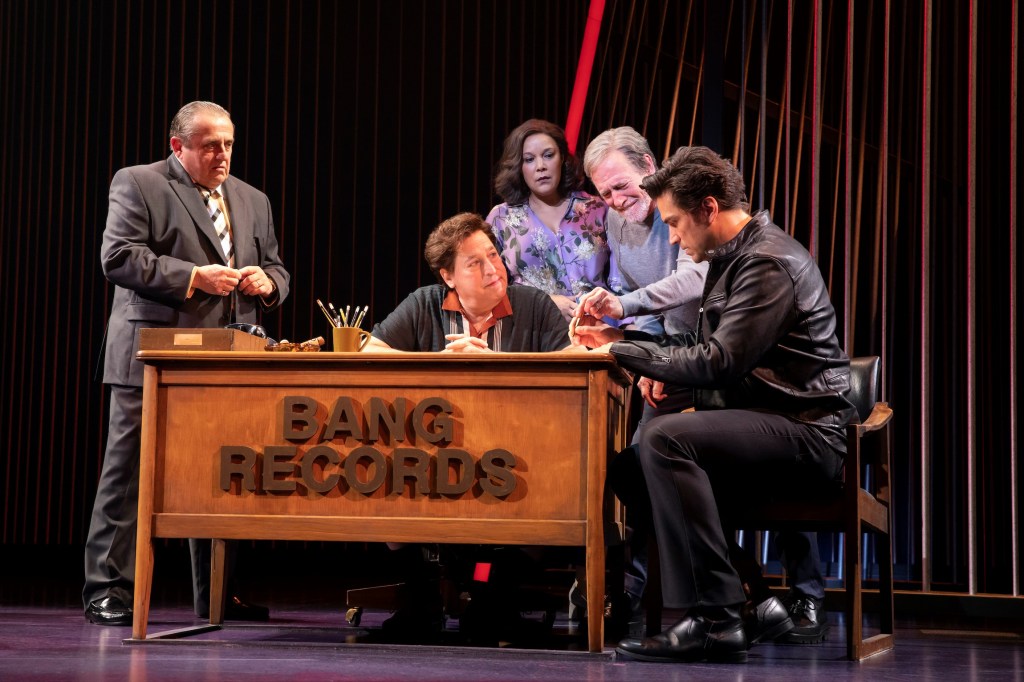
Ellie introduces Neil to Bert Berns (Tom Allan Robbins) who runs Bang Records, while Mob Boss Tommy O’Rourke (Michael McCormick) funds the company. In a flashback Swenson’s Neil makes a deal with them to produce hits, if they then produce more artistic songs like “Shilo,” which may not be hits. Though O’Rourke agrees, McCormick’s O’Rourke humorously indicates he has no intention of keeping his promise. In a scene where time stops, the older Neil tries to prevent younger Neil signing on with Bang Records by trying to take the pen away. Older Neil fails and younger Neil signs and is controlled by them. He must produce three hits or end up in peril of his or his family’s lives.
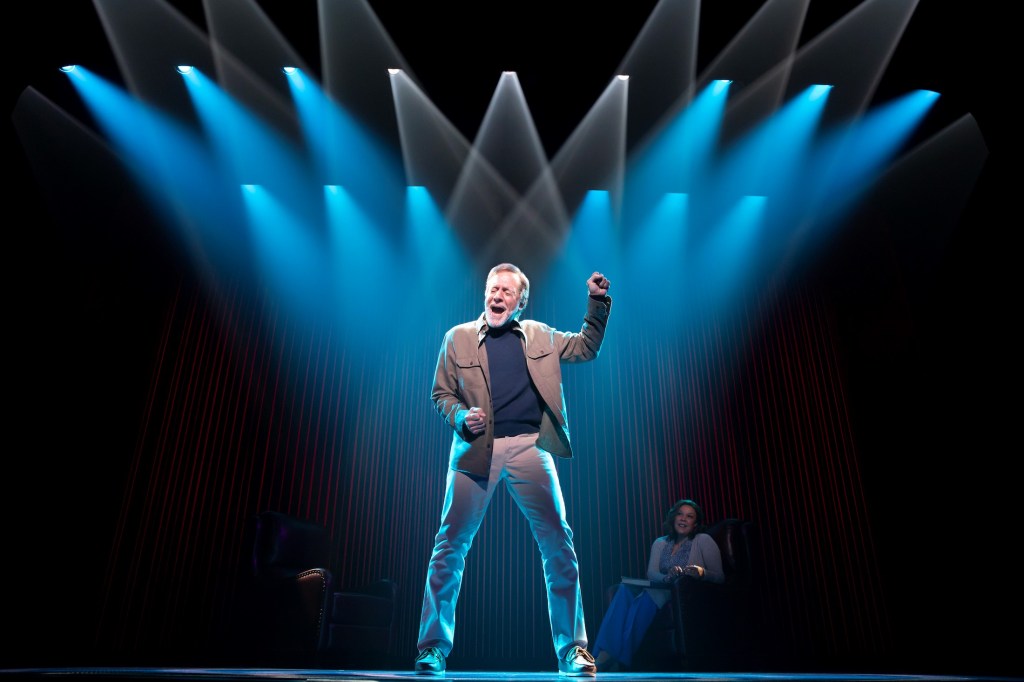
In revealing how younger Neil is torn between Jaye and Marcia, the musical number with the Noise “Cherry Cherry” rocks it as the number physicalizes Neil’s quandary first with Jaye and then moving toward Marcia until he is with her. As Fisher’s Jaye sings “Love on the Rocks,” with Swenson’s Neil begging her to stay, she asks if he loves Marcia. At this point the question is moot.
Neil’s exciting foray into success as he fulfills his contract to mob controlled Bang Records reaches its dramatic high point played out in a dingy Memphis motel, where he retreats to write and get away from the gun happy O’Rourke. Jacoby’s Neil reveals how he was under tremendous pressure to create or suffer the dire consequences. O’Rourke has the Bitter End bombed to send Neil “a message.” Older Neil shares how in Memphis after days of rain, the symbolic sun comes out. He credits the inspiration to “God” coming into the motel room, sealing his children’s future and his own. In thirty minutes the metaphoric dark clouds clear (dark clouds are used as a symbol throughout) and Neil writes one of his signature songs. Act I ends with the rousing “Sweet Caroline.” During their song performance the audience went wild the night I was there. The audience, and Swenson and the Noise “reach out, touching me, touching you.” Theirs is an electric connection that younger Neil is not able to muster with his wife Jaye and their children.

Act II begins with the persona Neil Diamond, who is now famous. Director Mayer has Swenson’s Diamond rise on a platform surrounded by lights and glory with a “Hollywood Squares” type layered set with the band in various “squares.” Clearly, Neil is becoming the award winning legend, singing “Brother Love.” Subsequently, through the older Neil’s retelling, we note that Swenson’s Diamond, with dazzling, sparkling sequins runs from concert to concert, fulfilling the destiny that he dreamed of in Flatbush, Brooklyn, the place that controls his psyche, the place he still runs from. This is especially so even though his concerts sell out with greater fandom than the Rock & Roll King Elvis. In the next decades with Marcia in twenty-five years of marriage, he has it all, friends with the Redfords, a Malibu home and money raining down. Where his first marriage to Jayne dissipated with “love on the rocks,” his marriage to Marcia quietly implodes during phone calls, separate lives and acknowledged disinterest. This is manifest with Hurder’s Marcia and Swenson’s Neil with “You Don’t Send Me Flowers,” in a lovely rendition.
At their divorce, Diamond gives Marcia everything and continues to work. Jacoby’s Neil tells us a few years pass and he meets third time lucky Katie and establishes a family. But the diagnosis has brought him to a place of reckoning at the therapist’s office. And we are back in the present when Powell’s therapist asks the question about Neil’s feelings of being alone, an emotion which permeates many of his songs. During this segment Mark Jacoby’s quiet resolve and recalcitrance breaks open in expansive revelation.
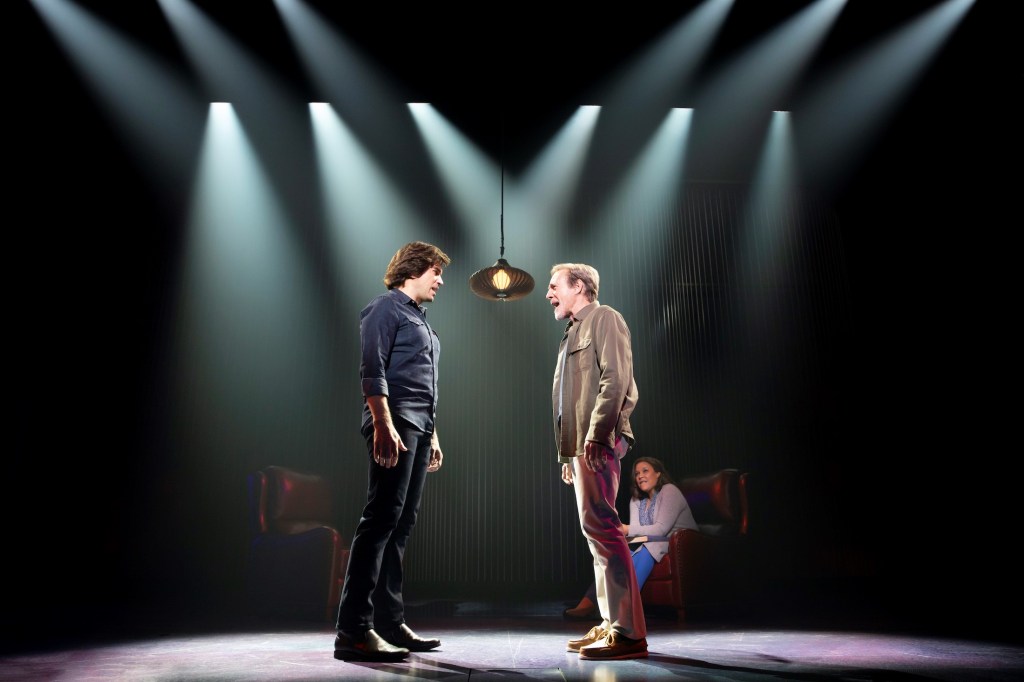
For the first time we hear him sing filled with the depth of years of repression to claim his self-affirmation in “I Am I Said.” Jacoby hits it out of the ball park and brings the entire journey into completion as Swenson’s Neil joins him and the two identities are conjoined. It is an astounding, brilliant piece of writing coupling the elements and characters bringing them into sharp focus. The power of the moment hinges on Jacoby’s portrayal of Neil which is heartfelt, touching and human. The conclusion memorably coalesces the dream coming to its full humanity in Neil Diamond. Merging his identity as a performer and as a cultural prophet he gains a new understanding of his emotions from the past viewing them with the comfort in the present reality of who he is and what he has accomplished.
Directed by Michael Mayer with Steven Hoggett’s choreography and Sonny Paladino’s music supervision and arrangements and the near-perfect performances, this astounding and prodigious effort is bar none. Above all it is a tribute to Neil Diamond the performer and Neil Diamond, the man, like all of us, broken by his own inner fears and isolation which is an integral part of his creative spirit and artistic genius. The breadth of the songs included in the show which reveal that Diamond mastered pop, rock, country and blues indicates why in addition to his awards is also an honoree at the Kennedy Center Honors and a recipient of the Grammy Lifetime Achievement Award (2018).

Importantly, The Neil Diamond Musical, A Beautiful Noise probes themes that reveal how driving ambition and talent shadow an artist’s personal life. In chasing the dream it is sometimes difficult to fully enjoy one’s success. In his resolution at the conclusion, Jacoby’s Neil understands the importance of this and expresses gratefulness at all the directions, all the roads his life has gone down.
There are a few critical junctures that don’t quite work and sometimes the staging and sound were problematic for those not seated direct center. But these details are overshadowed by the ingenuity of the book, the resonance and gorgeousness of Diamond’s music, the energetic, believable performances and the organic, modern and retro dances. Jacoby’s Neil who is listening and participating as he watches Neil’s own reflections manifest before him, never flags in his portrayal in a difficult, complex role. Neither does Swenson who’s evocation of Diamond is an intimation of his attitude and spirit and not an imitation. Hurder, Powell, Fisher and Sudia are excellent and Sudia is flexible doing double time as younger Neil’s mom. Robbins and McCormick fulfill their portrayals with humor and kudos to them for taking on additional roles.
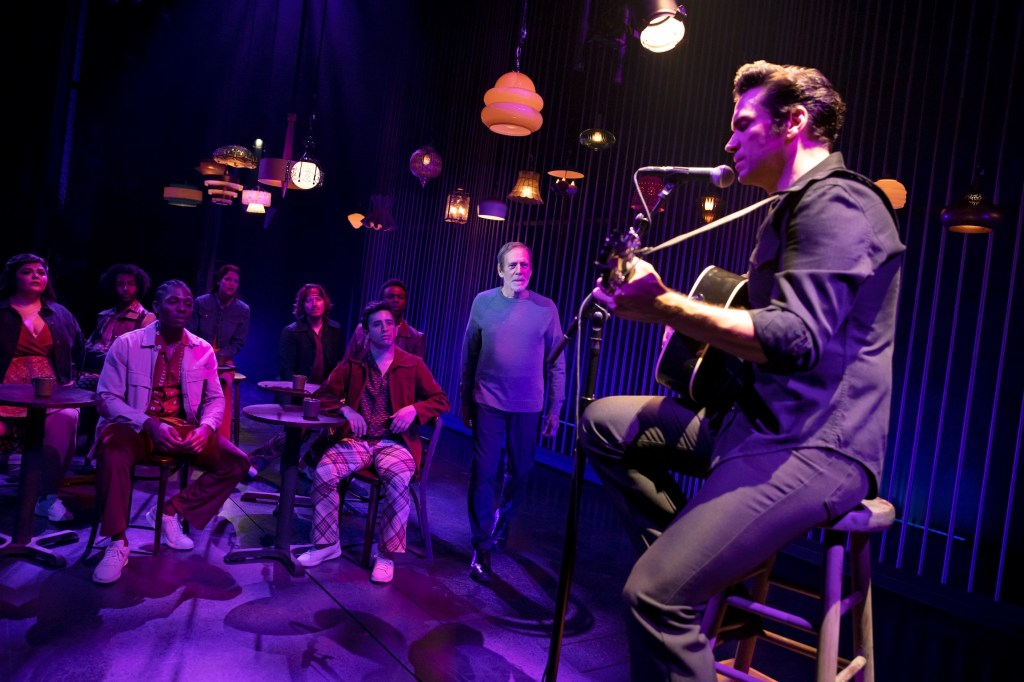
David Rockwell’s scenic design, Emilio Sosa’s costume design, Kevin Adams’ fine lighting design and Jessica Paz’s sound design work to deliver an amazing production. Noted are Luc Verschueren’s hair, wig & makeup design and Annmarie Milazzo’s vocal design. Bob Gaudio, Sonny Paladino & Brian Usifer delivered the superb orchestrations and Brian Usifer is responsible for incidental music and dance music arrangements.
If Neil Diamond’s music doesn’t rock for you, see it for the performances and spectacle. If you adore Neil Diamond, what are you waiting for? Go to their website for tickets and times https://abeautifulnoisethemusical.com/
.
t
 CAROLE DI TOSTI