Blog Archives
‘The Seven Year Disappear,’ Mother-Son Relationship Chaos as Performance Art
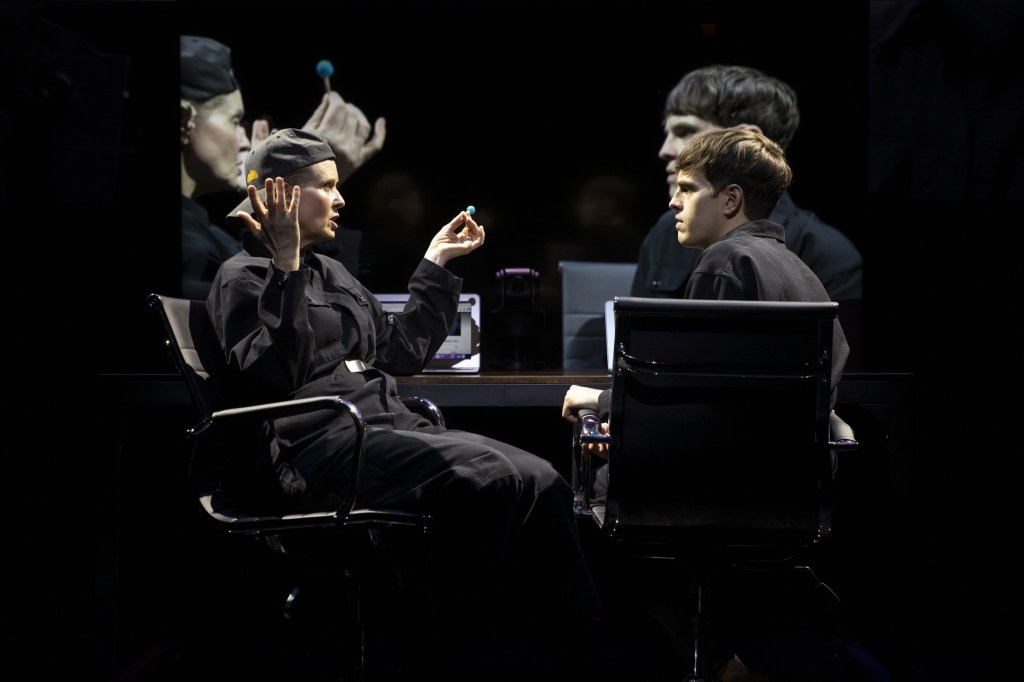
In The Seven Year Disappear, Jordan Seavey (Homos, or Everyone in America), creates celebrated, bi-polar, performance artist Miriam (Cynthia Nixon), and her gay son Naphtali (Hebrew for “my struggle, my strife”), played by Taylor Trensch, to elucidate the darkness in a mother-son relationship when the personalities are hyper creative and high strung. Issues especially evolve when the artists, like Miriam, are complex, self-centered, demanding, assertive and exceedingly ambitious. Indeed, Miriam’s perspective and being blur the boundaries of normalcy and reality and engulf everything and everyone close to her, mostly her son.
Currently running as a World Premiere at the Signature Center, The Seven Year Disappear with no intermission concludes its limited run on 31st of March.
Directed by Scott Elliott with assists by Derek McLane’s scenic design, Rob Milburn & Michael Bodeen’s excellent sound design, Qween Jean’s costume design (workman’s black coveralls and boots), and John Narun’s projection design, which together, keep the audience stirred and engaged, The New Group’s presentation of Seavey’s comedic drama intrigues. There are no easy answers. Complication rules the day, and the overall structure of systematic flashbacks of titled events in three movements, slips backward in time, with four brief returns to the present year, 2016, then back again, to unspool the ominous artistic relationship between Miriam and Naphtali over a twenty-six year period.

The two-hander relies on the dynamic performances of Nixon and Trensch. The wrangling mother and son strike high points of Naphtali’s life, during the time when Miriam disappears for seven years (2009-2016). Her premeditated disappearance, a publicity stunt, happens right after funds have been raised for the first half of her commission as a performance artist in a project to be presented at MOMA. When Miriam goes missing, Naphtali contacts the NYPD and does all he can to relocate her, to no avail. She doesn’t want to be found and perhaps has elicited the help of MOMA to increase the suspense and excitement of her invisibility as performance art, that is a hardship especially to Naphtali. For her, it is a triumph. She will emerge to acclaim when she is ready, and then, present the key moments of her invisibility.
Leaving Naphtali to fend for himself with little money from 2009 through 2016 when she “returns,” he is forced to get a job and apartment and struggle on his own after being dependent on her. For emotional sustenance to fill in the void his mother’s absence has left, he engages with numerous unusual people, all of them portrayed by Cynthia Nixon, using various physical and vocal changes, as he searches for Miriam and irons out his own life. Naphtali is full of questions and feelings of victimization where he sometimes helps himself to drugs and alcohol and attempts to confront her abandonment, which has always been a fact of his life.
MIriam’s durational disappearance is another demonstration of her dislocation from motherhood which initiates when she left four-year-old Naphtali alone at the zoo watching penguins. She leaves him to pursue a drink with Wolfgang, who becomes her intimate partner for a time, then years later becomes Naphtali’s sexual lover for a time during Miriam’s disappearance. Ironically, when Wolfgang is concerned about the young Nephtali in the zoo, Miriam comments, “He’ll be fine.” As it turns out, leaving him traumatizes Naphtali, who never gets over it. We learn it sets him up for a lifetime of his mother’s leaving, which he never conquers.

Clearly, unlike Miriam’s rival, Marina Abramović, one of the most renown performance artists in the world, who chose not to have children, Miriam has Naphtali. However, she refuses to sacrifice her art for her son. Instead, we learn that she exploits him by incorporating him in her work as a durational performance artist. When he is older, he allows her to continue using him, even becoming her manager in order to be close to her, which he says is the only way he gains her attention.
However, Miriam’s seven year disappearance is a piece de resistance, a capstone to shake the art world, which reveals her dedication and wildness in her artistry to effect a total invisibility. On another ironic level, leaving her son and manager behind to go incommunicado is a cheap, attention getting stunt. If it is a cost to her, we don’t see it. We do see the pain it causes Naphtali.
Clues to what Miriam is doing appear throughout the drama which reveals the more pretentious side of the durational performance art world, which we note impacts her son, not necessarily others, as Marina Abramović’s performances do. Where Miriam’s rival has put herself through grueling feats to test her physical, psychic and mental strength to acclaim and positive impact, Miriam’s disappearance doesn’t function positively, though it forces Nephtali to appear to become more independent.
However, during the seven years, everyone Nephtali sees or meets for support (Wolfgang-a sexual father figure, Brayden-a gay lover, Tomas-a gay lover, Kaitlyn-his manicurist, Aviva-an actress, Michael-a gay priest who conducts sex orgies, Nicole-a detective), is a reflection of his mother. Indeed Cynthia Nixon portrays each of these characters.
Thus, though Miriam has “flown the coop,” she is very much present in Nephtali’s life and emotional and psychic imbalances. To say that Miriam’s parenting skills leave much to be desired is an understatement. Her strident character, arrogance, unapologetic nature, and “take or leave it” attitude blaming God for making her this way, only reinforces Marina Abramović’s quote that Seavey includes in the play’s script, which perhaps should appear in the production projected on a backdrop but doesn’t.

‘I had three abortions because I was certain that [having a child] would be a disaster for my
work. One only has limited energy in the body, and I would have had to divide it.’
– Marina Abramović
MIriam, clearly, has difficulty dividing her energies. Thus, she rationalizes using Naphtali to uplift her art at his expense. We learn she has done this cruelly, sadistically with performance art Seavey slyly references. With the artistic endeavors after the disappearance is over, Miriam hopes to achieve a redemptive artistic reconciliation, once again at Naphtali’s expense, though she sells it to him as an equalizer. She claims it will center on Naphtali as a co-partner in making her new performance art to finish MOMA’s commission, as they present their divergent experiences separated during her “seven year disappear.”
However, as we learn piecemeal, in reverse chronology what happens between the mother and son, taking it all in, the result is structural chaos in Naphtali’s life that he is in bondage to. Their relationship is a devastation. And the bits and pieces of performance art evident in the play (at the beginning when Nixon and Trensch stare at each other from across the table), Nixon’s various characterizations pitted against Trensch’s searching, enhanced in closeups by John Narun’s projection design, leave the audience enervated not uplifted.
The Seven Year Disappear is one to see for its performances and play structure. The mother-son relationship disturbs and gives one pause. Nixon’s Miriam is stark. Taylor Trensch’s portrayal is empathetic. Together, they evoke a work which is memorable and unique.
The Seven Year Disappear. The Alice Griffin Jewel Box Theatre, The Pershing Square Signature Center
480 W 42nd Street https://thenewgroup.org/production/the-seven-year-disappear/
 CAROLE DI TOSTI