Blog Archives
‘Father Mother Sister Brother’ With Adam Driver, Cate Blanchett, Tom Waits @NYFF

Father Mother Sister Brother
Jim Jarmusch’s Golden Lion award winner at the Venice Film Festival is a quiet, seemingly unadventurous film that nevertheless packs a punch. Instead of car chases and bombs exploding, Jarmusch employs subtext, nuance and quietude to convey family alienation.. His dangerous IUDs include slight gestures, a raised eyebrow here, a smile there and stilted, abrupt silences throughout.
Jarmusch quipped in the Q and A during the 63rd NYFF screening about such captured details of human behavior. To focus on nuances and what they reveal becomes much more difficult to film and edit rather than “12 zombies coming out of the ground.” Certainly the laconic characters portrayed by superb award winning actors (Charlotte Rampling, Adam Driver, Cate Blanchette, Tom Waits, Vicky Krieps, the beautiful Indya Moore and Luka Sabbat), hold one’s attention as masters of understatement. Indeed, Jarmusch forces us to carefully observe them because of what they don’t say, as they ride the pauses between what they do express.

Jarmusch’s triptych of meet-ups among family members rings with authenticity. Principally because Jarmusch wrote the parts for the actors he selected, the dialogue and situations unfold seamlessly. Of course the stilted silences fill in the gaps between parents and children when both are fronting about what is true and real. To what extent do we cut off 80% of what we would like to say to “keep the peace,” “mask our true emotions” or “get over?”
The film divides familial separation into three scenarios in three locales. In the last sequence, the separation has no hope of reconciliation. In the first scenario a slick, quirky father (Tom Waits) hosts his children (Adam Driver, Mayim Bialik). In their ride to his house in a wooded area by a lake, the brother and sister discuss how their father has difficulty making ends meet and may have dementia. Ironically, when they share that he hits them up for money, they haltingly discuss that they give it to him. Sister Mayim Bialik humorously comments that the frequency and amount may have contributed to her brother’s divorce. Then she ruefully realizes her insulting remark and apologizes. Their conversation reveals, they too, display an awkwardness with each other.
Of course this ramps up when they sit down with their father who offers them only water to drink, instead of something more. However, his wife, their mother passed, so assumptions abound. For example, they assume his shabby, messy living room signifies he struggles with her loss. And perhaps his lack of funds and sloppiness reveal a purposelessness in his own life without her. However, when Jarmusch has the children leave, we note the reality behind the assumptions. Waits’ Dad transforms into someone else. Not only have the grown children underestimated their father, they’ve completely misread his personality, character and intentions.
The scene is heavy with humor. Indeed, it reminds us that the Italian proverb “You have to eat 100 pounds of salt with someone to understand them,” isn’t an exaggeration. And this thematic thrust Jarmusch has fun with in the next scenario as well.
The second interlude takes place in Ireland, where a wealthy novelist mother (Charlotte Rampling) hosts a formal tea for her grown daughters who live in Dublin (Vicky Krieps and Cate Blanchett). The lush setting and table filled with all the proper treats for an afternoon tea impress. However, the sophistication of the setting adds to the cold atmosphere among the daughters and mother who play act at niceties. The daughters appear at opposite ends of their lives. Kreps with pink hair contrasts with Blanchett outfitted with glasses, short cropped hair and regressed to dour blandness. Rampling’s remote, regal mom presides over all austerely.
Before the daughters arrive, the mother reveals her attitude about the tea. Krieps alludes to a relationship with another woman. However, none of the interesting frequencies in their real lives come to the table. Instead, they drink tea politely accomplishing a duty to their blood. Truly, folks may be related by DNA, but their likenesses, interests, values and personalities may have little alignment with their blood kinship. We do choose our friends and are stuck with family relations.
Interestingly, the third segment returns to the theme of children not understanding their parents, who grow up in a different time warp. In Paris, two lovely-looking fraternal twins (Indya Moore and Luka Sabbat) make a return visit to their late parents’ spacious apartment. Their parents, who died in a plane crash, have separated from them for the rest of their mortal lives. As they walk through the empty apartment then go to their parent’s storage unit, they confront the impact of their parent’s deaths. Additionally, they marvel at their parents’ things. These had little significance to them but had meaning to their parents who kept them and paid for the storage.
Of the three scenarios, in the last one Jarmusch reveals the love between the siblings. Additionally, he reveals a potential closeness to their parents. As they go through a few old photos, they show their admiration and they mourn. However, what remains but memories and the stuff in the storage unit whose meaning is lost to them? The heartfelt poignance of the last scenario contrasts with the other family scenarios and lightly holds a greater message that Jarmusch doesn’t shove down our throats.
Jarmusch’ Father Mother Sister Brother reveals profound concepts about family, human complication and mystery of every human being, who may not even be knowable to themselves.
Father Mother Sister Brother releases in US theaters at a perfect time for family gatherings, December 24, 2025 via MUBI, where it will stream at a later date. For the write up and information at the 63rd NYFF, go to this link. https://www.filmlinc.org/nyff/films/father-mother-sister-brother/
‘Saturday Church’: The Vibrant, Hot Musical Extends Until October 24th
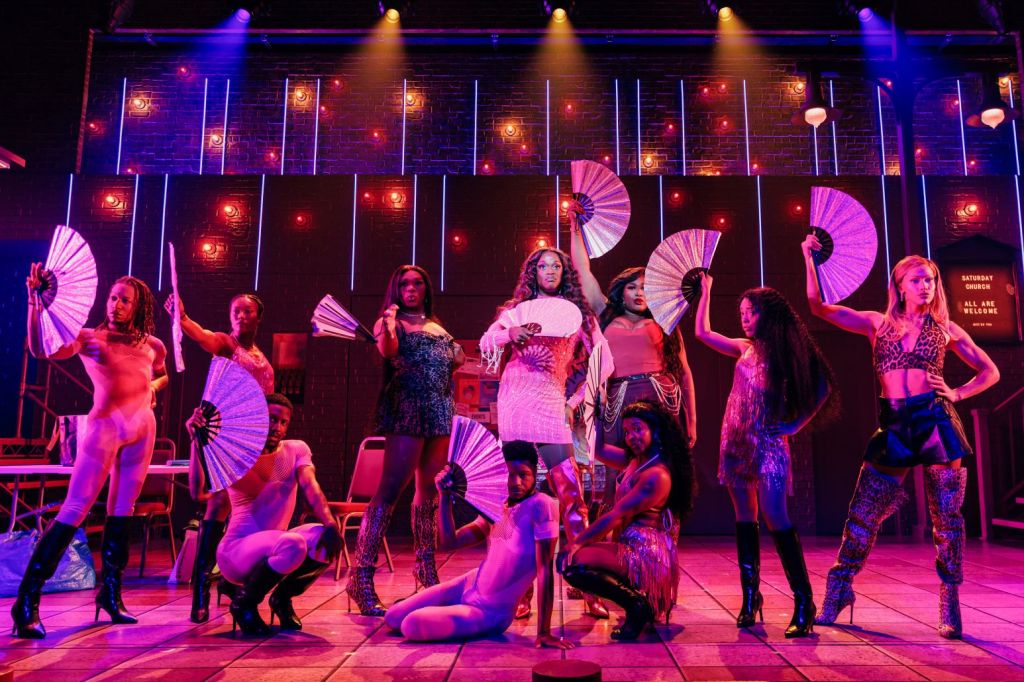
With music and songs by Grammy-nominated pop star Sia and additional music by Grammy-winning DJ and producer, Honey Dijon, Saturday Church soars in its ambitions to be Broadway bound. The excitement and joy are bountiful. The music and songs, a combination of house, pop, gospel spun into electrifying arrangements by Jason Michael Webb and Luke Solomon, also responsible for music supervision, orchestrations and arrangements, become the glory of this musical. Finally, the emotional poignance and heartfelt questions about acceptance, identity and self-love run to every human being, regardless of their orientation and select gender identity (65-68 descriptors that one might choose from).
Currently running at New York Theatre Workshop Saturday Church extends once more until October 24th. If you like rocking with Sia’s music, like Darrell Grand and Moultrie’s choreography and Qween Jean’s vibrant, glittering costumes, you’ll have a blast. The spectacle is ballroom fabulous. As J. Harrison Ghee’s Black Jesus master of ceremonies says at the conclusion, “It’s a Queen thing.”
However, some of the narrative revisits old ground and is tired. Additionally, the music doesn’t spring organically from the characters’ emotions. Sometimes it feels imposed upon their stories. Perhaps a few songs might have been trimmed. The musical, as enjoyable as it is, runs long.
Because of the acute direction by Whitney White (Jaja’s African Hair Braiding), the actors’ performances are captivating and on target. Easily, one becomes caught up in the pageantry, choreography and humor which help to mitigate the predictable story-line and irregularly integrated songs in the narrative.
Conceived for the stage and based on the Spring Pictures movie written and directed by Damon Cardasis, with book and additional lyrics by Damon Cardasis and James Ijames, Saturday Church focuses on Ulysses’ journey toward self-love. Ulysses (the golden Bryson Battle), lost his father recently. This forces his mother to work overtime. Unfortunately, her work schedule as a nurse doesn’t allow Amara (Kristolyn Lloyd) to see her son regularly.
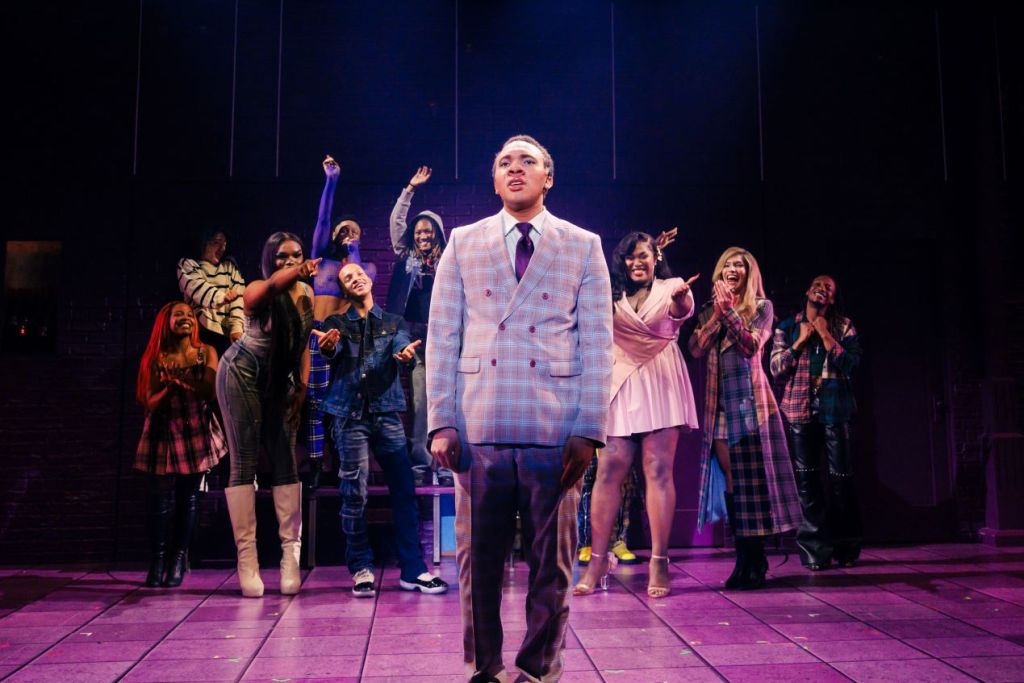
Though the prickly Aunt Rose (the exceptional Joaquina Kalukango), stands in the gap as a parental figure, the grieving teenager can’t confide in her. Even though he lives in New York City, one of the most nonjudgmental cities on the planet, with its myriad types of people from different races, creeds and gender identities, Ulysses’ feels isolated and unconnected.
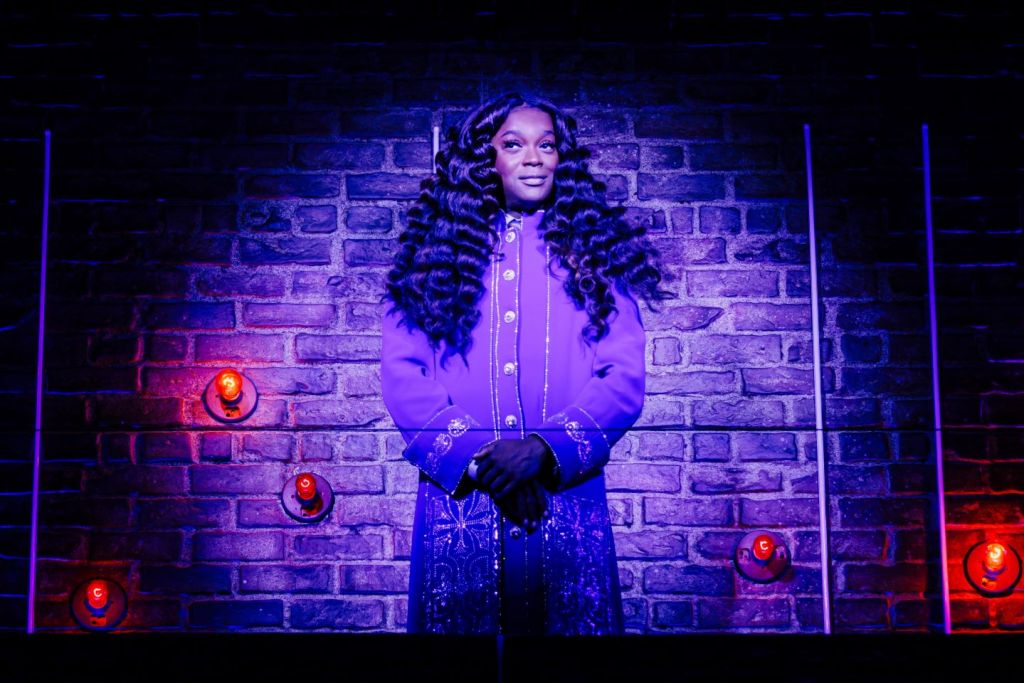
His problem arises from Aunt Rose and Pastor Lewis (J. Harrison Ghee). Ghee also does double duty as the master of ceremonies, the fantastic Black Jesus. Though Ulysses loves expressing himself in song with his exceptional vocal instrument, Aunt Rose and Pastor Lewis prevent him from joining the choir until he “calms down.” In effect, they negate his person hood.
Negotiating their criticisms, Ulysses tries to develop his faith at St. Matthew’s Church. However, Pastor Lewis and Aunt Rose steal his peace. As pillars of the church both dislike his flamboyance. They find his effeminacy and what it suggests offensive. At this juncture with no guidance, Ulysses doesn’t understand, nor can he admit that he is gay. Besides, why would he? For the pastor, his aunt and mother, the tenets of their religion prohibit L.G.B.T.Q Christianity, leaving him out in the cold.
During a subway ride home, Ulysses meets Raymond (the excellent Jackson Kanawha Perry). Raymond invites Ulysses to Saturday Church and discusses how the sanctuary runs an L.G.B.T.Q. program. With trepidation Ulysses says, “I’m not like that.” Raymond’s humorous reply brings audience laughter, “Oh, you still figuring things out.” Encouraging Ulysses, Raymond suggests that whatever his persuasion is, Saturday Church is a place where different gender identities find acceptance.
Inspired by the real-life St. Luke in the Fields Church in Manhattan’s West Village, Saturday Church provides a safe environment where Christianity flourishes for all. When Ulysses visits to scout out Raymond, with whom he feels an attachment, the motherly program leader Ebony (B Noel Thomas), and her riotous and talented assistants Dijon (Caleb Quezon) and Heaven (Anania), adopt Ulysses into their family. In a side plot Ebony’s loss of a partner, overwork with running activities for the church with little help, and life stresses bring her to a crisis point which dissolves conveniently by the conclusion.
The book writers attempt to draw parallels between Ulysses’ family and Ebony which remain undeveloped. As a wonderful character unto herself, the subplot might not be necessary.
As Ulysses enjoys his new found persona and develops his relationship with Raymond, his conflicts increase with his mother and aunt. From Raymond he learns the trauma of turning tricks to survive after family rejection. Also, Ulysses personally experiences physical and sexual assault. Finally, he understands that for some, suicide provides a viable choice to end the misery and torment of a queer lifestyle without the safety net of Saturday Church.
But all’s well that ends well. J. Harrison Ghee’s uplifting and humorous Black Jesus redirects Ulysses and effects a miraculous bringing together of the alienated to a more inclusive family of Christ. And as in a cotillion or debutante ball, Ulysses makes his debut. He appears in Qween Jean’s extraordinary white gown for a shining ballroom scene, partnering with Raymond dressed in a white tux. As the two churches come together, and each of the principal’s struts their stuff in beautiful array, Ghee’s Jesus shows love’s answer.
In these treacherous times the message and themes of Saturday Church affirm more than ever the necessity of unity over division, and flexibility in understanding the other person’s viewpoint. With its humor, great good will, musical freedom and prodigious creative talent, Saturday Church presents the message of Christ’s love and truth against a pulsating backdrop of frolic with a point.
Saturday Church runs with one fifteen minute intermission at New York Theatre Workshop until October 24th. https://www.nytw.org/show/saturday-church/?gad_source=1&gad_campaignid=22911892225
‘Purpose’ Brandon Jacobs-Jenkins’ Riotous Play, Directed by Phylicia Rashad

In Purpose, Brandon Jacobs-Jenkins’ satiric family expose directed by Phylicia Rashad, we meet a patriarchal Black American civil rights icon, Solomon “Sonny Jasper (Harry Lennix), who is forced to confront his disappointments and foibles as his family gathers to celebrate the homecoming of his eldest son and namesake, Solomon “Junior” Jasper (Glenn Davis). Navigating the audience through treacherous familial waters with asides and intermittent, pointed narration, the youngest son Nazareth “Naz” Jasper (Jon Michael Hill), explores his family’s complicated legacy as he attempts to confront issues about his own identity and future.
Currently running at the Hayes Theater until July 6th, this ferocious, edgy and sardonic send up of Black American political and religious hypocrisy resonates with dramatic power. Its superlative performances and Rashad’s fine direction, make it a must-see. Importantly, in typical Brandon Jacobs-Jenkins style, the tour de force with jokes-a-plenty raises questions. It prompts us to reflect upon our own life intentions, as we examine the Jasper family’s dynamic through the acute perspective of the endearing, sensitive, vulnerable and authentic Naz. Hill is just terrific in a role which requires heavy lifting throughout.

As the play opens we note the subject matter and foundation upon which Jacobs-Jenkins’ moralistically satiric drama rests, namely the Jaspers (think along the lines of Jesse Jackson), whose heritage boasts of leaders in civil rights, congress and the protestant church. Todd Rosenthal’s lovely, well-appointed, Jasper family home represents prosperity, upward mobility and the success of the celebrated Black political elite. Solomon Jasper was Martin Luther King, Jr.’s heir apparent in the civil rights movement.
However, among other questions the play asks is, what happened to the substance and efficacy of the movement, considering the current “state of the union” under MAGA Party president Donald Trump, whose cabinet has no Black American member? What are the legacies of the Jasper’s faith? What is the heritage of their former Black radicalism, which Naz calls into question throughout the play, as the evening explodes into tragicomedy in front of unintended witness Aziza Houston (Kara Young)? As a result of the evening with the Jaspes, Aziza is horrified to see her civil rights icons, Solomon and Claudine, smashing her respect for them to smithereens during the family imbroglio in Act I.

Via an intriguing flashback/flashpresent device, Naz exposes and illustrates how the family’s shining history becomes obliterated by circumstances in the present “state of the family union,” which has not lived up to their patriarch’s illustrious expectations. Ultimately, Solomon Jasper, too, may be counted as not living up to his own personal expectations, a fact revealed by the conclusion of the second act, which further adds to his hypocrisy for giving Naz a hard time about his sexually, abstemious, personal choices..
With increasing intensity, the upheavals occur by the end of the first act and augment into further revelations and complications well into the second, until the wounds exposed are too great to ignore. Naz’s final synopsis and soulful, poignant comments solidify at the conclusion bringing this family retrospective together. His questioning wisdom leaves us as he is left, wondering what is the trajectory of this once august Jasper legacy, which Naz has chosen not to perpetuate. Not going into politics or the church, Naz selected a career in photography where he communes with nature’s beauty and peace.

Jacobs-Jenkins’ work is filled with contrasts: truth and lies, health and sickness, moral uprightness and moral turpitude. In fact the contrast of the outer image of the Jasper calm and sanctity versus the inner corruption and turmoil becomes evident with Jacobs-Jenkins’ character interactions throughout, heightened by Naz’s confidential asides.
Additionally, this contrast of superficial versus soul depth is superbly factored in by Rashad and Todd Rosenthal’s collaboration on set design. Initially, all is peaceful in their gorgeous home set up by matriarch Claudine Jasper (the excellent Latanya Richardson Jackson). The home’s beauty belies any roiling undercurrents beneath the family’s solid, upright probity. Perfection is their manufactured brand, which Aziza has bought hook, line and sinker as a Jasper fan.
To continue with the Jaspers’ “brand,” the inviting great room boasts a comfortable and lovely open layout-living room and dining room-backed by a curved staircase to the second level of bedrooms off the landing. The dark peach-colored walls are beautifully emphasized with white trim molding. The cherry wood furniture and cream colored sofa color-coordinate with the walls. The sofa is accented with appropriate pillows. Interspersed among furniture pieces are obvious antique heirlooms. Indeed, all is perfect with matching table runners and dining room tablecloth and napkins and dinnerware tastefully selected for its enhancing effect.
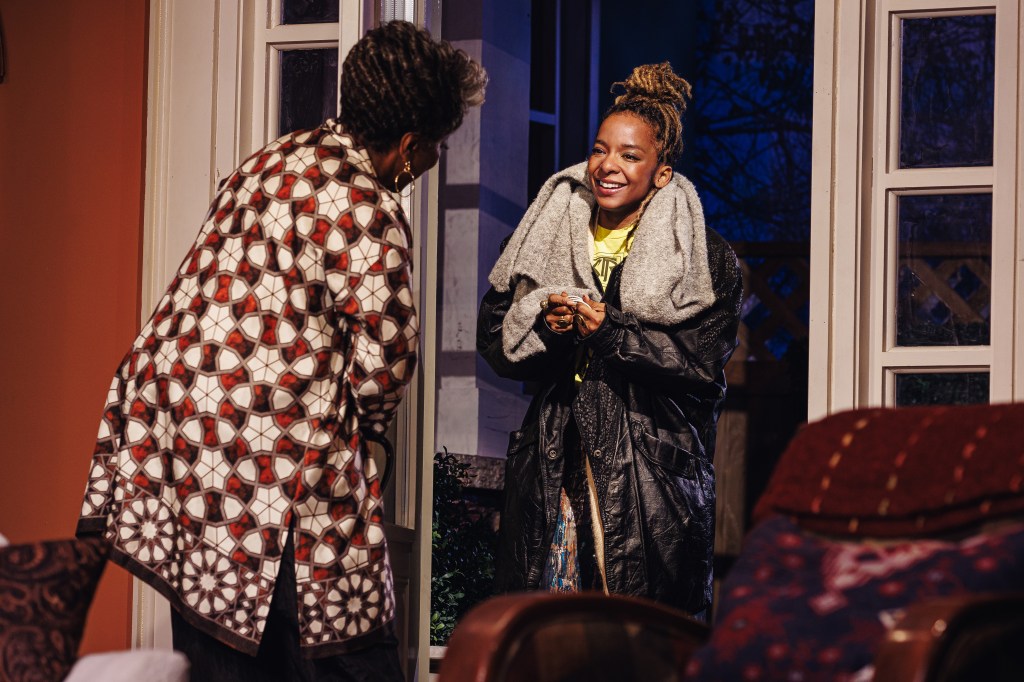
Prominently featured is the Jasper family heritage and legacy, a large portrait of Dr. Martin Luther King, Jr. proudly displayed on the first level, and a lesser portrait of political/cultural heir apparent, Solomon “Sonny” Jasper on the second floor landing. Surrounding the Sonny Jasper portrait are framed photos chronicling the civil rights warriors and family, shining their historical significance. When Aziza first arrives and is welcomed desperately by Claudine who fears Naz’s not bringing any woman home means he is gay, Aziza is gobsmacked by the house. Seeing the portraits and Solomon Jasper, she realizes who Naz really is. She is over the moon slathering blandishments to Sonny. Thrilled, she can’t help but take selfies with the Jaspers to send to her mom, a mutual fan. Naz is beyond humiliated and surreptitiously pleads with her to leave.
What does Naz know about his family that he fears Aziza will discover? If Aziza doesn’t leave quickly, his mother’s hospitality to divine who Aziza is will make sure she stays. Indeed, Jackson’s Claudine never fails in her intentions.
Against the storied backdrop of their illustrious past that Aziza worships, the garish present unfolds at dinner. It is the celebration of Junior’s homecoming and reunion with the family since his thirty month prison stay for embezzling campaign funds. Junior’s behavior is one of the gravest disappointments that Sonny holds against his son. For him it is unforgivable that his namesake who was to take his place has tarnished the Jasper name with corruption.

Thus, when Junior presents a birthday gift to Claudine, of the letters she wrote to him in prison in a lovely book, Sonny scoffs, especially after reading a particularly mundane letter. (Lennix’s reading of a sample letter is hysterical). Then, Sonny questions Junior who wants to exploit their family name and go on tour with the book of Claudine’s letters, and Claudine, lifting up the hellishness of his imprisonment like a martyr.
Ironically, bitterly, humorously, Sonny airs his disgust that Junior would present himself as a Nelson Mandella, as if Junior’s prison experience was in any way equivalent to the horrors of imprisonment used as a tool of oppression and racism throughout US history. Sonny is especially livid because Junior’s crimes ripped off his father and Blacks who supported him. Additionally, the time Junior did was easy because Sonny used his influence to get Junior into “a minimum security playground.” Though it is revealed that Junior has bi-polar disorder, (the scene when Glenn Davis manifests this is superb), Sonny lacks empathy for Junior. He dismisses his illness and says he got caught where other politicians don’t get caught because Junior is stupid.
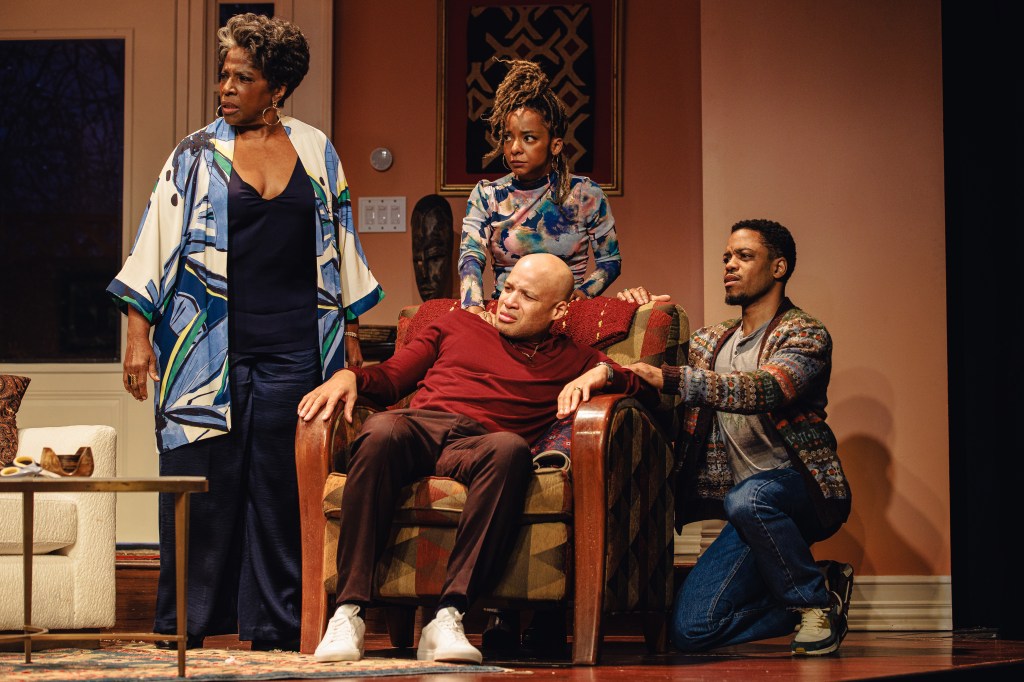
At dinner the dour Morgan (Alana Arenas), Junior’s wife, sits quietly at first. After Junior uplifts Claudine, Morgan claims neither he nor the Jaspers helped her through Junior’s mental breakdown. Nor does he acknowledge her visiting him through the prison experience with a present. Morgan rips into him and the family. They are “hucksters,” who don’t care about her and “have no sense of responsibility or remorse.” Listening to the Jasper’s accountants, Morgan signed their joint tax returns that implicated her in tax fraud with Junior. She has lost her career and will have to do time in prison for an error that she was ignorant about, trusting the family to not mislead her.
Thus, the artifice gradually peels away, shaped by the characters’ ever increasing digs at each other and Naz’s humorous perspective. To top it off, despite her promise to Naz that she will keep quiet, Aziza reveals how she trusts Naz to be the sperm donor for their child. This piece of information is a stick of dynamite for this religious family who chaffs at unmarried young people sleeping together. Then, when Claudine and Morgan go head to head and Morgan calls the family’s “honesty” into question and accuses Sonny of having “his fiftyleven other kids scattered all over this damn country,” Claudine loses it and gets violent.
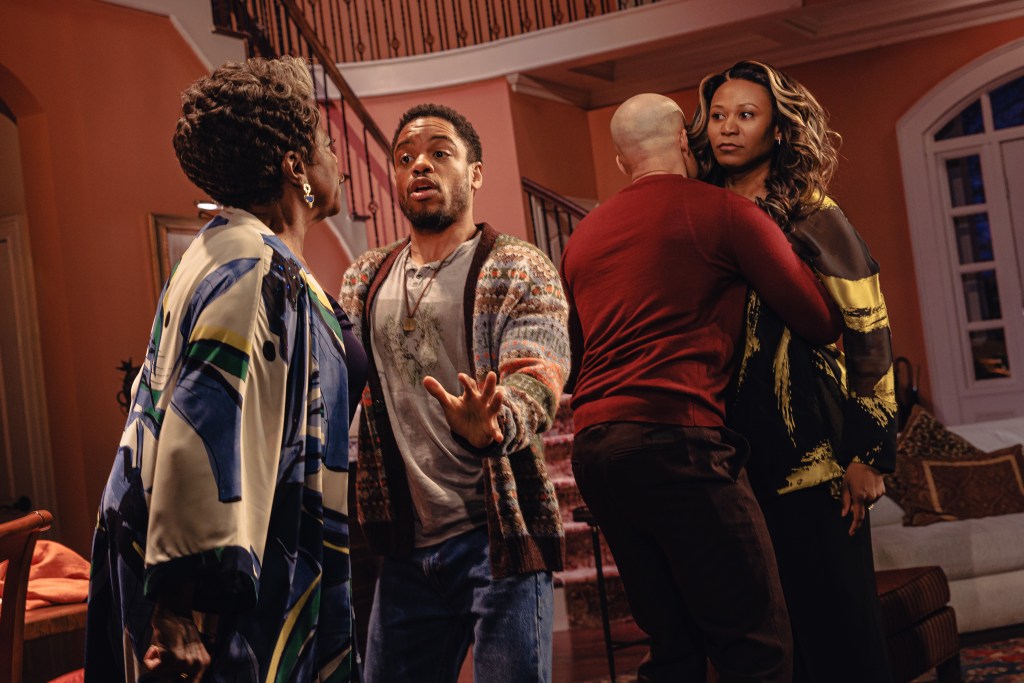
Ironically, the act ends with the patriarch blaming Claudine, “I have let you build this house on a foundation of self-deceit.” Sonny loudly declares the time is now for “redemption” and a “new era in this family – a new era of truth! Truth!”
Act II indicates how that “truth” is to come about, as Naz and Aziza argue about why she broke her promise to him. Abashedly, Naz disavows the violence that spilled out between his mother and Morgan. Meanwhile, the verbal and emotional violence has always been an undercurrent in the family that has never confronted their issues. In other words, the dissembling, the lies and the deceit have augmented until “enough is enough.” Aziza, caught up in the fray rethinks what she has seen and no longer has any wish to have Naz’s child from their “illustrious” DNA. Additionally, she has learned not to lionize any other civil rights icon or celebrity easily, again. Celebrities, like the Jaspers, are not saviors or worthy to be made into icons. They have clay feet if you see them up close and personal.

Though the first act sails smoothly, the second act digresses in part with Naz’s extensive dialogue and explanations, which might have been slimmed down. Nevertheless, as we learn about each family member’s complications, the intensity shifts. Though there is less humor, there is incredible poignancy and each of the actors have their moments to shine. Not only do we note the profound aspects of character complexity, we understand the difficulty of attempting to maintain an oversized legacy of greatness when one is an imperfect human being. Indeed, the one who comes out best appears to be Naz, until the conclusion. It is then we understand how the family has impacted him and in response, he has sent himself spinning into his own chaos, which he will have to unravel for himself. So do we all as we deal with our own legacy, heritage and family dysfunction.
Purpose is brilliant, if a tad unwieldy. However, the ensemble cracks sharply like lightening. Rashad has a deep understanding of Jacobs-Jenkins’ themes, dynamic characters, prickly relationships and the sub rosa levels of meaning in the interactions. The pace is lively despite the playwright’s wordiness and keeps the audience engaged.
Kudos to the creative team including those not already mentioned: Dede Ayite (costume design), Amith Chandrashaker (lighting design), Nikiya Mathis (hair & wig design), and Bob Milburn & Michael Bodeen (sound design). Purpose runs two hours fifty minutes with one intermission at the Helen Hayes Theater on 44th between 7th and 8th. https://purposeonbroadway.com/
 CAROLE DI TOSTI