Blog Archives
‘The Ferryman’ on Broadway, Jez Butterworth’s Striking Tragedy About The Silent Unspoken

‘The Ferryman,’ ensemble, by Jez Butterworth, directed by Sam Mendes (Joan Marcus)
How does one disentangle oneself from a clandestine tribe that has no legitimacy? A tribe who bonds over shared bloodshed, brutality, and murder to achieve a political purpose? Jez Butterworth’s masterpiece The Ferryman, superbly directed by Sam Mendes, has transferred to the Bernard B. Jacobs Theatre in New York from its run in London. This smashing production confronts important themes about politics and violence for our times, for all times.
The Ferryman opens up a series of conundrums. First, is it possible to turn away from violence without completely working through one’s past bloody deeds? Or is an inherently violent nature prone to murderous acts when an occasion for vengeance presents itself? Second, when a loved one has gone missing, can family members truly reconcile the absence? When there is no closure to grieve because of the “ambiguous loss,” what is the impact on family relationships? Finally, is the missing one physically absent but still present? Or is their absence a haunting force, a myth that overwhelms, even if some family members never knew them?
Butterworth confronts these issues in his epic family tragedy akin to the works of classical Greek playwrights Sophocles and Euripides. Those ancients selected war as the backdrop to develop their dramas. And so does Butterworth. He sets this three-act play in Northern Ireland during what is referred to as the Troubles.

‘The Ferryman’ by Jez Butterworth, directed by Sam Mendes (Joan Marcus)
Through his characterizations and the references of irascible elderly Aunt Pat and sweet oldster Aunt Maggie Far Away, we learn of the Irish-British conflict. (Dearbhla Molloy as Aunt Pat and Fionnula Flanagan as Aunt Maggie Far Away are “bring-down-the-house” phenomenal as their family’s and culture’s historian and prophet respectively.) The bloody shadow of civil strife darkened the relationship between British Protestants and Irish Catholics for centuries. But by the 20th century, the Irish Catholics were taking a stand. From the Easter Rising (1916) and the partition of Northern Ireland to the Battle of Bogside (1969), the Irish fought back. With the inception of the IRA (1970), and Bloody Sunday when hundreds of young men and women joined it, British and Irish blood continued to soak the land.
As the intensity of the strife grew and bombs exploded in Belfast, killing nine in 1972, the IRA went on record. Suspected informers began to disappear. The British continued to round up and intern members of the IRA. As the prisoners held actions, the Thatcher government refused to change their status to that of political prisoners. When in 1981 the imprisoned Bobby Sands and others went on a hunger strike and died, global censure helped to turn the tide. From August to October of that year, during the action of The Ferryman, the hunger strikes ended. Not only was Bobby Sands elected to Westminster, a platform opened for the rise of Sinn Fein, the IRA’s political wing.
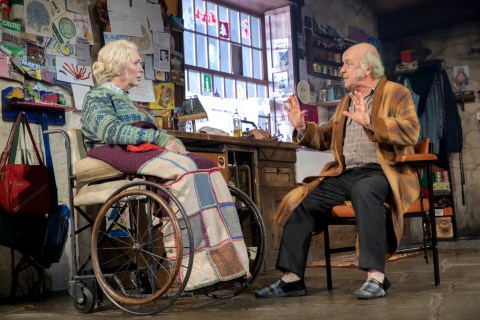
Fionnula Flanagan, Mark Lambert in ‘The Ferryman’ by Jez Butterworth, directed by Sam Mendes (Joan Marcus)
From the outset Butterworth reveals the Troubles broiling beneath the land, which ironically revolts at the strife and bloodshed by spewing up one of its “disappeared.” In the prologue a priest and sinister IRA men discuss a body popping up from its clandestine burial ground in a bog. Butterworth gradually reveals the import of this pivotal moment. After the body’s public discovery, Father Horrigan (Charles Dale), the IRA’s Muldoon (Stuart Graham), and the entire 14-member Carney family will never be the same.
Though the body, blackened from the peat, looks appalling, its preservation secures the man’s identity as Seamus Carney. The husband of Caitlin Carney (Laura Donnelly) and brother of Quinn Carney (Paddy Considine), had gone missing 10 years before. Mysterious reported sightings in Liverpool and elsewhere suggested Seamus had abandoned wife and family.
For the Irish Catholic Carneys living on a farm in County Armagh, Northern Ireland, all has remained in a suspended state. This is especially so for Caitlin, Quinn, Mary (Quinn’s wife), and Oisin (Seamus’ son). On closer inspection, the meaning of Seamus’ loss has afflicted all of the family interactions. Not only has their dynamic been upended, but Quinn’s, Mary’s, Caitlin’s guilt, regrets, and self-recriminations simmer in the ground of their souls. Closure eludes them. It’s as if the spirit of absence inhabits family members, who come and go like wraiths. In fact a malaise of absence abides between Mary and Quinn, Oisin and Caitlin, and Aunt Maggie Far Away and the family. Indeed, this raucous family talks, but their conversation rarely achieves intimacy or depth.

(L to R): Laura Donnelly, Genevieve O’Reilly, Paddy Considine in ‘The Ferryman’ by Jez Butterworth, directed by Sam Mendes (Joan Marcus)
After the prologue, an immense bustle of activity explodes in the 14-member household. As the children rouse and come down for breakfast, happy chaos filters in with the sunlight. Tom Kettle (Justin Edwards), a Brit saved by the family as an orphan, brings his good will. Along with apples, a live bunny, and strength for the harvest, Kettle’s slow-witted presence provides assurance of a good harvest. Still, Aunt Pat carps about his being a Brit. And she warns that the family has forgotten what is important. Eventually Mary comes downstairs in her nightgown, like a ghost, then goes back upstairs. And somewhere in this foolishness, the sterling portrayals by the ensemble win our hearts. So does the live goose that Tom Kettle rescues for the dinner.
Beautifully staged with the clutter of fun and bounty of children’s drawings, the production convincing shows us a convivial, lively family. Mendes’ staging of the entrances of the numerous Carney children (including a gorgeous baby), three elders, three parents, and cousins strikes with wonder. The enthusiasm of life and togetherness bubbles with cheer.
Their joy manifests the day’s specialness. For today, the Carneys and their Corcoran cousins will harvest the fruits of their labors. Surely, they will move out to the combines with thoughts of celebration: with the killing of the goose, feasting, drinking and dancing. But before they leave, as they have breakfast, in the midst of the ebullient confusion come the prophet and historian. The truth resounds with the moral imperative that comes with the women’s presence.
Certainly, Uncle Patrick’s (Mark Lampert) jokes about Aunt Pat’s having turned from a sweet girl to a bitter witch entertain us. But the playwright has effected a greater purpose for her character. From Pat we learn of the ongoing socio-political conflict in Northern Ireland. And yes, Aunt Maggie’s dementia breaks our hearts. But her character carries a message. All of a sudden, as she is wont to do, she comes out of her fog and sings. She “arrives!” Next, she interacts with Uncle Pat about the harvest. Then she “disappears” in a twinkling. Her absence devastates. Her arrivals vibrate with contagious electricity. She is a will-o-the-wisp sprinkling laughter until she closes up in deadly silence.

Paddy Considine, Genevieve O’Reilly in ‘The Ferryman’ by Jez Butterworth, directed by Sam Mendes (Joan Marcus)
As Maggie disappears, the children’s lively banter once more takes over. But we understand that both women serve as omens, as does Uncle Pat. Toward the end of the play, Uncle Pat delivers the final truth about the ferryman of Greek mythology, to capstone the meaning of Seamus’ loss. And Aunt Maggie sees into the spirit realm and cries out our future for all of us.
Indeed, the three elders reveal the family’s irrevocable foundations in sorrow and struggle. Through them, Butterworth most poignantly and powerfully unfolds the symbolism, beauty, and tragedy of what has been culturally and socially “disappeared.” The spiritual ethos of the Irish culture’s identity, voice, beneficence would be buried under British rule of Northern Ireland. And that rule ensures vengeful violence and murder.
Ironically, the youngest children seem dislocated from their background until Aunt Maggie reveals Aunt Pat’s miseries about the Easter Rising. The teenagers know more about the Troubles. Brooding Oisin (Rob Malone) acknowledges the struggle at the worst possible moment. When he confuses his loyalties, he reaps a horrific fate.
The climactic reckoning comes to Quinn Carney when his brother’s body emerges in a public disgrace of the IRA. Will Quinn choose to be silent to protect the IRA as he has done since his brother disappeared? Or will he take press interviews and blow the whistle on his brother’s murder? Muldoon fears the latter.
Once a member of the IRA, now a farmer, Quinn has submerged for a decade his awareness of how British rule impacts his daily life. Not until Seamus’ body with a bullet hole in the back of his head arises from the earth to confront him and Caitlin, do they move from their stasis. Ironically, Quinn regenerates the cycle of bloodshed and revenge he attempted to leave before Seamus went missing. Indeed, in a malevolent twist Muldoon provokes him to it.

Paddy Considine in ‘The Ferryman,’ directed by Sam Mendes, written by Jez Butterworth (Joan Marcus)
Quinn (an incisive and fierce portrayal by Considine) had left off this cycle to embrace his family and his farm. As patriarch he carried on the family tradition and created a large brood with Mary, which would wall him off from the political necessities of gaining freedom. They lived with Seamus’ loss, somehow waiting in peace to learn his fate. But in Butterworth’s stark, heavily messaged tragedy, the harvest brings more than the barley. And it brings more than his brother’s body, which evidences the IRA’s handiwork on alleged traitors. For the harvest returns the bloody nature and being that Quinn Carney manifested years before. If blood will let blood, surely the deeds of the fathers come knocking on the doors of the sons and the nephews. This is a bitter harvest indeed, sown in blood with little fruit to enjoy.
The play evokes a timelessness with profoundly spiraling themes and symbolism. Mendes has shepherded the actors to terrific performances and created a potent, masterful production that must not be missed. Paddy Considine, Laura Donnelly, Justin Edwards, Fionnula Flanagan, and Dearbhla Molloy are standouts. Michael Quinton McArthur delivers some of the funniest lines of the play with perfect timing. The ensemble also includes Dean Ashton, Fra Fee, Tom Glynn-Carney, Stuart Graham, Carla Langley, Matilda Lawler, Conor MacNeill, Willow McCarthy, Brooklyn Shuck, Glenn Speers, and Niall Wright.
Kudos go to Rob Howell (Scenic & Costume Designer), Peter Mumford (Lighting Designer), Nick Powell (Sound Designer & Original Music), and the rest of the creative team.
The Ferryman runs 3 hours and 15 minutes. (There is a 15-minute intermission following Act I and a three-minute pause following Act II.) The production closes on 17 February 2019. You will not forgive yourself if you miss it.

‘The Belle of Belfast’ at The DR2 Theatre in NYC
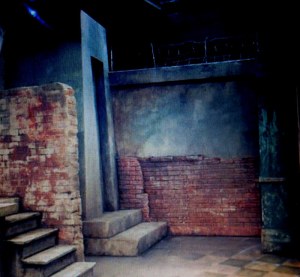
‘The Belle of Belfast,’ at the DR2 Theatre, a production of The Irish Repertory Theatre. Exterior, Belfast, Ireland in 1985. Photo take from the Irish Rep Facebook page.
A few years ago, my friend Bob who was wearing an orange shirt and was going through passport control in Dublin, Ireland, was startled when a staffer stopped him and said, “I wouldn’t wear that shirt outside of Dublin though you’re a Yank. People will take offense.” Bob heeded his advice and after doing a bit of online research at his Dublin hotel, understood what the official meant. Even though the Good Friday peace agreement ended The Troubles in Northern Ireland in 1998, the wounds were still raw. At the time Bob visited, there was an unrest that bubbled just under the surface. If the protestant pro-British Orange Order held a parade, the Irish Catholics often were unduly provoked and took umbrage. Surely, peace had come. But the conflicts were all encompassing, then and now, and it may be a few more decades before the waters have completely smoothed over and horrible incidents that occurred during The Troubles remain buried forever in lost memories.
The Belle of Belfast presented by The Irish Repertory Theatre which is currently playing at the DR2 Theater, has as its setting Belfast, Ireland. The time is 1985 the year of the Anglo-Irish Agreement and 13 years before the 1998 Good Friday peace agreement. In Belfast 1985 The Troubles between Irish Catholic paramilitary groups who intend to break away and join the Republic of Ireland to the south and the protestant paramilitary groups who are determined to keep British rule of Northern Ireland are steadfast, and there doesn’t appear to be an adequate resolution in sight.
The intense and harrowing conflict of the 40 years war is not the subject of The Belle of Belfast. Nevertheless, it contributes an elusive and ever-present darkness that overshadows the events and individuals’ inner conflicts. The darkness continually rises from the depths of the abyss of hatred and despair that impacts the main characters who try to make their lives in Belfast but who are often jolted by the sporadic violence which they have come to internalize. The characters live with the tiresome, oppressive atmosphere of guerilla warfare which can strike anyone at any time. And they must become inured to it and find their way through the morass of bloodshed as individuals are “disappeared,” become martyrs, or are hapless victims of the collateral damage sprayed by bombs meant for “the enemy.” We come to understand the depths of the dark shadow of war as the play evolves and the characters react to each other and seek unsuccessful personal solutions most probably influenced by the undercurrents of danger they must live with and force themselves to reconcile as a fact of life in Belfast during The Troubles.

Patricia Conolly and Hamish Allan-Headley in ‘The Belle of Belfast,’ directed by Claudia Weill at the DR2 Theatre. Photo by Carol Rosegg.
Director Claudia Weill has expertly fashioned Nate Rufus Edelman’s The Belle of Belfast. With the help of set designer John Mcdermott, the director has made sure the production employs a clever and symbolic economy of design. The three sections of the stage suggest different areas: outside in the city of Belfast and inside in the private interior of the Catholic church confessional and the rectory. For the outside, the bleak walls of division and sterility of a life lived amidst randomized terror is evoked with graffitied brick walls and barbed wire, stage left. The exterior is contrasted with an interior, the ironic security offered by a church confessional in the stage middle. To stage right is positioned the personal inner sanctity of the priests’ rectory where truthful actions and comments are laid bare by three of the main characters. Lest audience members are unfamiliar with the history of the setting, at the play’s outset a black and white film clip of a variety of shots of beleaguered Belfast unspools to project the tattered lives of the residents (children and adults), and the sorrow and violence that is their portion during The Troubles.
As these projections fade, the light focuses on the confessional interior. At confession is a typical, elderly, staunch Irish Catholic woman, Emma Malloy (Patricia Conolly does a beautiful job as the humorous, slightly ridiculous and eccentric aunt of feisty Anne Malloy). Emma Malloy is sharing her darkest secrets with the handsome, youthful priest, the father confessor in a parish that offers help in this trying time of soul need to offset the chaos and confusion everyone is experiencing. Of course the help is for Catholics and though the tenets of Christianity encompass both protestants and Catholics, the irony is not lost on us that Catholicism is a tremendous thorn in the flesh of the Protestants on the other side of the high walls which divide Irish from Irish.
During the ironic and funny exchange between the priest and Emma Malloy, the playwright has unfolded the character of Father Ben Reilly (an excellent Hamish Allan-Headley), as a sympathetic and well meaning Irish Catholic cleric who attempts to remain above the fray following the tenets of Christianity as best he can. Nate Rufus Edelman has expertly established the gnawing rodents of duplicity within the Father that will continue to eat at him until they devour his potential for goodness. With Emma Malloy, we understand that the Father is playing the part of the good priest as he perceives his role to be. However, we also understand that the depth of goodness is not yet present in him to actually be that good priest, for we also see the extent to which Emma Malloy tries his patience and the extent to which he allows her to frustrate him. Instead of “stopping her in her tracks” for her silly ideas of what constitutes sinning (one thing Catholicism teaches well is sinning and condemnation), he allows her to continue in folly, “showing” how kind he can be until she makes untoward remarks that are sinful. Here is a flawed priest, who in his attempts to be empathetic and gracious goes overboard toward permissiveness because of his notions about how a priest should be kind and understanding. In attempting both, he ends up doing neither, though he is charming, self-deceitful and apparently “harmless.”

Kate Lydic and Hamish Allan-Headley in ‘The Belle of Belfast,’ at the DR2 Theatre. Photo from this site.
Of course, the irony is that with the true tenets of Christianity, it is not about image, it is about substance, about what happens behind closed doors, about what happens in the rectory when the public isn’t watching. That is what counts and the playwright never reveals the characters’ relationships with God and that absence is crucial to the understanding of the play and the understanding of the characters who are in desperate need of help and who are incapable of receiving it through the source they have supposedly chosen to pray to. Clearly, this priest and his colleague Father Behan (Billy Meleady), are having their own “troubles” with the substance of love and truth. Edelman brilliantly reveals how they are having issues with self-deceit as they attempt to “appear good” but find it much harder to “be” good. Their trials are revealed during their personal moments away from their roles as priests and after they return to the rectory, relax and take off their collars. This is one of the main conflicts of the play, the image of goodness versus the reality of goodness and gives rise to the theme: if one does not live in truth, one is miserable living in hypocrisy. The theme has broader implications for indeed, the whole of Northern Ireland is reeling from this problem, especially in their disparate warring religious factions which lack “the substance” to be Christians in word, deed and love: they cannot forgive each other; they cannot ultimately forgive themselves.
The playwright has cleverly characterized Father Reilly revealing the seeds of his potential downfall which like weeds in a garden plague him. These weeds grow quickly and are the cause of his weaknesses which allow him to succumb to the manipulative wiles of the fiery teenager Anne Malloy (the angst-filled “belle”). As a result of their flawed actions both Anne and the Father are forced to view the truth of themselves and the pictures are ugly. The characterizations are aptly drawn; we note Father Reilly’s rationalizations to Father Behan when he protests that he is trying to help Anne. But when he ends up seducing her, he is easily able to convince himself that it is the other way around, that he has allowed her to seduce him. Regardless, both Anne and he are culpable; both make each other miserable with the truth of their self-deceit and lies, though his is the greater blame because he violates his position as a “pure man of God,” and she is a minor, not really responsible for her own decision making, though of course, she believes she is.

Hamish Allan-Headley and Billy Meleady in ‘The Belle of Belfast,’ Photo by Carol Rosegg
Likewise, the playwright’s characterization of Father Ben Reilly’s fellow colleague in the parish, Father Behan (a fine, nuanced and edgy performance by Billy Meleady), shows another cleric in the throes of a personal crisis. Behan despises the protestants and supports the Irish Republicans, though he knows he should remain objective. He is an alcoholic with the excuse that it is a way to get over and through the miseries of the times. Yet, rather than to rely on his faith to help him end the addiction, we see that his faith fails him and even inspires him to drink more. He has chosen a profession about which he is largely indifferent and is now stuck in. It is a cryptic irony that he hopes he doesn’t have to continue to be a priest when he is dead and in heaven, for that would be hellish. As a priest there are no choices left for him and he wishes he were anywhere but Belfast, the worst place to get murdered for being a priest. As we see for Father Reilly and Father Behan, both succumb to the dark time of chaos. Both cannot see their way clear to confront their character imperfections. Both lack the faith to work through and achieve peace.
Edelman has presented the underlying issues of the characters from which the incipient themes evolve, hammering these through to the conclusion. We recognize that all of the characters have opaque vision; they are limited from seeing the hypocrisy of their own actions as they walk in a bizarre, dual state of determination and haphazardness. They mistake their false assumptions about themselves as truthful and accurate, only to find out later they are playing at being what they are not. Of course, they are miserable and their actions lead to devastation. However, because of the backdrop of war which rears its ugly head from time to time in a bomb blast that kills or in the terrible beating and victimization of someone, we know that the characters are reeling from the confusion which foments the mist through which the ever-present threat of violence erupts. We forgive them for they are easy to recognize in ourselves; such is the state of affairs in the human soul: until unity and peace come, it’s division and war.

Hamish Allan-Headley and Kate Lydic in ‘The Belle of Belfast,’ at the DR2 Theatre. Photo by Carol Rosegg.
Thus, when wise-cracking, foul-mouthed and brash Anne Malloy (played with abrasive and wild-hearted abandon by Kate Lydic), tells conflicted and insecure friend Ciara Murphy (the vulnerable and resigned Arielle Hoffman), that she is in love with Father Reilly and she will be with him, we are not surprised. We have anticipated this, as we anticipate the tragedy of their coupling and the impossibility of their being together because they have no solid relationship borne of love. We know his permissiveness and his playing at being the good priest has been the snare that renders him a hypocrite to the faith and a predator. With kind duplicity he does harm to her and himself. Father Reilly is incapable of seeing clearly that Anne Malloy is playing at being in love with him in a desperate quest for happiness. He cannot discern the truth to know that she is searching for a love of self that will fill her soul more than what she could ever have with him. Blindly, Father Reilly takes advantage of her inner emptiness. Deceitfully, he becomes a predator exploiting her sorrow. He adds to her soul damage; orphaned by her parent’s death in a bomb blast as a child, she is forced to live with her difficult aunt from whom she feels little love.
The importance of The Troubles as a backdrop to what happens in the inner sanctum of the rectory is a clever touch brought to the fore by the canny director. Father Reilly’s abuse of Anne’s fragile emotions and the abuse of his position is performed behind closed doors away from the prying eyes of the parish. In the rectory he turns this emotional violence against himself as he upends his own integrity. In hypocrisy he trashes everything good that he may have attempted in the past. In an invisible line from the external brick wall and barbed wire right through to the rectory, the director and playwright show that the war’s shocks have led him to become an emotional casualty of the war’s harm. The tragic irony is that as a casualty, he cannot rightly understand how to best help Anne. Thus, he contributes to making her into a twice-fold victim of The Troubles. His failures as a priest thwart her from achieving soul health: the “love” she sought to replace that was lost at her parent’s death can never come from Father Reilly; she is twice traumatized. The emotional violence Father Reilly and Anne enact upon themselves and each other mirrors the violence of Belfast. Though they are alive and breathing, emotionally they shatter one another. They can only inure themselves to the pain and move on. If they make themselves numb, there may be a kind of deliverance after all. However, there is no grace that they can give each other; they lack that power. It will have to come from another source, if it comes at all.
Through the fine, on point acting, the director’s steadfast vision and the help of the artistic team, Edelman’s work shines with humor, cleverness and grace, revealing how in a time of chaos, individuals attempt to make the best of the hand they are dealt but often make a shambles of it, instead. This would appear to be doubly true when those appointed to help “make the peace” are often the ones doing the harm. To what extent does the war impact individuals’ choices? On a continuum from 1-100, it cannot be discounted and like an earthquakes’ aftershocks, the calm may settle but things have been irrevocably changed. So Edelman points out. After a few years have passed, Anne Malloy, achieves a term of happiness which she discusses with Father Reilly when she finds him after he moves from Belfast. Meeting with him, she explains what happened in her life after she left the war zone. It is obvious that she has made a tentative peace. For Father Reilly the playwright is silent about the divisions in the cleric’s soul. Nevertheless, for these two characters, it is a fitting conclusion reflective of the citizens in Belfast whose high walls still divide and whose wounds have yet to heal completely.
You can see the terrific The Belle of Belfast at the DR2 Theatre until June 14th.
This review first appeared on Blogcritics: CLICK HERE WHERE IT WAS AN “EDITOR’S PICK.”
 CAROLE DI TOSTI