Blog Archives
‘Bughouse’ John Kelly Becomes the Fascinating Ousider Artist Henry Darger
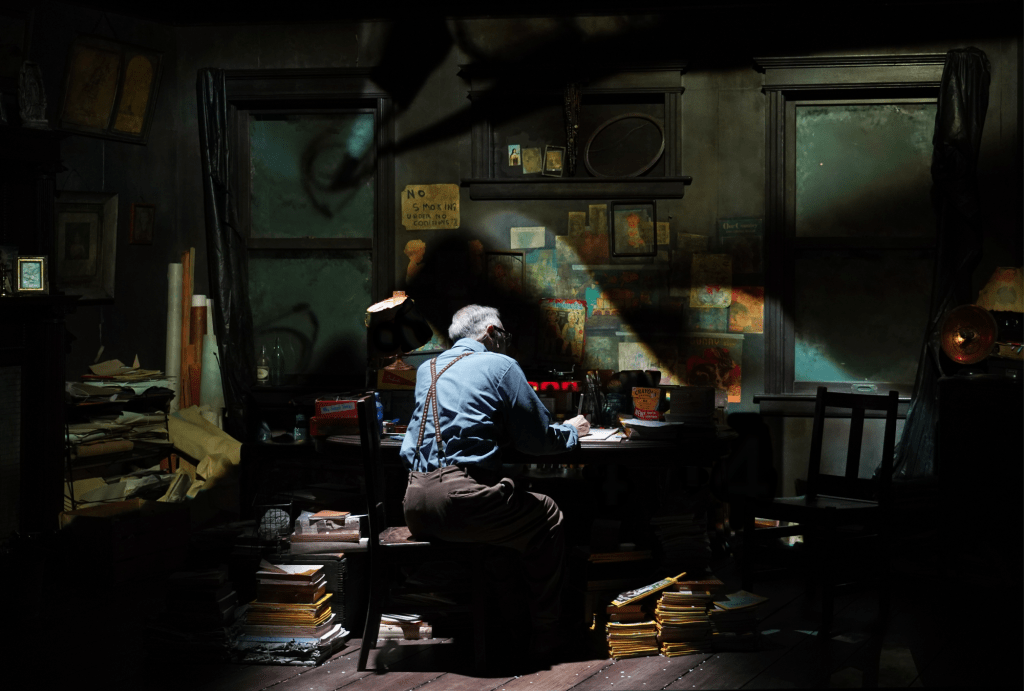
An unknown until his work was discovered just before his death, the incredible outsider artist and epic novelist Henry Darger (1892-1973) is celebrated at the Vineyard Theatre in the multi-media work Bughouse. Adapted from the writings of Henry Darger by Pulitzer Prize-winning playwright Beth Henley, the 70-minute play is conceived and directed by Drama Desk and Obie Award winner Martha Clarke.
The dance-theater director’s prodigious talents are on full display in Bughouse. Incisively, Clarke shepherds Obie Award-winning performance artist John Kelly to emotionally spin Henry Darger’s creative angst into the fantastical in this beautiful and poignant production. Heartily embraced by its audiences, Bughouse has been extended an additional week until April 5, 2026.
Martha Clarke uses Ruth Lingford’s animation, John Narun’s projection design and Fred Murphy’s cinematography to create the layered realities of Darger’s exterior and interior worlds. She uses animations created from Darger’s illustrations to explore and enhance Darger’s life and work. When projected on windows and mirrors, the “unreal realms” live to the delight of the audience. Kelly’s Darger moves seamlessly through the artist’s interior states of consciousness with enthusiasm and feeling. We can’t help but identify with Darger’s uniquely metaphoric creations. These include archetypal battles between good and evil. When hearing of Darger’s childhood experiences, one concludes the battles express emotional conflicts from his past that he could only reconcile through his artistic creations.
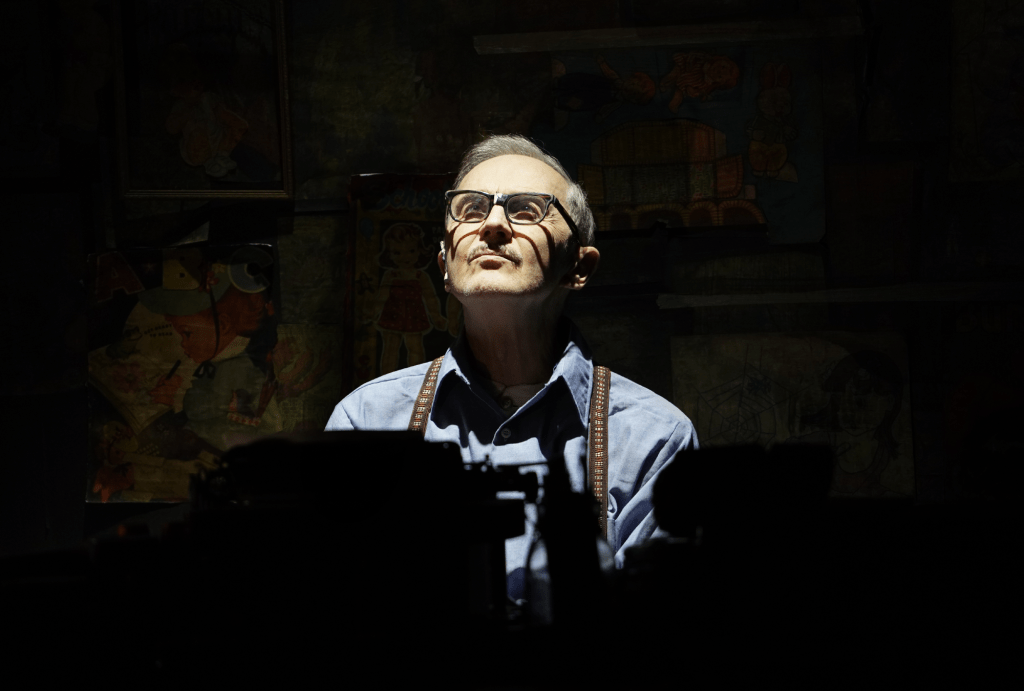
Inspired by photographs of Darger’s apartment, Neil Patel’s production design shows Darger living and creating in a claustrophobic, curio and antique stuffed apartment. In Patel’s recreation, Darger hordes National Geographics and period magazines in piles on the floor. Various items crowd every inch of space in the room. Papers and illustrations cover the table where Darger types up his magnum opus, a few lines of which Kelly’s Darger reads as he types. Beth Henley aptly uses passages from Darger’s epic fantasy in Bughouse (i.e. “The Vivian Girls, fought bravely against the Christian hating, child slave holding Glandelinian demons.”)
The audience becomes Darger’s confidente as we watch his creative process unfold. When he explains his life story, his imagination sparks. Immediately, he moves to type up the continuing adventures of the Vivian Girls, his chief protagonists. “The Vivian Girls…were prettier than fairies and as good as saints and though delicate in form as they looked, they were perfectly strong.”
In their perfection, his characters fight battles in righteousness, overcoming oppression and brutality. Darger explains what makes them heroic when he says, “Beautiful as they were in features however, they were more beautiful in soul doing all that all good children should do, and were so righteous and attended church so frequently every day that their father began to look upon them as saints!”
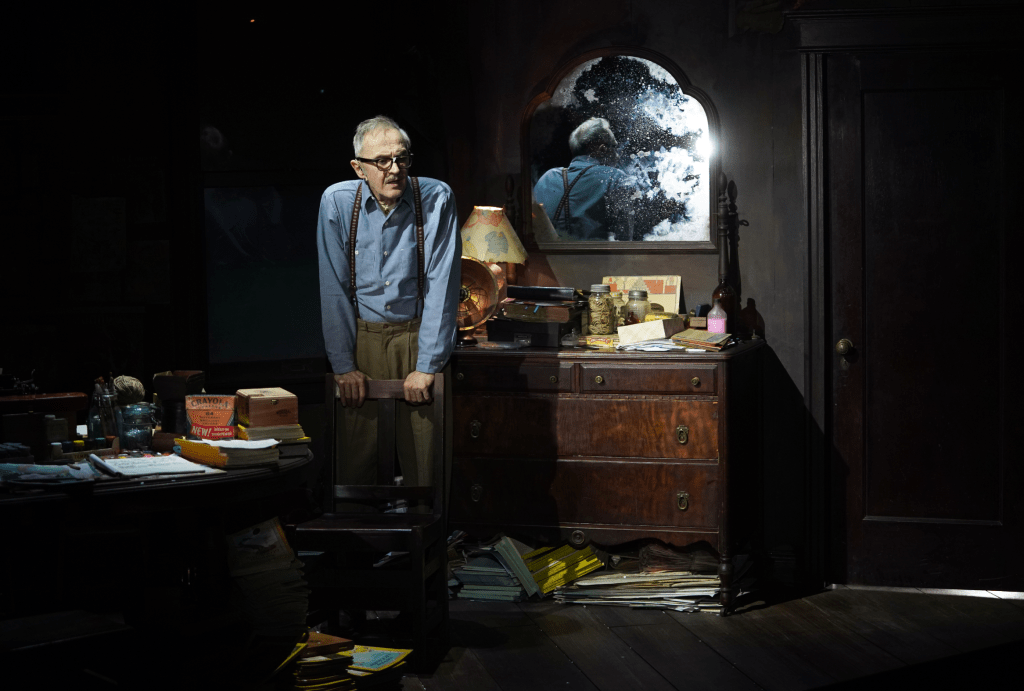
In between sharing his woeful childhood after his mother died and his father could no long care for him, Darger expresses his hatred of the abuse he experienced as a child. From the nuns in the school he attended, “Mission of Our Lady of Mercy,” and the caretaker at an asylum for feeble-minded children, where he lived until he finally escaped after two failed attempts, Darger was bullied and persecuted for “being different.” Based on various reports and his examination, a doctor misdiagnosed him as feeble-minded when, in fact, the opposite was true. Henry’s father taught him to read at a very young age so he could read the newspaper to him.
We question why these incompetent individuals didn’t recognize or encourage Darger’s talents. But then perhaps snatches of the creative soul of the reclusive, hospital janitor and dishwasher Henry Darger wouldn’t be the essence marvelously portrayed by John Kelly in this fine production. If one believes the adage that pain and suffering produce the artistic drive to express and relieve an artist and writer’s soul’s agonies, then Darger surely is representative.
Thankfully, Darger’s incredible imagination and genius lives on in 350 exquisite watercolors which appear in museums, galleries and collections worldwide. His fantasy novel of 15,000 pages, his 5000 page autobiography and more are available to read.
Caveat: noted is the warning that the content in Darger’s illustrations sometimes depict harm against children as the heroines battle to free enslaved children against evil forces. Also, some of the illustrations depict children without clothes. A few of these images are “included in brief moments in Bughouse.”
Bughouse runs 70 minutes with no intermission at the Vineyard Theatre until April 5, 2026. https://vineyardtheatre.org/shows/bughouse/
‘The Burning Cauldron of Fiery Fire,’ Anne Washburn’s Challenging, Original Play
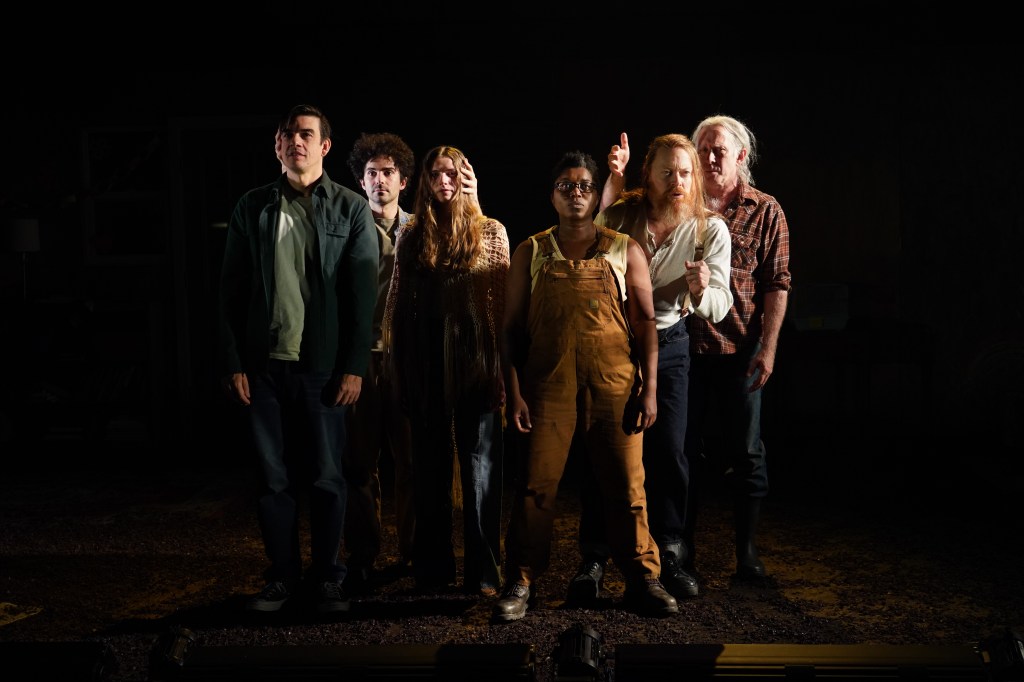
Known for its maverick, innovative productions, the Vineyard Theatre seems the perfect venue for Anne Washburn’s world premiere, The Burning Cauldron of Firey Fire. Poetic, mysterious and engaging, Washburn places characters together who represent individuals in a Northern California commune. When we meet these individuals, they have carved out their own living space in their own definition of “off the grid.” Comprised of adults and children, their intention is to escape the indecent cultural brutality of a corrupt American society, where solid values have been drained of meaning.
Coming in at 2 hours, 5 minutes with one 15 minute intermission, the actors are spot-on and the puppetry engages. However, the play sometimes confuses with director Steve Cosson’s opaque dramatization of Washburn’s use of metaphor, poetry and song. More clearly presented in the script’s stage directions, the production doesn’t always theatricalize Washburn’s intent. Certainly, the themes would resonate, if the director had made more nuanced, specific choices.
The plot about characters who confront death in their commune in Northern California unfolds with the stylized, minimal set design by Andrew Boyce, heavily dependent on props to convey a barn, a kitchen and more. The intriguing lighting design by Amith Chandrashaker suggests the beauty of the surrounding hills and mountains of the north country where the commune makes its home.
The ensemble of eight adult actors takes on the roles of 10 adults and 8 children. Because the structure is free-flowing with no specific clarification of setting (time), it takes a while to distinguish between the adults and children, who interchange roles as some children play the parts of adults. The scenes which focus on the children (for example at the pigpen) more easily indicate the age difference.
The conflict begins after the members of the commune burn a fellow member’s body on a funeral pyre to honor him. Through their discussion, we divine that Peter, who joined their commune nine months before, has committed suicide, but hasn’t left a note. Rather than to contact the police and involve the “state,” they justify to themselves that Peter wouldn’t have wanted outside involvement. Certainly, they don’t want the police investigating their commune, relationships and living arrangements which Washburn reveals as part of the mysterious circumstances of this unbounded, “bondage-free,” spiritual community.
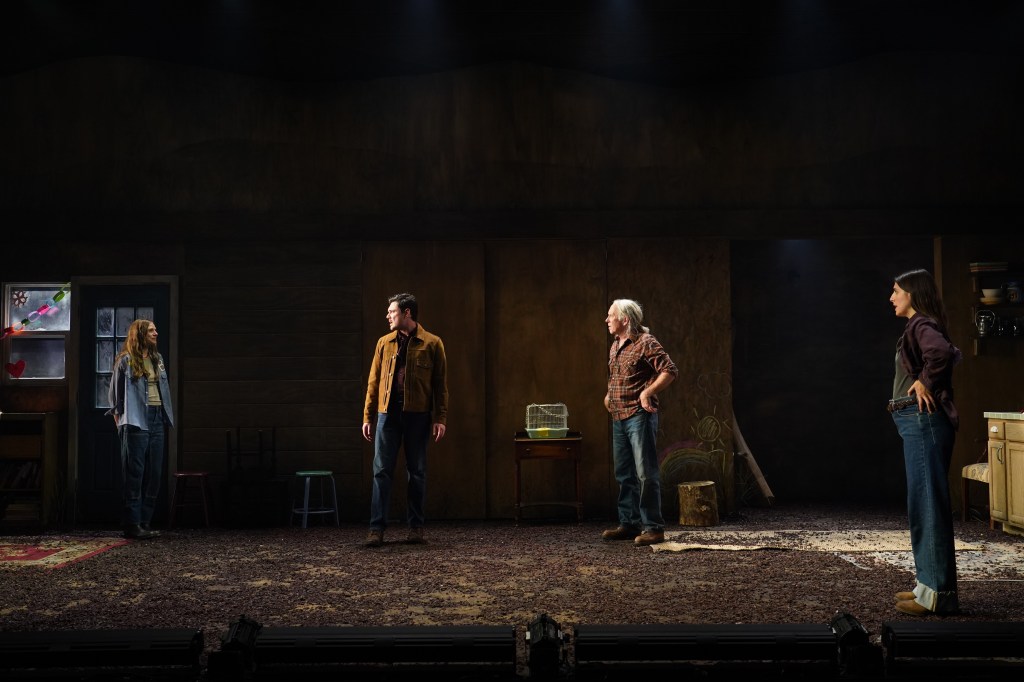
Nevertheless, Peter’s death has created questions which they must confront as tensions about his death mount. Should they reburn his body which requires the heat of a crematorium to reduce it to ashes? After the memorial fire, they decide to bury him in an unmarked grave, which must be at a depth so that animals cannot dig up his carcass. Additionally, if they keep any of Peter’s belongings, which ones and why? If someone contacts them, for example Peter’s mother, what story do they tell her in a unity of agreement? Finally, how do they deal with the children who are upset at Peter’s disappearance?
We question why they feel compelled to lie about Peter’s disappearance, rather than tell the truth to the authorities or Peter’s mom, even if they can receive her calls on an old rotary phone. Thomas, infuriated after he speaks to Peter’s mom who does call, tells her Peter left with no forwarding address. After he hangs up, Thomas (Bruce McKenzie) self-righteously goes on a rant that he will tear down the phone lines.
When Mari (Marianne Rendon) suggests they need the phone for emergency services, he counters. “Can anyone give me a compelling argument for a situation in which this object is likely to protect us from death because let me remind you that if that is its responsibility we have a recent example of it failing at just that.”
Indeed, the tension between commune members Thomas, Mari, Simon (Jeff Biehl), Gracie (Cricket Brown) and Diana (Donnetta Lavinia Grays) becomes acute with the threat of outside interference destabilizing their peaceful, bucolic arrangements. Washburn, through various discussions, brings a slow burn of anxiety that displaces the unity of the members as they work to hide the truth. What begins at the top of the play as they burn the body in a memorial ceremony that allows Thomas and the group to take philosophical flights of fancy, augments their stress as they avoid looking at hard circumstances.
Fantasy and reality clash also In the well-wrought scene where the actors portray the children moving the piglet they believe is Peter when it reacts to Peter’s belongings, specifically, a poem it chews on. Convinced Peter has been reincarnated and is with them, they take the piglet staunching their upset at Peter’s death by reclaiming and renaming the piglet as the rescued Peter. Rather than to have explained what happened, the commune members allow the children to believe another convenient lie.
This particularly well-wrought, centrally staged scene of the children in the pigsty works to explicate the behavior of the commune members. They don’t confront Peter’s death and don’t allow the children to either. The actors captivate as they become the children who relate to the invisible mom Lula and her piglets with excitement, concern and hope. It is one of the highpoints of the production because in its dramatization, we understand the faults of the commune. Also, we understand by extension a key theme of the play. Rather than confronting the worst parts of their own inhumanity, people close themselves off, escape and make up their own fictional worlds.
Washburn reveals the contradictions of this commune who parse out their ideals and justify their actions “living away from society.” Yet they cannot commit to this approach completely because of the extremism required to disconnect from civilization. As it is, they have a car, they do mail runs and sometimes shop at grocery stores. At best their living arrangement is as they agree to define it and as Washburn implies, half-formed and by degrees runs along a continuum of pretension and posturing.
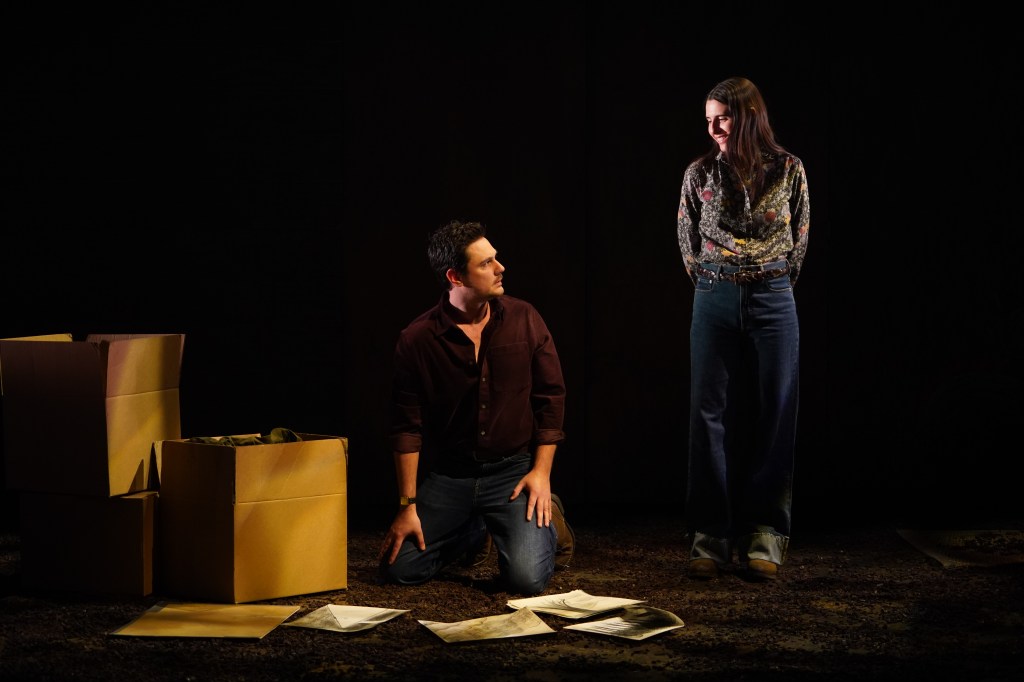
The issues about Peter’s death come to a climax when Will (Tom Pecinka), Peter’s brother, shows up to investigate what happened to Peter. Washburn ratchets up the suspense, fantastical elements and ironies. Through Will we discover that Peter was an estranged, trust-fund baby who will inherit a lot of money from his grandmother who is now dying. Ironically, we note that Mari who claims she had an affair with Peter and dumped him (the reason why he “left”), is willing to have sex with Will. They close out a scene with a passionate kiss. Certainly, Will has been derailed from suspecting this group of anything sinister.
Also, Will is thrown off their lies when he watches a fairy-tale-like playlet, supposedly created by Peter and the children that is designed to lull the watcher with fanciful entertainment.
In the fairy tale a cruel king (the comical and spot-on Donnetta Lavinia Grays), prevents his princess daughter (Cricket Brown) from marrying her true love (Bartley Booz), also named Peter. The bad king thwarts Peter from winning challenges to gain the princess’ love. Included in the scenarios are puppets by Monkey Boys Productions, special effects (Steve Cuiffo consulting), the burning cauldron of fiery flames with playful fire fishes proving the flames can’t be all that bad, and a beautiful, malevolent, dangerous-looking dragon who threatens.
Once again creatives (Boyce, Chandrashaker and Emily Rebholz’s costumes) and the actors make the scene work. The clever, make-shift, DIY cauldron, puppets and dragon allow us to suspend our judgment and willingly believe because of the comical aspect and inherent messages underneath the fairy-tale plot. Especially in the last scene when Peter (the poignant Tom Pecinka), cries out in pain then makes his final decision, we feel the impact of the terrible, the beautiful, the mighty. Thomas used these words to characterize Peter’s death and their memorial funeral pyre to him at the play’s outset. At the conclusion the play comes full circle.
Washburn leaves the audience feeling the uncertainties of what they witnessed with a group of individuals eager to make their own meaning, regardless of whether it reflects reality or the truth. The questions abound, and confusion never quite settles into clarity. We must divine the meaning of what we’ve witnessed.
The Burning Cauldron of Fiery Fire runs 2 hours 5 minutes with one 15-minute intermission at Vineyard Theatre until December 7 in its first extension. https://vineyardtheatre.org/showsevents/
 CAROLE DI TOSTI