‘Purlie Victorious,’ a Riotous Look in the Backward Mirror of 1960s Southern Racism

White power structures die hard. However, they do fall apart when the younger generation helps to topple them.
This is particularly true in Purlie Victorious, a Non-Confederate Romp Through the Cotton Patch, currently in revival on Broadway at The Music Box. It is the next generation that overwhelms the cement-like apparatus of noxious, white paternalism in Ossie Davis’ trenchantly funny play. Thus, we cheer on the pluck, humor, audacity and cleverness of the young reverend Purlie Victorious Judson, exquisitely inhabited by the unparalleled Leslie Odom, Jr. of Hamilton fame. Odom, Jr. leads the cast with his kinetic and superb performance.
The premise for the play that initiates the action is steeped in hope and youthfulness-the righting of a an ancestral wrong symbolically-the despotic terrorism of slavery’s oppressive violence. With mythic actions and intentions Purlie returns home to the Georgia plantation where he was raised, to claim his inheritance and take back the honor which racist owner Ol’ Cap’n Cotchipee siphoned off from his family through peonage (servitude indebtedness).
How Purlie does this involves a fantastic and hysterical scheme, eliciting the help of the adorable Lutiebelle Gussie Mae Jenkins (the riotous Kara Young). Purlie, who met Lutiebelle in his travels, intends to pass her off as his Cousin Bee, who will charm Ol’ Cap’n (the perfect foil, Jay O. Sanders), into giving her the $500 cash that was bequeathed to their aunt by her wealthy lady boss. After succeeding in the scheme to dupe Ol’ Cap’n, Lutiebelle will give Purlie the cash. With cash in hand, Purlie will purchase and restore the Old Bethel Church, so he can preach uplifting freedom to the sharecroppers, who are enslaved by peonage to Ol’ Cap’n.

As Purlie relates his scheme to family, Missy Judson (the fine Heather Alicia Simms), and Gitlow Judson (the riotous Billy Eugene Jones), they avow it won’t work. At first, Gitlow refuses to take any part because he is one of Ol’ Cap’n’s favorite “darkies.” Gitlow has risen to success through his amazing cotton picking labors. Ol’ Cap’n bestows upon him the anointed status of chief oppressor of the “colored folk” working for Ol’Cap’n. He keeps them nose to the grindstone at their backbreaking work.
However, when Purlie introduces his relatives to Lutiebelle, and unleashes his persuasive and inspiring preaching talents on his kin, they give the scheme a whirl. What unfolds is a joyous, sardonic expose of all the techniques that Black people used when dealing with the egregious, horrific, white supremacists of the South, represented by Ol’ Cap’n, The Sheriff (Bill Timoney), and The Deputy (Noah Pyzik).
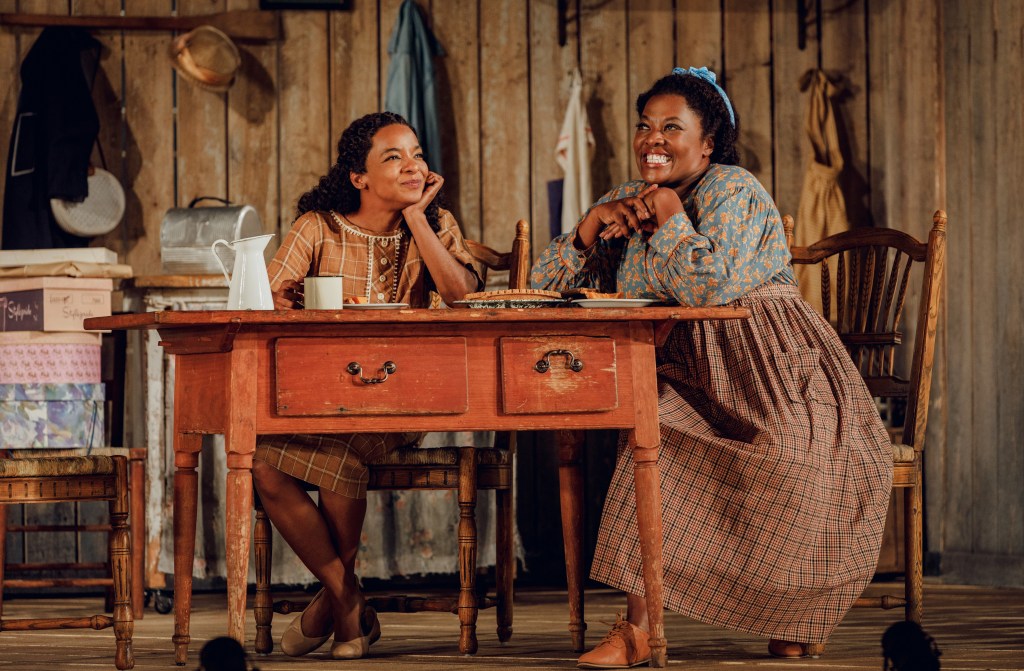
The irony, double entendres and reverse psychology Purlie and family use when confronting Ol’ Cap’n are sharp, comedic, and of moment. Though Ol’ Cap’n owns the place and exploits the sharecroppers using indebtedness, on the other hand, we note that Gitlow is able to manipulate Ol’ Cap’n with his “bowing and scrapping” which, as we are in on the joke, is brilliantly humorous.
It is in these moments of dramatic irony when Ossie Davis’ arc of development reveals how the characters work on a sub rosa level, that the play is most striking and fabulous. The enjoyment comes in being a part of knowing that Purlie and the others are able to “get over,” while Ol’ Cap’n is unable to see he is “being had.” Additionally, with the assistance of Ol’ Cap’n’s clever, forward-thinking son, Charlie (the wonderful Noah Robbins), Ol’Cap’n is completely flummoxed, having missed all the undercurrents which indicate he is being duped.

The actors, beautifully shepherded by director Kenny Leon, effect this incredible comedy, which also has at its heart a deadly, serious message.
Black activist, writer, actor, director Ossie Davis wrote Purlie Victorious, which premiered on Broadway in 1961 at a time when Martin Luther King, Jr. had strengthened the Civil Rights Movement and celebrities were taking a stand with Black activists. In fact, Martin Lurther King, Jr. saw the production and was pictured with the cast, Ossie Davis and Ruby Dee, his wife, who portrayed Lutiebelle.

Particularly in the final speech that Purlie delivers, we can identify with the important themes of a unified human family being together on an equal plane. It is a message that is particularly poignant today, considering the political divisiveness of the white nationalists, a throwback to the Southern racists of the 1960s, like Ol’ Cap’n, who Jay O. Sanders makes as human as possible to allow his racial terrorism to leak through with humor. Because of Sanders’ balanced portrayal, Ol’ Cap’n is an individual who has become his own hysterically funny caricature and stereotype, precisely because he is so obtuse in his self-satisfied mien as their “great white father.”
In the play Davis’ themes about the cruelties of peonage resonate today in the corporate structures which have kept wages low while giving CEOs 500 times what their average workers make. Indeed, the play resonates with the idea of servitude and keeping the labor force however indebted (with student loans, loans, mortgages, credit card debts), so that individuals must work long hours to keep one step ahead of financial ruin. We note the parallels between then and now. The inequities then are in many ways reflective of current economic disparities between the classes, allowing for very little upward mobility from one generation to the next.

It is this that Purlie attacks and preaches against throughout the play. It is this inequity and enslavement indebtedness that Purlie intends to educate Black people about, so that they become free and whole. It is for this reason Purlie wants to purchase and renovate Bethel Church, where he will preach his message of freedom. As we listen, we also realize that the message resonates with everyone, regardless of race, except, of course, the white oppressors, who stand to lose their power, lifestyle and privilege.
This material loss, which would be their spiritual gain, is unthinkable to them. Davis’ indirect message is that this is the oppressors’ greatest sin. They don’t see that by internalizing the defrauding and inhumane values of white supremacy, they are the truly hellish, loathsome monsters, the “other,” they seek to destroy. The destruction only happens to them, while the strengthening happens to those they oppress.
Kenny Leon’s direction expertly guides his actors, moving them with perfectly timed pacing and comedic rhythm. The play develops from broad farce and hi jinks and moves to an ever-expanding roller coaster ride of frenetic humor and excitement. We note Purlie’s desperation and frustration with Ol’ Cap’n’s arrogance and presumptions about Black inferiority, which Purlie will not scrape to. Of course, Idella Landy (the wonderful Vanessa Bell Calloway), who has been a mother to Charlie, with love, influences him to override his father’s brutal attitude toward their family. Indeed, Charlie adopts the Judsons as the family he chooses to be with, rather than his arrogant, ignorant, abusive father.

Leon manages to seamlessly work the staging and find the right balance so the irony and true comedy never becomes bogged down in the seriousness of the message. Because of the lightheartedness and good will, we are better able to see what is at stake, and why Charlie comes to the rescue of his Black family, against his own father, who is an inhumane obstructionist past his prime.
The set design by Derek McLane allows the action to remain fluid and shape shifts so that we move from the Judson family home, to Idella Landy’s kitchen, to the Bethel Church at the conclusion. With Emilio Sosa’s costume design, Adam Honore’s lighting design, Peter Fitzgerald’s sound design and J. Jared Janas hair, wig and makeup design, the creatives have manifested Leon’s vision for the play. Additional praise goes to Guy Davis’ original music, and Thomas Schall’s fight direction.

This revival of Purlie Victorious is a wonderful comedic entertainment that also has great MAGA meaning for us today. For tickets to this must-see production that runs without an intermission, go to their Box Office on 239 West 45th Street or their website https://purlievictorious.com/tickets/

Posted on October 3, 2023, in Broadway, NYC Theater Reviews and tagged Bill Tomoney, Billy Eugene Jones, Heather Alicia Simms, Jay O. Sanders, Kara Young, Leslie Odom, Leslie Odom Jr.. Bookmark the permalink. Leave a comment.
 CAROLE DI TOSTI
Leave a comment
Comments 0