‘After the Hunt’ Featuring Julia Roberts, Andrew Garfield @63rd NYFF
After the Hunt
Directed by Luca Guadagnino and written by Nora Garrett, After the Hunt is a complex, psychological, mystery drama with comedic/ironic flourishes that turn culture wars on their heads. Pointedly, its entangling themes never resolve into a satisfying resolution. Reflective about current social issues involving sexual abuse, gender identity, race, power dynamics, ethics and women’s career ascendance against the backdrop of Yale University in New Haven Connecticut, Guadagnino and Garrett tackle some of the themes credibly. Others they leave swinging in the winds of uncertainty.
Thanks to the incisive performances of principals Julia Roberts, Michael Stuhlbarg, Andrew Garfield and Ayo Edebiri, the film’s central mystery whether sexual abuse did or didn’t occur and why it occurred holds our interest.
However, the subtle nuances and motivations each character reveals become convoluted and incoherent at times. Is this in the service of the notion that human beings are layered, self-destructive, self-betrayers driven by their own nihilistic impulses? In a further irony, the philosophy professors Alma (Roberts) and Hank (Garfield), and their Ph.D. student Maggie (Ayo) are adept at weaponizing philosophy as a defense they use to promote their personal agendas. As a perfect foil, the most well-drawn character of rationality, Alma’s husband psychiatrist Frederick (Stuhlbarg), receives the prize for being the authentic adult in the room. Stuhlbarg’s Frederick is a perfect delight to watch and a welcome relief from the others’ Sturm and Drang.
Main Slate Section of the NYFF
Having its world premiere at the 2025 Venice International Film Festival, After the Hunt in its North American premiere opened the New York Film Festival in the Main Slate section. Interestingly, though the film takes place at Yale University in New Haven, Connecticut, Guadagnino filmed it in England. The superb set design provides the ambience for the 2020 setting and final epilogue in 2025.
In the opening scene, Guadagnino shares his first clue with a title message stating that the event happened at Yale. However, many events occur at the party Alma holds at her home for her students, colleagues and friends. First, we learn about Hank, Alma and Maggie, those closest to Alma, who briefly discuss Maggie’s dissertation on why she selected her topic, “the resurgence of virtue ethics.” Additionally, we learn that Alma and Hank compete for a tenured line professorship. Frederick asks both how they would respond if the other wins it? Do we take them at their word or do they lie?
Finally, Maggie goes to the bathroom. In searching for toilet paper, she finds a “hidden” envelope taped to the interior top of a cabinet. When Maggie opens the envelope she sees it contains an article and pictures. Maggie takes the article which we don’t see in close-up. So much for Maggie’s ethics and respect for her beloved professor’s privacy. Immediately, we note an immoral aspect of her character. We also have an indication of Alma’s character in placing an envelope with secret information where it can be found.
Initial incidents we see, a hidden incident occurs we don’t see
These initial incidents that we see, eyes wide open, take place in Alma and Frederick’s house. However, another incident that happens after the party, we don’t see. We hear about it from the victim, Maggie, who returns the next day to Alma’s. Dripping wet, bedraggled and forlorn, a waif to sorrow over, Maggie tells Alma that Hank sexually attacked her. Maggie admits she shouldn’t have allowed Hank to come over after the party where they had been drinking. Of course, he didn’t stop after she kissed him, though she said, “No.”
Somewhere in the emotional grist of this event that Alma doesn’t initially respond to with care and concern, we consider Maggie’s highly leveraging position at Yale, the antithesis of a conservative, “Red State” university. She is a Black, gay student whose wealthy parents donate heavily to Yale. Close to her professors Hank and Alma, who taught Hank, she goes to Alma for support. Maggie suggests Alma’s background will help her understand what Maggie feels. This comment short circuits Alma. Manipulatively, Maggie brings Alma into the situation and makes it personal to her. In other words, whatever Maggie read in the article she uses as leverage to manipulate Alma to help her. Confused, Alma wonders what Maggie knows about her.
Questioning Maggie’s motives
Thus, we question the wisdom of Maggie’s manipulation and wonder what information the hidden article about Alma held. Also, we question the extent to which the article influenced Maggie to invite Hank to her apartment where she kissed him and then tried to back off his advances. Did this event even occur? What underlying motives does Maggie have if It didn’t? By this point we have forgotten the ironic import of Maggie’s dissertation topic (the resurgence of virtue ethics). If virtue ethics gives weight to practical wisdom and the pursuit of a flourishing life through moral excellence, Maggie appears a hypocrite to even deal with such a topic. Taking the article about Alma doesn’t exemplify moral excellence. Neither does manipulating her with it.
Nevertheless, Maggie’s potentially heart-wrenching emotional experience of sexual assault by a close professor becomes occluded by many factors. Perhaps because of Alma’s cool response, we don’t feel sorry for Maggie or believe her. Her moral ambiguity taking the secret article also makes us question her veracity. Indeed, in the discussion of the “rape” by Alma, Hank and others, then in subsequent compelling scenes more information about the three philosophers unfolds. Against Alma’s suggestions, Maggie presses charges against Hank a surefire way to end his career at Yale.

Spiders spinning webs
As Garrett and Guadagnino spool out clues to interconnecting spider webs spun by three clever spiders with conflicting agendas and motivations, we remember Frederick’s unction about Maggie. He implies that Maggie is a mediocre student. This gives credence to Hank’s assertions that Maggie plagiarized parts of her dissertation. Apparently, her abilities falter, she can’t do the research and resorts to plagiarism. In fact Maggie’s plagiarism will disqualify her Ph.D., and possibly get her evicted from Yale, if either Hank or Alma hold her to account. How should Hank handle Maggie’s plagiarism? Does Alma, an expert in her field qualifying for tenure know Maggie plagiarized? Why don’t Alma and Hank report or correct Maggie?
To what extent do repercussions from Maggie’s wealthy donating family shut Hank and Alma’s mouths about the plagiarism? Shouldn’t they take the moral high ground and have her change her dissertation instead of ignoring it? To what extent does Maggie use the race card to her advantage? Doesn’t she understand that her behaviors play into the stereotypes about wealth, class and race? Does she even care?
Clearly, everyone’s careers are at stake, especially after Maggie accuses Hank of sexual assault. By this point morality, ethics and philosophy don’t help these philosophy professors and would-be philosophy professor. Governed by their own impulses of fight, flight, desire, need beyond intellectual thought, they founder in their own moral morass. Indeed, the irony becomes who is preying on whom? And “after the hunt,” who will be left standing and what will the carcasses look like?
Extreme complications
During the course of the film the complications become extreme when we learn that Alma and Hank had an affair which ends, perhaps prompted by Maggie’s accusation. Additionally, we learn that Maggie emulates Alma obsessively and loves her beyond a teacher student relationship. Also, we learn that Frederick knows about Hank and Alma, and understands the affair’s necessity and impermanence. Finally, we learn that Alma has some disease or pain that requires her to take pain killers or medicine that Frederick leaves on her table stand each morning. However, doctor and colleague Dr. Kim Sayers (Chloë Sevigny) also helps her out with medication.
How many more webs can Garrett and Guadagnino have their spiders spin? Well, Alma’s secrets have yet to be exposed. To what extent should truths be uncovered sooner rather than later to free individuals from wounds that govern their lives? Guadagnino and Garrett do have much to suggest about this through Alma’s revelations and Frederick’s wise love and counseling. Truly, as she says, “she doesn’t deserve him” and is fortunate that he loves her.
As an important point, this film could never take place in a part of the country that is governed by “red state” politics. Ironically, Connecticut, a blue state prides itself on listening to anyone coming forth with accusations. Safe to say that such events occur most probably in universities and colleges around the country. That the screenwriter and director set it in an Ivy League School that takes such issues seriously adds to the gravitas of the film.
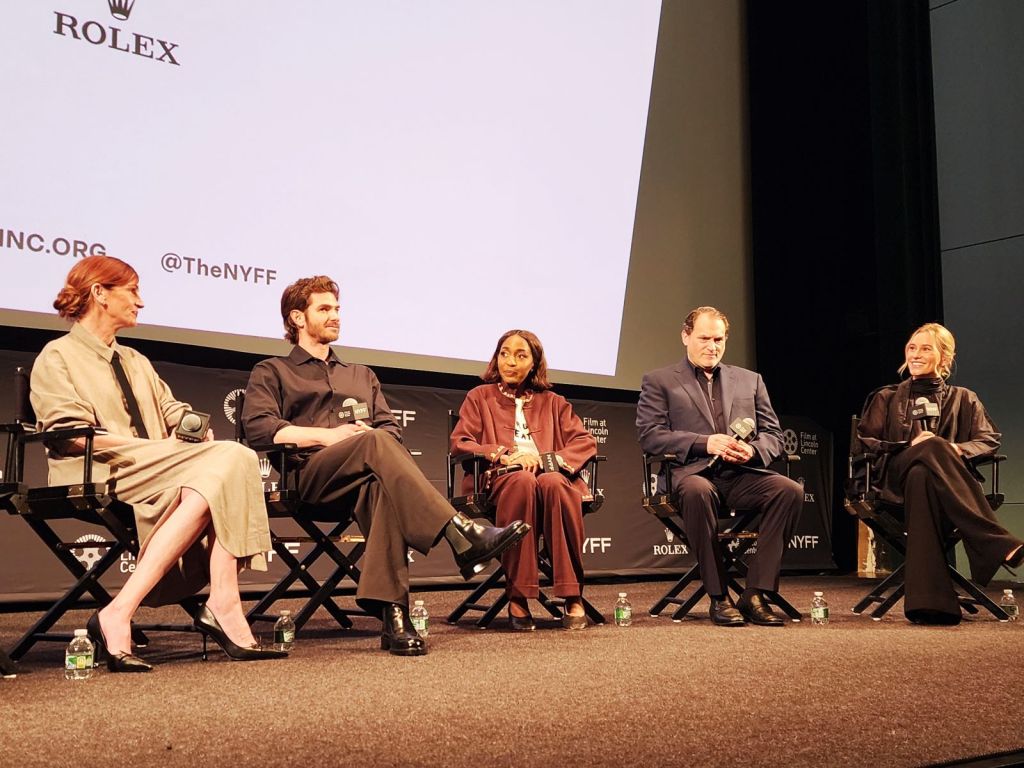
In the Q and A after the film, Guadagnino admitted he is a provocateur, but more for entertainment purposes in a positive way. Perhaps, as an iconoclastic clown, he attempts to nudge his audiences to think after unsettling them and providing no easy answers. Indeed, the main tenor of After the Hunt appears to be his wish to provoke discussion more than to present a dialectic and conclusion. Considering his cavalier voice over “cut,” then blackout to end the over two hour film, Guadagnino suggests that the characters he set in motion will continue their duplicity and self-betrayal long after it’s “lights out.”
After the Hunt will open October 10th at select theaters. For screening information for the 63rd NYFF, go to https://www.filmlinc.org/nyff/films/after-the-hunt/

Posted on September 30, 2025, in New York Film Festival and tagged After the Hunt, Andrew Garfield, Ayo Edebiri, Julia Roberts, Luca Guadagnino, Michael Stuhlbarg, Nora Garrett. Bookmark the permalink. 2 Comments.
 CAROLE DI TOSTI
She does bway?? Did not know
LikeLike
This is a film. She was on Broadway years ago.
LikeLike