‘The Dinosaurs’ at Playwrights Horizons
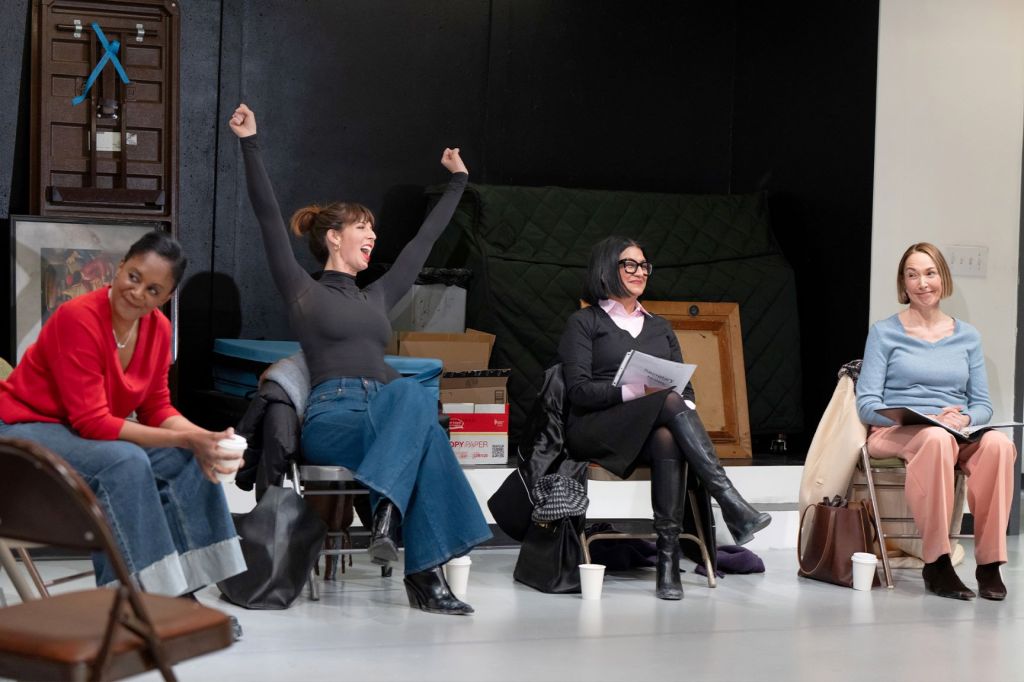
In The Dinosaurs written by Jacob Perkins and directed by Les Waters, time stands still yet moves in leaps that are hard to figure out. It takes place in a room where women who are alcoholics meet, form community and establish friendships helping each other through the years. With strong performances that require solo monologues, the characters share experiences and perspectives and enumerate their days of continuing sobriety. The Dinosaurs currently runs at Playwrights Horizons until March 8, 2026.
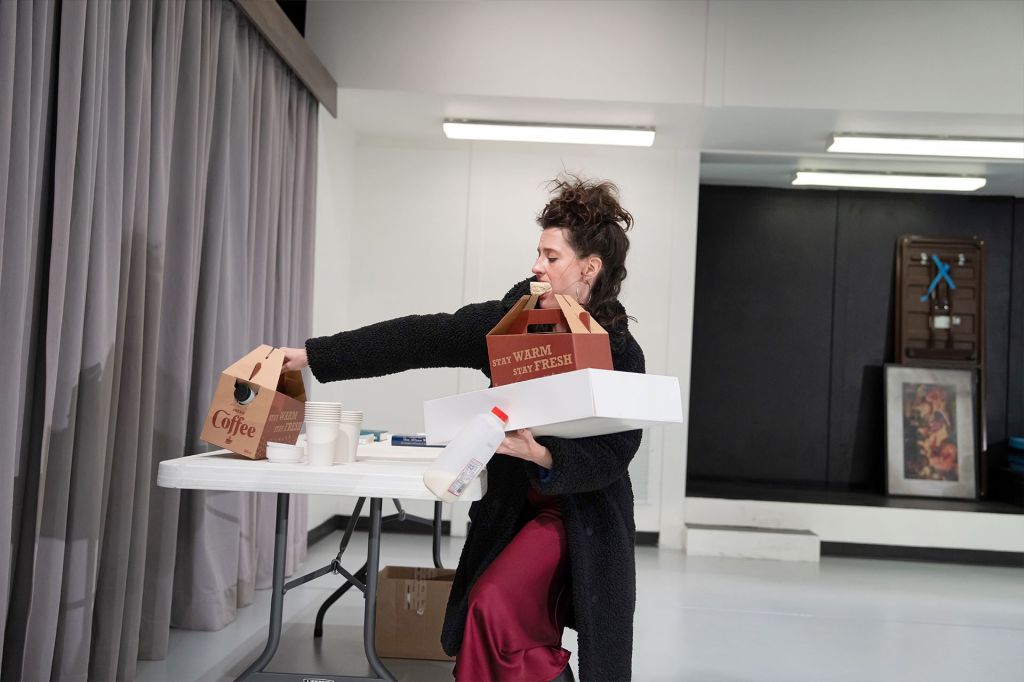
As the characters set up the neutral unadorned room (scenic design by dots), where they meet, wait for participants to show up and reaffirm the rules of their sessions, we understand this is a female inclusive community. April Matthis as Jane is first to arrive to begin setting up chairs, followed by nervous Buddy (Keilly McQuail), who after a humorous exchange with nonjudgmental Jane, decides she can’t stay. She does show up during the meditation and the end only making a connection with Jane in a layering that makes the time structure hard to divine.
Next, Elizabeth Marvel as Joan enters with the coffee and helps Jane set up. She is followed by Kathleen Chalfant’s Jolly as the longest, oldest member of the group, who brings positivity and warmth with the donuts and scones. Newer member Joane (Maria Elena Ramirez), arrives with gossip about a female teacher. Finally, Janet (Mallory Portnoy)–the appointed time keeper–arrives late and is the first one to share on the topic “coming back,” after their group meditation.
The playwright avoids heavy emotional content related to grief, sorrow, regrets, abuse or violence. Indeed, he avoids in the moment conflict in the plot and character development, with the exception of Joan, Jane and Joane who disagree about feeling empathy for a “lonely” female teacher who has sex with a teen who is “of age.” Jolly provides the down-to-earth humorous perspective as the argument persists then ends once Janet arrives. Interestingly, one would think these are average women of various ages who live regular lives, but for their momentous pronouncement later, during their time to share, that they are alcoholics.
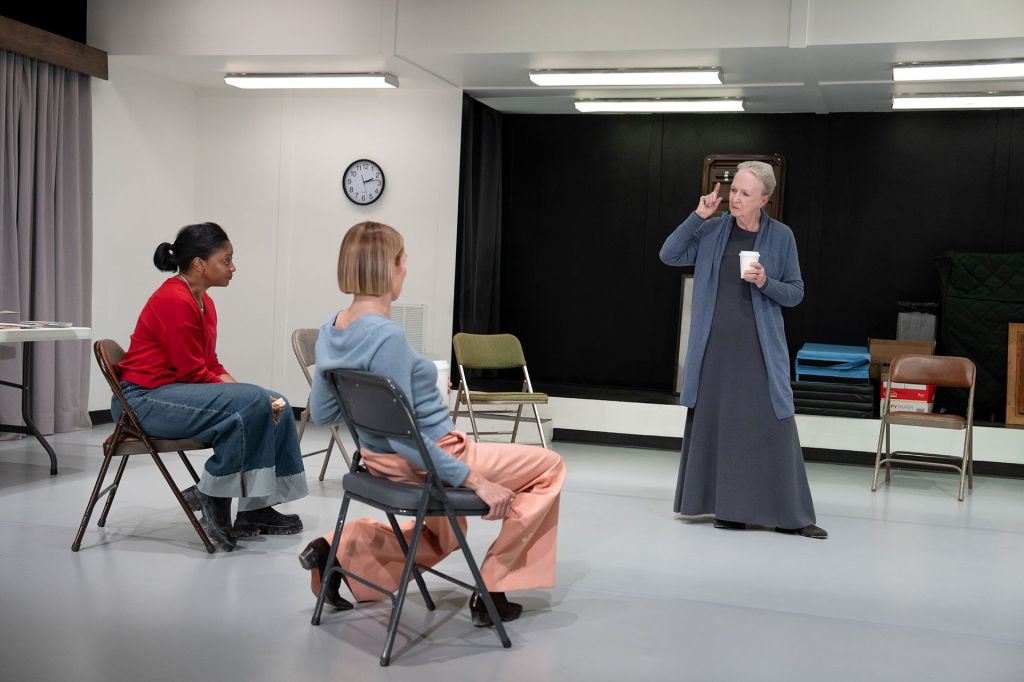
The production spends a good deal of time having Joan, Jane and Jolly set up the room making small talk. Chalfant’s portrayal as Jolly mesmerizes with substance, authenticity and humor, which she clearly infuses with backstory and meaning. In comparison with the other women, Jolly’s character is the most delineated because of Chalfant’s superb, specific performance, as is Marvel’s Joan who reveals why she is an alcoholic toward the end of the play. Otherwise, the characters divulge little else about themselves. This forces the audience to imagine who these women are and why they chose alcohol as their drug and not opiates, barbiturates, food or other addictive elements to anesthetize themselves and escape from life’s “slings and arrows of outrageous fortune;” if indeed, that is why they are alcoholics.
Janet’s metaphoric experience about being driven by a chauffeur she hates and who tells her to throw out the body of a man instead of carrying it around, seems to express her situation of carrying baggage which she eventually throws away in her awake dream state. However, we don’t understand to what she refers and she doesn’t connect the dots. Likewise, the others say little hard evidence about their situations. This adds to a general tiresome opaqueness.
All important personal details are absent, perhaps playwright censored to indicate his characters’ self-censorship. No explanation is given by the playwright, which leaves a huge gap in the ethos of the play. Nevertheless, a picture forms of these characters and the process of their recovery from a disease. However, its horrific effects in their personal lives as they share with their community is never identified. Indeed, the recovery process seems deadening as the women avoid discussing even the difficulty of fighting the urge to taste a drop of their favorite alcoholic beverage.
The characters also avoid discussing the severity of their alcoholism. If the blood never boils with emotion, then not feeling alive removes any impulse to drink. Perhaps keeping a steady deadened state is their key to recovery. How fortunate that they have found other individuals who allow this type of emotional void to be shared. Their tell-tale meditation at the beginning of their meeting indicates what substitutes for feeling and the connection with their feelings.
Notable examples of a separation perhaps disassociation from feelings happen with a few of the characters. Joane’s discussion of finding her son pleasuring an older man in their house seems devoid of an emotional reaction on her part in relation to her drinking. The assumption is that her discovery caused the rift between herself and her son that she describes and perhaps this led to her alcoholism. She and her son never discussed or dealt with her seeing her son with the older man. Did this lead to the dire circumstances that happened later in their lives? Ramirez’ Joane recalls it with dispassion though she takes a moment to breathe revealing the confession is difficult. Her admission that she is revealing it for the first time is groundbreaking.
That her son at fifteen was under the apparent influence of an older man reflective of the current pedophilia reports in the Epstein files is passed over without judgment by Joan or any of the other women. Is this what it takes to recover from alcoholism, this passive, non-reactive state of mind while others are there to just listen?
Joan’s time lapse discussion of the days of her recovery to sixteen years emerges with vitality. A matter-of-fact statement of her number of years without a drink that has seen her in this room with various community members of alcoholics hearing her make comments becomes her milestone. And apparently, during that sixteen year period she had to say goodbye to Jolly who dies and whom she misses. Thus, Jolly’s influence on her own recovery is reduced to less than a minute of time, though counting the years of struggle to maintain sobriety must have seemed an eternity. Unfortunately, there is a grand absence of information. Perkins revels in being opaque. More is needed.
Thankfully, the actors do a yeowoman’s job of leaping over the play’s lack of detail by providing as much of their interior substance as possible. Nevertheless, the lifeblood of theatricality and living onstage is hindered by the playwright’s lack of clarity. Nor is the play’s incoherence at times clarified by Waters’ direction.
Perhaps Rainer Maria Rilke’s quote from Book of Hours which Perkins uses to head up his script might have been spoken aloud by one of the characters in a prelude to The Dinosaurs. The lines of poetry present a lens though which to view each of the characters’ journeys, lifting them to a spiritual plane and revealing the irrelevance of time.
I live my life in widening circles that reach out across the world. I may not complete this last one but I give myself to it. I circle around God, around the primordial tower. I’ve been circling for thousands of years and I still don’t know: am I a falcon, a storm, or a great song. –Rainer Maria Rilke from Book of Hours
The Dinosaurs runs 1 hour 15 minutes at Playwrights Horizons until March 8, 2026. playwrightshorizons.org.

Posted on March 4, 2026, in Off Broadway and tagged April Matthis, Elizabeth Marvel, Jacob Perkins, Kathleen Chalfant, Keilly McQuail, Les Waters, Mallory Portny, Maria Elena Ramirez, The Dinosaurs. Bookmark the permalink. Leave a comment.
 CAROLE DI TOSTI
Leave a comment
Comments 0