Blog Archives
‘Here There Are Blueberries’ Evil’s Ordinary Face at Auschwitz Death Camp
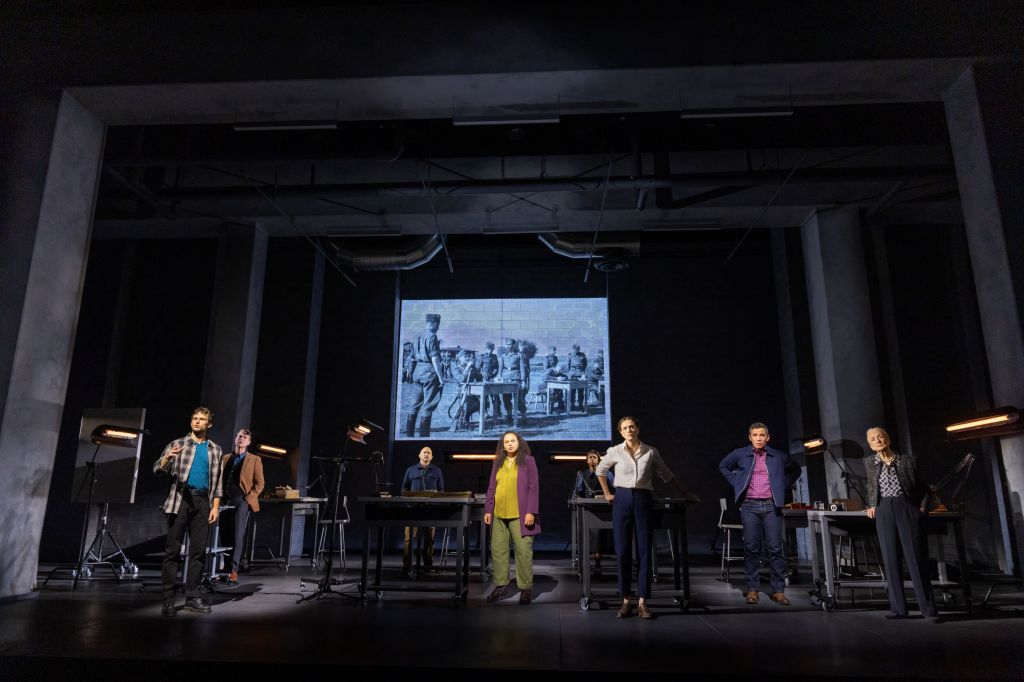
The many-layered, magnificent production of Here There Are Blueberries, first presented at NYTW, landed on Broadway in early November. Currently, it runs at the Barrymore Theater until January 20, 2027.
Stylized as a quasi-documentary that travels back and forth in time the play investigates the mysteries centered around an album of 116 photographs taken at Auschwitz. A retired U.S. Lieutenant Colonel, who found and kept the album for sixty years, contacts the US Holocaust Memorial Museum to see if it can contribute to their research. Problematically, the album has no pictures of the victims to be memorialized. However, after a tense build-up to a crucial meeting, experienced director Sara Bloomfield (Montego Glover) determines archivists can work on the album to study its significance.
Based on interviews, extensive research and photographs rarely seen of the infamous concentration camp from another perspective, the play follows archivists on their journey of discovery. Written by Moisés Kaufman and Amanda Gronich, and directed by Moisés Kaufman, Here There Are Blueberries resonates. Thematically, the play reaffirms Hannah Arendt’s explanation for the complicity of people who allow genocide to happen as, “the banality of evil.”
The playwrights introduce us to the archivists in the second scene. It is then Rebecca Erbelding (Delia Cunningham in an emotionally invested portrayal), reads the letter from the Lieutenant Colonel notifying the museum about the album. From that juncture on, we become engrossed. Gradually, the researchers and others close the monumental gaps in information about the album’s purpose, provenance and significance.
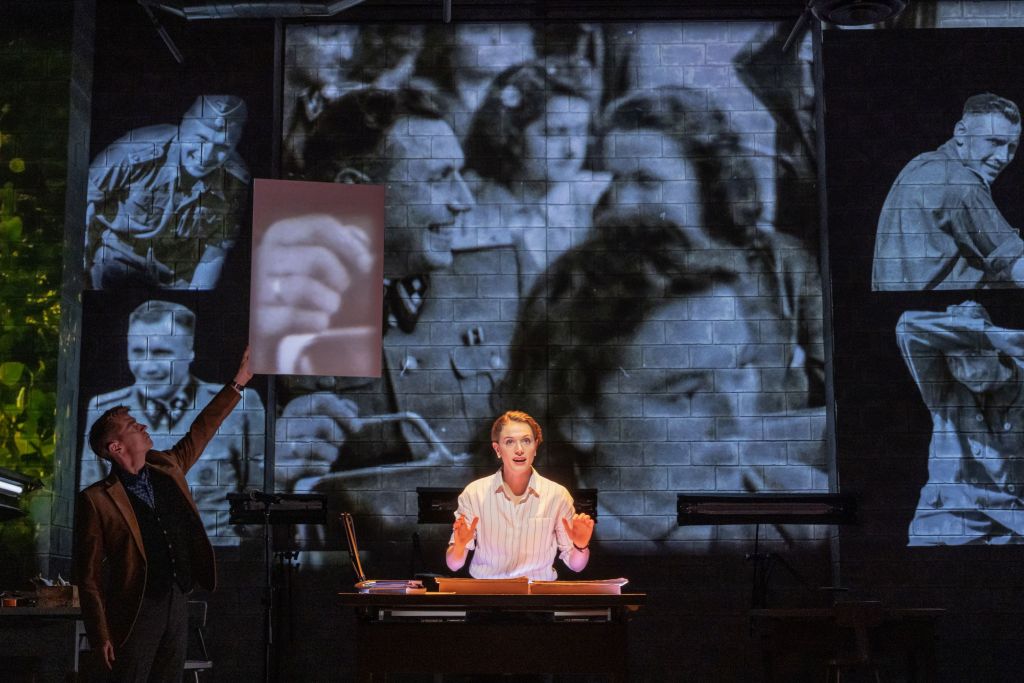
In the production’s transfer to the Barrymore, scenic designer Derek McLane makes use of the expanded space to meticulously define the large room where archivists pour over photographs and make conclusions. As a result of David Bengali’s expert projection design of the black and white photographs displayed on the back of the stage in all their stark clarity, the audience engages with lead archivist Rebecca Erbelding’s questions. One example that puzzles concerns a Nazi officer smiling and laughing as he enjoys blueberries with various secretaries (Helferinnen, who were in communications, etc., and held jobs at the camp).
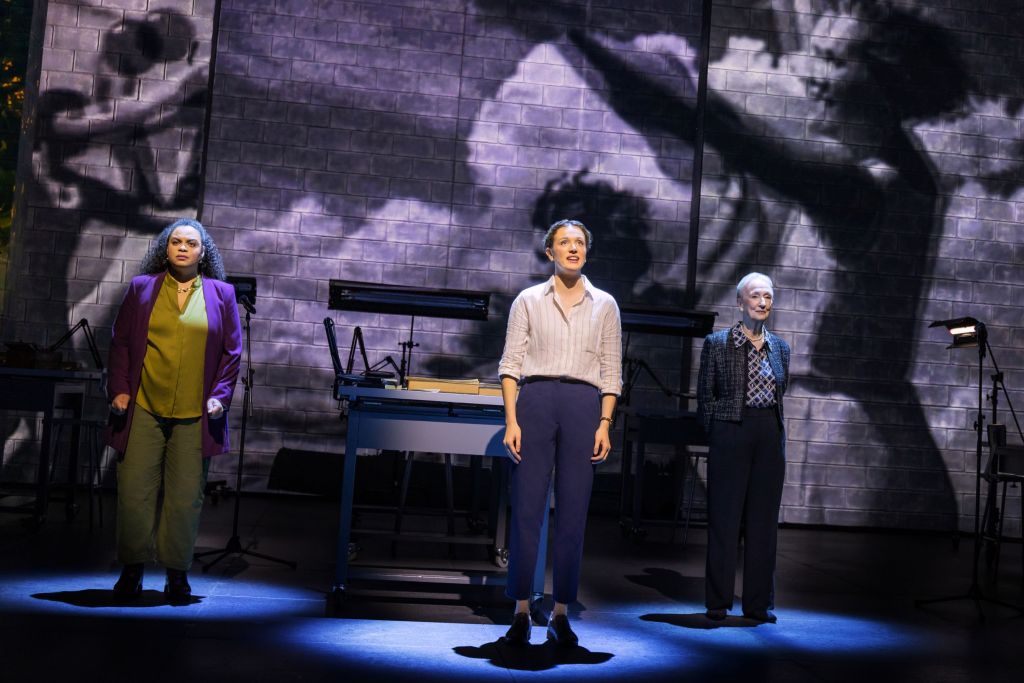
Kaufman’s staging moves the search for the purpose and ownership of the album forward. Through Erbelding’s queries, directed to the audience, he creates suspense because the archivists become detectives. Personifying the various characters/historical individuals, actors like Kathleen Chalfant, Michael Cerveris and Brandon Flynn take on a variety of roles. As they step forward from their research tables, like a Greek chorus, they bear witness and speak from the ethereal realms of history. All of the creatives-Dede Ayite (costume design), David Lander (lighting design), Bobby McElver (sound design)-further the play’s themes. These, like most themes probing historical truth, sit on the edge of darkness. Here, we attempt to understand why nondescript bureaucrats of civil society become the monstrous accomplices to an efficient, mass murdering operation.
After pinpointing the owner of the album as Karl Höcker (Scott Barrow), who moved his way up to become the administrative assistant to the head of Auschwitz, the archivists explore the lifestyle of those in the photographs. These include the SS guards, top brass, doctors, various secretaries, staff and others. Like average people, they have meals, relax at a nearby resort, participate in athletics, and carry on with wholesome, human activities. Meanwhile, monumental horrors happen nearby on the death camp’s grounds.The disconnect staggers the audience.
The global attention the album receives (revealed by projections of headlines), brings new interest and adds to information when individuals from around the world contact the museum. Indeed, some revelations are from grandchildren of the SS, like Tilman Taube (Conrad Ricamora). Of course ,seeing hidden aspects of their relatives shocks them. Secrets kept hidden eliminated family shame. Additionally, perpetrators avoided accountability.
None of the photos show the functions of Auschwitz, the prisoners, victims or crematoria. All is pleasant and reflective of the wonderful world that Hitler spoke about bringing to mankind, after the “vermin” were removed. That the Helferinnen were photographed, surprised a number of researchers who wondered if the young women knew about the gas chambers. How could these young women be aware of the extemination and stay?
After denials, one of the secretaries who worked at Auschwitz discusses this. Matter-of-factly, Charlotte Schunzel (Michelle Beck) states that she and the other women recorded how many victims were sent to hard labor and how many were sent to “SB.” The initials stood for “special treatment,” a euphemism for the gas chambers. In other words, the sweet, smiling secretaries enjoying blueberries with Karl Höcker in the titular photograph, knew they participated in a genocide.
The archivists pin down the identity of the SS officers and high command in the photographs. One is the notorious “Angel of Death,” Dr. Menegele. Another is the commandant who set up Auschwitz-Birkenau, Rudolph Höss. Eventually, they realize he returned to oversee the extermination of Jewish Hungarians. The researchers determine that the photos are like selfies. In fact they reveal the happy, Auschwitz, camp life of Karl Höcker (Scott Barrow), who would have been a “nobody” if he had not joined the Nazi party in 1937. With Höss, Menegele, Tilman Taube’s grandfather and others they took a group photograph in what archivists describe as a “Chorus of Criminals.” However, researchers don’t understand the date or significance of the photo.
The most enlightening revelation comes from Holocaust survivor Lili Jacobs, who contacts archivists, as a result of the press reports. She possesses an album she uncannily found of 193 photographs of Hungarians standing in groups waiting. After she donates her album, the researchers solve the dates of the mystery of the albums. Also, they figure out the purpose of the photo which shows all the SS, high command and workers celebrating at Solahütte, a resort on the camp grounds. At this resort Karl Höcker occasionally rewarded the SS guards, workers, Helferinnen etc., when they did something special.
With the evidence of the two albums together, archivists complete the full story of murderers and victims. The victims in Jacobs’ album were those who arrived in train transports from Hungary toward the end of the war. The album included photographs of Lili, her family and her rabbi, right before they were separated into the lines for labor camp and gas chambers which the Helferinnen recorded. Höcker assembled and photographed what archivists called the “Chorus of Criminals'” photograph for a vital reason because the murderers at Solahütte celebrated. Relieved, they successfully finished a job well done. In a united victory they proudly uplift the massive operation that divided, selected, processed Hungarians, so that 350,000 could be exterminated, among them Lili’s parents and two younger brothers.
Through their research, archivists discovered that Lili arrived one day after Höcker arrived at Auschwitz. He most probably received a career bump up to administer the massive “Hungarian Project.” In light of Lili’s discovery and sharing it with the archivists at the museum, she and they “get the full picture.” She sees the identity of the men who murdered her family. Finding the album of herself in the tie in with the album of the SS and commandant seems an extraordinary sequence of events beyond coincidence. For Lili, the discovery is mystical and divinely spiritual.
For us, the play charts how evil becomes normalized, even banal, once the wall of human empathy is breached.
Here There Are Blueberries runs 1 hour 30 minutes with no intermission through January10, 2027 at the Barrymore Theater.
‘The Dinosaurs’ at Playwrights Horizons
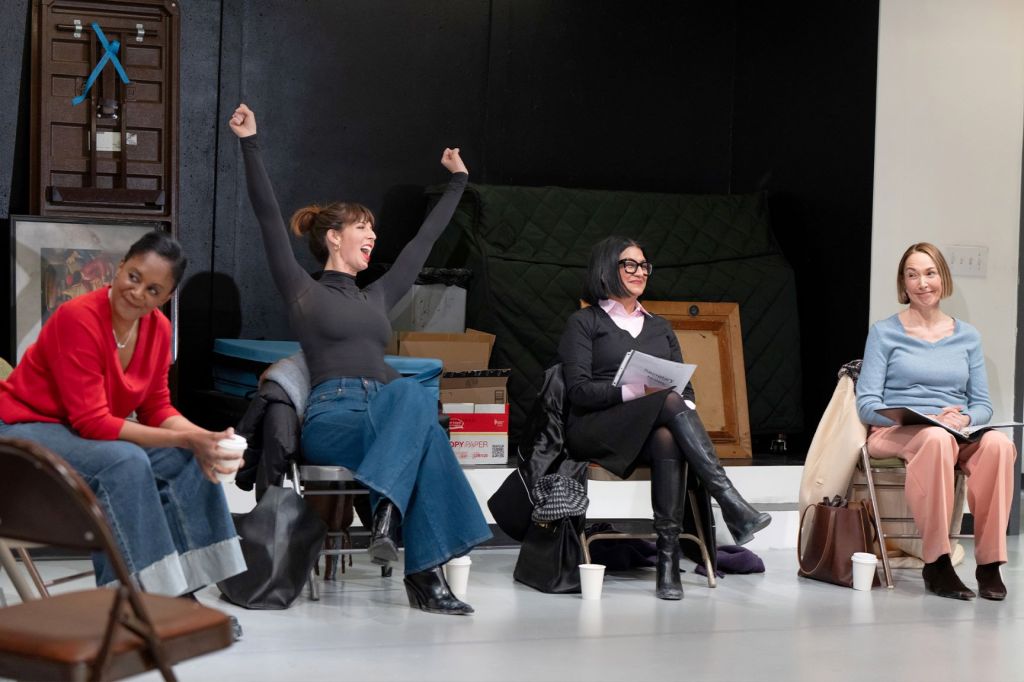
In The Dinosaurs written by Jacob Perkins and directed by Les Waters, time stands still yet moves in leaps that are hard to figure out. It takes place in a room where women who are alcoholics meet, form community and establish friendships helping each other through the years. With strong performances that require solo monologues, the characters share experiences and perspectives and enumerate their days of continuing sobriety. The Dinosaurs currently runs at Playwrights Horizons until March 8, 2026.
As the characters set up the neutral unadorned room (scenic design by dots), where they meet, wait for participants to show up and reaffirm the rules of their sessions, we understand this is a female inclusive community. April Matthis as Jane is first to arrive to begin setting up chairs, followed by nervous Buddy (Keilly McQuail), who after a humorous exchange with nonjudgmental Jane, decides she can’t stay. She does show up during the meditation and the end only making a connection with Jane in a layering that makes the time structure hard to divine.
Next, Elizabeth Marvel as Joan enters with the coffee and helps Jane set up. She is followed by Kathleen Chalfant’s Jolly as the longest, oldest member of the group, who brings positivity and warmth with the donuts and scones. Newer member Joane (Maria Elena Ramirez), arrives with gossip about a female teacher. Finally, Janet (Mallory Portnoy)–the appointed time keeper–arrives late and is the first one to share on the topic “coming back,” after their group meditation.
The playwright avoids heavy emotional content related to grief, sorrow, regrets, abuse or violence. Indeed, he avoids in the moment conflict in the plot and character development, with the exception of Joan, Jane and Joane who disagree about feeling empathy for a “lonely” female teacher who has sex with a teen who is “of age.” Jolly provides the down-to-earth humorous perspective as the argument persists then ends once Janet arrives. Interestingly, one would think these are average women of various ages who live regular lives, but for their momentous pronouncement later, during their time to share, that they are alcoholics.
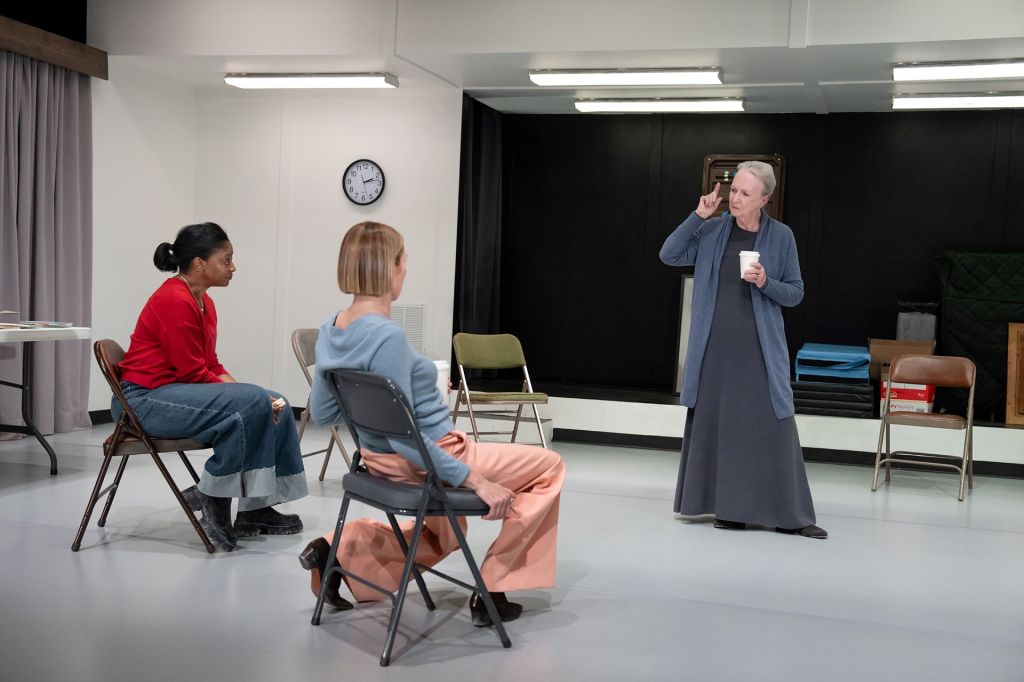
The production spends a good deal of time having Joan, Jane and Jolly set up the room making small talk. Chalfant’s portrayal as Jolly mesmerizes with substance, authenticity and humor, which she clearly infuses with backstory and meaning. In comparison with the other women, Jolly’s character is the most delineated because of Chalfant’s superb, specific performance, as is Marvel’s Joan who reveals why she is an alcoholic toward the end of the play. Otherwise, the characters divulge little else about themselves. This forces the audience to imagine who these women are and why they chose alcohol as their drug and not opiates, barbiturates, food or other addictive elements to anesthetize themselves and escape from life’s “slings and arrows of outrageous fortune;” if indeed, that is why they are alcoholics.
Janet’s metaphoric experience about being driven by a chauffeur she hates and who tells her to throw out the body of a man instead of carrying it around, seems to express her situation of carrying baggage which she eventually throws away in her awake dream state. However, we don’t understand to what she refers and she doesn’t connect the dots. Likewise, the others say little hard evidence about their situations. This adds to a general tiresome opaqueness.
All important personal details are absent, perhaps playwright censored to indicate his characters’ self-censorship. No explanation is given by the playwright, which leaves a huge gap in the ethos of the play. Nevertheless, a picture forms of these characters and the process of their recovery from a disease. However, its horrific effects in their personal lives as they share with their community is never identified. Indeed, the recovery process seems deadening as the women avoid discussing even the difficulty of fighting the urge to taste a drop of their favorite alcoholic beverage.
The characters also avoid discussing the severity of their alcoholism. If the blood never boils with emotion, then not feeling alive removes any impulse to drink. Perhaps keeping a steady deadened state is their key to recovery. How fortunate that they have found other individuals who allow this type of emotional void to be shared. Their tell-tale meditation at the beginning of their meeting indicates what substitutes for feeling and the connection with their feelings.
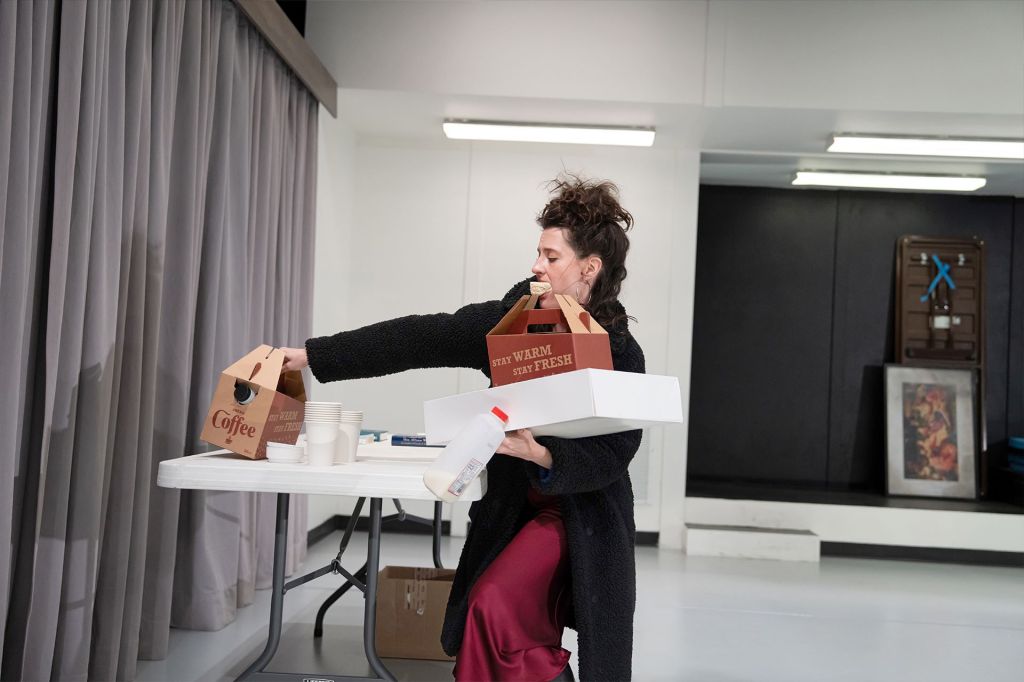
Notable examples of a separation perhaps disassociation from feelings happen with a few of the characters. Joane’s discussion of finding her son pleasuring an older man in their house seems devoid of an emotional reaction on her part in relation to her drinking. The assumption is that her discovery caused the rift between herself and her son that she describes and perhaps this led to her alcoholism. She and her son never discussed or dealt with her seeing her son with the older man. Did this lead to the dire circumstances that happened later in their lives? Ramirez’ Joane recalls it with dispassion though she takes a moment to breathe revealing the confession is difficult. Her admission that she is revealing it for the first time is groundbreaking.
That her son at fifteen was under the apparent influence of an older man reflective of the current pedophilia reports in the Epstein files is passed over without judgment by Joan or any of the other women. Is this what it takes to recover from alcoholism, this passive, non-reactive state of mind while others are there to just listen?
Joan’s time lapse discussion of the days of her recovery to sixteen years emerges with vitality. A matter-of-fact statement of her number of years without a drink that has seen her in this room with various community members of alcoholics hearing her make comments becomes her milestone. And apparently, during that sixteen year period she had to say goodbye to Jolly who dies and whom she misses. Thus, Jolly’s influence on her own recovery is reduced to less than a minute of time, though counting the years of struggle to maintain sobriety must have seemed an eternity. Unfortunately, there is a grand absence of information. Perkins revels in being opaque. More is needed.
Thankfully, the actors do a yeowoman’s job of leaping over the play’s lack of detail by providing as much of their interior substance as possible. Nevertheless, the lifeblood of theatricality and living onstage is hindered by the playwright’s lack of clarity. Nor is the play’s incoherence at times clarified by Waters’ direction.
Perhaps Rainer Maria Rilke’s quote from Book of Hours which Perkins uses to head up his script might have been spoken aloud by one of the characters in a prelude to The Dinosaurs. The lines of poetry present a lens though which to view each of the characters’ journeys, lifting them to a spiritual plane and revealing the irrelevance of time.
I live my life in widening circles that reach out across the world. I may not complete this last one but I give myself to it. I circle around God, around the primordial tower. I’ve been circling for thousands of years and I still don’t know: am I a falcon, a storm, or a great song. –Rainer Maria Rilke from Book of Hours
The Dinosaurs runs 1 hour 15 minutes at Playwrights Horizons until March 8, 2026. playwrightshorizons.org.

