Category Archives: Global Theater News
‘Paula Vogel in Conversation With Linda Winer’
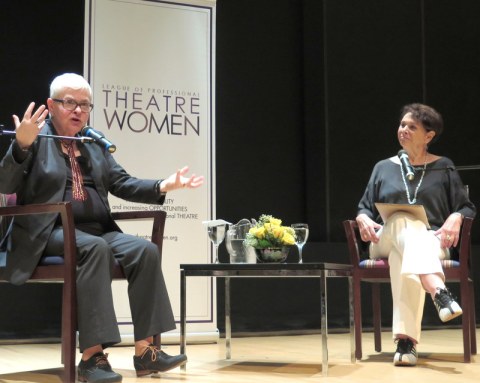
(L to R): Pulitzer Prize-winning playwright Paula Vogel, Linda Winer in NYPL for the Performing Arts at Lincoln Center, League of Professional Theatre Women collaboration, ‘Paula Vogel in Conversation With Linda Winer at Bruno Walter Auditorium (photo Carole Di Tosti
The League of Professional Theatre Women’s Pat Addiss and Sophia Romma again have successfully collaborated with Betty Corwin, who produces the New York Public Library’s Oral History Interviews, to present an enlightening, joyous evening with one of Broadway’s hottest playwrights, Paula Vogel. In conversation with Linda Winer, long-standing theater critic of Newsday, the Pulitzer Prize-winning playwright discussed her life, her work and the journey of her play Indecent from conceptualization through development, regional theater production and Off Broadway right up to its current run at Broadway’s Cort Theatre. The immutably themed Indecent has been nominated for a Tony Award in the category of Best Play. It is not only a must-see, it is a must-see two or three times over for its metaphors, themes and sheer genius.
Paula Vogel, a renowned professor of playwriting (Brown-two decades, currently Eugene O’Neill Professor of Playwriting (adjunct) at Yale School of Drama, Playwright-in-residence at Yale Rep) generously shares her time and dynamism with global communities. She conducts playwriting “boot camps,” and playwriting intensives with various organizations, theater companies and writers around the world. What is smashing is that Vogel not only is a charming, vibrant raconteur, she is an ebullient, electricity-filled advocate of the artist within all of us.
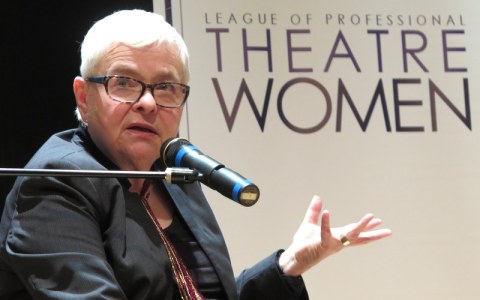
Pullitzer Prize-winning playwright Paula Vogel, a presentation by The NYPL for the Performing Arts at Lincoln Center and League of Professional Theatre Women, ‘Paula Vogel in Conversation With Linda Winer, Bruno Walter Auditorium (photo Carole Di Tosti)
In her philosophy and approach toward theater, we are all story tellers, we are all playwright,s and we must cultivate the citizen artist within to insure that the theater arts are accessible and relevant to all cultures and populations, not just the “haves.” What she discussed about the current state of theater arts past and present was profound and prescient in response to why it took her so long to get to Broadway. Vogel reminded the audience that in the 1980s there were about 50 innovative, theme-rich plays on Broadway exemplified by The Elephant Man and M Butterfly. Such plays dealt with difficult issues that brought audiences together in a profound communal experience. Currently in 2017 there are a handful of productions that effect this. Commercialism has enveloped Broadway.
Hence, Vogel expressed a motivating joy that perhaps we should all entertain. We should roll up our sleeves to fight the good fight against philistine commercialism and consumerism and Byzantine gender and racial bias. Such dampening restrictions and discriminations parade behind the notion that film and theater are essentially liberal mediums. Vogel introduced the thought that they are the opposite. To her way of thinking there is a profligate conservatism akin to that of corporate America that hampers theater innovation and prevents provocative theater production to readily make it to Broadway.
However, she did affirm that the next generation of playwrights, whether older or younger, are seeing an explosion of work featured Off Broadway and Off Off Broadway which is where a lot of the innovation and experimentation has found a home. That aspect of the theater is thriving and in the upcoming years we can expect an elegance of defining work that will have an illuminating impact on Broadway.
A believer of reverse capitalism, that supply increases demand, Vogel’s ideas and effervescence are contagious. She “spreads the word” and brings the community of theater wherever she visits, from Austin, Texas to Sewanee, Shanghai Theatre Academy in China, from Minneapolis to the neighborhood near the Vineyard Theatre in New York City. And together she and her audience of all ages across the communities (from 15-90), of seasoned writers and playwrights and neophytes alike, experiment, grow and enjoy writing and reading plays during her intensives.
Her current playwriting boot camps (they used to take a week to do) to make live theater a communal experiment much like its original creative form as a social, cathartic experience resonate today. They make complete sense especially at a time when artistic shallowness manifested in some entertainment forms has achieved a noxious superfluidity that really needs to die a death (my thoughts).

(L to R): Paula Vogel, Linda Winer, ‘Paula Vogel in Conversation With Linda Winer, in a collaboration by The New York Public Library for the Performing Arts at Lincoln Center and the League of Professional Theatre Women (photo Carole Di Tosti)
Some of the highlights of Paula Vogel’s discussion with Linda Winer, who was a wonderful interviewer, revolved around how she conducts her “bootcamps,” culminating in bakeoffs to spur on a fountain of creativity. In response to how her Pulitzer Prize-winning play Learning How to Drive was produced Off Broadway but never made the transfer to Broadway, she repeated an incisive comment from the past, “How often do the girls get to play with the big expensive toys?”
Now that Vogel’s Indecent and colleague Lynn Nottage’s play Sweat also transferred to Broadway from the Public Theater, Vogel laughingly acknowledged that for both of them, the expensive toys are “a lot of fun.” Vogel stated that when one acclimates to the house size, whether the play is in a 60 seat theater or a 200 seat theater, the effort and the intensity of the work process is the same. Vogel joked, “The only difference is I’m not sleeping on a sofa bed.” Indeed, with Indecent, Vogel has graduated to a mattress and a bed, “more expensive toys.”
Vogel discussed the evolution of Indecent which was fascinating. In her twenties she had read The God of Vengeance, by Sholem Asch, the play upon which Indecent revolves. She was mesmerized by the transcendent love scene between the pious Jewish father’s daughter and one of the prostitutes who works for him in the brothel below their apartment. When the world renowned Yiddish play was translated into English and brought to Broadway in 1923, the cast, director and producer were arrested for obscenity, even though some of the love scenes were cut. The play received a greater following and lasted 133 performances, but there was a trial after the play closed. The Court of Appeals overturned the convictions of the director and producer in 1925.
Twenty years after Vogel read Asch’s play, she learned that Rebecca Taichman was attempting to direct the obscenity trial for her thesis. Vogel learned of her work and pronounced her a genius. Vogel was inspired when she received a call from Taichman to collaborate on a play about the events surrounding the trial of Asch’s play. During their conversation Vogel had a lightening-like vision seeing a scene from the play which she stated “always happens” (it happened with Learning How to Drive) when she knows she can write a particular play. Having read up on Yiddish Theater, she told Taichman, “I think this is a play way beyond an obscenity trial.” Taichman was thrilled at her enthusiasm. Vogel admitted that this was around nine years and 40 drafts ago.

(L to R): Pat Addiss, Paula Vogel, ‘Paula Vogel in Conversation With Linda Winer presented by NYPL for the Performing Arts at Lincoln Center and League of Professional Theatre Women (photo Carole Di Tosti)
They workshopped at Sundance Theatre Lab (2013) and after many drafts and other workshops they put it on at Yale Repertory for the first time with the music, choreography and staging. Vogel joked the “flop sweat” was prodigious. Taichman’s and Vogel’s shirts were sticking to their backs. Since then it has moved on and was performed at La Jolla Playhouse in Fall 2015 and in May 2016 was produced at the Vineyard Theatre in New York City.
There is such enthusiasm for the production since Yale (2015) that the ensemble, the musicians, the stage manager and the assistants have remained together. As Vogel says, “We’ve all moved together as one.” This never happens with a production that transfers to Broadway. If it does, it is extremely rare. Vogel laughingly joked they have become a family. When two children were born during the evolution of Indecent, Vogel commented she has become like a godmother to both.
What a memorable evening! Vogel is about fun, about community about connections, about living and creating whatever comes next. That spontaneity and flexibility is like jumping off into the darkness, knowing you will land on soft ground at sunrise. The moment you think about the jump, you stop yourself. Vogel is not about stopping. She’s there already and beckoning us to join her. Why not?
Paris: The Sorbonne, The Irish Cultural Center and an American Connection
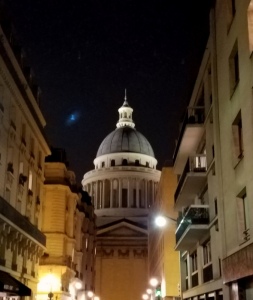
The Pantheon, near the Irish Cultural Center, La Rive Gauche (photo Carole Di Tosti)
People clamor that it is good to be busy. Sometimes I question that thought, especially when I have press deadlines, when cinema publicists are wondering where their reviews and articles are and I’m exhausted from seeing a play on Broadway that I must review the following day.
So my travel to Paris in September of this year was exquisite because it took me away from the NYC helter skelter night life of an entertainment journalist. In Paris, la Rive Gauche, the pace is not as fast, the imperative not as overwhelming.
I could casually take photographs of the rainbow colored and salubrious fresh vegetables, sumptuous steaming paella flavoring the air with delicious spices along with other items folks lined up for in the open air markets.
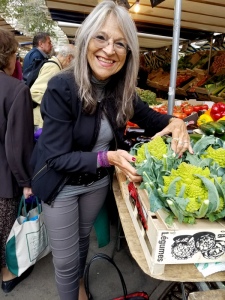
Carole Di Tosti at an open air market in Paris, La Rive Gauche (photo Carole Di Tosti)
I did write but at a more leisurely pace. I could do casual interviews of musicians and star Anne Carrere of Piaf! The Show.
I could have a casual chat with Rita Duffy about her brilliant installation The Souvenir Shop-marking the 1916 Rebellion, at the Irish Cultural Center. At the Irish Cultural Center, I could speak with Irish poet Pat Boran, and I could cover the goings and comings of playwright Rosary O’Neill in her celebration of Irish playwright Samuel Beckett and Impressionist painter Edgar Degas.
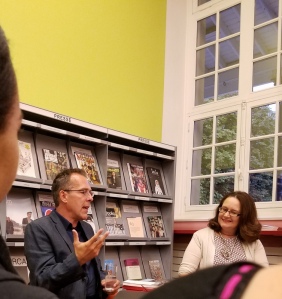
Pat Boron and Sinéad Mac Aodha at an Irish Cultural Center event. (Photo Carole Di Tosti)
Rosary O’Neill has more than a cursory connection to Beckett and Degas. She has thoroughly researched both men’s lives and has written plays about each. Her play about Beckett, Beckett at Greystones Bay received a focused reading in Paris in a downtown venue this September. It was directed and acted by Brendan McCall.
Earlier in the summer Barrett O’Brien directed and acted in the role of Beckett in a staged production of Beckett at Greystones Bay at the Oregon Shakespeare Festival. As a result of that production, O’Neill collaborated with the director and upon his suggestion, expanded the work into two acts. O’Neill’s Beckett is being developed for future focused readings and productions in Paris and back in the US.
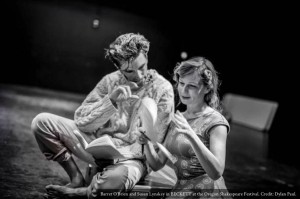
Barret O’Brien and Susan Lynskey in ‘Beckett at Greystones Bay’ at Ashland Shakespeare Festival (photo Dylan Paul)
O’Neill’s love of Degas began when she first appreciated his work as a young child. It blossomed when she was a Drama Professor at Loyola in New Orleans, Louisiana where she founded the nonprofit theater company, Southern Repertory which produced a number of her plays.
It was during the time she ran Southern Rep, that she researched Degas’s life and discovered that he had strong familial ties to New Orleans where he stayed for about six months during the tumultuous era of reconstruction seven years after the Civil War. Fascinated by Degas’ relationship with his brother Rene’s wife, Estelle Musson, and intrigued by Rene’s spendthrift lifestyle which bankrupted the Degas fortune along with the crash in the cotton markets during and after the war, O’Neill marshaled her talents and wrote Degas in New Orleans
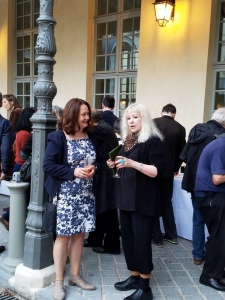
Sinéad Mac Aodha and Rosary O’Neill at an Irish Cultural Center event (photo Carole Di Tosti)
This year marks the centennial year of Degas’ death. O’Neill, who has collaborated on productions of her two act play Degas in New Orleans has enjoyed seeing her work performed in regional theater in Texas and Louisiana. The play has received focused readings in New York City and New York where it caught the attention of professional musician and Bard College professor David Albert Temple, who wrote music for the play and collaborated with O’Neill to make Degas in New Orleans, The Musical.
Their collaboration which included producer/director Deborah Temple and a cast from a regional performing arts high school, brought the musical to New York City where it was performed in a one-night-only show. Prior to its New York premiere, the production was performed in upstate New York at Bard College’s Black Box Theater.
The musical like the play focuses on Edgar Degas’ time spent with his mother’s relatives, the Mussons. It intimates the potential for a love relationship with his brother’s wife, Estelle. Surely, if his brother had not bankrupted the family fortune after the crash of the cotton trade (a painting of the family’s cotton office hangs in the New Orleans Museum of Art, as does his portrait of Estelle Musson with lovely red peonies), the situation would have been very different for the painter. Degas would most likely have stayed in New Orleans to pursue the possibilities of love with Estelle and to help her pick up the pieces after his brother Rene deserted her for her maid America. His painterly subjects would have been of the city of New Orleans, family portraits and perhaps even his cousin Norbert and his wife who were mixed race and free persons of color. But alas, Edgar had to return home to financially support his father, who was suffering a near breakdown because of Rene’s wantonness wracking up gambling debts.
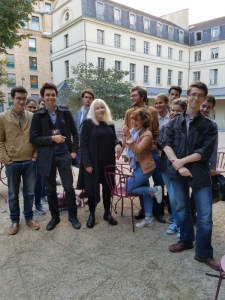
Rosary O’Neill and students from the Sorbonne at the Irish Cultural Center (photo Carole Di Tosti)
It would have been a magnificent tribute to Degas to mount a production of either the play or the musical Degas in New Orleans in New York City in celebration of the centennial of Degas’ death on September 27, 1917. Currently, the process is on hold. However, O’Neill’s play about Degas and the strong cultural ties between New Orleans and Paris are being studied by the students at the Sorbonne. French Professor of Contemporary Literature Joseph Danan will be examining Degas in New Orleans as contemporary literature. Additionally, the play will have a focused reading in French at Columbia University’s center at the Sorbonne at Reid Hall. It is an event that is a first-of-its-kind.
Rosary O’Neill has made friends of visiting artists in residence at the Irish Cultural Center where she will be staying as her work is being studied and performed in Paris. She will continue to write, speak and share with the visiting Irish artists in residency at the Center, and be stimulated by their support and brilliance.
The Irish Cultural Center is the go-to place for events that highlight the strongly rooted Irish experience in Paris. It serves as an amazing resource for the community, students from the Sorbonne and visiting artists who are looking to feel at home in Paris. O’Neill is enthusiastic about her stay at the Center, and is happy that she, in a small way, is continuing to affirm links among the learning centers of the Sorbonne, the Irish Cultural Center and New Orleans. It will be a pleasure to cover the readings of her plays Beckett at Greystones Bay and Degas in New Orleans.
 CAROLE DI TOSTI