Category Archives: NYC Theater Reviews
Broadway,
‘Punch’ Makes its Vital Impact on Broadway
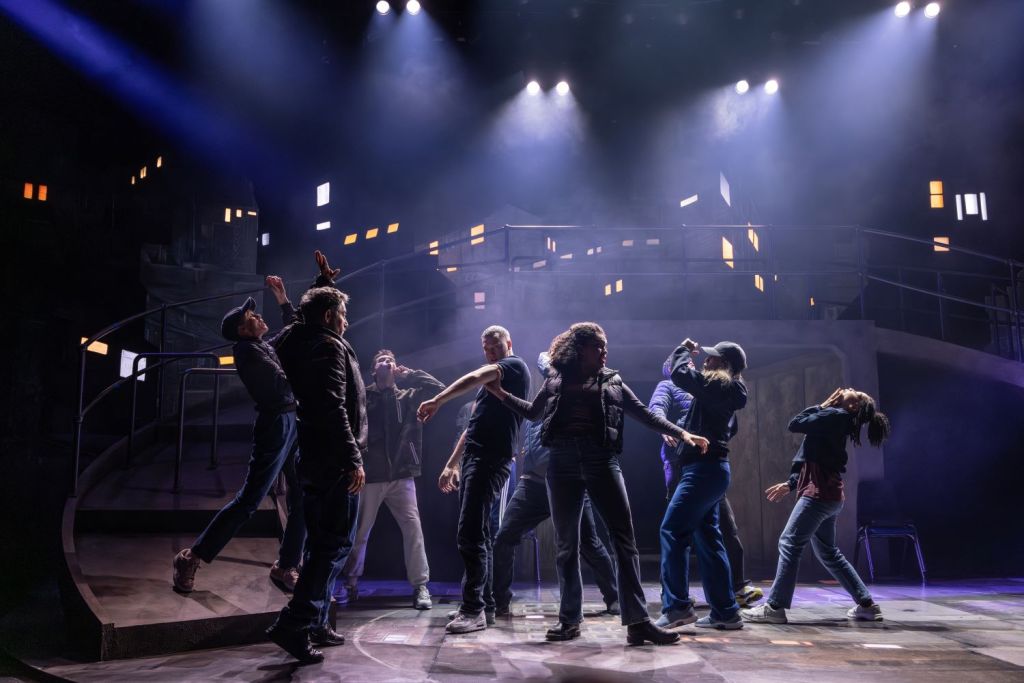
In 2025 when US citizens witness violence by those who profess patriotism, conservatism and religious fervor, one must look past the cognitive dissonance for clarity and understanding. Though the setting of Punch is Nottingham, England between 2011-2025, it is representative. The initial events might have happened in the US or any other country where punches are thrown as a right of passage for strapping young men. For these reasons Punch at Manhattan Theatre Club arrives at a crucial time.
Importantly, the heartfelt drama explores trending social concepts and themes that impact our cultural well being. The play presses hot button issues with vitality and energy. It examines the ethos of violence as the evidence of weakness. It explores how accountability for wrongdoing must be a part of rehabilitation or the likelihood of rehabilitation decreases. Finally, through the arc of the protagonist’s transformation, the play reveals that restorative justice can promote self-forgiveness and healing.
Based on Jacob Dunne’s book Right from Wrong, playwright James Graham with crystal clarity squares off against the confusion associated with brawling as thrilling, fun and justifiable. The play identifies the societal constructs that in the last decade have been infused with political nuance to exploit division and violence. Such constructs lift up physical assault as an emblem of masculinity. Likewise, they demean and dismiss kindness, compassion and empathy as true measures of strength and power.
Through Graham’s well-articulated characterizations of Jacob (the sensational Will Harrison), whose one punch kills James, and James’ mom Joan (the equally sensational Victoria Clark), we learn that redemption, forgiveness and hope are not empty words bandied about after violent acts that kill. Made alive by spiritual goodness, the process of redemption and forgiveness can manifest positive results. And with hope and persistence, nihilistic behavior can be turned around.

The two act structure of Punch stylized by minimal sets and props put to suggestive use seems front-loaded with exposition in the first act. In the prologue Graham carefully creates the circumstances moving from the present to Jacob’s past during the fateful night that changed his life. In the present Jacob barely is able to articulate what happened to a facilitator and “circle group” in an initial therapy session. To them he describes the night of Raf’s birthday celebration and the reasons how and why the confrontation with a stranger upends his life.
Principally through his precise descriptions, the choreographed action via Leanne Pinder’s movement direction, and director Adam Penford’s staging of Jacob and his mates, we understand how and why the killing happened. After they celebrate with drugs and pub crawls, his friends scatter in various directions planning to meet up later. Jacob runs into a girl, Claire (Camila Canó-Flaviá) and has a brief flirtation. Then, Raf phones him for some “action” going down at Yates’ Bar in Market Square. For Jacob, “You always step in, your mate, my mates, your people.”
Sadly, Jacob allows himself to be Raf’s and his friends’ tool. Jacob describes that he arrives at Market Square where they wait for him but they take no responsibility for their own provocation. Helping his “mates” Jacob slams a man with his fist during what he assumes to be a brawl. With one blow, he knocks down the guy he doesn’t know whose name he discovers later is James. It is a punch that lasts forever, symbolized effectively in a freeze frame tableau and directed lighting.
In the first act the events move to James’ parents David (Sam Robards) and Joan (Victoria Clark), who deal with James’s condition and eventual diagnosis that he can’t just sleep off being drunk in the ER. Through a series of acute, brief questions, Joan queries David why James needs hospitalization. We divine he received a severe concussion. Subsequently, a diagnosis comes. A brain bleed requires James to have surgery. However, he never regains consciousness. After a decision to pull him off life support, his parents review how and why their giving, gentle, twenty-eight year old son died.

In his circle group, Jacob discusses his childhood, parents divorce, change of living arrangements and choice of friends in school. Jacob makes the point that his early decisions to choose one group of friends over another directly influenced his life negatively. Additionally, trouble in his school work because of autism adds to his alienation from school, his feelings of inferiority and need to fit in with “his mates.” For them engaging in violence bonds them together in a show of masculinity and power.
These scenes and Jacob’s discussing his jail time and encouragement by convicts to seek revenge on Raf for tipping off the police alternate with scenes between David and Joan. The couple discuss wonderful memories of James, the trial, appeals for a tougher sentence for their son’s killer and the underestimation of the “one punch” that frequently causes death. In another turning point, Joan discusses the uselessness of the situation where she feels no relief. In seeking relief, she ends up in a program called “restorative justice.” During the program she communicates with Jacob who is encouraged by his social worker (Camila Canó-Flaviá) and parole officer (Lucy Taylor).
Segments of the first act might have been streamlined and tightened as the repetition of scenes with Jacob and his mates become tiresome. The second act moves more quickly. It profoundly deals with Jacob’s self-realizations and transformation prompted by communication with David and Joan. The three, who agree to participate in the British restorative justice system communicate through letters. At this point Jacob is out on parole after 14 months. David and Joan question him about the circumstances of the fateful night. In the last scenes, they meet face to face and Jacob asks for forgiveness.
Harrison and Clark with the assistance of a fine ensemble (who take on many roles) breathe life into the characters and make them identifiable. The power of the play lies in the performances. Harrison’s move deeper into the emotions of Jacob as he seeks relief, redemption and forgiveness astounds. Clark’s Joan makes one admire James’ mother’s spiritual strength. She recognizes that she cannot live with hate and resentment toward her son’s killer. By seeking to understand and have hope for Jacob’s future, she gives birth to the possibility that Jacob can make something of himself. That satisfies her so that her own son’s sacrifice gains meaning in Jacob’s redemption.
The adaptation from narrative to drama requires theatricality. At times, the dialogue doesn’t deliver and must be activated. In the shuffling into action some scenes are awkward and need tweaking. Some might have been removed altogether. Overall Punch rides the zeitgeist of the moment. Its performances elevate its timeless themes and strike us with their vitality and power.
Punch runs approximately 2 hours and 30 minutes with one intermission at the Samuel J. Friedman Theatre until November 2nd. https://www.manhattantheatreclub.com/shows/2025-26-season/punch/
‘Saturday Church’: The Vibrant, Hot Musical Extends Until October 24th
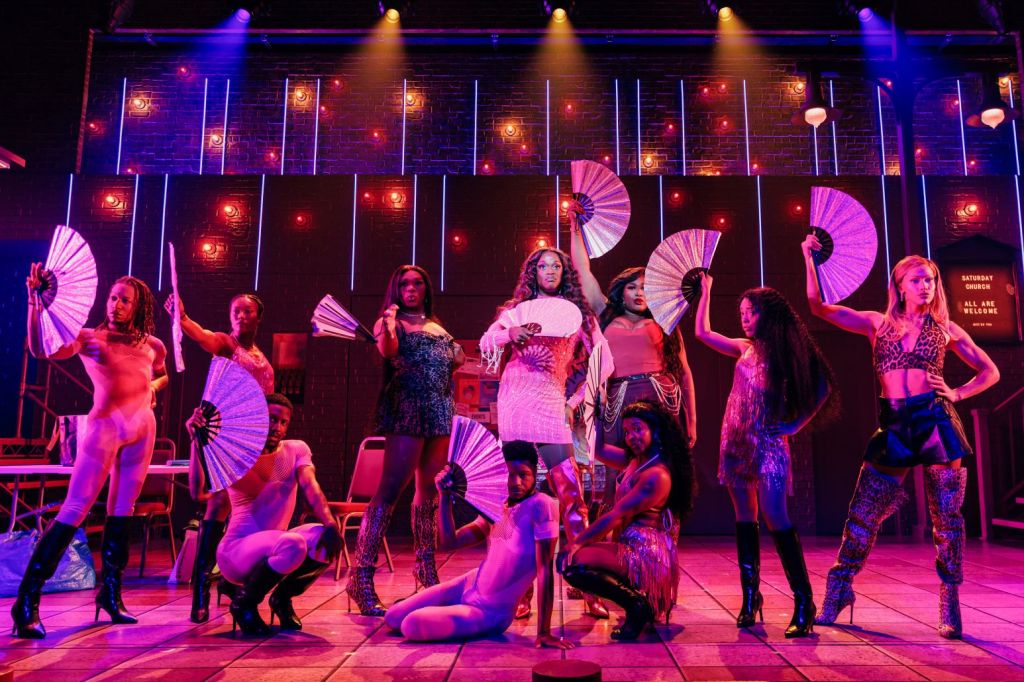
With music and songs by Grammy-nominated pop star Sia and additional music by Grammy-winning DJ and producer, Honey Dijon, Saturday Church soars in its ambitions to be Broadway bound. The excitement and joy are bountiful. The music and songs, a combination of house, pop, gospel spun into electrifying arrangements by Jason Michael Webb and Luke Solomon, also responsible for music supervision, orchestrations and arrangements, become the glory of this musical. Finally, the emotional poignance and heartfelt questions about acceptance, identity and self-love run to every human being, regardless of their orientation and select gender identity (65-68 descriptors that one might choose from).
Currently running at New York Theatre Workshop Saturday Church extends once more until October 24th. If you like rocking with Sia’s music, like Darrell Grand and Moultrie’s choreography and Qween Jean’s vibrant, glittering costumes, you’ll have a blast. The spectacle is ballroom fabulous. As J. Harrison Ghee’s Black Jesus master of ceremonies says at the conclusion, “It’s a Queen thing.”
However, some of the narrative revisits old ground and is tired. Additionally, the music doesn’t spring organically from the characters’ emotions. Sometimes it feels imposed upon their stories. Perhaps a few songs might have been trimmed. The musical, as enjoyable as it is, runs long.
Because of the acute direction by Whitney White (Jaja’s African Hair Braiding), the actors’ performances are captivating and on target. Easily, one becomes caught up in the pageantry, choreography and humor which help to mitigate the predictable story-line and irregularly integrated songs in the narrative.
Conceived for the stage and based on the Spring Pictures movie written and directed by Damon Cardasis, with book and additional lyrics by Damon Cardasis and James Ijames, Saturday Church focuses on Ulysses’ journey toward self-love. Ulysses (the golden Bryson Battle), lost his father recently. This forces his mother to work overtime. Unfortunately, her work schedule as a nurse doesn’t allow Amara (Kristolyn Lloyd) to see her son regularly.
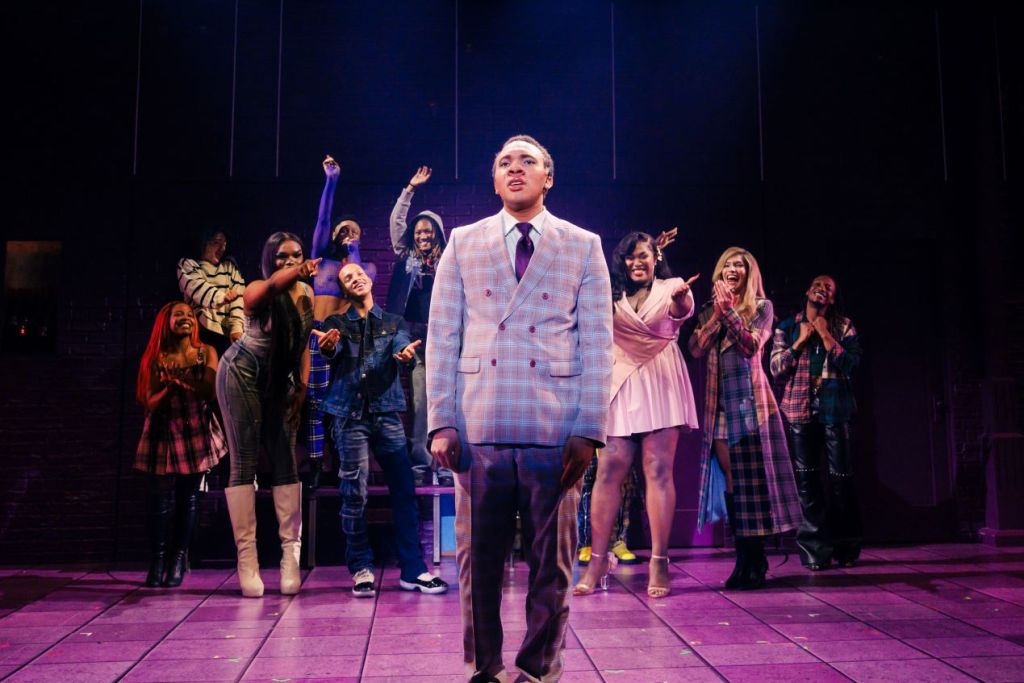
Though the prickly Aunt Rose (the exceptional Joaquina Kalukango), stands in the gap as a parental figure, the grieving teenager can’t confide in her. Even though he lives in New York City, one of the most nonjudgmental cities on the planet, with its myriad types of people from different races, creeds and gender identities, Ulysses’ feels isolated and unconnected.
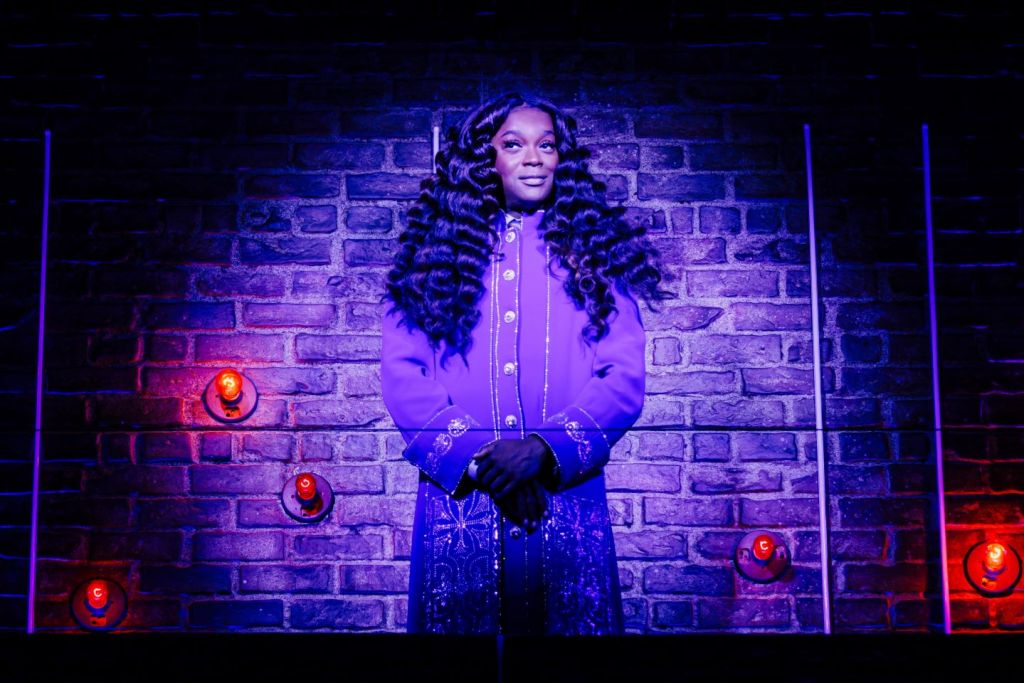
His problem arises from Aunt Rose and Pastor Lewis (J. Harrison Ghee). Ghee also does double duty as the master of ceremonies, the fantastic Black Jesus. Though Ulysses loves expressing himself in song with his exceptional vocal instrument, Aunt Rose and Pastor Lewis prevent him from joining the choir until he “calms down.” In effect, they negate his person hood.
Negotiating their criticisms, Ulysses tries to develop his faith at St. Matthew’s Church. However, Pastor Lewis and Aunt Rose steal his peace. As pillars of the church both dislike his flamboyance. They find his effeminacy and what it suggests offensive. At this juncture with no guidance, Ulysses doesn’t understand, nor can he admit that he is gay. Besides, why would he? For the pastor, his aunt and mother, the tenets of their religion prohibit L.G.B.T.Q Christianity, leaving him out in the cold.
During a subway ride home, Ulysses meets Raymond (the excellent Jackson Kanawha Perry). Raymond invites Ulysses to Saturday Church and discusses how the sanctuary runs an L.G.B.T.Q. program. With trepidation Ulysses says, “I’m not like that.” Raymond’s humorous reply brings audience laughter, “Oh, you still figuring things out.” Encouraging Ulysses, Raymond suggests that whatever his persuasion is, Saturday Church is a place where different gender identities find acceptance.
Inspired by the real-life St. Luke in the Fields Church in Manhattan’s West Village, Saturday Church provides a safe environment where Christianity flourishes for all. When Ulysses visits to scout out Raymond, with whom he feels an attachment, the motherly program leader Ebony (B Noel Thomas), and her riotous and talented assistants Dijon (Caleb Quezon) and Heaven (Anania), adopt Ulysses into their family. In a side plot Ebony’s loss of a partner, overwork with running activities for the church with little help, and life stresses bring her to a crisis point which dissolves conveniently by the conclusion.
The book writers attempt to draw parallels between Ulysses’ family and Ebony which remain undeveloped. As a wonderful character unto herself, the subplot might not be necessary.
As Ulysses enjoys his new found persona and develops his relationship with Raymond, his conflicts increase with his mother and aunt. From Raymond he learns the trauma of turning tricks to survive after family rejection. Also, Ulysses personally experiences physical and sexual assault. Finally, he understands that for some, suicide provides a viable choice to end the misery and torment of a queer lifestyle without the safety net of Saturday Church.
But all’s well that ends well. J. Harrison Ghee’s uplifting and humorous Black Jesus redirects Ulysses and effects a miraculous bringing together of the alienated to a more inclusive family of Christ. And as in a cotillion or debutante ball, Ulysses makes his debut. He appears in Qween Jean’s extraordinary white gown for a shining ballroom scene, partnering with Raymond dressed in a white tux. As the two churches come together, and each of the principal’s struts their stuff in beautiful array, Ghee’s Jesus shows love’s answer.
In these treacherous times the message and themes of Saturday Church affirm more than ever the necessity of unity over division, and flexibility in understanding the other person’s viewpoint. With its humor, great good will, musical freedom and prodigious creative talent, Saturday Church presents the message of Christ’s love and truth against a pulsating backdrop of frolic with a point.
Saturday Church runs with one fifteen minute intermission at New York Theatre Workshop until October 24th. https://www.nytw.org/show/saturday-church/?gad_source=1&gad_campaignid=22911892225
‘Ava: The Secret Conversations’ is Enthralling
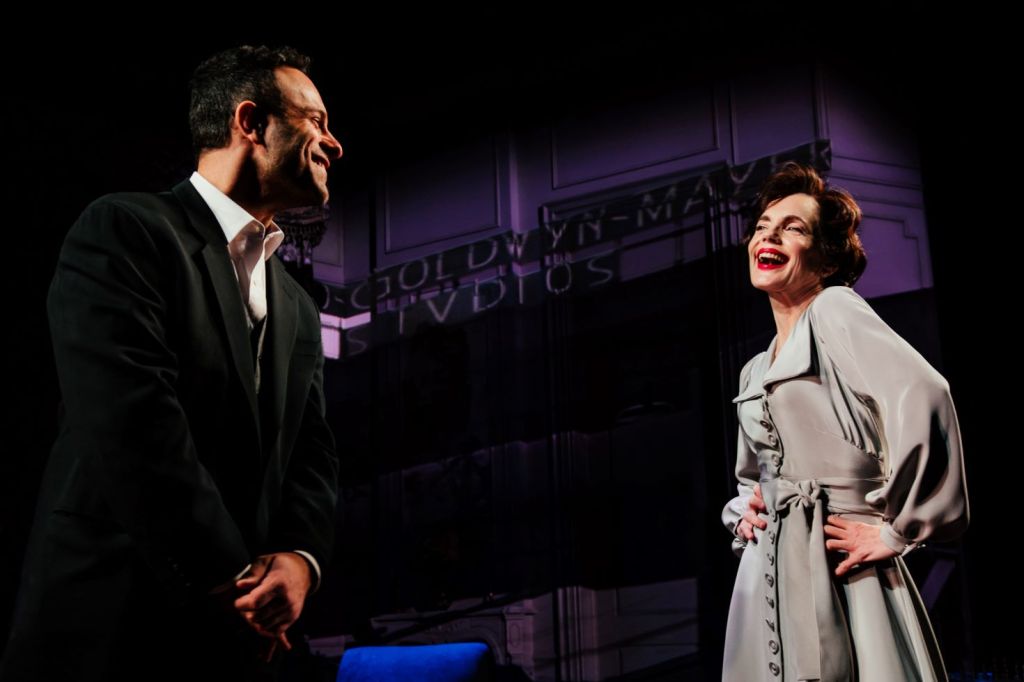
What happens to beautiful women after Hollywood chews them up and spits them out? Ava Gardner, who the studio labeled in a promotion for The Barefoot Contessa (1954) as “The World’s Most Beautiful Animal,” worked in the industry and mostly on TV until her stroke in her 60s. After her illness, she clawed her way back into functioning health to sit for a series of interviews with author Peter Evans who she asked to ghostwrite her autobiography. In Ava: The Secret Conversations, Downtown Abbey star Elizabeth McGovern channels Ava Gardner at New York City Center until September 14th. Her riveting performance mesmerizes with an equivalent assist from Aaron Costa Ganis as Peter Evans and Ava’s husbands.
The play, written by Elizabeth McGovern, reveals known facts about Gardner. However, for those who haven’t read Peter Evans’ titular book on which McGovern bases her writing, the work includes many surprising details.
When Gardner met with Evans at her apartment in London, both had achieved success in their careers. An iconic actress during the Golden Age of Hollywood, Gardner lived her life to the fullest with marriages to Mickey Rooney, band leader Arti Shaw and Frank Sinatra. Additionally, her relationships with many men alluded to in the play indicate she enjoyed her femininity and sexuality. Journalist Evans, who had been recommended to her by a friend wrote biographies of Peter Sellers and Aristotle Onassis to name a few. Together, they brought excitement, experience and expertise to the project which Gardner initiated.
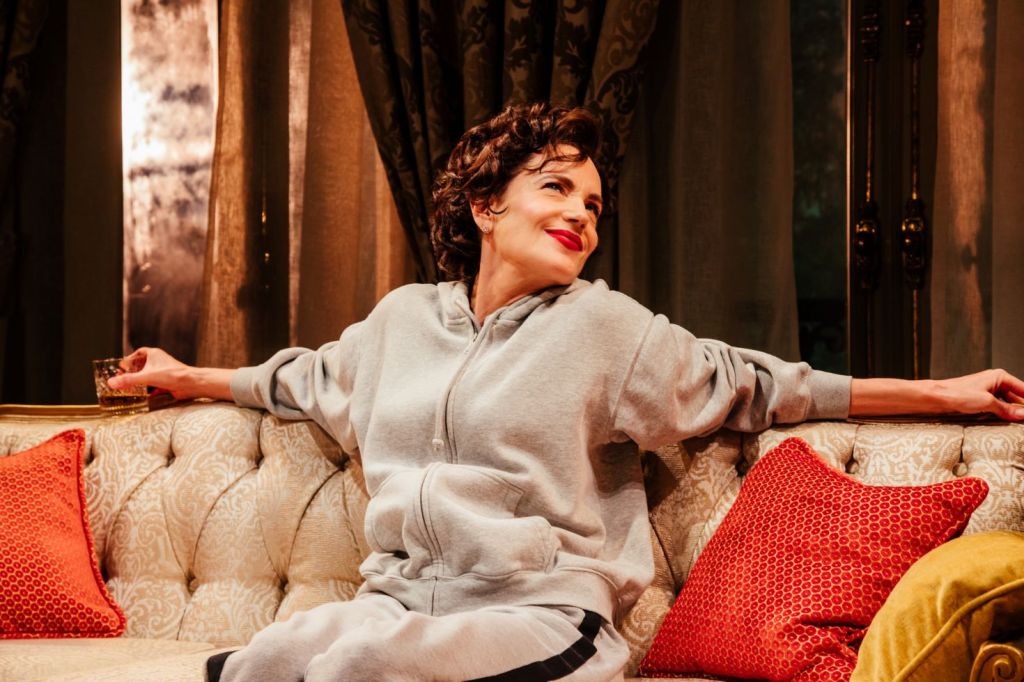
Essentially a two-hander, Ava: The Secret Conversations displays the Gardner/Evans relationship, conflicts about how Ava Gardner wanted to present her legacy, and the split that caused the shuttering of their project. The production features film clips of her husbands integrated throughout, thanks to Alex Basco Koch’s projection design, Cricket S. Meyrs sound design and Amith Chandrashaker’s lighting design.
David Meyer’s scenic design and Amith Chandrashaker’s lighting design present Ava’s lush apartment, and minimal sets and spots to reference Peter Evans’ writing study and other scenarios.The technical elements serve Moritz Von Stuelpnagel’s vision of the push and pull of Gardner and Evans who were dependent upon one another for a hoped for profitable outcome which never happened.
Instead, Gardner wrote her own autobiography published shortly after her death in 1990. From the interviews that Evans cobbled together, he wrote Ava: The Secret Conversations published in 2013 after his death. Neither were alive to see their work’s success.

Thematically, as we watch these individuals whose attitudes and values collide, we recognize their interactions happened in a more gracious, decent world than today’s current media circus.
At the top of the play in the prologue, McGovern’s Gardner ominously calls Evans in the middle of the night and tantalizes him like a siren. She mentions she’s thought about assisted suicide, using the organization “Exit.” Then, the scene switches and Ganis’ Evans faces the audience. As he talks to his agent Ed Victor (Chris Thorn’s voice throughout), he questions where to begin the “play?” In a surreal moment we realize the characters discuss “the play” as a framing device. What follows becomes a series of layers which unfold to a core of intimate moments shared between these two individuals remarkable in their own right.
During the uninterrupted span of ninety minutes we watch how Evans engages his subject to be authentic and even raw in her descriptions. For her part McGovern’s Ava tugs at the image of her glittering celebrity and overlays it with her humanity. For example she discusses some graphic details of her rehabilitation after her stroke. The glamor vanishes. Instead, we appreciate Ava’s beauty in mortality.
This key identification reinforces the theme that the human need for community and warmth increases with age and may be hard to come by the greater the celebrity. Gradually, the portrait of Gardner clarifies so we understand the extent to which she experienced heartbreak, loneliness and regret. Additionally, we learn that in exchange for her status, she allowed the studio to dictate her decisions about having a family.
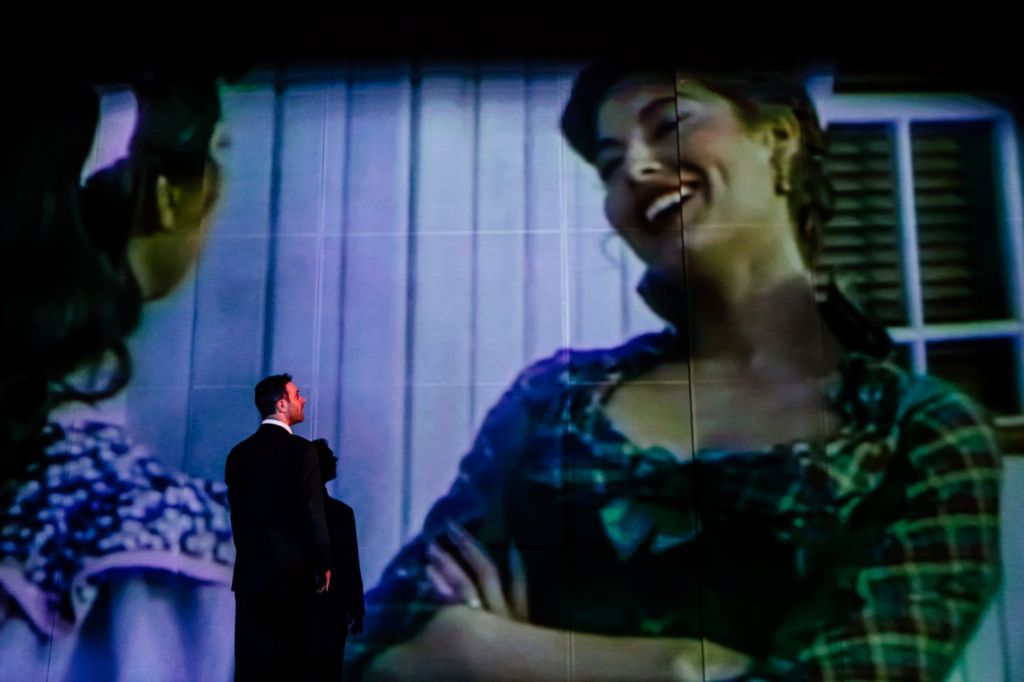
In the interim between discussions, projections and re-imaginings of conversations between Ava and her husbands (Mickey Rooney, Arti Shaw, Frank Sinatra), Ed Victor presses Evans for salacious details. The concept of commercialism everpresent today rears its ugly head. Of course “the dirt” fascinates readers. Obviously, Evans has thoroughly researched Ava’s life, so he attempts to confirm rumored sexual tidbits. Sometimes Ava obliges, enthralled with her own history. Then she realizes she takes the honesty and authenticity too far. Indeed, how will she be viewed if Evans uncovers this earthy, untoward portrait of her brought to life beyond a two-dimensional screen?
On the other side of Evans and Ava’s relationship Victor stands. He intends for the book to achieve best seller status, an easy “slam-dunk.” However, Evans’ scruples and perhaps fears of lawsuits take over. And then Ava makes a decision about the project guided by an important influencer in her life. Abruptly, Evans and Gardner never speak again. However, she does leave him a sign he is in her thoughts, a promise she once made when they first met.
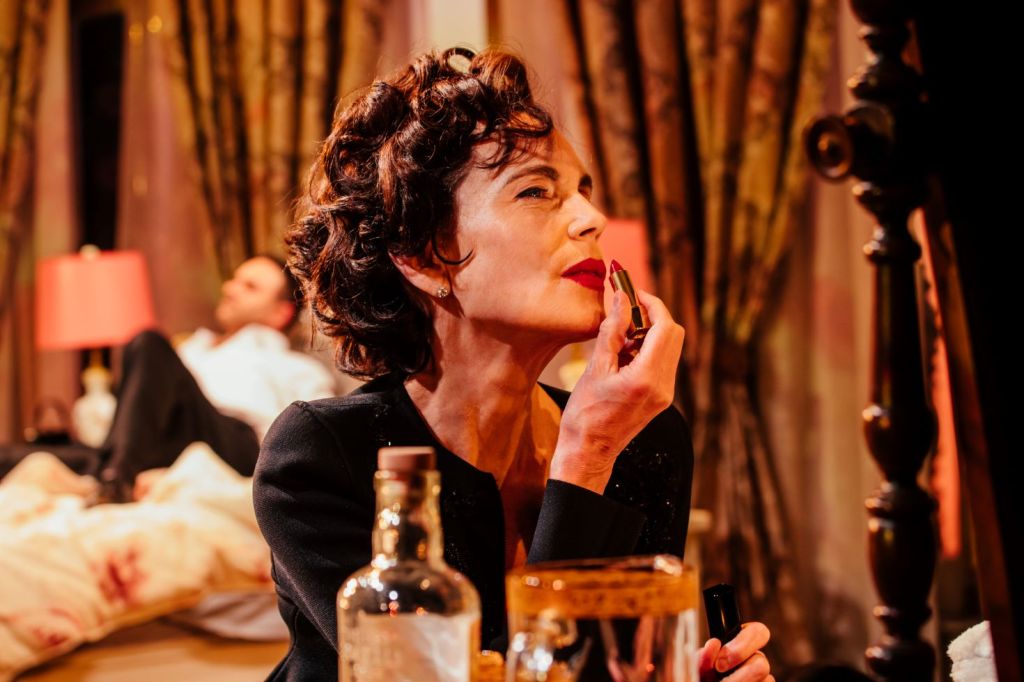
Ava: The Secret Conversations challenges one’s expectations about celebrity without using tired cliche’s. Once the conflicts emerge between Evans and Gardner, the pace picks up. When Evans steps into the characters of Rooney and Sinatra, he does so winningly. With Sinatra he gives McGovern’s Ava emotion to respond to. Toward the last half of the production, the play pops. Toni-Leslie James’ costuming as McGovern dresses for a red carpet appearance, enhances the fading star’s glamor. For most of the play Ava has been sitting around in track suits. Putting on her long sleeve white gloves, McGovern dons Ava’s skin. Regally, she convinces us that Ava is every inch a star, even in her 60s after a stroke.
Ava: The Secret Conversations runs 90 minutes with no intermission at New York City Center, 131 W 55th St (between Sixth and Seventh avenues) until September 14th. https://www.nycitycenter.org/pdps/2025-2026/ava-the-secret-conversations/
‘Duke & Roya’ Review, in Love and War
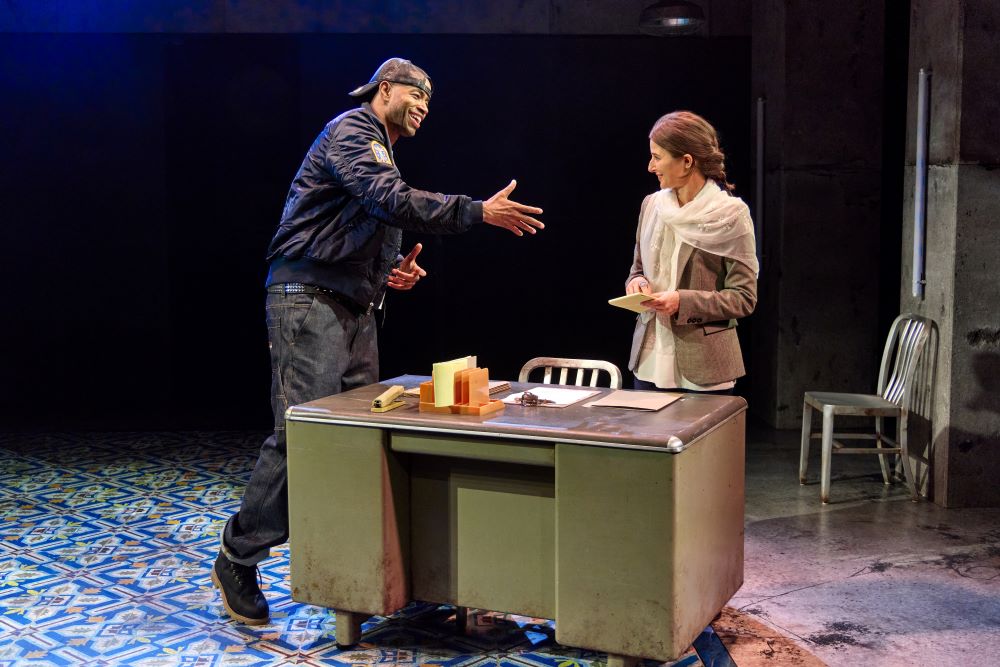
What does Hip Hop music have to do with a Muslim country whose strict religious practices frown on it? Nothing, unless an American base commander brings in a rapper to raise morale and entertain the troops stationed at Bagram Air Force base in Kabul, Afghanistan circa 2017. As unlikely as Hip Hop is to Afghanistan, so is the unlikelihood of the developing relationship between famous rapper Duke (Jay Ellis) and Afghan translator Roya (Stephanie Nur). The evolution of their love and respect for each other develops with humor and insight in Charles Randolph-Wright’s entertaining and meaningful play Duke & Roya. Currently, the hybrid comedy/drama runs at the Lucille Lortel Theatre until August 23rd.
Randolph-Wright unfolds his intriguing play through a series of flashbacks stirred by interviews and interrogations. The purpose of the interviews for the media, obviously is to entertain and titillate. On the other hand the interrogations yield information for investigators. Though we never see the questioners, the four principals, who answer the interrogators,’ questions do the heavy lifting. Through the nimble and talented actors, we form a perspective of the danger and the intrusion into their characters’ personal lives and identities. Randolph-Wright uses the “questioner” device so he can move immediately into the action and adventures between the titular characters in scenes between 2017 and 2025.
Initially, the media questions Duke about his music in the present. Then action transfers from the TV studio to his time in Kabul, Afghanistan. When Duke helicopters onto the base he meets Roya (Stephanie Nur) and her father Sayeed (Dariush Kashani), translators for the American military during the War in Afghanistan. Amiable Sayeed and cool Roya extend their hospitality as employees of the American government. Immediately, Duke shows interest and flirts with Roya, using his confident, “full-of-himself” attitude. Unsurprisingly, his approach, which most likely works on American women, falls flat with Roya.
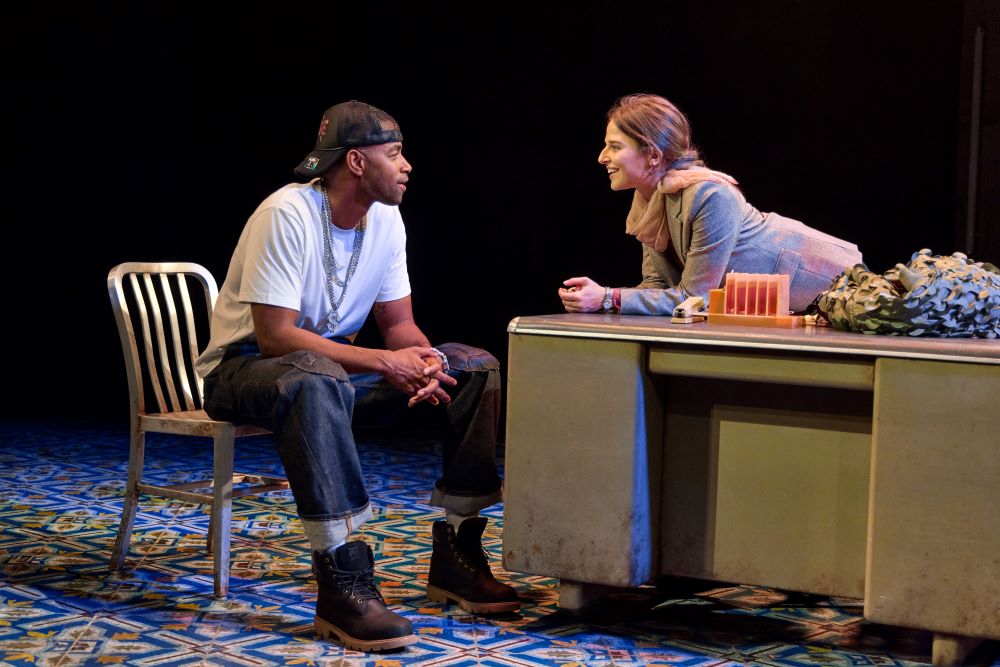
A product of her culture’s strict mores which Duke knows little about, Roya remains aloof. Because he interprets her reaction as “playing hard to get,” their acquaintance happens slowly. Influentially, Roya redirects him toward a new approach with women to encourage his respect. We recognize her brilliant balancing act. Cleverly, she resists his charms, yet lets him know he does appeal to her. So she teases and surprises him with ironic jokes. However, he eventually understands she must be her own woman.
Throughout their experiences together, this push-pull by Ellis’ Duke and Nur’s Roya plays believably. Acutely shepherded by director Warren Adams, the actors and Adams’ staging of them grounds the play in Wilson Chins’ minimal, stylistic set.
Vitally, the contrast between folkways of the west and east reflected in the lightheartedness, emotional drama and revelation of their personalities does capture our interest. For example we learn about the Afghan practice of bacha posh. Because Sayeed has many daughters, he chose the oldest Roya to live as a boy until puberty. Thus, as a boy she had the opportunity of an education. However, sometimes for purposes of safety she dons male clothing and practices bacha posh, which jeopardizes the situation for her later in the play.
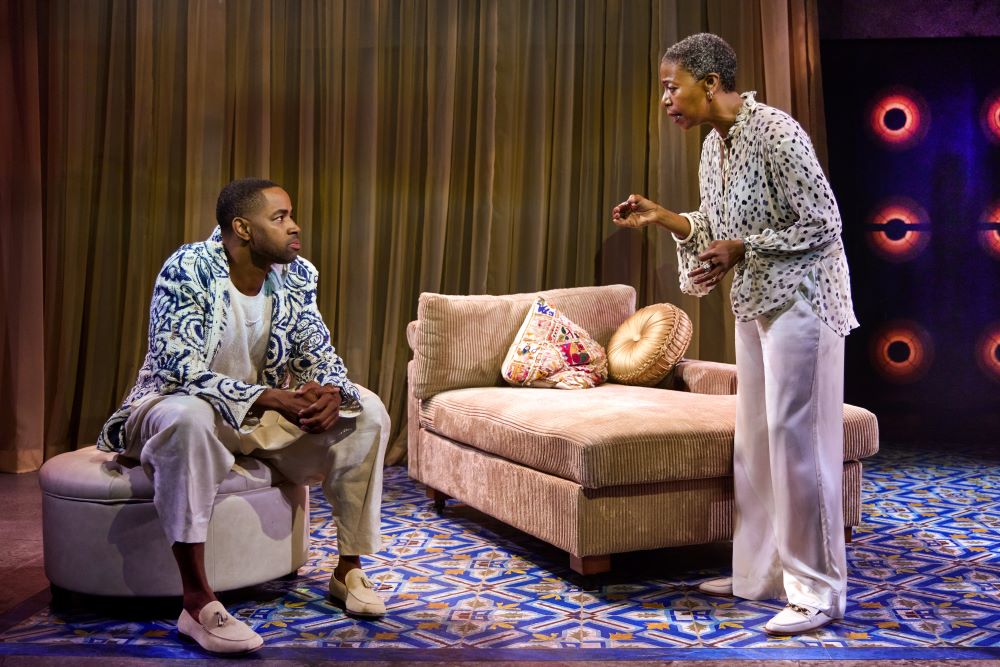
In addition to the standout performances by Ellis and Nur, Noma Dumezweni and Dariush Kashani keep us guessing as Duke’s mom and Roya’s dad. As Desiree, Dumezweni’s strong and forthright sister/mother figure, who chastises Duke when he needs it most, gains our admiration. She’s spot-on mesmerizing. The affable and charming Dariush Kashani authentically conveys the plight of Afghanis caught in an impossible situation. Not aligned with the Taliban that threatens to take over, nor with Americans who will leave the forever war, he, Roya and the family face ever-present danger. Though American visas have been promised for almost a decade, none are on the horizon, a horrific betrayal.
The complex themes sometimes get in the way of each other as the production moves toward the conclusion. Subtly, Randolph-Wright throws into the mix the perspective that Duke exploits the Black experience as a rapper, though his mother is middle upper class. However, Duke’s relationship with Roya changes his perspective and deepens his creativity. Of course the issues of religion, gender and politics come into play. Randolph-Wright intimates the strange parallel of Taliban repression to current oppression of women in the US.
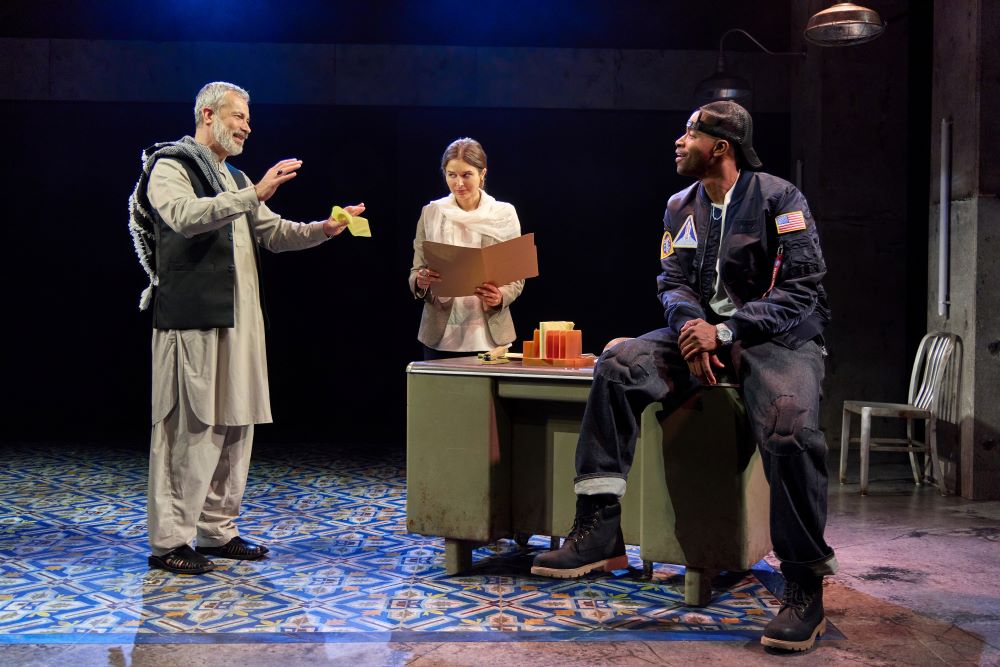
Also, in pointing out facts about the culture clashes and the Afghan war, Randolph-Wright shows the poisonous fallout when the Taliban made a peace deal with the Trump administration without the commitment of Afghan President Ghani. This led to a disastrous withdrawal of American troops and chaos, torture, imprisonment and death for Afghani/US government employees left behind. (Though it is true President Biden extended the evacuation dates, he could not delay the withdrawal indefinitely. Forced to cave to the previous administration’s pressure, he evacuated American personnel and as many of their Afghan counterparts as possible.)
As Duke and Roya mature over the 9 year period, Ellis particularly reveals his maturity during the completion of his interview at the play’s conclusion. Finally, when Duke and Roya meet up again after things become settled, we enjoy watching how their relationship continues to evolve into something profound. Whether or not they end up together is uncertain. However, they have earned their joyful moments together, especially when Ellis’ Duke sings his rhymes for Nur’s Roya with energy and pace. (Ronve O’Daniel’s original music and lyrics are easy and approachable in Ellis’ presentation.)
Amina Alexander’s lighting design, Sanowber Sabrina Spanta’s costume design, Taylor J. Williams sound design and additional music, and Caite Hevner’s projection design provide the background to enhance Chin’s minimal props and set design. These suggest an office at Bagram Air Force Base, an exterior scene in Kabul at night, a swanky hotel room in Dubai, an interrogation room and more.
As one of the more unique, nuanced offerings during this summer Off-Broadway, Duke & Roya shouldn’t be missed.
Duke & Roya runs 2 hours 20 minutes with one 15-minute intermission at the Lucille Lortel Theatre (121 Christopher Street) until August 2nd. https://dukeandroya.com/
‘The Weir’ Review: Drinks and Spirits in a remote Irish Pub
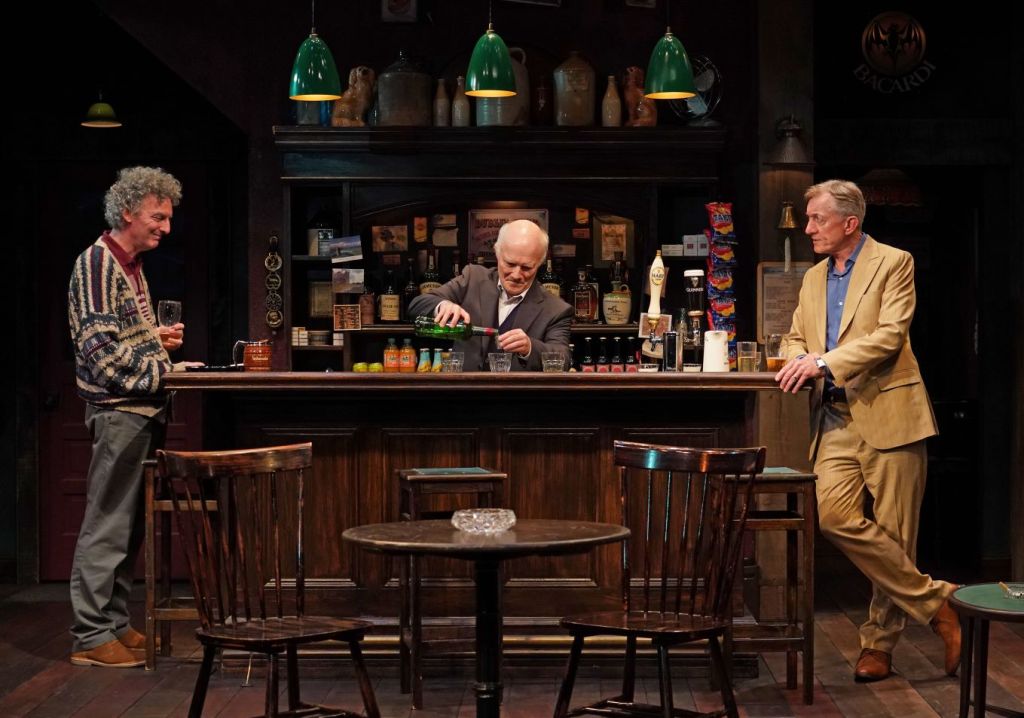
Conor McPherson’s The Weir currently in its fourth revival at Irish Repertory Theatre has evolved its significance for our time. It captures the bygone Irish pub culture and isolated countryside, disappeared by hand-held devices, a global economy and social media. Set in an area of Ireland northwest Leitrim or Sligo, five characters exchange ghostly stories as they drink and chase down their desire for community and camaraderie. Directed with precision and fine pacing by Ciarán O’Reilly, The Weir completes the Irish Rep’s summer season closing August 31st.
Charlie Corcoran’s scenic design of the pub with wooden bar, snacks, bottles, a Guinness tap and heating grate is comfortable for anyone to have a few pints and enjoy themselves at a table or nearby bench. With Michael Gottlieb’s warm, inviting lighting that enhances the actors’ storytelling, all the design elements including the music (Drew Levy-sound design), heighten O’Reilly’s vision of an outpost protective of its denizens and a center of good will. It’s perfect for the audience to immerse itself in the intimacy of conversation held in non-threatening surroundings.
On a dark, windy evening the humorous Jack drops in for drinks as a part of his routine after work at the garage that he owns. A local and familiar patron he helps himself to a bottle since he can’t draw a pint of Guinness because the bar’s tap is not working. Brendan (Johnny Hopkins) owner of the pub, house and farm behind it informs him of this sad fact. But no matter. There are plenty of bottles to be had as Jim (John Keating) joins Jack and Brendan for “a small one.” The entertainment for the evening is the entrance of businessman Finbar (Sean Gormley), who will introduce his client Valerie to the “local color,” since she recently purchased Maura Nealon’s old house.
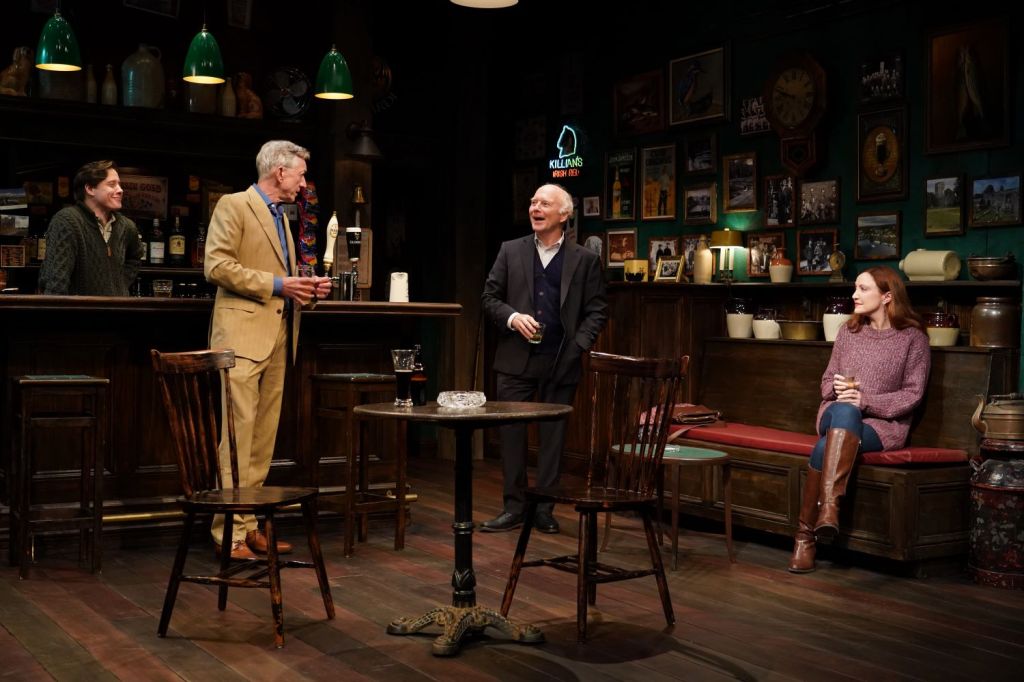
Initially, Jack, Jim and Brendan gossip about the married Finbar’s intentions as he shows up the three bachelors by escorting the young woman to the pub. Jim, caretaker of his mom, and Jack are past their prime in their late 50-60s. Brendan, taken up with his ownership of the pub and farm, is like his friends, lonely and unmarried. None of them are even dating. Thus, the prospect of a young woman coming up from Dublin to their area is worthy of consideration and discussion.
McPherson presents the groundwork, then turns our expectations around and redirects them, after Finbar and Valerie arrive and settle in for drinks. When the conversation turns to folklore, fairy forts and spirits of the area, Valerie’s interest encourages the men to share stories that have spooky underpinnings. Jack begins his monologue about unseen presences knocking on windows and doors, and scaring the residents until the priest blesses the very house that Valerie purchased.
Caught up in his own storytelling which brings a hush over the listeners (and audience), Jack doesn’t realize the import of his story about the Nealon house that Valerie owns. Thankfully, the priest sent the spirits packing. Except there was one last burst of activity when the weir (dam) was being built. Strangely, there were reports of many dead birds on the ground. Then the knocking returned but eventually stopped. Perhaps the fairies showed their displeasure that the weir interfered with their usual bathing place.
Not to be outdone, Finbar shares his ghost story which has the same effect of stirring the emotions of the listeners. Then, it is Jim who tells a shocking, interpretative spiritual sighting. Ironically, Jim’s monologue has a sinister tinge, as he relays what happened when a man appeared and expressed a wish, but couldn’t really have been present because he was dead.
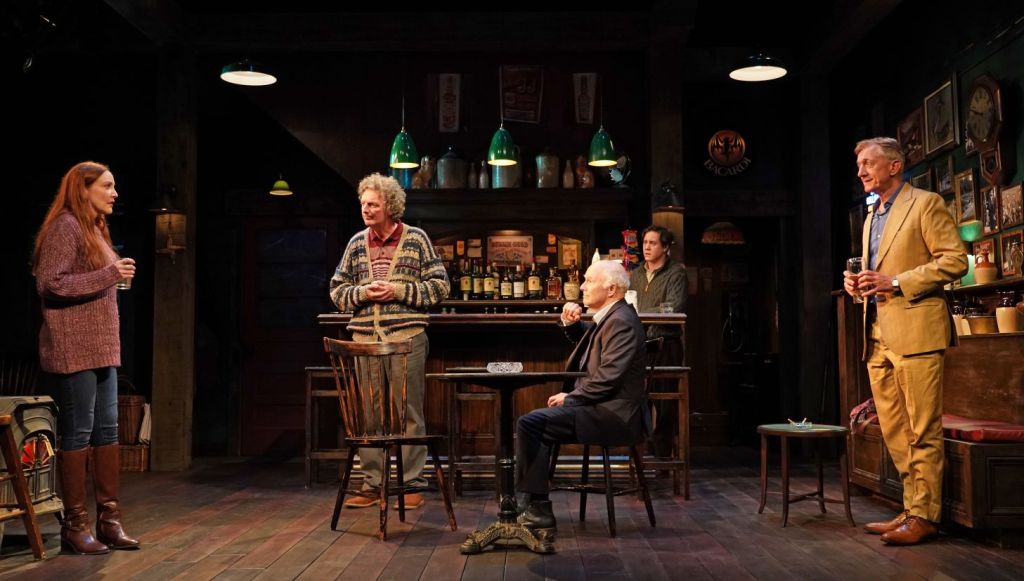
As drinks are purchased after each storyteller’s turn, the belief in the haunting spirits rises, then wanes as doubts take over. After Jim tells his story about the untoward ghost, Valerie goes to the bathroom in Brendan’s house. During her absence Finbar chides all of them. He regrets their stories, especially Jim’s which could have upset Valerie. With Jack’s humorous calling out of Finbar as a hypocrite, they all apologize to each other and drink some more. By this point, the joy of their conversation and good-natured bantering immerses the audience in their community and bond with each other. I could have listened to them talk the rest of the night, thanks to the relaxing, spot-on authenticity of the actors.
Then, once more McPherson shifts the atmosphere and the supernatural becomes more entrenched when Valerie relates her story of an otherworldly presence. Unlike the men’s tales, what she shares is heartfelt, personal, and profound. The others express their sorrow at what happened to her. Importantly, each of the men’s attitudes toward Valerie changes to one of human feeling and concern. Confiding in them to release her grief, they respond with empathy and understanding. Thus, with this human connection, the objectification of the strange young woman accompanied by Finbar at the top of the play vanishes. A new level of feeling has been experienced for the benefit of all present.
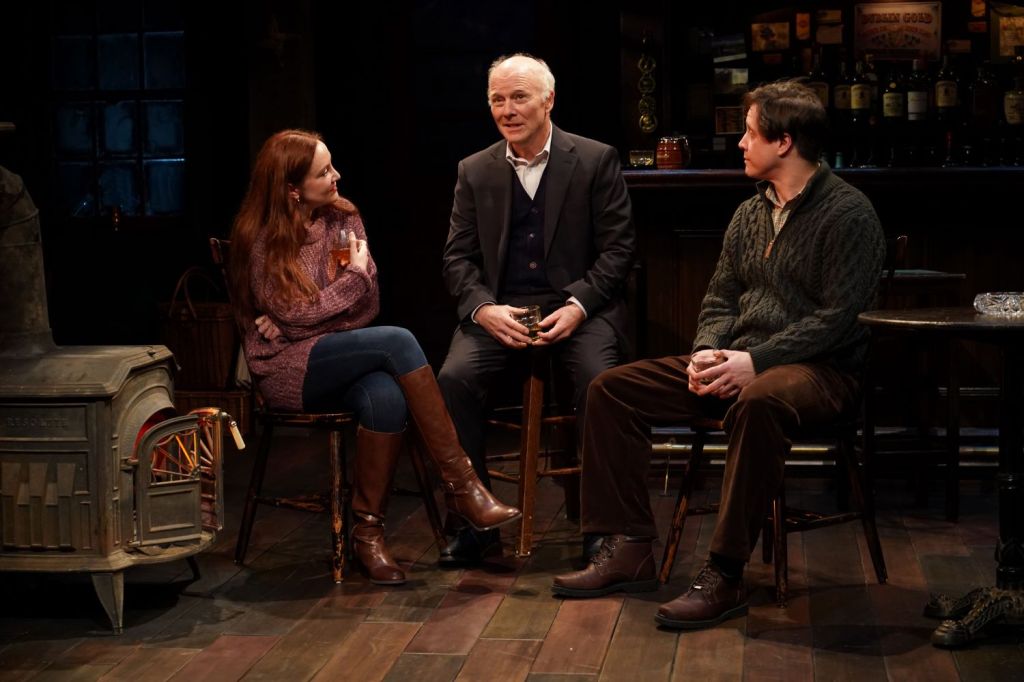
After Finbar leaves with Jim, McPherson presents a surprising coup de grâce. Quietly, Jack shares his poignant, personal story of heartbreak, his own haunting by the living. In an intimate emotional release and expression of regret and vulnerability, Jack tells how he loved a woman he would have married, but he let her slip away for no particularly good reason. Mentoring the younger Brendan not to remain alone like he did, Jack says, “There’s not one morning I don’t wake up with her name in the room.”
McPherson’s theme is a giant one. Back in the day when the world was slower, folks sat and talked to each other in community and conviviality. With such an occasion for closeness, they dispelled feelings of isolation and hurt. As they connected, they helped redeem each other, confessing their problems, or swapping mysteries with no certain answers.
As the world modernized, the ebb and flow of the culture changed and became stopped up, controlled by outside forces. Blocked by fewer opportunities to connect, people retreated into themselves. The opportunities to share dried up, redirected by distractions, much as a dam might redirect the ebb and flow of a river and destroy a place where magical fairies once bathed.
McPherson’s terrific, symbolic play in the hands of O’Reilly, the ensemble and creative team is a nod to the “old ways.” It reminds us of the value of gathering around campfires, fireplaces or heating stoves to tell stories. As companions warm themselves, they unfreeze their souls, learn of each other, and break through the deep silences of human suffering to heal.
The Weir runs 1 hour 40 minutes with no intermission at Irish Repertory Theatre (132 West 22nd St). https://irishrep.org/tickets/
Casey Likes, Lorna Courtney are Terrific in ‘Heathers The Musical’
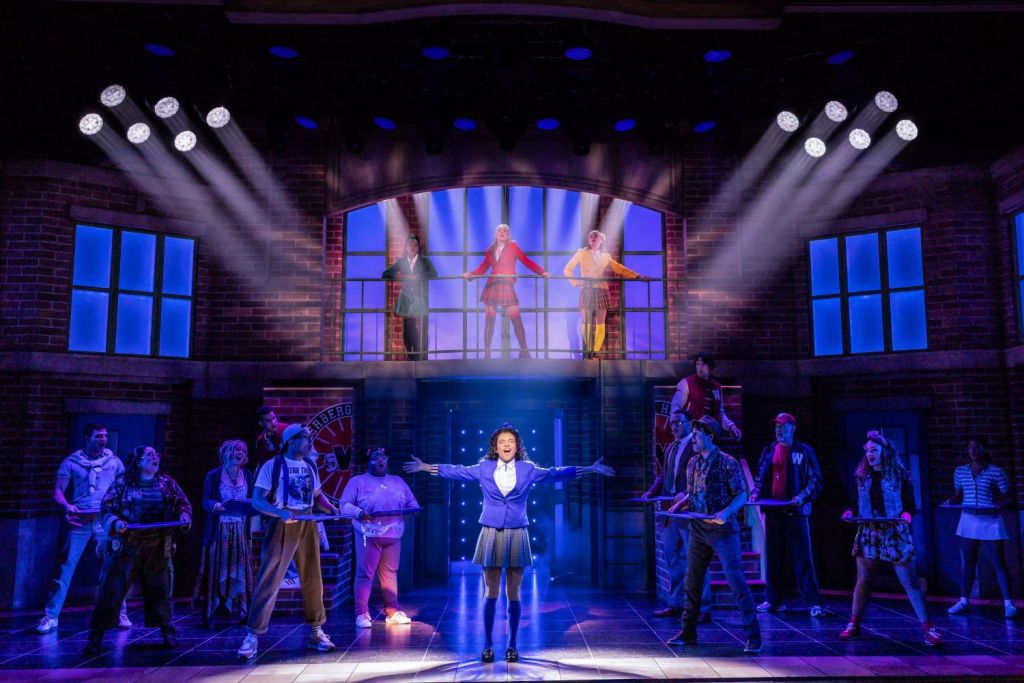
Heathers the Musical
Currently in revival, Heathers The Musial, based on the cult classic film Heathers (1988), written by Daniel Waters, has rocketed onto New World Stages with fans screaming in delight. The production with book, music and lyrics by Kevin Murphy and Laurence O’Keefe first opened at the same Off-Broadway venue in 2014 with Andy Fickman directing. However, O’Keefe and Murphy continually reworked the production honing it to a fine brilliance during the last decade. Most recently in a limited engagement in the West End, it finally transferred to New World Stages. There, it has been extended until January 25, 2026 for good reason.
The 2025 version incorporates changes, including new songs, created in the intervening decade. The concept and subject matter appeals because the sardonic musical comedy satirizes the cruel power dynamics prevalent in high schools across America. Unless one is a part of the ruling elite and finds popularity and favor, the typical high school social machine grinds you up as trash. Admittedly, each high school has its own peculiar “selektion process” of those who “matter,” and those who “don’t.”
How do communities fight this? In a backlash, one character’s notion to purge the toxicity is to “burn everything down.” However, exchanging one form of hatred, nihilism and supremacy for another can create a never-ending cycle of retribution as the musical indicates. Can anything be done?

In its latest version this terrific, complex production asks and answers these questions. Additionally the top notch performances, music (Will Joy), choreography, (Gary Lloyd, Stephanie Klemons), Andy Fickman’s direction and the design elements cohere with near perfect unity to present an overall message. Despite the darkness present in all of us, our humanity has a softer side. We have only to manifest it with courage in the face of bigotry.
The musical opens as narrator/diarist Veronica Sawyer (the amazing Lorna Courtney) considers the negative transformations her classmates have gone through since kindergarten (“Beautiful”). Brainy, misfit Veronica is a senior at Westerberg High in1989, Ohio. Though Veronica believes herself to be a good person (she befriended uncool Martha Dunnstock {Erin Morton}), she must navigate around her classmates who welcome each other with the insults, “FREAK! SLUT! LOSER! SHORT BUS! BULL-DYKE! STUCK-UP! HUNCHBACK!”
Though Veronica blames this toxicity on their growing up and losing their innocence, we wonder if anyone in authority can rein in the students’ brutality toward each other? Therein lies one conflict. Of course the power dynamic is sub rosa. Because students maintain its secrecy, clueless parents and teachers like Ms. Fleming (Kerry Butler), don’t satisfactorily deal with the horrible social culture. Thus, nothing changes.
It is precisely because those in authority can’t influence the students that the three “Heathers” (McKenzie Kurtz, Kiara Lee covered for Oliva Hardy when I saw the show, and Elizabeth Teeter) rule with ferocity (“Candy Store”). In order to lift up their own status, the Heathers make everyone else feel worthless. Ironically, the students electrify the Heathers’ power grid because they fear their wrath and retribution. What would happen if they didn’t bow to Queen Heather Chandler?
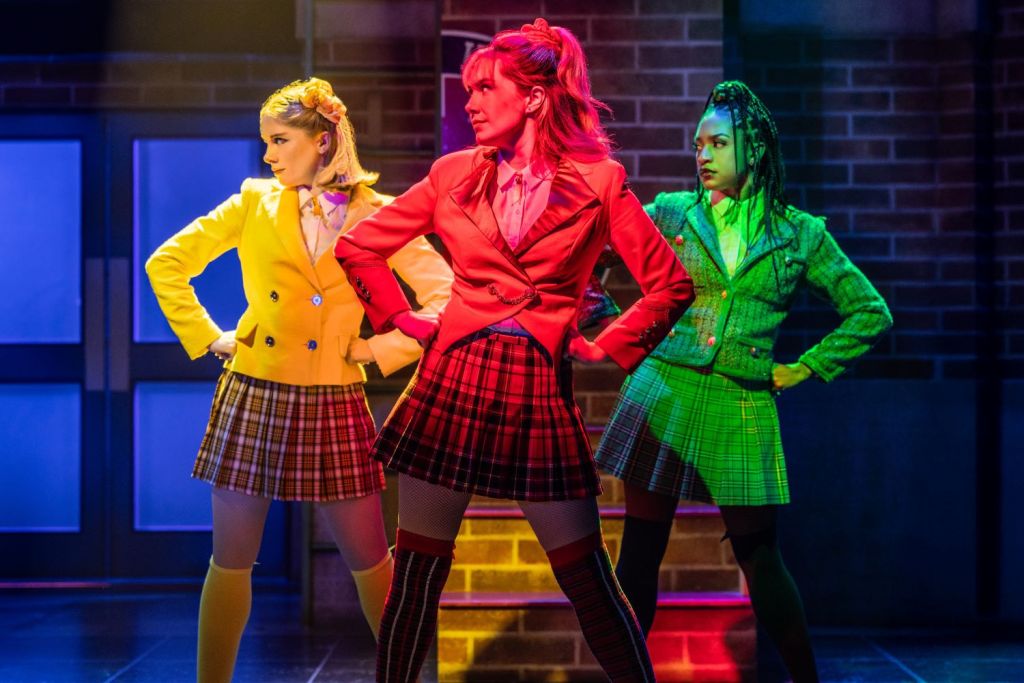
The situation looks up for Veronica when she uses her talent for forgery to save the Heathers from detention. As a result they take her under their wing, give her a make-over and lift her status to “beautiful.” However, she must set up her friend Martha for a grand humiliation at an upcoming party (“Big Fun”) to maintain her popularity.
In a counter punch to stop the Heathers’ obnoxious reign of terror, the new student J.D. (the superb Casey Likes) provides another perspective. He criticizes Veronica for selling out Martha to the, “Swatch-dogs and Diet-Cokeheads.” Likes’ JD, dressed in a trench coat and dripping charisma and courage dazzles, a rebel against the stifling social order.
Because JD, stands up to popular jocks, Ram Sweeney (Xavier McKinnon) and Kurt Kelly (Code Ostermeyer), Veronica becomes interested in him (“Fight For Me”). They form an attachment (“Freeze Your Brain”), and J.D. helps Veronica avoid becoming the “laughing stock” of the school (“Dead Girl Walking”). However, Veronica’s innocent plan to apologize to Heather Chandler for throwing up on her outfit backfires. Mistakenly, Veronica gives Heather the wrong cup filled with drain cleaner (JD’s instigation), instead of the cup with her usual prairie oyster hangover cure.
This unexpected twist brings Veronica and JD closer. But their love relationship fueled by a conspiratorial cover-up of Heather’s death leads to more diabolical behavior. With JD’s help Veronica forges a suicide note imitating Heather’s handwriting. The clever, ironic lyrics to dead Heather’s suicide note, in “The Me Inside of Me,” resonate hysterically. (“No one thinks a pretty girl has substance. I am more than just a source of handjobs. No one sees the me inside of me.”) Easily duped, despite Chandler’s horrible nature, the school community believes in her vulnerability and unhappiness.
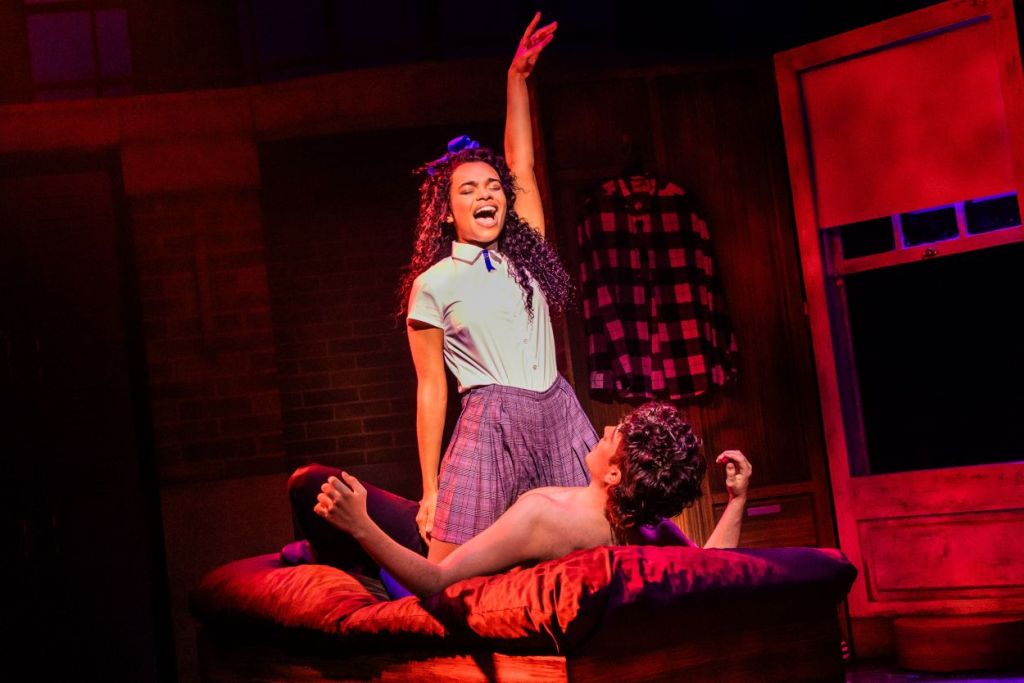
The suicide note elevates Heather to even greater status as a flawed, lonely teenager like everyone else. Meanwhile, the ghost of dead Heather haunts Veronica and cryptically comments while Heather Duke takes Chandler’s place as “Queen.” In a downward spiral Heather Duke’s reign turns out to be worse than Chandler’s. Duke sets up Veronica to be sexually attacked by Ram and Kurt. Though Veronica foils the rape, she and JD plot revenge. Once again the vengeance which begins innocently in Veronica’s misguided mind turns deadly in JD’s hands.
After Veronica and JD tally up two more “accidental” murders, they write believable suicide notes that Ram and Kurt were gay. Neatly, they’ve cleansed the school of three of the most brutal kids in the social hierarchy. In Act I’s closing number (“Our Love is God”), they affirm their love and righteous acts of “justice” with the mind-blowing lyrics: “We can start and finish wars. We’re what killed the dinosaurs. We’re the asteroid that’s overdue.” As JD tells Veronica he’d give his life for her, Veronica cannot resist his love and allure. Energized by her and their new found form of justice, JD’s nihilism continues in Act II. Only Veronica can stop him.
With Andy Fickman’s superior staging and humorous, well-paced timing, the production flies by at two hours and 30 minutes. The ensemble’s exuberance, voices and dancing are cracker-jack, the arrangements super. Memorable throughout, Lorna Courtney sustains her portrayal of Veronica’s transformation from “good person” to JD’s unwitting accomplice to murder, and back again. As JD Casey Likes is Courtney’s match pitting his phenomenal voice against hers with every song. As a couple they shine, reminding us that evil can be seductive.

Finally, McKenzie Kurtz lifts the ironic character of Heather Chandler in death with fine pacing and great humor. She aligns in a perfect contrast with Erin Morton’s kind-hearted, loving Martha Dunnstock, who would be everyone’s friend if they they opened their eyes to her goodness. Standout numbers “My Dead Gay Son,” (Ben Davis, Cameron Loyal are hysterical) and “Shine a Light” (the funny Kerry Butler) are LOL. “Kindergarten Boyfriend” (Erin Morton is spot-on authentic) resonates with pathos.
Thematically, Water’s film and the Heathers musical (2014) were harbingers of today’s cultural divisions. With prescience they exposed the danger of allowing high school communities to be breeding grounds of hate and discrimination, fostered by a school’s particular “master race” clique. If high schools reflect the larger culture, then social media exponentially spreads their poison. Is it any wonder that insults, hate and bigotry are embraced by “seleckt” political groups to gain votes? Spawned in community settings and reinforced by boards of education in their curriculums, hate and discrimination become normalized.
Heathers the Musical reveals the social construct which accepted a “president” who uses insults, bullying tactics and death threats to get what he wants. It also reveals a better answer than JD’s nihilism in the concluding song. It’s up to us to “make it beautiful.”
Heathers The Musical runs 2 hours 30 minutes with one intermission at New World Stages. https://heathersthemusical.com/new-york/about-ny/
In “Angry Alan,” John Krasinski Leaps into the Snakepit of Toxic Masculinity

When cruelty spools out gently and gradually, the witness to it barely notices. However, after a wholesome, middle-aged man morphs from a butterfly of geniality into an ugly, devouring canker worm, the “in-your-face” transformation appalls. John Krasinski reverse engineers Roger’s good-guy persona (think Jim Halpert, “The Office”), into a self-satisfied misogynist in the one-man show Angry Alan. Presented as a limited engagement, Angry Alan, directed by Sam Gold, written by Penelope Skinner (created with Don Mackay), currently runs at the refurbished Studio Seaview through August 3rd.
If you enjoy Krasinski’s work, in Angry Alan he’s humorous and heartfelt, and at the top of his game. Krasinski slyly generates Roger’s emotional breakdown. When we reach the finale, spun out after eighty-five minutes, Roger’s darkening metamorphosis has numbed our emotions.
With insight and ingenuity, the playwright reveals how cultural influences can harm men as they “look for shelter” from their own inner pain and torment. Rather than get professional, local help, they may seek like-minded others on social media for a quick, feel-good fix with disastrous results.
When we meet Roger in his unremarkable, unadorned home in the midwest (courtesy of dots’ apt scenic design), his confessional tone and good-natured aura solicit our interest. Despite his divorce and his firing from an upper level position at AT&T, his smiling face and energy shine with positivity. Krasinski hones his portrayal skillfully with power. Winningly, he mines Roger’s goodwill with his charming audience interactions. He has us. However, where are we going with him?

As we learn his back story, we note his “good guy” persona. For example, ex-wife Suzanne always receives child support payments on time for their son Joe whom he loves. Additionally, he encourages his girlfriend Courtney and her new friends who are feminists and vegans. Furthermore, he supports Courtney’s taking art classes at the local community college, despite the nude male and female models. Not an “extremist,” he walks the political middle of the road.
Thus, Roger’s frenetic enthusiasm about the online guru he recently discovered and hesitates to discuss with Courtney doesn’t alarm. So, we “hear him out.” Clearly, the guy on the internet that Roger finds simpatico has drawn him with his mesmerizing, candid videos. Sure, we know how addictive videos can be. Don’t we immerse ourselves watching them on our phones?
However, the video creator “Angry Alan,” uses a handle that expresses the feelings of hundreds of his followers. As it turns out Alan pushes a stereotypical, one-sided perspective about men’s oppression by “a gynocracy out of control,” a feminist movement over the edge. Roger ignores the causes of feminism as he presents how Angry Alan uplifts men’s rights. Obviously, because women “dominate the world” (like Beyoncé says), men are in crises. Roger cites various statistics (men are more likely to commit suicide, die in combat, be college drop-outs), to reveal how modern men are “in trouble.”
After Roger confides in girlfriend Courtney and they discuss his new interest, he gains her support, though she doesn’t watch any of the videos. Instead, the affable Roger filters Alan through his vulnerable lens and makes him sound reasonable. In fact, this new direction Roger takes prompts him to send a video to Joe. And for the first time, Joe texts him and they agree to Joe’s visit, a first that thrills Courtney. However, Roger doesn’t tell her he uses his child support money for a pricey gold donor ticket to Angry Alan’s men’s conference.
As a turning point in Roger’s downward spiral, the men’s empowerment conference skyrockets his enthusiasm. Meanwhile, the truth revealed in Gold’s staging and the scenic design indicate Roger’s brokenness and susceptibility to brainwashing. As Roger describes the numbers of men and a few women who attend, Gold represents this with two dummies sitting in chairs and a painted backdrop of indistinguishable figures in the distance. No wonder why Roger dismisses those few he talked to and only has eyes for the internet icon and star of the conference, Alan, whom we never see.

The more urgent his need to calm his inner turmoil and isolation, the less Roger focuses on reality. So when he attempts to cheer up a woman he meets at the conference, who leaves depressed, she expresses truths Roger dismisses. There to report on the economic practices of online personalities, Roger quotes her, ” I’m ‘upset’ cos I just sat in a room all day with a bunch of guys like you spewing hate and laughing at rape jokes.” Then she reveals that Alan doesn’t use the donations he receives for charities. Instead, the money goes in Alan’s personal bank account.
Though she has given Roger the inside truth of Angry Alan’s MO, Roger insults her and walks away. Reinforcing his position, he projects onto her his inner emotional state, “What a bitter woman. Talk about fake news.” This stubbornness thrusts him deeper into the abyss. So, when Joe visits and confides in his father looking for comfort, Roger can’t accept Joe’s revelation because it doesn’t line up with Alan’s world view. The affable good guy disappears and a monster of hate and rage manifests. “Angry Alan” has spawned “Angry Roger.” Unable to self-correct or self-evaluate, Roger destroys his relationship with Joe.
Krasinski makes Roger’s descent and self-annihilation believable with the exception of the last moments of the play. Though Roger has a cathartic moment, Skinner drags us back to the internet and Angry Alan’s followers. If she ended the play with Roger feeling the despair of his own pain and sorrow, the play might have had more thematic grist and allowed the audience to identify with Roger’s humanity. Instead, Skinner leaves him online. Though Roger hasn’t had enough, we have. Despite Gold’s finely paced direction, coherent technical vision and Krasinski’s performance, the conclusion leaves us cold.
Angry Alan runs 1 hour 25 minutes without an intermission at Studio Seaview through August 3. studioseaview.com.
‘Call Me Izzy’ Jean Smart Triumphs in her Broadway Return

It was a wise casting choice to engage Jean Smart for Call Me Izzy, written by Jamie Wax. Call Me Izzy currently runs at Studio 54 until August 17th. The beloved “Hacks” star, a Six-time Emmy Award winner and Tony nominee is drawing fans who are delighted to see her after a two-decade absence from Broadway.
The 90-minute play is aptly shepherded with fine pacing and staging by Sarna Lapine. This is especially so once Izzy moves from the bathroom where she is forced to write in secrecy. The director’s collaboration with Smart and the technical team reveal a woman’s life under siege in a horrific marriage.
With supporting lighting effects by Donald Holder, compressed interior scenic design and haunting, exterior forest projection by Mikiko Suzuki MacADAMS, the production is nuanced and profound. Though the play does feel contrived in its development, overall, the production is memorable for Smart’s performance and the technical elements that highlight the play’s themes. Even Smart’s costumes (long flannel shirts and jeans by Tom Broecker) and the original music composition by T Bone Burnett and David Mansfield cohere with the characterization and suggest the South.
Smart portrays Izzy in a moment-to-moment solo performance. She takes on the voices of various characters as she relates Izzy’s story. Throughout, Smart shimmers as a powerhouse of feeling, evoking empathy and emotion. Though at times the accent she uses wasn’t clear, (Beth Lake’s sound design), enough of the humor broke through. Smart’s illuminating portrayal of the Louisiana poet who lives in a trailer park with a mean, abusive husband, did override any artificiality that distracted me.
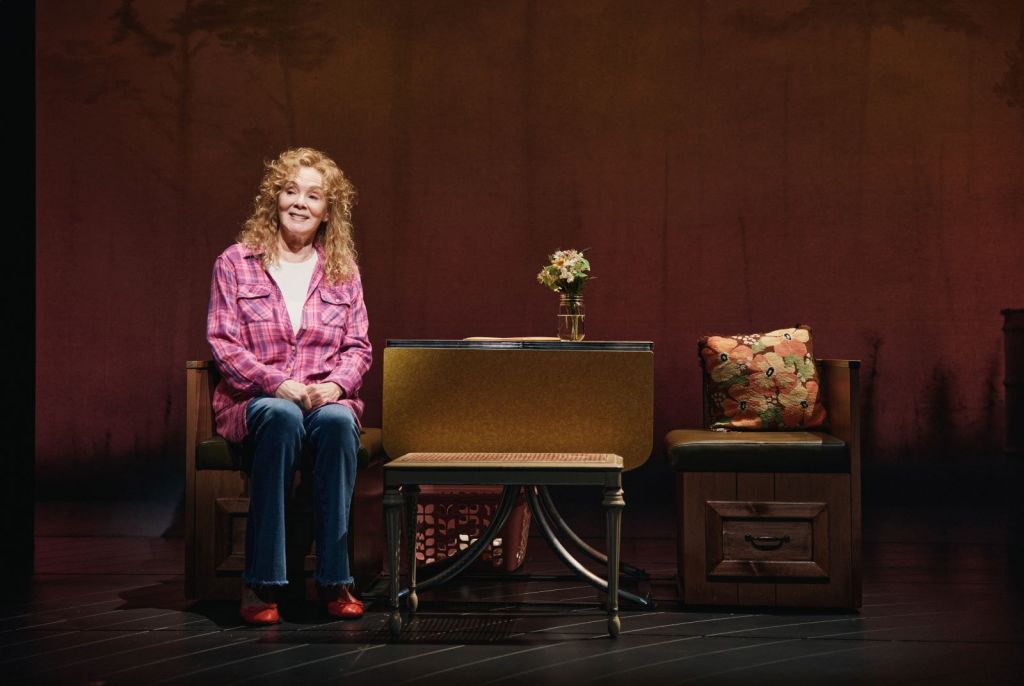
Nevertheless, because of the setting and background details, one can easily figure out the direction of events after the first fifteen minutes. Additionally, the play’s predictability and Izzy’s self-victimization, provoked when she stays with the violent Ferd for years, strain one’s patience. Thank goodness for the talented Jean Smart whose affability and humility lead one to hope for Izzy, despite knowing what the inevitable, dire conclusion will be.
As a housewife in rural Louisiana in 1989, Izzy adores writing, even though it must be in secret away from Ferd’s prying eyes. With exuberance she explains her first inspiration to write, her high school teacher who encouraged her, and a neighbor who takes her to a nearby library where Izzy reads Shakespeare and writes a sonnet. Over the years she fills her journals which she hides away in a back closet because Ferd despises such “uppity ways.” Clearly, as his possession she must remain on his intellectual level. Thus, he prevents her attending college though it might improve their lives. And a monetary award she wins to pursue a writing residency is her curse to be punished, not their blessing.
Izzy writes to express her feelings. Married to Ferd since her 17th birthday, initially they enjoyed each other, prospered and moved to a more upscale trailer park abutting a forest. As Izzy discusses their relationship we note that he gradually meets her attempt to establish her identity through poetry with violence. Tip-toeing around Ferd, Izzy learns to live an inner life apart from him. Whenever she or others inadvertently reveal her talents, Ferd takes offense. He interprets her work as treason and beats her. At a particularly crucial turning point, he takes all of her journals and burns them. He forces her to watch her words, which symbolize her lifeblood, “go up in smoke.” Izzy says with his act he has killed her.
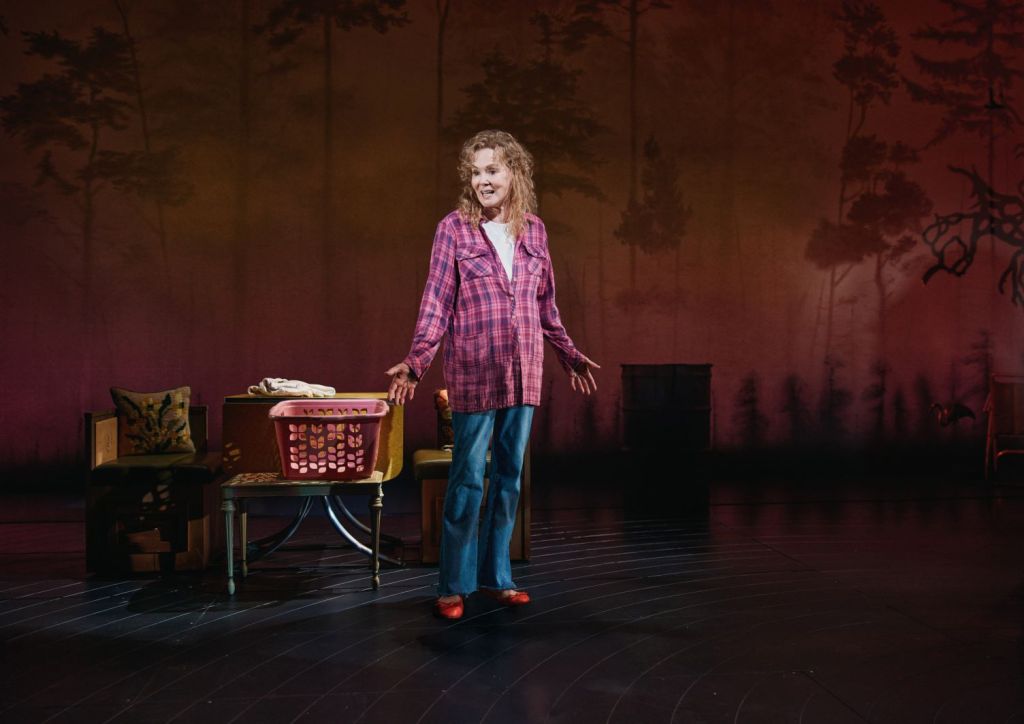
Ferd controls. Izzy lets him believe he is the lord and master, and she bows to his every whim. What sustains her? The inner resilience she receives by writing poetry.
Izzy persists after he burns her journals. Covertly, she evolves herself, her reading and writing. It is why she is in the bathroom discussing the blue tablets she puts in the toilet tank at the top of the play. She shows us how she writes in the bathroom of the cramped trailer. In fact a good deal of the play takes place in the bathroom where she can be alone in quiet to write, think and speak to us.
Mikiko Suzuki MacAdams’ scenic design aptly walls off a bathroom and squeezes in an oversized toilet with a lid that serves as a “table” where Izzy writes on toilet paper. The sonnet and other poems are wadded up and hidden in a Tampax box in a cabinet. The toxically masculine Ferd would never look there. The irony of the bathroom setting is a wonderful touch. In its small space Izzy finds the solace of her wide imagination.
Unfortunately, her writing is not enough. Izzy is a product of the folkways of her culture and her upbringing. Unable to escape them they influence her final actions at the play’s conclusion.
The subject matter of Call Me Izzy is important now more than ever. However, Izzy’s passivity is difficult to experience. It is why, when Smart’s Izzy expresses an interest in leaving Ferd, the audience cheers her on. Too little, too late; we must be tortured by Izzy’s last choice which leaves an uncertain ending.
Call Me Izzy runs 1 hour 30 minutes through August 17th at Studio 54. callmeizzyplay.com.
I
‘Pirates!’ Is a Riot With David Hyde Pierce, ARGH!
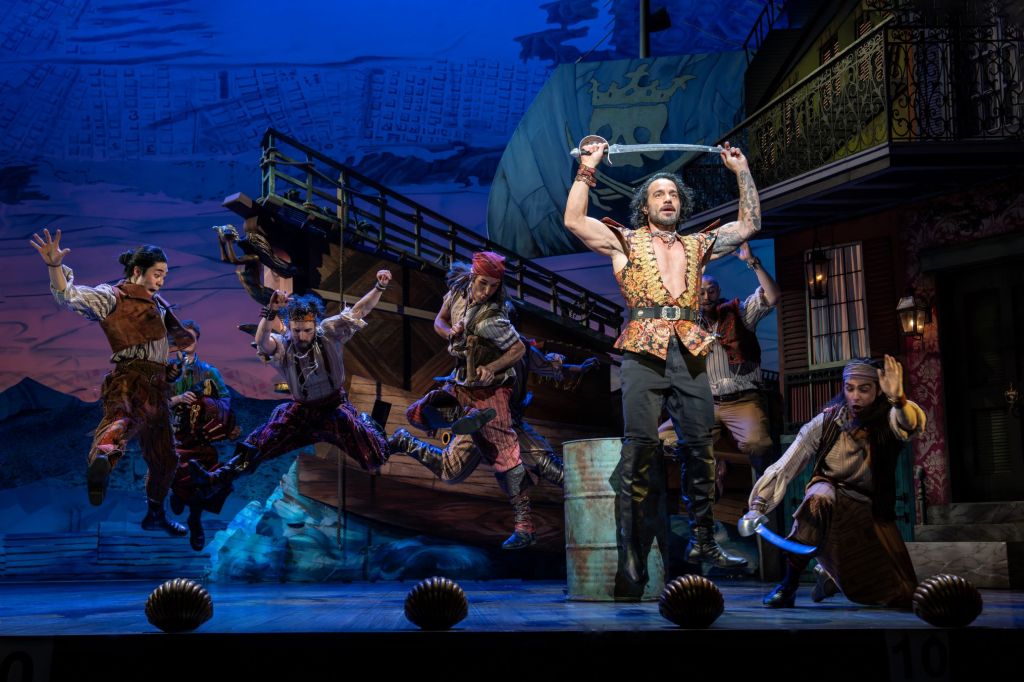
Pirates! The Penzance Musical Set in The Big Easy
The revival of Pirates of Penzance, the comedic operetta with music by Arthur Sullivan and libretto by W. S. Gilbert, has been transformed into Pirates! The Penzance Musical. Indeed, it has been hauled overseas from Penzance, England to New Orleans, Louisiana for a riotous update by Rupert Holmes with new orchestrations by Joseph Joubert and Daryl Waters. It is currently revving up exuberance and laughter at Roundabout’s Todd Haimes Theater.
Holmes attempts to spin the setting changes by having a “real” Gilbert (David Hyde Pierce, who also plays Major General Stanley), and Sullivan (Preston Truman Boyd, who also plays the sergeant of Police), take the audience into their confidence in the show’s prelude. They discuss why they brought the musical to premiere and tour US cities. Importantly, they relate their enchantment with post-Reconstruction New Orleans which inspired them to “pirate” the colorful flavor of the music in the French Quarter and adapt it to various songs in the musical. Indeed, all of the scenes take place in and around the atmospheric New Orleans (even a graveyard) that represents the varied ethnic and cultural ethos of the city.
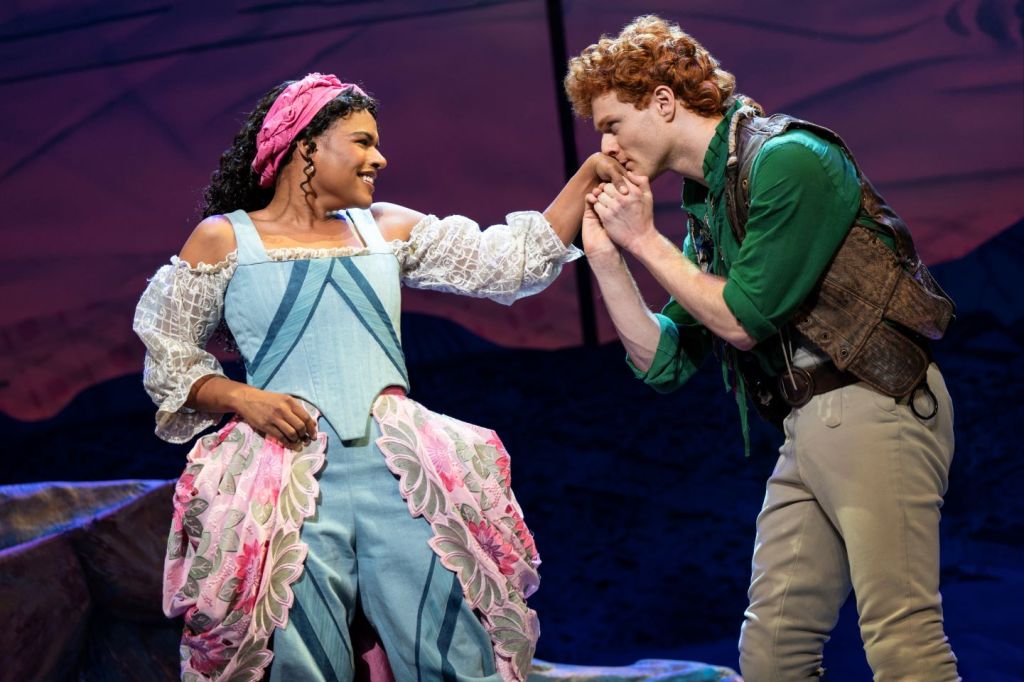
This is where fantasy takes over and “reality” is dumped by the wayside. New Orleans (1880s) notoriously expanded white supremacy (the White League was the racist organization that benefited from the eventual Jim Crow legislation, Plessy v Ferguson) despite its multicultural population, after Reconstruction ended in 1877.
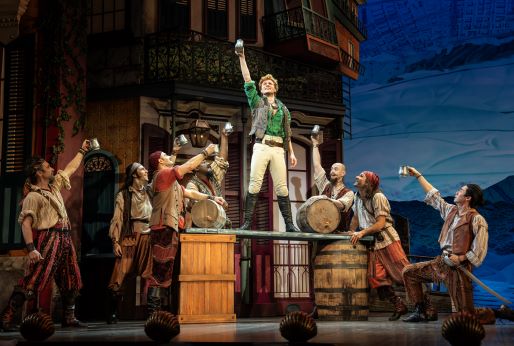
Nevertheless, as facts are stretched to fantasy, the casting of Major General Stanley’s daughters along a racial divide in contrast to the pirates must suspend one’s imagination into the realm of farce and pure entertainment. Actually, Holmes’ version would do well in a current MAGA South adverse to being aligned with “woke” or “critical race theory,” as it throws history out the window. However, the production makes New Orleans “historical” in its wonderful costuming (Linda Cho) and David Rockwell’s scenic design of the pirate ship that Karimloo makes his rope-swinging, spectacular entrance from.
As farce Holmes’ reworking is top notch for humor. His desire to update the musical and appeal to current audiences is understandable because Gilbert and Sullivan’s work (first brought to the US in 1878) is extraordinary, British ironic and extremely clever. It is especially appreciated if one is able to launch into the nooks and crannies of its brilliant and humorous lyrics. Though I was able to look at the script, for those who must rely on the ensemble to enunciate the lyrics, especially in the choral numbers, one loses much in the translation. However, the driving music and director Scott Ellis’ staging and frenetically paced action mitigates that loss.

In keeping with reimagining a New Orleans’ vibe that is more Southern down home than British witty, the production sports a different tenor than a superb but traditional revival produced at The Public Theater in 1981, starring Kevin Kline, Linda Ronstadt and Estelle Parsons. That Pirates of Penzance was gloriously captured on film in 1983. For a contrast, it would be delightful to revisit the film then see the Roundabout’s lighthearted production.
Maintaining the general plot of Gilbert and Sullivan’s 1878 operetta, “Pirates!” unfolds the story of the hapless and innocent Frederic (the excellent Nicholas Barasch). In the antiquated fashion of indentured servitude, Frederic is duty-bound by his deceased father to be the apprentice to the Pirate King (the gymnastically vigorous, organically funny and gorgeously voiced and appearanced Ramin Karimloo). Ironically, the Pirate King is derelict in his piracy (we discover why at the conclusion), as he incompetently leads his band of “spurious” pirates NOT to plunder, kill or steal.
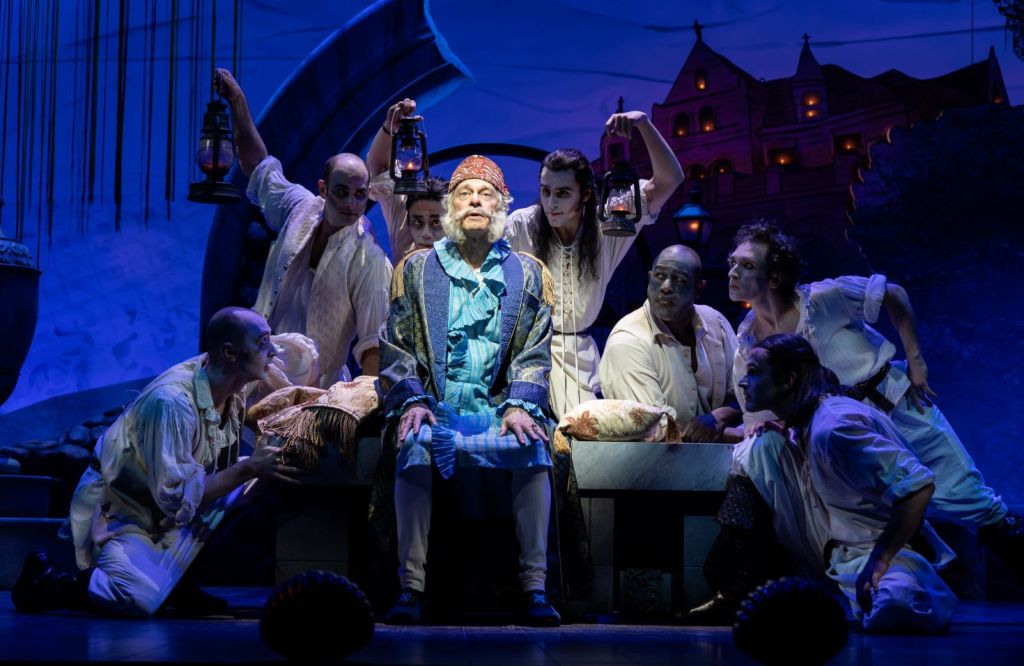
Thus, residing with the pirates and following the dereliction of duty promoted by the Pirate King, Frederic eventually completes his service on his twenty-first birthday. It is then the Pirate King frees him so he can go ashore, join law abiding society and kill every pirate he was colleagues with during his long servitude. Of course, his freedom doesn’t go as planned because of a mathematical miscalculation, and the conflict turns in another direction teetering on debacle until it is righted.
Additionally, in between meting out justice, Frederic plans to find a bride, though marrying a younger woman will break Ruth’s heart because he promised to be with her for the rest of his life. But information enlightens him and makes Frederic change his promise to Ruth, especially after he meets the lovely Mabel (Samanta Williams) and they pledge their love for each other. However, as with a common Shakespearean theme, for Frederic and Mabel, “The course of true love never runs smoothly.” And it is in the kinks and gyrating turns that the comedy reaches its heights.
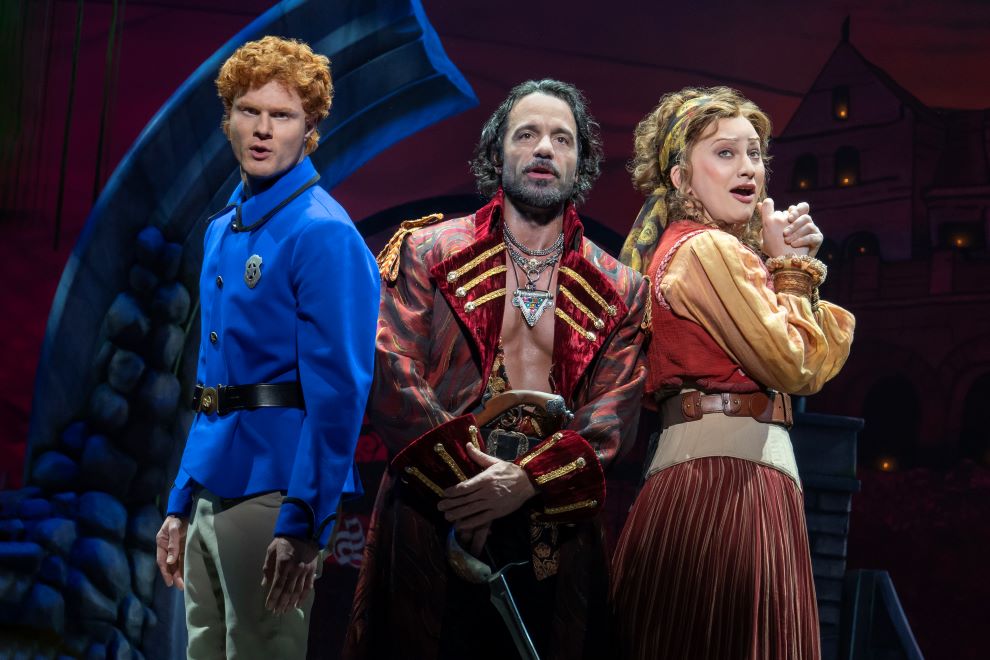
The comedy also is delivered with David Hyde Pierce’s exceptional performance of Major-General Stanley, which he acts with complete aplomb and authenticity. Pierce enunciates every word clearly and thus unrolls the stuffy, effete, sincere Major-General with dedicated determination. Considering Pierce is doing double time as Gilbert performing the Major-General, his ironic demeanor is the vehicle which is a natural for the British Gilbert’s stiff upper lip delivery. And it is hysterical. His is a really well-thought out performance as is Monsoon’s and Karimloo’s, which is memorable for his leaps over barrels, leaps onto tables and veritable sailing in the air during various numbers. Humorous as well, he is outrageously good as he pings the Pirate King’s vulnerability falling for the plight of the orphaned who into his sphere of influence.
To his credit, Holmes has put his imprint on Gilbert and Sullivan with this reinvention and has even tucked in numbers from other Gilbert and Sullivan operettas (HMS Pinafore, The Mikado and Iolanthe) to fill in and round out the characterizations and establish bridges seguing action from one sequence to the next. For characterization, in Act II, we learn more about the emotions of lovelorn and Frederic-spurned pirate wench Ruth (featuring the versatile talents of Jinkx Monsoon-two-time winner of “RuPaul’s Drag Race”). Bemoaning her fate away from her unrequited love interest Frederic, she sings “Alone and Yet Alive” with lyrics adapted from the song in The Mikado.
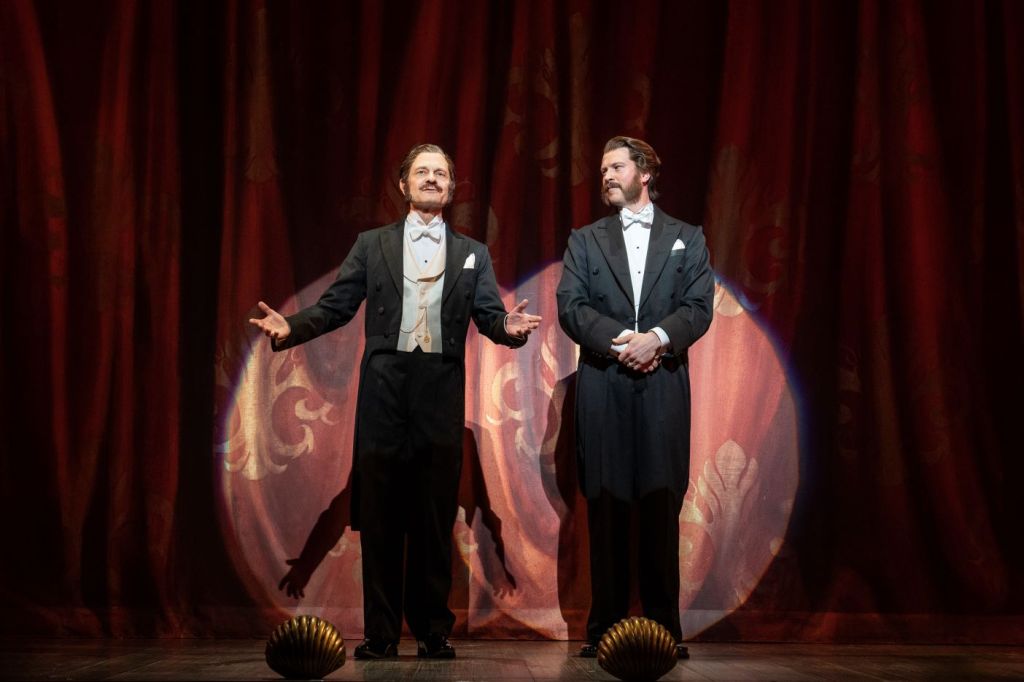
It is Holmes’ bold move to create empathy for Ruth, add coherence and deepen the emotion in the fun frolic. Jinkx Monsoon does a fine job in keeping balance with humor and pathos so we understand Ruth’s heart-felt loss, yet appreciate how she encourages herself to make the best without a particular “someone.”
Waters’ orchestrations and Joubert’s music direction strike various phrasings which are current New Orleans (not the setting of the post-Reconstruction town). These include blues, jazz, Creole notes and rhythms, Dixieland and much more. There is even an ersatz funeral New Orleans style music which is thrown in for good measure. And Mardi Gras season comes upon the pirates as they “let the good times roll.”
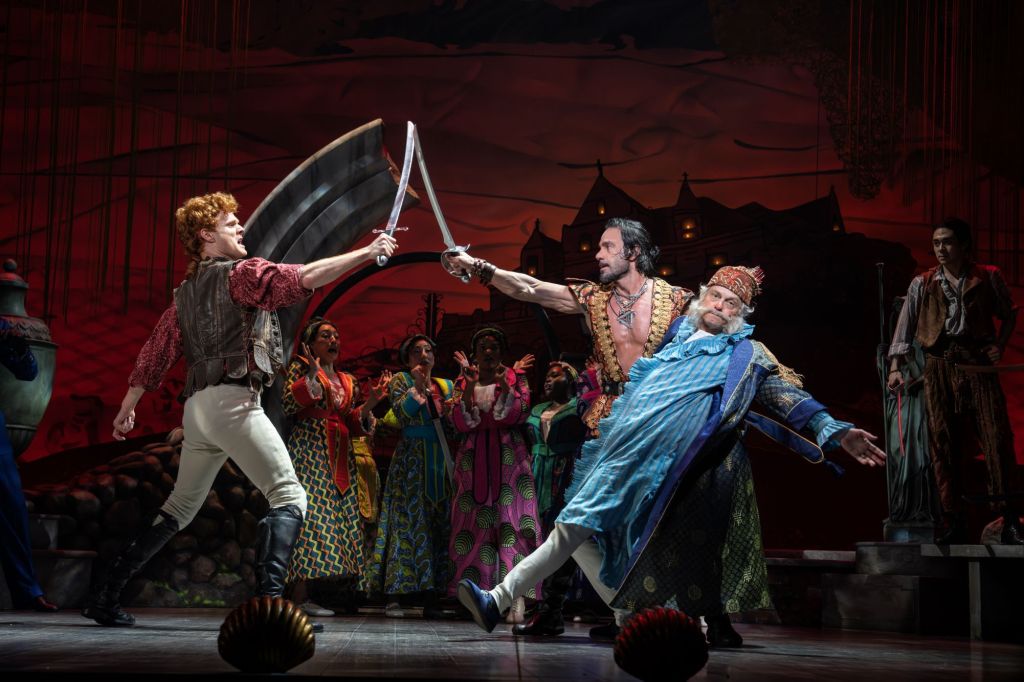
Finally, I enjoyed the washboard number at the end of Act I (“We Sail the Ocean Blue” from HMS Pinafore) for its cleverness and rhythmically united efforts by the entire cast. And the conclusion is a fantasy finale which uplifts the Trump, Musk, MAGA hated DEI lyrics “integrated” into “He Is an Englishman” from HMS Pinafore, which is a sardonic joke in itself, which I completely adored. This is in your face Broadway. If the Bill of Rights doesn’t apply, then nowhere on the globe and in the former British Empire or American is humanity safe. I completely appreciate Holmes’ sardonic and charming approach with a wit that Gilbert and Sullivan would have approved of.
I just loved this reimagining as a farce with fantastic elements, all with a point. See it.
Pirates! The Penzance Musical runs 2 hours, 15 minutes with one intermission until July 27 at the Todd Haimes Theater. roundabouttheatre.org.
‘Real Women Have Curves’ is a Sensational Adaptation With an Underlying Moral Imperative
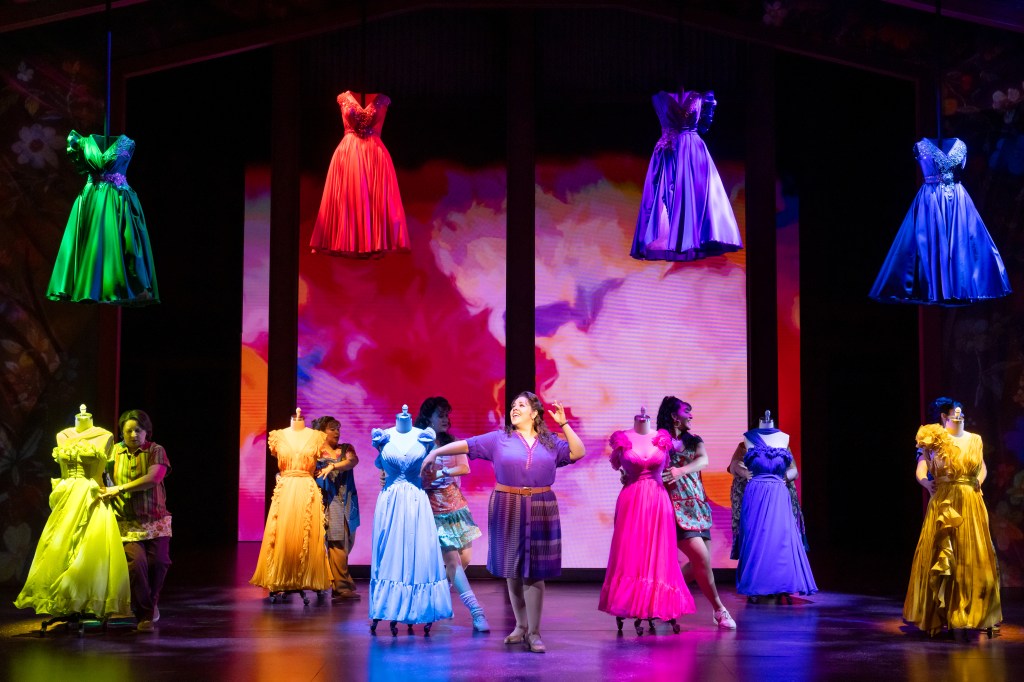
Read Women Have Curves
Based on Josefina López’s titular play, and the 2002 HBO film adaptation starring America Ferrera, Real Women Have Curves, at the James Earl Jones Theater, is an exuberant, humorous, beautifully colorful fun-fest with underlying messages about past Republican immigration policies, discrimination, fat-shaming, Latinx cultural iconography, female empowerment, self-love, and making the American Dream one’s own. Delighting the audiences, the production also is vitally historic in reminding us of the great sacrifice those who seek a better life make when they leave their native country for an unwelcoming nation.
Though the musical is set in Los Angeles, 1987, it has tremendous currency during the debacle of the Trump administrations’ kidnapping, trafficking and incarceration of migrants in concentration camps out of the country, illegally without due process. This unlawful, brutal practice misnamed deportation (which mandates due process), is being noted as a crime against humanity by many groups, including the United Nations and The Hague. The musical’s themes and plot contrast between the past and the present, where the current derelict, corrupt administration would degrade the United States by violating the 5th amendment to the constitution.
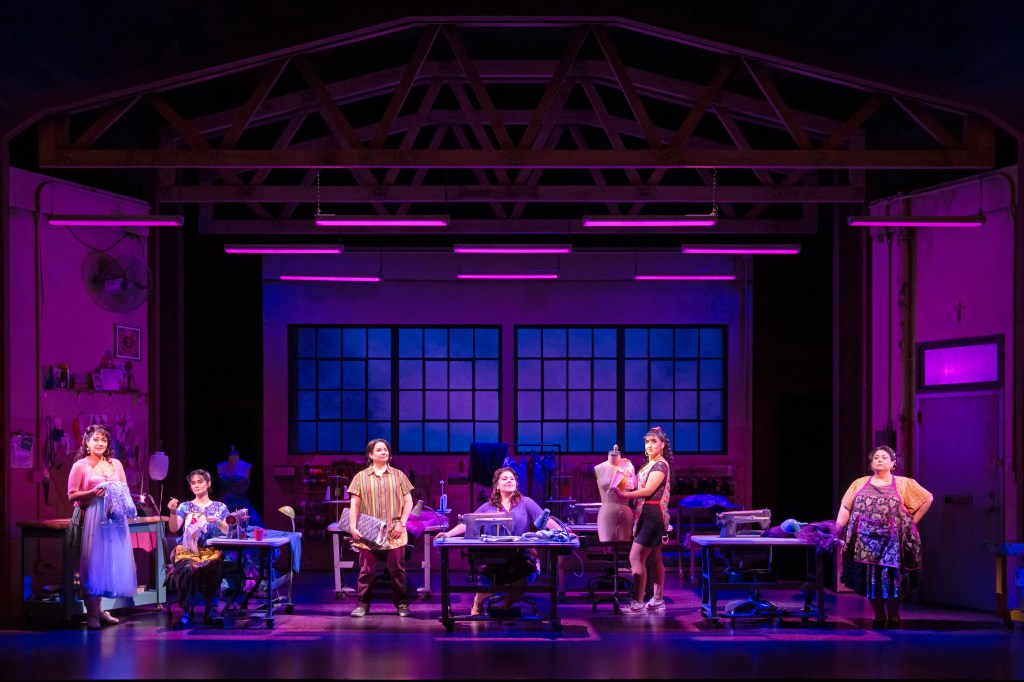
The Tony-nominated score by Grammy® Award–winning singer-songwriter Joy Huerta (known as half of the pop duo Jesse & Joy), was written with Benjamin Velez. Both wrote the music and lyrics and are also responsible for orchestrations and arrangements. With the book by Lisa Loomer (Distracted) and Nell Benjamin (Mean Girls), music supervision by Nadia DiGiallonardo (Waitress), and choreography and direction by Tony® winner Sergio Trujillo (Ain’t Too Proud), these creatives have knocked it out of the ballpark. to make the show a winner.
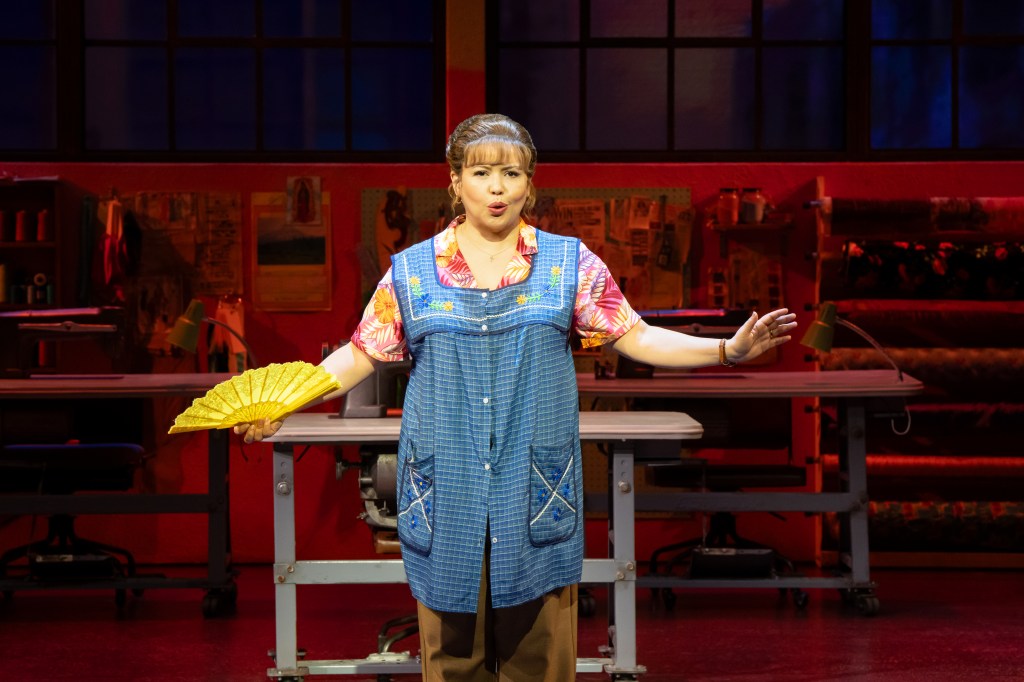
Coupled with the superb performances and ensemble work by the cast, the ebullience is catching and it’s impossible not to hum along, or sway in one’s seat with many of the upbeat, message-filled numbers (“Make It Work,” “De Nada,” “Oy Muchacha,” “Adios Andres,” and “Real Women Have Curves.”). We feel immediate empathy with the likable, endearing and ironically humorous Mexican women of various ages, who dream of establishing themselves in prosperity despite the incredibly long work hours at two or three jobs, the social obstacles of being “the other” culturally, and the daily threat of being deported back to their own country, a dangerous prospect.

At the outset, we note the key conflict is between mother and daughter, 18-year-old Ana García (Tatianna Córdoba), and her mom, Carmen (Justina Machado). Ana was born in the United States and has constitutional birth-right citizenship. Her older sister Estela (Florencia Cuenca), was born in Mexico. To improve their situation, father Raul (Mauricio Mendoza), found work in Los Angles and eventually moved the three of them to Boyle Heights, and stayed with persistence and tolerance of discrimination. As they prospered, Carmen and Raul subsidized Estela’s dress business, all the while raising the younger Ana to adopt American ways, but never forget her heritage.
As the only American citizen, Ana excels in school, graduates with honors and as an aspiring journalist with a summer internship, applies to Columbia University where she receives an acceptance and full scholarship. At her internship with a local paper where she practices her journalism skills pro bono to gain valuable experience, she meets Henry (the superb Mason Reeves), and forms an adorable attachment. Aye, if Carmen knew about Columbia and Henry, she would hit the roof.
Of course Carmen, unsettled by their illegal status fears deportation and intends to keep the family together, just in case. Carmen’s plans are why Ana can never tell her mother about her great news that she has climbed the first rung of her dreams in her full-ride scholarship to Columbia in New York City. Now, it’s only a matter of going, regardless of Carmen’s stubbornness to keep Ana at home. When she finally does tell her, Carmen is beyond herself.
The chief reason why Carmen can’t let her go concerns their status. If they are picked up by INS, Ana’s birthright citizenship will possibly save them. The question becomes will Ana choose her dreams or put them on hold and stay with her family in support. However, if she waits, she may never get another opportunity like a free-ride to expensive Columbia again. Ana does tell sister Estela who encourages her; they agree behind Carmen’s back she should wait to tell Carmen.
In a second conflict which involves their prosperity in their business and their immigration status, Estela’s dress shop receives a fabulous order for 200 dresses. The order is from the well-connected, elite-looking, stylish Mrs. Wright (Claudia Mulet when I saw the production). Mrs. Wright gives the order under the condition that unless they are finished in three weeks, she won’t pay Estela and will take the dresses the dressmakers did finish. Thrilled to work with Mrs. Wright for her buyer contacts-a chance to increase their opportunities-Estela agrees to Mrs. Wright’s handshake contract, despite the fact that it is an onerous and shady arrangement. The dressmakers are thrilled and agree to work hard (“Make It Work”). Carmen suggests that Ana can help them get the job done and learn to sew.
However, as we find out into Act 2, Estela has taken a tremendous risk. A second question arises as the suspense increases. Will they be able to get the dresses in on time? As a further obstacle, while they are progressing, there is a loud explosion. Next door an illegal factory with undocumented workers is raided. In panic and fear, the dressmakers turn the lights off and remain in the darkness until there is quiet. It’s a moment of great tension for everyone.
After the lights are on and the danger passes, the 19-year-old Itzel (Aline Mayagoitia), from Guatemala has an asthma attack. Ana takes her to the roof to “breathe,” with a change of scene and humor to recoup. There they sing “If I Were a Bird.” It’s an important turning point in the musical as we empathize with the women, understanding the horror migrants live with to follow their dreams.
Every day Estela goes to the shop is a day they might be raided. The risks they take to survive and try to carve out a place for their families is fraught with struggle and sacrifice, but they persist. Seeing this from the perspective of the undocumented, though it was during the time of Republican President Ronald Reagan is historic. Reagan offered Amnesty as a path to citizenship, the antithesis of what current MAGA politicos and the Trurmp administration offer.

Instead, the current administration kidnaps and trafficks. It isn’t deportation, for deportation mandates due process first. The administration kidnaps and trafficks for the sole purpose of getting white supremacist votes. They sadistically enjoy the cruelty and brutality. Thus, the kidnapping, etc. without due process “shows” machismo as the MAGAS embrace hatred and discrimination against those of color. The Trump administration even supports death threats against judges who give migrants constitutional due process. Was this person inaugurated as he said he accepted his “oath?”
The INS raid in the musical is truly horrific. A hush fell over the audience as they “got it.” I couldn’t help but think how much more duress the migrants and the dreamer generations have experienced from the 1990s to today. Not only is there no path, citizenship is near impossible unless “extra” means are used to open the doors, as they were with Elon Musk and his brother and Melania Trump. All came here illegally.
As if to underscore the cruelty that has been exponentially increased during the present administration, making it unrecognizable as Republican, the announcement at the end of Act I is terrifying. The sweet, funny Itzel has been picked up by INS. In Act II when Ana tries to help her after she finally locates Itzel in a bleak detention center (Arnulfo Maldonado’s set design), where she is receiving due process. INS is willing to turn Itzel over to Ana if she will be her sponsor. It’s an impossibility. Though Ana’s an American citizen, she can do nothing without jeopardizing her family and the other women. It’s a Catch-22 situation, so she says good bye, is insulted by the guard and leaves Itzel to the unsympathetic and demeaning prison keepers.
After this difficult scene, Carmen announces she is “eating for two,” and is “pregnant.” But the women tell her it is menopause. The scene uplifts with unifying details women can empathize with as they mourn getting older. The ensemble riffs and joke, sharing their names for their “monthly;” Carmen’s is “Andres.” “Adios Andres,” an upbeat song with riotous lyrics helps bring them together to move on because there is nothing else they can do for Itzel without jeopardizing themselves. As they work on finishing the order, it gives rise to a terrific bonding song, “Real Women Have Curves.”
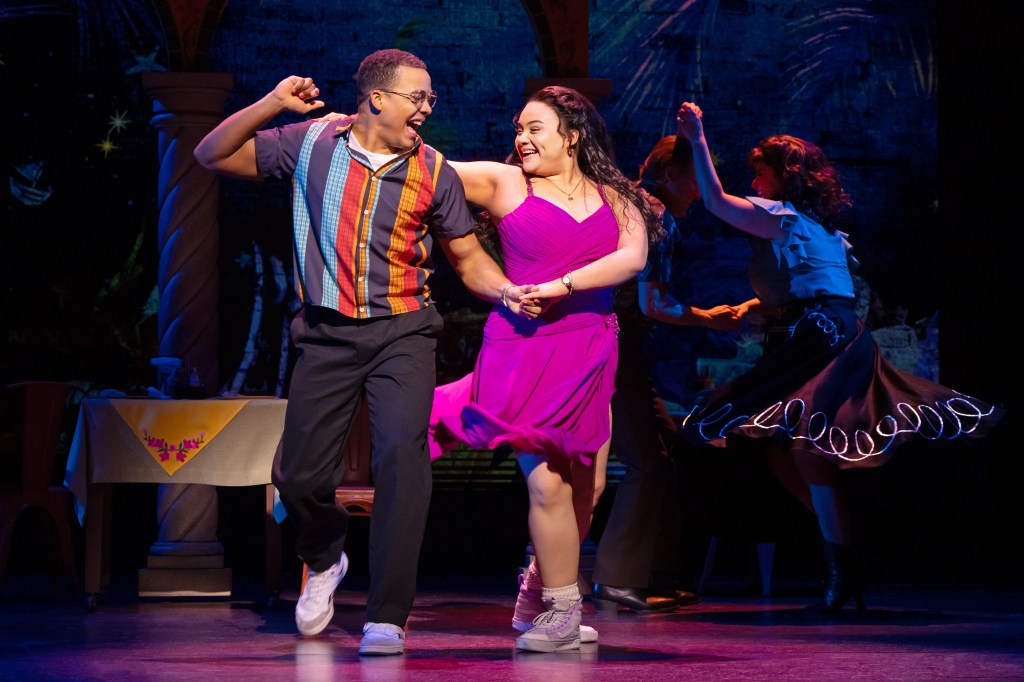
During the titular song, the women disrobe in order to encourage one another to love themselves and dispel the body shaming plasticity of the white culture’s mores to be television-ready thin (BMI 18), young, stylish, non-ethnic. Hispanic cultures find it hard to assimilate into the fat is hateful value, though Carmine beats up and body shames Ana for needing to lose weight, which obviously is a form of emotional abuse. And as we learn with the humorous “Real Women Have Curves,” and “Adios Andres,” extra pounds never stopped the women from enjoying their sexuality. When Ana puts aside her mother’s criticism of her weight, she establishes a budding relationship with fellow journalism intern Henry in a riotous scene (“Doin’ It Anyway”).
However, the beauty of the song “Real Women Have Curves” is the ensemble’s assertion that they are the normal ones and not the white culture’s anorexic leaning, surgery-enhanced women like Mrs. Wright. One after the other, the dressmakers stand singing in their underwear. This symbolizes gaining their power to throw off fat shaming. The audience went wild and perhaps some in the balcony joined them by tearing off their blouses/t-shirts. All this to express that a majority of the social culture is tired of the sickness/anorexia inducing emphasis of a fascist appearance ideal, now stoked with diabetes drugs, a different kind of “shooting up” from other drugs that previously addicted and decreased appetite and speeded up metabolism (cocaine).
The ensemble knocks it into the next galaxy with this number, beautifully staged and choreographed by director Sergio Trujillo. Afterward, the women become even more energized and Ana gains the confidence to approach Henry and be intimate with him in a later scene.
Meanwhile, the stakes are raised. Estela receives a call from Mrs. Wright who is pulling the contract because they lost a worker to INS. When Wright arrives, she attempts to take the dresses and pay Estela nothing. How does Mrs. Wright know they lost a worker? Mrs. Wright implies she knows much about their community. In other words, she has spies, has exploited undocumented worker factories and turns the situation cruelly to her advantage.
The character of Mrs. Wright, is a subtle counterpoint to the other characters. We learn she was also a migrant, but assimilated and internalized some of the worst of American “values”-the love of money and the necessity of adopting arrogance and branding herself a success. As Wright explains, she turned her back on her roots, changed her appearance to fit in with white women’s fascist and oppressive “can’t be too rich or too thin” mantra. They eat little and are on a constant diet. We learn at the conclusion that Mrs. Wright married up. We don’t know if he is older and uglier with money, but we do know she is ferociously determined and not averse to exploiting the illegal status of Estela and her undocumented dressmakers.
As a character foil, Mrs. Wright provides Ana’s most excellent ridicule. Ana stands up to her, using her power as a journalist. She traps her into keeping the date and time for delivery when Wright attempted to cut it short and steal from the women because they had no leverage. Ana shows she has leverage and uses her brilliance to force Mrs. Wright to uphold her end of the contract in a very funny, satisfying scene.
Perhaps most importantly as an understated conflict there is the tension of what it means to be from a different culture and have to assimilate in order to “get along.” How much must one adapt to the culture to fulfill one’s dreams? How much must one retain of one’s identity to gain one’s power but not be “too ethnic” to be a success?
Real Women Have Curves is just sensational in revealing these complex issues with humor, grace and power. It shines a beacon on all of Americans as migrants, some of whom have stupidly “forgotten” their heritage. Indeed, today, some like Mrs. Wright become lost in the process of “shedding” their unwanted ethnic identity, even to the point of “color-correcting” their appearance. In their self-loathing, they uplift artificiality, fashioning themselves into an AI generated, surgery-enhanced image. In such a culture with such warped values and “amnesia,” is it any wonder that the current political administration with an abundance of former plastic-looking TV personalities, with little qualifications or merit, support migrants and some green card holders being brutalized, kidnapped, trafficked and stripped of their basic human rights?
Look for the layers in Real Women Have Curves. From technicals to performances there is perfection and coherence: set design (Maldonado), Natasha Katz’s lighting design, the sensational costume design (Wilberth Gonzalez & Paloma Young), John Shivers’ sound design, Hana S. Kim’s video design, and Krystal Balleza & Will Vicari’s hair, wig & makeup design. Their collaboration with Trujillo’s vision of Lisa Loomer and Nell Benjamin’s book and Joy Huerta and Benjamin Velez’ music and lyrics make this a must-see many times over.
Real Women Have Curves runs 2 hours 20 minutes with one intermission at the James Earl Jones Theater. realwomenhavecurvesbroadway.com.
 CAROLE DI TOSTI