Blog Archives
‘Birthright’ at MCC is Exceptional
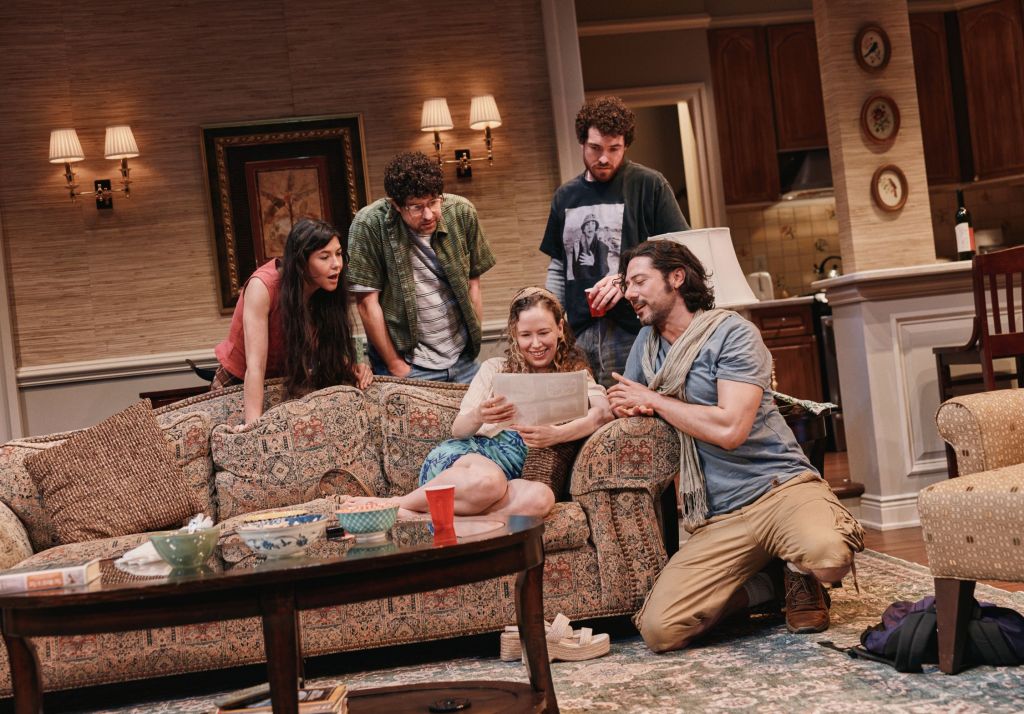
In Birthright writer Jonathan Spector tackles Jewish identity through the viewpoints of six friends as they evolve their relationship with each other after they return from a “Birthright” trip to Israel. Examining each of the characters over an extended time frame from 2006 through 2024, Spector reveals their psychic and spiritual growth as they confront the ever-changing dynamic of the political state of Israel, an increasingly violent and unsafe country.
Spector brilliantly integrates their emotional and personal backgrounds initially as twenty-somethings during the presidency of George Bush Jr. in 2006. After highlighting specific turning points he fast forwards to 2016 ten years later, during Hillary Clinton’s momentous campaign. The last segment settles on the salient points of their journey as they are still in touch with each other. The time quickly forwards through eight years to land in 2024, during the backdrop of President Joe Biden’s campaign, before he moved aside for Kamala Harris to run as the Democratic candidate.
Complex, insightful, philosophical, humorous, fascinating and profoundly human, Spector’s play strikes theatrical gold. Directed by TeddyBergman, Drama Desk nominated director, producer, actor, Birthright currently runs in an extension at MCC through August 23, 2026.
As he did with Eureka Day, the Tony Award-winning playwright presents controversies and explores various cultural opinions. His distinct characters, portrayed almost to near perfection by the ensemble, reveal perspectives that deepen and change over time. Each individual, raised in the cultural background of Judaism with its holiday traditions, foods, behaviors, language and concentration on identity, expresses their own brand of personal and political liberalism. Together, they eschew American conservatism and the Republican Party. In the last segment, we understand that they all deplore Benjamin Netanyahu’s leadership and AIPAC’s (wealthy Jewish donors) influence over congress.
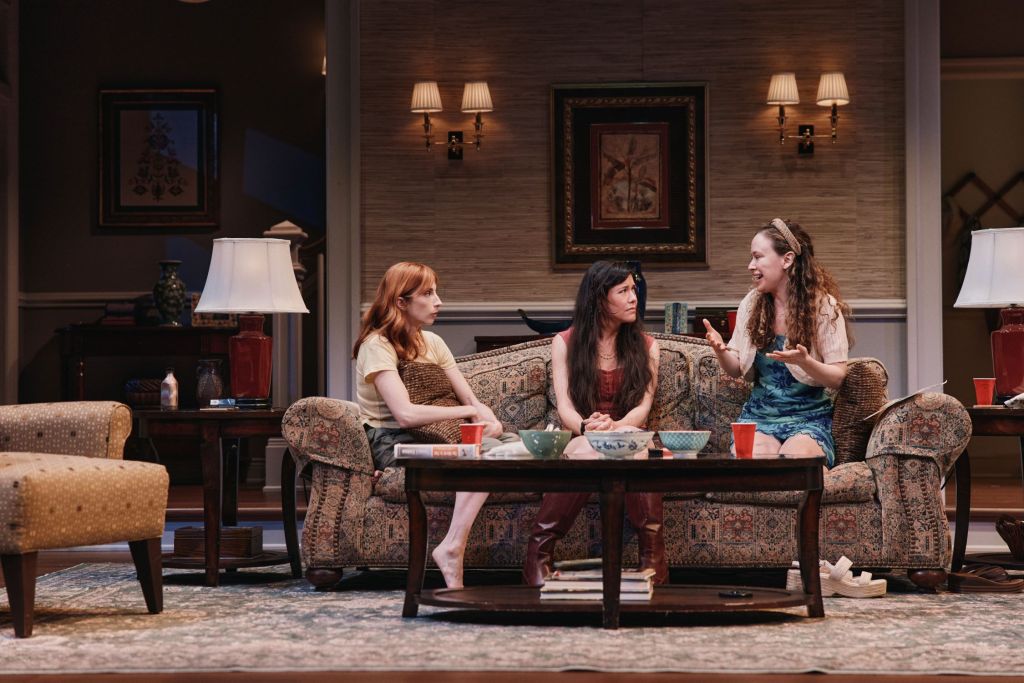
Indeed, some of the play’s humor derives from advancing political ironies cleverly using the flashbacks against our present as a medium. For example one of the characters comments that when “Hillary’s administration gets in, there will be job opportunities.” In another, an anecdote about a conservative father who voted Republican tells his son he may vote Democratic based on Kanye West’s comment that “Bush doesn’t care for Blacks,” evidenced by his dilatory response to Hurricane Katrina. The audience never loses track of the ironies of both statements and others. Indeed, years later West supports Republican Trump, then campaigns to divide Black votes from Biden to help Trump in the 2020 election. Throughout, Spector makes use of the characters’ assumptions about the future which blow up in their faces later in the play as “impossibilities” happen again and again, i.e. “one-third of the nation votes for Trump.”
The play opens at the reunion party that Chaya (Zoe Winters) holds for friends who recently returned from their trip to Israel. Birthright Israel gives Jewish adults between 18 and 26 years old an all expenses paid educational and fun trip to experience Israel as a “journey of a lifetime.” At Chaya’s parents’ house in a suburb of Washington, D.C. (with fine period appropriate set designs by Scott Pask), we first meet the brilliant, Israel-aware, gay Izzy (Molly Bernard), Chaya’s long-time friend. Next, we meet politically-minded blogger Noah (Eli Gelb), then drug-fueled musician Emerson (Nate Mann), recently expelled from his band for drinking. Arriving last, comes the philosophical, searching, profound Lev (Hale Appleman),
Also, we discover Chaya’s ulterior motive for the gathering; to dissuade Alona (Molly Ranson) from her rash decision to immigrate to Israel (“making aliyah”). Chaya spills that Alona lost her virginity to an IDF soldier during the trip. As Chaya tries to discourage her in front of the others, Emerson reveals the soldier sexually hooked up with a number of the other young women. Though this devastates Alona, we learn later the trip probably had the greatest impact on her because of her future decision to move there.
Interestingly, we learn the friends’ various attitudes about the trip’s inauthentic, unreal nature. The friends see through the propaganda about Israel to persuade young Jewish people to leave their birth countries. With the exception of Ranson’s Alona, all agree to one degree or another their established camaraderie fostered a bond with each other greater than any loyalty to Israel. Lev, who left the tour, felt, “it was all this like crafted Styrofoam,” like “seeing The Matrix.” Lev tells Izzy (who also felt the unreal situation), if I “wanted any kind of authentic experience, I had to get away from the trip.” After Lev disappears, he visits Jordan’s Petra, and Egypt. Also, he doesn’t miss the significance of the hours long lines for Palestinians to cross borders versus the fifteen minute line white tourists and others easily wait on. If Lev had not left the tour, he wouldn’t have seen this other alarming experience of Israel which he shares with Izzy.
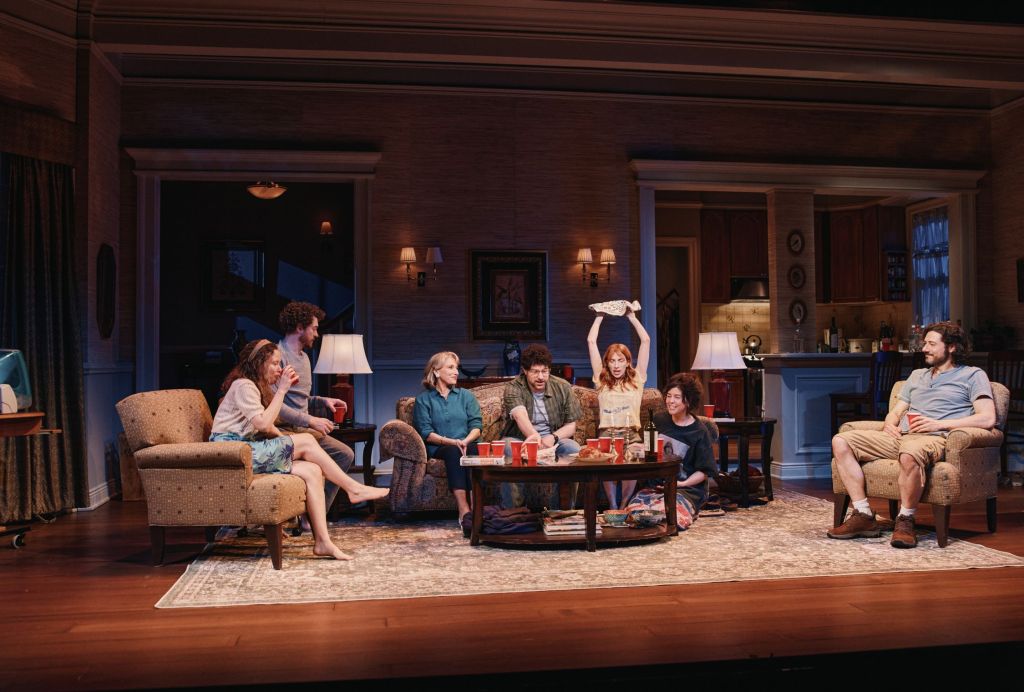
In the 2016 segment during another reunion at Chaya’s as they plan their toast for Alona’s wedding celebration the next day, we discover Alona and her husband are moving to Israel. From this meeting we understand the characters’ progress in search of something to strengthen their sense of purpose, despite personal successes or failures. For example married lawyer Izzy, at polar opposites with Alona, passionately speaks out against Israel’s apartheid. Chaya and Izzy question Alona’s Israel move in light of its moral ambiguity. As a citizen she will take part in the oppression and abuse of the Palestinians through her complicity by simply moving and living there. Will she stand for justice for Palestinians, or walk obliviously over their trail of tears?
Lev, who had spoken of his desire to become a rabbi years before drops out of school, gets married, divorced and beats himself up about not seeing his child as often as he likes. Noah quits The Washington Post and reinforces his online presence as a political influencer which eventually morphs into podcasting by 2024. Noah’s interest in Chaya which began after a brief affair on the trip continues despite Chaya’s marriage which heads toward divorce. Her work with the Obama administration ends and she takes on an organization to help Hillary get elected. Emerson seems the most lost at this point; unmarried, composing a few solo albums. But he stumbles into keeping kosher in spite of himself. All look forward to the hope of the first female president, some more avidly than others.
In the last segment, the downturn from hope and light into confusion and darkness becomes symbolized in the death of one of their number. Consequently, his loss raises the stakes of their relationships. The original bonds fostered during the trip have developed into love and an emotional concern and closeness which sustains them. Likewise, on another cultural, personal level, the devastating attack of Hamas on October7th, and the subsequent turmoil and chaos of finding the hostages amidst the daily bombing of the people of Gaza causes emotional devastation for Izzy, Chaya and Alona. And to various degrees, each friend questions the well-meaning values of the Judaism they were raised in versus Netanyahu’s bloody, never-ending punishment of Palestinian women and children.
What is the right path? Can the initial massacre justify the piles of bodies and annihilation and ethnic cleansing implicating the US government’s complicity supplying aid which includes weapons to Israel? Where did this begin? In Zionism as Izzy suggests or in the foundation of the state of Israel as a safe haven for outcast Jews in search of their birthright? And arguing whether the bloody slaughtering is or isn’t a genocide becomes a distraction while the incessant murdering continues. As Noah attempts to mitigate Izzy and Chaya’s arguments, Emerson arrives. He missed the funeral service. As it turns out he has arrived just in time for some food and community. And his surprising presence brings gasps from the audience.
As it turns out after years of wandering, in this 2024 reunion, the friends are brought together once again in a new way. And maybe just maybe Chaya and Noah will see their way clear to be with each other after all is said and done.
Birthright runs 3 hours 20 minutes through August 23, 2026 at MCC Theater; mcctheater.org.
‘Miss Representation: Rise Up’ at Tribeca Festival
Miss Representation: Rise Up
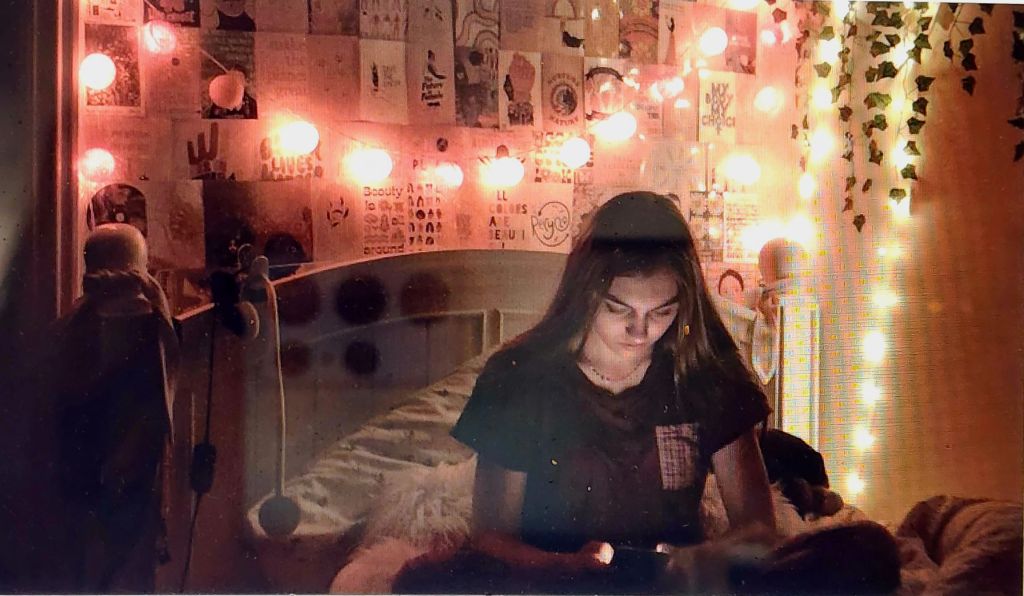
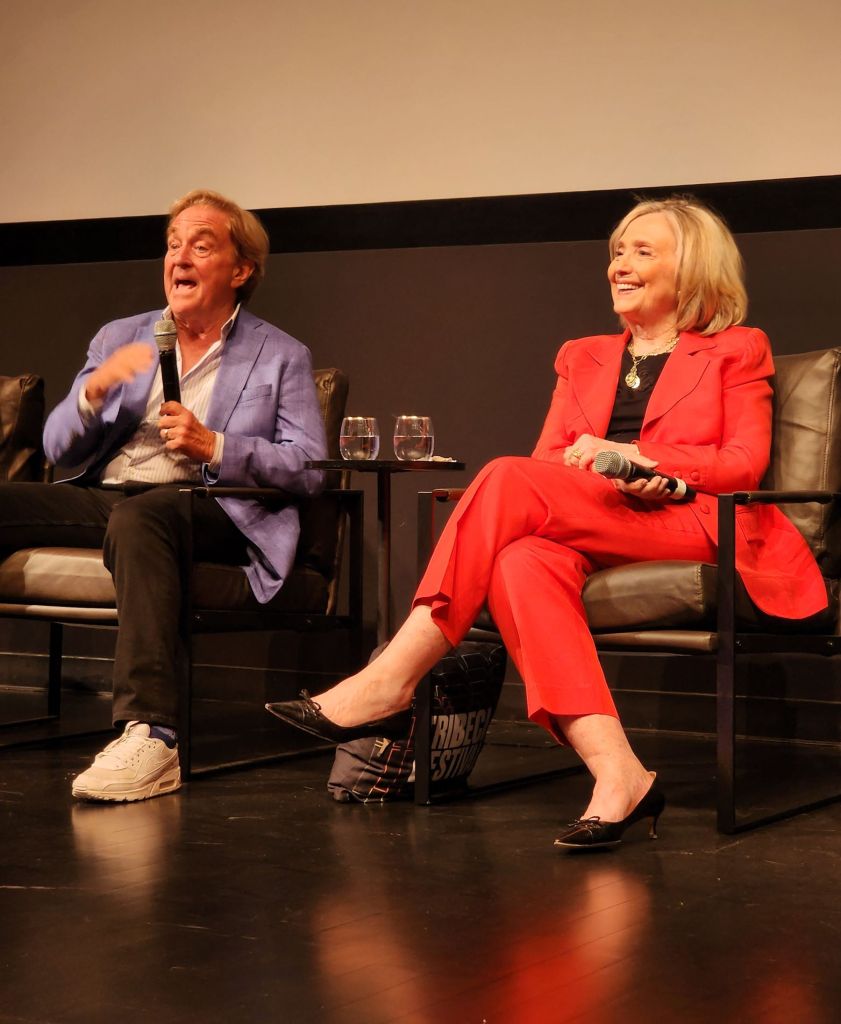
Jennifer Siebel Newsom’s expanded message for women in Miss Representation: Rise Up is crucial viewing. Her second documentary about women under attack presents the untenable problems women face as the tech industry attempts control via AI, co-opting resistance and empowerment. In the spotlight category the film had its world premiere at Tribeca Festival. It hosted special guests after the screening who appeared in the film.
Newsom’s first film Miss Representation began the conversation
Newsom’s first film, Miss Representation (2011), delved into the normalization of unrealstic body images by all forms of media to manipulate and disempower women emotionally. The images of perfection and beauty perpetuated in the music, fashion, advertising, entertainment industry, etc., negatively impacted teen girls and women who felt they could never measure up. Stoking shame and guilt the related industries encouraged them to buy products to change their appearance and be prettier, thinner, “better.”
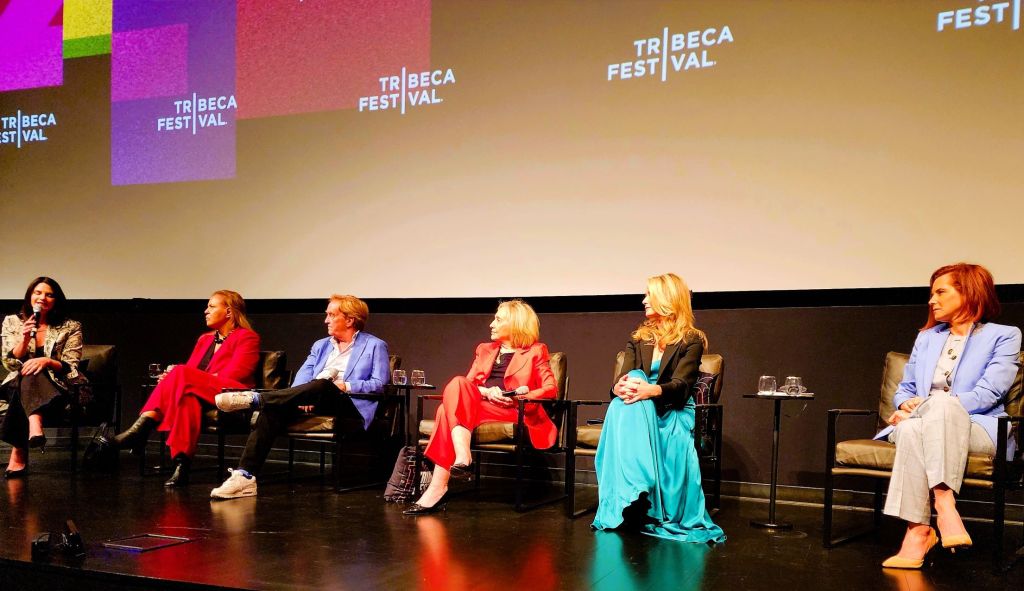
Newsom includes statistics of the percentages of women and teen girls suffering from depression, body dysmorphia, feelings of unworthiness and dis-empowerrment. Oftentimes, depression and body dysmorphia would lead to cutting and other forms of self-harm including suicide. In her acute depictions Newsom revealed an important story about our culture and society that rang alarm bells, but offered no real prescriptions for change. The relentless assault against girls and women has been unstoppable.
Newsom’s Miss Representation: Rise Up shows the situation has worsened
Miss Representation: Rise Up proves that the situation has worsened exponentially through Social Media’s algorithmic engagement. Male and female influencers via Instagram, Tik Tok and other platforms whether through soft power (body perfection) or toxic masculinity hate on women 24/7. Parallel with the demand for women’s perfected beauty we note the rise of the fascist, toxic, male “ugly,” who looks like Joe Rogan and demeans like the conservative MAGA Nick Fuentes.
The Trump administration has exacerbated the misogyny and objectification of women with the intent of removing them as an effective power block.Trump’s response to a female reporter whose question unsettled him, “Quiet piggy,” sums it up. In the fifteen years, strategic political pressure via media (images, toxic talking heads) inevitably moved to reverse women’s rights in the Dobbs decision. Spreading domination and hopelessness, these malign actors politically work to silence women’s voices because of the power they threaten.
Newsom interviews key spokespersons, i.e. Frances Haugen (Facebook whistleblower), Jim Steyer (CEO Common Sense Media), Secretary Hillary Rodham Clinton, Amy Klobuchar and more. Using their commentary she explores the backlash against women’s progress. Also, Newsom uses powerful firsthand accounts of young women across the country. She highlights their experiences and gives them a platform to voice their concerns. Giving specific examples the documentarian reveals how political influencers on the radical right have created a hostile online ecosystem with ChatGPT, Grok and other AI tools. Following the Trump administration’s MO, they weaponize these to harass, stalk, threaten and ultimately, make women do what they want. In other words they metaphorically disappear them and take their voices and power.
Because everyone has a phone, the toxic messaging can be seen every hour on the hour. Unlike the analog assault of fifteen yeas ago, influencers personalize their digital warfare on others. Often AI Bots are set to monitor and comment on every powerful young woman’s social media account. Insulting comments and memes can erode girls’ and women’s self-esteem, mental health, and public engagement. The more these insidious technologies emotionally engage, the more money is made. Abuse and verbal beatings mean dollars. Young women navigate the currents of abuse with pain. Instead of pushing through, eventually they refuse to take on leadership roles and positions of political power.
Congress must step in to regulate tech companies
Congress has attempted to hold CEOs of companies like Facebook accountable for allowing toxic messaging to get through. With the MAGA administration threatened by women, they try to prevent regulation of tech companies to engage them in their misogyny. In avoiding regulation for big tech and data centers, the companies have made payoff donations to campaigns. However, Newsom shows he resilience of young women who fight back and carve out their own power. Their voices now and in the future sound a reckoning. Increasingly, with awareness the public fights against data centers and wins.
Miss Representation: Rise Up reminds us that all of us must remain engaged in our life’s processes, politics and our votes make a difference. Finally, by empowering women through agency, and maintaining hope, no one’s rights can be diminished.
Look for Miss Represenation: Rise Up on streaming platforms. See the synopsis on the Tribeca Festival website.
https://tribecafilm.com/films/miss-representation-rise-up-2026
Casey Likes, Lorna Courtney are Terrific in ‘Heathers The Musical’
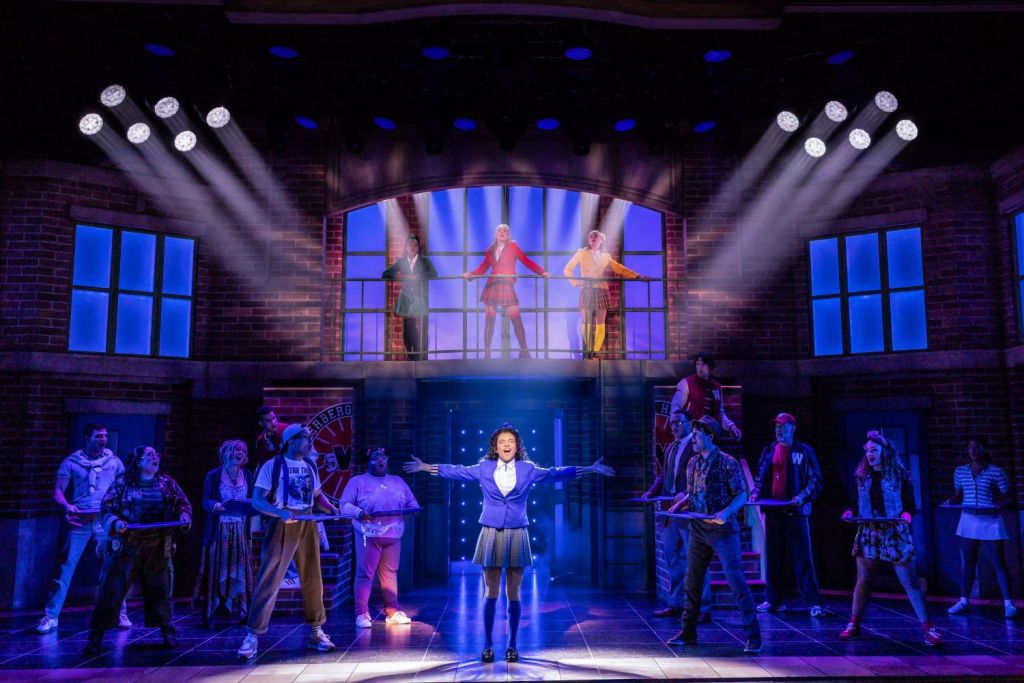
Heathers the Musical
Currently in revival, Heathers The Musial, based on the cult classic film Heathers (1988), written by Daniel Waters, has rocketed onto New World Stages with fans screaming in delight. The production with book, music and lyrics by Kevin Murphy and Laurence O’Keefe first opened at the same Off-Broadway venue in 2014 with Andy Fickman directing. However, O’Keefe and Murphy continually reworked the production honing it to a fine brilliance during the last decade. Most recently in a limited engagement in the West End, it finally transferred to New World Stages. There, it has been extended until January 25, 2026 for good reason.
The 2025 version incorporates changes, including new songs, created in the intervening decade. The concept and subject matter appeals because the sardonic musical comedy satirizes the cruel power dynamics prevalent in high schools across America. Unless one is a part of the ruling elite and finds popularity and favor, the typical high school social machine grinds you up as trash. Admittedly, each high school has its own peculiar “selektion process” of those who “matter,” and those who “don’t.”
How do communities fight this? In a backlash, one character’s notion to purge the toxicity is to “burn everything down.” However, exchanging one form of hatred, nihilism and supremacy for another can create a never-ending cycle of retribution as the musical indicates. Can anything be done?
In its latest version this terrific, complex production asks and answers these questions. Additionally the top notch performances, music (Will Joy), choreography, (Gary Lloyd, Stephanie Klemons), Andy Fickman’s direction and the design elements cohere with near perfect unity to present an overall message. Despite the darkness present in all of us, our humanity has a softer side. We have only to manifest it with courage in the face of bigotry.
The musical opens as narrator/diarist Veronica Sawyer (the amazing Lorna Courtney) considers the negative transformations her classmates have gone through since kindergarten (“Beautiful”). Brainy, misfit Veronica is a senior at Westerberg High in1989, Ohio. Though Veronica believes herself to be a good person (she befriended uncool Martha Dunnstock {Erin Morton}), she must navigate around her classmates who welcome each other with the insults, “FREAK! SLUT! LOSER! SHORT BUS! BULL-DYKE! STUCK-UP! HUNCHBACK!”
Though Veronica blames this toxicity on their growing up and losing their innocence, we wonder if anyone in authority can rein in the students’ brutality toward each other? Therein lies one conflict. Of course the power dynamic is sub rosa. Because students maintain its secrecy, clueless parents and teachers like Ms. Fleming (Kerry Butler), don’t satisfactorily deal with the horrible social culture. Thus, nothing changes.
It is precisely because those in authority can’t influence the students that the three “Heathers” (McKenzie Kurtz, Kiara Lee covered for Oliva Hardy when I saw the show, and Elizabeth Teeter) rule with ferocity (“Candy Store”). In order to lift up their own status, the Heathers make everyone else feel worthless. Ironically, the students electrify the Heathers’ power grid because they fear their wrath and retribution. What would happen if they didn’t bow to Queen Heather Chandler?
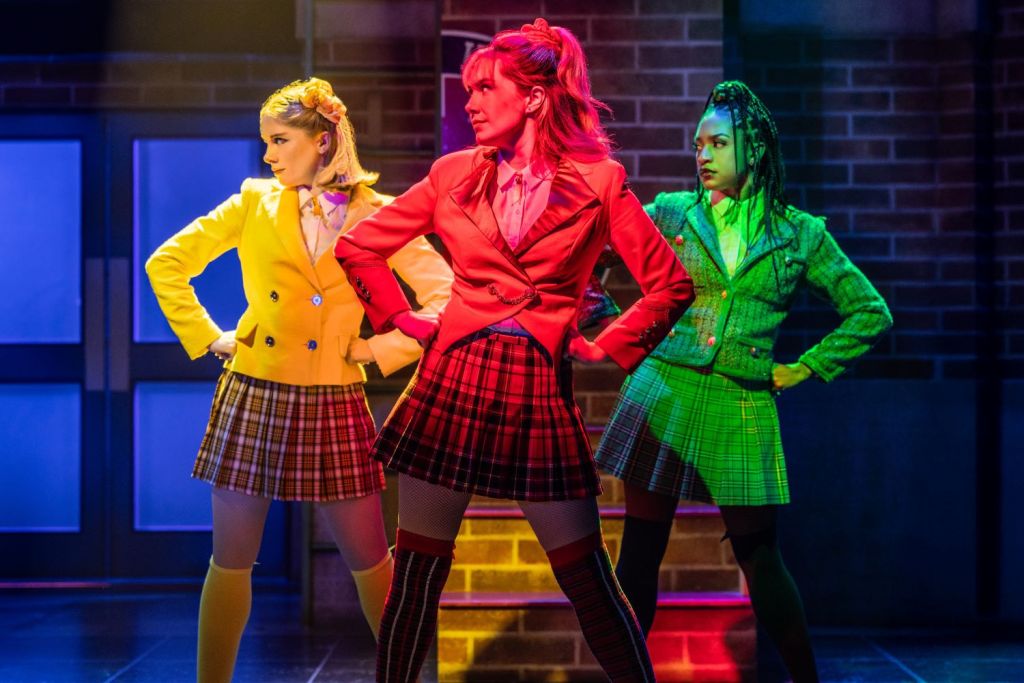
The situation looks up for Veronica when she uses her talent for forgery to save the Heathers from detention. As a result they take her under their wing, give her a make-over and lift her status to “beautiful.” However, she must set up her friend Martha for a grand humiliation at an upcoming party (“Big Fun”) to maintain her popularity.
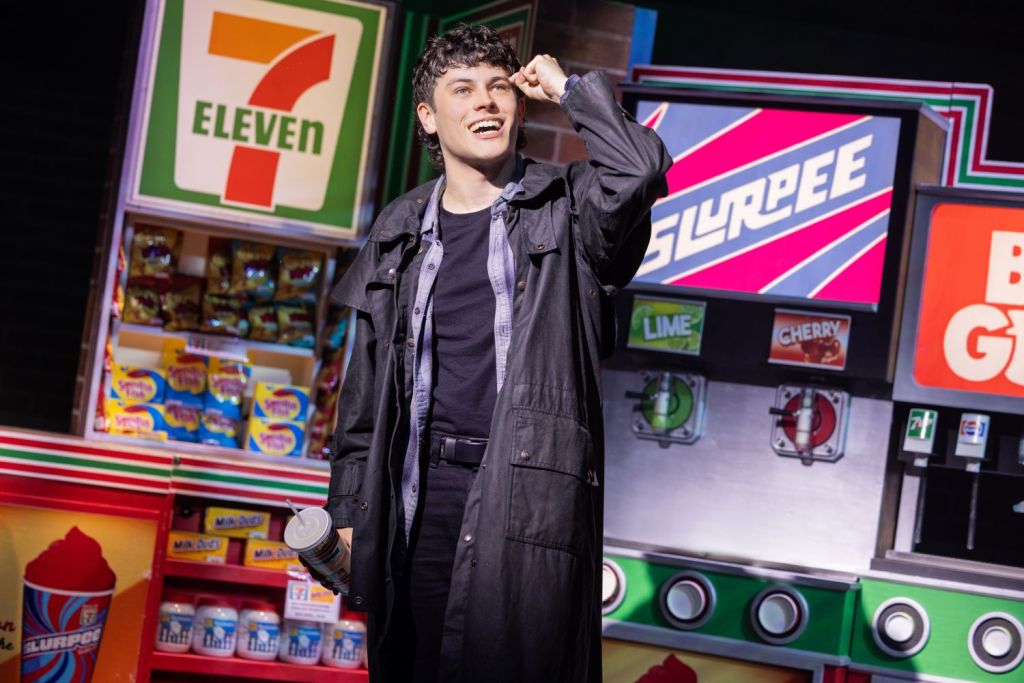
In a counter punch to stop the Heathers’ obnoxious reign of terror, the new student J.D. (the superb Casey Likes) provides another perspective. He criticizes Veronica for selling out Martha to the, “Swatch-dogs and Diet-Cokeheads.” Likes’ JD, dressed in a trench coat and dripping charisma and courage dazzles, a rebel against the stifling social order.
Because JD, stands up to popular jocks, Ram Sweeney (Xavier McKinnon) and Kurt Kelly (Code Ostermeyer), Veronica becomes interested in him (“Fight For Me”). They form an attachment (“Freeze Your Brain”), and J.D. helps Veronica avoid becoming the “laughing stock” of the school (“Dead Girl Walking”). However, Veronica’s innocent plan to apologize to Heather Chandler for throwing up on her outfit backfires. Mistakenly, Veronica gives Heather the wrong cup filled with drain cleaner (JD’s instigation), instead of the cup with her usual prairie oyster hangover cure.
This unexpected twist brings Veronica and JD closer. But their love relationship fueled by a conspiratorial cover-up of Heather’s death leads to more diabolical behavior. With JD’s help Veronica forges a suicide note imitating Heather’s handwriting. The clever, ironic lyrics to dead Heather’s suicide note, in “The Me Inside of Me,” resonate hysterically. (“No one thinks a pretty girl has substance. I am more than just a source of handjobs. No one sees the me inside of me.”) Easily duped, despite Chandler’s horrible nature, the school community believes in her vulnerability and unhappiness.
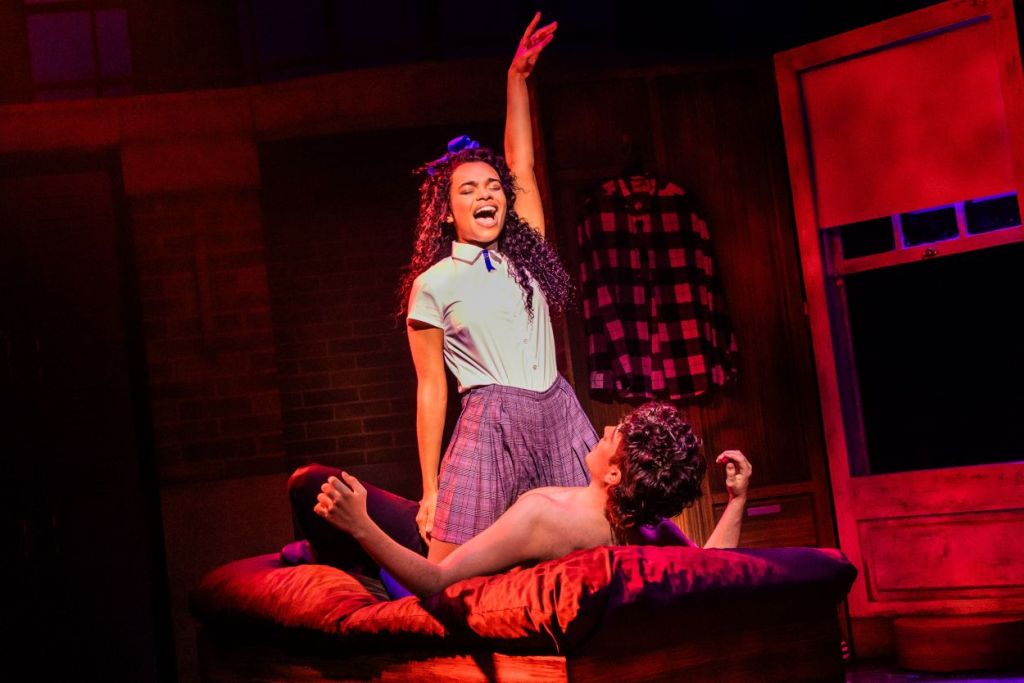
The suicide note elevates Heather to even greater status as a flawed, lonely teenager like everyone else. Meanwhile, the ghost of dead Heather haunts Veronica and cryptically comments while Heather Duke takes Chandler’s place as “Queen.” In a downward spiral Heather Duke’s reign turns out to be worse than Chandler’s. Duke sets up Veronica to be sexually attacked by Ram and Kurt. Though Veronica foils the rape, she and JD plot revenge. Once again the vengeance which begins innocently in Veronica’s misguided mind turns deadly in JD’s hands.
After Veronica and JD tally up two more “accidental” murders, they write believable suicide notes that Ram and Kurt were gay. Neatly, they’ve cleansed the school of three of the most brutal kids in the social hierarchy. In Act I’s closing number (“Our Love is God”), they affirm their love and righteous acts of “justice” with the mind-blowing lyrics: “We can start and finish wars. We’re what killed the dinosaurs. We’re the asteroid that’s overdue.” As JD tells Veronica he’d give his life for her, Veronica cannot resist his love and allure. Energized by her and their new found form of justice, JD’s nihilism continues in Act II. Only Veronica can stop him.
With Andy Fickman’s superior staging and humorous, well-paced timing, the production flies by at two hours and 30 minutes. The ensemble’s exuberance, voices and dancing are cracker-jack, the arrangements super. Memorable throughout, Lorna Courtney sustains her portrayal of Veronica’s transformation from “good person” to JD’s unwitting accomplice to murder, and back again. As JD Casey Likes is Courtney’s match pitting his phenomenal voice against hers with every song. As a couple they shine, reminding us that evil can be seductive.
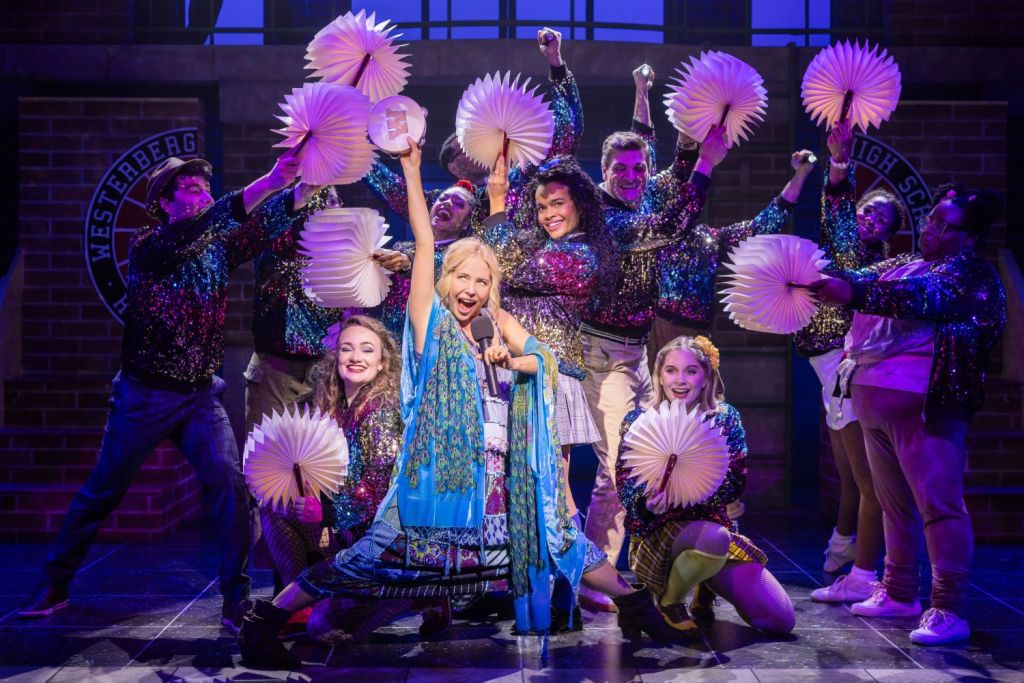
Finally, McKenzie Kurtz lifts the ironic character of Heather Chandler in death with fine pacing and great humor. She aligns in a perfect contrast with Erin Morton’s kind-hearted, loving Martha Dunnstock, who would be everyone’s friend if they they opened their eyes to her goodness. Standout numbers “My Dead Gay Son,” (Ben Davis, Cameron Loyal are hysterical) and “Shine a Light” (the funny Kerry Butler) are LOL. “Kindergarten Boyfriend” (Erin Morton is spot-on authentic) resonates with pathos.
Thematically, Water’s film and the Heathers musical (2014) were harbingers of today’s cultural divisions. With prescience they exposed the danger of allowing high school communities to be breeding grounds of hate and discrimination, fostered by a school’s particular “master race” clique. If high schools reflect the larger culture, then social media exponentially spreads their poison. Is it any wonder that insults, hate and bigotry are embraced by “seleckt” political groups to gain votes? Spawned in community settings and reinforced by boards of education in their curriculums, hate and discrimination become normalized.
Heathers the Musical reveals the social construct which accepted a “president” who uses insults, bullying tactics and death threats to get what he wants. It also reveals a better answer than JD’s nihilism in the concluding song. It’s up to us to “make it beautiful.”
Heathers The Musical runs 2 hours 30 minutes with one intermission at New World Stages. https://heathersthemusical.com/new-york/about-ny/

