Category Archives: Off Broadway
‘The Trees,’ Agnes Borinsky’s Fantasy of Stasis, a Review

The abstract white, platformed set design (Parker Lutz) appears stark and majestic with arched rectangular pillars proscribing a curvilinear playing area center and downstage. The set is a symbolic representation of a park, interestingly absent any greenery. It’s a fine space to present a metaphoric fantasy like Agnes Borinsky’s The Trees, directed by Tina Satter, currently at Playwrights Horizons.
The Trees opens with the possibilities of a unique, mysterious conflict, and ends in medias res, as Borinsky mines the central conceit adding various layers and meandering back and forth with no seeming resolution, though there is one that is abstract and philosophical. As the playwright suggests she is wont to do, The Trees avoids a developed plot. It concerns the logistics of arranging the movement of players and supplies around the static protagonists whose human condition changes at the top of the play.

Brother David (Jess Barbagallo) and sister Sheila (Crystal Dickinson) who is visiting from Seattle, return home from a party playfully drunk. Appreciative of the night’s beauty and environs, they decide to stay outside and spend some enjoyable time in the park adjacent to their family home, which they’ve inherited from their father, who recently died. Overnight, a cataclysm occurs without rhyme or reason that neither we nor the characters are a party to. It involves a mega change that defies description.
Absurdly, David and Sheila awake the next morning in horrified shock to find themselves rooted to the soil, their feet immobilized and frozen in place. Theirs is an unexplained miraculous transmogrification from flesh to plant matter, though they retain cellular structures of both humans and trees. They refer to their tree selves as humans and identify as humans, however, physically in defiance of reality, they are also trees.

In this hyper-state of existence, the siblings learn to overcome the conflict of former identities abutting their new beings. Gradually, their consciousness expands. They accept their new lives, but cannot move nor take care of their past identities, activities and relationships. For Sheila this means having to give up her life and work in Seattle. For David this entails perhaps never having sex again. Sheila reveals a nature that is flexible, accepts, goes with the flow, makes the best and follows all the cliches people use in life when there is nothing they can do to change things. However, David resists and is not happy with “what is.” In fact after David’s transformation, his old lover Jared (Sean Donovan) throws him over for someone else, though they still remain friends and Jared joins the community which sprouts up to nurture and care for Sheila and David. David learns to accept, but he always complains and resists before he settles into the status quo.
The playwright asks us to suspend our disbelief by suggesting anything is possible in her her fairy tale. In the twinkling of a few hours worlds can come and go, consciousnesses can be raised and a new perspective and ethos might be a pleasant, happy experience that exists in and of itself for the purpose of whimsy, if we are open-minded. Indeed and perhaps.
This appears to be one of Borinsky’s themes in The Trees. The circumstances are because they are and exist despite all defiance to science and logic. For that reason alone, The Trees is worthy of presentation. Understanding it as an allegory of human experience and the human condition, one is able to translate the metaphors and reactions of the protagonists to the unusual, whether in the play’s instance they have turned into a tree or in another instance, someone has been turned into deteriorating flesh through disease, drugs and their side effects.

Acutely directed by Tina Satter, who shepherds the actors, all do a yeoman’s job with the fantastic elements and fluid happenings that take place representationally over a seven year period. This is especially so of Crystal Dickinson and Jess Barbagallo, who make sense of the absurd, as we watch how Sheila and David confront their new genetic transformation.
Fortunately, when word gets around, friends help the tree/humans with food and other necessities. No logical sensibility is relayed as to why they need human food, why they need clothing, etc. They are immobilized in the trans-state of human/tree and achieve a status quo state of being in the park, where events transpire around them, where people enter and join them in community, while they are stuck and going nowhere. All seamlessly coheres as the thrust of Borinsky’s conceit. With these friends, neighbors and strangers, David and Sheila might live forever. Certainly, trees can live longer than human beings, if their environment is not undone by commercialization, fire and development. These possible undoings do threaten David and Sheila’s community as we see later in the play.
The fairy-tale elements of The Trees are heavily fantastical and provide some of the humor and most of the conundrum of illogical occurrences as David and Sheila grow a network of friends, who appreciate how they have embraced a back to nature, celebration of the earth lifestyle as tree/humans.

Those who visit feel an affinity to the siblings and become friends. These include Julian (Nile Harris) who makes a documentary on the siblings and Tavish (Pauli Pontrelli) who saves David and Sheila’s grandmother from a fire. As their Grandmother, Danusia Trevino speaks the entire role in Polish and references the mystical elements of David and Sheila’s “back to nature” movement as an inherent part of their ancestry. Others include Norm (Ray Anthony Thomas) a gay man cruising in the park, and importantly, Saul (Max Gordon Moore) a rabbi who believes in the miracle of their transformation by God and eventually marries Sheila and has Ezra (Xander Fenyes) with her. Lastly are friend Charlotte (Becky Yamamoto) and Sheryl (Marcia Debonis) a member of the Rabbi’s former congregation, whose heartfelt description of her Dad quickens Sheila in remembrance of her father.
The interesting villain who actually joins the community of friends begins as Vendor (Sam Breslin Wright). He hawks chips, pretzels and water to park visitors. As Wright’s Vendor ingratiates himself to the community eventually, he presents plans which would protect their human/tree status. Ironically, as quickly as they morphed into trees, he becomes the developer whose thrust is to build a mall in the park that will house David and Sheila. When the community that initially accepted the Vendor’s plans come to the final decision about the mall, there is another magnificent change. Sheila, David and their community decide that they don’t want a mall in the park. They want the park to remain undeveloped.
In a superb rant decrying how their decision is disloyal and has caused him time and money (he has been giving them checks for their support) Wright’s Vendor expertly magnifies all the hope and despair of progress and the destruction of land and environment for a questionable result.

The community and specifically David and Sheila have lost his friendship which Sheila is sanguine about, a reflection of her nature. She has been flexible about all that life and the situation has thrown at them. When David questions what will happen, Borinsky’s main theme comes to the fore. Love and community have been sustained by their transformation into trees, as they have provided an ecosystem that gives and receives, is nurtured and has nurtured. David counters that a mall will destroy what they’ve built with love. However, Sheila reminds him that nothing is certain. Truly, when they unwittingly began their fantastical adventure, goodness and love abounded from it because they accepted it instead of calling up woodcutters to chop off their legs.
Though at times the play appears illogical, the characterizations as uneven as some of them are give the play a quirky and exotic rhythm. In appearing to go “nowhere” the playwright takes her characters to an open ended conclusion which emphasizes love, community and the inability to know much of anything in the vast future which can turn on a dime overnight. Sometimes, even when malls are being scheduled to be built, they never materialize. And that’s a good thing, especially if the love of the surrounding community has petitioned their demise.
Kudos to the creative team which includes Parker Lutz (scenic design) Enver Chakartash (costume design) Thomas Dunn (lighting design) Tei Blow (sound design) Amanda Villalobos (puppet designer) and Nazareth Hassan (original music). The Trees runs until March 19th. For tickets go to their website https://www.playwrightshorizons.org/tickets-packages/buy-show-tickets/
‘A Bright New Boise’ by Samuel D. Hunter, Sardonic, Devastating and Profound, a Review

In A Bright New Boise, Samuel D. Hunter’s sardonic, dark play about events that take take place in a Hobby Lobby break room, the award-winning playwright (A Bright New Boise, The Whale) acquaints us with characters that may be more alien to our cultural beliefs and economic well being than individuals we might converse with in another country. Acutely directed by Oliver Butler and currently running in its Off Broadway Premiere at the Signature Theatre until March 12th, Hunter and Butler reveal a sometimes funny but mostly tragic, portrait, and a cross-section of another America reflected in the 90 minute play’s characterizations, plot and themes.
Hunter opens the play with protagonist Will (the superb Peter Mark Kendall) who, facing the audience, stands at the side of the road, eyes closed, concentrating. Then, he says one word as if to call into existence, time and place, “something.” Four times he says, “Now.” By the play’s conclusion, we understand his cryptic pronouncement which produces only a vast emptiness and “never works.”

In the second scene we meet the feisty, hyper-organized, store manager Pauline, portrayed by the excellent and humorously volatile Eva Kaminsky. Pauline interviews Will for a sales position in the break room at Hobby Lobby, Boise which in 2010 (the setting) is owned by an Evangelical CEO who runs the company as a Christian organization. During the interview Pauline makes Hobby Lobby’s conservatism clear when she reminds Will, “no unions,” explaining that a Hobby Lobby in Kansas was shut down when employees tried to unionize. The economy is struggling, there is little opportunity for those without a college education and the big box stores like Hobby Lobby are the expansive grand employers of the moment. Thus, the minimum wage that Will readily accepts (under $8.00 an hour) is the best for his circumstances and is an offer he dare not refuse for a reason more important than financial. This, we learn with the introduction of another character in the break room, taciturn teenager Alex (Ignacio Diaz-Silverio).
Will’s apparent emotional dislocation is made clear in Kendall’s superb performance. From his evasive and contradictory responses to Pauline’s questions, we understand he needs money and appears to be in unusual life circumstances because he is unable to give her a reference or emergency contact. However, he is hired so that Pauline can continue to run her “tight ship.” He begins to socially settle in by striking up a conversation about music with Alex who is taking his break and wishes not to be disturbed.

Hunter immediately establishes Will’s additional intentions and enjoins the main conceit of the play, “abandonment” and “loss,” setting in motion the conflicts with a shocking surprise. Spoiler Alert: Will announces he is Alex’s father and he proclaims that Alex was named after him so his real name is also Will. Fortunately, Pauline returns and interrupts Will’s announcement. Simultaneously, the TV whose satellite glitches vie between graphic surgeries and monotonous conversations between two Hobby Lobby male employees, snaps back to the Hobby Lobby’s conversational monotony about how to sell products. And a disturbed Alex walks out as Pauline tries to make a joke most Americans would understand, if they have been culturally plugged in for the last two decades.
However, Will doesn’t get the joke or the celebrity associated with it, and even if he did, Kendall’s Will appears overwhelmed about introducing himself to his son. He could care less about Pauline’s attempt to make him feel comfortable and appears lost in his thoughts about how he will negotiate and respond to the brutal questions from Alex that are sure to come.

Will’s deadened reaction is another clue that ties in to Hunter’s characterization of a hapless, unsound father, whose adopted son he has desperately sought out by getting a job at a Hobby Lobby, instead of using another means to contact him that is less traumatizing. From this first turning point of many, the revelations between and among characters spin out as surprises continue in a grotesque emotional and psychological maze that Alex, Leroy, Alex’s brother (Angus O’Brien) and employee Anna (Anna Baryshnikov) inhabit in the coldly remote, depersonalized break room of the Boise, Idaho Hobby Lobby. The sterile, severely lit space is perfectly ironic as a symbolic setting where they attempt to go to relieve the stress of their job, but end up frantically confronting a hellish swamp filled with regrets from their past. The result exacerbates the demeaned alienation of each of the characters who have lost their way and whose religion is unable to help and in fact makes things worse.
By degrees we learn the backstory of Alex and Will. Instead of clarifying toward comfort in a way to salve emotional hurts, by degrees Alex with stress and strain in his questions puts together the puzzle why Will has come to establish a relationship with him. Eventually, after Will reveals the truth of where he lives, the joy his church gave him and the events which transpired there, Alex appears to forgive him and defend him to his brother Leroy who fears Will has another motive for wanting to see Alex. In a secondary plot to enhance the characterizations, Anna and Will stumble upon each other in a darkened break room after hours, which seems even more sinister (the TV is still on vying between blood and guts and boring Hobby Lobby guys).

Anna sneaks her way in beyond closing hours by hiding in various sections of the huge store unnoticed. We learn she does this to avoid her father and brother’s criticism of her always reading and we get the sense that she is a misfit without a medium to feel comfortable in until she has a few conversations with Will whom she likes. Will is homeless; we eventually learn why and what happened to him. Furthermore, he is afraid to sleep in his car.

Their conversation gives occasion for Will to read parts of his Evangelical “End Times” blog to her, which he intends to make into a novel. Anna is taken up with the notion she has met a writer whose work she likes and she encourages him. It is then we understand the extent of his beliefs and his hope of being taken up in the Rapture (often used as a fund raising tactic by Evangelical Mega Churches) away from the wicked hell that has been perpetrated in the culture and on the earth by sinners who must be saved or perish in damnation. We also understand that he feels he has a purpose in converting people before it’s too late. He tells Alex he has to believe in God because the alternative is terrible. He would have to look at himself as an utter failure as a father, whose triumph is working in Hobby Lobby, while he lives in his car. Will tells Alex, “There are greater things in life. There have to be.”
Will gradually works his way into Alex’s world by asking to hear the song Alex wrote with his friend. He praises some of Alex’s poetry. However, Leroy is incensed about Will after he reads articles about Will’s former church and especially after Alex appears to favor Will over his adoptive family and tells Leroy he is changing his life plans. Leroy lashes out in revenge against Will after Pauline affirmed that it doesn’t matter what people’s personal beliefs are, as long as they are on time and do their jobs. However, Leroy involves Hobby Lobby in his revenge, making it impossible for Will to work there. Leroy and Will’s conflict has broken Pauline’s rule to maintain order as the status quo. After working for four years to make the store profitable and organized, she will not allow their conflict to drag it into the chaos that Will has brought with his presence. (Eva Kaminsky’s affirmation speech about Pauline’s taking the store to profitability earlier in the play is corporately magisterial and humorous.) Thus, Will, the last to be hired will be the first to be fired, aside from the fact that Alex and Leroy’s talents make them indispensable.
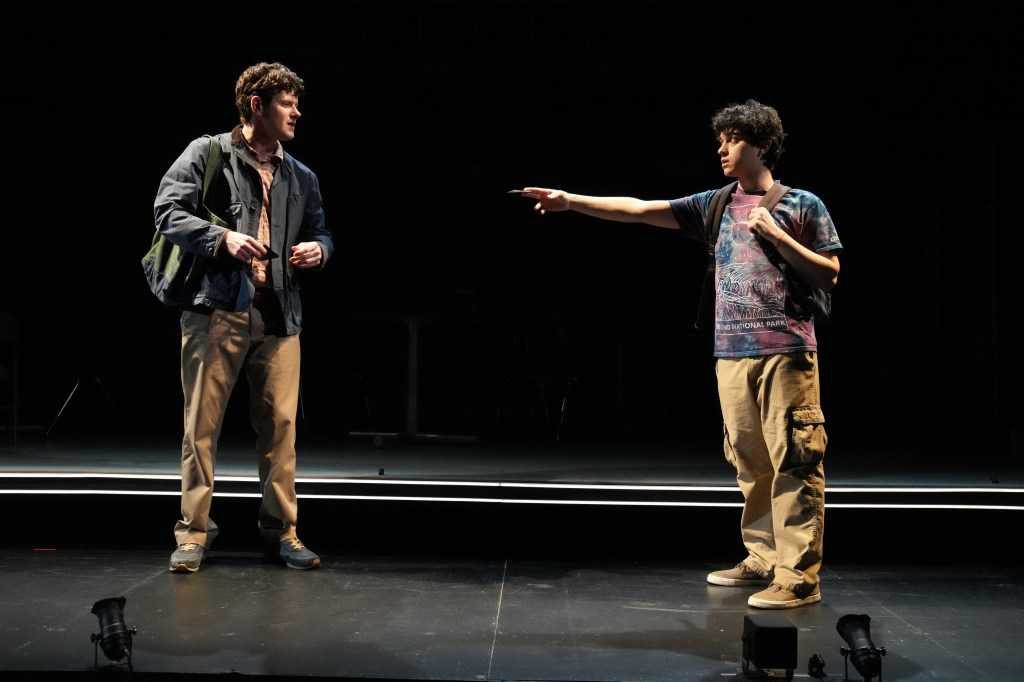
How events further evolve are both surprising and expected. However, when Leroy confronts Will about Alex, the result is uncertain and unpredictable. Hunter’s writing is freshly wrought and organic. The characters are well-crafted and their motley and unique differences meld well with each other for maximum tension, which abides throughout. By the conclusion Hunter ties Will’s injunction to God, “Now,” and explores another reason why Will seeks out Alex for comfort in a relationship that is not destined to grow closer or even continue unless Will makes a decision to change.
The play is wonderful on many levels. Hunter allows us to get under Will’s skin and into his soul which is both horrifying and sadly authentically truthful if one has been around certain Evangelical sects for more than a few days. Importantly, though we might not be able to put ourselves in Will’s shoes, Kendall portrays Will with empathy and pathos thanks to Butler’s incisive direction. Thus, we can understand his emotional guilt and torment and his desire to be a better person, the point of his religious journey, which becomes sidelined. The relationships Hunter establishes are woven with heightened drama. Alex feels a misfit and is emotionally traumatized by Will moving on a roller coaster of emotions through to the play’s conclusion. That Will doesn’t consider another way to get in touch with Alex speaks to his inner turmoil and disregard for Alex’s feelings and response. However, Will’s need to see Alex is urgent and has to do with the “Now” that is the final puzzle piece that unfolds in the flashback at the very end.

The terrific and terrifying set design by Wilson Chin and jarring fluorescent lighting and vibrant neon lighting in the road scenes by Jen Schriever are evocative and symbolic. That the appliances (i.e. microwave, VCR, etc.) barely function and little attention is given to popping up the color to make a unique, interesting or warm environment speaks volumes about Hobby Lobby, the employees and Pauline who is the epitome of the loyal, harried worker bee manager. The break room set, props and lighting reference the respect that the corporate officials have for their employees in a nullifying environment that is neither challenging, purposeful or life affirming. Hunter conveys the sense of Big Brother when Eva explains to Will as a blind, deaf and dumb team player that it’s a “pretty great company” that knows how to run a business, because everything is “hooked up to the corporate office.” Then, she cheerfully states, “We can’t even turn the air conditioning on without calling Oklahoma.”
The Hobby Lobby envisioned by the director and playwright and what fuels it, also reflects the nature of the commercial culture that creates consumer robots whose function least of all is a purposefully human one. That Will, Alex and Leroy refer to a job there as something loathsome by which to define oneself is further irony because the store is incredibly profitable, if money is its Christian measure of success as the prosperity gospel likes to portray. That Will has accepted religious rhetoric as his mantle and believes the world needs to be destroyed becomes particularly sardonic considering Hobby Lobby’s function and value system as a Christian organization with tenets about love, forgiveness and acceptance.

Another of the themes of the play is manifest in the characterization of these conservative Christians who are devout, yet are incapable of applying the tenets of the religion to their lives to achieve peace and fulfillment. Along with the themes of abandonment, isolation, and purposelessness that nullifies comes the important irony that Hunter relates at a time (2010) before the religious political movement grew into what it is today in 2023 in the culture wars, book bannings and civil rights curtailments. The hypocrisy, spiritual unhappiness and emptiness tied to a culture that is broken and breaks those who live in it to seek other ways to escape (through the belief of the Rapture) Hunter’s ironic play underscores. The play was humorously prescient then, more frightening now. A Bright New Boise is an ironic expose of the worst of Christian sects’ hold on the minds of those like Will and others.
Kudos to the creative team not mentioned before which include April M. Hickman (costume design) Christopher Darbassie (sound design) Stefania Bulbarella (projection and video design). This is one to see especially for the ensemble work, the fine performances and direction that teased out the actors’ efforts to be spot-on authentic. The creatives did a smashing job to fulfill the director’s vision of A Bright New Boise. For tickets go to their website.
https://www.signaturetheatre.org/shows-and-events/Productions/2022-2023/A-Bright-New-Boise.aspx
‘The Seagull/Woodstock, NY’ Review

The Seagull by Anton Chekhov is a favorite that receives productions and has been made into films, an opera and ballet performed all over the world. Some productions (with Ian McKellen at BAM in 2007) have been absolutely brilliant. What’s not to love about Chekhov with his dynamic and ironic character interactions, sardonic humor, enthralling conflicts that unspool gradually, then conclude with an ending that explodes and carries with it devastation and heartbreak. These elements cemented in Chekhov’s work since its initial production in 1896 represent what Chekhov himself described as a comedy.

Thomas Bradshaw, an obvious lover of Chekov’s The Seagull, has updated and adapted Chekhov’s work in the world premiere The Seagull/Woodstock, NY presented by The New Group. The playwright, who has previously worked with director Scott Elliott (Intimacy, Burning) has configured the characterizations, entertainment industry tropes, humor and setting in the hope of capturing Chekhov’s timelessness to more acutely evoke our time with trenchant dark ironies that are laughable. As he slants the humor and pops up the sexuality, which Chekhov largely kept on a subterranean level, Bradshaw has added another dimension to view the themes of one of Chekhov’s finest plays. Directed by Scott Elliott with a cast that boasts Parker Posey, Hari Nef, David Cale, Nat Wolff, Aleyse Shannon and Ato Essandoh as the principal cast, The Seagull/Woodstock, NY, at the Pershing Square Signature Theater has been extended to April 9th.

The play’s action takes place in a bucolic area in the Hudson Valley. Woodstock is the convenient “home away from home” of celebrities who live, work and fly between Los Angeles and Manhattan, and who feel they need to take a break between jobs, or just take a break from the stress of performance and helter skelter pressures and BS of the industry. The house where they retreat to is peopled by the family, caretakers, guests and a neighbor. The individuals are based on Chekhov’s characters, brother Soron, sister, actress Arkadina and son Constantine, who Bradshaw has renamed Samuel (David Cale) Irene (Parker Posey) and Kevin (Nat Wolff). Chekhov’s Trigoren, Arkadina’s lover, Bradshaw renames William, who is portrayed by Ato Essandoh. Nina, whose Chekhov name Bradshaw keeps is portrayed by Aleyse Shannon. Chekhov’s Masha becomes Bradshaw’s Sasha (Hari Nef).
In his update Bradshaw streamlines some of Chekhov’s dialogue and upturns the emphasis of conversation into the trivial without Chekhov’s character elucidation, as he spins these individuals into his own vision. The cuts truncate the depth of the characters, making them more shallow without resonance or humanity with which we might identify on a deeper level. However, that is Bradshaw’s point in relaying who they are and how they are a product of the noxious culture and the times we live in, unable to escape or rectify their being.

For example the initial opening conversation between Samuel (David Cale) and Kevin (Nat Wolff) loses the feeling of the protective bond between uncle and nephew scored with nuance and fine notes in Chekhov’s Seagull. Additionally, in their discussion of actress Irene, Kevin’s criticism of his mother emphasizes her faults and superficiality. In the Chekhovian version, the son expresses his feelings of inferiority in the company of the artists at his mother’s gatherings. Because of the son’s admissions we immediately understand his inner weakness and hopelessness, feelings which set up the rationale for his devastation of Nina’s abandonment and his suicide attempts later in the play.
Chekhov’s characterization of the actress and mother is tremendously subtle and cleverly humorous. Bradshaw’s iteration of the celebrity actress, her lover, the ingenue Nina and Irene’s brother become lost in the eager translation into comedy without the emotional grist and grief which fuels the humorous ironies of human frailty. Again, as we watch Bradshaw’s points about these individuals which reflect our modern selves, we laugh not with them ruefully, but at them for their obnoxiousness and blind hypocrisy.

Such points appear to be inconsequential and minor, however, the overall impact of Bradshaw’s characterizations makes them appear to be stereotypes of artificiality rather than individuals who are believably sensitive, vulnerable and hypocritical so that we care about them, yet find humor in their bleakness. Irene adds up to a figure of sometime cartoonish arrogance and pomposity without the sagacity and nobility of Chekhov’s Arkadina, who nevertheless is intentionally “oblivious” to herself out of desperation, hiding behind her facade, which on another level reveals a tragic individual. The same may be said for the characters of William and Nina who deliver the forward momentum of the work in their relationship that symbolically and sexually culminates in a bathtub on the stage where Nina previously masturbated as a key element of Kevin’s play. Their characters remain artificial and shallow, and the play’s conclusion and Nina’s collapse follows flatly without the drama and moment so ironically spun out in Chekhov’s Seagull.
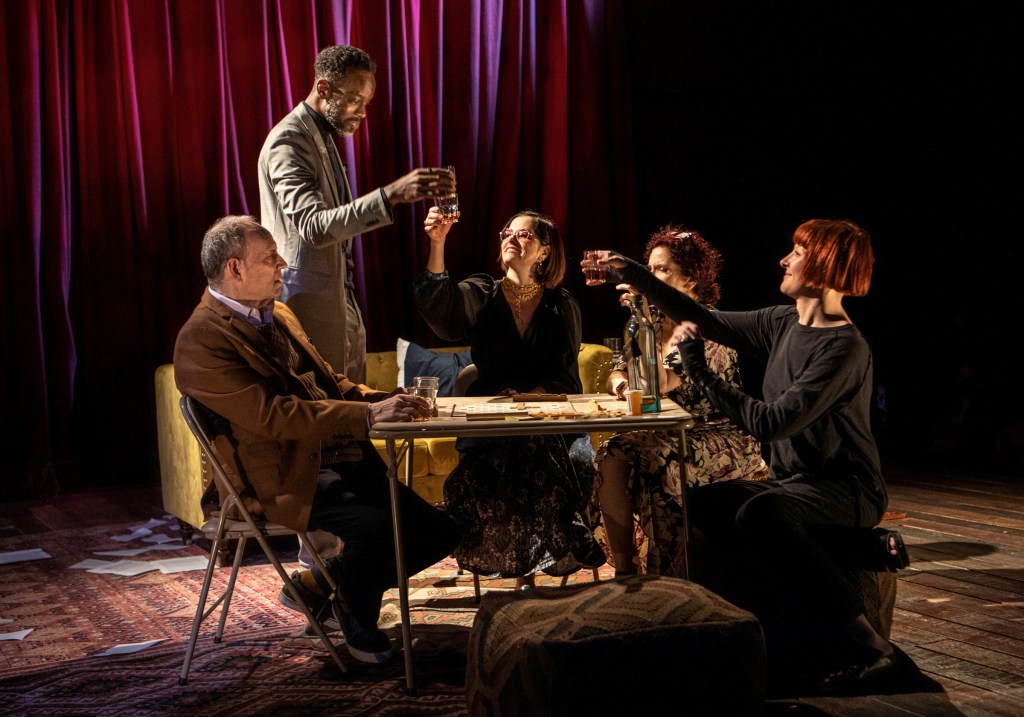
Indeed, the meaning of Bradshaw’s work is clear. There has been a diminution of artistic greatness and sensibility, moment and nobility in our cultural ethos, which makes these players as inconsequential and LOL as he has drawn them. They are caricatures who wallow in artificiality and purposelessness, not of their own making. They have been caught up in the tide of the times and the vapid culture they seek to be celebrated in. That some of the actors push for laughs which don’t appear to come from organic, moment-to-moment portrayals makes complete sense. Theirs is a high-wire act and anything is up for grabs. Whatever laughter can be teased out, must be attempted. That is who these people are in The Seagull/Woodstock, NY.
Though the actors (especially Posey who portrays Irene with the similitude of other pompous, self-satisfied characters we’ve come to associate her with) attempt to get past the linearity of Bradshaw’s update, they sometimes become stuck, hampered by the staging, the playing area and direction whose action perhaps might have alternated between stage left and stage right (the audience is on three sides). Most of the action and conversation (facing the upstage curtain where Kevin puts on his play in the first act) takes place stage right. Since the set is minimalist and stylized with rugs, chairs and other props forming the indoor and outdoor spaces, the stage design might have been more fluid so that the various conversations were centralized. Unfortunately, some of the dialogue became swallowed up and the actors didn’t project to accommodate for the staging.
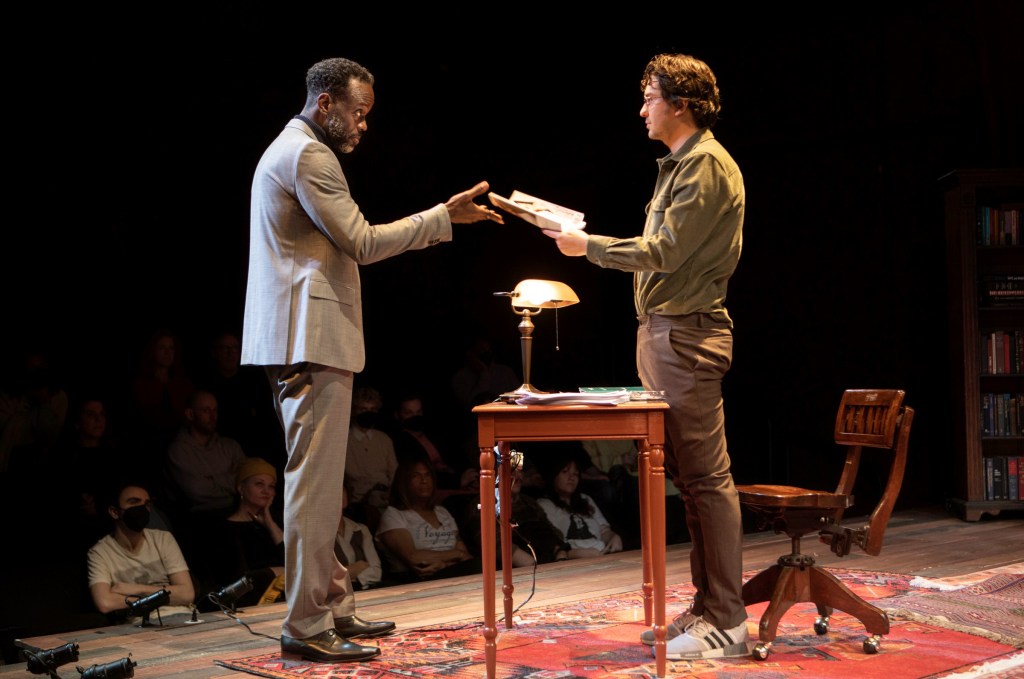
Only Nat Wolff’s portrayal of Kevin rang the most real and authentic. However, this is in keeping with the overall conceit that the playwright and director are conveying. Wolff doesn’t push for laughs and his portrayal of Kevin’s intentions are spot on. As a contrast with the other characters, he is a standout and again, this appears to be Bradshaw’s laden message. Kevin is driven to suicide by the situation, his mother, William’s remote selfishness and Nina’s devastation which she has brought upon herself. He is happier to be away from them. And perhaps Irene will be relieved, after all is said and done, that he has finally succeeded to end his misery. As Bradshaw has drawn her and as the director and Posey have characterized her, Irene has an incredible penchant for obliviousness.

At times the production is uneven and the tone is muddled. At its worst The Seagull/Woodstock, NY is a send up of Chekhov’s The Seagull that doesn’t quite make it. At its finest Bradshaw, Elliott and the ensemble reveal the times we live in are destroying us as we attempt to escape but can find no release nor sanctuary from out own artificiality and meaninglessness, as particularly evidenced in the characters of Irene, William and Nina. Only Kevin appears to have true intentions for his art but is stymied by the crassness of those considered to be exceptional but are mediocre. As in all great artistic achievement, only time is the arbiter of true genius. Perhaps Kevin’s time for recognition will come long after Nina, Irene and William are dead.
The creative team for The Seagull/Woodstock, NY includes Derek McLane (scenic design) Qween Jean (costume design) Cha See (lighting design) Rob Milburn & Michael Bodeen (sound design) UnkleDave’s Fight-House (fight and intimacy director). For tickets and times go to the website https://thenewgroup.org/production/the-seagull-woodstock-ny/
‘The Wanderers,’ Complex, Stylized, Engrossing Theater
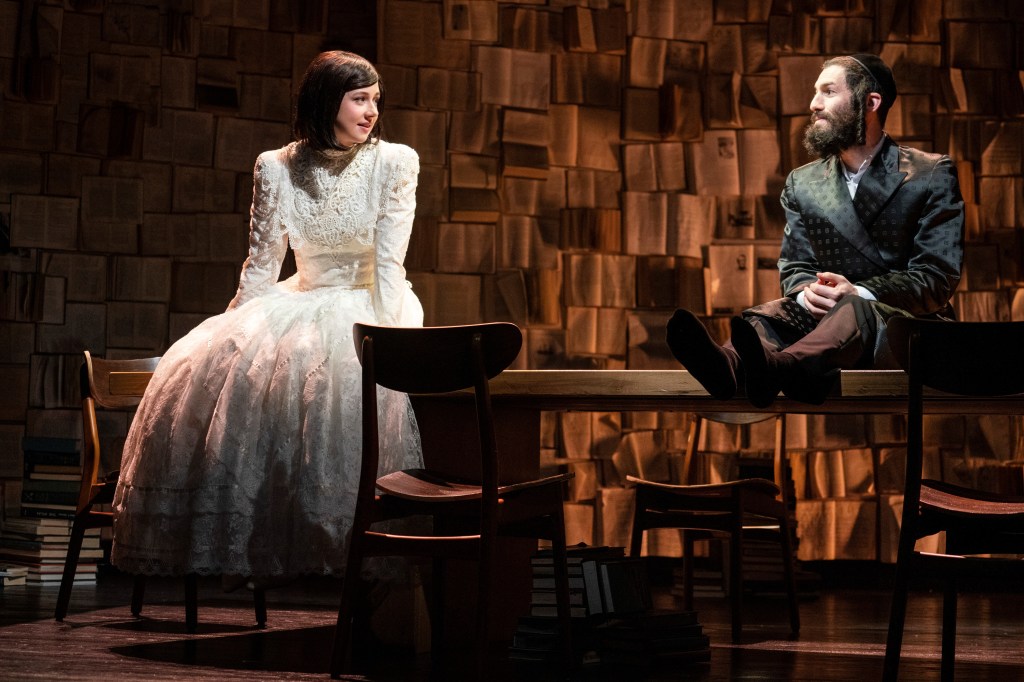
Alternating seemingly disparate lives, two couples actually reveal a similar arc of development, from marriage to divorce in Ann Ziegler’s humorous, cleverly crafted The Wanderers, an exploration of how individuals create their own deceptions, live by them then shatter them, experiencing a fragmentation of self from which they never recover. Acutely directed by Barry Edelstein, and currently enjoying its New York City premiere at Laura Pels Theatre Harold and Miriam Steinberg Center for Theatre, Ziegler’s play runs for 95 minutes with no intermission. Because of its popularity, it has been extended until 2nd April.
Anna Ziedler employs artifice of time and place to gradually promote the revelation of lives lived in quiet desperation and loss, unrealized until trigger moments of clarity occur. Ziegler’s play is ambitious. In it she presents complex, interwoven stories of culture clashes, identities in crises, and the search for happiness when its dream is an illusion created by self-deceptions. She accomplishes this storytelling of two interrelated couples allowing the audience to merge the pieces of the puzzle by the conclusion of this wonderful and gutsy play.

Ziegler introduces us to the central character Sophie (Sarah Cooper) who makes her announcement in present time, circa 2017, that she is divorcing her husband Abe (Eddie Kaye Thomas), whom she has known since she was a teenager. From this point on the play unfolds as a series of flashbacks of the two couples’ conversations. These occur in eight thematic scenes as pointed revelations in sequence, beginning with Abe’s parents Esther (Lucy Freyer) and Schmuli (Dave Klasko). Their conversations Ziegler carefully sculpts to contrast and abut Sophie’s and Abe’s interactions. To comprehend how the characters and their discussions are related, Ziegler keeps us focused on every word of dialogue, some of which is poetic and lovely. In other segments the dialogue is profound and richly thematic about identity, personal yearnings and self-revelation, especially in the scenes between Abe and Julia Cheever (Katie Holmes).
After Sophie introduces the profound metric of separation and divorce in her long marriage with Abe, Ziegler switches to another marriage which appears unrelated but is not. Esther and Schumuli (spoiler alert-Ziegler gradually reveals them to be Abe’s parents), are Hasidic Jews of the Satmar sect. When we meet them, their arranged marriage has just been performed. In a sweet, intimate repartee, they discuss how to begin the consummation of their union. Clearly, Schmuli is the naive one and Esther is forthright, adventurous and maverick, having read books on sex which Schmuli has not. The passive, accepting, dutiful wife Esther doesn’t appear to be in this brief interchange. It is Schmuli who is gentle, hesitant and sweetly anticipating something which he is clueless about.
With just a few defining details, the characterizations of Esther and Schmuli, incisively, sensitively portrayed by Freyer and Klasko, have been set by Ziegler. By the end of the threads of their interactions, which move for nine years through chronologically ordered vignettes that alternate in a revelatory puzzle with Sophie’s and Abe’s interactions, we discover just how rebellious Esther is. Not content with being a house frau with little of her own autonomy and authority to establish a career for herself, we learn that events push her to disavow her identify as a woman who must bow to the paternalistic culture fostered upon women of their sect. After she visits a friend in Albany (spoiler alert-her friend is Sophie’s mom), Esther learns that she can control her own body with birth control pills. After the momentous, life-changing birth of their son Abe, who Esther names “Abe” with great authority, contravening religious ritual, she tells Schmuli she wants no more children.

That Esther is forging out a life beyond the boundaries of their sect and her marriage only is strengthened when her father-in-law prevents her from seeing her daughters. He takes them to live in a household where she will not influence them against their religion. Schumli opposes her taking the pill and “slips” telling his father what Esther told him. It is a severe violation of the sect, whose intentions are to “increase and multiply.” Rather than to subject baby Abe to a life of religious bondage composed of ritual after ritual and still unable to see her daughters, Esther moves out of the neighborhood to raise her son Abe by herself. It is the equivalent of a divorce, though nothing occurs officially. Esther leaves convinced that the “grass is greener,” and she will live a much more fulfilled life out from under the paternalistic oppression of a religion and sect she disagrees with.
Esther and Schumuli’s crises points are revealed in Ziegler’s beautifully crafted dialogue. However, we don’t understand the final revelations and the profound impact of Esther and Schumuli’s crises on Abe and Sophie until the conclusion. That the play gyrates back and forth between the two couples, who mesmerize us to keep track of the details, is part of the enjoyment in solving the mystery which eventually crystallizes. And like the mysteries of lives explored, Ziegler throws in twists and curves, and with artifice, masks them over to create the surprises that happen.
Ziegler uses a conceit to manifest and uncover the hidden elements in the marriage of Sophie and Abe that dovetail with elements of Abe’s parent’s arranged marriage. In both marriages there are external and internal prison bars that keep the individuals from achieving happiness, fulfillment and peace individually and as couples. The conceit comes in the form of celebrity Julia Cheever (Katie Holmes), the character Ziegler uses to manifest the truths that both Sophie and Abe are avoiding in their marriage, their relationship with each other and with themselves.
Abe, who is a Pulitzer Prize winning novelist and success in his field, attends a reading where beautiful, luminous, entertainment star Julie Cheever is present. When Holmes’ Cheever replies to his email, they strike up an intimate and heartfelt conversation and Abe becomes so engrossed with writing to her, Sophie notices that he neglects his own children and their relationship.
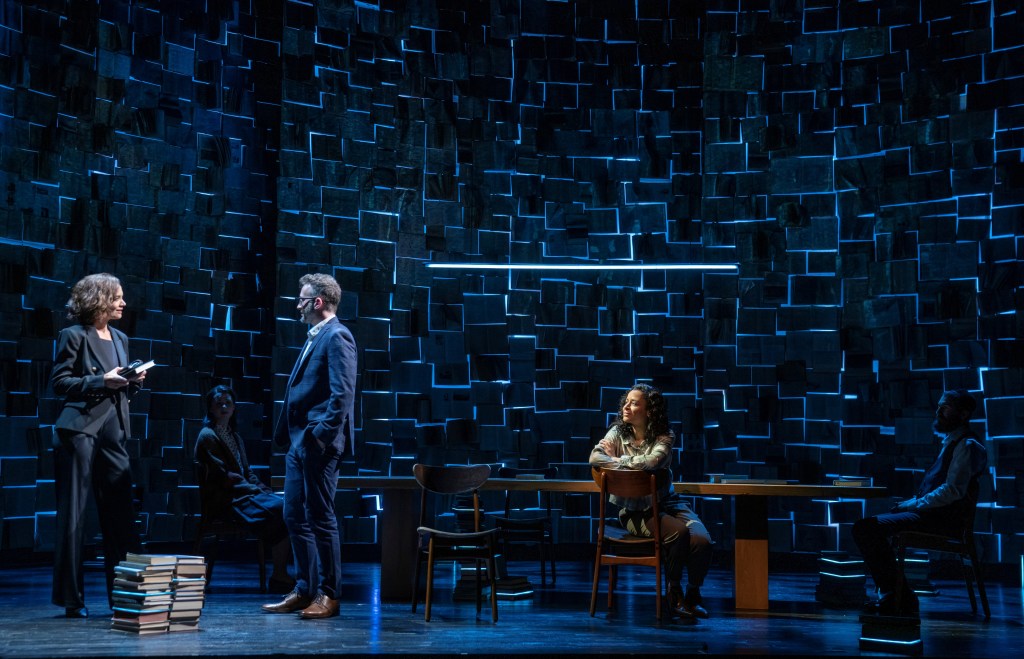
Abe’s and Julia’s email conversations are acted out live by Eddie Kaye Thomas and Katie Holmes. Both actors are excellent and spot-on authentic. The emails are enlivened so that it is as if Julia Cheever is present with Abe, who is over the moon that someone of her celebrity, beauty and intelligence is complimenting him about his work, and inspiring him to discuss his parents and his upbringing. Indeed, Ziegler’s construct supplements Abe’s discussions with Sophie. What is revealed melds and substantiates the revelatory conversations of Esther and Schmuli, though these happened long before Abe was born. Because only Esther raised him, Abe never had an understanding of his father, nor the religion that would have given him power as a man. Raised outside of it without a father role model, he is lost. Though Esther encouraged his love of words and his wonderful success as a writer, as did Sophie, there are gaps in his soul, and his life’s vision is myopic.
As Julia’s and Abe’s online relationship strengthens, eventually Abe wishes to meet her. However, this is not to be. After his father dies, his discussions with Cheever eventually lead to a revelation that is devastating for both Abe and Sophie.
Ziegler’s thematically structured scenes featuring the couples, first appearing disparate, are eventually conjoined. However, unless you read the script, think about the play at length or see it a few times, it is easy to miss the importance of what is happening as a precursor to Schmuli’s death, or understand why Abe decides to re-write and fictionalize how his father died to make his death more beautiful and moving.

Zielgler’s play is fluid and slips in and out of present and past ,which appear to be concurrent, though they are not. The artifice evokes aspects of consciousness and spirituality that are opaque. Because of the conceit that Ziegler has chosen to use as a vehicle to uncover the mysterious elements of her characters and their lives, the scenes suggest linearity, but for the sake of mystery, they are profound and labyrinthine. Like all flashbacks, the scenes occur as a result of memory. Clearly, the characters nuance the events.
Well acted, the director has finely shepherded this as an ensemble piece, though only the married couples interact with each other. Yet, we feel we know them, know their agony and brilliance which surprise us in their final revelations.
Kudos to Marion Williams for the stylized spare set whose backdrop is populated by pages of books which encompass the great expanse of reading that the characters have accomplished in their lives. A table and some chairs are used to evoke a bedroom and other spaces. And of course there are piles of actual books, almost an anachronism in a digital age. Kudos to other creatives who completed the director’s vision for Ziegler’s play. These include David Israel Reynoso (costume design), Kenneth Posner (lighting design), Jane Shaw (original music & sound design), and Tommy Kurzman (hair and wig design).
The Wanderers is thought-provoking, symbolic and most strongly felt when the superb actors are authentic and in the moment, inhabiting the characters and making them alive. This play has proven itself a must-see by audience word of mouth, for it has garnered an extension. To purchase tickets go to their website.
https://www.roundabouttheatre.org/get-tickets/2022-2023-season/the-wanderers/performances
‘Colin Quinn: Small Talk’ Humorously Shines a Light on Chit Chat

Colin Quinn is above all a social critic who strips away our lifestyles down to their humorous, bare bones ridiculousness. Having mastered the art of the quirky ironist, Quinn has previously cycled through six successful solo shows, two on Broadway (An Irish Wake and Long Story Short) and the rest off Broadway. His most recent Red State Blue State explored the depths of the political divide with his wit and wisdom to take no prisoners. In his seventh one-man show Colin Quinn: Small Talk, Quinn gives a fond farewell to the dying art of “small talk,” otherwise known as blather, chit chat, idle conversation. The show runs 1 hour 10 minutes through Feb. 11 at the Lucille Lortel Theatre in Manhattan.

Directed by James Fauvell, written and performed by Colin Quinn, Small Talk manifests Quinn’s signature style which includes lightening delivery that ranges over subjects that branch out, circle around and mount with one-liners that crescendo to the next subject. Initially, Quinn illustrates clever examples of “small talk” and reveals how it functions to keep people sane, rational and polite with each other as the fine lubricant of a thriving civil society. During the LOL set up Quinn’s examples zero in on manners and sociability, blathering when one is with strangers waiting on line, in an elevator, at a party, and other various and sundry spaces and places when people are forced to be together, are feeling uncomfortable and pressed to end the silence of unfamiliarity.
Quinn references our illustrious past and appropriate social tactic used when charged with needing to “break the ice” in an uncomfort zone. Launch into a discussion about the weather. Once belittled precisely because “the weather” was always an apparent effort to stave off the humiliation of unsociable silence, Quinn insists in our day of internet and social media insult and rudeness, the pandemic’s forced isolation and social distancing and insularity, more than ever “small talk” is an imperative. It is a connection to kindness that our children need to learn. Friendly chit chat has been cut short by our hand held devices and redirection inward with mobile phones and air pods.
Even self-checkout has decreased our affability as we avoid having to wait on lines and rush in and out of grocery stores, another result of the pandemic. Quarantining, social distancing and fearing elevator rides where even a “Hello” was initially dangerous, especially if the speaker was maskless, all contributed to small talk “destruction.” Quinn calculates that small talk has decreased by 87%, a problem that he intimates has decreased our humanity and graciousness with each other.
Quinn ironically suggests children should be taught chit chat as a talent to develop along with personality or they’ll become social introverts and isolates. Without such casual sociabilities, misanthropy runs rampant. Indeed, misanthropy is a tonal hallmark of social media (algorithms ping on controversy, argument and insult increasing a platform’s profitability). Quinn’ humorous insistence is to resurrect “small talk” along with agreeability which everyone appreciates rather than argument, negativity and complaint. This may help to diffuse the rancor whipped up by the news media and increased outrageousness by political parties topping themselves. As an encouragement he affirms that there is a direct correlation between saying “Yes,” and higher salaries. (This received a huge laugh.)

Throughout the evening Quinn moves scattershot in and out of various subjects. He leads from one to the other in a domino effect cascading out into humorous observations about “personality” and our current presumptions about expressing our opinions on social media though no one cares. He briefly lands upon various personages from history (i.e. Adam and Eve, Socrates, Attila the Hun, King George of England circa the 1800s to name a few). He hysterically drops rapid-fire one liners aligning them to his topics.
Deftly, Quinn relates some of these to our assumptions about free speech and voicing what we think to political leaders, celebrities and those with power. Steve Jobs and Bill Gates made this ultimately possible and we have run away with the opportunity “mouthing off” online anonymously with impunity. Imagine a peasant (which we are in the classist sense) “mouthing off” to a King! It would never have been tolerated. We live in a time of incredible privilege with our rights, though we are delinquent on responsibilities.

However, Quinn reveals that to those online, the manifest concept is that everyone has the right to their opinion, even if it doesn’t make sense, is outlandish and has no facts backing it up. Social media has harmed the civil affability and humanity of our society. It reveals impairment. Quinn suggests: “If you post more than five times a day, you should be in a 72-hour psychiatric hold. (This also brought a huge laugh.)
The one thing we do have going for us as a country are our social constructs built on charm, talk and salesmanship, in other words, our inauthenticity. Quinn suggests fakery is our fine export and he intimates that we don’t want to see people being their “real selves.” This conjures up images of the unwashed, ungroomed, utterly nasty and debased, untoward person. Appearance and personality are our “coin of the realm.” To ditch these and the massaging aspect of “small talk” for the “real person” is NOT a good idea.
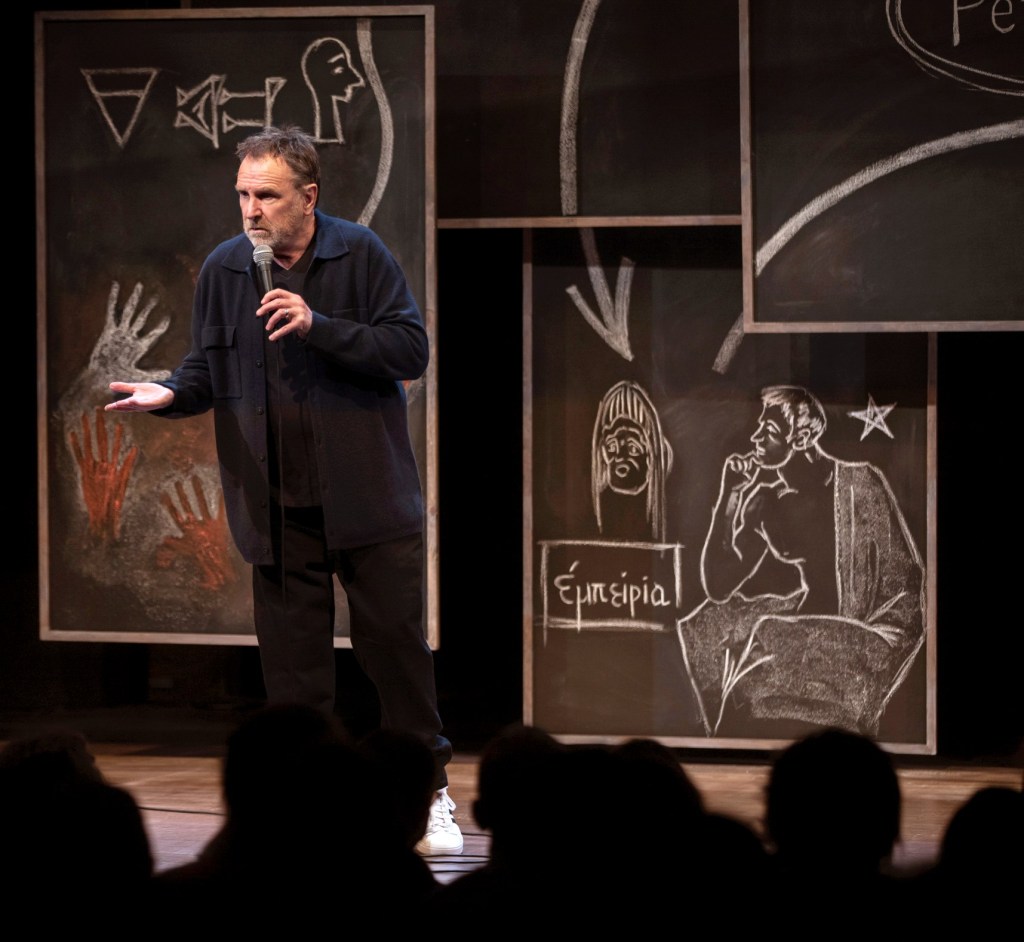
The production sports a clever backdrop that suggests a blackboard upon which chalk drawings of the topics to be discussed casts Quinn as our instructor in the fine art of verbal social graces to equip us for the future. Never was a teacher funnier. The blackboard (scenic design by Zoë Hurwitz) and otherwise bare stage are appropriate grist for his stand-up comedy club approach.

Quinn mentions death’s inevitability. After quips and one-liners, he drops in that he had a near fatal heart attack. However, he is verbally fleet-footed and never gets more personal than that tip of the iceberg. At some point in the flurry of comedy he shares a humorous remembrance involving chit chat and Norm McDonald his buddy from SNL, who died in 2021. The story involves McDonald riffing on Quinn and using off-handed banter to relax the group they were with. Quinn as the brunt of the joke was a great “ice-breaker.”
The Brooklyn-born comic skirts the edges of politics in this show. It is a topic counter to his intent which is more about bringing people together and returning them to their humane roots. Thus, what’s a little kindness with others evidenced by some choice banter? Quinn makes excellent points about diffusing the impolitic divides that have sprung up over the years with niceties and small talk. Clearly, the January 27, Friday night audience appreciated his intent and comedic observations with chortles and belly laughs.
Kudos to the other creatives Amina Alexander (lighting design) and Margaret Montagna (sound design). If you are a fan of Colin Quinn you don’t want to miss Colin Quinn: Small Talk. If you are not, take the plunge and enjoy. You’ll be glad you did.
For tickets and times go to the website: https://www.colinquinnshow.com/
‘Not About Me’ by Eduardo Machado: Two Pandemics & Hiding in Plain Sight (Review)
Contagion converts human bodies into weapons. The “gay disease,” an early name for the AIDS pandemic, burgeoned in the time of President Ronald Reagan, who initially did nothing to even acknowledge it existed. Likewise, COVID-19 which began in the time of an even more derelict Republican president, unfolded as a ubiquitous horror which could impact all mortal flesh because it was easily contracted in the air. For gay men who had been traumatized by the AIDS crisis, COVID-19 was a PTSD slap in the face, a double whammy. How does one reconcile the remembrances of friends who died of AIDS with the current COVID plague that still roams and kills older friends or those who have HIV autoimmune vulnerabilities or co-morbidities?
Insightful playwrights like Eduardo Machado, who have lived through both plagues, reconcile their emotions by writing. Machado’s latest play Not About Me, currently running at Theater for the New City until February 5th is an evocative, quasi, avant-garde, memory play which references an alignment between both plagues. As a result it raises trenchant questions which we must consider and confront as a culture or doom ourselves to greater catastrophes.

Machado, a gay Cuban-American playwright who lived through the AIDS crises, found himself slammed with memories from that time, while negotiating COVID-19 quarantines, masking and isolation. Moving through the present crises, during these plague years, he recalled images of friends and events from “the first crises of his generation.” Themes about death and dying, isolation, loneliness and the desperate need for real, human connection resurfaced from that time in the early 1980s. These recollections linked with the present time almost four decades later.
Inspired to write about these themes, his friendships and companionable ideas, Machado’s Not About Me, which he also directs, takes place when the “gay disease” evilly blossomed. He evokes that time with music and sound (David Margolin Lawson) original music (Michael Domitrovich) minimalist sets (Mark Marcante) props (Lytza Colon) lighting (Alex Bartenieff) puppet designer/maker (Emily Irvine) and costumes (Kelsey Charter). At the back of the playing area hangs a neutral colored backdrop, upon which atmospheric film clips at various junctures are projected (Bird Rogers). These clips, which Machado also directed, convey cultural memes in their grainy, stylized, “period” ambience. One clip of figures costumed and made up for the Halloween Day Parade in the Village is particularly intriguing. It portends a magnificent irony. A “hedonistic,” colorful and carefree, gay lifestyle was gradually being smashed to bits with the ugliness of Kaposi sarcoma lesions and withering physical symptoms of AIDS. Two of Eduardo’s friends begin to manifest symptoms before the plague has a name.

The main character, whose gay friends call Ed (a point of friendly sub rosa bigotry) is the playwright’s avatar/alter ego, Eduardo portrayed by Mateo d’Amato. COVID-19 has compelled Eduardo to relate what he went through in the 1980s from the current perspective of COVID’s horrors. Thus, d’Amato’s Eduardo filters two plagues through his psyche as the unreliable narrator, who directly addresses the audience, then dramatically activates his memories with a picaresque, hybrid play with characters inspired by his friends and two actresses. Eduardo addresses the audience at the beginning of the play, during the play and most importantly at the conclusion, when he importunes the audience and evokes an estranged friend from that time, Tommy (Charles Manning) who may still be alive (despite COVID) and present in the audience.

D’Amato’s Eduardo recalls certain events and exchanges with gay friends in New York City via selective memory, a clue to the main character and themes. In the opening address Eduardo stops himself three times and redirects his narrative. Is there something he wishes to disguise or hide, or is this a dramatic artifice? The gaps in the play indicate that Eduardo’s personality and the image of himself he wishes to convey perhaps reveal a skewed remembrance. What results includes a mash of emotions and encounters in a wild and sometimes unflattering portrait of a bi-sexual who fronts and manipulates his gay friends and most probably his wife Harriet, who never appears onstage. He appears most sincere and authentic when he desperately reaches out for comfort from two gay friends, and when he reveals his fear and insecurity to female actress friend Marjorie (Sharon Ullrich covered for Crystal Field when I saw the play). Marjorie knows he is gay.
Eduardo continually shifts in antic behavior, especially when he is doing drugs. He appears to be a flaunting egotist, shy, reticent, mercurial and effusive with various gay friends. Then he shape-shifts to wily confidence, compliments and expressed “love” with actress friend Donna (Heather Velasquez). In short he is an actor in his real life and an enigma at times to himself. He has learned to “front” because of his Cuban heritage which his gay friends ignore and attempt to suppress when they are clubbing. His center does not hold well, especially when he uses drugs. Eduardo’s fleeting, sincere moments waver, and he appears most real with Marjorie and at times with Gerald (Michael Domitrovich) and Tommy (Charles Manning). And he seems most persuasively authentic when he addresses the audience, just before the lights dim at the conclusion.

This bold play is a discomforting landscape of Eduardo’s ambivalences searching for love, feeling lost and found and lost, as he yearns for a relationship with someone who can fill the void and make him feel less alone. Why he has not found this with his wife Harriet is revealed in a discussion with friend Marjorie who mentions that she noted Harriet does all the talking when they were together. He is not free with Harriet who dominates, though he has so much to offer. Ironically, this admixture of confused emotions and scattershot behavior fueled by Eduardo’s use of drugs runs rampant under the hovering cloud of the “gay disease,” which creates a great disconnect and human isolation for both the straight and gay society.
Tragically, the playwright reveals that it is a time when innocents, who did not understand what was looming, marched into the fire without safeguards because there were none. Many died before the medical profession woke up and began to identify what “the disease” was about. If this sounds familiar, parallels with the current plague subtly dot Not About Me. Both diseases have a similar ethos. We are still experiencing both. Thankfully, there are medicines and vaccines which can mitigate death, but not always.

After d’Amato’s Eduardo gives his initial opening salvo, the play seamlessly moves to abundant flashbacks as Eduardo relives in his memory his experiences as a bi-sexual among gay friends and actresses Donna and Marjorie in this time when he was an actor and emerging playwright. Marjorie is an actress of renown with whom he rehearses a Tennessee Williams one act out in LA where Eduardo lives with Harriet, who is at least two decades older. Marjorie (Sharon Ullrich gives a heartfelt, touching performance) and Eduardo have a close friendship. She confides that she is dying of cancer and she will help him perfect his acting skills. In exchange, he will give her a sense of purpose and help her sustain the time she has left as they rehearse, then present the one-act at Ensemble Studio Theatre (LA).
Eduardo confesses that he is afraid of dying and doesn’t want to lose her. It is ironic that she is there for him at a critical point in his life as a preview for what will come with the death of friends. As they rehearse, to become closer to the character he is playing, she suggests he think of a time when he was lost.
Eduardo’s reverie opens up and he steps seamlessly into a gay bar in New York City when he was on Ecstasy and dancing with his friends. Though he is a professed bi-sexual and holds up his wife Harriet as a badge of honor, he is entranced by his gay friends and on the “down-low.” He especially is lost in desire for a beautiful director who wishes to direct a play of his.
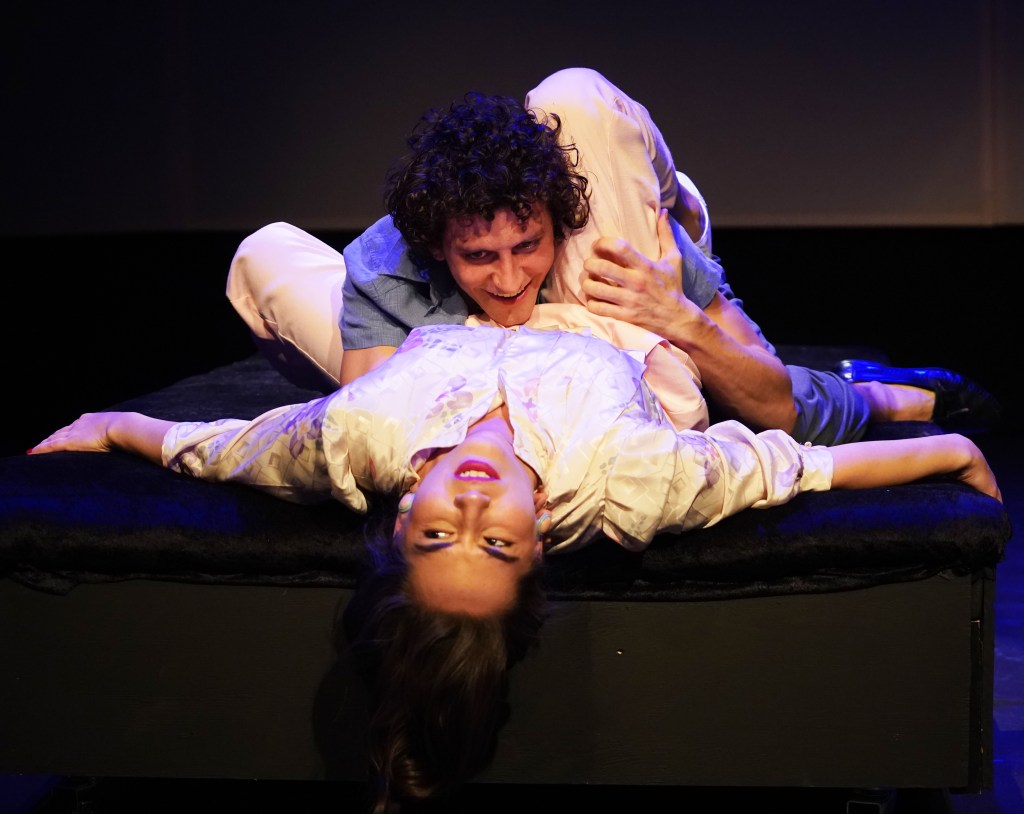
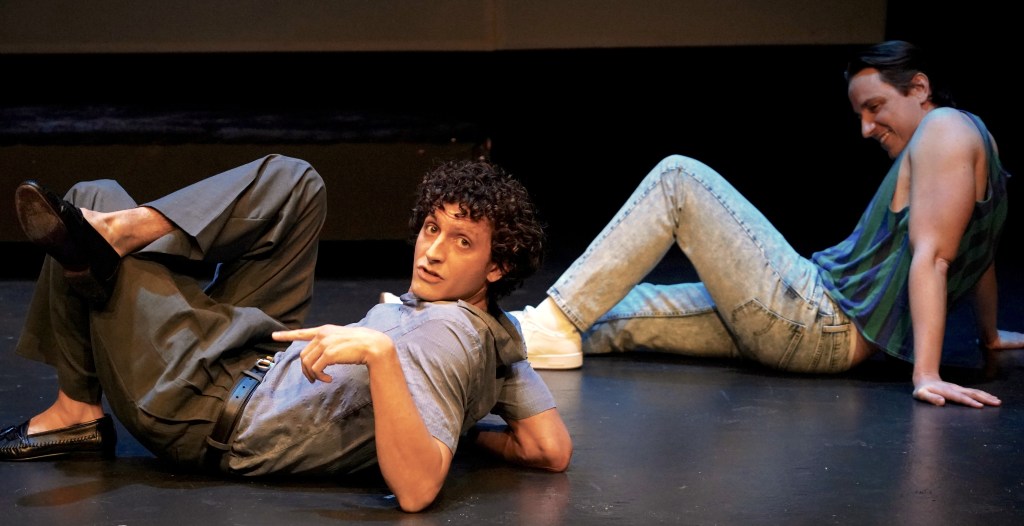
The gay friends include the caustic, jealous Frank (Ellis Charles Hoffmeister gives a humorous, edgy portrayal) the kindhearted, sweet Tommy (Charles Manning is spot-on) and Paul (Drew Valins is a quiet, sensitive buffer in the group). Paul is the one who alerts them to the “gay disease” and first identifies he has has “it.” Tommy and Frank also lust after the gay director Gerald (Michael Domitrovich, who co-wrote Tastes like Cuba with Machado). As they watch Gerald looking at Eduardo as he dances by himself, they become jealous when he joins Eduardo. Both Gerald and Eduardo feel “something” for each other and Gerald’s beauty unsettles him as does his kiss which humiliates Eduardo initially.
Clearly, the Ecstasy which is supposed to acclimate him to the gay bar makes him frenetic. Though Gerald proposes a future “date” of intimacy for them, it never pans out. In the interim, Gerald finds out he has the “unnamed” disease. Though Eduardo attempts intimacy, desperate to make a connection based on love, Gerald shows Eduardo the Kaposi sarcoma and pushes him away telling Eduardo he must “live” and continue working his art. Gerald doesn’t want to kill him. This is the first death knell of the play. It is chilling and tragic.
Additional flashbacks shift between Eduardo’s rehearsal with Marjorie in LA and his encounters with Donna (Heather Velasquez) who he cast in his play which she must later turn down. His relationships with Marjorie and Donna evolve as Eduardo’s ambivalence about his sexuality intensifies and rumors of the “gay disease” grow. His confused emotions turn into a confluence of attractions and “love” for Gerald and Donna. However, as with Gerald, his intimacy with Donna is never meant to be. Though he and Donna discuss a permanent relationship and divorcing their partners, by this point “the gay disease” is moving through the gay population with a vengeance and straight people are rumored to have it. Paul and Gerald are sick. We experience a growing dread because we know the dire consequences, though Frank boldly asserts, “I’m going to live my life.”

When Marjorie dies, Eduardo’s center collapses. He throws himself at his gay friends and tries to initiate intimacy to stave off his aloneness. However, when Frank and Tommy “fight” for him, interestingly, Tommy insists he will be with Eduardo. Frank, who is clear-eyed, accuses Tommy of being with Eduardo to protect him from AIDS, which at this point, they both have, though they don’t admit it. As Frank leaves in jealousy and disgust, Eduardo seeks comfort in Tommy’s embrace. Tommy makes sure they engage in “safe sex.” Though Tommy attempts to have Eduardo commit to him when he is in New York, Eduardo is a chameleon and he must be in the driver’s seat as his career takes off.
After his intimacy with Tommy and his last visit with Gerald who is dying of AIDS (d’Amato’s and Domitrovich’s powerful scene is beautifully wrought) Gerald dies and the rumor goes around that the AZT experimental drug they gave Gerald actually hastened his death. Gerald’s forever absence is an emotional devastation. Eduardo’s notions about bi-sexuality end in gay authenticity. When he shares that he can’t be with Donna and that he is gay, she takes him to an evangelical meeting to pray and exorcise the “gay” out of them. The scene is hysterical. The ensemble in masks becomes the aroused prayer warriors and Donna (Velasquez is LOL believable and funny) “shakes, rattles and rolls” releasing her “lesbianism.” She, too, is bi-sexual. When the same preacher (Domitrovich) exorcises the “gay” from Eduardo, Eduardo fakes it, then reveals he faked it. This blows up Donna’s plans for their divorces and marriage to each other. Outraged, Donna throws up her hands in a cross and tells the Eduardo “devil” to get away from her. Eduardo states to the audience that he never saw her again except in films which she swore she would never do again. He is thankful the exorcism didn’t work. (So much for gay conversion which was rampant at that time.)

There is no spoiler alert. You’ll just have to see the play to discover the direction d’Amato’s Eduardo takes with friends who are still alive and what his injunction is to the audience at the conclusion.
Mateo d’Amato with antic enthusiasm and “dramatic” verve that covers over a brooding loneliness, isolation and emotional pain, persuasively shows that the Latino Eduardo is hiding in plain sight. Lightning glimpses of the depths of his despair flash then vanish as the Ed persona takes over to dazzle, annoy, make jealous, provoke and boast about his exploits. Of all his gay “friends” Tommy appears to understand him best: understand his protests he is “bi-sexual,” understand his aloneness. It is Tommy who empathizes with him and loves him when he needs it most, though ultimately, he knows they are just friends.

One of the most important take-aways from the bold and profound Not About Me is we must and should remember and learn from the past. And if it is not in the DNA of some to learn and change and be better, then perhaps as some did then and still do now, go ahead and ignore the warnings, like Frank. Frank understands that regardless, he will live and he will die and it is best to live as he wishes and accept the consequences of his choices. However, underneath it all, we never find out if Frank goes ahead and intentionally infects others without “safe sex,” knowing he has AIDS. Unlike Frank, Tommy will not. Later in the play we understand after another event, Tommy is an incredible friend worth keeping.
For his part d’Amato’s Eduardo always plays it safe with a healthy fear of death and dying and solipsism. Certainly, the characters in Not About Me, who don’t make it are the innocent victims, not understanding what they were up against, until it was too late. For those who have been warned in our current time and don’t believe the consequences or ignore them not caring that they may infect others, the same cannot be said if they willfully, politically flaunt contagion and their contagiousness.

Machado’s play appears to be a labor of love seasoned with doses of self-revelation that filters youth through the wisdom of remembrance and understanding. It explores past foibles and “warts” through an opaque lens of forgiveness, through which one might emerge cleansed or guiltier than ever that one is spilling “truth,” yet hiding in plain sight. (Though Machado borrows from his life to make assertions, the play is a fiction.) Throughout, the playwright brings us to the present day, always with these questions. What has been learned? Are we as a culture any wiser? Is Eduardo the avatar any wiser after sharing his reflections, pain and emotions? Or are we evolving into a greater muck with “one foot on a banana peel,” as we attempt to race forward to forget? The play brings these and other questions to the fore in its tragicomedy and ironies.
Not About Me is a must-see for its hybrid genre, its re-imagined collage of truths and realities about a “distant time.” It is notable for its acute and interesting performances and fine ensemble work. The high points shine with black comedy and a sardonic tone. Even more notable are its gripping moments of drama in its portrayals of individuals who have died and now live as flashes of light and darkness and evanesce, once the play is over and the audience applauds the actors.
For those too young to remember that time, and for those who do remember recoiling at the “gay disease,” the playwright conveys what it must have felt like for his gay friends and himself, who endured and suffered as they watched others cycle through symptoms, feared death, tried to live, stopped thinking, and tried to move past heartbreak via drugs or escapism or love as they hoped that things would get better. They eventually did get better, until the whole world shut down in quarantine and “resurrected” over one million, two hundred thousand dead (Worldometer) in the U.S. Our three-year COVID anniversary is coming up in March for the shutdown, though COVID was in the culture long before that, as noted by former President Donald Trump in Bob Woodward’s Rage.

It would be remiss of me not to mention that the playwright is a friend whose classes I have enjoyed. Thus, this review has been one of the most difficult tasks as a reviewer and Drama Desk voter. That said, I highly recommend the play, especially for the younger generations, both straight and LGBTQ, who don’t even worry about AIDS contagion, thanks to Machado’s generation that went before them. For tickets and times go to Theater for the New City’s website https://theaterforthenewcity.net/
‘Des Moines,’ the Opaque and Mysterious Artfully Shine at TFANA

In Des Moines by award winning writer Denis Johnson nothing vital seems to happen during the time Dan, his wife Marta, their grandson Jimmy, Father Michael and Mrs. Drinkwater get smashing drunk and have a wild party in Dan and Marta’s modest second floor apartment in Des Moines, Iowa. Yet, in the 12 hours they spend together, much does happen. Connections are made, personal revelations are expressed and in each individual’s life, as a result of the dynamic interactions that take place, all experience a shift. For some it’s in perspective. For others the change is behavioral. However, in this deceptively “small” but mighty play, Johnson reveals the importance of listening to others’ faint soul cries and helping them relax into a zaniness that soothes.
At the play’s outset for a moment all is blackness. We hear a deafening roar, a loud cacophony of noise, a piercing, grating, rolling thunderous sound like a ripping away of the earth’s atmosphere as if a bomb had been dropped. We ask what is happening and what does that sound mean?
The lights come up on cab driver, husband Dan who has come home from work. He hits upon what the sound might be as he discusses with wife Marta that Mrs. Drinkwater, the wife of a man who died in a recent plane crash, has sought him out to ask him questions. Dan was one of the last people to speak to Mr. Drinkwater, when he took him to the airport, before he got in the plane that crashed in an embankment, killing everyone onboard. Thus, we put together the roaring sound at the top of the play with the plane engines roaring before the crash.

By the end of the play we are no closer to understanding the symbolism, though it is repeated during a blackout between scenes after a raucous party. Perhaps it symbolizes the “veil being rent,” what must happen in human consciousness to allow enlightenment and an awakening to flood the psyche with new understanding. Though Johnson makes references to being awakened and made aware, these concepts are fleeting, and unexplained.
This is one of the joys of Des Moines in which Johnson seems to suggest that human existence in its greatest depth is about understanding, empathy and the bridge of consciousness between and among people in the realms of their own experience. All of these elements at one point or another Johnson touches upon in each of his characterizations, portrayed by prodigious actors, who are incisively directed by Arin Arbus.

During Dan’s discussion with Marta, we understand that he is startled that Mrs. Drinkwater would seek him out to ask him questions about her dead husband. It is as if she looks for anything to bring her comfort through the trauma she’s experiencing from her partner’s strange death in a shocking, rare accident. During Dan’s discussion, the playwright raises questions about the fragility of life and the permanence of death. The conundrum of dying in life daily, momentarily looms, then vaporizes as Dan jumps to raw reality. He tells Marta how medical examiners attempt to identify the smashed bodies picked up at the crash site. From what he’s learned from Mrs. Drinkwater, the next of kin are asked to think about looking for one identifying feature of their loved one and not look at or imagine the entire body. Immediately, one’s loved one is reduced to one feature to better help the coroners during the cold and alienating identification process. This is another startling crash of death’s finality which shakes Dan.
Arliss Howard who portrays Dan with an organic realism and authenticity relays Dan’s concern about Mrs. Drinkwater. She is Black and Mr. Drinkwater was a prominent Black lawyer. Seeking information, Mrs. Drinkwater has shown up at the car garage daily to joggle Dan’s memory until he finally pictures her husband and remembers snatches of conversation they had in the cab before Dan dropped him off at the airport. Thus, an ancillary, “meaningless” conversation carries with it great moment for Mrs. Drinkwater and for Dan in light of the catastrophe of Mr. Drinkwater’s irrational and sudden death. Indeed, we are reminded if it happened to him, death will happen to us. Momento mori. Mortality is a hard fact Dan nor Mrs. Drinkwater can’t seem to negotiate, nor can Marta as we discover in her interaction with Father Michael when the priest visits.
Johanna Day as Marta is perfect as Dan’s patient, dutiful partner, who listens to Dan’s concern and gets the importance of this last conversation with the husband. Also, it isn’t unusual to her that Mrs. Drinkwater wants to know everything Dan can remember. We learn later that Dan and Marta, too, have suffered a sudden loss of a loved one. Thus, Mrs. Drinkwater’s endless questioning makes weird sense and reveals the pain and hurt she obviously experiences. It is a shared hurt for Dan and Marta, which we note later in Marta’s fleeting few words which vaporize into thin air, not belabored because the pain of loss has settled into the characters’ ethos, becoming a part of their consciousness.

From their interchange in the kitchen, we note that Dan’s and Marta’s is a close relationship. This closeness bears up throughout the play. They appear to be a typical, married, older couple who have lived together for years. However, on closer inspection, there is nothing typical about them. There is a profound comfort to their relationship that reveals a tight bond that connects them beyond understanding. This closeness especially manifests in their drinking, carousing, acceptance and love of their transgender grandson, who lives with them and who is wheelchair bound. They are also bonded together having experienced pain, loss and tragedy.
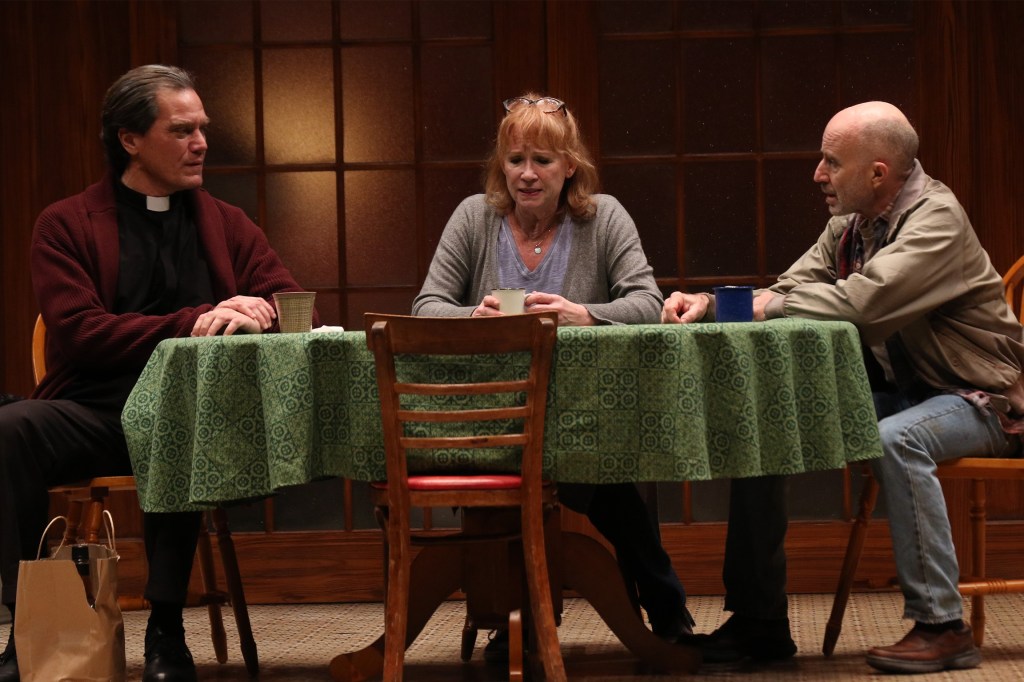
The character dynamics take off when Father Michael (the superb Michael Shannon) visits. Denis Johnson has set up Father’s Michael character by having Dan discuss with Marta that he saw Father Michael wearing make-up in front of a gay bar. Ironically, Dan mentions that he won’t feel so inferior or insecure at Confession knowing that Father Michael is less than perfect and most probably is gay. His response is all about forgiveness and an absence of judgment. And it is clear that this has now become a two way street of forgiveness and acceptance.
Marta has asked Father Michael to come over to receive comfort and perhaps prayer as she tells Dan that the doctors only gave her two to four months to live because the cancer has spread throughout her body. The only comfort Father Michael gives is his honesty in saying that death is a mystery and one can’t say much about it. However, the most accurate and hopeful comment he tells her is that the doctors don’t know everything. In other words their prognosis may be wrong. Father Michael ends any further discussion of Marta’s cancer and shifts to another topic abruptly which is humorous. Then the action gyrates so that Dan and Marta decide to pick up some beers as if the dire conversation never happened nor should happen. Dan and Marta promise to come back, leaving Father Michael with Jimmy (Hari Nef) in a blonde wig, rhinestone boots, make-up and wheelchair.
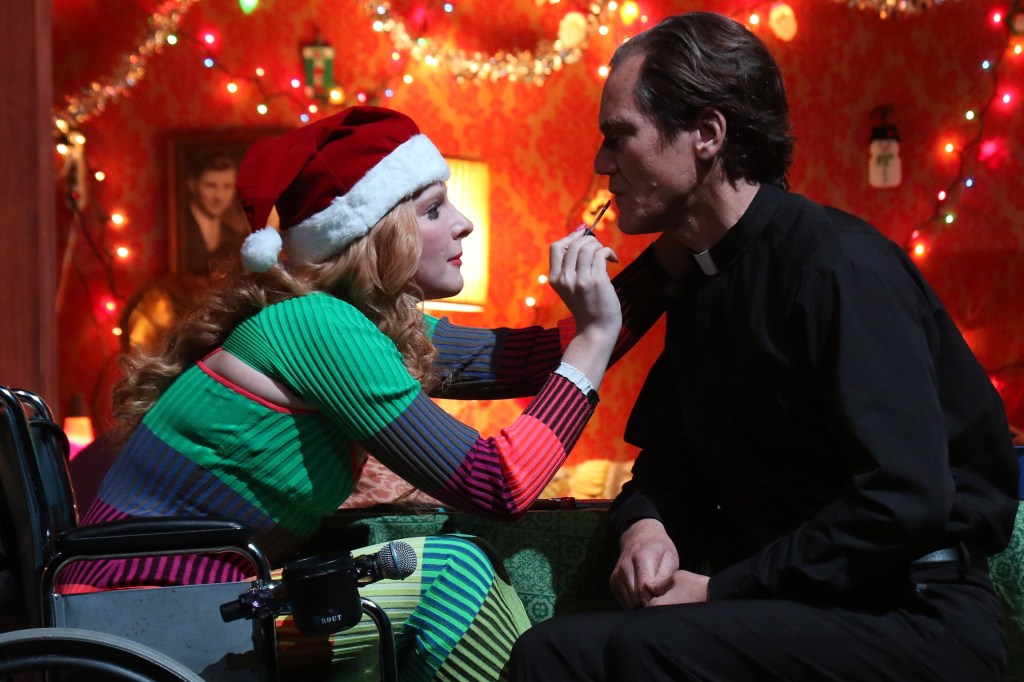
Jimmy who has been crippled by a doctor during the sex change operation appears to take this in stride. However, we discover what is motivating Jimmy’s apparent calm later in the play, the hope of walking again. The scene between Nef’s Jimmy and Shannon’s Father Michael is wonderfully acted, free and spot-on quirky. Jimmy tells Father Michael that he heard his parents discussing that Father Michael wears make-up. Father Michael is honest. Jimmy suggests that Father Michael allow him to be his make-up artist. Though Father Michael prefers putting on his own make up, with good will, he lets Jimmy add lipstick, rouge and eye-shadow to his face. The two bond during this amazing scene because the actors are “in the moment” superb.

As Jimmy, Hari Nef is adorably believable without pushing any of “behaviors” to get a laugh. Shannon’s prodigious versatility as an actor has him portray cruel thugs (Bullet Train) and Elvis (Elvis and Nixon) to name a few of his screen roles. As Father Michael he is organic, hysterical and profound. He negotiates the whimsical and empathetic priest with an uncanny and otherworldly aspect. Shannon’s delivery of Father Michael’s most philosophical and trenchant lines is sheer perfection in their tossed away thoughtfulness. It is as if Shannon’s Father peers into another realm, expresses what he sees, then retracts from it like nothing extraordinary has happened, though it has.
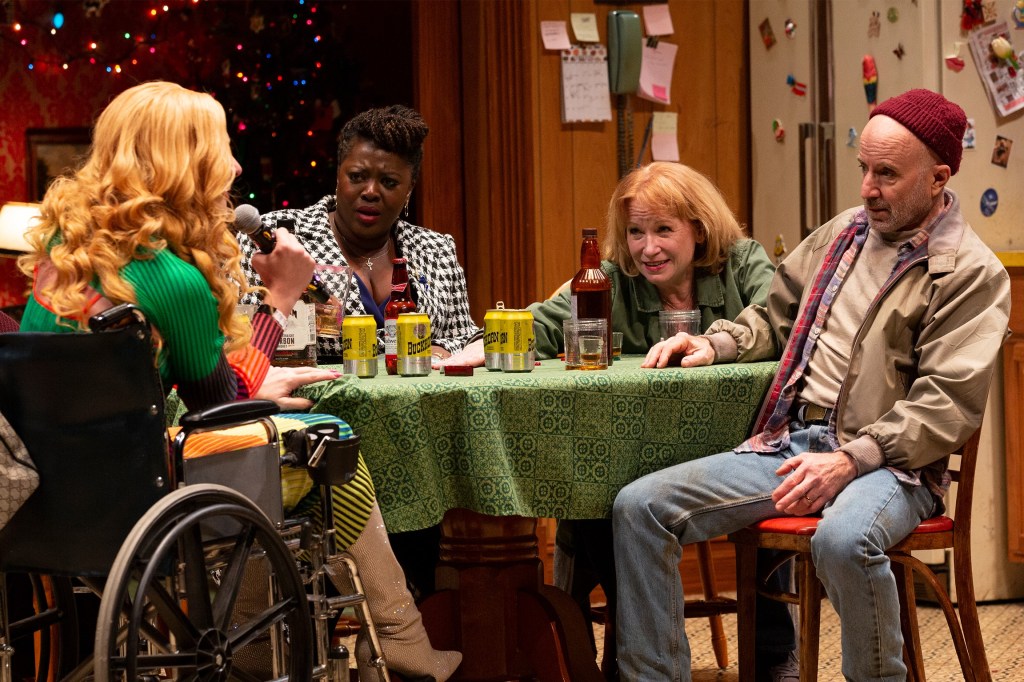
To round out the gathering Mrs. Drinkwater (the heartfelt Heather Alicia Simms) shows up looking for the gold wedding band that she gave Dan and forgot to take back. Dan and Marta have not returned with the beers, so Father Shannon and Jimmy introduce themselves and Mrs. Drinkwater tells them that her husband was killed in the plane crash. Abruptly, Father Michael announces that they need to have drinks and specifically, depth chargers (shots dropped in a mug of beer). At this point, the wild party begins and when Dan and Marta return with more beer, the events revolve upside down and sideways as each takes their turn at Karaoke and “lets it all hang out.” Kudos to Hari Nef, Michael Shannon and Heather Alicia Simms for their passionate renditions of their solo numbers.

The fun is in watching the actors enjoy themselves to the hilt and in the process, convey the loneliness and angst each of the characters personally experiences. We appreciate the drunken camaraderie and comfort they share. It is better than that of “old friends” who know “too much” of their pain and torment. Nevertheless, they have just enough information about each other. They understand that they all are imperfect and have experienced loss, uncertainty, confusion. They have been tossed about by life’s seemingly random trials, forced to assign their own meaning to the haphazard and horrible events. Theirs is the sticky understanding that they can help each other through their personal crises that none of them can specifically explain because it can’t be articulated. All they can do is state concrete facts about conditions. But underneath are miles of subsurface emotions, psychic damage, pain, fear, sorrow.

The hope is that they are alive with the determination to keep on “truckin’,” as they receive solace in understanding the ubiquity of their absurd-life-in-death condition. They, like all human beings, roll a metaphoric boulder up a hill, knowing at the top they will slip and fall to the bottom. Then, they will have to do it again and again does Sisyphus of Greek mythology.
For Dan and Marta, the loss of their daughter who overdosed is most acutely felt, a fact they mention then drop. For Mrs. Drinkwater, the loss of her husband has dislocated her and upended her identity about herself. Who is she now and how does she define herself without him? For Nef’s Jimmy, the paralysis is devastating, but it may not be permanent. At one point when Jimmy is alcohol buzzed, he stands up and proclaims that he, “will walk again.” Lastly, Father Michael is negotiating his physical person, his celibacy, his marriage to Mr. Drinkwater (a mysterious notion) and his straddling the otherworldly realms of consciousness and spirit.
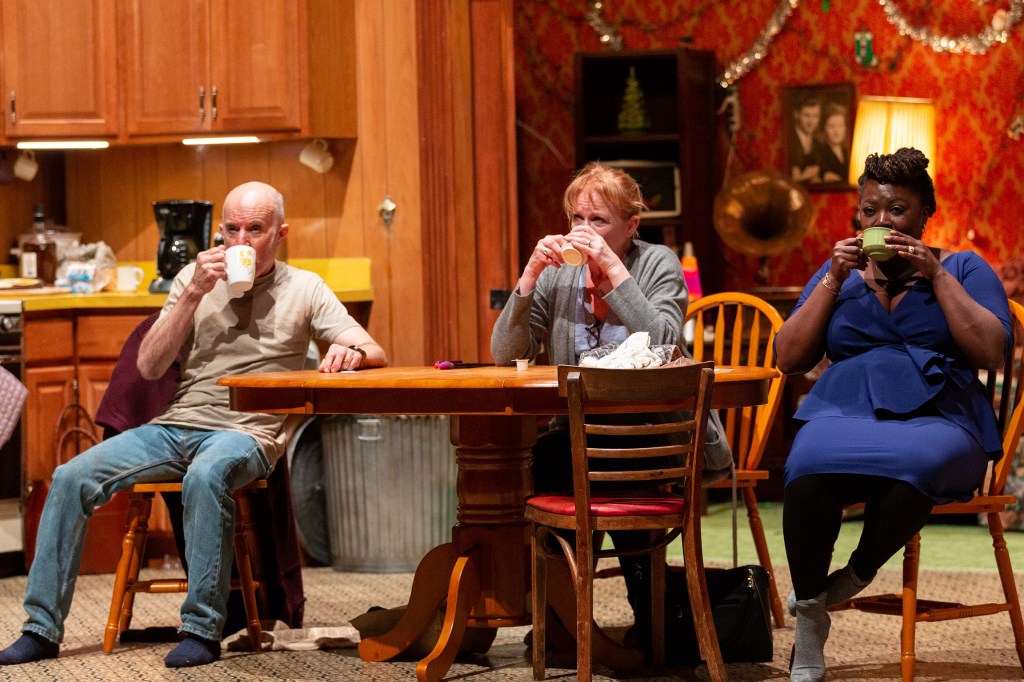
Johnson’s play cannot easily be pinned down in its hybrid, comedic absurdism and avant garde elusiveness. It zips along with unlikely and surprising twists with every character dynamic and every character expose. Its strong spiritual themes about life, the afterlife, consciousness and no boundaries between and among these realities, are thought-provoking. The ensemble’s acting is top-notch and their team work reaches a high-point when each performs their solos while the others move into themselves, all creating an exceptional, flowing dance.
Arin Arbus has staged the wildness so that it is zany yet meaningful with the help of Byron Easley (choreographer). Riccardo Hernandez’s scenic design, Qween Jean’s costume design, Scott Zielinski lighting design and Mikaal Sulaiman’s original music and sound design effectively capture the director’s vision and enhance Johnson’s themes about human nature, pain and seeking to escape from it with like-minded others through alcohol or just letting go. In this production, which emphasizes humanity, forgiveness, understanding and empathy, we realize the isolation of individuality and the commonality of emotions whether joyful or sorrowful, that often prompt escapism to crazy, if only for a moment in an eternity of time.
This is one to see. It ends January 8 and runs with no intermission. For tickets and times go to their website https://www.tfana.org/current-season/des-moines/overview
‘A Child’s Christmas in Wales,’ Tidings of Comfort and Joy in Dylan Thomas’ Reflections

Irish Repertory Theatre’s A Child’s Christmas in Wales by the brilliant Dylan Thomas, adapted and directed by Charlotte Moore hits the spot for Christmas loveliness and grace. An old-time favorite of Irish Repertory Theatre, this is the sixth version they have produced since their first adaptation in 2002 of A Celtic Christmas. Thanks to Charlotte Moore’s prodigious dramatic talents this is one of the most heartwarming, elegant and memorable of versions and I’ve seen a few. Perhaps it is because of its simplicity as a chamber musical, which features poignant songs written by Charlotte Moore, and the favorite traditional carols of the season, one receives a new appreciation of Christmas. Its vitality in bringing together a community that greatly longs to erase thoughts of separation that have characterized the past few years, cannot be underestimated.

For this production of A Child’s Christmas in Wales, the stage is flanked with tall, stalwart looking Christmas trees uniformly lit against a mirrored background which adds to the stage width and depth, thanks to John Lee Beatty’s set design. There are even large presents tucked away in a back corner on the left side of the stage continuation. The light reflections, and nuanced lighting (Michael Gottlieb) softly enhance the six singers. These include Kerry Conte, Ali Ewoldt, Jay Aubrey Jones, Kylie Kuioka, Ashley Robinson and Reed Lancaster, who was covering for Dan Macke the night I saw the production.
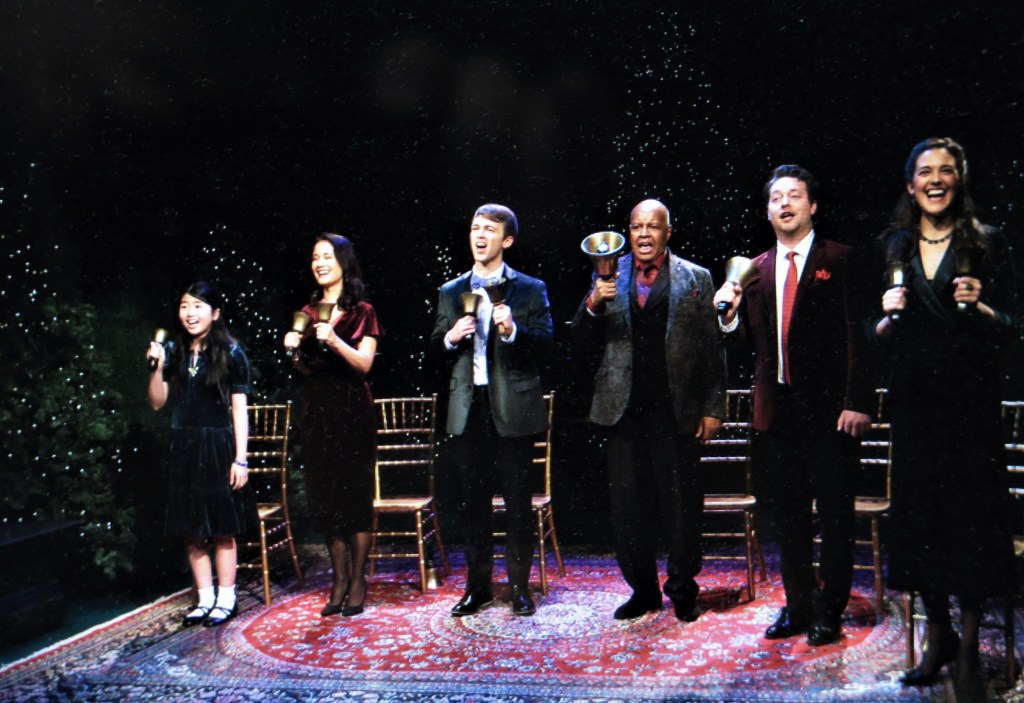
The trees in their arrangement are an excellent choice not only for their placement but for their symbolism representative of Christ and Christianity. The fir tree was widely adopted during the Victorian Age after a picture of Queen Victoria, German Prince Albert and their family appeared in Illustrated London News. Queen Victoria was so popular that the public became enamored of the royal family standing around the decorated, tall, fir tree. They clamored to make it fashionable, cutting down their own trees or purchasing them from vendors after demanding them. Certainly, the historic Christmas captured by Thomas’ gorgeously poetic language seems best ringing out the holiday season with the trees as a evergreen, mythic backdrop.
The music supervision by John Bell and music direction by David Hancock Turner are impeccable. I particularly enjoyed the carols I hadn’t heard in a long while, the traditional ones like “A-Soaling” (Hey, Ho, Nobody Home), “I Don’t Want a Lot for Christmas” and the humorous “Miss Fogarty’s Christmas Cake.” There are songs sung in Welsh “Tawel Nos” (“Silent Night”) which moves to a beautiful segue of “O Holy Night.” And I was surprised to discover that “Deck the Halls,” All Through the Night” and “Suo Gan” are traditional Welsh songs.

I felt an otherworldly appreciation of the carols and live music and singing arranged with thoughtfulness and joy. Thoma’s clever and poignant remembrances narrated with every attention to his incredible wordcraft by the ensemble remind us of a romantic past that we all long for. I am so sick and tired of the canned, artificial music signaling commercialism and grasping greed as it pipes over the loudspeakers of big box stores and various establishments. I do hope this chamber musical was recorded. Its one-of-a-kind exceptionalism in its celebration of a historic time before cell phones, mass media, television and the complications of what at times seems like overwhelming chaos, is bar none.

What was another pleasant surprise were the songs “Take My Hand, Tomorrow’s Christmas,” “Open Your Eyes,” and “Walking in the Snow.” The music and lyrics are Charlotte Moore’s and they appropriately threaded throughout the 75 minute presentation among Thomas’ memories that speak of childhood innocence, frankness (in his recall of the quirky aunts and uncles) and sense of security and safety embraced by a loving family. His work is a milestone and thankfully Irish Repertory Theatre has shared its immutable glory with us, reminding us of family, friends, love, community, history and the meaning of such vital themes that strengthen our lives.

David Toser’s costume design are befitting of the fashionable stylishness of a lovely holiday party where everyone is shining in their finery like their own decorated Christmas trees. In this “never to be forgotten day at the end of the unremembered year” Thomas’ snowy Christmas Day in Wales at the Irish Repertory Theatre is a stunner whose nostalgia is all the more affecting now that Christmas has passed.

See it before it closes. For tickets and times go to their website: https://irishrep.org/show/2022-2023-season/a-childs-christmas-in-wales-4/
‘Not About Me’ Coming to Theater for the New City
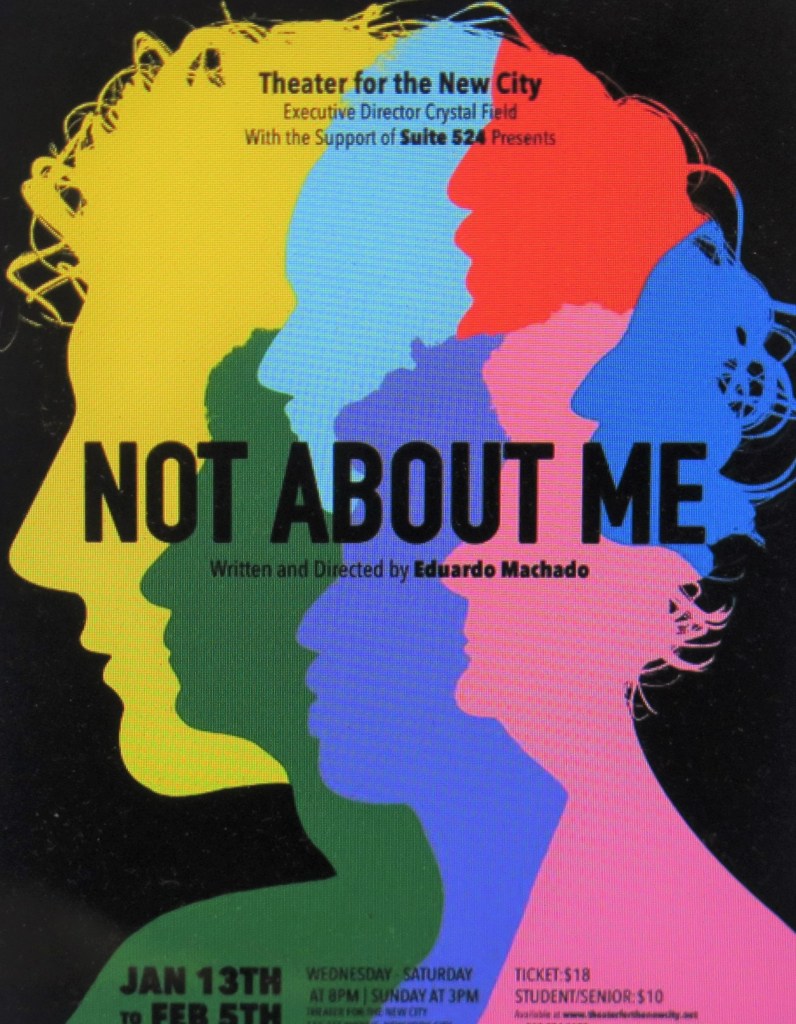
Theater for the New City,
with the Support of Suite 524,
Presents
the World Premiere of NOT ABOUT ME
Not About Me is written & directed by Eduardo Machado (Havana is Waiting, “Hung,” “Magic City”)
The Limited Off-Broadway Engagement Begins Friday, January 13th
Theater for the New City (Crystal Field, Executive Artistic Director), the Pulitzer Prize winning community cultural center that produces over thirty premieres of new American plays each year, is pleased to announce the world premiere of Not About Me, written and directed by acclaimed playwright Eduardo Machado.
Not About Me will begin previews Friday, January 13th with Opening Night set for Wednesday, January 18th (8pm), at Theater for the New City (155 First Avenue, between 9th and 10th Streets). This limited Off-Broadway engagement will continue through Sunday, February 5th only.
The cast features Mateo d’Amato, Michael Domitrovich, Crystal Field, Ellis Charles Hoffmeister, Charles Manning, Drew Valins, and Heather Velazquez.
The creative team for Not About Me includes Mark Marcante (scenic design), Sean Ryan (production design), Alex Bartenieff (lighting design), Kelsey Charter (costume design), Bird Rogers (projection design), Emily Irvine (puppet designer/maker), and David Margolin Lawson (sound design). Not About Me will feature original music by Michael Domitrovich.
Not About Me is a memory play that takes audiences on a haunting journey through the mind of a playwright during COVID-19 lock downs. Long buried memories of friends lost to a mysterious “gay” disease come crashing into the present, and he is compelled to examine his artistic and political life in the theater. This play is a bittersweet reflection on how tragedy can unearth pain and laughter and bring back to life the treasures buried in the past.
“During the first summer of the lock down one of my best and dearest friends died of COVID. For the next three years all I could think about was all my friends that died of AIDS when I was in my twenties. COVID-19 brought the end of a certain way of life, as did AIDS in the 1980s. What had been a time of freedom and joy, a time when anything could happen, came crashing to a close, as our own sexuality became our illness. Queer people of a certain age know what this is like. Now, in 2022, the whole world has gotten a taste. We must speak out so the world can change to something better once again,” said Machado.
Eduardo Machado was born in Cuba and came to the United States when he was eight and grew up in Los Angeles. He is the author of over fifty plays, including The Floating Island Plays, Once Removed, Stevie Wants To Play The Blues, A Burning Beach, Havana Is Waiting, The Cook, Mariquitas, Worship, and Celia & Fidel. They have been produced at many major regional theaters, as well as in Europe, South America and Off-Broadway including, among others, The Actors Theater of Louisville, Mark Taper Forum, Seattle Rep, Goodman Theatre, Hartford Stage, Theatre for the New City, Long Wharf Theater, Williamstown Theater Festival, Arena Stage in Washington D.C. Cherry Lane Theater, INTAR, Ensemble Studio Theatre, American Place Theater, and Hampstead Theatre in London.
Mr. Machado’s television credits include Executive Story Editor on Season 2 of the drama “Magic City” (Starz) and two seasons on the HBO’s “Hung.” He has written pilots for Starz, Amazon, and AMC. He wrote and directed the film Exiles in New York, which played at the A.F.I Film Festival, South by Southwest, Santa Barbara Film Festival and Latin American International Film Festival in Havana, Cuba. He has directed numerous plays, including his own works and those of emerging writers. As a director his work has appeared in numerous regional theaters including INTAR, Theater for a New City, EST, Mark Taper Forum, Culture Project, Playwrights Collective, The Company Theater, Cherry Lane Alternative, Flea Theater, Group Theater and the Inner City Cultural Center.
Mr. Machado has taught playwriting at Columbia University (Head of Playwriting 1997 to 2007), NYU Tisch (Head of Playwriting 2007 to 2018), and HB studios since 2020. He also taught at the Public Theatre, Mark Taper Forum, Sarah Lawrence College and the Playwrights Center. He has served as an Artistic Associate at The Public, the Flea Theatre/Bat Theatre Company, and The Cherry Lane Alternative. He was playwright-in-residence at The Mark Taper Forum. From 2004 to 2010 he was the Artistic Director of Off-Broadway’s INTAR Theatre.
He is the recipient of the Raúl Juliá HOLA Founders Award and the Berrilla Kerr Grant for contribution to American Theater. Other grants and awards include: AT&T: Onstage Grant; National Endowment for the Arts and Theater Communications Group Playwrights In Residence Fellowship at Theater For the New City; Bernice and Barry Stavis Playwright Award from the National Theatre Conference; two Dramalogue Awards, Best Play; three LA Weekly Awards; Theater Communications Group and Pew Charitable Trusts National Theater Artists Residency Playwright In Residence, Mark Taper Forum, Los Angeles, CA; Viva Los Artistas Award from the city of Los Angeles; Ford Foundation Grant; Rockefeller Foundation Playwriting Award; three National Endowment For the Arts Playwriting Grants; and National Endowment for the Humanities Youth Grant.
He is a member of the Actors Studio, Ensemble Studio Theater, and an alumnus of New Dramatists. He has served on the boards of TCG, New Dramatists and Theater for the New City.
Two collections of Mr. Machado’s work, The Floating Island Plays and Havana is Waiting and Other Plays, are published by the Theatre Communications Group. His plays are also published by Samuel French. Tastes Like Cuba: An Exile’s Hunger for Home, a food memoir by Eduardo Machado and Michael Domitrovich, was released by Gotham Press.
Not About Me will be presented at Theater for the New City (155 First Avenue, between 9th and 10th Streets) from January 13th through February 5th. Performances will be Wednesday through Saturday evenings at 8pm, with matinees Sundays at 3pm. Opening night is set for January 18th. Tickets are $18, student tickets $10 and may be purchased by calling 212-254-1109 or online at https://theaterforthenewcity.net/shows/not-about-me/
‘Becky Nurse of Salem’ a Dark, Comedic Must-See at Lincoln Center
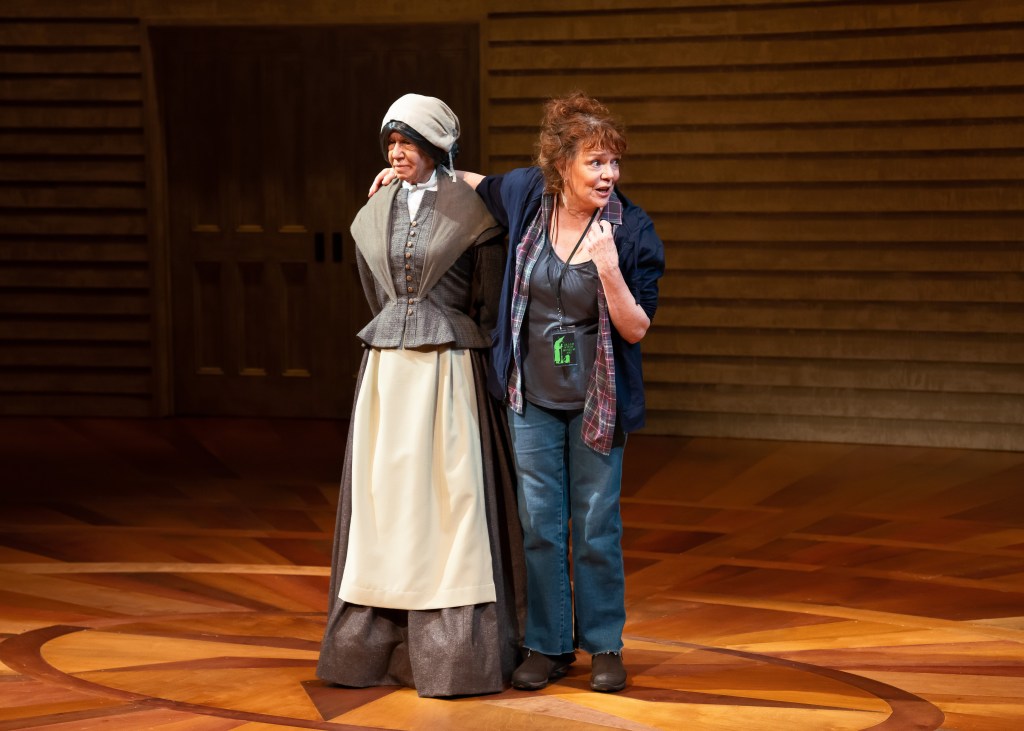
In Becky Nurse of Salem, Deirdre O’Connell (Tony, Obie, Outer Critics Circle award-winner for Dana H) is luminous. O’Connell portrays Becky Nurse, descendant of Rebecca Nurse who was convicted and hanged as a witch during the Salem witch trials. The actor, incisively shepherded by director Rebecca Taichman (Indecent) does a yeowoman’s job in a role that flies high in humor and crashes into tragedy and remorse at the two-act play’s heart-felt and satisfying conclusion.
Written by Sarah Ruhl (The Clean House, How to Transcend a Happy Marriage) the play artfully rides on a meme printed on protest signs during the global Women’s March of 2017, a march which took place the day after former President Donald Trump’s sparsely attended Inaugural celebration. Some of the signs read: “We are the Great, Great, Great Granddaughters of the Witches You Were Not Able to Burn.” Selecting the concept that women have transported themselves from that time to this and achieved prodigious exploits, then have been regressed by the Supreme Court’s Dobbs decision and the Republican penchant for misogyny and repression of women’s rights, Ruhl’s play speaks to many issues with currency, vitality and humor.
Running at Lincoln Center Theater at the Mitzi E. Newhouse, the sardonic comedy investigates how the descendant of Rebecca Nurse has dealt with her haphazard life in Salem, Massachusetts, where she gives tours in the the Museum of Witchcraft, riding the coattails of her famous ancestor’s “cursed” reputation. On another level, Ruhl reveals that women still abandon each other and are abandoned by a culture surreptitiously steeped in patriarchal folkways, that suppress and stifle their growth professionally and individually. That rejection and judgment sets them up to pursue other ways to achieve what they want, some of them illegal and many of them ineffectual, causing them to plunge into a downward spiral, wasting their talents and intelligence.
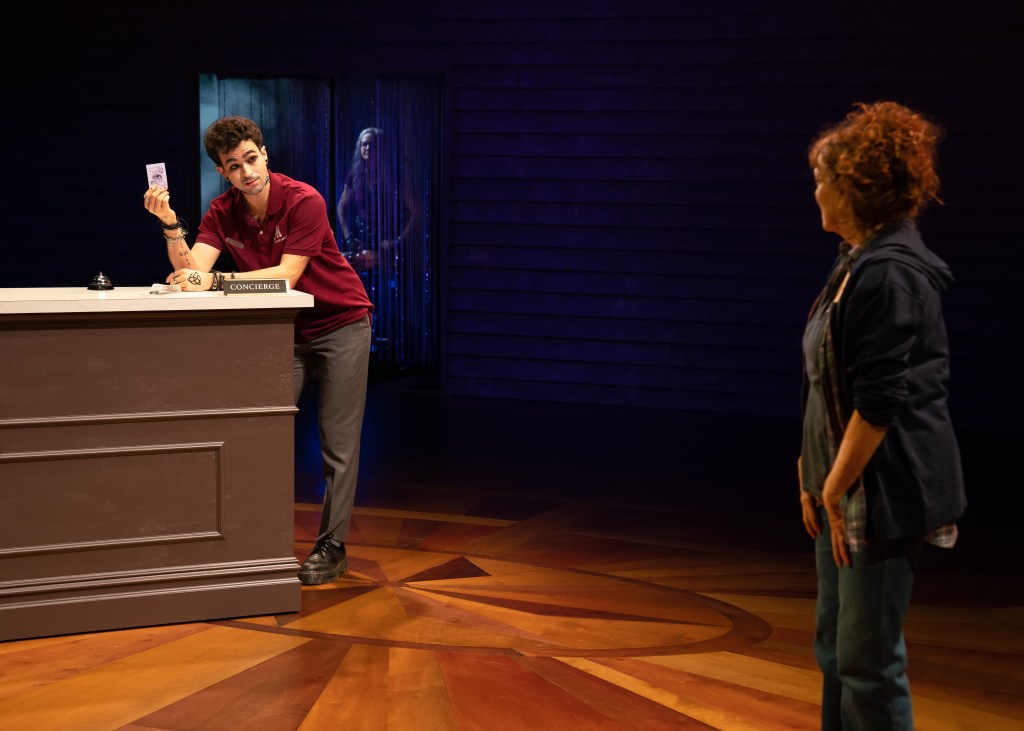
Ruhl’s humor, under the clever direction of Taichman, develops into full blown belly laughs as Becky attempts to negotiate the ruins of her angst-ridden life, after telling off her new museum boss Shelby (Tina Benko). Her boss censures her for saying inappropriate epithets and getting carried away with what Shelby believes to be misinformation about “Gallow’s Hill.” Becky swears that the real place where Rebecca Nurse and the other women were hanged is on the spot of the second Dunkin’ Doughnuts farther away from the center of Salem. Shelby calls her down for spreading falsehoods, though clearly, as a non resident, she doesn’t have Becky’s information on the background of Salem.
Becky is the type of individual to be spunky, individualistic, strongly autonomous and not easily given to “obeying” someone she determines to be an inferior, despite her credentials. Though Becky apologizes, this isn’t enough for the arrogant Shelby who summarily fires her without hearing her pleas. It fits in with the plans for having the museum turn a profit without the overhead of salaries. Over ego and presumption, the competitive Shelby upends Becky’s financial security. The job has allowed Becky to support herself, pay her granddaughter Gail’s medical bills and generally get to the next day caring for herself and Gail. Shelby’s cruel firing leaves her with no recourse except to find another job in an area that has seen record unemployment. When Becky is cut out of the only job in town she is qualified for, Stan, who got the job, gives her the card of someone who can help her. She is a a witch.
Becky seeks the only safe place left open to her away from her own backward movement and regression. She goes to Stan’s recommended witch (the hysterical Candy Buckley whose twanging Boston accent is milked for well-placed laughs). Additionally, she also throws herself on the mercy of Bob (Bernard White), a high school sweetheart, now married, who owns a bar. She asks Bob for cash to pay the high-priced witch to end the Rebecca Nurse curse, and other expenses as the play unfolds with conflict upon conflict. Becky must reconcile her worsening problems or end up totally succumbing to the curse of her ancestor which appears to be directing her life toward complete failure and destitution.

Buckley’s Witch and O’Connell’s Becky make nefariously funny bosom buddies in changing the trajectory of Becky’s life since she can’t count on the culture to help her. Ruhl’s themes about women having to come up with ingenious ways to support themselves is clear in Becky’s reliance on witchcraft. The clever, randy spells that the Witch concocts for Becky prove to be effective on Bob who is entranced with his old sweetheart. Bob may be an answer to her financial problems, as men usually are for women who cannot sustain themselves due to a myriad of reasons, including unequal pay and unequal opportunities. The scene where Bob emerges in his underwear dancing to Donovan’s “Season of the Witch” as Becky joins him and they have a mild sexual romp is priceless. The scene, the choice of music is superbly directed by Taichman for maximum humorous effect. Both actors carry if off with authenticity and hysterical playfulness.
Unfortunately, when things appear to be going swimmingly for Becky with her new love and revenge on her former boss succeeding when she falls and breaks a limb, the worm turns. The universe which has been bent to the arc of the two women’s magical contrivances upends. During Bob’s love fest with Becky, he collapses and has a heart attack which places him in the hospital. There, Bob has a vision of the Virgin Mary who reminds him of his vows and his marriage and gives him an ultimatum if he wants to live. Thus, he must give up his adulterous relationship with Becky and sell his bar.

Meanwhile, Becky, convinced she can use the waxwork of Rebecca Nurse to conduct her own tours on the background of the real Salem witch trials freely goes off the museum’s canned script. She informs an interested group that The Crucible, Miller’s play is filled with inaccuracies. For example Abigail’s age in reality was 11 years old, but Miller, who fantasized about sleeping with Marilyn Monroe, made her older and lusting after John Proctor to satisfy his own fantasies about the celebrity. Becky insists that rather than it be a play about John Proctor’s “virtue” what really happened was 14 women were hanged, something that Miller didn’t portray accurately, nor did he care about. In one of the funniest lines in the play Becky says, “…our country’s whole understanding of the Salem witch trials is based on the feeling–of I want to fuck Marilyn Monroe, but I can’t fuck her.”
At that juncture, an officer interrupts her tour and arrests her because she has been charged with theft. She was caught on tape stealing the lifelike wax figure from the Museum of Witchcraft in order to fulfill the last part of her spell to achieve wholeness and to earn some money in her newly self-created job. But at the point of the arrest, there is a pivot in time magically. The setting regresses to 1692. A crowd (all who judge her in the present-Bob, Witch, Shelby, Gail, Stan) dressed in pilgrim outfits scream, “Lock her up!” Because she dares to question why she is being arrested, she transgresses the laws, an insult to the officer. Act I ends in the throes of her panic and fear as the crowd in pilgrim garb demands, “Lock her up. Kill the witch. Lock her up.”
As the complications arise and boil over by the end of Act I, we have watched the character of Becky become unraveled as she takes more pain pills and makes untenable decisions. Though she is obsessed with wanting to change her life, she has neither the means, the nature, nor the sobriety to find a path which will lead her to success. Everyone except the Witch has turned against her. They can offer no route out of the morass she’s built for herself in her Salem life. And to make matters worse, while she is in jail, Shelby ends up taking care of Gail and applying for custody of her granddaughter. It is both an emotional and psychic blow as Shelby now has the upper hand over every aspect of her life.

How Taichman and Ruhl bring Becky to her knees leading to the court trial where she raises herself up to admit responsibility and become accountable for her own actions is the crux of Act II. Vitally, Ruhl brings together thematic elements from 1692 with the present to magnify the issues Ruhl introduced in the beginning. Ruhl intimates that the threads of Becky’s self-destruction are rooted in paternalistic folkways which encourage women to accept victimization and passivity rather than to struggle and fight to empower themselves. Indeed, as Ruhl points out the through line from the 1700s puritanism to the present, such behaviors are culturally learned, generational patterns that are difficult to extricate oneself from. Even Shelby spouts the rhetoric that is most current as a “liberal” but is a hypocrite, incapable of employing the substance of what progressiveness is, women helping women. Instead, Shelby competes and follows what is most damaging to the town, its legacy and future. Her taking in Gail on the surface appears kind but is questionable.
Taichman’s and Ruhl’s vision combines the best of humor, drama and profoundly current concepts. To do this she relies on a superb ensemble with O’Connell, White and Buckley as standouts.
Kudos to the creative team who conveys the settings and provides the chills that leak from the past to the present and back again. Particularly effective are the projections of the black birds symbolizing the occult and perhaps evil spirits at salient points in the play. These are effective thanks to Barbara Samuels lighting and Tal Yarden’s projections. The sets are effectively fluid and mimalistic thanks to Riccardo Hernandez. The costumes designed by Emily Rebholz are eerie enough to remind us of the fearful pilgrims.The waxwork of Rebecca Nurse is sufficiently life-like to imagine her presence being enlivened for a twinkling moment, then vanishing as all things magical are wont to do.
Because of Taichman’s direction, the production translates into masterful performances with high energy, LOL humor and current themes without relying on rhetoric or cant. This is not easy. Taichman, Ruhl, the actors and creative team make this comedic play a must-see. For tickets and times go to their website: https://www.lct.org/shows/becky-nurse-salem/
 CAROLE DI TOSTI