Category Archives: Off Broadway
‘White Rose the Musical,’ Impactful, Uplifting

Inspired by true events, White Rose the Musical with book and lyrics by Brian Belding and music by Natalie Brice, reveals the important story of heroic and morally engaged university students, who, at great risk to themselves, took a stand against Hitler’s Third Reich killing machine with paper, a mimeograph, ink and spiritual courage. Directed by Will Nunziata, with orchestrations by Charlie Rosen, and music direction, supervision and arrangements by Sheela Ramesh, White Rose, the Musical is a tour de force that resonates for us today.
Currently in its premiere at Theatre Row in a limited engagement until March 31st, the musical holds vital themes that uplift the human spirit. Importantly, it reminds us to stand against political criminals who would usurp power, murder, and destroy human rights to maintain their agenda of domination.
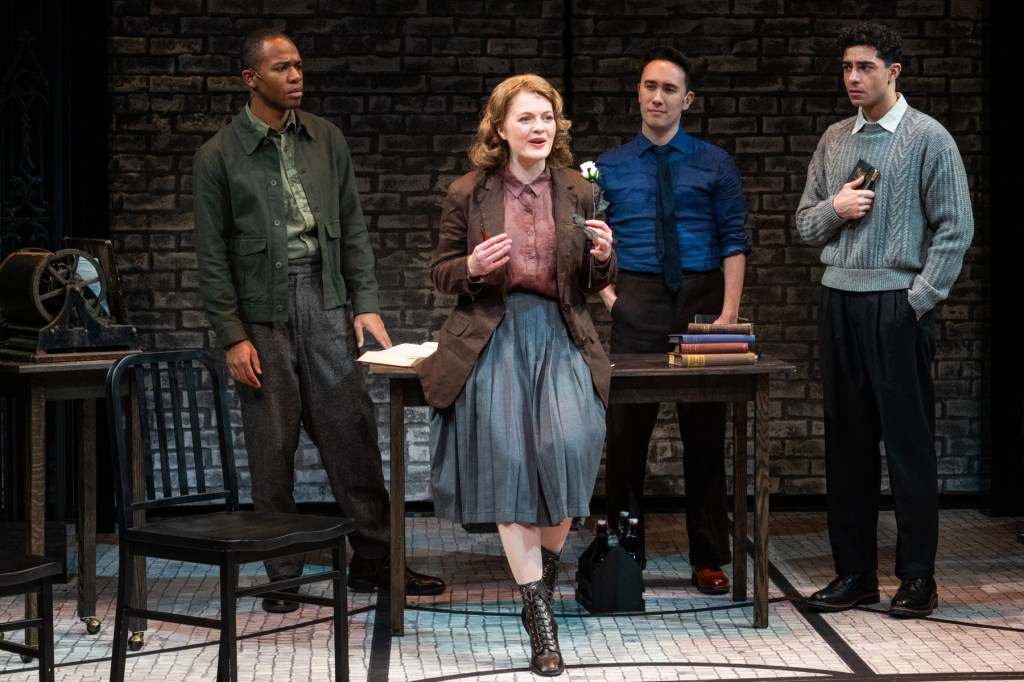
Celebrated throughout Germany today with memorials of school, street, fountain and plaza names, the group who identified as the White Rose printed and distributed leaflets and risked their lives to inform German citizens about the Nazi terrorists. They dared to countermand the brainwashing propaganda of Goebbels that dominated German culture and society. Their main purpose was to inspire and encourage citizens and create a community who did not feel alone against Nazi brutality, so they might resist, speak out and denounce the Third Reich in whatever way possible.
Belding begins the story with brother Hans Scholl (Mike Cefalo), and sister Sophie Scholl (Jo Ellen Pellman), looking out over a balcony readying themselves to take a final decisive action. Before they do, they recall to their remembrance how they arrived at this crucial moment from which there is no turning back. What follows is a flashback that reveals the arc of how the White Rose came into being, who was involved with the group and how they motivated citizens to take a stand with non-violent resistance.
In “Munich” Sophie Scholl sings about her decision to break away from activities elsewhere and join her brother Hans (Mike Cefalo), a medical student at the University in Munich. There, she takes a class with Professor Kurt Huber (Paolo Montalban), and meets Hans’ friends Willi (Cole Thompson) and Christoph (Kennedy Kanagawa). Willi is hopeless (“I Don’t Care”) about what is happening in a society cowed by the police and Gestapo overlords who monitor citizens’ every word, look and deed, ready to arrest anyone who even breathes counter to Nazi propaganda and Hitler’s political ideology.
It is 1942 and by this point in time, from books to decadent works of art, priceless cultural artifacts have been confiscated and banned, and professor Huber can only teach a censored curriculum approved by Hitler and his propaganda minister. Nevertheless, the professor manages to get around the bans and inspire his students to think, question, (“Truth”), and not allow themselves to be seduced by Nazi propaganda.

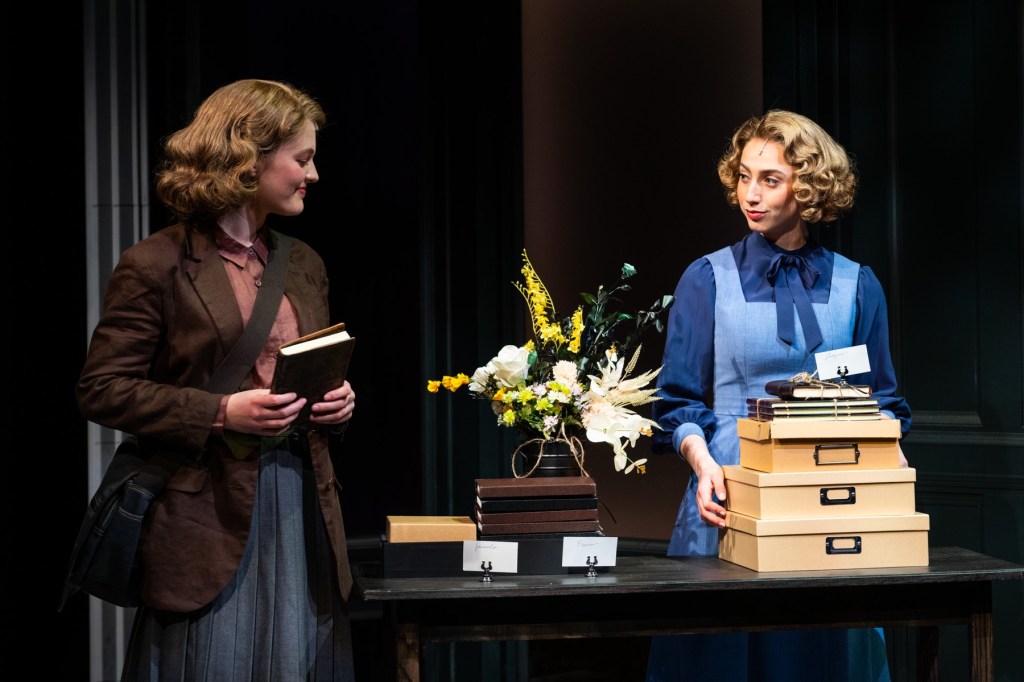
A series of events help to raise the consciousness of the activist students (“Blind Eye”). The oppressive social order impassions Sophie (“My Calling”) and Hans (“The Sheep Chose a Wolf”). With Hans’ friends they form the” White Rose,” a name which reflects innocence and goodness pegged against the dark storms of Nazism. First, they write anonymous letters against the Third Reich and send them to addresses of those living in Munich. When Sophie becomes friends with shopkeeper Lila (Laura Sky Herman), who gives her a mimeograph machine, Sophie and the others create leaflets and leave them on the streets where citizens can read their exhortations.
Complications develop. Frederick (Sam Gravitte), who is on the police force but answers to Nazi handler Max Drexler (Cal Mitchell), protects Sophie from being arrested. We discover that Frederick, who was a friend of Hans, knew their family. He and Sophie had a relationship then broke up. Now, when he suggests that they escape to Switzerland, (“Run Away”), it is too late. Sophie has found an important mission that gives meaning to her life, and she is not going to leave it for Frederick who is blind to the consequences of his complicity, however minor, with the Third Reich.

When Professor Huber becomes involved with the White Rose, they determine to step up their plans to engage the public. For example, they learn the elderly and handicapped are being euthanized as a part of the Nazi “master race” cleansing program. Thus, their moral imperative to encourage resistance and rebellion (“Why Are You Here?” “The Mess They Made”), gains greater impetus in the service of saving lives.
To expand their sphere of influence, Huber involves his friend Karl Mueller (Aaron Ramey), who is in another resistance group. Hans and Willi are called up to go to the Russian front and help there as medics. On the front, they see the torture and abuse of Jews first hand, and note the Nazi atrocities and brutalities on the civilian populations which stirs them to further redress Nazi abuse when they return home. In a pamphlet, the White Rose provokes the German population to turn away from the Nazis who are destroying their nation and are losing the war having been horrifically defeated at Stalingrad. In the meantime, Sophie invites Lily to join them. But Lily reveals she is a Jew in hiding, who must live in hope and keep on moving (“Stars”).

Sophie tasks herself with provoking the remaining members of the White Rose to continue decrying the propaganda of the Third Reich. However, the Nazis via Max Drexler have intensified their search and destroy mission to close down the White Rose. The Gestapo bring in Mueller for interrogation to find out who the White Rose members are. When he remains silent, they kill him to send a message to the White Rose. Either cease and desist, escape or be killed.
The question remains. Will the German people rise up and take a stand against the Nazis, which is what the White Rose intends they do? The revelation of who and what the fascist Nazis are happens slowly by degrees, primarily because the lies, the brainwashing, the power-mad, bullying Nazis mow down any in their path who resist. They control through fear and violence. The populace has no freedoms-of speech or assembly-or any rights apart from what the Nazis allow them. Their portion is oppression, abuse and mental and physical enslavement for if they don’t like it, they can’t even leave. Above all, they cannot voice another opinion contrary to Nazi propaganda.

As an oppressor under these conditions, Frederick goes through a crisis of conscience (“Air Raid”), and questions his cowardice being swept up to obey orders and continually bend to wickedness in the banality of evil. Kurt, Christoph and Sophie engage the population with expanded actions in graffiti and pamphlets. When Hans and Willi return from the front, Hans feels the pressure of being back and of having to protect Sophie from being arrested, a promise he made to his parents (“They’re Here Now”).
As Hitler’s armies suffer defeat in 1943, the prospect of the allies rescuing Europe from the fascists puts the Nazis in a frenzy to keep the populace in line by making more arrests (“Pride and Shame”). Ironically, as their brutal grip intensifies, Sophie and the other members become bolder. Sophie leads a walk out during a speech given to university students by Nazi official Paul Giesler (Aaron Ramey), that is particularly loathsome. In response the Nazis close down the university to punish them and look for the girl who led the walkout. However, news of the defiant walkout spreads far and wide and touches the hearts of students in other German universities.

As the members stay one step ahead of the Gestapo, Frederick, who knows they are the White Rose, tells Hans he can no longer protect them. The group decides upon an action in another city. It is then that the flashback comes to a close and the resolution and themes unfold. Rather than to spoil the last half of the musical, I can only recommend that you see this superb production for yourself to learn of the group’s final heroic actions.
White Rose the Musical with simplicity and beauty showcases the lives of individuals who lived and who have been memorialized in films and books. The production does a fine job of capturing the passion of the White Rose’s convictions with stirring music. The songs toward the end of the production especially, “They’re Here Now,” “Pride and Shame,” “Who Cares?” “We Will Not Be Silent” have particularly moving lyrics in strong melodies. The songs are a call to arms reaffirming immutable verities. To thrive and maintain one’s spiritual integrity, one must stand for justice and righteousness whenever possible in the face of tyranny, oppression and criminality.

Perhaps one reason why the songs at the end are the most impactful is because the arc of development of the music and book complicates. The numbers in the beginning are light, easy ballads that sound similar. However, when the themes of duplicity, treachery and corruption manifest in the understanding of the characters, (i.e. Hans describes the seduction of Hitler “The Sheep Chose a Wolf”), the music becomes more darkly driving and complex. Likewise, Cefalo’s interpretation of “They’re Here Now,” is exceptional in illuminating the fear and anticipation of being the hunted waiting to be caught.
The ensemble are uniformly strong with standouts Mike Cefalo as Hans, Jo Ellen Pellman as Sophie and Sam Gravitte as Frederick. At times, the performers needed to enunciate and articulate the superb lyrics which are too good to be missed. Whether it was an issue related to sound design (Elisabeth Weidner), or voice projection issues, Brian Belding’s lyrics (I read a copy of the fine script) must be heard. The lyrics manifest all of the insinuations of how corruption takes over, how despots rule with fear, and how in the face of darkness and evil, the only way to overcome the horror of such terrorism is with bravery, as the just shine the light of truth.
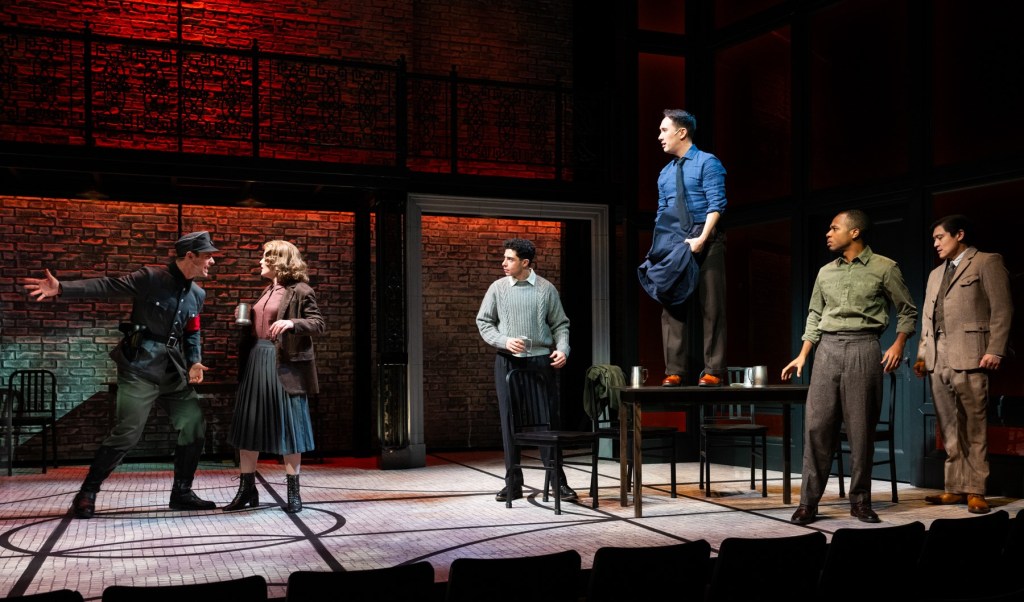
James Noone’s set design is appropriately minimalist with a curtain of the members of the White Rose projected on it at the outset of the play thanks to Caite Hevner’s projection design. With Sophia Choi’s period costume design, Alan C. Edwards fine lighting design and Liz Printz’s hair and wig design, the actors conveyed their characters with spot-on vitality.
The musical is a must-see because of its currency today. It reminds us that evil brutality and terrorism in a despotic, autocratic nation destroy the culture and people who support it. When human rights are vitiated and the populace cannot enjoy their freedoms of expression and rights over their own bodies, when ideas, books, and the arts are banned and burned, human dignity and community are demeaned and displaced. Such wickedness cannot live in truth because it is based on lies and propaganda which are created, not to uplift the common good, but for the purpose of idolatry, to worship one man and one ideology which must be bowed to, or one’s life or career are forfeited.
The limited engagement of White Rose the Musical on Theatre Row, 42nd Street between 9th and 10th, runs 90 minutes with no intermission. For tickets go to the Box Office or their website. https://whiterosethemusical.com/
‘Aristocrats,’ Irish Repertory Theatre, Review
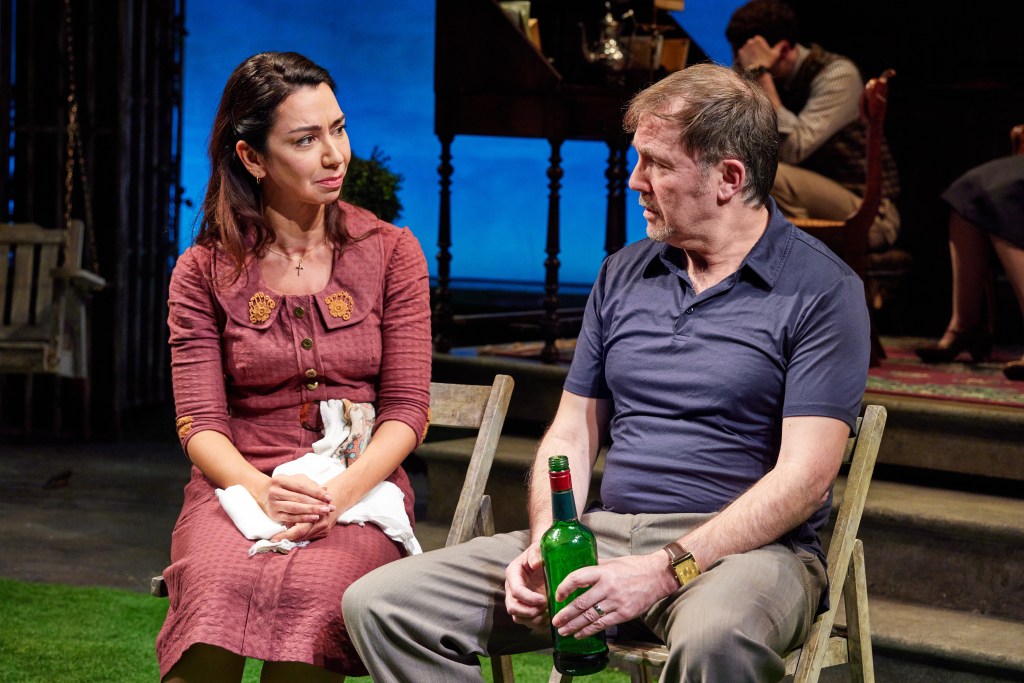
Dysfunction and decay are principle themes in Brian Friel’s Chekovian Aristocrats, a two-act drama about a once upper middle class family in precipitous decline in the fictional village of Ballybeg, County Donegal, Ireland. Currently at the Irish Repertory Theatre as the second offering in the Friel Project, the intricate and fine production is directed by Charlotte Moore and stars a top-notch cast who deliver Friel’s themes with a punch.
Two members of the O’Donnell family, headed up by the autocratic and dictatorial father, former District Justice O’Donnell (Colin Lane),, who remains offstage until a strategic moment brings him on, have arrived at the once majestic Ballybeg Hall. They are there to celebrate the wedding of Claire (Meg Hennessy), the youngest of the four children, who still lives with her sister Judith (Danielle Ryan), the caretaker of the estate. Well into the play, Ryan’s Judith reveals the drudgery of her responsibilities caring for her sickly father and her depressive sister Meg, as well as managing the estate and the chores of the Big House.
At the top of the play, we meet the grown children who live abroad and arrive from London and Germany. These include Alice (Sarah Street), her husband Eamon (Tim Ruddy), and the O’Donnell brother Casimir (Tom Holcomb). As Friel acquaints us with his characters, we discover Eamon, who once lived in the village, claims he knows more about Balleybeg Hall from his grandmother, who was a maid servant to the O’Donnells. Also present is Willie Diver (Shane McNaughton), who is attentive to Judith as he helps her around the estate and farms and/or rents out the lands to the locals. Initially, we watch as Willie organizes a monitor through which Justice O’Donnell can speak and ask for Judith to attend to him.

By degrees, through the character device of the researcher, Tom Huffnung (Roger Dominic Casey), and especially the ironic comments of Eamon, Friel discloses who these “aristocrats” of Ireland are. First, they were the upper class with land, who once dominated because the English protestant faction empowered them to do their bidding. The irony is that over the years, they have devolved and have imploded themselves. The sub rosa implication is that the seduction of the English, to give these Catholic Irish power, has led to their own emotional and material self-destruction.
The father, the last of the dying breed of “gentlemen,” like his forebears, took on the cruel, patriarchal attitude of the English. Raising his family in fear and oppression, and indirectly causing his wife’s suicide, he has deteriorated after strokes. We learn this by degrees, as Friel catches us unaware, except for the title of the play, by revealing the characters to be on equal class footing at the play’s outset. We learn the irony of the great “fallen.” The past distinction between the “superior” O’Donnell’s of the Hall, and the rest of the village peasantry, who referred to them as “quality,” (Eamon’s grandmother’s definition), has faded and is only kept alive in the imagination of a few.
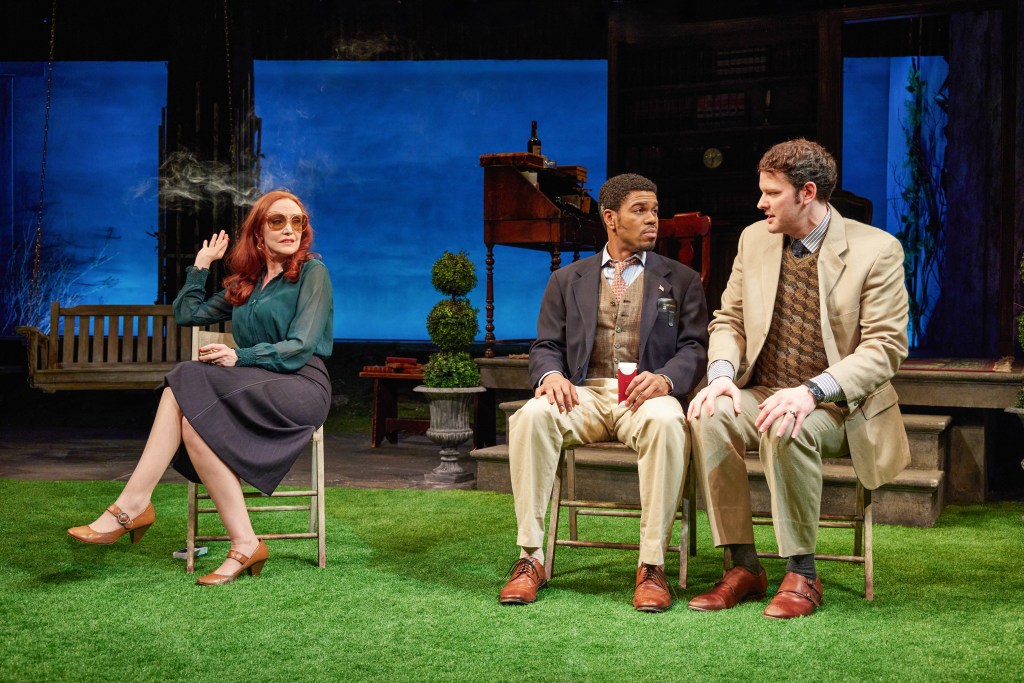
Throughout, Claire’s music can be heard in the background as Alice and Casimir converse with Huffnung, whose research topic is about the impact of the Catholic Emancipation laws on the “ascendant Roman Catholic ruling class and on the native peasant tradition.” In other words Huffnung has come to Ballybeg Hall to research the aristocratic O’Donnells and discover the political, economic and social impact they have had on the villagers.
Interestingly, Eamon sums it up to Huffnung when he ironically answers the question as an insider who knows the Hall and what it is like being married to Alice, one of the former “ruling class.” Alice and her sister Judith were repeatedly sent away from home for their schooling. Alice marries Eamon who, caught up in the Civil Rights action against the English Protestants, loses his job in Ireland and eventually works for the English government in London. Alone most of the day, Alice has become an unhappy, isolated alcoholic. Eamon, whose irony wavers between obvious bitterness and humor tells Huffnung that the O’Donnells have had little or no impact on the local or “native peasants,” of which he numbers himself as one of the classless villagers.

Indeed, noting the shabbiness of the Hall and the problems of the family members, we see the pretension of superiority has long gone. All of them face emotional challenges and need rehabilitation from their oppressive upbringing under their father, Justice O’Donnell who seems to have be a tyrant and unloving bully. We note this from his rants over the monitor and Casimir’s response to his father’s imperious voice.
Judith contributed to causing her father’s first stroke having a baby out of wedlock with a reporter, after joining the Civil Rights fight of the Catholics against the British Protestants. Forbidden to raise her child at home, which would bring shame to the family, she was forced to give him up for adoption; he is in an orphanage. Over the monitor in a senile rant we hear the bed ridden O’Donnell, refer to her as a traitor. Thus, we imagine the daily abuse she faces having to care for her father’s most basic needs, while he excoriates her.
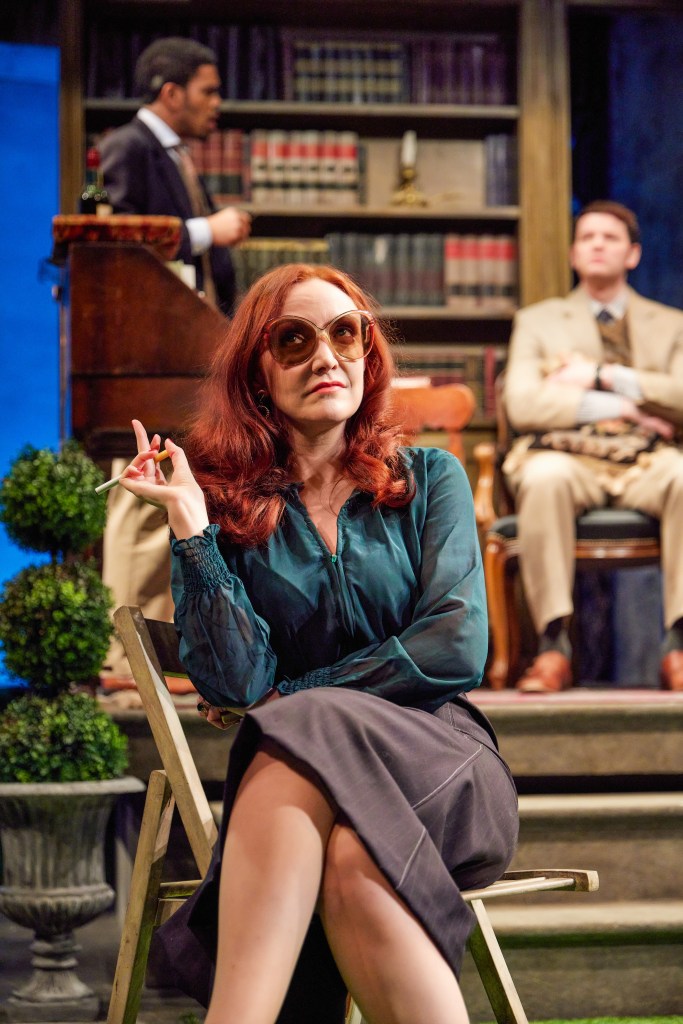
Meg is a depressive on medication who helps around the house, plays classical piano, and plans for her marriage to a man twice her age in the village, a further step down in class status. Desperate to leave, she selects escape with this much older man who has four children. She enjoys teaching piano to them.
Casimir is an individual broken by his father’s tyranny and cruelty. Holcomb’s portrayal of the quirky, strange Casimir is excellent, throughout, but particularly shines when he reveals to Eamon, how Justice O’Donnell’s attitude shattered him. The Justice’s cruel judgments about his only son, are revealed by Casimir toward the conclusion of the play. Ironically, Casimir politely attempts to uplift the family history to Casey’s clear-eyed Huffnung who, tipped off by Eamon, fact checks the details and realizes that Casimir exaggerates with a flourish. Additionally, most of what Casimir shares about his own life is suspect as well, and used to appear “normal,” though he may be gay.
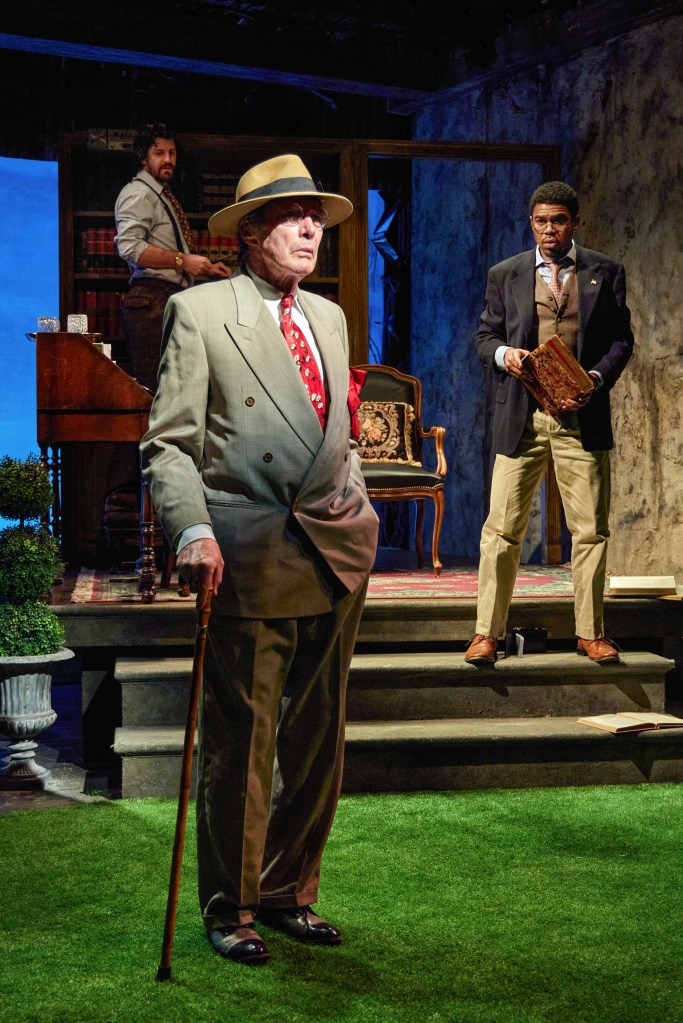
Thus, as Friel unravels the truth about the family, largely through Eamon, we come to realize the term “aristocratic” is a misnomer when applied to them. The noblesse oblige, if it once existed, has declined to mere show. As Casimir attempts to enthrall Huffnung with the celebrated guests who visited the Hall (i.e. Chesterton, Yeats, Hopkins), his claims by the conclusion are empty. In turn Huffnung’s research seems ironic in chronicling the decline of an aristocracy that has self-destructed because it remained isolated and assumed a privileged air, rather than become integrated with the warmth and care of the local Irish Catholics.
The brilliance of Friel’s work and the beautiful direction by Charlotte Moore and work of the ensemble shines in how the gradual expose of this family is accomplished. As the ironies clarify the situation, Friel’s themes indicate how the oppressor class inculcated those who would stoop to their bidding to maintain a destructive power structure which eventually led to their own demise. Of course, Eamon, who is bitter about this, also finds the “aristocracy” enchanting. He wants them to maintain the Great House and not let it go to the “lower class” thugs who will destroy it further, though it is in disrepair and too costly to keep up.

The class subversion is subtle and hidden. What appears to be “emancipation” perhaps isn’t, but is further ruination. How Moore and the creatives reveal this key point is vitally effected.
Thanks to Charlie Corcoran’s scenic design, we note the three levels of the Big House’s interior and exterior where most of the action takes place. David Toser’s costume design is period appropriate. Ryan Rumery & M. Florian Staab’s sound design is adequate. The original music is superb along with Michael Gottlieb’s lighting design. Accordingly, Justice O’Donnell’s entrance is impactful.
This second offering of the Friel Project is a must see. Aristocrats is two acts with one fifteen minute intermission. For tickets go to the Box Office of the Irish Repertory Theatre on 22nd Street between 6th and 7th. Or go online https://irishrep.org/show/2023-2024-season/aristocrats-2/
‘The Night of the Iguana,’ Theater Review
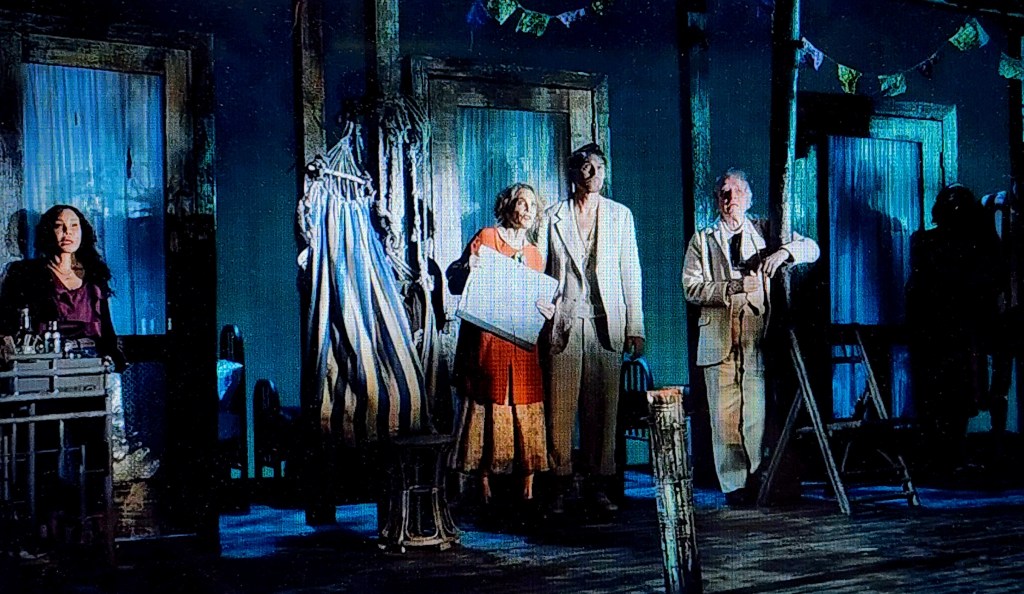
The Night of the Iguana is one of Williams most poetic and lyrical plays with dialogue that touches upon the spiritual and philosophical. On the one hand in Iguana, Williams’ characters are amongst the most broken, isolated and self-destructive of his plays. On the other hand, in their humor, passions and rages, they are among the most identifiable and human. La Femme Theatre Productions’ revival of The Night of the Iguana, directed by Emily Mann, currently at the Pershing Square Signature Center until the 25 of February, expresses many of these elements in a production that is incompletely realized.
The revival, the fourth in 27 years, and sixty-one years after its Broadway premiere, reveals the stickiness of presenting a lengthy, talky play in an age of TikTok, when the average individual’s attention span is about two minutes. Taking that into consideration, Mann tackles Williams’ classic as best as possible with her talented creative team. At times she appears to labor under the task and doesn’t always strike interest with the characters, who otherwise are hell bent on destruction or redemption, and if explored and articulated, are full of dramatic tension and fire.
Beowulf Boritt’s scenic design of the off-kilter, ramshackle inn in the tropical oasis of 1940s Costa Verde, Puerto Barrio, Mexico, and Jeff Croiter’s fine, atmospheric lighting and superbly pageanted sky are the stylized setting where Williams’ broken individuals slide in and out of reality, as they look for respite and a miracle that doesn’t come in the form that they wish. With the period costumes (exception Maxine’s jeans) by Jennifer Von Mayrhauser), we note the best these characters can hope for is a midnight swim in the ocean to distract themselves from their inner turmoil, depression, loneliness, DT’s and brain fever/ The latter are evidence of addiction recoiling, experienced by the play’s anti-hero, “reforming” alcoholic Reverend T. Lawrence Shannon (Tim Daly).

One of the issues in this revival is that the humor, difficult to land with unforced, organic aplomb is missing. At times, the tone is lugubrious. This is so with regard to Tim Daly’s Reverend Shannon, in the scene where he expresses fury with the church in Virginia that locked him out, etc. If done with “righteous indignation,” his rant, with Hannah Jelkes (Jean Lichty), as his “straight person,” could be funny as her response to him elucidates the psychology of what is really going on with the good reverend. It would then be clearer that Shannon is misplaced and just can’t admit he loathes himself and agrees with his congregants who see him as one who despises them and God, an irony. Indeed, is it any wonder they see fit to lock him out of their church?
The ironies, his indignation and Hannah’s droll response are comical and also identify Shannon’s weaknesses and humanity. Unfortunately, the scene loses potency without the balance of humor. Shannon is a fraud to himself and he can’t get out of his own way. Is this a tragedy? If he didn’t realize he was a fraud, it would be. However, he does, thus, Williams’ play should be leading toward a well deserved redemption because of the underlying humor and Shannon’s acceptance that his life is worth saving. In this revival, the redemption merely happens without moment, and the audience remains untouched by it, though impressed that Tim Daly is onstage for most of the play.
The arc of development moves slowly with a few turning points that create the forward momentum toward the conclusion, when Shannon frees an iguana chained at its neck so it won’t be eaten (a metaphor for the wild Shannon that society would destroy). The iguana is released, yet the impact is diminished because the build up is incompletely realized. Little dramatic immediacy occurs between the iguana’s release into freedom and the initial event when Daly’s quaking Reverend Shannon struggles up the walkway of Maxine’s hotel. Daphne Rubin-Vega’s Maxine Faulk and her husband Fred have previously offered escape for Shannon. Now, at the end of nowhere, he goes there to flee the condemnation and oppression meted out by the Texas Baptist ladies he is tour guiding, This slow arc is an obstacle in the play that is difficult to overcome for any director and cast.
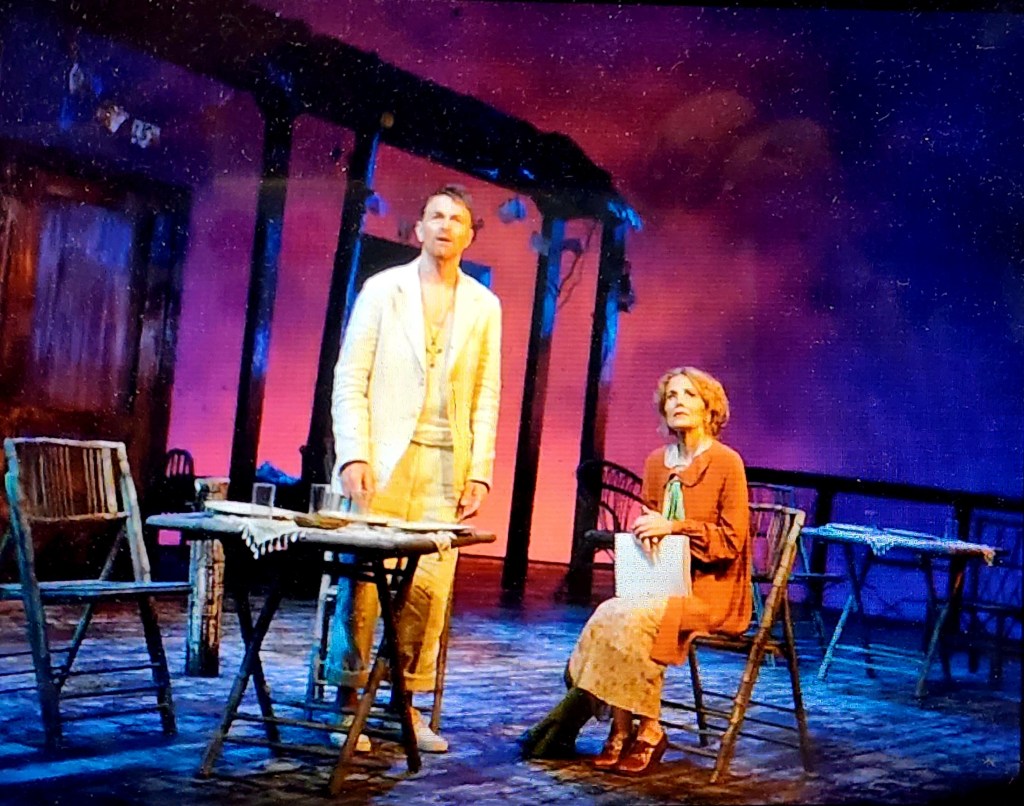
In the Act I exposition, we learn that Shannon’s job of last resort as ersatz tour guide has dead-ended him in a final fall from grace. He is soul wrecked and drained after he succumbs to seventeen-year-old Charlotte Goodall’s sexual advances in a weak moment, while “leading” the ladies through what appears to be paradise (an irony). However, their carping has made the Mexican setting’s loveliness anything but for the withering, white-suited Shannon, who was moved toward dalliances with Carmen Berkeley’s underage nymphet. Whether culturally imposed or self-imposed, prohibition always fails. Ironically, clerical prohibitions (alcoholism, trysts with women), are the spur which lures Shannon to self-destruction.
Already a has-been as a defrocked minister when we meet him, Shannon is hounded by the termagant-in-chief, Miss Judith Fellowes (Lea Delaria), who eventually has him fired. He has no defense for his untoward behavior, nor explanation for his actions, when he diverts the tour, and like a foundering fish gasping for air, flops into the hammock at Maxine’s shabby hotel. There, he discovers that her husband Fred has passed. In her own grieving, desire-driven panic, Rubin-Vega’s Maxine welcomes Shannon as a fine replacement for Fred.
It is an unappealing and frightening offer for Shannon, who views Maxine as a devourer, too sexual a woman, who takes swims in the ocean with her cabana boy servants to cool off the heat of her lusts. Shannon prefers her previous function in her collaboration with Fred, when her protective husband was alive enough to throw Shannon on the wagon, so he could prepare for his next alcoholic fall off of it.
While the appalled Baptist ladies remain offstage, honking the horn on the bus to alert Shannon to leave, and refusing to come up to Maxine’s hotel to refresh themselves, Shannon makes himself comfortable. So do spinster, sketch artist and hustler Hannah (Jean Lichty is less ethereal than the role requires), and her Nonno, the self-proclaimed poet of renown, Jonathan Coffin (Austin Pendleton moves between endearing and sometimes humorous as her 97-year-old grandfather).

Oozing financial desperation from every pore, the genteel pair have been turned away from area hotels. As Hannah gives Maxine their “resume,” the astute owner sniffs out their destitution and is about to show them the door, when the down-and-out Shannon pleads mercy, and Maxine relents. Her kindness earns her chits from Shannon that she will capitalize on in the future. Maxine knows she won’t see a dime from Hannah or her grandfather, whether or not Nonno dramatically discovers the right phrasing and imagery to finish his final poem at her hotel, and earns some money reciting it to pay their bill.
Though the wild and edgy Maxine allows them to stay, she “reads the riot act” to Hannah, suggesting she curtail her designs on the defrocked minister. If Hannah doesn’t go after Shannon, she and her grandfather might stay longer. However, the tension and build up between Maxine and Hannah never fire up to the extent they might have.
To what end does the play develop? Explosions do erupt. Maxine vs. Shannon, and Shannon vs. Miss Judith Fellowes create imbroglios, though they subside like waves on the beach minutes after, as if nothing happened. Only when tour replacement Jake Latta (Keith Randolph Smith), confronts Shannon for the keys to the bus, must Shannon reckon with one who enforces power over him. Neither Maxine, nor her cabana boys, nor Hannah, nor Fellowes can bend Shannon’s will to his knees. Jake Latta’s reality rules the day.

As the bus leaves and his life blows up, Shannon must face himself and end it or begin anew. In the scene between Daly’s Shannon and Lichty’s Hannah after Shannon is tied up in the hammock to keep him from suicide, there is a break through. Daly and Lichty illuminate their characters. Together they create the connection that opens the floodgates of revelation between Shannon and Hannah in the strongest moments of the production. When Nonno finishes his poem and expires, the coda is placed upon the characters who have come to the end of themselves and their self-deceptions. Life goes on, as Shannon has found his place with Maxine who will help him begin again, free as the iguana he set loose. Perhaps.
Williams’ characters are beautifully drawn with pathos, humor, passion and hope. If unrealized theatrically and dramatically, they remain inert, and the audience doesn’t relate or feel the parallels between the universal themes Williams reveals, or the characters’ sub text he presents. Mann’s revival makes a valiant attempt toward that end, but doesn’t quite get there.
For those unfamiliar with the other Iguana revivals or the John Huston film starring Richard Burton and Ava Gardner, this production should be given a look see to become acquainted with this classic. In this revival, there are standouts like Daphne Rubin-Vega as the edgy, sirenesque Maxine, and Pendleton’s Nonno, who manages to be funny when he forgets himself and asks about “the take” that Hannah collected. Lea Delaria is LOL when she is not pushing for humor. So are the German Nazi guests (Michael Leigh Cook, Alena Acker), when they are not looking for laughs or attempting to arouse disgust. That Williams includes such characters hints at the danger of fascist strictures and beliefs, that like the Baptist ladies follow, threaten free thinking beings (iguanas) everywhere.
Humor is everpresent in The Night of the Iguana‘s sub text. However, it is elusive in this revival which siphons out that humanity, sometimes tone deaf to the inherent love with which Williams has drawn these characters. Jean Lichty’s Hannah, periodically one-note, misses the character’s irony in the subtle thrust and parry with Tim Daly’s humorless, angry and complaining Reverend T. Lawrence Shannon. Daly’s panic and shakiness work when he attempts to hide the effects of his alcoholic withdrawal. Both Lichty and Daly are in and out, not quite clearly rendering Williams’ lyricism so that it is palpable, heartfelt and shattering in its build-up to the significance of Shannon’s symbolically freeing himself and the iguana.
The Night of the Iguana with one intermission at The Pershing Square Signature Center on 42nd Street between 9th and 10th until February 25th. https://iguanaplaynyc.com/
‘Buena Vista Social Club™’ is Phenomenal, Theater Review

If you are a world music lover, you don’t need any introduction to the “Buena Vista Social Club,” a group of Cuban musicians that Cuban producer and musician Juan De Marcos González, brought together in a recording studio in Cuba to eventually release an album in 1997. González is to be credited for his passion to capture the striking beauty and spirit of traditional Afro-Cuban music of the Buena Vista Social Club, while some of the members were still alive and able to perform and record in 1996.
Surprising everyone, the Buena Vista Social Club musicians, who had been a hit in the 1950s and disappeared after the Cuban Revolution, created a smoking hot album in 1997 that won a Grammy in 1998. Subsequently, they were the subject of the documentary initiated by musician/songwriter Ry Cooder and filmed by Wim Wenders, that rocked the BVSC into the stratosphere of global fame by 2000, when the documentary was nominated for an Academy Award.
The Atlantic Theater Company’s musical, Buena Vista Social Club™ is based on the titular documentary with references to Buena Vista Social Club: Adios, a second documentary filmed in 2016. The superb musical, directed by Saheem Ali (Fat Ham), has as its creative consultant David Yazbek (The Band’s Visit). With book by Marco Ramirez and music by the Grammy Award winners known as the Buena Vista Social Club, the production currently runs with the ebullient magnificence of songs, brilliant tonal hues, dances and movements at the Linda Gross Theater with one intermission until 21st of January. The Buena Vista Social Club™ is a touch of paradise with Afro-Cuban rhythms and sonority that are unforgettable.
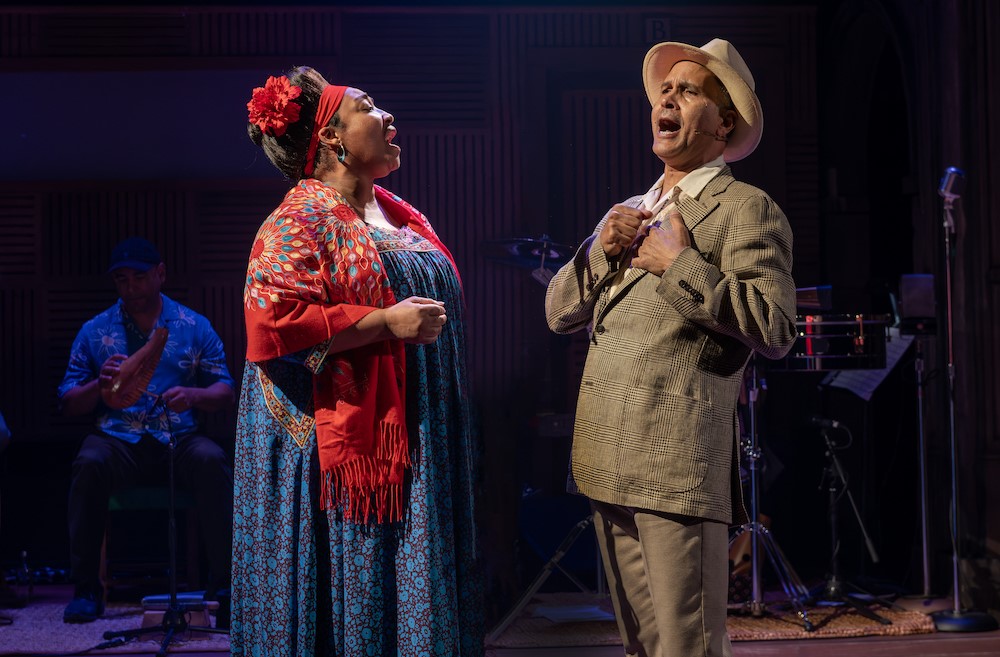
When you see it, and you must, you will not be able to sit still. The music fills you with its joyous power and heartfelt beauty. The production which extends beyond the crass label of “jukebox musicals” gives a reverential bow to the album, the documentaries and importantly, the magnificent musicians and singers who were vaulted to a success they had never known when they started out.
The production, loosely narrated by Juan De Marcos (Luis Vega), boasts a song list that is steeped in the incredible social club’s rhythms and cadences that spiritually manifest the history and diversity of the Cuban people. At the opening, De Marcos, who stands in Egrem Studios-the Old Havana music studio where musicians in the 1990s still record states, “A sound like this, it tends to travel.” His prophetic remarks reference how Buena Vista Social Club’s songs resonated and still resonate throughout the world today, even though most of the original members of the BVSC have passed. Only Omara Portuondo, the National treasure of Cuba, still sings and tours.
The key to opening the lock on the social club that dissolved with all the social clubs that Castro disbanded to end discrimination in Cuban society is Omara Portuondo. As the musical indicates, her notoriety and fame in Cuba allows her to serve as the bridge between the traditional musicians no longer heard and herself who is very much in the Cuban music scene in the 1990s and today.
Thus, the musical focuses on Omara and flashes back and forth from the past to the present in recounting her history with the BVSC, as well as introducing the members, and revealing how they were a part of the popular social club in a Cuba whose segregated clubs prevented various groups from singing and dancing together. The musical’s arc of development unspools as De Marcos attempts to interest Omara in making a recording of the musicians from long ago, who are still alive to keep the torch of Cuban folk music vibrating and lighting the way for musicians and fans of a younger generation.

Initially, when Vega’s, De Marcos approaches her, Omara (Natalie Venetia Belcon), is not interested because she doesn’t sing with a live band anymore. Her attitude is cold, aloof and proud, but later, we discover this hard shell fronts for deep pain underneath, concerning her alienation from her sister and niece because of the Revolution and the US embargo barring any exchange of visitors between the two countries. Recording the album would bring up tenuous memories. However, her dismissal of De Marcos on the surface appears to be because she is famous and he is an unknown, who intends to exploit her beloved renown for his own purposes.
Cleverly, De Marcos plays one of her old recordings with the BVSC. Only then, reflecting back to the past, does she relent and give her stipulations for the recording. First, she must be the voice that’s front and center, as De Marcos writes the arrangements. Second, she must be in control to select the singers and musicians. Thus begins the process, conveyed with humor and pathos, that Omara and De Marcos use to bring back the members of the BVSC, so that they are able to record together and reestablish the vitality, importance and universality of Afro-Cuban music, making them a global phenomenon.
The musical is an important tribute to revitalizing how the BVSC Afro-Cuban stars were incredible singers and musicians. It also intimates in the flashbacks and lovely balletic dances featuring the Young Omara (Kenya Browne), and her sister Haydee (Danaya Esperanza), the historical, social schemata of a diversely segregated Cuba, referencing its importance in the Slave Trade, the divisions between the rich and the poor, as well as Castro’s plan to bring equality to the country that backfired and instead created a hell and misery for the Cuban people. This was especially so after the revolution and the flight of wealthy Cubans and middle class off the island.

As is pointed out as a major theme, which indicates the segregation still is manifest concerning Cuba, the division became forever known as “the ones who stayed” and braved out the situation in their mother country, and the “ones who left” and went to various parts of the United States and elsewhere.
Crucially, Omara is an important symbol of transition and the voice and the bridge between the rich and the poor, the socially upscale strata of Cuban society, and the segregated, representing the traditional Cuba with which all Cubans can identify, if they put their prejudices away. Indeed, in this musical, the character of Omara magnifies the best of Cuban culture. She recalls the past and weds it to the present, in the tears and pain of the loss of family and her sister Haydee, who died before she was ever able to see her again. Because Omara was already famous, she was able to negotiate travel as she employed her talents on tour. This mobility was not possible for the other BVSC musicians who were not as famous, and lived under the oppression of segregation and poverty before and ironically, after, in Castro’s Cuba.
Obviously, the ones like Omara who had mobility or the thousands of others who left, had some money to establish themselves elsewhere, even though they lost their lands and businesses to Castro’s “communistic” usurpation. It is a wealth Castro didn’t share with the Cubans who stayed, reminiscent of Vladimir Putin’s behavior toward the Russian people in today’s Russia. Like a predominance of the Russian society, the Cubans who stayed were impoverished and the musical references that during the “Special Period” when the dissolved U.S.S.R. split up, there was no longer any “communistic” aid to Cuba. Thus, the people starved.
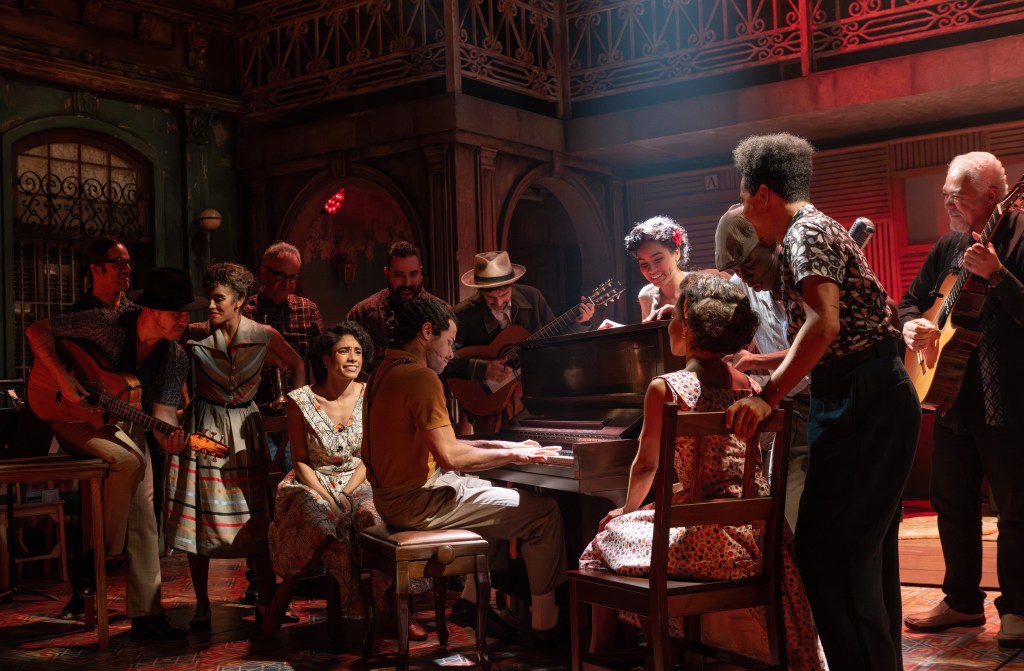
The hope of recording an album with BVSC members was to earn a bit of money, as many of the musicians and singers we meet and learn about in their relationships to Omara and the club were barely scraping by from day to day. During the production we meet the incredible individuals who Omara was close to and sang with in the 1950s when they were young and in 1996 during the recording. These include the charming, funny Compay (Julio Monge), the sweet, loving Ibrahim (Mel Seme), the wonderful pianist Ruben (Jaindardo Batista Sterling) and Eliades (Renesito Avich).
The seminal moments of the production however, meld the present to the past, revealing how Omara connected with each of the BVSC members in the flashbacks with the Young Omara and the Young Haydee. The musicians/singers include the Young Compay (Jared Machado), the Young Ibrahim (Olly Sholotan), and the Young Ruben (Leonardo Reyna).
The balletic sequences with dancers portraying the Young Omara and Young Haydee, choreographed by Patricia Delgado and Justin Peck, developed and directed by Saheem Ali. These sequences seamlessly and stylistically reveal the differences in opinions between the sisters, regarding the BVSC which Haydee feels is beneath her. Also revealed in these flashback dance sequences, is Omara’s sadness in losing her sister and family forever because of the Revolution and US Embargo. As Belcon’s Omara sings of her feelings, the poignance of her expressiveness resonates with all Cubans and punctuates the cruel punishment visited upon the people by both governments, revealing the malevolence of political machinations. However, it is in the power of the songs that the Cuban people thrive and with dignity transcend the brutality.
The BVSC playlist is sung in the native tongue of the BVSC, and on one level doesn’t need translation because the music “speaks” for itself. However, the musical’s closed captions in Spanish, should also have had an English counterpart. In English, the lyrics can relate the historical culture of the Cuban people which is referenced throughout in the English dialogue and storyline. English closed caption lyrics, as well as Spanish, would convey the complete picture of the BVSC and its tremendous importance socially, politically (their democratic diversity should not be diminished), and spiritually.
The BVSC’s immutable human values conveyed in their incredibly poignant rhythms and music is what resonates and draws in fans globally in an egalitarian message that makes sense and that most human beings yearn for. Politics and the power hungry divide to conquer. The music of the people soars, uplifts, transcends hardship and unifies. This production’s value is priceless and the ensemble of musicians and singers are fabulous in memorializing the Buena Vista Social Club for all time.
The creative team brings the director’s vision together in a beautifully stylized way that breathes life into the real musicians and singers who made up the BVSC (1950s, 1996). These creatives include Arnulfo Maldonado (sets), Dede Ayite (costumes), Tyler Micoleau (lighting), Jonathan Deans (sound), J. Jared Janas (hair, wigs & makeup), Dean Sharenow (music supervisor), Marco Paguia (music director, orchestrations & arrangements), Javier Diaz, David Oquendo (additional arrangements), the swings and band.
The company of Buena Vista Social Club™, Atlantic Theater Company, 20th Street between 8th and 9th. https://atlantictheater.org/production/buena-vista-social-club/
‘Hell’s Kitchen,’ Alicia Keys’ Glorious Musical, a New York High

Vibrant, relentlessly electric, Hell’s Kitchen with music and lyrics by Alicia Keys and book by Kristoffer Diaz sends one out into the night elated and energized. In a sold out run at the Public Theater, Hell’s Kitchen is transferring to Broadway for five good reasons. These include award-winning Alicia Keys’ glorious music, Adam Blackstone’s music supervision, Camille A. Brown’s dynamic choreography, Michael Greif’s thoughtful direction and Alicia Keys and Adam Blackstone’s arrangements of key songs from her repertoire, and three new ones.
Integrating Keys’ playlist with an organic storyline rooted to a New York setting during a period of a few months, Greif, Keys and Diaz’s choices stir up the magic that makes this work sizzle beyond the bounds of the typical jukebox musical.

Clearly, the coming of age story about a seventeen-year old living in Manhattan Plaza takes its inspiration from Keys’ life. She lived in Manhattan Plaza with her mother, and then she took off, living independently after about a year, all before seventeen. Diaz’s book moderates Keyes’ exceptionalism, especially that she began to establish her musical prodigy at 7, and by seventeen was arguing with Columbia records about control of her music, image and songs for an album she already created.
Ali (Gianna Harris the night I saw it), dramatically casts herself as a Rapunzel in cargo pants and Tommy Hilfiger underwear and tops, locked away in the isolated “tower” of Manhattan Plaza by her mother, Jersey (Shoshana Bean). Though mom intends for her to stay safe from the dangers of Hell’s Kitchen, which is gradually being cleaned up of its unsavory druggy characters by then Mayor Rudy Giuliani, Ali questions her mother’s judgment.
Narrating her story in the present, Ali flashes back to key events and key people she meets in her life at the large, subsidized housing arrangement for artists initiated by Estelle Parsons and others. Parsons and other fed up actors, musicians, dancers, etc., encouraged city fathers to create apartments where artists could live while working in the city whose rising costs have continued to this day.
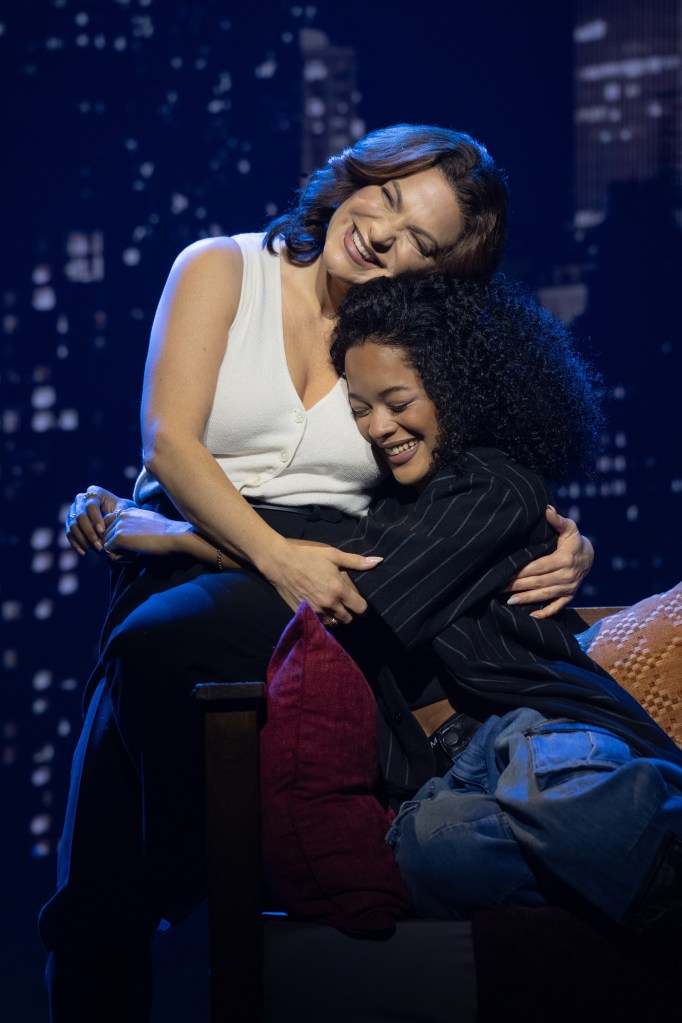
(Joan Marcus)
Artists then and now bring in millions/billions of dollars to the second largest entertainment capitol of the world, yet, subsist on poverty level wages, plying their craft, despite being unable to maintain themselves even on welfare. As a former actress, Jersey is able to meet the requirements at the Plaza for a small living space with Ali, still working part-time as an actress when she can get jobs. However, forced to scramble to support them, Jersey, works the night shift with a steady job, having essentially given up her career to take care of Ali, who doesn’t understand or appreciate the sacrifices her mother has made.Instead, Ali focuses her complaints on her absent father who abandoned the family, and her lack of freedom to hang out with friends and strike out on her own to do what she wants.
The overriding conflict in Hell’s Kitchen is between mother and daughter in their story of reconciliation, which on another level writes a love letter to New York’s loudness, brashness, street people, and atmospheric social artistry in the 1990s.
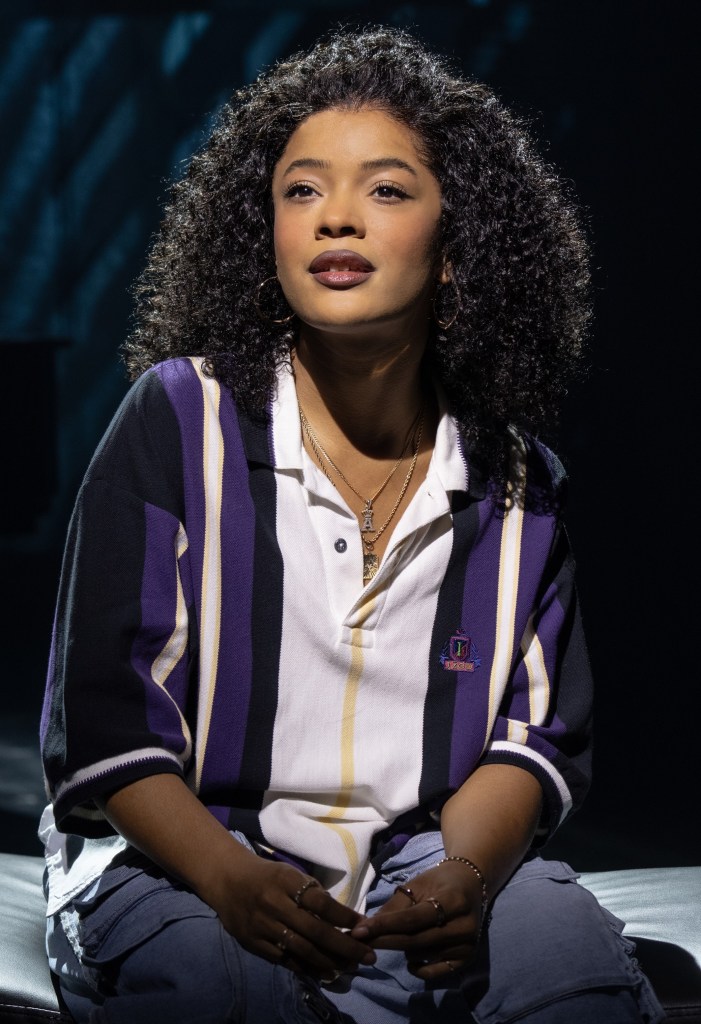
Key to the arc of development is that Jersey doesn’t want Ali to follow in the shadow of her “mistakes” (she got pregnant and had to raise Ali), which she sings about in “Teenage Love Affair” as she affirms why Ali’s soulful father Davis (the smooth-sounding, seductive Brandon Victor Dixon) was not the type of man to settle down. Having heard this story before, the fun and juice of her mother’s passion for her father prod her emotions. She is seduced to walk the alluring tightrope of danger to replicate her mother’s forbidden experiences while trying to find her true purpose which will lift her up from identity disappointments and anger about her father’s neglect. But how can you tie down a crooning club singer who is always on the move and looking for excitement around each corner of life?
This background is presented in Act I (‘The Gospel,” “The River,” “Seventeen,” You Don’t Know My Name,”) as Ali seeks her identity and purpose apart from the family situation she rejects, spurred on by her friends to throw herself at Knuck (the adorable Lamont Walker II when I saw it). The twenty something is one of a three-person bucket drumming crew providing excitement and sexy currents busking in the courtyard of Ali’s residence. Ali’s attraction to him is so palpable, Jersey warns the doorman and her police friends to “watch out” for her daughter’s wiles with the “bucket drummer,” which miffs Ali. When tensions increase with her mother, Ali seeks comfort from Miss Liza Jane’s classical piano playing in the Ellington Room of the Plaza, which so inspires her, she realizes she’s found a part of herself, (“Kaleidoscope”).

Although Keyes’ own storyline is much more complicated, Diaz keeps it simple in order to integrate Keys’ repertoire which includes eleven numbers in Act I and twelve in Act II (according to the program). In Act I, the songs weave Knuck and Ali’s coupling in “Gramercy Park,” and “Un-thinkable (I’m Ready),” and gyrate into an amazing “Girl on Fire” in a heady, rigorous number that involves the entire company and ends in an explosion of emotions.
Unable to contain themselves, Knuck and Ali are intimate in Ali’s apartment. Is it any surprise that Jersey looses it when she finds the older Knuck and her underage daughter on the living room sofa in a rerun of Jersey’s life with Davis? Shocked that the precocious, sexually self-possessed Ali is seventeen (making him a rapist), Knuck is infuriated and races out. He is one step ahead of Jersey but is arrested, and humiliated in public, which Ali tries to prevent but can’t.
Because of her colliding impulses and emotions, Ali has recklessly endangered and effectively punished Knuck for his affections which he tried to resist. In a gender role reversal, she has exploited him as the “innocent,” while “getting off” on using her sexual power. Too late, she backtracks with empty apologies and remonstrances.

The event resolves in the Ellington Room where Ail seeks comfort, while Miss Liza Jane sings the instructive and heartfelt “Perfect Way to Die,” highlighting the culture’s racism, police brutality and discrimination as the daily portion of hatred and violence that communities of color still have to face and fear. Act I concludes powerfully with the song highlighted by Peter Nigrini’s projection design in black and white of victims of future police brutality. Miss Liza Jane and Ali conclude in hope with a focus on Ali’s lesson at the piano. The reveal is that art is the way out of the ghetto, the violence, the discrimination, the institutional racism that so often cuts down Black men and colored populations.
Act II (“Authors of Forever,” Heartburn,” “Love Looks Better,” “Work on It,” to name a few), follows with a lengthy resolution after Ali experiences a loss, ends her brief encounter with Knuck, and Jersey calls in Davis to help her daughter overcome her emotional depression and grief. Together, father and daughter sing a lovely duet with Davis at the piano. Mother and daughter have a new appreciation of one another and the musical ends on a celebratory bow to the city with Keys’ “Empire State of Mind.”

The covers, Gianna Harris, Lamont Walker II, and Crystal Monee Hall are spot-on marvelous, working seamlessly with Shoshana Bean’s powerhouse singing and emotionally riveting portrayal of Jersey. Bean’s Jersey is a tumbling cycle of love, fear, anger and confusion as she tries to negotiate the rebellious Ali. Likewise, Harris perfectly portrays her attempt to kindle a relationship with Davis. The smooth, relaxed portrayal by Brandon Victor Dixon, shines as the counterpart of Jersey. His mellow, and beautifully mellifluous singing is sensational. Dixonl clearly reveals why Bean’s Jersey fell hard for him and was so acutely disappointed and broken when they couldn’t make it as a family.
The musical, pegged as entertainment with the intent of heading for a Broadway audience avoids going as far as it could only inferring Knuck’s arrest might have ended up in a brutal attack against him. Instead, the death that occurs is a loss that is devastating, but not aligned with any cultural indictment. It is most felt by Ali and it triggers her feelings to be more supportive and loving of her mother which ends up in a satisfying and uplifting conclusion.

Nigrini’s colorful projections of New York City lighten up Robert Brill’s grid-scaffolding, dark scenic design and minimalist set pieces. Dede Ayite’s costume design is setting appropriate and dated for that period in time. Lighting design by Natasha Katz, sound design by Gareth Gwen, and hair and wig design by Mia Neal all are in concert with Greif’s vision of a Hell’s Kitchen which is undergoing transformation and hope, despite unresolved institutional racism and discrimination.
I was most drawn by Camille A. Brown’s choreography and the dancers amazing passion and athleticism incorporating a variety of hip hop dances from the period and then evolving into something totally different. Unusually, there is movement during times when least expected, but all correlated with the emotion and feeling of the characters making the dancers moves emotionally expressive and coherent.
Hell’s Kitchen is a winner. Look for it when it opens on Broadway or try your luck with tickets based on availability at the Public Theater on Lafayette Street, downtown. https://publictheater.org/
‘The Gardens of Anuncia’ Lyrical, Unique, Fanciful, Directed by Graciela Daniele

In order to deal with the past, sometimes memories must be altered to beautify the ugliness of their reality. This is one of the themes in Michael John LaChiusa’s musical, The Gardens of Anuncia, directed and choreographed by Graciella Daniele. The Gardens of Anuncia is currently running at Lincoln Center’s Mitzi E. Newhouse.
The musical’s picaresque, lyrical journey memorializes the women who inspire and encourage the artistic soul of Annuncia (Kalyn West), as she grows into a teenager, who then will flourish in her global career as a director, choreographer and dancer. The journey intimated is that of Graciella Daniele, Tony Award nominee (ten times), and recipient of a Lifetime Achievement Award. Though she never won a Tony, Daniele’s directing and choreography of Chita Rivera: The Dancer’s Life, Annie Get Your Gun, Marie Christine, Once on This Island, The Pirates of Penzance, and Ragtime, are among her most memorable achievements.
Wisely, LaChiusa focuses not on the public career of Daniele, but on those who grounded the choreographer and director to prepare her to be an overcomer, ready to face obstacles and not be daunted by them. Through present narration by the older Anuncia (the charming, endearing Priscilla Lopez), on the eve of her acceptance of the Lifetime Achievement Award, in the garden of her country house, Anuncia meditates in flashback about her childhood with the three great women who influenced her, making her who she is today. As she readies herself to bury her aunt’s ashes, a final goodbye, she works through her memories, some hurtful, all poignant, growing up in Buenos Aires, Argentina during the Peronista government and movement in the 1940s and 1950s.

Auncia’s memories are vignettes that encompass vital turning points and revelations in the lives of the Younger Anuncia, Tia (Andrea Burns), Granmama (Mary Testa), and Mami (Eden Espinosa), all of them flowers burgeoning in the beautiful garden of her mind. Bounded by the older Anuncia’s narrative, we are introduced in the “Opening” to the women and their routines in the life they live daily in Granmama’s house in Buenos Aires. Together, the women raise the youngster and support each other after Mami and Anuncia are abandoned by Anuncia’s father, referred to as “That Man.” Lyrically, poetically, La Chiusa moves from present to past as the older Anuncia lands on memories that eventually reveal how each of the women traverse the paternalism of a male world and thrive.
The superb Priscilla Lopez (i.e. The Skin of Our Teeth, Anna in the Tropics), originated the role of Diana Morales in A Chorus Line, winning an Obie Award and Tony nomination. Lopez and Kalyn West portray Older Anuncia and Younger Anuncia, playing off one another seamlessly with grace. Through her reflections, the older Anuncia merges with her younger self to gain strength to finally put to rest the pain of the past, manifested in her finally burying her Tia’s ashes. As Lopez brings humor, poignancy, wisdom and loveliness to the older Anuncia, West embodies the innocence, increasing understanding, anger and astuteness when she asks questions and discovers the truth behind the answers that Tia, Grannmama and Mami give her.
From Tia, Young Anuncia learns to use her imagination to explore her world in, “Listen to the Music.” Additionally, Tia explains why she isn’t married and implies that she is happier without being tied down, having to answer and be obedient to a husband (“Smile for Me, Lucia”).
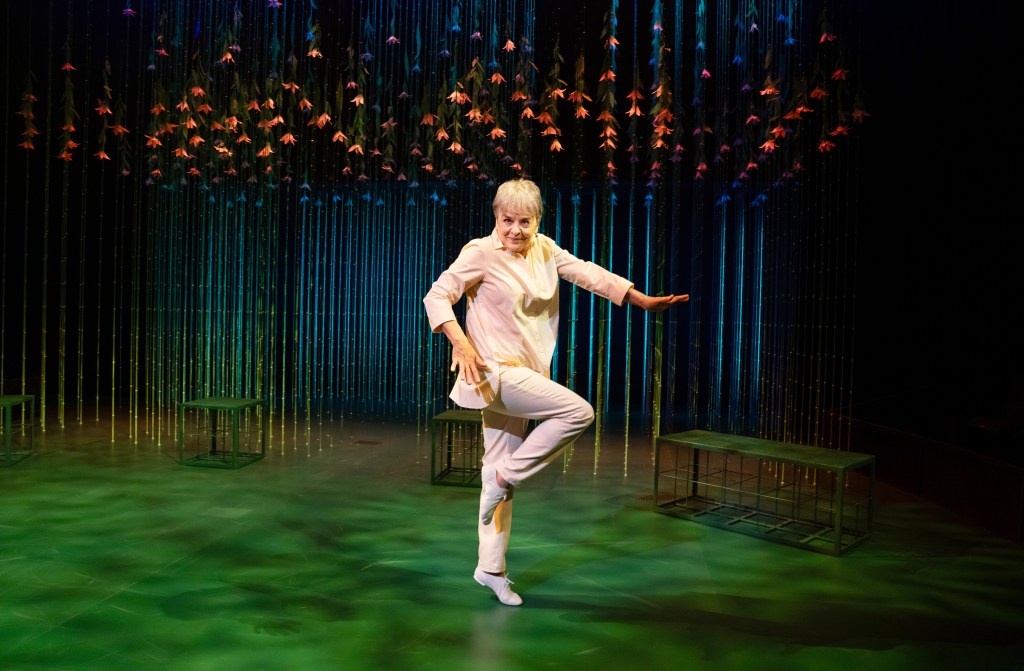
From her mother Mami, she receives the gift of ballet classes to strengthen her flat feet, as well as her interest in the dance. In Espinosa’s interpretation of the sensual “MalaGueña,” Mami dances the tango and sings about the club where she goes to dance with various partners in order to have fun, something that Granmama disapproves of.
Mary Testa’s Granmama adds humor and irony to the relationship the women have with each other. From Granmama, Anuncia learns her love of the dramatic and theatrical, as her Granmama’s reactions are always over the top. Her relationship with her husband, Anuncia’s grandfather, is explosive and extreme. It is forged in scandal and passion, thought it ends up in an eventual tiresome marriage, after which Granmama, eventually kicks him out. In “Waiting/Dreaming,” Anuncia learns they long for each other when he is away in the merchant marine, then can’t wait until he leaves, after a few days of crazy arguments and harangues when he returns.
From each of these incredible women, Anuncia attributes elements of her inner soul. Importantly, she also learns how and why “That Man,” her father, abandoned them and left them destitute, forcing Mami and Anuncia to move in with Tia and Granmama. All of the songs and events take place with the backdrop of danger and “disappearances,” during the Peron regime, a regime which also threatens the family when Mami is arrested.

The events in flashback and flash forward, with Older Anuncia’s narration that bridges them, unspool fluidly in a stylized, minimalist set design by Mark Wendland. The past and present flow into each other in Older Anuncia’s memory, suggested by the ease by which the characters step into the present in the garden of flowers that Older Anuncia talks to, beautifully intimated by Jules Fisher and Peggy Eisenhauer’s lighting design.
The garden is the perfect place of solitude where Old Anuncia revisits conversations and events with these beloved women, who shaped her and sent her with confidence and beauty into the wide world. The colorful, atmospherically lighted beads with attached flowers (Jules Fisher and Peggy Eisenhauer), separate the downstage where the conversations and reminiscences take place, with the past behind the beading where the characters exit.
Lopez, in her direct address to the garden of flowers that includes the audience, animates and enlivens them. Lopez is so specific in her performance, we believe she sees the peonies, the irises, the anemones and forsythias, though nothing is there. However, we note that this is who Anuncia has learned to be, influenced by Tia, to use her imagination.

Thus, in her garden of delights, she is able to converse with the floral pageantry she has planted, as well as the two male deer who come to visit her and nibble on her vegetables. The deer, who are brothers, are hysterically portrayed by Tally Sessions. The first deer gives her the wonderful advice to “Dance While You Can,” as they do a bolero. The second deer, shows up after an interval in time. He shares with the Older Anuncia that he lost his half-brother, who was hit by a car, obeying a “deer crossing” sign. The half-brother is bitter and droll. Lopez’s Anuncia returns the advice she received from the cheerful brother to the nihilistic half-brother, almost cheering him up.
The other male parts are portrayed by Enrique Acevedo who is Granpapa, That Man (Anuncia’s father) and other characters.
Older Anuncia’s garden meditations where she speaks to the plants and the deer are charming, ethereal and magical. They are part of her cultural heritage and legacy from Tia. Like her conversations with Tia, Mami, Grandmama and the others who have passed on, they are a part of her and not “ghosts” or something to be frightened of. The enlivened memories eventually bring the Older Anuncia to closure so that she can finally bury Tia’s ashes. It is time to rest her memories, it is time she lays them in peace in the garden of her mind, manifested in her country house garden.
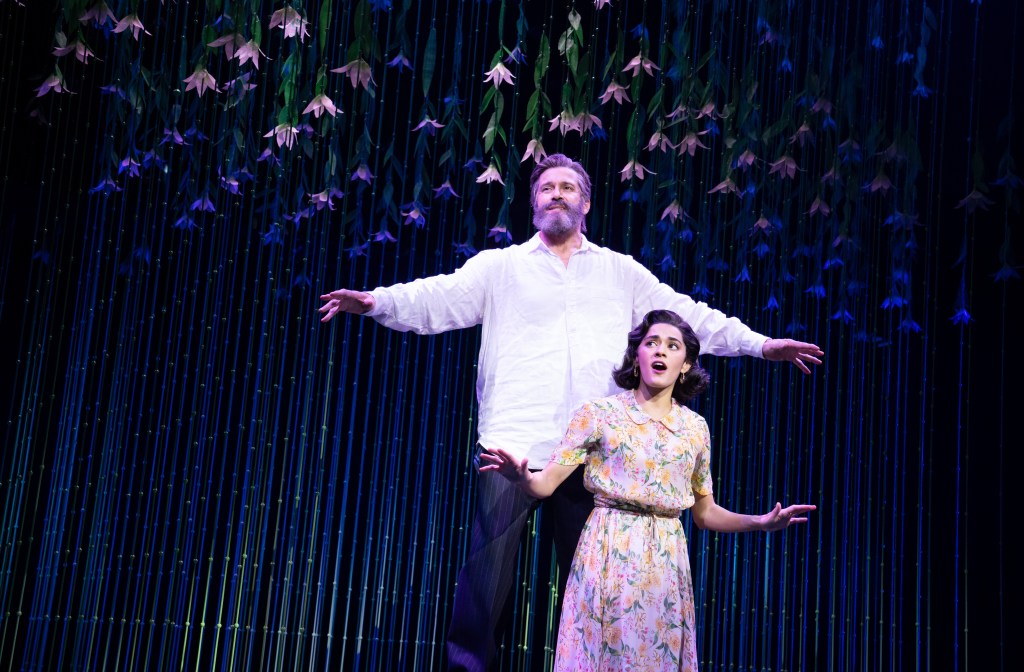
Daniele directs and stages the actors specifically and acutely so that they seem to create their own geometric patterns and rhythms. The choreography remains simple and evocatively cultural, reflecting the time and place to emphasize the Older Anuncia’s memorialization of the women who are so dear to her. Though West does some ballet, it is more representational, as befits the glimpses into the past, as if Anuncia looks into the mirror and can only bear snippets of reminiscences. Indeed, memories are elusive and questionable. Did certain events happen? There is one that the Younger Anuncia affirms happened and wishes she could forget.
From the lyricism, to the suggestiveness and poetic nuances, LaChiusa’s musical is in a category by itself. As elusive as a butterfly’s shimmering, gossamer wings, The Gardens of Anuncia floats into our consciousness with its poignant softness and seduction with stirring themes about the power of imagination, the profound love conveyed by relatives to strengthen progeny, about legacy, and about the wisdom and love it takes to understand the impact of one generation shepherding the next.
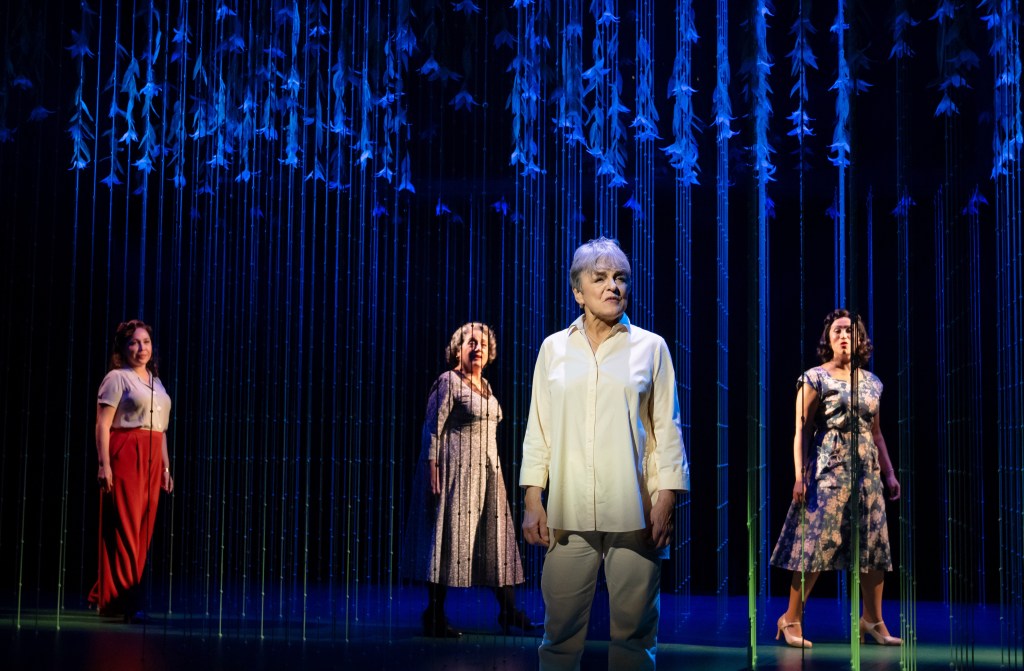
The ensemble are exceptional. They merge, flow, harmonize, dance, spinning into the garden’s loveliness, then retreating back into the corner’s of the Older Anuncia’s mind. Just great!
Kudos go to all the creative team who explored and solidified Daniele’s vision of LaChiusa’s evocative, unique musical. In addition to those mentioned above, these include Toni-Leslie James (costumes), David Lander (lighting design recreation), Drew Levy (sound), Michael Starobin (orchestrations), Deborah Abramson (music director), and Alex Sanchez (co-choreographer).
The Gardens of Anuncia, Lincoln Center Theater at the Mitzi E. Newhouse. Website: https://www.lct.org/shows/gardens-anuncia/
Dianne Wiest in ‘Scene Partners,’ a Wild, Woolly Romp Through The Reality of Imagination

How many women have dreamed of a career in Hollywood only to be dunned by everyone in their lives, except the still small voice encouraging them to try? And after they’ve reached their seventies and it’s too late and they attempt a career in the movies? WTF! Are they out of their minds? In Scene Partners, currently running at the Vineyard Theater, John J. Casewell, Jr. (Wet Brain) presents such a woman in his character Meryl Kowalski, portrayed with exceptional authenticity by Dianne Wiest in a bravura role that challenges expectations.
If Meryl’s relatives believe her packed bags, they would stop her and instead, shore up her living will and have her make final payments on her cemetery plot. Actually, they don’t have to. It’s 1985 and the entertainment industry patriarchy is in full swing, still the perfect place for abuse and rejection. After all, women in their late thirties are considered ancient and unbankable. Men and their puppet females in the industry will send Meryl to an insane asylum or to the grave toute suite, once she discovers how uncooperative they will be. Let her go to Los Angeles and make a fool of herself, a lesson she will never recover from. NOT!
the rub of John J. Casewell, Jr.’s genre-bending play is that Wiest’s enigmatic, nuanced Meryl succeeds beyond our wildest dreams. And she succeeds at a fractious time in the factory town when she should crash and burn immediately. Instead, Meryl and the acolytes she picks up along they way, unspool her anti-matter adventures that involve lift chairs and elevator shafts, and defy sense and sensibility, just for the fun of it.
Indeed! What else has a 75-year-old to do after her mouche (fly projected on a screen), husband dies and frees her from his battering abuse and emotional terrorism? Of course, she must free herself and follow the yellow brick road of her dreams sans money, sobriety and nihilism to become a movie star.
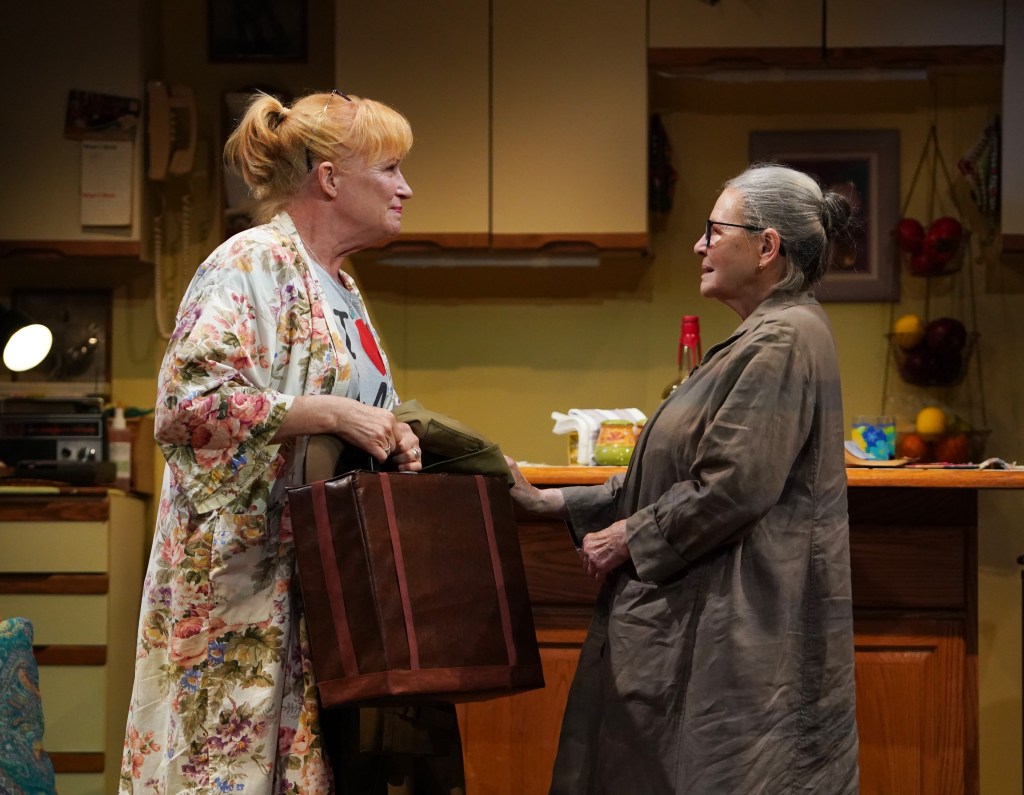
Part of the charm, humor and horror of Casewell Jr.’s Scene Partners, guided by astute director Rachel Chavkin, is that he playfully strings together scenes that appear haphazard but eventually have their own coherence, for a time. He stands familiar tropes (like logic and reality), on their heads, juxtapositioning them so that up is down, left is right. Then he turns them around again. Where is this lack of structural structure taking us, deep into the recesses of Meryl’s imagination? Or is this the stuff that dreams are made of and we all will wake UP back in Meryl’s kitchen, her bags ready to be unpacked?
This out of the box thinking is a good thing, for along the journey, we come to admire this unusual protagonist and find her humorous and adorable. Engaged, we watch as Meryl (turns out she was the first “Meryl” before the other actress), uses her determination and nimble mind, in whatever state it’s in to live in irony, freedom and her fantastic imagination. After all, what is reality anyway but quarks, particles, protons and electrons spinning beyond the speed of light so that what we think is a solid, is actually an illusion of spinning particles. What better place for Meryl to be than the land of illusions to add her own fantasies and realities to theirs! And lo and behold, she gets people out there to believe her! Could this happen as easily in New York City?
In a non-linear, fractured fashion, Meryl eventually spills the beans about her life which is being made into a film with her scene partners from acting class. Born in Los Angeles her father loved her, but her parents divorced and her mother ran away with another man, dragging her along. This stepfather fancied Meryl’s youth and expended himself on her, raping her for his good pleasure, though her mother and stepsister Charlize (the excellent Johanna Day), refused to acknowledge his sinister, sick lechery.

Masochistically continuing the abuse, instead of seeking freedom, we learn, she marries an abuser for life, named Stanley Kowalski. She explains, and we laugh, “I have no idea who’s responsible for feeding the details of my life to Mr. Williams for his little play.” Seeing her father relentlessly beat her mother, daughter Flora (Kristen Sieh), another victim, becomes an addict who depends on Meryl for food, clothing, everything.
Appalled that her mom is leaving her with no food in the house and abandoning her to confront her own addictions (principally self-destruction), Flora criticizes and insults Meryl for following her dreams. Meryl replies, “I have been acting all of my life! It’s about time I get paid for it!”
Indeed, I cannot imagine anyone else in this role, even Meryl Streep. In every breath of dialogue, Dianne Wiest appears to comprehend this victim turned hero, who is a combination of fantasist, Norman Vincent Peale practitioner and chronic traumatic encephalopathy survivor (battered brain syndrome). The power in her will to carve out her own reality out of life goal takes an inner truth and determination that Wiest so capably expresses. She has done similarly in each of the roles she performs, i.e. the sweetly accepting mother in Edward Scissorhands, the hysterical actress Helen Sinclair in Woody Allen’s Bullets Over Broadway (1994). In this ironic, wildly insentient role of Meryl, she achieves a pinnacle, if that is possible. I hope not, for she is imminently watchable and must do more stage productions.

When she points the gun at Josh Hamilton’s Herman, you believe she will shoot as she smiles at him. She’s happily dead serious. Thus, he believes her and he takes her on as his client, interested at her new approach and believability.
Additionally, at times Wiest’s Meryl is out of focus as if in medias res, in a chopped up segue which has no before and a questionable after, confused, wobbly, unsure of herself. This is especially so in the opening scene when she appears on camera (David Bengali’s video & production design), via projection. Styled with make-up and hair for her “close-up, Mr. DeMille,” her wide-eyed, silent response to the voice-over director’s, “Whenever you’re ready, sweetheart,” appears vacantly shocked. Is she amazed that she actually is where she said she would be? Or is something else going on, like a lapse in memory or identity? Wiest keeps her portrayal fresh, surprising, astounding. You can’t take your eyes off her.
Intentionally difficult to describe, Caswell, Jr.’s play hides in the shadows, as if throwing onto the stage anything that is humorous, upended and Wiest is up for. He twits our need to grasp onto something firm, like an arc of development that doesn’t involve Meryl’s strange train ride and sexual intimacies with a Russian conductor. And then there is a hop, skip and jump to “Horray for Hollywood!” and Meryl is threatening Herman Wasserman for auditions and parts with a gun. Speedily after that, she is in acting class with fellow actors.

Scene Partners succeeds because it cracks open another realm of being that is illogical and brashly, humorously defiant. It asks us to accept Meryl for who she is and what she learns about herself in her fragility, lapses, unreal realities and bits and pieces from movies that have clearly impacted her psyche. With help from a fine ensemble, Johanna Day’s grounded stepsister, John Hamilton, edgy and annoying in various roles, Kristen Sieh and others, the vignettes created and cobbled together form a life resurrected into one of purpose, joy and happiness. Does it truthfully matter if we don’t understand all elements about Meryl? Do we ever understand all elements about ourselves?
If we see through a prism the rainbow colors, some emphasized one day, others the next, maybe that’s a good thing. And if we follow dreams, even if only in our imaginations, perhaps that’s all that matters if we don’t harm anyone else. In fact, we may even bring others together pursuing the “unlikely” or the “ridiculous.”
Kudos to the creative team which includes Riccardo Hernandez (scenic design), Brenda Abbandandolo (costume design), Alan C. Edwards (lighting design), Leah Gelpe (sound design), Leah Loukas (hair, wig & makeup design), David Bengali (video & projection design) and others. And special kudos to the director, actors and Wiest, who helped to make Meryl’s world authentic in its wild and crazy configurations.
Scene Partners is a must-see for its zaniness and for Wiest’s dynamic, fascinating performance. For tickets go online https://vineyardtheatre.org/shows/scene-partners/
‘The Refuge Plays,’ Nicole Ari Parker and Daniel J. Watts are Smashing

Nathan Alan Davis’ The Refuge Plays, directed by Patricia McGregor, chronicles a family’s survival with a play whose structure employs an interesting twist. The production, a world premiere, begins in the present and flashes backward in generational segments to 70 years prior, spanning four generations. Though the three plays or segments may stand alone, the characters repeat in each and the thread of the main character’s resilience is the principle linchpin around which the events revolve.
In its world premiere presented by the Roundabout Theatre Company in association with New York Theatre Workshop, The Refuge Plays unspools its epic saga during three hours and twenty minutes, and two intermissions. It runs until November 12th at the Laura Pels Theatre.
In Davis’ epic of family bonds happening away from any social construct after World War II, we note how the reigning matriarch and great, grandmother Early wields subtle power and presence despite her advanced years. The superb Nicole Ari Parker is a standout in the role as she evokes the elderly, middle aged and teenage Early.
Contrasted with her great grandson Ha, Ha (JJ Wynder), who expects others to do for him, Early takes it upon herself to chop wood for the stove which also provides heat, despite her granddaughter Joy’s protests that her seventeen-year old son Ha Ha should be doing the chopping, which he says he doesn’t know how to do.

From that action alone the clue is given that Early’s age belies her life force and vibrancy. Living in this cabin in the woods off the grid, which she and husband Crazy Eddie (the superb Daniel J. Watts), built with their own hands decades before, she makes the best of her roughly-hewn life, which she shares with family. Remaining isolated from culture, technological developments and progress, they have managed to find a measure of comfort and peace that society doesn’t offer. The inference is that is perhaps that is why they are still alive. Though not living in the lap of luxury, they want for nothing. What carries them onward are the the authentic community and relationships they forge with each other.
Davis symbolizes Early as the seminal earth mother who sustains her family’s survival, which we understand watching the characters in the present and their movement into the past. From the outset, we note the elderly Early is determined, feisty, funny and authentic no nonsense with family members.
Though she doesn’t get along with her son’s wife Gail (Jessica Frances Dukes), she allows her to stay with them for the sake of their daughter Joy, who once left then came back. Making cryptic comments at times, Early puts up with Gail, though it is obvious she approves of her granddaughter for what they share. Both mourn Walking Man (Jon Michael Hill), who we hear died in a freak accident when a cow crushed him with its weight as he slaughtered it.
In the first segment, “Protect the Beautiful Place,” Davis sets the tone and presents the four generations of family members living in a two room cabin, cramped together, not seeming to mind the lack of personal and private space. This cabin that they call home is a refuge from all that would destroy and divide them, we realize, by the play’s conclusion.
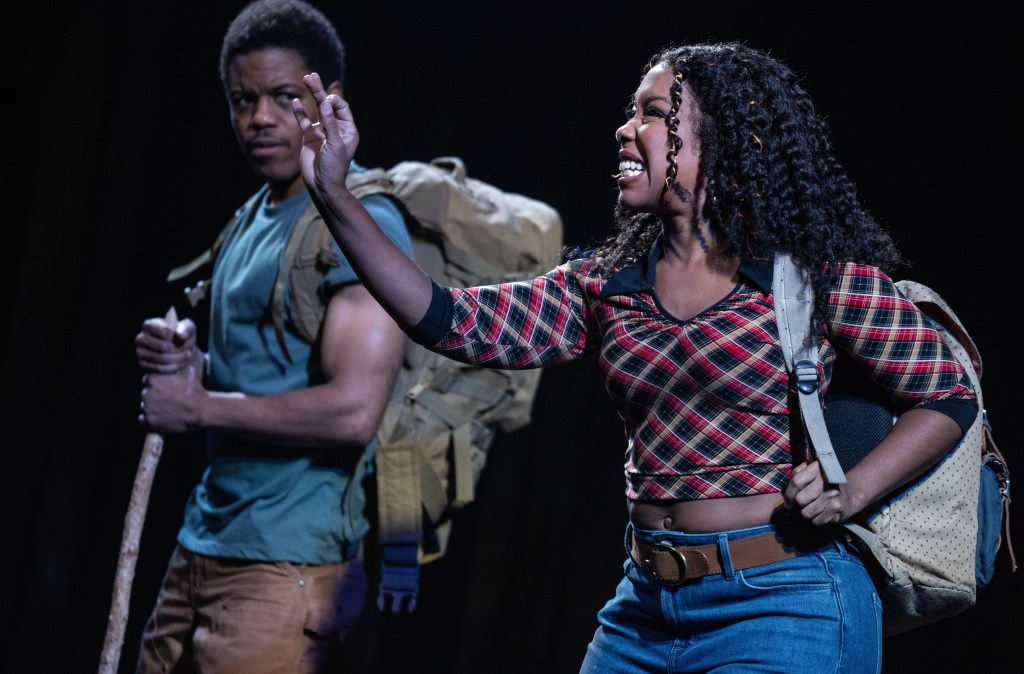
Arnulfo Maldonado’s set design reveals the rawness of their life that indicates economically that they are lower middle class. Only Gail has her own bedroom. Early, Joy and Ha ha sleep together in the living room in a chair, a sofa and the floor. In the same room they cook and eat with spare utilitarian minimalism. The outhouse is around the corner and in the distant past, a younger Early took the water in pails up from the river.
In “Protect the Beautiful Place,” the supernatural eerily wends its way into the family’s routine as they wake up and get ready for their day. The spirit of Gail’s husband Walking Man is a welcome visitor. He moves between the veil of life and the afterlife, and all know of his presence and communicate with him. Recently, he has appeared and announced to Early that Gail will pass on and join him. The family, even Ha ha, accepts this notion, though Gail resists it. During the course of the family interactions, we learn that the women hope that Ha Ha finds a woman to love and have children with to continue the family’s bloodline, though he is only seventeen. We also learn clues about the family history that Davis clarifies in subsequent segments.
When Walking Man visits Gail in a dream, he helps her to make up her mind about joining him. The eventual result occurs through an interesting sequence of events. Thus, we see that the family, encouraged by Early, has created its own myths and folklore which is as natural to them as breathing. Importantly, that one generation has exceeded another is striking and a testament to Early’s resilience and survival instincts. By the conclusion of The Refuge Plays, we understand how Early’s youthful struggles strengthened her, gave her courage and fostered the thriving of this family whose dominance will be taken up by the innocent, clever, book-smart Ha Ha with his new found girlfriend.
The second part, “Walking Man” features Early’s son after he leaves home, wanders to Alaska and other parts of the world, then returns home to his mother and father. Maldonado’s sets include the outdoor space in front of the cabin which is indicated by a front door. During the course of Walking Man’s return home, he talks to his father’s brother, uncle Dax (the humorous Lance Coadie Williams), and two spirits who are his grandparents Clydette (Lizan Mitchell) and Reginald (Jerome Preston Bates). Through them he discovers the truth of his legacy and why he has no birth certificate, why his mother raised him to be self-sufficient and why he is compelled to wander the earth, which he doesn’t understand.

After he learns this truth, Walking Man doesn’t have the heart to confront his mother with the specific details, though he confronts Crazy Eddie who he has accepted as his father. Angry, Walking Man intends to take revenge on the world and kill anyone he finds who exhibits the wickedness of his blood father. Early, stalwart, trusting in God, doesn’t insist with her son, but makes a suggestion and leaves him to his own decisions.
The segment ends with a new influence in Walking Man’s life, his future wife Gail, who the spirits have brought to him. We know this because of the lighter which Gail has been given by Clydette and Reginald and which she uses to light Walking Man’s pipe. The lighter, exhibited by Gail in the first segment which Ha Ha’s girlfriend Symphony (Mallori Taylor Johnson), picks up and uses, reveals the spiritual and ancestral influences that surround this family and guide it to peace and security.
The third segment, “Early’s House” flashes back to Early as a teenager living in the forest with her baby, Walking Man. Through her conversations with Watts’ Crazy Eddie who seeks her out and brings her food, we discover how she has survived through the winter after bearing her child alone. The relationship they develop over the course of the segment is powerfully drawn by Davis and acted with smashing resolve by Parker and Watts. As Crazy Eddie draws her out of herself so she trusts him, similar to how a feral animal is wooed by a well-meaning animal lover, Early reveals herself.
The place by the river she has chosen to be her sanctuary to receive respite and peace. Because she has been forbidden to return home, she determined to turn her back on society and her parents and make it in the woods. Nature has embraced her and with faith in God and the supernatural, she has received sustenance and wisdom to survive with Walking Man.
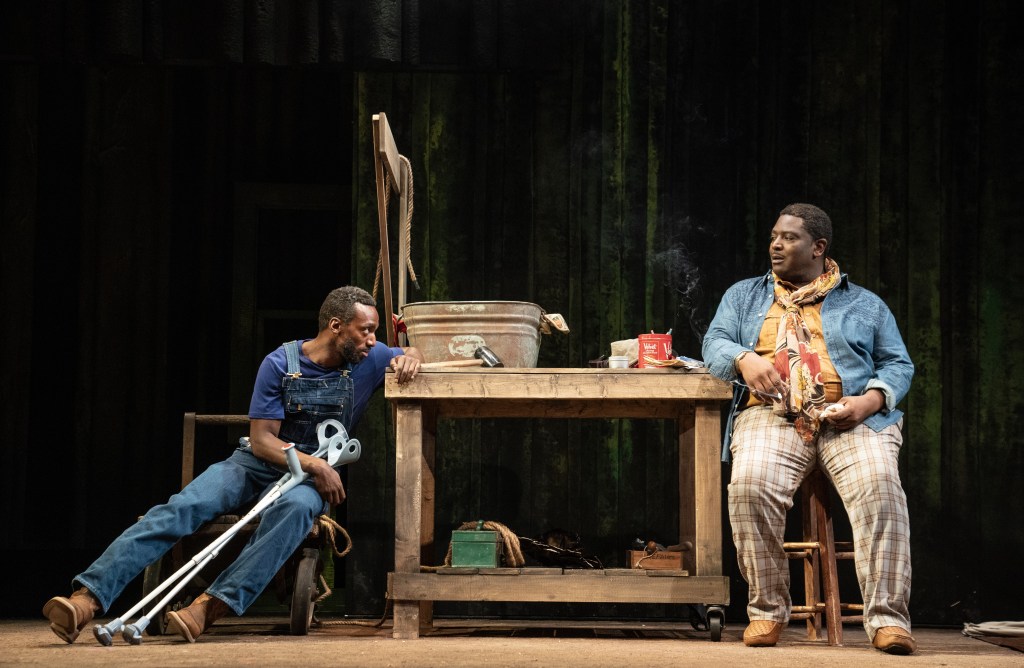
Parker’s amazing portrayal of the young Early reveals the depths of a woman who will fight against all odds to live and care for her child whom she loves. Ironically, there is more peace in nature than there could be found back in her home and former lifestyle which she has renounced to keep Walking Man with her.
The gentle Crazy Eddie is the only one who seeks her out and attempts to help her. Because he, too, has been wounded like Early, hobbled by extensive war injuries, she pities, accepts and trusts him. Both need one another and gradually they receive each other’s help and care. And it is in this place by the river that Eddie and Early sanctify their union and build a rudimentary cabin where they will live and raise Walking Man, whom Eddie unofficially adopts as his son.
“Early’s House” is poignantly written and acted with spot on authenticity. Davis brings together all of the character threads and elements so that we realize how Early compelled herself to forge a family which burgeons and will be sustained past the seventy years that we witness this saga. Excellently directed with fine performances all around, The Refuge Plays is fascinating especially in its structure and poetic, striking dialogue.
A fault at the outset was in the sound design which was corrected in the latter segment. Props go to Emilio Sosa’s costume design, Stacey Derosier’s lighting design, Earon Nealey’s superb hair and wig design and J. Jared Janas make-up design.
For tickets to the unique production, The Refuge Plays, go to their website https://www.roundabouttheatre.org/get-tickets/2023-2024-season/the-refuge-plays/performances
‘Jaja’s African Hair Braiding,’ Hysterical, Fun, Profound
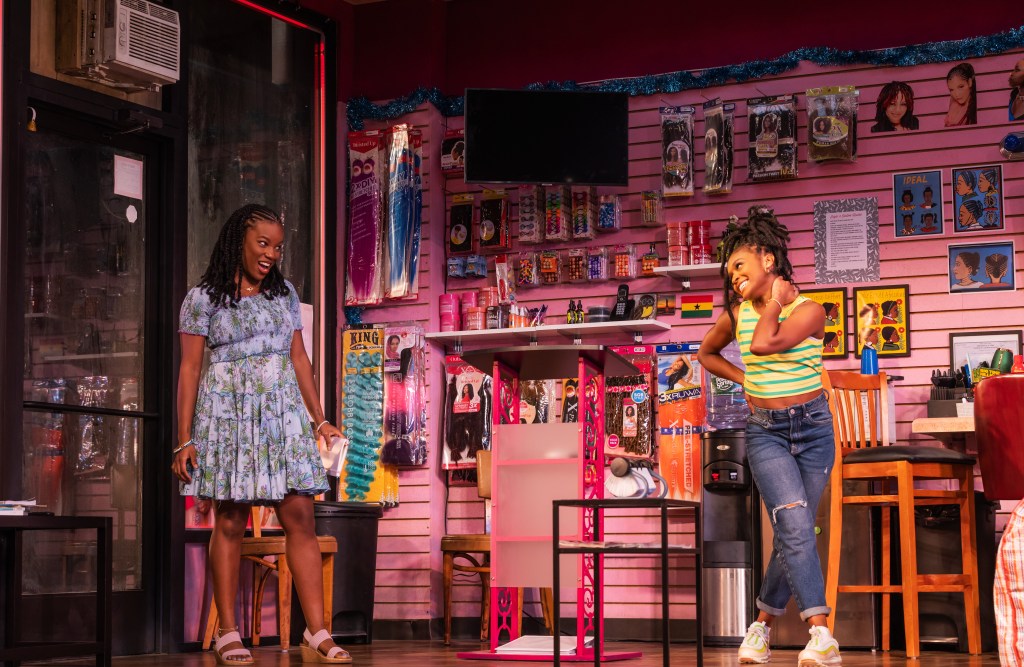
Jaja’s African Hair Braiding by Jocelyn Bioh in its world premiere at the Manhattan Theatre Club (Samuel J. Friedman Theatre), is a rollicking comedy with an underlying twist that, by the conclusion, turns as serious as a heart attack. Bioah’s characters are humorous, quick studies that deliver the laughs effortlessly because of Bioah’s crisp, dialogue and organic, raw themes about relationships, community, female resilience and the symbolism of hair braiding which brings it all together.
The setting is in Harlem, at Jaja’s Hair Salon where African hair braiding and the latest styles are offered. For those white gals and guys who envy the look of long lovely extensions but are too afraid to don them, it is understandable. You have to have a beautiful face to sustain the amazing, freeing look of long braided tresses that you can fling with a gentle or wild toss, evoking any kind of emotion you wish.

During the course of the play, we watch fascinated at the seamless ease with which the actors work their magic, transforming otherwise unremarkable women into jaunty, confident and powerful owners of their own dynamic presentation. While we are distracted by the interplay of jokes and mild insults and gossip, the fabulous shamans weave and work it.
In one instance, Miriam (the fine Brittany Adebumola) takes the entire day to metamorphose her client Jennifer (the exceptional Rachel Christopher). Jennifer comes into the shop appearing staid, conservative and reserved with short cropped hair that does nothing for her. But once in Miriam’s chair, something happens beyond a simple hairdo change.
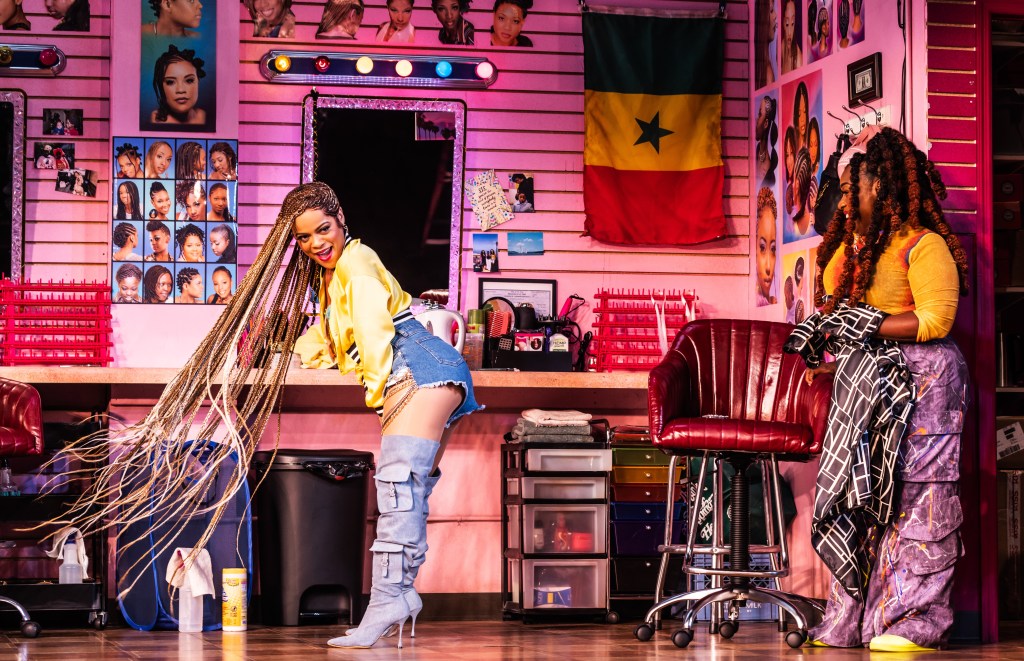
After MIriam is finished discussing her life back in Sierra Leone, which includes the story of her impotent, lazy husband, her surprise pregnancy and birth of her daughter by a gorgeous and potential future husband, and her divorce from the “good-for-nothing”, paternalistic former one, Jennifer is no longer. Miriam has effected the miraculous during her talk. Jennifer has become her unique self with her lovely new look. As she tosses her head back, we note Jennifer’s posture difference, as she steps into the power of how good she looks. Additionally, because of Miriam’s artistry, Jennifer is the proud receptor of a new understanding and encouragement. She has witnessed Miriam’s courage to be open about her life. If Miriam can be courageous, so can she.
Jennifer leaves more confident than before having taken part in the community of caring women who watch each other’s backs and hair, which by now has taken on additional symbolic meaning. Incredibly, Miriam works on Jennifer’s braids the entire play. However, what Jennifer has gained will go with her forever. The dynamic created between the storyteller, Miriam, and the listener, Jennifer, is superb and engages the audience to listen and glean every word they share with each other.
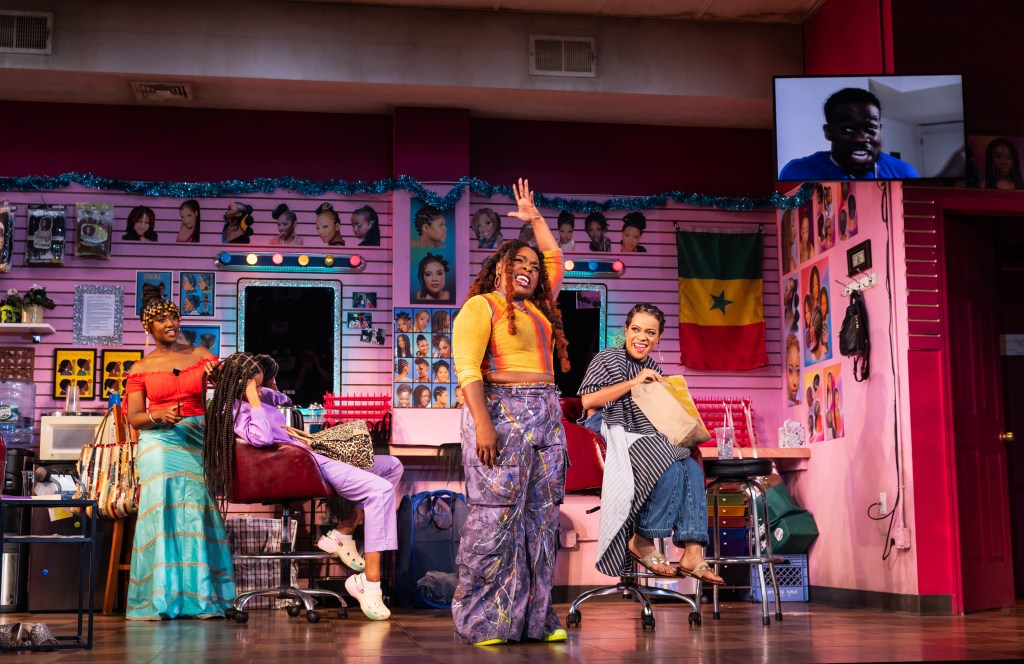
On one level, a good part of the fun and surprise of the production rests with Bioh’s gossipy, earthy, forthright characters, who don’t hold back about various trials they are going through involving men, who exploit them. Nor do they remain reticent if they think one of their braiding colleagues has been surreptitiously stealing their clients, as Bea accuses Ndidi of doing in a hysterical rant
Another aspect of the humor deals with the various clients who come in. Kalyne Coleman and Lakisha May each play three roles as six different clients. They are nearly unrecognizable for their differences in appearances. They change voices, gestures, clothing, mien, carriage and more. For each of these different individuals, they come in with one look and attitude and leave more confident, happier and lovelier than before.
Portraying three vendors and James, Michael Oloyede is hysterically current. Onye Eme-Akwari and Morgan Scott are the actors in the funny Nollywood Film Clip that Ndidi imitates.

For women, hair is key. Bad hair days are not just a bad joke, they are a catastrophe. Bioh capitalizes on this embedded social, cultural more. Presenting its glories, she reveals the symbolism of “extensions,” and “new appearances” as they relate to uplifting the spirit and soul of women who are required to look gorgeous.
Above all, Bioh elevates the artists whose gifted hands enliven, regenerate, encourage and empower their clients. Along with Miriam (Brittany Adebumola), these include Ndidi (Maechi Aharanwa), Aminata (Nana Mensah) and Bea (Zenzi Williams). Sitting in their chairs, under their protection, trusting their skills at beautification, we recognize the splendid results, not only physically in some instances but emotionally and psychically.
The only one who isn’t an African braiding artist is Marie (Dominique Thorne). She is helping out her mother Jaja (Somi Kakoma), who owns the salon and who is getting married that day, so she can get her green card for herself and Marie. Jaja who appears briefly in wedding garb to share her excitement and happiness with the women who are her friends, then goes to the civil judge to be married. However, Marie can’t be happy for her mother. Likewise, neither can old friend Bea, who has told the others the man Jaja is marrying is not to be trusted.

Nevertheless, the point is clear. Within the shop there are artists who are working their way toward citizenship. And Miriam is saving money to bring her daughter to the US. Though Bioh doesn’t belabor the immigration issues, but instead, lets us fall in love with her warm, wonderful characters, it is a huge problem for the brilliant Marie, who has been rejected from attending some of the best colleges. Her immigration status is in limbo as a “Dreamer.”
And like other immigrants, she is living her life on hold in a waiting game that is nullifying as well as demeaning because, as Jaja points out repeatedly to her, she can be a doctor or anything she wants. Her daughter, Marie, is brilliant, ambitious and hard working. Taking over the African hair braiding salon is not good enough. She can do exploits. But without a green card, she can do nothing.
Directed by Whitney White whose vision for the play manifests the sensitivity of a fine tuned violin, the play soars and gives us pause by the conclusion. The technical, artistic elements cohere with the overall themes that show the hair salon is a place of refuge for women to commiserate, dig deep and express their outrage and jealousies, then be forgiven and accepted, after a time. It is a happy, busy, brightly hued and sunny environment to grow and seek comfort in.

David Zinn’s colorful, specific scenic design helps to place this production on the map of the memorable, original and real. This salon is where one enjoys being, even though some of the characters snipe and roll their eyes at each other. Likewise, Dede Ayite’s costume design beautifully manifests the characters and represents their inner workings and outer “brandings.” From her costumes, one picks up cues as to the possibilities of what’s coming next, which isn’t easy as the production’s arc of development is full of surprises.
Importantly, Nikiya Mathis’ hair & wig design is the star of the production. How the braiding is done cleverly with wigs so that it appears that the process takes hours (it does) is perfect. Of course the styles are fabulous.

Kudos to the rest of the creative team which includes Jiyoun Chang (lighting design), Justin Ellington (original music & sound design), Stefania Bulbarella (video design), Dawn-Elin Fraser (dialect & vocal coach).
This is one to see for its acting, direction, themes and its profound conclusion which is unapologetic and searingly current. Bioah has hit Jaja’s African Hair Braiding out of the park. She has given Whitney White, the actors and the creatives a blank slate where they can enjoy manifesting their talents in bringing this wonderful show to life. It is 90 minutes with no intermission and the pacing is perfect. The actors don’t race through the dialogue but allow it to unfold naturally and with precision, humor and grace.
For tickets go to the Box Office on 47th Street between 7th and 8th Avenues or their website https://www.manhattantheatreclub.com/shows/2023-24-season/jajas-african-hair-braiding/?utm_source=google&utm_medium=cpc&gclid=CjwKCAjwvfmoBhAwEiwAG2tqzDaZkpYxm9EVbEs9yQ0hCPDF5gTyx9a8iy4yFCkwZxfd3skrmdD8oxoCAfgQAvD_BwE
‘Dig’ by Theresa Rebeck, Caring for Plants and People, Review
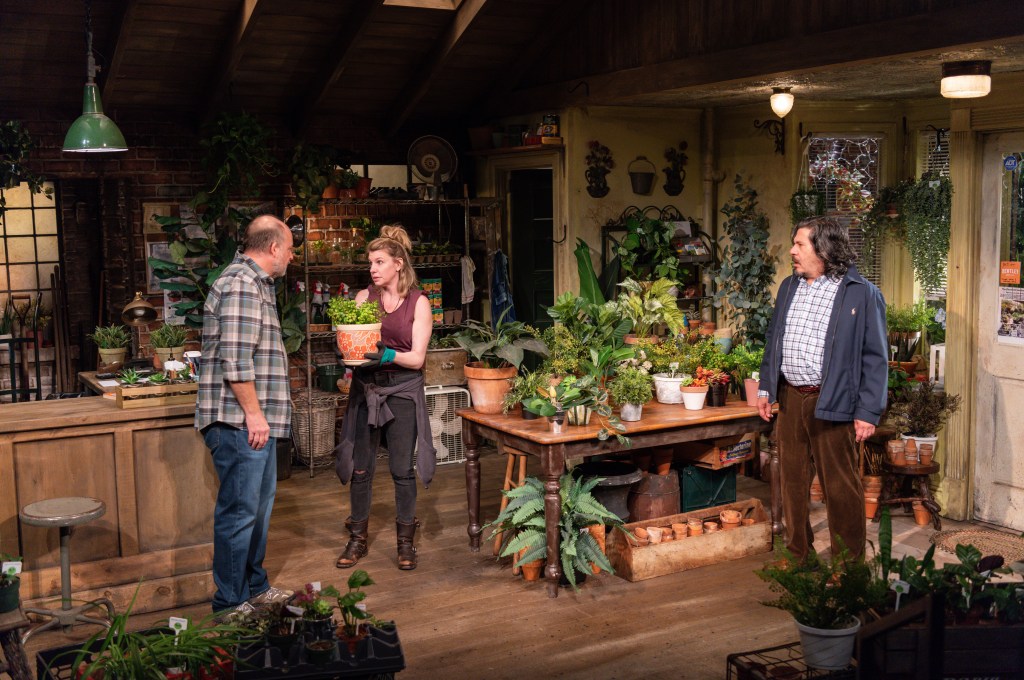
In her comedy/drama Dig Theresa Rebeck (Bernhardt/Hamlet) examines the transformative moments that happen imperceptibly to individuals, when no one is paying attention and they are least expected. With serendipity and the synergy of human need, responsiveness and emotional immediacy, the energy for change becomes the forward momentum of this superb, exceptionally acted and directed production. Rebeck, wearing two hats as director and writer, effects a powerful character dynamic in the play, which first premiered at the Dorset Theatre Festival in Vermont, and is now enjoying its New York City Off- Broadway premiere at Primary Stages, 59E59 Theaters.
With striking characters that Rebeck displays in their quirky, raw humanity, gradually stripped away to their bloody core in an identifiable, magical coalescence, the themes of hope and resurgence are unveiled. That this happens in a small town which is imploding for want of commercial viability, and to an insular shop owner in need of a personal revolution, is all the more engaging.
Importantly, in Dig, Rebeck prods us to recall verities of redemption and reconciliation, which abide in all of our lives. Second chances are possible, regardless of how dire or malevolent the circumstances appear in the lives of the damaged, lost and hurting.

The setting for hope and transformation is fitting. It is the plant shop, “Dig,” where set designers Christoper Swader and Justin Swader have done a magnificent job in displaying wall to wall greenery, and later, as the characters spark to life and regeneration, floral beauty. Roger is the reticent, thoughtful owner who has created “Dig.” He controls his singular botanical world, is knowledgeable about plants, and is an amateur botanist who has a “knack” with encouraging dying plants back to life. Healthy and unhealthy plants are a perfect metaphor for the human condition, and Rebeck with tongue-in-cheek amply uses this metaphor selectively and profoundly.
The playwright initiates this metaphor and other concepts in the opening scene between Roger (Jeffrey Bean in a brilliant, nuanced performance), and his longtime friend, Lou (Triney Sandoval effectively portrays his feisty and catalytic counterpart). Lou has abused a plant Roger gave him with the unwitting behavior of a plant neophyte. He’s underwatered and overwatered the “elephant ears” to it’s last “breath.” As Roger chides him like a school teacher, Rebeck’s humor gains traction. Immediately we understand the relationship between Lou and Roger and the otherworldly importance plants have in Roger’s life. After scolding Lou, he assures him that he will salvage the dying plant. Lou is relieved.

The action redirects when Lou’s daughter Megan (the terrific Andrea Syglowski), speaks up in defense of Roger about the money he gave Everett (Greg Keller in a humorous, off-beat turn) to buy them coffees. Megan, who has quietly disappeared into the background, sitting near the door, is barely noticeable because of her withdrawn posture. Additionally, she is overshadowed by the lively, antic banter between Lou and Roger. Clearly, there are undercurrents in Lou’s neglect of the plant and Roger’s gentle upbraiding. Concurrently, Lou’s suspicion of Everett, Roger’s truck driver, who Lou says smokes pot, is a criticism which chafes Roger.
Lou’s neglectful plant care and his guilty response have more meaning we discover later, when the parallels between caring for plants and caring for human beings comes to the fore. Likewise, Roger’s permissiveness with Everett comes back to “hit him in the face” like a bad karma rash.

In this initial exchange Rebeck has laid the foundation for the interactions among Roger, Lou, Megan, Everett, and Molly (the fine Mary Bacon), who drops in a bit later looking for tulip bulbs. Like strategically placed dominoes that topple and swerve around corners, do complicated gyrations and elaborate tricks, the characters’ knock and shuffle against each other with various encounters, emotional explosions, jealousies and eventual quietude, which Rebeck brings to a poignant and satisfying conclusion at the end of the two hours and one intermission.
How she effects this character sleight of hand, under-girded by the superb actors, leaves the audience feeling they’ve experienced a series of events with surprisingly disparate individuals who, are somehow similar. Each attempts to affirm their identity and place in a life that may or may not have meaning for them, save Roger who is perhaps ahead of the others in finding his place, though the town is dying like a poorly cared for plant. Into this mirror of humanity, we note the pain and struggle of finding a way to understand others, when not all of their truth has been revealed.

Megan, fresh out of prison and rehab is living with Lou, her adoptive father, who has taken care of her for her entire life. She lives with him because she has no money and nowhere else to go. She is responsible for an accident during which she killed her son through negligence. Confused, filled with guilt, Megan tried to end her own life and failed.
This backstory is revealed gradually by discovery through the comments the other characters make about Megan when she isn’t in their presence. Rebeck’s skill in disclosing who Megan and her father are, their close relationship, and the town’s response to Megan’s responsibility in the accidental death of her son, is effected with power and realism. It is a sad tale that has hushed up the community and left Megan with few friends except for the comfort of her father, her trying, martinet-like AA group, and Roger, Lou’s best friend.
Apprised of Megan’s story, Roger is tentative and gentle with her. But he is bewildered when Megan screams at a customer for being nosy about recognizing her (most probably in the news reports on TV). In a follow up of her anger, Megan curses Everett and forces her father to leave before they’ve enjoyed their coffees. Her fury is shocking, however Roger takes it in his stride and defends her against gossip which Everett repeats. It is in Roger’s and Everett’s discussion we learn the way which Megan accidentally caused her son’s terrible death.

In this pivotal scene the stakes are unveiled and Megan’s volatile, unbalanced personality which Lou has confided to Roger places her on a knife’s edge. However, Megan returns the next day to apologize to Roger and is manipulative in wanting to ingratiate herself with him for a job. Interestingly, the job would make her feel useful; she does not want to be paid. And though Roger says he needs no one and rejects her, she pushes her way in, immediately demonstrating her usefulness by potting a plant, Perhaps, she can make a difference in the shop, can stabilize her life and reinvigorate Roger’s life as well.
In her actions, we are watching Megan throw herself a lifeline. Drawn to something in Roger’s nature, perhaps his empathy and his incredible weirdness in caring for his plants and in setting up his environment which is soothing and peaceful, she attempts to try something different.

That Roger allows her into his life to “disturb his peace,” and assist him for no pay, is something that Lou objects to out of fear for his friend. He knows her unreliability and feels guilt for Megan’s causing the accident. Furthermore, with her alcoholism, unless controlled, she can “fly off the handle” and explode into a frenzy.
In a protective mode, Roger recognizes that she is willing to change and work toward improving herself with her apology. It is unmistakable that she took responsibility for acting improperly. Her humility to change is again affirmed for Roger when Molly comes into the store and Megan apologizes to Molly and accepts Molly’s invitation to a prayer meeting at church.
In Act II “all’s well that ends well,” until it isn’t. By that point the shop is blooming with lovely flowers and Roger has fired Everett for his pot smoking antics in the truck and his disrespectful, judgmental attitude about Megan. In an argument which Roger won, Roger suggests his critical attitude toward Megan is unfair because the details surrounding her son’s death were uncertain. Roger has feelings for Megan. And though she senses it and tries to advance their relationship beyond friendship, we learn that Roger has spurned her attentions.

It is in this act when her former husband Adam ((David Mason’s portrayal is potent and searing), tracks her down to to confront her about their son’s death. Once again, Roger defends her. However she stops him and forces him to leave so she can hash out the issues with Adam. This revelatory scene is another turning point where we understand their relationship in an explosion that Roger cannot mitigate or influence. It is up to Megan to deal with the shreds of her life that remain, with the only intervention that might heal her-Roger and the plant store-which she has influenced and helped to make thrive in the fading town. But there are obstacles. Everett resents her taking his place. And in an underhanded, slick seduction, his actions influence her to leave so he can get back into Roger’s good graces.
Rebeck and her cast and creatives have put together a smashing work whose honesty and power is breathtaking. DIG is a refreshing, bold, funny and poignant production which defies easy definition.
In magnifying Rebeck’s vision, the superb design team worked overtime. They include Christopher Swader and Justin Swader (scenic design), Fabian Fidel Aguilar (costumes), Mary Ellen Stebbins’ atmospheric, mood-suggesting lighting design and Fitz Patton’s original music and and sound design. These creatives give the production the medium which allows the actors to seamlessly move and inhabit their characters with humor and probity.
DIG is memorable and metaphoric and profound. In a limited engagement until October 22nd, it is not to be missed. For tickets and times go to their website https://primarystages.org/shows/current-season/dig/

