Category Archives: Off Broadway
‘Baldwin & Buckley at Cambridge’ at the Public, Review

Baldwin & Buckley at Cambridge, the 1965 debate of James Baldwin and William F. Buckley, Jr. at the Cambridge Union, University of Cambridge, UK is receiving its New York Premiere at The Public Theater. You need to see this production presented by Elevator Repair Service (Gatz, The Sound and the Fury) for many reasons. First, it’s vitally important for us in this present moment to hear and understand Baldwin’s criticism about our nation from the perspective of an articulate novelist, playwright, essayist, poet, identified as one of the greatest Black writers of the Twentieth Century. The production, which captures the debate in its entirety, will also help you understand Baldwin’s realistic acknowledgement of American attitudes and sensibilities, many of these carryovers to our present society and divisive culture, whether we are loathe to admit it or not.
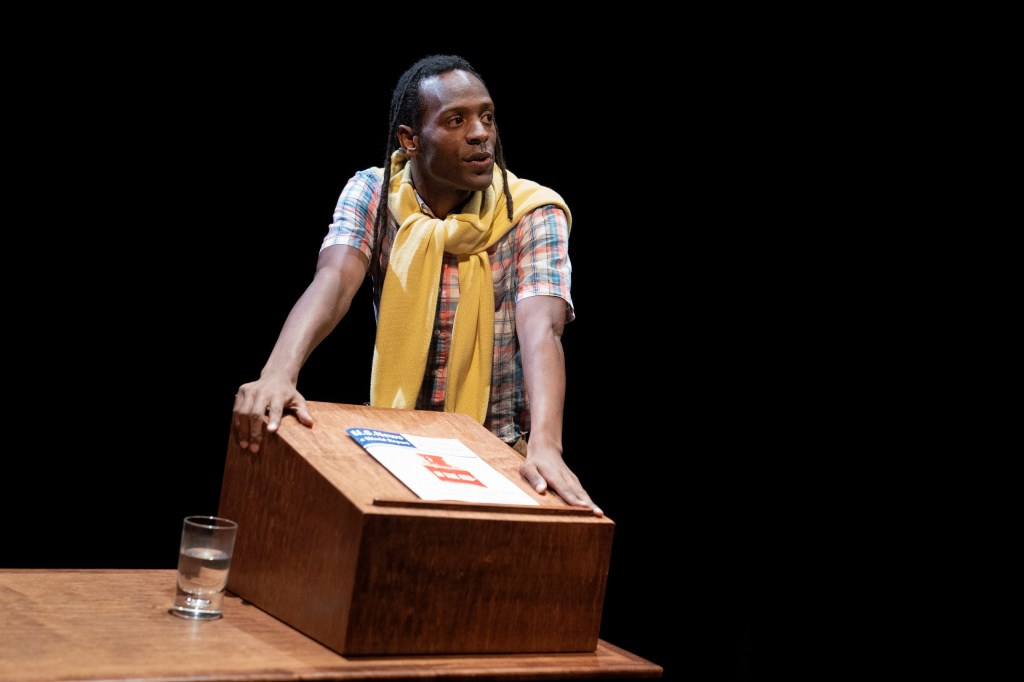
The unadorned, bare bones production highlights the arguments Baldwin and Buckley presented at Cambridge in response to the question, “Has the American Dream been achieved at the expense of the American Negro?” With a minimalist set, two desks, chairs, lamps staged with the audience on three sides at the Anspacher Theater, the evening replicates the words if not the tone, ethos or dynamic drama of Baldwin (Greig Sargeant) and Buckley (Ben Jalosa Williams) in their face-off.
It is a worthy triumph of ERS to re-imagine these two titans, one eloquently speaking for Black America, the other a conservative writer and National Review founder. The latter supported a slow walk of desegregation which Blacks must “be ready for,” and were “not yet ready for.” Baldwin’s and Buckley’s perspectives reflected national attitudes, especially after the legislative gains made for Blacks in 1954, 1964 and 1965 which Baldwin didn’t trust because the power structures of the South and North didn’t adequately enforce the laws. In viewing their comments now, as our nation experiences “in-your-face” racism and discrimination, that would overthrow all gains (revealed in striking down Roe vs. Wade and most of the 1965 Voting Rights Act) the concepts in the debate between Baldwin and Buckley are highly relevant and worthy of review.

The inherent drama of the debate, its electric personages, and the crisis of the time eludes the actors and the director. Indeed, perhaps the task is impossible without sufficient artistry, and imagination to suggest what once was, the frenetic and feverish times of the country that in 1965 saw the Watts riots, which Baldwin alludes to at the end of his speech.
When Baldwin and Buckley debated, America was still fighting segregation in the deep South, the effects of which Cambridge student Mr. Heycock (Gavin Price on Saturdays) discusses to introduce Baldwin’s arguments. He mentions statistics quoted by Martin Luther King, Jr. when they conducted a protest supporting voting rights in Alabama. Heycock states, there were more Negroes in jail for protesting than on the voting rolls. He enumerates other statistics. These identified the extent to which Blacks had been excluded from the White society’s opportunities and their aspirations to achieve the American Dream: jobs with benefits, college educations, economic prosperity, home ownership and more.

As both Heycock and later Sargeant’s Baldwin make clear during their fact-laden presentations, in no way was the Black experience in America “separate but equal” to that of Whites. Their lives, their worlds, their perspectives, opportunities and approach to daily living was anything but equivalent.
Though this was especially so in the South, the quality of life disparities also were prevalent in Northern cities like New York, Detroit, Chicago, Los Angeles. There, Blacks were shoveled into the projects branded as a Utopian “urban renewal.” Actually, there was no renewal, as Blacks were crowded into broken-down buildings and crime-ridden ghettos, where rats flourished and the garbage spilled over into the streets. All of these points, Sargeant’s Baldwin mentions, disputing that Blacks have an equal opportunity in achieving the “American Dream,” which is obtain by Whites at Black’s expense.

The debate is a historic call to remembrance and worthy as such, which is why it bears being watched on YouTube, after seeing the Public’s production, directed by John Collins. The YouTube video reveals the unmistakable ambience of Cambridge and the scholars and students present in their formality and sobriety, laughing at Baldwin’s wit and wisdom and sometimes laughing with ridicule at Buckley’s pompousness and stumbles into bigotry.
Indeed, what is absent from the Public Theater production is this sense of moment. Missing is the ambience of setting and the nature of the audience which played a role in relaying the importance of the Baldwin and Buckley debate. These two giants in their own right honored Cambridge with their presence and concern, conveying American voices and perspectives. The gravitas is lacking in the production and is a possible misstep. Though an announcement is made as to the setting, more should have been done to convey the place and time. With a minimum of dramatization, the production wasn’t as dynamic as it could have been.

Creatively conveying time and place was not the choice of ERS or director Collins. Thus, Baldwin & Budkley at Cambridge is uneven. In structure and format the production follows the original debate. The elements are modernized, costumes in modern dress, not the black bow tie and suit worn for the formal Cambridge debate.
Also, somewhat confusing is that Price’s Heycock acknowledges the Lanape Indigenous Tribe who owned the land the Public Theater rests on. Then immediately he segues into the original debate structure. Perhaps as is done with other productions at the Public, a voice over by Oskar Eustis honoring the Lanape would have been less confusing. The separation of the present America from the debate setting is needed so the audience might reflect on the history of the land. After a pause, the setting of Cambridge, 1965 could then be established.

When Heycock finishes his introduction, Cambridge student Mr. Burford (Christopher-Rashee Stevenson) introduces Buckley’s argument, that it is not true that “the American Dream has been achieved at the expense of the American Negro.” To refute this Mr. Burford points out that 35 Black millionaires have achieved the American Dream. This justification that Blacks have attained the dream and not at the expense of Blacks is an example of the convoluted logic that will follow in Buckley’s confused and misdirected arguments.
Burford’s belittling statement in ignoring the huge unequal and disproportionate number of the few wealthy Blacks to numerous wealthy Whites deserves laughter and ridicule. Interestingly, the audience at the Public didn’t respond, as bigoted as the comment was. Possibly the lack of context of time and place contributed to an absence of audience engagement with Burford’s obnoxious statement and at other times during the performance.
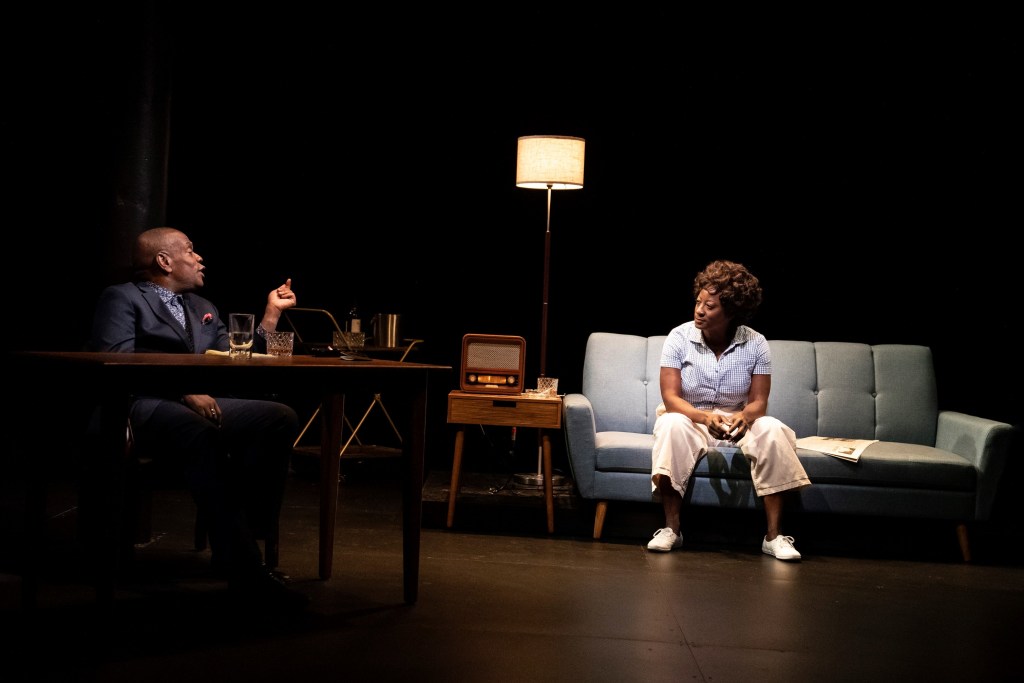
Identifying the number of Black millionaires, while ignoring the large percentage of Blacks who live in poverty, evidences the superficiality of Buckley’s arguments which follow Burford’s introduction. As Williams’ Buckley launches into his presentation, we understand that the reality that Baldwin just portrayed about the Black experience in America, will in no way enter in to Buckley’s discussion. Indeed, he dismisses and ignores Baldwin’s brilliant conceptualizations, something which Baldwin intuits that the White culture does to perpetuate the status quo. Throughout his presentation Buckley doesn’t acknowledge that White culture controls, creates and dictates the Black experience. In no way is Baldwin’s picture of reality confronted by Buckley in his disjointed and at times abstruse speech.
Buckley diverges from Baldwin’s statements so that he does not dispute that the American Dream exists at the expense of Black exploitation. He ignores Baldwin’s dense discussion that the American Dream by its very nature in the White culture’s understanding nullifies its existence if Blacks are to be a part of it. For the American Dream to exist, Baldwin suggests from the White perspective, Blacks must be excluded and given little opportunity to achieve it. Blacks can’t be a part because it necessitates exploitation of themselves. Baldwin’s point is that the dream only exists for Whites. Blacks are a part only in so far that they are at the bottom of the power structure, the foundation upon which Whites step up and rise, taking with them all the spoils, all the opportunities.

Sargeant’s Baldwin is wry and not as nuanced, expressive and dramatic as he might have been. On the other hand, Williams’ Buckley is vital, stirring and engaging. Clearly, in the Public Theater production, Buckley won. I found myself dropping out as Sargeant’s portrayal missed important beats. Williams’ sharp edginess and movements kept my interest. Conversely, Price’s Heycock was portrayed with vitality. Stevenson’s Burford was adequate.
Interestingly, after the debate Sargeant’s Baldwin sits with friend and playwright Lorraine Hansberry (Daphne Gaines). Their interchange reveals their close friendship. Unfortunately, the scene is too brief and should have delved deeper. At the very end, Sargeant takes off the mantle of Baldwin in his most authentic moment. He acknowledges the company’s own politically incorrect historic racism when ERS cast White actors to play Black roles in their early versions of The Sound and the Fury. To identify a past that we are still trying to become free of, even the most well meaning of us, seems counterproductive, guilty and fearful. I look forward to a time when theater moves beyond this stance which in itself is disingenuous and “protests too much.”
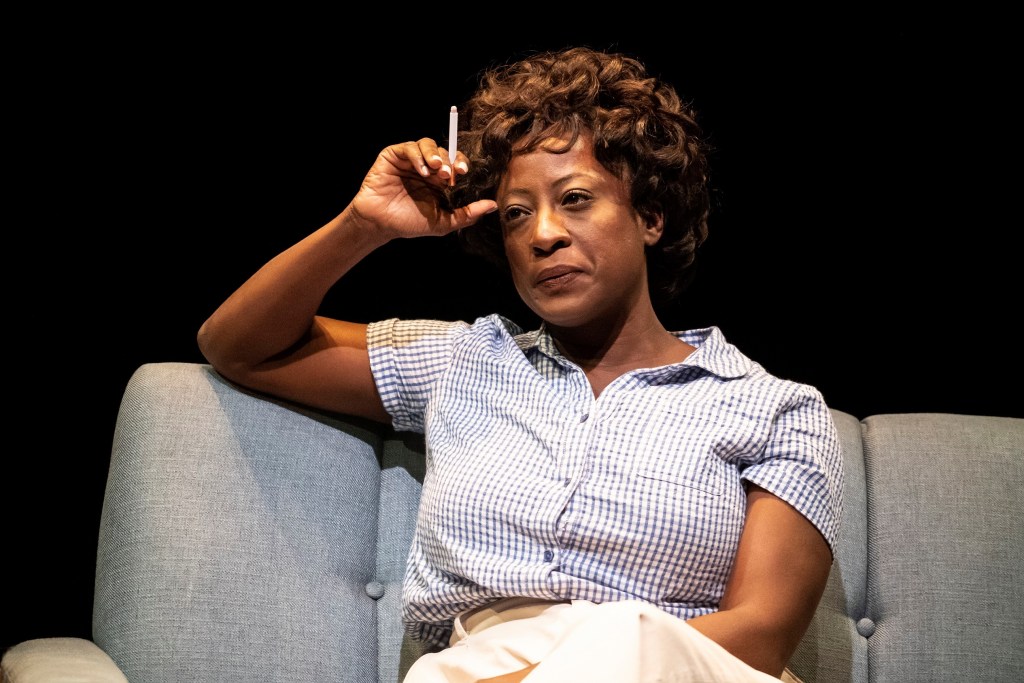
Clearly, at this time it is appropriate that the debate of Baldwin & Budkley at Cambridge be re-imagined. We are at a crossroads. This is not 1965. We are not in Cambridge, however, the ideas from our racist past that were entrenched, have been redeemed as useful and justifiable for us in the present. At no other time in history having attained what we thought was racial progress, have we been so duped by the residual racism that existed culturally into believing it was harmless. Its dangers have always been there and liberals have been blind to it despite warnings by Black and Brown critics.
Baldwin knew, he saw. The Black reality and White world were as clear as day. He understood that the White reality was convinced of its craven rightness to oppress and suppress Blacks to achieve White agendas at Black expense. Today, this horrific White reality is most visible in law enforcement abuse of Blacks, in the broken justice system that incarcerates Blacks disproportionately, in the exclusion of Blacks in corporate empires, in every institution that harbors systemic racism.
And the economic oppression is growing worse to include everyone except the .001%. These truths existed sub rosa for decades as the gap between the wealthy and everyone else widened. However, it took an egregious and criminally-minded opportunist in former president Donald Trump to justify and promote a resurgence of open hatreds branding the necessity of racist oppression, and authoritarianism ruling the underclasses, using media PR of lies and obfuscation.
For that final reason, Baldwin & Budkley at Cambridge is an extremely vital production which must be seen. For tickets go to their website: https://publictheater.org/
‘This Beautiful Future’ Transfers to the Cherry Lane

Sometimes the only hope alive during crises or the trauma of war are romantic dreams which disappear in the light of day. Young love, illusion, rueful regret and irony thread two lines of action, one .in the past in Chartres, France, 1944, the other in an opaque and timeless present. The threads are like parallel tracks that coexist simultaneously without touching until the conclusion of This Beautiful Future where they do briefly coalesce. The production directed by Jack Serio and written by Rita Kalnejais is running at the Cherry Lane Theatre until October 30th.

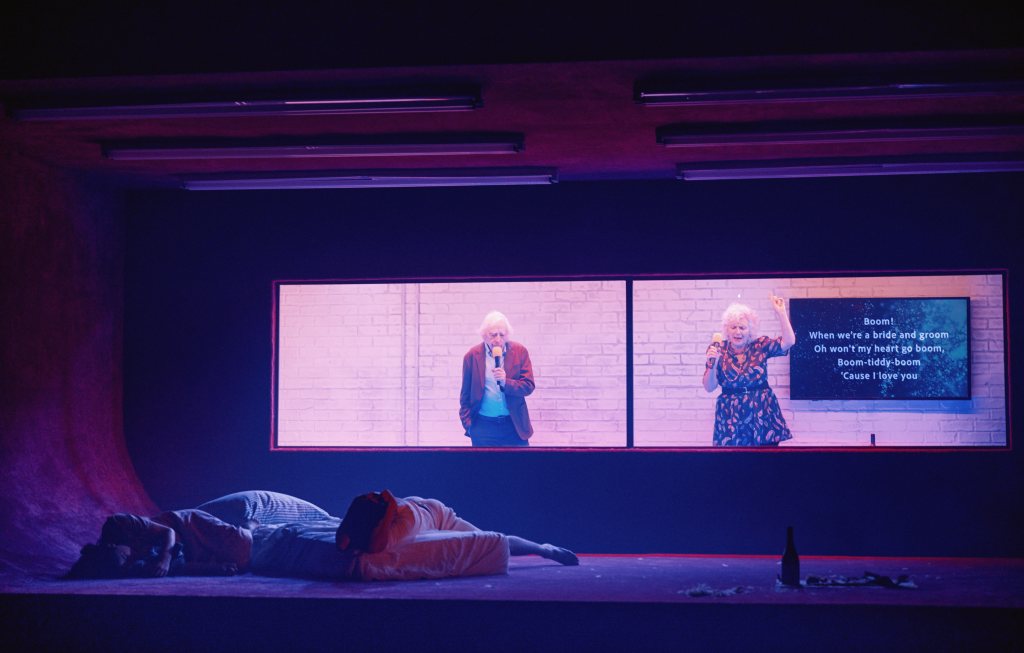
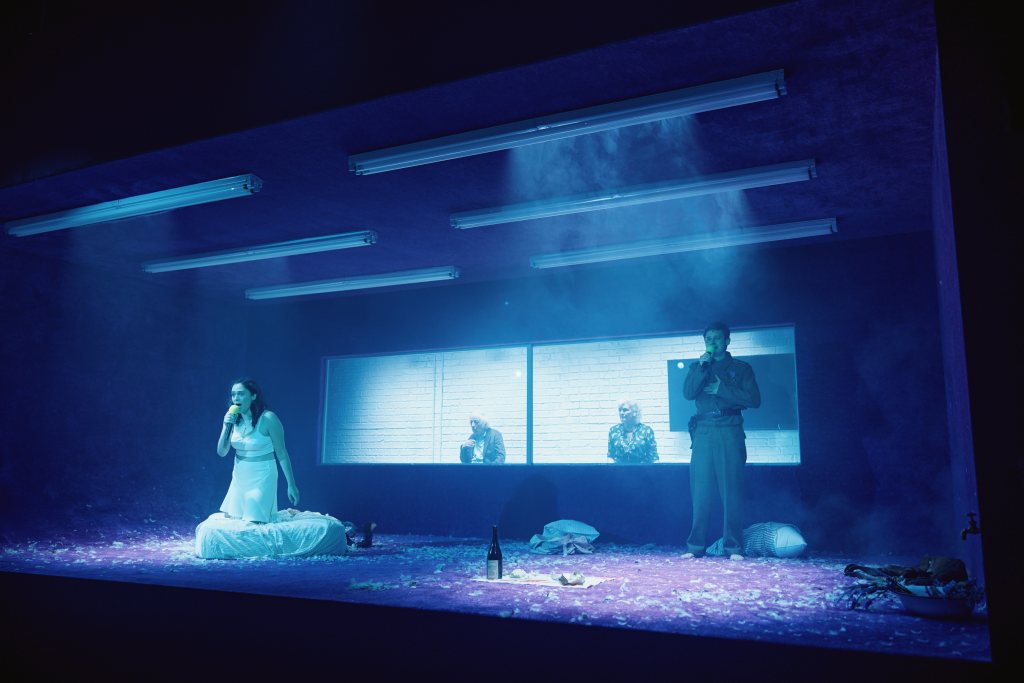
The playing space downstage front represents an abandoned house once occupied by Jews, rousted out by the Nazis. The setting is Chartres France, 1944 at the end of WWII. Upstage, behind a plastic window partition in the present are observers of the action, two wise, world-savvy seniors (Angelina Fiordellisi) and (Austin Pendleton), playing themselves. These venerables serenade us with ironic songs that provide an exclamation point to the the troubling conversations, cognitive dissonance and contradictions that abide between love-mates, a canny French teenager Elodie (Francesca Carpanini) and Otto (Uly Schlesinger). Otto is a Nazi youth, old enough to shoot Frenchmen for his idol Hitler, but too naive and ignorant to understand the heinousness of his actions.
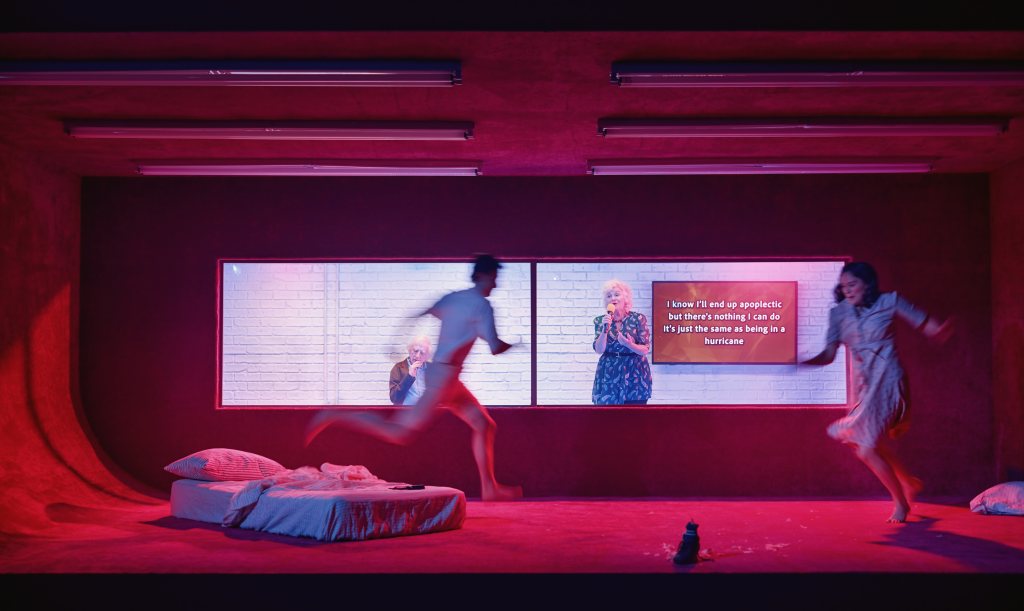
Though the conflict is understated, Elodie has fallen in love with Otto despite his mission to kill, and he is entranced with her, possibly using her to ignore the rude reality that the war is over and he is on the wrong side and facing certain death as American forces are a day, then minutes away.
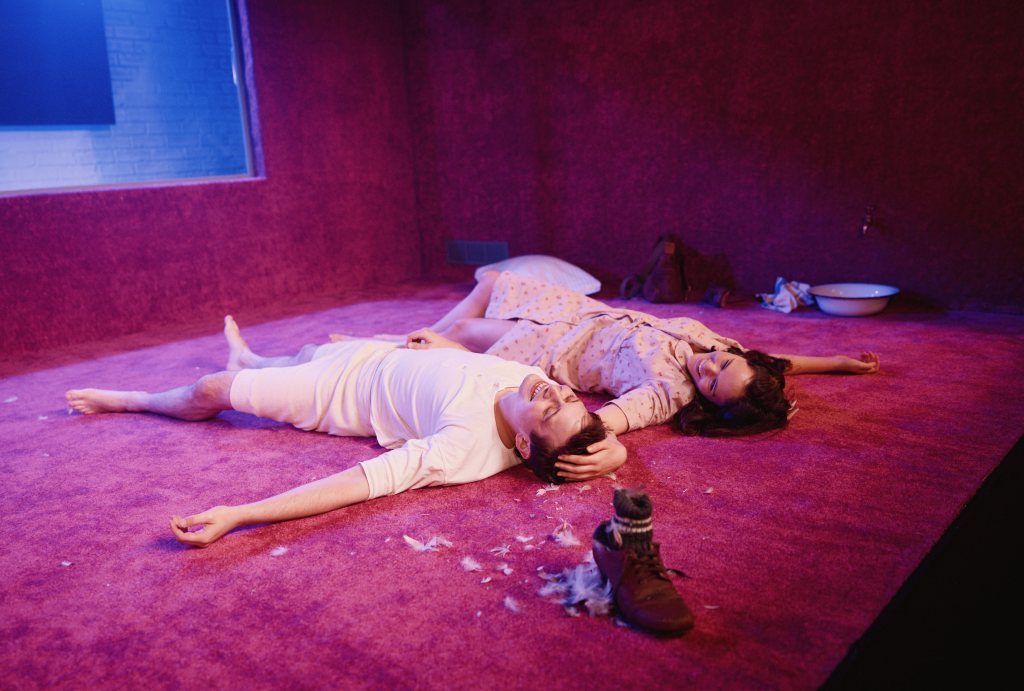
The play combines monologue and interactive dialogue. The time is non linear and moves into flashbacks which alternate from Elodie’s and Otto’s magical and sweet interludes in the bedroom of the abandoned house their last evening together, to the following day when in monologue they unremorsefully describe the consequences of their love’s fool-heartiness. Another flashback skips to the time when they first discovered their interest in each other at the lake. Then the next scene jumps to Otto’s monologue describing his last moments on earth and Elodie’s monologue describing her public shaming and harassment for making love to a Nazi.
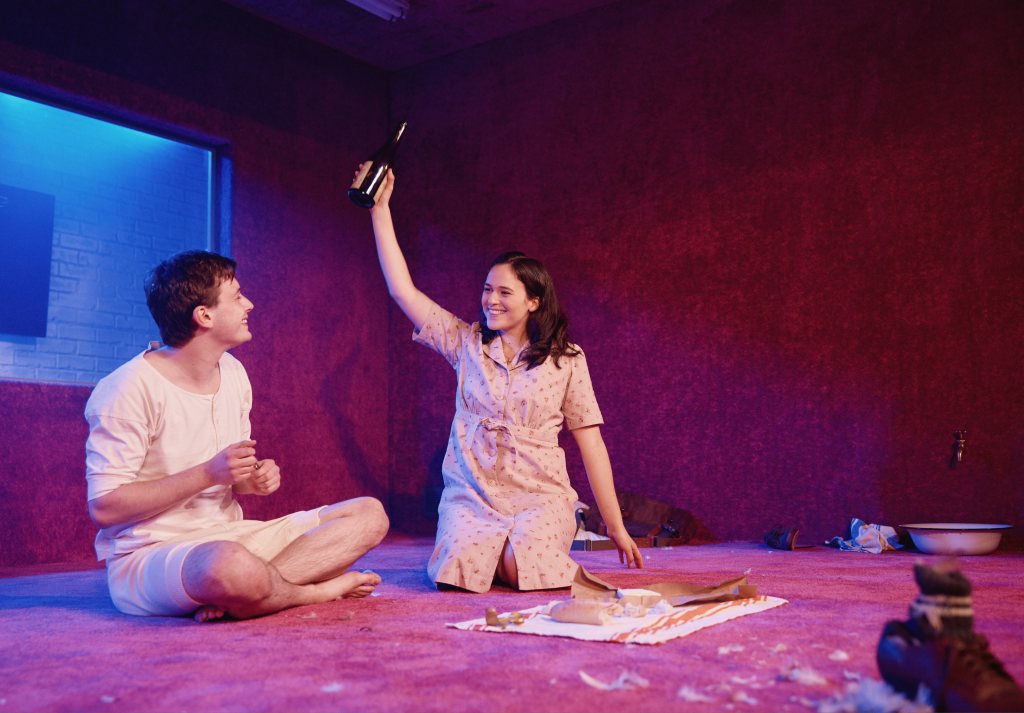
Elodie’s and Otto’s separate monologues delivered to the audience are reveries without emotion. As they discuss the consequence of their brief love relationship the following day after their night together in the house, we are surprised by the contrast with the previous scenes when their interactions are joyous, magical, uplifting. During their pillow fight, their throwing water and teasing each other, we forget that this is wartime. As they are compelled to escape to each other, we are relieved to focus on the silliness of their youthful innocence. Yes, even a killer Nazi has elements in his spirit that are silly and sensitive. Importantly, Kalnejais never steps too far away from Otto’s humanity to make him a stereotype.
In the final section the morning before they both leave the house, an egg which Elodie has stolen from a nearby chicken coop hatches and the loud chick proclaims it is alive. Of course the irony is that as the two of them leave, the chick will have to fend for itself and most probably die. This irony is heaped on another irony, because in the first scene they discuss their future after the war; they will raise this chick and have more chickens. This is the “beautiful future” of Otto and Elodie, wayward dreamers who at this point in their lives do not regret what they have experienced together. Theirs is a respite in the horrors of death and chaos. Of course they must dream of the beautiful future because it will never come to pass.
Interestingly, toward the end of the play after the wise observers of these events sing songs whose lyrics are loaded with irony, Angelina and Austin come down from their perch “on high” and hug and comfort Otto and Elodie because of what they are going through. One wonders; if the observers could intervene would they encourage Otto to leave Elodie before morning so he doesn’t fall into the hands of the Americans and die? And if Angelina could counsel Elodie, might she have left Otto and the house before her countrywomen catch her and deem her a traitor? Elodie is punished for sleeping with a Nazi, she shares in a monologue. They publicly shame, harass her and shave her head.
Most probably even if Angelina and Austin attempted to stop Elodie and Otto, they would have rebuked their interference so they could continue to believe in their dreams and “beautiful future.” They prefer being swept up by the annihilation of romantic love’s curse. Evidence of this abides throughout.
Otto is like the QAnon MAGAS in our nation who revel in the fantasies of their own making. Like them he is convinced of his rightness in bringing about Hitler’s “perfect” Master Race and the ideas of the Third Reich. Staunchly oblivious, he refers to news reports of Germany’s loss that Elodie shares with him from the BBC as banned propaganda. He even suggests he could arrest her for listening to enemy radio. Otto cannot be dissuaded from his beliefs that his troop is going to invade England the next day. Most probably his commanders have told them these lies to bolster their flagging moral. It is a wartime trick. One is reminded of Putin’s commanders lying to the Russian youth to get them to fight his losing war against Ukraine.
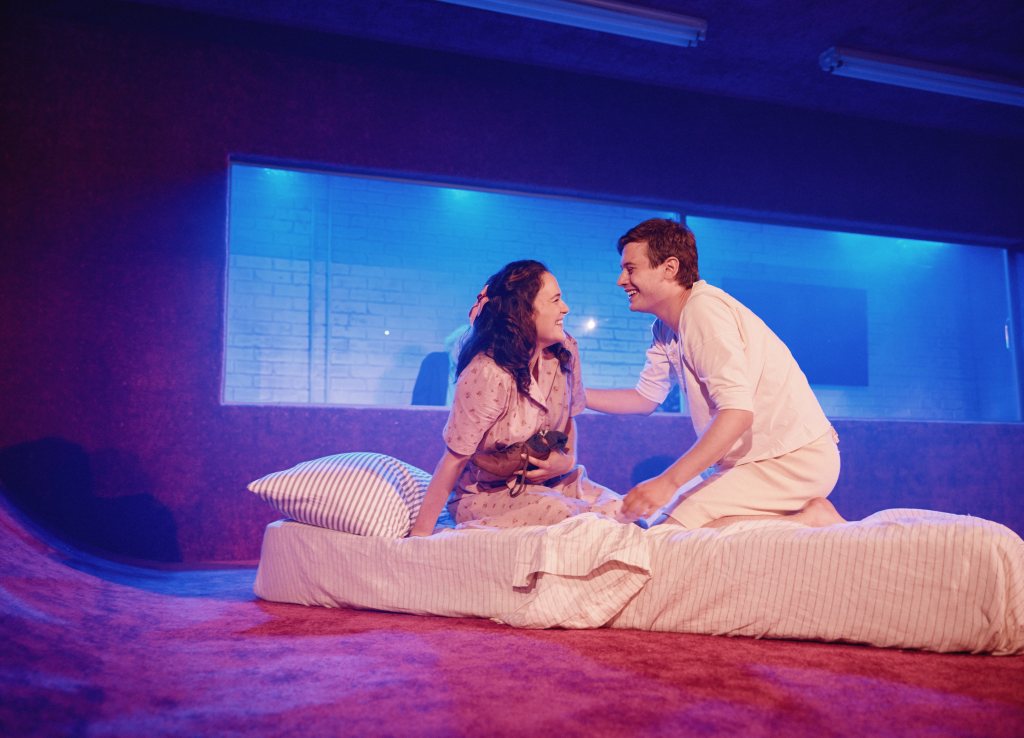
From war to war throughout the ages up until today, no sane individual wants to kill other human beings. They have to be brainwashed with lies, scapegoating “the enemy other” to do so. Of course, the final lie is that the war is being waged to bring about “the beautiful future.” Things will be better once “the other” is wiped out, cleansed from the face of existence. That Elodie “loves” someone who believes this is an interesting phenomenon. Thus, the songs that Angelina and Austin sing are supremely ironic as they heighten the obliviousness of Elodie and Otto, who we somehow find ourselves engaged with, precisely because they are youthful and off-the-charts irresponsible and blind.
Elodie is like the MAGA wife who supports her husband going to radical, conservative, right-wing Donald Trump rallies, though it is counter to their lives to give money to a grifter, defrauder and proven liar. Elodie ignores the truth that Otto is a killer, a brainwashed Nazi who has most probably killed her brother’s friend and others in her acquaintance. Indeed, the Nazis have killed friends, neighbors and family. Yet, she is able to live with the cognitive dissonance and “love” him.
For his part Otto puffs himself up riding on Hitler’s coattails. He imagines Hitler’s greatness when he started out from nothing to become the near ruler of all of Europe. Otto is tremendously enamored of the adventures he’s had fighting for Hitler and the respect he garners because he wears a uniform. During Elodie’s and Otto’s monologues and interactions, the songs which Angelina and Austin sing are laughably sardonic. That they sing with sweetness punctuates the dark irony all the more.
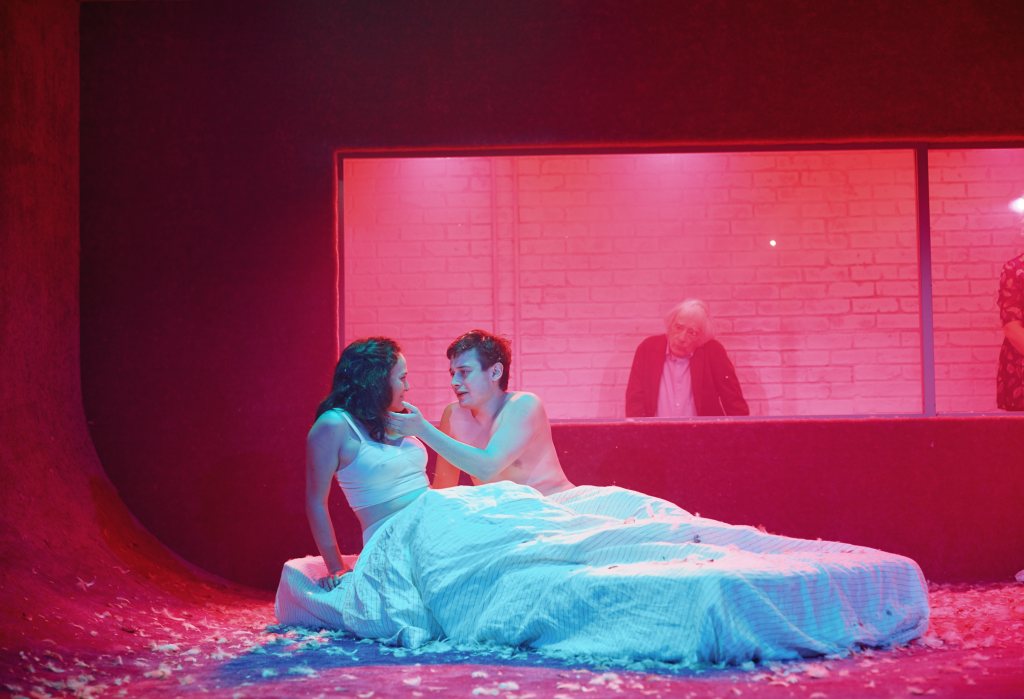
This Beautiful Future is not for everyone. From the rosy, pink set appointments evoking the concept of seeing life through “rose colored glasses” (Frank J. Oliva-scenic design), to the contrast of action and singing in a divided stage (Lacey Ebb-production design), by undefined observers, one may be confounded with a cursory viewing. The play necessitates one goes deeper for it is thought provoking and extremely current. It is well acted and finely directed. The scenes between Carpanini’s Elodie and Uly’s Otto have striking moments of whimsy, beauty and poignancy. However, playwright Rita Kalnejais always makes sure that the romantic fantasy is momentary and that leering reality lurks around the corner ready to pop up and set Elodie’s and Otto’s tranquility spinning into fear.
This Beautiful Future runs 80 minutes with no intermission at the Cherry Lane Theatre. For tickets and times go to their website: https://thisbeautifulfuture.com/
‘Kinky Boots’ is BACK, and It’s Phenomenal!
I did not ,see the 2013 production of Kinky Boots, the multi-award winning blockbuster by Harvey Fierstein (book) and Cindi Lauper (music & lyrics), that ran for six years and fortuitously closed April of 2019, one year before the COVID pandemic upended Broadway. The show won six Tony Awards, including Best Musical. These went to Billy Porter as the Best Actor in a Musical, Cindi Lauper for her amazing music and lyrics, Jerry Mitchell for choreography, Stephen Oremus for his orchestrations and John Shivers for sound design.

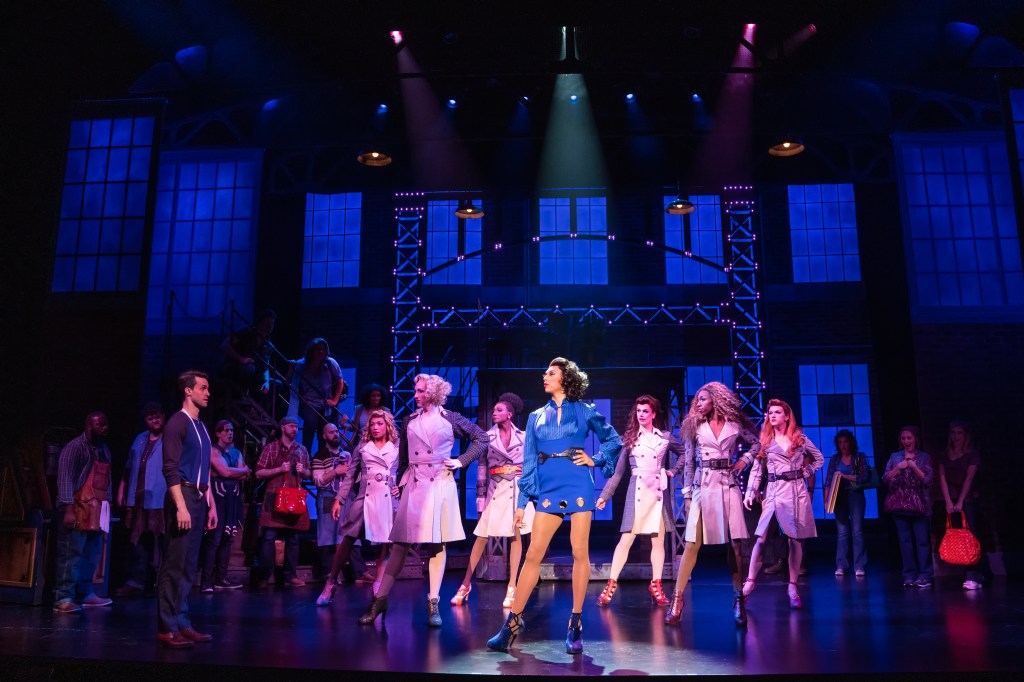
To share in the bounty for theater goers like me who missed the show and for those fans who are over the moon for Lola and her posse-pop-rocking Angels, producers continue to inspire us presenting this glorious musical at the appropriately intimate, yet large cast accommodations Off Broadway at Stage 42. The creatives are the same with the exception of Gareth Owen, whose sound design keeps the pared- down orchestra as enthralling as ever, and the actors’ vocals spot-on clear. Cleverly keeping the ticket prices at a reasonable level, this “kick-ass” Kinky is a slimmed down version, loyal to what works timelessly with the songs and book with tweaks and a few changes. The cast is extraordinary with gobsmacking, striking voices and performances.

Based on the titular 2005 British film written by Geoff Deane and Tim Firth, partly inspired by true events, the musical highlights Charlie Price (the wonderful Christian Douglas), the inheritor of Price & Sons shoe factory. Planning to launch out on a career with his fiancee Nicola (Brianna Stoute), Charlie’s last wish is to keep the failing company afloat. However, an unusual sequence of events redirects him from his intentions and prompts him to form a partnership with drag queen Lola (Callum Francis), in a wild scheme to produce a line of high-heeled boots for a niche market, which just might save the company. In the process circumstances evolve for the characters, who in their collaboration discover their unique talents, release their inner apprehensions and fears and become more accepting and loving of themselves and others.

The leads are brilliant. Christian Douglas’ Charlie is a reluctant inheritor. Before his death his father attempts to convince him that the company offers a purposeful career (“Price & Son Theme,” “The Most Beautiful Thing”). However, his father went into debt to keep his workers in their jobs and unbeknownst to Charlie plans to sell the company. Charlie vows to leave for London and start another career with Nicola (“Take What You Got”).

Douglas’s voice is sterling and his acting chops are right on. He builds Charlie’s character into one with more confidence to rally his workers after Lola’s designs inspire him to take the “kinky boots” journey. He is Lola’s perfect foil, who turns into a friend, when they both accept the depth of their sense of failure to create an opportunity (“I’m Not My Father’s Son”). As Charlie, Douglas’ pulling away from his relationship with Nicola is subtly gradual, with a grand assist by the superb Danielle Hope, factory worker Lauren, whose swooning gestures as she falls in love with Charlie are organically comedic and delightful (“The History of Wrong Guys”).
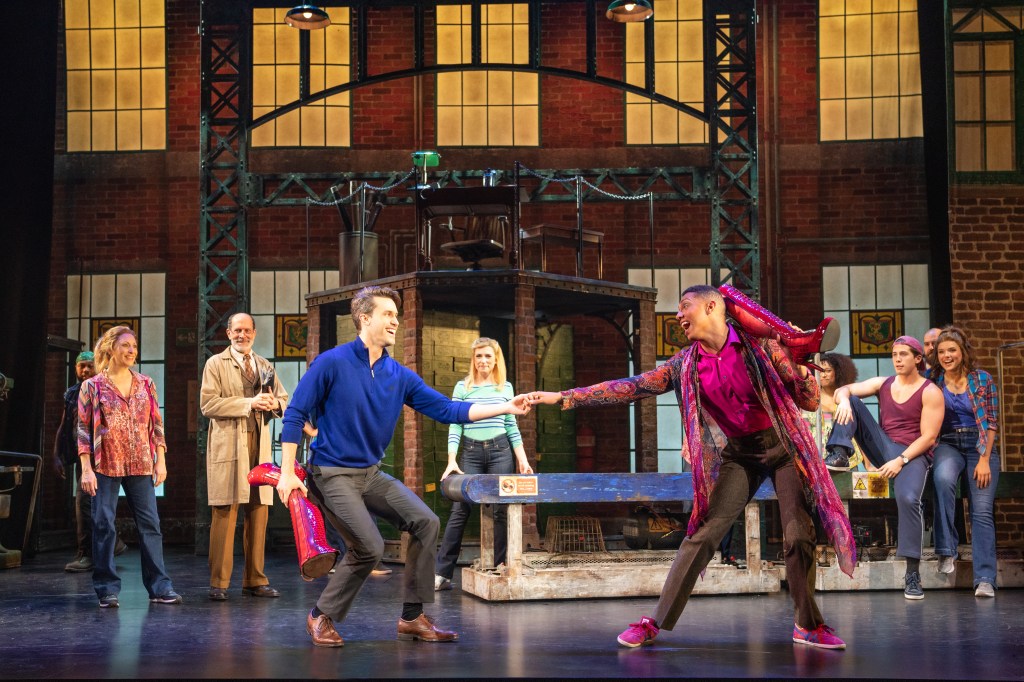
When the pressure is on to produce for the Milan show, we see Charlie’s obsessive, martinet nature arise. Douglas turns on a dime as he becomes fearful of failure and a perfectionist, fighting with Lola and infuriating his workers in a destructive act that threatens to upend their hard work. But for an unlikely savior who provides encouragement and funds in “the nick of time,” the factory’s closure would have been imminent. All they need for their success is Lola’s and the Angels’ participation in the Milan show. But Charlie can’t reach Lola, though he’s profusely apologized.
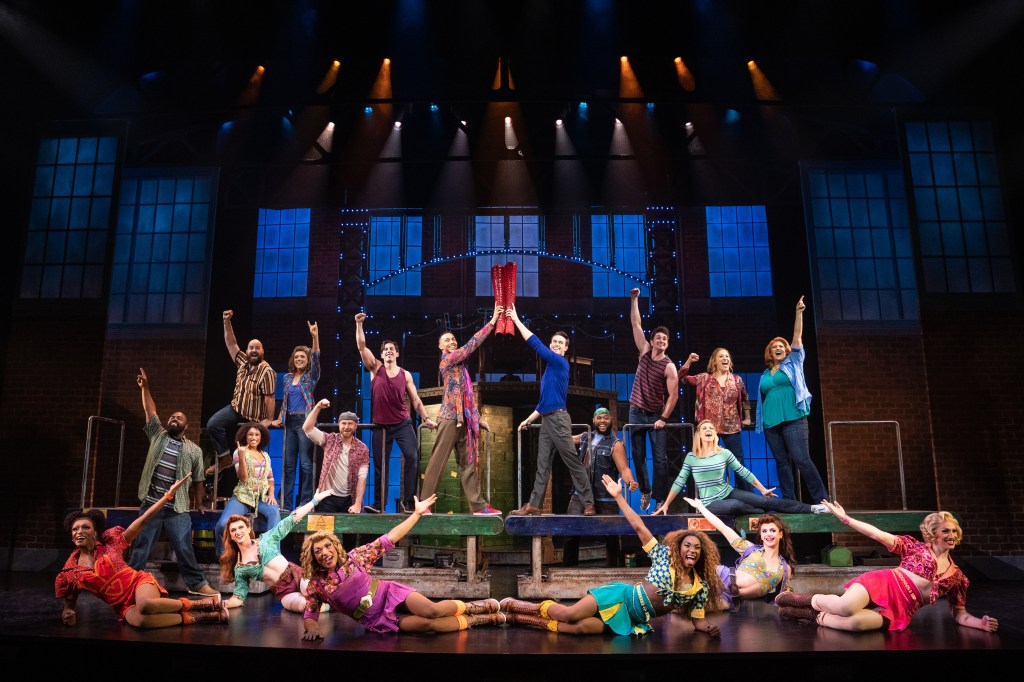
As Charlie, Douglas’ various complicated turns of character are well drawn and profoundly specific. In the powerhouse song where Charlie confronts his self-destructive hubris, “The Soul of a Man,” he brings down the house with applause that lasts some minutes. His performance is superb and heartfelt.

As Charlie’s friend and his initial foil, Lola is a character for the ages. As Lola Callum Francis is galactic star shine. Beautifully graceful and luminous, Francis is true to Lola’s cheeky characterization of himself: “an attention getter,” who mesmerizes. When he is on stage, your eyes invariably shift to him because of his relaxed authenticity and enjoyment in “bringing it.” One has the sense he understands all of the pain and glory that has been Lola’s journey toward self-acceptance and self-love.
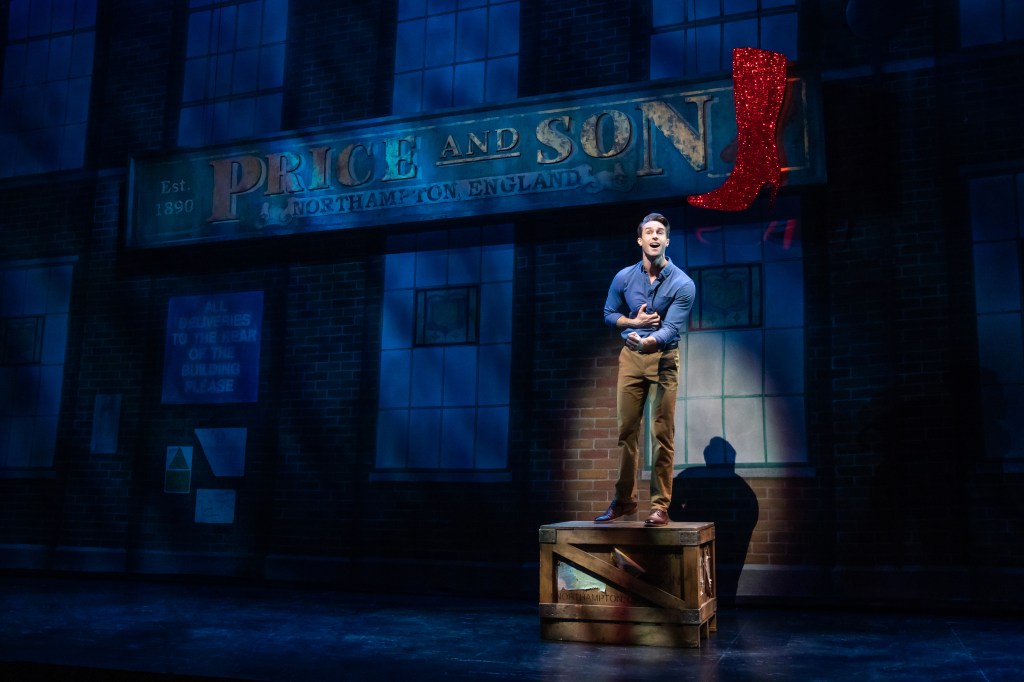
This is especially so when he sings with Charlie (“I’m Not My Father’s Son”). His smashing solo “Hold Me in Your Heart” kills. The latter song he sings to the nursing home residents, one of whom is his father. Francis inhabits Lola in “The Land of Lola,” “Sex Is in the Heel,” the magnificent “Everybody Say Yeah” and the uplifting finale “Raise You Up/Just Be.” Profoundly, Francis exhibits the disparities and complexities of the character; Lola is confident about his feminine gorgeousness, and less accepting about his identity as Simon. However, Charlie, Don and the others at Price & Sons help him grow into a fuller human being over the course of their designing and manufacturing “kinky boots.”

As Lola evolves and gains confidence being Charlie’s glam boot designer, Callum Francis deftly brings the two halves together to magnify what we must acknowledge as the finest strains of our humanity. The actor/character does this with such love and joy, one wants to embrace him for striking the divine and the human as he embodies all the themes of the musical: the importance of acceptance, love, compassion and empathy.
When we first see Simon as his male self, the shock is palpable. Francis is unrecognizable, for we have come to enjoy his Lola self. Thus, the difference, like night and day “says it all,” making Francis’ Lola all the more astounding. His gestures, mien, voice for Simon and Lola are distinct, unique, incredible. It is no wonder that having played the part in Britain, Australia and, briefly, on Broadway, Callum Francis won the Helpmann Award, Australia’s equivalent of the Tony Award.

Some have whined that the scene of the young Simon and young Charlie, de-mystifying their backgrounds shouldn’t have been cut. However, there has been a sea change since the show closed and a pandemic has been weaponized by political conservatives who are against the existence of anyone who cannot be stuffed into their frightening cardboard copies of “normal.” Initially, crass, British lout Don (the fabulous, hysterical Sean Steele), reflects why both Simon and Charlie want a life elsewhere and are attracted to London. He represents the bigoted individual Charlie and Simon have had to suffer.

Additionally, the cuts make sense in 2022. The radically repressive, conservative, political tenor of our times moving into a Mid Terms where the far-right MAGA retrenchment against LBGTQ rights, human rights (Fla. Governor Ron Deathsantis’ migrant trafficking), the loss of the right to privacy (the overturning of Roe vs. Wade), has been so outrageous, the cut scenes are not necessary. The idea of anti-democratic cultural paternalism is pervasive. We understand such discriminatory rejection as inhuman. Drag queen Lola, is a firebrand of political controversy, daring to accept herself. The play’s uplifting themes are all the more trenchant, salient and vital for our times where hatred and condemnation lurk around every corner.
Thus, we feel the full thrust of Lola’s hearbreak in the ballad, “Hold Me in Your Heart,” which identifies the paternal rejection. It is not only a cry from Simon’s heart, it is a cry we can identify with, for who has not experienced rejection in one form or another, parental, familial, rejection from friends, strangers, etc.?
This faithful reboot of Kinky Boots directed by Jerry Mitchell is a marvel. The musical is two hours and twenty-five minutes that fly by. For tickets and times go to their website: https://kinkybootsthemusical.com/
‘Chains,’ an Exceptional American Premiere by Mint Theater Company

The Mint Theater Company resurrects worthy playwrights that haven’t been produced in decades. Before COVID-19 upended their plans the company scheduled two productions of Elizabeth Baker’s works (Chains, Partnership) for the summer of 2020. After the dust settled the company revised their plans for the summer of 2022 and decided to first present Chains in its American Premiere. Later, the Mint Theater Company will present Partnership. At some point they will offer the three Baker plays The Price of Thomas Scott (produced in 2019) Chains and Partnership in an online Streaming Festival so that global audiences might become familiar with the exceptional, profound playwright who was certainly a maverick ahead of her time.
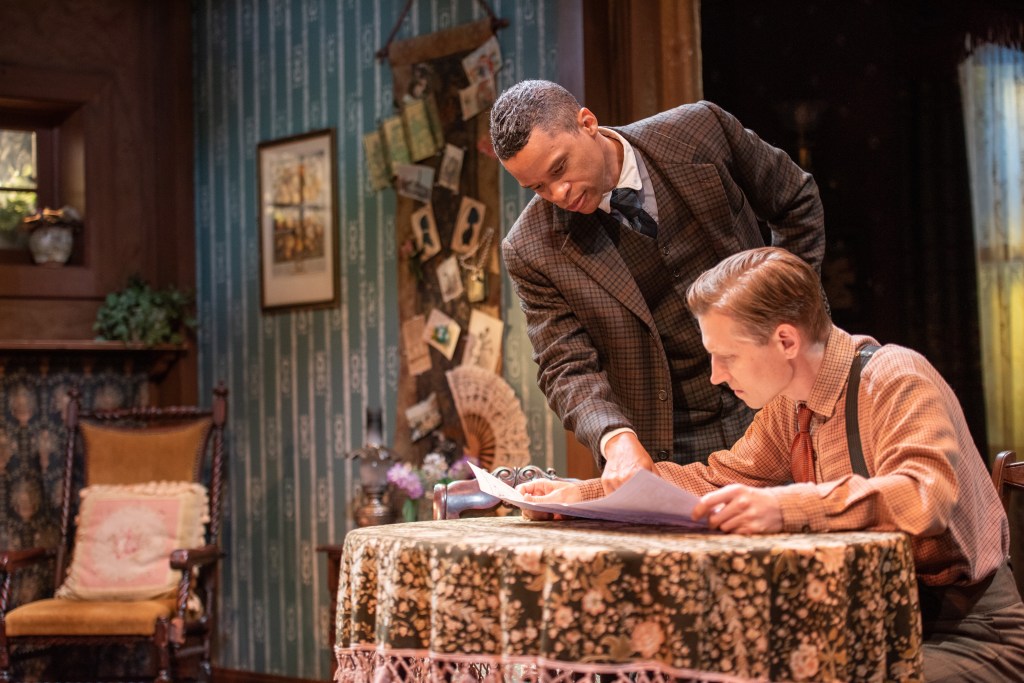
Elizabeth Baker (1876-1962) wrote Chains in the early 20th century, though the themes and issues Baker has her characters confront are current and identifiable with our time. Running at Theatre Row until 23rd of July, the Mint’s production of Chains must not be missed for its acute attention to details of setting, as well as the superb direction by Jenn Thompson (award nominated for Women Without Men, 2016) who has teased out striking performances from her cast. Their ensemble work is authentic and forceful.
Baker’s play focuses on the problems of London’s working classes (clerks, shop girls, etc.), their aspirations pitted against the trials of insecurity, workplace competition and the doldrums of career immobility. In its centrality Baker highlights not only issues of class, but those of gender, economic inequality, immigration and the difficulties of economic upward mobility. Subtly, Baker alludes to the strains between workers and employers. Though the word “union” is not mentioned, the “S” word, “socialism” is referred to once or twice jokingly by the characters as a negative. Nevertheless, the dull, work atmosphere, oppression and owner hostage taking that some characters refer to would be mitigated by unions to equalize the power dynamic with owners.

Using the backdrop of married couple Lily and Charley Wilson (Laakan McHardy, Jeremy Beck) and their extended family, the conflict initiates when the couple’s border and Charley’s work colleague Fred Tennant (Peterson Townsend) announces his plans to leave the boredom of his clerk position and take off to Australia for a change of scene and career. This simple announcement upends Charley’s perspective about his own life and brings to the surface his dissatisfaction with the drudgery of his career and the constraints of his married life.

Additionally, it encourages and inspires Maggie Massey (Olivia Gilliatt) Lily’s sister, to rethink her own plans for her life with her future husband, as she yearns to have the independence that men have to travel and pick up roots and settle wherever they like. Though fiance Walter Foster (Ned Noyes) is a generous and well-off partner who would give her independence with his money if they married, Maggie is unsure that marriage with Walter is right for her.
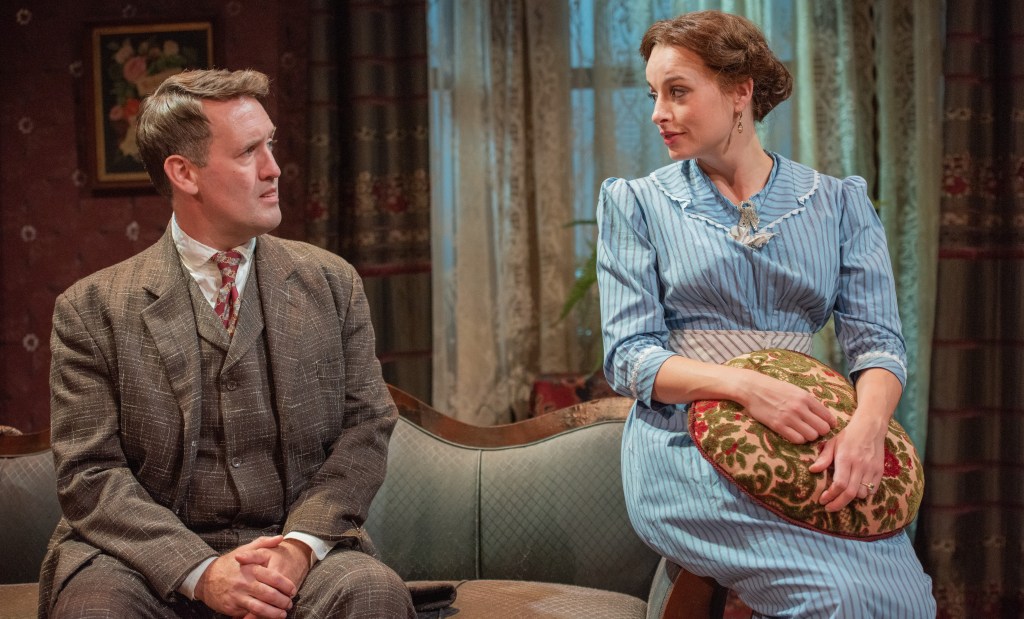
This is extremely novel for her generation and gender. Folkways stipulated that women marry well-off men, be provided for, keep house, raise children and be contented to shut up, not make waves and not be ambitious or creative. Maggie views Lily’s and her mother’s lives and questions if she “loves” Walter enough to be bound to him forever, when she may be happier on her own, expressing her talents. Or perhaps she may find and love another.

Thus, Baker cleverly explores the themes of security and safety for both the men and women (then and now) who have chosen either to take risks or remain stuck in a life of mediocrity and misery, whether single or married. As Charley’s neighbor Morton Leslie (Brian Owen) suggests, leaving behind one’s secure boring position and comfortable, familiar life holds tremendous risks for Tennant, for anyone.

Against the romanticism of leaving, various characters throughout the arc of the play’s development pose questions about Tennant’s choice which appears to upset them because it is particular and uniquely not their experience. They ask the following. Will he be able to get a position to support himself easily in Australia, when there are so many thousands looking for employment? What if he fails? What if he proves to be an embarrassment to himself and has to return home to be closed out of his career prospects?

Indeed, Morton Leslie ridicules Tennant’s ambitions and ideas to his face. He insists jokingly, though he is very serious, that Tennant is going to fail. Eventually, this is echoed by others in Charlie’s sphere of influence, including his in-laws (Anthony Cochrane, Amelia White). Lily expresses her upset at Tennant’s leaving because they need his rent. So Tennant’s decision proves economically trying for them, adding instability to their lifestyle. Meanwhile, Lily’s brother Percy (Avery Whitted) at a young age plans to marry Sybil Frost (Claire Saunders) following in the footsteps of what is expected for a young man. This is even after Charley warns him to wait and consider the future because he is too young. In an interesting turning point, Charley tells Percy that he married too young.

On the other side of the argument about why it’s good to take risks, Tennant explains his rationale to Charley. Unlike Charley and the others, Tennant is not married with the burden of having to take care of a wife and children. He is independent, young, makes his own decisions and has no family ties or responsibilities. He has friends, but can make friends anywhere, as he is sociable. So fear of uncertainty has been overcome. He is more afraid of remaining stuck in a miserable position at his job that has little upward mobility.

Thus, if he leaves England, he leaves the class system, the varied oppressions by owners, the stultifying atmosphere of the workplace and the lack of challenges. For him, anything will be possible and only he will stand in the way of that. Leaving, he will learn to redefine himself and seek out a different identity. His excuses and blaming others for his condition will fall away; he will evolve stretching his talents and abilities. The incredible power and courage of Tennant’s decision amazes because he is ending a nullifying pattern before it becomes too entrenched in his soul to escape it. He recognizes and appreciates this knowledge; the others fear it or are blind to it. We empathize with his situation of wanting to seek a better life in another country. It is historic and symbolize the longing of the spirit to evolve from stasis.

Charley has the self-knowledge to understand what is at stake beyond material, pragmatic considerations as does Maggie. They credit Tennant’s decision. The irony is clear. The more the others question and challenge Tennant’s fool-heartiness, the more we realize their fear, their mediocrity, their acceptance of their condition which may be tantamount to a form of slavery. The theme is metaphorical and profound, and Baker nails how difficult behavior change can be when one keeps adding daily to the links in the chain of sameness in one’s life.
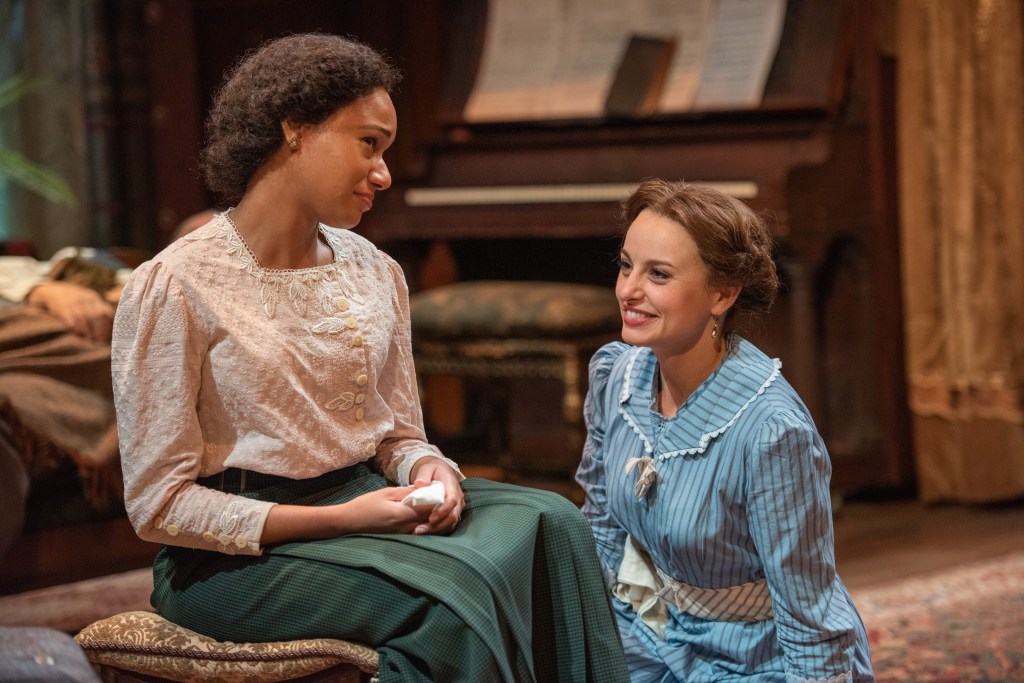
When Charley gradually discloses that he agrees with Tennant’s desire for a more fascinating life, the conflict between him and Lily and her family grows. Herein lies the main theme of the metaphor of chains. On the one hand, a secure position chains individuals from falling into the abyss of dissolution and bondages. These include fear of uncertainty: of confronting treacherous risks; of failing and never recovering from poverty and its ills. On the negative side, security deadens one to being adventurous and the chains of miserable dullness hold individuals to a bondage of their own making. Soon they believe they can’t take risks or it is too late to be an adventurer when one is older. Thus, severing the chains of security that bind the inner adventurer to the hackneyed, uninteresting, uncreative, unchallenging existence becomes impossible.

As an example of the terror of atrophying at work Baker introduces the character of Mr. Fenwick (Christopher Gerson) an older employee at the firm where Charley and Tennant clerk. Fenwick visits Charley and affirms Tennant’s decision is a wise one that he, at his age, could never take. And when he announces that there is some question about receiving their bonuses for the year, all the arguments about the benefits of time off (three weeks, a day on the weekend) go out the window.

Indeed, the employees are at the mercy of their employers/owners who can do as they please. There is no guarantee about work conditions and salaries. The propaganda against socialism was rife during Baker’s time as Morton Leslie suggests mocking “socialism.” Baker subtly reveals that such propaganda picked up by louts like Leslie keeps the society in line to produce workers who are “well-oiled,” uncomplaining machines. As for those like Tennant, who would challenge their work conditions? The social culture discourages their ambition or desire to want something better or to break free and move into a more productive, satisfying life. Meanwhile, Maggie’s situation is more complicated with heavier strictures on what opportunities are available to her.

Director Jenn Thompson shepherds her actors to highlight the conflicts, issues and themes in this extraordinary play which resonates for us today in a myriad of ways, politically and socially. Specifically, the actors portray without stereotyping the individuals they inhabit. These characters divide into two camps; those who agree with Tennant (Charley, Maggie) and those who do not.
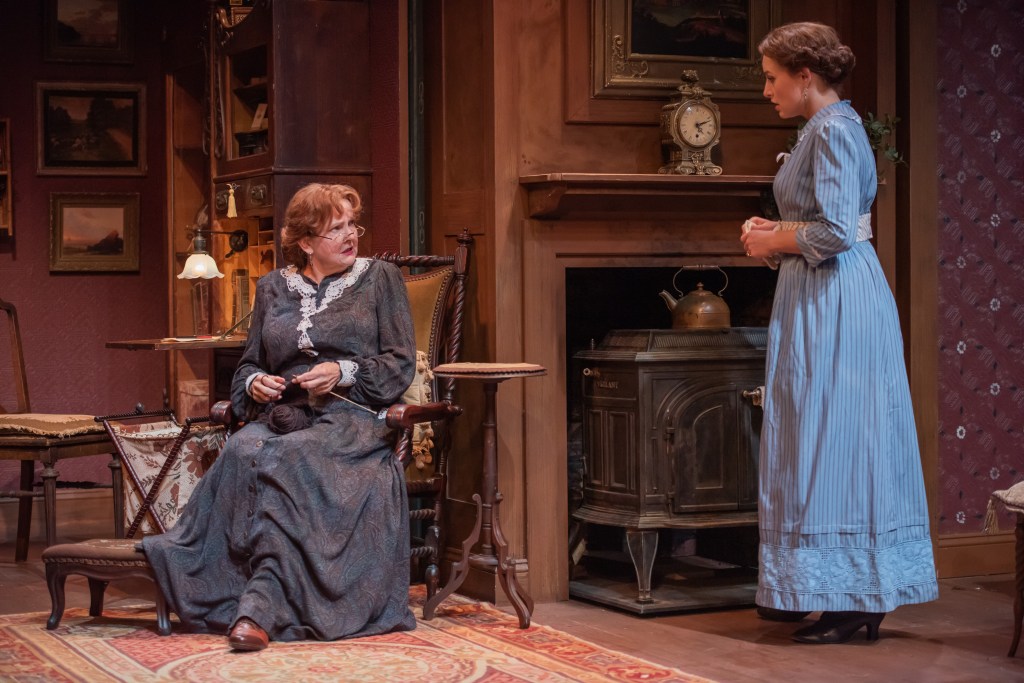
Townsend’s Tennant seduces Beck’s Charley with his immigration plans, so that Charley can think of nothing else. Jeremy Beck imbues Charley with concern, confusion and distraction with increasing intensity until he reveals his plans to leave for Australia which upend Lily. We know it is coming and we wish him to be successful. And we believe what Lily does not, that he will make a way for her and send for her, after he has made his way in Australia. All she can do is weep; she is devastated.
The tensions that Thompson strives to create with Beck’s superb acting and McHardy’s heartfelt response and sense of doom raise the stakes and bring us to a confluence of feeling. The ending may be controversial, depending upon the audience viewer. Indeed, Thompson has helped to strengthen the brilliance of Baker’s work and reveal her to be a playwright worth revisiting again and again.
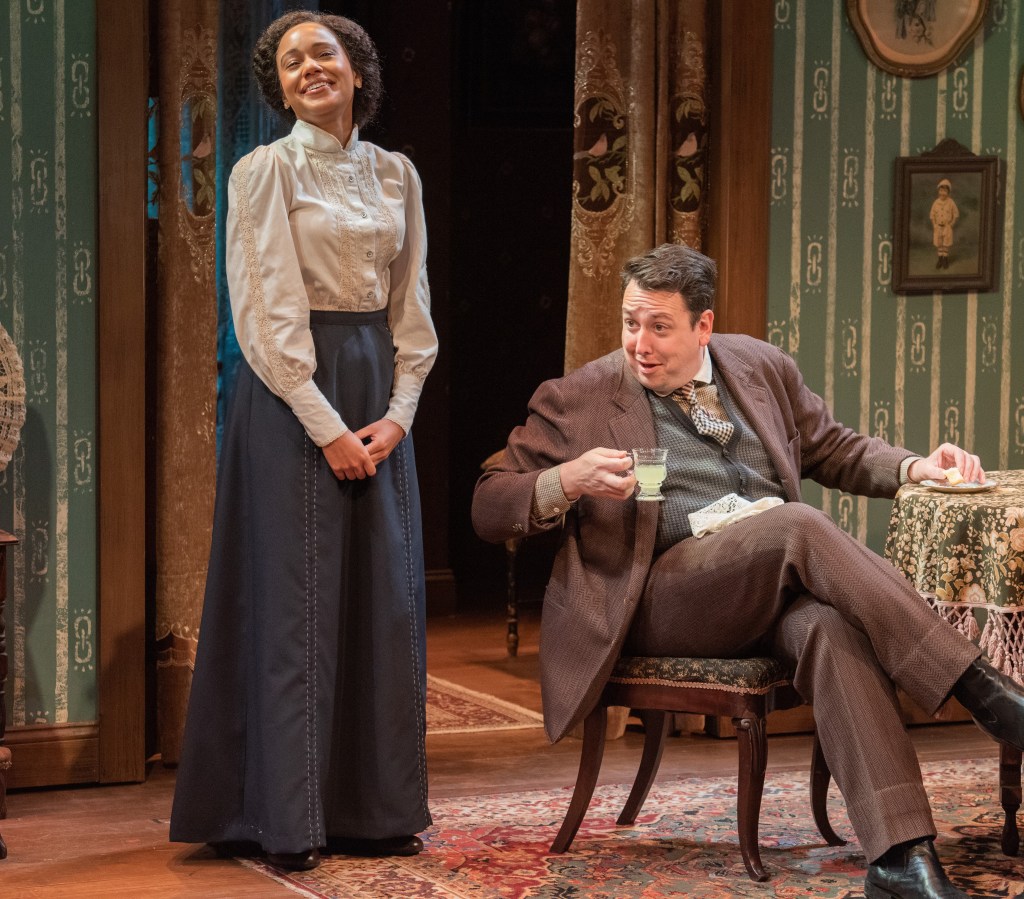
The production succeeds from start to finish thanks to the creative team. I particularly enjoyed the actors helping morph the set from the Wilson’s home in Hammersmith to the Massey’s house in Chiswick and then back again. Incorporated into the theatrical experience of the production, it was seamless. Just terrific! Kudos to the following creatives: John McDermott (sets) David Toser (costumes) Paul Miller (lights) M. Florian Staab (sound) and the others that made Thompson’s vision for Baker’s work to come alive.
I cannot praise this presentation enough. COVID-19 was a devastation we have yet to overcome and deal with emotionally and psychically, perhaps. On the other hand this production was worth the wait, well chosen for our time. Go see it. For tickets and availability to Chains that plays with one intermission go to: https://minttheater.org/production/chains/
‘Corsicana,’ Will Arbery Tackles a Kinder, Gentler Texas

Will Arbery’s Corsicana directed by Sam Gold in its world premiere is more an evocation and memorial to these representative characters of the heart’s universal weirdness, who try to find comfort and make their own space in the world. Unfettered with glamor and starlight, Arbery’s portrait of humanity in all its endearing strangeness is one we can easily identify with.
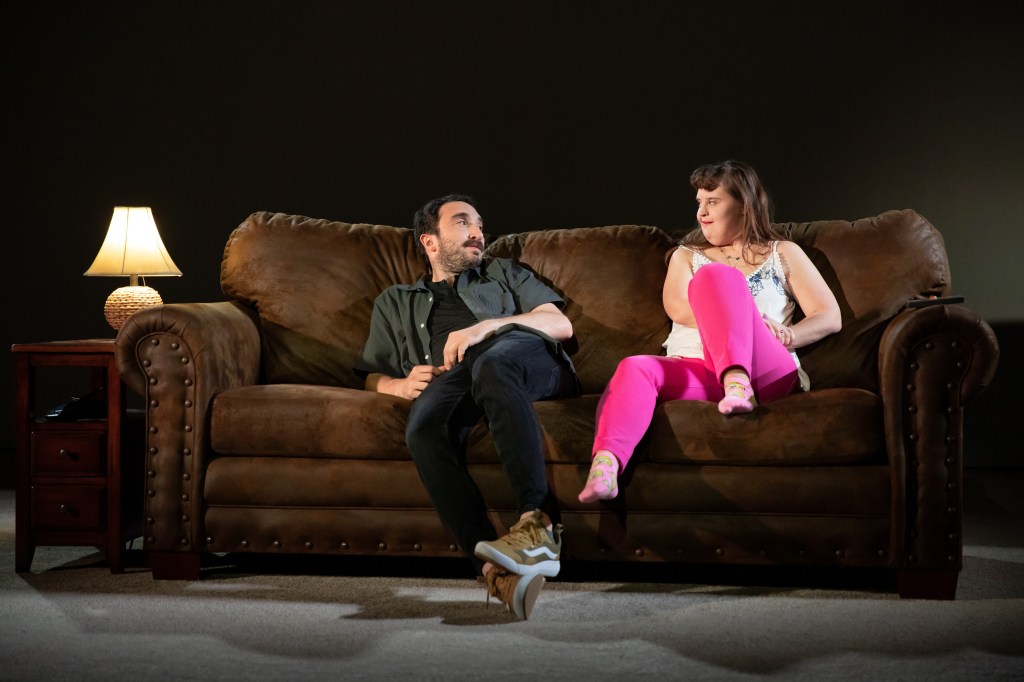
The play’s progression moves slowly by degrees of the stage turn table fitted with two couches. This revolves when the time/space continuum shifts and scenes change. The large couches and a small table and chairs downstage are the only furniture in a white-walled warehouse of a structure that represents the house where the two siblings Ginny (Jamie Brewer) and Christopher (Will Dagger) live and where neighbor and friend Justice (Deirdre O’Connell) visits. With a plexiglass framed roof that the characters slide forward, Lot’s (Harold Surratt) barn emerges as the lights upstage dim and the characters step downstage in the light, signifying Lot’s property when they visit him.

The actors do a phenomenal job revealing the inner and outer emotional filaments, quirkiness and complications their characters experience during their interactions with one another. Arbery’s central focus of Corsicana, finely directed by Gold, is on Christopher and Ginny, aged one year apart. They have recently lost their mother. Feeling adrift in their mourning, they awkwardly reposition their identities and relationship with each other, haphazardly shuffling toward a new respect, love and understanding without their mother’s buffer of love.
Will Dagger’s Christopher is humorously chided by his sister Ginny (Brewer) a smart, sharp-witted thirty-four year old woman with Down Syndrome, as they sit and plan the rest of their lives turning over Christopher’s initial question about Ginny’s unsettled unease. As they discuss the state of themselves in their loss, we understand how much their mother meant to their sense of purpose and being. Living in the house she left them, they are in stasis, not engaging in their previous lives with work and friends. Ginny can’t find interest in taking up her hobbies, choir or her job. Mourning is a tricky business. When does one return to one’s life? Can one return? Should there be new engagement immediately afterward?

They are displaced in a limbo between losing an old life and negotiating a new one, their hearts glazed over in non-feeling.. It rather seems they are plopped down together for our own good pleasure to understand how siblings close in age in adulthood (Christopher is thirty-three) might get along, when one of them is not living in a group home, but is being “taken care of” by family and a close friend. However, when Ginny asks Christopher’s help in finding something for her to become engaged in, he understands that it must be something novel. All of her previous pursuits don’t satisfy. And she affirms that she is proud, so asking for his help is the last thing she wants to do, but desperately must do.
From their discussion and Ginny’s listing of wants and wishes, we discover that Ginny did many things with her mother. And when family friend of their mother. Justice (Deirdre O’Connell) drops over with groceries and a chat from time to time, we note that she is willing to stay with Ginny, baby-sit her, though Ginny bristles at the reference and loudly affirms she is an adult. Of course she is, but there are boundaries that she crosses unwittingly as we see with her attempt at friendship with Lot. Thus, clearly, Ginny relates differently, from a unique frame of reference, perspective and response to others that is uniquely her own.

Indeed, Jamie Brewer’s Ginny seems extremely adept and mature enough to take care of herself which is where her relationship with her brother may end up, in separate houses, lives, spaces. Steps must be taken, so of course, Christopher tries to help. The conflict of “how to help Ginny find something to do” blooms in full force when Christopher visits Lot, an artist that Justice recommends because she knows him and has even collected some of his work that might be exhibited, if the situation pans out. In the interim Lot works on a project he won’t let anyone see that thematically manifests as “a one-way street to God.” Clearly, he is secretive and religious and private, and shares those similarities with Ginny who believes in God and is so secretive she refuses to allow anyone into her room because she values her privacy.

In the hope that Lot might help Ginny express her musical talent and come out of her current doldrums with a sense of purpose and collaboration, Christopher visits the artist and after some humorous repartee which Arbery is a master of, Lot agrees, but she must come to his place. Lot’s demeanor is straightforward and no nonsense, revealing a brilliance and wisdom. Arbery also plants seeds of Lot’s story in his upset to hear that Ginny is “special needs.” He questions if Christopher thinks he is that way, too. His question is out of left field, but intimates the story which he unfolds in the conclusion of the play, a story whose revelation to Justice reveals he is ready to take their relationship into something more than friends.

Christopher’s cajoling and friendship with Justice (we never find the symbolism of her name, though she is the balancing force among the characters) peaks Lot’s kind approval. He refuses money, but would like a gift as payment, throwing in a philosophical comment about materialism and waste which he and Justice eschew. What the gift is remains a mystery, but as God bestows talents, Lot indicates an acceptable gift would be an expression of someone’s talent at the appropriate time. Turns out, he receives his gift at the play’s conclusion when all contribute their gifts in a song which, as it turns out, has been written by the characters responses, feelings and issues throughout the play. Indeed, the play is the theme song of their humanity that they sing at the end followed by audience applause.

Lot’s appreciation and closeness to Justice is revealed when she visits and they banter, again with Arbery’s talent for pointed, humorous dialogue whose sub rosa content shines through. She tells him “shut up,” and not stop her relating a fascinating, symbolic dream about a dead man who haunts her. And he tells her repeatedly she’s “weird.” But they are birds of a feather, though Lot is noncommittal at this point.
When Ginny visits, Lot attempts to find something interesting to sing about and collaborate on. As Lot tries we note his cleverness and creativity with an amusing story that includes dinosaur ghosts. However, though most “children” and individuals would be interested, Ginny isn’t. Eventually, she expresses her interest in pop music and singers who Lot is unfamiliar with. Their discussion comes upon a dead end until Ginny expresses something which is untoward to Lot and something which she doesn’t realize is a trigger for him. What she expresses upsets Lot who affirms he can’t work with her and who dismisses her. She is perplexed.
In the next segments of the Second Act the revelations of why Lot reacts as he does come to the fore. The unsettled issues of Ginny’s “untoward” response to Lot, her unwitting comments to him about Christopher, and Justice’s feelings about Lot are resolved in Arbery’s exotic dialogue that is out there and ethereal but grounded in undecipherable, spiritual human consciousness and experience. Christopher, Justice and Lot have exceptional monologues beautifully delivered by Will Dagger, Deirdre O’Connell and Harold Surratt. That the audience was breathless and silent and the annoying barking seal in front of me was mesmerized through all of them, indicates the depth of authenticity the actors effected to make such profound moments “take our breath away.”

Arbery’s Corsicana is not like his other plays. That is a good thing. It is humanity, unadorned, quixotic, exotic in its peculiarity with these amazing characters warmly, lovingly inhabited by the ensemble whose teamwork is right-on. Gold’s direction infuses the characterizations with haunting absences of time and space reflected in the set design (Laura Jellinek, Cate McCrea) and efficient, suggestive lighting design by Isabella Byrd. Sound (Justin Ellington) was at times in and out perhaps because of the acoustics in the theater or the actors not projecting when their backs were turned to the audience. Not every word was sounded in clarity, whether a fault of the hearer or the structure of the theater, projection or something else. However, the monologues, because of their importance, were bell clarity sensational. The repartee and quips sometimes were thrown away into deep space heard by elves.
Finally, a note about the music which was characteristic of the characters’ souls thanks to Joanna Sternberg and Ilene Reid music director. The song at the end, the gift that Lot receives, is endearing, humorous and fun. Sung in collaboration, the unity and community that the characters achieve is poignant. Of course that they all have faith in God, not a specific political faith. But spiritual understanding threads throughout the song, which is in sum, the play. That their type of deep spiritual faith is refreshing Arbery notes with complexity. That their faith is essential to how the moments that looked like they were going downward, instead reversed and moved to a contented and hopeful resolution, makes sense.
Corsicana is at Playwrights Horizons on 42nd Street with one intermission. For tickets and times go to their website: https://www.playwrightshorizons.org/shows/plays/corsicana/
‘The Bedwetter’ a Hysterical and Meaningful Sarah Silverman Romp

Sarah Silverman is a legendary comic and she may have been born with a funny bone. But how did she morph into the talented comedian who has a musical production about her early life, playing eight times a week at the Atlantic Theater Company? We discover the inspirations that planted the seeds of comedic success in the very humorous, irreverent pop music show The Bedwetter. Based on Silverman’s memoir The Bedwetter: Stories of Courage, Redemption, and Pee, the theater adaptation highlights the most important year of Sarah Silverman’s life, a year that intimated the possible future success Silverman would offer in her unique comic grist.

With book by Joshua Harmon and Sarah Silverman, lyrics by Adam Schlesinger and Sarah Silverman, music by Adam Schlesinger, choreographed by Byron Easley with creative consultation by David Yazbek, The Bedwetter is a hoot. Also, it is ironically woven with themes about divorce, mental illness, childhood angst and dysfunctional families. The two act musical briskly unfolds via the comical and exuberant perspective of precocious, potty-mouth Sarah played by the uber talented and sharply focused Zoe Glick.

Glick is a wunderkind. Her pacing, nasal singing voice and edgy delivery reveal she is a natural. She portrays Sarah as a loving, exhausting, “in-your-face, quick-witted love bug who goes through a series of disastrous events at the worst time in her life. The momentous problems occur at the formative age of ten-years-old when she has to go through her parent’s divorce, her mother’s increasing depression, her father’s philandering with most of the moms in town, and a move which forces her to attend a different middle school where she has no friends.

Though she manages to face these cataclysms with the help of her alcoholic Nana played by the inimitable Bebe Neuwirth in a wonderful turn, there is one issue which is insurmountable. She is a bedwetter. The secret remains among family and perhaps former friends, however, it cramps her style with making new acquaintances. Not only is she embarrassed because she is “too old” to wet the bed, her terrible debility infantalizes her. Thus, she feels inferior and demeaned by a condition she can’t control. The opening number (which also closes the show in a beautifully made sandwich) “Betterwetter” encapsulates all of her issues. Glick sings it with zing, verve and joy.
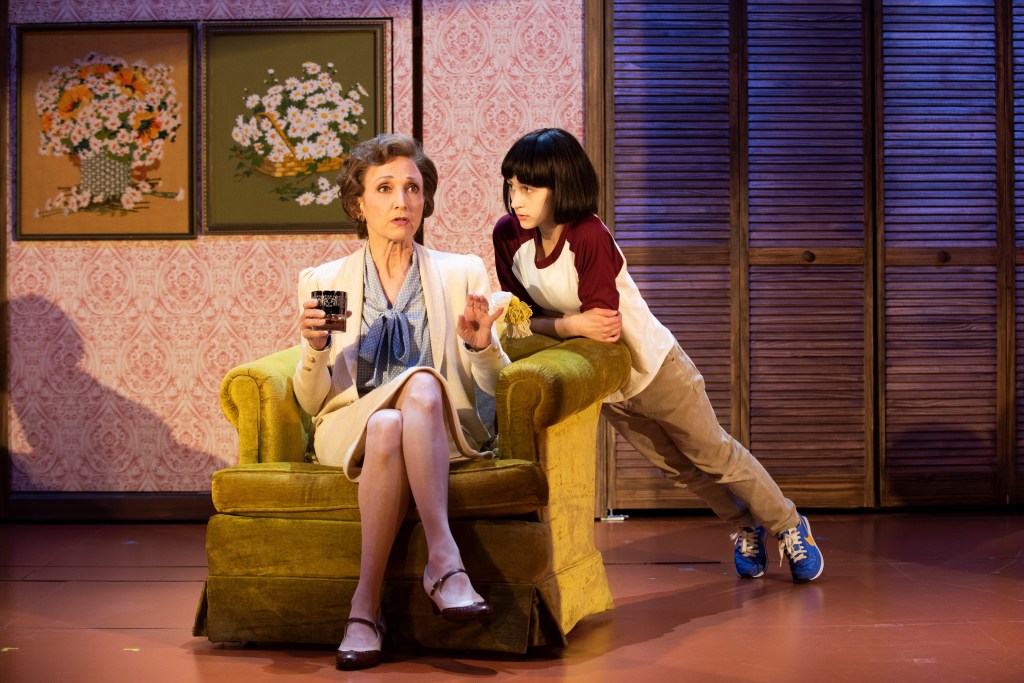
Interestingly, wetting the bed at her age, we note, must be related to her parents’ divorce, the move and inner stress. And then we discover that it is genetic. Her father Donald (the humorous Darren Goldstein who rocks many women’s boats) also wet the bed. However, as he enjoys reminding her, he did grow out of it. Sarah wonders when that wonderful occasion will happen in her life to end the emotionally painful stigma.

As we follow Sarah who introduces us to her family, we meet her sister Laura (Emily Zimmerman) who disowns her in school and puts up with her at home, decrying she doesn’t know who she is and how she is a part of the family. Interestingly, in Act II, Laura’s approach changes after Sarah’s life takes nullifying downturn. And when Nana has to be hospitalized, the Laura softens her attitude toward Sarah. Then the sisters unite and become close again. As Laura, Emily Zimmerman works the transformation from annoyances to hypocrisies to fear and concern for Sarah in a fine and authentic acting and singing performance.
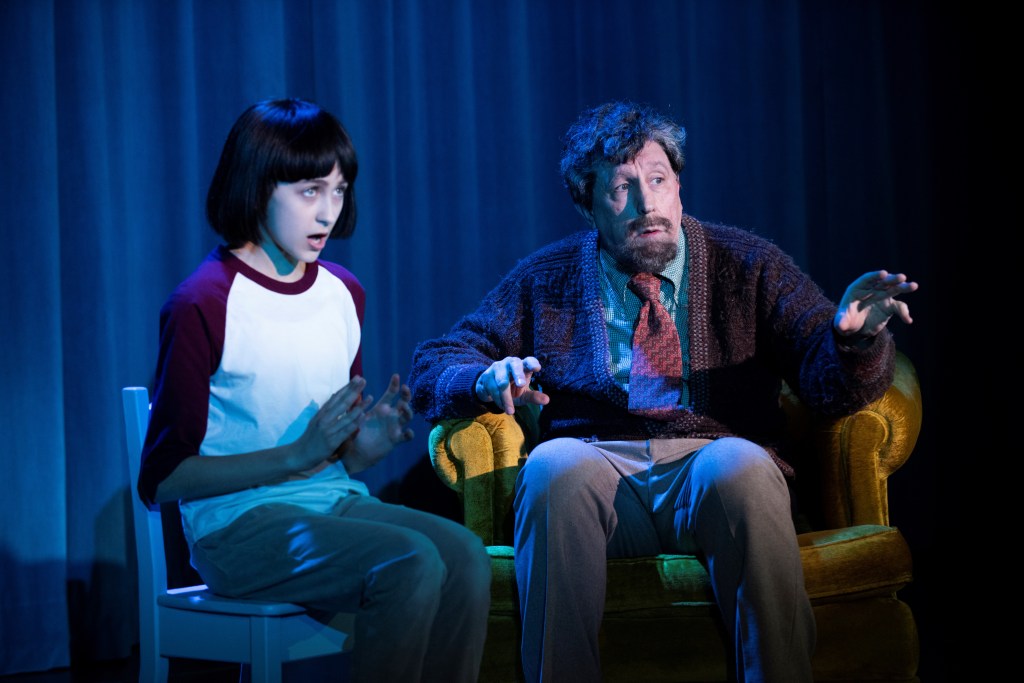
Sarah’s mother Beth Ann, normally portrayed by Caissie Levy covered by Lauren Marcus the night I saw the production is only capable of staying in bed and watching television. We learn why this situation abides in the second act when a fight erupts between Beth Ann and Nana and the truth spills out. It is then we understand Beth Ann’s depression and feel empathy for her. However, Nana ends up becoming sick over the remembrance of what happened. Indeed, her hospital stay reveals self-punishment and feelings of guilt for she feels responsible for events that cause Beth Anns’ depression.

Considering the circumstances of her caved-in life, Beth Ann does the best she can. She is aware of Donald’s philandering, one cause for the divorce. However, he is a good father. He provides enough money to take care of the family and eventually pay for Sarah’s treatments to stop her bedwetting. Also, he is there for his two daughters. Likewise, though Beth Ann’s debilitating depression hinders her for “normal” activities, she stands by her children and when Sarah needs her most, she is present for her.
Initially, Sarah, encouraged by Nana (Bebe Neuwirth comes prepared with an authentic accent and bright, cheerful demeanor) who tells her she can do anything, coasts into school. We are impressed as Sarah’s humor and agreeability eventually lures the girls in her classes to be her friends, rendered in an adorable song with Charlotte Elizabeth Curtis (Ally) Charlotte MacLeod (Abby) and Margot Weintraub (Amy).
Mrs. Dembo their teacher (the very funny Ellyn Marie Marsh) tries to inspire them to hone their talent like Mrs. New Hampshire did (the lovely voiced, effervescent and funny Ashley Blanchet) for their school is presenting a talent show. Sarah and her friends begin to practice songs for the show, inspired by the golden tones of Mrs. New Hampshire. When they practice together, they are crackerjack astounding with their harmonies and seriousness in “getting the number right.” They should form a girl band.

After Sarah invites her new friends to her Dad’s house, they are impressed. Darren Goldstein’s philanderer number as Donald brought the house down when I saw the show. The men loved his machismo, which he manages in the ethos of a hapless idiot far from a hot, “know-it-all” arrogant lothario. His balance in achieving a hysterical, irreverent unpolitically correct and refreshing tone is well shepherded by director Anne Kauffman.
The ease that Donald presents with Sarah and her friends opens a door of hospitality so that Sarah is invited to a sleep over. She almost doesn’t go because she will wet the bed and the girls use the occasion to add to her horrific embarrassment. But her mother unthinkingly tells her she’ll be OK. Meanwhile, Donald tries to find cures for Sarah which result in a very funny bit between the hypnotist portrayed by Rick Crom who is brilliant and whose voice is excellent for the role. Unfortunately, the hypnosis doesn’t work and the hypnotist sings a counterpoint duet with Sarah underscoring that he’s a fraud as she sings that the hypnosis doesn’t work.

When Sarah goes to the sleepover, she has an accident. What happens after this event reaches into catastrophe. However, Silverman’s horrors come with great humor and irony. The number that takes place in the psychiatrists office is farcical in a great way, for the doctor (Crom) sings the praises of the latest cure for depression, the diagnosis he gives Sarah. As the doctor Crom leads the large dancing yellow Xanaxes that come alive to sing along with him about their wonderous effects. Crom attests to their ebullience as he flutters and skips high as a kite on Xanax. The number is one of the best in the show, as well as the most sardonic. Just great!
As the good doctor and singing dancing Xanaxes move off stage, Sarah desperate to do anything to stop her debility pops her pills for “depression.” We shudder understanding that Sarah is too young to take such powerful drugs, but it is a fact that Big Pharma likes to get folks hooked as young as possible. Instead of stemming her depression, anxiety and sorrow, Sarah joins her mom in bed where together the sing of their troubles and their hopes.
Ironically, the depression that Xanax is supposed to cure throws her into a full-blown depression so she must take more to attempt some relief. Once again, the cure is worse than the condition. The resolution does arrive to reveal the need for redemption for the family and salvation for Sarah who is still wetting the bed.
The deus ex machina (a seemingly unsolvable problem in a story is suddenly and abruptly resolved by an unexpected and unlikely occurrence) arrives when Miss New Hampshire appears in a dream. She tells Sarah about her secret which brings the child confidence in knowing that this lovely, talented woman had the same problem. Maybe there is hope for her after all. By the conclusion of this wacky and warm musical, Sarah takes the stage in the talent show and cracks open her wild and authentic comedy number (which we’ve been watching). The show ends with the rousing song “The Bedwetter” sung by the cast, and our delectable farce sandwich concludes.

The production is excellent, though it is “dirty” and “uncouth” and unpolitically correct and indecent for younger girls (that’s for the NEWSPEAK thought police on “the left” and “the right,” reference to 1984 by George Orwell). Anne Kauffman has rehearsed the cast to a fine rhythmic pace, rapid fire delivery of quips and jokes and acute pauses for timing which add to the overall hilarity and upbeat performances.
Nevertheless, when the show turns to the dark side, all of the issues break wide open and we can empathize with what this family has gone through to make it to the next day. Of course the struggles and strains provide the foundation for Silverman’s comedy and engender her growing up beyond her years, sustained by cracking jokes to forestall the misery. Indeed, misery and humiliation provide the meat upon which Thalia, the muse of comedy feeds. Silverman and Thalia are besties in this production. And Silverman’s and Harmon’s and Schlesinger’s book and lyrics inspired by the immortal acquaint us, the actors and director with her finer points of merriment.
The cast works seamlessly as an ensemble. Their voices are powerfully resonant and spot-on. Each of the leads remains precisely authentic in their own songs, whose lyrics are humorous, sometimes wildly hysterical, but always pealing out the human condition.
Kudos to the set design which was functional, variable and effectively minimalistic (Laura Jellinek). Costumes by Kaye Voyce showed up the Ad dancers and Miss New Hampshire well. Japhy Weideman’s lighting, Kai Harada’s sound, Lucy Mackinnon’s projections, Kate Wilson’s dialects made the production’s themes cohere. The music team is exceptional. These include: Dean Sharenow (music supervisor & coordinator) Henry Aronson (music director) and David Chase (orchestrations).
This is one to see for its exuberance, fun, laughter and poignant moments, too rendered by the fine performances of the ensemble and sensitive, balanced direction, keeping the humor in the pathos. For tickets and times to The Bedwetter that runs about two hours go to their website: https://atlantictheater.org/production/the-bedwetter/
‘Coal Country’ is Amazing

When money and wealth become more important than the lives of others, that is the time to write a play with powerful, sonorous music. Oh, not to uplift the CEOs who collect the millions like Don Blankenship of Massey owned Performance Coal Company. No. The play should uplift and memorialize the ones who die because of that CEO’s greed, selfishness and refusal to accept accountability for what many have called murder. Above all the play must repudiate the wealthCy’s Puritan assertions that money and power make right. They don’t. Not now, not ever.
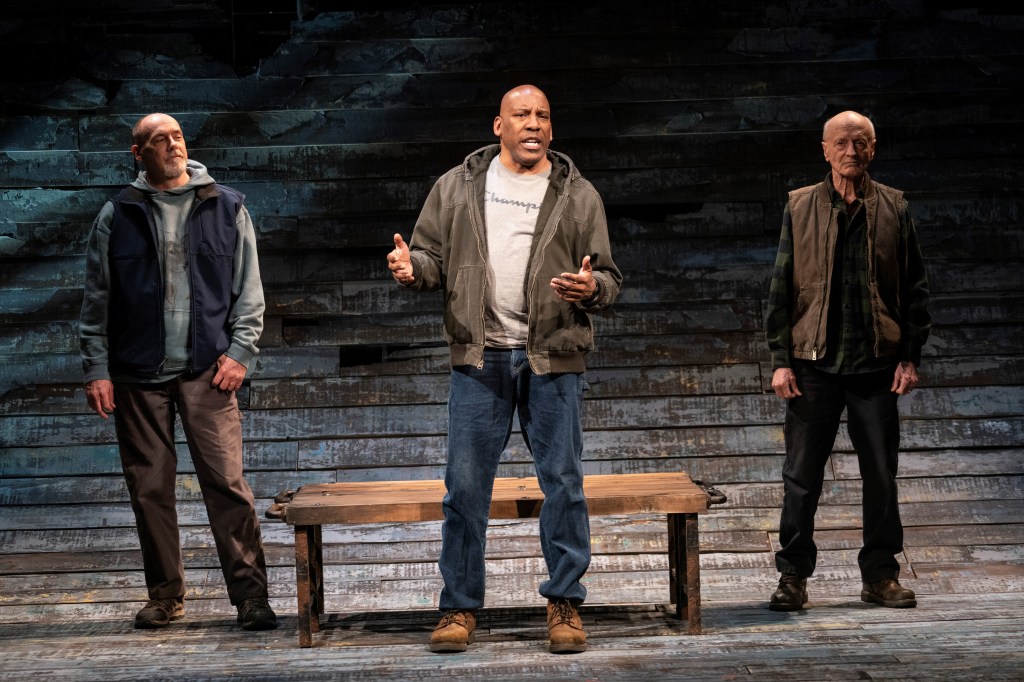
Coal Country is a docu-drama with incredibly relevant themes for us today. The riveting, masterful work written by Jessica Blank and Erik Jensen with original music by Steve Earle in a fabulous encore presentation by Audible and the Public Theater seems more impactful each time it is presented. We can never get enough of this exceptionally performed, shining work which runs at the Cherry Lane Theatre until 17 of April.
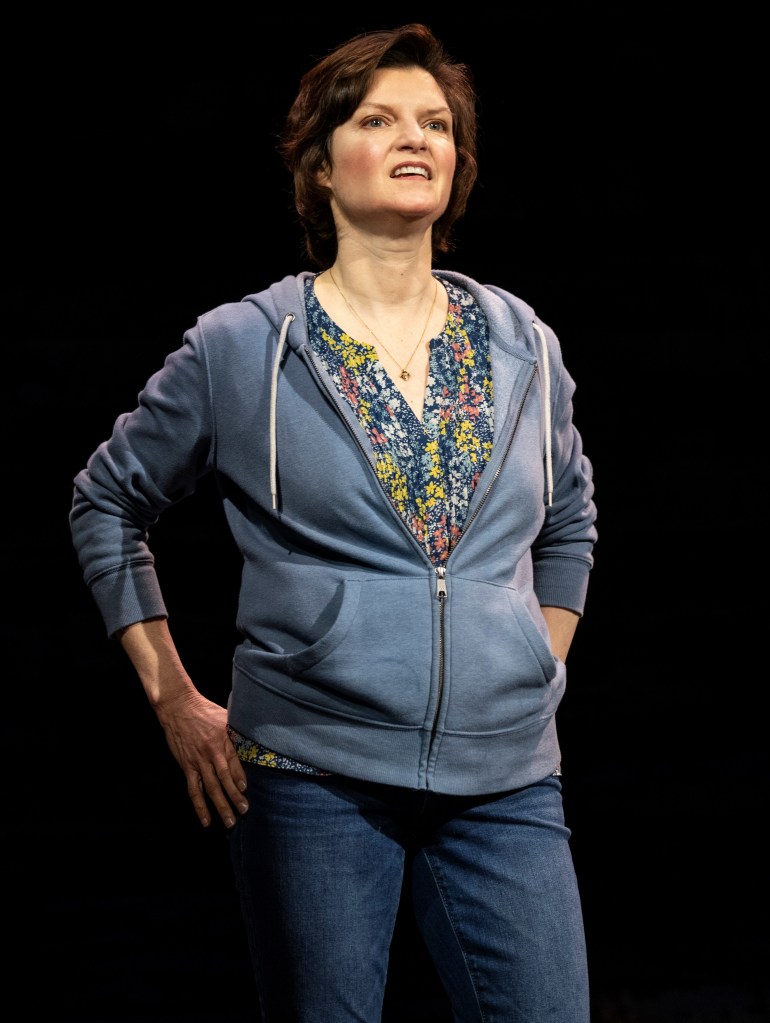
Though the worst of human nature asserts its primacy, poignant, moving stories like those in Coal Country are timeless in revealing that love despite tragedy culturally work us toward enlightenment. The voices of those who have been wrongfully snuffed out can resonate with meaning. This is especially so when fine artists like Blank, Jensen, Earle and superb performers effect those voices to channel the great moral imperative. What is good, what is true, what is valuable is never lost. It lives on.
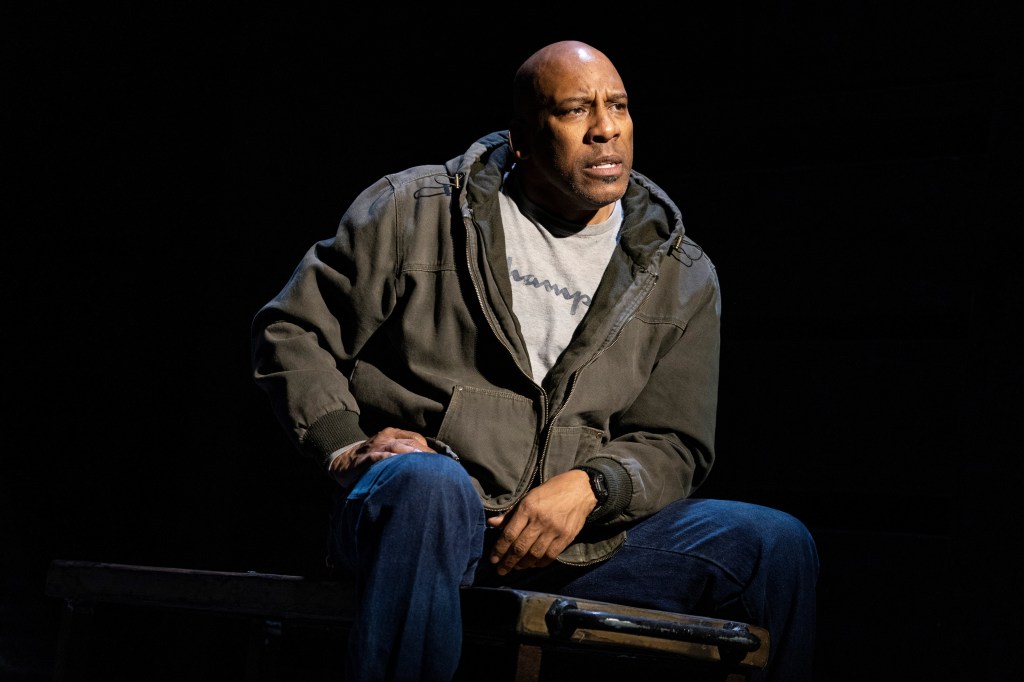
The themes which the playwrights and songwriter ring out in Coal Country focus on the devastating catastrophe known as the Upper Big Branch Mine disaster of 2010, which cost 29 West Virginians their lives. Through family eye-witness accounts cobbled together in a tapestry of poetic beauty, vitality and grace, we learn the facts about the huge machine that operated over- capacity 24/7 on the long wall, sheering off the finest, most valuable coal so Blakenship could get his contract percentage of the mine’s earnings of $650,000 a day.

We learn through the accounts of union miners like Tommy (Michael Laurence), Gary (Thomas Kopache), and “Goose” (Joe Jung), how and why government inspectors never found the broken systems that allowed low oxygen levels to increase the build-up of methane gases and thick coal dust that caused the massive explosion. As the experienced miners relate how the broken sprinklers ineffectively doused the sparks created in machine operations that ignited the coal dust and methane behind the long wall, the final picture of egregious negligence and rapacious lust for money clarifies in the blood of innocents merged with the blood of family bonds.

Tommy, Laurence and Gary discuss how the power of the union to protect and respect the miners’ rights in the past has been subverted by the CEO and company, and government de-regulation. The owners who bought the mine hired a large percentage of non-union men, who didn’t dare “speak up,” to government inspectors and the FBI about extremely unsafe conditions in the mine. They feared reprisals. The question of payoffs arises and dead ends. We learn how those miners who did “say something” were warned and ignored. Miners were rendered voiceless against the inevitability of their deaths, because Blankenship was on a mission. No one was going to stop him.
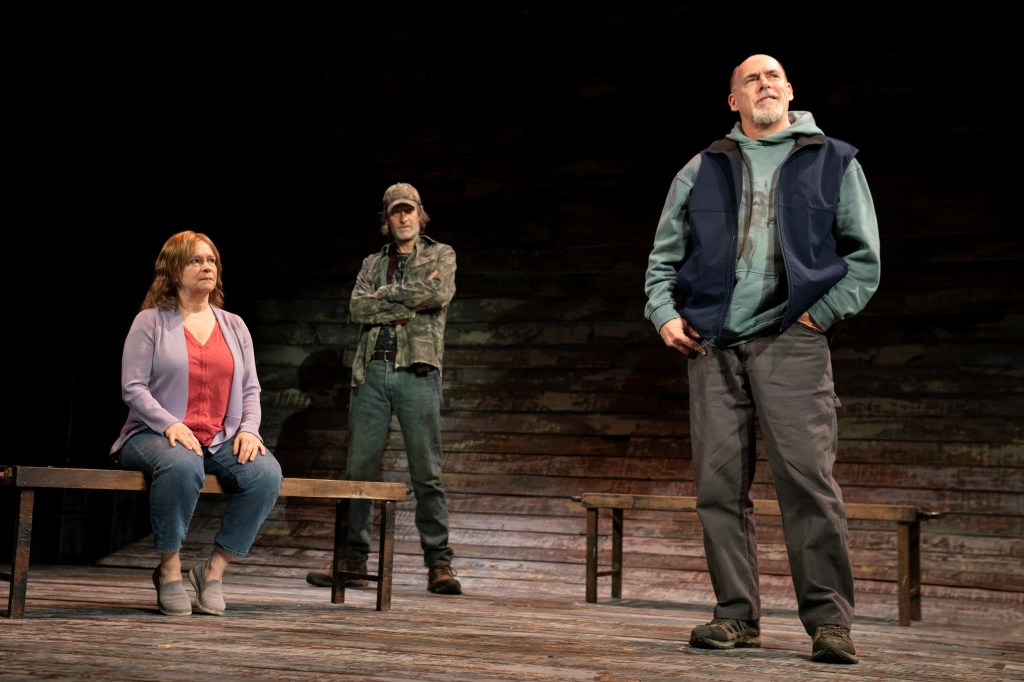
As families identify bodies on blankets on the gravel, some collapse. Roosevelt (Ezra Knight) who identifies his father, who appears to be “asleep,” remains calm until his mother comes. They weep together. As others express outrage, the families of four missing men wait to hear whether or not their loved ones cheated death. Finally, the wait is over. None make it out. Tommy, who loses his son, his nephew and his father, waits to spill the news, overcome with pain.
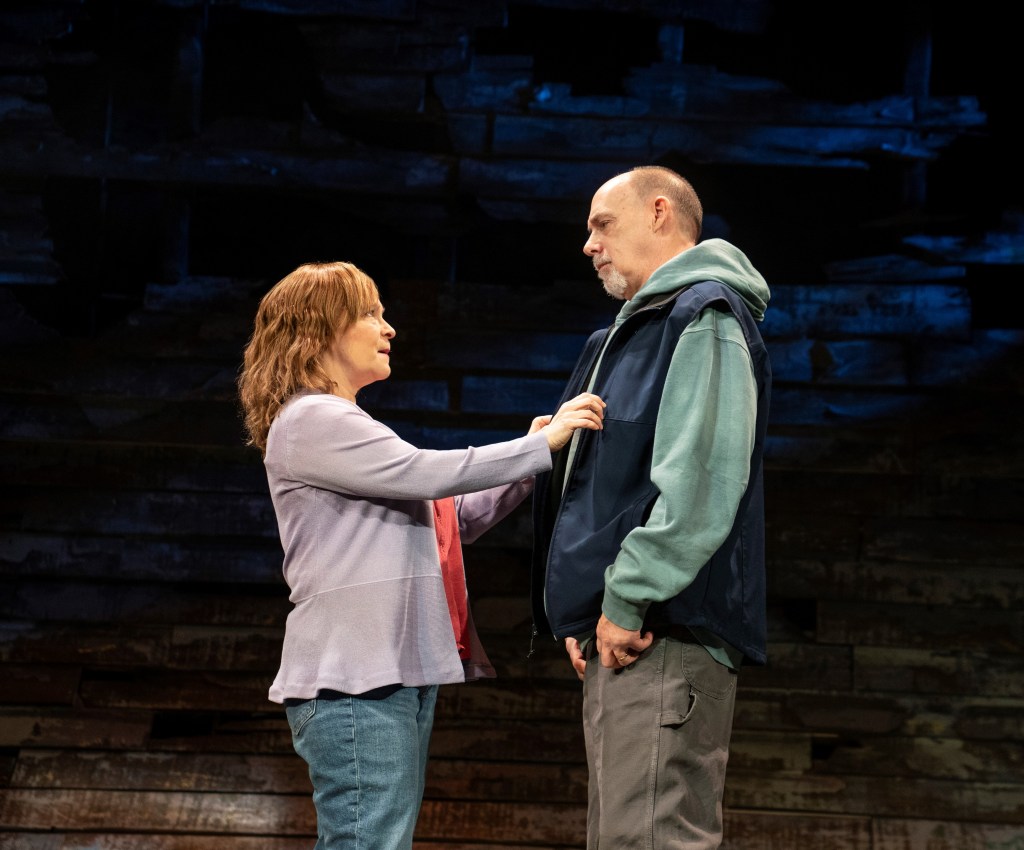
Judy (Deidre Madigan), a doctor who lost her brother in the catastrophe rides a roller coaster of emotional expectation. First, she believes her brother died. Then she believes he found refuge. Then, all is finality. She describes that she feels she is an outsider because of her socioeconomic status. But emotion and love transcend economics; she is one of them. Her brother is dead and though the medical examiner tells her not to, she insists on seeing his remains. It is ironic that even her medical background does not prepare her for what the mine did to him. It is beyond calculation. In pieces, her brother is without human form.

One by one seven family members tell their story of a simple, satisfying life before the catastrophe in a community that mined for generations. Indeed, the mountain supported and nurtured them until it was bought over by Massey Energy and a new CEO came to town. We learn of the loving relationships between Mindi (Amelia Campbell) and Goose, and Patti (Mary Bacon) and Big Greg who dies leaving Little Greg traumatized by the loss of his dad and Patti when he is taken away from her. And interspersed with their stories, Steve Earle’s country ballads lyrical and poignant drive home the resonance of their love and remembrances of their dear ones. They live in his songs and echo in the actors’ mesmerizing performances.
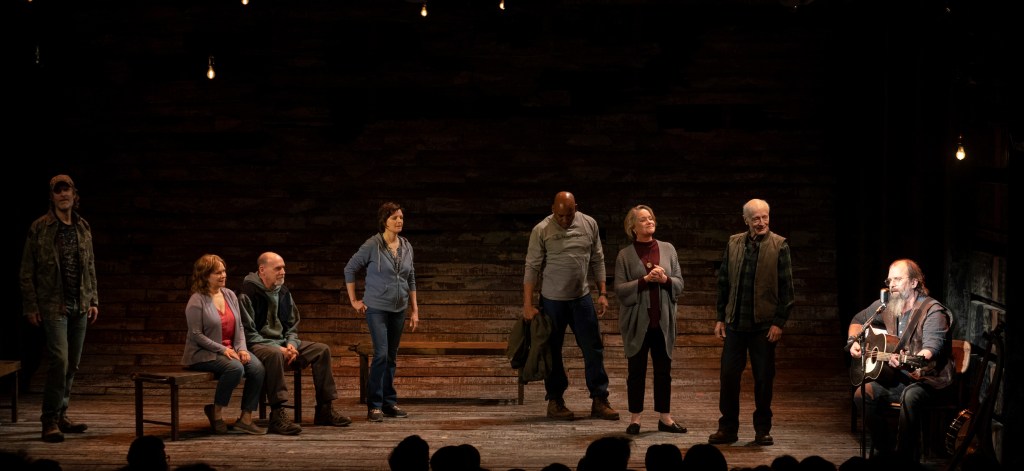
Blank and Jensen (the husband-wife team who created The Exonerated), choose to present this dynamic piece as a flashback after Earle (playing guitar), opens with two songs that set the themes: “John Henry,” and Heaven Ain’t Goin’ Nowhere.” Cleverly, the action begins in the courtroom at the end of Don Blakenship’s trial as Judge Berger (Kym Gomes), states they cannot read their “Victim Impact Statements.” What family could never speak in court, they relate to the court of public opinion (the audience who sees this play).

The flashback comes full circle back to the court, so the audience hears Blankenship only gets one year in jail and a fine of $250,000. Arrogantly, Blankenship uses that money to run Ads and create pamphlets in which he characterizes himself as the victim of government as a “political prisoner.” Nevertheless, in final, moving encomiums, each family member details how they remember their loved ones who live on in their hearts and in this production which has called. out to music the names of all who died in the UBB mine explosion.
With minimalist but trenchant symbolic Scenic Design (Richard Hoover), effective Lighting Design (David Lander), Sound Design (Darron L West) and Costume Design (Jessica Jahn), Coal Country is an amazing revival. It is profound and memorable in scope and power. Don’t miss it this time around. For tickets and times go to their website: https://www.cherrylanetheatre.org/coal-country
‘English’ a Seminal Play by Sanaz Toossi

Born into our parents’ culture and country, we learn how to communicate with them easily and take our language for granted without thinking about it. Delving deeper, language defines us, defines our thoughts, our ways. Our name in our native language has meaning from its history. It describes who we are and how we perceive ourselves. Many change their names as a result, knowing the change means a different self. Considering the import of the language we speak and our identification with it, how does learning a new language impact the way we understand ourselves? How might learning another language affect our being?

English, the insightful and powerful work by Sanaz Toossi, presents these questions and answers them poignantly through the voices of five individuals from Iran, who grapple with learning English. Starring an all-Iranian cast, the play enjoyed an extended run at The Atlantic Theater Company and most probably will be a favorite to be staged globally. Directed by Knud Adams, the play remains an original that unfortunately, couldn’t have had a longer run.
The setting is Karaj, Iran in 2008 before and during a confluence of events taking place between Iran, the United States and other English speaking countries. At the time immigration is fairly easy and Iranians on the move want to study abroad, do business and travel for extended stays to English-speaking countries to which their families emigrated.

Marjan (Marjan Neshat portrays the instructor), teaches for the TOEFL, the Test of English as a Foreign Language. The standardized, timed test measures the English language ability of non-native speakers, who wish to study in English-speaking universities. The test is accepted by more than 11,000 universities and other institutions in over 190 countries. The selective test guarantees that the students have an excellent working knowledge of the language to insure their success, not only in their classes, but also in navigating the culture and society.
As Neshat’s Marjan teaches, she realizes as we do that in every class there is a dynamic. Personalities emerge. Though she attempts to be objective, she finds herself aligning with students who demonstrate like-minded abilities and cognition. As her students reveal themselves in their response to her and the language, we find their observations humorous, their interactions fascinating. And the conflict arises when the struggling and often embarrassed students relate her to the onerous time they have with learning a completely different mode and thought process of communication. Neshat is authentic in her portrayal as Marjan, revealing the inner emotional struggle she has especially with Elham (the feisty, assertive Tala Ashe).
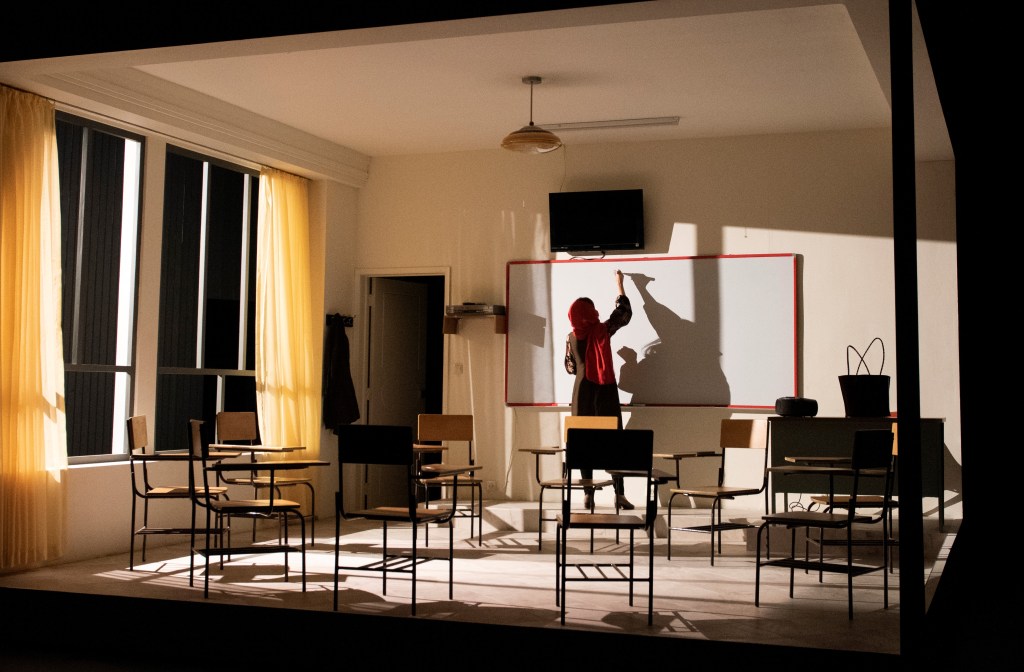
Humor evolves organically from the students’ perceptions, struggles and slippage into their native tongue Farsi in the first weeks of the class. An excellent teacher, Marjan attempts to gradually curb their fear and angst holding their feet to the fire by speaking only English and giving them a demerit if they fall back into Farsi. Her skills are effective. We watch these individuals speak halting English. When they rip off sentences quickly (in English), that designates they speak Farsi.
At the outset Neshat’s Marjan reveals equanimity despite the competitive confrontations of Elham (the excellent Tala Ashe), the shy, halting behavior of Goli (the sweet Ava Lalezarzadeh), and the lackluster, removed Roya (the heartfelt Pooya Mohseni). Eventually, it becomes apparent that Omid (the attractive, confident Hadi Tabbal), the only male in the class, whose English is nearly unaccented and spot-on, is the one that Marjan connects with cognitively and perhaps, as Elham suggests, on a more personal level. Neshat and Tabbal effect an intriguing bond that flows with undercurrents between their characters.
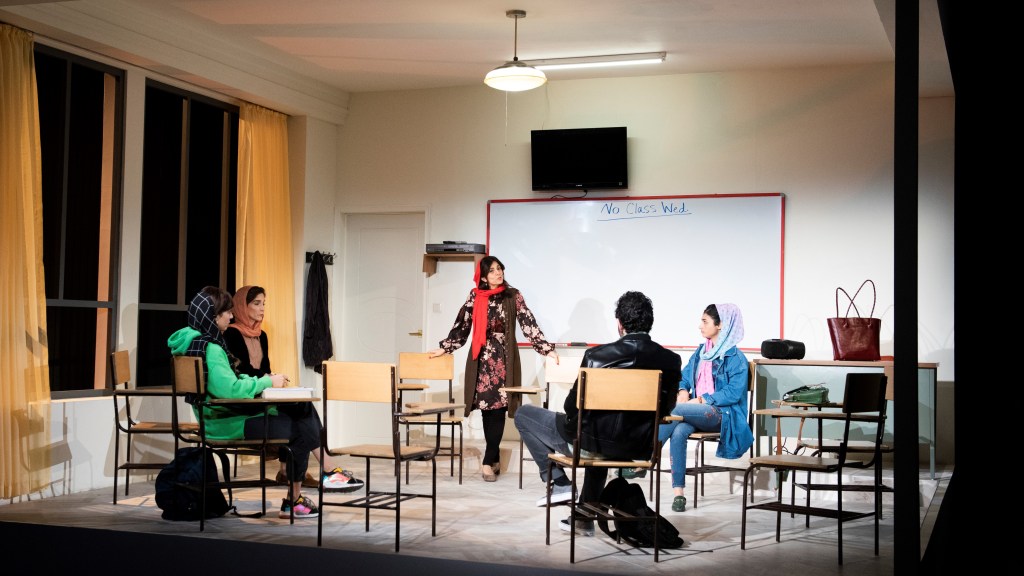
We enjoy Marjan’s activities with the class which reinforce recognition of English nouns through games that emphasize speed. She keeps in mind the TOEFL is a timed test. However, eventually, the language begins to wear down the teacher and the students after Neshat’s Marjan encourages them to undertake the most difficult part of learning a language; they must only speak in English.
Thus, they must converse in sentences, and in effect begin to approach thinking as a native English speaker. All of them chafe at this and break into Farsi which Neshat’s Marjan “censures” by noting it on the chalkboard. The only one who doesn’t find this difficult is Tabbal’s Omid.

As Marjan attempts to have each of the students integrate themselves more personally with English, the conflicts explode. We discover Mohseni’s Roya only wants to learn because her son wants his mother to speak to her Canadian granddaughter in her native tongue which is not Farsi. This devastates Roya, who in a show and tell explains the two languages as she hears their differences. When she discusses her son’s email in Farsi and a voice mail he leaves in English, she uplifts the beauty of Farsi. She emphasizes the softness of her son’s intent in Farsi. Then she notes in his English voice mail, his speech. The sounds he makes are harsh, removed, cold. She asks the class, “Who is mom? I am Maman.” There, in one word the history of Persia is eradicated. The audience was completely silent during Mohseni’s plaintive discussion of loss; her son and granddaughter disappearing her culture before her eyes. This powerful moment is beautifully rendered by Mohseni and insightfully directed by Knud Adams.
The distinction Toossi suggests is profound and thought-provoking. Roya’s relationship to her son has been separated by the nature of the language, and we see her heart is broken because of it. As he lives in Canada over the years, the separation will become impossible. The geographical difference matters little. It is his adoption of this new way of being in English. Even if she stays with him in Canada, she will be forced to learn this harsh, cold speech and ways of thinking to attempt to form a relationship with her granddaughter. But a culture, a way of being, a way of life and history has been disintegrated in the next generation. Mohseni’s Roya defines this as a death. As a result of her incredible performance, we believe and buy into Roya’s grief. Her granddaughter will never know the softness and poetic beauty of Farsi, the language of poets, of Omar Khayyam.

When Marjan has all of her students speak their English names, Roya rebels. It is her last stand. She never returns to class. We anticipate that the cost is too great for her to be reborn into a culture that reshapes her identity with an ugly name and being. As Roya leaves the class, Marjan’s response is invisible, absent. When a student asks what happened to Roya, Marjan dismisses the question. We are left to think that Roya failed to even desire to evolve, and Marjan failed Roya. Marjan, normally empathetic, moves on to “save” the others. However, Neshat’s Marjan too swiftly dismisses Roya. The undercurrent of her own feelings screams out with her silent dismissal, as harsh as the sounds of English to Roya’s intellect.
Toossi makes an important choice for our understanding of the complicated Marjan who puzzles us. Why didn’t she use Roya’s difficulty as a teachable moment? Why didn’t she encourage the others or explore for a few minutes a path to enhance their connection with her? We don’t know if she deeply empathizes and understands Roya’s rebellion or if she is annoyed she failed her. The question Toosi raises about Marjan’s character, she never answers because it is a developing characterization steeped in a confluence of emotions and feelings. Clearly Neshat’s Marjan is thrown by this event. Her becoming an English teacher has impacted her. There is gain, and there is loss and there is the price she pays for the trade-off.

Pooya Mohseni’s portrait of Roya is eloquently delivered, touching and emotionally driven. In every line we feel Roya’s pain in having to deal with this untenable situation. Mohseni knocks it out of the ballpark. Through her character most of all, we understand what it means to be a native speaker. We empathize with the loss of dignity, honor and person-hood Roya feels being forced into speaking English by Neshat’s Marjan. We get how Marjan’s restrictions not to communicate and make herself understood in the beauty of Farsi is anathema. Of course, she feels English is like putting on a cloak of stupidity, ugliness, ungainliness. If her granddaughter never learns Farsi (something Omid suggests her son should have his daughter do), she will never know who her grandmother really is. Roya’s loss, historical, cultural, personal is beyond calculation.
Toossi’s strongest moments present themes of loss of the old identity, yet the incomplete adoption in fluid grace with a new one. For each of the characters, we empathize that it is like being birthed again, torn from one’s natural lush habitat and plopped down in a desert left to die of thirst every moment, as they yearn to feel the cool balm of speaking in one’s mother tongue. English shines when the pronounced conflicts increase.

For example, Elham’s ambitious nature and brilliance force her to try to be the best in the class to achieve a high grade on the TOEFL in her pursuit to be a doctor. Ashe nails Elham’s frustration in achieving a high score on the MCAT and fearing a low score on the TOEFL. The TOEFL is a mountainous hurdle, so she hates English and by extension is oppressed by Neshat’s Marjan. Nevertheless, her competitive nature compels Elham to provoke Marjan in the stress and strain of being challenged. Speaking Farsi, yearning to be close, she manipulatively accuses Marjan of disliking her.
Ashe’s exceptional portrayal is revealed in her character’s suppressed anger. Thus, Elham proclaims to Ava Lalezarzadeh’s Goli that Marjan “loves” Omid. The sweet, shy Goli avers. But Elham insisits that because Marjan invites Omid to watch English films with her there is a “bond.” Indeed, in their moments together Tabbal’s attractive Omid is suggestive and in his scenes with Neshat’s Marjan there is a connection. However, it is not as Ashe suggests; it is based in understanding English fluidly. Indeed, Marjan invites Elham and Goli, but they don’t want to spend the time with Marjan and Omid watching films like Room With a View. These conflicts are vital to the play’s forward movement. Perhaps they might have been established earlier.
Toossi’s uses her characterizations to organically develop her themes. These strengthen our engagement and pull at our empathetic heart strings. Thus, when Omid’s mystery is revealed or when Elham comes back to discuss how she performed on the TOEFL, we identify. Most of all Toossi has accomplished a milestone by indicating the importance for native speakers to stand in the shoes of immigrants who are even attempting to learn English. To learn a different language is a courageous, heroic feat, as Toossi suggests. It is a willingness to expand to another identity, another thought process. Ultimately, the nature of the language, its formation and structure changes the individual emotionally, mentally, indeed psychologically. This must not be underestimated. All of the actors’ portrayals vitally heighten Toossi’s themes and bring us closer to the importance of empathy. Ashe’s development of her character Elham is exceptional and we thrill for Elham as she shocks us with her success which was in her all along.

Toossi also reveals why there are those who don’t wish to learn English, even though they’ve lived in an English speaking country for years. These individuals remain in their own communities, never learn the language and never venture out to immerse themselves in new experiences. The risk of embarrassment is too great. They will not live in humiliation as their new persona, feel like an idiot and be quiet and uncommunicative, not understanding the too rapid speech bursts around them.
Finally, Toossi implies that by leaving behind the old self and adopting a new one, the individual wipes out the favored history of their beloved country, identity, relationships, being. Of course, if there is no direct imperative for business or education, they will not even try. Additionally, in the United States, their accent will be so thick it will be tantamount to a “war crime,” especially in the rural South and West as Ashe’s Elham ironically and humorously suggests.

This is one of the great lines in Toossi’s superb play. Understandably, non-native speakers do not wish to brave the looks of disgust, horror and puzzlement on the faces of native English speakers when they try to ask, “When will the waiting room open?” (Ws without an accent are particularly hard for non-native English speakers). Toossi covers a great deal of ground in her touching play which ends on a high note. We finally hear the actors speak in Farsi.
The production has ended. A few points about when I saw it the last day of its extended run.
Some of the actors couldn’t be heard, even by those sitting in the second row. Friends sitting there told me they barely heard certain thin-voiced actors. Also, sitting up close they became annoyed because the chairs blocked their view at times and they had to lean to the left or right. I was in row F and I thought it was just me when I missed some of the dialogue. I wasn’t the only one.

Problematic was the set construction, a lovely box set classroom which kept in the sound and echoed it. A wonderful idea for the set shouldn’t obstruct the audience’s enjoyment of the production with occluded sight lines and muffled sound. The idea of the classroom, revolving on a turntable platform is symbolic. But unless the audience hears each line of the actors and sees all areas of the stage without obstruction, the symbolism is impaired. This is too wonderful a work for it not to be technically spot-on.
Look for the marvelous Toossi’s work. She is a treasure and English is a vibrant, important and current play that begs to be performed again.
‘A Touch of the Poet’ The Irish Rep’s Brilliant Revival Exceeds Its Wonderful Online Performance. Eugene O’Neill’s ‘Poet’ is Amazing Glorious Theater!

From the moment Cornelius “Con” Melody (Robert Cuccioli) appears, shaking as he holds onto the stair railing of the beautifully wrought set by Charlie Corcoran, we are riveted. Indeed, we stay mesmerized throughout to the explosive conclusion of the Irish Repertory Theatre’s A Touch of the Poet by Eugene O’Neill. Compelled by Cuccioli’s smashing performance of Con, we are invested in this blowhard’s presentiments, pretenses and self-betrayal, as he unconsciously wars against his Irish heritage. Con is an iconic representative of the human condition in conflict between soul delusion and soul truth.

What will Con’s self-hatred render and will he take down wife Nora and daughter Sara (the inimitable pairing of Kate Forbes and Belle Aykroyd), in his great, internal classicist struggle? Will Con finally acknowledge and accept the beauty and enjoyment of being an Irishman with freedom and hope? Or will he continue to move toward insanity, encased in the sarcophagus image of a proper English gentleman? This is the identity he bravely fashioned as Major Cornelius Melody to destroy any smatch of Irish in himself. O’Neill’s answers in this truly great production of Poet are unequivocal, yet intriguing.
The conflict manifests in the repercussions of the drinking Con takes on with relish. So as Cuccioli’s Con attempts to gain his composure and stiffly make it over to a table in the dining room of the shabby inn he owns, the morning after a night of carousing, we recognize that this is the wreck of a man physically, emotionally, psychically. His shaking frame soothed by drink, which wife Nora (Kate Forbes), brings to him in servile slavishness, is the only companion he wants, for in its necessity as the weapon of destruction, it hastens Con’s demise. The beloved drink stirs up his bluster and former stature of greatness that he has lost forever as a failed Englishman and even bigger failure as comfortable landed gentry in 1828 Yankee country near Boston.

Director Ciarán O’Reilly and the cast heighten our full attention toward Con’s conflict with the romantic ideal of himself and the present reality that will eventually drive him to a mental asylum or a hellish reconciliation with truth. All of the character interactions drive toward this apotheosis. The actors are tuned beautifully in their portrayals to magnify the vitality of this revelation.

Nora (Forbes is authentic and likeable), is the handmaiden to Con’s process of dissolution. In order to fulfill her own glorified self-reflection and identity in loving this once admirable gentleman, she coddles him. Riding on the coattails of her exalted image of Con, she maintains beauty in her self-love. She loves him in his past glory, for after all, he chose to be with her. So Nora must abide in his every word and deed to maintain her loyal happiness, taking whatever few, kind crumbs he leaves for her under the table of their marriage. As a result, she would never chide or browbeat Con to quit the poison that is killing him.

The good whiskey he proudly provides for himself and friends like Jamie Cregan (the excellent Andy Murray), to help maintain the proper stature of a gentleman, steadies his mind. The whiskey also makes him feel in control of his schizoid personas. He clearly is not in control and never will be, unless he undergoes an exorcism. The audience perversely finds O’Neill’s duality of characterizations in Con and the others amusing if not surprising.
Cuccoli’s Con at vital moments rejects the painfully failed present by peering into his mirrored reflection to quote Lord Byron in one or the other of two mirrors positioned strategically on the mantel piece and a wall. There, fueled by the alcohol, he re-imagines the glorious military man of the Dragoons as he stokes his pride. Yet, with each digression into the past, he torments his inner soul for reveling in his failed delusion.

Likewise, each insult he lashes against Nora, who guilty agrees with him for being a low Irish woman, both lifts him and harms him. It is the image of the Major ridiculing Nora because of the stink of onions in her hair one moment, and in self-recrimination, apologizing moments after for his abusiveness. In his behavior is his attempt to recall and capture his once courageous, successful British martial identity, while rejecting the Irish humanity and decency in the deep composition of his inner self.

Always that true self comes through as he recognizes his cruelty. He behaves similarly with Sara, bellicose in one breath, apologetic in the next, fearful of her accusatory glance. In this production Con’s struggle, Nora’s love throughout and Sara’s resistance and war with herself and her father is incredibly realized and prodigiously memorable. O’Reilly and the cast have such an understanding of the characters and the arc of their development, it electrified the audience the night I saw it. We didn’t know whether to laugh (the humor originated organically as the character struggles intensified), or cry for the tragedy of it. So we did both.

Con’s self-recrimination and self-hatred is apparent to Nora whose love is miraculously bestowed. His self-loathing is inconsequential to Sara, who torments him with an Irish brogue, lacerating him about his heritage and hers, which the “Major” despises, yet is his salvation, for it grounds him in decency. Sara and Nora are the bane of his existence and likewise they are his redemption. If only he could embrace his heritage which the “scum” friends who populate his bar would appreciate. If only he could destroy the ghost of the man he once was, Major Cornelius Melody, who had a valiant and philandering past, serving under the eventually exalted Duke of Wellington.
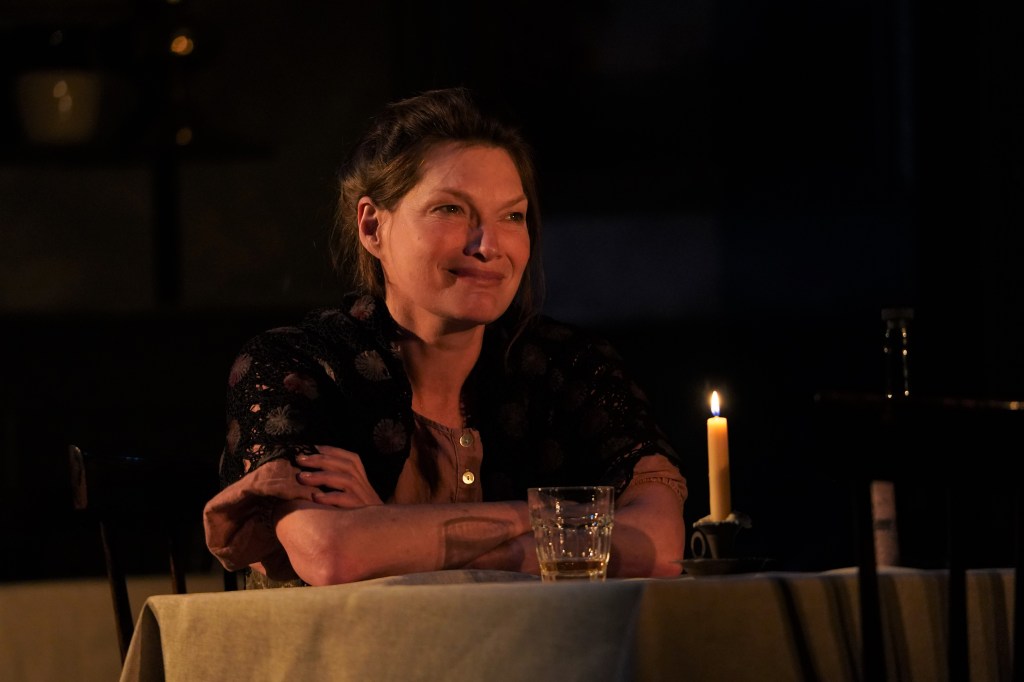
Through the discussions of Jamie Cregan with Mick Maloy (James Russell), we learn that the “Major identity” caused Con to be thrown out of the British military and forced him to avoid disgrace by settling in America with Nora and Sara. We see it causes his decline into alcoholism, destroys his resolve and purpose in life, and dissipates him mentally. It is the image of pretension that caused the bad judgment to be swindled by the Yankee liar who sold him the unproductive Inn. Sadly, that image is the force encouraging the insulting, emotional monster that abuses his wife and daughter. And it is a negative example for Sara who treats him as a blowhard, tyrant fool to vengefully ridicule and excoriate about his class chauvinism, preening airs and economic excesses (he keeps a mare to look grand while riding). It is the Major’s persona which brings them to the brink of poverty.
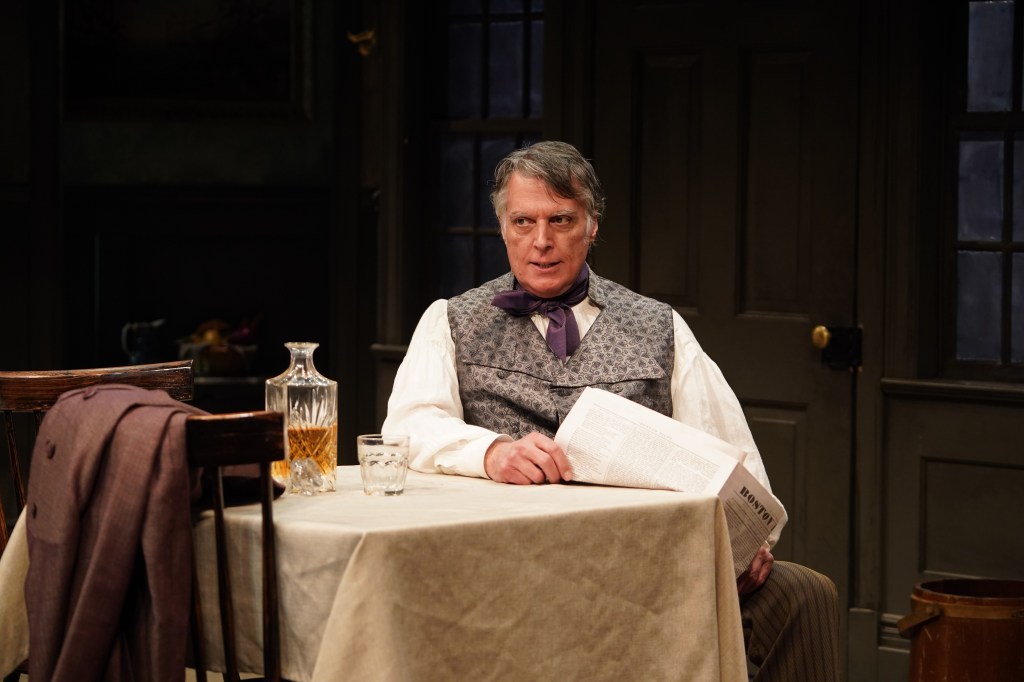
The turning point that pushes Con over the edge comes in the form of a woman he believes he can steal a kiss from, Deborah Hartford, the same woman whose intentions are against Sara and her son Simon Hartford falling in love. Without considering who this visiting woman might be, Con assumes the Major’s pretenses and we see first hand how Con “operates” with the ladies. His romanticism awkwardly emerges, left over from his philandering days with women who fell like dominoes under his charms. He is forward with Hartford who visits to survey the disaster her son Simon has befallen, under the spell of Sara’s charms, behavior not unlike Con’s. The scene is both comical and foreboding. From this point on, the events move with increasing risk to the climactic, fireworks of the ending.

As Deborah Hartford, Mary McCann pulls out all the stops in a performance which is grandly comical and real, with moment to moment specificity and detail. When Con attempts to thrust his kiss upon her, there were gasps from the audience because she is a prim Yankee woman of the upper classes who would find Con’s behavior low class and demeaning. That he “misses” the signs of who she is further proves his bad judgment. Sara is appalled and Nora, not jealous, makes excuses for him satisfying herself. The scene is beautifully handled by the actors with pauses and pacing to maximum effect.
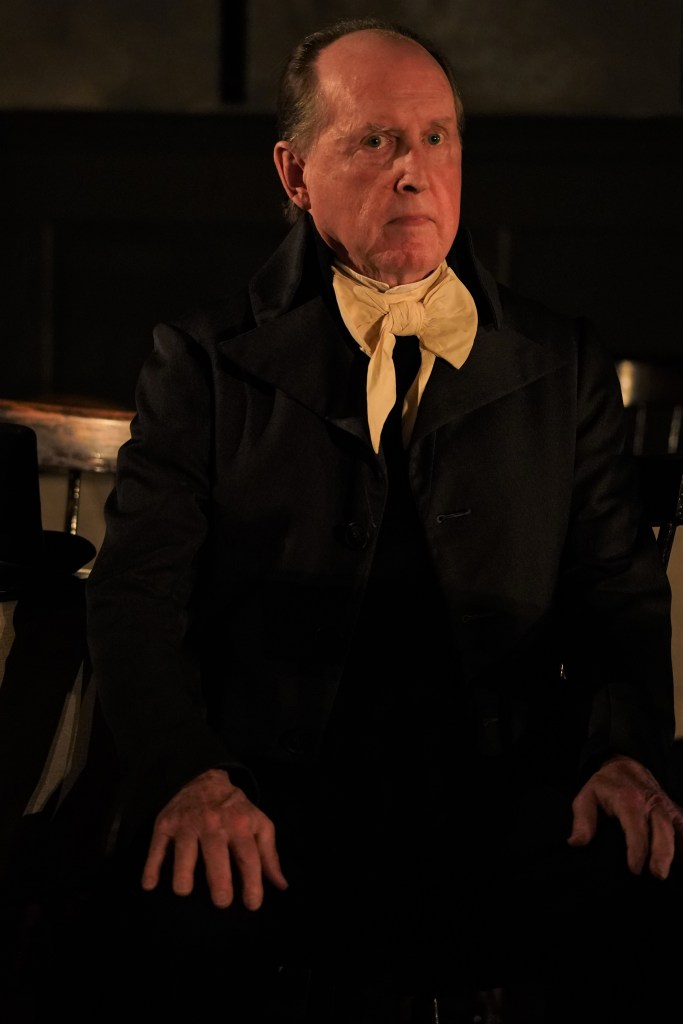
McCann’s interaction with Aykroyd’s Sara is especially ironic. Deborah Hartford’s speech about the Hartford family male ideals of freedom and lazy liberty that forced the Hartford women to embrace their husbands’ notions by taking up the slave trade is hysterical. As she mildly ridicules Simon’s dreams to be a poet and write a book about freedom from oppressive, nullifying social values, she warns Sara against him. It is humorous that Sara doesn’t understand what she implies. Obviously, Deborah Hartford suspects Sara is a gold digger so she is laying tracks to run her own train over any match Sara and her son would attempt to make. After discovering the economically challenged, demeaned Melody family, Hartford informs her husband who sends in his man to settle with the Melodys.
Together McCann and Aykroyd provide the dynamic that sets up the disastrous events to follow. Clearly, Sara is more determined than ever to marry Simon and as the night progresses, she seals their love relationship with Nora’s blessing, until Nora understands that her daughter walks in her own footsteps in the same direction that she went with Con. Unlike Nora, however, Sara is not ashamed of her actions.

O’Neill’s superb play explores Con’s past and its arc to the present, revealing a dissipated character at the end of his rope. Wallowing in the Major’s ghostly image, Con vows to answer Mr. Hartford’s insult of sending Nicholas Gadsby (John C. Vennema looks and acts every inch the part), to buy off Sara’s love for Simon and prevent their marriage. After having his friends throw out the loudly protesting Gadsby, Con and Jamie Cregan go to the Hartfords to uphold the Major’s honor in a duel. Nora waits and fears for him and in a touching scene when Sara and Nora share their intimacies of love, Nora explains that her love brings her self-love and self-affirmation. Sara agrees with her mother over what she has found with Simon. The actors are marvelous in this intimate, revelatory scene.
The last fifteen minutes of the production represent acting highpoints by Cuccioli, Forbes, Aykroyd and Murray. When Con returns alive but beaten and vanquished, we acknowledge the Major’s identity smashed, as Con sardonically laughs at himself, a finality. With the Major’s death comes the hope of a renewal. Finally, Con shows an appreciation of his Irish heritage as he kisses Nora, a redemptive, affirming action.

O’Neill satisfies in this marvelous production. The playwright’s ironic twists and Con’s ultimate affirmation of the foundations of his soul is as uplifting as it is cathartic and beautiful. Nora’s love for Con has finally blossomed with the expiation of the Irishman. It is Sara who must adjust to this new reality to redefine her relationship with her father and reevaluate her expectation of their lives together. The road she has chosen, like her mother’s, is hard and treacherous with only her estimation of love to propel her onward.
From Con’s entrance to the conclusion of Irish Repertory Theatre’s shining revival of Eugene O’Neill’s A Touch of the Poet, presented online during the pandemic and now live in its mesmerizing glory, we commit to these characters’ fall and rise. Ciarán O’Reilly has shepherded the sterling actors to inhabit the characters’ passion with breathtaking moment, made all the more compelling live with audience response and feeling. The production was superbly wrought on film in October of 2020. See my review https://caroleditosti.com/2020/10/30/a-touch-of-the-poet-the-irish-repertory-theatres-superb-revival-of-eugene-oneills-revelation-of-class-in-america/
Now, in its peak form, it is award worthy. Clearly, this O’Neill version is incomparable, and O’Reilly and the actors have exceeded expectations of this play which has been described as not one of O’Neill’s best. However, the production turns that description on its head. If you enjoy O’Neill and especially if you aren’t a fan of this most American and profound of playwrights, you must see the Irish Rep presentation. It is not only accessible, vibrant and engaging, it deftly explores the playwright’s acute themes and conflicts. Indeed, in Poet we see that 1)classism creates personal trauma; 2)disassociation from one’s true identity fosters the incapacity to maintain economic well being. And in one of the themes O’Neill revisits in his all of his works, we recognize the inner soul struggles that manifest in self-recrimination which must be confronted and resolved.
Kudos to the creative team for their superb efforts: Charlie Corcoran (scenic design), Alejo Vietti & Gail Baldoni (costume design), Michael Gottlieb (lighting design), M. Florian Staab (sound design), Ryan Rumery (original music), Brandy Hoang Collier (properties), Robert-Charles Vallance (hair & wig design).
For tickets and times to the Irish Repertory Company’s A Touch of the Poet, go to their website: https://irishrep.org/show/2021-2022-season/a-touch-of-the-poet-3/
‘The Daughter-in-Law,’ by D.H. Lawrence is Superb! Theater Review

D.H. Lawrence is rarely known for his plays. However, British critics have noted that he was a master playwright, and if discovered as such earlier in his life, he would have been appreciated for his dramas, however maverick and forward-thinking. One such incredibly rich play is being presented by the always excellent Mint Theater Company, who enjoys bringing to life rare jewels in drama that have often been overlooked. The Daughter-in-Law is one of these gems.

Directed by Martin Platt The Daughter in Law presents an amazing portrait of an independent woman, Minnie (Amy Blackman), a former governess married to a collier (coal miner), Luther Gascoyne (Tom Coiner). The couple live in a mining town near his mother’s (Mrs.Gascoyne-Sandra Shipley) home where his brother Joe (Ciaran Bowling), also a collier, works with him in East Midlands England.

The setting is autobiographical and akin to where D.H. Lawrence’s father worked and where he and his siblings lived with their mother (reminiscent of Minnie), who had cultural aspirations for Lawrence, and who inspired him in his studies. Lawrence’s play evolves into conflicts among the characters. These are rich in thematic evolution that comes to some resolution by the end of the play after the colliers riot against scab workers during a strike. Interestingly, the themes involve gender roles, class, economic inequity and familial love. Also, Freudian tropes between mothers and sons, an issue that Lawrence often investigated, receives a hearing in this realistic and beautifully acted production that Platt has tautly directed, so it remains provocatively, emotionally, tense throughout.
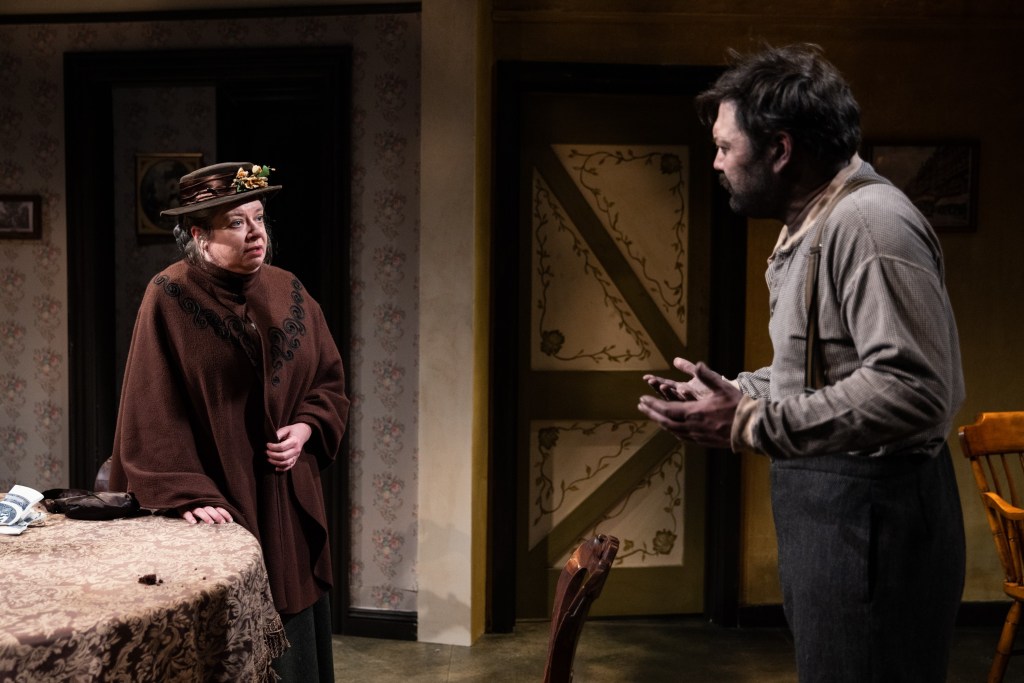
To a fault, the actors have been schooled in the Midlands accent which provides realism and creates the audiences’ attentive stir to understand all that the characters communicate. At times, this takes getting used to. However, the actors portray the characters’ emotional feeling sincerely and authentically, so that one understands, even though one may not be able to translate word for word what the characters say.

Nevertheless, when Joe (the vibrant Ciaran Bowling), enters sporting an arm in a sling and his mom (the dynamic and authentic Sandra Shipley), fusses over him with his dinner and probes what happened with receiving a disability check, we understand their close relationship, and we also understand that mother and son mutually care for each other, living under the same roof, watching out for each other, while other family have gone on to make their own lives.

The hard conditions of the mines remind us of the corporate structure which Lawrence reveals has changed little over one hundred years later. The owners receive all the benefits, and the workers are given low wages and are subcontracted out to keep them hungry and off-balance, so they are unsure of where they stand in the company’s graces. Joe and his brother, like their father before them, were at the mercy of the owners; and their father died as a result of an accident we find out later in the play. This undercurrent of workers vs. owners is the driving undercurrent and reveals that the misery of need and want is what impacts the families who live and depend on coal mining for their survival.
During lively dinner conversation, Joe tells his mother that his attempt to receive a check for his broken arm has been rejected. His manager tells his version of “the acceptable truth” of what happened to Joe, so that it is Joe’s fault that he was injured, because he was “fooling around.” It was not that he was injured on the job because of some dereliction of another worker or the mine. Lawrence strikes at the inequality of the haves and have nots and the managers who make sure to protect their employers. Thus, we feel for Joe and his mother, who are not destitute, but who struggle economically. If any stress comes to either of them, they are a few steps away from the equivalent of the poorhouse. Such is their economic and class level.

Into the background of this economic insecurity and potential working class impoverishment comes Mrs. Purdy (the convincing and excellent Polly McKie), a neighbor who brings disturbing news. Her daughter, who she describes as rather a simple girl, is pregnant. And after avoiding the direct truth until Mrs. Gascoyne drags it out of her, Mrs. Purdy lays the blame at the feet of Luther, who married Minnie seven weeks before. Mrs. Gascoyne pushes Mrs. Purdy cleverly off on Luther and Minnie, especially Minnie since she has brought some money into the marriage and can afford to pay Mrs. Purdy and her daughter off for their silence and for Bertha’s upkeep with the baby. This suggestion is made after Joe and Mrs. Purdy verify that Luther was seeing Bertha Purdy, something that Mrs. Gascoyne didn’t realize because Luther kept it under the radar and wasn’t serious with her.
Assurances are made to Mrs. Purdy that she must see Luther and Minnie at their house, since Minnie has received an inheritance that Mrs. Gascoyne insists should be used to pay off Mrs. Purdy. This malevolent and resentful suggestion is disputed by Joe whose empathy for his brother and Minnie is greater than his mother’s. As Mrs. Gascoyne discusses Luther’s marriage to Minnie in demeaning terms, it is obvious that she resents the “high and mighty” Minnie ending up with her son. She tells Mrs. Purdy that it’s because he is the only one she could get.
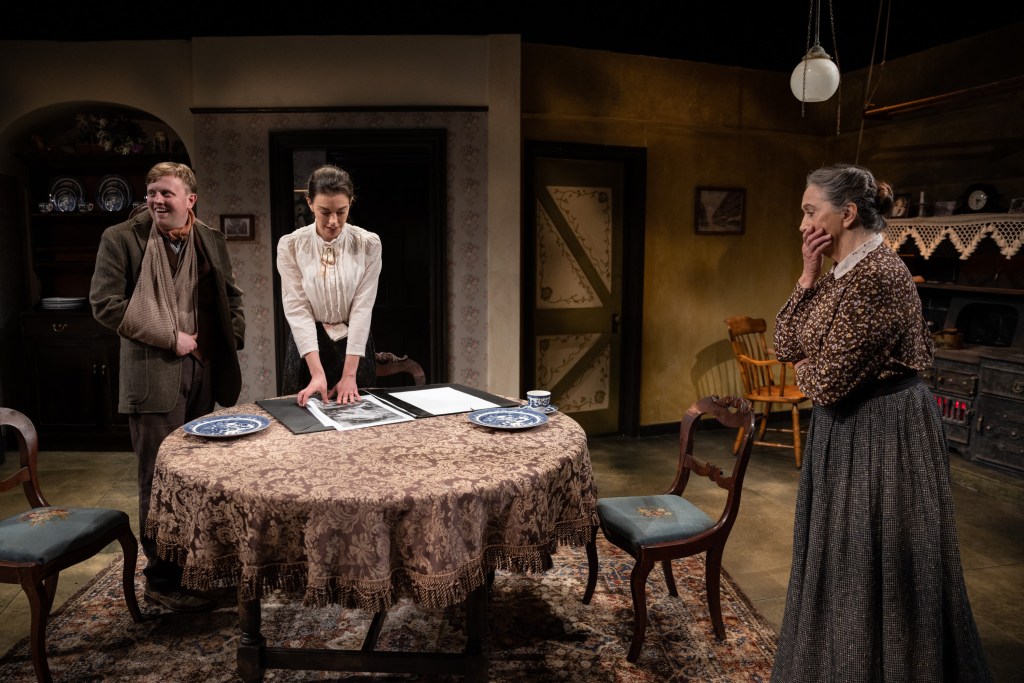
At this point not meeting Minnie, we wonder who this snotty woman is and side with Mrs. Gascoyne because we have gotten to know this nurturing, motherly type who obviously cares about her children. Based on Lawrence’s brilliant dialogue characterizing Minnie through the eyes of Mrs. Gascoyne, we believe that this snobby woman who thinks she’s “better” than the colliers and their families is pretentious. Also, we believe that she is so desperate, she doesn’t love Luther, but she just wants not to be an old maid.
Interestingly, Lawrence allows this portrait of Minnie to remain, until we see her relationship with the two brothers unfold. Gradually, her characterization is revealed and her strength, power, indomitable wisdom and love for Luther becomes apparent but with twists and turns, ups and downs by the the end of the play. But first, she must stand up and upend her mother-in-law’s presumptive discriminatory attitude against her, and then wait for the right moment to forgive her so that the two of them become closer.

Platt’s direction in keeping us wondering how Minnie will react when she discovers Luther has a child on the way is subtle and yet eventful, as Lawrence provides surprises and unusual events which keep us enthralled. Mrs. Purdy tells Luther about the child, but Joe manages to drive Minnie out of the house so that she leaves before Mrs. Purdy confronts her with the “truth.”
In an ironic twist it is Luther, who returns much later drunk, guilty and ready to be rejected. He picks a terrible fight with Minnie, then in humiliation covered over with bravado, he reveals that he has gotten Bertha with child. Interestingly, Minnie remains calm and collected, non judgmental and rational, presenting the idea that the child may not be Luther’s, but another man’s. Nevertheless, Luther becomes churlish and obnoxious, which prompts her to call him out for his meanness, especially when he suggests that Bertha was nicer to him than Minnie.
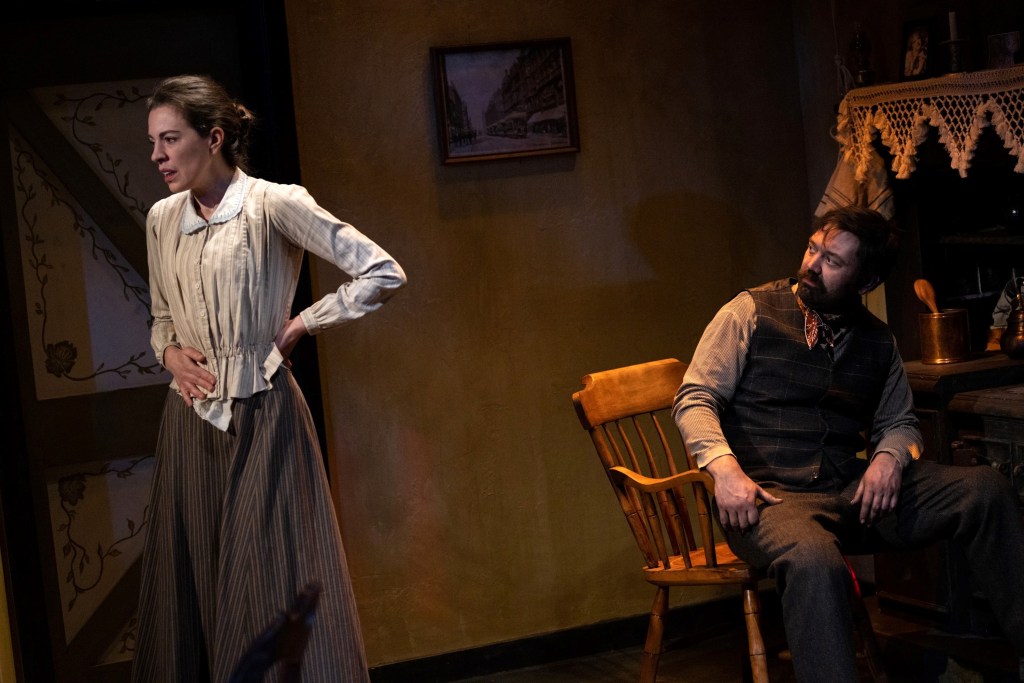
The actors do an exceptional job in raising the stakes and increasing the argument and tension between Minnie and Luther, so that we don’t know whether or not they will break up, Minnie will leave, whether Luther will have to return to his mother or both of them will end up bloodied and bruised as they come to blows. In Lawrence’s characterizations of Minnie and Luther, their relationship becomes explosive and we aren’t sure whether it’s because of class differences, economic differences (she came from a bit more money than he and he may resent it) gender role assumptions (Minnie has worked for herself and made her own money) or something else. Interestingly, we don’t consider that they may love one another, feel hurt and pain that they might lose each other, or are emotionally trying to settle out their own feelings.
The actors are just exceptional in revealing this marvelous nuance and the director has shepherded them so that we are off balance in attempting to figure out how they really feel about each other. One of the high points of the play comes when Minnie confronts her mother-in-law and indicates that she has not allowed either of her sons to become men. Minnie points out that she has babied them so that they remain shells and are forced to rely on her emotionally and psychically which has destroyed them and made them weak. Interestingly, Joe agrees with Minnie. And he indicates this situation emotionally has debilitated him and at times has left him suicidal. Ciaran Bowling, Sandra Shipley and Amy Blackman are wonderful in this confrontation scene.

Amy Blackman as Minnie gives an amazing and powerful performance. She is stalwart and strong as she stands up to Sandra Shipley’s mother-in-law who manages to be infuriating and yet very human and poignant as a woman who is needy and relies on the ties amongst her and her sons. Tom Coiner as Luther is frightening and brutal as well as weak and sheep-like when he finally admits his love and dependence on Minnie.
Lawrence concludes the play surprisingly by revealing what has been at stake all along. It is a complicated and intricate conundrum that he presents and then the revelation clearly indicates that there was no mystery. This is how a couple is settling into themselves and separating from every other family member to cling to each other as they define themselves in the most important relationship of their lives.

This wonderful production should be seen for many reasons, principally because D.H. Lawrence has written a great play with nuanced characters in striking relationships that are unfamiliar to us that the Mint Theater Company has presented in this superb revival. The intricate details of setting, the props, the coal stove that is the hearth, the set design, down to the food and plates that show Minnie’s aspirations to being middle class, manifest a reality that makes us identify with these individuals. Kudos to the tremendous effort on the part of Bill Clarke (sets), Holly Poe Durbin (costumes), Joshua Larrinaga-Yocom (props), Jeff Nellis (lights), Original Music & Sound (Lindsay Jones).
The Daughter-in-Law comes in at two and one-half hours and is at New York City Center, Stage II. For tickets and times go to their website: https://www.nycitycenter.org/pdps/2021-2022/the-daughter-in-law/
 CAROLE DI TOSTI