Category Archives: Off Broadway
‘Prayer for the French Republic,’ Haunting, Current, Universal
Shifting in flashback between (2016-2017) and (1944-1946) set in two different Parisian apartments, Prayer for the French Republic (currently at Manhattan Theatre Club) by Joshua Harmon (Bad Jews), directed by David Cromer (The Band’s Visit), focuses on a Jewish family’s concerns about identity, safety and security in a country that they’ve called home for five generations. The backdrop of their apprehensions then and now is an uncertain world where humanity’s fears and needs turn increasingly predatorial. Capitalizing on such fears, political actors mine the unbalanced, raw emotions of deranged citizens, to create scapegoats which help grow their power and popularity. Whether left or right politically, oftentimes the scapegoats are religiously or ethnically engineered.
Such was the case in France during Hitler’s fascist occupation and the Vichy government’s cooperation with the roundup of French Jews that were murdered or sent off to concentration camps. Such is the case in France in recent years where attacks against Jewish citizens have multiplied, stirred up by opportunistic, right-wing, fascistic politicos ravenous for power.
As an overseer, Patrick Salomon (Richard Topol), connects the ancestral ghosts from the past, his great grand parents, Irma and Adolph Salomon, grandfather Lucien and his father Pierre, still living, as a bridge from the past to the present. In the present are Patrick, his sister Marcelle Salomon Benhamon, husband Charles and their adult children, Daniel and Elodie. The play is Patrick’s meditation on five generations of family. Patrick redefines what being a Jew in France means, as he narrates the saga of their Parisian Jewish identity and magnifies it in light of the age-old conundrum Jews historically confront throughout the ages. To survive do they assimilate, or do they risk the danger of standing apart as they embrace their religious beliefs?
As the play progresses, these questions expand and complicate against the current global crises (climate, socio-political, economic). What do Jews do in response to severe persecution? Do they embrace their identity, suffer and die valiantly resisting? In the name of living do they become invisible, marry out of their religion to avoid the turmoil, danger and abuse that comes with the trajectory of uncertain social unrest that Jews inevitably find themselves in the midst of? Do they emigrate to “certain” safety?
Interestingly, before the last generation of the Salomon family makes any final decisions, they confront their father Pierre and present him with their conundrum. Would he go with them, for example, to a safer place with other Jews in Israel? Who better than their father, a survivor of the atrocities of Auschwitz, can ,advise them about their future? Indeed, he made his decision years ago, married a Christian woman and didn’t keep up Jewish tradition, intentionally. He remained safely in Paris raising Marcelle and Patrick without keeping ancient Jewish traditions. And until Marcelle married an Algerian Jewish emigre, they didn’t keep them either.

Patrick (the superb Richard, Topol whose easy, relaxed persona is confidently relatable and empathetic), introduces the Salomon family to the audience and discusses their business operating a store where they attempt to sell beautiful pianos that are no longer viable in modern society. Patrick brings us into 2016 to view his closest relatives, sister Marcelle (Betsy Aidem), brother-in-law, Charles (Jeff Seymour), their bi-polar daughter Elodie (Francis Benhamou), and son Daniel (Yair Ben-Dor). The cross-section of their lives begins as Marcelle (Betsy Aidem in a fine, layered performance), becomes acquainted with her guest, Molly (the clear-eyed, authentic Molly Ranson), a non-practicing Jewish, distant cousin from NYC.
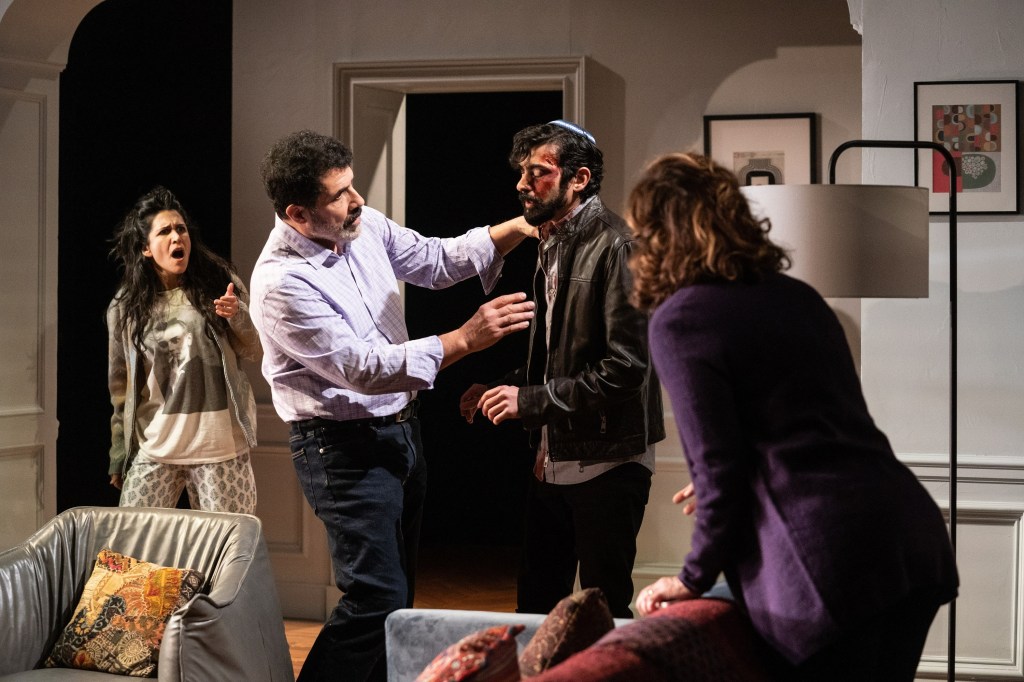
Their humorous exchange ends when Daniel comes in bleeding and an uproar begins in the household. He has been attacked in a hate crime where the young men who assaulted him yell out epithets because he has obviously distinguished his religious identity with a kippah. The arguments ensue and we discover that neither Marcelle nor Charles make an obvious show of their Judaism and that Daniel is the only Orthodox one in the family. Molly watches the scene unfold and learns as we do about family dynamics.
Daniel recently became Orthodox. He doesn’t even want to go to the police to identify his beating as a hate crime. Though Marcelle insists, Daniel makes excuses that he didn’t see his attackers and the police won’t do anything about it. All land on the fact that it will only exacerbate matters in the society and spread more fear. The discussion is closed when Daniel insists Marcelle light Shabbat candles.
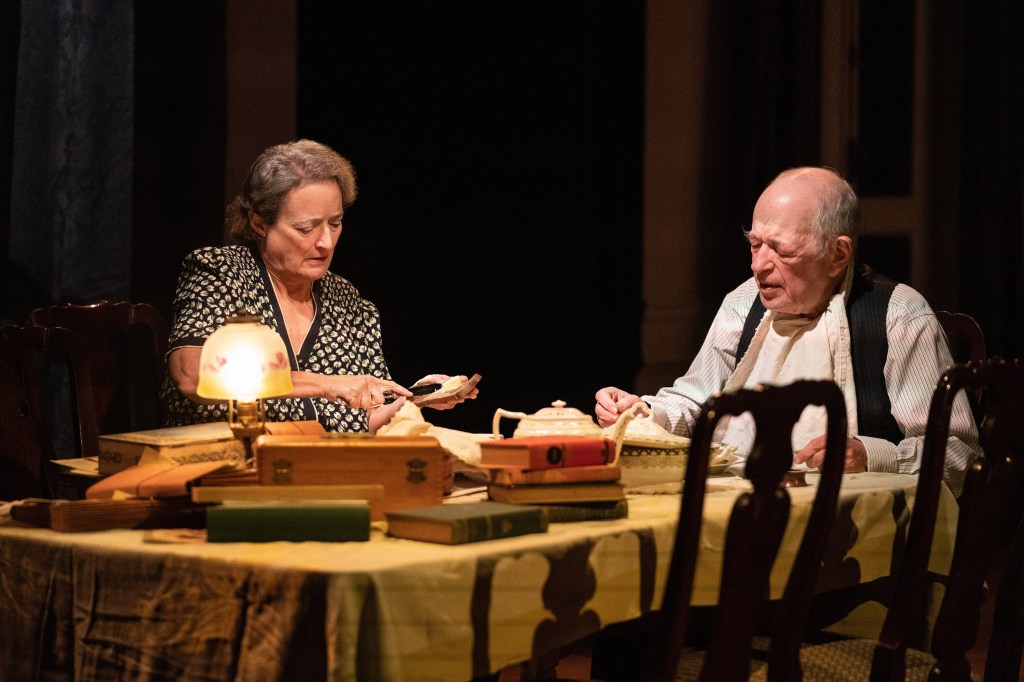
The scene deftly shits to the past, as we note that ancestry (the ghosts of time past), runs concurrently and influences the Salomons in the present. The spirits of their forebears come to life, and we watch the characters in their small Parisian apartment in 1944, having a conversation about their children and other family who escaped France rather than stay, which other family did. As Irma (Nancy Robinette), and Adolphe (Kenneth Tigar), wait safely in their apartment, away from the horrific persecution of Jews throughout the Third Reich occupied countries, of which France is one, they pray that Lucien and Young Pierre are safe in the mountains. This is what Adolphe encourages Irma to believe. As they pray that Lucien and Pierre will come home to their apartment in Paris, hope sustains them.
Patrick connects present and past during these moments. He ruminates about what his great grandparents, grandparents and father went through, touching upon the conversations they may have had and the rationing they went through. Furthermore, he reveals the family’s penchant for argument and debate before decisions are made. Adolphe humorously suggests that at the reunion when family is together, after ten minutes of peace there will be arguing and fighting and crying. We marvel that Irma and Adolphe can sit there and imagine what it will be like after liberation. We discover later that most of the family who didn’t escape to Cuba or elsewhere died. Adolphe’s fantasy is a manifestation of hope to uplift Irma. Their safety in Paris affords them this luxury of hope; meanwhile, Jews died in the millions.
How are they alive? Patrick relates that the superintendent of the building didn’t give Adolphe and Irma up to the Gestapo during a roundup. Thus, both escaped in that rarest of occasions; they were protected by other French people. However, at this point, they don’t know the fate of their son Lucien (Ari Brand) and their grandson Pierre (Peyton Lusk) who may have fallen into the hands of the Nazis and ended up gassed in a concentration camp. But Adolphe and Irma live in faith securely, waiting their return.
In the segue back to the present Molly and Daniel form an attachment. Daniel explains why he has become Orthodox when the family never was. He discusses the attacks at the newspaper Charlie Hebdo and the killing of four Jews at the Kosher Supermarket in Paris as proof that the hate crimes against Jews are increasing. On a hopeful note, he tells Molly that the peace marches against the violent attacks were massive, and Prime Minister Manuel Valls stood with the Jews against Benjamin Netanyahu, who told them to leave France and come to Israel. Valls encouraged belief in the French Republic stating, “If 100,000 Jews left, there would be no more France; the Republic of France would be a failure. Daniel points out that Jews left, but only a tiny fraction; the rest stayed. He affirms that always it is a matter of choice. Jews stay in France because they love their nation and have faith in the French people.

It is this concept of choice that carries through the rest of the play in the decision whether to escape persecution and hate crimes or stay and fight with courage and resistance. But slowly, this family because of the past losses, attenuates their faith in the French Republic.
First, it is Charles who rebels against staying in France after we hear the prayer for the French Republic spoken in a voice over in French and English when Charles and Daniel go to the synagogue. The Jews loyally support the French Republic, though some, like Charles, feel it is a waste of time. As father and son walk home, Charles notices the stares of disdain and anger at Daniel’s assertion of his religion. Charles insists, “I can’t take it any more.”
Once again the family is up in arms presenting arguments. Marcelle refuses to leave, decrying the beauty of their life in France. Fed up Charles wants to go to Israel. He remembers the persecution he experienced in Algeria where everyone got along when he was a child, but later socio-political forces disrupted the social fabric. Indeed, he has no allegiance to France. He doesn’t have the history, as Patrick puts it, that Jews have been in France for over 1000 years and have made a way for themselves there.
The discussion and wrangling back and forth between Aidem’s Marcelle and Jeff Seymour’s Charles is powerful and strident. We are riveted by the danger in Charles’ tone, of hidden subtext that is palpable and his fervor to believe there is safety in Israel, though that isn’t necessarily a rational conclusion because of the terrorism there as well.

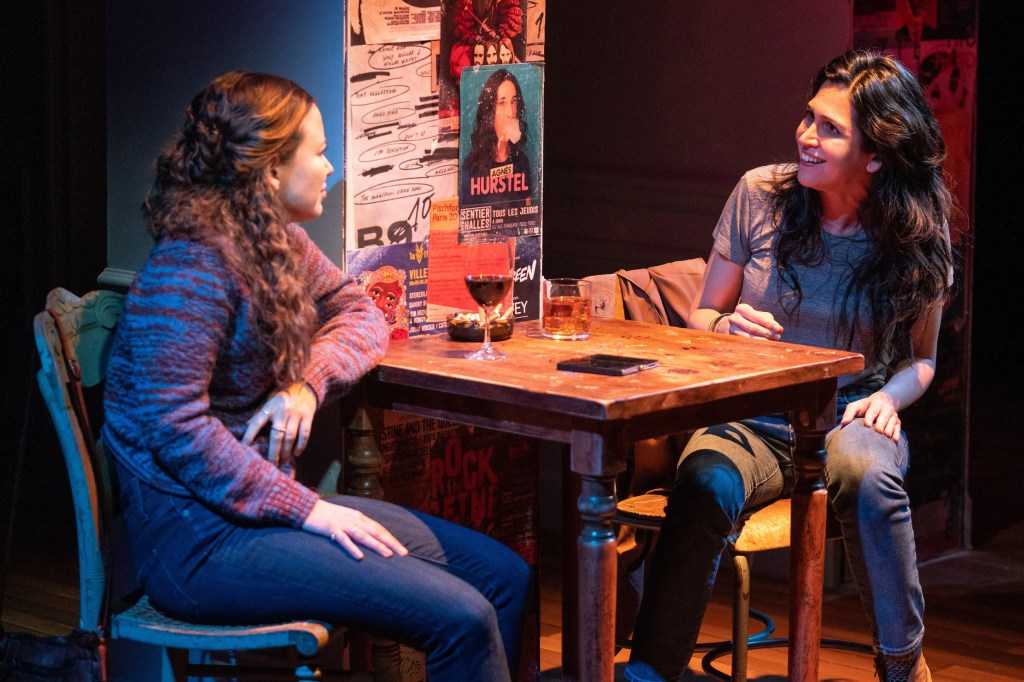
The argument carries over when Molly and Elodie go to a Dive Bar. Francis Benhamou’s Elodie rant against Molly Ranson’s Molly is humorous and as powerfully strident as Charles’ argument with Marcelle. Elodie gives forth, illustrating Molly’s hypocrisy when she argues against Israel’s Palestinian settlements. Elodie’s point drives deeper to human nature. There are the power-hungry and the occupiers; how does one resist not becoming power-hungry as a matter of security? Molly’s criticism belies historic U.S. colonization and oppression of everyone but white males. Elodie indicates that finger pointing is useless.
Eventually, both manage to reach common ground on a personal, familial level. Humanity takes precedence in their discussion when Elodie explains that Daniel became Orthodox because of a girl. Revelation of his vulnerability opens the door to Molly’s and Daniel’s relationship. It also opens the door to Marcelle’s fury because she believes that Molly has taken advantage of her son’s vulnerability.
Nothing is resolved even after Charles and Daniel return from a trip to Israel to look at living arrangements and social culture. Charles gives in; he affirms wherever Marcelle is, he will stay with her. Daniel proclaims that he didn’t want to go to Israel, but just accompanied his distraught father to help him. The playwright indicates the confusion and the stress that accompanies the hassle of confronting danger in one’s daily life, as this family feels they are under siege since Daniel paraded his Jewishness. But it is understandable because the family has a history of loss and death at the hands of French fascism. Furthermore, fascists like Marine Le Pen (Deputy of the French National Assembly), and her right-wing conservative political group don’t readily disavow fascism.
As the scene shifts to the past, Lucien and Young Pierre return from the camps bringing the horrific information that family was lost. Lucien is overcome in the telling of it. Ari Brand’s performance is appropriately drained, inwardly devastated but holding it together as best he can. It is Young Pierre who eventually expresses how his father’s hope saved him. Peyton Lusk gives an incredible portrayal of the PTSD of a young person returning from an unspeakable experience. But as Lusk explains how he survived, once again comes the affirmation that hope is how people survived the persecution, attacks and killing, as community and family helped family. For Lucien always told Young Pierre that they would make it.
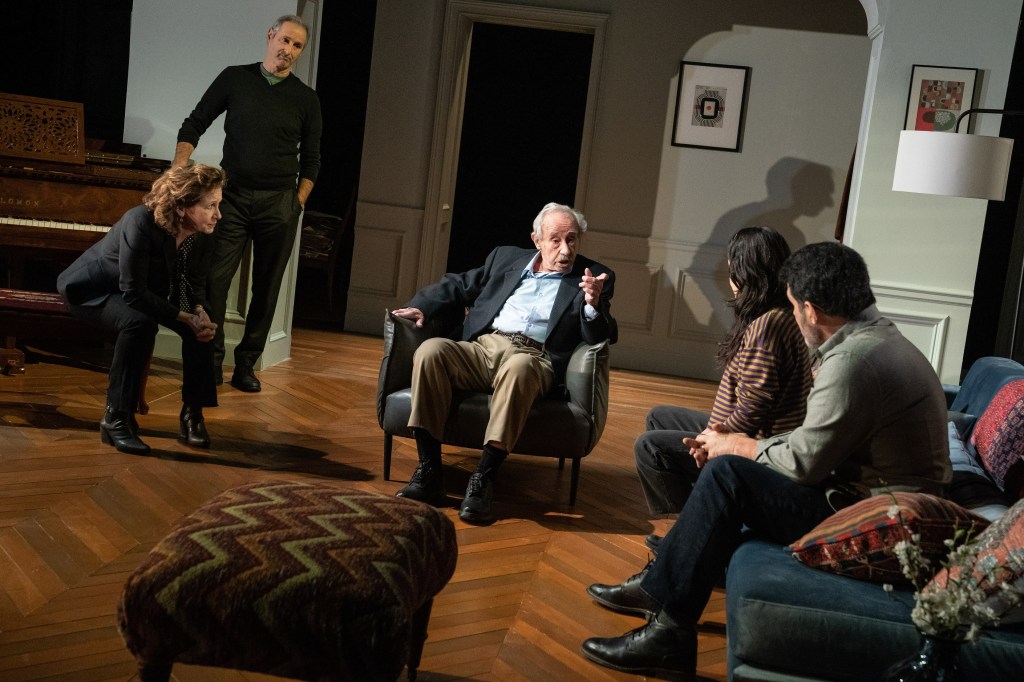
But it is in the final act when the dam bursts with a traumatic episode for Marcelle, who by degrees has given up on her beloved Paris. It occurs at the symbolic Passover Seder, a remembrance of when God wrought miracles to help the Israelites escape slavery in Egypt. At the celebration, when they arrive at the “opening of the door to let the angel in,” Marcelle becomes hysterical like Charles did weeks before. She, too, has a “can’t take it any more” moment and refuses to open the door, terrorized that a Marine Le Pen engineered terrorist will enter and kill them.
The scene is shocking. Betsy Aidem’s performance is riveting as are the other actors. Harmon establishes centuries old horror of death at the hands of haters. Though the idea seems ridiculous, recently a woman was burned alive in her apartment in Paris.
That Harmon has conjoined Marcelle’s terror with the symbolic traditional night commemorating their escape from persecution and oppression is an apotheosis. In an irony of twisted emotion, Marcelle gives in to the terrorists who want Jews gone from “their” country, the most grievous insult of all. It is an incredible message because Marcelle’s fear destroys her ability to believe in God’s protection, a basic fact of her religion. She believes in God’s protection only if she flees, like the Jews of ancient history. The hatred of others intellectually and representationally in various select acts of violence has overwhelmed Marcelle’s ability to feel secure in her own religion, her own apartment, her own country, her own identity. She must leave.
Of course it is a sardonic fact that her family’s escape will be to one of the most dangerous countries on the planet. Patrick raises the issue about the security question in Israel. Indeed, physical security must have as its precursor intellectual and philosophical security in the Golden Rule of “do unto others,” democratic values, an ideal that France attempts to follow and does with exceptions, better than other countries. Certainly, in Israel’s West Bank, the Golden Rule does not abide for Palestinians who are treated as “the other” and are oppressed and have no rights under Netanyahu’s ultra right wing, increasingly anti-democratic government.
Harmon’s play is filled with thesis/antithesis arguments, and this is a family that generationally loves a worthy argument with well supported logic and details. Patrick takes the position that the Republic of France will stand by its ideals and that there is nowhere safe globally, moment to moment; not Israel, not the United States, not Europe, the Middle East, Asia, etc. Human hearts are not safe.
To counter his sister he correctly asserts that the fascistic government of Marine Le Pen will be voted down and the Republic will persist. Harmon’s point is well taken. There are those across the globe who value equanimity in greater numbers than those whose megalomania and craven hate seeks the death of others for power. However, his commentary falls on deaf hears; Marcelle has made up her mind to go to Israel where their Jewish identity may be expressed freely with little fear of reprisal by crazies. For her France has nullified her existence as a Jew.

Whether she will feel safe in Israel relies on hope and sacrifice. In Israel they have to start all over again. They will have sacrificed their careers, friends, culture, language, everything for the hope of a safety and security that is never guaranteed. If they are on a bus that terrorists decide to blow up in Tel Aviv, there is no way to stop that. But Marcelle is convinced, turning 180 degrees from her position at the play’s beginning. Fear possesses her soul and she makes decisions based on it.
In the final segment of the play the argument takes further flight with elderly father Pierre (Pierre Epstein is eloquent in this last speech to the family). If they leave, it is their choice, but he will not go with them. Having the freedom to choose and not be compelled is vital to his identity. Ironically, by giving into their fear, they have compelled and oppressed themselves. Pierre who has seen the worst of the camps and survived, knows the difference of experiencing the worst. His children and grandchildren have not and they don’t want to. That is why Marcelle compels them to leave, though such an event happening again is a probability off the charts. But no one dares speak that to her, not even her own brother.
The performances are sterling and sensitive, at times funny, and always compelling. The canny direction by Cromer to “get it all down” and thrill the audience with ideas and concepts is just great. I particularly enjoyed the Set Design by Takeshi Kata that designated the differences between present and past efficiently and seamlessly. The Lighting Design by Amith Chandrashaker provided the ephemeral, soft, wistful tone of the past and stark contrast with bright light that magnifies the present. Kudos to the other creatives, Sound Design by Lee Kinney & Daniel Kluger, Original Music by Daniel Kluger.
Prayer for the French Republic is revelatory and insightful in questioning our arrogance to believe we, who are transient beings on this planet, have an identity and home, knowing mortality comes to all of us physically. He also twits our assumptions about safety and security, the difference between life’s enjoyments and living an existence permeated by psychological fear. Above all he designates in a Republic, there is the right to choose one’s destiny, free from personal harm because, if applied, the rule of law secures it. But if it is not exercised, then what? Harmon asks the questions through lives, relationships and situations that embody them in seeing the Salomon family live in the past and present. If one delves deeply enough and contemplates like Topol’s Patrick does, one sees the answers can only be individual and personal. No one can answer for someone else.
This is a wonderful play dramatically rendered. It should be seen, especially if you enjoy thought-provoking plays that move swiftly on emotional power. For tickets and times go to their website https://www.manhattantheatreclub.com/shows/2021-22-season/prayer-for-the-french-republic/
Prayer for the French Republic has transferred to Broadway and will run until February 18th at the Samuel J. Friedman Theatre. Look for my review of the Broadway production on Blogcritics.org.
‘Nollywood Dreams’ a Comedic Farce With Intriguing Undertones

Jocelyn Bioh (School Girls; or, The African Mean Girls Play), and director Saheem Ali her frequent collaborator (Merry Wives of Windsor), once again work comedic magic in Nollywood Dreams, a farce that twits burgeoning Nigerian Cinema in the 1990s, yet makes a statement about dreaming, and dreamers influenced by countries with jaded, hypocritical values.
The production makes the most of the Newman Mills Theater’s intimacy with heightened, particular and detailed scenic design by Arnulfo Maldonado,, that cleverly enhances Bioh’s characters, set changes, story arc and thematic focus. Dede Ayite’s appealing and over-the top costume design and Nikiya Mathis’ hair and wig design encourage the actors to pull out all the stops. These production elements especially enhance the actors’ characterizations and encourage their freedom to humorously tear up Bioh’s witty celebrity inferences with grace and humor, that moves the production along at a well-paced clip.
If Bioh’s characterizations are superb, even greater is the cast that inhabits the recognizable celebrity types and their acolytes with definition, depth and unique authenticity. The humor is organic and situational, and part of the laugh riot comes at witnessing how other countries, i.e. Nigeria, emulate some of the worst of American, to wit “Hollywood” culture through a lens brightly. Thus, Bioh’s farce not only humorously underscores and gently ridicules Nollywood cinema, but it also satirically rocks the most shallow and nauseating American entertainment transference, save the send up of Oprah in the TV hostess Adenikeh by the fabulous Abena. Interestingly, Nollywood cinema has grown by leaps and bounds to be one of the most productive engines globally.

The plot is as simplistic as the Hollywood pie that actors refuse to eat for fear of going over their 18 BMI. Ayamma Okafor (the lovely Sandra Okuboyejo), dreams of being an actress, as she and her older sister Dede (the jealous, know-it-all humorously portrayed by Nana Mensah), run their parents’ travel agency. They intend to move up in the world beyond their middle class status, of course, influenced by the US and other capitalist countries. The siblings are well drawn with the older Dede continually chiding Ayamma, dumping the work on her and generally being a scutch. Then events break for the sweet but down-to-earth Ayamma and she becomes Dede’s rival for the man in their dreams (for different reasons), the gorgeous star Wale (the sweet and adorable Ade Otukoya).
In all the gossip magazines that Dede reads, confirmed by the guests on Adenikeh’s TV show, we learn the backstory and the stakes for the characters. The gobsmacking Wale is slated to be in the next film from director and all-around big producer who learned the ropes in America, Gbenga Ezie (Charlie Hudson, III has the energetic, compromised Hollywood director/schmoozer down perfectly). However, to spur interest, cleverly, the big man announces a nationwide open audition for the part of the female lead in his next film, “The Comfort Zone” (how Bioh introduces the title and the name of the lead character is hysterical). For Ayamma, this is the opportunity she has dreamed about, to be able to raise herself up into stardom as an actress. Meanwhile, Dede will just settle as second best to marry Wale.

Bioh ratchets up the sibling rivalry when Ayamma asserts herself and visits Gbenga’s offices to get the part and play against Wale to prove she is a great actress and can make something of herself. In Gbenga’s office, we see the allure of possible future starlet vs. potentially predatory director. Enjoying the visit of the lovely Ayamma, an ingenue of innocence, we note that Gbenga never misses an opportunity with the ladies. Gbenga allows her to read with the actress and his former partner Fayola (the Nollywood “Hallie Berry with the Tina Turner legs”). The “fix is in.” He will most likely cast Fayola in the part to prevent her spilling the dirt on him which would put him in jail.
Emana Rachelle portrays the wild and dramatic Fayola with vibrance, humor and sheer joy. Ayite and Mathis’ costumes, shoes, wigs give even more umph and fabulousness to Emana’s Fayola, whose gestures and movements, like Abena’s, celebrate those they imitate and gently ridicule. The women are in conflict against each other for the part of Comfort; the sisters are in conflict for Wale, and Adenikeh wants in and will use her leverage in whatever way possible to be with Wale and Gbenga. Interestingly, Hudson III’s king manipulator Gbenga keeps them all allured. Meanwhile, Ade’s Wale, with quiet confidence oozing sensitivity, the honey which every woman loves, sits back and is himself.
The actors are having a blast as is the audience. And we even get to see a clip of The Comfort Zone which is a LOL overacting extravaganza at its best. Special kudos to David Weiner’s and Jiyoun Chang’s lighting design, Palmer Hefferan’s sound design, Alex Basco Koch’s projection design. It’s a shame that the run of Nollywood Dreams isn’t longer. It’s a wonderful romp with depth, for it exposes the broken promises and seductions which are the dark side of the predatory entertainment industry. Thanks to the creative team, Saheem Ali-director, Bioh and especially the ensemble who are seminal performers. It is clear they listen to each other to remain “in-the-moment” authentic. All make this production memorable.
To see Nollywood Dreams, you must act fast. It is over November 28th. For tickets and times go to the MCC website and CLICK HERE.
‘The Visitor,’ Not to be Underestimated, Extended at The Public

The Visitor, is a haunting musical based on Thomas McCarthy’s resonant, titular, award-winning film (2007). In its World Premiere, The Visitor has been extended at The Public Theater, and is ending December 5th, 2021. That we are able to see it at all, given the pandemic which made New York City the global epicenter of death, shuttering theater for months, is nothing short of miraculous.

The egregious hell of the previous administration, including its threatened overthrow of the nation led by the former president and white supremacists who oppose immigration and the constitutional rule of law, may influence one toward a jaded view of The Visitor as woefully “uncurrent.” Some critics suggested this. Indeed, that is dismissive of the musical’s inherent hope, goodness and prescience. Not to view it through the proper lens of historical time would be as limiting as the unjust institutions and failed immigration policies that the production thematically indicts.

The Visitor, acutely directed by Daniel Sullivan, takes place after 2001 during the administration of President George W. Bush Jr., when certain groups viewed Muslim immigrants as possible terrorists. The period 2001-2007 was a less divisive time in the nation, but our failed immigration policies did stagnate and worsen, setting us up for future debacles and the growth of white domestic terrorism. Nevertheless, if one’s sensibilities are too upended by the traumas of the Trump administration to enjoy the musical without keeping the 2001-2007 time period in mind, the themes and the human core of this work by Tom Kitt (music), Brian Yorkey (lyrics), Kwame Kwei-Armah & Brian Yorkey (book), will be overlooked and given short shrift.

The themes are relayed principally through the relationships established between white college professor Walter (David Hyde Pierce in an emotional and effecting portrayal), Syrian Tarek (the likeable Ahmad Maksoud), and his girlfriend from Senegal, Zainab (the golden voiced Alysha Deslorieux). Believing Walter’s Manhattan apartment has been vacated, Tarek and Zainab, tricked by an “Ivan,” have been staying there without Walter’s knowledge. What occurs after Walter discovers their presence, takes us back to a time before Donald Trump’s inhumane immigration policies, Republican party nihilism and Democratic governors’ establishment of sanctuary cities to protect the undocumented and waiting asylum seekers.
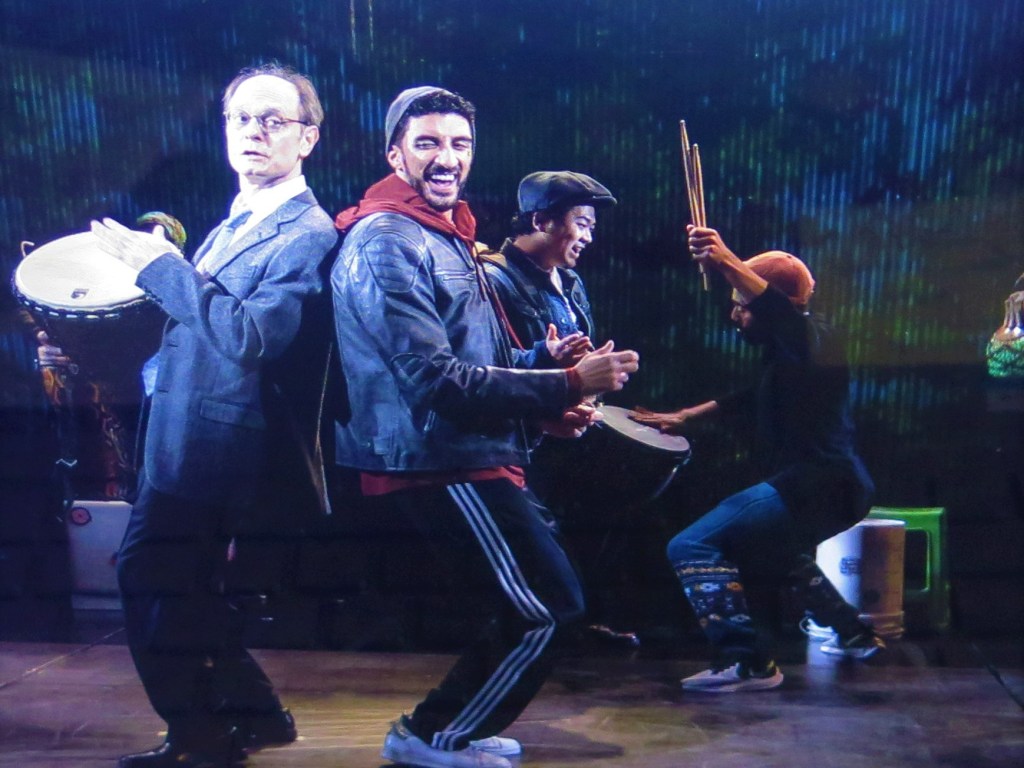
The opening numbers (“Prologue,” “Wake Up,” “Voices Through a Window”), establish why Walter is amenable to not behaving like a guard dog (who would note Zainab’s accent and Tarek’s swarthy looks), and immediately call the police to arrest the couple. Walter is a professor, not law enforcement. However, Zainab sees the precariousness of their situation and with passion mitigates their mistake (Zainab’s Apology”). After they leave, Walter finds Zainab’s sketch pad and runs after them. What results is an act of hospitality and generosity, as he allows the couple to stay until they find somewhere else to go.

Walter’s state of mind, character, background and the loss of his wife and emotional destitution prompt this irregular action. On the couple’s part, Zainab, who has been through an undocumented female’s hell which we later discover (“Bound for America”), doesn’t trust Walter and presses Tarek to leave, despite their desperate circumstances. David Hyde Pierce, a consummate actor whose Walter floats like a ghost without any sense of purpose, mission or happiness, sparks to interest identifying with the couple’s romantic love (“Tarek and Zainab,”). He wants to trust in their goodness and decency because he has already lost everything worth anything to him and he has nothing left to lose.

Walter, Tarek and Zainab take this incredible risk because of their overwhelming needs. All are visitors to this land of human decency which they extend to each other with hope and a faith that grows and changes their lives. When Tarek teaches Walter how to play one of his djembes (a goblet drum played with bare hands that originated in West Africa), and takes him to the park to play with others (the incredible “Drum Circle”), a bond is formed that will never be broken.
The production’s music (thanks to Rick Edinger, Emily Whitaker, musicians and the entire music team), solidifies the themes of friendship, unity, empathy, humanity. Significantly, the music suggests another vital theme. It is through our cultural differences via artistic soul expression, that the commonality among all of us may best be found. These themes, during what appears to be the height of racism and white supremacy in our nation today must be affirmed more than ever. The Visitor does this with subtlety like a grand slam in bridge played with three cool finesses.

At the first turning point in the production, the center starts to give way. Though Walter tries to advocate for the inaccuracy of the transit cops’ charges, Tarek is arrested for “jumping” a subway turn style after he pays but can’t fit himself and his drum through it. The cops’ action underscores the inequity of the justice system. If he were white, they probably wouldn’t arrest him. The cops find it “inconvenient” to believe Tarek’s explanation. Nor do they follow Walter’s advice to check his card to verify Tarek’s truthfulness.
Discovering Tarek is undocumented, they put him in a detention center in Queens. Feeling responsible for Tarek’s situation, Walter hires an attorney, visits Tarek and keeps Zainab encouraged. It is in the detention center that we note the cruelty toward the undocumented, who are treated as criminals, though they are asylum seekers and willing to work for a better life for themselves. The music, lyrics and Lorin Latarro’s choreography, especially in “World Between Two Worlds” sung by Tarek, Walter and the Ensemble are superbly expressive, heart-wrenching and powerful.

As the stakes become higher in the second turning point, Tarek’s mother Mouna (the effecting, soulful Jacqueline Antaramian), visits Walter’s apartment looking for Tarek. Events complicate. Walter finds Mouna appealing and authentic. Mouna and Zainab ride the Staten Island Ferry. They finally become friends (“Lady Liberty”), and share how they believed the seductive promises of the “American Dream.” Because Mouna and Zainab may never see Tarek again in the U.S., Walter becomes the one they must turn to (“Heart in Your Hands,” “Blessings,” “Such Beautiful Music.”). Beyond hope (“What Little I Can Do”), Walter does his best, but the institutions fail him as they have failed us for years.
It is through the relationships with Tarek, Mouna, Zainab that Walter’s humanity and empathy are stirred to change his soul and his direction in life. It is the love for Tarek and the hope of his release that changes Mouna’s and Zainab’s relationship with each other. And their relationship with Walter establishes a new level of understanding that there are “good” people who will help. Finally, it is the stirring of Tarek’s concern for Zainab, that helps him realize his spiritual love and connection with her is not bounded by the material plane (“My Love is Free”), or held in by the walls of his jail cell, or deportation back to Syria. And it is that spiritual love for her and his connection to Walter that will help him face whatever he encounters.
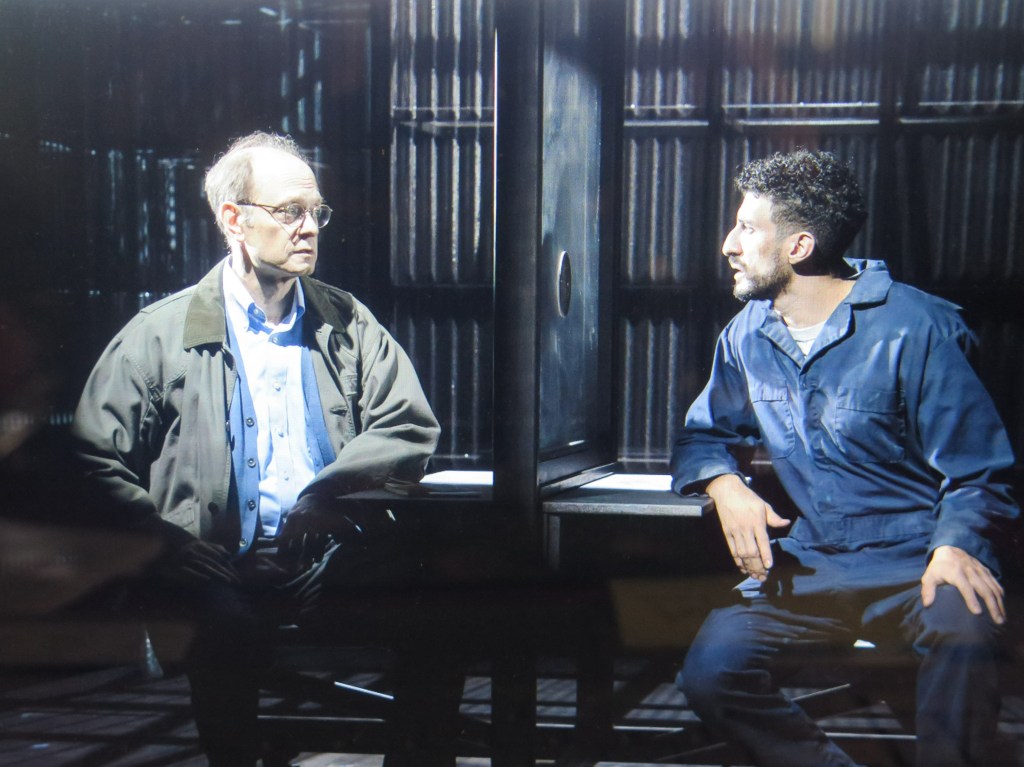
As an archetype for all sane individuals, Walter realizes the issues underlying Tarek’s, Zainab’s, Mouna’s situation. We are to agree with him, the creative team hopes. These individuals are not “the other” that their nationless position or the white supremacists’ stereotyping suggests they are: dangerous, encroaching, grifting. In the showstopping “Better Angels,” David Hyde Pierce prodigiously, emotionally expresses his song-prayer for Tarek. He petitions against the injustice of Tarek’s situation. Our nation should act better, but it has become unmoored from its founding ideals of liberty and the inalienable rights of human beings (“We hold these truths to be self-evident…”).
As Pierce sings, the irony of an older, white gentleman whose life has been bled out of him, standing in the gap for a young undocumented Syrian, who is full of vitality and hope, wanting to live his life to the fullest in a country that doesn’t deserve him, is beyond fabulous. It is also heartbreaking. Pierce, impassioned, speak/sings it out into the nether regions of spiritual consciousness. Is anyone listening? Have we forsaken our citizen right to help others?
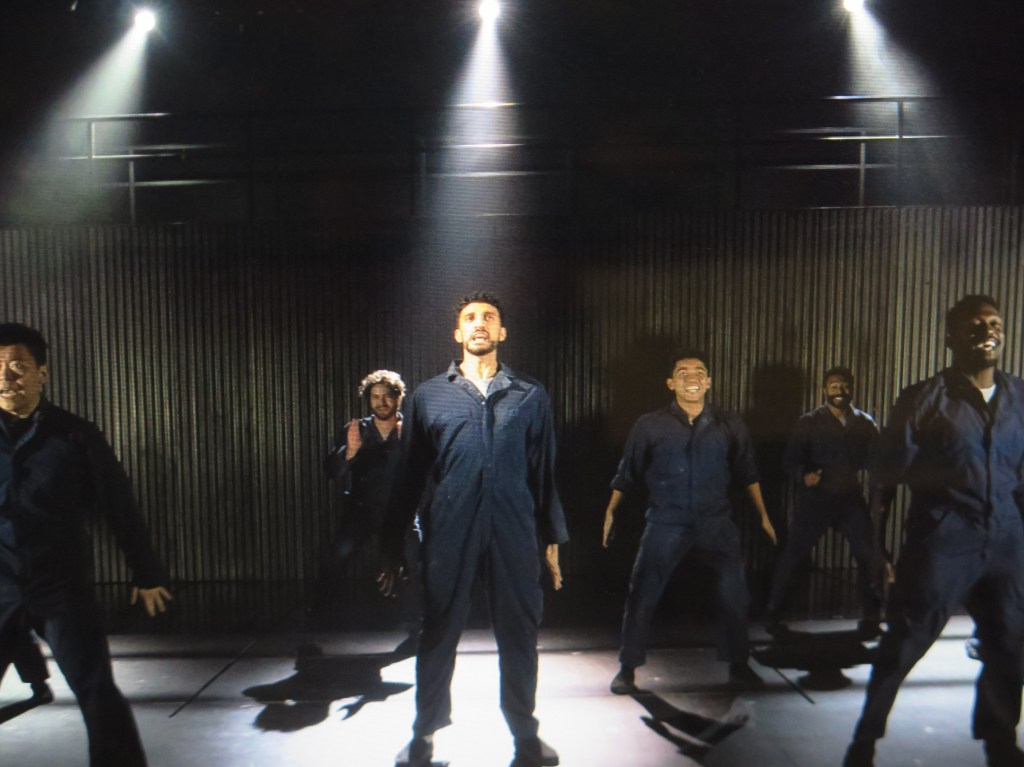
I apologize for being moved for I thought of what was to come because of these failed immigration policies which continued and inspired the former President Donald Trump’s white supremacist agenda: kids in camps at the Southern Border, kids lost to parents for years, the undocumented dying in stifling heat and horrific conditions, proud Trumpers appreciating Steven Miller’s cruelty, while donating to grifter Steve Bannon’s fake “Build the Wall” fund.
The Visitor presciently, horrifically intimates what happens if injustice and cruelty are institutionalized and the populace is inured to it or worse, uses xenophobia as a whipping post to domestically terrorize others for pleasure’s sake. White supremacists have evolved to do so precisely because of failed immigration policies which a craven, unhinged politician exploits for his own grifting agenda.
Equally terrifying is the war of attrition against decency, and the lack of wisdom to appreciate this historically as revealed by The Visitor. If we consider that critics are inured/jaded not to see in The Visitor the failed state of our culture in 2001-2007, that augmented during and after the Obama administration, the loss of that understanding bears reviewing. And while many were thrilled with former President Obama, in the shadows, white supremacy groups grew by demonizing “the other.” Sadly, they blossomed to a “first wave,” who supported a president against democratic values, one who followed up with inhuman, indecent acts from immigration crimes to COVID deaths.
The character of Walter reminds white males it’s OK to be humane and decent and empathetic. To think this production is not “current” enough via its historical perspective is misguided.
In Kitt’s, Yorkey’s, Kwame Kwei-Armah’s musical, Tarek and Mouna symbolize the courageous willing who take horrific risks. We need to be reminded of this again and again. Sullivan’s profound direction prompts the musical to change our perspective through empathy and identification. Thematically, The Visitor suggests we no longer allow ourselves to be like inconsequential stones kicked around by politicians. What is it like to sustain the impossible hardship of leaving all that was familiar and comforting in the hope of escaping catastrophe, only to never gain the security sought (“Where Is Home?/No Home”)? As climate change continues to roil the planet and immigration issues worsen, we can’t drop a stitch of understanding or subdue an impulse to assist in whatever way we can.
The actors/singers, phenomenal swings, musicians and creative team stir us to listen to the production’s call to arms. We must reform our failed immigration policies that have caused horrific pain for asylum seekers and dreamers, as they wait for citizenship to no avail. Not only must changes be made, they must be made permanent so that no Executive Order, lawsuit or state can reverse it to pleasure white supremacists.
Specific shout outs to David Zinn’s evocative scenic design: the steel backdrop of the detention center and its ironic contrast, Walter’s comfortable apartment. Kudos to Toni-Leslie James (costumes), Japhy Weideman (lighting), and others who helped to make The Visitor a compelling, must-see production. For tickets and times visit the website: CLICK HERE.
‘The Dark Outside’ by Bernard Kops, Starring Austin Pendleton and Katharine Cullison
The Dark Outside by Bernard Kops currently at Theater for the New City is the renowned 94-year-old English playwright’s most recent work. The play uplifts the importance of family with themes of unity, love, encouragement, light and hope against the all-encroaching darkness that would turn family members against each other and destroy them. Kops’ lyrical play had a staged reading at London’s National Portrait Gallery in 2020. It is a great irony that The Dark Outside presciently foreshadowed the tenor of the times as the pandemic broke out and upended global society and culture right after the reading.
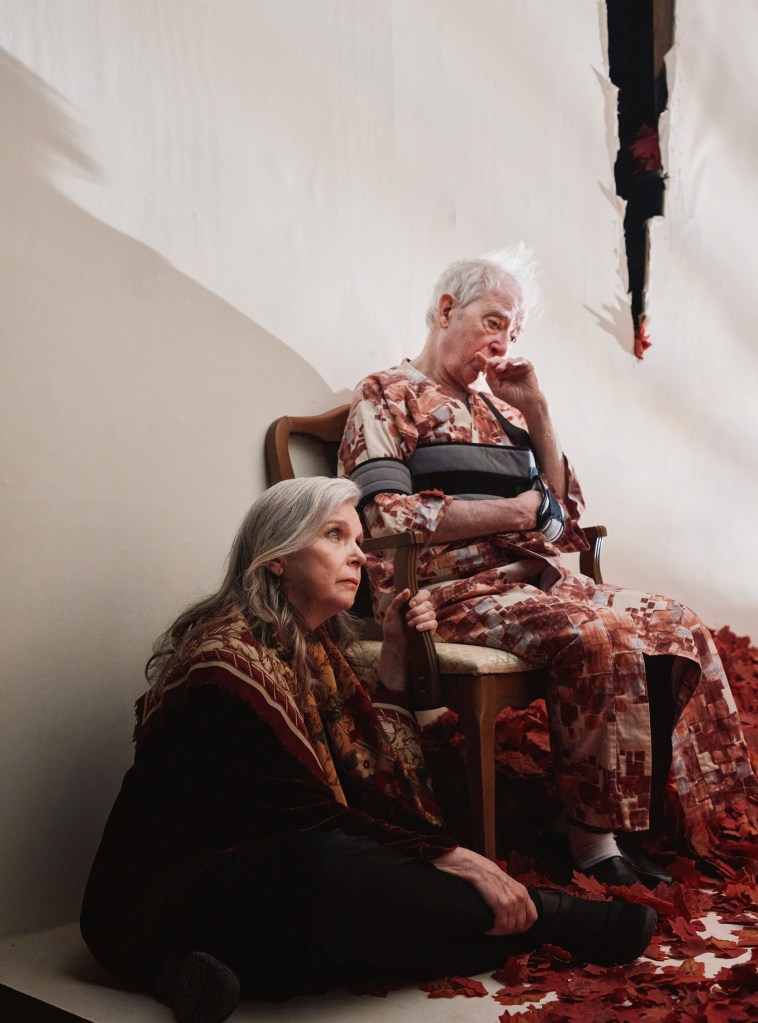
Through the COVID-19 chaos and upheaval, which bred uncertainty, want and fear, oftentimes, family provided the bulwark of steadfastness against psychic and physical infirmities and death. Disastrously, in the United States the divisiveness over how to handle COVID-19 became a political football which, to this day, divides families and ends friendships. Most importantly, Kops’ The Dark Outside reminds us of the moral, sociological and personal imperative of the family unit to sustain its members. Though the inevitable tribulations of life will come, they can be withstood through love’s immutable power.

In this premiere at Theater for the New City, director Jack Serio and the creative team deliver the beauty and sanctity of the play’s themes with a fascinating production that is incredibly timely. Serio highlights the British dramatist’s poetic sensibilities and notes Kops’ homage to archetypal character types through the production’s staging and overall design elements.
To achieve Kops’ ethereality, Serio selects minimalism. The production strips away material clutter and simplifies, using the bareness of space. In the atmosphere created, the superb acting ensemble conjures up the symbolic mulberry tree, the garden behind the house, the dinner, and more. All are in the service of Kops’ revelations about this family’s unity, inspired by the beautiful and loving mother and wife, Helen, portrayed with precision by Katharine Cullison and supported by the wounded, sensitive, poetic father and husband Paul, played by the impeccable Austin Pendleton.

At the outset, Kops introduces us to Paul (Pendleton) the father/husband, a former East London tailor who faces a life crisis after he loses the use of his arm in an accident. To inspire and encourage Paul, wife/mother Helen (Cullison) gathers their children, Penny (Kathleen Simmonds) Ben (Jesse McCormick) and Sophie (Brenna Donahue) to unify the family at the important occasion of celebrating Paul’s birthday.
As the play progresses, we discover that each of the children confronts conflicts and traumas in their own lives. Thus, the chaos that is outside on the streets and in the neighborhoods that Paul often refers to threatens to disturb and destroy each of the family members unless they are able to work through their problems, seeking the comfort of each other to tide them over to face another day.

Kops uses the majestic mulberry tree in the family’s garden to reveal the issues of the characters. For strength and peace, family members confess their angst and deep secrets to the tree whose life force listens and, in its silence, allows the characters to gain an inner solace and calm. Additionally, sisters Sophie and Penny share confidences. Sophie relates a horrific experience that caused her to leave college and spiral downward into emotional devastation and near destruction.
Sophie’s salvation is in coming home where she finds love, acceptance and redemption. Revitalized, Ben and Sophie receive great comfort in the arms and soul strength of Helen, who soothes and reassures both as she helps them overcome their inner hell. Paul’s great appreciation of his amazing wife is his continual blessing. Cullison and Pendleton are authentic and believable in the relationship they build of the loving couple. Thus, it follows that the children, despite their heart-rending troubles, have rightly come home to heal, as they receive encouragement and love from their parents.

Of the joys in this production are the poems and songs that are wide-ranging and eclectic. These, the family sings together or recites individually as expressions of emotion that are difficult to articulate. The songs resonate and recapture the play’s themes. They indicate how the family copes when a member needs help and uplifting. This is especially so in the poignant conclusion when Helen sweetly sings Paul to sleep with soothing grace. The moment is mythic in its power, and it is obvious that love’s sanctity is a balm which never falls short or fails. Thus, by the conclusion, joy returns to the household. The “darkness” has been thwarted with regard to Ben and Sophie who return to the family to complete the circle of love.

The only one who does not join them and leaves for New York City with her husband is Penny. In her move it is intimated that the wholeness of the family may remain incomplete for a season. But we have seen the strength of the archetypal mother who unites her children and husband. Regardless of whether the external darkness is in London or in New York City, Helen will continue to be the binding force that holds the family together with grace.
Jack Serio, the cast and the creative team have delivered the essence of Kops’ work and made it memorable. With the music and sound (Nick T. Moore) scenic design (Walt Spangler’s leaves are a lovely addition) the modulations of the darkness and light symbolism through Keith Parham’s lighting design, the production’s heightened moments are felt acutely. This is one that should be seen because of its cast and the symbolic iteration of one of Kops most heart-felt works.
The production runs at Theater for the New City until November 28th when Bernard Kops turns 95-years old. It is a feat for one of Europe’s best-known and most admired playwrights who the Queen awarded a Civil List pension for his services to literature. It is an award garnered by a very select few, namely Lord Byron, Wordsworth and Alfred, Lord Tennyson. For tickets and times go to the website https://theaterforthenewcity.net/shows/the-dark-outside/
Theater Review: ‘Trevor’ a New Musical at Stage 42, Based on the Titular Film

The musical Trevor with book and lyrics by Dan Collins and music by Julianne Wick Davis manages to run an emotional continuum from delightful, funny and whimsical to poignant, profound and heart-breakingly current. Based on the 1994 titular short film which inspired a suicide prevention organization, The Trevor Project, the musical comedy delivers without being a hokey, silly-serious “message” play. This is principally due to the vibrant direction by Marc Bruni, the fine cast lead by the impish Holden William Hagelberger, the energetic musical direction by Matt Deitchman and the ebullient choreography by Josh Prince.
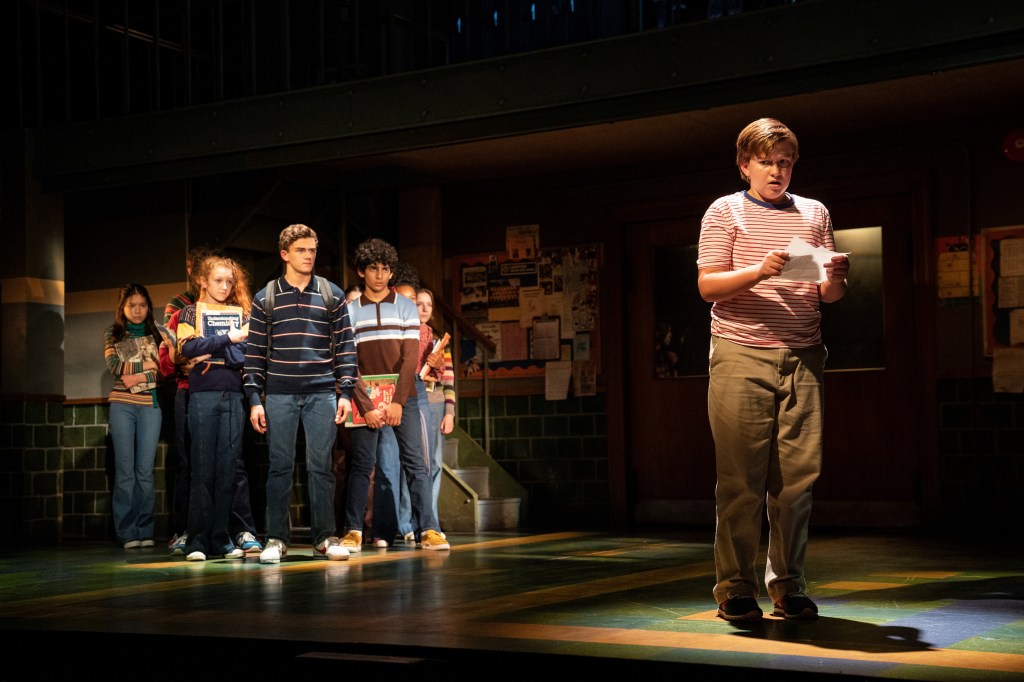
As a result, the musical comedy soars just high enough in the first act without burning itself up in the second, which takes a dark turn but remains ironic and soulfully empathetic. Its subject matter remains human and will touch even the most hard-hearted bigots who were never “cool” or “awesomely popular” in school. Above all Trevor touches upon the human need to be inspired by secret goals and dreams, which keep us enthusiasts of life and young at heart.
The original story by Celeste Lecesne generated the Academy Award-winning short film “Trevor” directed by Peggy Raiski and produced by Randy Stone. The film serves as an excellent foundation for the stage adaptation because it resonates with the familiar and never stands on sanctimony. Unfortunately, the all too probable “real life” situation provides the key conflict in the musical. What Trevor faces happens every day in a school in every school system in the nation to kids who are brave enough not to fit in despite the pain and bullying miscreants who will punish them for it out of cowardice and fear.

The musical in its New York premiere highlights the enthusiastic teen, Diana Ross fan and wanna be singer and performer Trevor, who is coming into his gay identity which he accepts and reconciles by the end of the production. Trevor lives in a suburb in 1981 before LGBTQ was “a thing” and at the outset of the AIDS crisis before it was “identified” as such. Neither of those factor into the arc of Trevor’s discovery and affirmation of himself which is a huge plus. Indeed, we are only caught up in the dramadey of this coming of age story without the angst or preachy assertions about gender identity. Trevor is and because he is, he is unequivocally acceptable and adorable in the human family.
Trevor’s uptight Catholic parents (Sally Wilfert, Jarrod Zimmerman) are clueless. Their fearful refusal to acknowledge that Trevor might be “gay” is humorous (thanks to Wilfert and Zimmerman). Their lack of understanding provides one of the conflicts in the production when they deliver Trevor to Father Joe, a Catholic priest for counseling. He is as helpful as a rock and Trevor’s reaction and the situation provides irony and humor. Importantly, Trevor must work out his own “redemption” for himself with the help of his friends, however difficult that is. Nevertheless, it is his talent and his dreams and interests that see him through the dark times.
Holden William Hagelberger is a likable and cheerful Trevor who is involved in his own world with his school friends, the funny geek Walter (Aryan Simhadri) and the awkward, humorous Cathy (Alyssa Emily Marvin) with glasses and rubber bands on her braces. Trevor is considered weird by the other kids in school, but fate throws him in with Pinky (the fine Sammy Dell) one of the most popular kids. Pinky is kind to Trevor who gives him help to hook up with Frannie (Isabel Medina).
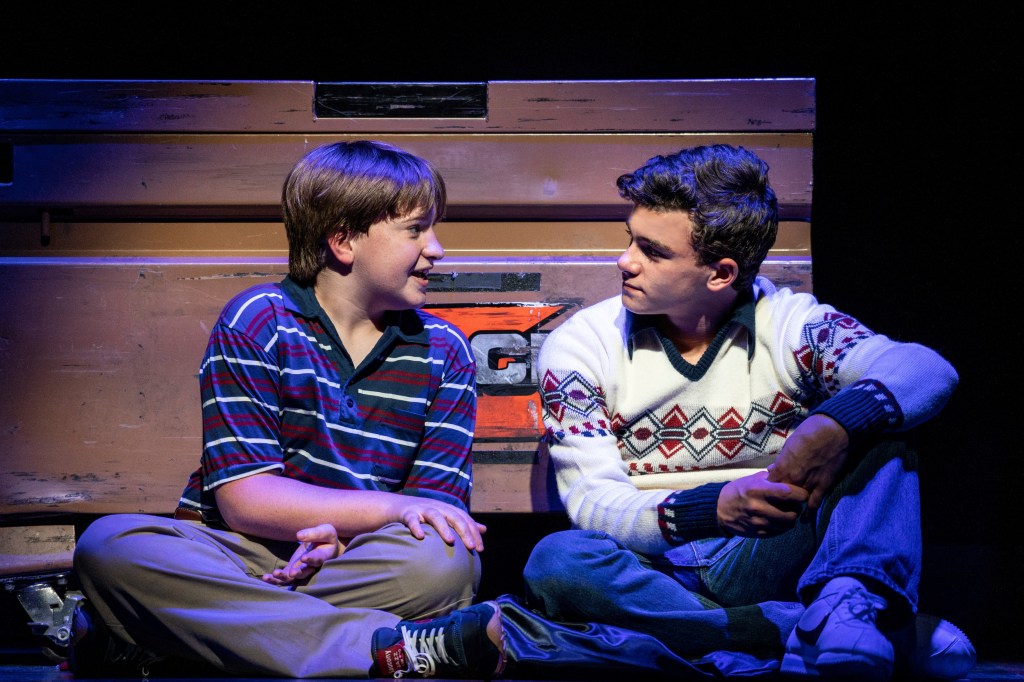
As Pinky and Trevor become friendly, Trevor finds himself “falling for” Pinky, having his first crush on a guy. Unfortunately, the friendship turns sour when someone steals Trevor’s notebook which has entries that indicate how much Pinky means to him. When Trevor’s classmates treat him as an “invisible” to punish him for his “crush” on Pinky, Trevor is devastated and takes it out on himself.
The turning point in the play with the number “Your Life is Over,” is campy and staged well (as are most of the musical numbers). The serious subject of suicide (Trevor tries to OD on Aspirin) is dealt with as a Diva’s comedic irony, skirting the edge of darkness successfully. Yet, the seriousness of what occurs is noted with concern and reverence.
How Trevor comes out of his morass of emotions with the help of his friends, and specifically his trust in the magically realistic Diana Ross (Yasmeen Sulieman) who appears and disappears when he needs her, encourages and enlightens. Indeed, Diana Ross is an extension of Trevor’s talent and wisdom. In his reliance on this inner ethos, we are released into an uplifting resolution in Act II.
Trevor does not wear political correctness on its sleeve. Nor does it beat its breast with finger-pointing. In remaining real and human, the creators hit this production out of the ballpark with its humor, music and the ensemble’s energy. Its appeal is wide-ranging. Who would not uplift being decent and kind? Who would disavow the Golden Rule to do unto others as we would have them do unto us? These values are cross-cultural, cross-national, cross-global. In its message, the production is not self-aggrandizing nor pushing any political stance. How refreshing! As such, that is Trevor’s strength and why it should be performed in schools across the nation.
Kudos to the creative team, to the director’s apt shepherding of the ensemble who does a bang up job led by Diana Ross (Yasmeen Sulieman) Trevor (Holden William Hagelberger) and Pinky (Sammy Dell). For tickets and times to see this must-see musical go to their website. https://www.trevorthemusical.com/?gclid=Cj0KCQiA-K2MBhC-ARIsAMtLKRsWL0YelVs_Hh9DC-KAOX76sPUOKMSwC-3EmKmF0YoUMHsHeY_bhQEaAtPGEALw_wcB
‘Morning Sun’ Starring Edie Falco, Blair Brown, Marin Ireland at MTC

Morning Sun by Simon Stephens directed by Lila Neugebauer, presented by Manhattan Theatre Club (New York City Center Stage 1), takes its name from the titular Edward Hopper painting. Hopper’s austere work is of a woman on her bed in bright sunlight staring out the window that faces a factory type building in the distance and rooftops below. The building is out of view from the high-floor perspective of the painted cityscape.
Edward Hopper came from the same hometown, Nyack, as the McBride family women who make reference to him with pride. The painting “Morning Sun” is symbolically appropriate, because Stephens’ protagonist (#1 or Charlotte/Charley) played with terrific focus and authenticity by Eddie Falco, is peering out the window of her life in a flashback life review. She recalls to remembrance her past, assisted by Blair Brown (#2, her mother) and Marin Ireland (#3 her daughter). The woman in the painting steeped in reflection and introspection mirrors Charley McBride.

Brown, Falco and Ireland represent three generations of the lower middle-class McBride women. We see their perspectives and lives as they discuss their relationship with Charley who is the centerpiece of the play. Brown and Ireland also portray the important friends, family and male partners who populated Charley’s life and who are central to the events that took her on her singular journey through the stages of youth, middle age and beyond.
The exposition begins after Charley cries out about safety and security for herself, like a child crying out in the dark. The others assure her she is safe, and calm her down. We understand this beginning to mean that Charley initially is in a place where she fears for her safety. Ironically, it comes to refer to her entire life as a question of unsafe uncertainty. Like every human being who confronts death every moment without accepting or understanding the conundrum of life in death, they move without fully grasping that their instinctive purpose is to stay alive until they leave this earthly plane.
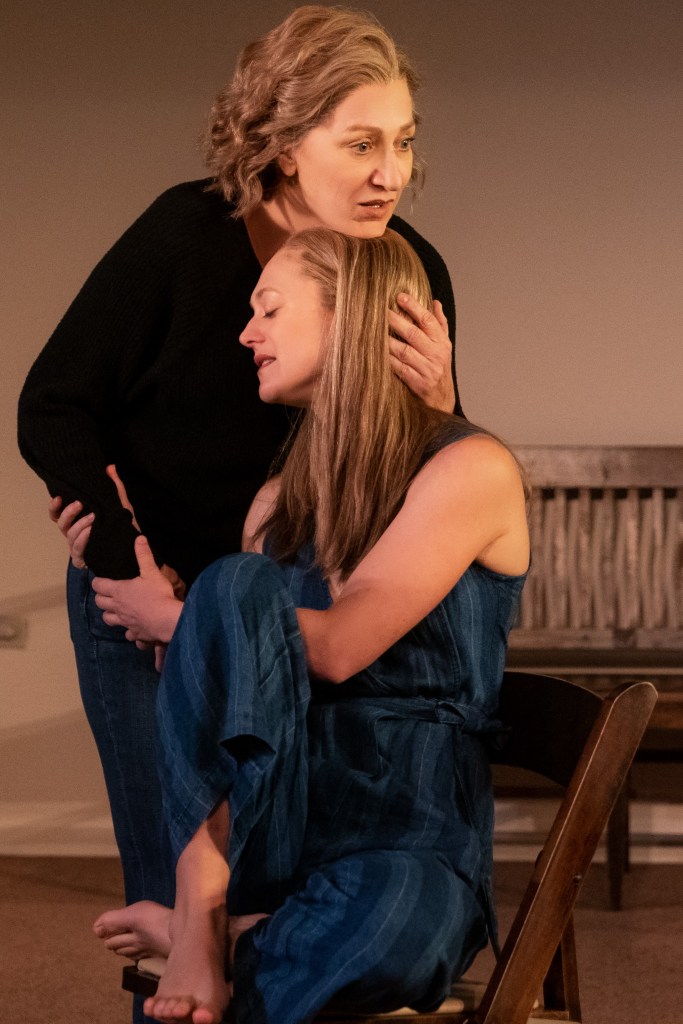
Stephens intimates that there is another consciousness, and the characters inhabit some netherworld in it. But he never clarifies the specifics and certainly not with any religious overlay. Thus, Charley’s cries have great moment. However, we don’t realize why this is so and to what she refers to in her cries until the conclusion, when Stephens reveals it.
With rapid-fire unveiling, the women stream through the beginning, middle and ending of Charley’s life assessment. Their exposition has break through dynamic moments where the women or men that #2 and #3 portray argue or disagree and resist Charley. The drama of a “life well or ill lived” is bled out of Charley’s existence which might be characterized as one of the invisible millions of “average” and “ordinary” women. These lived and died as New Yorkers making do, because they decided not to commit suicide and affirm their identity with an important emotional statement embracing death as a balm for their life’s miseries. Without much reflection or philosophical pondering, they a day-to-day existence.
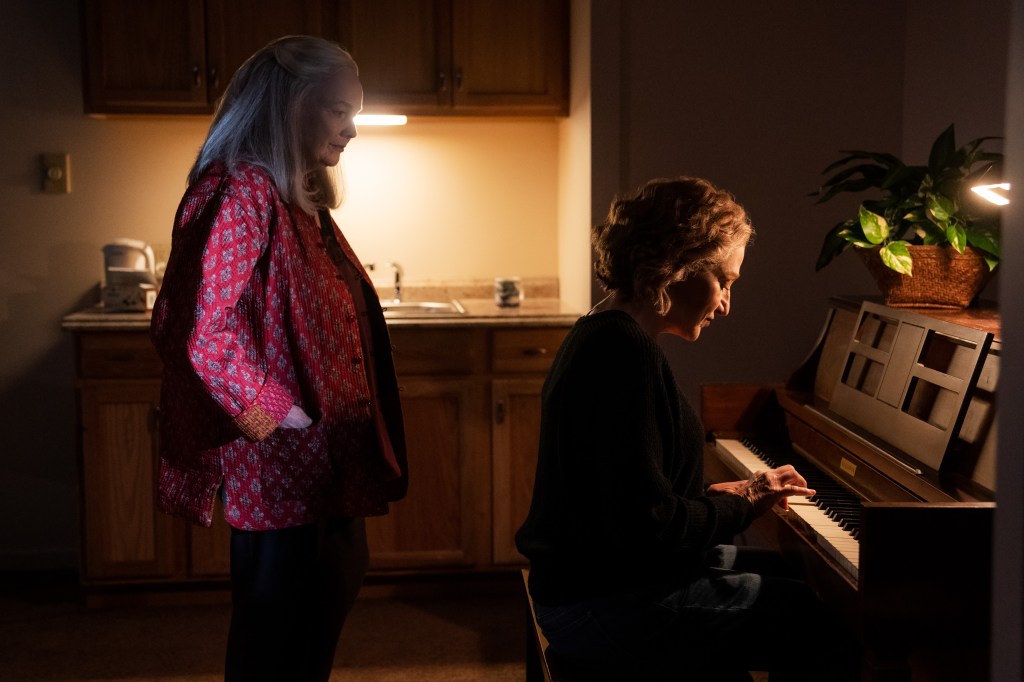
Charley’s chronicle is sandwiched between Claudette’s move to New York City and purchase of an apartment on 11th St. in Greenwich Village where she raises Charley, and years later when Charley comes back to visit and stay with Tessa after she moves to Colorado. The apartment bought on the cheap, in a questionable area grows in value and becomes the envy of all who hear of it, including the audience.
We learn that Claudette arrived in NYC to escape upstate New York and an untenable home-life. By degrees almost as an expanded laundry list, we learn of Claudette’s work, her husband, Charley’s father, Charley’s formative years, her friendship with Casey, her work as a receptionist at St. Vincent’s Hospital, her one-night stand with a pilot and her pregnancy and decision to keep Tessa as a single mother without extensive means. We also learn of Charley’s substantive partners, one abusive, the other kind.

The chronicle is also of New York City’s rise, fall and rise again, revealed as Stephens intertwines Charley’s personal events through the decades which are sometimes impacted by the culture. Ironically, Claudette wants to linger on the 60s, her generation, while Charley affirms the 70s is more important and it’s about “her life” after all. Thus, politics and the upheavals of the 1960s roll off Charley’s back without notice. We consider that Claudette’s viewpoints perhaps were shaped by that time, while Charley, the recipient of the benefits of the 60s social upheavals, remains unconcerned about them.
Throughout, as New York’s financial situation improves, there is discussion about the apartment and what to do with it. We discover that one of Charley’s partners, Brian, who Claudette can’t tolerate because he abused her daughter, persists in trying to get Charley to sell the place, even after they split up. Such discussions become points of humor, as every New Yorker at one time or another finds looking for a place to live, finding a place to live and staying once they’ve found it, one of the main preoccupations of being a New Yorker and living in the city.

Stephens’ vehicle of using #2 and #3 to supplement Charley’s perspective with the men and friends in her life offers an unsettling, unemotional scoping of a list of remembrances that speed us to the why and wherefore of Charley’s existence, however tedious it may be for the audience. The exposition in its great swaths of the non-confrontational is wearisome and uneventful. My neighbor in the audience slept through most of the play and at one point, I found myself almost joining him as I struggled to stay “woke.”
Clearly, Stephens is making a thematic point similar to one heralded by Thorton Wilder’s Emily in Act 3 of Our Town. That life, all of it, especially in its sameness and undramatic monotone is wonderful. Even if one’s life is dreary, monochromatic, dull and uneventful, it is up to us, the players, to bring purpose and meaning to it. This, Charley realizes by the end of the play. She understands the great importance of being a receptionist at St. Vincent’s after the hospital is shut down. She tells Tessa the amazing things about her that she loves.
Such realizations, Stephens suggests, arrive just on time for their full appreciation. Indeed, Charley understands by the end, that she misses what she took for granted as a privilege. Most importantly, those people, places and wants only resonate with her unique ethos and being.
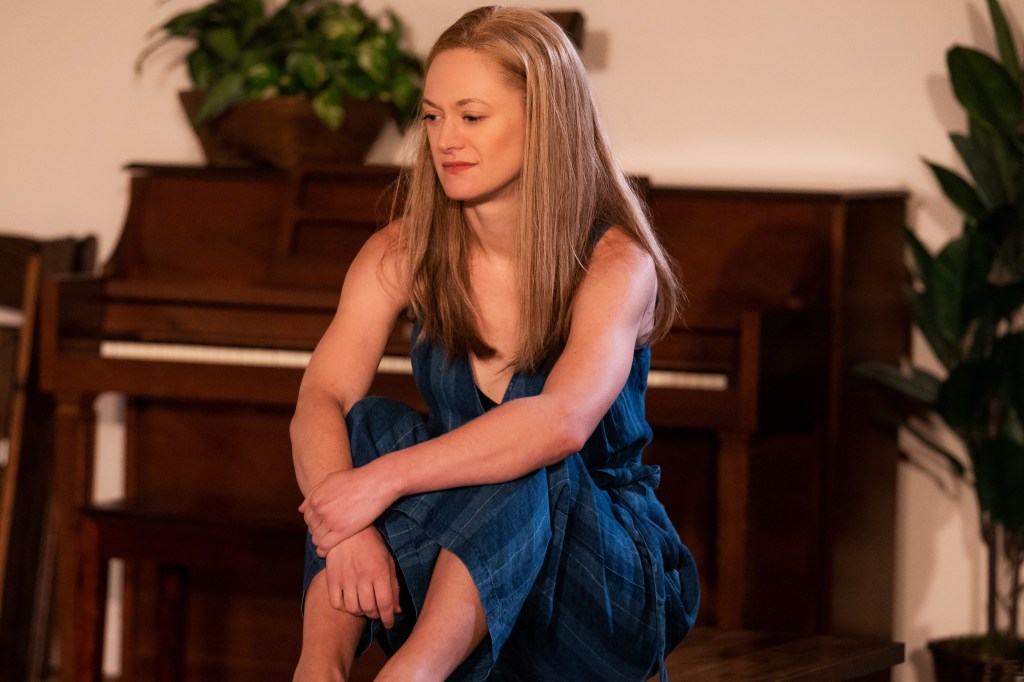
The strength of Stephen’s work which requires a yeowoman’s job of getting all of the details down is in the overall message and the last few minutes of the play which is an apotheosis for Charley and the audience. Throughout, Falco is a tour de force, in a role beautifully rendered, especially at the conclusion. Blair Brown and Marin Ireland are wonderful assistants, though Ireland needed to project and at times in her inward emotion-gathering became a faint wisp, indeed, in character, but not always articulated.
Director Lila Neugebauer properly stages Morning Sun in the ethers, not focusing on the material aspects of the production so that we listen carefully and take in the lives being shared with us. Though Charley’s journey is told in flashback narrative, we do come to trust the reliability of those who speak. This is a testament to the actors and director savoring the playwright’s work.

Kudos to the creative team: dots (scenic design) Kaye Voyce (costume design) Lap Chi Chu (lighting design) Lee Kinney and Daniel Kluger (sound design) Daniel (original music) Tom Watson (hair and wig design). For tickets and times go to https://www.manhattantheatreclub.com/shows/2021-22-season/morning-sun/
‘Mrs. Warren’s Profession,’ by George Bernard Shaw at Theatre Row, a Must-See

The Gingold Theatrical Group once again reminds us of the greatness of George Bernard Shaw’s Mrs. Warren’s Profession currently at Theatre Row. It is one of his earliest plays that was banned in London, produced in a private club in 1902 and finally received a public airing in 1925. When it was produced in the US in 1905, the entire cast was arrested via the New York version of the Comstock Law. They were released immediately afterward. Naturally, the controversy created the PR to pack the auditorium for the remainder of the run.

What was the fuss and furor? Shaw, an activist-playwright in addition to his many other talents (journalist, poet, politician, critic) wrote conflict plays exposing egregious social ills, hypocrisies and oppressive institutional class structures contrary to what the culture expected at the time. For example, plays could be about conventional prostitutes “with hearts of gold” who sacrificed themselves for the good of others or who died of consumption.

But God help you if you revealed the corrupt, capitalistic institutions that forced women to starve as factory workers and use their bodies to supplement their below living wages to make it to the next day. Shaw portrays the antithesis of the conventional prostitution accepted by church and decent society, by contriving a Madam for the ages, Mrs. Warren (the superb Haren Ziemba). She has bested the patriarchy and exploited it for her own advantage with the help of Sir George Crofts (the always excellent Robert Cuccioli) a clever exploiter who exploits her and his fellow men supplementing his finances and keeping his Baronet station with all propriety (wink, wink).

The problem is that Mrs. Warren has done this in the name of seeking the conventional-respectable for her daughter in order to purify herself. This is a blindness in Shaw’s astute hands. Indeed, Mrs. Warren’s Profession has as its conflict a mother-daughter disagreement over the conventional unconventional. Miss Vivie (the spot-on Nicole King) disagrees with her mother’s insistence that she receive money the rest of her life instead of Vivie making her own way from her own source of income which she has prepared for at Cambridge.
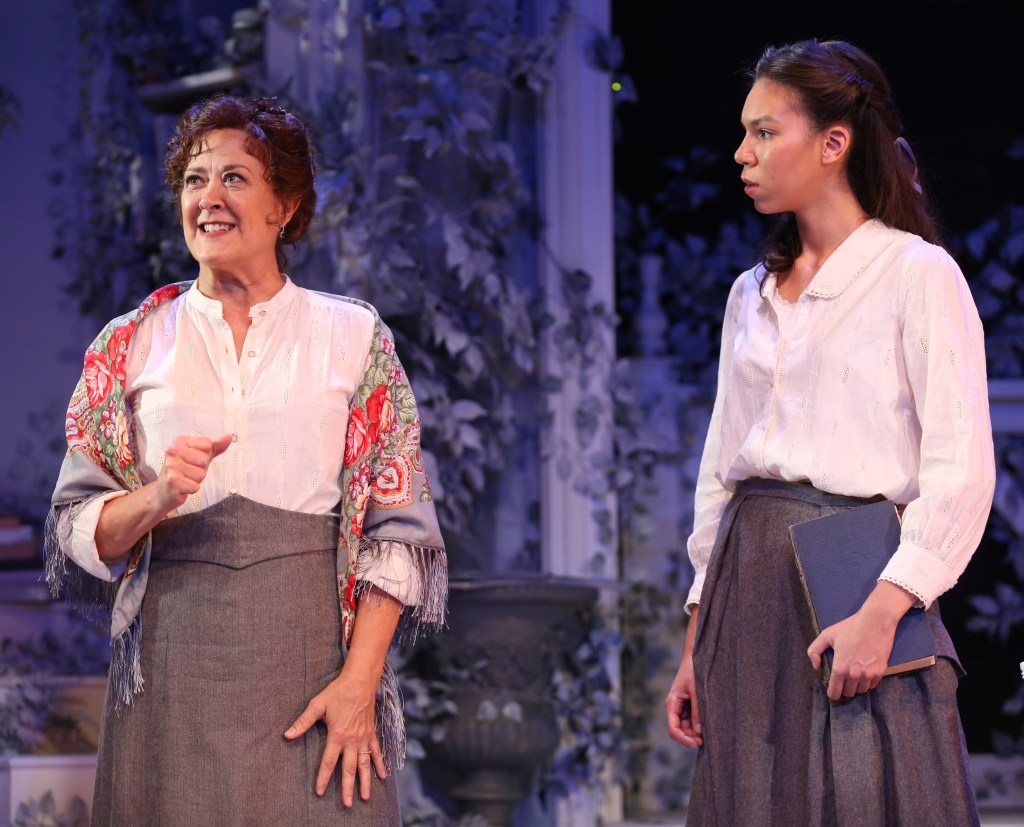
Shaw humorously reveals Vivie’s unconventionality when she rejects her mother’s largesse. Contrary to the usual mother-daughter relationships, she will not take care of her mother in her old age. By degrees we understand the backstory and ironies. Mrs. Kitty Warren also rejected her mother’s influence and domination. She made something of herself, transforming her low social station to one of wealth, culture and status, ably hobnobbing with the best of society.
The two women are admirably similar in getting over the patriarchy’s dominion. However, their professions are different and indeed, Mrs. Warren’s exploitation of lower class women’s horrific situation is a triumph of selfishness if not an expose of the corruption and hypocrisy of the patriarchal, colonial class system that applauds her surreptitiously for doing this. Of course, Shaw’s truthfulness in revealing the appalling conditions women faced at the time was an outrage to Shaw’s critics and commentators (backed by fat capitalists, most probably).

Mrs. Warren has worked her way up to moneyed respectability entrepreneurially by running high class hotels in various parts of Europe with her partner and friend the Baronet Sir George Crofts. Her “rags to riches” story speaks to the ambition and grit of a self-made woman. The most thrilling fact is that she has done this as a Madam which Shaw could only infer in his play in keeping with the hypocritical, judgmental Victorian Age mores which he twits from start to finish in this play. Mrs. Warren has taken life by the top hat and tails and exploited her beauty instead of allowing other men to exploit her and pay her nothing for it. She has worked out a special deal with Crofts taking the lion’s share of the profits. And she loves the work; it has made her self-sufficient and the gowns and lifestyle and being somebody is just grand.
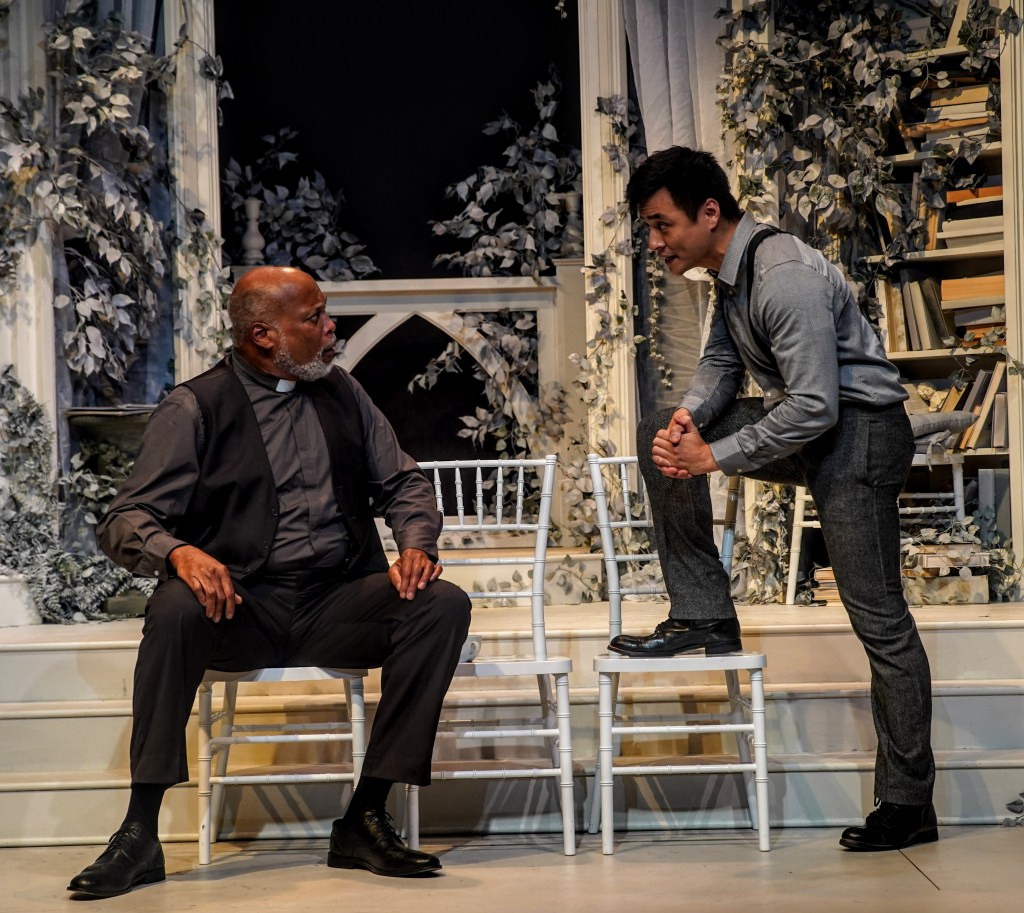
Vivie, supported by her mother’s funds, unlike most woman of the time who could ill afford a college education, has found a useful career in an industry requiring her skills and education. Thus, she has achieved her own autonomy and refuses to be pinned down to the social prison and folkways of “respectability,” marriage, and being the little lady to some great philandering husband.
Like Kitty Warren, Vivie defines herself. This empowerment reveals a strong character undergirded by disallowing the patriarchy to demean and control her. Nor will she allow women entrapped by the patriarchy (her mother) to belittle her own self-achievement.

The initial scenes open on this conflict when Mrs. Warren comes to visit daughter Vivie to pave the way for her to be brought under her wing and into the fold of her grand, elegant lifestyle with Crofts. The women know little of each other and couldn’t be more disparate. When they discover each other with the help of Kitty’s friends and neighbors, Praed (Alvin Keith in a fine performance of the dandy) Frank (David Lee Huynh, Vivie’s energetic suitor) and Reverend Gardner (the fine Raphael Nash Thompson) the chaos mounts until the jig is up.

Shaw’s sardonic humor and irony is in the situation and the conflict between mother and daughter. Modern audiences will find humor that Vivie stands up to her mother who is appalled that her daughter eschews men, luxury, money and the gaudy cultural life. Instead, she prizes work, work, work. Vivie’s austerity and her rejection of everything that smacks of hypocrisy is downright Puritanical and actually uplifting to see on the one hand, but frightful on the other. Shaw’s depiction of her as a “modern,” young woman is ironic.
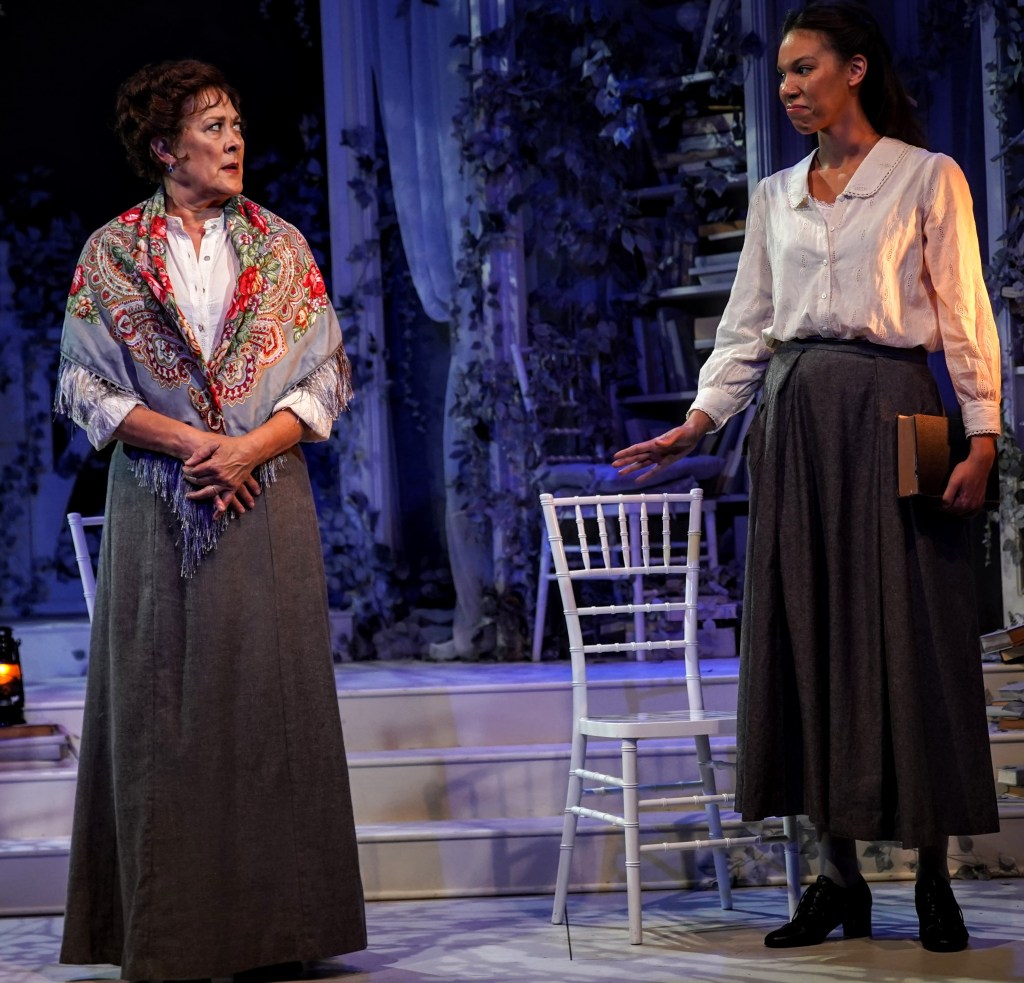
Shaw twits all his characters and has fun with them. Crofts’ cheap caddishness as one of the landed gentry is humorous as are Praed’s and Frank’s notions of womanhood and “how it should be.” Shaw twits the Reverend who joins the clergy after sewing his wild oats. He is so devoted to his congregation, he pays for his sermons to be written.
The production is well handled and a superb revelation of Shaw’s work because of the direction (David Staller), on point ensemble, and creative teams’ enhancement of the play’s timeless themes. I did enjoy the monochromatic set’s conceptualization. See this wonderful production to appreciate this master playwright whose currency so appeals. For tickets and times go to their website: https://gingoldgroup.org/mrs-warrens-profession/
‘Lackawanna Blues,’ Starring Ruben Santiago-Hudson is Just Superb!

Once upon a time when Buffalo, Lackawanna, Detroit, Chicago, Cleveland, Pittsburg and other cities in the North were humming with industry, jobs, hope and prosperity, blacks migrated northward from the Jim Crow oppressions, danger and poverty of the South. Their industry, hard work and efforts contributed to a thriving black middle class which eventually petitioned and protested against the government for Civil Rights reform. In his one-man musical Lackawanna Blues, currently at the Samuel J. Friedman Theatre, Ruben Santiago-Hudson weaves together a beautiful elegy to the people of Lackawanna, New York, who grew him up and impacted the course of his life.
Santiago-Hudson writes, directs, performs-sings, blows a mean harmonica and dances his joy and revelations about Lackawanna, whose current population statistics indicate is growing out of its period of decline during previous decades. Accompanied by the superb Junior Mack on guitar, Santiago-Hudson transforms himself into more than twenty distinctive and unique characters that peopled his formative years, when his beloved Ms. Rachel Crosby raised him. He, and most of the people who knew her, lovingly called her Nanny.
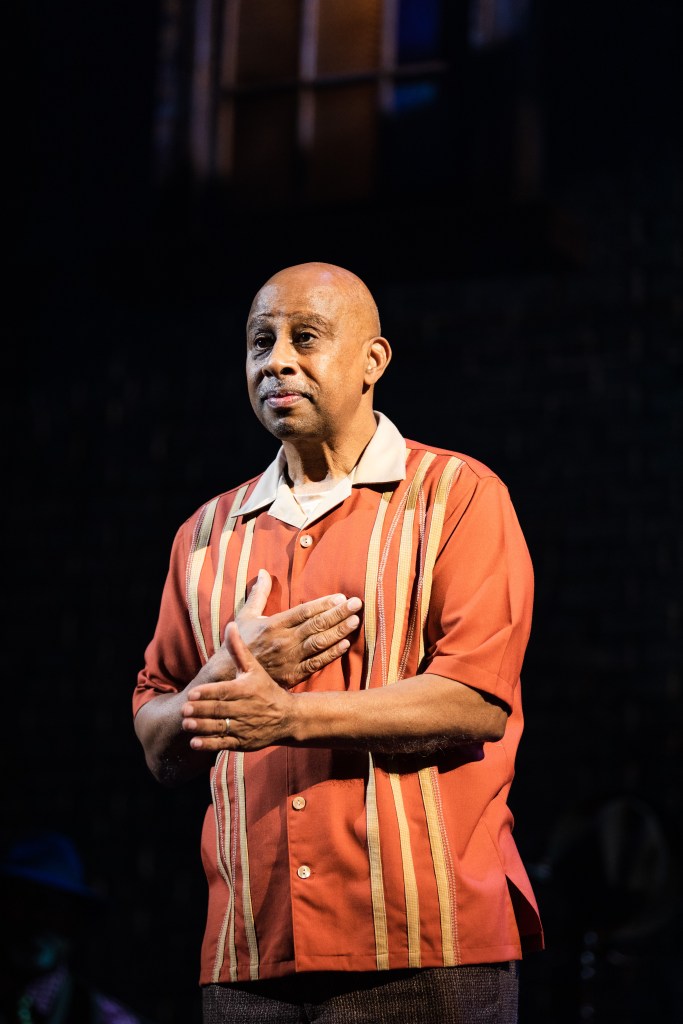
Nanny is at the center of his remembrance, the star of the production, the good and faithful servant on earth, who, laid to rest, brings on God’s greatest praise, “Well done.” Santiago-Hudson’s reflections on Nanny, through her interactions with others, indicate why God praises her so. The acute characterizations melded together and heightened by Mack’s guitar riffs and Santiago-Hudson’s jazz/blues harmonica and songs, reveal a woman we’d all love to be protected by. The picture is glorious. It is of individuals in need, beaten down by human cruelty being helped back up by a compassionate, loving, generous woman, more dignified than the government. Santiago-Hudson brings us into the cloud of witnesses to behold Nanny’s Christianity
Not to be understated is the underlying theme. We discover through humor and pathos, a migrating black culture settling in the middle of a white culture which wasn’t loving. As a result, Nanny “stood in the gap” with grace and a pure heart. Through the men and women that the prodigious Santiago-Hudson effects with his amazing performance skills, we come to know Ol’ Po’ Carl, Lottie, Ricky, Mr. Lemuel Taylor, Numb Finger Pete, Norma, Norma’s Mother, Bill, Dick Johnson, Sweet Tooth Sam and others who Nanny feeds, clothes, boards, chides, scolds and threatens in her way like a rod of Godly justice. Heck! You know they had it coming and invariably, they listen to her like chastened children in a kindergarten class.

What makes Lackawanna Blues so remarkable, apart from the music, is how Santiago-Hudson inhabits the characters with incredible details of speech, phrasing, word choice, stance, voice, behavior and walk, and in the twinkling of an eye switches from individual to individual without taking a noticeable breath. This is his understanding of these individuals’ souls and spirits, fictionalized with the sheen of memory. Interestingly, the result is in the revelation of this humanity, we become humanized with new knowledge of the time, place and culture. The effect is that we empathize and are fascinated to learn of each individual, to learn how Nanny attempts to bring them to wholeness. Though we may never have had a wonderful Nanny in our lives who demonstrated forgiveness and kindness, nor may we never have experienced some of the rough types that she took into her boarding houses and provided a meal, a bed and comforting words of hope to, we understand and experience her through Santiago-Hudson’s gifts of transference.
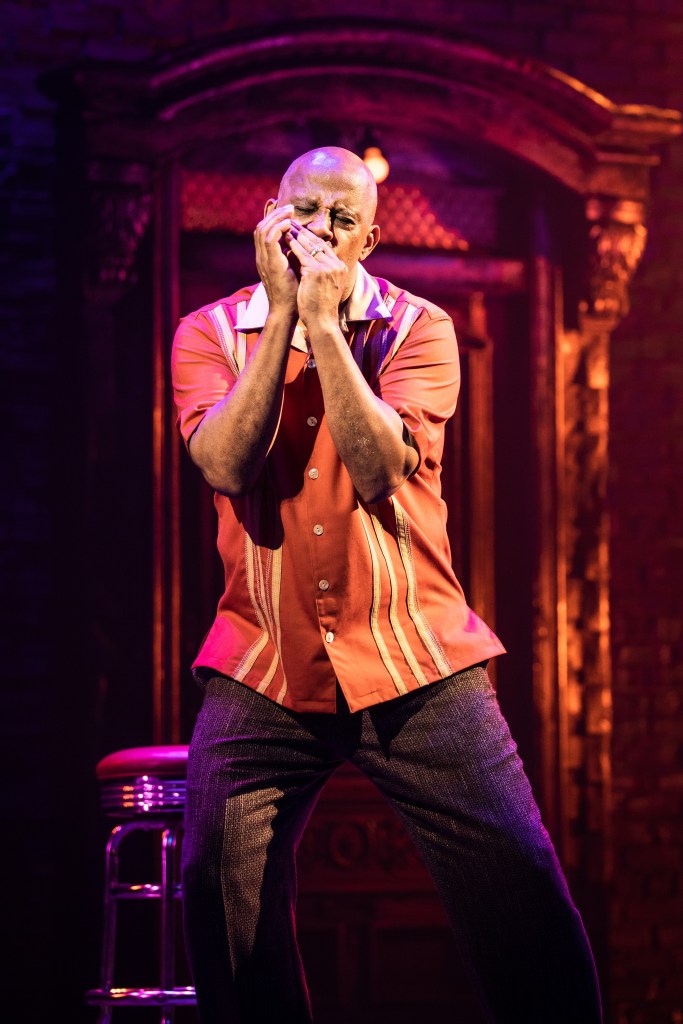
Each of Santiago-Hudson’s portraits of humanity are heart-felt. In some instances, they are so authentic you believe Pauline is standing before you, though Santiago-Hudson is wearing his shirt and pants throughout. Thematically, male or female, whether whole or in pieces as some of the characters are who have lost a limb or fingers, all have dignity and are respected regardless of their foolishness and hijinks. Through Nanny’s love, they are worthy of that respect and dignity. She elevates them from their low-down and fearful view of themselves.
,The writing and acting is breathtaking. Elegiac is the nearest word that comes to mind. However, that, too, is limited because there is great breadth of cultural humor and irony that allows the audience to laugh at themselves as much as they laugh at the situations the characters get into helped by Nanny’s wise responses which give them a way of escape.
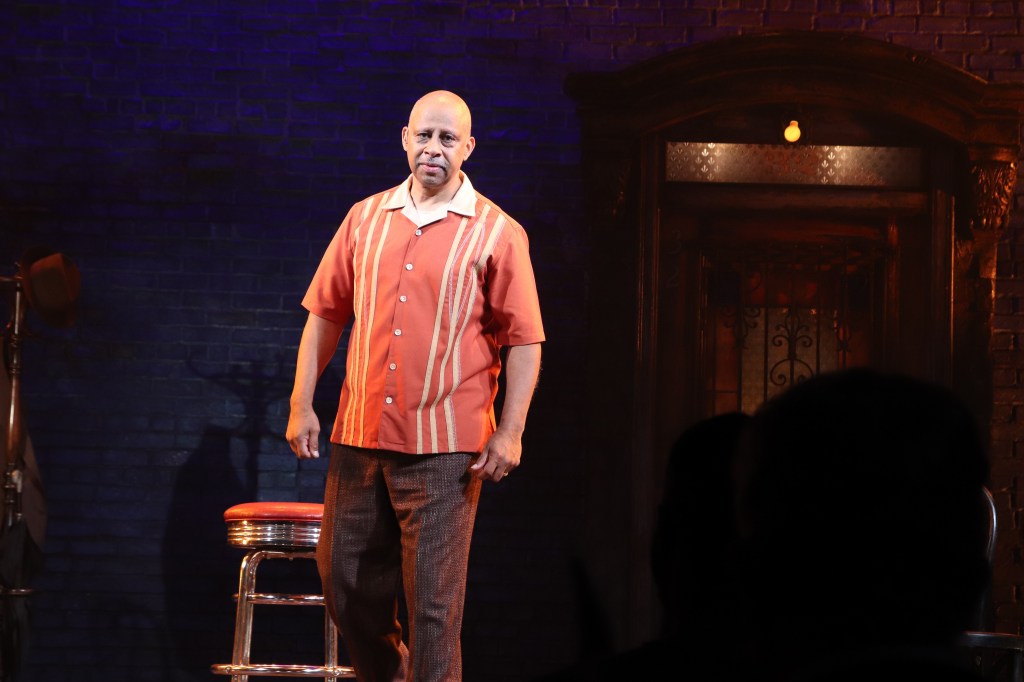
The suggestive blues club lighting (Jen Schriever) and minimalistic stage design (Michael Carnahan) convey the blues/sadness of each story. Karen Perry’s costume design reminds us that Santiago-Hudson doesn’t need costume tricks to become characters. He can effuse them with a smile, tilt of the head, protruding tongue or swagger. I loved the brick wall backdrop, majestic door, lighted window suggesting one of Nanny’s boarding houses, like whisps lifted from memory, that in turn lift us into timeless space and the ethers of imagination. The minimalism encourages a unified realm of audience consciousness thrilled to see and feel and experience live performance. Additional kudos for Darron L West’s sound design.
Santiago-Hudson states in the program that the musical is dedicated to the memory of Bill Sims Jr. who wrote the original music for Lackawanna Blues. In spirit Bill Sims Jr. and Nanny are the force that assists Santiago-Hudson in his dynamite portrayals, in his expressive joy and poignancy, and in his paean to a past that brought him to where he is today, on a Broadway stage.
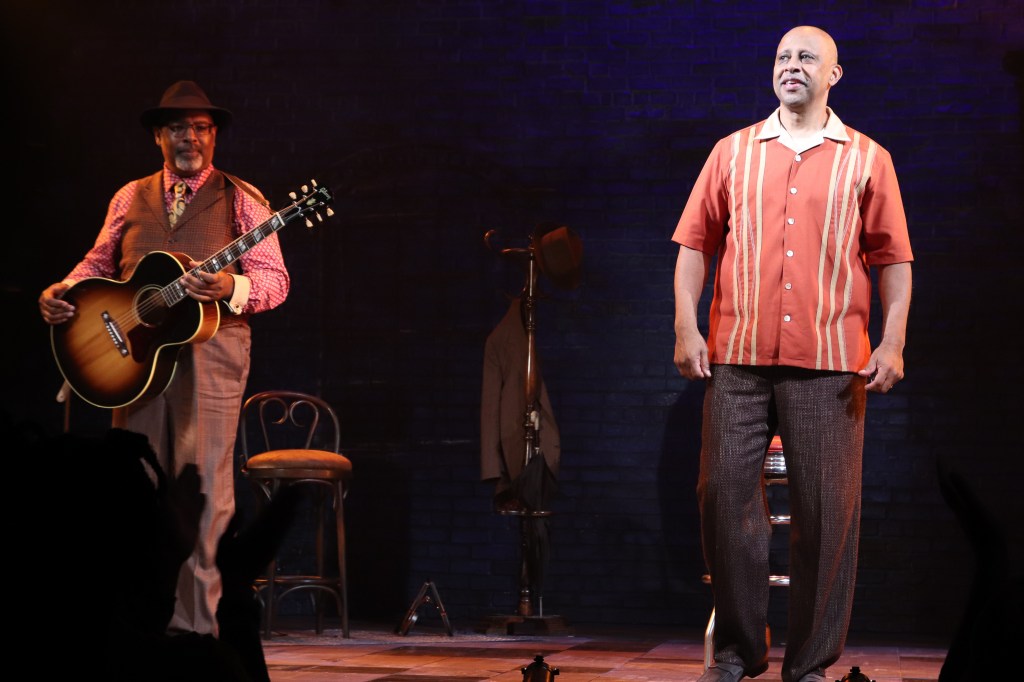
This is one that you don’t want to miss for the humor, writing, Junior Mack’s guitar and the easy way Bill Sims Jr.’s music tonally breezes the themes of goodness overpowering cruelty and hatred, love answering wrath and anger. Lackawanna Blues is uplifting and unifying in this time of division. It reminds us that we all crave love, forgiveness and care, all of us. That goodness lasts a lifetime and beyond. It stops the trajectory of destruction and converts sorrow and hurt to wholeness. And it brings spiritual life and love. Nanny is one for the ages. Hudson-Santiago’s portrayal is beyond triumphant. For tickets and times go to the website https://www.manhattantheatreclub.com/shows/2021-22-season/lackawanna-blues/
‘Autumn Royal’ at the Irish Repertory Theatre
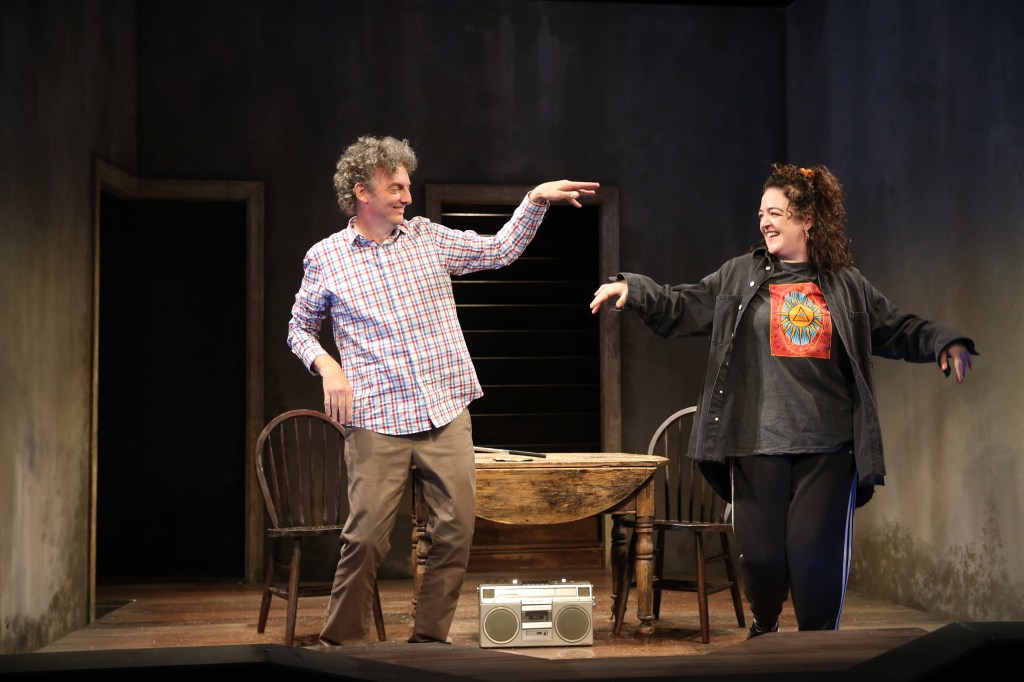
Kevin Barry’s dark comedy Autumn Royal, currently at the Irish Repertory Theatre’s Francis J. Greenburger Mainstage is a blend of dark and light humor centered around a poignant family dynamic: what do we do with cantankerous, ailing Pa when Ma left the family? Directed by Ciarǻn O’Reilly, the production builds with gradual LOL riot to an ironic conclusion that is also a tragic reflection of human nature now and for all time.,
Barry, an award-winning novelist (most recently Night Boat to Tangier) and short story writer (most recent, That Old Country Music), launched out to write his first play, Autumn Royal. When they heard the news, artistic director Charlotte Moore and director Ciarǻn O’Reilly snapped it up for the live 2021 season after triumphantly producing superb digital productions seen globally during the pandemic.

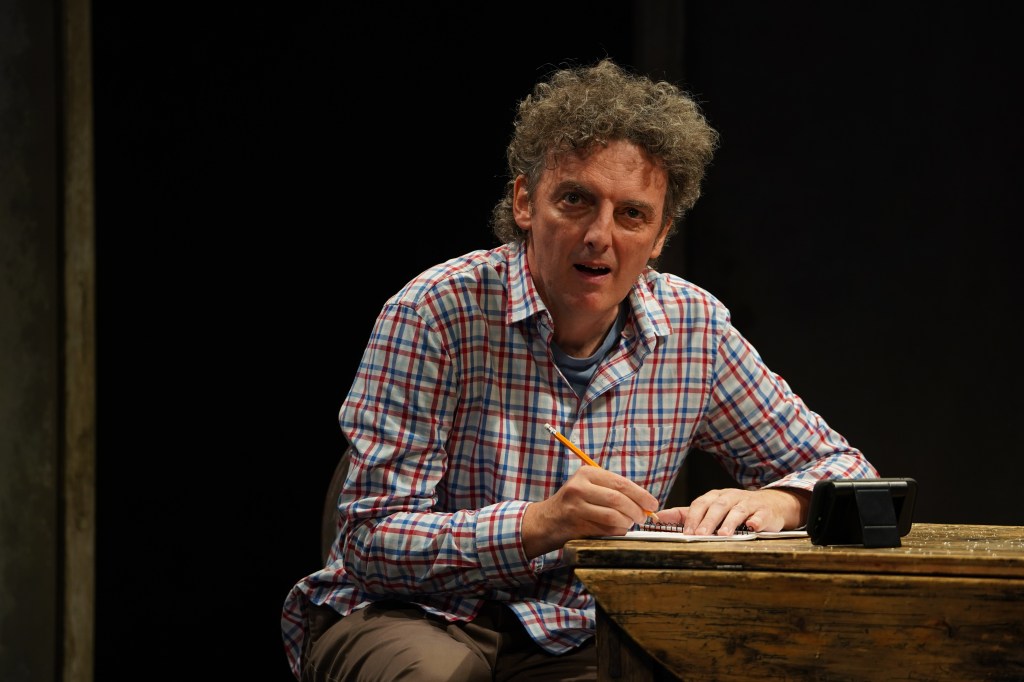
Starring the comic actor and writer Maeve Higgins as May and company member of the Irish Rep John Keating as her sibling Timothy, the actors show their talents as they conduct the audience on a romp which is both surreal and symbolic. The characters’ journey takes them into past events whose revelations inform their present predicament. As the arc of their situation intensifies because of their emotional angst, we are engaged with the surprising and humorous dialogue and flashbacks as family mysteries that haunt the siblings become exposed. The revelations impact how they determine their way forward as they live with and take care of their father 24/7, while he languishes in his sick bed.
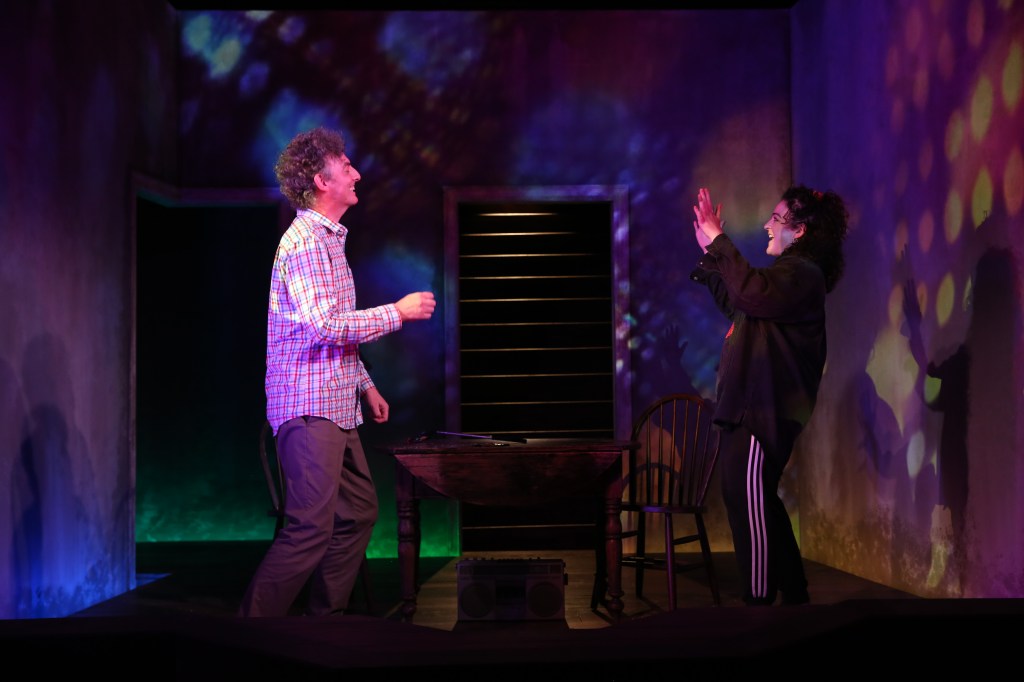
We discover by degrees the conflicts amongst family members, May and Timothy and their parents. Through their commentary and banter with each other, the fine actors reveal reveal the puzzle pieces of their characters’ history. Rapt, we cobble together the threads to divine how and why they continue to live in Cork, Ireland with their father in his house as they care for his most intimate, personal needs. Their father and mother we understand by inference, description and reaction via amazingly suggestive flashbacks rendered with precision by Higgins and Keating. The flashbacks are theatrically presented with the sounds of machinery and projections on the dreary walls of a downstairs room, courtesy of Charlie Corcoran’s set design, Michael Gottlieb’s lighting design, Ryan Rumery’s original music and sound design, Dan Scully’s projection design and Hidenori Nakajo’s sound design.
All elements of spectacle are expertly woven by the creative team to the maximum creating a frightening effect. The theme of parental impact on their children’s emotions and psyche is driven home, but in a unique and stark way as May and Timothy struggle to expurgate or suppress the parental damage that changed the course of their lives.
The images and sounds combine to represent the siblings’ imaginations and personal memories. The revelations are of their unique character; other individuals would flashback to events in a different way. These are Barry’s superior characterizations, so beautifully understood and effected with O’Reilly’s direction and Higgins’ and Keatings’ sensitivity. May’s and Timothy’s stories connect past and present. Their humor, a way to deal with the terrors of parental verbal abuse, arises from misery and torment.

From the dramatically imagistic connections we understand clearly how and why they approach their lives, each other, their parents, their dreams and the possibilities of their future portentous decisions. Interestingly, Barry never presents the mother and father onstage. They are like living ghosts, shadows of their former selves, once a lighthearted family of four before the darkness came.
As the ghostly unseen, the father rains dust down on May and Timothy in the room on the first floor as he bangs out tempestuous ructions in his upstairs bed. The mother, a dark figure wandering up the hill above their house never visits, though she lives somewhere in Cork and remains incommunicado by her own design. However, she once visits her husband in his sickbed and compliments Timothy when she comes downstairs again. Timothy reports this to May after she confronts him about their parents. It is then we learn how May despises their mother, as they note their father’s religious fanaticism.
There is no spoiler alert. The events progress as the siblings try to make cogent decisions about their father’s condition and theirs with humorous effect. To what extent do they determine to fail? To what extent do they interact with each other in combined stasis and nihilism to deliver a result they don’t want? Or do they want it? You will just have to see this superb production to experience the humor, the poignancy and the uncertainty inherent in Barry’s work, prodigiously staged and shepherded by O’Reilly’s direction and Higgins’ and Keating’s wonderful performances.

Barry’s work intrigues with its complexities. The actors make the characters authentic in their hellish prison which they impose on themselves and each other. Gradually, they back themselves in a convenient corner. Their past, ironically suggested with symbolic flashbacks indicating a machinery which catches them up and spins them in circles of torment they cannot break, speaks to all of us. How caught up are we in past hurts delivered by individuals who have long since died? How much do we allow past events to determine how we relate to individuals in the present, who have vastly changed when the circumstances are also different? Or have the relationships we’ve developed over time worsened in revenge, self-punishment and unforgiveness? To what extent do we keep the machinery spinning because we don’t know how to stop it or won’t stop it?

The creative team, the director and the actors have brought to life the tragicomedy of a family in Barry’s powerful play. The production values enhance the themes and bring them home. As we laugh, the impact of May’s and Timothy’s reality drives into our hearts. This is a wonderful production to begin Irish Repertory’s return to live theater. Kudos to all involved. For tickets and times visit their website https://irishrep.org/
Romy Nordlinger is Alla Nazimova in ‘Garden of Alla’
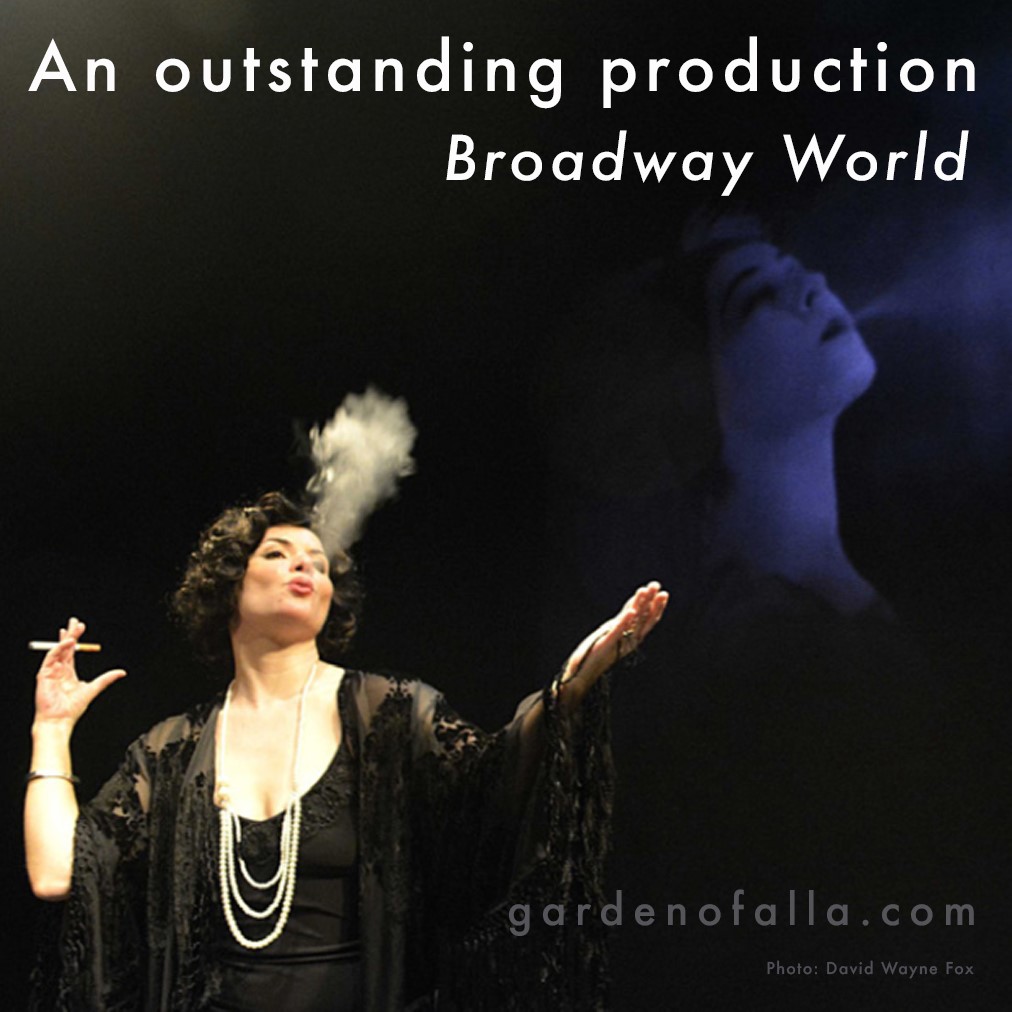
I had seen Romy Nordlinger in her solo show PLACES! at 59E59th’s East of Edinburgh Festival and thought she was marvelous. Evolving her presentation before and after the pandemic, once again she is stepping out to bring to life the amazing Nazimova who lived and made her mark during the early twentieth century. With additional performances under the direction of Lorca Peress, Romy’s achieved new heights exploring the maverick woman who was a force in her time. Ahead of her 7:30 pm show on Thursday, October 21st at The Cutting Room on 44 E 32nd St. (arrive at 6:00 pm for the live jazz cocktail hour) I had the opportunity to interview Romy about this production which she has also written.

Who is Alla Nazimova, the person you are bringing to life in your show?
Perhaps the greatest star you’ve never heard of, one of the brightest lights on America’s stage and cinema screen was actor, director, writer and producer Alla Nazimova. Few women, or men, rose to such great heights – but now she languishes largely forgotten. A student of Stanislavski, she fled from Tsarist Russia and an abusive father, to the Lower East Side, where she founded a Yiddish theatre – her play The Chosen People put her on the map.
From humble beginnings to a meteoric rise to stardom, she became Broadway’s biggest star, and in 1910-1911 made the Shuberts $4 million dollars in sold out runs (that’s 400 million dollars today). Described by Dorothy Parker as “the greatest Hedda Gabler” she helped to bring acclaim to playwrights such as Eugene O’ Neill, Chekhov, Ibsen, and Strindberg. She even inspired Tennessee Williams to become a playwright. The Shuberts then named the Broadway theatre after her, The Nazimova Theatre on 119 W. 39th St. Growing weary of the increasing pressure to perform in second rate commercial plays, she left the Shuberts and The Nazimova Theatre was renamed the 39th Street Theatre. It was finally torn down in 1926.
Nazimova went on to become the highest paid silent movie star in Tinseltown commanding a five year $13,000 a week salary in 1916. The first female director and producer in Hollywood and pioneer of the first art film, her stunningly avant-garde Salome was too “Wilde” for 1926. Unapologetic about her bisexual decadence, she defied the moral and artistic codes of her time that eventually forced her into obscurity.
Her legendary Garden of Allah mansion in Hollywood was a haven of intellectual and sexual freedom with regulars such as F. Scott Fitzgerald, Hemmingway, Garbo, Dietrich, Valentino, Chaplin, Rachmaninov – basically anybody who was anybody. There, she declared her all women’s “sewing circle” in open defiance, proclaiming her strength when women were relegated to silence. In financial and critical ruin after Salome, the press and the studios destroyed her. Finally, she rented a small bungalow in the grounds of the mansion she had built on Sunset Boulevard.
Her bold, trailblazing artistic legacy is unprecedented, unrepeated and under the radar. Her iconoclastic story of freedom and nonconformity was silenced under the smoldering rubble of forgotten history.
How did you “hear” about Nazimova?
The brilliant theatre historian, author and founder of The Society for The Preservation of Theatrical History, Mari Lyn Henry was putting on a production of ‘Stage Struck’ about famous actresses from history. She asked me to pick an actress to research and write about and she suggested some wonderful actresses, but none really struck my fancy. They all were very blonde and talented, but I felt no relation to them – and then Mari Lyn said, “I’ve got it! Alla Nazimova!” I thought, “Who in the heck is that?”
I started reading about Nazimova. She is also Jewish and Belarusian as I am, and I felt an immediate kinship. I read her biography by Gavin Lambert which quotes from writings from her own journals. I was mesmerized by her humor, her story, and most of all, her zest for life! She was a survivor. This was a woman who lost everything, overcame the most horrible circumstances, became a star more meteoric than even Madonna and ended up a guest inside the mansion she used to own. She was a maverick ahead of her time, investing her money for the love of art/film and experimenting with new forms. Despite her losses, she kept her joie de vivre, having no regrets or bitterness. She remained full of wonder with the beauty of life.
THIS, I thought, THIS is a person who inspires me to risk, to dare to dream out loud and bring to life my dream. Most importantly, she inspired me to be myself in a material culture that is constantly trying to commoditize and sell, a society that values only your worth in money. This was a woman who valued herself and loved life to the fullest.

Tell us about previous performances of the show.
I have performed the show in another incarnation under the title PLACES! at Edinburgh Fringe, HERE Theater, Dixon Place, The Players Club and the studio center at The Kennedy Center. This is the production where, although we’ve always been received very well, we really tell her story to the best of all we have. It’s a multimedia show that is like a live silent movie with absolutely beautiful and evocative video design by Adam Burns, a brilliant musical score by Nick T. Moore and directed by the very talented Lorca Peress.

How has your performance and understanding of Nazimova evolved?
As life is wont to do, the more you experience the joys, the sorrows, all life’s disparities, the more you “understand” the heights and depths of the characters you play. After undergoing many upheavals in my own life, ups and downs in careers, triumphs and flops, deaths and loss, and then of course the pandemic, I feel an even stronger kinship to Nazimova’s survival instinct. I understand and am inspired by her amazing capacity for feeling – pain, joy, love, anything and everything but boredom. I channel her and she makes me feel able to cope. She helps make me a better person. This production is a great labor of love and a lot of work. It takes everything I have to get up on stage and perform a solo show – and to “bring” Nazimova there. It’s all worth it, every moment, for both the audience, and myself. It is a cathartic experience, and now more than ever, it’s a valentine to theatre.
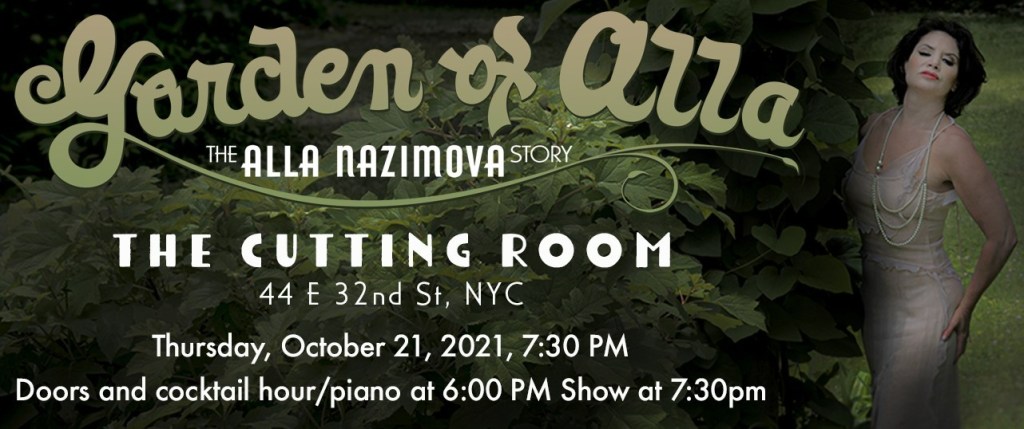
What would you like the audience to understand about Nazimova that your performance enhances?
I’d like the audience to realize that we are standing on the shoulders of giants. That the LGBTQ movement started long ago with brave people like Nazimova who stood up and demanded she be herself, but alone and without a Twitter account, and that we can all dare to dream – and fail – and rise again – and fail again. It’s all the same. It’s the journey that’s important. To anyone whose felt like the underdog, I want them to feel less alone, and to feel that they, too, can use their voice (whether out loud or in writing or however they express themselves) to be an instrument, an extension of themselves. Their life matters. Their differences are beautiful.
Romy Nordlinger will be channeling Alla Nazimova in her exceptional show at The Cutting Room 7:30 pm, Thursday, Oct 21. Arrive at 6:00 pm for the live jazz cocktail hour. The Cutting Room address is 44 E 32nd St., NY, NY.
The interview has been gently edited.
 CAROLE DI TOSTI