Blog Archives
‘The Saviors’ Exquisite Acting, a Heartfelt, Complex, Profound Play
Fresh off their Drama Desk nominated production Well I’ll Let You Go, the playwrighting and directing team of Bubba Weiler and Jack Serio have created another sterling production. The Saviors, their pointed, coming of age play about faith, fear and emotional and spiritual abandonment runs in its World Premiere at the Atlantic Theater Company until August 15, 2026.
The terrific actors Ivan Howe (Michael) and Julius Rinzel (Paul) dynamically lead the small cast rounded out with excellent performances by Crystal Finn (Judy) and Stanley Simons (Julian). The Saviors, which appears simplistic and is anything but, contrasts religious doctrine, faith, love and living one’s Christianity through one’s identity and personal relationships.
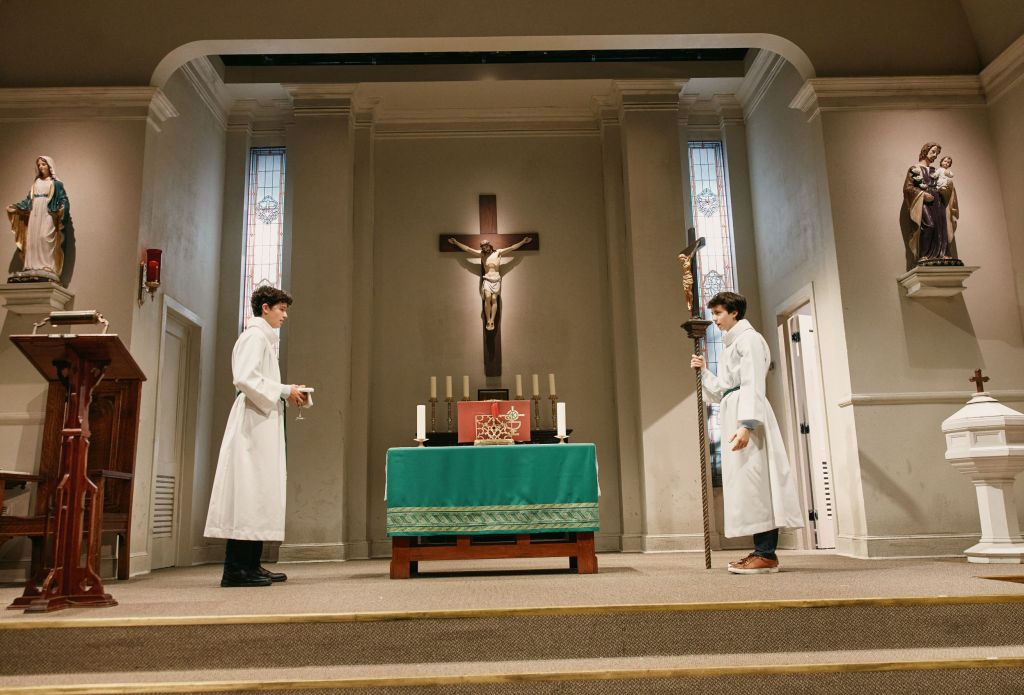
Weiler introduces the two teenage altar boys who take their faith seriously enough, by spending time doing tasks of service before and after mass in a Catholic church. They reveal their camaraderie and closeness competing with each other, for example, snuffing out candles or stuffing church bulletins. Significantly, their responsibility extends to cleaning and preparing the officiating table, updating the hymnal numbers on the board, closing the lights and locking up the church for the evening. Initially, we think that their time and dedication to the church community and God solidifies their friendship and unity. From their conversation we learn of their upcoming confirmation, plan to go to a Catholic high school, and decision to select a particular saint who will protect them spiritually for the rest of their lives.

During their preparations to close down for the day, Weiler specifically gives clues to their personalities and sets up the development of events. Of the two Michael appears to be more dedicated but more troubled. Indeed, he has nightmares and calls Paul for comfort to talk him out of his bad dreams.
During their conversation, Michael reveals the choice of the saint has consumed him and he has researched St. George, drawn to his martyrdom and persistence in faith in the face of brutal torture. When Paul asks why Michael likes saints who die horrific, deaths, Michael dismisses Paul’s lack of understanding about church canonization. Instead, he aligns Paul with his own strong faith, countering that a girl they know selected St. Genevieve for her confirmation because of the pretty name, not the saint’s sacrifices. Michael suggests Paul and he “get it,” whereas others like her do not. Then, he affirms if tortured for his faith, he would never renounce God. Instead, he’d choose death and martyrdom and subsequently, go right to heaven and maybe become a saint kids will choose for their confirmations. On the other hand, Paul affirms he doesn’t know if he could sacrifice himself for God.
At the heart of faith and belief in God, the Roman Catholic Church reverences its martyrs, and the sacrifice of life for one’s belief in God. Thus, the discussion seems particularly fitting in set designer David Zinn’s beautiful, finely effected chancel. There, Michael and Paul express their feelings on the altar of service with the large statue of Christ on the cross centered between stained glass windows, as if looking down at the long tables with the candles lit for mass. And the other statues of saints attached to the walls farther out on either side, reveal the gradual separation between those who serve with holy distinction and those who receive service seated in the Nave (audience), down from the steps of the altar that come to the end of the stage.
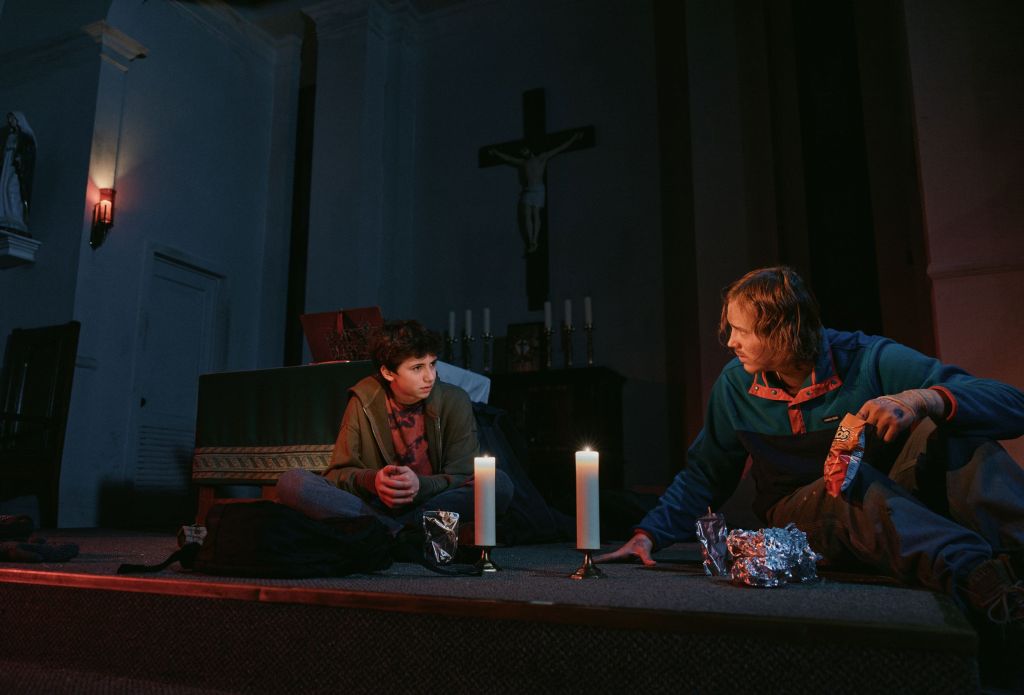
Indeed, the set design couldn’t be more symbolically, thematically and effectively staged for the entrance of Simon’s disheveled, homeless-looking, forlorn Julian. When he slowly comes down the aisle of the “nave” and goes up to the altar, his presence unsettles, even frightens. Michael takes authority to question him and get the intruder to leave, but then Paul overrides Michael. Ironically, Paul in empathizing with Julian’s physical state follows the tenets of Christianity to give succor to those in need. In contrast Michael never forgets his responsibility to the church community and his role in it. Since a winter blizzard threatens, Paul extends an authority he doesn’t have to Julian. He will leave a door unlocked for Julian to stay safely inside during the storm.
Thus, a parable clarifies. Paul’s extends kindness to Julian, though his act requires no real personal sacrifice and, in fact, could get Paul and Michael in trouble if Julian vandalizes the church. Indeed, Paul abuses his responsibility by allowing Julian to trespass when a nearby shelter down the road could help Julian more efficiently, something which Michael suggests. However, the suggestion falls on Julian’s deaf ears. Additionally, we discover Paul’s motive in leaving the door open for Julian, despite Michael telling him he shouldn’t.
Later that evening Paul walks a mile in the blizzard and startles Julian who takes shelter in the church which he seems familiar with, a Weiler-planted clue. After giving food and juice to a grateful Julian, Paul questions the stranger who holds a romantic allure for him. Though Julian tries to discourage Paul’s looking up to him with an angry retort not to, Julian fascinates Paul. In Paul’s imagination he’s different from the hackneyed church goers who live meaningless, boring lives. Encouraged, Julian relates an experience he had in his travels which he interprets as a sign from God.
Julian’s presence is a catalyst and prompts turning points for all the characters. Ironically, it opens the door to Paul’s exit from his friendship with Michael, his faith in God and his service in the church community. He tells Michael he doesn’t believe in God. and won’t serve in church.
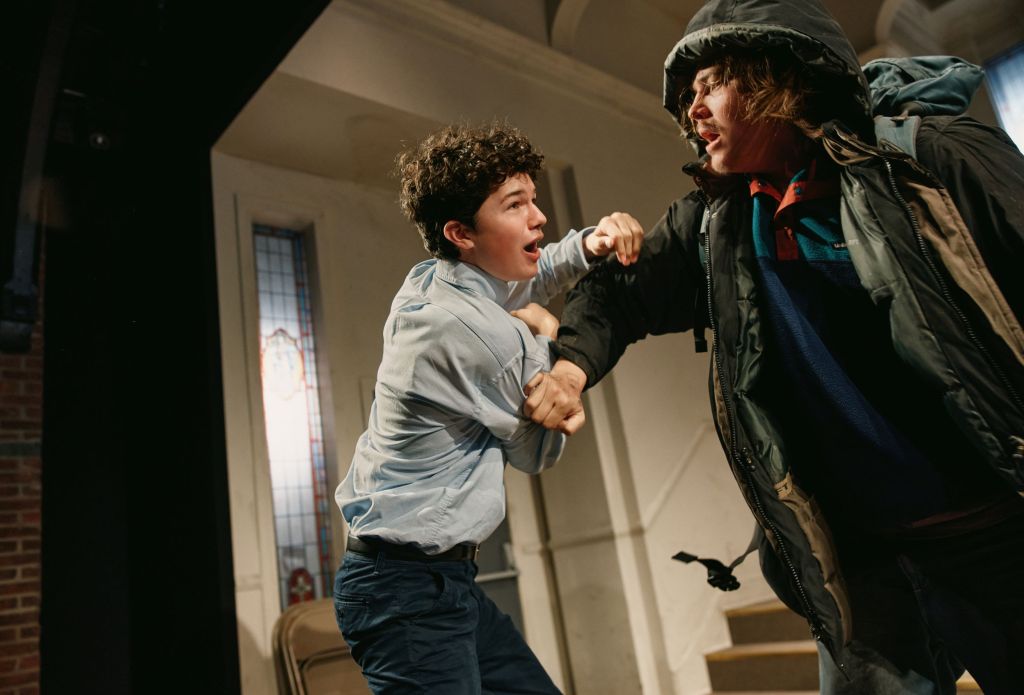
Additionally, because of Julian, Michael better understands Judy, whom he initially asked to be his confirmation sponsor because she’s “like Mother Mary.” Judy devotes herself to the church community by serving as choir director and youth leader. Also, she presents her son as a missionary in Africa, who sacrifices his life daily to help others. To his great upset Michael discovers she lies. Furthermore, she asks him to continue a deception because she can’t live with the truth. Rather than to go to the church community for help over her weakness that the church could save her from, she fronts.
Finally, Paul’s negative and insulting reaction to Michael’s friendship, “You’re not my boyfriend,” prompts Michael to realize his “former friend’s” cruelty for which Paul has no answer. Indeed, rather than tell Michael how Julian influenced him during the late night discussion they had, Paul refuses to confront Michael because the truth may be too dangerous for him to discuss. Like Judy, Paul would rather say nothing, a lie of omission. Ironically, Michael who has remained as honest as possible as an act of faith, learns the cruelty of lies and deception by those whom he admired, looked up to and loved.
This situation seems much more difficult than the situation with the saints whose enemies of God told them to renounce their faith or die. That, Michael could answer and do unequivocally. Indeed, this situation throws him off his certainty and makes him question his identity and goodness in God. Will his faith Hold?
In the very powerful last scenes of the play, we understand the manifestation of Michael’s inner hell, his stress and anxiety about his identity in Christ. Despite his affirmed doubt about God, Paul helps Michael in an act of standing on God’s word. Paul saves Michael through Michael’s faith. Does this act of saving his former friend save Paul’s faith? What a magnificent way to conclude this superb play, wrought by the extraordinary, miraculous performances of Ivan Howe and Julius Rinzel.
The Saviors runs 1 hour 30 minutes at Atlantic’s Linda Gross Theater thrrough August 15, 2026; atlantictheater.org.
‘The Dark Outside’ by Bernard Kops, Starring Austin Pendleton and Katharine Cullison
The Dark Outside by Bernard Kops currently at Theater for the New City is the renowned 94-year-old English playwright’s most recent work. The play uplifts the importance of family with themes of unity, love, encouragement, light and hope against the all-encroaching darkness that would turn family members against each other and destroy them. Kops’ lyrical play had a staged reading at London’s National Portrait Gallery in 2020. It is a great irony that The Dark Outside presciently foreshadowed the tenor of the times as the pandemic broke out and upended global society and culture right after the reading.
Through the COVID-19 chaos and upheaval, which bred uncertainty, want and fear, oftentimes, family provided the bulwark of steadfastness against psychic and physical infirmities and death. Disastrously, in the United States the divisiveness over how to handle COVID-19 became a political football which, to this day, divides families and ends friendships. Most importantly, Kops’ The Dark Outside reminds us of the moral, sociological and personal imperative of the family unit to sustain its members. Though the inevitable tribulations of life will come, they can be withstood through love’s immutable power.

In this premiere at Theater for the New City, director Jack Serio and the creative team deliver the beauty and sanctity of the play’s themes with a fascinating production that is incredibly timely. Serio highlights the British dramatist’s poetic sensibilities and notes Kops’ homage to archetypal character types through the production’s staging and overall design elements.
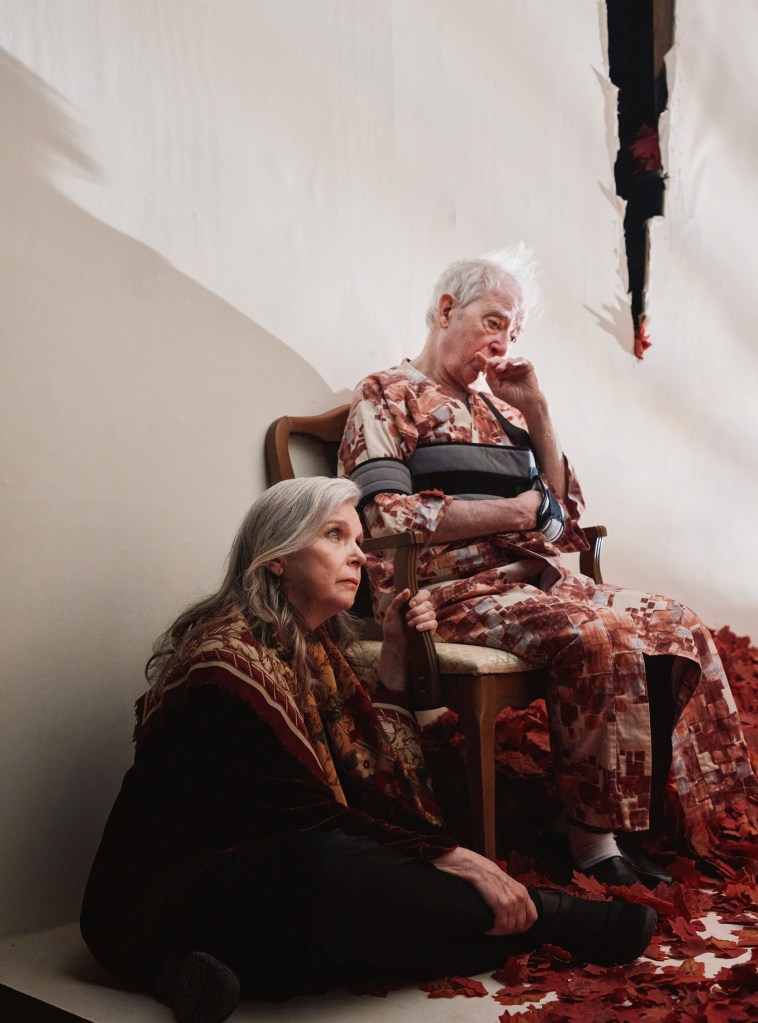
To achieve Kops’ ethereality, Serio selects minimalism. The production strips away material clutter and simplifies, using the bareness of space. In the atmosphere created, the superb acting ensemble conjures up the symbolic mulberry tree, the garden behind the house, the dinner, and more. All are in the service of Kops’ revelations about this family’s unity, inspired by the beautiful and loving mother and wife, Helen, portrayed with precision by Katharine Cullison and supported by the wounded, sensitive, poetic father and husband Paul, played by the impeccable Austin Pendleton.

At the outset, Kops introduces us to Paul (Pendleton) the father/husband, a former East London tailor who faces a life crisis after he loses the use of his arm in an accident. To inspire and encourage Paul, wife/mother Helen (Cullison) gathers their children, Penny (Kathleen Simmonds) Ben (Jesse McCormick) and Sophie (Brenna Donahue) to unify the family at the important occasion of celebrating Paul’s birthday.
As the play progresses, we discover that each of the children confronts conflicts and traumas in their own lives. Thus, the chaos that is outside on the streets and in the neighborhoods that Paul often refers to threatens to disturb and destroy each of the family members unless they are able to work through their problems, seeking the comfort of each other to tide them over to face another day.

Kops uses the majestic mulberry tree in the family’s garden to reveal the issues of the characters. For strength and peace, family members confess their angst and deep secrets to the tree whose life force listens and, in its silence, allows the characters to gain an inner solace and calm. Additionally, sisters Sophie and Penny share confidences. Sophie relates a horrific experience that caused her to leave college and spiral downward into emotional devastation and near destruction.
Sophie’s salvation is in coming home where she finds love, acceptance and redemption. Revitalized, Ben and Sophie receive great comfort in the arms and soul strength of Helen, who soothes and reassures both as she helps them overcome their inner hell. Paul’s great appreciation of his amazing wife is his continual blessing. Cullison and Pendleton are authentic and believable in the relationship they build of the loving couple. Thus, it follows that the children, despite their heart-rending troubles, have rightly come home to heal, as they receive encouragement and love from their parents.

Of the joys in this production are the poems and songs that are wide-ranging and eclectic. These, the family sings together or recites individually as expressions of emotion that are difficult to articulate. The songs resonate and recapture the play’s themes. They indicate how the family copes when a member needs help and uplifting. This is especially so in the poignant conclusion when Helen sweetly sings Paul to sleep with soothing grace. The moment is mythic in its power, and it is obvious that love’s sanctity is a balm which never falls short or fails. Thus, by the conclusion, joy returns to the household. The “darkness” has been thwarted with regard to Ben and Sophie who return to the family to complete the circle of love.

The only one who does not join them and leaves for New York City with her husband is Penny. In her move it is intimated that the wholeness of the family may remain incomplete for a season. But we have seen the strength of the archetypal mother who unites her children and husband. Regardless of whether the external darkness is in London or in New York City, Helen will continue to be the binding force that holds the family together with grace.
Jack Serio, the cast and the creative team have delivered the essence of Kops’ work and made it memorable. With the music and sound (Nick T. Moore) scenic design (Walt Spangler’s leaves are a lovely addition) the modulations of the darkness and light symbolism through Keith Parham’s lighting design, the production’s heightened moments are felt acutely. This is one that should be seen because of its cast and the symbolic iteration of one of Kops most heart-felt works.
The production runs at Theater for the New City until November 28th when Bernard Kops turns 95-years old. It is a feat for one of Europe’s best-known and most admired playwrights who the Queen awarded a Civil List pension for his services to literature. It is an award garnered by a very select few, namely Lord Byron, Wordsworth and Alfred, Lord Tennyson. For tickets and times go to the website https://theaterforthenewcity.net/shows/the-dark-outside/

