Category Archives: Wine Tastings
Wine Enthusiast Magazine Awards Arnaldo-Caprai Winery, “2012 European Winery of the Year.”
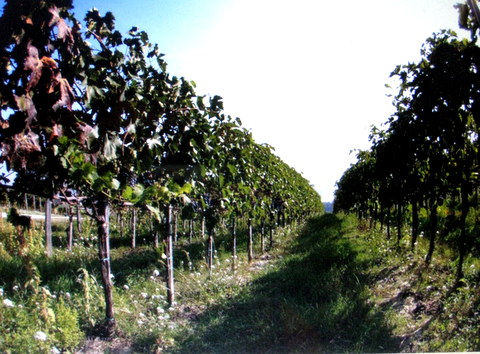
The Arnaldo-Caprai vineyards.
What does it take to be an award winning winery? Centuries. What contributes? Various factors, the terroir, changes in the wine making process, the winery’s sustainability and innovations, possible climate changes based on land changes and the regulations, protection and veneration of the social culture, government and owners/keepers of the harvest, their industry and efforts. Italy is an ancient land of wine making, dating from before the Romans. The social culture supported the grape harvests and enjoyed drinking wine daily; it was certainly better than water.
In current times, the 1700s, the growing of grapes and wine making was suited to Umbria, the “green heart of Italy” and Montefalco, where documents of the time noted that “fine and delicate wines were produced there in ‘beautiful and good’ vineyards.” So much was this the case that municipal sanctions were strengthened to maintain and sustain the culture of thriving, glorious vineyards and sumptuous wines. If you hampered a winery in its noble and sacred endeavors, you were in big trouble. In 1622 Cardinal Boncompagni, the Pontifical delegate in Perugia, threatened “capital punishment for anyone found cutting down grape vines.” Cutting down a plant was worthy of death? Such was the symbolism, of grape vines and the vitality of wine to the culture and the church.

The Arnaldo-Caprai vineyards in Montefalco
With this dictum in place, Montefalco was assured of continued abundant grape harvests and in good seasons and bad, productive, determined wineries. In the next two centuries, the place was considered “at the summit of the State for its wine production.” though even then, the cultivation of Sagrantino grapes, a varietal indigenous to the region, was destined to produce sparely. However, difficult their productivity, the Sagrantino vines were nevertheless preserved in ancient monasteries by wine-making monks.
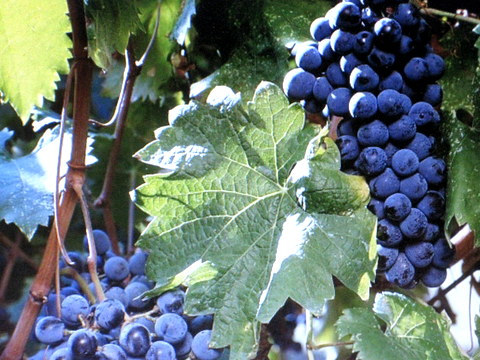
Sagrantino grape vines and characteristic leaves. Arnaldo-Caprai Winery
Interest in the Sagrantino grape waned after World War II and trends had changed by the 1960s. Perhaps because of its scarce productivity, the Sagrantino grape nearly disappeared from Umbrian vineyards. It was the dedication of a few courageous wine producers and perhaps their romantic imaginations and interest in the Sagrantino as an indigenous varietal that the D.O.C. label in 1979 and D.O.C.G label in 1992 officially sealed that the important tradition of these vines would continue. After this, the few Sagrantino vines still flourishing within the city walls of Montefalco were labeled and classified. The history of the grape had been preserved, and with research, it was assessed that some vines growing in the monasteries of St. Claire and St. Leonard dated between 1700 and 1800. Certainly, when the wine producers encouraged the sustainability of the Sagrantino vines, they were also preserving the sacred nature and lineage of the wine’s association.

The Sagrantino grape varietal of spare productivity.
It was in 1988 that Marco Caprai, son of Arnaldo Caprai began managing the Arnoldo-Caprai winery that had been producing unique, top quality, Umbrian wines. Because of the father’s and son’s passion and rich understanding of the local varietals, and Marco Caprai’s desire to expand the work and develop the winery and the indigenous grape, the Sagrantino, Marco Caprai partnered with the University of Milan. His goal was to research the neglected native Umbrian Sagrantino varietal.

With the collaboration and support of top local winemakers and sustained effort, Caprai and colleagues succeeded in transforming a relatively unknown indigenous grape to one that is world renown. Because of the connection to his ancestry, with his characteristic enthusiastic fervor, Capai expanded the winery to over 375 acres of vineyards. One of the keys to his great success was and is his selection of a first-rate team. The team worked and continue to work alongside him in both wine production and company management. Together, their efforts contributed to making The Arnaldo-Caprai winery the “acknowledged leader in the production of top quality Sagrantino di Montefalco, the wine produced exclusively from the Sagrantino grape.”
For his determination in working to pioneer and produce excellent wines of unique character and depth, Marco Caprai and the Arnaldo-Caprai Winery have garnered multiple awards and global recognition. A few examples include Winery of the Year – Gambero Rosso Slow Food 2006, and Best Winery of 2011 from the Italian Sommelier Association (AIS). Their Sagrantino di Montefalco has won awards up to the present.
Not satisfied resting on these laurels developing the Sagrantino, to global renown, currently Marco continues to assist in the development and reclassification of the Montefalco territory suitable for vineyards. He works in collaboration with the La Strada del Sagrantino Project, the prime force in engineering the marketing of the territory.
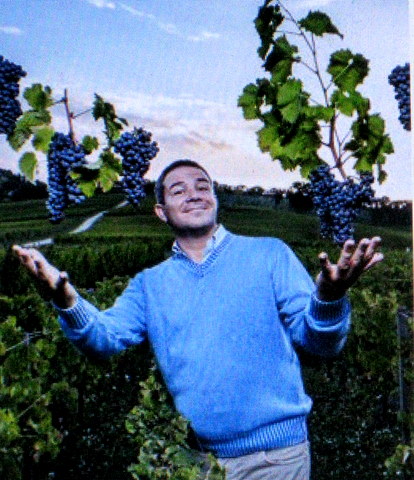
The irrepressible Marco Caprai. What grapes are those?
Photo courtesy of Wine Enthusiast Magazine, from the article by Monica Larner at the announcement of the Arnaldo-Caprai “European Winery of the Year Award.”
Marco is president of the Vinegrowers of the Provincial Agricultural Union of Perugia, as well as the president of the Association of Foodstuffs Industry of Perugia. He was formerly the director of the Consortium which protects and promotes authentic Montefalco wines and president of the Agri-Foodstuffs Center of Umbria Marco Caprai was presented with the Best Producer award by the Italian Sommelier Association.

Arnaldo-Caprai vineyards in the fall.
This year, the Arnaldo-Caprai Winery has been recognized by Wine Enthusiast Magazine, which is an industry leading publication founded in 1988 to bring consumers information about the world of wine through its reviews. The periodical, which has grown to become the world’s largest and most respected magazine devoted to wine and spirits, gives out annual “Wine Star Awards.” The magazine’s editors honor the year’s finest wineries and highlight the influential personalities who have contributed greatly to the world of wine, celebrating outstanding achievement both within that given year and over time.
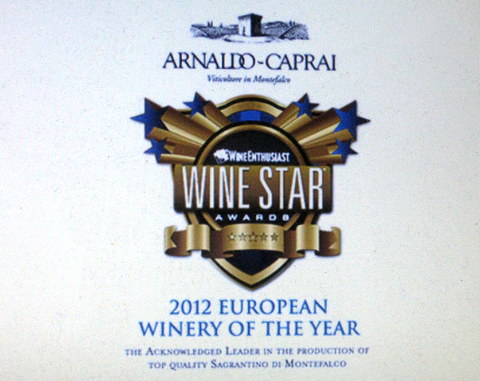
Wine Enthusiast Founder, Chairman, Publisher and Editor Adam Strum explained the winery’s selection, “The innovative Arnaldo-Caprai Winery has helped revive Umbria’s indigenous grapes, bringing the wine region into the international spotlight for its production of Sagrantino di Montefalco.”
 Upon receiving notification of the award, Caprai said, “The Sagrantino grape has been my lifelong passion. I have dedicated my life to making Sagrantino a grape known worldwide and this award is a terrific testament to that effort. We’re honored to be chosen for such an important international award and to be in the company of some of the best wineries and wine personalities in the world.”
Marco and the Arnaldo-Capri Winery are now the toast of the town in recognition of being awarded the Wine Enthusiast‘s European Winery of 2012. On January 22, 2013, there was a Marco Caprai Producer Dinner at L’Artusi. Attendees enjoyed a delectable five course dinner with wine pairings. Marco is also being celebrated for his achievements by Roberto Paris and Il Buco Alimentari & Vineria in a private event the following week.
Can things get better than this? From the bit I have researched about this diligent, resourceful, innovative entrepreneur and fine wine artist, Marco Caprai, there are even better things on the horizon.
What is Slow Wine? Come to the Slow Wine Tasting in NYC on January 28th to Find Out!
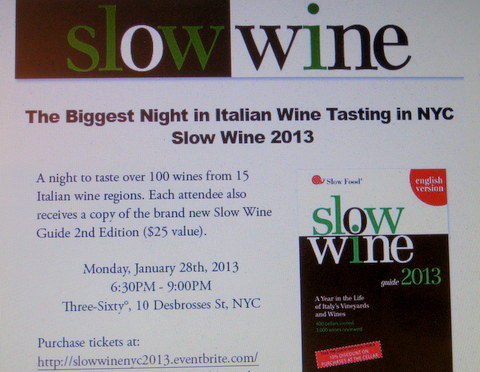
Slow Food NYC website
SLOW FOOD, SLOW WINE, WELLNESS
If you are living in the 21st century, you know the importance of wellness and healthy lifestyle as it integrates with the wellness of our planet. You also know that ecology is tied with food production, that increased carbon dioxide in our atmosphere is threatening all of our ecosystems, that ultimately every country is interrelated regardless of whether it is a failed state with a tiny carbon footprint or a prospering one responsible for chemical mega poisoning. Whether you are connected to enhancing the current paradigm shift, changing the negative impact of corporations, fighting against GMO salmon and wheat and corn and adulterated processed foods like pink slime, or whether you are a part of the problem, turning a blind eye to all of it, the quality of what you eat and drink over the next ten years will determine whether you stay well, or build up toxins that will eventually wreck your immune system shortening your life span.
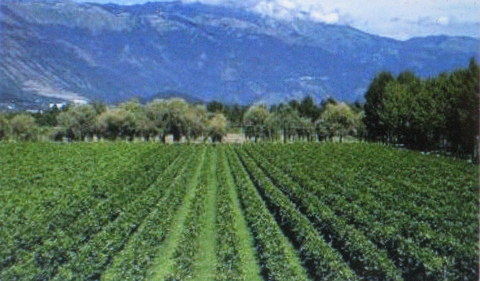
Conte Brandolini Winery is located in Vistorta, a small “borgo” within an agricultural estate in the heart of Western Fruili. The winery embraces Slow Wine concepts.
Nino Negri Winery’s “5 stelle’ Sfursat di Valtellina DOCG.” The winery embraces Slow Wine concepts.
BIRTH OF SLOW FOOD AND SLOW WINE
Did you know that this idea of countering toxic food intake and supporting healthy eco-agronomy actually began to boil over in the 1980s in Italy? As the economy of Italy improved in the 1970s-1980s and tourism burgeoned, Italian chic gave way to the lure of American globalism. Italy’s once fabulous cuisine was being thwarted by pandering to fast food franchises. Its ancient culinary traditions centering around home made and locally farmed deliciousness were being overrun by processed, chemicalized, adulterated convenience foods. If this continued, the land of sumptuous eating and wine-making would be no more. A vital aspect of Italy’s historical culture was at stake.

The Slow Food and Slow Wine website
Many understood the country was under a cultural siege and one of these was a culinary writer and journalist. Fast food was anathema to Carlo Petrini, who first came to prominence when he campaigned against the fast food chain McDonald’s opening near the Spanish Steps in Rome. Petrini’s successful activism prompted him to found a “slow food” and eventually “slow wine” movement initiating and establishing the importance of “eco-gastronomy.” In 1989 Petrini’s Slow Food nonprofit determined to influence producers and consumers in a paradigm shift away from processed, bland, unhealthful, chemical-ridden foods that Petrini recognized were destroying the gastronomy of the world. He spearheaded global advocacy starting in Italy to redirect food production back to Italy’s glorious agricultural past.
In two decades, his dream of protecting the biodiversity of the land and the cultural food traditions of Italy caught the imagination of many who saw the common sense of his platform. The movement has spread to more than 130 countries. The U.S. has the second largest chapter behind Italy which is the leader in the Slow Food and Slow Wine Movement. Just how does the movement make its impact guiding consumers’ food selections? Represented by the symbol of a snail (see the example given in the New York City Slow Food blog) restaurants or products approved by the Slow Food movement display the organization’s snail logo in their window or on their packages. Slow Food has also burgeoned into Slow Wines and wineries in Italy and elsewhere have employed the principles initiated by Carlo Petrini over two decades ago..

Assiduous grape selection after the harvest at the Nino Negri Winery…embracing the Slow Wine concepts.
The Slow Food precepts have encompassed the area of wines and wineries. Wineries in Italy and elsewhere have employed the vital factors initiated by Carlo Petrini over two decades ago. You will be able to taste Slow Wines from the wineries pictured here and many others at a grand tasting event in NYC. This year the Slow Wine Guide 2013 is presenting its latest edition on January 28th in New York City, January 30th in Miami and February 4th in San Francisco. To celebrate, Slow Wine and Vinitaly International are hosting this grand wine tasting.
SLOW WINE AND VINITALY INTERNATIONAL WINE TASTING EVENT (NYC)
For this wine tasting evening, Slow Wine’s collaboration with Vinitaly International offers an exceptional opportunity. Vinitaly holds the largest annual wine event in the world in Verona, Italy. Vinitaly’s expertise and presence assures that January 28th will be an unforgettable night in Italian wine tasting and education for New York City oenophiles and Slow Food and Slow Wine NYC members.

Slow Wine Guide, 2013 Attendees of the grand wine tasting event in NYC will receive a free copy of the Slow Wine Guide 2013 ($25 value)
Sagrantino grapes from the multiple award winning Arnaldo-Caprai Winery, which embraces Slow Wine concepts.
The Slow Wine Guide highlights the extent to which wineries follow the slow food, slow wine concepts. What’s a slow wine? Thirst Wine Merchants in Fort Greene Brooklyn describe it perfectly. It’s wine made from vineyards without pesticides or herbicides, and without chemical additives or flavors. Slow wines are made sustainably, organically, biodynamically. They are made on a small scale, from grapes grown in low-yielding, dry-farmed vineyards. Slow winemakers make their careful selection of grapes and harvest them by hand. No laboratory yeasts are used. Ambient yeasts allow the fermented grapes to naturally unfold revealing their distinct terroir (place of origin). New oak barrels (if necessary) are used with circumspection. The winemakers who follow these methods do it as has been done for centuries. There is no necessary certification, because winemakers believe this is in the best interest of preserving a tradition and making a great wine. In fact, this is the way my family members make wine, cherry liquor and lemoncello in my ancestors’ home town, Bagnoli del Trigno, Italy.
The vineyards of the Arnaldo-Caprai Winery, Wine Enthusiast Magazine’s 2012 European Winery of the year.
If you attend this Slow Wine tasting event, you will receive the added benefit of trying approved Slow Wines using the complimentary Slow Wine Guide 2013 to make your selections for future purchase. You will be tasting graciousness and supporting a movement which has taken hold and which will continue to grow exponentially as it gains critical mass against mechanized, adulterated, industrialized food and wine.
ABOUT THE SLOW WINE GUIDE
Like the 2012 guide, this year’s Slow Wine guide does not use a point system to evaluate wines. Instead, according to the Slow Wine US Tour article, wineries are judged “in their entirety, taking into consideration the wine quality, typicity and adherence to terroir, value, environmental sensitivity and ecologically sustainable viticultural practices.” wine connoisseurs, US industry producers, Italian wine aficionados and just your average oenophiles. Last year, The Slow Wine Guide 2012 debuted its first ever English-language edition in what was a compilation of expert reviews of Italian wineries, examining their production as it related to region and a myriad of other factors. This year’s Slow Wine Guide 2013 presenting its latest edition on January 28th in New York City, promises to offer interesting revelations and additions to last year’s guide.
SLOW WINE GUIDE SYMBOLS
Because Slow Wine was conceived to indicate the reality of the present Italian wine “landscape,” the guide presents reviews of 400 different wineries. Each of these wineries in Italy has been visited by Slow Food experts and their evaluations employ these symbols:
- The Snail (Slow Food symbol) indicates a cellar that has distinguished itself through its interpretation of sensorial, territorial, environmental and personal values in harmony with the Slow Food philosophy.
- The Bottle is attributed to cellars which reveal a consistently high quality throughout their range of wines.
- The Coin indicates great value.
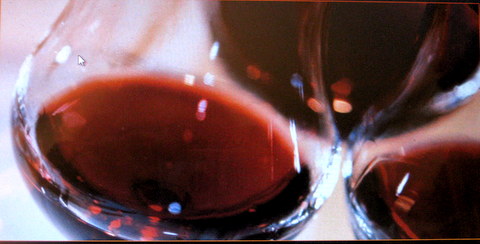
A wine from the Nino Negri Winery, embracing Slow Wine precepts.

The Conte Brandolini Winery has been in the Brandolini family since 1780. The Brandolini estate is beautiful and boasts a lovely villa and gardens.
The Slow Wine guide is published by Slow Food Editore (the publishing arm of Slow Food Italy) and distributed in the U.S. by Chelsea Green. Following the events, the book will be available for purchase nationally on Amazon.com and select retail stores throughout US.
 CAROLE DI TOSTI