‘McNeal’ Robert Downey Jr. a Bravura Performance in a Complex Play

McNeal, starring Robert Downey, Jr., is currently at Lincoln Center’s Vivian Beaumont. The drama by Ayad Akhtar (Disgraced), directed by Bartlett Sher, has sardonic/comedic elements. Akhtar’s work examines the successful writer Jacob McNeal under extreme duress at the pinnacle and nadir of his career and life.
As the play opens in McNeal’s doctor’s office, Doctor Sahra Grewal (Ruthie Ann Miles), reminds McNeal his relapse into drinking is killing him. From this point on, we follow the principal character on his downward journey into the abyss, after he wins the Nobel Prize for Literature. Throughout, McNeal literally and symbolically dies piece by piece, brain cell by brain cell, deep fake digital projection by deep fake digital projection. Thanks to the technical team, the digital designs and projections pop phenomenally. Indeed, they place us in the bubble unreality of Jacob McNeal’s imagination, where emotional grist rarely resonates.
Ironically, the discipline it takes McNeal to win the Nobel Prize for literature, doesn’t apply when he attempts to control his alcoholism. Indeed, a conundrum of side effects from a drug slated to help him stop drinking himself to death makes his life untenable. Addicted, he continues to drink bringing on side effects which include hallucinations, pain and thoughts of suicide. As McNeal bounces between self-loathing and overweening pride, we follow him deep into the bowels of AI assisted writing. Ironically, this hazard removes him further from himself and serves as the last straw which figuratively breaks his back.
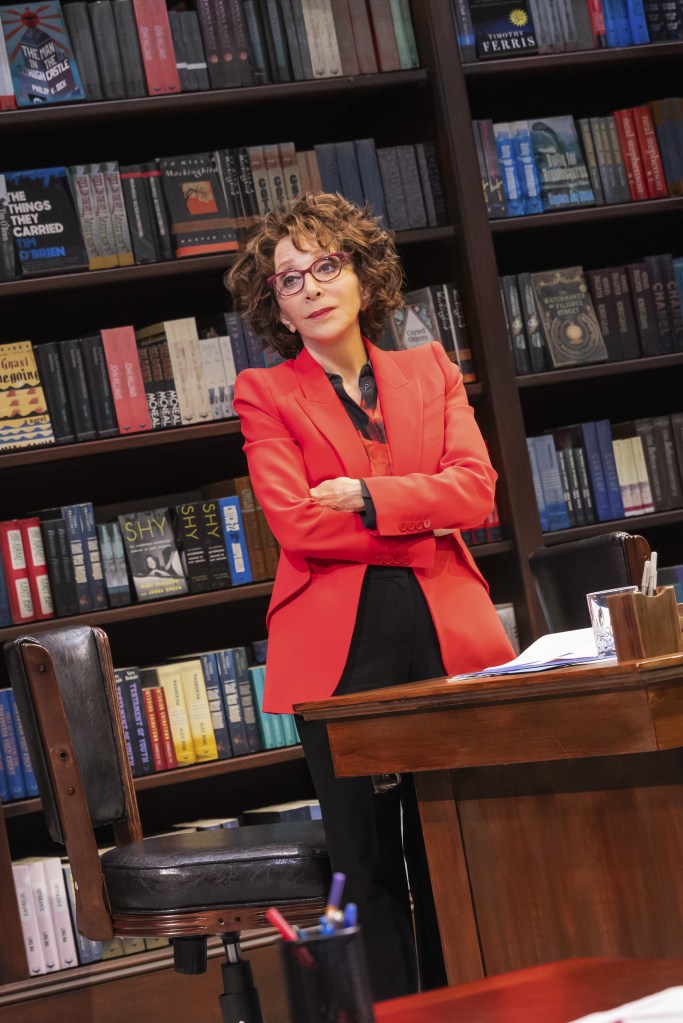
Akhtar/Sher present the glorious image of McNeal as prizewinner giving his speech at Stockholm City Hall using video, then having McNeal step forward in his tuxedo to speak to us, the Nobel audience. After this climax in his life comes the downhill crash. The playwright removes the soul of the prizewinner’s art and exposes the ugliness. Elucidated by the technical team’s sets and projections, McNeal’s mind-bending journey strikes us with wonder, thanks to Michael Yeargan, Jake Barton and AGBO. Finally, Downey Jr.’s keenly woven, provocative interactions with women enlighten us to McNeal’s deep-seated toxic masculinity and admitted feelings of inferiority.
Throughout Akhtar’s interesting work, we experience McNeal’s calm, ironic self-annihilation. Numbly, we watch his digital-symbolic, self-destruction in front of witnesses/characters who don’t understand his destructive journey as they do battle with him. These include his son Harlan (Rafi Gavron), New York Times reporter, Natasha Brathwaite (Brittany Bellizeare), and his former mistress, Francine Blake (Melora Hardin). These are shadows of individuals without definition which McNeal, in a brain fog, uses to pick ax his soul. Will anything be left of him after he finishes?
With sardonic, arrogant aplomb, McNeal rationalizes and accepts himself as a fraud. During each of his interactions, he charmingly employs his antic self-loathing to dismantle himself and drive through to his core truth. Through Robert Downey, Jr.’s fine performance we understand McNeal’s disgust, his masochism and self-betrayal, masked by ego, charm and pride. McNeal may have fooled the world to give him a prestigious prize, but he knows better. He cannot fool himself. And what he seeks he eventually attains by the conclusion.
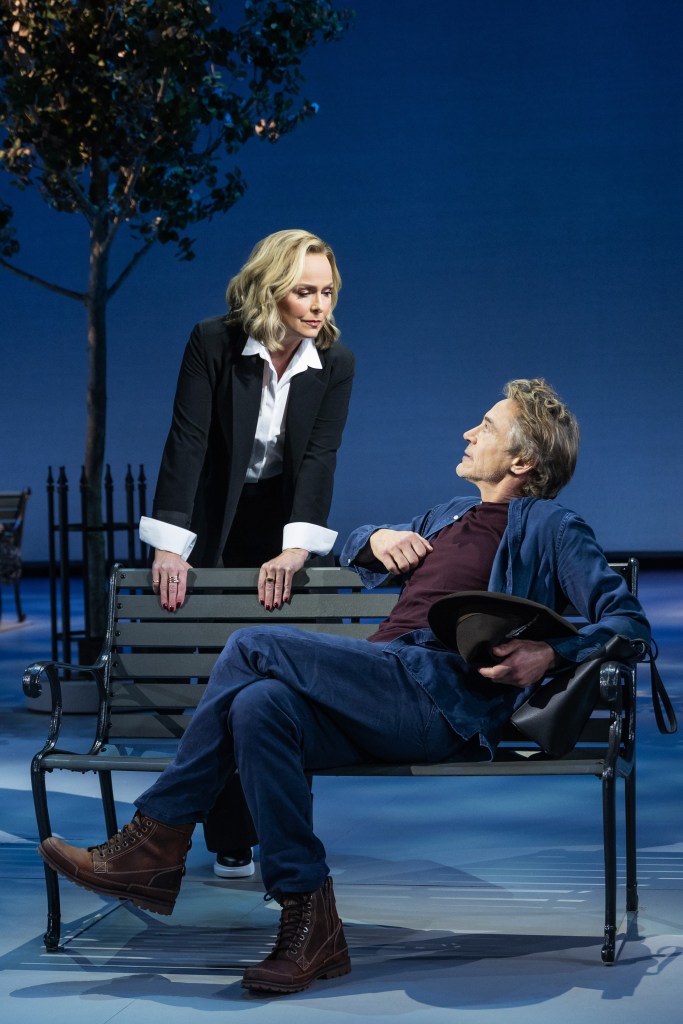
On top of McNeal’s neurotic struggle to “set things straight,” we learn in horror (the writers in the audience, anyway), about his penchant for writerly duplicity. Like a kleptomaniac (a writer’s klepto), addicted to theft, we learn through his confrontations that McNeal engaged self-destructively in plagiarism to achieve his success.
However, plagiarism increases his feelings of inferiority. And it promotes a twisted cycle of repetition. We learn through Harlan’s and Blake’s attacks that McNeal stole from his son’s friend, his wife’s bad novel, Francine Blake’s life, etc.). With these he creates his successful but basely unoriginal works. All of this occurs not without consequence. For he turns from his successes and belittles his creative talent. Ironically, the plagiarism reaches an apotheosis of fraud when he employs the inferior AI program CHAT GPT. Combined with his self-immolating interactions and the drug’s side effects, his use of the program pushes him over the edge. Jake Barton’s projections fantastically convey this as he vomits up stolen words projected on the stage floor.
Interestingly, we see how he employs CHAT GPT in an earlier sequence. Inputting literary works from Shakespeare, Ibsen, Kafka, Sophocles, Flaubert, etc., he examines concepts to explore. Then employs the program to convert these inputs to the style of Jacob McNeal. Each use of GHAT GPT increases his soul sickness.
Sadly, with the exception of his doctor and his agent Stephie Banc, the always wonderful Andrea Martin, no one knows he’s dying. In a strange self-satisfaction he is comforted that the other characters, especially his son, find him as loathsome as he finds himself. Thus, they can offer little comfort which he wouldn’t accept anyway.
In the last scene, McNeal confides in his audience eloquently after striking layers of his fraudulent self against the sharp criticisms of his son, the reporter and Blake. Only then does he attempt to speak in his true voice. But once more, he applies AI, this last time inspired by Prospero in Shakespeare’s The Tempest. How can we trust his narrative? Does anyone reliably, truthfully relate their own story? Robert Downey, Jr. makes a convincing case for our straddling the fence of incredulity, then leaping into the last artifice with him.
Bartlett Sher’s integration of the digital imagery and projections to illuminate McNeal’s imagination and world is spot-on. Likewise, the ensemble, integral players in McNeal’s journey through self-torment, charges the play’s energy. Robert Downey Jr.’s sustained performance gives one pause and intrigues as Akhtar’s confounding character, McNeal.
Though the playwright uses AI as an object lesson and/or bête noire, more importantly, he reveals the kinds of writers who might employ it and why. Lastly, the tragedy becomes that McNeal separated himself from himself in alienation. AI also becomes a symbol or instrument of death, the death of creativity and originality, despite McNeal’s clever justifications for using it.
McNeal runs one hour forty minutes with no intermission at the Vivian Beaumont. It’s a pleasure to see Robert Downey Jr.’s superb performance. https://www.lct.org/shows/mcneal/
‘Our Town’ Starring Jim Parsons, Katie Holmes, Richard Thomas in a Superb, Highly Current Revival

Part of the magic of Thornton Wilder’s Our Town is its great simplicity. In Jim Parsons’ (Stage Manager), facile, relaxed, direct addresses to the audience lie the profound themes and templates of our lives. The revival of Our Town directed by Kenny Leon with a glittering cast of renowned film, TV and stage actors, reinforces the currency and vitality of Wilder’s focus on human lives, and the seconds, minutes, hours and days human beings strike fire then are extinguished forever, eventually forgotten as the universe spins away from itself. A play about the cosmic journey of stars and their particle parts in human form in a small representational town on earth, Our Town is iconic. Leon’s iteration of this must see production runs at the Ethel Barrymore Theater until January 19th.
The three act play is in its fifth Broadway revival since the play premiered in the 1930s. This most quintessential of American plays appeared on Broadway when the United States was in the tail end of the Depression during a period of isolationism, and concepts about Eugenics from American researchers had been adopted by the Third Reich to effect their legal platform for genocide. At a curious turning point in American history before a conflict to come, Wilder’s work about life and death in small town Grovers Corners in the fiercely independent state of New Hampshire represented a symbolic microcosm of life everywhere. Perhaps, the play’s themes, especially in the third act were a harbinger, and a warning. In its theme, “we must appreciate life with every breath,” was prescient because WWII was coming to remove millions in a devastation that was incalculable, noted by many as the “deadliest conflict in human history.”

Despite its stark ending and in your face “memento mori,” Wilder’s play found and finds an appreciative audience because of its universality and unabashed assertions about our mortality, walking unconsciousness, and refusal to remain “awake” to the preciousness of our lives.
Indeed, the play has continued to be widely read and performed globally in commercial theater, as well as educational institutions. Leon’s production is no less riveting than other revivals and is even more elucidating and vital in its stylistic dramatic urgency. This is especially so at this point in time, at the eve of a crucial period in our body politic, when we are deciding between two pathways. Do we want to continue to uphold the inexorable verities expressed in Wilder’s themes about living with as much equanimity as possible in a democratic nation that respects the peaceful transfer of power as Grovers Corners symbolizes in Leon’s production? Or do we jettison the rule of law, and the peaceful transfer of power in the US Constitution for a dictatorship in which not all lives are equal or valuable but one life must be bowed down to unequivocally?
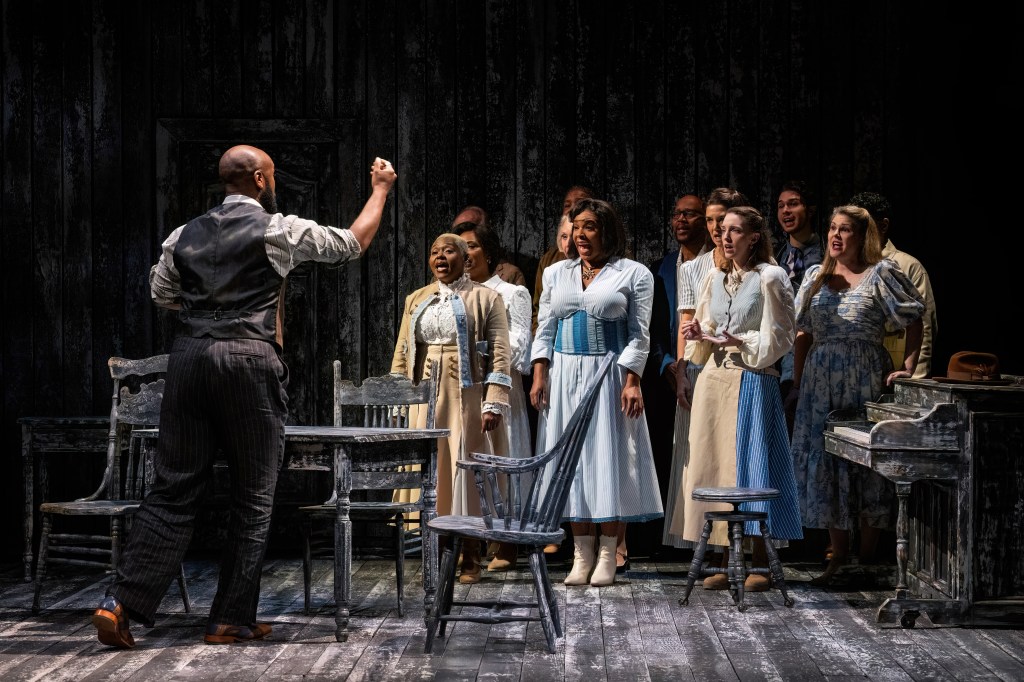
Leon’s direction stands in with the former, primarily in the production’s inclusiveness of a diverse group of actors representing Grover’s Corner’s accepting, and non judgmental townsfolk as they go about their business. The business of being human, Wilder divides into three segments (Daily Life, Love and Marriage, Death). Through the omnipotent Stage Manager, which Jim Parsons portrays with a low-key, pleasant avuncular and philosophical style, we quiver at his ironic, pointed rendering of life on this planet.
At the top of the play, the brisk, time-conscious stage manager, after detailing the ancient geological foundation of Grovers Corners, introduces us to the two families which Wilder highlights throughout the play to note their arc of development. Doc Gibbs (Billy Eugene Jones), the local physician, and Mr. Webb (Richard Thomas), the editor of the Sentinel are neighbors. At the turn of the century their wives, like most married women of the time, stay at home, do the housework and prepare meals, none of which is relieved by modern mechanical devices. We learn Mrs. Gibbs (MIchelle Wilson), and Mrs. Webb (Katie Holmes), “vote indirect,” which is to say women are considered incapable of making a rational voting decision.

However, the Stage Manager’s two words hold more weight than he seemingly intends to give them. Instead, he glides by the import of sociopolitical trends because it is unrelated to the cosmic picture alluded to by Rebecca Gibbs (Safiya Kaijya Harris), at the end of Act I. Indeed, the universal themes Wilder drives at do not focus on specific political details. Wisely, Leon takes his cues from the script having Parson’s Manager speak about the titles of the acts as dispassionately and unnuanced as possible. Importantly, Leon “gets” that the functioning of the town, symbolically rendered and opaquely stylized is how Wilder achieves the ultimate impact of the powerful conclusion about appreciating life each day we live it, as insignificant and boring as it may seem at times.
After we meet the children at a breakfast prepared by Mrs. Gibbs and Mrs. Webb via pantomime, the Stage Manager provides the locations of key places like the Post Office, the newspaper office, etc., and reminds us of the town routines, i.e. the train’s arrival and departure, milk and paper deliveries, etc. In the another part of the act, we meet the children who get hooked up in Act II, George Gibbs (Ephraim Sykes), and Emily Webb (Zoey Deutch).
Also, clarified is the town “problem,” Simon Stimpson (Donald Webber, Jr.), who we meet as the play opens when Simon Stimpson conducts the choir in a lovely song. Stimpson becomes the subject of gossip because choir members know he drinks and is drunk a good deal of the time. Mrs. Soames (Julie Halston) gossips about Stimpson and is hushed up by Mrs Gibbs, who tells a little white lie that Stimpson is getting better, then later tells her husband he is getting worse. Webber, Jr. is masterful in the small part. Clues are given about Stimpson’s future, as the character is referred by townspeople in Act I, with some questioning and not knowing “how that’ll end.” Eventually, the Stage Manager shows us how it “ends,” in Act III with Stimpson commenting about life and Mrs. Gibbs responding to him. Whose view should we accept? It, like this production, is open to interpretation.

Three years pass between Act I and Act II, and Parson’s Manager officiates at the marriage between Emily Webb and George Webb, after showing the event which reveals that these two individuals are special and their relationship which is “interesting” is grounded in being truthful to one another. The marriage scene which has been a bit tweaked and slimmed down from the original play, does include the Stage Manager philosophically discussing marriage and particularly George and Emily’s marriage when he says, in part, that he has married over two hundred couples and continues, “Do I believe in it? I don’t know. Once in a thousand times it’s interesting.” Again, we realize the profound comment and question what “interesting,” means.
In the last act which the production speeds to with no intermission as it clocks in at a spare one hour and forty-five minutes, Wilder’s vaguely spiritual metaphors are touching and poignant, despite the production’s bare bones lack of sentimentality. Warning, here is the spoiler, so don’t read the rest of the review if you are unfamiliar with Our Town.
Wilder’s third act resonates with symbols of death, as “the Dead” sit together on chairs as Parson’s unemotional Stage Manager describes the hillside cemetery. Importantly, the lack of Parsons’ emotion stirs the audience deeply. And in Leon’s production, the stylization in the previous acts makes the power of Emily’s return to see and live through her 12th birthday even more potent. Newly dead in childbirth, the Stage Manager gives Emily the privilege, which he says all the dead have, to return to a day in her life to relive it. The morning of her birthday, Emily watches herself, symbolically live without the realization that she will be dead in less than two decades later.

After commenting at how young her parents look and recognizing their love and affection, her pain at her obliviousness to life’s beauty overcomes her and she wants to leave to go back to the cemetery, a lovely spot where her brother Wally, Mrs. Gibbs, Simon Stimpson and Mrs. Soames wait for “something to come out clear.”
Emily’s dialogue is breathtaking and Deutch gets through it with less emotion and passion than is probably required for the audience to feel the reality of her words. “So all that was going on, and we never noticed.” And perhaps more emotion is needed as Emily asks the Stage Manager, “Do any human beings ever realize life while they live it? – every, every minute?” The audience in shock silently answers for itself as the Stage Manager responds.
This is the cruel and truthful heart of the play, especially experiencing it through the character of Emily and the Stage Manager’s comforting but remote words which somehow fall ironically when Parsons says, “No. The saints and poets,maybe – they do some.” However, only in death does Emily realize the suffering pain of not appreciating and being grateful for every fabulous, wondrous moment of life.
Certainly, Wilder needs to hit his audience over the head, and they walk out silently receiving the message, then days later forget it. However, for the moments when Leon, Parsons, the cast and the superb and lovely lighting and staging hold us, we “get it.” And we are grateful for teachable moments received through the actors’ fine efforts, the creative team’s craft and Leon’s minimalist stylization. And we appreciate the rich fullness of each gesture, word and grace delivered to make us get in touch with ourselves in our own Grovers Corners’ life.
Kudos to all involved in this magical production. Thornton Wilder’s Our Town runs one hour forty-five minutes without an intermission at the Ethel Barrymore Theatre (243 West 47th Street). https://www.ourtownbroadway.com/?gad_source=1&gclsrc=ds
‘From Here,’ Poignant, Uplifting Musical, Theater Review

From Here, the musical by Donald Rupe, with arrangements and orchestrations by Jason M. Bailey, is a framed story told by the delightful narrator, Daniel (Blake Aburn), a gay man in Orlando, Florida. Daniel journeys us through his relationships with his selected family of friends and lovers, as he confronts his estrangement from his single mother.
From Here is a revelation of love and hope, as the musical’s events beginning in January of 2016 hurtle us toward June 12th, the date of the Pulse Night Club shooting, the largest mass shooting in the United States up to that point in time. Currently, the musical is running with no intermission at the Alice Griffin Jewel Box Theatre, at the Pershing square Signature Center until August 11tth.
The musical opens with Daniel’s introduction of himself, his problems and his friends who help him relate his angst at this time in his life. Blake Aburn’s Daniel focuses on his mother whose love he craves as he calls her every day, though she refuses to pick up. Though the reasons for their alienation are not revealed initially, in the tuneful song “Where do I go?” which begins “Hey Ma,” we learn the backstory of his love for his mother, her ambivalence toward him and his life questions about his future. Then, as this introductory song continues, we meet his partner Michael (Julien Aponte), and they go clubbing.

At the club, their friends pick up the refrains of the song which concludes the first scene. Thus, we have a picture of Daniel and his friends who are the players whose lives will be impacted by the shooting in June. Importantly, we note that Michael and Daniel’s relationship appears comfortable and warm. We learn it has burned brightly for seven years then blow”s up in the next scene when Michael dumps Daniel, who admits Michael’s reasons for their split are right-on. After they split, they decide to remain friends.
Another key figure in Daniel’s and his friends lives is Jordan (Michelle Coben), a petite but mighty powerhouse of a club singer who invites Daniel to her performance and also invites his mom to bring them together and smooth over their separation. As his mom, Becca Southworth spills her emotions about her failed marriage and her alcoholic husband who blamed Daniel’s homosexuality for leaving. Unable to assuage the guilt she feels, she carries her wounds around with her, and like Daniel, is forced to reconcile a situation which neither she nor Daniel are responsible for, but is dumped upon them by an emotionally damaged and sick man.
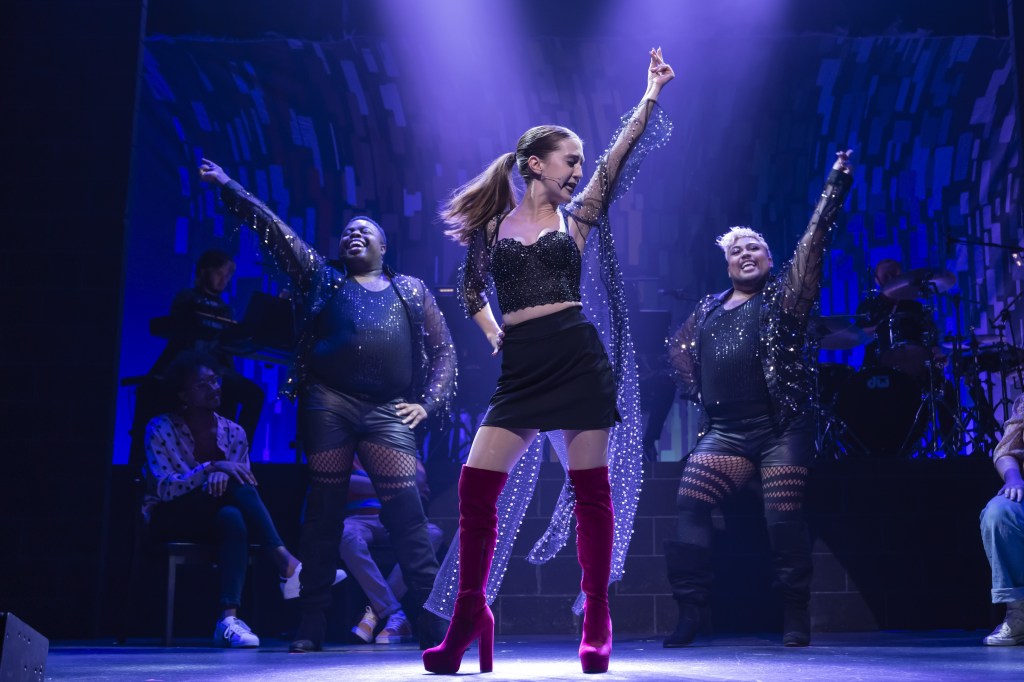
After his breakup with Michael, Daniel meets Ricky and forms an attachment which is binding by the end of From Here. Shy, awkward and sweet, Omar Cardona, as Ricky is embraced by Daniel and his family of friends. Cardon’s Ricky has an incredible voice and a deep heart. As the friends gather for togetherness and comforting, whether for fun, for a birthday party of just to hang out, we note how these gays and Jordan who is straight but who enjoys the warmth and non-judgmental attitude of these friends/family, remain uplifted despite whatever happens. This is especially so after they learn of the shooting in a scene of shared humanity, love and feeling as one after the other they confess their weaknesses and gain strength from their truthfulness to each other.
As the narrator who guides us from beginning to end with a variety of songs, monologues, beautiful philosophical bits of poetry (I.e. “Hand in hand, Time and her lover, Regret, dance circles around us, their loyal subjects.”), Daniel’s pointed self-reflection as a gay man strikes us as we note he hopes to evolve to a place where he is comfortable. The monologues and various bits are authentic and well-written by Rupe. Blake Aburn also grows upon the audience with his familiarity and confessional tone, winks and endearing expressions which he uses as Daniel twits himself and lets the audience in on his humorous self-deprecation.

Though he doesn’t take himself seriously for the most part, Daniel does take his relationship with his mother very seriously. When she doesn’t receive a call from him the night of the shooting, the only day he did not call, she is beside herself. He is sorrowful for causing her suffering. It is then he realizes the great love, perhaps unacknowledged before, between them. Their reunion is touching and leads to the last scenes of the play where the family of friends gathers together to uplift each other and speak a memorial to those who lost their lives in a senseless needless killing spree of hate.
By the conclusion, the musical’s themes are apparent. Without the friendships and love of community, we are lost. It is the lack of the friendship and love of community that caused a killer to wreck a vengeance of hate to answer the misery of his failed life. Without collective bonding and sharing of love, whatever one’s sexual preference, humanity can face little safely, and the darkness overwhelms. But the light of love and friendship sustains as friends go “from here,” to spread to others, what they’ve found with each other.
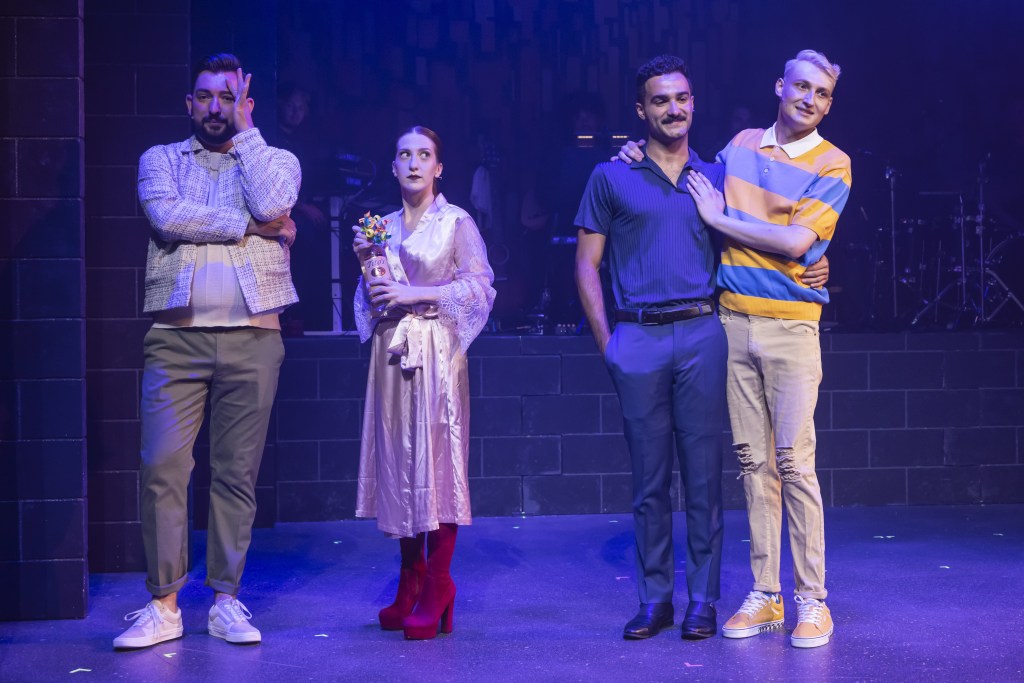
Importantly, Daniel concludes with the aftermath which establishes the goodness of people despite the horror of one night. Daniel remarks that Orlando has changed.
“For months after Pulse, each night the skyline would light up in Rainbow lights. Murals dedicated to angels appear when you least expect them to. There’s more art now. People stare less.” (at the gay-ness expressed). Daniel also reflects about the “quiet monument where Pulse once stood. It’s a rare time that you drive past and there isn’t someone sitting, quietly paying their respects.”

Rupe’s contemporary score succeeds lyrically because of its pop-ballad simplicity and repeated refrains of melody that are memorable, especially in the opening song. For example, the vital and effective “I love you/I miss you/I’m sorry” theme is resonant and a foreshadowing of the musical’s finale when we imagine that those words were said to those who were killed. Though the four piece band (bass, guitar, keyboard, and drums) accompanying the performers is excellent, the sound system (Matt Craig), needed adjusting the evening I saw the performance. Sometimes, the lyrics in the group numbers were unclear. However, that is not only in this show. Annunciation is a dying art in theater, oftentimes.

Rupe, who also directed, keeps the staging and scenic design spare and minimalist thanks to Philip Lupo. That simplicity serves to emphasize the dialogue and songs well, without any unrelated extravagant numbers distracting. All coheres in unity. Choreography is by Adonus Mabry and costume design is by J. Marie Bailey.
As a unique regional theater production, presented by Renaissance Theatre Company, which has transferred to New York’s Off Broadway, From Here succeeds largely because it doesn’t focus luridly on the Pulse mass shooting, but allows it to hover in the background. Indeed, Daniel’s narrative in songs with good will and humor presented to an interested audience occurs as a retrospective, a flashback of events leading up to that horrific night. And seen in light of the wisdom that memento mori, Daniel is chastened, and grateful for all he has, especially his community who are unique and wonderful.
From Here runs with no intermission for 1 hour 40 minutes. For tickets go to the box office at Pershing Square Signature Center or online at https://fromhere.com/
‘Here There Are Blueberries,’ No Evil. Just Ordinary, Enjoyable Routines.

Here There Are Blueberries, now in its third extension at New York Theatre Workshop, is a many-layered, superb production running until June 30. Stylized and theatricalized as a quasi-documentary that travels back and forth from present to past to present by enlivening characters in various settings, the play unravels the mysteries centered around an album of 116 photographs taken at Auschwitz. Though the album has no photographs of the victims to be memorialized, it eventually is donated to archivists at the US Holocaust Memorial Museum, by a retired U.S. Lieutenant Colonel.
Based on real events, interviews, extensive research and photographs rarely seen of the infamous concentration camp from another perspective, the play follows archivists who shepherded the photographic artifacts toward a greater understanding of the political attitudes and the daily routines of the people who ran the camp. Written by Moises Kaufman and Amanda Gronich, and directed by Moises Kaufman, Here There Are Blueberries is a salient, profound work that has great currency for our time.
With expert projection design by David Bengali, Derek McLane’s scenic design, which suggests the archivists’ workplace, and Kaufman’s minimalism, characters/historical individuals step forward to bear witness, like a Greek chorus, to speak from the ethereal realms of history. The play which has some Foley sound effects for purposes of interest, dramatizes scenes which hover around a concept. All of the fine artistic techniques by Dede Ayite (costume design), David Lander (lighting design), Bobby McElver (sound design), further the plays probing themes which examine questions the researchers ask about those who murdered and why they murdered. As the drama poses questions to its audience and itself, some, the play answers. Others, the audience must answer for themselves.

At the outset, a narrator explains the importance of the Leica camera for the people of Germany in the 1930s, when the society was at a crossroads after economic depression and the reformation of Hitler’s new government. Perched on a stand center stage is the camera in the spotlight, while projections of black and white photos scroll in the background, exemplifying the subjects taken by people using it. Some are of German people enjoying family events, as we note the narrator’s comment that in Germany, amateur photographers took up the activity as a national pastime and became “history’s most willing recorders.”
As the photos scroll showing stills of children and young adults giving the Hitler salute, the narrator suggests that “each frozen moment tells the world this is our shared history.” Her tone is ironic and the Hitler salute, as terrible as it is, physicalized by the bodies of children, indicates an alignment with Hitler’s politics, attitudes and way of life. Additional photos of children and adults enjoying outings, show Nazi flags; the narrator continues, the “apparent ordinariness of these images does not detract from their political relevance.” Indeed, she states, “On the contrary: asserting ordinariness in the face of the extraordinary is in itself, an immensely political act.”

In photographs and videos of Hitler’s marches by soldiers of the Third Reich (shown in the Nazi propagandist films of Leni Riefenstahl, etc.), we note Nazi militarization and might, which after a while are easily relegated to “the past.” Photographs throughout the play’s album note the Nazi flag, Hitler salute and SS uniform as a common fact of life lived at that time. Indeed, Hitler’s politics became the breath of life itself and all aspects of the German people’s existence and happiness were intertwined with Nazism, Hitler’s “great” leadership, his conquests, economic prosperity, and the ready identification with all of this by the average German. This was so until things went terribly sour and German war losses multiplied.
However, the Third Reich’s asserting ordinariness and commonality, when in fact it was anything but, is one of the concepts the archivists deal with throughout their journey to organize the photographs, categorize them and analyze what they are looking at in the photo album of the SS’ lives at Auschwitz.
The playwrights introduce us to the archivists in the second scene. It is then Rebecca Erbelding (Elizabeth Stahlmann), first reads the letter from the Lieutenant Colonel notifying the museum that an album with photographs from Auschwitz that he possesses might be of import. From that juncture on, we become engrossed in the archival journey as the researchers, experts and others delve into the album and attempt to understand it. Curiously, there are no photos of the victims and prisoners of Auschwitz.
As they take on the difficult task and uncover details through trial and error, eventually, researchers bring together the puzzle pieces which explain the photographs and identify the SS officials and the various workers up through the hierarchy, who helped Auschwitz seamlessly function. Clearly, Auschwitz was a huge endeavor that contained an industrial complex and barracks for laborers, housing for guards and administrators alike, and a killing machine and ersatz assembly line of death.

After pinpointing the owner of the album as Karl Höcker, who moved his way up to become the administrative assistant to the head of Auschwitz., the archivists (who also bring to life Karl Höcker and others via dramatization), gradually explore the lifestyle of those in the photographs. These include the SS guards, top brass, doctors, various secretaries (Helferinnen, who were in communications, etc., and held jobs at the camp), staff and others having meals, relaxing at a nearby resort and more daily activities.
None of the photos show the functions of Auschwitz, the prisoners, victims or crematoria. All is pleasant and reflective of the wonderful world that Hitler spoke about bringing to mankind after the “vermin” were removed. That the Helferinnen were photographed surprised a number of researchers who wondered if the young women knew about the gas chambers in the camp or smelled the acrid air of burning flesh in the crematoriums. After denials and relatives probing and finding innocence, what the women knew is later answered by one of the secretaries who was at Auschwitz. She was questioned after the war. Charlotte Schunzel stated she and the other women recorded how many were sent to hard labor and how many were sent to SB, “special treatment,” a euphemism for the gas chambers.
The archivists pin down the identity of the SS officers and high command in the photographs, one of whom was the notorious “Angel of Death,” Dr. Menegele. Another is the commandant who set up Auschwitz-Birkenau, Rudolph Höss. The researchers determine that the photos are like selfies that reveal the happy life of Karl Höcker (Scott Barrow), who would have been a “nobody” if he had not joined the Nazi party in 1937 and arrived at the camp in 1944, just in time to help “process” the thousands of Jewish Hungarians (350,000), who rode in trains three days, only to be murdered in gas chambers after they arrived.

Kaufman and Gronich seize our interest especially when actors take on historical personages, relatives of the SS, survivors, researchers, historians and others. in view of the audience, actors create Foley sound effects to usher in events and accompany Erbelding, Judy Cohen (Kathleen Chalfant), Charlotte Schunzel (Nemuna Ceesay), Tilman Taube (Jonathan Ravlv), Melita Maschmann (Erika Rose), Rainer Höss (Charlie Thurston), Peter Wirths (Grant James Varjas), and others as they uncover bits of information and puzzle together what is happening in each photograph.
The global attention the album receives (revealed by projections of headlines), brings new interest and revelations, some by grandchildren of the SS who are horrified to see uncovered aspects of their relatives they didn’t want to imagine. These aspects have been kept hidden from families out of shame and especially to avoid accountability. Perpetrators of murder and the accomplices to murder are still being located and held to account, even as recently as the last two years. Murderers and the complicit and culpable had a great need for covering up their crimes, as long as they were alive.
Another revelation comes from Holocaust survivor Lili Jacobs, who contacts archivists, as a result of the press reports. She had been holding on to an album she uncannily found of 193 photographs of the Hungarians arriving on the trains, all of whom were “processed” by the SS and high command in the photos. After she donates her album (it contains pictures of herself and family taken by the SS in the camp the day she arrived from Hungary), the researchers are able to solve the dates of the mystery of one photo which shows all the SS, high command and workers celebrating at Solahütte (a resort), where Karl Höcker occasionally rewarded the SS guards, workers, Helferinnen etc., when they did something special.
One example is given when guards prevented an escape by killing four prisoners. Administrator Höcker rewarded them for their “courage” by sending them to Solahütte for a few days.
Previously, the archivists couldn’t understand what and why the large group of camp officials, workers, drivers, Auschwitz staff, referred to by one archivist as the “Chorus of Criminals,” were photographed celebrating. However, through interviews with experts, and piecing together the facts, they divine why the entire group of Auschwitz Nazis standing and smiling, were enjoying the accordion music in one, fine, inclusive photograph, from the top brass in the front, to the lowly staff standing on a hill in the back.
With the evidence of the two albums together, archivists complete the full story of murderers and victims. The victims in Jacobs’ album were those who arrived in train transports from Hungary. The photographs included photographs of Lili and her family and her rabbi, right before they were separated into the lines for labor camp and gas chambers. In Höcker’s album, the administrator assembled and photographed the “Chorus of Criminals'” photograph for a vital reason. The murderers celebrating at Solahütte were congratulating themselves. They had successfully finished a job well done, the massive operation, processing Hungarians, dividing and selecting, so that 350,000 could be exterminated, among them Lili’s parents and two younger brothers.

Through their research, archivists discovered that Lili arrived one day after Höcker arrived at Auschwitz. He most probably received a career bump up to administer the massive “Hungarian Project.” In light of Lili’s discovery and sharing it with the archivists at the museum, she and they “get the full picture.” She sees the identity of the men who murdered her family. Finding the album of herself in the tie in with the album of the SS who ran the camp is an extraordinary sequence of events that is beyond coincidence. For her, the discovery is mystical and divinely spiritual.
Ironically, in Here There Are Blueberries, the victims that the Holocaust Memorial Museum has been so diligent about uplifting and respecting are not the only ones to be considered in studying and understanding the Holocaust. The innocent victims, indeed, were the extraordinary ones in Hitler’s politics that had infiltrated into the bones of the German people, but not the bones of the innocent ones ravaged by acts of the brutal tragedy delivered for the “good of the nation” in its lust for domination. The victims’ impossibly painful stories of survival or loss, escape, surrender, the trauma, and the horror, shock, astound and enrage.
That the ones who perpetrated murder and genocide were able to do it day in and day out as a matter of routine, a job to be done, exemplifies the normalization and internalization of a monstrous political attitude. That attitude that the SS, many Germans and surrounding cultures (i.e. Austria) adopted as right and true, a way of being, a way to live one’s life, which necessitated that others bleed and die for it as a general social good, is evidenced throughout Hocker’s album of photographs of the SS’s smiling faces as they perform daily activities.
It is this above all that Kaufman and Gronich bring to the table and highlight like no other work, with the exception of Martin Amis’ novel Zone of Interest, about the life of Auschwitz commandant Rudolf Höss, which was recently made into a film, directed by Jonathan Glazer. However, unlike Zone of Interest, Kaufman and Gronich don’t include responsive photos to the crematoria. All photos of camp function and purpose are missing. Only in Lili Jacobs’ companion album do we note the horror of the transports and the photos of her rabbi, her parents and siblings who died.
The photos of those accountable for all of the activities at Auschwitz, their reason for being there-to kill, oppress, subjugate and promote the war effort-is implicit. Their very images in the photographs stink with the noisome odor of the gas chambers. The absence of the victims and any evidence of the killing machine, a final realization of the archivists who investigate the album, if anything, incriminates all of the SS officers even more in their guilt. If they were innocent and in the right, why did Höcker need to edit out the buildings of the killing machine, the prisoners and torturing that happened in the labor complex? Why did he need to present his album of “happy days are here again?” when obviously the smoke of the burning had to be hidden?
In the archivists’ explorations they learned the backgrounds of the SS running the camp were ordinary-former clerks, bank tellers, confectioners, teenage girls. We are prompted to ask what separates these murderers and accomplices to murder from the rest of us? Stating the Nazis were monsters allows us the luxury to say “we are not like them.” It dupes us to think we would never be caught up as these were, convinced in the rightness of their actions. This is a dangerous attitude. Indeed, playwright Kaufman reflects the overriding theme of Here There Are Blueberries when he states that “the Nazis were not monsters-they were normal people who did monstrous things.”
How are political cults convinced of their rightness convinced to murder for the right? How did the January 6th insurrection fomented by a sore loser with revenge on his mind to punish his VP because he didn’t do what “was right” happen? Are there any elements that might be compared? This amazing play is filled with parallels to our time, as it raises profound questions about our humanity. For that reason, as well as the fine dialogue and overall presentation and ensemble work, one should see this play.
Here There Are Blueberries runs 90 minutes with no intermission at NYTW on 4th St. between 2nd and the Bowery. Don’t miss it.
‘Home,’ The Journey of a Lifetime in Wisdom and Poetry, Review

With lyricism and poignancy in this Roundabout Theatre Company revival of Home, directed by Kenny Leon, Samm-Art Williams spins a story of life’s rhythms, spanning decades during the Great Migration, the time when thousands of Blacks moved with hope to northern cities, leaving Jim Crow’s economic oppression and lynching violence behind. Williams’ covers distances and cultural spaces, all the while evolving his protagonist’s mental, physical and spiritual well being. Home has been receiving a “warm welcome,” at the Todd Haimes Theater, after a prolonged lapse since its original production in 1980 when it was Drama Desk and Tony-award nominated.
Starring Tory Kittles as Cephus Miles, newcomers Brittany Inge and Stori Ayers, portray a multiplicity of characters (40+) from family members to the men and women positively or negatively rubbing up against Cephus on his journey to self-realization. Williams’ representatives move us from a tobacco farm in Cross Roads, North Carolina to a prison in Raleigh, to a northern city (New York), of subways, a roiling, feverish, chaotic place for Cephus that spills out a never-ending cacophony of noise, colors, struggle and conflict.
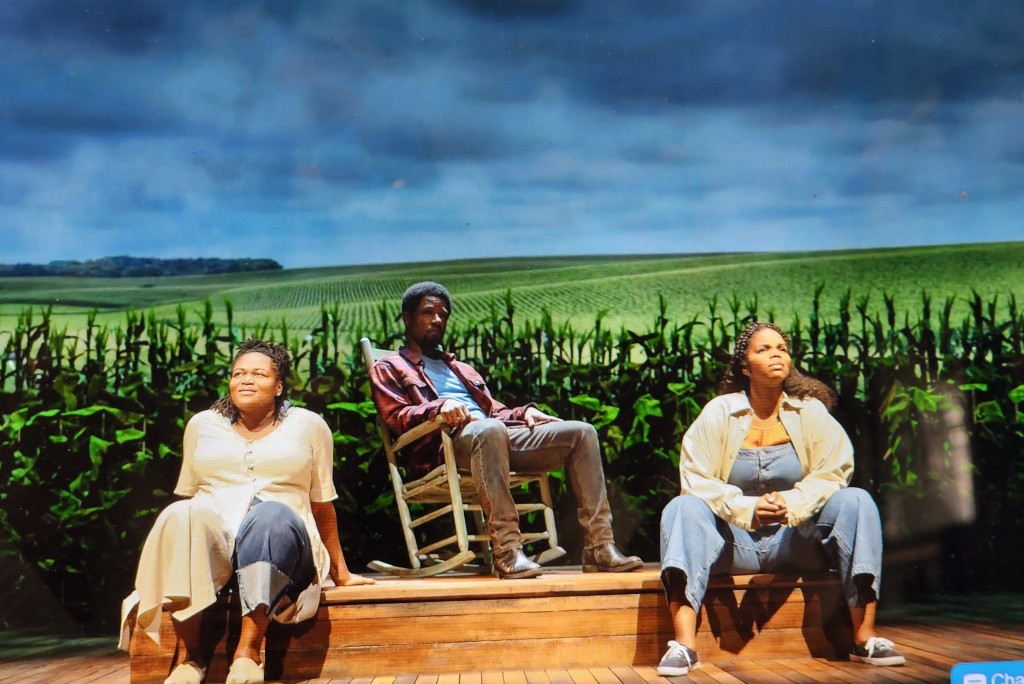
Then finally, a battered, bruised and reformed drug and alcohol-addicted Cephus has had enough. By that point, he has died to his ego to return home to the rich black soil he thought he had lost, and God’s grace, which was apparently late in coming, but actually was with him all along.
It takes wisdom to know that God has been with him, which he has obviously gained as it is subtly expressed by the ersatz Greek chorus (Inge and Ayers), who introduce the theme of God’s grace which we and Cephus learn abides throughout his life. (“If there was ever a woman or man, who has everlasting grace in the eyes of God. It’s the farmer woman… and man.”) As Inge and Ayers repeat these affirmations as Woman Two and Woman One at the top of play and in a brief song and rhythmic summation of the life of the farmer/sharecroppers who labored and sweat under the sun, then left for the cities, they state that one “fool” came back. And Cephus, “the fool” sits in a rocking chair center stage listening to them.
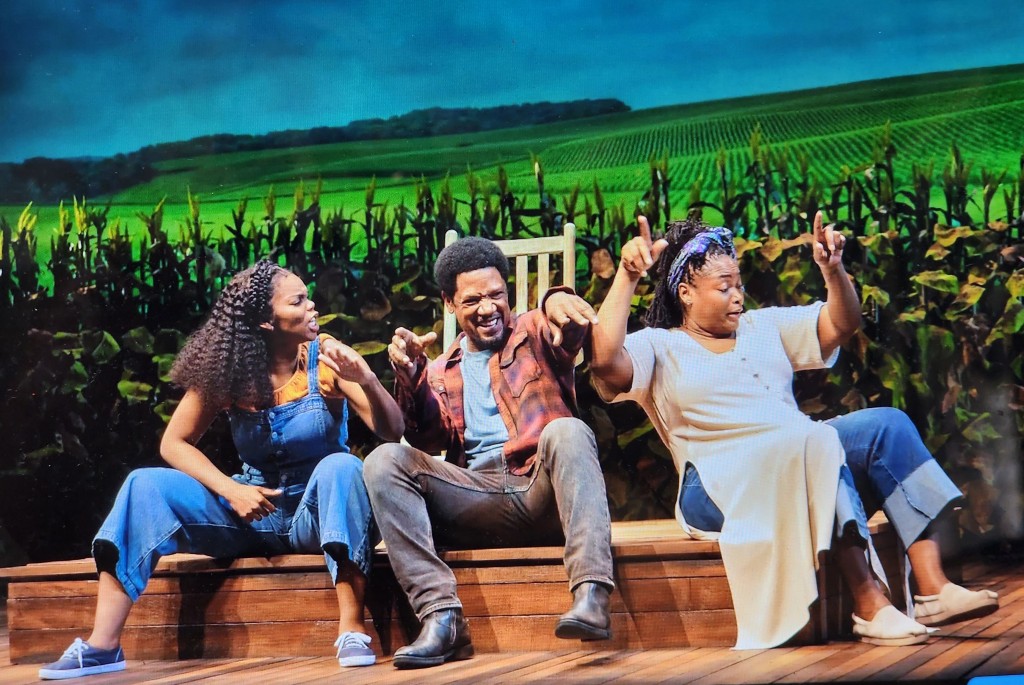
Cephus, is anything but a fool. His travels have converted him to a contented man of wisdom who has learned, through patience, the hard lesson of God’s everlasting grace. Though we don’t realize it at the top of the play, Cephus has returned from his odyssey. The townspeople’s myths swirl around him (via Inge and Ayers), and town children (Ayers and Inge), whisper the rumors, “Old Cephus Miles. Can’t be saved,” that “he’s dead,” that “he’s a ghost,” as they throw rocks at the windows of the “haunted house,” where he has returned to claim “I’m alive,” “I’m flesh, blood and bone.”
The play is Cephus’ lyrical and dramatic life told in flashback, at times in and out of sequence, like an epic tone poem with the chorus (Ayers and Inge), at the ready to activate his narration, an exegesis exploring and explaining the spiritual text of the grace that threads through his life.
Against a backdrop of tobacco plants, corn stalks, golden lighting by Allen Lee Hughes and a projection of distant acres of crops to the horizon line (the projection changes when Cephus moves to the city), Leon employs a symbolic minimalism of set and props (set design-Arnulfo Maldonado). He adjusts scene changes based on the dialogue and simple objects, a box, a chair, a drop-down cross. Dede Ayite’s costumes and Ayers and Inge’s hair (Nikiya Mathis-hair & wig design), essentially remain the same with a few additions and subtractions (hats, scarves, hair let down-a wig). Miraculously, Leon’s simplicity which fits the thematic, lyrically flowing style of this work, is not only fitting, it is revelatory. However, it is also arcane and opaque at times.
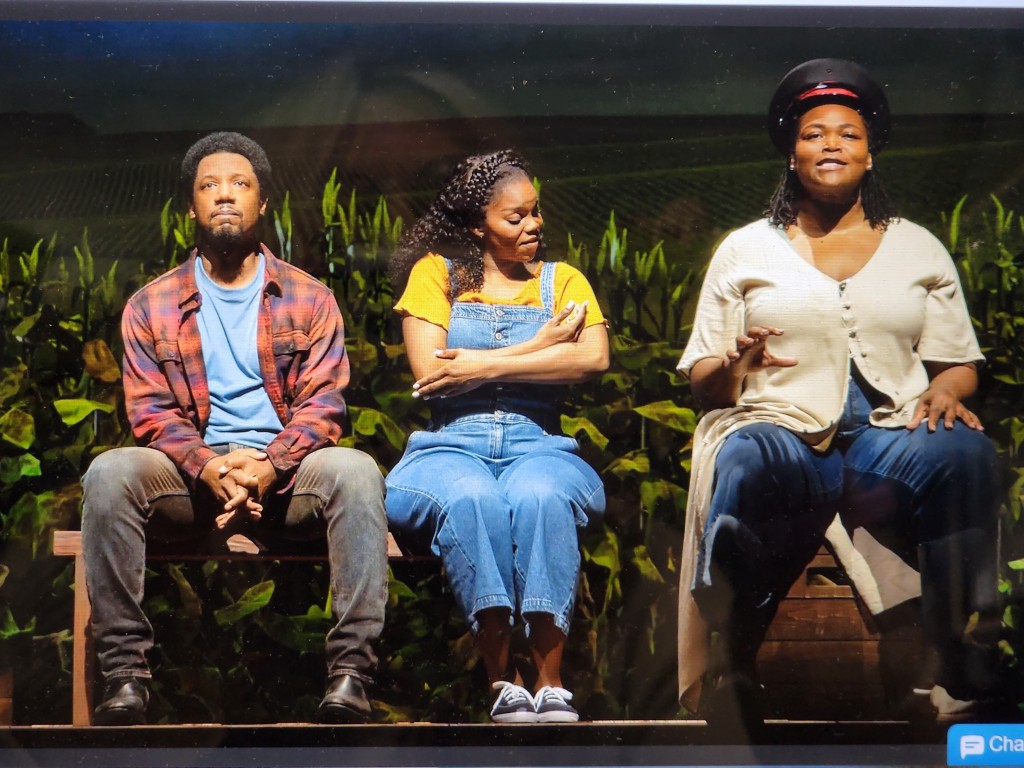
Ultimately, Williams/Leon’s symbolic translation of Cephus’ seemingly “ordinary” existence becomes a spiritual guidepost that focuses on uplifting the souls of those who witness it. Thus, we gradually understand why Cephus quietly dismisses the extraordinarily horrid conditions of racism in the Jim Crow south. Slowly we realize how he withstands injustice related to his poverty and lack of education. That impact is demonstrated when Cephus, unlike those whites who paid to get bone spur deferments or were deferred by college, is drafted during the Viet Nam war. Many Blacks who were unable to get such deferments fought and died in the jungles. He reads the letters of two friends who warn him off going to fight.
But fear didn’t stop Cephus from serving. God’s commandment, “Thou shalt not kill,” stops him. A religious conscientious objector, he spends five years in prison because he refuses to kill in battle. After his imprisonment, Cephus gives up sharecropping and heads north. He has tethered his happiness to Pattie Mae, the love of his life, and thinks he may get an education and “improve” himself like she did. Her mother prompted her to go north, get an education, became a teacher and forget about marrying Cephus because she was “better” than he.
However, at this point in his life, destitute and without friends or shelter, somehow Cephus ends up in the city where life befalls him as he waits for God to “come back from Miami” and help him deal with countless issues. Life takes an unbelievable turn for him and he questions God’s absence. With humor Williams relates Cephus’ travails and shares stories out of the traditions of citified Black folk and stories from his country childhood, i.e. his time in the hayloft with Pattie Mae, gambling in the cemetery with friends, loss of close family members and more. Home presents the important and crucial moments in Cephus’ life under the long arm of God, who he prays to, sometimes.
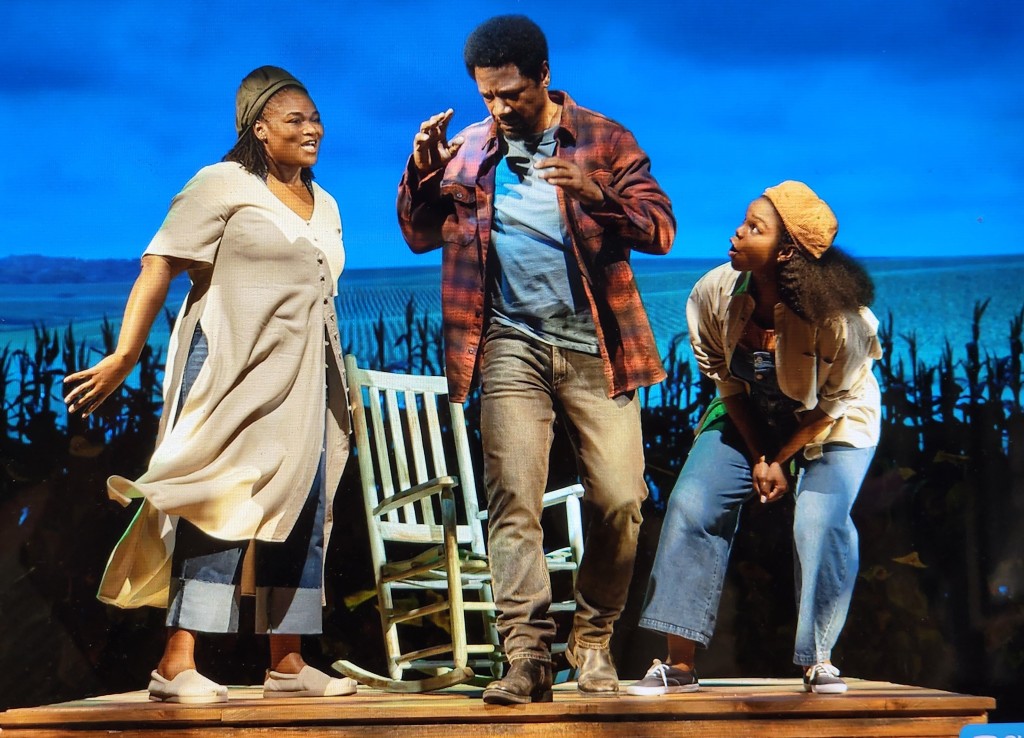
Caught up in the emotionalism of his pain, Cephus, delivered in an incredible performance by Kittles, draws us in and keeps us engaged with humor bytes and memes that reoccur and have their final concluding day. The ending is more than a satisfactory relief and it is the first time we see Cephus grin from ear to ear. Indeed, he has come home in relating and reliving his journey with us with the dogged and wonderful supporting help of Inge and Ayers.
Williams’ style and poetic form is easy listening, as one catches the music inherent in the language and the word beats. At times, however, the pacing and lack of theatricality are uneven and I found myself drifting, despite the tremendous performances of the actors. Overall, the ensemble and their direction by Leon are smashing, as is Williams’ Homeric view which provides a look at war and battle in the human psyche filtered through the American Black experience.
This is one to see. Unless it is extended, the end date is July 21.
Home. Todd Haimes Theatre. 224 West 42nd Street with no intermission. https://www.roundabouttheatre.org/
Theresa Rebeck, Presented by League of Professional Theatre Women at NYPL for the Performing Arts at Lincoln Center
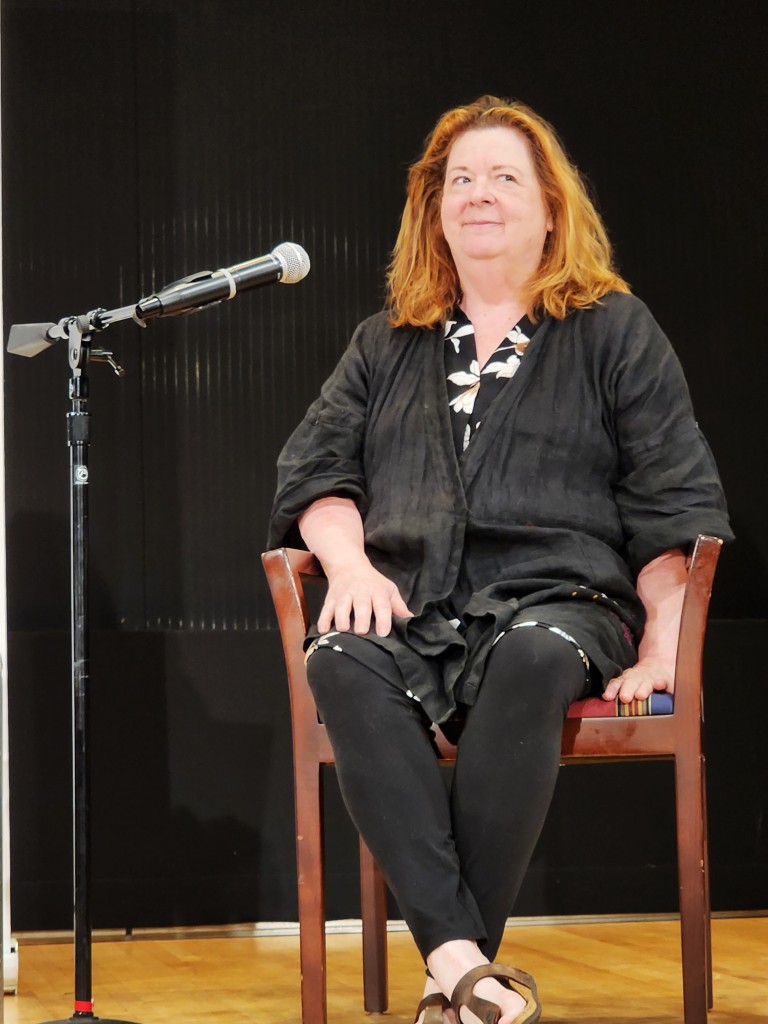
Theresa Rebeck. If the name doesn’t sound immediately familiar, chances are you do know Theresa Rebeck’s work from Broadway, off-Broadway, television, films or literature. A prolific writer, she is the most produced female playwright of her generation. Her work is presented throughout the United States and internationally. Her Broadway credits include I Need That (starring Danny DeVito), Bernhardt/Hamlet (starring Janet McTeer), Dead Accounts (starring Norbert Leo Butz), Seminar (starring Alan Rickman), and Mauritius (starring F. Murray Abraham). Her off-Broadway productions are numerous.
It was a pleasure to hear and see her live in an event sponsored by the League of Professional Theatre Women, Monday, June 3, 2024 at the New York Public Library for the Performing Arts, Lincoln Center’s Bruno Walter Auditorium. Interviewed by her close friend and producer Robyn Goodman (Avenue Q-Tony Award 2004, In the Heights-Tony Award 2008), Robyn founded Aged In Wood Productions in 2000. Their discussion was taped and is part of LPTW’s Oral History Project to preserve visual records of interviews of august women in the theater. The event was produced by director and producer Ludovica Villar-Hauser. A video of the event can be found in the Library’s TOFT Archive.
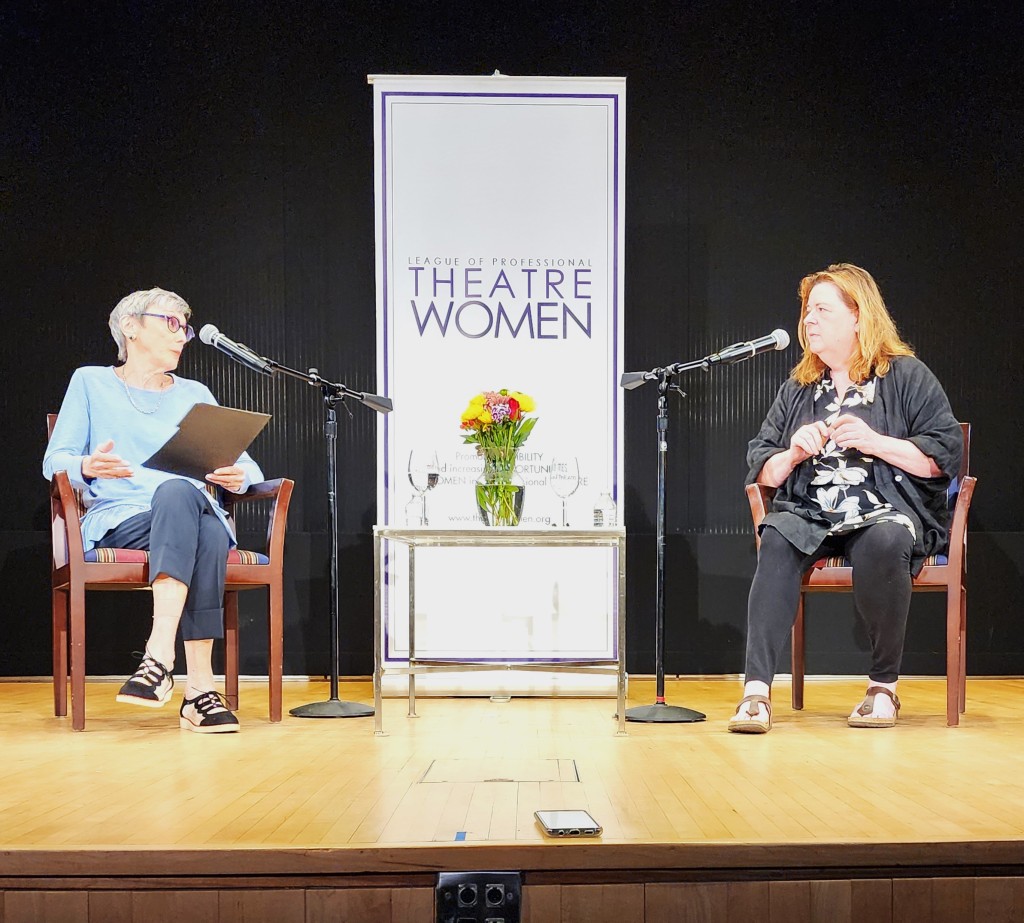
For the members of LPTW, Theresa Rebeck needed no introduction. Robyn Goodman began by asking general questions about Rebeck’s early life, and her background tie-ins to themes which often arise in her plays. This brief post focuses on a few salient highlights of the interview.
Born in Ohio, Rebeck grew up in an “ultra Republican, ultra Catholic” world. Receiving a Catholic education throughout, she graduated from Ursuline Academy in 1976 and continued with her Catholic education, graduating from the University of Notre Dame in 1980.
With irony and humor, Rebeck confided, “My parents didn’t want me to go to any East Coast School because they were afraid I’d lose my faith.” She shared that as a child, at times she went on a bus to see theater productions. Even at a young age, she venerated playwrights, thinking them gods. To her, Shakespeare, Moliere, Arthur Miller and Tennessee Williams were fantastic. She joked that she was already into theater and drama before she got out of grade school.

After Rebeck began acting in earnest at Ursuline Academy, she told her mother “I think I want to be a playwright.” Rebeck got laughs when she joked about her mother’s response, “She turned grey.”
Interestingly, during her freshman year at Notre Dame, Rebeck was invited to a very religious group who was holding a prayer meeting. It was “really spooky,” and the people were “really religious.” Rebeck sensed something “dark and weird going on.” They were speaking in tongues and talking about women being subservient so that everyone “should know their place.” She quipped, “After ten minutes I wanted to go back to my dorm room.” However, she wasn’t sure how to get back.
This was an introduction to members of “People of Praise,” the religious community Supreme Court Justice Amy Cony Barrett has been a member of since birth. “People of Praise,” is associated with the Catholic charismatic renewal movement, but is not formally affiliated with the Catholic Church. Rebeck’s experience at the prayer meeting and listening to the group’s tenets sent her fleeing in the opposite direction. “People of Praise” appears to be unrepresentative of Rebeck’s Catholic upbringing which has well served her life and work.

As a tie-in, Robyn Goodman read a quote from the award-winning playwright Tina Howe (Coastal Disturbances, Pride’s Crossing), who died last year at 85-years old. Howe said of Rebeck that her “Catholic upbringing has had a profound imprint on her work,” and there’s “a moral heart to Theresa.” According to Howe, “She’s a force of nature who always carries her altar with her.”
When Robyn Goodman asked Theresa, “Do you see this in your work?” She responded, “I do.” Rebeck then grounded the history of theater with the idea of faith as an inherent meld. She claimed she is “one of those people” who thinks that the theater is “holy territory.” And she says of herself, “I’m always a person that points out that theater was a religious ceremony.”
In ancient civilizations the dance and tribal ritual and ceremonial presentation had a deep spiritual and religious basis. With the Greeks who allowed even the slaves to take off from work to participate, theater was a celebration of the god Dionysus, and there were annual play festivals and competitions. Rebeck suggested that in various cultures, there was the shaman or priest, and sitting right next to him was the playwright. For Rebeck, “The gathering of people to share stories and identify with the stories is powerful.”
In responding to Robyn Goodman’s question about her transformation to professional theater, Rebeck mentioned her first production was Spike Heels (1993), that Goodman produced at Second Stage Theater. It starred Kevin Bacon, Tony Goldwyn, Saundra Santiago and the great Julie White. “My husband was in it,” quipped Rebeck. Theresa is married to Jess Lynn, and together they have two children.

Goodman asked if the production and notoriety changed her life, especially the good reviews. Rebeck suggests that with the critics peppering her with questions, “It was like watching all the senators grilling Anita Hill.” One of the questions they asked, was, “Are you going to write a book?” Frank Rich compared Spike Heels to the film Pillow Talk. According to Rich, Kevin Bacon was Gig Young, etc.
Four months later, David Mamet’s Oleanna, which premiered in Cambridge, Massachusetts, appeared off- Broadway at the Orpheum Theater. Frank Rich reviewed it and Rebeck noted Rich’s review. He commented that after the Anita Hill-Clarence Thomas fiasco on Capitol Hill, “finally someone wrote a play about sexual harassment.” Rebeck’s response was tellingly frustrated. She shared her feelings about his comment. “Hey! You saw a play about sexual harassment written by a women and you didn’t notice.”

It was “a different time,” Rebeck said, as she discussed how she reacted to the male/female power issues. “You go along with it, get mad when you go home and try to discuss it, and you’re incoherent.” With Rich’s comment about Oleanna, Rebeck says,”I thought, ‘Come on, this isn’t about sexual harassment. This is a women lying about sexual harassment.'” Rebeck affirmed with Goodman that women were fighting for their place and stature at the time, so it was “very important to produce plays like that.” Rebeck suggested, “I was way ahead of my time,” which received an appropriate laugh.
Goodman pointed out another quote about Rebeck’s writing in that she often writes about “betrayal, treason and poor behavior, a lot of poor behavior.” To that Theresa agreed that many playwrights write about “poor behavior.” Goodman added that Rebeck also writes about class and power shifts.
Rebeck discussed her experiences with productions on Broadway and off-Broadway. In fact, she suggested that she began directing because after the effort and time spent writing a play, she got tired of the release process, after her initial involvement with the production. She went to the table reads, heard design presentations and answered questions people asked. Then came the “thank yous” and she would leave. Rebeck didn’t want to be at the side of “the main event.” She wanted total involvement.
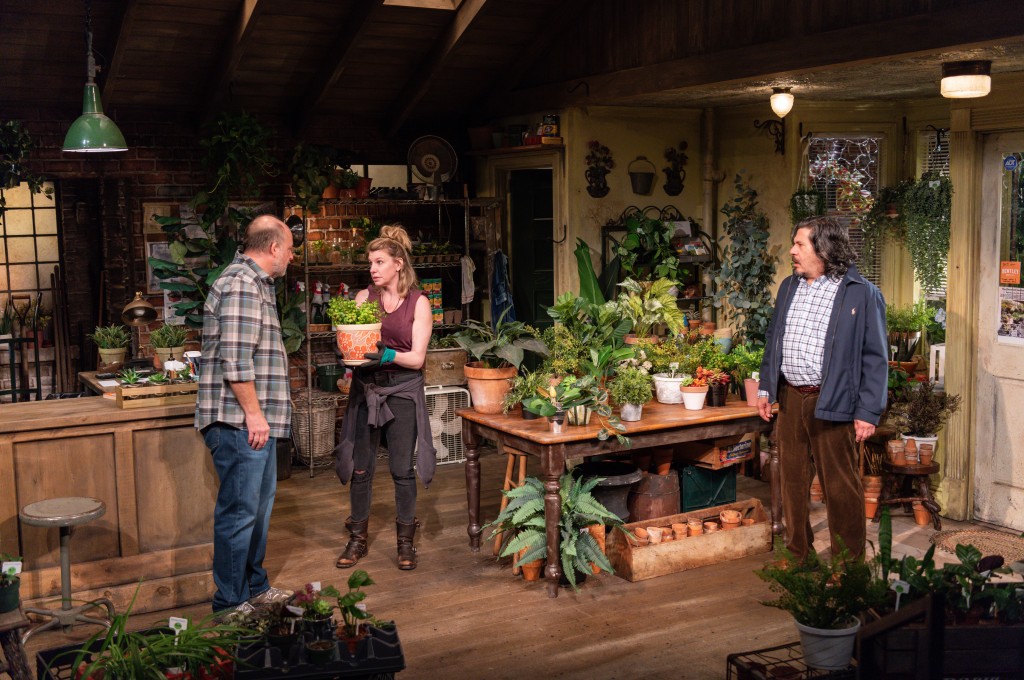
She enjoyed working on Dig, which she also directed and which received wonderful reviews. “I’m so proud of it. It was a good experience.” It is important to Rebeck that the creators have work that they can claim as their own. She enjoys working collaboratively when people are respectful.
Goodman and Rebeck appear to have a shared view of how people negotiate successfully in the “real world.” They negotiate with a sense of morality. Goodman shared the quote which political parties, especially the Trump MAGA Party, eschew as anathema. “If you make the truth your friend, it can’t come and eat you alive.” Rebeck and Goodman agree that a clear, moral point of view in plays, musicals and literature is vital.
Theresa suggested that her alma mater Brandeis University also grounded her toward presenting a clear, moral point of view in her work. She received her three graduate degrees from Brandeis: her MA in English in 1983, a MFA in Playwriting in 1986, and a PhD in Victorian era melodrama in 1989. Fittingly, Rebeck pointed out, that on the seal of Brandeis University are the words, “Truth even unto its innermost parts.” The university president decided to surround the shield on the seal with the quote about truth which is from Psalm 51. Rebeck noted that she recognized the seal on the podium (though it wasn’t clear at that point that it was Brandeis), hearing/seeing a clip of Ken Burns deliver his trenchant Keynote Address to Brandeis University’s 2024 undergraduate class during the 73rd Commencement Exercises. If you haven’t heard any of his speech, you can find it on YouTube. It is definitive and acute.

Rebeck affirms that “writing plays is about people” in the hope to understand “human brilliance and failure.” Of course at times there’s “political content.” However, at the heart it’s about people and human behavior.
In responding to Goodman’s question related to critics, Rebeck agreed that sometimes reviews are devastating and that her husband goes through the process with her. She mentioned that there can be five wonderful or enlightening critiques, and then there is the “crazy” review which is off kilter and seemingly out of nowhere, and people are “foaming at the mouth.” Sometimes, there is that one review while other critics and audiences love the work.
At one point Rebeck thought, “Why do they hate me?” Then, she realized if there’s one outlier, then there isn’t coherence. She mentioned that for a long time people only cared about and quoted the “paper of record.” Of course the irony was that there were many different critics and opinions. The diverse voices and viewpoints are exciting and especially vital for our time. That one opinion held sway and could make or break a play was “damaging to the psyche of the community.” She affirmed, “Now, it’s less dire.”
Rebeck spoke of an incident with a young producer who acted as if there was only one paper that mattered, historically, the “paper of record.” This individual said, based on one review, “Well, the reviews were bad.” Rebeck gave them a reality check. She said that a producer should never act like there is one reviewer who speaks for all critics. To obsess about one review is to bury oneself in negativity and recriminations. She told the producer, “Don’t do that!”
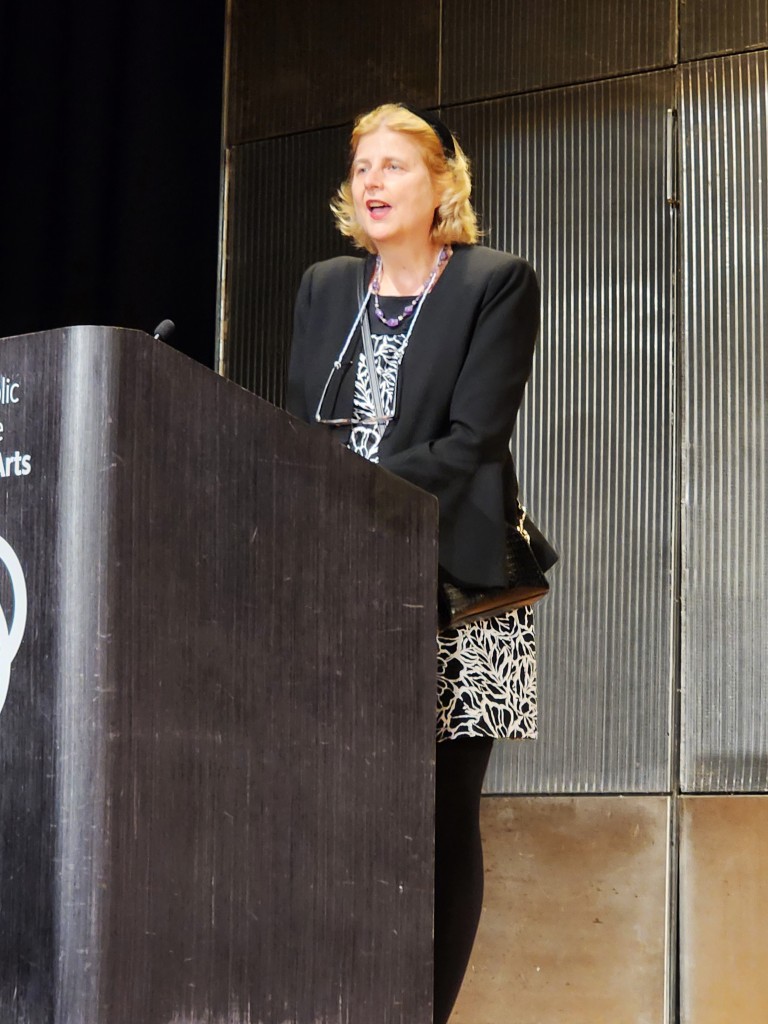
Indeed, Rebeck’s point is well taken. Historically, other critics bought into the prestige factor of “the paper of record,” denigrating their own voices and viewpoints, and bowing to the one review that allegedly spoke for all critics. In this day of book bannings, culture wars and rewriting history, such an approach is tantamount to critics mentally censoring themselves as inferiors. If there is a consensus about a play, that speaks volumes. One “determination” by one critic, regardless of how much he or she is paid, shouldn’t be the “word from on high” that the critics, theater professionals or the public “should” listen to and take to heart.
Rebeck and Goodman are expanding their winning teamwork. They’ve joined together on the musical Working Girl, based on the titular1988 Twentieth Century Fox motion picture written by Kevin Wade. Aimed for Broadway, the musical is presented by special arrangement with Buena Vista Theatrical. Writing the book, Rebeck discussed how she loves working with Tony-winning, composer-lyricist Cyndi Lauper (Kinky Boots), who is writing the score. Tony winner Christopher Ashley (Come From Away) is directing. Producers include Goodman and Josh Fiedler of Aged in Wood Productions, and Kumiko Yoshii.
Rebeck created Smash for NBC and briefly discussed a few highs and lows of working on the showbiz dramatic series. She liked Stephen Spielberg. Since Smash, she has been especially enamored of musical theater. Working Girl is a project that involves collaboration. To have to write a play singularly and then give it to a composer and lyricist is something Rebeck wasn’t interested in doing. She and the team are reimagining and updating the classic. It’s an exciting approach because it also emphasizes women working together and supporting each other on their “climb to the top.” With the political climate as it is, the musical is profoundly important.

One of the themes of the evening was that especially after COVID-19, theater has changed. Theaters around the country are in deep financial trouble. Robyn Goodman suggested that Broadway has gotten out of hand. The business is completely different than what it was two decades ago. Now, to mount a production viably, it costs $25 million dollars. It’s all about the money and finding backers.
As for budding playwrights, Rebeck advised that festivals are a good venue as a place to begin and get noticed. Indeed, 10 minute play festivals allow the creative team to put on “a beautiful event” for little or no money. One can even write a short one-act play and submit it to a one-act play festival. This is a boon for the playwright, who needs to learn how the process works and see the audience’s response to the play. That is an imperative for beginning playwrights.
Rebeck’s plays are published by Smith and Kraus as Theresa Rebeck: Complete Plays, Volumes I, II, III, IV and V. Acting editions are available from Samuel French or Playscripts. For a complete listing of all of her work you can find Theresa Rebeck on her website: https://www.theresarebeck.com/ Robyn Goodman’s website is https://www.agedinwood.com/about
Visit The New York Public Library for the Performing Arts at Lincoln Center, the Library’s TOFT Archive to see the digital recording of the evening. For more information about the TOFT Archives, see this link. https://www.nypl.org/locations/lpa/theatre-film-and-tape-archive To learn more about LPTW, check out their website. https://www.theatrewomen.org/
‘Wonderland: Curious Nature’ at New York Botanical Garden
Victorian “Age of Wonder,” Alice’s Adventures in Wonderland, a Fascinating Exhibit



NYBG opened its latest exhibit this weekend. Inspired by the classic Alice’s Adventures in Wonderland and the sequel, Through the Looking-Glass, And What Alice Found There, by Lewis Carroll, the all-new garden-wide exhibition is whimsical and full of fun and surprising features.


Today, Sunday is the Opening Weekend Garden Party Celebration from 11 a.m. to 5 p.m. on Daffodil Hill. You can dine as a special guest at the Queen’s Tea. And you can encounter The Mad Hatter, Alice, the Red Queen, and other Wonderland characters popping up on the walkways throughout the Garden.
OPENING WEEKEND GARDEN PARTY CELEBRATION TODAY, SUNDAY, MAY 19
Today, May 19, Sunday, there are lawn games like croquette, and other craft activities. Or if you prefer to meditate and reflect as you relieve the stresses of a hard work week, just enjoy a self-guided tour following the digital signs as you appreciate the Garden in its glorious pageantry in the spring. Everywhere you look there is a plant wonderland and themes from Carroll’s works and the Victorian era’s new age of exploration and wonder.



And as you are swept up in the Garden’s heavenly beauty you just may see a Cheshire Cat grinning out at you, for real. Certainly, if you let go, that Cheshire is there smiling at your happiness that you’ve treated yourself and your family to the Garden’s fantastical retreat.
Follow the Signs
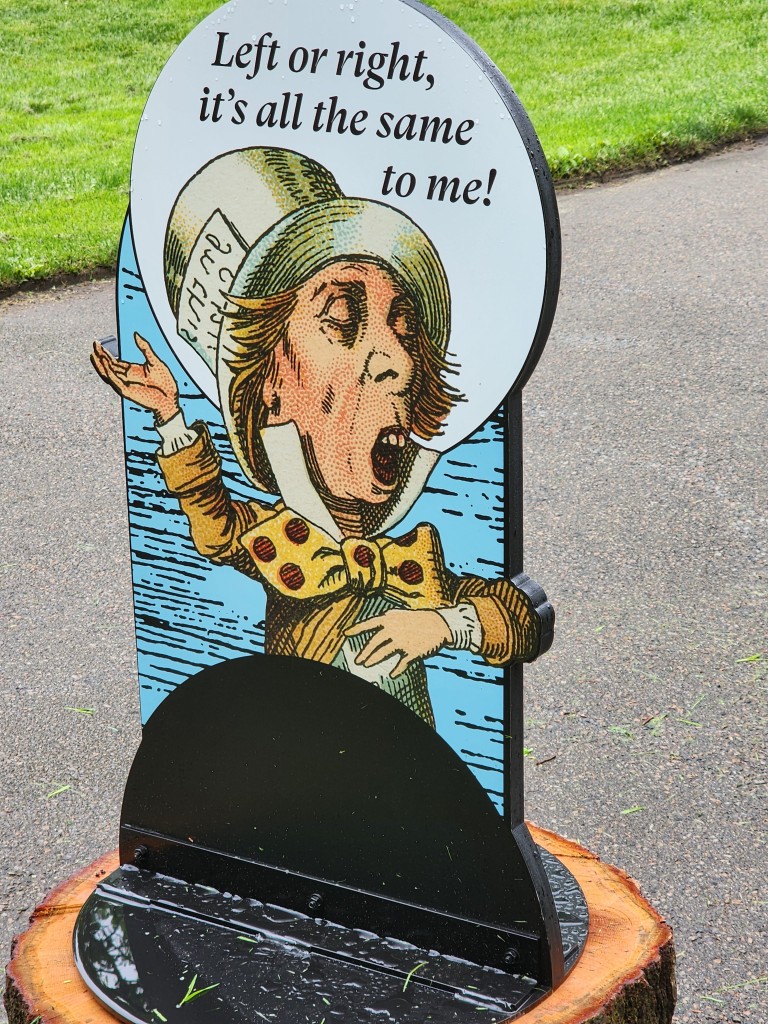


Plants Inspired by Oxford Botanical Gardens, Where Lewis Carroll Walked

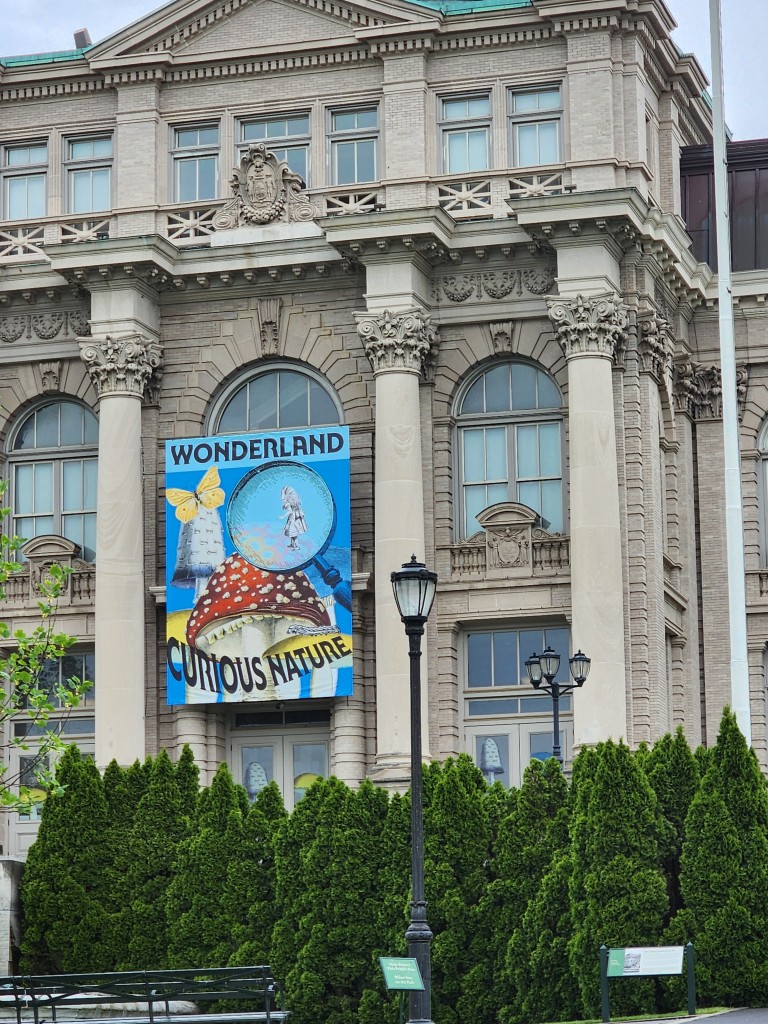
The Wonderland Exhibit continues at LuEsther T. Mertz Library. Visit the galleries to see the contemporary global artists, i.e. Abelardo Morell, Beverly Semmes, Agus Putu Suyadnya and others inspired by Carroll’s books. There are artworks reflect the global appreciation of the wacky characters and settings found in Alice’s Adventures. And in the rotunda of the Library look at the exhibit of dried mind-altering plants, their descriptions, and the songs and books they inspired which reference Carroll’s work. Some of these plants like opium and various mushrooms promoted altered states. The plants influenced Carroll’s idea about perception that he incorporated in Alice’s Adventures in Wonderland and Through the Looking-Glass, And What Alice Found There.
Wonderland: Curious Nature runs until October 27, 2024

The events run from this weekend through October 27th across three seasons, spring, summer and fall. There are programs for the entire family and even the characters from the fantastical books by Lewis Carroll show up to entertain and frolic down the Garden’s pathways always ready for a photo or chat with the more serious patrons wanting to find out more about the characters they portray.


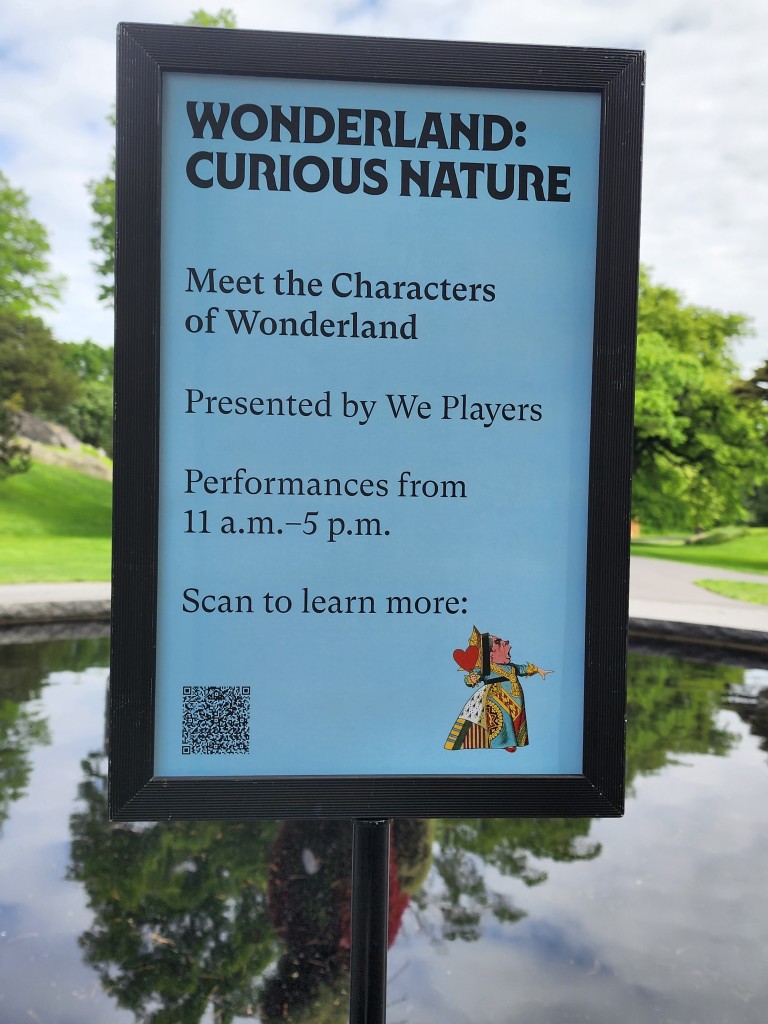
Wondrous people and plants.
Look out for unusual characters and unusual plants that enjoy a marriage with insects like the fern below.

Wonderland: Curious Nature is not only fun, it is ingenious. From the spectacular flower show in the main galleries of the Enid A. Haupt Conservatory to the scheduled tea parties and brunches in the Stone Mill near the Peggy Rockefeller Rose Garden and different menu offerings at the Hudson Garden Grill, there is something for everyone. I will update the exhibit coverage in weeks to come.
For specific programming, go to the New York Botanical Garden site: https://www.nybg.org/event/wonderland-curious-nature/wonderland-curious-nature-programs/wonderland-curious-nature-opening-weekend/
‘Staff Meal,’ Avant Garde, Experimental, a Review

In the notes from playwright Abe Koogler about Staff Meal, directed by Morgan Green, currently at Playwrights Horizons, Koogler hopes that the audience, “will emerge from it the way you might emerge from a transportive meal in an unusual restaurant in a part of town you’ve never been to before. The avant garde work, shrouded with a uncertainty is most interesting when there appears to be a linear forward movement among characters during vignettes of scenes which take place in Gary Robinson’s restaurant, that once was packed, but by the end closes down.
At the top of the play Ben (Greg Keller) and Mina (Susannah Flood), sit near each other in a coffee shop working on their laptops. Eventually, their proximity prompts them to become familiar with each other so after a number of days, saying “Hi,” and other chatty comments, they leave and seek better coffee and/or food elsewhere. The search leads them to Gary Robinson’s restaurant.
The rapport and pacing between Keller and Flood is enjoyable and funny by these talented actors. However, it ends when they get bogged down ordering from a waiter who takes an inordinately long period of time to take their order and bring back an excellent wine. In the interim, they take humorous and sobering flights of fancy about their personal lives which include some of the most imaginative dialogue in the play. However, when the waiter has not brought their food, then the scene shifts with the mood, and the focus becomes their waiter and his experience at the restaurant.

As a flashback of “The Waiter” segment begins, Ben and Mina leave “hanging in the air,” the thread of dialogue along with Ben’s story about his dog, whom his parents mistreated during the time he lived with his family in Spain. Hampton Fluker is the waiter who enters the spotlight. He discusses his time at the restaurant joined by other members of the wait staff (Jess Barbagallo, Carmen M. Herlihy), and chef Christina (Erin Markey), who serves them their delicious “staff meal” before they begin the evening’s service. Fluker’s waiter declines the meal at this point because it is his first day and he is afraid he will throw up out of nervousness.
What is striking about this vignette is that Christina doesn’t come up with ordinary food for the staff, but serves them extraordinary dishes following the philosophy of Gary Robinson, who emphasizes the importance of being of service to others. As one of the servers affirms, “Our power, our glory increases only so much as we give it away, constantly, only so much as we serve.” This is akin to a Biblical verse which implies, if one would be a great leader, one must be great at serving others. This philosophy is the antithesis of that practiced by politicians who serve themselves first, last and always, a virus that has particularly attacked the former Republican Party known as the Trump MAGAS.

However, like fragments of wisdom and truth which filter in and out of our consciousness, this conversation among the staff as they eat Christina’s delicious food and reference two of Gary Robinson’s books, dissolves into the air, though it is a profound concept that is incredibly current. However, one of the reasons why this wisdom and the astute servers’ conversation comes to a screeching halt is that an audience member interrupts with an important question, akin to “What the hell?”
By this point in time, the fourth wall has been broken twice; first by a vagrant (Erin Markey), who attempted to steal Mina’s laptop, though Mina elicited the help of an audience member to watch it for her when she went to the bathroom, because Ben wasn’t there that day. Luckily, Mina interrupts The Vagrant’s theft and sends her away without the laptop as Mina chides the negligent audience member, who was obedient to the playwright and didn’t tell The Vagrant, “Stop thief!”

The second breaking of the fourth wall is by a disruptive “audience member” (the fine Stephanie Berry), who is “annoyed” and questions the direction of the play defining it as meaningless, unrelated to her life, not current-when the world is burning down, and a waste of the gift of the audience’s time. Joining the other actor/servers onstage, she then discusses what she considers meaningful, her life, and the direction it has taken recently.
Of course, this is humorous and gives way to the notion that audience members’ opinions don’t always jive with theater professionals, though they can make or break them via word of mouth recommendations. Then the playwright forestalls audience opinions about his avant garde, surrealistic, weird work, using Berry as a a mouthpiece when the playwright has her say, “Do you ever get this feeling with young writers, or early writers, writers who are developing….do you ever wonder: when will they develop?” Berry’s audience member excoriates the quality of the play, Staff Meal, addressing the characters and absent playwright before sharing what is relatable to her in her life.

On consideration this surreal vignette works because of Berry’s authentic, spot-on performance which is confessional and makes us empathize with her even more so than with the other vignettes. But then she leaves and Koogler picks up where he left off back to the servers discussing the dwindling clientele and whether or not Robinson is going to close the restaurant down.
Then time and space shift once more. At this point, the servers and the couple have disappeared and the vignette with The Vagrant (Erin Markey) occurs. She explains that she takes on three roles, one of which is the chef, but the segment of The Vagrant involves her living in a hole and trying to acquire laptops so that she can get a job. Ah ha! We have the explanation of The Vagrant attempting to steal Mina’s laptop early on in the play. Eventually, she goes for a job interview and is hired and tells us she lived an extraordinary ordinary life and concludes with her affirmation that the rest of the play is about “how it ended.”

Berry’s audience member returns, warning us that she has been found out to be an artifice, and her role in the play is over, but she notices the weather outside is shifting and becoming ominous. The time has shifted once more and events move toward an unsettling conclusion. However, we do find out what happened to Ben’s dog, after they leave the restaurant without their food or wine. The waiter receives a delectable “staff meal,” Ben and Mina are separated walking home, and The Waiter is left questioning if Christina is still in the restaurant.
At this juncture it’s time to reconsider the audience member/playwright twitting himself about what he’s written. However, the play is more naturalistic in its chaotic, unthreaded, seeming randomness with bits of profound meaning stuffed here and there, like life, perhaps. In that we realize that we make meaning from our own lives, as random and strange as events can sometimes be, which have no rhyme or reason. Indeed, a fictional play with a neat beginning, middle and ending is easy to follow, but is perhaps easily dismissed as fiction. Staff Meal, as surreal as it is, is darkly memorable.

To assist with the sets which dissolve away to a bare stage, Jian Jung’s minimalist scenic design creates a cafe, a kitchen, a restaurant dining room and the dark ominous streets. Additional kudos go to Kaye Voyce’s simple (costume design), though I thought the elaborate costume for The Vagrant was interestingly layered with various “stuff.” Masha Tsimring (lighting design), kept segments toward the end foreboding, and Tei Blow (sound design) and Steve Cuiffo (illusion design), executed Morgan Green’s vision for Staff Meal.
Staff Meal will keep you guessing and wondering and perhaps as annoyed as Stephanie Berry’s Audience Member, trying to find the portal to understanding what’s beyond this unusual restaurant that serves its staff better than its customers. It runs with no intermission at Playwrights Horizons, Peter Jay Sharp Theater, 416 West 42nd Street. https://www.playwrightshorizons.org/shows/plays/staff-meal/
‘The Great Gatsby,’ Sumptuously Re-imagined, A Must-See, Unforgettable Broadway Spectacle

The Great Gatsby by F. Scott Fitzgerald is an iconic American novel set during the Jazz Age. It is about class, the privilege of old wealth and the excesses of the nouveau riche, who can never attain the status of the generational moneyed class, regardless of how hard they try. The Great Gatsby a New Musical, based on the titular novel, retains this key theme of America’s class system from the perspective of unreliable narrator Nick Carraway (Noah J. Ricketts). Carraway memorializes Jay Gatsby, the extraordinaire, whose ability to distill hope and materialize his dreams achieves its own artistic perfection. Examined from the perspective of Nick Carraway (Noah J. Ricketts), the tragic flaw in Gatsby’s process is that he attaches his hope to the imperfection of love and a woman who wasn’t worthy of his vision, faith or love.

The Great Gatsby, a New Musical made its premiere at the Broadway Theatre after its fall run at the Paper Mill Playhouse in New Jersey. With book by Kait Kerrigan in her Broadway debut, music by Jason Howland (Paradise Square), and lyrics by Nathan Tysen (Paradise Square), the musical is suprbly choreographed by Dominique Kelley and acutely directed by Marc Bruni (Beautiful: the Carole King Musical). Overall, it’s a gorgeously conceived production with exceptional ensemble work and flamboyant spectacle that sumptuously re-imagines the distinctive settings, individualistic characters and seminal events that make the novel a singular and timeless classic.

The strength of this production is that Kerrigan, Howland and Tysen are loyal to Nick’s perception of the magnificent Jay Gatsby, portrayed exquisitely by Jeremy Jordan. Jordan’s luscious, exceptional voice, Gatsbyesque persona, and passion do justice to Howland and Tysen’s lyrical and dynamic songs, “For Her,” “Past Is Catching Up to Me,” and the duet “Go.” We empathize with Jordan’s Gatsby, whose near divine love of Daisy (the lovely Eva Noblezada), never fails him, though Daisy can’t handle the irrepressible and divine nature of his efforts to transform time.
In “My Green Light,” an extraordinary duet between Noblezada and Jordan at the end of Act I, the couple consummates their love in Gatsby’s lavish bedroom with the projection of the rippling Long Island Sound at night, and the green light at the end of Daisy’s dock twinkling behind them in the background.

Bruni’s phenomenal staging, Paul Tate DePoo III’s projection and set unifies the key elements of the love relationship between Gatsby and Daisy, the artistry of Gatsby’s vision and his infinite hope (symbolized by the green light), driving it. The acting talents of Jordan and Noblezada, their lustrous singing and the setting are dazzling in this memorable, uplifting scene, where Gatsby, indeed, for a moment conquers time.

At that point we believe that Gatsby’s love is enough to hold Daisy and take her away from the craven, brutish, hypocritical Tom, who breaks his mistress Myrtle’s nose (Sara Chase), and manhandles Daisy leaving bruises on her arms during their quarrels. We believe like Nick and Jordan (the adorable Samantha Pauly), that Tom doesn’t deserve Daisy. However, by the conclusion of the musical, Nick realizes that Tom and Daisy do deserve each other. She won’t even attend Gatsby’s funeral, acting like he never existed. We agree with Nick that Gatsby is “worth the whole damn bunch put together.”

As Nick spins it, the tragedy lies in Daisy’s soulish weakness and her inability to live up to Gatsby’s love to “forget the past,” which he asks her to do in front of Tom in the superbly acted scene at the Plaza Hotel. Together the characters sing the sensational ensemble number “Made to Last.” John Zdrojeski’s Tom is particularly cruel as he arrogantly denounces Gatsby, his criminal bootlegging and his low class background. The lyrics are profound and spot-on. The dynamic music reinforces the themes which the characters forcefully embrace and symbolize. Tom sardonically sings, “It’s not about wealth, it’s blood. It’s class. The day you were born, your die had been cast.” And Gatsby insists, “Daisy, tell him you’re through.” And he tells Tom to “face reality,” affirming that Daisy never loved Tom.

During the explosive turning point in the song, Gatsby insists she renounce her marriage to Tom, and in effect her position and class to which Tom “elevated” her. When Tom sees she falters, that she honestly admits that she loved them both, and that Gatsby “wants too much,” Tom feels secure. He knows she is too weak and insecure to leave him and their daughter. Noblezada’s Daisy, Zdrojeski’s Tom and Jordan’s Gatsby strike the mixture of emotions of their characters with authenticity and power. Daisy’s heightened angst and tenuous state of mind force her to leave the suite, with Gatsby running after her. It is not a position of power from which Gatsby might redeem himself with her, though he tries.

Tom’s defamation and insults to Gatsby’s face and the reality of what Daisy would be giving up to leave him dislocates Daisy to distraction and ultimately causes the fatal accident and final tragedy of the underclasses, who make the mistake of becoming involved with the soulless, unimaginative upper class.

Noblezada portrays Daisy’s confusion with grist, making Jeremy Jordan’s desperation to stop Tom’s brainwashing and win her back even more pronounced. When Tom’s words hit their mark, it’s as if a curtain shuts down Daisy’s mind. Jordan’s Gatsby sees the impact of Tom’s cynicism as it disintegrates all the romance of what he has accomplished in order to turn back time to the fullness of Daisy’s love when Tom never existed. The scene is the brilliant high-point. What follows is the aftermath from which there is no recovering, except that Nick must lead the musical encomium to the greatness of his friend Gatsby. He alone fully grasps who the man was, so of course, he is furious that the papers slam Gatsby and further drive Daisy into oblivion and Tom into victory, as they jaunt away to Hawaii.

Kerrigan, Howland and Tysen are faithful to the key events in the novel down to no one going to Gatsby’s funeral except Nick which Bruni simply stages with black curtains, the casket and bier and red roses. Howland and Tysen fill out Wilson’s mania as he assassinates Gatsby, after Tom sets him up (“God Sees Everything”). As Gatsby sings the reprise “For Her” and Nick imagines how it happens, Wilson joins in and asks God’s forgiveness for using his hands to met out justice and take responsibility for the execution. Of course, Wilson’s ask is ridiculous as his justice is misplaced. Duped by Tom to do violence and pay for it with his own life, Wilson is a pathetic figure. Reflecting on these events, and Daisy and Tom’s nonchalance about Gatsby and the Wilsons, Carraway disdains Daisy and Tom as representative of the careless rich who destroy people and things leaving the Nick Carraways of the world to clean up the mess.

Comedic elements are found in this adaptation which sometime diffuse the impact of the story, as does attention to the secondary characters who are given greater focus. It is also problematic that Nick’s perspective doesn’t cohere throughout the musical, but leaves off in a few scenes, one between Jordan and Daisy.

Some of the comedy is refreshing as in the scene Nick and Jordan share at Nick’s cottage while Daisy and Gatsby meet for the first time in five years. Their relationship is expanded beyond the novel when Jordan and Nick’s intimacy gives way to his proposal of marriage which she is on the verge of accepting, though in Act I she is against marriage. Her characterization is more in keeping with today’s women than women of the early 20th century. Nick’s characterization is largely faithful to the novel. Noah J. Ricketts does a fine job of rendering Nick the unreliable narrator who thinks highly of himself, but doesn’t completely stand up to Tom and Daisy. Instead, he turns tail and runs back to the Midwest away from the” “evil” East, an irony. The only way he can reconcile his self-loathing about his behavior is to attempt to expiate his guilt by memorializing Gatsby.
The Jordan/Nick scenes are humorous and flirtatious. Their number “Better Hold Tight” is a diversion more for its own sake. However, we are not surprised that Nick throws over Jordan who doesn’t show up to Gatsby’s funeral either. She is one of the bad drivers, the careless rich who sicken and disgust him, for they dupes the fools who would seek the dream “boats running against the current” (“Finale: Roaring On”), to only to stumble because their dreams are behind them in the past.

Kerrigan, Howland and Tysen take even greater liberties with the secondary characters for the sake of dramatic purposes. Kerrigan, et. al. strengthen and coalesce the ideas symbolizing George Wilson (Paul Whitty), George’s wife Myrtle (Sara Chase), and Meyer Wolfsheim (Eric Anderson), by giving each of them solo numbers which define their personalities, desires and attitudes. These add to the themes, though they refocus the thrust of Nick’s story of how Gatsby is a romantic hero. The mystery surrounding Gatsby’s identity which is slowly revealed in the novel, is lost in this musical with attention going elsewhere.

As a representative of the criminal class that feeds the dreams of the lower class, breaking the law to do so, thug Wolfsheim joins the company singing “New Money,” which old wealth (Tom), regards as garish and meretricious. Anderson’s Wolfsheim (“who made Gatsby”), also sings and joins the company dancing in the excellent number “Shady.” As Wolfsheim sings, Bruni stages vignettes with each of the character couples being corrupted in their adultery or “sinful” affairs (Jordan and Nick, Gatsby and Daisy, Tom and the Wilsons). According to Wolfsheim, “I’m okay with keeping secrets. I’m okay with being naughty. I approve of indiscretions, if you know how to hide a body.”

Eric Anderson and cast of The Great Gatsby (Matthew Murphy and Evan Zimmerman)
Read the rest of this entry
‘Uncle Vanya,’ Steve Carell in a Superb Update of Timeless Chekhov

A favorite of Anton Chekhov fans is Uncle Vanya because it combines organic comedy and tragedy emerging from mundane, static situations, intricate, suppressed characters and their off-balanced, mired-down relationships. Playwright Heidi Schreck (What the Constitution Means to Me), has modernized Vanya enhancing the elements that make Chekhov’s immutable work relevant for us today. Lila Neugebauer’s direction stages Schreck’s Chekhov update with nuance and singularity to make for a stunning premiere of this classic at Lincoln Center’s Vivian Beaumont in a limited run until June 16th.
With a celebrated cast and beautifully shepherded ensemble by the director, we watch as the events unfold and move nowhere, except within the souls of each of the characters who climb mountains of elation, fury, depression and despair by the conclusion of this two act tragicomedy.
Schreck has threaded Chekhov’s genius characterizations with dialogue updates that are streamlined for clarity, yet allow for the ironies and sarcasm to penetrate. At the top of the play Steve Carell’s Vanya is hysterical as he expresses his emotional doldrums at the bottom of a whirlpool of chaos which has arrived in the form of his brother-in-law, Professor Alexander (the pompous, self-important Alfred Molina in a spot-on portrayal), and Alexander’s beautiful, self-absorbed, younger-by-decades wife Elena (Anika Noni Rose). Also present is the vibrant, ironic, self-deprecating, overworked Dr. Astrov (William Jackson Harper), a friend who visits often and owns a neighboring estate.

During the course of the first act, we are witness to the interior feelings and emotions of all the characters who in one way or another are bored, depressed, miserable and disgusted with themselves. Vanya is enraged that he has taken care of Alexander’s lifestyle, even after his sister died in deference to his mother, Maria (Jayne Houdyshell). He is particularly enraged that he believed with is mother that Alexander was a “brilliant” art critic who deserved to be feted, petted and over credited with praise when he lived in the city.
Having clunked past his prime as an old man, Alexander has been fired because no one wants to read his work. He and Elena have run out of money and are forced to stay in the family’s country estate with Vanya and Sonia, Alexander’s daughter (the poignant, heartfelt Alison PIll), away from the limelight which shines on Alexander no more. Seeing Alexander in this new belittlement, though he orders around everyone in the family, who must wait on him hand and foot, Vanya is humiliated with his own self-betrayal. He didn’t realize that Alexander was a blowhard who duped and enslaved him to labor on the farm to supporting his high life, while he pursued his “important” writing. Vanya and Sonia labor diligently to make sure the farm is able to support the family, though it has been a difficult task that recently Vanya has grown to regret. He questions why he wasted his years on a man unworthy of his time and effort, a fraud who knows little about art.

Likewise, Astrov questions his own position as a doctor, admitting to Marina (Mia Katigbak), that he feels responsible for not being able to help a young man killed in an accident. To round out the “les miserables,” Alexander is upset that he is an old man who is growing more decrepit by the minute as he endures believing his young, beautiful wife despises him. Despite his upset, Alexander expects to be waited on by his brother-in-law, mother-in-law and in short, everyone on the estate, which he has come to think is his, by virtue of his wanting it. Though the estate has been bequeathed to his daughter Sonia by Vanya’s sister, his first wife, Alexander and Elena find the quiet life in the country unbearable.
As they take up space and upturn the normal routine of the farm, Elena has been the rarefied creature who has disturbed the molecules of complacency in the lives of Vanya, Sonia and Astrov. Her beauty is shattering. Sonia hates her stepmother, and both Vanya and Astrov fall in love and lust with her. As a result, their former activities bore them; they cannot function with satisfaction, and have fallen distract with want, craving the impossible, Elena’s love. Alexander fears losing her, but realizes if he plays the victim and harps on his own weaknesses of old age, as distasteful as he is, Elena is moral enough to attend to him, though she is bored and loathes him in the process.

The situation is fraught with problems, hatreds, regrets, upsets and soul turmoil, which Schreck has stirred following Chekhov’s dynamic. Thus, Carell’s Vanya and Harper’s Astrov are humorous in their self-loathing as is the arrogant Alexander and vapid Elena who Sonia suggests can end her boredom by helping them on the farm. Of course, work is not something Elena does, which answers why she has married Alexander and both have been the parasites who have sucked the lifeblood of Vanya and Sonia, as they labor for their “betters,” who are actually inferior, ignoble and selfish.
To complicate the situation, Sonia is desperately in love with Astrov, who can only see Elena who is attracted to him. However, Elena is afraid to carry out the possibility of their affair. Instead, she destroys any notion that Sonia has of being with Astrov by ferreting out Astrov’s feelings for Sonia which tumble out as feelings for Elena and a forbidden, hypocritical kiss which Vanya sees and adds to his rage at Elena’s self-righteousness and martyred morality. When Elena tells Sonia that Astrov doesn’t love her, Sonia is heartbroken. It is Pill’s shining moment and everyone who has experienced unrequited love empathizes with her devastation.
When Alexander expresses his plans to sell the estate and take the proceeds to live in the city in a greater comfort and elegance, Carell’s Vanya excoriates Alexander and speaks truth to power. He finally clarifies his disgust for the craven and selfish Alexander, despite Maria’s belief that Alexander is a great man, not the fraud Vanya says he is.

It is a gonzo moment and Carell draws our empathy for Vanya who attempts to expiate his rage, not through understanding how he is responsible for being a dishrag to Alexander, but through manslaughter. The scene is brilliantly staged by Neugebauer and is both humorous and tragic. The denouement happens quickly afterward, as each of the characters turns to their own isolated troubles with no clear resolution of peace or reconciliation with each other.
The ensemble are terrific and the actors are able to tease out the authenticity of their characters so that each is distinct, identifiable and memorable. Naturally, Carell’s Vanya is sympathetic as is Pill’s heartsick Sonia, for they nobly uphold the ethic that work is a kind of redemption in itself, if dreams can never come true. We appreciate Harper’s Astrov in his love of growing forests and his understanding of the extent to which the forests that he plants will bring sustenance to the planet, if even to mitigate only somewhat the society’s encroaching destructiveness. Even Katigbak’s Marina and Sonia’s godfather Waffles (the excellent Jonathan Hadary), are admirable in their ironic stoicism and ability to attempt to lighten the load of the others and not complain.

Finally, as the foils Molina’s Alexander and Noni Rose’s Elena are unredeemable. It is fitting that they leave and perhaps will never return again. The chaos, misery, dislocation and confusion they leave in their wake (including the somewhat adoring fog of Houdyshell’s Maria), are swallowed up by the beautiful countryside and the passion to keep the estate functioning which Sonia and Vanya hope to achieve in peace. Vanya, for now, has thwarted Alexander, by terrorizing Alexander into obeying him in a language (threatening his life), he understands. For this we applaud Vanya.
When Alexander and Elena leave, the disruption has ended and they take their drama and chaos with them. It is as if they were never there. As Vanya and Sonia handle the estate’s paperwork, which they’ve neglected having to answer Alexander’s every need, the verities of truth, honor, nobility and sacrifice are uplifted while they work in silence, and peace is restored to the estate, though they must suffer in not achieving the desires of their lives.
Neugebauer and Schreck have collaborated to create a fine version of Chekhov’s Uncle Vanya that will remain in our hearts because of the simplicity and clarity with which this update has been rendered. Thanks go to the creative team. Mimi Lien’s set design functions expansively to suggest the various rooms of the estate, the garden and hovering forest in the background. A decorative sliding divider which separates the house from the forest and allows us to look out onto the forest and woods beyond (a projection), symbolizes the division between the natural and the artificial worlds which influence and symbolize the characters and what they value.

Vanya and the immediate family take their comforts from the earth and nature as does Astrov. Alexander and Elena have forgotten it, finding no solace in the beautiful surroundings and quiet, rural lifestyle which they find boring because they prefer chaos and the frenetic atmosphere of society. Essentially they are soul damaged and need the distractions they’ve become used to when Alexander was famous and the life of the party before he got tiresome and old and disgusting in the eyes of Elena and those who fired him..
The projection of trees that expands entirely across the stage in the first act is a superb representation of what is immutable and must be preserved as Astrov works to preserve. The forest of trees which is the backdrop of the garden, sometimes sway in the wind. The rustling leaves foreshadow the thunder storm which throws rain into the garden/onstage. The storm symbolizes the storm brewing in Uncle Vanya about Alexander, and emotionally manifests when Alexander suggests they sell the estate to fulfill his personal agenda.
During the intermission every puddle and water droplet is sopped up by the tech crew. Kudos to Lap Chi Chu & Elizabeth Harper for their lighting design and Mikhail Fiksel & Beth Lake for their sound design which bring the symbolism and reality of the storm home.
The modern costumes by Kaye Voyce are character defining. Elena’s extremely tight knit, brightly colored, clingy dresses are eye candy for her admirers as she intends them to be to attract their attention, then pretend she doesn’t want it. Of course she is the leisurely swan while Sonia is the ugly duckling in work clothing, Grandmother Maria dresses like the “hippie radical feminist” that she is, and Marina is in a schmatta as the servant who cooks and cleans. Here, it is easy for Elena to shine; there is no competition.
Vanya looks frumpy and uncaring of himself. This reflects his depression and lack of confidence, while Molina’s Alexander is dressed in the heat like a peacock with a scarf, cane and hat and cream-colored suit when we first see him. Astrov is in his doctor’s uniform, utilitarian, purposeful, then changes to more relaxed clothing. The costumes are one more example of the perfection of Neugebauer’s vision and direction of her team.
Uncle Vanya is an incredible play and this update does Chekhov justice. It is a must-see for Schreck’s script clarity, the actors seamless interactions and the creative teamwork which elevates Chekhov’s view of humanity with hope, sorrow and love in his characterizations, especially of Vanya.
Uncle Vanya runs two hours twenty-five minutes including one intermission, Lincoln Center Theater at the Vivian Beaumont. https://www.lct.org/shows/uncle-vanya/whos-who/
 CAROLE DI TOSTI