‘Mother Play,’ Stellar Performances by Celia Keenan-Bolger, Jessica Lange, Jim Parsons

One of the keys to understanding Mother Play, A Play in Five Evictions by Paula Vogel is in the narration. Currently running in its premiere at 2NDSTAGE, directed by Tina Landau, Vogel’s play has some elements of her own life, but is not naturalistic. It is stylized, quirky, humorous, imaginative and figurative, like most of her plays. In a nod to Tennessee Williams’ The Glass Menagerie, in the notes, she suggests it is a memory play.
Presumably, the play focuses on a representative mother, Phyllis, portrayed with impeccable sensitivity, raw emotion and nuanced undercurrents of bitterness, humor and irony by the exceptional Jessica Lange. However, the play is actually about a mother-daughter relationship that moves toward reconciliation. As such, the narrator/daughter (the always superb Celia Kennan-Bolger), directs us to her understanding of the last forty years of her life in her relationship with her mother, via the unreliable narrator’s viewpoint.

Should we believe everything the narrator says happened? Or does Martha’s perception of her mother cling to highlights of the events most hurtful and damaging to her? We must ultimately decide or remain uncertain until the play’s conclusion. It’s a delicious conundrum that emphasizes Vogel’s themes of the necessity of developing a deeper understanding of relationships, emotional pain, working through hurt and so much more.
Martha’s genius gains our confidence, empathy and identification with her confessional re-enactment flashbacks as she remembers events. She takes us through the highs and lows of five evictions her family experiences together, after their father dumped them for greener pastures. A key figure in the family dynamic is her two-years older brother Carl, Martha’s brilliant, sweet and kind protector, portrayed with clarity, humor and depth by Jim Parsons.

At the top of the play, which is in the present, Martha is in her early 50s. She tells us that by the time she was 11, their family had moved seven times because their father had a “habit of not paying rent.” Thus, they learned to pack and unpack in a day. She comments with irony that there is a season for packing and a season for unpacking, referencing the Biblical verse (Ecclesiastes 3:1-8), and the Byrd’s song, “Turn, Turn, Turn.”
To destabilize and uproot children from their friends and school mates so many times is a calculation Vogel’s Martha never makes. But it speaks volumes about how the brother and sister rely on each other emotionally, because they are social isolates by necessity because the continued movement which their father, whom we only hear about, didn’t even take into consideration.
As Martha opens a box of the only things her deceased brother had left in their apartment, she takes out a bunny rabbit and a letter Carl had written to her. With the letter, Parson’s Carl materializes and Martha joins him as they step into a series of flashbacks which chronicle events that lead to the five times they were evicted by landlords or they evicted themselves from each other’s lives, only to return, eventually.

Cleverly grounding this family’s living arrangements to present her salient themes about “forever pain,” the impossibility of “mothering,” sacrifice, regret and love, Vogel uses two devices. The first is their furniture which they take with them and rearrange each time they pick up and take off for various reasons. Secondly, there are the roaches, which are magical and symbolic, not only of the poverty and want their father stuck them with, but of the emotional terror and fear of living precariously on the edge of society, sanity and Phyllis’ desire for normalcy.
The roaches, at key moments manifest, swarm, go creepy crawly and loom monstrously in their lives. Since Phyllis signs leases to cheaper basement apartments, promising they will take out the garbage, they are forced to live with these vermin, an indignity of representative squalor from which they never seem to be freed, despite upwardly mobile Phyllis’ attempts to rise to apartments on higher floors.
The first flashback occurs when Martha is twelve, Carl is fourteen, and Phyllis is thirty-seven, in their first apartment away from their father after the divorce. Carl and Martha arrange the furniture and when they are finished, they swivel around Phyllis, reclining in an easy chair in Landau’s deft, humorous introduction of the women the play is allegedly about. Far from “taking it easy,” Lange’s Phyllis demonstrates she is “on edge” and seeks to quell her nerves at this first move without her husband. She immediately importunes her children for the following: her cigarette lighter (a gift from “the only one she loved”), a glass for the gin which she carries in a bottle in her large handbag, and ice, ready made in a tray in a box. After pouring herself a drink and puffing on her cigarette, she begins to relax and says, “Maybe mother will be able to get through this.”

Ironically, the “this” has profound, layered meaning not only for the moment, but for what is ahead for Phyllis, including single parenting, a possible nervous breakdown, poverty, responsibility as a mother, her job and more.
Phyllis pulls out their dinner in a McDonald’s bag from her bottomless black purse, which is empty of money because their father wiped out all the accounts. She speaks of their future-Martha cooking, cleaning and getting dinner, and Carl continuing his excellence of a near perfect score on the PSATs in verbal skills. Phyllis predicts Carl will be the first one in the family to get into college via a scholarship. Martha will take typing and get a job like her mother, so that if a man leaves her like her father discarded her mother, she will be able to support herself.
Though Carl quips flamboyantly about affording rent at the Algonquin, Martha sours at having to share a bedroom with her mother who snores. The favored one, Carl gets his own room. With their new beginning as latch key kids, who have to make their own lunches and deal with their own problems, toward the end of the segment, Carl humorously asks Martha if their childhood has ended.

Being a breadwinner and sole parent is a circumstance Phyllis bitterly resents. Culturally, moms still stayed at home, cooked, cleaned, did the laundry, took care of all the needs of the children, attended to them before and after school, and bowed to their husbands, who had the freedom to do what they pleased, expecting dinner at whatever hour they returned to a wife thrilled to see them. It is this “achievement” that Phyllis wishes for Martha, whom she hopes will marry someone unlike Mr. Herman, in other words a bland man who is unappealing to women and just wants a loyal wife like Martha will be because Phyllis has raised her to be the good woman.
Though Phyllis proudly proclaims this new apartment is a step in the right direction, Phyllis cannot “move on” to annihilate memories of her husband’s past physical and financial abuse, his scurrilous behavior, his machismo insisting all is his way. Filled with regret, Phyllis lapses into negative ruminations about their father who doesn’t provide child support or come to visit. Her cryptic remarks, sarcasm and “treatment” of Martha and Carl, who she openly praises and admires, while being “hard” on Martha, so she won’t marry a fraud, is sometimes humorous, but mostly unjust. In the telling Martha has our sympathy against this cruel, anti-nurturing mother.

Ultimately, we learn that each time they move for a reason that triggers them, each time they pack and unpack and arrange the furniture to settle in, they are still stuck in the same place emotionally because Phyllis can’t forget, forgive or release her anger. And though she adjusts as best she can, she relies emotionally on Carl and Martha, who she eventually evicts when she discovers they live a lifestyle that disgusts her and shatters her dreams for them.
Sprinkled throughout the five evictions and events leading up to them is Vogel’s humor and irony which saves the play from falling into droll repetitiveness because emotionally Phyllis’ needle is stuck in the same groove. Her emotionalism worsens as key revelations spill out about who she is as a woman, who once was adored by the same man who left her for “whores.” Throughout the sometimes humorous, sometimes tragic and upsetting events, Carl and Martha continue to serve and wait on Phyllis until they reach their tipping point. Overcoming these painful events with their mother because they have each other, Carl continues to guide and counsel Martha as a loving brother. This becomes all the more poignant when he leaves the family for various reasons, the last one being the most devastating for Martha and Phyllis.

Landau’s direction and vision for this family whose dysfunction is driven by internal soul damage shared and spread around is acutely realized. The following creatives enhance her vision: David Zinn’s scenic design of movable furniture, Shawn Duan’s projection design of interminable roach swarms, Jen Schriever’s ethereal, atmospheric lighting design (when Carl appears and disappears in Martha’s imagination), and Jill BC Du Boff’s sound design (I heard every word).
Landau’s staging and shepherding of the actors yields tremendous performances. Lange’s is a tour de force, encouraged by Parsons and Keenan-Bloger, whose development through the years pinging the ages from Martha’s 12 years-old and Carl’s 14-years old through to Martha’s fifties is stunning. Parson moderates his maturity and calmness as a contrast to the dire events that occur in the play’s last scenes. The disco scene is amazingly hopeful until Phyllis breaks emotionally and spews fearful, hurtful words.

Always, Keenan-Bolger’s Martha remains ironic, rational, questioning, matter-of-fact. Lange’s fragility and vulnerability underlying her outbursts prompt the stoic response from Parsons and Keenan-Bolger, whose Carl and Martha often take the role of the adults in the room. After a while, Martha has so blinded us to her portrait of Phyllis, we believe her hook, line and sinker that Phyllis is a b*&ch.
Phyllis’ deterioration into heartbreaking loneliness as her children remain estranged from her is attempted by Vogel in a scene that may have been shortened or should have been realized differently, or should have included different tasks by Lange’s Phyllis. Phyllis attempts to moderate her drinking alone in the evening at a time when women get drunk as evening alcoholics. She prepares her drink when she arrives at her set time (looking at her watch), as if using alcohol like a prescription medicine. The playing of cards, getting dinner, trying to make it tastier, spitting it out and trashing it, then having her timed drink, then eventually looking into a crystal ball might have been shortened.

But this is Martha’s imagined view of what her mother does alone. It doesn’t work as fluidly as the other scenes do. Perhaps this is because none of Martha’s interior dialogue is externalized.We only see her outer actions in silence. Martha doesn’t imagine Phyllis’ interior dialogue because that might require an empathy for her mother which she doesn’t have. It is an interesting disjointed scene, perhaps for a very good reason that exposes Martha’s shortcomings about her mother, particularly in understanding and empathizing with her.
However, Keenan-Bolger and Lange bring the play home with the poignant, affirming ending. For the first time, as Martha speaks to an ethereal Carl sitting in a chair reading in a dimly lit section of the stage, she gives herself a break from internalizing her anger. She allows herself to see what was perhaps there all along in her mother’s opinion of her. She does this after she casts all the anger from the past aside. What penetrates is Martha’s new realization of a Phyllis she never understood before. It is a long awaited for moment of feeling that opens a flood of love between them. Vogel leaves the final scene open for audience interpretation as it should be. Either way, the misshapen puzzle pieces fit into redemption and forgiveness.
Mother Play, a Play in Five Evictions is a must-see. It runs with no intermission for one hour and forty-five minutes. The Hayes Theater is on 210 West 44th Street between Broadway and 8th Avenue. https://2st.com/shows/mother-play
‘Hell’s Kitchen’ Blasts Onto Broadway and Electrifies With New York’s Resounding Energy

Hell’s Kitchen, premiering on Broadway in its transfer from the Public Theater is nothing short of gorgeous perfection. Though the creative team rendered a phenomenal production in the fall of 2023 at the Public’s Newman Theater, the 299 seat venue and smaller stage offered a constricted space. The Shubert Theatre Broadway is the proper venue for this update, expanding the bravura performances and allowing for the outsized dance numbers and abundance of talent that is free to explode with musical glory. This production is totally “on fire” and more than “ready” for Broadway in a masterful presentation of Alicia Keys’ music in a coming-of-age story that is inspired by her own life!
With its apparently seamless transfer, Hell’s Kitchen, with book by Kristoffer Diaz, Alicia Keys’ glorious lyrics and music, Adam Blackstone’s music supervision, Camille A. Brown’s dynamic choreography, Michael Greif’s thoughtful direction and Alicia Keys and Adam Blackstone’s arrangements of key songs from her repertoire (and a few new ones), what’s not to adore?
Integrating Keys’ playlist with an organic story rooted to a New York setting during a period of a few months, Greif, Keys and Diaz’s choices stir up the magic that makes this production uncharacteristic and unique, far from the typical obtuse branding of a “jukebox” musical, which it isn’t. The overriding conflict in Hell’s Kitchen is between mother and daughter in their story of reconciliation, which on another level writes a love letter to New York’s loudness, brashness, street people, and atmospheric social artistry in the 1990s.
Even if you are not an Alicia Keys’ fan, you will be enthralled with the performance of the sterling, exceptional voice and presence of Maleah Joi Moon, who is the frustrated Ali, who casts herself as the princess her mother (Shoshana Bean), cages in their apartment. Ali fights for her “freedom” against her narrow vision of her “monster” mom who she believes is a restrictive, paranoid, hypocrite who doesn’t know what life is about. Meanwhile, underneath, she is crying inside, but doesn’t realize how and why.

Using flashbacks from the present with events highlighting all the characters that mattered in her life at the time, Ali tells her story of a special summer, not as we are initially led to believe, because she is with a man. Rather it is a reflection on her past from which she gains wisdom and understanding, through love, sorrow, heartbreak and renewal. The backstory of Ali’s life at Manhattan Plaza, a subsidized residency for artists, is revealed in various songs: “The Gospel,” “The River,” “Seventeen,” and others. Through her storytelling, she reveals her understanding of how pivotal these events are in her relationship with her mother and father, and her relationship with herself as an artist.
Ironically, Jersey (the non pareil Shoshana Bean), knows all too well how one is caught up in the distractions of the opposite sex (“Seventeen”). She coupled with Davis (the soulful Brandon Victor Dixon), when both were not ready to be Ali’s parents. While Davis took off to pursue his career, Jersey gave up hers to raise Ali, work two jobs, live in subsidized housing for artists at Manhattan Plaza, and attempt to corral Davis whenever he was in town to be a father to Ali. Though Ali knows the facts about her parents, she doesn’t understand the profound nature of their relationship as it relates to her. She resents Jersey and Davis and tries to suppress underlying anger about feeling unloved, unwanted and tyrannized. The rage spills out continually against Jersey who must take the brunt of it as a single parent.
Ali seeks her identity and purpose apart from the family situation and her father’s “abandonment” that she rages against. Spurred on by her friends she throws herself herself at Knuck (Chris Lee). The twenty something is one of a three-person bucket drumming crew providing excitement and sexy currents busking in the courtyard of Ali’s residence. Ali’s attraction to him is so palpable, Jersey warns the doorman and her police friends to “watch out” for her daughter’s wiles with the “bucket drummer,” which miffs Ali. When tensions increase with her mother, Ali seeks comfort from Miss Liza Jane’s (the incredible Kecia Lewis), classical piano playing in the Ellington Room of Manhattan Plaza, which so inspires her, she realizes she’s found a part of herself, (“Kaleidoscope”).

There is an underlying irony that Diaz’s book suggests about Ali’s selection of Knuck. Of all the guys at her disposal in New York City, the ultimate attraction falls under her mother and her gossipy doorman’s and neighbors’ noses. Of course her mother is provoked and has a friend cop disperse the drummers. The drummers think they are unwanted because Ali’s mom is white and a racist. Though they are not arrested, the event is frightening. Importantly, it reveals Ali is selfish and willful. Her underlying problems with her family will leech out to impact her relationships unless she checks herself and tries to resolve them, but at this juncture, she doesn’t. Instead, she searches out Knuck who tries to tell her his experiences as a Black man fighting an identity he is branded with, in an attempt to get her to understand that the situation with her white mom’s reaction is dangerous (“Gramercy Park”).
In an attempt to reach out to her daughter, Jersey discusses why she is so “paranoid,” and we get to meet the sexy Davis (“Not Even the King”) when Brandon Victor Dixon smoothly croons his heart out. Bean’s Jersey joins him in “Teenage Love Affair,” and we understand how both allowed the sizzling attraction between them to overthrow rationality, precisely what Jersey fears will happen to Ali. After her discussion with Ali, it seems that mother and daughter have reached an agreement and understanding. However, Ali pushes that understanding aside and willfully seeks out Knuck.
With almost unconscious rebellion, without regard for Knuck (she lies about her age), she pursues an intimate relationship with him (“Un-thinkable [I ‘m Ready]). Indeed, with her provocative behavior, encouraged by her friends in the astounding “Girl on Fire,” she boldly brings Knuck to her apartment, flaunting her faux adulthood on Jersey and disrespecting their home. is it any surprise Jersey finds them in a state of undress? The white mother who has branded Knuck throws him out; and that is when he is told Ali is underage. He runs for his life.
When Ali runs after him, there is confusion and chaos downstairs where his friends have been drumming. Ali tries to apologize to Knuck in front of the crowd when Jersey stops her, tells her to go upstairs and slaps her when she ignores her. Jersey’s action serves as a trigger, the doorman catches Knuck, and cops arrive with flashing red lights to arrest the drummers.

In a typical aftermath, we don’t know if the drummers who have done nothing are OK or not. A hysterical Ali is helped by Miss Liza Jane who finally gets through to Ali (“Perfect Way to Die”), helped by the Peter Nigrini’s projection design which include black and white photos of sons and daughters who have been the victims of police brutality, otherwise known in the South as lynchings. In the interlude Miss Liza Jane tries to encourage Ali, inform her about the racial history of the US and quietly suggest that she can’t afford to be reckless in a racist culture. Miss Liza Jane affirms that Ali must take her anger and pain and use it for an artistic purpose. This is another major theme of Hell’s Kitchen, a theme which Alicia Keys and her friends in the music industry realize every day of their lives.
Interestingly, Hell’s Kitchen doesn’t beat the audience over the head with police brutality; no one is injured, but Miss Liza Jane, who shares her historical, personal experiences sings/speaks to Ali like an adult who can understand. Wisely, Keys and Diaz reveal sub rosa the institutional racism in the culture as it is suggested in “You Don’t Know My Name.” In that song, they emphasize the harm in stereotyping, branding and dismissing the humanity of Knuck as “invisible.” Indeed, Jersey falls into the trap out of fear, though she is not a racist and has a mixed race daughter. Nevertheless, this profound concept is revealed; and as open minded as Jersey is, she is unfair to Knuck. Her daughter is to blame for lying to him.. In how many situations like this have Black men been killed? Knuck and his friends, thus far, have been fortunate.

Moon’s Ali is a combination of innocent and alluring, a convincing “wild child” who wants to attract Knuck, the forbidden prize she can toy with, (repeating the same situation her mother was in), to provoke Jersey for love, or perhaps to drive at a deeper understanding between them. Her obtuseness in endangering Knuck and the others, until the amazing Kecia Lewis’ Miss Liza Jane, and Brandon Victor Dixon’s superb Davis counsel her, is key to her evolution. Importantly, it is a vital mentoring theme for teenagers.
In Act II, when Ali suffers a touching loss that she can’t overcome, but can only move forward through, Moon is just terrific in expressing her hurt and sorrow with grace. Her performance is a smashing powerhouse. Likewise Shoshana Bean as Jersey, in her presence, her fear, anger, panic and emotionalism, rocks the role out of the ballpark.

The two actors create a felt relationship that is authentic and heartfelt. They effect a mother daughter bond that satisfies all the digressions from rebellion, to incriminations to regrets, to sorrows, to reconciliation and a forever, spiritual love which Act II’s songs encompass, especially “If I ain’t Got You,” Hallelujah/Like Water,” “No One.” And of course Hell’s Kitchen wouldn’t be “Hell’s Kitchen” without “Empire State of Mind” in which all the creative team, the swings, Chloe Davis (dance captain), and others pull out the stops and dance and sing passionately as Peter Nigrini’s marvelous projections of New York City’s aerial views at night, form the moving backdrop.
Kecia Lewis as Miss Liza Jane, Chris Lee’s Knuck and the smooth, silky voiced Brandon Victor Dixon are the counterparts of Maleah Joi Moon and Shoshana Bean. The bucket drummers, and Ali’s girls have exceptional voices and presence. There is no spoiler; I’ve intentionally left out a discussion of how the resolution and renewal occurs and when it occurs in Act II.
You really shouldn’t miss Hell’s Kitchen, especially if you are a New Yorker.

Finally, Michael Greif’s vision, his integration of Robert Brill’s fabulous scaffolding scenic design with the rectangular construction grids stylizing the New York City buildings with neon lights, is perfect. Situating the musicians above on the scaffolding so the music rings out the harmonies of Adam Blackstone’s and Alicia Key’s arrangements, in fact all of it, including Natasha Katx’ multi-colored lighting and spots are breathtaking. Importantly, Gareth Owen’s sound design is balanced and painstakingly effected, so I heard each word. On many musicals, the sound design is problematic and slips. Owen’s was right on. Dede Ayite’s costume design and Michael Clifton were period appropriate. The Hilfiger and Gap brands, cargo pants, mid-drift tops, low slung pants with jazzy underwear, and sparkles and shimmering outfits when most needed (especially the last song), were fun and New York identifiable.
All the creative elements aligned with Greif’s vision of a Hell’s Kitchen which is undergoing transformation and hope, despite unresolved institutional racism and discrimination.
As with the Public’s production I was thrilled by Camille A. Brown’s choreography and the dancers’ amazing passion and athleticism incorporating a variety of hip hop dances from the period and then evolving into something totally different. Unusually, there is movement during times when least expected, but all correlated with the emotion and feeling of the characters making the dancers’ moves expressive and coherent.
I’ve said enough. Get your tickets. After the Drama Desks and Tony’s the prices will be higher and you won’t be able to get a more affordable ticket. Now is the time.
Hell’s Kitchen in its Broadway premiere runs two hours thirty-five minutes at the Shubert Theatre, 235 West 44th Street between Broadway and 8th Avenue. https://www.hellskitchen.com/
‘Patriots,’ a Superb Play About the Oligarch Kingmaker Who Made Putin

After the USSR dissolved and Ukraine and various former Soviet republics established their independence, the popular Boris Yeltsin was elected as the President of Russia and remained as President from 1991-1999. Yeltsin, who attempted to transform Russia’s command economy into a capitalist market economy during a period of upheaval, allowed a small number of oligarchs to obtain a majority of national property through wheeling, dealing and manipulation. One of them was the brilliant mathematician Boris Berezovsky, portrayed in the play Patriots with lightening acumen, ferocity and humor by the phenomenal Michael Stuhlbarg.
Written by Peter Morgan (The Crown), directed by Rupert Goold, Patriots in its New York Premiere and transfer from London runs in a limited engagement at the Barrymore Theatre. A loosely inspired examination of recent Russian political history, this exceptional, riveting, new work is not to be missed.
Patriots is a tragicomedy of epic proportions that pits two enemies against one another as they vie for power, redefine what love of country means, remake and brand themselves, examine risk reward ratios, then fall back into default positions: one of fear to maintain control, the other of dismissing fear to live with courage, despite impending doom.

Morgan, inspired by events in Russian politics over the last thirty years, theatrically reconfigures the fascinating situational intrigues and power plays that may have happened during the time of Yeltsin and after his resignation. Uncertainty abounds, for there are no archived records of conversations between the former KGB agent, the nefarious Vladimir Vladimirovich Putin, and the ferociously ambitious and brilliant businessman, Boris Berezovsky. Thus, with humor and chilling currency, the playwright fills in the profiles of these men on antithetical sides of liberalism and conservative soviet autocracy.
With the assistance of Miriam Buether’s interesting multi-level, versatile set design, Jack Knowles symbolically ironic lighting design, Ash J. Woodward’s exceptional video design, Adam Cork’s sound design and music compositions, and co-costume designers Deborah Andrews and Miriam Buether, director Goold teases out Morgan’s fascinating story about how Berezovsky was Putin’s kingmaker and “krysha,” (roof or protector), until Putin turned the tables on him and seized power for himself.
Today, Putin enjoys the longest “reign” of leadership in Russia, even besting Soviet Premiere Joseph Stalin. According to Morgan, Berezovsky engineered Putin’s rise. Then Putin metaphorically stabbed Berezovsky in the eye because he was a better “patriot” than the criminal Berezovsky, who refused to heel to Putin’s power as an autocrat. That is Putin’s story to build up his pride and save face. Indeed, what is the truth? Morgan throws a monkey wrench into Putin’s branding of himself as strong man and creates an indelible portrait of an unknown mealy mouth who bows, flatters and takes orders from the mathematical genius and the most renowned oligarch at the time, Boris Berezovsky.

At the top of the play, Stuhlbarg’s Berezovsky addresses the audience for a brief moment, sharing his “patriotism,” as a man who loves his country and sees its poetic beauty in the simplicity of its natural surroundings. With this interlude, Morgan initiates a sub rosa theme the West finds difficult to believe. For Russians who have sought the West for asylum and safety, it is a much less fulfilling life and an oblivion almost worse than death, for they miss their mother country and would never leave unless forced to.
Shifting to a series of flashbacks Morgan profiles the Russian “patriot” moving into his prime as a successful billionaire. As he juggles his various business interests, interrupted with a phone call from his hysterical daughter which he pawns off to his assistant, he also speaks charmingly to a “Katya.” She is his young women of an inappropriate age, who extorts an expensive necklace from him with a remark that this birthday gift is cheaper than going to a lawyer. It is a coded message that she could financially harm him if she went public and disgraced him with a lawsuit about his taste for teenagers.

Clearly, Berezovsky is an oligarch’s oligarch who is known by everyone in Yeltsin’s Russia for his wealth, his luxuries, his power, his keen business sense, his charm and his affairs with women. He has made good on his prophecy to his math Professor Perelman (Ronald Guttman), that he would use his skills to seek opportunities. However, Boris has no time for his former research in mathematical theories with Perelman. He is too busy making money and creating more opportunities for himself and others who wish to be wealthy.
In the midst of this activity that reveals his vast influence and control, Berezovsky takes a call with the Deputy-Mayor of Saint Petersburg, and we are introduced to a diminutive Putin (the marvelous Will Keen). Putin is the soft-spoken, provincial, invisible, whose rigid, austere, conservatism and upright inflexibility, at this point in time, will not allow him to yield to Berezovsky’s offers of a Mercedes or cash bribe. However, he will exchange favor for favor, perhaps, and in the future may call on Berezovsky if he needs his help.

Using his position, Putin speeds up and smooths over arrangements for a deal Berezovsky makes adding to his rapidly accumulating wealth which allows him to purchase the number one TV station in Russia. And with the TV station in a later scene, after he recovers from a car bomb explosion assassination attempt, Berezovsky and his oligarch friends bankroll the reelection of Yeltsin. This investment allows Berezovsky to take a seat in the government and become closer to Yeltsin (the hysterical Paul Kynman), and his daughter Tatiana (Camila Cano-Flavia).
After a brief scene of Berezovsky with “The Kid,” oligarch Roman Abramovich (Luke Thallon), who needs Berezovsky’s help to expand his oil company Sibneft to one of the largest in the Russian Federation, Berezovsky meets with FSB officer Alexander Litvinenko (Alex Hurt). Litvinenko who investigates the assassination attempt suggests Boris needs protection but refuses Berezovsky’s fabulous offers to be his personal body guard. Litvinenko would rather stay as an impoverished but honorable, “patriotic” FSB officer. Interestingly, the idea of incorruptibility is aligned with the FSB, a fraud which Morgan later reveals is a hypocritical lie.
Interspersed with these scenes are flashbacks of Berezovsky with Professor Perelman. In one, Boris’ mother brings the nine-year old math prodigy to Perelman, who takes him on and asks Boris how he intends to use his mathematical talents. The precocious Berezovsky, who comes from humble means, says he wants to win a Nobel Prize because with it comes $1 million dollars. Winning the prize, he will gloat about it to others. This is another example of Morgan’s truth stretching; there is no Nobel Prize in mathematics. The rough equivalent is The Fields Medal. Nevertheless, Morgan aligns Boris’ youthful desires with his portrait of Berezovsky as an ambitious man with great pride and a taste for what money can buy.

This is further affirmed in a scene that takes place in Moscow in 1989. Stuhlbarg’s Berezovsky thanks his professor and justifies leaving the institute and his work in decision-making theory after the dissolution of the Soviet Union. There is no money in academia and research. While his professor mourns the humiliating break up of their “greatest asset” the Soviet Union, as the country embraces “‘casino capitalism’ in the hope it will make us feel whole,” Berezovsky glories in “liberation.” He embraces the movement toward Western democracy. In the ensuing chaos of economic shifting by Yeltsin, Berezovsky explains to his conservative professor that there are new opportunities that the Russian people hunger for. By employing his mathematical genius for monetary gain in the new found free expression of ideas, he will achieve possibilities that never existed in the former, closed communistic system.
By the end of Act I, Berezovsky hires Litvinenko as his security guard after the FSB officer resigns because his corrupt boss ordered him to assassinate Berezovsky without an investigation or a trial. What was Berezovsky’s crime? The conflation of politics with business; he and his oligarchs bankrolled Yeltsin. Litvinenko announces his resignation publicly decrying the FSB as corrupt. Thus, we understand how the players on both sides justify their actions as “patriotic” to “help” mother Russia for their own benefit, while accusing each other of criminal actions. However, the “austere,” “self-denying” FSB murders; Boris draws the line at using money to buy people.

Meanwhile, Putin, who lost his elected position of Deputy Mayor of Saint Petersburg and was foundering as a tax driver has been rewarded for helping Berezovsky. Boris finagles a position for him with the “Family” (Yeltsin and his daughter), as the new Director of the Federal Security Service (FSB), which displeases Putin who previously asked Boris for a political position. As FSB Director, Putin punished Litvinenko by putting him in the salt mines where he is tortured, while allowing the corrupt FSB boss who wanted Berezovsky assassinated to go free. When Boris questions Putin about this, Putin claims the FSB boss was investigated and denied the charges. Instead, for telling the truth and hinting at the inherent corruption permeating the FSB, Litvinenko is punished.
Ironically, Berezovsky who gave up studying decision-making and mathematical models, makes a terrible decision. He overlooks Putin’s “patriotism” and loyalty to the FSB, which tried to have him killed. As its director, Putin lets the boss who ordered the “hit” on Boris to go free. Clearly, the FSB and by association Putin is treacherous and acts like its own independent “hit” squad. However, Berezovsky overlooks Putin’s lies and determines him to be a soft-spoken, inconsequential, order-taking nebbish. This tragic flaw, whether blindness or pride at believing he can control all players, causes his own destruction when Boris makes another deal with Putin to give him what he wants. In exchange for freeing Litvinenko from prison, he will speak to the “Family” about a political position for Putin in the government.

For helping to reelect Yeltsin, Berezovsky has carte blanche and he asks the “Family” to help find Putin a leadership position. This is another Morgan stretch as he skips all the interim positions Putin held before he became a leader. However, Morgan uses his character Tatiana to counsel Boris. First, she reminds him that he is the third most powerful man in Russia, not the first as Berezovsky boasts he is. Astute about people, Tatiana initially rejects Putin as a possibility for their next leader, suggesting other men for a good reason. Tatiana affirms, “Those KGB guys, they’re not like us.” Agreeing with Boris that Putin is an unremarkable nobody who grew up poor, and as a liberal deputy-mayor was good at taking orders, Tatiana’s final comment is prescient. She says, “He feels little;” and little is “dangerous.” “Little, in my experience, only ever wants to be perceived as big.”
In the next scenes, Yeltsin resigns, most probably pressured to by the oligarchs. Putin meets with Berezovsky and tells him Yeltsin called and “begged him” to take his place. Berezovsky happily believes he will continue to be Putin’s krysha (protector). He assures Putin that his appointment is a tremendous opportunity for Russia and agrees with President Clinton, who told Putin in a phone call, that this is a “historic milestone” for freedom in Russia. Putin tells Boris the second phone call he received was from the Secretary-General of NATO who wanted to open conversations about Russia becoming a member. Boris’ reply, believing Putin will obey him says, “These are our friends.” “Trust them.” As Berezovsky goes for a week’s vacation of fishing, Keen’s Putin does his first official act as President. He calls a meeting of Boris’ oligarch friends, without Boris’ permission.

In Act II as the tragicomic battle for the soul of Russia explodes and Putin’s treachery manifests, events reveal Boris’ mistake ignoring Tatiana’s warnings about Putin. Indeed, Morgan’s enlightened play references the Putin FSB tactics he uses against his enemies that we see Putin use today (poisoning, plane crashes, pushing out of windows). Covering these killings up with lies, he cracks down on freedom of speech, reverses his position on liberal democracy and acts petulant with NATO, infuriated he is not treated with proper deference, bowing and scraping.
Berezovsky opposes Putin’s behavior and stands up to him. In the power shift between the two men, Putin has taken over Berezovsky’s persona, swaggering in admiration. However, he could never be the charming, effusive Boris Berezovsky. Instead, Putin mistakes Berezovsky’s confidence and inner strength of will and is still a little, puffed up nobody, albeit treacherous. He capitalizes on the ruthless evil of the FSB, harnessing them whenever possible to get what he wants. In that, Morgan’s portrait is accurate and essential; a warning to the West who didn’t see coming Putin’s war on Ukraine, starting in 2014, or his Saint Petersburg troll farms which used Social Media to divide the nation and help throw the US Presidential election to Putin’s puppet, the incompetent, derelict Donald Trump. (Read the Mueller Report, not Bill Barr’s “summary”.)
There is no spoiler. You’ll just have to see how Stuhlbarg’s Berezovsky and Keen’s Putin resolve their differences as “patriots,” uplifting Russia and its citizens with every chess move on the board.
This is one to see especially for the beautifully nuanced, humorous, brilliant performances by Keen and Stuhlbarg, Goold’s direction, the fine ensemble, and the powerfully thematic writing by Morgan which will force you to research these individuals to discover more about them.
Patriots, is in a limited engagement until June 23rd. It runs two hours with one 15 minute intermission, 243 West 27th Street between Broadway and 8th Avenue. https://patriotsbroadway.com/
‘Cabaret’ Revival is an Expressionistic, Hypnotic, Smashing Must-See

Rebecca Frecknall’s darkly spirited and remarkable revival of the amazing John Kander and Fred Ebb musical Cabaret, haunts as it moves with frenzy toward increasingly frightening revelations filled with understated, metaphoric violence. With book by Joe Masteroff, Julia Cheng’s choreography, and Tom Scutt’s breathtaking scenic, theater and costume design, this latest iteration of Cabaret, which is based on the 1951 play I Am a Camera by John Van Druten, which in turn was based on the 1939 novel Goodbye to Berlin by Christopher Isherwood, is complex, riveting and unforgettable. With Jennifer Whyte as music supervisor and conductor (sensational music throughout), this revival is one for the ages in greatness, for its performances, its technical grace, its energy, its profound conceptualization and brave stylistic choices.
For Cabaret purists expecting benign, “prettified” variations on past revivals (this is the fifth), director Rebecca Frecknall’s vision will probably jars or disgust. Congratulations. It’s one point of the musical. This is especially so, if one doesn’t want to accept the musical’s messages about how one is seduced into embracing ideologies which promote dictatorships that become killing machines. As in Germany then, today, there are those who would twist the law for their own lucrative agendas. These threaten to establish a leader who is above the law and accountable to no one. Welcome to dictatorship 101, if Trump is voted in.
In light of this salient horror in our increasingly fragile democracy, Frecknall’s brilliant production indicates how such a situation may occur here, as it did in Weimar Germany to bring a genocidal killer to power, while the citizenry watched, then gradually embracing the movement’s martial power, cheered him on.To establish these unlovely, and terrifying themes, Frecknall’s creatives display efforts that are non pareil. Tom Scutt is extraordinarily gifted in his theater design and companion costuming. The August Wilson Theater has been astoundingly transformed into a happening, libertine Berlin jazz joint and cabaret, representative of those found at the twilight of the Weimar Republic in Germany, before the Nazis shuttered them for their filthy, hedonistic decadence.

The entrance to Cabaret at the Kit Kat Club reminds one of a hidden speakeasy as it leads into an eerily lit hallway of abundant, green, shiny fringe that walls off an alley of garbage bins and opens into the heady and enjoyable “Prologue.” You have arrived at the Kit Kat Club, a nesting doll arrangement of outer and inner lounges and bars serving drinks.
If one has arranged to be a part of the immersive seventy-five minute “Prologue,” one is offered a schnapps, the favored drink of Herr Schultz (Steven Skybell in a bravura performance). With schnapps in hand, one follows the crowd up and down a series of stairways into a rosy-pinkish-reddish, maroonish spacious, two-room sectioned lounge. In one section musicians (violin, piano, bass, accordion, clarinet, saxophone), in Kit Kat club costumes and make-up of the era play jazz, and vibrant melodies (Did I hear a polka?), on a raised small stage. Other Prologue dancers gyrate beyond the fringed maroon-toned curtains in the long bar lounge, where one may order drinks.
The Kit Kat Club has a variation of its own “Mayfair cocktail” (in honor of Sally Bowles who hails from Mayfair), and it is delicious. Jordan Fein is responsible for this immersive and delightfully surprising program of drinks and entertainment designed to massage you toward expectation, like a fly enticed forward into the web with promises of wild fun and surgery pleasures.

After one makes one’s way back upstairs into a smaller bar-lounge area, one may order dinner (charcuterie or a vegetable equivalent), and a bottle of champagne or wine, etc., and there is also dessert. After you order, you make your way into the Kit Kat Club theatrical space, the center of the web of intrigue. There, you find your seats at lamp lit tables close to the revolving circular stage, or at rows of seating behind the tables, on either side, where you may also order drinks. This is a surround sound event. The audience seating is on all sides, with the orchestra situated in two mezzanines on opposite sides. Additional seating is arranged in the balcony for another exquisite view of the revolving stage platform with risers that appear and disappear, chiefly transporting and featuring the powerful symbolism of the phenomenal, unparalleled Eddie Redmayne as Emcee.
Tom Scutt’s gobsmacking design is wondrous and memorable, and allows for the attractive waiters, which are NOT actors, to move up the slim paths between tables, bringing menu choices you may order (large Bavarian pretzel and a bag of spicy chips). There’s an accompanying selection of drinks at Manhattan prices, which far outstrip the value of Marks in 1929-1930 Berlin. Risque dancers mingle and mix in the audience and cast glances as they gyrate in stylistic modern dance moves, and flit up to the stage gesturing, voguing and vamping to enliven the audience.
This is not your mama’s cabaret. It reflects a cultural environment of excess and wantonness, borne out of desperation and the desire to please, to get someone to use the phone on the table to arrange a later rendezvous which will add a few more marks to a skinny wallet. Frecknall’s creative team are audience directed, striking the right ambience and mood to encourage satisfaction for a fun, boozy time of oblivion, only to be startled by an “ugly” reality.

There is a somnolent lull as the last orders are fulfilled, then patrons are awakened as the lights dim, cymbals crash and the Emcee (the breathtaking Eddie Redmayne), appears dressed in an unlikely outfit for a Master of Ceremonies: wide, knee-length leather shorts, an unremarkable tank top that looks like underwear, and a green party hat on top of red, red, red hair, which is its own costume. The Emcee crouches, hunching down his height to sing, making macabre hand gestures in long, black, thin gloves. He gains your curious trust as he leads you to the center of the web and keeps you there until the final bow and piercing realization that you’ve witnessed much of the prelude to what is going on in fragile democracies today.
Redmayne’s performance is mesmerizing, not because he is sinister, unemotional, or automatonish like other Emcees, who have gone before him. Nor is his flamboyance pushing it to the edge with star quality gay evocations. Redmayne’s sexuality is overshadowed by his stark determination and intention to be the consummate host and director of the audience’s will, which they should just give over to him obediently, like the Nazis gradually captured the will of the German people who stayed. (the fate of Fraulein Schneider, scene stealer Bebe Neuwirth, in “What Would You do”). With astounding presence, Redmayne personifies a quixotic, soul deformed character. He is internally debilitated and lost as are the Kit Kats and headliner, Sally Bowles (Gayle Rankin). Those who are most lost and broken find political movements and cults appealing and join them.

Indeed, in Frecknall’s production underneath the excess and the raucous dance numbers and “shouting,” it is clear why the soul broken, Kit Kats and Sally Bowles eventually embrace the glamor of Nazi strength and power, despite the terrifying violence behind it. This is reflected in the costume design in Act II, when the entire cast (except those who reject the Nazis), dons light brown suits reflective of fascism’s brown shirts until Hitler gained complete control and went over to the colors black and grey.
Wearing the same light brown suits, unified in belief and purpose, the Kit Kats signify they have put aside their individuality, uniqueness and inferiority, displayed in all its tawdriness and extremities in Act I, as they go around in circles on the stage singing and dancing to earn their keep. The costuming of Act II reveals they are united as part of something bigger than themselves that makes them feel empowered and confident. Sally Bowles craves such empowerment in Act I. She sings to Cliff that she was always “a loser,” and that “maybe this time I’ll win,” after agreeing to hook up with writer Clifford Bradshaw (Ato Blankson Wood). Gayle Rankin sings with soulful heart in a style appropriately different from her frenetic, zany cabaret persona.

Frechnall’s vision of the brown suits shows that the Kit Kats, Sally and the Emcee have embraced Nazi ideology and behavior. It is why the Kit Kats sing aggressively at the conclusion, losers singing for low wages in a seedy jazz joint no more. Triumphant at the “Finale,” the Emcee conducts his brown suit troop band as he sings, “the girls are beautiful.” Their beauty signifies they fit in to the “Master Race ideal. Marching as he directs them, we realize they support the fascists accepting the violent aggression against anyone who would disagree, and call that ideal “ugly” and horrible.
In Act I, all of the players we meet inside and outside the Kit Kat Club are crippled souls who are unaware, purposeless, misdirected and scrounging for their livelihood. The exceptions are Clifford Bradshaw (Ato Blankson-wood), Fraulein Schneider (Bebe Neuwirth provides the phenomenal contrast of one who is fairly whole), and Herr Schultz (the incredible Skybell is her counterpart in spiritual beauty and kindness). Clifford, a bisexual writer who comes to Berlin to finish his novel stays at Fraulein Schneider’s boarding house. Fellow traveler, Ernst Ludwig (Henry Gottfried is a friendly, sweet Nazi), introduces Cliff to racy, wild Berlin, the Kit Kat Club and Sally Bowles (“Don’t Tell Mama”). He also provides Cliff with German pupils (budding Nazis), so he can make money tutoring English.
Clifford lets Sally stay with him when her former boyfriend and club owner dumps her (“Mein Herr,” “Perfectly Marvelous”). It is a time when love is in the air. The magnificent Bebe Neuwirth as Frau Schneider is gently wooed by superb Steven Skybell’s Herr Schultz, with a sensual, delicious pineapple (“It Couldn’t Please me More”). The loving, heartfelt union they effect is a joy and pleasure to behold. These incredible on-point actors’ authenticity is a stark contrast to the twisted, grotesque, clown world of the Kit Kat Club. Likewise, Clifford develops a sexual relationship with Sally which encourages both of them for a time until events shift.

The only ones who don’t establish bonds of love are the Kit Kat performers and the Emcee, however, they are open to establishing a greater bond with a political evil spirit that is whipping through the Weimer Republic and ends up at the door of the Emcee, who uncharacteristically appears and without gestures, contortions and antic party costume, stands straight and tall, clothed in a robe. I was amazed at Redmayne’s height after his crouching, slouching postures.
Standing, no longer in the persona of the Emcee, he sings as himself-the anonymous person who portrays the Emcee-whose name we never learn. He’s obviously a representative of the “everyperson.” What he sings is more frightening than what he sings in his role as Emcee at the Kit Kat Club. But I must take a moment to elucidate Frechnall’s striking “before” and “after” and difference between the songs in Act I and Act II regarding their ambience and the behavior of the Kit Kats, Sally and the Emcee. The changes are significant and give rise to understanding why and how the “everyperson” in the Weimar Republic did nothing to stop the Nazi rise to power.
Initially, when the Kit Kats and Emcee appear for their opening song of “welcome” and “introduction to Berlin,” they perform individualistically and are their own “characters,” with stylized moves, costumes and presentations thanks to Julia Cheng’s choreography and Scutt’s costume design. Whether one describes the cabaret scenes as expressionistic or Brechtian, they are weirdly entrancing, strangely removed and objectified. They are masked with Guy Common’s make-up and Sam Cox’s excellent wigs & hair design, covering up the soul infirmities of these individuals who are scrambling for chump change in this seedy club, that can’t afford a more beautiful, divine “decadence”.
Their costumes are not “polished” or “uniform.” The Emcee is not in a tux and tails and top hat. Altogether, their appearance is one level above rag tag, thrown together with party hats. Sally’s “fur” is hardly that; it’s a dyed light turquoise-mint green, massive fluff piece. To state this club and its owner are scrambling is an understatement. But inside it is warm, and the drinks, dancing and atmosphere says “leave your troubles outside.” All the better to anesthetize you out of your money. The irony and conceit is fabulous. Eventually, the troubles in the form of Nazism will arrive and intensify, as asserted at the “Finale.”

Redmayne’s Emcee is the epitome of the Kit Kats’ leader. His gestures, his hands in black gloves are claw-like, opening and closing, pointing. His body is hunched and at times twisted. The disposition the Emcee displays in “Wilkommen” and “Welcome to Berlin” is not only Brechtian it is vampyric and beckoning. In his delivery of the opening songs and “Two Ladies,” some of the marvelous gestures reminded me of Max Schreck’s vampire Count Orlok in F.W. Murnau’s expressionistic film, Nosferatu (1922).
The crippled interior of the Emcee disappears and transforms to strength and power as he embraces fascism when he sings “Tomorrow Belongs to Me,” alone, without make-up, dressed in an unadorned robe singing of Nazi possibilities. “But gather together to greet the storm, tomorrow belongs to me.” Then in the second stanza, “But somewhere a glory awaits unseen, tomorrow belongs to me.” As he sings the Kit Kats place figures representing the tall, straight, martial Emcee on the circular stage as he finishes the song, foretelling of the Nazi’s rise to power, which has seduced him, “But soon says a whisper, arise, arise, tomorrow belongs to me.”

It’s an incredibly profound number, for we note the philosophical and interior change the Emcee goes through physically. Straight and tall he is empowered; he embraces the “positive future” the Nazis will bring to Germany. The sweetness and lyrical harmonies of the song, and Redmayne’s powerful voice and changed mien are terrifying. In the Emcee’s embrace of Nazism, we understand how the desire to identify with a movement’s promised glory can slowly take over one’s intellect and being, beyond rationality.
It is after the Emcee’s adoption of Nazi pride (“Tomorrow Belongs to Me,”), that Frecknall ties in another reason why fascism became acceptable to many citizens in the Weimar Republic in the superb Kander and Ebb song, “Money.” The Emcee arises from the trap below in a striking black outfit whose see through fabric overlays a skeleton pattern underneath. With the chest and hips embossed with metallic beading and a black fascist-looking helmet, the Emcee sings of the economics of politics between the rich and poor. Because “money answers all things,” the rich are obstacle-overcoming winners. Thus, “Money makes the world go around of that we can be sure. (—-) on being poor.”
The Emcee is an iconic figure symbolizing death, dark power and militarization which brought Germany out of its impoverishing depression as Hitler built munitions factories, employed men and built his war machine. In this scene, the simple words and “jingle” of a tune take on darker meaning. All the characters we meet are strapped in by poverty with the exception of widower and love interest Herr Schultz who owns a fruit market. But poverty breeds misery and jealousy.
At a party to celebrate Schneider’s and Schultz’s wedding, Kost (Natascia Diaz), gossips to Ludwig that Schultz is a Jew with money. Of course, Ludwig warns Frau Schneider not to marry Herr Schultz. The scenes following reveal the growing antisemitism (a brick is thrown through his shop window). Herr Schultz dismisses this as “children,” but Schneider fears Ludwig’s warning. Frechnall configures the scene stylistically with power, referencing and foreshadowing the “Night of the Broken Glass,” when every Jewish business was vandalized and shop windows broken. Herr Schultz holds on to the fantasy that he will be all right; he is a German, after all (an irony). But he moves on the opposite side of the plaza to avoid Frau Schneider.
Neuwirth and Skybell’s performances express the human tragedy of two individuals who love, but for fear’s sake break up and move on. We note that in this event alone, the Nazis have won, and love and truth have lost. This is a society and culture whose tomorrows belong to the Nazis, as Kost, Ludwig and the company sing while Cliff decides to break off his friendship with Ernst Ludwig. The writer and thinker sees the ugliness where the others ignore and dismiss it based on information from the past.

But Act II reveals, “the handwriting is on the wall. It is already too late as the Kit Kats’ “Kick Line” led by the Emcee morphs into a militaristic regimented number as they march off as if at a Nazi Rally. With the discrimination increasing (If You Could See Her”), Cliff confronts Sally about leaving. He refers to the danger of blindness and disinterest in political events, trying to get her to “wake up.” When she says the Nazis have nothing to do with them, Cliff says, “If you’re not against all this-you’re for it. Or you might as well be.” This theme that hits the bullseye for us today, is immutable.
Thus, it is no surprise that Sally has made up her mind to return to the Kit Kat Club and leave Cliff. When the Emcee characterizes her relationship with Cliff, singing the beautiful ballad to Sally with sincerity (“I Don’t Care Much” (“go or stay”), she is moved. It is then she dons the brown suit and with the other Kit Kats and Emcee embraces the Nazi’s “tomorrow.”
Rankin’s parting “Cabaret” is sung as a hellion’s frustration at the choice she’s made (the abortion and leaving Cliff), and the questionable options ahead of her. More than ever because life “isn’t a cabaret,” she will make it one with all the fury in her being and end up like Elsie (who partied hard and left a smiling corpse), perhaps, not with a smile on her face. However, Redmayne’s Emcee has a smile on his face as he directs the militaristic “Finale,” all suggestive, risque Kit Kat behavior disappeared. Dressed in the brown suits, the Kit Kats follow regimented movements. All have embraced the Nazis in a stark horrifying sameness. They’ve sacrificed their gorgeous, crippling individuality for the Nazi nationalism and the greater “good.” They’ve accepted fascism which victimizes, ridicules and scape goats the weak.
Those of the Kit Kat Club follow fascism’s hope. That hope, however, bellicose, is easier to accept than the reality of living which frustrates in a never ending wheel of misfortune going around in circles, going nowhere except into more suffering. For such individuals, embracing destruction and death found in the brutal Nazi ideology brings renewal. Older Germans like Herr Schultz and Frau Schneider accept and make excuses or allow fear to control.
Frecknall’s vision and tone are extremely dark and sardonic, heightening the original book of Cabaret and layering it for us today in a disastrous, repellent warning. Its macabre stylization is perfect as are Redmayne, Neuwirth, Skybell, the heroic Blankson-Wood and Rankin’s devastating Sally Bowles.
Cabaret at the Kit Kat Club. August Wilson Theater, West 52nd Street. Running time: 2 hours 45 minutes. 75 minute optional prologue. https://kitkat.club/cabaret-broadway/
‘Sally & Tom,’ Suzan-Lori Parks’ Brilliant Play About Hemings and Jefferson, a Must-see

That “all humankind is created equal,” never was penned by Thomas Jefferson, nor by our most illustrious founding founders, who insured that only privileged white men with property were “equal” enough to vote. This is well noted by Suzan-Lori Parks in her satiric, New York premiere Sally & Tom, directed by Steve H. Broadnax III, currently running at the Public in its fourth extension until June 2nd.
Suzan-Lori Parks (2002 Pulitzer Prize and 2023 Tony Award winner for Best Revival of a Play for Topdog/Underdog), takes up Thomas Jefferson and fillets him for a farcical repast in this exceptional, complex new work. Examining Jefferson’s relationship with his slave mistress Sally Hemings (with whom he fathered six known children), Parks uses “their love” as fodder for her satiric cannons. She employs a play within a play structure to heighten the complexities of shedding noxious, historical, cultural notions and facing the contradictions in human behavior when attempting to do so.

During the process, where she alternates scenes from the play Pursuit of Happiness set in the past, and the actors working backstage to rehearse, revise and reconfigure the play in the present, Parks elucidates themes about racism, slavery, the patriarchy and power domination. Gradually, she reveals how the actors, and three of the technical team realize that these elements permeate their cultural attitudes in their own lives, despite their assumptions that they’ve released themselves from such bondage. Parks’ intention is for us to identify with the Good Company’s enlightenment and self-awareness toward a new “freedom.” Finally, Parks uses the occasion to expose fascinating information about “Sally and Tom” that the audience may not have known before.

Taking cues from Parks’ dialogue, Broadnax III’s setting leaps seamlessly as it alternates back and forth from 1790, Monticello, Jefferson’s plush home where the play, Pursuit of Happiness predominately takes place. Then Sally & Tom shifts to the present, backstage, and in the apartment of actors and lovers, Mike, the director, who plays Jefferson (Gabriel Ebert), and Luce, the playwright, who plays Sally (Sheria Irving). Like the characters they portray, Mike and Luce are intimate partners in their lives. Like Sally Hemings, Luce discovers she’s pregnant during the course of reworking and acting her role in the Pursuit of Happiness.
As a humorous, Mark Twain-like ironist, Suzan-Lori Parks sends up the cliche that truth in life is stranger than fiction, as the parallels between Sally and Tom and Mike and Luce blow up by the conclusion.

Broadnax III’s technical team crafts the sets (Riccardo Hernandez), costumes (Rodrigo Munoz), hair, wig, and make-up (J. Jared Janas & Cassie Williams), lighting (Alan C. Edwards), sound (Dan Moses Schreier), and music (composers-Parks and Dan Moses Schreier), to clarify when and where the action is unfolding. As the actors wrangle with increasingly desperate and funny problems, putting on the performance about Jefferson and Hemings, all of the characters/actors have different goals in their own pursuits of happiness. We get to see some of them blossom and others implode.

The enjoyment of Parks’ delightfully meaningful work is that one becomes immersed in both the Monticello past and the backstage present. The illusion of Jefferson’s Montocello is recreated at the top of the play as Tom and Sally dance the minuet accompanied on the violin by the slave, Nathan-actor counterpart Devon (Leland Fowler), as guests regaled in period clothes and wigs, enjoy their turns around the dance floor. As Parks exposes the colonial, repressive, anti-democratic culture of that time and stands it on its head in Pursuit of Happiness, she twits the current politically skewed theater trends presenting upbeat, nonthreatening productions, which offer “talk backs” when subjects skirt the edges of “triggering,” in order to “work through” potentially offended audience sensibilities.
Indeed, the actors of Good Company have changed their attitude toward offending audiences in this latest play to “stay alive,” and keep their company solvent. Good Company has been stretched to its limits in the past because audiences have rejected their “in-your-face” productions like “Listen Up, Whitey, Cause It’s All Your Fault.” Their producer and key financier Teddy schmoozes Luce and Mike to keep Pursuit of Happiness palatable to a diverse crowd.
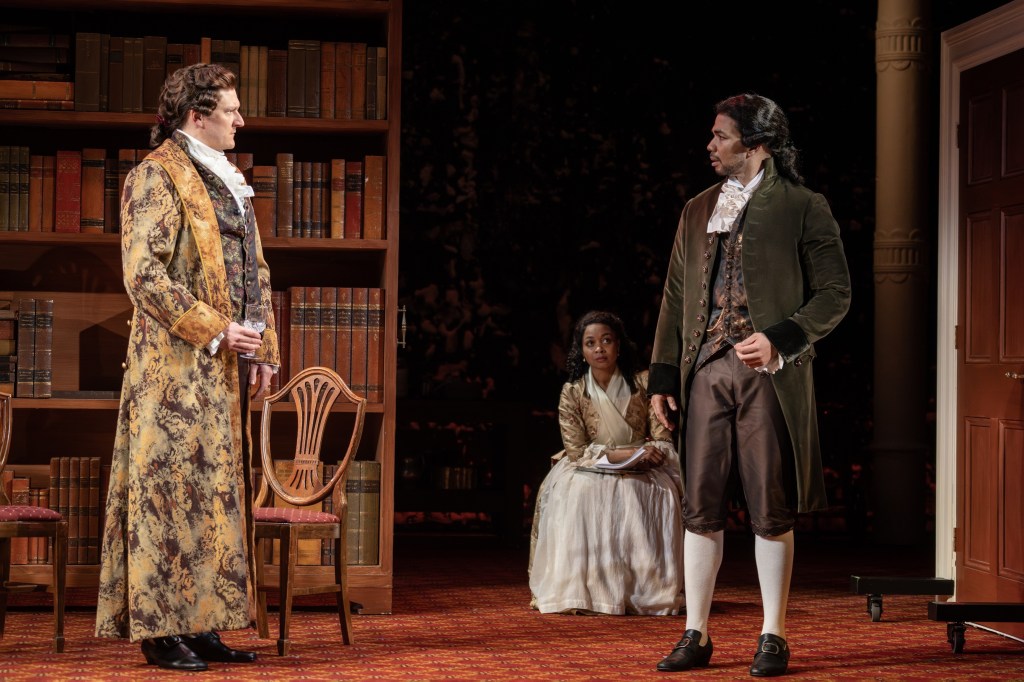
The play is heavy on accurate information. Jefferson’s “kindness” to his slaves is suggested up to a point. However, one senses the irony of a sub rosa rebellion underneath this essentially Black play which points up the scandalous “relationship” of the “good guy” Jefferson and presentation of Sally, Jefferson’s mistress, who gently gestures to her baby bump at the end of the play. Theirs was no love relationship, Luce, the playwright insists.
As the playwright Luce and director Mike rework various scenes, put in and take out inflammatory speeches, and try the patience of their producer, who eventually quits because the play is still too “in your face,” they evolve in their understanding. They are forced to modulate their impulses which reflect the present.
Some of the actors, prefer to show that the oppressed slaves had agency. In one instance, a beautiful speech is so incendiary, Teddy wants it to be removed because then, the play would be a hit and “sell,” and he’d get his money back, obviously. The point is made that during Jefferson’s time, a slave’s agency would be construed as an act of rebellion and punished with death.

The tension between what was (the oppressive horrors of slavery), and what is (current cultural freedom especially in New York City), rocks Kwame (Alano Miller), who is on the verge of “making it” in the business. Kwame portrays Sally’s brother James, who Jefferson promised to free when they returned from Paris, where James enjoyed freedom as the other Blacks did. However, when Jefferson et. al. return to Virginia where slavery is the law of the land, Jefferson makes excuses about freeing James, because why would he do what is illegal and frowned upon by the society of his plantation peers?
James continually confronts Jefferson about his promised freedom, and stands up to Colonel Carey portrayed by Geoff (Daniel Petzold), who refers to Sally, his sister, as a “fine animal.” When Jefferson “mildly” rebuffs James telling him to “remember himself,” James holds forth in a three minute speech which producer Teddy insists must be cut.

As brother James, Kwame enjoys speaking truth to power, though it is completely ridiculous for the 1790s South. It is clear that Kwame chafes at portraying a slave and feels he must redeem himself in such a role. The speech, which he delivers to “perfection” is his shining moment. The cast initially agrees and Luce, believing that Teddy is under her power, massages the producer to keep the speech and prevent Kwame from walking. Instead, Teddy quits and Mike and Luce are left with a financial abyss to fill and a long speech which makes no sense in Jefferson and the fledgling United States’ tide of times. Of course the “full of himself” Kwame believes his empowerment speech is the only value Pursuit of Happiness has.
The show, however, does go on as Mike and Luce’s relationship is sacrificed, Kwame quits, scenes are rewritten at the last minute and the acting “troopers” pull together and get to opening night. In the process, the farce unleashes and the admixture of revelation and forgiveness but not forgetfulness wins the day for the actors, and even for Sally and Tom at the “perfect” conclusion, that a sadder but wiser Luce has written for Pursuit of Happiness.

The actors are top notch in this glorious ensemble where Sun Mee Chomet, Kristolyn Lloyd and Kate Nowlin portray supporting roles. For those who gloried in founding father Thomas Jefferson’s iconic stature, Parks, speaking through Luce, pointedly suggests Sally did not love Tom. Though he supposedly was a kind master, unless one could go back in a time machine taking one’s present-day perceptions with them, it is impossible to know, given he kept 600 slaves and sold them off to raise money when he went to the Capitol, New York City. Finally, the audience is reminded that our great founding father never gave Sally her freedom. It was Jefferson’s daughter Patsy, disappointed at her father’s lascivious behavior, who finally freed Sally after Jefferson died.
If the Good Company had had their way with Teddy, who most probably insisted they change it, the title would have been E Pluribus Unum (“out of many, one”), instead of the benign Pursuit of Happiness. One would think that the implied unity has yet to be achieved in our nation, culturally fractured by foreign adversaries like Putin for politically opportunistic reasons. However, looking beyond social media posts of Marjorie Taylor Green, MAGAS, and Russian and Chinese trolls, federally, we are indeed, E Pluribus Unum, united and standing tall, while we attempt to iron out issues, as Parks points out, that are extremely complex.
Sally & Tom runs two hours, thirty-five minutes with one intermission at The Public Theater, on Lafayette Street. I loved it.
‘Stereophonic,’ Adjmi’s Hit Transfers to Broadway

When Stereophonic opened at Playwright’s Horizons in the fall of 2023, the hybrid comedy/drama/musical was extended a number of times for a multitude of reasons. The acting was superb. The subject matter intrigued. Who is not enthralled by a smooth rock band on the cusp of greatness with a chonky financial contract, “getting their s%$t together,” as a small privileged audience watches them record their artistry in two sound studios? Under pressure, the two couple’s relationships straining, the husband-wife partners display pustules bursting with emotionalism, and the audience sees the interior of these relationships. What’s not to love?
This is live theater at its best. The audience lives moment to moment with the musicians (we have forgotten they are actors), riding to the mountain tops and canyons as we joy to their pain of creation, producing what may be a #1 album that soars to the top of the charts. In its transfer and Broadway premiere at the Golden Theatre, the cast, music, verité style, and arc of development are the same as is the three-hour length as in the original production at Primary Stages. Bravo. It is still a must-see.

Why would playwright David Adjmi (The Evildoers, Stunning), Will Butler, who wrote the terrific original music and lyrics, and superb director Daniel Aukin muck with success? The solid, winning substance of Stereophonic is about the five-member rock band and studio engineers working at an accelerated pace to record an album at two California sound studios in the mid-1970s. We get the “low-down” perspective of what it takes to be great.
Above all Stereophonic Broadway remains a stylistic masterpiece of theater verité with a view into two separate worlds, music creation and technical engineering, without which musicianship would not exist. The meld of the two in a great album reveals the dynamic genius of technicians and musicians, though the musicians are the public face who receive all the glory.

Two points to make about the production, which is integrated and fantastic from my perspective, with one suggestion. First, Stereophonic may not be understood by a “Broadway” type audience, who might not have the patience to work through the incredible detail of “moment to moment” dialogue and complications so organically constructed, intimate and authentic, that the realistic action brings one into oneself, rather than encouraging escapism in a flight of song and dance numbers characteristic of “the Broadway show.” In its brilliance, Stereophonic may not be fully appreciated for what it is. Stereophonic is a “one-of-a-kind” original that provides an electrifying evening of music creation as one would imagine happened in iconic recording studios like Muscle Shoals Sound Studio in Alabama or Abbey Road in London, perhaps, without the histrionics.
Secondly, in its staging at the Golden Theatre, a larger venue, the sound design has to be properly figured out by the designers, and the actors. They are not in a smaller venue. The actors must project, especially when their backs are turned from the audience. The sound design must be at equal level in every portion of the theater to eliminate dead spots. In the transitioning this must continue to be fine tuned.
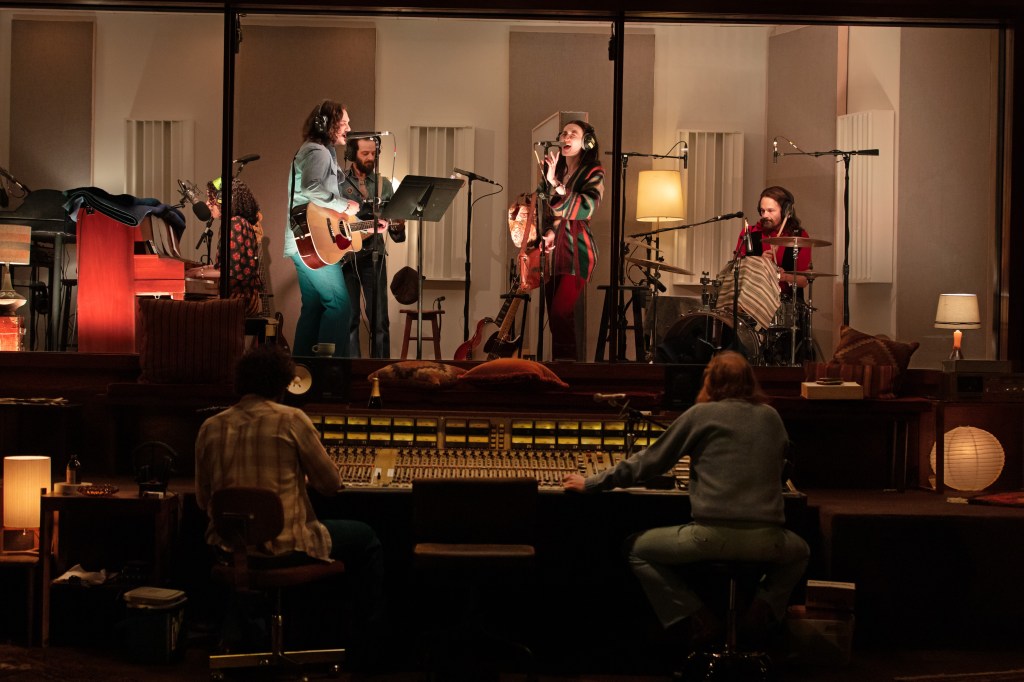
For rock fans and those fascinated by the ethereal nature of how bands collaborate, the Broadway production mesmerizes because we clearly understand the division between the musicians’ mystical artistry, which is always front and center, and the unseen, faceless, backstage engineering by Grover (Eli Gelb), and Charlie (Andrew R. Butler), who are finally revealed in process. It is the engineers’ artful techniques which enhance the overall effect and impact of each recorded song. This division of the two different realms of making music is beautifully manifested in David Zinn’s wood paneled scenic design, and Jiyoun Chang’s lighting design, which Aukin carried over to Broadway, along with Enver Chakartash’s period costume design. Robert Pickens & Katie Gell’s hair and wig design are new in this production.
As at Primary Stages, the Golden Theatre’s stage is divided into two sections. The upper level reveals the sound studio protected by glass, where we see and hear the musicians perform in a theater verité style, as they stop to revise tempos, add pauses, evolve riffs, etc. Downstage is the massive control panel where the engineers sit mostly with their backs to the audience and work to serve, manipulate, and stoke the musicians’ extraordinary talent and heightened emotional states, all the while discussing “their truth” with each other. With Aukin’s superior staging, we can track both worlds, feeling we are in their midst, interactively participating in music creation and understanding how the worlds precariously interact.
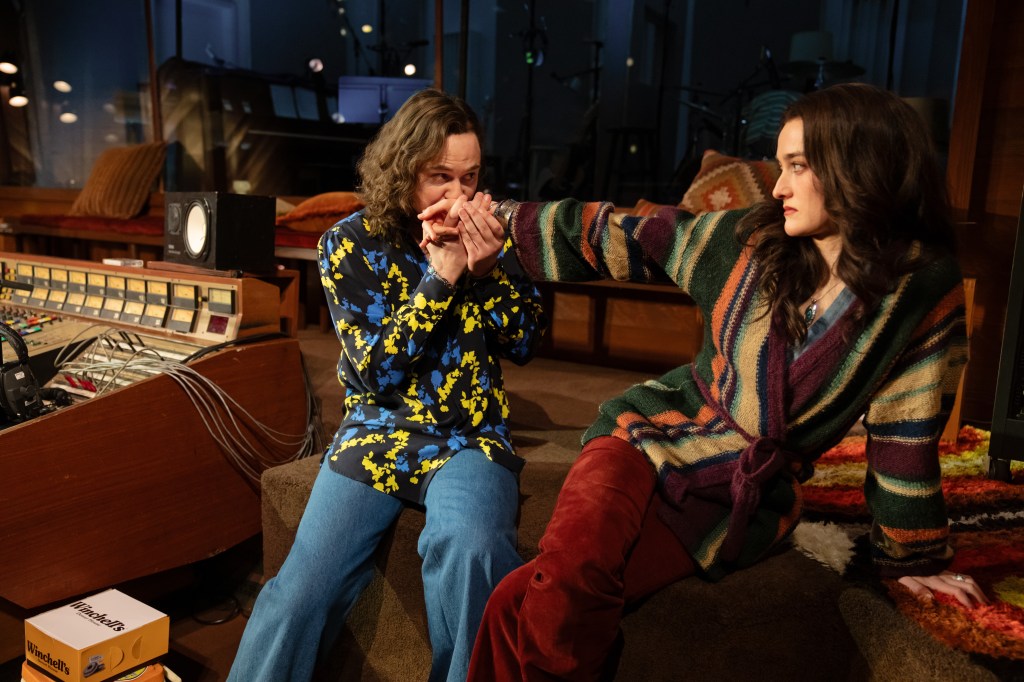
Though band members treat Grover and especially the shy Charlie as invisibles they don’t speak to, without their efforts the band’s unique identity and glorious sound wouldn’t exist. Therefore, in the production’s arc of development, Adjmi gradually uncovers the engineers’ centrality to the creative process and the band’s success. It is especially funny and poignant to witness how the engineers moderate the emotional infantilism of the “high-strung” musicians to get the recordings in top shape.
Throughout, drugs and alcohol become a panacea to quell the rough edges of sleep deprivation and stimulate a frenzied work environment. The cocaine, supplied by overworked engineers, keeps the band working at a frenetic pace. Ironically, drug use intensifies the arguments but floods the band’s creative juices.

Aukin’s vision of Adjmi’s themes of art, music, sacrifice and suffering, heighten the importance of sound engineers. They must have skill and expertise in the control room, as well as the personalities to cope with and manipulate artistic personas like druggy Reg (the hysterical and funny Will Brill), and diva Diana (Sarah Pidgeon).
For example Grover and Charlie must be temperate as Diana strains to get the notes, emotionally loses it, and must be encouraged by her partner lead musician and producer Peter (Tom Pecinka), to try again and again to “get it right.” Additionally, the engineers must be purposed to withstand the emotional word bludgeons from their “boss,” Peter, who launches off into a demeaning tirade against Grover and fires him. It is an idiotic move because Grover is the backbone of the album and Peter knows it. That is why he later makes Grover co-producer and apologizes.
The songs of Will Butler, (Oscar-nominated and former member of the Grammy-winning indie rock band Arcade Fire), remain as striking as ever. Indeed, one would wish that this band does produce an album, finishing the partial songs (we only hear a few in their entirety), that we hear them rehearse. The songs resonate with the themes of emotional yearning and the deceptions of fame, money and commercialism, the masquerade that they must avoid. If they embrace the commercialism, they will lose their way as artists, attempting to achieve perfection, a goal of the hard driving Peter.

Butler’s songs importantly reveal the raw emotions of anger and hurt, stirred by betrayal and loss that couples Reg (Will Brill) and Holly (Juliana Canfield), and Peter and Diana, experience in their relationships. Working frenetically together in close quarters to exceed the results of their previous album require sacrifice to be great. Peter constantly pushes them toward this. But by the conclusion as their work is finished, all have suffered for it. Simon (Chris Stack), who has been away from his wife and children for six months faces the threat of divorce and losing his family.
However, only Diana has been signed on to be a solo artist. Is the pain, suffering and sacrifice worth it for the others? Juliana Canfield’s Holly, a close friend and ally of Diana, congratulates her on this success. But we are left wondering if they will remain close or if the band will remain together to collaborate again?
A tour de force, Stereophonic runs over three hours with one intermission. Thanks to Adjmi, director Daniel Aukin, the sensational cast, whose acting chops and vocal talents are non-pareil, and the technical design team, the compelling forward momentum of the band’s creative dynamic resonates with powerful immediacy.
Special kudos goes to Music Director Justin Craig and Will Butler and Justin Craig’s orchestrations.
Stereophonic runs through July 7 at the Golden Theatre (252 West 45th Street, between Broadway and Eighth Avenue). www.stereophonicplay.com
‘Lempicka,’ The Art of Survival With a Paintbrush

Loosely inspired by tumultuous events in the life of Tamara de Lempicka, which gave rise to her provocative oil paintings of high society portraits and nudes in an Art Deco style, the musical Lempicka magnifies the theme of femininity unbound. The “unbound female” is a marvelous theme, perhaps annoying to some male critics, but welcome to most women, who have been undervalued and diminished throughout history. The expressive, glamorous and impassioned Eden Espinosa stars in the titular role. The premiere currently runs at the Longacre Theatre until September.
With the book, lyrics and original concept by Carson Kreitzer, and book and music by Matt Gould, this sensational, must-see musical is directed by Rachel Chavkin, who shepherds a superb creative team. The director effectively stages the action with her signature, fast-paced forward momentum. Minimalist, geometrically shaped scenic design elements and stylized ironwork scaffolding (Riccardo Hernandez’s design), adapt to the various settings. Thanks to the effective use of light and color (Bradley King), sound (Peter Hylenski, Justin Stasiw), and Peter Nigrini’s projections, the combining elements symbolize the cultural and historical references to the musical’s settings in Russia, France, and the United States.

Choreographed by Raja Feather Kelly, the amazing music is arranged and supervised by Remy Kurs. Lempicka reveals an incredible female artist, whose works Madonna and Barbra Streisand have purchased.
Chronicling the artist’s journey in flashback, Lempicka opens with a musical pop flourish to reveal an elderly woman sitting on a bench, “painting” en plein air, sans paints and canvas. Under the wide brimmed hat, Lempicka (“Unseen”), reminisces about her former glorious European life. Now, an “old woman that doesn’t give a damn; that history has passed her by,” she asks, “How did I end up here?”
The question is readily answered. She sheds her “old lady digs,” (Paloma Young’s costume design), and steps back into the past, transformed into a lovely, young woman, in a shining white wedding dress. It is the happy day of her marriage to wealthy Russian aristocrat, Tadeusz Lempicki (golden voiced Andrew Samonsky).

In a flurry of action in the next scenes, with jarring lighting, sound and bellicose revolutionaries, the Russian Revolution storms onstage (“Our Time”). Officials arrest Tadeusz, boasting that now everyone is like everyone else. Kreitzer and Gould’s book reveals Lempicka’s steadiness and presence in the moment, as she uses jewels and her body to save Tadeusz and baby Kizette. (The older Kizette is played by Zoe Glick.)
Within her heart and soul, Lempicka, a survivor with flexibility “in season and out,” converts the violence, oppression, and trauma of losing everything, into the building blocks of a unique artistic expression. After the family arrives in Paris as destitute refugees, with Tadeusz useless and despondent, she forces herself to paint for their subsistence.

Clearly, her experiences shape her art, and Chavkin’s vision, beautifully executed by her creative team, subtly ties the two together. Lempicka infuses her work with hints of her sexually frenetic lifestyle during the Anneés Folles in Paris, through the depression to 1939. Guided by her futurist teacher Marinetti (the superb George Abud), the art instructor insists “we are sober broken creatures; we need art that speaks to us now” in “the age of the machine” (“Plan and Design,” “Perfection”). Striking out in her own direction, employing some of his suggestions, Lempicka creates exquisite, tonal melds of steely, cool sensuality to convey her “larger-than-life,” shimmering, women subjects.
As her prime muse, she paints her lover Rafaela, the phenomenal Amber Iman, whose thrilling voice is sultry and seductive (“Don’t Bet Your Heart,” “The Most Beautiful Bracelet,” “Stay”). Despite Rafaela’s intentions “never to love,” they couple in an intense relationship that spurs Lempicka’s creativity to expand her chic brand. Rafaela helps her to forever solidify her iconic, ravishing, sensually bold artistry of women nudes and portraiture.
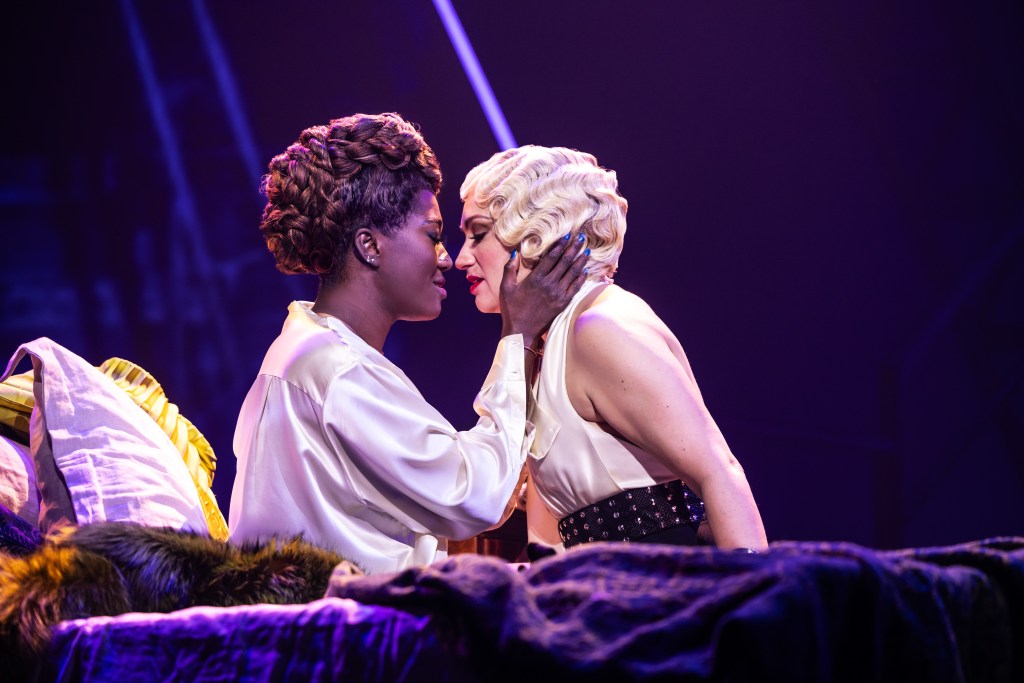
Her subjects bridged the worlds of Café Society and the underbelly of Paris’ open sexuality, represented by the Club Monocle, owned by audacious, bon vivant, Suzy Solidor (Natalie Joy Johnson). There, forbidden love and entanglements are encouraged because payoffs to the authorities allow such entertainment to flourish (“Women”).

In the opening scene’s moment of reflection, Lempicka says she, “loved more than life itself,” and specifically loved two people at the same time. They are Tadeusz and Rafaela. In an exceptional moment, they meet at Lempicka’s exhibition and sing “What She Sees.” Iman and Samonsky sing the ballad with gorgeous, resonating power.

As the Black Shirts, joined by Marinetti, flood the forbidden cultural spaces of Paris with intimidation (“Here it Comes,” “Speed”), they destroy Suzy’s club. The center does not hold, and Paris begins its transition to fascism’s conservative allure banning “decadence.” Lempicka’s life in Paris disintegrates. The operatic powerhouse number, “Speed,” is particularly striking as Tamara, Rafaela, Marinetti, Tadeusz emotionally convey the upheaval in their lives. Circumstances force them to rapidly spiral away from each other.
In a vital scene, Beth Leavel’s Baroness asks Lempicka to paint her for her husband’s remembrance. She is dying of cancer and encourages Lempicka to be with the Baron (Nathaniel Stampley), who is also her agent and an art collector. The way will be clear for Lempicka, divorced from Tadeusz at his insistence, because he can’t abide by her alternate lifestyle.

In “Just This Way,” Leavel’s pitch-perfect, full-throttled power brings down the house. Though the part is small, Leavel makes it loom gloriously. In the Baroness’s dying is the intensity of her desire to live forever in Lempicka’s incredible art.

When Lempicka and the Baron presciently flee Paris in 1939 ahead of the Nazi occupation, Lempicka forever leaves the philosophy, culture and wild personas that engendered her most appealing works. She settles into oblivion in Hollywood, as the flashback of her European life closes. At the conclusion, she sits “In the Blasted California Sun,” haunted by memories of Rafaela, who disappears, but like all those from her past, lives on in Lempicka’s artistry (“Finale”). Today, Lempicka’s paintings are worth millions.
Lempicka. Two hours, thirty minutes with one intermission. Longacre Theatre, 220 West 48th Street between Broadway and 8th Avenue. https://lempickamusical.com/
‘The Who’s Tommy,’ a Nod to the Past, and Segue into the Future

If you are a fan, The Who’s Tommy, currently in its first revival by Des McAnuff, (he directed the show’s original Broadway presentation over thirty years ago), may absolutely thrill you with its exuberant, pulsating electricity and phenomenal musical arrangements. With music and lyrics by Pete Townshend, additional music by John Entwistle and Sonny Boy Williamson II, and Ron Melrose’s music supervision and additional arrangements, it’s a gobsmacking explosion from the past for Boomers, and a scintillating acceleration into the future for Generations X, Y and Z. The production’s hyper-effects leave the music thrumming in one’s mind long after you leave the Nederlander Theatre, where the revival is currently in an unlimited run.
The rock opera which exploded on the music scene in 1969, in long album form was codified as groundbreaking, and eventually was inducted into the Grammy Hall of Fame. Townshend’s chords and story line were memorized by legions in the immediate years after, as critics and fans alike interpreted what the story could be about.

Meanings and symbols spanned from Jesus to Buddha to Townshend’s own avowed inspiration, Meher Baba. The interpretation encompassed a spiritual leader who arcs the soul’s journey and helps mankind and womankind shatter the ego/carnal self to see and feel the spiritual immortality in their humanity. However, mistakenly assuming that everyone’s path toward wholeness can be achieved via the leader’s methods, he makes his followers do exactly as he did, making them suffer. His followers rebel and ultimately reject and metaphorically crucify the one they formerly idolized. The reward is not worth the path of suffering, denial and dedication to get there, they feel, as they take out their suffering on Tommy’s parents while he escapes to solitude and the seeker’s path at the conclusion.
Of course, these interpretations reflected the progressive spirituality and dedicated movement toward liberation of the late 1960s-70s, heavily influenced by psychedelics, flower power, gurus and shamans from various cultures, belief in peace-not war, and the Jesus Freaks movement (not the same as carnal, conservative evangelical, political Christianity today). Duly inspired, the maverick British film director Ken Russell created his hybrid fantasy drama musical based on The Who’s titular album. With an exceptional cast (Oliver Reed, Ann Margaret, Roger Daltrey, Tina Turner, Elton John, Jack Nicholson), Russell maintained the story which centered around traumatized Tommy Walker (Roger Daltry in the film). The literal story follows from the film and subsequent productions, Broadway (1993), through the first section until the latter part of Act II.

This latest Broadway revival veers off after the healed Tommy establishes his fan base and seeks to “correct” them with his methods. Townshend and McAnuff’s book sterilizes the retributive, shocking ending. Tommy purists may not like how the book truncates the force of the last half. “Tommy’s Holiday Camp” is cut, as is the subsequent brutality visited on his fans and parents. Some songs are added, without the same musical strength as those in the original album. The spiritual concepts are also minimized. Instead, this version emphasizes the visual, futuristic design spectacle of the production by David Korins (scenic design), Amanda Zieve (lighting design), Saragina Bush (costume design), Peter Nigrini (projection design).
It suggests video gaming culture and the small screen iPhones and Androids forever before our faces. In the suspended lighted frames of all sizes in various scenes that generally frame the story, is the theme that society and parents frame us. These frames echo and the central mirror framed by lights that Tommy repeatedly looks into and looks out of. The effect echoes the culture’s “branding,” boxing in everyone to fit in to get along.
Not having seen other productions, or The Who in concert, the updated, futuristic spin for me, carried its own message, themes and warnings. Certainly, with its high-tech projections and minimalist frame lighting, echoing the frame of the mirror which Tommy is obsessed with and his mother eventually shatters, we are reminded of our current culture’s preoccupation with gaming, selfies, ego, self-importance and encouraged selfishness. Especially through the staging and design, this version emphasizes such nihilistic obsessions and the danger of small screens whose App platforms brainwash, distract and seduce.

This theme moves throughout this revival’s technical aspects which align with our own culture’s deluded “deaf, dumbness and blindness” and the near cultism inspired by hand-held devices. These have increasingly disassociated us from our own natural environments and directed us toward a dystopian, fabricated world view of division, hatred and insult or complete distraction and entertainment with the effect of protecting adherents in their own information silos. This parallels how Tommy protects himself with his psychosomatic illness.
This version begins with Peter Nigrini’s fine production design that spins a black and white collage backdrop of the setting for 1941. Against that backdrop acted out are the Walker’s marriage, the German POW Camp, etc., as the Overture plays and the company sings.

Mrs. Walker (the sweet voiced Alison Luff whose climactic moment of shattering the mirror is delivered forcefully), gives birth (“It’s a Boy”) after which Tommy’s father, Captain Walker (Adam Jacobs), is believed to have died, though the war has been won (“We’ve Won”). Understandably, Mrs. Walker takes another lover (“Twenty-One”), but when Captain Walker returns to see his wife in the lover’s arms, he kills him in front of four-year-old Tommy (Cecilia Ann Popp and Olive Ross-Kline alternate days). Told by his parents to suppress what he sees and hears about the manslaughter, Tommy turns himself “deaf, dumb and blind” in a crazed psychosomatic obedience and rebellion against his warped, fearful parents (“Amazing Journey”).
As Tommy grows up unresponsive and uncommunicative with his parents and his environment (Quinten Kusheba and Reese Levine portray the 10-year-old Tommy alternating days), he is further traumatized by his pedophile Uncle Ernie (John Ambrosino’s part is sanitized in the song “Fiddle About”), and sadistic cousin Kevin played by the superbly arrogant, wickedly sinister Bobby Conte, who gloriously sings as the perfect, cruel foil to Tommy’s innocent. Both villains “babysit” Tommy as his parents neglect him (“Do You Think It’s Alright?”).

The actors portraying the younger Tommy are incredible as automatons. Their performances represent the result of horrid parenting and enforced objectification, when children receive orders then respond/rebel in original ways. In the story Tommy is an objects to be played upon and pushed around. I found this interpretation by McAnuff frighteningly symbolic, giving new meaning to parental abuse, neglect and force-feeding an obedient image, “acceptable” to his parents. They remain obtusely unaware about their integral part in suppressing Tommy and fashioning him into a non-person who screams “See me, Feel Me,” for he wishes to be free from the soul bondage.
Tommy’s future, older self is portrayed by the stellar Ali Louis Bourzgui, whose voice shatters consciousness itself with its phenomenal power and nuance. McAnuff has him stand in the light-framed mirror, reflecting back his alter-ego when the younger Tommys look in the mirror, their backs to the audience. This is open to interpretation. One possibility is a metaphoric representation of hope of who Tommy can become, including the whole person, free and in touch with his spirituality.

Though Tommy diminished three of his senses to suit his parents’ wishes, he compensates with an enhanced sense of touch and his sixth sense tied to his imagination (“Sensation”). A series of fateful events leads Tommy to become a pinball champion with his energized sense of touch. But despite this compensation and rise to fame, his parents want him to check in with reality, tired of the robot they created unaware. This leads to a series of interventions at a clinic and at a place where Tommy can receive drugs from the Acid Queen (Christina Sajous).
This wild scene in what looks like a crack den out of a Spike Lee Joint (film), reveals Sajous to be a desperate addict doing the bidding of her pimps. Jacobs’ Walker relents at the last minute and leaves with Tommy. It is another veering off of the original album and Russell’s film (with Tina Turner as the Acid Queen in an unforgettable performance in the film). This redirection which purists will object to de-glamorizes the positive effects of psychedelics in what is now becoming treatment for PTSD survivors and those with severe depression. However, sanitizing the Acid Queen scene also emphasizes the father’s desperation to have his son cured. He’ll try anything, but then realizes “anything” has its own potential horrors.

Obviously, Townshend and McAnuff keep the audience away from the disturbing and unsettling as much as possible, reflecting the conservatism of our times which ironically has given rise to the runaway chemicals of the pharmaceutical industry, controlled substances and highly addictive prescription medications like oxycontin and fentanyl. Both highly addictive “meds” have caused thousands more deaths than “orange sunshine.”
“Pinball Wizard,” the spectacular number sporting contrasting colors, flashing lights, searing projections and uber-technicals, as the grown Tommy “shows his stuff,” is breathtaking. Sung by Bobby Conte and the ensemble (with a nod to Elton John in the film by an unnamed “Local Lad” who belts out the opening salvos of the song and is fantastic), the audience experiences a gyration of emotions as the first act ends. The music has elevated and mesmerized, and one is left anticipating Act II with the timeless rock music pulsating through minds, hearts and bodies.

The first Des McAnuff production of The Who’s Tommy in 1993 starred Michael Cerveris as Tommy. The production, nominated for 11 Tonys, won five, including Best Original Score for The Who co-founder and musician Pete Townshend. The revival will surely be nominated, principally for its phenomenal find in the latest Tommy, Ali Louis Bourzgui, whose penetrating voice, compelling presence and powerful mien establish Tommy in all aspects of the character, implying sensitivity, charisma, spirituality and the ability to mesmerize and lead.
However, in updating The Who’s Tommy to make it relevant for our time, the spirituality and wisdom of the album’s meaning is inevitably softened to encourage a frightening look at our contemporary culture, albeit also softened. If anything is at fault with this version, though there is too much that is great which does mitigate any faults, a flaw is this. McAnuff didn’t go far enough with his vision to expose the importance of Tommy’s message-the need to return to spirituality, with direct references to the current ubiquitous technology, fake, hollow Christianity, and memes that seek to globalize, pasteurize and with cacophonous, information overload, overwhelm the importance of original unique voices emerging from the human spirit.
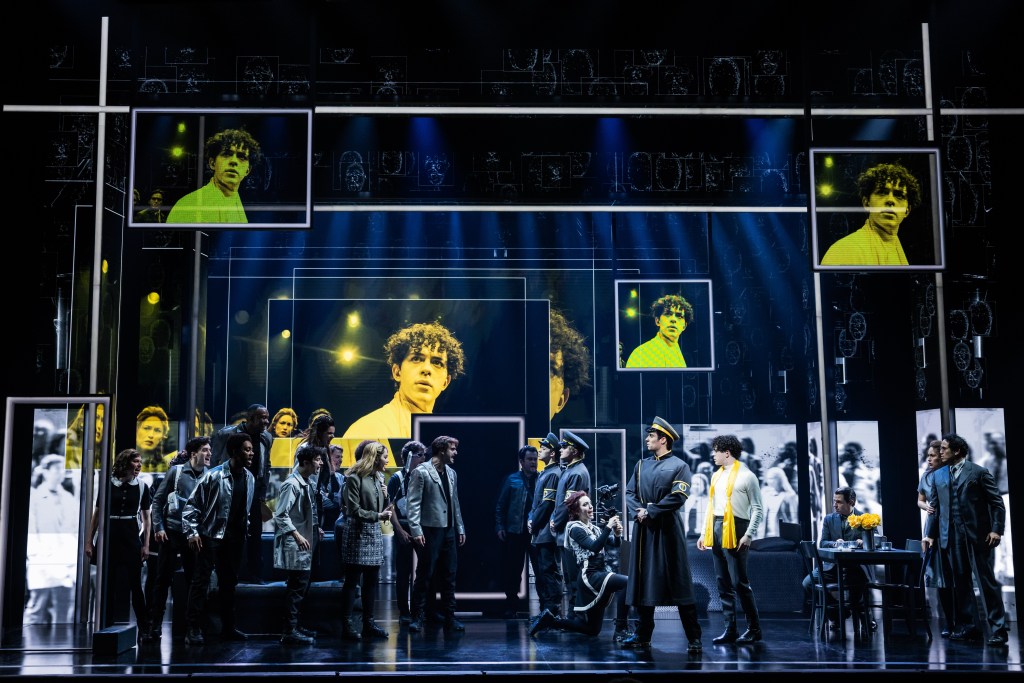
The finale attempts to do this. It happens as the audience and cast, who stands on the edge of the proscenium, sings “See Me, Feel Me”/”Listening to You.” It is enough, yes, but it also isn’t. With so much at stake in our present culture, with so great a need for people to return to inner healing and spiritual wisdom, McAnuff’s softening of the inherent villainy and spiritual revelations of the original album with an incomplete update of the cultural relevance, might be a lost opportunity. Regardless, I loved The Who’s Tommy.
Kudos to those not mentioned before. These include Lorin Latarro (choreography), Steve Margoshes (orchestrations), Charles G. Lapointe (wig & hair design).
The Who’s Tommy. Nederlander Theatre, 208 W. 41st. St., New York with one intermission. TommyTheMusical.com
‘Water for Elephants’ a Sensational, Poignant, Uplifting Spectacle

Based on the titular novel by Sara Gruen, Water for Elephants, excitingly directed by Jessica Stone, currently runs at the Imperial Theatre until September 8th. The production is a circus musical about redemption, love, courage and faith. With a book by Rick Elice and songs with a variety of dynamic musical styles and empowering lyrics by Pigpen Theatre Co., this is one of the finest, most rousing musicals to land its premiere on Broadway.
Water for Elephants richly incorporates the spectacle of the circus with stylistic artistry and well choreographed, impressionistic, acrobatic, aerial beauty. The company particularly embodies the spiritual essence of the beloved animals that are integral to the acts that barely keep solvent the foundering Benzini Brothers Circus, taken over by ringmaster/owner August (the excellent Paul Alexander Nolan).

However, before the spectacle begins, at the top of the musical, a wizened, grey-haired, tall gentleman, Mr. Jankowski (the fine Gregg Edelman), appears. He is serenaded by ghosts of the past (Prologue) which remain obscure in our understanding until Charlie (Paul Alexander Nolan doubles in two roles), returns Mr. Jankowski to the present from his reverie, and Jankowski good naturedly comments that he enjoyed O’Brien’s One-Ring Circus. As June (Isabelle McCalla) and Charlie make sure everyone is packing up, a few turns of dialogue later, the elder gentleman comments that June’s horse could use “a stress test.”
Immediately, we realize that Jankowski’s knowledge is particular. And when he says he is there alone because his kids were too busy to come with him, and he’s escaped from the “home” and that will put the nurses in a tizzy, we are intrigued by what deep element in his psyche has brought him to this small circus. Affable and pleasant, Jankowski ingratiates himself with Charlie and June. Warmed up by his inside knowledge of circus jokes, Charlie says Jankowski can use his phone to call a cab to return him to the “home.” In the interim, June offers to show him around as they discuss his involvement in the circus of yesteryear and the differences between then and the present-day. Finally, Jankowski, a former animal vet, offers to look at the mare that “needs a stress test.”

From this segue, the arc of development begins and Edelman’s Jankowski genially and intelligently narrates his involvement with the circus. As we move into the flashback, Edelman deftly walks us into the past. It is during the depression and Grant Gustin portrays Jacob Jankowski as a young man. In an amorphous scene of memory and voices, the older man sees his younger self reacting to the news of his parent’s death in a car accident, after which he was orphaned and left homeless. The powerfully voiced Gustin’s Jacob lives hand to mouth fending for himself. Hoping things will be better somewhere else, his destitution places him with other hobos on a train going wherever the wind blows them, (“Anywhere/Another Train”).
Jacob’s fellow riders Camel (Stan Brown) and Wade (Wade McCollum) are ready to throw him off this special train, but Jacob roundly stands up to Wade’s bullying aggression. Afterward, the two men who are roustabouts tell Jacob he hopped on a circus train and he can ride with them to the next town and stay for a day by making himself useful. There is fierce competition for every job, and he needs to distinguish himself to stay around permanently.
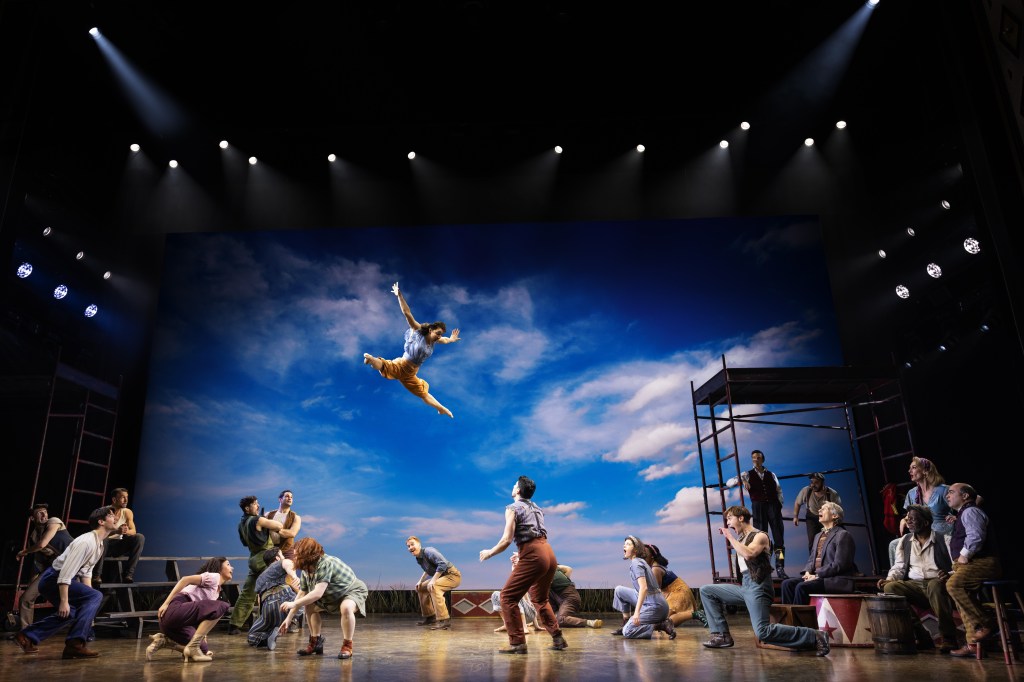
The stylized sets by Takeshi Kata in this scene of fast pacing movement are scaffolds on rollers which suggest a moving train with the help of the company, who create the bouncing motion which suits the rhythms of the music. Camel, who empathizes with Jacob, is the one who persuades Wade to allow him to stay for one day. Since Jacob elects to work with the menagerie, Camel tells him after they arrive in Utica and start setting up, he can earn his day’s keep by shoveling “s%$t.”
Director Jessica Stone and her creative team, which includes Shana Carroll’s circus design, Jesse Robb & Shana Carroll’s choreography with Mary-Mitchell Campbell & Benedict Braxton-Smith’s music supervision and arrangements, reimagine the interior, backstage world of the circus, of roustabouts, and the odd mix of personnel attracted to the nomadic, unique, showmanship of circus performance. In the musically synchronized “The Road Don’t Make You Young,” Jacob tours the circus and sees the insider’s scoop. The company of singers and acrobats swing mallets to stake the ropes for the Big Top and do daring twists and thrusts high into the air to commit muscular feats that take one’s breath away and rival the masters of Cirque du Soleil.

Jacob is nonplussed, figuring he will only stay one night, but is amazed to meet Agnes the Orangutan (Alexandra Gaelle Royer cutely re-imagines the reputedly smartest ape). Introduced to Barbara (Sara Gettelfinger), the mothering lead dancer of the “cooch tent,” Barbara tells him to get some grub and act as bouncer. Wade (August’s deadly right arm), renames her act to “Barbara and the Bally Broads,” and elevates them from the side show to the Big Tent to do “less strippen and more dippen.” Gettelfinger in a minor part plays it to the hilt.
As the song continues, Jacob, nicknamed Jake, also meets knife thrower and clown Walter (the humorous Joe De Paul), and Queenie his dog (a fluffy, long haired, hand puppet skillfully authenticated as a pooch by whomever “handles” her). By this juncture, Jake has met all those, who have been worn out by traveling the adventurous, road except the puppet master who keeps all in line. To conclude “The Road Don’t Make You Young,” owner August Rachinger presents himself center stage as the Broadway audience goes back in time to become the Benzini Brothers audience. In typical one-up-man ship razzle dazzle, Nolan’s ringmaster sings, “You wanna see something to set your spine tingling, something that blows Ringling out of the Ring?”

We question. Is he for real or just another blowhard exaggerating that chaff (the empty hull of a grain of wheat) is the meaty kernel of substance as he pretends his circus is finer than Ringling Brothers?
Unlike the quaint audience of the 1930s, who could not fathom black holes in space, television, quantum physics, cell phones, space stations orbiting the earth, Social Media and AI, we are the audience who experiences daily scientific wonders. What we’ve seen thus far on stage makes us understand August’s drive to be great in a time frame that is 90 years in the past before the dropping of the atom bomb. Additionally, we must consider that the parochial audiences of that time may rarely have seen a live lion.
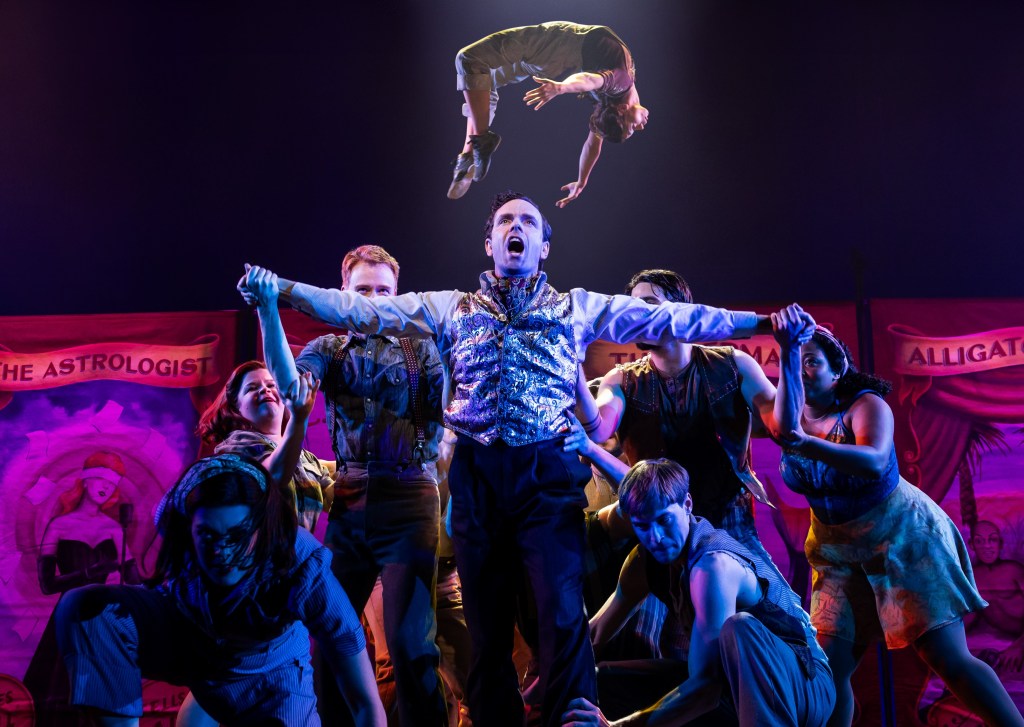
Our disbelief at August’s pronouncement is gradually suspended when the action moves back to the present with the elderly Jankowski. Charlie and June act amazed when he tells him that this circus was the famous Benzini Brothers of 1931. The crux of the story, how the foundering Benzini Brothers becomes THE Benzini Brothers of 1931, an outfit which made circus history, but not in a good way, is the substance of Jankowski’s tale.
The turning point for the circus and Jankowski’s narration begins at the encouragement of June and Charlie in the present. They want to know what happened. It is then Elice’s book returns us to the past, when Jake hears the limpid voice of Marlena (Isabelle McCalla also doubles as June). She coaxes and attempts to calm the ailing Silver Star (the horse she rides who brings in the crowds), out of his pain by singing, “Easy.”

This is an exceptionally moving number as Antoine Boissereau infuses the agony of the horse with liquid movement aerially, as the white drapery flows with choreographed simplicity to effect his spirit struggle to stay alive despite his pained flesh. Jake is emotionally moved by Silver Star’s pain and the soulfulness of Marlena’s healing song. However powerful Marlena’s love is, Silver Star needs weeks of rest and recuperation to return to the center ring. If he doesn’t heal he will be lame, a death sentence for a star horse. Jake, uses the knowledge he has learned at Cornell as a vet, and his father’s experience as a vet. He tells August, who Jake finds out is Marlena’s husband, that the situation is dire for Silver Star.
August has him mercifully kill Silver Star which is a dramatic moment created by the Boissereau’s artistry. By that point August realizes Jake’s value and offers him a job. Jake avers because he realizes the pressure and tension he will be under having fallen for Marlena and having to live under the watchful and sinister monitoring of August whose behavior, at times is cruel and bellicose. When the train arrives too late at Wilkes-Barr, Pennsylvania where they try to get a replacement horse, they discover only Rosie is left for them to buy. August purchases her, and then is told she is an elephant, and they discover a truth her caretaker shares after purchasing her. She is one of the dumbest creatures anyone has ever worked with.
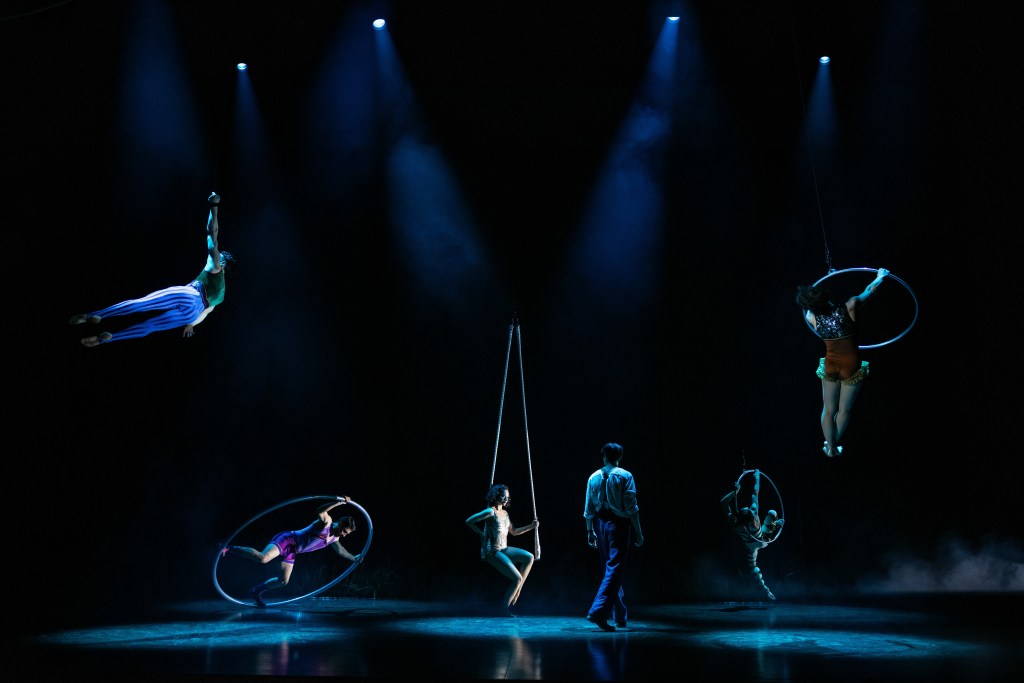
Humorously, not only has Jake fallen for Marlena, he falls for Rosie, who appears first as a trunk, then as various parts of an elephant in a clever “keep the audience wondering” if she will ever appear as the whole package. Interestingly, there is a meld of time, of present and past so that the elder Jankowski and Jake and Marlena sing the praises of Rosie (“Ode to an Elephant”) in another of Jankowski’s reveries.
With transformative hope, Marlena and Jake work together with Rosie as August suggests, while he sinisterly comments that Jake will never have Marlena and in effect threatens him away from her. Nevertheless, Rosie, Marlena and Jake work to try to get Rosie to do tricks with Marlena. In these sequences with Rosie the past is the present. Mr. Jankowski relives the hard work they go through with Rosie, who just doesn’t get much of what they are trying to teach her. (“Just Our Luck”) (“I Shouldn’t Be Surprised”)

Meanwhile, if they can’t get Rosie in the center ring with Marlena as their main attraction, the circus which was foundering will completely fail. They need a miracle. Wisely, Stone teases the audience with what it wants to see, Rosie in full regalia as the beautiful elephant that all, including the company, have been singing about. Tantalized, we see the shadow of Rosie whole, but have to wait for her in fullness, until after the romance between Marlena and Jake blossoms in a kiss that happens almost unconsciously and whose “tell-tale” signs of lipstick alert Camel to warn Jake that he won’t be able to handle the trouble August will bring upon him for stealing the affections of his wife. Likewise, Barbara warns Marlena off Jake. However, both cannot help themselves.
Despite Marlena not getting Rosie properly trained for her star performance, August pushes the issue because they are desperate for the money the act will bring. In “The Grand Spec” Nolan’s August and the company superbly whip up the crowd as we anticipate seeing Rosie do “her thing.” When he is left standing with no stars emerging, the humiliated August runs backstage and attacks Rosie and beats her, trying to get her to move. We hear her pained trumpeting cries, and then she defends herself and knocks down August. She is ready to stomp him when the miracle happens.

Jake in the twinkling of an eye reacts and Rosie stops herself from killing August whom she hates. The day is saved and the audience finally sees Rosie in full form. She is awesome in all her glorious, sensitive puppetry thanks to Caroline Kane, Paul Castree, Michael Mendez, Charles South and Sean Stack. “The Grand Spec” concludes and August finally becomes what he’s dreamed of being, the proud, successful “ringmaster extraordinaire.”
However, this achievement is at great cost, for he realizes he has harmed his relationship with his wife. Jake’s success with Rosie and August’s own cruelty and jealously have pushed Jake and Marlena together. She hugs Jake celebrating their success. Though she blows August a kiss, his inferiority and insecurity make him feel the loser. Nothing she can say and do will arrest his thoughts that Jake and his wife are lovers, though nothing but a kiss and hug has happened between them.
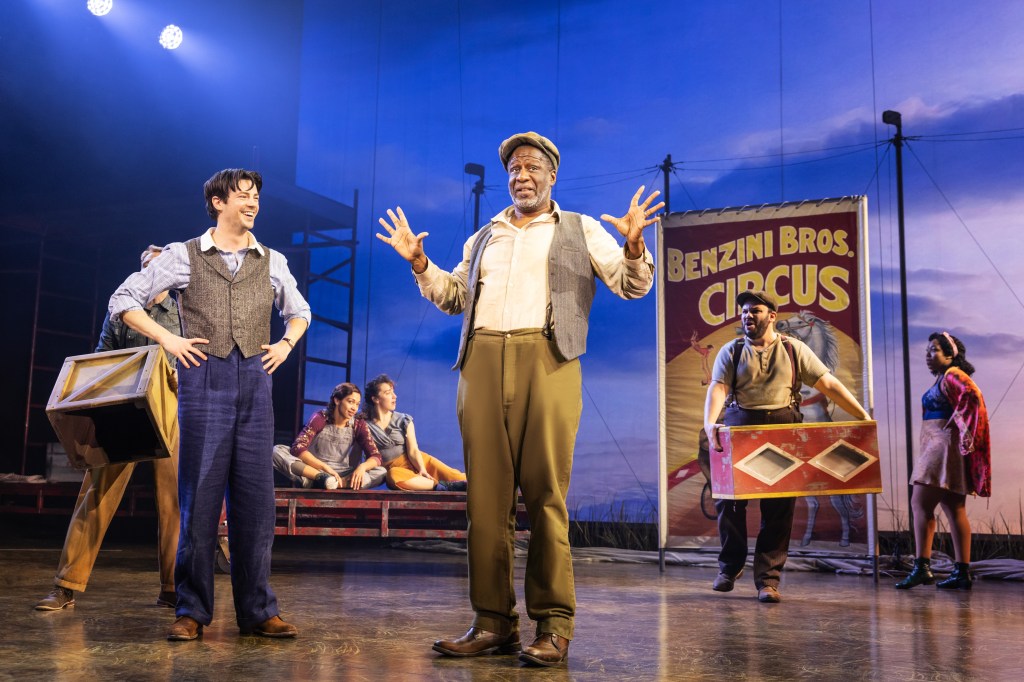
Thus, one problem is solved, however, unchecked psychologically, August, who should be thrilled with Rosie and Marlena’s sensational act, is driven toward distrust and anger. He drowns in his own bitterness that the reason why the act with Rosie is a success is because of, Jake, who has become invaluable.
Act II unfolds as the conflicts increase among August’s circus people and himself as well as August, Rosie, Marlena and Jake. In the first act we have a clue to August’s character (“The Lion Has Got No Teeth”); he feels he is a worthless fake. Though he glories in it and embraces his lies, this attitude does nothing to uplift him. August allows his envy of Jake, who is his superior in attitude, personality, education and kindness to animals, to be his undoing. Instead of realizing Jake and Marlena love each other and it’s time to move on, his cruelty and thuggery (we see how Wade, his lackey, acts out August’s evil wishes) cause him to seek vengeance. This spills out onto others in his company, and we note that he becomes so loathsome, that he cannot even stand himself.
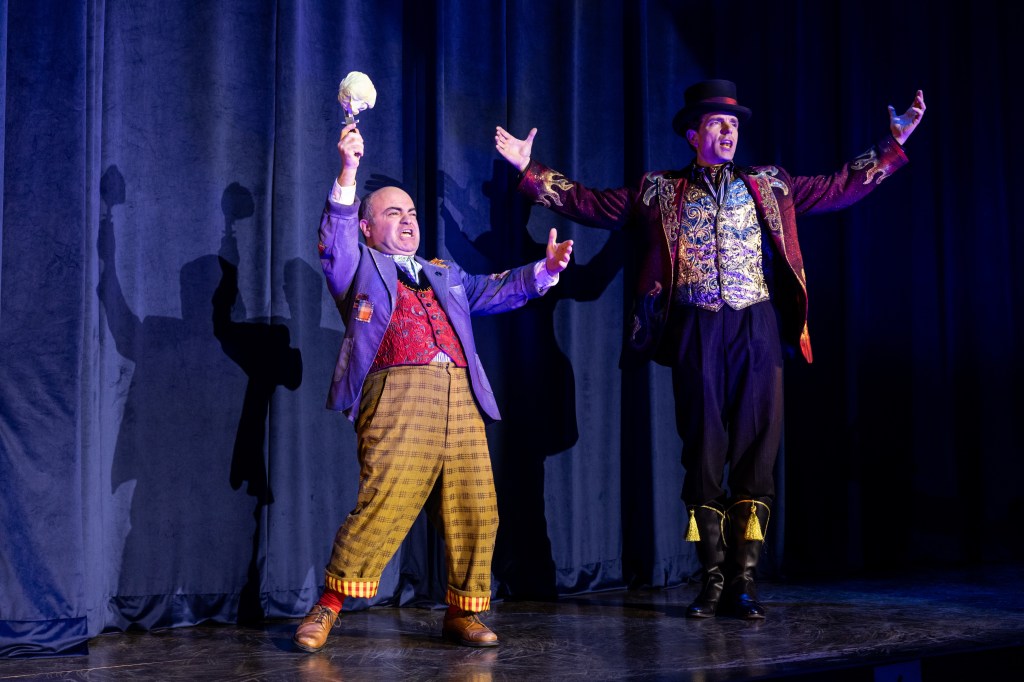
Nolan is the perfect, nuanced villain that we can understand because Elice’s characterization gives the actor so much to work with. Likewise, with the other characters who are strongly portrayed in song i.e. (“I Choose the Ride”), a song which Camel leads beautifully, we understand the choices the characters make. These ultimately lead to their victimization by August who becomes more and more tyrannical and vengeful without good reason. How he moves against Walter and Camel is terrifying, and McCollum’s Wade haplessly allows himself to be ill-used and exploited by August.
Once more we are reminded that evil flourishes because potentially good people do nothing to stop it. In Wade’s instance, he services August’s wickedness for his own purposes, willingly becoming his slave.

The energy and enthusiasm of the acrobatic dancers of Act I are even greater in Act II. Importantly, their action arises organically from the sequence of events that occur. Nothing the creative team does seems extraneous or out of place in the circus world. And it is a delight to watch their expertise and phenomenal talents singing, dancing and doing exploits during the various musical numbers which range from jazz, country, blues, ballads and more. The score and complex lyrics by Pigpen Theatre Co. have been reworked, honed and refined to precision.
This is one to see for the outstanding performances, the acrobatics and aerial spectacle which are extraordinary. The circus design makes sense in Stone’s creation of a small-time circus of 1931, run by a flawed ringmaster who attempts to keep things together, despite his interior brokenness. The director’s staging capture’s the novel’s ethos and heightens all the characters’ vulnerabilities. August’s failings make him the perfect foil for cruelty and exploitation. His darkness is made all the more evident in contrast to Jake, who in every way is his opposite, especially in his humility, gentility and decency.

There is one scene taken out of Victor Hugo’s novel Les Misérables, which clues in the differences in the soul conflict and morality between August and Jake. Jake has the opportunity to kill August while the ringmaster sleeps. His goodness wins out and he stops himself. It’s a marvelous inclusion in an intricately woven, profound musical about individuals pressed by circumstances toward the abyss, until they free fall into their own inevitable demise.
Kudos to those not mentioned above which include David Israel Reynoso’s costume design, Bradley King’s lighting design, Walter Trarbach’s sound design, David Bengali’s projection design, Campbell Young Associates’ hair & wig design and Ray Wetmore & Jr. Goodman, Camille Labarre’s puppet design. Finally, the music was compelling thanks to Daryl Waters, Benedict Braxton-Smith, August Eriksmoen’s orchestrations, Music Director, Elizabeth Doran and Music Coordinator, Kristy Norter.
Water for Elephants. Imperial Theatre, 249 West 45th Street, between 7th and 8th. 2 hours forty minutes with one intermission until September 8th. https://www.waterforelephantsthemusical.com/
‘An Enemy of the People’ Brilliant, Drop Dead Tragicomedy With Jeremy Strong, Michael Imperioli

In Amy Herzog’s adaptation of Ibsen’s sardonic An Enemy of the People, currently at Circle in the Square for a limited engagement, we are treated to a modernized version of a work whose timeless verities ring true for us today. Aptly directed by Sam Gold (A Doll’s House Part 2), Jeremy Strong (TV: “Succession”) as Dr. Thomas Stockmann and, Michael Imperioli (TV: “White Lotus”) as his brother, Peter Stockmann, go head to head about a subject that should concern every politician and citizen on the planet: clean, potable water.
In adequately slimming down Ibsen’s five act play to highlight important themes that are taken out of our current headlines, Amy Herzog confirms her penchant for adaptation. Successful with the process of refining, to trim the salient dialogue and concepts of a classic work, Herzog’s minimalist adaptation of A Doll’s House was nominated for a Tony Award. Likewise for An Enemy of the People, Herzog tames the unwieldy Ibsen sentence construction and vocabulary (sometimes hampered by translation from the Norwegian), so its clarification provides accessible, trenchant, stark meaning with a greater impact than the work may have had in an original translation.
Other changes in characterization compact the play’s crystalline focus. Conjoining two characters (Petra and Mrs. Stockmann) into just daughter Petra (Victoria Pedretti), Herzog humanizes Dr. Stockmann, who misses his dead wife, and is gratified that his remaining family is close and supports him. Reinforcing Petra’s identification with her father, Herzog intensifies Stockmann’s dilemma and persecution which becomes Petra’s problem as well. So we appreciate her defense of her father and courage in braving the victimization and town’s retribution after the doctor attempts to save the town from itself by blowing the whistle about a nearby spa’s contaminated water supply.

Herzog emphasizes the situation and brings it rapidly to a crescendo. It begins with acknowledgement of Stockmann’s heroism by his friends. The fine scientist and researcher sends the nearby resort’s water sample to the university lab which affirms disease-causing, killing bacteria in the water. In Europe those who would visit spas for treatment, sometimes would “take the waters,” meaning drink the waters for their reputed, curative healing effects. Stockmann has discovered that if the patrons sip the “healing” waters, the tourists will become deathly ill. If they bathe in it, perhaps the polluted water won’t be as immediately disastrous, but it will be dangerous. This is Ibsen at his sardonic best and the message is meaningful for us today, (water damaged by PCBs, microplastics, hormone disruptive contaminants). Though Ibsen wrote the play over 140 years ago, little seems to have changed.
When Stockmann’s more liberal friends, newspaper editor Hovstad (Caleb Eberhardt), his assistant, Billing (Matthew August Jeffers), and even Aslaksen, Chair of the Property Owner’s Association and printer (Thomas Jay Ryan), hear of Stockmann’s prescient action, they deem him to be heroic in “saving” the town. During their discussion we find out that both Hovstad and Billing resent the wealthier investors having come from impoverished backgrounds; they encourage the doctor to publish the report. Additionally, Aslaksen, wants to hold a dinner party and present Stockmann with a small award. Aslaksen, a self-declared “man of moderation” says, “nothing too flashy, we don’t want to ruffle any feathers.
To complicate the situation, Stockmann’s father-in-law, Morten Kiil (David Patrick Kelly), who is still alive and a wealthy man, owned one of a number of tanneries near the spa area. Apparently, Kiil and the other tannery owners “forgot” to properly dispose of the chemical runoff used to cure the hides and the poisons have seeped into the water table. (Think of Jonathan Harr’s book and adapted film A Civil Action, about the pollution of the Woburn, Massachusetts water supply that sickened and killed children and families.).
Petra reminds her father that he suggested before the construction of the resort that they make adjustments for such a possibility because Stockmann feared the tannery’s proximity. However, his brother, Peter (the town mayor), the investors and officials shot down the doctor’s idea because of additional cost and delay. Their wants were understandable; the sooner they opened the resort and spa to make money and bring tourists in droves to the town, the better. Indeed, the town, in anticipation of the spa’s opening in the summer has grown more prosperous and the people are looking forward to servicing the tourist trade that the spa will bring.
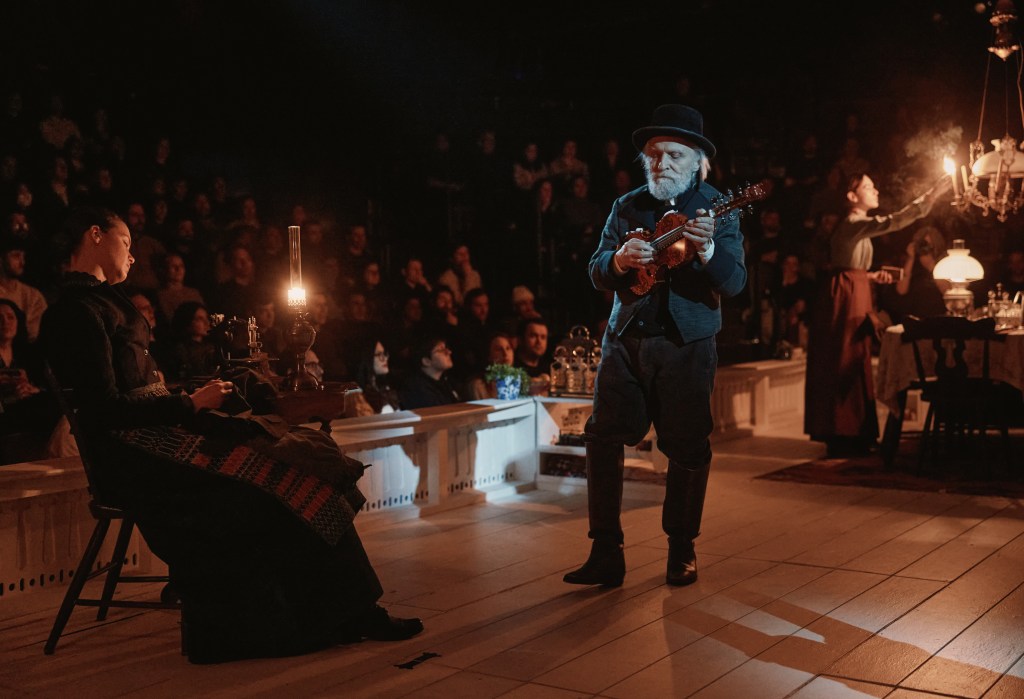
Clearly, money “trumps” the viability and security of the spa. Stockmann’s science and the safety and sanctity of human life are in bondage to financials and commercialism. The developments that follow after Stockmann receives the lab report hang in the balance. Will his boss and brother, the mayor and investors agree that the situation warrants rehabilitation of the baths, though that might jeopardize the town’s commercial viability? Or will the mayor and investors hold the line that the spa and resort be opened and celebrated, despite the potential harm to come? In other words should the truth be exposed or covered up?
The brothers are on opposite sides of the dilemma; one represents science, the other the town’s economic prosperity. A critical factor is that Peter is Thomas’ boss and Thomas answers to him. As Dr. Stockmann lives for his work, so does his brother Peter, who has never married and demonstrates overweening pride as the mayor servicing the richest, most prosperous citizens. If they were at odds with each other before, with Peter ignoring his brother’s scientific suggestions and criticism of his “liberal” newspaper friends, their conflict explodes after the doctor confronts Peter with the report.
Unfortunately, the doctor’s idealism and self-righteousness has blinded him, as Peter’s greed, self-importance and his rich friends sway him beyond human decency. Peter appears to hold all the chips in this poker game. Their struggle is an iconic one and Gold’s direction and Strong and Imperioli’s acting are on-point superb during their interactions and arguments and especially at the town meeting.
Of the doctor’s three friends, Aslaksen is the one who anticipates that various townsfolk may not perceive Stockmann as a hero. And indeed, when the mayor reads Stockmann’s report, he takes it personally as an attack based on resentments stemming from their childhood. Beholden to wealthy interests, Peter actively dismisses the gravitas of what Thomas suggests and refers to his brother’s pronouncements as “speculation and wishful thinking,” and he insists the doctor’s attitude is “spiteful and childish” for cutting off the town’s “only” source of income.
From his perspective the proof screams at Thomas about how dire the situation is. Thus, the doctor expects his brother to retrofit the baths and delay the opening of the spa, though he has not researched the practicality of how long it will take and how much it will cost. The situation can be mitigated if the two sides agree to tackle the problem rationally and intelligently. However, both brothers cast it as an either or situation and Peter is predisposed to cover up the noxious, infernal truth and proceed with the spa’s poisoned-filled opening.

The genius of An Enemy of the People is the way in which the situation and character interactions reveal social and personal dilemmas. Do we uplift human rights supporting the sanctity of life and security for all as the doctor does? Or are rights subject to economic and class background and curtailed accordingly, as Peter wishes? Are we generous and life-supporting or selfish and nihilistic? Are those with money truly superior or is their arrogant, self-importance riddled with flaws because to value money and power over human life is suicidal folly that leads to catastrophic, karmic consequences?
In this play, Ibsen reveals the perniciousness of toadying to class and money at the expense of life and health. And so it goes with Peter, the mayor, who bows to special interests despite the apocalyptic moral imperative that the spa will kill instead of heal. According to the mayor, the cost and delay will bankrupt the town. He manipulates and threatens Thomas’ friends Hovstad, Billing and Aslaksen so that they turn against Thomas to “save” the town from the financial debacle that will occur if the spa closes.
As forces converge against Thomas, and his friends who once stood by him back away from his facts, we note that financial viability is the only consideration, when it doesn’t have to be. The arguments given settle in the “benefit” to the town’s prosperity which will be destroyed if they take two years to retrofit the spa. The spa supporters affirm that surrounding towns will jump in the gap and create their own resorts and wipe them out competitively by the time they finish their corrections. If they cover up the truth, at least the town will prosper commercially and the investors will receive an immediate return on the investments.
In their arguments, not one of the spa supporters, Stockmann’s friends or the mayor consider that tourist deaths and subsequent lawsuits could force the town into bankruptcy. Even worse, the scandal of a cover-up and eventual publicized expose will necessitate investigations and the public humiliation and outcry that such was allowed by the mayor, etc., destroy the town’s reputation and revenue for a long time to come. The gaslighting notion that the doctor’s facts are “speculation” is actually the fantasy (“wishful thinking”) that the bacteria and poisons in the water are not harmful and/or don’t exist. The investors, town and mayor are “damned if they do, and damned if they don’t.”
Rather than correct their attitude and behavior, Peter and his supporters double down on their initial dereliction in not following the doctor’s suggestions. They turn on him blaming him for the situation which they negligently in a criminal dereliction of duty refuse to believe and act on.
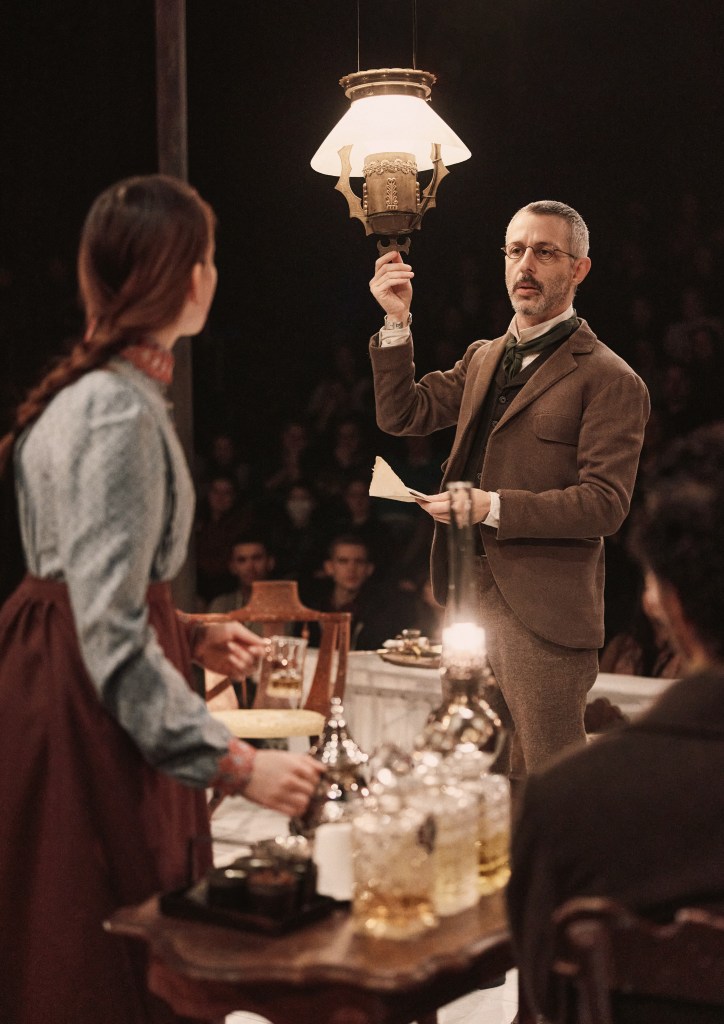
Strong’s doctor gives an impassioned speech to Peter, Hovstad, Aslaksen and Billing. He prophesies that he will present the truth at a general meeting and save lives regardless of their position not to publish the report. The town should be able to hear and decide the best path to take. At the end of his arguments with Aslaksen, his brother and the others he states, “I have faith in the people of this town. You can fire me, you can shun me. But you can’t stop me from telling the people the truth.” Strong’s performance is authentic; we believe him and hope with him. It is a superbly unforgettable dramatic moment.
It is also an excellent place to create “the pause” (not an intermission), which lasts five minutes, then segues into the town meeting where Stockmann presents the report. The playing area is converted from Dr. Stockmann’s atmospherically lit house and study, into a well-lighted bar where drinks (aquavitae) are served to the audience. Gold has dynamically staged this segment so that audience and actors mingle and imbibe for the five-minute interval. The atmospheric lighting of the first half of the production with gorgeous antique lamps from that period is replaced during this “pause”. The theater’s regular lighting is turned on as the drinks are served. It stays on, then, as the town meeting gets underway, and the play resumes with lights down, Dr. Stockmann confronts the mayor, his former friends and the townspeople.
This is genius staging because during the “pause,” Gold moves us from the past to the present in a time meld, and we are reminded of the currency of this play’s situation and themes.
Then the town meeting ensues. It is terrifying and fascinating. The mayor, Hovstad and others shut the doctor down with loud verbal muscling. When Thomas stands up to them speaking the truth, whipped up by the mayor and others, the townspeople repeat the others’ refrain that Thomas is “an enemy of the people,” and physically beat him. Strong’s performance and the ensemble’s counter-performances are incredible.

As we stand in the doctor’s shoes, we identify with his untenable situation which is beyond irony. This is especially so after he is pummeled with buckets of ice (the symbolic equivalent of a stoning) thrown on top of his head. Strong’s Stockmann rips off his shirt and offers his life for them if only they would accept the truth. The irony is complete. The townspeople and his brother want their fantasy. His life and their own lives are worth nothing. Money is everything. They believe that the spa will bring prosperity and money though they may not live to see it. They can’t handle Thomas’ “facts.”
We have seen this picture played out before in the COVID political botch job of the former president, who, like Peter the mayor, eradicated the deadliness of the virus with his lies and misdirection, as the US charts the largest number of COVID deaths globally to date; yes, people are still getting COVID and dying from it. The townspeople’s rejection of Stockmann’s facts hyped up by the mayor and his cohorts parallel MAGA’S convenient rejection of the truth for “alternate” facts (conspiracy theories) which they rabidly cling to in a morbidly cultish intractability whipped up by MAGA politicians. Then as now, science is rejected by those who wear their lack of education and ignorance on their sleeves, as the facts become others’ “wishful thinking.”
What is particularly ironic about seeing this production is the extended parallel of censorship then and now but differently processed. Ibsen never imagined media, social media and AI. Instead, of publishing Thomas’ factual report, the town paper is silent about the danger, censoring the report. Today, lies are broadcast on various media platforms including “Truth Social” precisely to extinguish the credibility of facts. The loudness and cacophony of wrong information and falsehoods deafen those willingly, lazily duped into a conspiracy of complacent trust. Those who would not be duped must read extensively to separate truth from lies and silence the cacophony to tease out what is really happening.
Do we laugh or cry? My response to Strong’s impassioned speeches after his beating and vilification was panic laughter and a few tears at the enormity of witnessing the play’s themes which resonated for me as an anti-MAGA who watched Republican truth-tellers like Liz Cheney, the former president’s Republican administration witnesses at the January 6th Commission, Dr. Fauci, former Governor Andrew Cuomo, and a legion of others who stood and still stand for the truth against the fraudulent former president. For their pleas of truth, they, like Strong’s Stockmann, have been symbolically crucified, character assassinated, demeaned, defamed and threatened with death. The dark ironies of this production are drop dead tragicomedy that is nonpareil in today’s theater.
And as such, this production is a warning. The message for me was “not on my watch!”

There are those who deny and punish truth tellers, whether scientists or Cassandras. Indeed, the more the leaders and their followers cry for blood, it would seem that the greater the confirmation that what is being said that inflames them is accurate. The final twist in this magnificent work which Herzog, Gold and the phenomenal actors have made as plain as day, you will have to see for yourself, if you can get a ticket. The conclusion just might involve a rescue by Captain Horster (Alan Trong), keen on Petra, who offers to take Stockmann, Petra and Stockmann’s son to America. Why? It is better there and the citizens are more amenable to hearing the truth. The audience laughter was as bitter as the dark irony inherent in Captain Horster’s innocent comment.
Re-imagining An Enemy of the People, Herzog, Gold and the creative team have delivered a searing, terrifying and at times humorous work that will remain in one’s consciousness long after one leaves the Circle in the Square. From the imaginatively stylized, technically galvanizing and evocative set design by dots, to the superbly thematic lighting design by Isabella Byrd, the period costume design by David Zinn, and Campbell Young Associates hair and wig design, the director’s vision coheres powerfully.
The singing of Norwegian folk ballads throughout is an additional atmospheric element that establishes setting and grounds us in history. Norway is a place that is often presented as more forward thinking than the US, another irony. Human nature is similar everywhere, especially when ignorance can be manipulated for profit and the illusion of prosperity for the poor, which rarely happens. Mikaal Sulaiman’s sound design helps to convey the timber of the music and voices. It might have been interesting to see a translation of their lyrics in the program.
An Enemy of the People is in a 16 week limited engagement that ends June 16. It is two hours with a five minute pause and no intermission. Circle in the Square, 235 West 50th St. between 7th and 8th. See it for its performances, the fine direction and inspired re-imagining. https://anenemyofthepeopleplay.com/
 CAROLE DI TOSTI