‘The Seven Year Disappear,’ Mother-Son Relationship Chaos as Performance Art
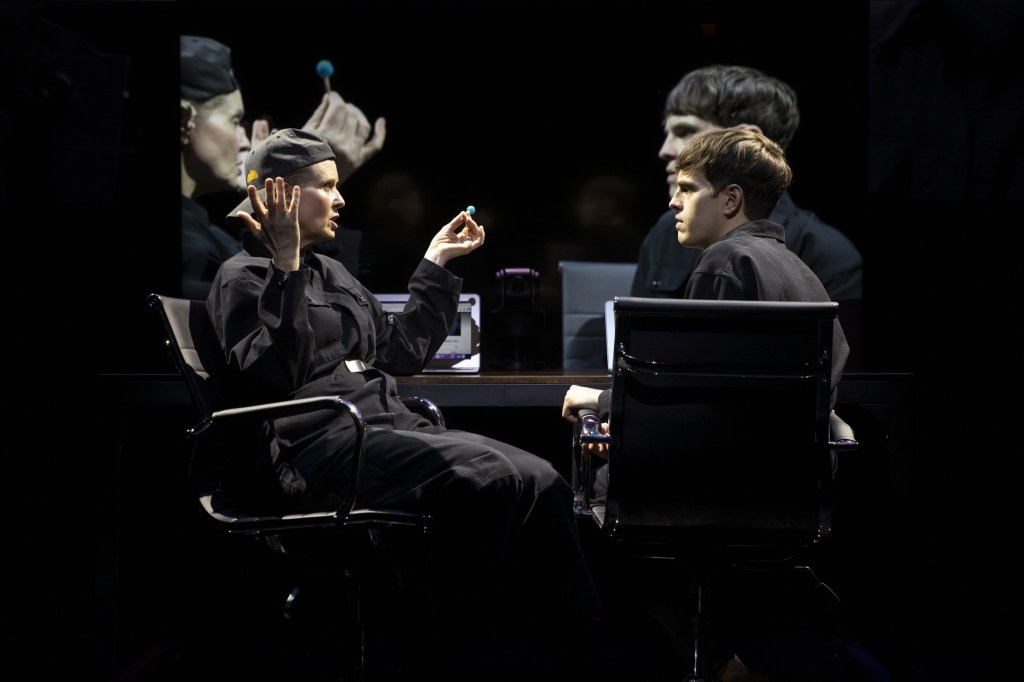
In The Seven Year Disappear, Jordan Seavey (Homos, or Everyone in America), creates celebrated, bi-polar, performance artist Miriam (Cynthia Nixon), and her gay son Naphtali (Hebrew for “my struggle, my strife”), played by Taylor Trensch, to elucidate the darkness in a mother-son relationship when the personalities are hyper creative and high strung. Issues especially evolve when the artists, like Miriam, are complex, self-centered, demanding, assertive and exceedingly ambitious. Indeed, Miriam’s perspective and being blur the boundaries of normalcy and reality and engulf everything and everyone close to her, mostly her son.
Currently running as a World Premiere at the Signature Center, The Seven Year Disappear with no intermission concludes its limited run on 31st of March.
Directed by Scott Elliott with assists by Derek McLane’s scenic design, Rob Milburn & Michael Bodeen’s excellent sound design, Qween Jean’s costume design (workman’s black coveralls and boots), and John Narun’s projection design, which together, keep the audience stirred and engaged, The New Group’s presentation of Seavey’s comedic drama intrigues. There are no easy answers. Complication rules the day, and the overall structure of systematic flashbacks of titled events in three movements, slips backward in time, with four brief returns to the present year, 2016, then back again, to unspool the ominous artistic relationship between Miriam and Naphtali over a twenty-six year period.

The two-hander relies on the dynamic performances of Nixon and Trensch. The wrangling mother and son strike high points of Naphtali’s life, during the time when Miriam disappears for seven years (2009-2016). Her premeditated disappearance, a publicity stunt, happens right after funds have been raised for the first half of her commission as a performance artist in a project to be presented at MOMA. When Miriam goes missing, Naphtali contacts the NYPD and does all he can to relocate her, to no avail. She doesn’t want to be found and perhaps has elicited the help of MOMA to increase the suspense and excitement of her invisibility as performance art, that is a hardship especially to Naphtali. For her, it is a triumph. She will emerge to acclaim when she is ready, and then, present the key moments of her invisibility.
Leaving Naphtali to fend for himself with little money from 2009 through 2016 when she “returns,” he is forced to get a job and apartment and struggle on his own after being dependent on her. For emotional sustenance to fill in the void his mother’s absence has left, he engages with numerous unusual people, all of them portrayed by Cynthia Nixon, using various physical and vocal changes, as he searches for Miriam and irons out his own life. Naphtali is full of questions and feelings of victimization where he sometimes helps himself to drugs and alcohol and attempts to confront her abandonment, which has always been a fact of his life.
MIriam’s durational disappearance is another demonstration of her dislocation from motherhood which initiates when she left four-year-old Naphtali alone at the zoo watching penguins. She leaves him to pursue a drink with Wolfgang, who becomes her intimate partner for a time, then years later becomes Naphtali’s sexual lover for a time during Miriam’s disappearance. Ironically, when Wolfgang is concerned about the young Nephtali in the zoo, Miriam comments, “He’ll be fine.” As it turns out, leaving him traumatizes Naphtali, who never gets over it. We learn it sets him up for a lifetime of his mother’s leaving, which he never conquers.

Clearly, unlike Miriam’s rival, Marina Abramović, one of the most renown performance artists in the world, who chose not to have children, Miriam has Naphtali. However, she refuses to sacrifice her art for her son. Instead, we learn that she exploits him by incorporating him in her work as a durational performance artist. When he is older, he allows her to continue using him, even becoming her manager in order to be close to her, which he says is the only way he gains her attention.
However, Miriam’s seven year disappearance is a piece de resistance, a capstone to shake the art world, which reveals her dedication and wildness in her artistry to effect a total invisibility. On another ironic level, leaving her son and manager behind to go incommunicado is a cheap, attention getting stunt. If it is a cost to her, we don’t see it. We do see the pain it causes Naphtali.
Clues to what Miriam is doing appear throughout the drama which reveals the more pretentious side of the durational performance art world, which we note impacts her son, not necessarily others, as Marina Abramović’s performances do. Where Miriam’s rival has put herself through grueling feats to test her physical, psychic and mental strength to acclaim and positive impact, Miriam’s disappearance doesn’t function positively, though it forces Nephtali to appear to become more independent.
However, during the seven years, everyone Nephtali sees or meets for support (Wolfgang-a sexual father figure, Brayden-a gay lover, Tomas-a gay lover, Kaitlyn-his manicurist, Aviva-an actress, Michael-a gay priest who conducts sex orgies, Nicole-a detective), is a reflection of his mother. Indeed Cynthia Nixon portrays each of these characters.
Thus, though Miriam has “flown the coop,” she is very much present in Nephtali’s life and emotional and psychic imbalances. To say that Miriam’s parenting skills leave much to be desired is an understatement. Her strident character, arrogance, unapologetic nature, and “take or leave it” attitude blaming God for making her this way, only reinforces Marina Abramović’s quote that Seavey includes in the play’s script, which perhaps should appear in the production projected on a backdrop but doesn’t.

‘I had three abortions because I was certain that [having a child] would be a disaster for my
work. One only has limited energy in the body, and I would have had to divide it.’
– Marina Abramović
MIriam, clearly, has difficulty dividing her energies. Thus, she rationalizes using Naphtali to uplift her art at his expense. We learn she has done this cruelly, sadistically with performance art Seavey slyly references. With the artistic endeavors after the disappearance is over, Miriam hopes to achieve a redemptive artistic reconciliation, once again at Naphtali’s expense, though she sells it to him as an equalizer. She claims it will center on Naphtali as a co-partner in making her new performance art to finish MOMA’s commission, as they present their divergent experiences separated during her “seven year disappear.”
However, as we learn piecemeal, in reverse chronology what happens between the mother and son, taking it all in, the result is structural chaos in Naphtali’s life that he is in bondage to. Their relationship is a devastation. And the bits and pieces of performance art evident in the play (at the beginning when Nixon and Trensch stare at each other from across the table), Nixon’s various characterizations pitted against Trensch’s searching, enhanced in closeups by John Narun’s projection design, leave the audience enervated not uplifted.
The Seven Year Disappear is one to see for its performances and play structure. The mother-son relationship disturbs and gives one pause. Nixon’s Miriam is stark. Taylor Trensch’s portrayal is empathetic. Together, they evoke a work which is memorable and unique.
The Seven Year Disappear. The Alice Griffin Jewel Box Theatre, The Pershing Square Signature Center
480 W 42nd Street https://thenewgroup.org/production/the-seven-year-disappear/
The Orchid Show: ‘Florals in Fashion’ at The New York Botanical Garden


The Orchid Show: Florals in Fashion runs from February 17 through April 21, 2024

Orchid Extravaganza
The orchid extravaganza at NYBG is always a unique and winning experience whether one goes in the day or in the evening hours for Orchid Nights. This yar, the 21st edition of NYBG’s iconic annual orchid exhibition features stunning fashion-inspired floral designs from three celebrated artists.
Meet the Floral Designers
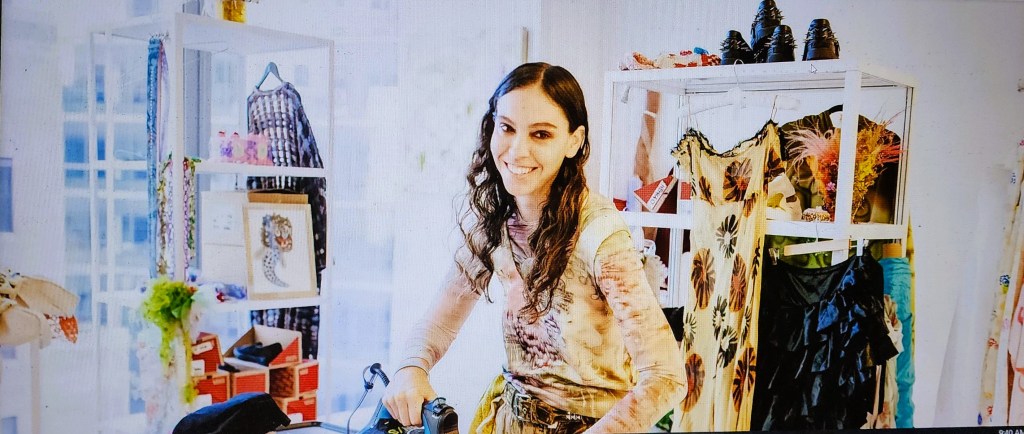


Floral Fashions by Collina Strada, Dauphinette and FLWR PSTL
The designers are Collina Strada by Hillary Taymour, Dauphinette by Olivia Cheng, and FLWR PSTL a.k.a. Kristen Alpaugh. The exhibit features the cleverness of the designers who integrate a gorgeous variety of orchids into their fashion creations in a dazzling and particular way. You will want to return again and again to marvel at the intriguing fashion designs composed of orchids and companion botanicals displayed poetically and artistically on mannequins.
Journeying Through NYBG Florals in Fashion




Orchids Always Inspired Fashions
For decades orchids, the most highly evolved, largest and most diverse families of flowering plants on the planet, have inspired fashions from Halston to Rodarte. For the 21st annual orchid exhibit, the NYBG horticulturists selected a showy panoply of specimens both popular and rare from the Garden’s collections. Interspersed among the orchids beautiful arrays are striking botanical specimens whose eye-popping collection accentuates the variety of hues, textures, sizes and differences in the wide-ranging orchid family. Some of these include epiphytic cacti, carnivorous nepenthes, air plants, beauteous bromiliads, maidenhead ferns and many more.
Olivia Cheng


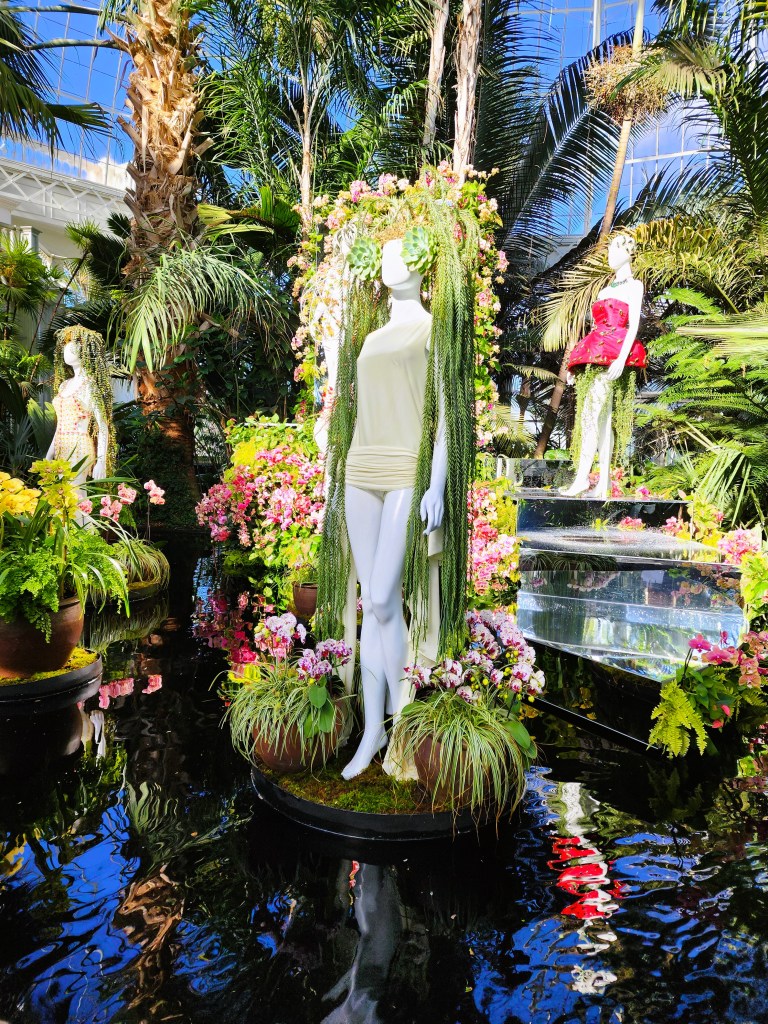
In the Palms of the World Gallery Olivia Cheng of Dauphinette (https://www.instagram.com/p/CljdMacgnRH/) presents her amazing designs centered among the orchid displays which serve as the backdrop to frame Cheng’s creations amongst mirrors and a grand staircase. Headdresses of Tillandsia air plants suspended with an orb create a floating effect. Sustainable plant-based outfits are finely made of vibrant living material, i.e. elegant blue-green tresses of Huperzia, pastel rosettes of Echeveria, and delicate Spanish moss.
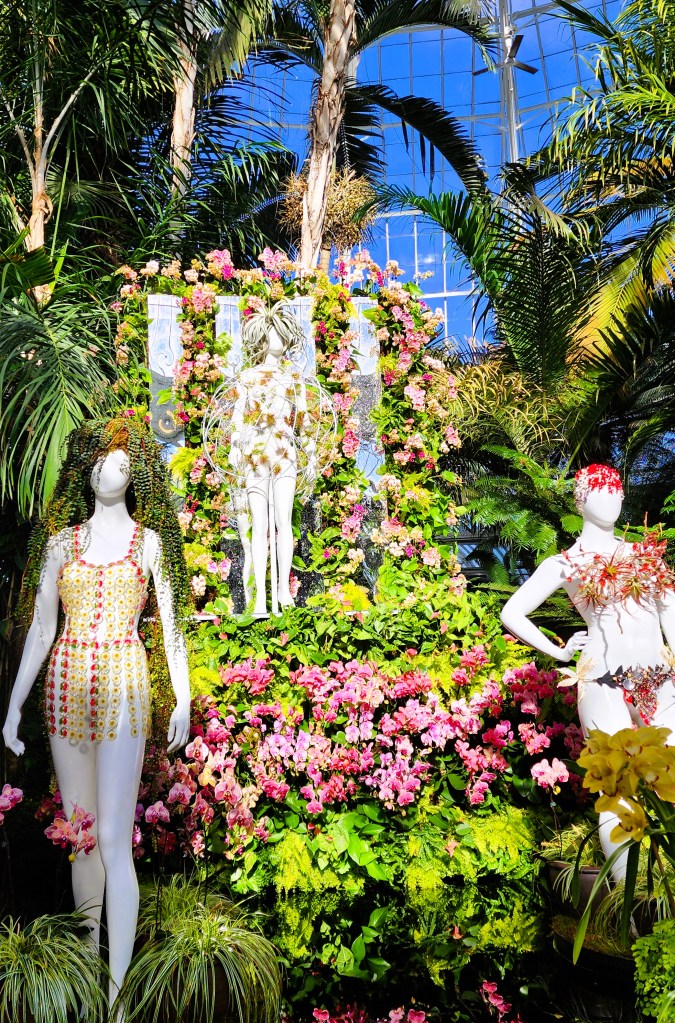

“A soft yet spikey palette of grasses, air plants and greens are the perfect foil to the orchids in Olivia Cheng’s edgy, ethereal designs. Cheng founded her fashion brand, Dauphinette, by transforming upcycled materials. The brand has since expanded with botanicals-including real resin-cast flowers and hand-drawn prints-enduring at the heart of Dauphinette’s designs.” (NYBG)


Cheng says of orchids, “Orchids have this very pristine and fantastical quality to them. And fashion is all about reinterpretations of what makes a person sexy or beautiful. That’s what makes orchids within fashion so symbiotic”

A Journey of Orchids Through Enid A. Haupt Galleries
From the Palms of the World Gallery and Cheng’s exhibit one proceeds along the orchid journey through the Conservatory’s Lowland and Upland Rain Forest Galleries. Along the way, look up to see hanging orchids seeking higher real estate up from the forest floor where there is more accessible light and moist air which they adore. Look down and you will note the Cymbidiums which flourish in soil as do the Lady Slipper Orchids.



Following the orchid journey you will notice the great diversity of orchid hybrids in magnificent colors which will take you through the tunnel of lights, your own runway, if you will, through the desert gallery.
Seasonal Exhibition Galleries, FLWR PSTL
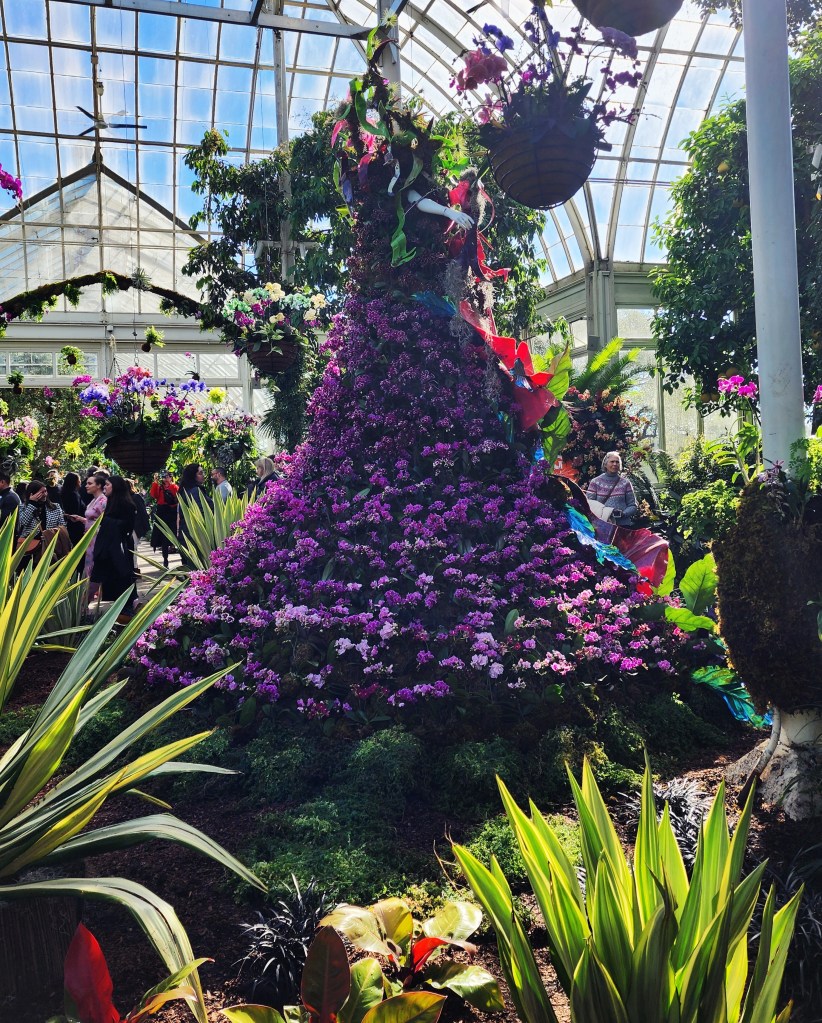
Kristen Alpaugh https://www.instagram.com/flwrpstl/?hl=en shared the names of the figures she has decked out. They are dramatically expressive of a variety of emotions. Central in the rotunda is Regina. Regina towers up and beckons with warmth in a 360 degree panoramic cape of Phalaenopsis in various shades of pink, purple and fuscia companioned by mini ferns. Up high are air plants, Spanish moss and miniature orchids encircling Regina’s face with Alpaugh’s signature “Iritherium” (iridescent painted Anthurium plants).


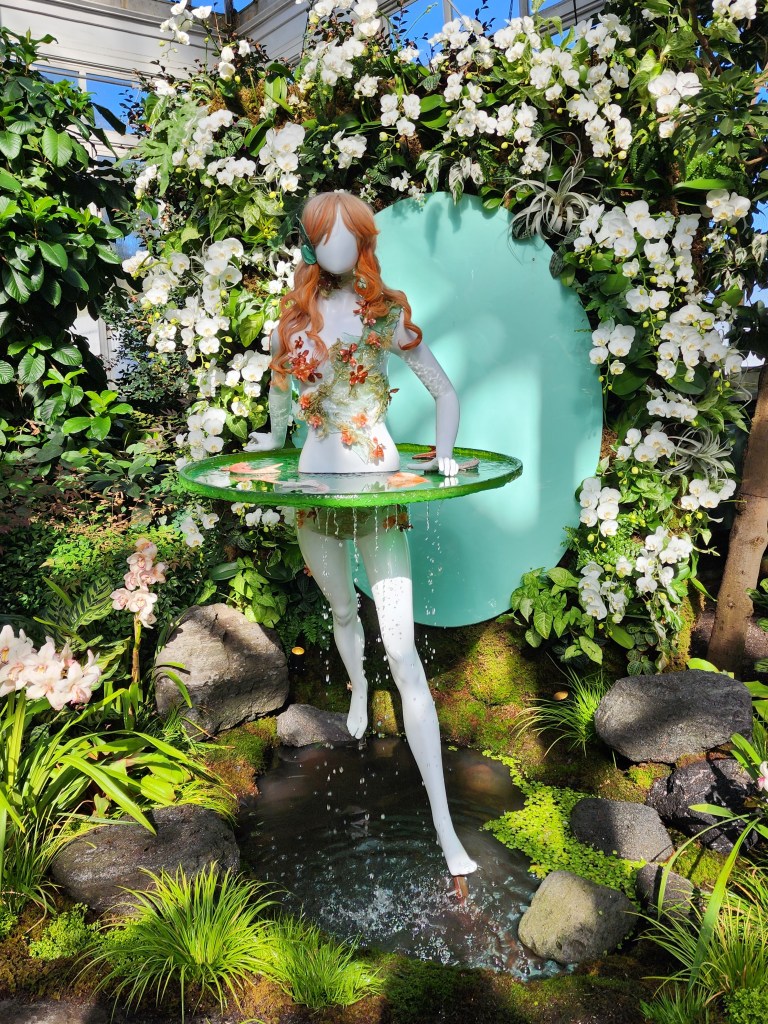
Surrounding Regina four other mannequens represent elements of joy and beauty in modern expression. Victoria’s water lily hoop skirt fountain framed with white Phalaenopsis and amber hues, matching a head piece features a delicate, feminine, balletic form.
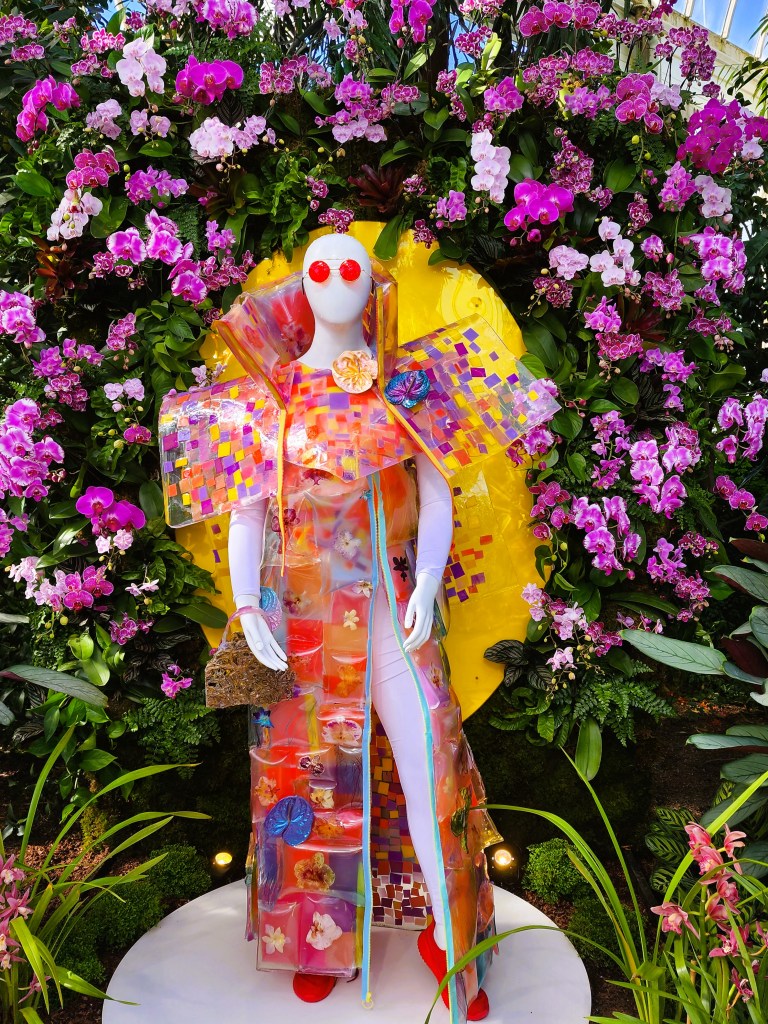

The others figures like Vespa with thigh-high floral boots and orchid headphones sport fun and rock the scene. FLWR PSTL’S vision is dramatized with “Iritherium”-iridescent painted Anthurium plants that she uses for floral displays and fantastical creations, one worn by Katy Perry in her music video Never Worn White. See the video by Katy Perry –Never Worn White below or go to YouTube to see the amazing dress FLWR PSTL created for her.
Kristen Alpaugh Works from an Emotional Foundation
When I briefly spoke to her Kristen Alpaugh said that she works from an emotional foundation to express her creations. Incorporating one essential orchids in her fun vignettes she mentioned, “Phalaenopsis orchid is a very warm and welcoming flower. It’s got this big face and these buttery petals, and it has a slightly shimmery finish, and it’s just like out there. It’s offering you a big hug.” Her experimental work merges natural beauty, high fashion and fine art. Interviews and features profile Kristen Alpaugh in The New York Times, The Lost Angeles Times, Architetural Digest and Vogue.
Collina Strada



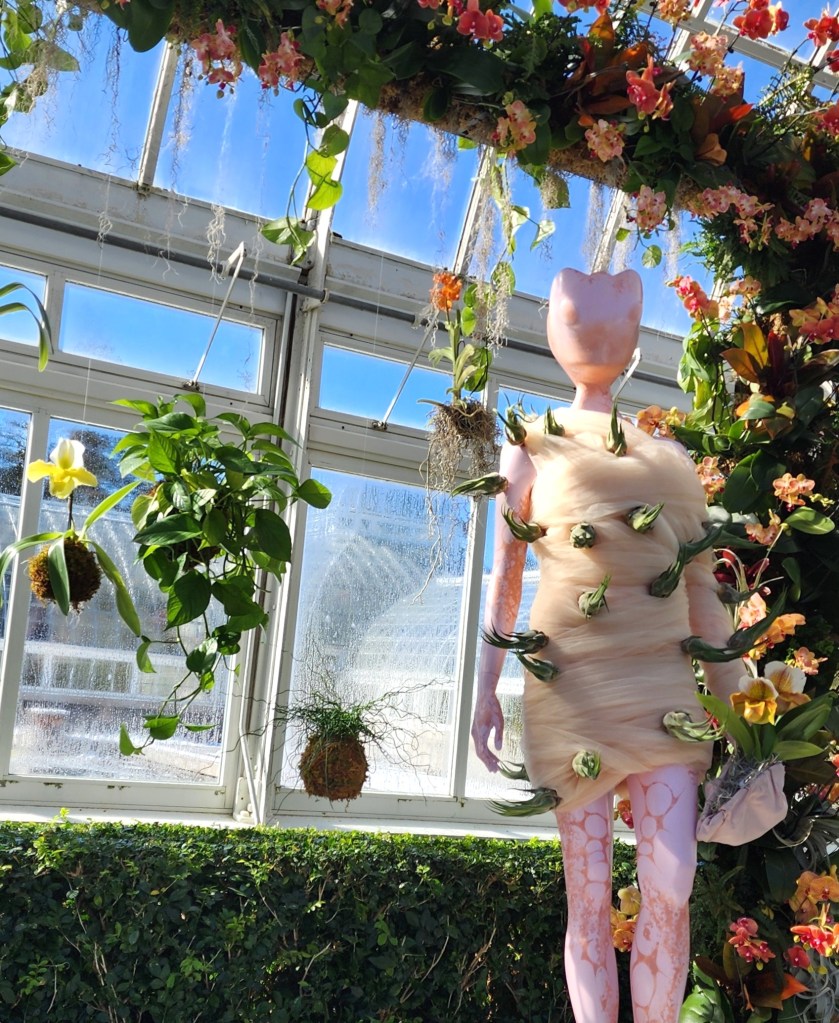
Moving into coordinated orchid displays to the right and left of the final gallery walkway, Collina Strada’s “Freeze-Frame” runway vignettes emerge. Hillary Taymour uses her platform not only for fashion but for social issues and awareness. Her main concern is staying true to her craft, and staying on course to becoming a fully sustainable and radically transparent brand.
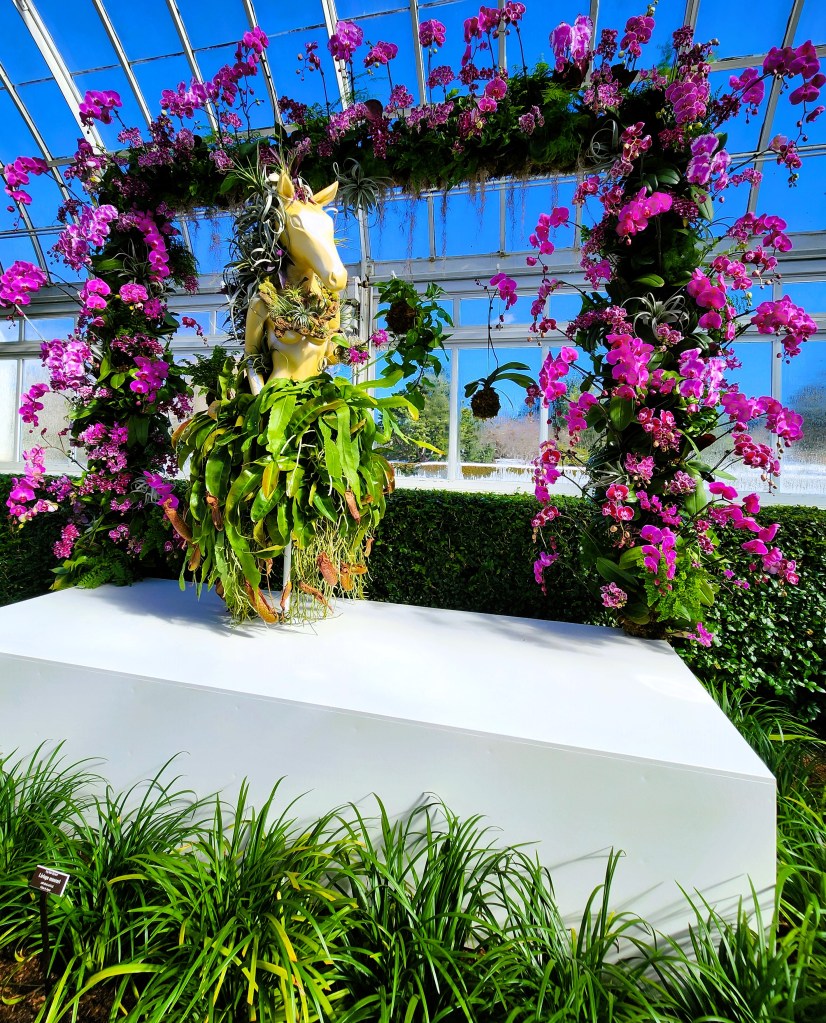
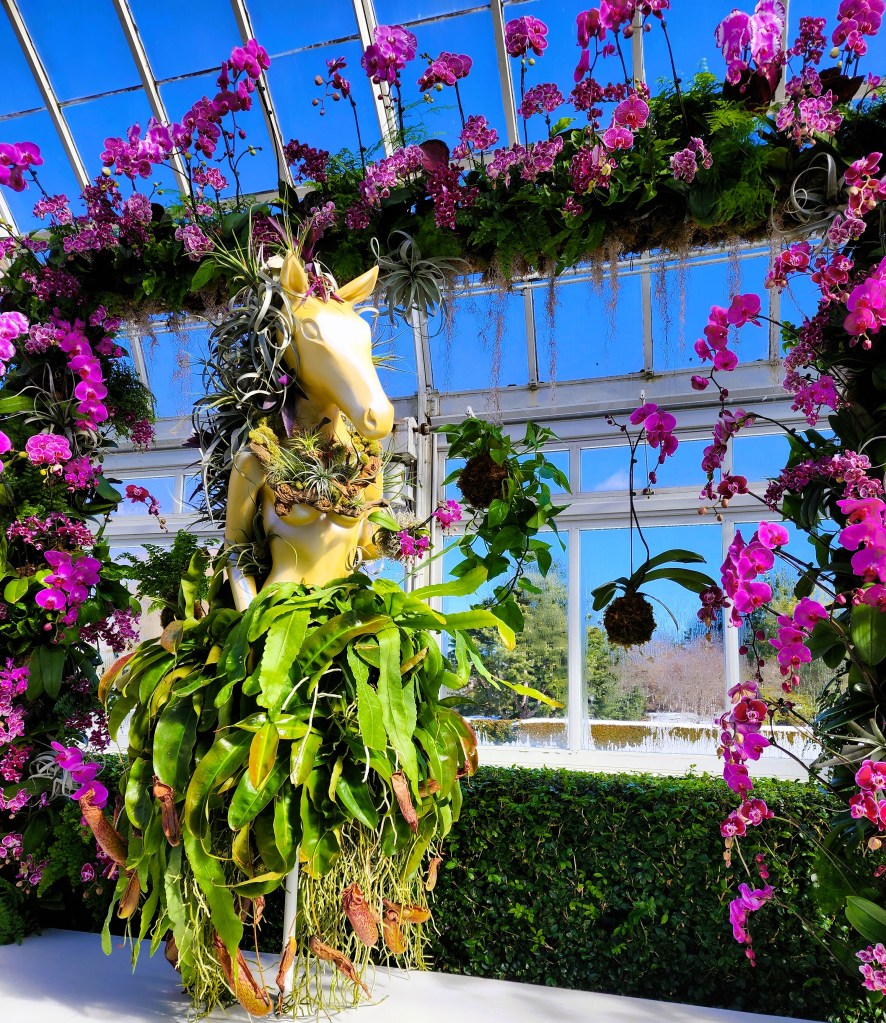
As such she employs upcycled materials such as “rose sylk,” made from salvaged rose plants. Taymour was the first to use artificial intelligence to generate looks for her New York Fashion Week and Spring/Summer 2024 collection. Her creations are accessorized by geometric plantings.
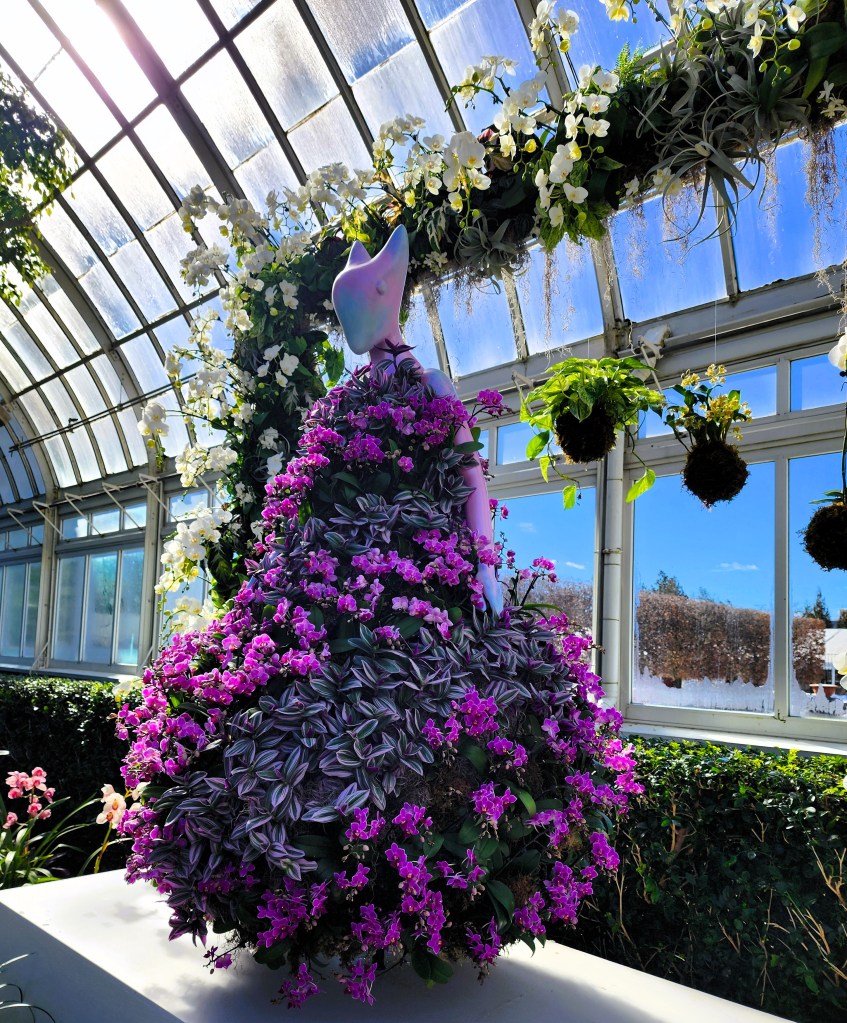
Orchid-decorated Kokedama-spheres of moss in which an ornamental plant grows-hang overhead. The mythic figures including a horse, frog, cat, are draped with Vanda orchids, many-hued miniature Phalaenopsis, variegated succulents and other botanicals.

Collina Strada manifests items that are created using sustainable methods and responsibly sourced materials to establish colorful designs for everyone. According to creator Hillary Taymour, “Nature is the mother of all inspirations.”

You can see a beautiful sunset in the middle of nowhere…and you’re never going to be able to mimic that beauty. Nature is the end goal of art.”

Orchid Nights
A main event during the Florals in Fashion Orchid Show, NYBG is hosting music, live performances and a selection of cocktails and lite bites for purchase at seasonal bars for adults 21 and over. Performances by the Iconic International House of Miyake Mugler, led by choreographer NY Father Icon Arturo Miyake-Mugler (Arturo Lyons), winners of Season 2 of HBO Max’s Legndary, wisk patrons to a ballroom culture scene with fashion and movement. Strike a floral pose entertaining your date in chic couture during one or more of the 7 Orchid Nights: Saturday, March 30; Friday, April 5; Saturday, April 6; Friday, April 12; Saturday, April 13; Friday, April 19; and Saturday, April 20, 2024, from 7 to 10 p.m. For additional programming at NYBG Florals in Fashion go to their website. https://www.nybg.org/
For additional events
‘Appropriate,’ Exceptionally Acted, Scorching, Complex, Revelatory

Appropriate’s theme
The truth is the truth, no matter how hard one betrays oneself into believing otherwise. Currently, segments of the American population have difficulty with the nation’s history of bigotry and murder and would mitigate it, not through reparations and reconciliation, but through dismissal and nihilism. As long as such masking occurs, the violence will continue in a legacy that can only be expiated and ended by confronting the deplorable aftereffects of racism head on. Such is the basic theme of Appropriate, Branden Jacobs-Jenkins harrowing, humorous, profound family drama about loss, self-betrayal, torment, fear and generational psychic damage, that is currently unraveling great performances at 2nd Stage’s Helen Hayes Theater. The drama with sardonic humor is in its Broadway premiere and has now been extended.
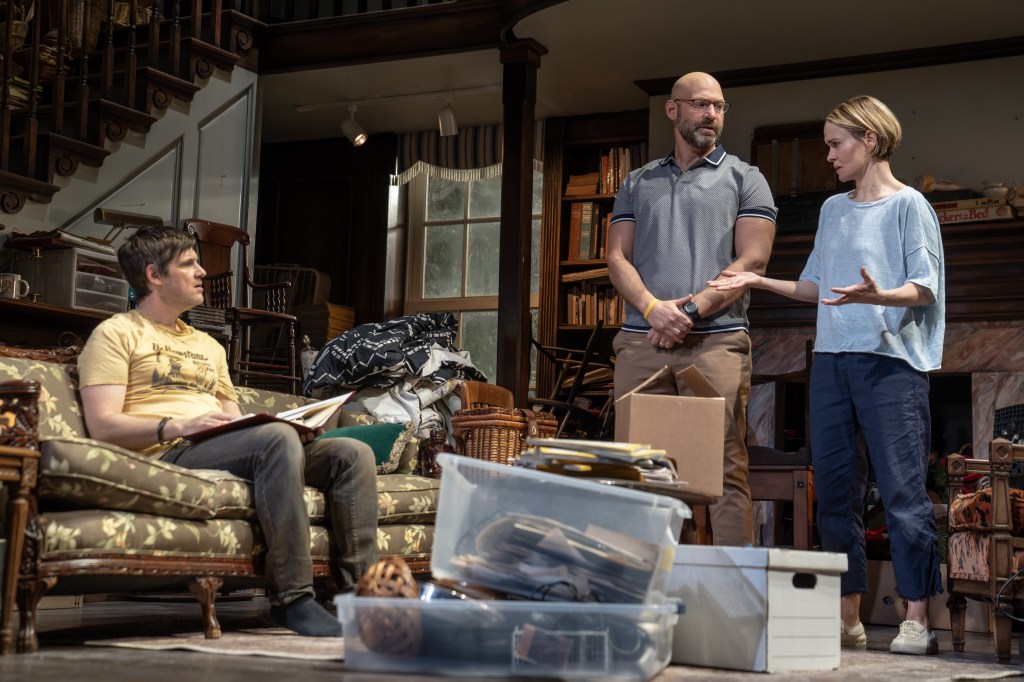
Before the curtain lifts onto the 7th generation Arkansas plantation home of the Lafayette family, the theater is plunged into the darkness of nighttime. Then, Bray Poor and Will Pickens let loose the prolonged, screeching sound of Cicadas, a sound repeated between acts and scenes. When Jacobs-Jenkins determines we’ve “had enough,” the lights dimly come up on a once stately mansion interior- living room, foyer, and stairs-leading up to the balcony landing and off to unseen bedrooms, where Toni (Sarah Paulson,Talley’s Folly), Bo (Corey Stoll, Macbeth), and Frans (Michael Esper, The Last Ship), slept during their childhood.
The mansion, in complete disarray, filled with hoarder’s junk-furniture, ceramics, glassware, clothing and more-still has remnants of beauty amidst its dilapidation and tawdry dressings of curtains and outdated furniture, thanks to dots’ prodigious scenic design. Symbolic of the once “glorious” South, with its penchant for ritual and gentility delivered by Black enslavement, servitude, Jim Crow peonage, bigotry and prejudice, the mansion, we come to discover, hides remnants of brutality, sadism and murder, a legacy of the Layafettes, which has not been recognized or confronted by the present generation, especially Toni.
The Backstory
In the backstory, we learn that Toni, Bo and their families are at the plantation for the auction of the estate interior, house and extensive property which includes two cemeteries, one for seven generations of Lafayette ancestors, and the other a slave cemetery isolated near the algae-ridden pond. Bo and Toni have kept in touch and were together for their father’s funeral six months prior, when they discussed raising money to pay off the loans of the estate’s indebtedness. Though they try to contact Franz, who has been AWOL for 10 years, they have been unable to tell him of their father’s death and the disposal of the estate.
It is no small irony that Franz, at the top of the play, comes in through the window with his girlfriend like a thief in the night, in the early morning hours, the day the liquidators are supposed to catalogue and price the estate’s valuables. When Paulson’s Toni makes a dramatic entrance from the 2nd floor balustrade, shining a flashlight on Franz, ranting at his presence and interrupting his reunion with her son, his nephew, Rhys (Graham Campbell), we question what is going on. From this incident of conflict, Jacobs-Jenkins unspools the mystery about the family, its members, their dead father and their ancestors. Throughout the play by agonizing and strategic degrees, the playwright reveals the Lafayette’s tragic family portrait, and explores many themes, key among them ancestral accountability for the past sins, which if not addressed or confronted, will be a curse on future generations.

As the play progresses and the siblings deal with the estate, we note that Toni, as executrix, makes unilateral decisions and controls everything to the point of “spur-of-the-moment” irrationality (though her explanations to herself are rational). This foments more chaos than is necessary in a situation fraught with turmoil, divisiveness and alienation among the siblings.
Pressures and conflicts in the Lafayette family
Pressures of the father’s illness and death, the disparate circumstances in each sibling’s family, Toni’s divorce and difficulties with her son Rhys (Graham Campbell), exacerbate the tensions of the stressful time, as the siblings attempt to create order out of chaos and obtain the most money to pay off the debts. Handling the estate and settling the inheritance would upend the most sanguine, peace-loving and close siblings. However, for the tormented Lafayettes, settling the estate is apocalyptic. The brokenness of each family member and their significant others raises the temperature of the non air-conditioned mansion to an explosive boiling point by the end of the play.
The first roiling incident begins with Franz, renamed from Frank by his California-dreaming, tendentious, sweetie, River (Elle Fanning is brilliant as the peace-keeping, pompous, shaman-loving spiritualist). The moment Paulson’s acerbic, sniping Toni sees Franz, she launches into strident questions, as he soft peddles his replies and defends himself against her accusations that he only showed up to greedily collect “his share.” When she threatens to “call the cops” on him, he ignores her and goes upstairs with River to sleep off their long trip from Oregon, where he had been hiding out for a decade.

Why she responds toward her youngest brother this way is revealed in the last act cataclysm. However, her bile-frothing attitude, while humorous and sardonic, frightens. Though she seeks hugs from her son Rhys and tells him she loves him, we question her volcanic response to Franz and fiery tirade answering Bo’s comments about shelling out money to maintain the estate through the last years of their father’s illness. Apparently, Bo paid for the aide who ministered to their father almost 24/7, and paid for all the house expenses. According to Bo, he took that “hit,” and hopes to recoup some of that loss from the proceeds of the auction and estate sale.
Questions about the kids’ discoveries
Toni dismisses him saying that it was “their father” who was ill. The implication is that he is heartless and should have opened his bank account willingly with no thought of recompense. We are curious about this “selflessness” she demands of others, while equating her time with her father and drives to Arkansas from Atlanta as more than the equivalent of the money Bo paid. Meanwhile, why wasn’t the father’s grand estate enough to pay for its upkeep? As a DC district justice (in line for becoming a Supreme Court Justice), didn’t the father have the acumen to financially manage it? Why didn’t Toni contribute monetarily, and why are there heavy loans against the property? And why did the father keep quiet about his precarious financial circumstances? Eventually, we learn the answers about this family which is so dysfunctional, it is caving in on itself by the weight of its violent legacy which they refuse to confront.
Little of what her siblings say Toni takes in giving any weight to their position or logic. She is quick to retort and uplift her own situation and attack theirs with seething anger. Whether this is a function of her age (the oldest), and her position as executrix, one concludes that it is mostly due to Jacob-Jenkins’ stylized characterizations in the service of elucidating his themes. A key theme is that karma is a bitch. Unless you break the cycle of abuse of others (slavery, murder) and acknowledge and reverse it, it comes to haunt you with its own particular brand of sickness and blight in the human heart. By the end of the play, we note how each sibling is crippled with agony, divided and isolated from each other without any possibility of reconciliation or redemption.
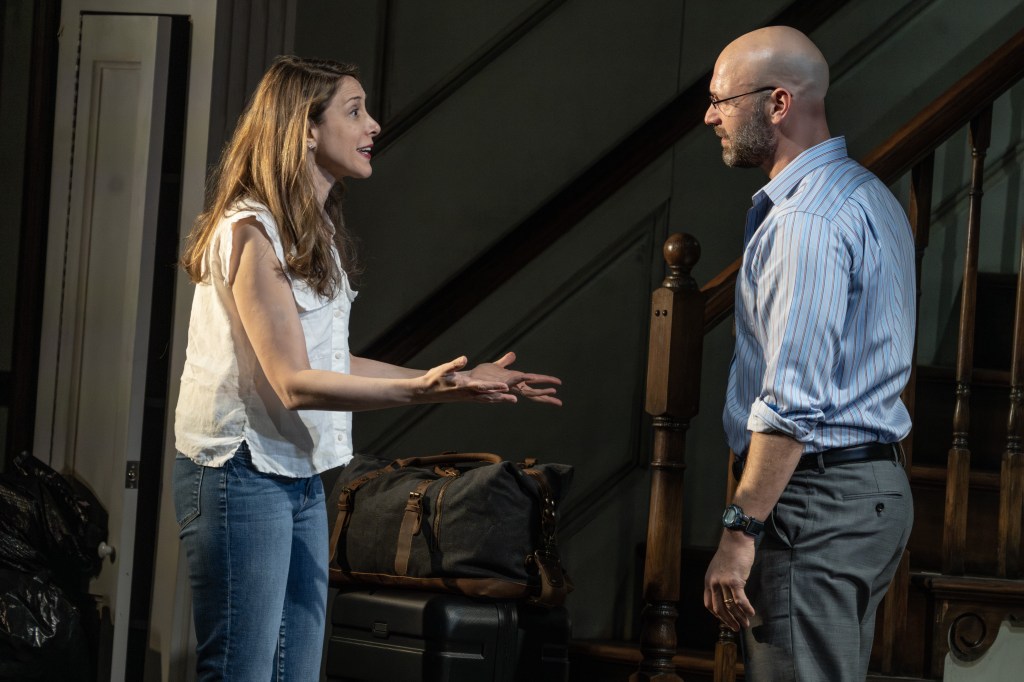
That this may be the result of what their ancestors had wrought upon the land they “appropriated,” and the slaves they abused, and the Black people they may have seen or had lynched, generational accountability is the last thing these present day Layafettes consider. However, adding other clues (i.e. River feeling the presence of spirits), it is a sub rosa theme of the play. Bo, Toni and even Franz hurt, lash out and move to disinherit themselves from each other, the estate valuables and the plantation which they leave to the elements, abandoning it.
Who would question their behavior? Who would want their legacy which involves lynchings (they find photographs of Blacks lynched), glass jars filled with noses, fingers, ears and penises of Black people carved out of the lynched bodies, and a Klan hood that was their father’s. Clearly, the race hatred permeated their childhood, but they didn’t realize it, having spent most of their lives in Washington, DC and some summers at the Arkansas plantation. Besides, around them, their father never mentioned the “N” word, though Bo remembers in college the judge refused to look at “in the eye,” or “shake the hand” of a Black dorm-mate.
The mystery revealed: spoiler alert.
The siblings and apparently, the father and mother, didn’t deal with their ancestry, but like so many others in the south, received the benefits of “free labor” and reaped the rewards of servitude and Black social oppression through the generations without considering the possibility of karmic reparations exacted on their being, emotionally, spiritually and psychically. Jacobs-Jenkins gives clues of the cruelty of their ancestors toward the Black population throughout, via the collector’s items and junk their father and his relatives hoarded.
That this sale of the estate represents the family’s apotheosis of failure and self-destruction, Jacobs-Jenkins uncovers by the conclusion. Bo has lost his cushy job. Toni has been fired from her teaching position when her son distributed her meds to classmates, for which he was kicked out of high school. She is finalizing her divorce and Rhys doesn’t want to stay with her but is going with his father because she is not a good mother.
We discover that Franz is only interested in collecting “his share,” after befriending Bo’s daughter Cassidy (Alyssa Emily Marvin), who broadcast family events to him via her Facebook pictures. Franz had been receiving checks from his father to pay for his upkeep after his jail sentence as a pederast (he got a teenager pregnant). During Toni’s harangues, we discover, though Franz is presently “clean,” Toni suffered with “worry” through his hospitalizations, rehabilitations and addictions to drugs and alcohol. Meanwhile, Franz blames his “bi-polar,” psychically-broken father who fell apart after his wife’s loss to cancer, as he attempted to raise Franz by indulging him. Franz also blames his siblings’ abandonment of him to his father’s questionably abusive care. Of course Toni counters Franz “defense” as lies.

The Lafayettes are an emotionally debilitated family on steroids
Jacobs-Jenkins clarifies that this is a emotionally debilitated family on steroids. Maybe the only member with any rationality is Bo, but only because of his wife. When discussing their father’s racism and prejudices, which Toni denies, Rachel mentions she overheard their father slur her when he referred to her on the phone with a crony, as Bo’s “Jew wife.” Toni dismisses her and the race hatred artifacts. She is “put-out” by Rachel’s alarm that the children have seen the photo album of Black lynchings and incensed that Rachel implies her father is anti-semitic and racist, she ends up provoking Rachel to provoke Toni to slur her. Toni does with ironic abandon, then claims she was joking.
Interestingly, Bo, who lives in the North has put a great distance between himself and his heritage, which is another form of dismissiveness. However, he has taken his racist attitudes with him. He attempts to recoup money from the estate by arranging to sell the photographs of the lynchings of Blacks, which apparently are valuable on a covert white nationalist market of sadistic memorabilia of the “good ole” Southern “glory days”
Bo is so numbed to his legacy, he doesn’t see the egregious amorality of making money off others’ victimization and death. This is a corrupt continuation of the “benefits” the South receives from its Jim Crow policies of racism and murder, heightened by the fact that there is a market for these “valuable collector’s items.” Though each revelation of the father’s racist hoardings is achieved through the kids’ innocent, sardonic, humorous discovery, as the adults try to cover up the shocking “in-your-face” racism, the audience’s real shock is at the macabre, psychotic nature of keeping such items. We ask, why would the father, a judge, “get off” on photos of Black lynchings and jars of Black body parts from the lynchings?
Who does the photo album belong to or the glass jars of body parts?
Toni, Bo and Franz don’t find this loathsome about their father, and try to pretend it belongs to someone else.

Jacobs-Jenkins clarifies the craven, broken psyche of Bo, Toni and Franz, who don’t see anything wrong with selling these items to recoup the estate’s losses. On the other hand, Rachel is outraged her children have been the ones to discover the photo album and jars of body parts. And at some point, she intends to discuss what they mean with her kids to work through the psychological shock of seeing such horrors. Indeed, she is the only one who seems to understand the brutality and violence such artifacts signify. It is her morality that stirs the morality of the others to try to protect the kids from further exposure. But Cassidy is interested because it is verboten, so she continues to look, seduced to the grotesque, cruel voyeurism that this American past was normal for the South..
The playwright speaks volumes through what is absent in the siblings’ conversation. They don’t deal with why the father hoarded such items and didn’t find a better place for them in the Smithsonian African-American History Museum, Arkansas African-American History Museum, or other educational institutions or museums. Why has he kept the photos in a shelf in the foyer, and the Klan hood and the body parts in his bedroom? They weren’t secreted away in a hiding place in the attic or elsewhere, but were out in the open. Obviously, there are two sides to the retired judge’s character. One part of him justifies lawless lynching via white domestic terrorist racism, while the other lives peaceably as a justice. Perhaps Franz has a better handle on his father’s “bi-polar” nature than Toni, who disbelieves all of the “incongruities” Bo, Rachel and Franz have pointed out about him.
The final coup de grâce

Jacob-Jenkins cannot resist the final coup de grâce on this tragic, racist, family legacy that is blowing up in their faces with regard to recouping money. Bo states the land cannot even be sold without dealing with the two cemeteries, so the property isn’t worth much. Secondly, Franz,, to “cleanse himself and get in good with his family,” throws himself and the photos into the pond by the slave cemetery before he knows they might be valuable. The photos are destroyed; the money up in smoke. This family can’t win for losing. Have the spirits of the dead effectively prevented any benefit to a family with its violent legacy of slavery and lynchings, as karma takes its recompense and the estate goes into receivership?
River, who has from the start been wary of the spirits on the place and has sensed “a presence” in the mansion, is used by Jacobs-Jenkins to validate this possibility that the spirits of lynched, enslaved African-Americans exact their karmic retribution. Additionally, the playwright and director’s vision reveal that such spirits may seek vengeance until the family expiates the bloodshed and torment their forebears have wreaked on the Black population on their lands. Thus far the current generation hasn’t and the siblings are a wreck.
The tragedy of blindness is on everyone in this family, who ignores the significance of those murdered, lynched, abused and oppressed. The lives of those in the slave cemetery and those in the photo album are like the lives of Blacks across the South, who were and are still being appropriated for money on the covert market of “lynching” items that white, terrorist racists find “quaint,” “cool” and “prize-worthy” for trading. It is an unacceptable criminal abomination that must not be normalized. It still is at what cost?
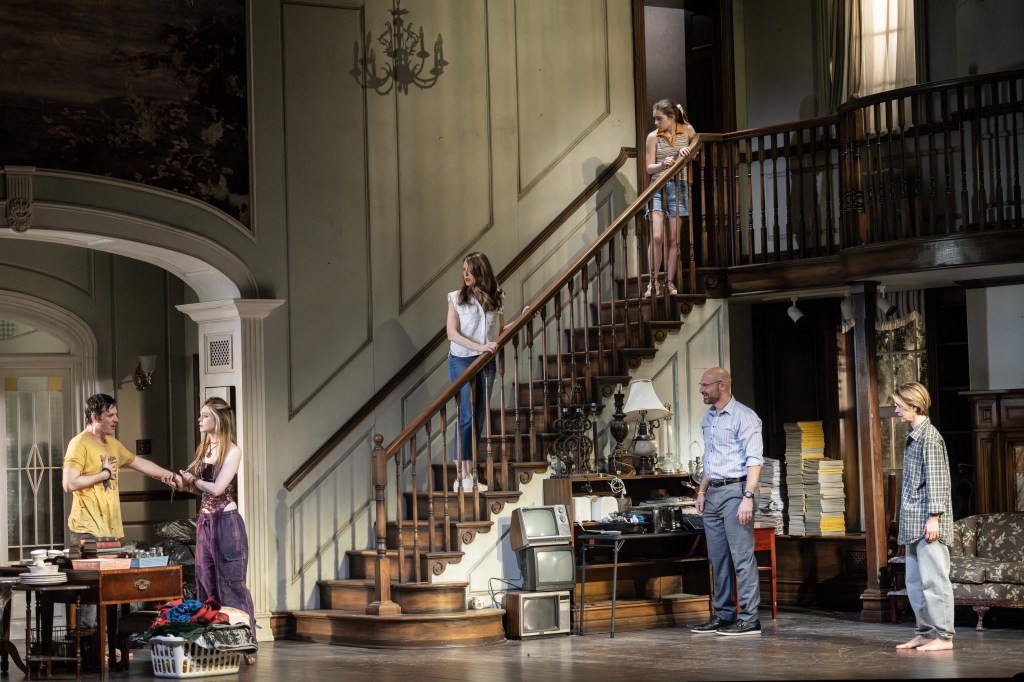
The siblings abandon the mansion and its contents which nature takes over and destroys through the decades as it collapses and a final haunting symbol emerges in the mansion center stage. It is a huge tree open to interpretation. It is representative of the lynchings in the photograph album which must be accounted for.
An amazing conclusion
The conclusion after the blighted family members have left, never to see each other again, is an amazing scenic feat. A tree rises from the mansion floor effected by the amazing scenic designers, dots. Neugebauer’s vision with dots’ execution of the house symbolically shattering as the tree rises up from the foundation of racial hatred, brings together Jacobs-Jenkins’ themes. They warn that despite assuming all is well, recompense will continue to be exacted for historic racial bloodshed and murder. As this family has a legacy of it and refuses to confront it, a bill for the bloodshed will be delivered on them and future generations, via psychosis, financial ruin, addiction etc. Karma is a bitch.
The play is exceptional in its themes and important in its significance about recognizing and not normalizing racial murder and lawlessness as the family tends to do when their father’s hidden life uplifts it. The characterizations serve the themes; the themes don’t arise from the characters. At times the dialogue is contrived to be humorous, especially as the playwright has stylized these individuals as types. Toni’s character is drawn as sardonic, insulting, shrewish and one-note.

The reason why the production gets away with the contrivances is because the director’s staging is perfection, the technical creative team is superbly coherent in conveying her vision. Most importantly, the actors are incredible, individually and as an ensemble. They flesh out and inhabit these unlikable individuals and make them watchable and horridly humorous. Paulson brings her own star quality and beauty to the role so we dismiss Toni’s obnoxiousness, until as with all of them, their faults gradually clarify and deaden them. Then, we reach the point of no return.
By the end we could care less that Toni declares herself dead to the others as they are dead to her. We watch as Bo weeps and questions why he cries. We assume that Franz will continue in his lost state with River directing him until she gets fed up. And Toni sums up what each of the siblings is thinking. She affirms this is who she is with them, implying they “make her” this way and she doesn’t like herself as a result. It is the same for Bo and Franz, who aren’t particularly happy with themselves. Neither do we empathize with any of them because they don’t acknowledge their legacy, they dismiss it or run from it. As their ancestors “threw away” Black generations, so these individuals in self-torment, “throw away” themselves…a tragedy.
This family is the problem and not the solution which is hard won. And as the themes imply, there must be recognition of the horrors of murder and reparations must be attempted. Karma is taking its toll. The sooner the crimes and injustice are recognized, the better for all who have a legacy of violence as this family does. Regardless of how disconnected they think they are from it, they are suffering and will suffer until the injustice is made right.
Kudos to the creative team not identified above. These include Dede Ayite (costume design) and Jane Cox (lighting design). This is not one to miss in its profound themes about the South, about normalizing crimes, and dismissing their historical significance and impact on us today.
Appropriate, two hours thirty minutes with one intermission at the Helen Hayes Theater, 240 W 44th St. between 7th and 8th. https://cart.2st.com/events/?view=calendar&startDate=2024-1
‘Jonah,’ Working Through Trauma Over Time

The world premiere of Jonah by Rachel Bonds directed by Danya Taymor and presented by Roundabout at Laura Pels Theatre, Harold and Miriam Steinberg Center for Theatre, is in a limited engagement until March 10th. Billed as a “coming of age story,” Jonah follows a young girl traumatized by events after her mother joins up with a man and his sons. This becomes an untenable living arrangement from which she and her mother cannot escape, all of which we learn through her dialogue with three characters.
In a nonlinear fashion, with sketchy details, Bonds reveals Ana’s backstory by degrees, as Ana (Gabby Beans-The Skin of Our Teeth) interacts with Jonah (Hagan Oliveras), Danny Samuel H. Levine (The Inheritance), and Steven (Good Night, Oscar), throughout undefined time sequences. Using obscurity, intimation, opacity and mystery as key devices to unfold how the “slings and arrows of outrageous fortune” have impacted the main character Ana, we gradually learn how traumatic events might be worked through with fantasy and the imagination to promote redemption and healing.
Bonds opens the play with Ana at an unspecified educational setting, most probably a private high school where Ana tells Jonah she is on a scholarship. Jonah (the adorable, exceptional Oliveras), walks with her and engages her in friendly conversation. Ana, who attempts to remain aloof, eventually allows him to follow her up to her dorm room after a few interactions outside her dorm. In the next few scenes, Jonah and Ana grow closer and share intimate details about their sex lives. Both are virgins and their intimacy never really “gets off the ground” into something sexual, though what they do share is profoundly substantive, sweet and loving.

The manner in which Jonah leaves, and the fantasies Ana shares about her being in love and sexually fulfilled, indicate the possibility that Jonah is her fantasy. He is the way she wishes a partner in love might be: sweet, caring, solicitous about her comfort, flattering, overwhelmed by her beauty, and articulate to the extent that he engages her trust and faith. It is these qualities that elicit her reciprocation, until shockingly, at the “twinkling of an eye,” he falls back into the blackness of the doorway.
Bonds shifts the time in the next segments. The playwright introduces another character, Danny, who is troubled, confused, traumatized. Though Wilson Chin’s set design remains the same, unobtrusive beige (rugs, bed linens, walls, etc.,), Danny appears at her doorway, taking the place of the sweet Jonah. We learn Ana’s mother has died, after remarrying a violent alcoholic with two sons. He abuses son Danny because he stands up to him. Through Ana and Danny’s dialogue we learn that her stepfather is also brutal to Ana emotionally, but stops at the point of physicality. However, the intimation is that soon he will go after Ana, and perhaps he has already abused her with inappropriate sexual touching.
In Ana’s scenes with Danny, we note how she comforts him and helps him cope with his father’s abusive beatings, either attempting to dress his wounds or give him a head massage. Clearly, Danny is protecting her by taking the brunt of his father’s alcoholic abuse, and he goes to her in kinship for comfort. Bonds doesn’t clarify how her mother died. Nor does she explain what happened to her sisters, referenced in a photo she discussed in the previous scenes with Jonah.

The one positive element in the series of events in the Danny sequences is that Ana is excellent in school and is pursuing writing which helps distance her from the terrible home circumstances. Apparently, Danny effects their escape before the stepfather sexually abuses Ana, who avoids discussion of the specific details of their situation. However, because Danny references that he brought Ana and his brother to a safe place, we note that Ana possibly feels an obligation to comfort Danny.
In one scene when Danny visits her drunk in her new location, presumably another school setting where she is pursuing her writing, they are intimate. The experience isn’t pleasant, but she permits him to “deflower” her out of pity. Because he is “out of it,” he doesn’t realize what he is doing until after it is over and Ana withdraws from him and becomes remote. In the final Danny segment, he reads an assignment that she has written about him, though she attempts to explain it awat. He is so upset by her view of him that he cuts himself to release the pain of what he interprets to be her censure and loathing. As he goes into shock, she is forced to get help to take him to the hospital to stem the bleeding.
Once again, the scene shifts and a new young man appears at the doorway of the same beige room which by now we gather is a combination of Ana’s memory, a fabrication of an alternate reality that Ana constructs to help herself emotionally, or a dorm-like setting in the future that manifests some elements of objective reality. As Ana converses with Steven (John Zdrojeski), the dialogue lets us know the setting has changed to a writing retreat, and Steven is concerned why she is not dining with the other writers. During their conversation, Steven discloses he has read her novel and found it fascinating. As he attempts to become closer to her through his kind manner and friendly conversation, we note that he is more like Jonah from the first segments.
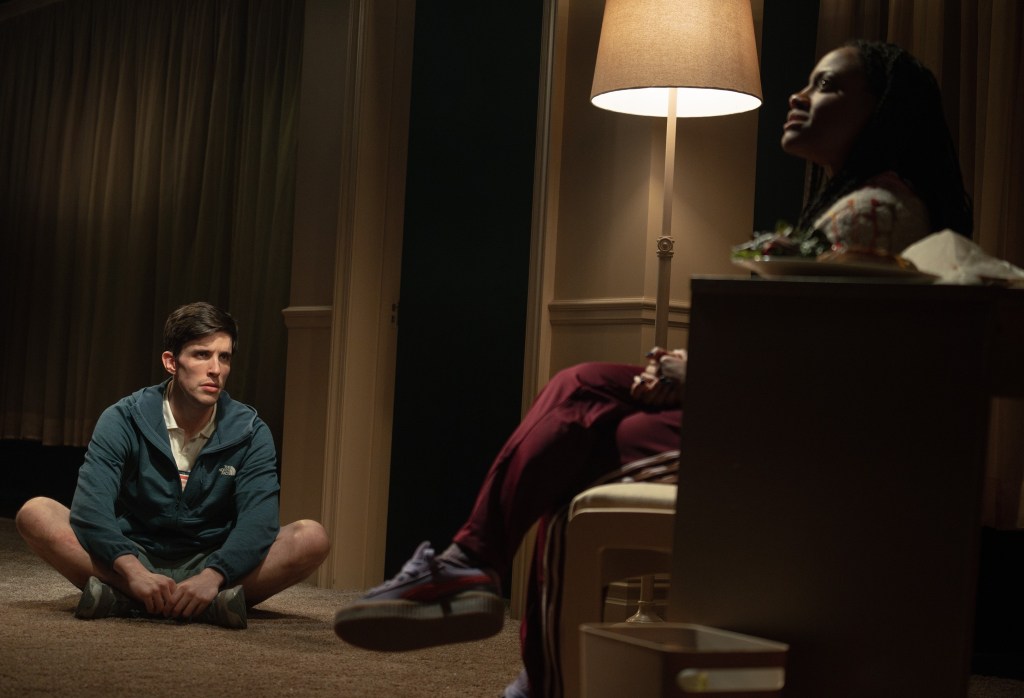
It is in this final segment with Steven that Ana discloses Danny committed suicide. The impact of this years later and the events that occurred in the past Ana relates to Steven, a lapsed Mormon because he wants to know about her family situation and her writing. During these segments with Steven, there is a scene when Jonah returns. He reaffirms their connection from the past. They discuss how they missed each other and Jonah apologizes for perhaps having done something that disconnected their relationship and closeness.
In this last meeting with Jonah, we realize that Jonah is symbolic. Perhaps, he is a configuration of her psyche that is her male counterpart. Perhaps he is a fantasy she uses to bring her to closure, so she can establish an intimacy that will help her overcome the previous traumas and unhealthful relationship with Danny.
Jonah and she briefly reunite in a healing moment and then he leaves. At the right time, Steven who has fallen asleep by her bedside, while Jonah visited, awakens.
It is after her visit with Jonah that Steven and Ana discuss the nature of intimacy and sex. Additionally, she is able to discuss God and answer Steven’s questions. As she describes her experience, we understand the impact of the past traumas. They disassociated her from her body and her faith in God. The pain was so great she went into a deep freeze and felt nothing, nor did she want to feel anything. However, the disassociation became a form of recuperation and allowed her an emotional pause. Eventually, as a result of it, she can begin to restore herself with a loving relationship, release the guilt and shame and become whole again.
During her discussions with Steven, they move to establish a closer, comfortable relationship, as Steven checks to make sure she is comfortable with him. Ana becomes reconciled to herself. She and Steven begin a more intimate chapter in their lives as Bonds concludes on an up note.

Bonds’ play is about the healing process after trauma and how individuals use elements of their own humanity to work through terrible events from their past. She merges fantasy and reality, past and present and cleverly uses the dialogue to identify emotional, psychological time so that we understand the nature of how physical violence and abuse may be worked through. Bonds’ conclusion shows Ana and Steven concerned for each other, unlike Ana’s incomplete, painful relationship with Danny, where Ana nurtured him as far as possible, but she wasn’t enough for him.
Bonds keeps us intrigued, though at times, the dialogue needed tightening. I drifted during some parts. I found the scenes with Jonah the most uplifting and credit Oliveras, who is sensational and believable as the forthright and candid Jonah. Levine has the most difficult role as Danny. His portrayal of Danny as broken, and as a taker is spot-on. Yet, despite the undercurrent of violence and overt neediness, Levine’s Danny is poignant. Additionally, he clarifies that, though Danny apologizes to Ana, we note that he is following in his father’s footsteps. He desperately needs help which Ana cannot give him or she will herself drown.
That she nearly does drown emotionally then closes off herself is a protective device against Danny, who has been so abused, he seeks suicide as a release for his inner torment. The extent to which his suicide impacts Ana and makes her feel guilty is intimated but not spelled out.
Zdrojeski’s Steven is a welcome contrast after Levine’s angst-filled Danny. His tenderheartedness recalls Jonah’s innocence and kindness. That Zdrojeski’s Steven is like Jonah in the concern expressed for Ana’s well being, as well as the admiration of her talent, creates the hopefulness that Bonds wishes for Ana’s emotional recovery. Beans’ Ana and Zdrojeski’s Steven remind us in a world of hurt, torment and violence, there are kind and loving individuals. Perhaps they are there when one doesn’t look for them or more importantly, when one is ready to work through one’s guilt, recrimination and pain.
Though Bonds ends the play affirmatively with Steven and Ana learning to be intimate with each other, she leaves many questions unanswered. What have we just envisioned? Were the scenes mere sketches in Ana’s psyche that are fantastical but not really grounded in objective reality? Or do they convey fictional accounts in Ana’s writerly imagination? Such is the nature of consciousness and the layers of personality when confronting trauma, abuse, violence so that the events tend to merge fantasy and reality in the haze of wounded memory. Taken on that level, Bonds’ work is fascinating and valuable.
The creative team effects Taymor’s unity of vision with Bonds’ themes with effective stylization,. Wilson Chin’s set design defines the place in Ana’s mind which never changes. Kaye Voyce’s costume design similarly remains the same for Ana and the characters with only two tops varying down through the years as Ana’s mind leaps in time segments. Likewise, Tommy Kurzman’s hair design (it stays the same), follows Taymor’s and Bonds’ vision that objective reality has been overcome by Ana’s interpretation and perspective in her conversations as she grapples with the past in her imagination in the present.
Likewise, the light flashes which signify a change in time sequence (Amith Chandrashaker’s lighting design), give structure to the scenes. The overall softness in the lighting when Ana is “in the room” with the young men, appropriately echoes the dimness of memory and hazy suggestion of imagination. Kate Marvin’s sound design accompanies the lighting flashes symbolically and indicates the shifts in time, reality, imagination.
The theme that over time one may heal from past emotional devastation, if one has the will to do so, is a hopeful one. Though we don’t understand all of Ana’s derivations through reality, fantasy, memory, flashback, objective reality, we do understand that she wants to release herself from the pain, and redeem herself so she can be intimate and open to love again. How Bonds effects this process is striking. The performances are terrific. And Beans sustains her energy and vitality throughout.
Jonah, Laura Pels Theatre Harold and Miriam Steinberg Center for Theatre, 111 West 46th Street between 6th and 7th for the Box Office. For their website: https://www.roundabouttheatre.org/get-tickets/2023-2024-season/jonah/
‘White Rose the Musical,’ Impactful, Uplifting

Inspired by true events, White Rose the Musical with book and lyrics by Brian Belding and music by Natalie Brice, reveals the important story of heroic and morally engaged university students, who, at great risk to themselves, took a stand against Hitler’s Third Reich killing machine with paper, a mimeograph, ink and spiritual courage. Directed by Will Nunziata, with orchestrations by Charlie Rosen, and music direction, supervision and arrangements by Sheela Ramesh, White Rose, the Musical is a tour de force that resonates for us today.
Currently in its premiere at Theatre Row in a limited engagement until March 31st, the musical holds vital themes that uplift the human spirit. Importantly, it reminds us to stand against political criminals who would usurp power, murder, and destroy human rights to maintain their agenda of domination.
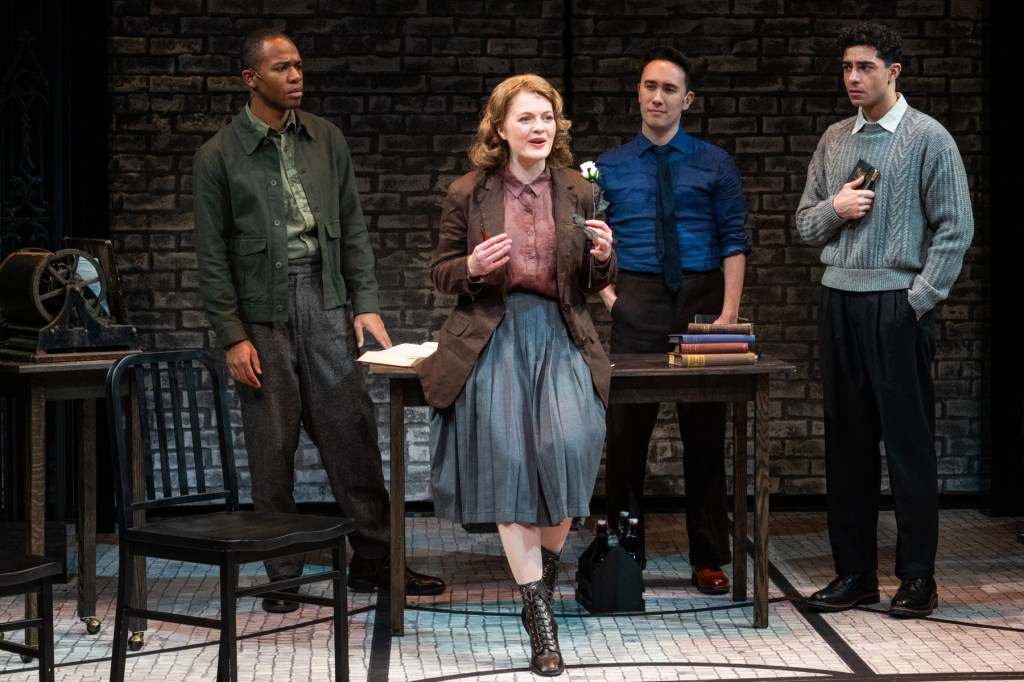
Celebrated throughout Germany today with memorials of school, street, fountain and plaza names, the group who identified as the White Rose printed and distributed leaflets and risked their lives to inform German citizens about the Nazi terrorists. They dared to countermand the brainwashing propaganda of Goebbels that dominated German culture and society. Their main purpose was to inspire and encourage citizens and create a community who did not feel alone against Nazi brutality, so they might resist, speak out and denounce the Third Reich in whatever way possible.
Belding begins the story with brother Hans Scholl (Mike Cefalo), and sister Sophie Scholl (Jo Ellen Pellman), looking out over a balcony readying themselves to take a final decisive action. Before they do, they recall to their remembrance how they arrived at this crucial moment from which there is no turning back. What follows is a flashback that reveals the arc of how the White Rose came into being, who was involved with the group and how they motivated citizens to take a stand with non-violent resistance.
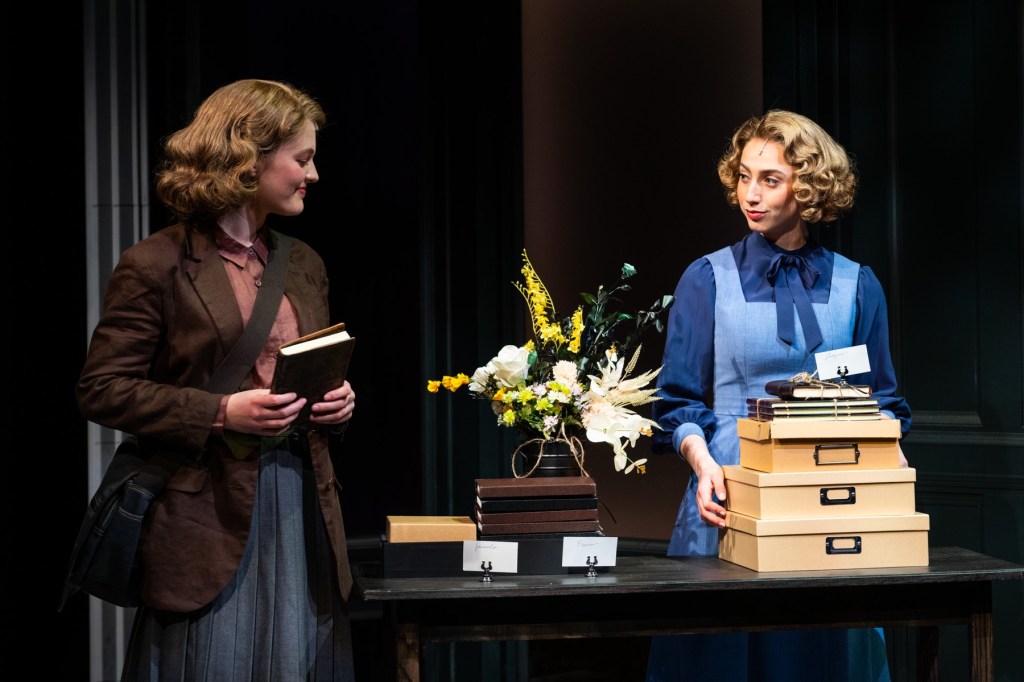
In “Munich” Sophie Scholl sings about her decision to break away from activities elsewhere and join her brother Hans (Mike Cefalo), a medical student at the University in Munich. There, she takes a class with Professor Kurt Huber (Paolo Montalban), and meets Hans’ friends Willi (Cole Thompson) and Christoph (Kennedy Kanagawa). Willi is hopeless (“I Don’t Care”) about what is happening in a society cowed by the police and Gestapo overlords who monitor citizens’ every word, look and deed, ready to arrest anyone who even breathes counter to Nazi propaganda and Hitler’s political ideology.
It is 1942 and by this point in time, from books to decadent works of art, priceless cultural artifacts have been confiscated and banned, and professor Huber can only teach a censored curriculum approved by Hitler and his propaganda minister. Nevertheless, the professor manages to get around the bans and inspire his students to think, question, (“Truth”), and not allow themselves to be seduced by Nazi propaganda.

A series of events help to raise the consciousness of the activist students (“Blind Eye”). The oppressive social order impassions Sophie (“My Calling”) and Hans (“The Sheep Chose a Wolf”). With Hans’ friends they form the” White Rose,” a name which reflects innocence and goodness pegged against the dark storms of Nazism. First, they write anonymous letters against the Third Reich and send them to addresses of those living in Munich. When Sophie becomes friends with shopkeeper Lila (Laura Sky Herman), who gives her a mimeograph machine, Sophie and the others create leaflets and leave them on the streets where citizens can read their exhortations.
Complications develop. Frederick (Sam Gravitte), who is on the police force but answers to Nazi handler Max Drexler (Cal Mitchell), protects Sophie from being arrested. We discover that Frederick, who was a friend of Hans, knew their family. He and Sophie had a relationship then broke up. Now, when he suggests that they escape to Switzerland, (“Run Away”), it is too late. Sophie has found an important mission that gives meaning to her life, and she is not going to leave it for Frederick who is blind to the consequences of his complicity, however minor, with the Third Reich.

When Professor Huber becomes involved with the White Rose, they determine to step up their plans to engage the public. For example, they learn the elderly and handicapped are being euthanized as a part of the Nazi “master race” cleansing program. Thus, their moral imperative to encourage resistance and rebellion (“Why Are You Here?” “The Mess They Made”), gains greater impetus in the service of saving lives.
To expand their sphere of influence, Huber involves his friend Karl Mueller (Aaron Ramey), who is in another resistance group. Hans and Willi are called up to go to the Russian front and help there as medics. On the front, they see the torture and abuse of Jews first hand, and note the Nazi atrocities and brutalities on the civilian populations which stirs them to further redress Nazi abuse when they return home. In a pamphlet, the White Rose provokes the German population to turn away from the Nazis who are destroying their nation and are losing the war having been horrifically defeated at Stalingrad. In the meantime, Sophie invites Lily to join them. But Lily reveals she is a Jew in hiding, who must live in hope and keep on moving (“Stars”).

Sophie tasks herself with provoking the remaining members of the White Rose to continue decrying the propaganda of the Third Reich. However, the Nazis via Max Drexler have intensified their search and destroy mission to close down the White Rose. The Gestapo bring in Mueller for interrogation to find out who the White Rose members are. When he remains silent, they kill him to send a message to the White Rose. Either cease and desist, escape or be killed.
The question remains. Will the German people rise up and take a stand against the Nazis, which is what the White Rose intends they do? The revelation of who and what the fascist Nazis are happens slowly by degrees, primarily because the lies, the brainwashing, the power-mad, bullying Nazis mow down any in their path who resist. They control through fear and violence. The populace has no freedoms-of speech or assembly-or any rights apart from what the Nazis allow them. Their portion is oppression, abuse and mental and physical enslavement for if they don’t like it, they can’t even leave. Above all, they cannot voice another opinion contrary to Nazi propaganda.

As an oppressor under these conditions, Frederick goes through a crisis of conscience (“Air Raid”), and questions his cowardice being swept up to obey orders and continually bend to wickedness in the banality of evil. Kurt, Christoph and Sophie engage the population with expanded actions in graffiti and pamphlets. When Hans and Willi return from the front, Hans feels the pressure of being back and of having to protect Sophie from being arrested, a promise he made to his parents (“They’re Here Now”).
As Hitler’s armies suffer defeat in 1943, the prospect of the allies rescuing Europe from the fascists puts the Nazis in a frenzy to keep the populace in line by making more arrests (“Pride and Shame”). Ironically, as their brutal grip intensifies, Sophie and the other members become bolder. Sophie leads a walk out during a speech given to university students by Nazi official Paul Giesler (Aaron Ramey), that is particularly loathsome. In response the Nazis close down the university to punish them and look for the girl who led the walkout. However, news of the defiant walkout spreads far and wide and touches the hearts of students in other German universities.

As the members stay one step ahead of the Gestapo, Frederick, who knows they are the White Rose, tells Hans he can no longer protect them. The group decides upon an action in another city. It is then that the flashback comes to a close and the resolution and themes unfold. Rather than to spoil the last half of the musical, I can only recommend that you see this superb production for yourself to learn of the group’s final heroic actions.
White Rose the Musical with simplicity and beauty showcases the lives of individuals who lived and who have been memorialized in films and books. The production does a fine job of capturing the passion of the White Rose’s convictions with stirring music. The songs toward the end of the production especially, “They’re Here Now,” “Pride and Shame,” “Who Cares?” “We Will Not Be Silent” have particularly moving lyrics in strong melodies. The songs are a call to arms reaffirming immutable verities. To thrive and maintain one’s spiritual integrity, one must stand for justice and righteousness whenever possible in the face of tyranny, oppression and criminality.

Perhaps one reason why the songs at the end are the most impactful is because the arc of development of the music and book complicates. The numbers in the beginning are light, easy ballads that sound similar. However, when the themes of duplicity, treachery and corruption manifest in the understanding of the characters, (i.e. Hans describes the seduction of Hitler “The Sheep Chose a Wolf”), the music becomes more darkly driving and complex. Likewise, Cefalo’s interpretation of “They’re Here Now,” is exceptional in illuminating the fear and anticipation of being the hunted waiting to be caught.
The ensemble are uniformly strong with standouts Mike Cefalo as Hans, Jo Ellen Pellman as Sophie and Sam Gravitte as Frederick. At times, the performers needed to enunciate and articulate the superb lyrics which are too good to be missed. Whether it was an issue related to sound design (Elisabeth Weidner), or voice projection issues, Brian Belding’s lyrics (I read a copy of the fine script) must be heard. The lyrics manifest all of the insinuations of how corruption takes over, how despots rule with fear, and how in the face of darkness and evil, the only way to overcome the horror of such terrorism is with bravery, as the just shine the light of truth.
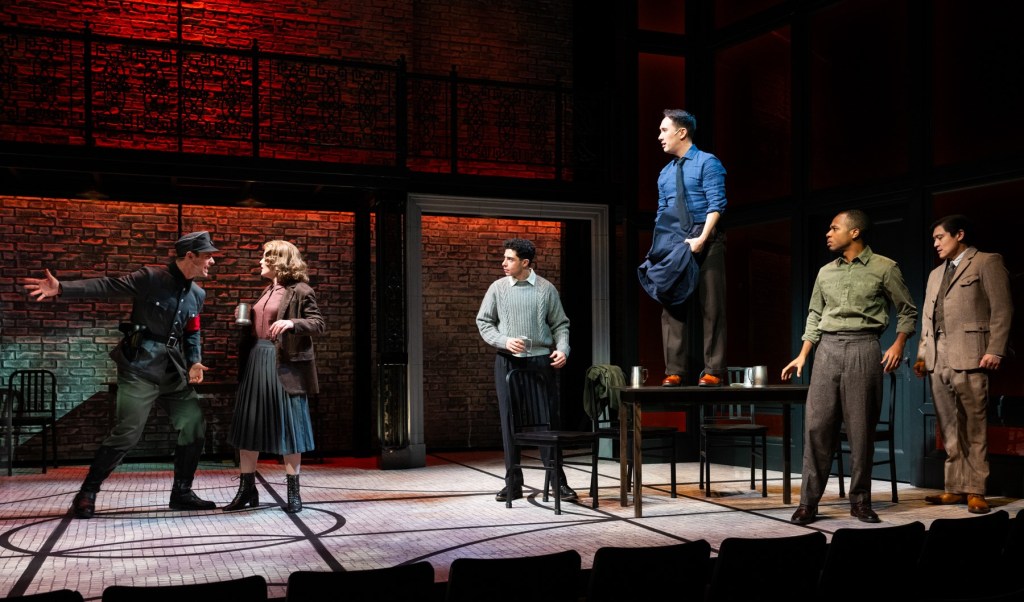
James Noone’s set design is appropriately minimalist with a curtain of the members of the White Rose projected on it at the outset of the play thanks to Caite Hevner’s projection design. With Sophia Choi’s period costume design, Alan C. Edwards fine lighting design and Liz Printz’s hair and wig design, the actors conveyed their characters with spot-on vitality.
The musical is a must-see because of its currency today. It reminds us that evil brutality and terrorism in a despotic, autocratic nation destroy the culture and people who support it. When human rights are vitiated and the populace cannot enjoy their freedoms of expression and rights over their own bodies, when ideas, books, and the arts are banned and burned, human dignity and community are demeaned and displaced. Such wickedness cannot live in truth because it is based on lies and propaganda which are created, not to uplift the common good, but for the purpose of idolatry, to worship one man and one ideology which must be bowed to, or one’s life or career are forfeited.
The limited engagement of White Rose the Musical on Theatre Row, 42nd Street between 9th and 10th, runs 90 minutes with no intermission. For tickets go to the Box Office or their website. https://whiterosethemusical.com/
‘Aristocrats,’ Irish Repertory Theatre, Review
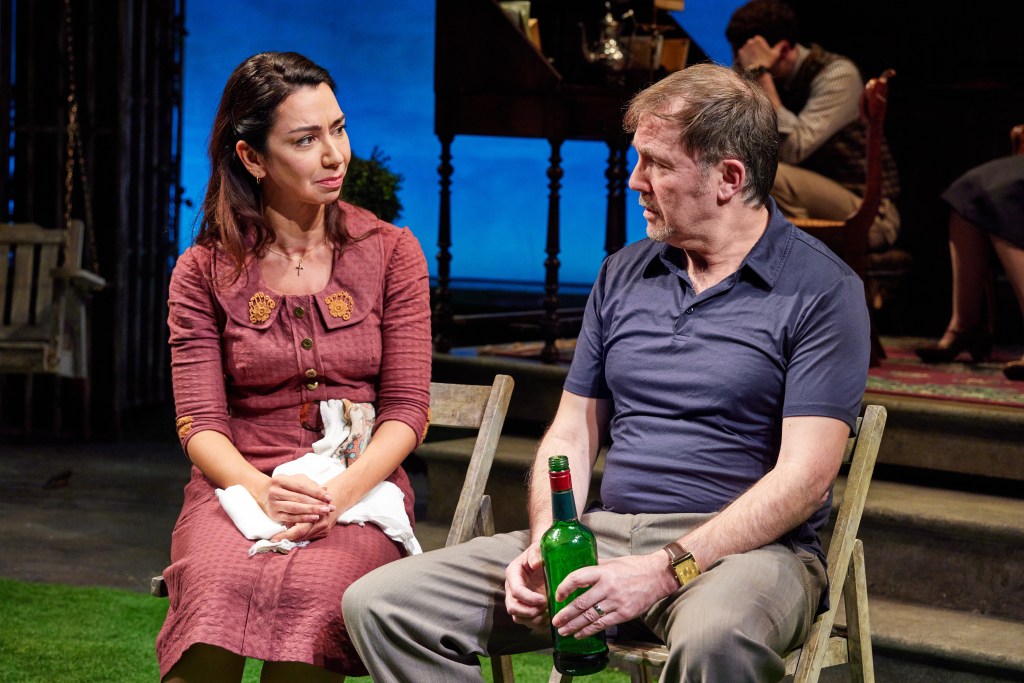
Dysfunction and decay are principle themes in Brian Friel’s Chekovian Aristocrats, a two-act drama about a once upper middle class family in precipitous decline in the fictional village of Ballybeg, County Donegal, Ireland. Currently at the Irish Repertory Theatre as the second offering in the Friel Project, the intricate and fine production is directed by Charlotte Moore and stars a top-notch cast who deliver Friel’s themes with a punch.
Two members of the O’Donnell family, headed up by the autocratic and dictatorial father, former District Justice O’Donnell (Colin Lane),, who remains offstage until a strategic moment brings him on, have arrived at the once majestic Ballybeg Hall. They are there to celebrate the wedding of Claire (Meg Hennessy), the youngest of the four children, who still lives with her sister Judith (Danielle Ryan), the caretaker of the estate. Well into the play, Ryan’s Judith reveals the drudgery of her responsibilities caring for her sickly father and her depressive sister Meg, as well as managing the estate and the chores of the Big House.
At the top of the play, we meet the grown children who live abroad and arrive from London and Germany. These include Alice (Sarah Street), her husband Eamon (Tim Ruddy), and the O’Donnell brother Casimir (Tom Holcomb). As Friel acquaints us with his characters, we discover Eamon, who once lived in the village, claims he knows more about Balleybeg Hall from his grandmother, who was a maid servant to the O’Donnells. Also present is Willie Diver (Shane McNaughton), who is attentive to Judith as he helps her around the estate and farms and/or rents out the lands to the locals. Initially, we watch as Willie organizes a monitor through which Justice O’Donnell can speak and ask for Judith to attend to him.

By degrees, through the character device of the researcher, Tom Huffnung (Roger Dominic Casey), and especially the ironic comments of Eamon, Friel discloses who these “aristocrats” of Ireland are. First, they were the upper class with land, who once dominated because the English protestant faction empowered them to do their bidding. The irony is that over the years, they have devolved and have imploded themselves. The sub rosa implication is that the seduction of the English, to give these Catholic Irish power, has led to their own emotional and material self-destruction.
The father, the last of the dying breed of “gentlemen,” like his forebears, took on the cruel, patriarchal attitude of the English. Raising his family in fear and oppression, and indirectly causing his wife’s suicide, he has deteriorated after strokes. We learn this by degrees, as Friel catches us unaware, except for the title of the play, by revealing the characters to be on equal class footing at the play’s outset. We learn the irony of the great “fallen.” The past distinction between the “superior” O’Donnell’s of the Hall, and the rest of the village peasantry, who referred to them as “quality,” (Eamon’s grandmother’s definition), has faded and is only kept alive in the imagination of a few.
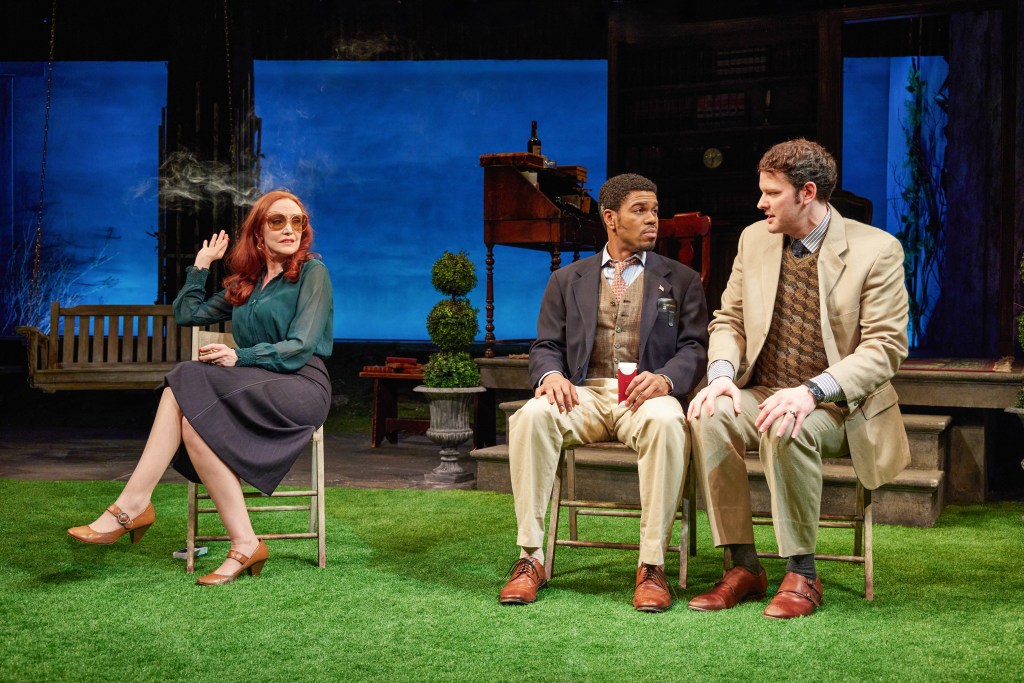
Throughout, Claire’s music can be heard in the background as Alice and Casimir converse with Huffnung, whose research topic is about the impact of the Catholic Emancipation laws on the “ascendant Roman Catholic ruling class and on the native peasant tradition.” In other words Huffnung has come to Ballybeg Hall to research the aristocratic O’Donnells and discover the political, economic and social impact they have had on the villagers.
Interestingly, Eamon sums it up to Huffnung when he ironically answers the question as an insider who knows the Hall and what it is like being married to Alice, one of the former “ruling class.” Alice and her sister Judith were repeatedly sent away from home for their schooling. Alice marries Eamon who, caught up in the Civil Rights action against the English Protestants, loses his job in Ireland and eventually works for the English government in London. Alone most of the day, Alice has become an unhappy, isolated alcoholic. Eamon, whose irony wavers between obvious bitterness and humor tells Huffnung that the O’Donnells have had little or no impact on the local or “native peasants,” of which he numbers himself as one of the classless villagers.

Indeed, noting the shabbiness of the Hall and the problems of the family members, we see the pretension of superiority has long gone. All of them face emotional challenges and need rehabilitation from their oppressive upbringing under their father, Justice O’Donnell who seems to have be a tyrant and unloving bully. We note this from his rants over the monitor and Casimir’s response to his father’s imperious voice.
Judith contributed to causing her father’s first stroke having a baby out of wedlock with a reporter, after joining the Civil Rights fight of the Catholics against the British Protestants. Forbidden to raise her child at home, which would bring shame to the family, she was forced to give him up for adoption; he is in an orphanage. Over the monitor in a senile rant we hear the bed ridden O’Donnell, refer to her as a traitor. Thus, we imagine the daily abuse she faces having to care for her father’s most basic needs, while he excoriates her.
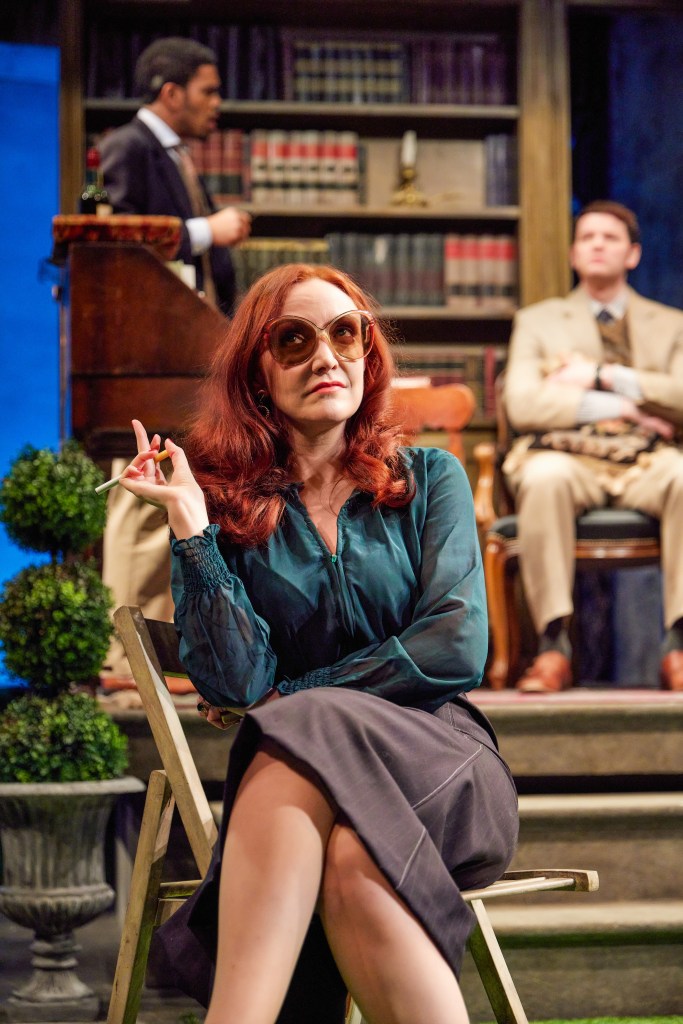
Meg is a depressive on medication who helps around the house, plays classical piano, and plans for her marriage to a man twice her age in the village, a further step down in class status. Desperate to leave, she selects escape with this much older man who has four children. She enjoys teaching piano to them.
Casimir is an individual broken by his father’s tyranny and cruelty. Holcomb’s portrayal of the quirky, strange Casimir is excellent, throughout, but particularly shines when he reveals to Eamon, how Justice O’Donnell’s attitude shattered him. The Justice’s cruel judgments about his only son, are revealed by Casimir toward the conclusion of the play. Ironically, Casimir politely attempts to uplift the family history to Casey’s clear-eyed Huffnung who, tipped off by Eamon, fact checks the details and realizes that Casimir exaggerates with a flourish. Additionally, most of what Casimir shares about his own life is suspect as well, and used to appear “normal,” though he may be gay.
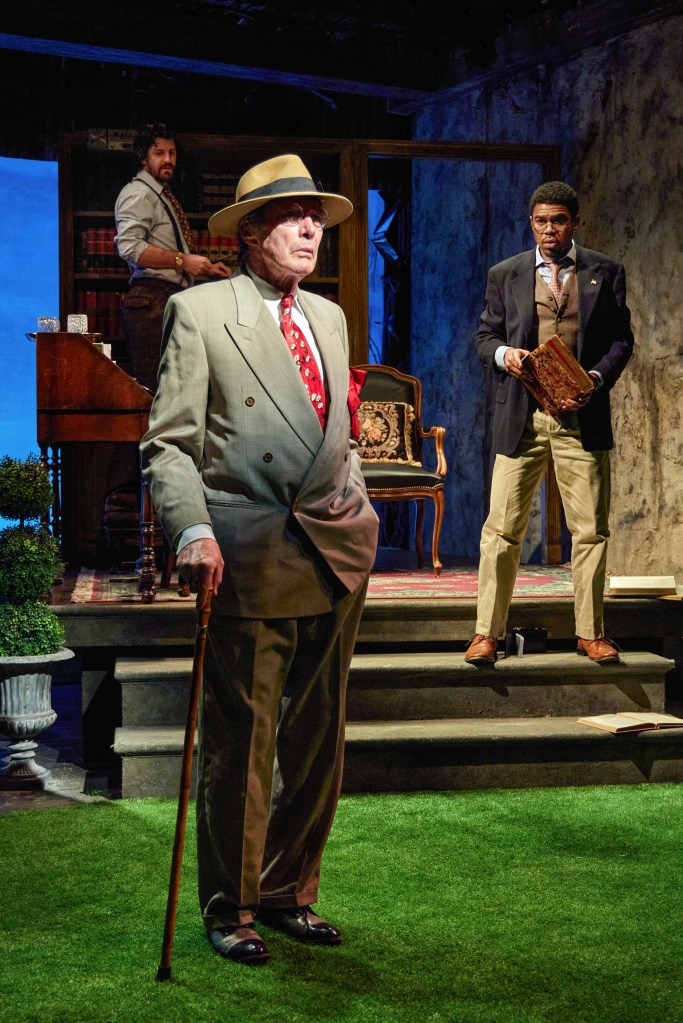
Thus, as Friel unravels the truth about the family, largely through Eamon, we come to realize the term “aristocratic” is a misnomer when applied to them. The noblesse oblige, if it once existed, has declined to mere show. As Casimir attempts to enthrall Huffnung with the celebrated guests who visited the Hall (i.e. Chesterton, Yeats, Hopkins), his claims by the conclusion are empty. In turn Huffnung’s research seems ironic in chronicling the decline of an aristocracy that has self-destructed because it remained isolated and assumed a privileged air, rather than become integrated with the warmth and care of the local Irish Catholics.
The brilliance of Friel’s work and the beautiful direction by Charlotte Moore and work of the ensemble shines in how the gradual expose of this family is accomplished. As the ironies clarify the situation, Friel’s themes indicate how the oppressor class inculcated those who would stoop to their bidding to maintain a destructive power structure which eventually led to their own demise. Of course, Eamon, who is bitter about this, also finds the “aristocracy” enchanting. He wants them to maintain the Great House and not let it go to the “lower class” thugs who will destroy it further, though it is in disrepair and too costly to keep up.

The class subversion is subtle and hidden. What appears to be “emancipation” perhaps isn’t, but is further ruination. How Moore and the creatives reveal this key point is vitally effected.
Thanks to Charlie Corcoran’s scenic design, we note the three levels of the Big House’s interior and exterior where most of the action takes place. David Toser’s costume design is period appropriate. Ryan Rumery & M. Florian Staab’s sound design is adequate. The original music is superb along with Michael Gottlieb’s lighting design. Accordingly, Justice O’Donnell’s entrance is impactful.
This second offering of the Friel Project is a must see. Aristocrats is two acts with one fifteen minute intermission. For tickets go to the Box Office of the Irish Repertory Theatre on 22nd Street between 6th and 7th. Or go online https://irishrep.org/show/2023-2024-season/aristocrats-2/
‘The Whole of Time,’ Explosive Change in an Intimate Space
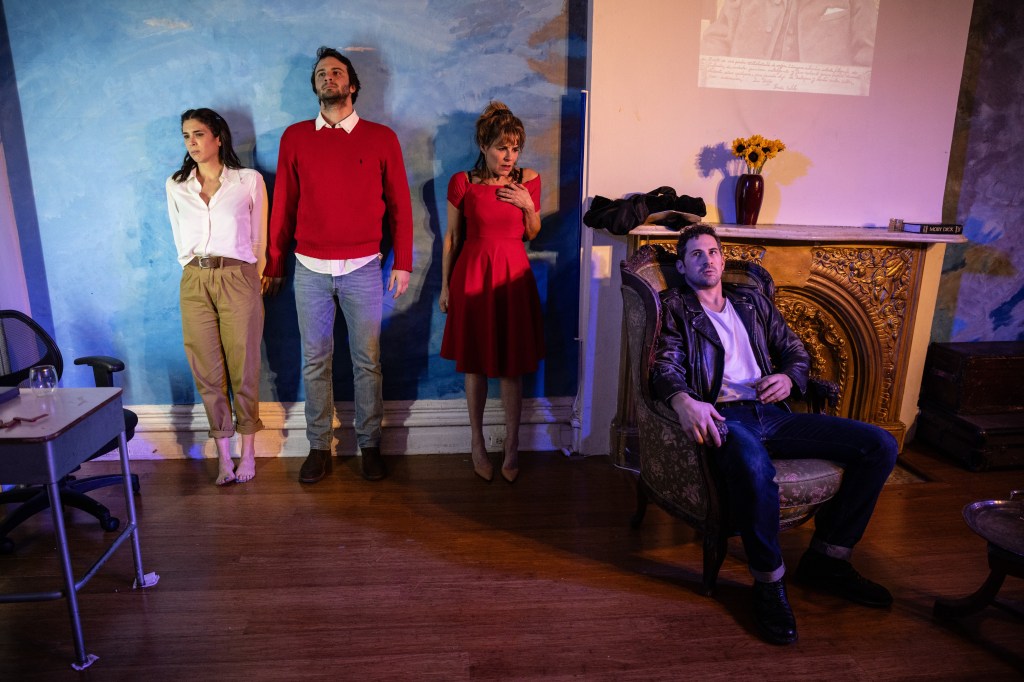
Inspired by Tennessee Williams The Glass Menagerie, the intriguing Off Off Broadway production, The Whole of Time by Argentine playwright Romina Paula challenges one to consider the idea of being whole in oneself. Directed and staged by Tony Torn with scenic backdrops by Donald Gallagher, the 22-seat theatrical space of Torn Page seems the perfect place to present a dramatic work that examines the meaning of insularity, affinity, individuality, and isolation within and without intense relationships.
Torn Page, managed by Tony Torn, is in the home of his late parents, the acclaimed actors Rip Torn and Geraldine Page. The three-story townhouse in Chelsea, its central floor, at the top of a wooden staircase that leads into a bar area and further opens into a roomy space to accommodate actors and audience in close proximity, provides the atmosphere and charm associated with artists, theater and film people. The moment I walked up the stairs and into the theatrical space and seating area, I was excited not only by the building’s history, but also by the production that would unfold intensely for an audience less than 10 feet away.
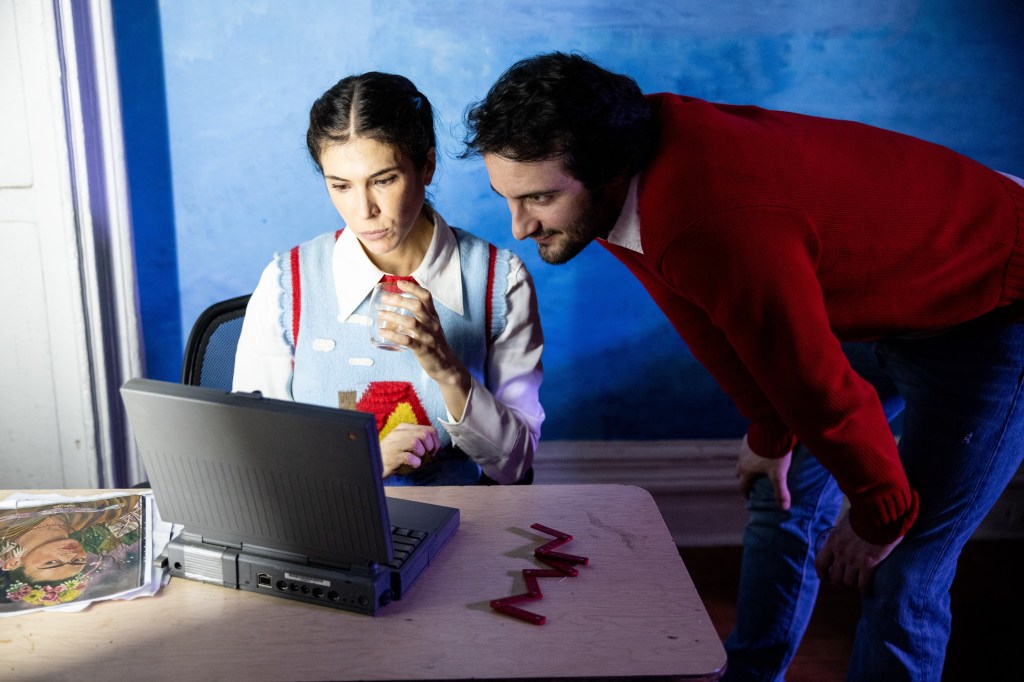
As Paula’s play opens, sister Antonia (Josefina Scaro) and older brother Lorenzo (Lucas Salvagno) enact “Si no te hubieras ido,” (“There’s nothing more difficult than living without you”) by Marco Antonio Solís, the award-winning Mexican singer-songwriter. As Lorenzo passionately sings, Antonia stages him on a chair. A projection of the photo of the singer appears on the wall. A game that they play, Antonia later suggests the singer-songwriter is in jail for murder, a fantasy she constructs to make the interplay between herself and her brother uniquely interesting, as he questions the truth of her assertions.
What is thematic is that the song passionately, romantically uplifts the pain of being separated from one’s lover. Ironically, Antonia alleges that in the case of Solís, the separation is lifelong, for his lover is dead. He killed her himself. Thus, Paula introduces the idea of separation from those one loves with an intriguing sadomasochistic twist: one causes the separation from the beloved, perhaps for the very notion of indulging in a romantic passionate pain of forever longing.
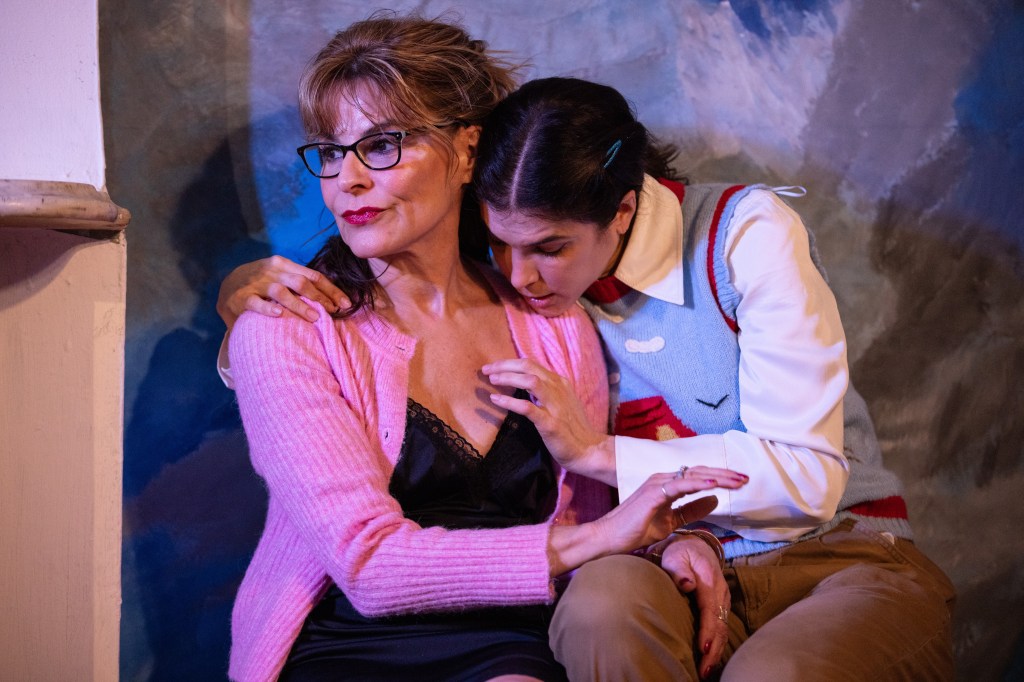
As Lorenzo dresses for a night out with a friend, Antonia asserts fantastic complications about the song which has underlying humor. She says, “Probably in Mexico people forgive or tolerate somebody killing his wife and then selling and making millions of dollars where he sings to the dead woman he misses so much.” Then Antonia continues integrating Frida Kahlo with another fantasy which involves love, death and the pain of loss. Clearly, Antonia’s energy keeps Lorenzo engaged and the nexus of the relationship and emotion between them is far closer than one might anticipate from a brother and sister who otherwise might express sibling rivalry.
However, the object of the rivalry, their mother, Ursula (Ana B. Gabriel), never approaches any level of competition for her children’s affection. Indeed, Antonia bristles at her mother’s insistence she find another path of life rather than to choose to stay at home and not cultivate external social relationships. When Ursula belabors the point, Antonia insists she is happy within herself, and uses her imagination to have experiences, after her mother stumbles at rationalizing Antonia should travel to gain experience.
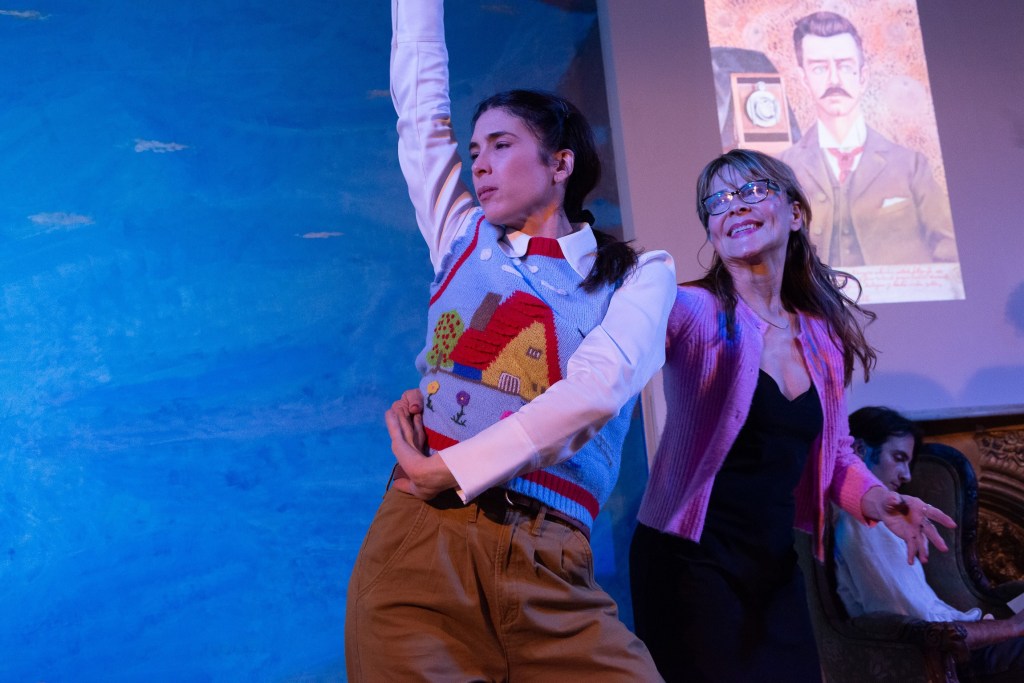
In her characterization of Antonia, Paula has created an ingenious, autonomous, self-aware and satisfied young woman who is confident and self-possessed. Of the characters in the family, somewhat aligned with Tennessee Williams’ Glass Menagerie only in function, Antonia is the least like her counterpart, sister Laura, who is emotionally broken by her physical handicap. Laura’s physical challenges and her mother’s overbearing, imperious presence have suppressed Laura’s voice and her soul. She has been stifled into shyness and withdrawal.
Conversely, in The Whole of Time, Antonia is her own person, whole and assured, happy to stay at home which she does not view as “isolation” or “withdrawal. Antonia tells Maximiliano (Ben Becher), that unlike him, who must have time from work from which he cuts loose, she doesn’t need to. Antonia says, “I don’t need that contrast to cope with time. I cope with all of my time, the whole of my time, nonstop.”

Thus, where Laura avoids the world, where Jim (the Maximiliano counterpart), and Tom (the Lorenzo counterpart), need a release from work and Lorenzo needs freedom from family, Antonia is contented with every second of her life. Clearly, the opening of the play indicates how she creatively uses her imagination to entertain herself and Lorenzo in fantasies of her own making. As long as he goes along with her in an unusual love dynamic which borders on romantic innocence, all is well for her.
In the scene with Maximiliano, change comes. Antonia interacts with him almost romantically dislocating the dynamic she has established with her brother, who interrupts them and ends any expression of love. Ursula further douses any fires between Maximiliano and Antonia by coming in drunk in a strange reversal.

In the usual construct, siblings vie for their parent’s attentions. In this instance, the interfering, fearful Ursula intends to dislodge Antonia’s love for Lorenzo and vice-versa. Thus, she insists at the top of the play that he tell his sister that he intends to leave. When he doesn’t, knowing the impact it will have on Antonia’s fantastic world and their relationship, later in the play Ursula picks the strategic moment when Maximiliano is present. It is then she reveals Lorenzo is separating from her and Ursula.
Though Lorenzo avers about his intentions, Antonia’s loving, intriguing relationship with her brother is severed. If they are to continue, it will be different. They will no longer be “fantasticks.” Ironically, Antonia’s ability to cope in herself with “the whole of time” has been shattered.

Thus, when Ursula is finished, she has exploded Antonia’s world and Lorenzo’s integral part in it. Despite his protestations that he won’t leave, the separation and loss once acknowledged continues. It is only a matter of “time” until Lorenzo leaves for good. Antonia and Ursula dissolve in tears trying to comfort one another as the opening song “There’s nothing more difficult than living without you” brings the play’s themes about insularity and affinity to a full circle of closure, while Maximiliano witnesses the aftermath.
The ensemble work is excellent and the performances are standouts thanks to Torn’s careful staging and specific shepherding of the actors with skill. The play is a fascinating and disparate take on Williams with countervailing themes that are profound. I especially thought the divergence of the proper Jim to the punk rockin’ Maximiliano was an ironic, humorous update. Jay Ryan’s lighting design adds a wilder perspective, then mutes when reality transfers from the fantastic.
There is no poignant narrator. There are no “tricks in his pocket.” Instead, we see a family, unique, undefinable, needing each other, and conversely, with the exception of Antonia, longing for escape. Any hope of independence from each other is as impossible as is the ability of the characters to leave their own interiors. Though they may separate physically, always, there will be the ties, the fantasies, the bonds, shattered, but still palpable with bits of feeling and emotion.
The Whole of Time at Torn Page. 435 W 22nd St., through February 11th. Delight yourself by seeing this production. You can get tickets online at https://www.eventbrite.com/e/the-whole-of-time-tickets-768576010537
T
New York Botanical Garden GLOW and the 32nd Holiday Train Show®
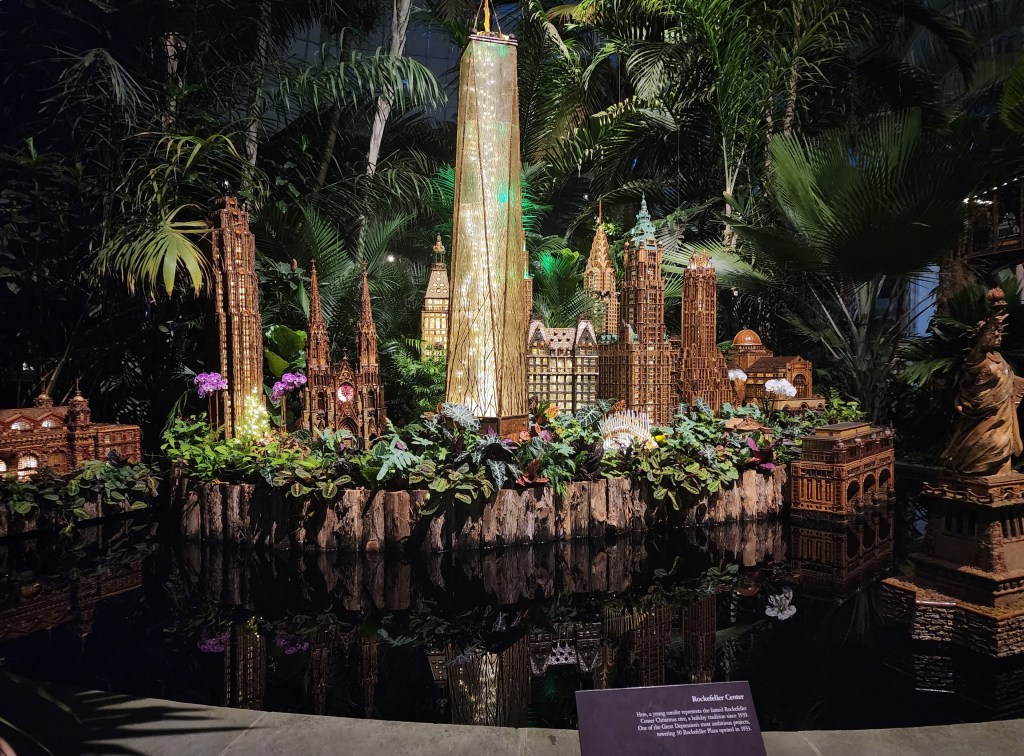

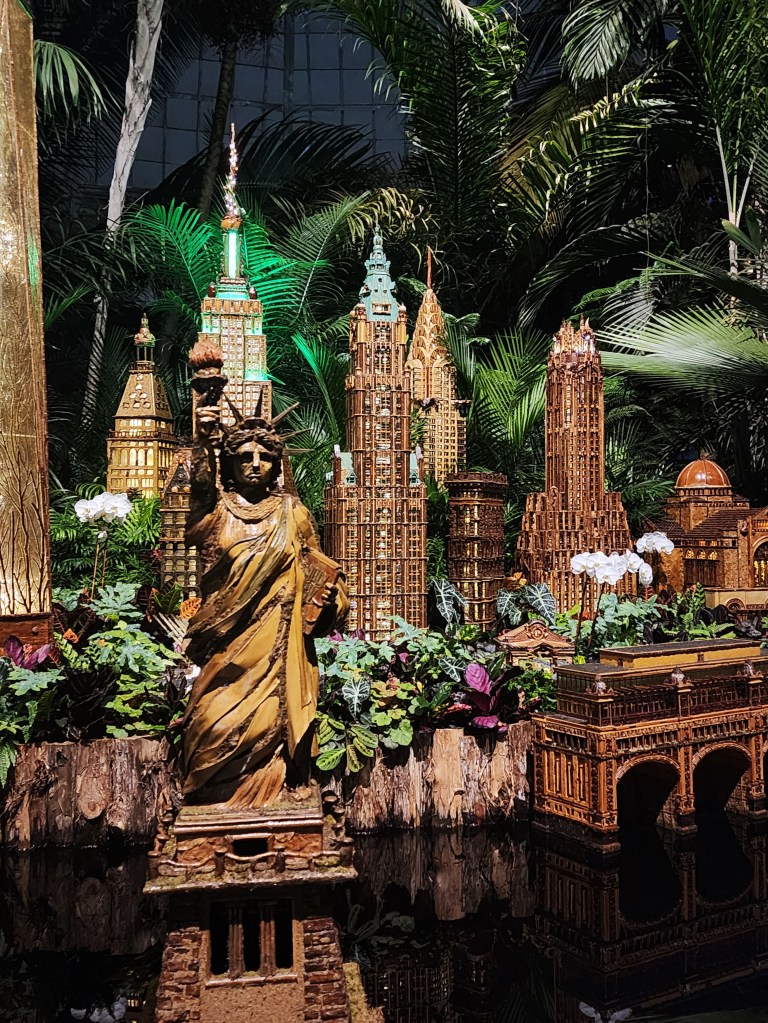
The NYBG Holiday Train Show®returns for its 32nd year. It is a magnificent stirring of the past in recalling the first train shows that were in the outdoor landscape in 1993, created by Applied Imagination’s founder Paul Busse. For more information about Applied Imagination’s collaborations with the NYBG and the artistry and process of Applied Imagination’s botanical spectaculars, click here.
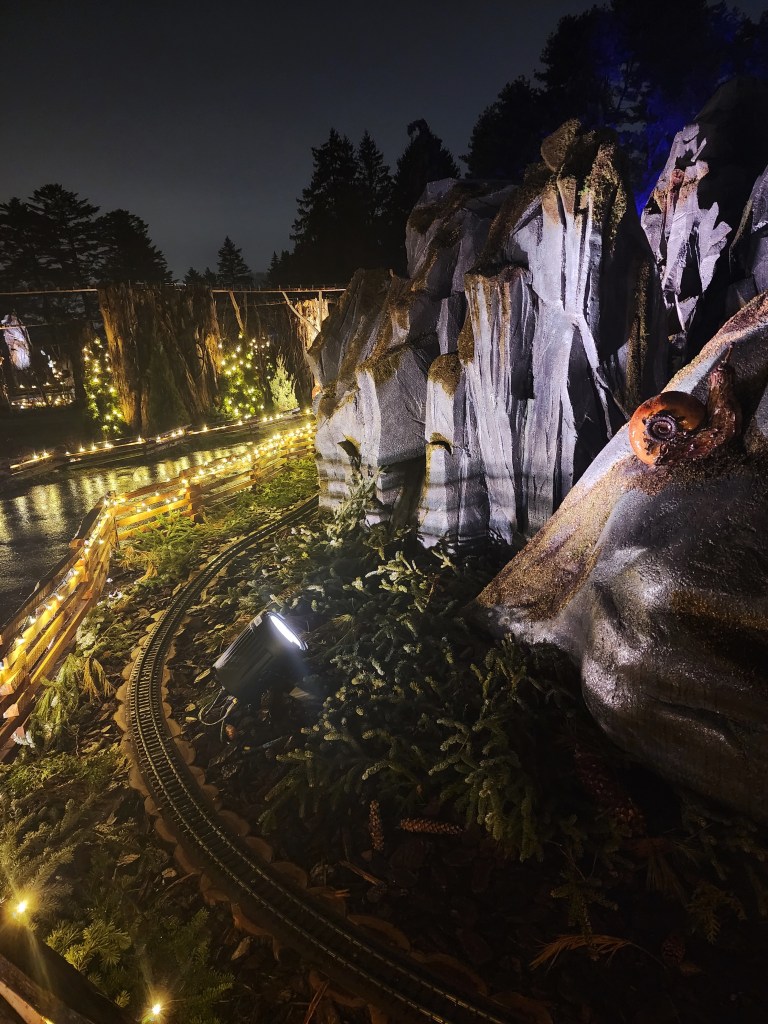
This year’s Train Show is fabulous and bigger than ever with more model trains and an “all-new outdoor display,” that is a magical woodland of fantastic fungi and creatures. Various slow and fast moving trains zip along merrily on raised trestles and around mountain landscapes on the Haupt Conservatory Lawn..
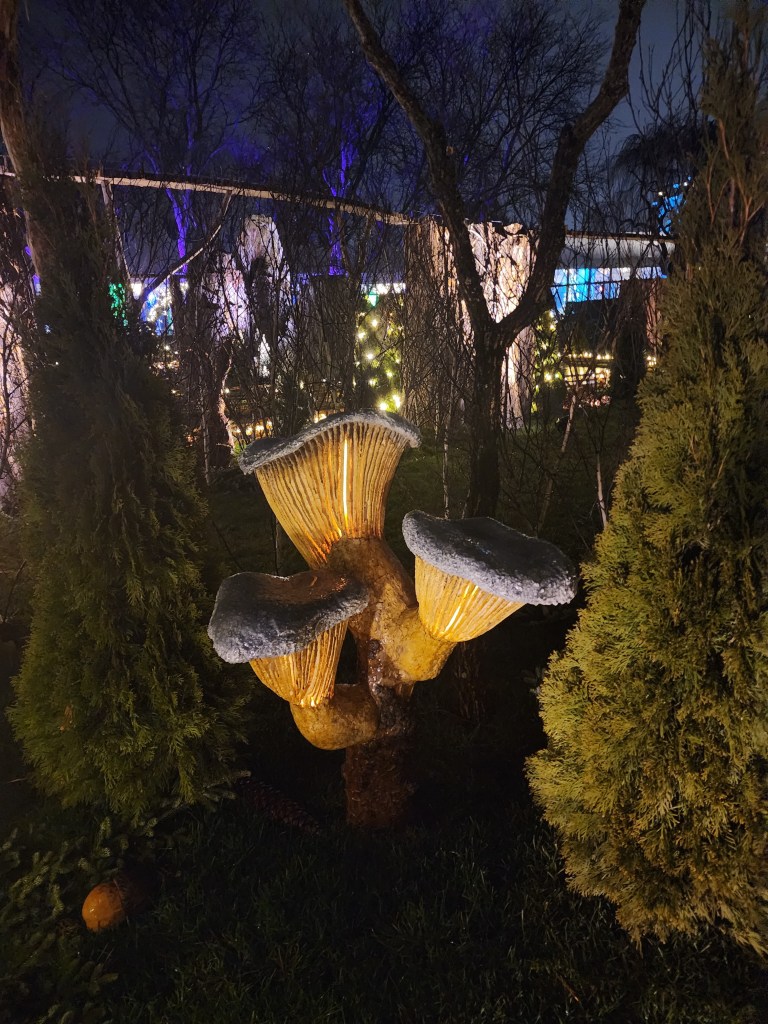
The NYBG Holiday Train Show®runs until Monday, January 15, 2024. For my article on my daytime visit to the Holiday Train Show® click here.
Importantly, On 2 REMAINING SELECT NIGHTS, SATURDAY, JANUARY 6 AND JANUARY 13, Holiday Train Show Visitors of all ages can enjoy NYBG GLOW, the OUTDOOR COLOR AND LIGHT EXPERIENCE, currently in its fourth year. It is just spectacular.


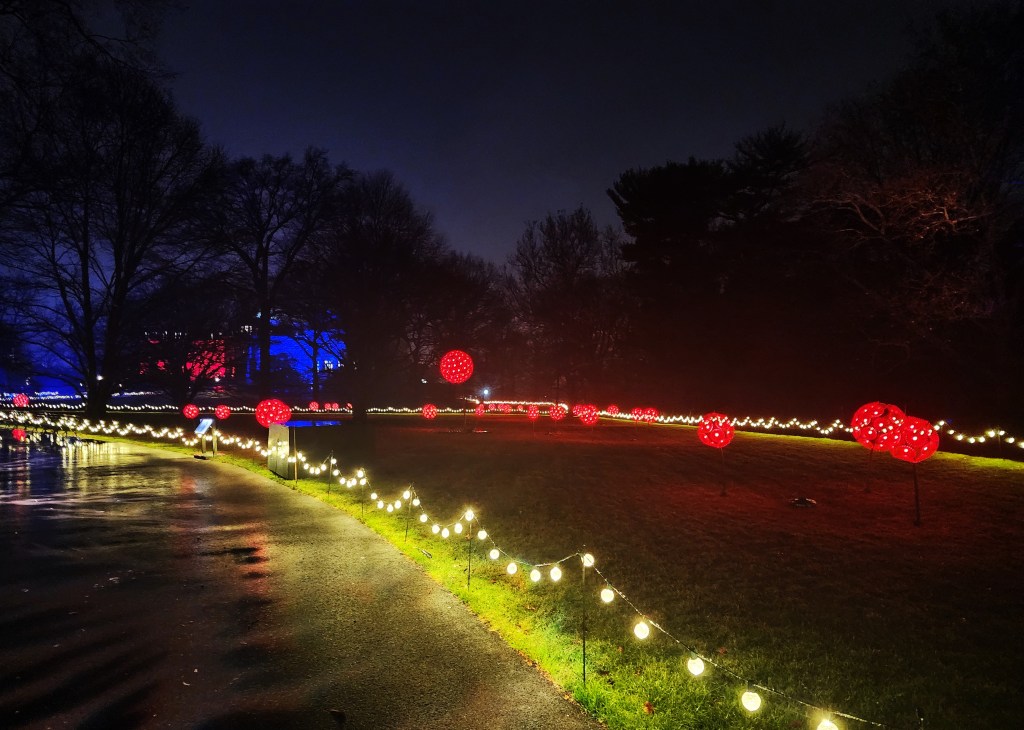

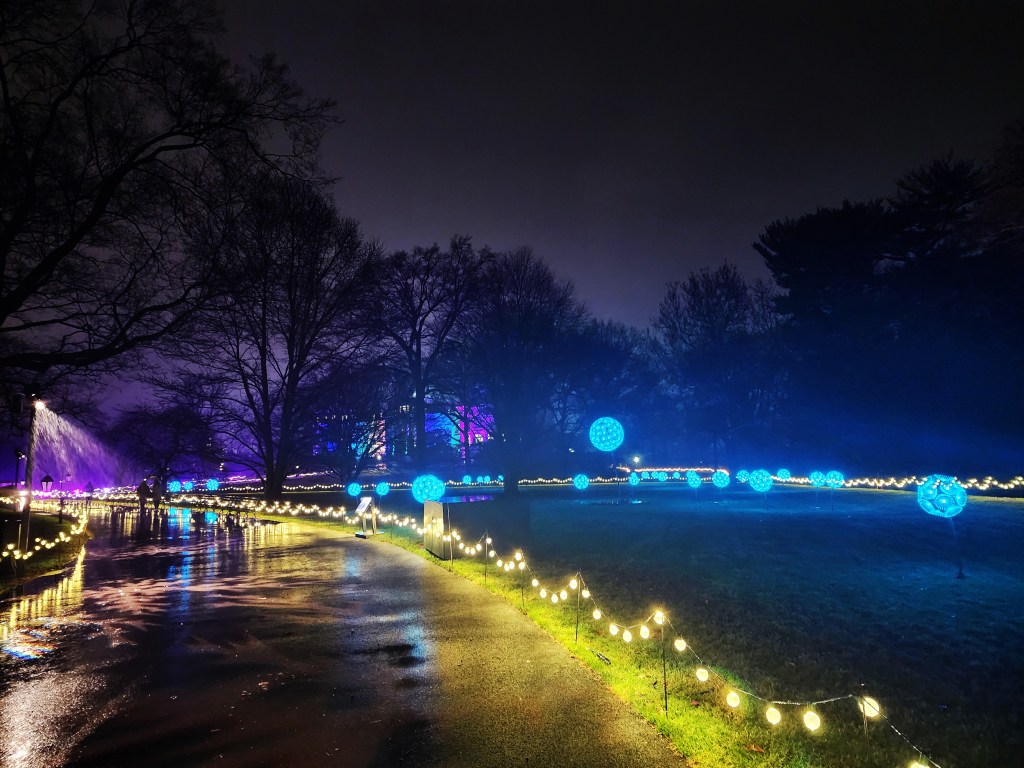
NYBG GLOW will take place from 5 to 10 p.m. on the following dates: Saturday, January 6; and Saturday, January 13, 2024.
Fan-favorite Bar Car Nights, for adults age 21 and over feature adults-only nighttime viewing of the Holiday Train Show and NYBG GLOW. These include light bites and curated beverages available for purchase. Visitors can sip their drinks and feast their eyes on the lighted, imperial beauty of the replicas (i.e. the old Penn Station, Grand Central Station, the Enid A. Haupt Conservatory) that speak of a time past whose like we shall never see again. There is one more Bar Car Night, Friday, January 5, 2024. Tickets are on sale now at nybg.org.

The night I visited, it was warm and misty. The grounds literally glistened with the very light rain and fog. The lights vibrated and as friends and I walked the landscape, the magic of the Garden made the title GLOW resonate with meaning.


Indoors, the Holiday Train Show twinkles with magic. Evenings are more mysterious in the Garden. The foliage seems more lush as the deep shadows suggest hidden secrets. The imagination runs wild as one moves along the walkways, to see an elf peer out from under a palm frond, then vanish in a nano second. Sounds of the train whistles and horns and clackings along the tracks accompany a variety of engines and cars, from passenger trains, to freights, to diesels to locomotives, trolley cars and whimsical fantastics (a bee car) buzzing along.

I enjoy catching glimpses of the trains jetting underneath the greenery and chugging past the beautifully crafted replicas of landmarks and iconic buildings from each of New York City’s five boroughs, as well as surrounding counties, i.e., Orange, Westchester and Columbia to name a few.
Thanks to artisans at Applied Imagination, currently run by Laura Busse Dolan, daughter of Paul Busse, who founded the show, the amazing, miniature landmarks are created from a myriad of plant parts, for example, artichoke leaves, seed parts, pistachio shells, walnuts, acorns, pine cones, tree bark, twigs, numerous leaves from plants, ranging from hedges to trees, a variety of gourds, pomegranates, etc.
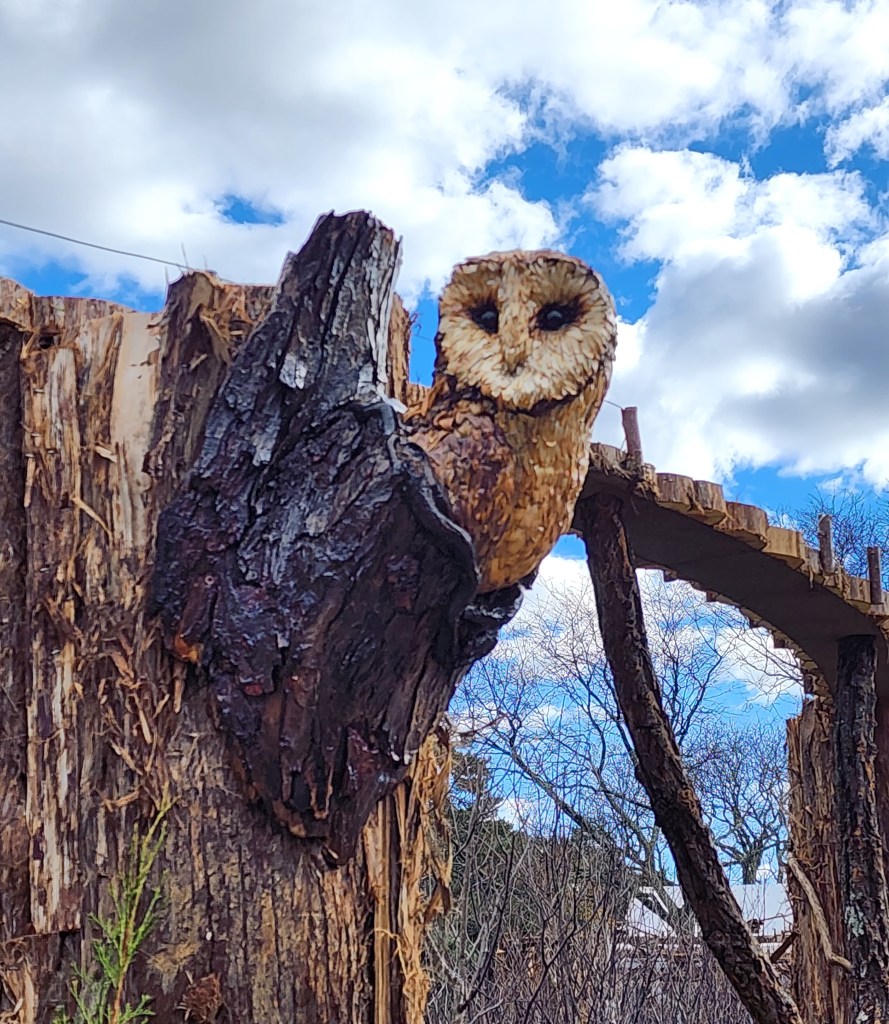
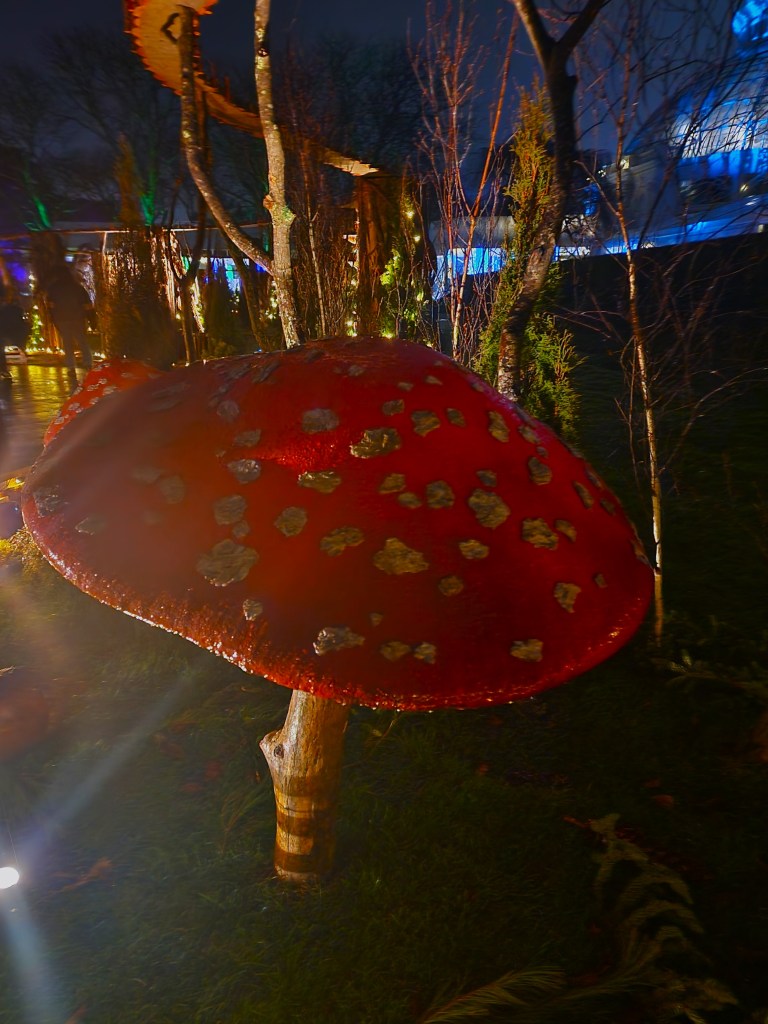
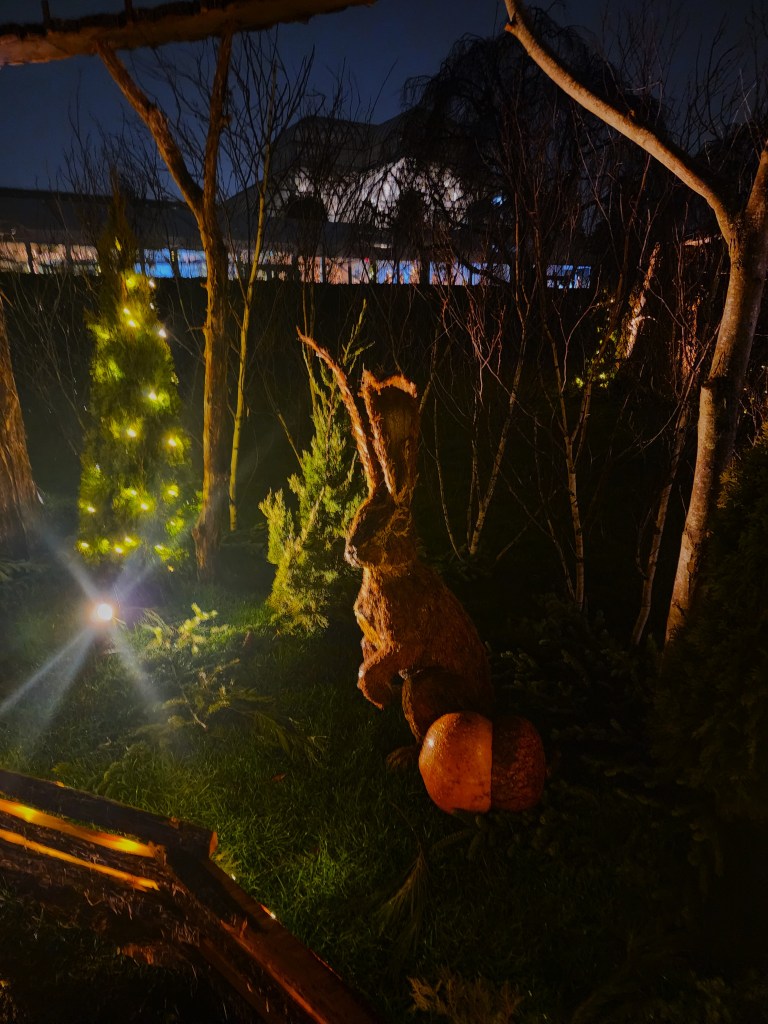
In the outdoor landscape, the toadstools and fungi that appear to be ceramic and plucked out of a Disney animation are actually carved wood finely shaped, shaved and smoothed, then painted cheerfully to shine a glossy surface. The detail of the fungi is mind-boggling and realistic. One can spend an hour taking in the near atomized work of the craftspeople whose creations are at the quality level of art. Look for animals, snails, the owl (made of artichokes) and other woodland creatures.
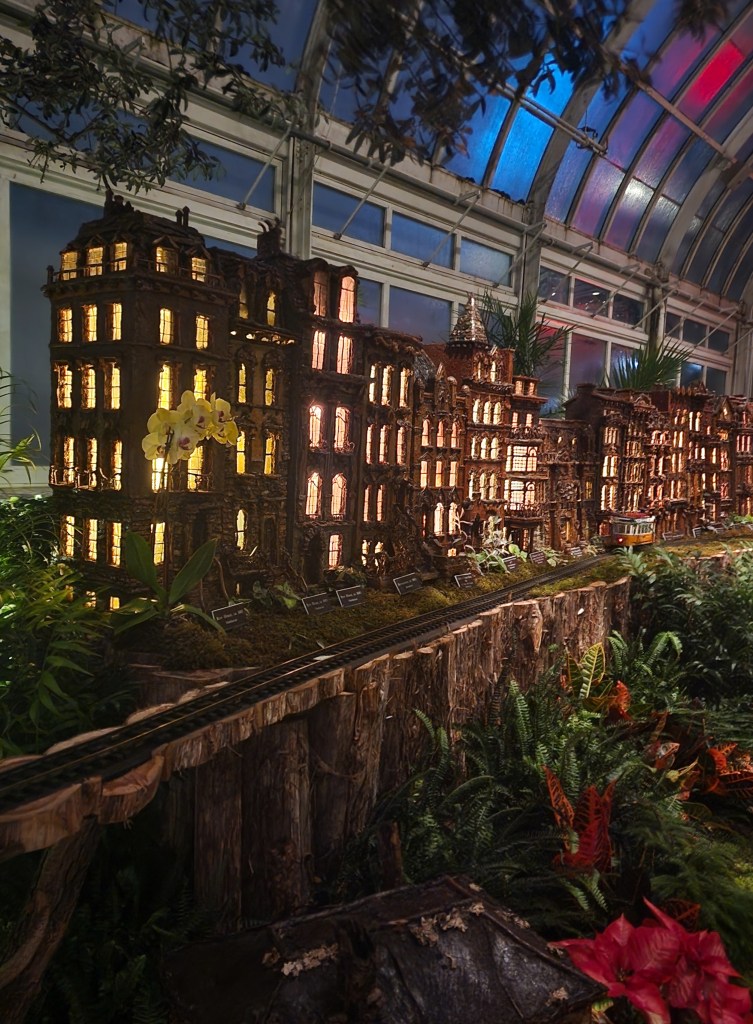

Indoors, some of the replicas I always look for include Clarke’s folly, a majestic Gilded Age mansion that was too costly to maintain and was torn down within a decade of its being finished.

The phenomenal row houses of New York City shine their lights in all their glory. I imagine living in one of the brownstone replicas that could easily fit into Edith Wharton’s New York City so cleverly portrayed in Age of Innocence. And another favorite is Poe Cottage. Every time I see it in the Train Show, I vow I must visit it. It is near the Garden in the Bronx.

The exhibit includes signage that explores the plants used to create the miniatures. It bears reading how the various parts are used to create structures like finials, roofs, portals, arches, bricks, mortar that visually look just like their counterparts. To an artisan at Applied Imagination, a pistachio shell might be the perfect part to complete a statue. In fact look for the pistachio shells on the angelic figures of the Kykuit replica (on the Rockefeller Estate) housed between the 360 degree display of Coney Island and Grand Central Station, and the doorway to the Enid A. Haupt Conservatory interior.


You won’t want to miss this years botanical theater of GLOW and the Holiday Train Show.® The exhibit’s wonder will cheer you up and resettle you into the joy of new beginnings in a new year.
For tickets to the Train Show and GLOW, click on the link.
‘The Night of the Iguana,’ Theater Review
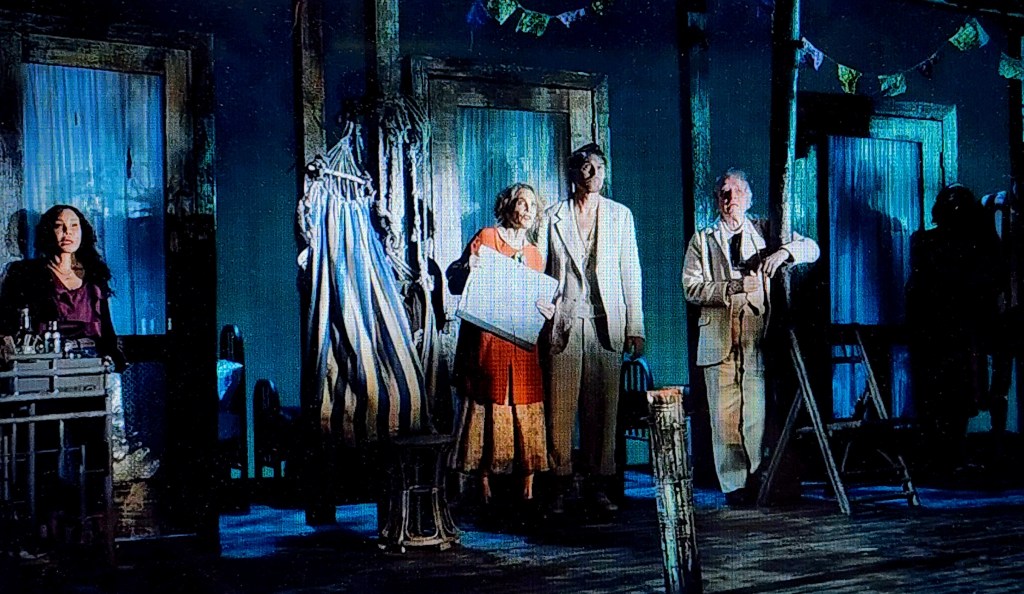
The Night of the Iguana is one of Williams most poetic and lyrical plays with dialogue that touches upon the spiritual and philosophical. On the one hand in Iguana, Williams’ characters are amongst the most broken, isolated and self-destructive of his plays. On the other hand, in their humor, passions and rages, they are among the most identifiable and human. La Femme Theatre Productions’ revival of The Night of the Iguana, directed by Emily Mann, currently at the Pershing Square Signature Center until the 25 of February, expresses many of these elements in a production that is incompletely realized.
The revival, the fourth in 27 years, and sixty-one years after its Broadway premiere, reveals the stickiness of presenting a lengthy, talky play in an age of TikTok, when the average individual’s attention span is about two minutes. Taking that into consideration, Mann tackles Williams’ classic as best as possible with her talented creative team. At times she appears to labor under the task and doesn’t always strike interest with the characters, who otherwise are hell bent on destruction or redemption, and if explored and articulated, are full of dramatic tension and fire.
Beowulf Boritt’s scenic design of the off-kilter, ramshackle inn in the tropical oasis of 1940s Costa Verde, Puerto Barrio, Mexico, and Jeff Croiter’s fine, atmospheric lighting and superbly pageanted sky are the stylized setting where Williams’ broken individuals slide in and out of reality, as they look for respite and a miracle that doesn’t come in the form that they wish. With the period costumes (exception Maxine’s jeans) by Jennifer Von Mayrhauser), we note the best these characters can hope for is a midnight swim in the ocean to distract themselves from their inner turmoil, depression, loneliness, DT’s and brain fever/ The latter are evidence of addiction recoiling, experienced by the play’s anti-hero, “reforming” alcoholic Reverend T. Lawrence Shannon (Tim Daly).

One of the issues in this revival is that the humor, difficult to land with unforced, organic aplomb is missing. At times, the tone is lugubrious. This is so with regard to Tim Daly’s Reverend Shannon, in the scene where he expresses fury with the church in Virginia that locked him out, etc. If done with “righteous indignation,” his rant, with Hannah Jelkes (Jean Lichty), as his “straight person,” could be funny as her response to him elucidates the psychology of what is really going on with the good reverend. It would then be clearer that Shannon is misplaced and just can’t admit he loathes himself and agrees with his congregants who see him as one who despises them and God, an irony. Indeed, is it any wonder they see fit to lock him out of their church?
The ironies, his indignation and Hannah’s droll response are comical and also identify Shannon’s weaknesses and humanity. Unfortunately, the scene loses potency without the balance of humor. Shannon is a fraud to himself and he can’t get out of his own way. Is this a tragedy? If he didn’t realize he was a fraud, it would be. However, he does, thus, Williams’ play should be leading toward a well deserved redemption because of the underlying humor and Shannon’s acceptance that his life is worth saving. In this revival, the redemption merely happens without moment, and the audience remains untouched by it, though impressed that Tim Daly is onstage for most of the play.
The arc of development moves slowly with a few turning points that create the forward momentum toward the conclusion, when Shannon frees an iguana chained at its neck so it won’t be eaten (a metaphor for the wild Shannon that society would destroy). The iguana is released, yet the impact is diminished because the build up is incompletely realized. Little dramatic immediacy occurs between the iguana’s release into freedom and the initial event when Daly’s quaking Reverend Shannon struggles up the walkway of Maxine’s hotel. Daphne Rubin-Vega’s Maxine Faulk and her husband Fred have previously offered escape for Shannon. Now, at the end of nowhere, he goes there to flee the condemnation and oppression meted out by the Texas Baptist ladies he is tour guiding, This slow arc is an obstacle in the play that is difficult to overcome for any director and cast.
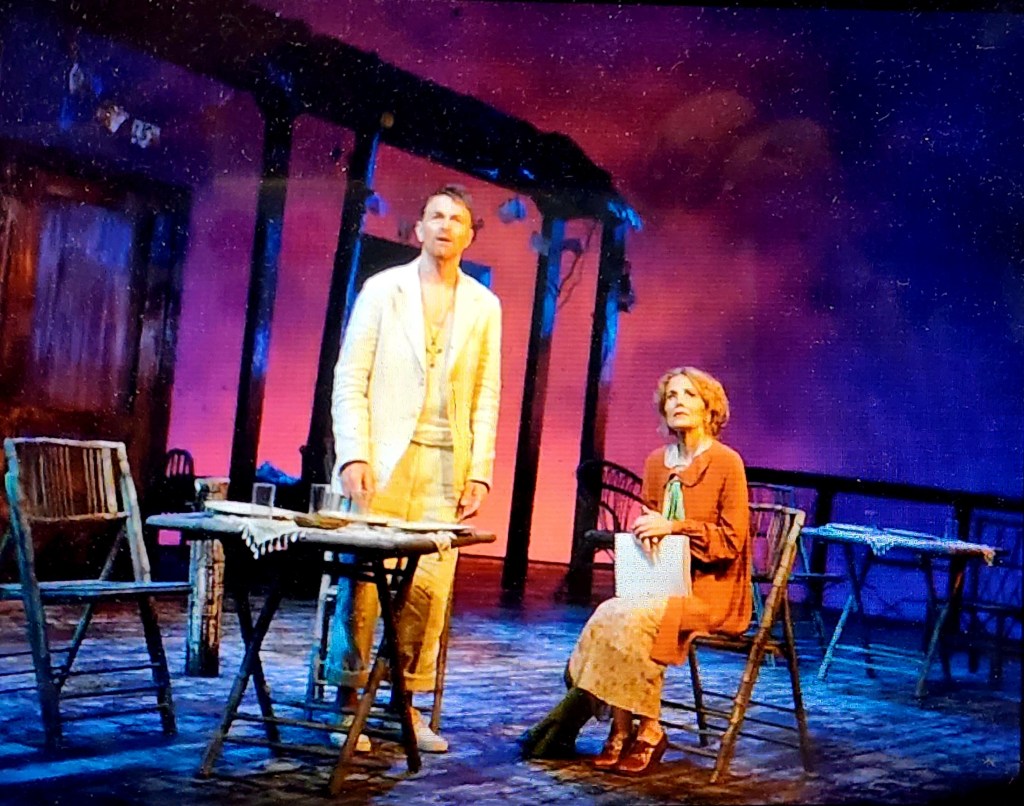
In the Act I exposition, we learn that Shannon’s job of last resort as ersatz tour guide has dead-ended him in a final fall from grace. He is soul wrecked and drained after he succumbs to seventeen-year-old Charlotte Goodall’s sexual advances in a weak moment, while “leading” the ladies through what appears to be paradise (an irony). However, their carping has made the Mexican setting’s loveliness anything but for the withering, white-suited Shannon, who was moved toward dalliances with Carmen Berkeley’s underage nymphet. Whether culturally imposed or self-imposed, prohibition always fails. Ironically, clerical prohibitions (alcoholism, trysts with women), are the spur which lures Shannon to self-destruction.
Already a has-been as a defrocked minister when we meet him, Shannon is hounded by the termagant-in-chief, Miss Judith Fellowes (Lea Delaria), who eventually has him fired. He has no defense for his untoward behavior, nor explanation for his actions, when he diverts the tour, and like a foundering fish gasping for air, flops into the hammock at Maxine’s shabby hotel. There, he discovers that her husband Fred has passed. In her own grieving, desire-driven panic, Rubin-Vega’s Maxine welcomes Shannon as a fine replacement for Fred.
It is an unappealing and frightening offer for Shannon, who views Maxine as a devourer, too sexual a woman, who takes swims in the ocean with her cabana boy servants to cool off the heat of her lusts. Shannon prefers her previous function in her collaboration with Fred, when her protective husband was alive enough to throw Shannon on the wagon, so he could prepare for his next alcoholic fall off of it.
While the appalled Baptist ladies remain offstage, honking the horn on the bus to alert Shannon to leave, and refusing to come up to Maxine’s hotel to refresh themselves, Shannon makes himself comfortable. So do spinster, sketch artist and hustler Hannah (Jean Lichty is less ethereal than the role requires), and her Nonno, the self-proclaimed poet of renown, Jonathan Coffin (Austin Pendleton moves between endearing and sometimes humorous as her 97-year-old grandfather).

Oozing financial desperation from every pore, the genteel pair have been turned away from area hotels. As Hannah gives Maxine their “resume,” the astute owner sniffs out their destitution and is about to show them the door, when the down-and-out Shannon pleads mercy, and Maxine relents. Her kindness earns her chits from Shannon that she will capitalize on in the future. Maxine knows she won’t see a dime from Hannah or her grandfather, whether or not Nonno dramatically discovers the right phrasing and imagery to finish his final poem at her hotel, and earns some money reciting it to pay their bill.
Though the wild and edgy Maxine allows them to stay, she “reads the riot act” to Hannah, suggesting she curtail her designs on the defrocked minister. If Hannah doesn’t go after Shannon, she and her grandfather might stay longer. However, the tension and build up between Maxine and Hannah never fire up to the extent they might have.
To what end does the play develop? Explosions do erupt. Maxine vs. Shannon, and Shannon vs. Miss Judith Fellowes create imbroglios, though they subside like waves on the beach minutes after, as if nothing happened. Only when tour replacement Jake Latta (Keith Randolph Smith), confronts Shannon for the keys to the bus, must Shannon reckon with one who enforces power over him. Neither Maxine, nor her cabana boys, nor Hannah, nor Fellowes can bend Shannon’s will to his knees. Jake Latta’s reality rules the day.

As the bus leaves and his life blows up, Shannon must face himself and end it or begin anew. In the scene between Daly’s Shannon and Lichty’s Hannah after Shannon is tied up in the hammock to keep him from suicide, there is a break through. Daly and Lichty illuminate their characters. Together they create the connection that opens the floodgates of revelation between Shannon and Hannah in the strongest moments of the production. When Nonno finishes his poem and expires, the coda is placed upon the characters who have come to the end of themselves and their self-deceptions. Life goes on, as Shannon has found his place with Maxine who will help him begin again, free as the iguana he set loose. Perhaps.
Williams’ characters are beautifully drawn with pathos, humor, passion and hope. If unrealized theatrically and dramatically, they remain inert, and the audience doesn’t relate or feel the parallels between the universal themes Williams reveals, or the characters’ sub text he presents. Mann’s revival makes a valiant attempt toward that end, but doesn’t quite get there.
For those unfamiliar with the other Iguana revivals or the John Huston film starring Richard Burton and Ava Gardner, this production should be given a look see to become acquainted with this classic. In this revival, there are standouts like Daphne Rubin-Vega as the edgy, sirenesque Maxine, and Pendleton’s Nonno, who manages to be funny when he forgets himself and asks about “the take” that Hannah collected. Lea Delaria is LOL when she is not pushing for humor. So are the German Nazi guests (Michael Leigh Cook, Alena Acker), when they are not looking for laughs or attempting to arouse disgust. That Williams includes such characters hints at the danger of fascist strictures and beliefs, that like the Baptist ladies follow, threaten free thinking beings (iguanas) everywhere.
Humor is everpresent in The Night of the Iguana‘s sub text. However, it is elusive in this revival which siphons out that humanity, sometimes tone deaf to the inherent love with which Williams has drawn these characters. Jean Lichty’s Hannah, periodically one-note, misses the character’s irony in the subtle thrust and parry with Tim Daly’s humorless, angry and complaining Reverend T. Lawrence Shannon. Daly’s panic and shakiness work when he attempts to hide the effects of his alcoholic withdrawal. Both Lichty and Daly are in and out, not quite clearly rendering Williams’ lyricism so that it is palpable, heartfelt and shattering in its build-up to the significance of Shannon’s symbolically freeing himself and the iguana.
The Night of the Iguana with one intermission at The Pershing Square Signature Center on 42nd Street between 9th and 10th until February 25th. https://iguanaplaynyc.com/
‘Buena Vista Social Club™’ is Phenomenal, Theater Review

If you are a world music lover, you don’t need any introduction to the “Buena Vista Social Club,” a group of Cuban musicians that Cuban producer and musician Juan De Marcos González, brought together in a recording studio in Cuba to eventually release an album in 1997. González is to be credited for his passion to capture the striking beauty and spirit of traditional Afro-Cuban music of the Buena Vista Social Club, while some of the members were still alive and able to perform and record in 1996.
Surprising everyone, the Buena Vista Social Club musicians, who had been a hit in the 1950s and disappeared after the Cuban Revolution, created a smoking hot album in 1997 that won a Grammy in 1998. Subsequently, they were the subject of the documentary initiated by musician/songwriter Ry Cooder and filmed by Wim Wenders, that rocked the BVSC into the stratosphere of global fame by 2000, when the documentary was nominated for an Academy Award.
The Atlantic Theater Company’s musical, Buena Vista Social Club™ is based on the titular documentary with references to Buena Vista Social Club: Adios, a second documentary filmed in 2016. The superb musical, directed by Saheem Ali (Fat Ham), has as its creative consultant David Yazbek (The Band’s Visit). With book by Marco Ramirez and music by the Grammy Award winners known as the Buena Vista Social Club, the production currently runs with the ebullient magnificence of songs, brilliant tonal hues, dances and movements at the Linda Gross Theater with one intermission until 21st of January. The Buena Vista Social Club™ is a touch of paradise with Afro-Cuban rhythms and sonority that are unforgettable.
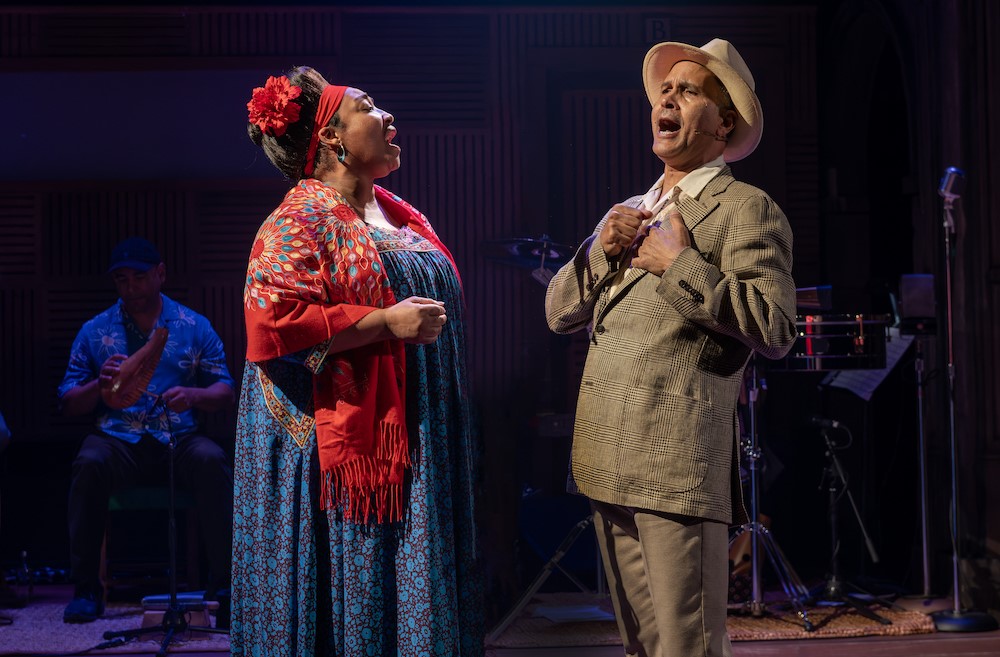
When you see it, and you must, you will not be able to sit still. The music fills you with its joyous power and heartfelt beauty. The production which extends beyond the crass label of “jukebox musicals” gives a reverential bow to the album, the documentaries and importantly, the magnificent musicians and singers who were vaulted to a success they had never known when they started out.
The production, loosely narrated by Juan De Marcos (Luis Vega), boasts a song list that is steeped in the incredible social club’s rhythms and cadences that spiritually manifest the history and diversity of the Cuban people. At the opening, De Marcos, who stands in Egrem Studios-the Old Havana music studio where musicians in the 1990s still record states, “A sound like this, it tends to travel.” His prophetic remarks reference how Buena Vista Social Club’s songs resonated and still resonate throughout the world today, even though most of the original members of the BVSC have passed. Only Omara Portuondo, the National treasure of Cuba, still sings and tours.
The key to opening the lock on the social club that dissolved with all the social clubs that Castro disbanded to end discrimination in Cuban society is Omara Portuondo. As the musical indicates, her notoriety and fame in Cuba allows her to serve as the bridge between the traditional musicians no longer heard and herself who is very much in the Cuban music scene in the 1990s and today.
Thus, the musical focuses on Omara and flashes back and forth from the past to the present in recounting her history with the BVSC, as well as introducing the members, and revealing how they were a part of the popular social club in a Cuba whose segregated clubs prevented various groups from singing and dancing together. The musical’s arc of development unspools as De Marcos attempts to interest Omara in making a recording of the musicians from long ago, who are still alive to keep the torch of Cuban folk music vibrating and lighting the way for musicians and fans of a younger generation.
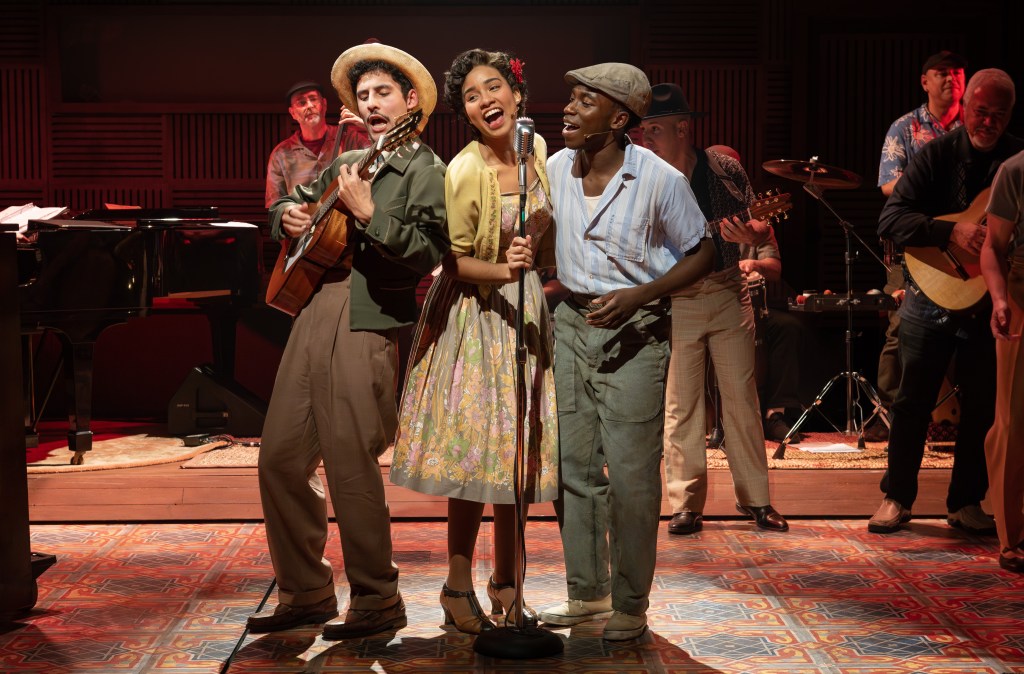
Initially, when Vega’s, De Marcos approaches her, Omara (Natalie Venetia Belcon), is not interested because she doesn’t sing with a live band anymore. Her attitude is cold, aloof and proud, but later, we discover this hard shell fronts for deep pain underneath, concerning her alienation from her sister and niece because of the Revolution and the US embargo barring any exchange of visitors between the two countries. Recording the album would bring up tenuous memories. However, her dismissal of De Marcos on the surface appears to be because she is famous and he is an unknown, who intends to exploit her beloved renown for his own purposes.
Cleverly, De Marcos plays one of her old recordings with the BVSC. Only then, reflecting back to the past, does she relent and give her stipulations for the recording. First, she must be the voice that’s front and center, as De Marcos writes the arrangements. Second, she must be in control to select the singers and musicians. Thus begins the process, conveyed with humor and pathos, that Omara and De Marcos use to bring back the members of the BVSC, so that they are able to record together and reestablish the vitality, importance and universality of Afro-Cuban music, making them a global phenomenon.
The musical is an important tribute to revitalizing how the BVSC Afro-Cuban stars were incredible singers and musicians. It also intimates in the flashbacks and lovely balletic dances featuring the Young Omara (Kenya Browne), and her sister Haydee (Danaya Esperanza), the historical, social schemata of a diversely segregated Cuba, referencing its importance in the Slave Trade, the divisions between the rich and the poor, as well as Castro’s plan to bring equality to the country that backfired and instead created a hell and misery for the Cuban people. This was especially so after the revolution and the flight of wealthy Cubans and middle class off the island.

As is pointed out as a major theme, which indicates the segregation still is manifest concerning Cuba, the division became forever known as “the ones who stayed” and braved out the situation in their mother country, and the “ones who left” and went to various parts of the United States and elsewhere.
Crucially, Omara is an important symbol of transition and the voice and the bridge between the rich and the poor, the socially upscale strata of Cuban society, and the segregated, representing the traditional Cuba with which all Cubans can identify, if they put their prejudices away. Indeed, in this musical, the character of Omara magnifies the best of Cuban culture. She recalls the past and weds it to the present, in the tears and pain of the loss of family and her sister Haydee, who died before she was ever able to see her again. Because Omara was already famous, she was able to negotiate travel as she employed her talents on tour. This mobility was not possible for the other BVSC musicians who were not as famous, and lived under the oppression of segregation and poverty before and ironically, after, in Castro’s Cuba.
Obviously, the ones like Omara who had mobility or the thousands of others who left, had some money to establish themselves elsewhere, even though they lost their lands and businesses to Castro’s “communistic” usurpation. It is a wealth Castro didn’t share with the Cubans who stayed, reminiscent of Vladimir Putin’s behavior toward the Russian people in today’s Russia. Like a predominance of the Russian society, the Cubans who stayed were impoverished and the musical references that during the “Special Period” when the dissolved U.S.S.R. split up, there was no longer any “communistic” aid to Cuba. Thus, the people starved.
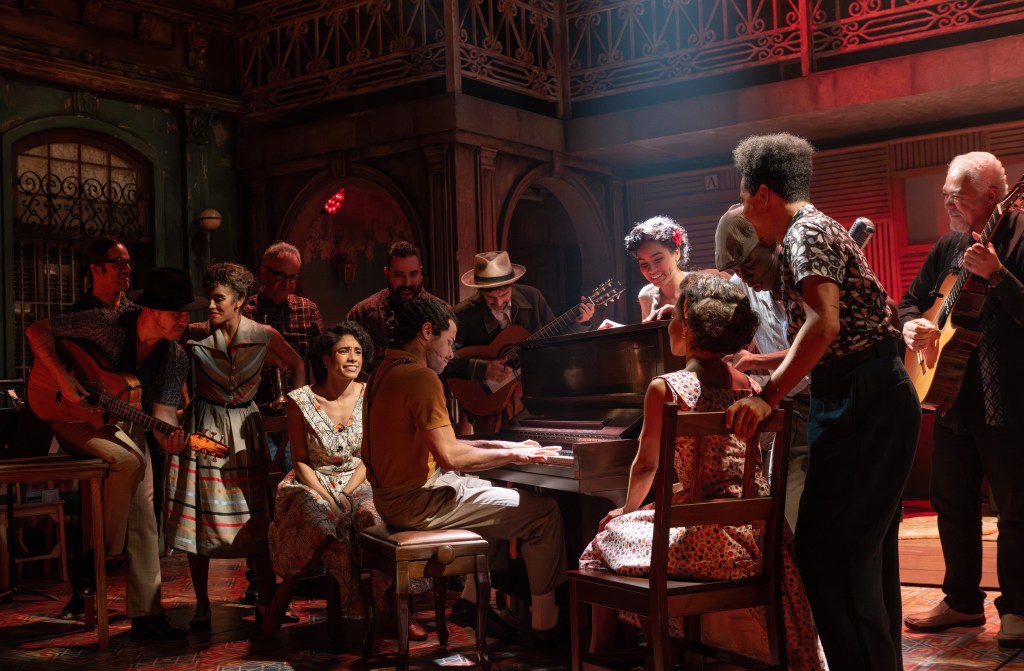
The hope of recording an album with BVSC members was to earn a bit of money, as many of the musicians and singers we meet and learn about in their relationships to Omara and the club were barely scraping by from day to day. During the production we meet the incredible individuals who Omara was close to and sang with in the 1950s when they were young and in 1996 during the recording. These include the charming, funny Compay (Julio Monge), the sweet, loving Ibrahim (Mel Seme), the wonderful pianist Ruben (Jaindardo Batista Sterling) and Eliades (Renesito Avich).
The seminal moments of the production however, meld the present to the past, revealing how Omara connected with each of the BVSC members in the flashbacks with the Young Omara and the Young Haydee. The musicians/singers include the Young Compay (Jared Machado), the Young Ibrahim (Olly Sholotan), and the Young Ruben (Leonardo Reyna).
The balletic sequences with dancers portraying the Young Omara and Young Haydee, choreographed by Patricia Delgado and Justin Peck, developed and directed by Saheem Ali. These sequences seamlessly and stylistically reveal the differences in opinions between the sisters, regarding the BVSC which Haydee feels is beneath her. Also revealed in these flashback dance sequences, is Omara’s sadness in losing her sister and family forever because of the Revolution and US Embargo. As Belcon’s Omara sings of her feelings, the poignance of her expressiveness resonates with all Cubans and punctuates the cruel punishment visited upon the people by both governments, revealing the malevolence of political machinations. However, it is in the power of the songs that the Cuban people thrive and with dignity transcend the brutality.
The BVSC playlist is sung in the native tongue of the BVSC, and on one level doesn’t need translation because the music “speaks” for itself. However, the musical’s closed captions in Spanish, should also have had an English counterpart. In English, the lyrics can relate the historical culture of the Cuban people which is referenced throughout in the English dialogue and storyline. English closed caption lyrics, as well as Spanish, would convey the complete picture of the BVSC and its tremendous importance socially, politically (their democratic diversity should not be diminished), and spiritually.
The BVSC’s immutable human values conveyed in their incredibly poignant rhythms and music is what resonates and draws in fans globally in an egalitarian message that makes sense and that most human beings yearn for. Politics and the power hungry divide to conquer. The music of the people soars, uplifts, transcends hardship and unifies. This production’s value is priceless and the ensemble of musicians and singers are fabulous in memorializing the Buena Vista Social Club for all time.
The creative team brings the director’s vision together in a beautifully stylized way that breathes life into the real musicians and singers who made up the BVSC (1950s, 1996). These creatives include Arnulfo Maldonado (sets), Dede Ayite (costumes), Tyler Micoleau (lighting), Jonathan Deans (sound), J. Jared Janas (hair, wigs & makeup), Dean Sharenow (music supervisor), Marco Paguia (music director, orchestrations & arrangements), Javier Diaz, David Oquendo (additional arrangements), the swings and band.
The company of Buena Vista Social Club™, Atlantic Theater Company, 20th Street between 8th and 9th. https://atlantictheater.org/production/buena-vista-social-club/
 CAROLE DI TOSTI