‘Elyria,’ by Deepa Purohit, a Gujarati Diaspora in Ohio, Review

The gorgeously vibrant sarees and salwar kameez take center stage as the characters spin and move exotically to traditional garba music. This is a festival celebration by Gujarati diasporans and other Indians who have found their way to Elyria, Ohio by 1982, the setting of the the titular play by Deepa Purohit. Currently in its World Premere at the Atlantic Theater Company’s Off Broadway Linda Gross Theater until March 19th, Elyria is incisively directed by Awoye Timpo and runs with one intermission. .
At its most powerful, Elyria captures the cultural nuances and shifting values gradually shaping the diasporans as they migrate from Kenya to London to Elyria. Through stylization and minimal, almost expressionistic set design, the play’s central tenet, how the past shakes itself into the present, unfolds in the imaginations of the characters, as they visualize their past interactions in flashbacks, which inform and drive their present behaviors.

Elyria never descends completely into a melodrama of a threesome gone awry. This is because of the director’s elusive suggestion of the principals’ younger versions of themselves, portrayed by Mahima Saigal, Avanthika Srinivasan and Sanskar Agarwal, in flashbacks symbolically staged with accompanying music. The wistful compositions by Neel Murgai convey timber and moment. They are especially effective in the first act and in the flashbacks. For it is the nuance and surrealism of the past which lift Elyria beyond the mundane. As a result the evocative scenes present a dream-state atmosphere, like a series of meditations through which we intuit that Dhatta (Gulshan Mia) and Vasanta (Nilanjana Bose) make peace with themselves and each other by the play’s end.
Into the celebration of dance and happy festivities, Vasanta emerges on the dance floor to confront Dhatta and briefly move with her as they share awkward, stilted greetings. We anticipate from their encounter that they have known each other in another time and place, as it turns out when they were growing up together in Kenya. Though the contrast between the two women is not apparent initially, after they have additional encounters, we learn that Dhatta comes from an upper class strata of Gujarati society and Vasanta comes from a family with little means. As the play gradually unfolds, we learn that traditional cultural folkways bleed into the relationships and interactions of the characters, defining their social positions, identities and behaviors.

Without slamming rhetorical intrusions into the love triangle which developed elsewhere and ended after Dhatta married Charu (Bhavesh Patel) the playwright gradually reveals the surreptitious bonds among the characters, using Vasanta as the catalyst. Though she promised she wouldn’t, Vasanta follows Dhatta and Charu all the way to Elyria to confront them about Rohan (Mohit Gautam) who is the child of Vasanta and Charu’s love relationship. Dhatta has told Rohan that she is not his birth mother, but she is his mother forever. Rohan tells his college friend Hassanali (Omar Shafiuzzaman) that he plans to locate his birth parents after he and Hassanali graduate from college. Hassanali, a self-proclaimed computer genius, promises that he will help Rohan locate them on the “Interweb.”
Two ironies immediately present themselves. Rohan and Hassanali will be searching globally on the nascent and clunky forerunner of the internet whose communication protocols were not yet standardized (the internet was born in 1983). Ironically, Rohan’s birth parents are in his backyard and he could know them if someone would just “spill the beans.” However, revealing the secret is a monumental endeavor for the one carrying it, a happening more far flung then landing a spaceship on Neptune.
But even mountains move and an upset Vasanta finds the means financially with her hairdresser skills to make it to Elyria, supporting charming, con man husband Shiv (Sanjit De Silva) to proclaim her truth and see her grown-up child. Thus, the forward momentum of Purohit’s delicate unfolding plot complication unravels and destroys Dhatta’s world.

The secret is not revealed to Rohan during the play. Rohan believes that he was adopted by both Charu and Dhatta. It is his misfortune that he never receives the information that Charu is his real father with his mother’s childhood friend Vasanta as his birth mother. Dhatta is responsible for sharing the information that she promised Vasanta she would share. She doesn’t because she can’t; she is afraid. She knows that Charu loved Vasanta more, but until she begins to reconcile her past younger self with her older self’s experience, she can’t confront her husband about that love or the child it produced. The play is the revelation of the truth about Rohan and how it has impacted the characters and their love of themselves. Until they confront the truth, the guilt and self-loathing they’ve experienced keeping secrets from each other fester inside their souls and psyches.
At the heart of the complications, emotional problems and self-revulsion that each of the characters feel, are Indian cultural folkways. These (arranged marriages, economic status, paternalism) have oppressed both Vasanta and Dhatta and have damned Charu to a life of remote isolation from his son and his wife, as he perfunctorily performs his role as a father and husband. Indeed, Dhatta has devoted all of her love to Rohan and has unconsciously closed out Charu. He accuses her of foiling their marriage and giving all her attention to Rohan in a dynamic scene where Dhatta finally is able to tell him she knows about Vasanta. Admitting that she has raised up his son from a woman he still loves clears the air. On the other hand the truth heaps recriminations on Charu for clearly Dhatta is the better person, despite his accusations that accepting Rohan and raising him as her own son has negatively impacted their marriage.
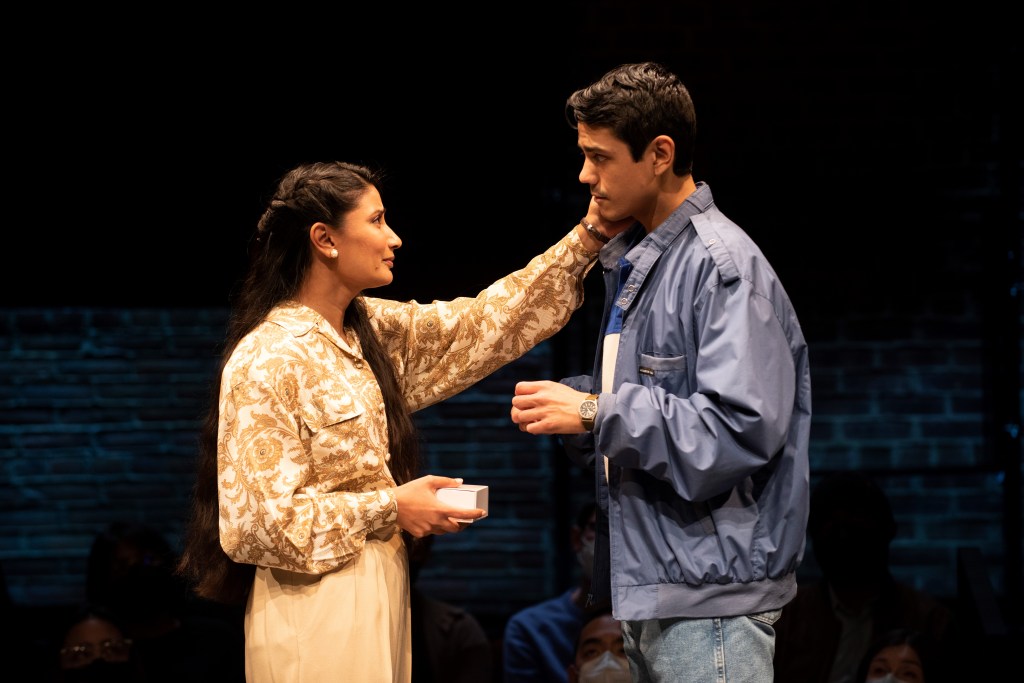
Eventually, we discover their past and the traditions that bound them and still bind them making Charu culpable in what has happened. Years before Elyria and his marriage to Dhatta, Charu and Vasanta were lovers. However, their future marriage was doomed by her parent’s financial status and inability to pay the high dowry price required. Thus, Charu must marry someone financially well-off, in an economically viable arranged marriage of which his parents and Dhatta’s parents approve. Vasanta keeps secret her pregnancy and when Rohan is born, she delivers her son to Dhatta, keeping the baby with at least one birth parent, that is, if Dhatta agrees to the secrecy, which Vasanta eventually wants to be divulged to everyone.
Of course human beings don’t keep their promises, as we learn from the brief conversations between Bose’s Vasanta and Mia’s Dhatta. Dhatta never tells Charu she knows about his love for Vasanta. In the complication of generously swallowing dishonor and raising her husband’s former lover’s child, the secret lays dormant and calcifies her marriage and relationship with Charu. Interestingly, they aren’t able to have another child. To what extent this is because of the burden of secrets that Dhatta carries is unclear. However, when Vasanta’s stalks Dhatta and Charu to Elyria, she, too, breaks the promise that she would never pursue them or interfere in their marriage. Spending the time and money to hunt them down, then dragging along her unsuspecting, career failed husband Shiv to Elyria, we recognize how high the stakes are for her to reconcile with her son and former lover.

Both women must receive satisfaction; one to remain in darkness, the other to expose Rohan to the light. The result is devastaing and wonderful. The upheaval at the top of the play which sets in motion a dynamic that could have unfolded in a more forceful way is not the intent of Purohit’s subtle, delicate work, which meanders and flows until a final truth emerges on the brink of revelation. Who will be the first to bravely speak it out?
There are many themes in Elyria. One is an indictment of the mores whose strictures create problems for families, binding individual in fear. Charu is a traditional, conservative man who refuses to marry Vasanta though he loves her. He chooses to stay with his parent’s ways, hurting himself and all involved. Adhering to these folkways threatens to derail Rohan’s circumstances in the future because Charu wants Rohan to marry a woman of economic means, matching if not exceeding his own lifestyle as a surgeon. In one scene Charu attempts to steer Rohan toward beginning to get serious about meeting a girl he will marry. However, in his interactions with Hassanali, we discover Rohan is attracted to men. Unless the family is truthful and frees itself from such bondages, more trouble, pain and sorrow will follow them.
Kudos to Elyria‘s creative team which includes Parijat Desai (choreography) Jason Ardizzone-West (sets) Sarita Fellows (costumes) Jeanette Oi-Suk Yew (lighting) Amatus Karim-Ali (sound) Jeanette Oi-Suk Yew (projections) Nikiya Mathis (hair design) Neel Murgai (compositions). Praise to the ensemble, who are vibrant and on-point, and the director whose vision brings Purohit’s work to life and endears us to her characters’ movement toward reconciliation.
For tickets go to the Atlantic Theater Company website https://atlantictheater.org/
‘The Trees,’ Agnes Borinsky’s Fantasy of Stasis, a Review

The abstract white, platformed set design (Parker Lutz) appears stark and majestic with arched rectangular pillars proscribing a curvilinear playing area center and downstage. The set is a symbolic representation of a park, interestingly absent any greenery. It’s a fine space to present a metaphoric fantasy like Agnes Borinsky’s The Trees, directed by Tina Satter, currently at Playwrights Horizons.
The Trees opens with the possibilities of a unique, mysterious conflict, and ends in medias res, as Borinsky mines the central conceit adding various layers and meandering back and forth with no seeming resolution, though there is one that is abstract and philosophical. As the playwright suggests she is wont to do, The Trees avoids a developed plot. It concerns the logistics of arranging the movement of players and supplies around the static protagonists whose human condition changes at the top of the play.

Brother David (Jess Barbagallo) and sister Sheila (Crystal Dickinson) who is visiting from Seattle, return home from a party playfully drunk. Appreciative of the night’s beauty and environs, they decide to stay outside and spend some enjoyable time in the park adjacent to their family home, which they’ve inherited from their father, who recently died. Overnight, a cataclysm occurs without rhyme or reason that neither we nor the characters are a party to. It involves a mega change that defies description.
Absurdly, David and Sheila awake the next morning in horrified shock to find themselves rooted to the soil, their feet immobilized and frozen in place. Theirs is an unexplained miraculous transmogrification from flesh to plant matter, though they retain cellular structures of both humans and trees. They refer to their tree selves as humans and identify as humans, however, physically in defiance of reality, they are also trees.

In this hyper-state of existence, the siblings learn to overcome the conflict of former identities abutting their new beings. Gradually, their consciousness expands. They accept their new lives, but cannot move nor take care of their past identities, activities and relationships. For Sheila this means having to give up her life and work in Seattle. For David this entails perhaps never having sex again. Sheila reveals a nature that is flexible, accepts, goes with the flow, makes the best and follows all the cliches people use in life when there is nothing they can do to change things. However, David resists and is not happy with “what is.” In fact after David’s transformation, his old lover Jared (Sean Donovan) throws him over for someone else, though they still remain friends and Jared joins the community which sprouts up to nurture and care for Sheila and David. David learns to accept, but he always complains and resists before he settles into the status quo.
The playwright asks us to suspend our disbelief by suggesting anything is possible in her her fairy tale. In the twinkling of a few hours worlds can come and go, consciousnesses can be raised and a new perspective and ethos might be a pleasant, happy experience that exists in and of itself for the purpose of whimsy, if we are open-minded. Indeed and perhaps.
This appears to be one of Borinsky’s themes in The Trees. The circumstances are because they are and exist despite all defiance to science and logic. For that reason alone, The Trees is worthy of presentation. Understanding it as an allegory of human experience and the human condition, one is able to translate the metaphors and reactions of the protagonists to the unusual, whether in the play’s instance they have turned into a tree or in another instance, someone has been turned into deteriorating flesh through disease, drugs and their side effects.

Acutely directed by Tina Satter, who shepherds the actors, all do a yeoman’s job with the fantastic elements and fluid happenings that take place representationally over a seven year period. This is especially so of Crystal Dickinson and Jess Barbagallo, who make sense of the absurd, as we watch how Sheila and David confront their new genetic transformation.
Fortunately, when word gets around, friends help the tree/humans with food and other necessities. No logical sensibility is relayed as to why they need human food, why they need clothing, etc. They are immobilized in the trans-state of human/tree and achieve a status quo state of being in the park, where events transpire around them, where people enter and join them in community, while they are stuck and going nowhere. All seamlessly coheres as the thrust of Borinsky’s conceit. With these friends, neighbors and strangers, David and Sheila might live forever. Certainly, trees can live longer than human beings, if their environment is not undone by commercialization, fire and development. These possible undoings do threaten David and Sheila’s community as we see later in the play.
The fairy-tale elements of The Trees are heavily fantastical and provide some of the humor and most of the conundrum of illogical occurrences as David and Sheila grow a network of friends, who appreciate how they have embraced a back to nature, celebration of the earth lifestyle as tree/humans.

Those who visit feel an affinity to the siblings and become friends. These include Julian (Nile Harris) who makes a documentary on the siblings and Tavish (Pauli Pontrelli) who saves David and Sheila’s grandmother from a fire. As their Grandmother, Danusia Trevino speaks the entire role in Polish and references the mystical elements of David and Sheila’s “back to nature” movement as an inherent part of their ancestry. Others include Norm (Ray Anthony Thomas) a gay man cruising in the park, and importantly, Saul (Max Gordon Moore) a rabbi who believes in the miracle of their transformation by God and eventually marries Sheila and has Ezra (Xander Fenyes) with her. Lastly are friend Charlotte (Becky Yamamoto) and Sheryl (Marcia Debonis) a member of the Rabbi’s former congregation, whose heartfelt description of her Dad quickens Sheila in remembrance of her father.
The interesting villain who actually joins the community of friends begins as Vendor (Sam Breslin Wright). He hawks chips, pretzels and water to park visitors. As Wright’s Vendor ingratiates himself to the community eventually, he presents plans which would protect their human/tree status. Ironically, as quickly as they morphed into trees, he becomes the developer whose thrust is to build a mall in the park that will house David and Sheila. When the community that initially accepted the Vendor’s plans come to the final decision about the mall, there is another magnificent change. Sheila, David and their community decide that they don’t want a mall in the park. They want the park to remain undeveloped.
In a superb rant decrying how their decision is disloyal and has caused him time and money (he has been giving them checks for their support) Wright’s Vendor expertly magnifies all the hope and despair of progress and the destruction of land and environment for a questionable result.

The community and specifically David and Sheila have lost his friendship which Sheila is sanguine about, a reflection of her nature. She has been flexible about all that life and the situation has thrown at them. When David questions what will happen, Borinsky’s main theme comes to the fore. Love and community have been sustained by their transformation into trees, as they have provided an ecosystem that gives and receives, is nurtured and has nurtured. David counters that a mall will destroy what they’ve built with love. However, Sheila reminds him that nothing is certain. Truly, when they unwittingly began their fantastical adventure, goodness and love abounded from it because they accepted it instead of calling up woodcutters to chop off their legs.
Though at times the play appears illogical, the characterizations as uneven as some of them are give the play a quirky and exotic rhythm. In appearing to go “nowhere” the playwright takes her characters to an open ended conclusion which emphasizes love, community and the inability to know much of anything in the vast future which can turn on a dime overnight. Sometimes, even when malls are being scheduled to be built, they never materialize. And that’s a good thing, especially if the love of the surrounding community has petitioned their demise.
Kudos to the creative team which includes Parker Lutz (scenic design) Enver Chakartash (costume design) Thomas Dunn (lighting design) Tei Blow (sound design) Amanda Villalobos (puppet designer) and Nazareth Hassan (original music). The Trees runs until March 19th. For tickets go to their website https://www.playwrightshorizons.org/tickets-packages/buy-show-tickets/
‘A Bright New Boise’ by Samuel D. Hunter, Sardonic, Devastating and Profound, a Review

In A Bright New Boise, Samuel D. Hunter’s sardonic, dark play about events that take take place in a Hobby Lobby break room, the award-winning playwright (A Bright New Boise, The Whale) acquaints us with characters that may be more alien to our cultural beliefs and economic well being than individuals we might converse with in another country. Acutely directed by Oliver Butler and currently running in its Off Broadway Premiere at the Signature Theatre until March 12th, Hunter and Butler reveal a sometimes funny but mostly tragic, portrait, and a cross-section of another America reflected in the 90 minute play’s characterizations, plot and themes.
Hunter opens the play with protagonist Will (the superb Peter Mark Kendall) who, facing the audience, stands at the side of the road, eyes closed, concentrating. Then, he says one word as if to call into existence, time and place, “something.” Four times he says, “Now.” By the play’s conclusion, we understand his cryptic pronouncement which produces only a vast emptiness and “never works.”

In the second scene we meet the feisty, hyper-organized, store manager Pauline, portrayed by the excellent and humorously volatile Eva Kaminsky. Pauline interviews Will for a sales position in the break room at Hobby Lobby, Boise which in 2010 (the setting) is owned by an Evangelical CEO who runs the company as a Christian organization. During the interview Pauline makes Hobby Lobby’s conservatism clear when she reminds Will, “no unions,” explaining that a Hobby Lobby in Kansas was shut down when employees tried to unionize. The economy is struggling, there is little opportunity for those without a college education and the big box stores like Hobby Lobby are the expansive grand employers of the moment. Thus, the minimum wage that Will readily accepts (under $8.00 an hour) is the best for his circumstances and is an offer he dare not refuse for a reason more important than financial. This, we learn with the introduction of another character in the break room, taciturn teenager Alex (Ignacio Diaz-Silverio).
Will’s apparent emotional dislocation is made clear in Kendall’s superb performance. From his evasive and contradictory responses to Pauline’s questions, we understand he needs money and appears to be in unusual life circumstances because he is unable to give her a reference or emergency contact. However, he is hired so that Pauline can continue to run her “tight ship.” He begins to socially settle in by striking up a conversation about music with Alex who is taking his break and wishes not to be disturbed.

Hunter immediately establishes Will’s additional intentions and enjoins the main conceit of the play, “abandonment” and “loss,” setting in motion the conflicts with a shocking surprise. Spoiler Alert: Will announces he is Alex’s father and he proclaims that Alex was named after him so his real name is also Will. Fortunately, Pauline returns and interrupts Will’s announcement. Simultaneously, the TV whose satellite glitches vie between graphic surgeries and monotonous conversations between two Hobby Lobby male employees, snaps back to the Hobby Lobby’s conversational monotony about how to sell products. And a disturbed Alex walks out as Pauline tries to make a joke most Americans would understand, if they have been culturally plugged in for the last two decades.
However, Will doesn’t get the joke or the celebrity associated with it, and even if he did, Kendall’s Will appears overwhelmed about introducing himself to his son. He could care less about Pauline’s attempt to make him feel comfortable and appears lost in his thoughts about how he will negotiate and respond to the brutal questions from Alex that are sure to come.

Will’s deadened reaction is another clue that ties in to Hunter’s characterization of a hapless, unsound father, whose adopted son he has desperately sought out by getting a job at a Hobby Lobby, instead of using another means to contact him that is less traumatizing. From this first turning point of many, the revelations between and among characters spin out as surprises continue in a grotesque emotional and psychological maze that Alex, Leroy, Alex’s brother (Angus O’Brien) and employee Anna (Anna Baryshnikov) inhabit in the coldly remote, depersonalized break room of the Boise, Idaho Hobby Lobby. The sterile, severely lit space is perfectly ironic as a symbolic setting where they attempt to go to relieve the stress of their job, but end up frantically confronting a hellish swamp filled with regrets from their past. The result exacerbates the demeaned alienation of each of the characters who have lost their way and whose religion is unable to help and in fact makes things worse.
By degrees we learn the backstory of Alex and Will. Instead of clarifying toward comfort in a way to salve emotional hurts, by degrees Alex with stress and strain in his questions puts together the puzzle why Will has come to establish a relationship with him. Eventually, after Will reveals the truth of where he lives, the joy his church gave him and the events which transpired there, Alex appears to forgive him and defend him to his brother Leroy who fears Will has another motive for wanting to see Alex. In a secondary plot to enhance the characterizations, Anna and Will stumble upon each other in a darkened break room after hours, which seems even more sinister (the TV is still on vying between blood and guts and boring Hobby Lobby guys).

Anna sneaks her way in beyond closing hours by hiding in various sections of the huge store unnoticed. We learn she does this to avoid her father and brother’s criticism of her always reading and we get the sense that she is a misfit without a medium to feel comfortable in until she has a few conversations with Will whom she likes. Will is homeless; we eventually learn why and what happened to him. Furthermore, he is afraid to sleep in his car.

Their conversation gives occasion for Will to read parts of his Evangelical “End Times” blog to her, which he intends to make into a novel. Anna is taken up with the notion she has met a writer whose work she likes and she encourages him. It is then we understand the extent of his beliefs and his hope of being taken up in the Rapture (often used as a fund raising tactic by Evangelical Mega Churches) away from the wicked hell that has been perpetrated in the culture and on the earth by sinners who must be saved or perish in damnation. We also understand that he feels he has a purpose in converting people before it’s too late. He tells Alex he has to believe in God because the alternative is terrible. He would have to look at himself as an utter failure as a father, whose triumph is working in Hobby Lobby, while he lives in his car. Will tells Alex, “There are greater things in life. There have to be.”
Will gradually works his way into Alex’s world by asking to hear the song Alex wrote with his friend. He praises some of Alex’s poetry. However, Leroy is incensed about Will after he reads articles about Will’s former church and especially after Alex appears to favor Will over his adoptive family and tells Leroy he is changing his life plans. Leroy lashes out in revenge against Will after Pauline affirmed that it doesn’t matter what people’s personal beliefs are, as long as they are on time and do their jobs. However, Leroy involves Hobby Lobby in his revenge, making it impossible for Will to work there. Leroy and Will’s conflict has broken Pauline’s rule to maintain order as the status quo. After working for four years to make the store profitable and organized, she will not allow their conflict to drag it into the chaos that Will has brought with his presence. (Eva Kaminsky’s affirmation speech about Pauline’s taking the store to profitability earlier in the play is corporately magisterial and humorous.) Thus, Will, the last to be hired will be the first to be fired, aside from the fact that Alex and Leroy’s talents make them indispensable.
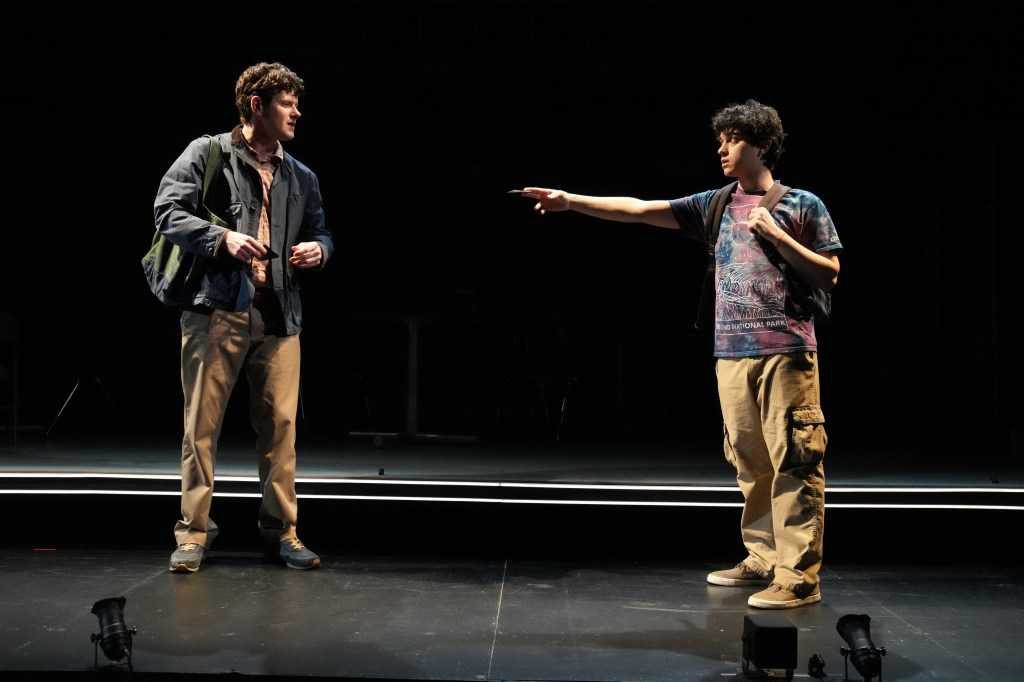
How events further evolve are both surprising and expected. However, when Leroy confronts Will about Alex, the result is uncertain and unpredictable. Hunter’s writing is freshly wrought and organic. The characters are well-crafted and their motley and unique differences meld well with each other for maximum tension, which abides throughout. By the conclusion Hunter ties Will’s injunction to God, “Now,” and explores another reason why Will seeks out Alex for comfort in a relationship that is not destined to grow closer or even continue unless Will makes a decision to change.
The play is wonderful on many levels. Hunter allows us to get under Will’s skin and into his soul which is both horrifying and sadly authentically truthful if one has been around certain Evangelical sects for more than a few days. Importantly, though we might not be able to put ourselves in Will’s shoes, Kendall portrays Will with empathy and pathos thanks to Butler’s incisive direction. Thus, we can understand his emotional guilt and torment and his desire to be a better person, the point of his religious journey, which becomes sidelined. The relationships Hunter establishes are woven with heightened drama. Alex feels a misfit and is emotionally traumatized by Will moving on a roller coaster of emotions through to the play’s conclusion. That Will doesn’t consider another way to get in touch with Alex speaks to his inner turmoil and disregard for Alex’s feelings and response. However, Will’s need to see Alex is urgent and has to do with the “Now” that is the final puzzle piece that unfolds in the flashback at the very end.

The terrific and terrifying set design by Wilson Chin and jarring fluorescent lighting and vibrant neon lighting in the road scenes by Jen Schriever are evocative and symbolic. That the appliances (i.e. microwave, VCR, etc.) barely function and little attention is given to popping up the color to make a unique, interesting or warm environment speaks volumes about Hobby Lobby, the employees and Pauline who is the epitome of the loyal, harried worker bee manager. The break room set, props and lighting reference the respect that the corporate officials have for their employees in a nullifying environment that is neither challenging, purposeful or life affirming. Hunter conveys the sense of Big Brother when Eva explains to Will as a blind, deaf and dumb team player that it’s a “pretty great company” that knows how to run a business, because everything is “hooked up to the corporate office.” Then, she cheerfully states, “We can’t even turn the air conditioning on without calling Oklahoma.”
The Hobby Lobby envisioned by the director and playwright and what fuels it, also reflects the nature of the commercial culture that creates consumer robots whose function least of all is a purposefully human one. That Will, Alex and Leroy refer to a job there as something loathsome by which to define oneself is further irony because the store is incredibly profitable, if money is its Christian measure of success as the prosperity gospel likes to portray. That Will has accepted religious rhetoric as his mantle and believes the world needs to be destroyed becomes particularly sardonic considering Hobby Lobby’s function and value system as a Christian organization with tenets about love, forgiveness and acceptance.

Another of the themes of the play is manifest in the characterization of these conservative Christians who are devout, yet are incapable of applying the tenets of the religion to their lives to achieve peace and fulfillment. Along with the themes of abandonment, isolation, and purposelessness that nullifies comes the important irony that Hunter relates at a time (2010) before the religious political movement grew into what it is today in 2023 in the culture wars, book bannings and civil rights curtailments. The hypocrisy, spiritual unhappiness and emptiness tied to a culture that is broken and breaks those who live in it to seek other ways to escape (through the belief of the Rapture) Hunter’s ironic play underscores. The play was humorously prescient then, more frightening now. A Bright New Boise is an ironic expose of the worst of Christian sects’ hold on the minds of those like Will and others.
Kudos to the creative team not mentioned before which include April M. Hickman (costume design) Christopher Darbassie (sound design) Stefania Bulbarella (projection and video design). This is one to see especially for the ensemble work, the fine performances and direction that teased out the actors’ efforts to be spot-on authentic. The creatives did a smashing job to fulfill the director’s vision of A Bright New Boise. For tickets go to their website.
https://www.signaturetheatre.org/shows-and-events/Productions/2022-2023/A-Bright-New-Boise.aspx
‘The Lost King,’ Athena Film Festival Review of a Superb Film
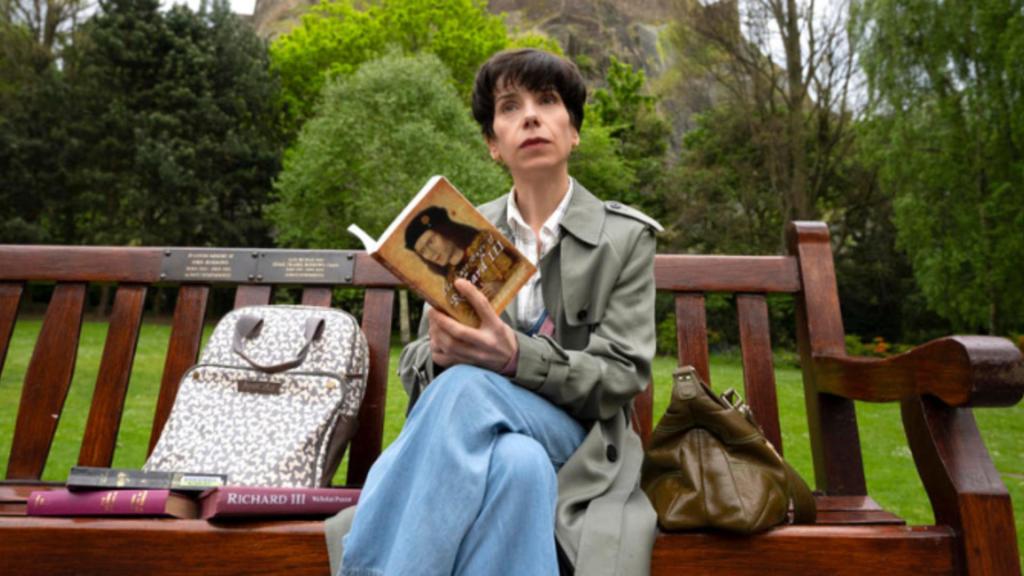
In the superb hybrid comedy-drama-mystery The Lost King, based on Philippa Langley and Michael Jones’ non-fiction book The King’s Grave: The Search for Richard III (2013), one can see a marvelous Frears film (director) and discover information about Richard III beyond William Shakespeare’s titular play and the Tudor’s 500 +-years-old smear of him. One will also be delighted with fine views of London, Edinburgh, the Edinburgh castle and Mon’s Meg (the Medieval cannon on display). The film, an offering presented at Athena Film Festival 2023, also had a talk-back with a panel of women with journalism and film production backgrounds.
After the screening the panel briefly focused on “Uncovering Stories Lost to History.” Compelling stories that must be told often find them by serendipity. Also discussed were important themes of the film, principally how women have been silenced while men, especially those in academia, have stomped their way around them making mistake after mistake, when they should have had the humility to listen with a collaborative spirit, the hallmark of wisdom.
Written by Steve Coogan and Jeff Pope The Lost King premiered at Toronto International film Festival and was released in UK cinemas in October. It will be released by IFC in theaters on March 19th and will then be on streaming services.
The film is special for many reasons. First, for its heroine, protagonist Philippa Langley (portrayed by the always incredible Sally Hawkins), who must stand her ground and fight against the male academic establishment, which nearly thwarts the triumphant discovery of the body of King Richard III. But for the will, wisdom and mystical consciousness of Philippa Langley, Frears and screenwriters make crystal clear that the body of Richard III would not have been discovered in the right area. And then, when it was uncovered, pride and the need for the power to “be right” would have ignored and dismissed the remains to be an insignificant personage, instead of the real king whose skeleton revealed the truth of his deformity.
The importance of the film and its themes have been underestimated by critics. Frears emphasizes vital elements about academia and research that unfortunately appear accurate in Philippa Langley’s case. More important than degrees which numb one to institutional group think, power games and cover ups, there is the passion required for historical research and inquiry that can move mountains and land on crucial discoveries. Sometimes the passion becomes an obsession, almost like a divine anointing which is what happens to Philippa, who becomes enamored of the story of Richard III, after she sees a production of Shakespeare’s play and begins to do her own research because the actor who plays the king (Harry Lloyd) elicits sympathy from her.

Philippa asks the right questions on her search, and she collaborates with others as she learns to question what the “experts” and the crackpots alike say. Her passion leads her to fund her own project as an independent researcher. She is not beholden to institutions who “control” history and deem which stories are “worthy” to be told for various reasons. The credibility and viability of well documented, independent, detailed, factual research is supported roundly by this film. Likewise, the corruption and support of shoddy research with an agenda, or skewed research to glean certain results and not others, which occurs in educational institutions dependent upon corporate donors, is excoriated by this film. The latter is a siren song and warning which has been taken to task by the very institution which took acclaim for the project, and sidelined Philippa.
Langley’s journey into information not normally known to the public and which, even historical scholars following established canon find challenging, is exciting. The conceit of Richard III’s spirit moving her is symbolic and profound. Each time the spirit appears, she acts. She joins a society in Edinburgh which believes the same as she, that Richard III was not the usurper of history but was maligned for corrupt purposes by those contending for the throne. Additionally, she discovers that Richard III has never been entombed or properly recognized as a King of England. His reputation of legend is as a wicked murderer of his nephews in the Tower of London. Additional rumors had it that his body either was thrown into the River Soar or buried in the Greyfriars Priory somewhere in Leicester, which was later destroyed by modernization, in a London paved over by roads and buildings in subsequent centuries. Nevertheless, spurred by visions and dreams of the actor who portrayed Richard III as emblematic of the king’s spirit reaching for proper recognition and burial from beyond the grave, she grows determined that perhaps she might locate the burial site of Richard III.
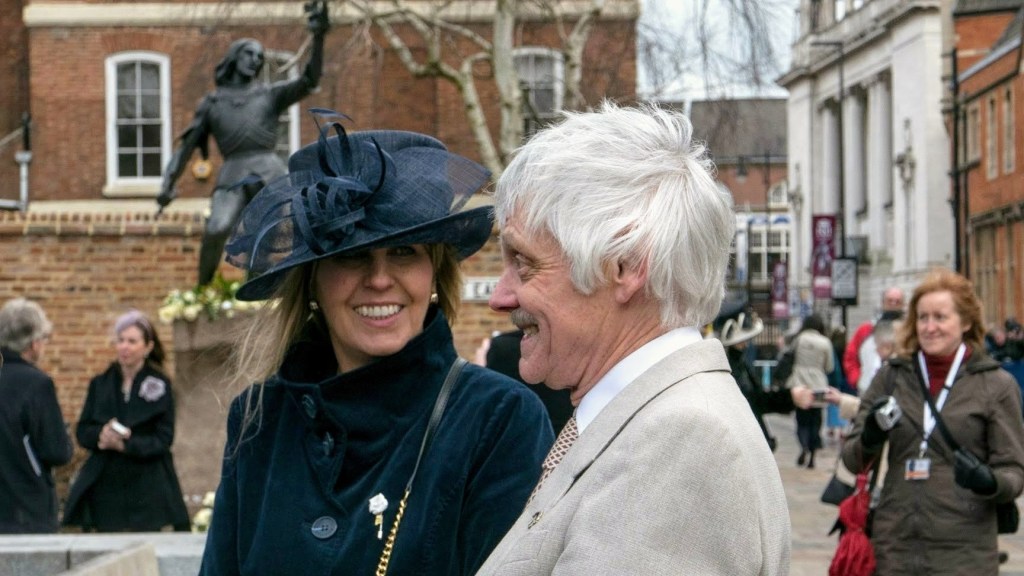
Her research and passion to uncover the grave and other truths about Richard III lead her to lectures where she meets professors, some dismissive of her ideas, others accepting and open to her lack of degrees and passion about discovering Richard III’s grave. An accepting professor she meets is Dr. Ashdown-Hill. He is publishing a genetic genealogical study on a Canadian direct descendant of Richard III’s sister. Ashdown-Hill tells her to look for Richard in open spaces in Leicester. Because of superstition and reverence, old abbeys were preserved after the buildings crumbled; it was unacceptable to build over them. So in open fields or spaces in cities, abbeys most often could be found.
Driven by a mystical sense and intuition, and encouraged by her work with the Richard III Society in Edinburgh, Philippa Langley raises the funds and contacts other professors (archeologists) who at first express it’s a noble idea but decline involvement. Then circumstances change when their funding is cut and they rush to become involved in her project which she commissions and funds, all the while working with the Richard III Society and recording her journey. Following seven and a half years of research and investigation, during which she reads Annette Carson’s Richard III: The Maligned King, she identifies the site of the church and grave and leads the dig, insisting after they ignore the remains in one of three trenches, that they dig in the first trench where she determined intuitively the body was buried. After hours, they proved she was right. Her triumphant discovery was the first of its kind searching for the lost grave of an anointed King of England, by someone who was not an institutional academic.
Though the film takes place over a decade, filmmakers highlight Langley’s obstacles and life’s intrusions, the gradual acceptance and help from her former husband John (Steve Coogan) and the physical difficulties from ME disease and exhaustion Hawkins’ Langley must overcome. A galling noteworthy point emphasized by Langley and screenwriters are the recalcitrant, closed-minded prejudgments by academia who diminish her efforts and lift up their own to the point of gaslighting for their own glory. Naturally, the professors in question dispute the film’s account, though it is indeed on record as an alarming fact that they sought glory, when they held a global press conference to announce “what they had done.”
However, they excluded Philippa Langley’s presence. She wasn’t informed about the press conference. They did not have the grace to invite her to the conference to speak about her commissioning the project, her extensive research, her passion and will to find the site and even her insistence that they not ignore the remains they found, where she said she believed they would be. To not have her present is damning evidence that they intended to minimize her efforts, which comprises a scene in the film. This scene and the ending scenes of the film are superb as Frears shows what the institutional academics celebrate and what Philippa celebrates. Rightly so, Queen Elizabeth had a ceremonial investiture for Philippa and Dr. Ash-Down Hill. Both received an MBE in the 2015 Birthday Honors for “services to the exhumation and identification of Richard III.”
Frears and the screenwriters emphasize this craven disregard of academia for the independently funded research by one who had a much greater passion for truth than those controlled by institutional handlers. But the point is made that there are fine academics, who are unlike those who undeservedly look for glory. With the help of like-minded Dr. Ash-Down Hill, those in the Richard III Society and other independent female researchers like Annette Carson, after 500 years, a lost king has been found.
For more photos and information about the dig and Philippa Langley, go to her website: https://www.philippalangley.co.uk/gallery.html
The film is a triumph and should be shown in universities everywhere. Frears’ heroine breaks through past institutional knowledge whose “guardians” not only repeatedly miss the mark, but intentionally, to maintain their power, botch and blunder investigative research. In this instance and in the record of events, it is at the last minute when, about to be embarrassed by their own stupidity, the individuals barrel in and attempt to take all the credit.
The film is a testament to independent researchers, female pluck and intuitive mysticism, and those men who know when to listen and assist to get the job done. It is also an excoriation of institutional learning and universities, a fount of crass, meretricious commercialism, which sets up undeserved memorials to itself and academics while doing little to uplift their mission. Their mission should be to research, discover and be open to the unbiased, unblemished, uncorrupted paths toward truth and knowledge, not for the riches and notoriety to be garnered.
British archeologist and academic Michael Pitt’s response to a favorable Guardian review of The Lost King, indeed appears to be “protesting too much” when he insists, “Contrary to movie PR and most media coverage, however, its key thread is fiction: the “bubble of academic arrogance” is a fantasy of the film’s anti-intellectual agenda.” What Pitt’s overbroad, misguided opinion fails to note is, it is also possible to be anti-intellectual because one is beholden to those funding one’s research. Thought happens in spite of academia not because of it. An open, collaborative, passionately investigative spirit is what the film uplifts, a practice followed by Philippa Langley. The closed system, the anti-intellectual group think among researchers that takes over institutions when careers are more important than truths, is what the film decries. Bravo! See it on March 19th in NYC.
‘Moving On’ at Athena Film Festival, Starring Lily Tomlin and Jane Fonda

Jane Fonda and Lily Tomlin, whose duo and friendship has been shining in films and TV for decades, work their magic in Paul Weiz’ hilarious comedy Moving On which Athena Film Festival presented in the film’s New York City premiere at Barnard College the third day of the four-day festival. Moving On premiere screened at Toronto Film Festival in September and will be showing in US theaters on March 17th. Athena Film Festival’s Artistic Director and Co-founder Melissa Silverstein also held a talk back via Zoom with director/writer Paul Weiz about the actors, the concept and a humorous take on Malcolm McDowell’s great good will in an always authentic performance playing the villain Howard that audiences love to despise.
Academy Award®-nominated* writer Paul Weitz admitted the conceit to Melissa Silverstein that had been haunted him for a few years before he wrote the film then set out to cast it with Academy Award® winner Jane Fonda and Academy Award® nominee Lily Tomlin. Beware, here comes a spoiler alert. The dialogue, which Weiz says he hears first rather than sees images, entranced him. “I’m going to kill you Howard,” was the phrase which Claire (Fonda is sparky white wig which she chose as revelatory to the character) says to her deceased friend’s widower (a crusty, petulant Malcolm McDowell) at the the funeral. The set-up is humorous as Claire’s Fonda looks angrily determined and McDowell appears both alarmed and annoyed to be so interfered with at a high moment of grieving with guests gathered around. We assume that Claire isn’t actually serious about her threat and perhaps is upset and delivering a quasi chiding threat.

However, when Tomlin’s Evelyn sees Claire and the two estranged friends begin to warm up to each, Claire reveals that her intentions are not only serious, she has thought about how she is going to kill Howard. At this juncture the film becomes a hybrid comedy, mystery, thriller. Will she be able to pull off Howard’s murder without out getting caught which she doesn’t particularly care about? Why does she want to kill Howard? And will Evelyn’s and Claire’s friendship bond once more over Claire’s pursuing revenge, which Evelyn doubts she has the “guts” to do since she never followed through on plans she confided in Evelyn years ago.
How Weiz, Tomlin, Fonda, McDowell and Richard Roundtree who portrays Ralph, Claire’s second husband, unfold the comic, poignant, sardonic and quasi suspenseful series of events to answer the questions makes for an entertaining and LOL romp into relationships, suppressed secrets, estrangements and reunions, truth-telling and love and concern for each other when most needed.
Weiz’s characters are authentic and true-to-life and the actors portray them with specificity and detail down to their costumes which Weiz discussed the actors had a hand in developing. Tomlin’s Evelyn is humorous and ironic, yet poignant as she confronts aging in an Assisted Living Center where she comes and goes as she pleases and eventually brings Claire to, though she is embarrassed about it and in their initial meeting lied telling Claire that she still lived in her adorable house. A former classical cellist who has arthritis and now finds it painful to play, Evelyn also lies about having continued her performances with a symphony. The scene where she attempts to play and can’t is a cruel one and a reminder of aging vicissitudes which have no answer except to endure them.
Weiz devotes time to rounding out both Evelyn and Claire with just enough backstory to spill into the present conflicts they have with each other as well as their interior hurts and difficulties in the decades since they’ve seen each other. For example Evelyn who is gay is friendly with an adorable youngster who is the grandson of one of the clients in the Assisted Living Center. The youngster loves putting on women’s clothes and Evelyn obliged him in a previous encounter while his parents visited his grandfather. Evelyn gives him earrings which he loves wearing and which become a point of contention with his parents later in the film. In a brief encounter with the parents, the youngster and Evelyn, we understand the decades of repression and rejection Evelyn as a gay woman experienced which the youngster’s parents are subjecting him to. Evelyn provides a hug and much needed warmth as they say goodbye with the scowling parents looking on after he returns the earrings to her.
The scene is a powerful one and substantiates the side-plot of how Evelyn as a gay woman for years had to be selective about her friends with whom she could and couldn’t reveal her identity with. Weiz’s fullness, clarity and profound writing strikes many chords about friendship, prejudice and love. And the character a perfect fit for Tomlin humorously reveals that she, too needs to get in on Claire’s revenge on Howard.
Weiz gradually reveals the mystery of why Claire intends to kill Howard. Key in bringing the truth to the fore is the relationship that Claire reestablishes with her former husband Roundtree’s Ralph, who she left because of what Howard did. The scenes between Roundtree’s Ralph and Fonda’s Claire are sensitively acted, enjoyable and humorous. Roundtree and Fonda are classic and modern and Weiz’s direction establishes him as a perceptive, incisive and philosophical humorous who is able to tease out the strengths of his actors to effect superb performances.
Likewise, Weiz shepherds the actors present their characters with spot-on authenticity in the scenes between Tomlin and Fonda in the planning of Howard’s death to the moment when Claire’s Fonda confronts McDowell’s Howard with an incident that occurred between them that changed her life. As we are kept in suspense about the revelations of what happened between them at the point when Claire threatens to kill him, we become shocked at their different responses to the incident. Howard, a reformed alcoholic was drunk and barely remembers what occurred. What he does recall from his different perspective, makes a case that Claire was blowing the situation out of proportion with the “hysterical woman” syndrome. The scene is symbolic, the actors fantastic and the profound meaning historic though the situation is as real as it gets. The writing, the acting and the direction are just great.
As a villain who is an everyman and charming individual, McDowell’s Howard walks the tight-rope of husband, father and lover of his deceased wife with sensitivity humor and complete normalcy. His shock and alarm at Claire’s accusations are humorous, his indignation hysterical. His is the most difficult role because we know the least about him with which to empathize, yet the director and actor make the necessary accommodations to reveal just enough so that the conclusion of the film when all the puzzle pieces are wrapped up is both hysterical and delightful
Weiz in his Q and A with Silverstein commented on the “beatings” that both Fonda and Tomlin delivered to McDowell were humorous if ferocious. And McDowell was “OK” about it. The title Weiz said affirmed that forgiveness, redemption and healing as themes of the film, which Evelyn and especially Claire experience, allow them to move forward with their renewed relationships and different perspectives about their past, key pieces of which would never have happened if they didn’t attend their friend’s funeral and take a stand for the truth publicly. The scene where Tomlin’e Evelyn speaks truth to power at the funeral is priceless and yields something glorious about who she is. Also, Weiz mentioned that governed by the dialogue and voices of the characters he was writing that moved him, once the initial line at the funeral emerged from his consciousness, the characterizations and situations unfolded and he finished the script quickly.
This is an enjoyable, classic film that is more current than the Marvel movies that populate screens globally and whose fantasy sometimes never transcends a puerile audience. Moving On is an exceptional effort by the actors and director and seamlessly entertains with humor, great comedic timing and overall good will. See it in theaters March 17th.
‘The Seagull/Woodstock, NY’ Review

The Seagull by Anton Chekhov is a favorite that receives productions and has been made into films, an opera and ballet performed all over the world. Some productions (with Ian McKellen at BAM in 2007) have been absolutely brilliant. What’s not to love about Chekhov with his dynamic and ironic character interactions, sardonic humor, enthralling conflicts that unspool gradually, then conclude with an ending that explodes and carries with it devastation and heartbreak. These elements cemented in Chekhov’s work since its initial production in 1896 represent what Chekhov himself described as a comedy.

Thomas Bradshaw, an obvious lover of Chekov’s The Seagull, has updated and adapted Chekhov’s work in the world premiere The Seagull/Woodstock, NY presented by The New Group. The playwright, who has previously worked with director Scott Elliott (Intimacy, Burning) has configured the characterizations, entertainment industry tropes, humor and setting in the hope of capturing Chekhov’s timelessness to more acutely evoke our time with trenchant dark ironies that are laughable. As he slants the humor and pops up the sexuality, which Chekhov largely kept on a subterranean level, Bradshaw has added another dimension to view the themes of one of Chekhov’s finest plays. Directed by Scott Elliott with a cast that boasts Parker Posey, Hari Nef, David Cale, Nat Wolff, Aleyse Shannon and Ato Essandoh as the principal cast, The Seagull/Woodstock, NY, at the Pershing Square Signature Theater has been extended to April 9th.

The play’s action takes place in a bucolic area in the Hudson Valley. Woodstock is the convenient “home away from home” of celebrities who live, work and fly between Los Angeles and Manhattan, and who feel they need to take a break between jobs, or just take a break from the stress of performance and helter skelter pressures and BS of the industry. The house where they retreat to is peopled by the family, caretakers, guests and a neighbor. The individuals are based on Chekhov’s characters, brother Soron, sister, actress Arkadina and son Constantine, who Bradshaw has renamed Samuel (David Cale) Irene (Parker Posey) and Kevin (Nat Wolff). Chekhov’s Trigoren, Arkadina’s lover, Bradshaw renames William, who is portrayed by Ato Essandoh. Nina, whose Chekhov name Bradshaw keeps is portrayed by Aleyse Shannon. Chekhov’s Masha becomes Bradshaw’s Sasha (Hari Nef).
In his update Bradshaw streamlines some of Chekhov’s dialogue and upturns the emphasis of conversation into the trivial without Chekhov’s character elucidation, as he spins these individuals into his own vision. The cuts truncate the depth of the characters, making them more shallow without resonance or humanity with which we might identify on a deeper level. However, that is Bradshaw’s point in relaying who they are and how they are a product of the noxious culture and the times we live in, unable to escape or rectify their being.

For example the initial opening conversation between Samuel (David Cale) and Kevin (Nat Wolff) loses the feeling of the protective bond between uncle and nephew scored with nuance and fine notes in Chekhov’s Seagull. Additionally, in their discussion of actress Irene, Kevin’s criticism of his mother emphasizes her faults and superficiality. In the Chekhovian version, the son expresses his feelings of inferiority in the company of the artists at his mother’s gatherings. Because of the son’s admissions we immediately understand his inner weakness and hopelessness, feelings which set up the rationale for his devastation of Nina’s abandonment and his suicide attempts later in the play.
Chekhov’s characterization of the actress and mother is tremendously subtle and cleverly humorous. Bradshaw’s iteration of the celebrity actress, her lover, the ingenue Nina and Irene’s brother become lost in the eager translation into comedy without the emotional grist and grief which fuels the humorous ironies of human frailty. Again, as we watch Bradshaw’s points about these individuals which reflect our modern selves, we laugh not with them ruefully, but at them for their obnoxiousness and blind hypocrisy.

Such points appear to be inconsequential and minor, however, the overall impact of Bradshaw’s characterizations makes them appear to be stereotypes of artificiality rather than individuals who are believably sensitive, vulnerable and hypocritical so that we care about them, yet find humor in their bleakness. Irene adds up to a figure of sometime cartoonish arrogance and pomposity without the sagacity and nobility of Chekhov’s Arkadina, who nevertheless is intentionally “oblivious” to herself out of desperation, hiding behind her facade, which on another level reveals a tragic individual. The same may be said for the characters of William and Nina who deliver the forward momentum of the work in their relationship that symbolically and sexually culminates in a bathtub on the stage where Nina previously masturbated as a key element of Kevin’s play. Their characters remain artificial and shallow, and the play’s conclusion and Nina’s collapse follows flatly without the drama and moment so ironically spun out in Chekhov’s Seagull.
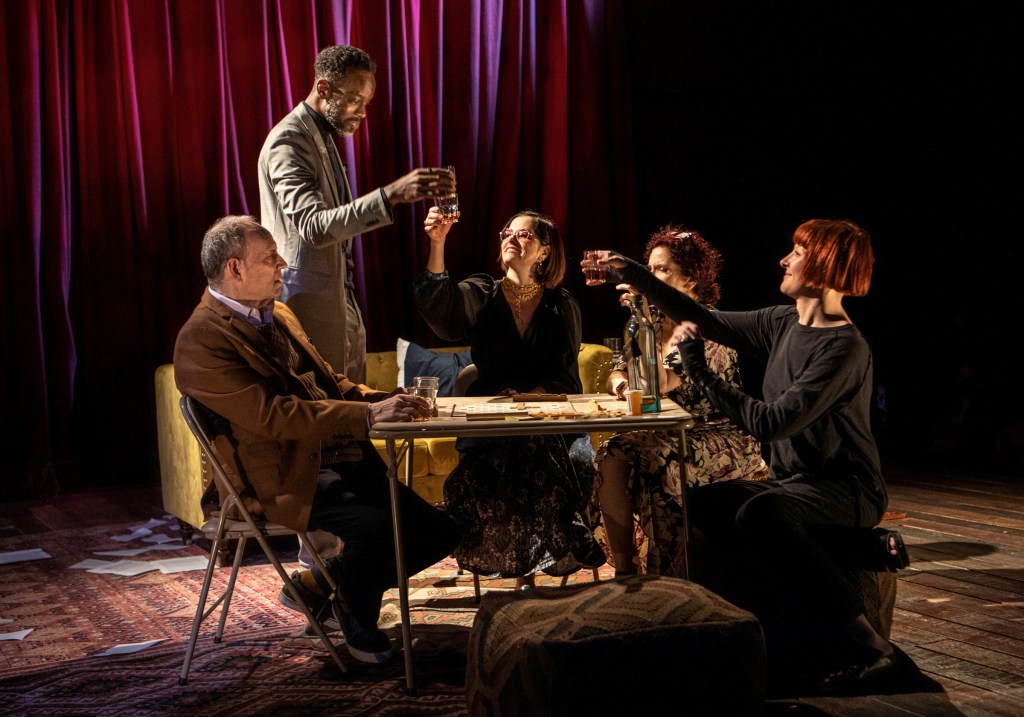
Indeed, the meaning of Bradshaw’s work is clear. There has been a diminution of artistic greatness and sensibility, moment and nobility in our cultural ethos, which makes these players as inconsequential and LOL as he has drawn them. They are caricatures who wallow in artificiality and purposelessness, not of their own making. They have been caught up in the tide of the times and the vapid culture they seek to be celebrated in. That some of the actors push for laughs which don’t appear to come from organic, moment-to-moment portrayals makes complete sense. Theirs is a high-wire act and anything is up for grabs. Whatever laughter can be teased out, must be attempted. That is who these people are in The Seagull/Woodstock, NY.
Though the actors (especially Posey who portrays Irene with the similitude of other pompous, self-satisfied characters we’ve come to associate her with) attempt to get past the linearity of Bradshaw’s update, they sometimes become stuck, hampered by the staging, the playing area and direction whose action perhaps might have alternated between stage left and stage right (the audience is on three sides). Most of the action and conversation (facing the upstage curtain where Kevin puts on his play in the first act) takes place stage right. Since the set is minimalist and stylized with rugs, chairs and other props forming the indoor and outdoor spaces, the stage design might have been more fluid so that the various conversations were centralized. Unfortunately, some of the dialogue became swallowed up and the actors didn’t project to accommodate for the staging.
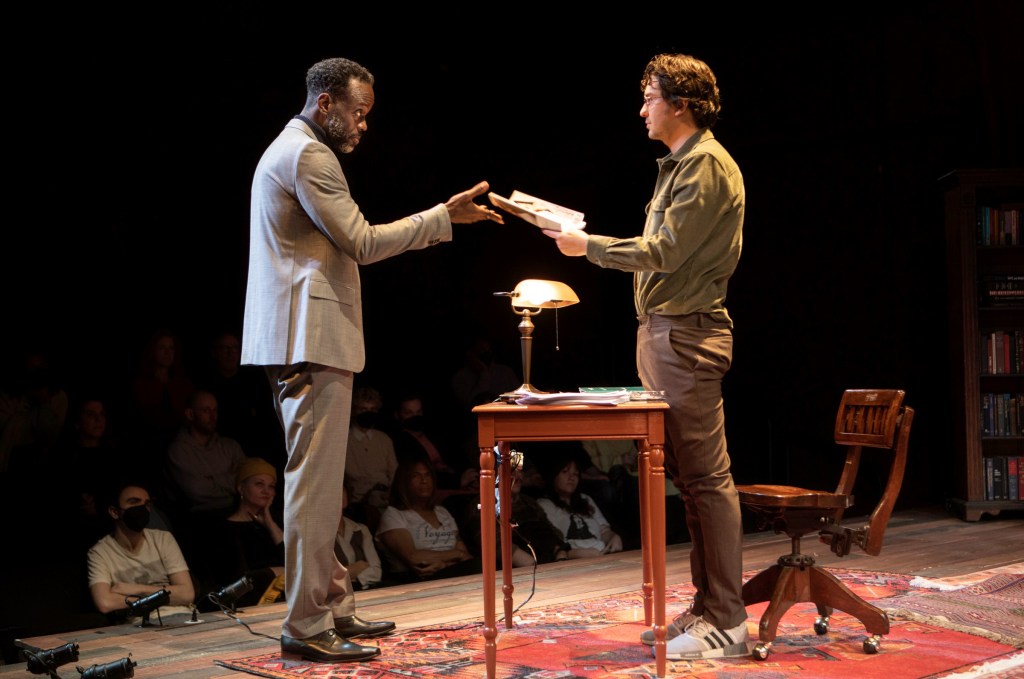
Only Nat Wolff’s portrayal of Kevin rang the most real and authentic. However, this is in keeping with the overall conceit that the playwright and director are conveying. Wolff doesn’t push for laughs and his portrayal of Kevin’s intentions are spot on. As a contrast with the other characters, he is a standout and again, this appears to be Bradshaw’s laden message. Kevin is driven to suicide by the situation, his mother, William’s remote selfishness and Nina’s devastation which she has brought upon herself. He is happier to be away from them. And perhaps Irene will be relieved, after all is said and done, that he has finally succeeded to end his misery. As Bradshaw has drawn her and as the director and Posey have characterized her, Irene has an incredible penchant for obliviousness.

At times the production is uneven and the tone is muddled. At its worst The Seagull/Woodstock, NY is a send up of Chekhov’s The Seagull that doesn’t quite make it. At its finest Bradshaw, Elliott and the ensemble reveal the times we live in are destroying us as we attempt to escape but can find no release nor sanctuary from out own artificiality and meaninglessness, as particularly evidenced in the characters of Irene, William and Nina. Only Kevin appears to have true intentions for his art but is stymied by the crassness of those considered to be exceptional but are mediocre. As in all great artistic achievement, only time is the arbiter of true genius. Perhaps Kevin’s time for recognition will come long after Nina, Irene and William are dead.
The creative team for The Seagull/Woodstock, NY includes Derek McLane (scenic design) Qween Jean (costume design) Cha See (lighting design) Rob Milburn & Michael Bodeen (sound design) UnkleDave’s Fight-House (fight and intimacy director). For tickets and times go to the website https://thenewgroup.org/production/the-seagull-woodstock-ny/
‘The Smuggler,’ A Thriller in Rhyme at Irish Repertory Theatre

In an energetic, boisterous performance delivered with a fever pitch that doesn’t quit or pause with quieter notes, Michael Mellamphy’s Tim Finnegan spills out The Smuggler, a story about how, as a naturalized citizen from Ireland, he was forced into a black-hearted situation he couldn’t refuse. In his delivery Mellamphy is like a high-speed train barreling down the track on a joy ride that threatens catastrophe at each turn in the journey, as customers and audience members alike are drawn in with his humor, excitement and storytelling verve, unfolding in rhyming couplets, that at times are insecure and slant. Written by Ronán Noone, himself an Irish-American immigrant from Galway, and directed by Conor Bagley, The Smuggler runs a slim 80 minutes at Irish Repertory Theatre in the W. Scott McLucas Studio Theatre. It has been extended until March 12.
At the heart of The Smuggler the protagonist (a con artist) attempts to get over with his charm and engagement to elicit audience sympathy. He seeks this as he tells about his plight to make a way for himself and his family in a culture that is the antithesis of welcoming and helpful to those “down on their luck.” When he’s fired from his job as a barman in Amity, Massachusetts, every door appears to shut in Finnegan’s face. Understanding the dark irony that America is portrayed as the land of “opportunity” in the alluring myth (the streets are paved with gold) told to strangers from other shores to entice them to leave their home country to provide cheap labor whether legal or illegal, he is caught in a morass of financial wrack and ruin of his own making.

Not only does Finnegan enjoy “a bit of drink” (an explanation for the selection of his job as barman) he appears not to be too swift in forward planning financially with his wife. Everything is a surprise that happens to them, not that they are responsible for selecting actions that leave them hanging off a cliff.
Many immigrants face hellish experiences, exploited by craven, greedy bosses, forced to live in overcrowded quarters, the pawns of merciless overlords wherever they turn. We have only to read about the history of America’s labor movement or Cesar Chavez and the farmworkers, or superlative, recent, non-fiction works (Tomato) to understand the desperation that immigrants go through, first to leave their countries, and then to attempt to “make it,” continuing the hell of the past in the present new “home.”

Thus, life moves from wheel to woe for those like Finnegan, who strike out to start a family, make missteps with bad choices, then fall on hard times. Finnegan and his wife live in a rental, that is no more than a shack with non-functioning plumbing. It is owned by a slumlord, a sleazy landlord who refuses to fix much of anything. As Finnegan unravels his dire circumstances with heavy poetic description, we identify with the immigrant experience, recognizing that the uniform abuse by those happy to mistreat and exploit the cheap labor of aliens and immigrants, is all too familiar.
What makes Finnegan’s experience a bit more interesting is how at each turn, being backed into a corner, by his boss, the landlord and the wife, he seeks a way to improve his family circumstances by “any” means necessary. Of course there’s the rub. “Any” reverts to lowering standards and morals he may have as a human being, as he turns to a life of theft and exploitation of other aliens and immigrants, he works with at his construction job.

Noone characterizes Finnegan during his monologue confessional with an emphasis on masculine bravado, fearlessness (especially when he confronts a menacing, “man-eating” rat) and chivalry in saving his wife and child from poverty, destitution and want. The heroic portrait is right out of “Captain America,” part of the glorious beauty of the American Dream of success, which lifts up the “heroic struggle” and vitiates the criminality, exploitation and violence that under-girds it. A good scam artist, Finnegan seductively blinds the audience to see things “his way,” so that they accept his justifications for his choices. His “bravery” and good will serves him like a magician’s prestidigitation at redirecting our understanding away from his conning nature.
Because his storytelling appears authentic and forthright, we gloss over his lack of accountability and responsibility in taking the low road toward crime, which he admits with (feigned?) abashment. Though he selects the exploitative way that harms and abuses others, we look at his efforts to succeed materially, not the dark side which he uses to get his “ill-gotten gains.” Finnegan’s “happy-go-lucky” attitude indicates that he knows the difference, but makes excuses for his behavior: “what else could he do?” The conclusion reinforces his triumph at “getting over.” The knock at the door, which we may anticipate brings recompense and punishment, never comes. Instead, the knock at the door brings a blessing. (There is no spoiler alert. You’ll just have to see The Smuggler to understand the symbolism of the knock on the door of the bar he was fired from, that his life of crime enabled him to buy back later on.)

Thus, Finnegan’s ultimate success as an Irish American is in how well he has gotten over, gotten the loot, made a beautiful material life for himself and his family, so they can “live happily ever after.” That there is some danger that lurks behind the triumphant Finnegan brand is smothered over by his intrepid nature and gumption to “just do it!” His is a male Cinderella story of achieving wealth. His macho actions to sacrifice for “the wife and family” actually reference the Trumps and Putins of the world and ridicule those who amass little monetarily, but scrape enough to get by, living in humility, honesty and decency. With boldness, his bravado encourages criminality and uplifts the fact that the law (represented by his adulterous cop brother-m-law) is capricious, unequally meted out and dysfunctional. Dali Lama, an unqualified loser, you have no place in America with your muted, unmaterialistic, nice-guy values
Rather than to evolve with hard work, sobriety, education and an ethos that undermines the exploitation of the abusive system that enslaves its workers and has converted Finnegan into a criminal, Finnegan jumps right in and embraces the “opportunity” to be at the top of the heap as “King Rat.” The symbolism of his killing the rat “guarding” a safe in the basement, whose contents he takes, is quite apparent. Ultimately, if justice ever knocks at Finnegan’s door, then he will have effected his own final self-destruction. Maybe! However, with his glib rhyming he proves to himself that there is nothing he can’t accomplish to become a success and be the type of “American” that extols scammers, con artists, schemers and material wealth, regardless of the soul damage and foulness created in the process. If he needs to, Finnegan has proven he’s a survivor. He can even get over in prison, if need be.

Clearly, Finnegan is smuggling more than a few ideas past the audience to justify his successful existence as proof of his greatness. The irony of themes and the well-written characterization acted by by Mellamphy and enhanced by the director’s vision is one more blow to smash the myths we may use to live by, as we dupe ourselves about America as a great nation. Clearly, it is fabulous for billionaires. For the immigrants who exploit and shred each other as the bosses divide and conquer them and us, it’s another America entirely. That Finnegan’s survival is cast in monetary terms aided and abetted to by his wife is his chief tragedy. But “what else can he do?” It’s the “land of the free and the home of the brave,” sung at every sports event nationwide.
Thanks to the creative team’s execution of set design which is just superb (Ann Beyersdorfer) atmospheric lighting design (Michael O’Connor) and sound design and original music (Liam Bellman-Sharpe). The production is first rate, if unsettling, as it leaves us with profound questions about how much we accept our foundational culture’s lies as truths.
For tickets to The Smuggler at Irish Repertory Theatre in the W. Scott McLucas Studio Theatre, go to their website https://irishrep.org/show/2022-2023-season/the-smuggler-2/
Ronán Noone
‘Pictures From Home,’ Strong, Humorous, Heartfelt Performances Bring Depth and Nuance to Must-See Theater

How does one negotiate one’s upbringing as an adult, when one’s parents still keep them under their charge and supervision as a comforting mainstay of their relationship? How does one one respond, if the parents in their relationships with adult children default to roles of superior authority figure vs. inferior minor? The superb Pictures From Home raises and answers these questions.
Pictures From Home in its premiere at Studio 54, currently runs until April 30. Written by Sharr White (The Other Place), and directed by Bartlett Sher (To Kill a Mockingbird) it sports a tremendous all-star cast who inhabit the characters to the cellular level. The play, which encapsulates photographer Larry Sultan’s decades-long project, exploring his relationship with his parents through pictures, is a knockout. Based on Sultan’s titular photographic memoir (1992), White’s work unfolds as an intimate portrait of a family that challenges the audience to think about how we reconcile issues with our own parents that we know may never be resolved.
White’s depiction of Larry (portrayed with great sensitivity and aplomb by the marvelously versatile Danny Burstein) and his parents, as a memory play is largely thematic. The son, Burstein’s Larry perseveres in his project initially to learn about his life and relationship with his parents through the post-war pictures taken before and after they moved to Southern California. Of course his initial intentions change with the passing years he gets to know his parents from a different viewpoint.

In his quest to understand levels beyond surface identities, Larry chronicles the culture against the backdrop of family photos, videos. discussions and interviews during weekend visits (twice a month) from 1982-1992. Importantly, Burstein’s Larry discovers that the process of “information gathering” itself is wondrous, life-affirming and loving. He learns to live with the uncertainty that the truth about his and his family’s past and present is always shifting. Eventually, he realizes that this is an acceptable revelation that occurs despite his creating frustrations and annoyances for his parents and himself. Complications arise, as he explores other perspectives about them through what he hopes will become a “more objective” lens.
However, throughout the humorous and at times rancorous give and take sessions among son Larry, Dad Irving and Mom Jean (the inimitable Nathan Lane and Zoë Wanamaker) there is the inevitable acknowledgement that this is “their” family. For good or ill they have navigated the emotional and psychological shark infested waters and stuck by each other protected by an abiding, scratchy, blanket of love. Who is anyone to judge them? There’s a quote about glass houses and throwing stones somewhere in this production which White, the actors and director take out and shake up with chiding humor to “not point the finger too readily or heartily.” Judgment doesn’t apply, regarding this intimate enlivened portrait; in fact, it is disingenuous.

Indeed, we cannot look back in hindsight and determine accurately, Sharr White suggests as one of the themes of this clever production which sneaks up on you, if you allow it the grace to do so. At it strongest moments the presentation of the family dynamic, becomes like watching our own family dysfunctioning in real time. Larry’s motivations and intentions as he seeks out Irving’s and Jean’s approbation, insights and perspectives, and weathers his father’s criticism during the unfolding of the project, are right out of our own home movies. Not only are the interactions hysterical and funny, they are heartbreaking and identifiable, and at times searing.
If one is fortunate to have family, it is what all adult children (if they are honest) cannot really grasp in the fullness of its significance and meaning to their lives. We can’t even securely attribute our successes or failures to them because there is the ineffable mysterious that cannot be pinned down. And if one does attempt to acutely define what is undefinable and cover it with blame or calculation, it will be incomplete, misaligned and skewed by one’s own biases. Family relationships in all their warts, impurities and embarrassments are beautiful because they are attempts to get it right, Sharr White teases out of Larry Sultan’s photo memoir. The heartbreak of Larry, Irving and Jean is that with every imperfect interaction, they don’t quite hit the mark. That is the pain and that is the glory. At least they tried.
And just as Burstein’s Larry concludes by the end of the play (and project) and we concur as an audience watching the intimacies of what the photos reveal, family relationships, individual and combined, are infinitely complex. In that complexity, if grace is attempted, there is mirth in the clown car of family gatherings. You have to laugh. If you don’t find the humor, you weep, and of course in the humor, there has been much weeping and pain to allow it to rise to the levity of wit and wisdom.

As Larry explores and unravels each home movie or picture, discussing it with Jean and Irving, he chooses to accept and love as his parents have and still love, despite the sorrows and pains. Underneath there are happinesses. And this is a treasure worth more than the profits that Larry gains when he publishes his photo memoir which receives wide acclaim and Irving’s praise and the relief that his son’s visits have accomplished “something worthwhile.” The time spent with his parents and their generosity in allowing him to needle and prod them could never be fashioned any other way. The bond they form holds no regrets because in due season, as Wanamaker’s Jean underscores in the poignant scene with Burstein’s Larry, she can’t live forever, though in his child-like heart he wishes she could.
Of course we “get” her question to him, “Why would I want to?” That one of the reasons why Larry might be doing this project, to redeem the time with his parents, turns out to be his finest reason for its accomplishment. Wanamaker and Burstein render every nuance and feeling out of their scene together which is lovely and outright smashing.
Thomas Wolf proclaimed in You Can’t Go Home Again, that you can’t return to the past, for time’s momentum dissolves what was into inaccurate memory. Likewise, there is something greatly tragic in viewing photographs to jar one’s memories and find meaning which can never be fully realized. For the faded photographs often capture a brand, a statement to cover over truths with impressions. However, as a photographer whose life is made full attempting to capture timeless compositions, Burstein’s Larry eschews Wolf’s adjuration and tries to discover meaning and substance from the impressions. And he doesn’t quite succeed to his liking, yet it is magnificent that he tries.

Time and again he visits Jean and Irving, flying from his professorship, wife and children to his old homestead in Southern California (neatly effected by Michael Yeargan’s set design). As he interviews his parents and reviews again and again various photos from his childhood to capture the cultural zeitgeist and look for new interpretations of his life and parents beyond his memories from a child’s perspective, he concludes points, then argues with his father who disagrees with him. Ingeniously, he examines and reflects upon their poses, facial expressions, gestures, activities, captured in the still point, directing his parents toward a new interpretation. It is a humorous fact that the photos Larry selects for his book are precisely the ones that his parents and particularly his father dislike because they are not posed to perfection or portray a flattering image.
In the dialogue centering on the photos,White has given the actors the grist to take off into the amazing territory of nuance to bring out sub rosa emotions, defense mechanisms and disclosures from each family member. That Jean is not as forthcoming as her husband, but is nurturing and supportive of her son speaks volumes. She is wary and deeply loves and understands her husband’s weaknesses and defensiveness, though she gets fed up with him at times. He counts on her understanding and is the one to affirm his love for her toward the conclusion.
Through each of their interactions that represent the many visits from Larry, White creates vignettes that are thematic. In one when Lane’s Irving hysterically hobbles about with an injury we never learn how he received, the scene moves to an unexpected and poignant end-stop about aging. Lane’s Irving effects the emotional arc of the scene with incredible moment and a cry from the heart that is tremendously moving.

In another interaction Jean’s growing dementia is subtly revealed in her panic about where she put various items. From the beginning of the play to the conclusion, Wanamaker subtly reveals Jean’s worsening condition. If one is not focusing, one might miss this incredible aspect of her performance. Wannamaker reveals Jean’s memory decline, nervous fidgeting and sometime irascibility, which Lane’s Irving discounts in the latter scenes that represent the end of the decade. We understand why Irving prefers not to note this as we look at the photo projections of them dressed to the nine’s decades earlier. Though we laugh, we get the undertones when Irving asks why Larry can’t use this photo where Jean is just stunning and Irving is certainly her inferior in the looks department.
The photos and videos blown up and projected on the set’s back wall become the backdrop upon which the actors acutely portray these individuals so that we become acquainted with them as archetypes with whom we identify. Thanks to 59 Productions these are integral to the themes in the vignettes. And they make all the more vital and poignant the last lines of the play when we discover that Jean dies after they move to Palm Springs (something which Larry disapproved of more for himself than for his parents). And as Burstein’s Larry proclaims his father’s illness and his death, his last lines fade and a visual of the photographer Larry Sultan is projected. Larry and Irving died in the same year, 2009. One cannot help but be stirred looking at his beautiful picture as a crystallization of his ancestry and his honest tribute to his parents in text and photos and this play’s messages of love, family, “seizing the day” and “memento mori.”
Kudos to Jennifer Moeller (costume design) Jennifer Tipton (lighting design) Scott Lehrer and Peter John Still (sound design) and Tommy Kurzman (wig/hair and makeup design) and of course 59 Productions projection design for bringing to life with the actors’ prodigious efforts the director’s stunning vision..
Pictures From Home is a must-see for the performances, the themes, the direction, the complexity and nuance of the play itself. For tickets go to their website, https://picturesfromhomebroadway.com/
New York Botanical Garden, ‘The Orchid Show: Natural Heritage’



Now in its 20th year and back in full swing after the COVID 19 pandemic, NYBG is bringing an exceptional presentation for this year’s Orchid Show entitled The Orchid Show: Natural Heritage.

For the 20th annual orchid extravaganza, landscape Artist Lily Kwong exhibits her immersive and dynamic designs. Throughout the exhibit Lily Kwong highlights her Chinese heritage by exploring the physical and psychic healing power of orchids. The exhibit is running from February 18 through April 23, 2023 in the NYBG Enid A. Haupt Conservatory.



Guest designer Kwong is featuring beguiling installations of thousands of orchids in the hope of recapturing our ancestral veneration of the land which previous generations often worked to produce food, environmental beauty and health. Lily Kwong’s designs touch the imagination and spirit with ethereal, peaceful landscapes inspired by ancient Chinese garden design and artistic principles and philosophical perspectives.

Understanding the diversity, adaptability and global cultural significance of orchids, Ms. Kwong was inspired to fashion spaces throughout the Garden based on classic paintings of Chinese mountainscapes. The Palms of the World and Reflecting Pool Gallery in the main entrance of the Enid A. Haupt Conservatory and the showcase theater gallery in the interior of the conservatory feature such mountainscapes festooned with orchids and other plantings.


The paintings that influenced Lily Kwong were passed down through her family from Shanghai. The effects created with stones, water features and companion plantings throughout the conservatory display all the variety of orchids imaginable including iconic and popular moth orchids as well as rare specimens.

The mountainscape designs meld ecology, culture, myth and spiritual solace that was present in Kwong’s heritage. The orchids also are representative in Chinese medicinal traditions and are used extensively for herbal teas and remedies. Kwong’s belief and interpretations of nature in the designs reinforce nature’s healing powers and encourage visitors to understand how the natural environment is crucial to our well being and soul’s equilibrium.
Kwong collaborated with NYBG horticulturalists and Exhibitions staff to identify and assemble a gorgeous selection of orchids that are native to Asian countries. The displays are visually dramatic and striking. Also, they are emotionally evocative, inspiring visitors toward inner reflection and serenity in a remembrance that nature’s rhythms and harmonies impact our own survival on this planet.

Kwong is the first woman of color to take on the role of NYBG guest designer of the Orchid Show. She felt an urgency to “celebrate an Asian-centered perspective in the midst of this charged and precarious moment.” Her intention with the entire exhibit is to “offer a bridge of cultural understanding across the valley between us, and act as an invitation to celebrate the diverse lineages that make up our country.”

Kwong’s vision for the exhibit dovetails with the NYBG’s mission. Jennifer Bernstein, Chief Executive Officer and The William C. Steere Sr. President of The New York Botanical Garden stated, “One of our major goals here at this beloved green space in the Bronx is to inspire visitors and learners of all ages to appreciate, respect and care for nature.”
It is no surprise that the annual Orchid Show is one of the most popular of exhibits at the Garden. Jennifer Bernstein highlighted that the orchid exhibition provides an opportunity to feature the most diverse and celebrated of “our unparalleled living plant collections” so that the Garden may “educate the public about NYBG’s plant research and conservation work.”

To be able to share the love of orchids and plants with Kwong (she graduated Phi Beta Kappa from Columbia University’s Urban Studies program and participated in the Landscape Design program at NYBG-2017) in a collaboration which enhances the Garden’s mission was a pleasure for all who worked on the exhibit.




This was especially so for Kwong, a Los Angeles-based artist who employs her varied talents and knowledge of horticulture, urban design, contemporary art, climate awareness, urban agriculture and wellness to reconnect people with nature through transformative landscape projects and site-specific botanical art installations.

Kwong’s career is particularly well placed for her goal to reconnect people with nature through her artfully designed botanical theater. She has been part of numerous public art initiatives since she began in 2017. These include botanical installations at The Highline, New York; Faena Arts, Miami; Grand Central Terminal, New York; Taipei Night Market, Taiwan; Bal Harbor Shops, Florida to name a few.


As a result accolades have come her way: ARCHMARATHON & Dezeen Awards in 2020 for Glossier Seattle and the World Spa Awards for Shou Sugi Ban House in East Hampton, New York. Kwong was named to the Forbes 30 Under 30 (Art & Style) list in 2018. She has been selected to speak at MOCA, The Aspen Ideas Festival, The World Youth Forum, Design Miami and NeueHouse.

When you are sauntering through the Enid A. Haupt Conservatory enjoying Kwong’s fabulous designs, also meditate on the importance of this incredible gift to New Yorkers that the Garden brings as a special haven and sanctuary to decompress and relax into nature’s wonders through every season. The Garden comprises a 250-acre landscape which includes a 50-acre, old-growth forest through which the Bronx River and waterfall meanders. It is breathtaking year-round.

And don’t forget to visit the Garden library at the far entrance, the most important botanical and horticultural library in the world. The LuEsther T. Mertz Library houses 11 million archival items spanning ten centuries and forming a historical record of plant species and extinction.

Most importantly, know that the Garden is dedicated to conservation as well as research. It and takes in and restores plants which have been pirated as rare and exotic species for sale, sometimes worth thousands of dollars. The William and Lynda Steere Herbarium (the largest in the Western Hemisphere with 7.8 million plant and fungal specimens), is home to scientists. These work on-site in various cutting-edge molecular labs and in areas worldwide where biodiversity is most at risk.



Reminders! On select evenings during The Orchid Show: Natural Heritage, adults 21 and over can enjoy the exhibition’s “Orchid Nights,” with music cash bars and food available for purchase. To learn more about The Orchid Show go to the NYBG website for tickets and other information about NYBG. https://www.nybg.org/
‘The Wanderers,’ Complex, Stylized, Engrossing Theater
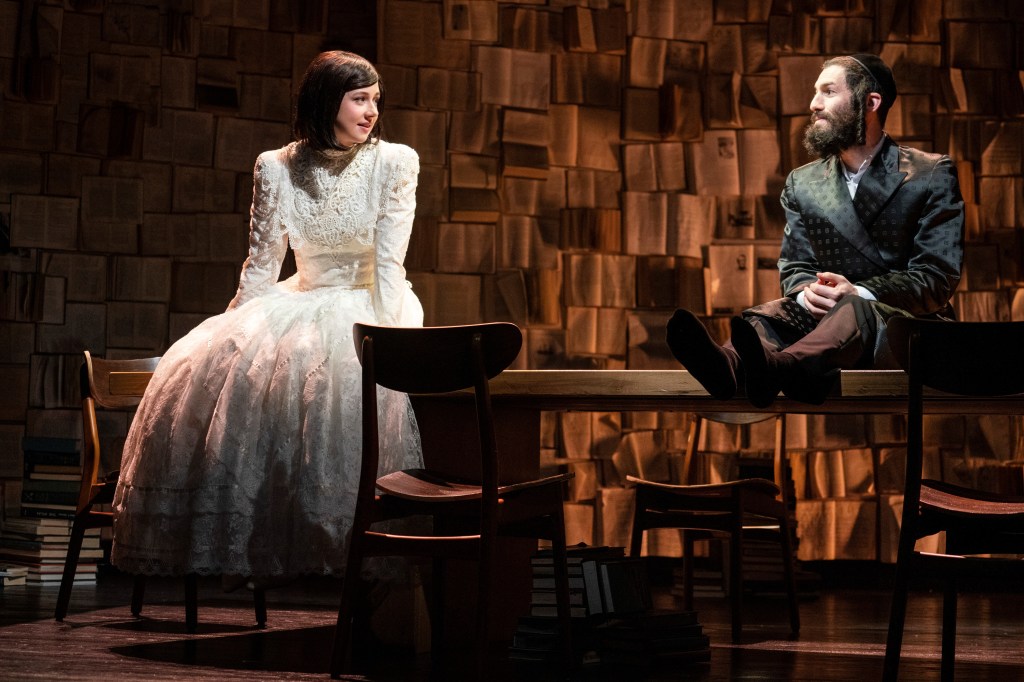
Alternating seemingly disparate lives, two couples actually reveal a similar arc of development, from marriage to divorce in Ann Ziegler’s humorous, cleverly crafted The Wanderers, an exploration of how individuals create their own deceptions, live by them then shatter them, experiencing a fragmentation of self from which they never recover. Acutely directed by Barry Edelstein, and currently enjoying its New York City premiere at Laura Pels Theatre Harold and Miriam Steinberg Center for Theatre, Ziegler’s play runs for 95 minutes with no intermission. Because of its popularity, it has been extended until 2nd April.
Anna Ziedler employs artifice of time and place to gradually promote the revelation of lives lived in quiet desperation and loss, unrealized until trigger moments of clarity occur. Ziegler’s play is ambitious. In it she presents complex, interwoven stories of culture clashes, identities in crises, and the search for happiness when its dream is an illusion created by self-deceptions. She accomplishes this storytelling of two interrelated couples allowing the audience to merge the pieces of the puzzle by the conclusion of this wonderful and gutsy play.

Ziegler introduces us to the central character Sophie (Sarah Cooper) who makes her announcement in present time, circa 2017, that she is divorcing her husband Abe (Eddie Kaye Thomas), whom she has known since she was a teenager. From this point on the play unfolds as a series of flashbacks of the two couples’ conversations. These occur in eight thematic scenes as pointed revelations in sequence, beginning with Abe’s parents Esther (Lucy Freyer) and Schmuli (Dave Klasko). Their conversations Ziegler carefully sculpts to contrast and abut Sophie’s and Abe’s interactions. To comprehend how the characters and their discussions are related, Ziegler keeps us focused on every word of dialogue, some of which is poetic and lovely. In other segments the dialogue is profound and richly thematic about identity, personal yearnings and self-revelation, especially in the scenes between Abe and Julia Cheever (Katie Holmes).
After Sophie introduces the profound metric of separation and divorce in her long marriage with Abe, Ziegler switches to another marriage which appears unrelated but is not. Esther and Schumuli (spoiler alert-Ziegler gradually reveals them to be Abe’s parents), are Hasidic Jews of the Satmar sect. When we meet them, their arranged marriage has just been performed. In a sweet, intimate repartee, they discuss how to begin the consummation of their union. Clearly, Schmuli is the naive one and Esther is forthright, adventurous and maverick, having read books on sex which Schmuli has not. The passive, accepting, dutiful wife Esther doesn’t appear to be in this brief interchange. It is Schmuli who is gentle, hesitant and sweetly anticipating something which he is clueless about.
With just a few defining details, the characterizations of Esther and Schmuli, incisively, sensitively portrayed by Freyer and Klasko, have been set by Ziegler. By the end of the threads of their interactions, which move for nine years through chronologically ordered vignettes that alternate in a revelatory puzzle with Sophie’s and Abe’s interactions, we discover just how rebellious Esther is. Not content with being a house frau with little of her own autonomy and authority to establish a career for herself, we learn that events push her to disavow her identify as a woman who must bow to the paternalistic culture fostered upon women of their sect. After she visits a friend in Albany (spoiler alert-her friend is Sophie’s mom), Esther learns that she can control her own body with birth control pills. After the momentous, life-changing birth of their son Abe, who Esther names “Abe” with great authority, contravening religious ritual, she tells Schmuli she wants no more children.

That Esther is forging out a life beyond the boundaries of their sect and her marriage only is strengthened when her father-in-law prevents her from seeing her daughters. He takes them to live in a household where she will not influence them against their religion. Schumli opposes her taking the pill and “slips” telling his father what Esther told him. It is a severe violation of the sect, whose intentions are to “increase and multiply.” Rather than to subject baby Abe to a life of religious bondage composed of ritual after ritual and still unable to see her daughters, Esther moves out of the neighborhood to raise her son Abe by herself. It is the equivalent of a divorce, though nothing occurs officially. Esther leaves convinced that the “grass is greener,” and she will live a much more fulfilled life out from under the paternalistic oppression of a religion and sect she disagrees with.
Esther and Schumuli’s crises points are revealed in Ziegler’s beautifully crafted dialogue. However, we don’t understand the final revelations and the profound impact of Esther and Schumuli’s crises on Abe and Sophie until the conclusion. That the play gyrates back and forth between the two couples, who mesmerize us to keep track of the details, is part of the enjoyment in solving the mystery which eventually crystallizes. And like the mysteries of lives explored, Ziegler throws in twists and curves, and with artifice, masks them over to create the surprises that happen.
Ziegler uses a conceit to manifest and uncover the hidden elements in the marriage of Sophie and Abe that dovetail with elements of Abe’s parent’s arranged marriage. In both marriages there are external and internal prison bars that keep the individuals from achieving happiness, fulfillment and peace individually and as couples. The conceit comes in the form of celebrity Julia Cheever (Katie Holmes), the character Ziegler uses to manifest the truths that both Sophie and Abe are avoiding in their marriage, their relationship with each other and with themselves.
Abe, who is a Pulitzer Prize winning novelist and success in his field, attends a reading where beautiful, luminous, entertainment star Julie Cheever is present. When Holmes’ Cheever replies to his email, they strike up an intimate and heartfelt conversation and Abe becomes so engrossed with writing to her, Sophie notices that he neglects his own children and their relationship.
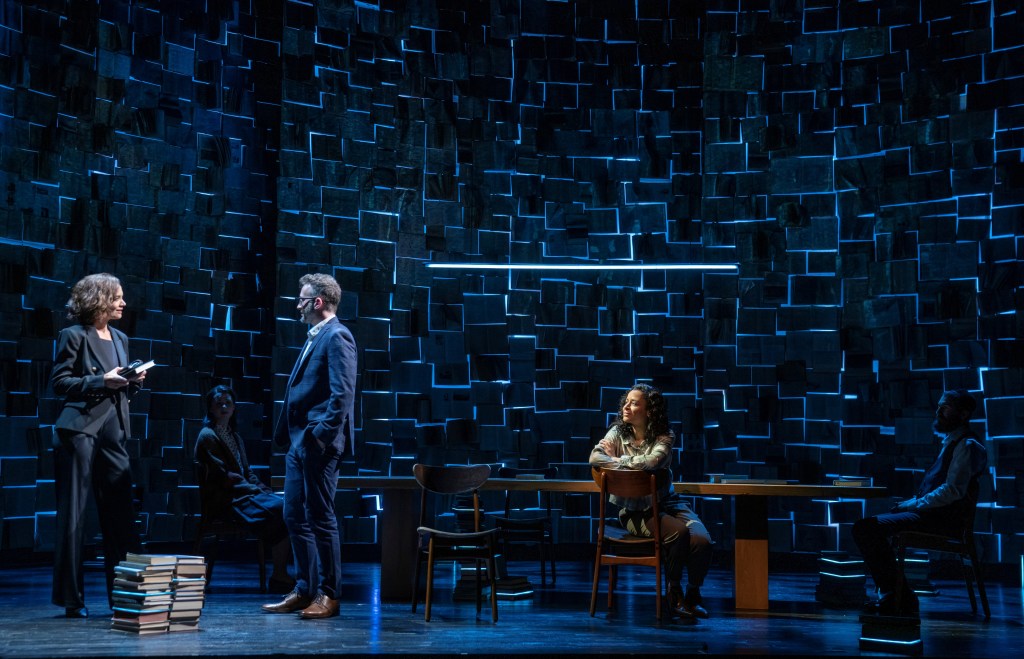
Abe’s and Julia’s email conversations are acted out live by Eddie Kaye Thomas and Katie Holmes. Both actors are excellent and spot-on authentic. The emails are enlivened so that it is as if Julia Cheever is present with Abe, who is over the moon that someone of her celebrity, beauty and intelligence is complimenting him about his work, and inspiring him to discuss his parents and his upbringing. Indeed, Ziegler’s construct supplements Abe’s discussions with Sophie. What is revealed melds and substantiates the revelatory conversations of Esther and Schmuli, though these happened long before Abe was born. Because only Esther raised him, Abe never had an understanding of his father, nor the religion that would have given him power as a man. Raised outside of it without a father role model, he is lost. Though Esther encouraged his love of words and his wonderful success as a writer, as did Sophie, there are gaps in his soul, and his life’s vision is myopic.
As Julia’s and Abe’s online relationship strengthens, eventually Abe wishes to meet her. However, this is not to be. After his father dies, his discussions with Cheever eventually lead to a revelation that is devastating for both Abe and Sophie.
Ziegler’s thematically structured scenes featuring the couples, first appearing disparate, are eventually conjoined. However, unless you read the script, think about the play at length or see it a few times, it is easy to miss the importance of what is happening as a precursor to Schmuli’s death, or understand why Abe decides to re-write and fictionalize how his father died to make his death more beautiful and moving.
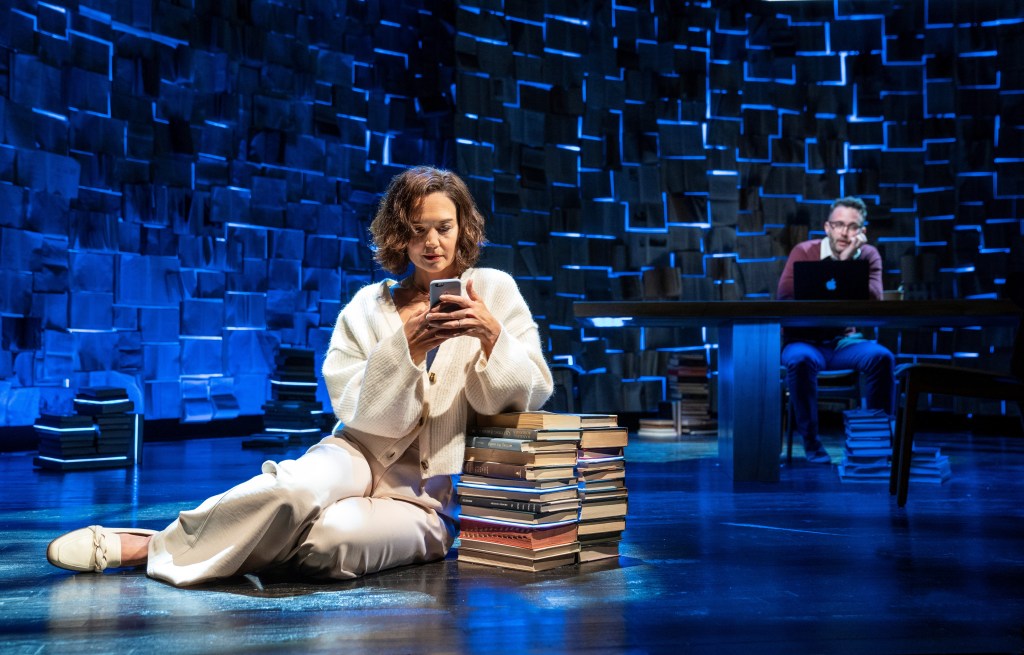
Zielgler’s play is fluid and slips in and out of present and past ,which appear to be concurrent, though they are not. The artifice evokes aspects of consciousness and spirituality that are opaque. Because of the conceit that Ziegler has chosen to use as a vehicle to uncover the mysterious elements of her characters and their lives, the scenes suggest linearity, but for the sake of mystery, they are profound and labyrinthine. Like all flashbacks, the scenes occur as a result of memory. Clearly, the characters nuance the events.
Well acted, the director has finely shepherded this as an ensemble piece, though only the married couples interact with each other. Yet, we feel we know them, know their agony and brilliance which surprise us in their final revelations.
Kudos to Marion Williams for the stylized spare set whose backdrop is populated by pages of books which encompass the great expanse of reading that the characters have accomplished in their lives. A table and some chairs are used to evoke a bedroom and other spaces. And of course there are piles of actual books, almost an anachronism in a digital age. Kudos to other creatives who completed the director’s vision for Ziegler’s play. These include David Israel Reynoso (costume design), Kenneth Posner (lighting design), Jane Shaw (original music & sound design), and Tommy Kurzman (hair and wig design).
The Wanderers is thought-provoking, symbolic and most strongly felt when the superb actors are authentic and in the moment, inhabiting the characters and making them alive. This play has proven itself a must-see by audience word of mouth, for it has garnered an extension. To purchase tickets go to their website.
https://www.roundabouttheatre.org/get-tickets/2022-2023-season/the-wanderers/performances
 CAROLE DI TOSTI