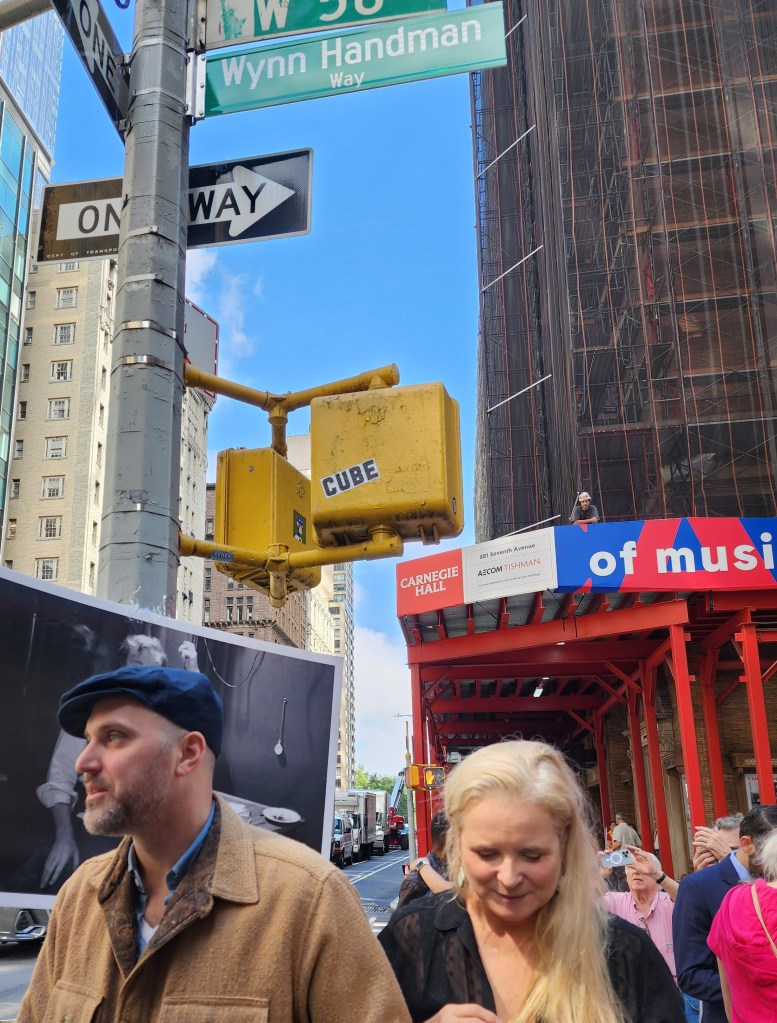
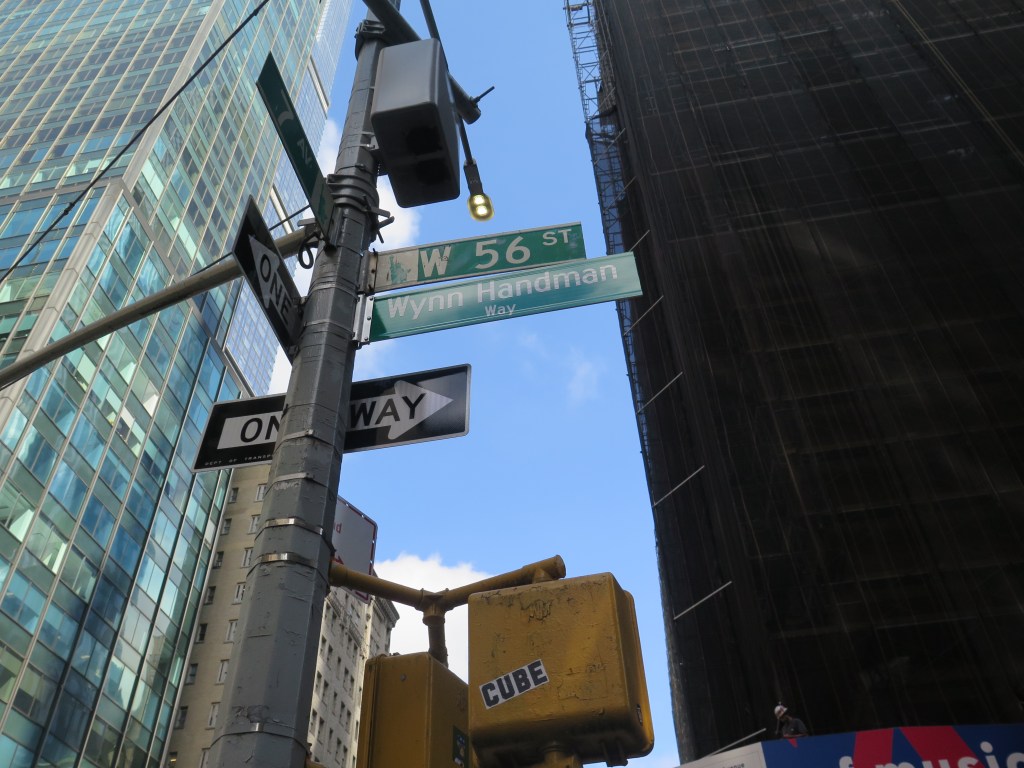
‘Wynn Handman Way’ is THE Way on 56th Between 6th and 7th Avenue in Manhattan
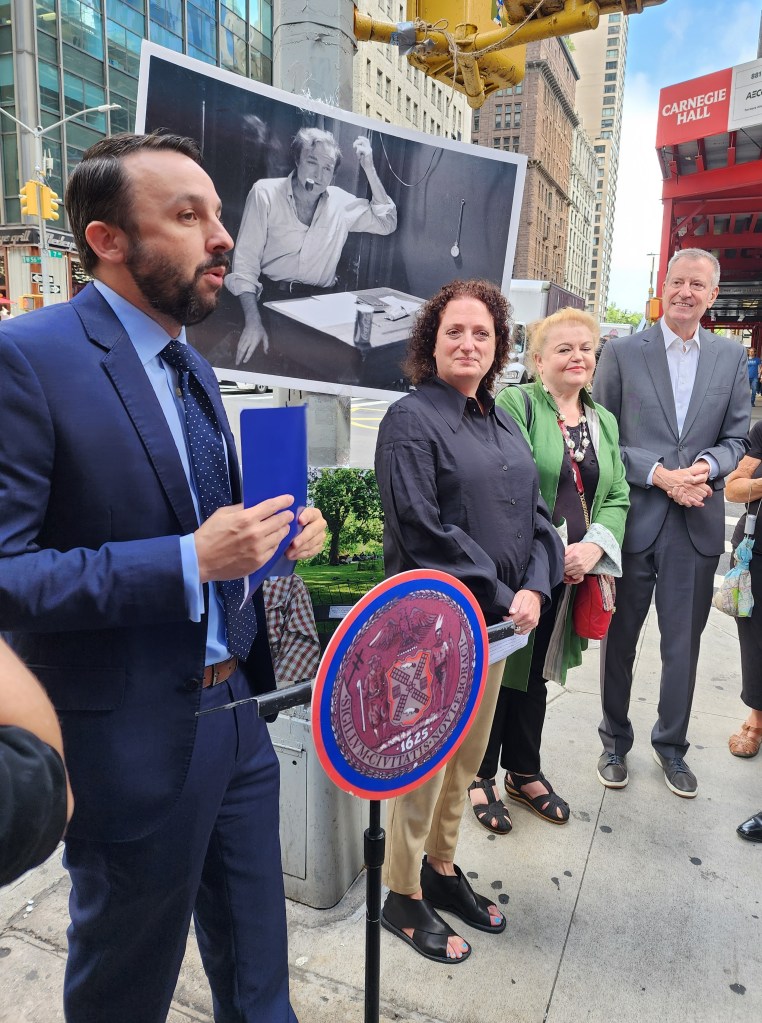
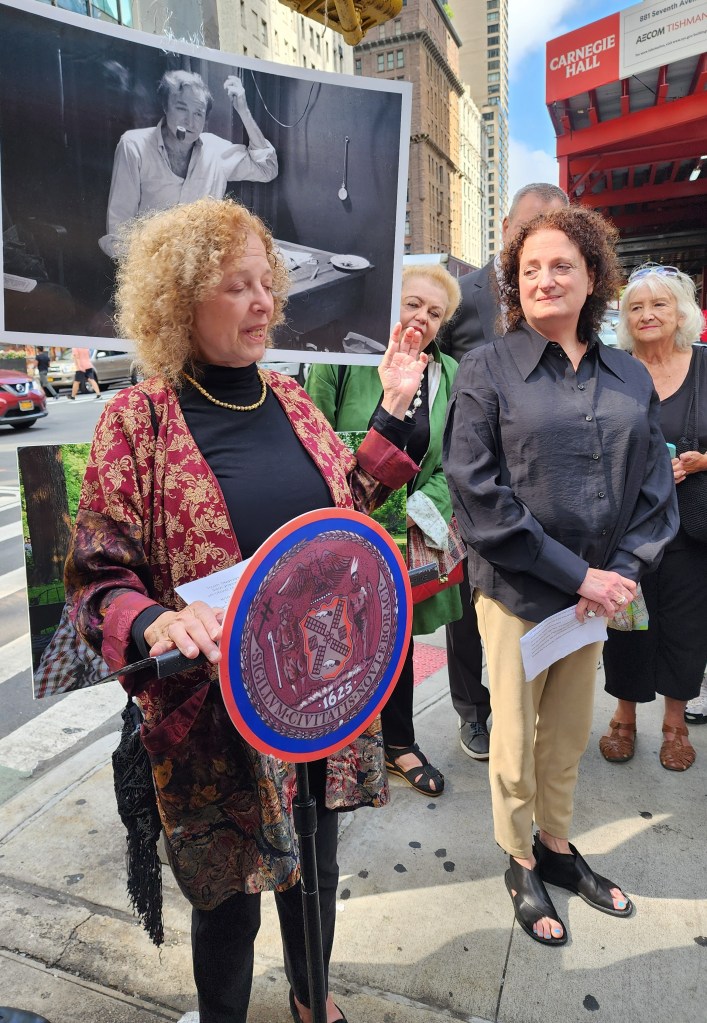
A crowd of friends, Wynn’s daughters Laura, and Liza Handman, close friend, filmmaker, acting teacher Billy Lyons, former Mayor Bill DeBlasio and City Councilman Keith Powers gathered together around 11 AM on the corner of 7th Avenue and 56th Street, September 12, 2022. They were there to celebrate the recognition of Wynn Handman’s prodigious contributions to American theater, American society and New York City with the renaming of 56th St. between 6th and 7th Avenue as “Wynn Handman Way.” This recognition is a long time coming and well deserved, though many may not be familiar with the name Wynn Handman.
Wynn flew under the radar unlike other acting teachers. Reading about Wynn’s life, seeing him in talkbacks, one in 2018 at Tribeca Film Festival after the showing of Billy Lyon’s film on Wynn, It Takes a Lunatic, (a Tribeca review is at this link https://caroleditosti.com/tag/wynn-handman/), one immediately has the sense that Wynn was all about the work. Perhaps the last thing he was interested in was promoting himself or advertising his acting classes. He never did. Yet, somehow, actors who studied with him and later became giants in film and on stage (i.e. Olympia Dukakis, Denzel Washington, Sam Shepard, Michael Douglas, Richard Gere), found out about Wynn and studied with him, realizing it’s all about the work, the authenticity, the humanity of the characters they portrayed.
To study acting with Wynn, one picked up information about him by word of mouth. He was down-to-earth, authentic, loving. At the Wynn Handman Street Sign Dedication, those who knew and loved him best, his daughters Liza and Laura and his friend and filmmaker biographer of Wynn, Billy Lyons, spoke fondly about Wynn. What a boon to study acting with him and be in his presence and in the presence of others studying with him. Just to be a fly on the wall would have been enough. However, if you were accepted after you auditioned, you worked, and worked hard.
Wynn Handman was the Artistic Director of The American Place Theatre, which he co-founded with Sidney Lanier and Michael Tolan in 1963. Going against the grain and a maverick for his time, Wynn engaged with Lanier and Tolan because they understood the vitality of theater to change lives and improve cultural understanding and awareness, making us more humane and empathetic. With these goals in mind and many more, Wynn and the others intended to encourage, train, and present new and exciting writing and acting talent and to develop and produce new plays by living American playwrights and writers.
As a change agent, The American Place Theatre was one of the first not-for-profit theaters in NYC. Unlike the current mission of non profits which sometimes appears to serve the CEOs and not the actors, creatives and playwrights, The American Place Theatre was dedicated solely to the development of new American playwrights and writers. Writers whose work was developed and produced there included Robert Lowell, Maria Irene Fornes, William Alfred, Ron Milner, C Frank Chin, Sam Shepard, Ron Tavel, Joyce Carol Oates, Clare Coss, William Hauptman, Jeff Wanshel, and solo performers Bill Irwin, Eric Bogosian, John Leguizamo and Aasif Mandvi, to name a few.
The American Place Theatre moved to a custom-built basement complex in 1970. The complex at 111 West 46th Street, operated until 2002. The organization received several dozen Village Voice Obie Awards and AUDELCO Awards for excellence in Black Theater.
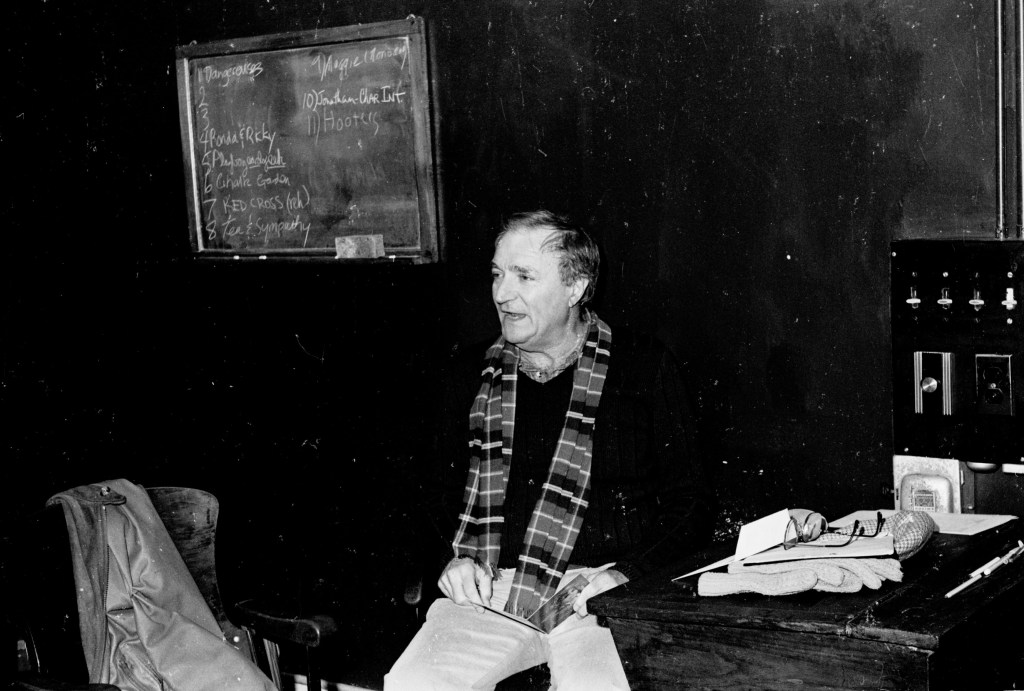
Always at the forefront of innovation with the intent to impact the New York City community, in 1994 friends and members, led by Wynn under the auspices of The American Place Theatre, created a Literature to Life program. The program adapted significant works of American literature to encourage literacy. Performed by solo actors, productions were offered to middle schools and high schools. Wynn Handman directed a number of projects. Also, Elise Thoron directed other projects; currently she heads up the program. To continue with the vital importance of literacy and theater’s place in revitalizing young people’s interest in reading, Project 451, a funding initiative of Literature to Life came into being during the 2008/2009 season. The mission is to ensure that reading, writing, and the arts remain a primary component of the education of young American citizens.
In the videos above City Councilman Keith Powers and former Mayor Bill DeBlasio underscore the great contributions Wynn Handman made to the New York City community and American theater. Funding, which has become problematic with skyrocketing city rents and the focus on purely commercial shows, has modified the impact of innovation, risk-taking and genius in the theater arts, and other processes and attributes that Wynn Handman prized.
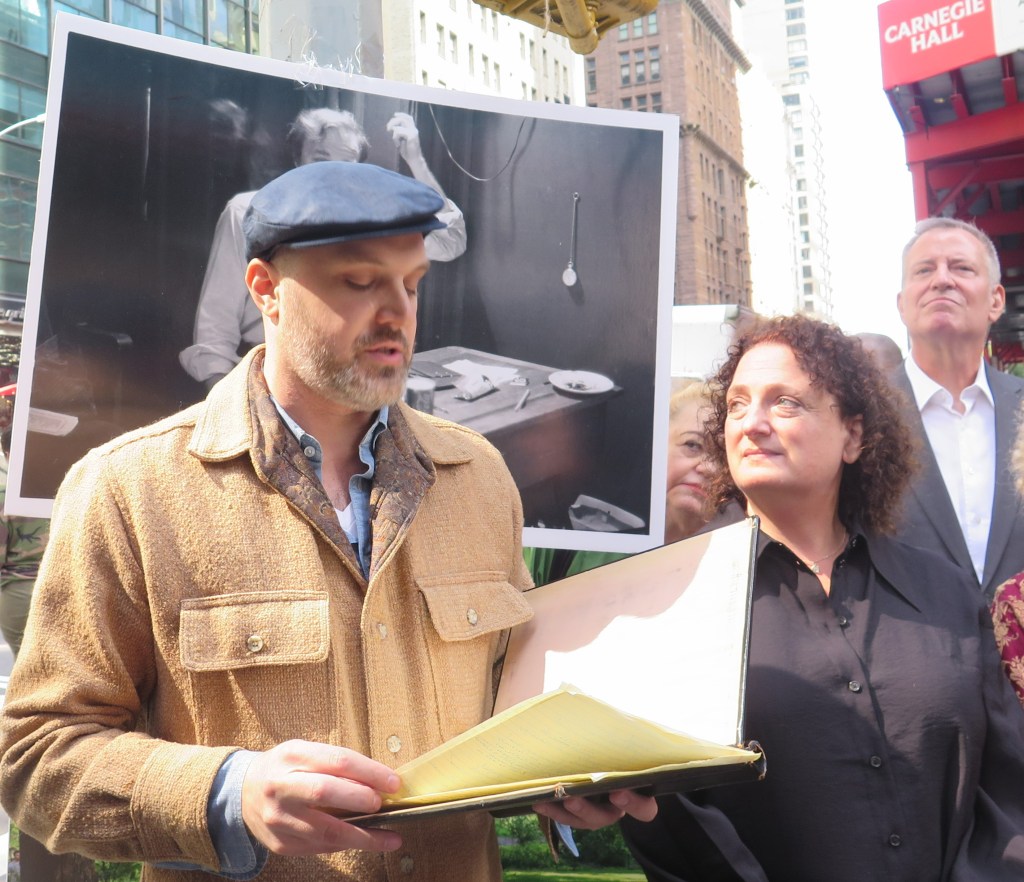
In his remarks Billy Lyons stated that Wynn told him not to fret or worry about American theater and the direction in which it appeared to be going. He said in effect, “Don’t be a “Miniver Cheevy.” Wynn’s reference to the Edwin Arlington Robinson poetic portrait of “Miniver Cheevy,” a man who mourned the glories of the past and drowned himself in drink, is apt. How comfortable it would be for theater to rest on the laurels of past great American playwrights, and quail at producing those who exemplify the unique, original, current and “off the charts” shows. How facile to put away the maverick and the daring for the sake of commercial success. Don’t fail has become the unspoken meme wafting through the psyches of those in the theater arts.
Indeed, the innovations in American theater have been occluded by rapacious Philistines quick to produce a Jukebox Musical, easy to finance a show adapted from a film that has a “sure-fire,” lucrative track record. There is nothing wrong with that. And yet, there is everything wrong with that. Is balance possible beyond Off Broadway and non-profits which overly reward the institution and give short shrift to the creatives?

To be forward thinking, as Wynn would have theater artists and producers be, then failure is something not to be feared. Above all the “critics” must understand the necessity of “Dynamic Theater,” which dares to fail to reemerge with new insights and new genius. Perhaps, in many respects, American theater over the past decades has been failing abysmally, though the box office looks good. There are plenty of anecdotes about shows whose audiences needed to catch up to their brilliance, doing better the second and third time around, when the time was “right and ripe.” Perhaps formulaic success is not an option, except in small doses. Isn’t a modicum of realignment necessary? After the ravages of COVID, it might be as good a time as any to innovate and take risks (i.e. Daryl Roth’s Kinky Boots reboot with reasonable ticket prices).

What to do in this shifting financial climate? We must rely on the generosity of those who have the abundant resources to share (private and government), so that they might bring ticket prices down, bring rentals down and establish more foundations to help subsidize the artists (actors, technicians, creatives), who live and work in New York City and justify its renown as the “#2 theater capital of the world.” If Wynn Handman has been a guiding light toward theater’s evolution, his “lunacy” must continue in theater’s bravest of hearts (producers, directors, actors, creatives), and all those willing to dedicate themselves to forge anew American theater’s next chapters.
‘The Butcher Boy’ Irish Rep’s Brilliant Production, A Review

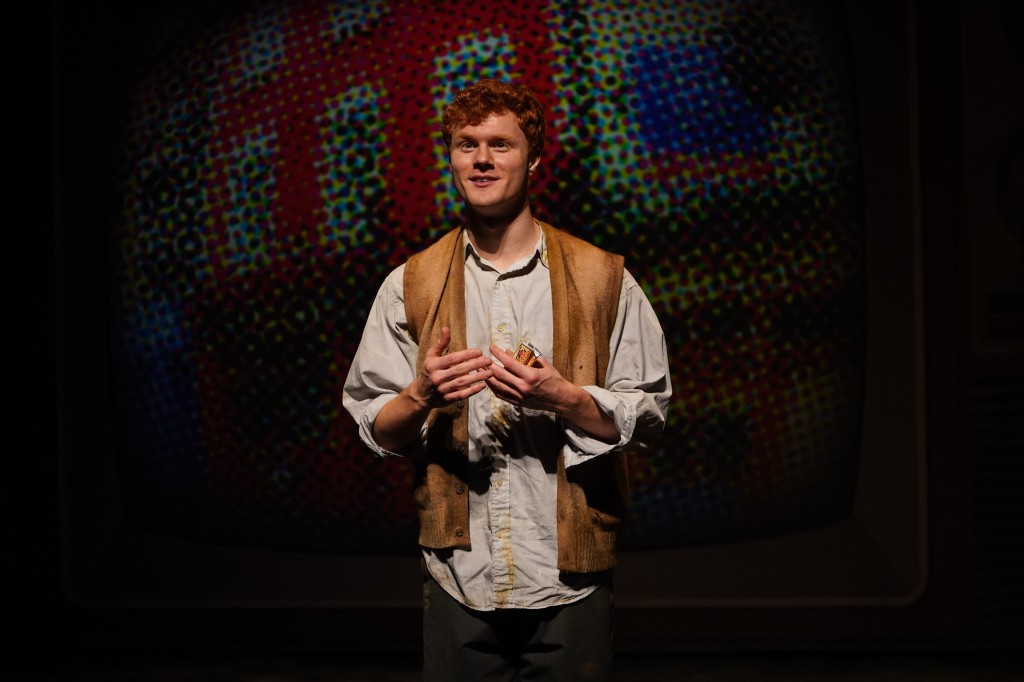
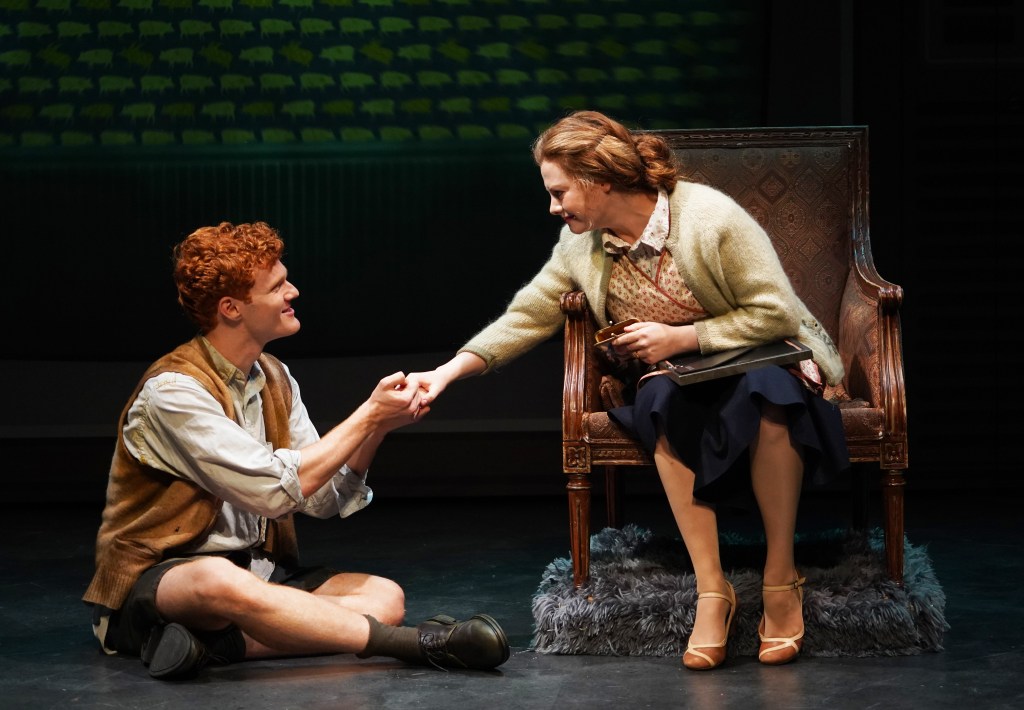
From the initial moments when Nicholas Barasch’s Francie Brady introduces himself to us with wide-eyed innocence and enthusiasm in Irish Repertory Theatre’s The Butcher Boy, we are mesmerized by his beauty and youthful vitality. Director Ciarán O’Reilly’s choice of actor is spot-on, for Barasch with openhanded good will carries us into the depths of Francie’s mind-bending phantasmagoria that leads him to a psychotic abyss from which he most probably will never escape.
The Butcher Boy, a new musical fashioned by the uber talented Asher Muldoon, who wrote the book, music and lyrics, is based on Patrick McCabe’s titular novel, which also engendered an award winning film adaptation that McCabe helped co-write. The novel won the 1992 Irish Times Irish Literature Prize for Fiction and was shortlisted for the 1992 Booker Prize.
Muldoon, who, with Sammy Grob accomplished the orchestrations and vocal arrangements, has created a genius work that will be controversial because it is refreshingly “out there” and unique. In the Playbill, the playwright discusses being enamored of the novel as a junior in high school. Muldoon’s passion propelled him to focus all of his talents on creating a musical adaptation that is prescient, strangely heartfelt, darkly ironic and tragicomic. Thanks to the director, cast and creatives, this amazing production lingers in one’s memory long after one leaves the Francis J. Greenburger Mainstage of the Irish Repertory Theatre, where The Butcher Boy currently runs until 11th of September.
O’Reilly’s vision of Francie’s world merges fantasy with reality creating an extraordinary surreality through which we understand the flashback vignettes that Francie Brady presents about his childhood. In Francie’s narration one may wonder if he is reliable, and as his descriptions to the audience enthrall us, we know he is not. However, that is not the point. What is the point is the emotional content which he confides to us that gains our sympathy. In a straight-forward manner he reveals how he takes his own form of vengeance on a narrow-minded town that offers him few opportunities to be anything other than what it defines him to be. Agree with him or disagree, his story is authentic, comedic and poignant. Considering the current state of the world and young men his age who are desperate for many reasons, it is also very believable.
Using a well conceived set design by Charlie Corcoran dominated by a large TV screen center stage upon which various thematic projections play out, O’Reilly highlights Francie and friend Joe Purcell’s escapism into the television shows of the time, i.e. The Twilight Zone and the The Lone Ranger, revealing their powerful influence on impressionable minds. Along with comic books whose memes cover their board slatted “hideaway” that lines the outer walls of the stage and boxes in the action, we realize how Francie and Joe (Christian Strange), are shaped by 1950s-1960s media.

Television, newspapers, magazines, comics magnify cultural entertainment curiosities and heighten fears of aliens, communists, monsters and the threat of nuclear annihilation. Muldoon peppers some of Francie’s memories with these notions, as he presents this time in Francie’s life of beginnings and endings, of happiness and loss, of friendship and peace, which devolve into increasing humiliation and chaos, after triggering events set Francie’s alienation in motion.
Spurred on by Joe’s idea, Francie and Joe run off with classmate Philip Nugent’s comic books. Mrs. Nugent (Michele Ragusa), visits Francie’s Ma (Andrea Lynn Green), censuring Francie and Joe for their abuse of Phillip (Daniel Marconi). Instead of appealing to Francie’s and Joe’s sense of honor to return the comics and restore good will between the families, Mrs. Nugent takes the punitive, vengeful approach. With classist arrogance, she insults mother Annie and blames Francie’s actions on his “disgraceful,” alcoholic Da. She cruelly carps that Annie’s husband isn’t raising their son properly because he’s a drunk and stays in bars from “morning to midnight.”
Mrs. Nugent’s indelible words “he’s no better than a pig, a pig,” imprint Francie’s mind with the full force of condemnation and verbal emotional abuse that neither Annie nor Francie can adequately defend against with clever, rebounding wit. They take in her scornful denunciation, like a blow to the head that knocks them unconscious. It is a blow from which Francie never recovers.
For Annie and Francie Mrs. Nugent’s abusive, humiliating words ring with a “truth,” whose obvious malice is meant to destroy. Da (Scott Stangland), beats “sense” into Francie, despite Annie’s protest, as Francie finishes singing the song he and Joe exuberantly started at the top of the play, “Live Like This Forever.” During his father’s abuse, Francie reminisces about this “sweet and simple time,” singing as his father beats him, “if we lived like this forever, we’d be fine.”
We note the irony in this flashback, as Francie presents the seminal event from his past. Indeed, if this shameful time is “sweet,” what terrible events will come where Francie and his parents “are not fine?” This is the first in a series of turning points when Francie reveals incidents after which he and his parents never gain solid footing again, as they live in “the bog life” of the small town, where everyone knows everyone else’s business, and mores embrace “upright,” Catholic behavior. Such fine behavior eludes the Brady family.
The Nugent incident most probably sets off Annie into despairing her situation. As a Catholic, she is unable to divorce an alcoholic husband who doesn’t work. One day Francie finds her standing on a table with a fuse wire looped like a noose, hanging suspended from the ceiling. When she “goes away,” after suffering a nervous breakdown, Francie understands that she was taken to “the garage” for repairs. Interestingly, her breakdown incites Francie to a comedic expression of rage, when on the highroad, he meets Mrs. Nugent and Phillip, enemies and authors of his demise. Francie confronts them, but not with the truth of how much Mrs. Nugent devastated him with her comments. He can’t articulate his emotional state, because he is incapable of verbalizing his sense of injustice and hurt at her judgment of him and his family. His behavior reveals he most probably agrees with her excoriation which he internalizes in an act of self-annihilation.
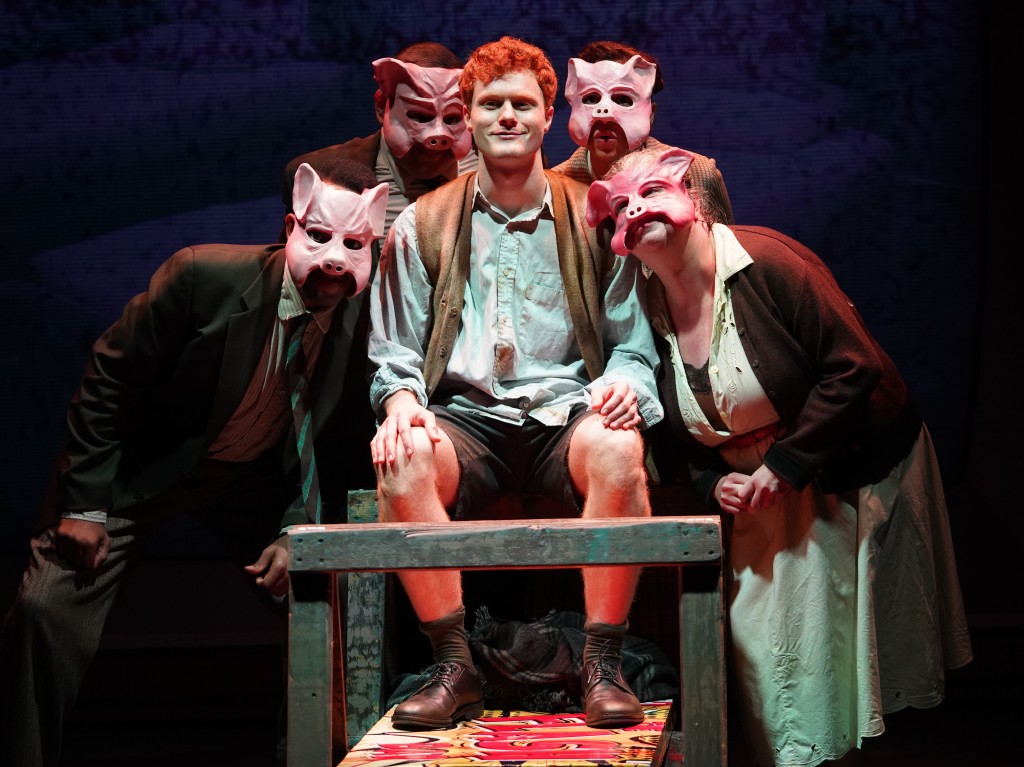
Unable to ignore her, his rage erupts in a clever ruse. He warns her that she and Phillip must pay the “Pig Poll Tax” to pass by him, the guard, who will protect them from the ranging piggies who may have gotten loose from their sty. His imaginative, bullying lie is escapist and funny, but it is also an incredibly sinister beginning to the end of his “sweet” childhood. As he demands payment for protection, Francie psychically hallucinates four pigs who become his companions (“Big Fat Piggies!”). Manifestations of his fury and rebellion against a class that rejects him, the piggies lead him on a tragic course that predictably ends in Francie’s embodying the title of the musical.
Though Phillip and Mrs. Nugent don’t see the piggies (David Baida, Carey Rebecca Brown, Polly McKie, Teddy Trice), the malevolent creatures materialize in macabre half masks. They sing, ridicule, cavort and dance, thanks to the choreography of Barry McNabb. Francie answers Mrs. Nugent’s damning label by using the piggy metaphor as a weapon against her and Phillip. The piggies suggest they will infiltrate the town and soon, “no one will know who is you and who is a piggy anymore.”
Inferred is the understanding that all, including Francie, are piggies that are capable of terrible mischief and evil, unless they are controlled. But who has the power to stop insidious thoughts before they materialize into acts of piggy violence? Furthermore, can an insulting condemnation that, like a bomb, vaporizes the soul of a child, ever be properly answered? Or is the wound, that never heals, a permanent debility framing their life, as they carry it with them into adulthood? The musical conveys these questions and thematically answers them by the conclusion.
Francie’s clever use of Mrs. Nugent’s insult to sardonically reply with a monetary demand for protection against a threat of future piggy violence, allows him to disconnect from her humanity, as she has disconnected from his with her epithet. However, Francie’s imagination takes this to an extreme. With the emergence of the four piggies, who haunt him until the musical concludes, it is clear Francie has internalized the pig metaphor in self-hatred. Tragically, neither his mother nor his emotionally removed father give him the tools to understand, negotiate around and forgive Mrs. Nugent’s classist, un-Christian attitude. Left to his own devices, his psyche rebounds into fantasy and comic book heroes, and the strange talking piggies, who emerge whenever they like.
The four piggies become his interactive companions, signifying Francie’s deteriorating mental state. They torture him to “live down” to Mrs. Nugent’s definition of the Brady family as pigs. They encourage him to deeds that are invariably anti-social, dangerous, aggressive and frighteningly rebellious.
As events unfold, Francie’s home situation worsens. His mother returns, sprung out of the psychiatric hospital to prepare for Uncle Alo’s yearly visit. She bakes cakes in a flurry of activity. Hypersensitive to gossip, Francie is aware of the townspeople’s view of his mother and the Brady family. However, many show up to the party Annie and Da hold for Uncle Alo (Joe Cassidy). Though the occasion begins with uplifting hope (“My Lovelies”), Da reveals the truth of Uncle Alo’s situation and embarrasses him in front of the party guests. A fight ensues and Francie realizes that he can’t tolerate the hellishness of his home life, so he escapes with the piggies to Dublin (“Ride Out!”).
On this fantastic journey where he imagines he can have adventures like a TV hero, he finds affection from a family who takes him in for a while. Though he lies about his identity, he manages to strike a rapport with William (Joe Cassidy), and Kathleen (Michele Ragusa), who sing optimistically about their lives, despite the depressing threat of nuclear war (“Still Here”). Their optimism is a key to their good nature and kindness toward Francie. The couple parallels his Uncle Alo and former love Kathleen, so they are a comfort to Francie. Additionally, he has a sweet conversational interlude with their daughter Mary (Kerry Conte), who forgives his theft from the cash drawer of the shop where she works, after he promises not to make trouble for her.
During the time he is in Dublin, he writes to Joe who chides Francie for leaving him behind. Without Francie near, Phillip approaches Joe to be friends. Because he is lonely, he accepts Phillip’s friendship (“Phillip’s Song”). Whether wittingly or not, Phillip’s divide and conquer strategy works. Francie is upset about any friendship between Joe and Phillip, encouraged to anger by the pigs who torment Francie about it. Joe is converted to Phillip’s lifestyle, which Francie ridicules and Joe defends. Provoked by the pigs, who increasingly dominate his world, Francie fears losing Joe’s friendship. What he fears eventually comes upon him.
It is after the lovely interlude with Mary, whom he asks to marry him, the pleasant respite of relative normalcy with a kind-hearted family and lovely daughter ends abruptly. To the surprise of William and Kathleen, Da, who Francie told them was dead, collects his son, and they return home to a devilish situation. Annie has drowned herself in the pond. Unable to appropriately grieve, Francie is caught up with Nugent’s statement about “the Bradys.” She and town gossips once more have proven that the Brady family are “out of control,” subjects for pity and gossip, which Francie knows is said about him. The piggies stir him to anger and paranoia (“Francie Gets Mad”).
Lashing out, unable to cope with his mother’s suicide, Francie’s psychotic emotional state converges in a series of events where he attempts to get revenge on Phillip. He is stopped by Joe who promises in a blood oath to maintain his friendship with Francie. It is an oath that Joe betrays in the second act, completely won over to the classist Nugents, ascribing to their lifestyle. Enamored by the Nugent’s status, Joe turns his back on Francie, who he rejects completely by the end of Act II. However, assured by their blood oath, Francie attempts to be “good,” but cannot help but humorously mock the Nugents during an imagined absurdist scene where he has tea with them (the superb props for this scene reflect his ridicule of their pretensions).
When he makes a faux pas and embarrasses himself during tea, he rebels against their notions of polite, well mannered society. He trashes their house, encouraged by his piggy companions (“The Magnificent Francie Brady/The School for Pigs”), and does something uncouth, unspeakable and very funny (seamlessly rendered by the creative team), which scandalizes the town and proves Francie is indeed the pig Mrs. Nugent declared him to be. The townspeople talk about Francie’s “act” years later. They are so hypocritically shocked by his impropriety.
As Act I ends, the creatives have authentically brought to life Francie’s world in a panorama of surreal, phantasmagoria, which he has come to depend upon to survive. It is an imagined reality where he increasingly fights off the bitter ugliness of his pitiable circumstances. Defiantly using hallucinated creatures as weapons to embody his emotional urges, whims and eruptions of anger, he exacts his revenge against his enemies, almost everyone. Confused, dislocated that it is he, himself, who effects the paranoid danger, he revels in self-destruction..
Enhancing Francie’s world and devolution, Muldoon’s lighthearted music (a combination of lyrical pop, ballads and Irish influenced tunes directed by David Hancock Turner), is incredibly sardonic. The melodies in which the piggies show up are especially so, as they dance and evilly insinuate their presence into Francie’s inner life and outer actions. The pleasant lyricism conveys tragedy in a clash of potent, antithetical forces which are as intentionally jarring as Francie’s downhill descent into madness, superbly rendered by Barasch.
Clearly, Muldoon reflects novelist McCabe’s themes of classism, bigotry, social hypocrisy, media escapism that exacerbates psychosis, as well as the ineffectiveness of mores and religion to humanly help individuals like the suffering Francie. Above all, Muldoon and the creative team in this wonderfully realized production remind us that inhumanity begins with cultural, socioeconomic divisions of superior and inferior people, instead of viewing the human community with equanimity. The extent to which Mrs. Nugent’s defamation harms Francie’s soul, reveals how hate and violence crescendos in a terrible chain reaction that affects all in the town.
Like a fly caught in a spider’s web of malice, Francie cannot extricate himself from internalized self-damage. The bits of kindness and feeling he experiences from friend Joe, his Ma, his Uncle Alo, Kathleen and the Dublin family are too briefly felt to counteract his illness and propel him onto a path of self-love and self-forgiveness. When he attempts to seek redemption from his piggy inner state with visions of Mother Mary, the hope she brings is a betrayal and a canard, luring him to an apotheosis of violence at the play’s end.
If Francie fails, it is because religion, family, friendship, townspeople fail him. All unwittingly cooperate in this endeavor and a potentially fine human being is cut down and butchered by all who contribute. Indeed if “No Man Is an Island,” as the John Donne poem states, Francie and the town surely exemplify this to a terrible degree.
The class distinction between Francie, Joe and the Nugents is suggested subtly in Charlie Corcoran’s set design of the meticulous Nugent kitchen with cabinets and a counter top covered by a lovely, white, flowery, embroidered cloth. These elements are in direct contrast to the Brady household which is minimalist and stylized. For example, events and props define the Brady space: a table set up with cakes here, a chair which Da sits in there. By comparison, theirs is a shabby, opaque space that others like Mrs. Nugent may write upon with arrogant insult.
From costume design (Orla Long), lighting design (Kat C. Zhou), sound design (M. Florian Staab), production design (Dan Scully), mask design (Stanley Allan Sherman), and properties (Brandy Hoang Collier), we are brought into Francie’s unforgettable world with empathy, as we stand in his shoes and feel the personal terror of what he experiences. In its radical extremist point of view, the production succeeds in allowing us to feel Francie’s pain and his unique and astounding configurations to rid himself of it.
The ensemble are first-rate talents; the leads have lovely, strong voices. Barasch, Strange and Marconi are exceptional together, inhabiting the iterations of boyhood, reflecting diverse personalities and morphing with subtle nuance as they grow into adulthood. Onstage in each scene, continually pouring out of himself, Barasch gives an incredible, moment to moment performance, peeling back the veil to show us the development of Francie’s psychotic mind.
This is a vital musical and incredibly current. Though the setting takes place sixty years in the past in Clones, Ireland, the situation and title character remind us of the teenagers of Columbine, Virginia Tech, Marjorie Stoneman Douglas High School and Ulvade, Texas. Clearly, The Butcher Boy in whatever form, film, novel, musical is continually prescient, revealing failures in every institution that should support children. And on a human, personal level, it reminds us that presumptuous, classist, arrogant words tinged with hatred, show the wickedness of the speaker’s heart, not the ones labeled.
Irish Repertory Theatre’s production is rich with meaning and profound with empathy. It is one to see. For tickets and times go to their website: https://irishrep.org/tickets/
‘Into the Woods’ Review: Glorious Revival Highlights Sondheim’s Masterwork as Uproariously Funny, Sonorously Poignant
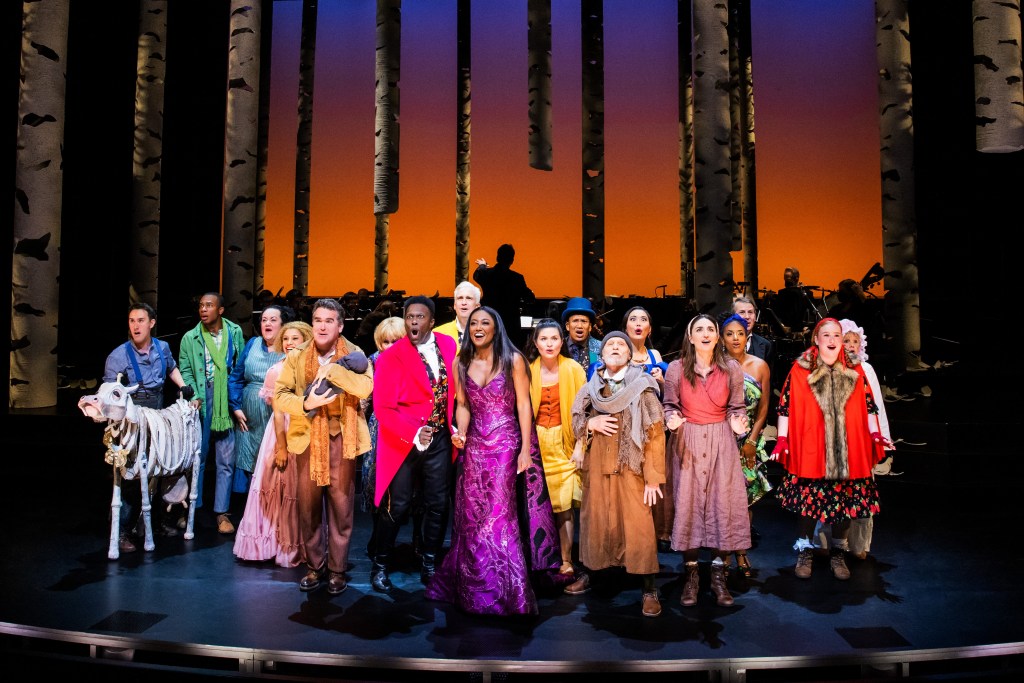
With music and lyrics by Stephen Sondheim, book by James Lapine and orchestrations by Jonathan Tunick, Into the Woods is in its brilliant fourth revival on Broadway at the St. James Theatre. This iteration magnifies the greatness of Sondheim’s iconic work with affecting power. Thanks to the cast and creative team, the production is a towering achievement.
Intricately making the complex crystal clear, the creatives have woven fantasy and magic into stylized perfection. The company conveys Sondheim’s sharply, ironic lyrics and Lapine’s clever, comedic book with campy authenticity that befits the tone of the production. All the while the cast twits their characters and performances with sheer abandon and fun.

If fairy tales embody archetypes that float in and out of our unconscious, this Into the Woods reveals how and why. Ancient folklore transfixes us because ultimately, it is immutable and intensely personal. Lapine and Sondheim have given us Into the Woods as a gift of wonder and wisdom and the amazing director (Lear deBessonet), has channeled their vision with grace and beauty that touches our souls.

Transferring from New York City Center Encores!, deBessonet’s metaphoric, symbolic, slimmed down production continues to thrill enthusiastic audiences as it takes them on the familiar roller coaster ride of highs and lows with humor, pathos, and sterling performances by an exquisite cast. The multitalented actors with comic flair portray the indelible Little Red Riding Hood, Cinderella, the Witch, two Prince Charmings and more. They romp with delight in Act I and with the searing edginess of moment and bitterness, they shed their “happy” in Act II. The two acts encompass the whole of our life’s experience; it is satisfying yet bittersweet as illumination becomes the true prize of living.
This production is bar none fabulous and appropriate thematic fare for young and old who have encountered their share of giants, witches and adventures into dark, foreboding places. The characters’ journey quest is the linchpin to the fulfillment of their dreams, not only returning wisdom and enlightenment, but moving them from innocence to experience. And the music, Sondheim’s soaring melodies are sensational. Presented by the golden-voiced cast and accompanied by The Encores! Orchestra under Rob Berman’s fine direction, the score has staying power that remains with one long after the audience’s raucous standing ovations end at the last curtain call.

Indeed, de Bessonet’s vision of minimalist staging, pared-down scenic design (David Rockwell), spare lighting design (Tyler Micoleau), and Andrea Hood’s unpretentious costume design work beautifully. Without costly extravagances and unencumbered by visual distractions, we are totally focused on the music, lyrics, and acutely spun characterizations portrayed by the actors’ dynamic performances.
For example the settings of the three families (Cinderella’s, the Baker and his wife, Jack and his mother), are suggested with old-fashioned cut-outs of their homes, suspended above their playing area as their family interactions and conflicts unravel. Rockwell’s suspended birch tree trunks suggest the sinister forest of shadowy fears all must confront. Combined with Micoleau’s atmospheric lighting and large evocative moon that rises and falls to “light the way,” the elements summon the surreal and illusive.

Additionally, Andrea Hood’s apt color-coded costumes define each character with particularity and interest. For example she employs primary hues (bright yellow and red jackets), for the comedic, over-the-top Prince Charmings. For the earthy folk heroes with whom we identify, she fashions rosey browns for the Baker and his wife. Their grounded dream to have a baby is one couples might most identify with.
Splendid, spot-on performances by Sara Bareilles as the Baker’s Wife and Brian d’Arcy James as the Baker showcase the common folk and the experiences of marriage. As a beautifully blended husband and wife team who must confront and satisfy Patina Miller’s scary-funny witch to fulfill their baby dream, the actors are in lockstep. Their duet “It Takes Two,” knocks it out of the park. Bareilles’ interpretation of a wife who controls her husband by surreptitiously winding her way around his machismo is brilliant. The audience catches her every nuance, every shrug of the shoulders. For his part D’arcy James’ pretend bravery masking fear is so aptly humorous. And in Act II d’Arcy James “No More,” sung with David Patrick Kelly’s Mysterious Man is heartrending. Our emotions are swept up as we agree there must be an end to the seasons of pain between fathers and sons, parents and children.
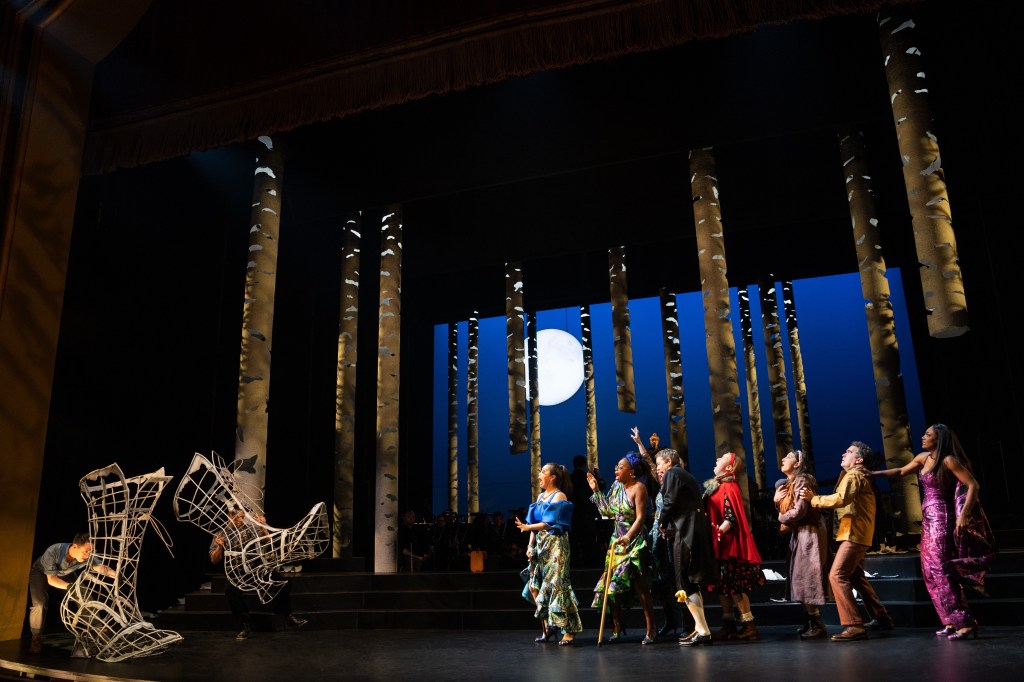
The two Prince Charmings, Gavin Creel and Joshua Henry, have choreographed their movements to represent the ineluctable adornments of seduction with verve and just enough hyperbole to make them deliciously palatable and hysterical (“Agony”). The wonderful Phillipa Soo’s dreaming Cinderella who sings her feelings with Bareilles’ Baker’s Wife resonates with beauty and humor (“A Very Nice Prince”). Soo’s awkward, klutzy Cinderella who falls every time she joins the Baker’s wife “lands.” Soo always gets a laugh as the audience appreciates the dreamy, ditzy humanity of this princess-to-be who humiliates herself. Indeed, we also appreciate that Cinderella is much more astute in Act II when the realities of her marriage to the Prince confront her full force.

Julia Lester’s Little Red Riding Hood plays to the audience, breaking the fourth wall with success as one of the most beloved of fairy-tale characters. As Little Red, Lester scarfs down all the treats before she makes it to grandma’s house. Thus, Gavin Creel’s Wolf is all the more satisfied after he scarfs her down. Their scene together is uproarious (“Hello, Little Girl”). Creel’s seducer Wolf is appropriately smarmy which Lester tweaks as the less-than-innocent Little Red, who enjoys tempting him.

Creel does double duty as seducer of the Baker’s Wife. Bareilles’ formerly faithful wife in Act I submits to the wolf Prince Charming in Act II (“Any Moment”), seeking something more. Creel pulls out all stops recalling to our remembrance the wolf metaphor in Act I. Princes and wolves are two sides of the same coin, Sondheim and Lapine intelligently note. And Bareilles’ “Moments in the Woods” is poignant and foreboding. Do Lapine and Sondheim punish the Baker’s wife’s behavior as an adulteress? Interestingly, the Prince’s wanderings receive no such comeuppance. Double standards are ever-present and especially when unlike fairy tales, Act II extends into the consequences beyond the artificial, “happily ever after.”

Jack (the superb Cole Thompson), his mother (Aymee Garcia), and the cow Milky White (the sensational puppeteer Kennedy Kanagawa), form the third household. Thompson’s heartfelt “I Guess This Is Goodbye,” and rousing “Giants in the Sky,” are beautifully rendered. The vibrant “Giants in the Sky” Jack sings to inspire himself with courage to save his family, kill the giant and attain the wealth his mother needs. As Jack, Thompson’s stirring faith and hope resound with triumph.

The Witch is the central figure that eventually brings the company together. Patina Miller lives up to the task with her extraordinary performance before and after her transformation when the curse that holds her from her true nature is broken. We understand her love for Rapunzel (Alysia Velez), in the soulful “Stay With Me,” and the tragedy of her daughter’s loss in Act II in “Witch’s Lament.” Perhaps my favorite is Sondheim’s incredible “Last Midnight,” that she sings with power and all the dynamism she can muster. Miller’s performance of the song is memorable as the claws of the giant’s wife (voiced by Annie Golden), enfold her in destruction. Indeed, also with the last song “Children Will Listen” that Miller sings with the Company, she is just stunning.
In Act II the consequences of apparently naive actions performed without thought converge on the main characters who seek to avoid blame in the wonderful “Your Fault.” However, after the death of the Witch and the Baker decrying “No More,” a bittersweet hope returns in the remaining song, “No One Is Alone,” sung by Cinderella, Little Red, the Baker and Jack, who struggle to encourage each other after their losses. Was the journey worth what it taught the seekers? “Children Will Listen,” sung by the Witch and the entire company brings back to life the spirit of those taken by the Giant’s Wife as they relate the lessons learned. We are uplifted and restored by the illumination.
Kudos and praise go to additional creatives not mentioned before. These include Lorin Latarro (choreography), Scott Lehrer and Alex Neumann (sound designers), James Ortiz (puppet designer), Cookie Jordan (hair, wigs & makeup designer), Seymour Redd Press/Kimberlee Wertz (music coordinators).
I have said enough. Go see this marvelous theatrical event which you will not be able to see again with this cast after September 4th. For tickets and times go to their website: https://intothewoodsbway.com/
‘The Kite Runner’ Resounds With Poignancy and Profound, Personal Intimacy.
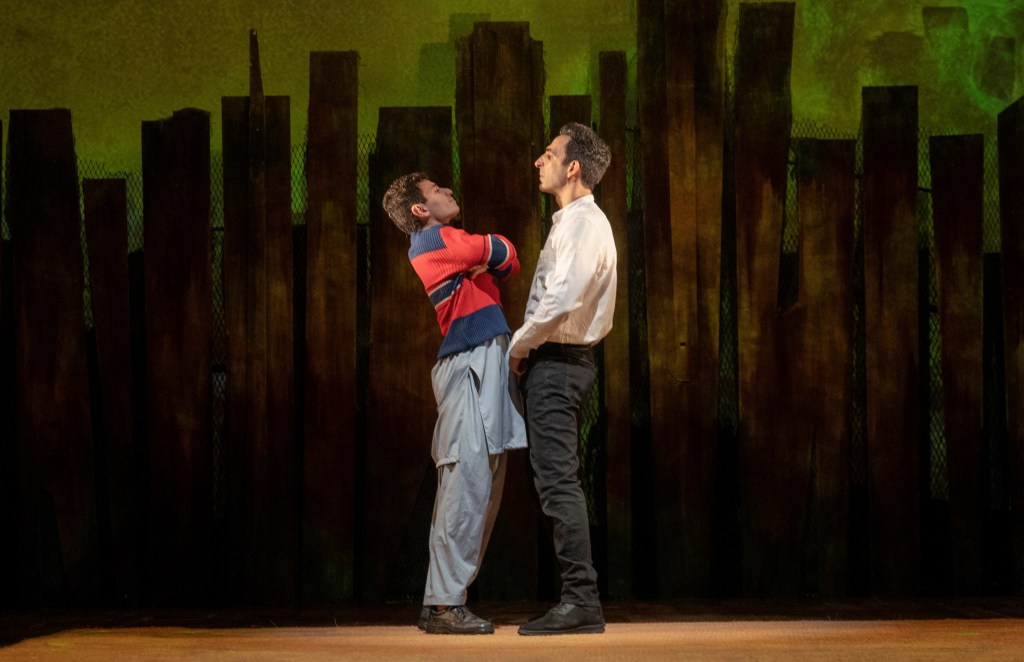
Rarely in life do we have the opportunity for second chances, to reverse the most dire, pitiful and hateful moments of our lives and transform them with aching hope toward acts of kindness, decency and courage. This resurrection of hope toward faith in God is integral to Matthew Spangler’s adaptation of The Kite Runner, based on the best-selling novel by Khaled Hosseini, currently running at the Helen Hayes Theater on 44th Street in New York City.
Acutely, The Kite Runner is a story of relationships. These abide between father and son, between servant and master, between friends who are in fact brothers. There is also the relationship the individual has with himself. In the instance of the protagonist Amir (portrayed with aplomb and fearless generosity by Amir Arison), this relationship reveals his struggle as a divided self, unable to overcome his sin of cowardice, fear and guilt that leads to self-betrayal and betrayal of those who love him.

In the play the relationships are further tested against the backdrop of a an economically, culturally and politically roiling Afghanistan, where Pashtuns (Sunni Muslims) have historically oppressed Hazaras (Shi’a Muslims). When the monarchy, which has managed to control the economic, religious and political divides eventually topples in 1975, chaos follows. This chaos spawns the major conflict of the play as Pashtuns and Hazaras attempt to survive in the new political landscape.
However, before that de-stabilization occurs, we witness the peaceful, prosperous life of Amir with his father Baba (Faran Tahir), though Amir feels that sometimes his father hates and despises him as a weakling. Baba is a wealthy businessman, who retains his servant Ali (Evan Zes), and his son Hassan (Eric Sirakian), like members of his family for forty years, despite their being lower class Hazaras. Baba and Amir are non- practicing Westernized Pashtuns. Years later when Amir returns on a mission of redemption and forgiveness, an Afghani driver characterizes him and Baba as “tourists,” superficially Afghani. Since Baba raises Amir without attention to strict religious observances and pretensions about class, the closeness and love between Baba and Ali and their sons is heartening.

In fact the beautiful friendship the boys have in a then peaceful Afghanistan is so well acted by Arison’s Amir and Eric Sirakian’s Hassan, that we nearly forget Amir’s warning comments at the top of the play, “I became what I am today at the age of twelve. It’s wrong what you say about the past about how you can bury it, because the past claws its way out.” Amir, who narrates throughout makes these comments in San Francisco almost twenty-five years later as a warning salvo before he relates the flashback of haunting events with Hassan. These are events with which we identify because of their intense poignancy and emotional grist that transcend culture, language, religious and classist differences. These seminal and particularly resonant scenes of Amir’s life with Hassan, fly like kites to the heart of our shared human experiences, revealing psychic flaws and mortal humanity.
After Amir’s warning comments, director Giles Croft’s vision of an idyllic, happy Afghanistan before the political upheavals is poetically suggested and elucidated as Amir’s wistful memories with the ensemble onstage. Croft employs the kite and sail metaphor in the props and scenic design to link Amir from the kites he watches being flown in San Francisco in 2001, as the threaded memory that brings him back to his time in Kabul, Afghanistan in 1973.

Arison takes on the mannerisms and stance of a younger self as he plays “cowboys and Indians” with his friend Hassan, who importantly remains the same age throughout the play in his enthusiastic, vibrant and noble self. Of course, this is as it must be because this is Amir’s memory of Hassan, who disappears, never to be seen again, after the negatively defining incident that impacts Amir’s life for twenty-five years.
Tabla Artist Salar Nader provides the melodic drumming as Arison’s Amir narrates and steps in and out of the action seamlessly against Barney George’s minimalist scenic design, a fence, enhanced by William Simpson’s projection design and Charles Balfour’s lighting design. These artistic elements effect various places along Amir’s journey into self-torment which takes him from Afghanistan to the US, then back to Afghanistan and back again to the U.S.

Croft establishes the setting in the flashback as an elusive but powerful memory. Spangler uses the dialogue in Farsi as Amir and Hasan play, which conveys the beauty of the time and the poetic rhythms of the language. It is rarely used afterward, except for an exclamatory effect or a “hello” or “goodbye.” We enjoy the bond of these two boys who have gone beyond their classes and religions to find the spiritual element which always remains but which Amir loses after his self-described sin and act of infamy against Hassan, Ali and Baba. But caught up in the joy of their youthful and free relationship, we forget what Amir says that he buried in his past that claws him back. We join them in play, as the literate Amir carves their names in a pomegranate tree as the Sultans of Kabul. And Amir reads to Hassan from a favorite story about which we discover later ironically relates to Hassan’s and Amir’s relationship to Baba.
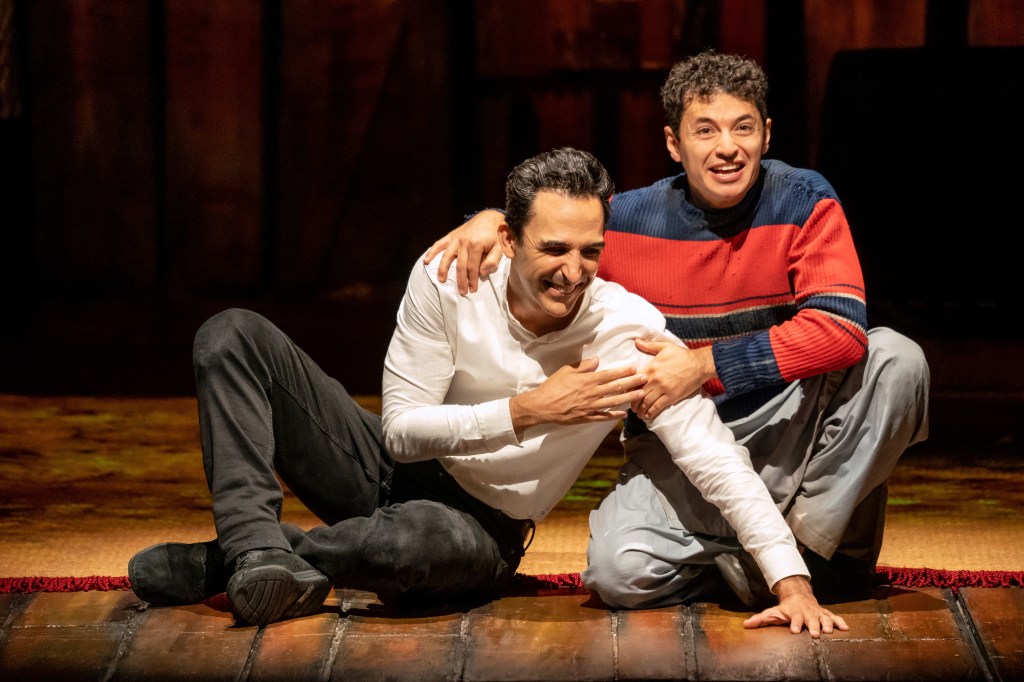
We get a flavor of this pleasant Afghanistan from these elements along with the two pieces of patterned curtain arranged prettily as two halves of a sail reminiscent of a kite as a backdrop for certain scenes. Amir familiarizes us with his relationship with Hassan as his friend who is one year younger. Yet, he indicates that always there is the distinction that Hassan is a servant, though Baba appears to love him, showering him with the same presents for his birthday that Amir receives. One gift we see is a cowboy hat which, of course, Amir has to put on and wear also.
Like two peas in a pod, the boys are motherless; Amir’s mother died giving birth to him, which Amir credits being one reason for Baba’s anger at him. And Hassan’s mother ran away to join a troop of actors and musicians, which was a fate worse than death in Afghanistan. Thus, both fathers must raise their sons without wives, though Baba has girlfriends and comes home late ignoring Amir who is lonely and insecure. Amir’s sole comfort comes from his friendship with Hassan. On the other hand, Ali is always there for Hassan, who has an inner core of strength, love and confidence.
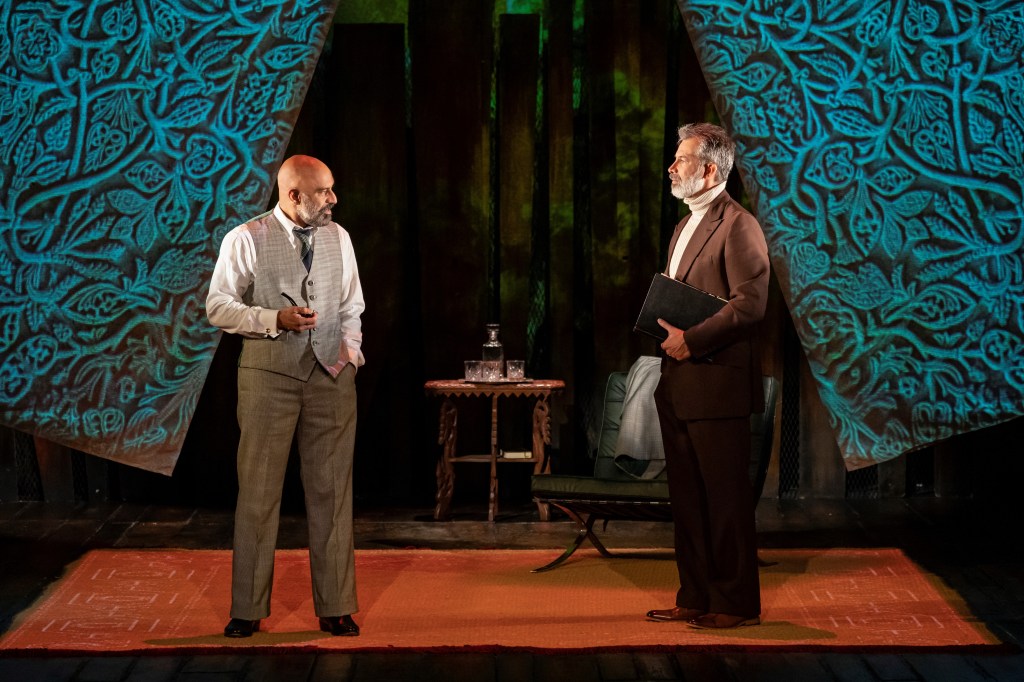
Spangler’s characterizations run deep and the actors make the most of the nuances in conveying the explanation of why Amir behaves as cruelly as he does. Though Hassan demonstrates love and faithfulness to Amir, whom he considers his best friend, Amir is incapable of returning this honor. Thus, as the myth goes, when Hassan learned to speak, the first word he said was “Amir.” For Amir the tragedy is that he has to understand and accept the love and faithfulness that Hassan has for him. He doesn’t. To our chagrin, though Arison makes Amir likeable, we discover that Amir is incapable of showing love and loyalty to anyone. So when the boys meet up with Assef (Amir Malaklou), a bigoted Pashtun bully, Amir behaves like a coward wussy, while Hassan fearlessly protects them both with his attitude, his innate courage and confidence. Also, he is a crackerjack with his slingshot which helps save the day.

Crofts stages the kite fighting tournament as the high point of Hassan’s and Amir’s relationship with excitement and verve, as the actors pantomime the cutting of the kite strings. Hassan, as the best kite runner, anticipates where the last “enemy” kite will fall. Securing that kite will be the prize that forever emblazons Amir and Hassan as the best team at kite fighting. However, when Hassan runs after the blue kite, Asseff and his gang intercept him. Asseff cannot brook losing the tournament to an unworthy blood polluted Hazaras. To punish and humiliate Hassan, he demeans him sexually in a cultural defilement and sin, which Amir hears happening from a hidden position. Amir is too frightened to help Hassan beat off the gang, because he believes himself to be too much of a wussy to stand up to Assef’s tyranny. Amir runs away, embarrassed and ashamed. What would Baba think?

After this incident on the day that Amir achieves his father’s praise for winning the tournament, he is desolate. Amir yearns for an elusive peace and freedom from guilt and self-torment in not helping Hassan. Amir’s sin of cowardice and lie of omission blossoms into overwhelming self-recrimination that causes him to project his self-hatred onto Hassan. Rather than to face the truth of his own inner weakness, he accuses Hassan of theft, one of the worst acts Baba says a man can commit. When questioned, Hassan admits he has stolen to protect Amir from Baba’s wrath, because both Ali and Hassan understand the reason why Amir has dishonored them.
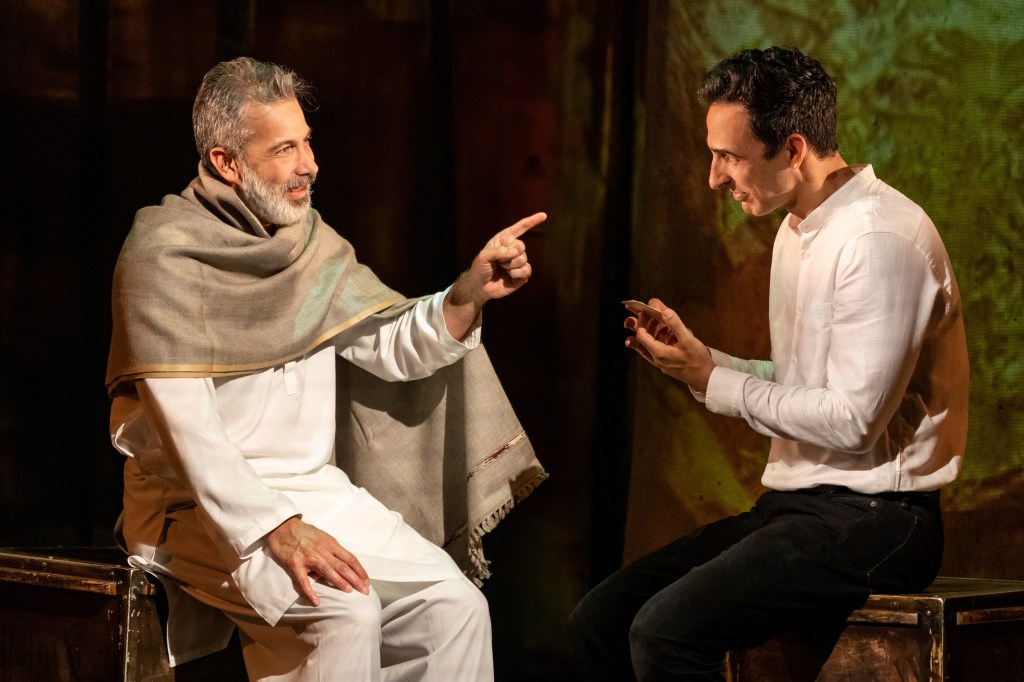
Baba forgives Hassan the theft and expects Ali and Hassan to go on as before. However, Ali and Hassan leave the household to maintain their honor. Ironically, Amir is even more ashamed of his wickedness because once again, Hassan has protected him out of the strength of sacrificial love in a move that is Christ-like. Amir’s is a monstrous act because Hassan the younger, the “low class” Hazaras is the more honorable, kinder and more loving person. Amir must face that he is a two-fold liar, a coward and an unworthy human being.
Amir’s unconscious guilt and self-recrimination consign him to a life of self-torment, until he allows himself to be redeemed by a call from Baba’s former business partner Rahim Khan (Dariush Kashani) who tells him, “Come see me. There is a way to be good again.” This is the opportunity to make amends to Hassan’s son Sohrab. Wisely, Croft casts Eric Sirakian as Hassan and Sohrab. Sirakian is absolutely terrific in both roles. And in Act II when Sohrab begs not to be taken to an orphanage where he will be harmed, he breaks your heart.

Interwoven in the relationships of Spangler’s adaptation are all the Shakespearean verities and vices elevated: sacrificial love and forgiveness, betrayal of self and those closest to us, unforgiveness, sadism and wanton cruelty leveled on an innocent who sacrifices himself for love and friendship. And these processes are pitted against the fateful opportunity to reverse the course of personal destiny and transform self-loathing to empowerme,nt, love and acceptance. Amir eventually is brought to his second chance in Act II. Interestingly, it is the time of the Taliban ascendancy to the point of despotic tribalism and murder.
Though he doesn’t believe in the religious observances, Assef’s bullying psychotic nature has found its true purpose to torture and kill in Taliban Afghanistan. That Amir must face his old demons of guilt, cowardice and fear to confront his nemesis Assef, fight him and escape with Sohrab, who Assef has kidnapped, is an incredible journey toward Amir’s personal closure and reconciliation with God.

If anything The Kite Runner underscores Amir as an Everyman, who reaches the bottom of his own personal abyss to seek forgiveness which helps him understand the meaning of “brotherly” love, the sacrificial love that his childhood friend Hassan (the marvelous, heartfelt Eric Sirakian) unquestioningly, gracefully bestows upon him.
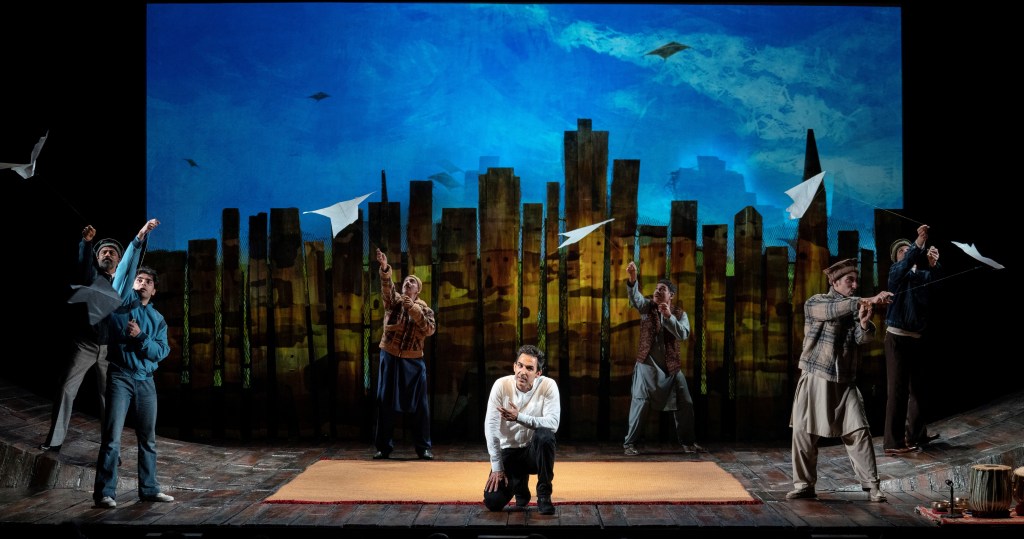
This imagistic, stylized production fades in and out of the epic in its cultural scope and breadth of events that take place between 1973 and 2001 in Afghanistan from monarchy, to republic, to communist coup, to Russian invasion, and Taliban takeover. Amir’s journey moves to Pakistan and San Francisco then back and forth again. With brief phrases of language at the beginning and sprinkled here and there, that reflect cultural authenticity, the fateful story emerges. Amir narrates and we witness vignettes that explore Amir’s evolution as a worthy human being. Arison does a yeoman’s job with a challenging role that spans decades and keeps him onstage until the intermission, then brings him back until the conclusion. With the music of the tabla drums, the singing bowls and the schwirrbogen, we find the rhythms of the culture always pulsating, to remind us of the vitality of history and ancestry.
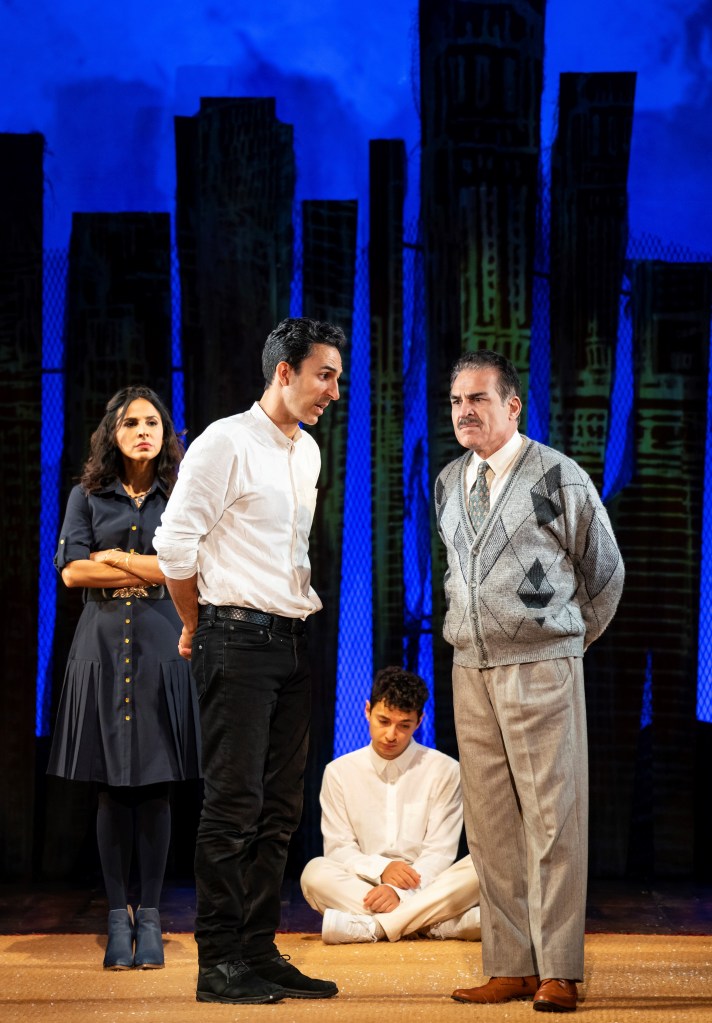
This is a fine adaptation and resounding, soulful production whose themes are immutable and current. Praise goes to the ensemble and Giles Croft who shepherds them to move like a synchronized pageant. Kudos goes to the Drew Baumohl (sound design), Jonathan Girling (composer and music supervisor), Kitty Winter (movement director) and Salar Nader (tabla artist and additional arrangements), as well as the other creatives previously mentioned.
The Kite Runner is at the Helen Hayes Theater for a limited engagement that ends 30 October. This is one not to miss for its acting, its stunning vibrance, poignancy and heart. For tickets and times go to their website: https://thekiterunnerbroadway.com/
‘Notre Dame de Paris’ at Lincoln Center is Just Smashing!

For the first time in its twenty-four year history since its premiere in Paris, France in 1998, Notre Dame de Paris makes its New York City debut. The acclaimed musical spectacular has toured internationally, featuring successful productions in Canada, Italy, Lebanon, Singapore, Japan, Turkey and China. Performed in 23 countries and translated into nine languages, accumulating an enthusiastic 15 million spectators worldwide, the production at the David H. Koch Theater at Lincoln Center premiered on the 13th of July and runs through, Sunday, 24 July.
Notre Dame de Paris extravagantly directed by Gilles Maheu is a transcendent, opera-styled musical rendering of Victor Hugo’s novel The Hunchback of Notre Dame. Based on Hugo’s monumental work of passion, love, lust, jealousy, cultural transformation, racism, classism and misogyny, the Notre Dame cathedral is the centerpiece around which most of the whirling action of this spectacle takes place.
It is there in front of the massive stones being set in the opening scene, Gingoire (the exceptional Gian Marco Schiaretti), introduces the cathedral in “Le Temps des cathedrals.” In the square in front of Notre Dame we meet the stratified economic classes of Paris, i.e. the undocumented immigrants who seek asylum and sleep in front of the cathedral. It is from there that the action leads out to the streets of Paris, beyond and back again. Thus, throughout, the cathedral becomes a moral, spiritual, ironic presence. It signifies a religion that encourages brotherly/sisterly love but rarely lives up to its aspirations in the actions of the clerics and the classist citizenry we meet.
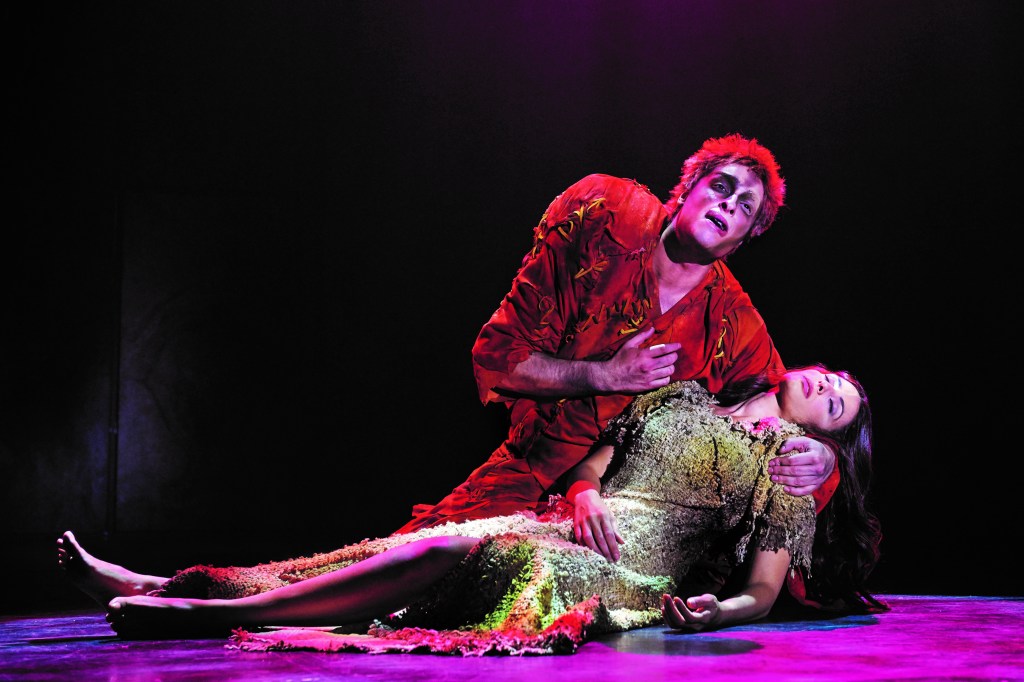
Luc Plamondon’s lyrics propel the arc of development in composer Richard Cocciante’s sung-through, pop-rock, people’s opera. Generally, the almost three hour production follows Hugo’s novel, omitting minor characters that lightly impact the plot of the original work.
Cocciante’s florid music and Plamondon’s pop-rock lyrics comprise a total of 51 separate songs. Many of these are lyrical ballads describing the principal characters’ feelings about the situations they find themselves in. Others are powerful anthems, like the gorgeous signature song “La Temps des cathedrals,” and “Florence,” when Frollo and Gingoire discuss how Gutenberg’s printing press and Luther’s 95 Thesis will kill the old Paris and the cathedral as they make way for the new in the roiling undercurrents of society, as immigrants flood the city bringing with them new trends and transformations as they swell the population of Paris.
Live musicians accompany pre-recorded tracks performed in French with English surtitles provided on two screens to the left and right of the stage. Unlike opera the performers’ voices are electronically enhanced. At times one focuses more on sound than the quality of the performance. But all the principals have gorgeous voices and their talents are memorable and exquisite for this amazing, iconic musical epic.
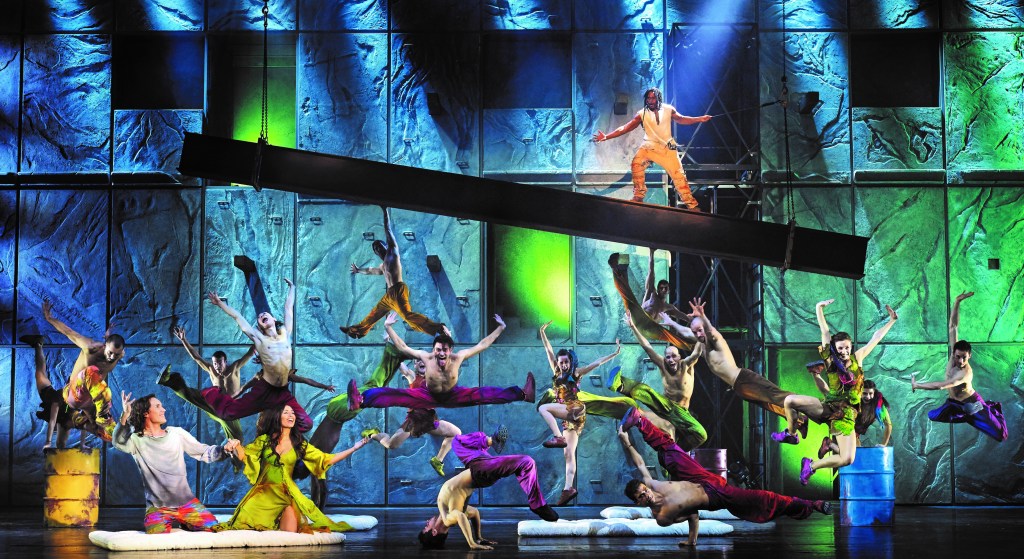
There are seven principal characters who represent the inner and outer circles of the populace. These include Gingoire the poet and narrator who codifies the settings around Paris and introduces the characters and situations. Gingoire is the herald who announces the shifts in action. He moves among the Parisians and is a friend of those who have status like Frollo the Archdeacon of Notre Dame (the superb Daniel Lavoie). Floating among the undocumented immigrants Gingoire gets to know Clopin and Esmeralda in Act I, proving he is no respecter of classes and persons. In Act II he informs Clopin (Jay), the leader of the undocumented immigrants, that Esmeralda is in prison. Gringoire is present to understand how the immigrants try to come to Esmeralda’s aid to no avail. Her gender, her striking beauty, her class and above all her destiny, damns her.
In his movements around the city when Gringoire stumbles into the wretched Court of Miracles, it is then he becomes acquainted with Clopin (Jay) and Esmeralda (Hiba Tawaji). Situated outside the city walls, the ironically named court is the den of the impoverished undocumented, and the city’s outcasts. Clopin has created his own set of rules for the Court of Miracles that those who live there must follow. Kindly, he protects teenager Esmeralda allowing her to take refuge in the Court. Like a brother, he warns her against being too trusting of men.
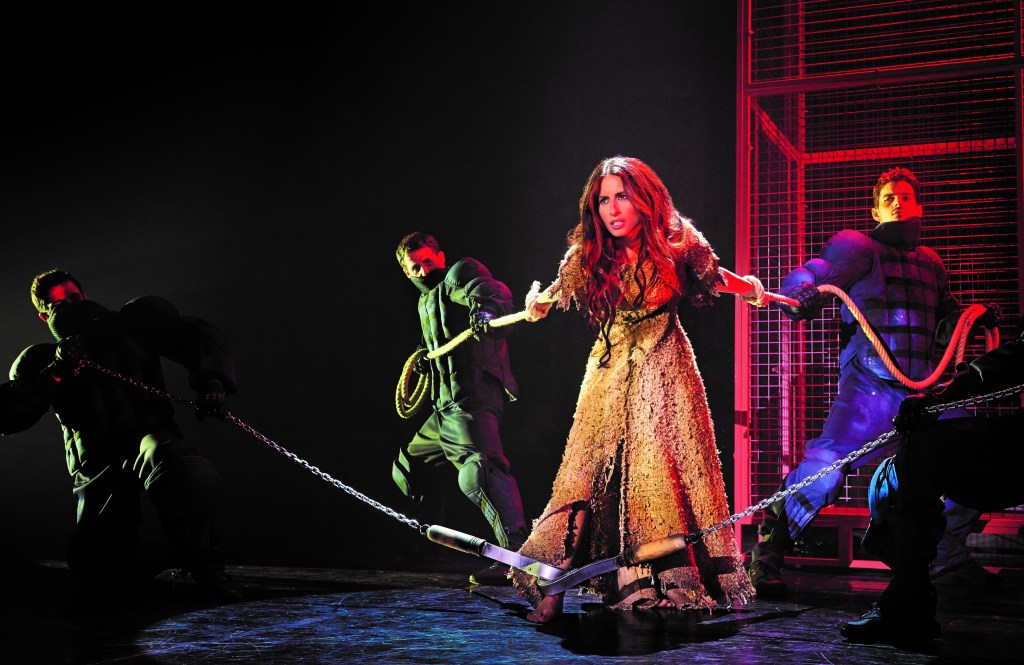
Emeralda, a Bohemian from Spain is the catalyst who moves the action and emblazons the passions of men to love, hate or exploit her. As she prettily dances in the square, she unfortunately attracts the attention of the men of power, Archdeacon Frollo and Phoebus (Yvan Pedneault), captain of the King’s cavalry. They both want her. She becomes the vulnerable pawn who they attempt to exploit, abuse, then expediently toss away. Her youth, innocence and beauty are the fatal instruments that contribute to effecting her demise as the men wantonly pursue her sexual affections. The only one whose love she returns is Phoebus. However, he is pledged to marry a woman of consequence and class, Fleur-de-Lys (Emma Lépine). Eventually, he chooses a life of unhappiness with Fleur-de Lys because it is one which satisfies his need for stature and security though it is empty of love and pleasure.
Quasimodo, the lame, hunchback bell ringer also notes Esmeralda’s beauty and unhappily contrasts himself with her. She is someone he wishes to love but he knows it would be an impossibility. To confirm his “celebrity” as the most externally loathsome of all creatures, he is crowned “The King of Fools” in the songs “La Fête des fous” and “Le Pape des fous.”
Staged as frenetic, wildly antic numbers that involve the large cast, we watch as five acrobats, two breakers, and sixteen dancers, all of them marvelously talented, hurl themselves across the stage, spin and gyrate. These two numbers are visually exciting as most of the songs which combine dance are. Importantly, they create empathy, revealing how Quasimodo is treated by a world that worships physical loveliness and eschews deformity. However, Esmeralda has a kind heart and wishes that all humanity could become like brothers/sisters with no boundaries. She makes a connection of consciousness with him. Quasimodo becomes Esmeralda’s chief protector after she gives him a drink during his punishment for attempting to kidnap her on Frollo’s orders.
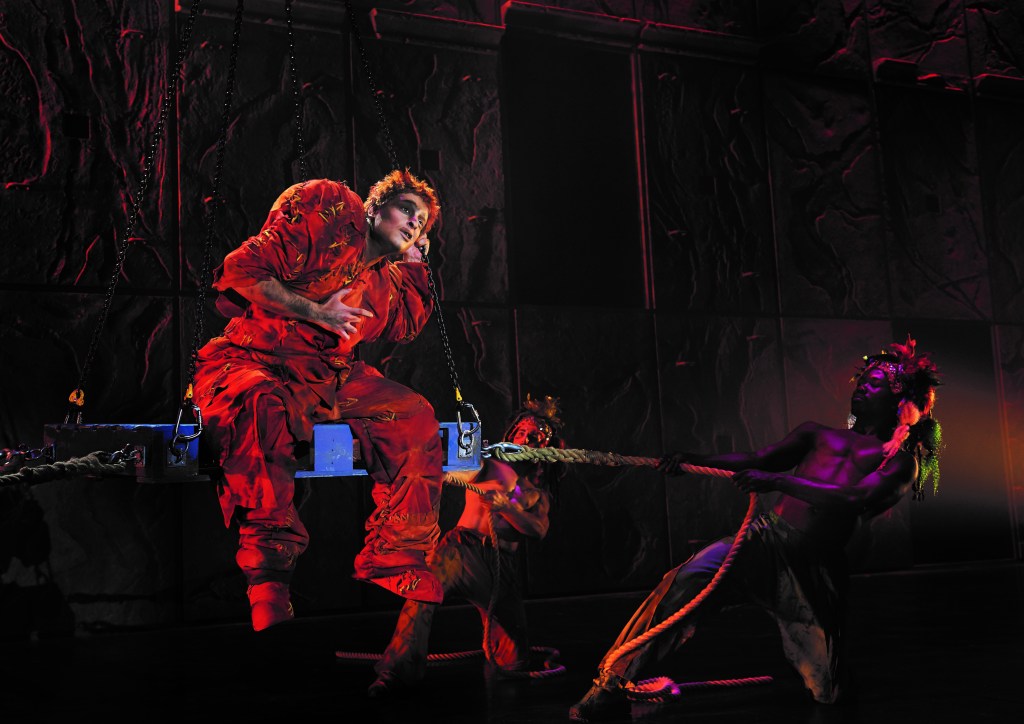
Quasimodo is Frollo’s puppet, having been raised by the cleric when he was orphaned as a baby. Whatever Frollo says to do he does because he is indebted to him. In the powerful and beautiful “Belle,” Frollo, Quasimodo and Phoebus secretly reveal their love of Esmeralda, claiming her for themselves. However, only Quasimodo loves her unselfishly without seeking to take anything from her, unlike Frollo and Phoebus.
The conflict intensifies when Frollo, unable to deal with his unholy, sexual feelings for Esmeralda attempts to take her for himself in an act of self-destruction and sinfulness, “Tu vas me détruire.” He has her falsely arrested for killing Phoebus, a lie. He knows she loves Phoebus and his jealousy enrages and victimizes him. His desire for her turns to hatred. Frollo visits her in jail where he propositions her to give herself to him and reclaim her life. Frollo has given up his identity and holiness embracing the hypocrisy of his lust and murderous jealousy of Phoebus. He is Archdeacon only in his robes and title. For her part Esmeralda realizes she fulfills her destiny loving Phoebus and sacrificing her life.

Daniel Lavoie who originated the role of Frollo masterfully reveals the character’s self torment, rage and incredible hurt, throwing off any mantel of faith to possess Esmeralda. In his portrayal Lavoie reveals Frollo’s doom as he blasphemes his religion, all in the shadows of Notre Dame. Though Quasimodo realizes Frollo’s malevolence and impulse to hang Esmeralda, there is little he can do to stop Frollo’s actions. Only after she hangs does he answer Frollo’s wickedness.
Notre Dame de Paris is a fitting title for this incredible production. The cathedral represents the chief moral and structural backdrop of the themes, characters and conflicts that reveal how religion, unless lived spiritually is a damnation. Also, it is upon this backdrop that we understand how fate and destiny unravel for Esmeralda, Frollo, Quasimodo and Phoebus, as they struggle to find but ultimately lose their place in the dynamically changing Paris of 1482.
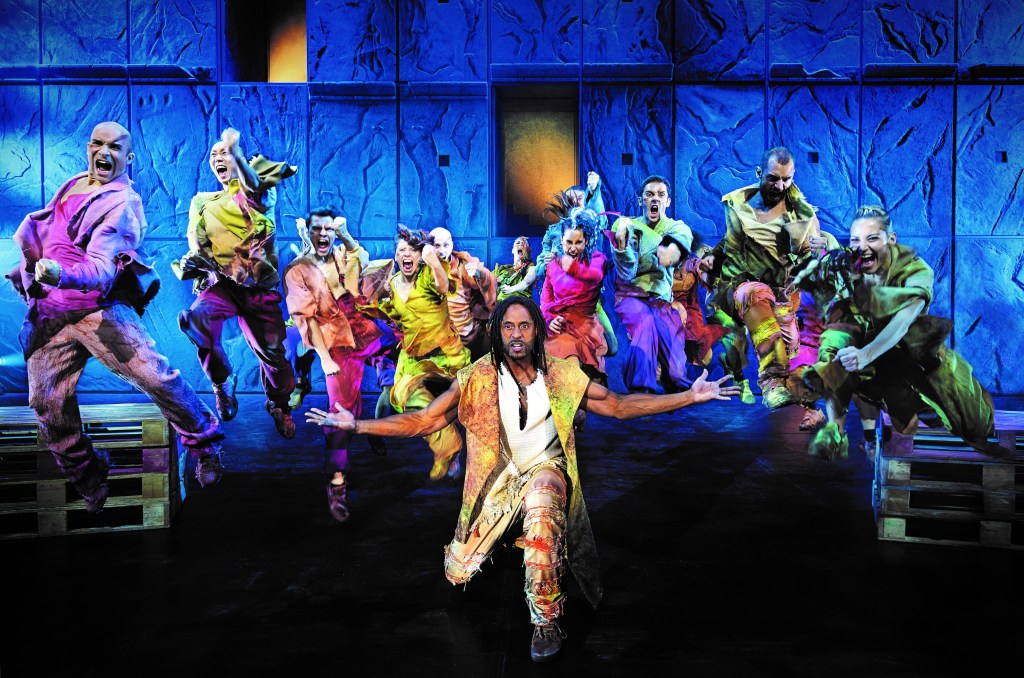
This version is incredibly current in its attention to the plight of the undocumented immigrants, a situation that will only worsen globally with climate change and Putin’s War in Ukraine. Also, the production reveals the plight of women in the hands of men who have the power to abuse and destroy them. Hugo’s attention to humanity and the incompetence of religion to deny decency and hope to individuals who are stateless, classless and viewed by citizens as lower than worms is all the more striking because the situation still abides. One asks the question does anything change except the progress of science and technology when it delivers monetarily? Only the gargoyles can answer. Since this production was first mounted in 1998, progress reveals how much our humanity has deteriorated and even the cathedral itself has suffered a cataclysm that will never return it to its former ancient glory.
Kudos to the the director Gilles Maheu whose vision was faithfully melded in the staging, choreography by Martino Müller, set design by Christian Rätz, costume design by Caroline Van Assche, lighting design by Alain Lortie and hair and wig design by Sébastien Quinet. Praise also goes to musical director Matthew Brind and surtitles by Jeremy Sams. The production takes one’s breath away and every song is exceptionally beautiful in French and poetically lyrical if one understands the language.
Though Notre Dame de Paris has finished its New York City run you may catch it elsewhere as it is on tour and heading to Canada. Check out their various websites: https://nac-cna.ca/en/event/20729 http://www.avenircentre.com/ and look for it to return to the U.S. and perhaps New York City in the future.
‘Richard III’ Shakespeare in the Park, a Stunning Achievement

For sixty years the Public Theater has kept its mission to offer free Shakespeare in the Park to educate and entertain in the finest of historical traditions that explore Shakespearean theater. This year as in previous years there are two productions Richard III and As You Like It offered in the lovely environs of the Delacorte.
Richard III explodes on the stage with energy and vibrance sported by an amazing and diversely talented cast overseen with stark determination, elegance and astute attention to detail by Tony nominated director Robert O’Hara (Slave Play) in his debut at the Delacorte. The production runs until July 17th, and is a must see event. So plan accordingly. You don’t want to miss what will surely be an award winner whose cracker jack design team blasts one’s socks off with beauty, majesty and thematic coherence.

From the moment Richard III kills Henry VI in a striking, surprising, violent moment on the circular platform center stage, to the end when Richard III in warring armor is killed, Danai Gurira doesn’t miss one beat in her authentic, dynamic and spot-on performance. Pinging every nerve of the malevolent genius of Richard, she never hesitates or pulls back. Throughout she wryly, intelligently gives sideways glances and makes ironic comments to the audience, who she wins over as we enjoy watching her unfold her wicked plans. This, Gurira does with humanity and a comfortable, cavalier attitude sans anger which comes later when her fears grow to maintain her crowning success and the kingdom. Indeed, she compels us to giver her license to endear us to her, as she gradually owns her enemies and seduces us with her frank, honestly expressed intentions.

Of course, these are given to us with jocular aplomb and sly smiles. Meanwhile, she lies, cheats, steals power acting the innocent and bereaved victim as a posture, then winks at us, letting us in on the joke of her machinations of which she is most proud. For with Richard, it’s all about the journey to the crown, not the receiving of the power. Like others we have seen in recent years, once power is attained, she is loathe to keep it and struggles ineffectively and incompetently to maintain what all at court and the officials know she has obtained illegally and through horrible treachery. The parallels to Donald Trump, Gurira and O’Hara have made clear, even gestures of success as she points to the audience as Trump often does and gyrates with a fist pump. At this point in time, the hypocrisy becomes comical, yet Gurira manages to keep the humanity, working an incredible balance and tone via O’Hara’s direction and the ensembles’ magnificent work.
I found this above all to be amazing about Gurira’s performance. We watch enthralled as norm after norm is broken. But we are mesmerized because she doesn’t hesitate nor flinch by caving to hypocrisy and morality. It is only until the last scenes when a cavalcade of haunting spirits of kinsmen and once loyal subjects occupy her nightmares that overwhelming guilt reveals she has a conscience and thus, her blood is required to sacrifice herself as she has sacrificed others.

In Richard’s first speech, Gurira complains of the court that glories in peace, something she throws off because that is not her way of being. This first admission of flaws opens us up to hear more as she aligns herself with the deformity of war which better hides her deformity. It is no small consolation to her that peace and court parties and rejoicing show her up to be a social outcast to beauty, civility, and courtly manners. Thus, we deformed are encouraged to empathize with her as outcasts of royalty, not able to prove lovers, but as she embraces herself will prove herself to be a most incredible, hypnotic villain.
And strangely we marvel as she gleefully seduces her enemy Queen Anne (Ali Stroker) who attempts to kill her, though half-heartedly to instead becomes Richard’s wife seduced and bedded with vanity, though Richard has killed her father and husband. Richard amiably spreads self-hatred wherever he goes. Those he seduces to compromise their integrity, end up hating themselves for their weakness in allowing themselves to be duped, like Queen Anne, his brothers, Lord Hastings, Queen Elizabeth and others.

How is it possible that Gurira’s Richard is so disarming? Perhaps because there is no feeble intention. All is to Richard’s purpose; thus, he will not party, he will plot vengeance and death to suit his ambitious hunger for power. As Richard, Gurira with “innocent” convictions declaims will be done and we are mesmerized to note whether she does it. And indeed goodly servants of the kingdom (Lord Buckingham-Sanjit De Silva, Lord Stanley-Michael Potts, Lord Hastings-Ariel Shafir, Catesby Ratcliffe-Daniel J. Watts) assist Richard in his plotting, taking on his evil without compunction, acting like good dogs.
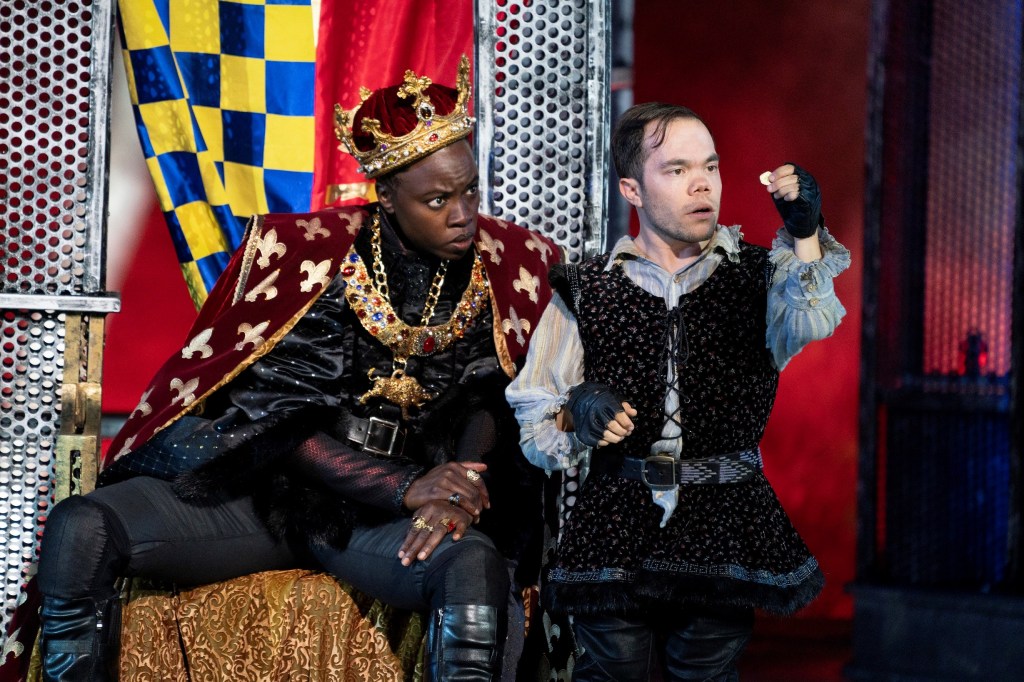
Of course we are reminded of the adage: evil flourishes when good men do nothing. Here, the once good men plot evil, infected by evil and the spoils promised. They fall under Richard’s spell and promises, but some of them end up dead. Richard’s loves are unreliable; the moment their loyalty seems wobbly, they are dispatched to hell or heaven which is a trap door that springs open in the stage floor billowing mists and clouds which one may interpret widely.
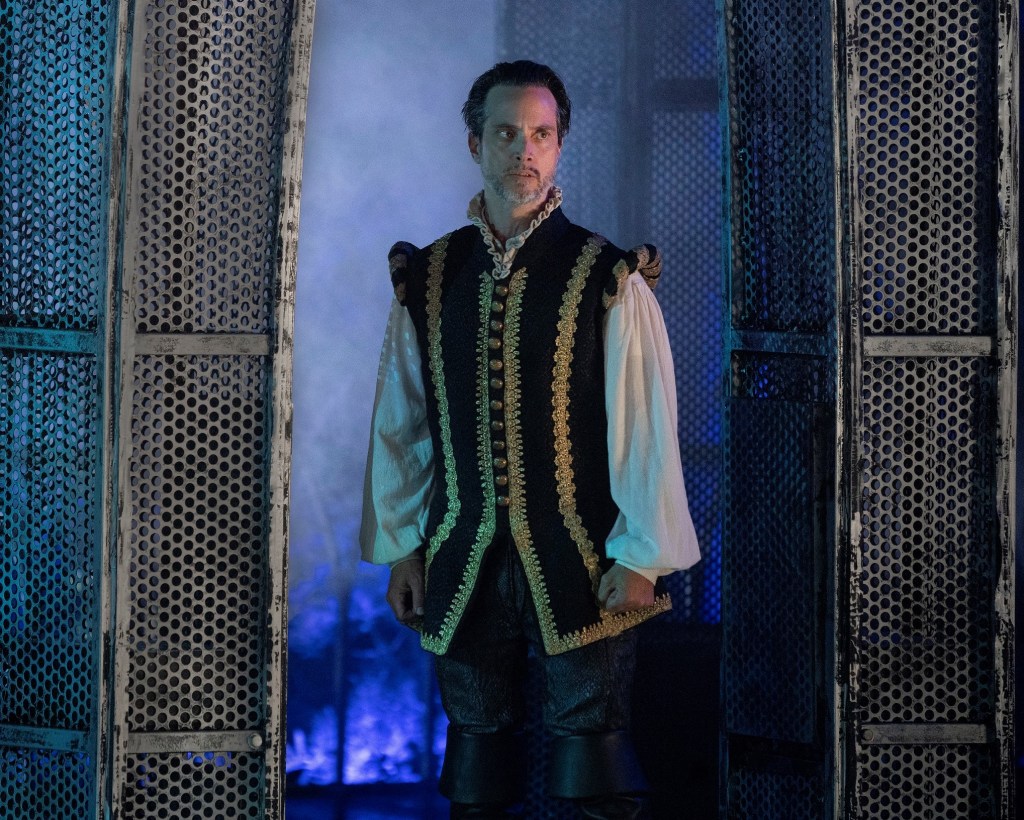
Like horrific dictator Adolf Hitler who declaimed in Mein Kampf what he purposed with the help of henchmen he rewarded, and like other despots whose clear-eyed intentions of massacre and genocide are propelled by justifications unstopped by guilt, people stood back and watched. It is incredible that leaders/enemies observing wickedness didn’t believe what these criminals and serial killers publicly said they would do. They didn’t take them seriously until it was too late. Indeed, oftentimes, the press and important political figures or royalty were on the side of the wicked, misinterpreting their actions precisely because the wicked were upfront and to the purpose (like Putin). They believed that the despot’s honesty assured they could be controlled. But as good people watched and hypocritically lied to themselves in allowing these, like Richard III to flourish, they destroyed themselves and thousands of others.

O’Hara’s attention to them is incredibly clear. His shepherding of the ensemble to relay it with great understanding is beyond breathtaking.
Thus, ironically O’Hara and Shakespeare cast the audience as citizens who are taken in and brainwashed by Richard’s mien and stance of confidence and unaffected presentment that she will succeed. We go along on the journey and follow her plotting and gaining results while sounding no alarm. Watching Gurira’s performance, one understands the imprints of bloody despots like Cuba’s “liberator” Fidel Castro and the “bloodless,” bullying machinations of failed politicos like Donald Trump. With brilliant cunning, charm and winning manipulations, such malevolents stun and disarm their prey, exploit and drain their energy, ply them with sweet poisonous promises, then toss them away as chaff to be destroyed after they’ve been bled dry of their use. And if they find that that their loyalty is waning, as Richard does with the admirable, obedient Hastings (the superb Ariel Shafir) then they reverse course and viciously attack without mercy.

Thus, by degrees we watch Richard revel in sickly brother’s (King Edward IV-Gregg Mozgala) downward fall into death as he further divides him from George who is thrown in the tower where eventually he and the Princes and others, including his wife Anne go before they are killed expediently by Richard’s lackeys. But not before Queen Margaret (Sharon Washington) excoriates all those who have killed and let blood run as she curses them with magnificence and majestic bearing. She does this in a rant that the audience applauded as Sharon Washington walked off, head held high as if to note, yes, what I declare will come to pass. Thus, Queen Margaret adjures that Queen Elizabeth will lose her sons to violence and like she, Margaret, will have lost husband, sons, crown, kingdom and be forced to live out her years in misery and mourning.

Queen Margaret saves the best for last. Richard shall die heavy in sin, unredeemed, unable to sleep, haunted by bloody deeds, seeing those killed in nightmares. Washington returns to continue her cursing diatribe in the second part of Richard III, and the audience thrilled to her speech which she pronounced with conviction. Of course her curses that all fear come to pass, despite Richard’s insults and references to her as a witch and a hag. Richard’s epithets don’t penetrate Margaret’s soul because she has endured so much misery in the loss of her husband, crown son, family. What are the slanders of a villain who all know to be a villain that is powerless to do anything against her?
Gurira’s incredible performance as the titular Richard III is one of the best I have seen. After her Richard gains the throne the paranoia and anger sets in and she wipes out more kinsmen and loyal Lords who she suspects of treason. It is a fascinating transformation from slinking deceiver to furious despot.

Of course the irony that Richard cannot be happy even after he has the crown because he is afraid he will lose it, becomes the obsession that takes him over and changes his character toward self-destruction. The journey of enjoyment has ended and now the hell, anger, fear and punishment of self and others blossoms evilly. As Richmond (Gregg Mozgala) threatens with growing armies, Richard has nightmares that frighten him more than when he commanded evil deeds awake. In Richard’s last speech, “There is no creature loves me, And if I die no soul will pity me” in which he attempts to rouse himself out of great despair at seeing the ghosts of those he killed who are coming for him in revenge, Guriara is magnificent. I found myself empathizing with this miserable creature who believed she could get away with nefarious deeds and not have her conscience convict her. Would these current despots of the world have such a conscience to convict them as Richard’s? Happy thought.

Robert O’Hara vision and astute guidance makes this an exciting and imminently watchable and glorious production with accompanying vibrant and stirring music and light. There is great humor in many of the scenes clarified by the pacing and delivery set up by the ensemble and director. The set design, royal gothic pointed arches fixed on the revolving turntable which reveals change of scene, time and place, wonderfully manifests the substance, mood and tone of the scene as well as reinforces the action. With the blood letting of war in the last moments of fighting, superbly stylized with just enough actors to represent the warring factions, the arches have veins of blood lines, ironic yet symbolic of the gore shed on the battlefield. In other scenes the arches turn blue, gold, various colors, the turntable spins as the actors are placed between. The sets and music that align with the action are spectacular because all cohere seamlessly.

The creatives who have explored O’Hara’s vision so masterfully are Myung Hee Cho (scenic design) Dede Ayite (costume design) Alex Jainchill (lighting design) Elisheba Ittoop (sound design and original music) Nikiya Mathis (hair and wig design) Teniece Divya Johnson/Jeremy Sample (fight directors) Neil Sprouse (director of artistic sign language–beautiful, poetic, effecting and relational hand movements) Byron Easley (movement director) Teniece Divya Johnson (intimacy director) Alexander Wylie (prop manager).
Check the Public Theater’s Free Shakespeare in the Park website for details to this unforgettable production of Richard III. CLICK HERE
‘Epiphany,’ Subtle, Understated, Irony, a Review
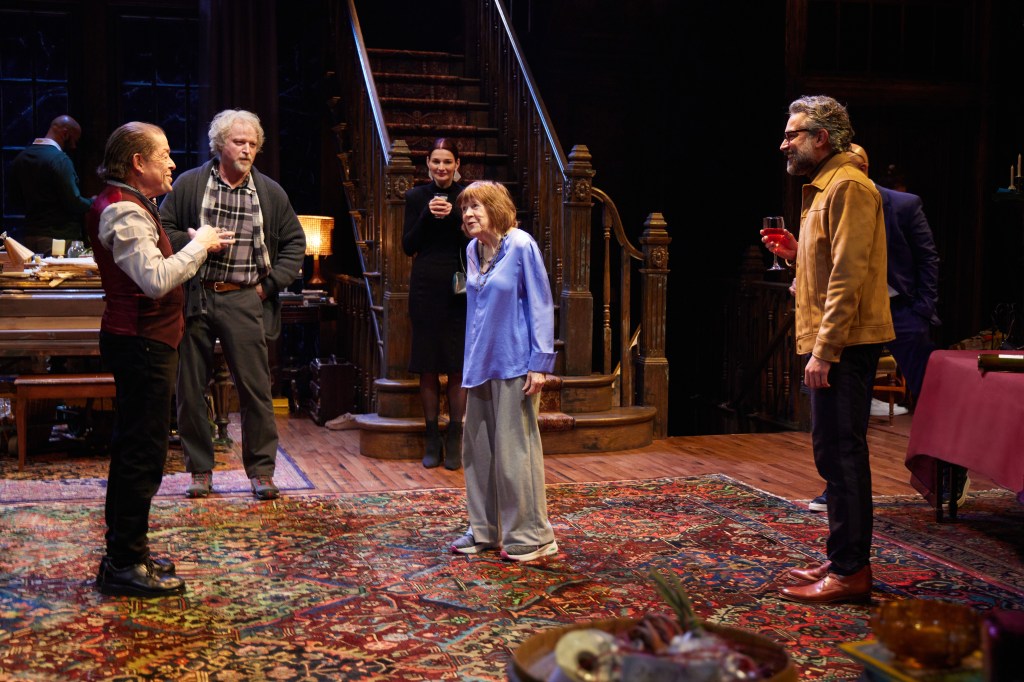
At the outset of Epiphany by Brian Watkins, directed by Tyne Rafaeli, we hear a thunderous, rumbling, like a breaking apart of the ethers, that signifies something momentous may occur. After all on one level, the title references the traditional yearly celebration after Christmas when the Magi acknowledged the divinity of the Christ child. On the other hand certainly, the play’s themes will stimulate us to have an “epiphany” about our own lives. As we sit in the dark theater, we wait to be moved by what may be some great stirring.
In the shaking and weird roaring noise that lasts a few seconds at the top of the play, we have a chance to peruse Morkan’s (Marylouise Burke) expansive, circular, den-dining room in her idyllic, barn-like mansion somewhere in the woods near a river. The place has been renovated and repainted, long-time friend Ames (the wonderful Jonathan Hadary) reveals during the course of the evening. Two large floor to ceiling windows are set equidistant to the right and left of the central staircase. They look out on an immense tangle of dark, surreal tree limbs and bushes upon which snow falls but never sticks. John Lee Beatty’s set is a magnificent throwback to a former Americana of dark, rich, wood paneled loveliness whose central point is three staircases: one short leap of stairs from the entrance opening onto the main floor, and two massive staircases leading to the second story presumably of bedrooms and a bathroom with a novel Japanese toilet that Freddy (C.J. Wilson) admires.
On January 6th, each year millions celebrate the Epiphany world-wide but not in America, the dinner hostess Morkan informs all her company after they have arrived. She has invited her friends and grand nephew Gabriel (name reference-the angelic messenger who announced the Christ child’s birth) to this unique January 6th dinner party for a celebration of the Epiphany during which her grandnephew will officiate. She doesn’t quite remember the significance of the day but thought it appropriate to have a gathering of friends she hasn’t seen for a long while to celebrate because the date is located in the dark loneliness of winter, after Christmas and the season of light.
However, Gabriel lets his aunt down. He can’t make the party, so he can’t officiate and Morkan is left to be mistress of ceremonies on this occasion, that no one in the group has celebrated before or even understands. However, she tries to guide the festivities and does so humorously in fits and starts. Interestingly, Gabriel makes up for his absence by sending his partner Aran (Carmen Zilles) the symbolic stranger (think “The Dead” by James Joyce that Watkins’ set up suggests). She is the only one to be able to relay something about Epiphany, manifestly suggesting its true meaning of the Magi bringing gifts to the Christ child, and referencing a layered meaning: the confluence of the divine in humanity by the play’s end.
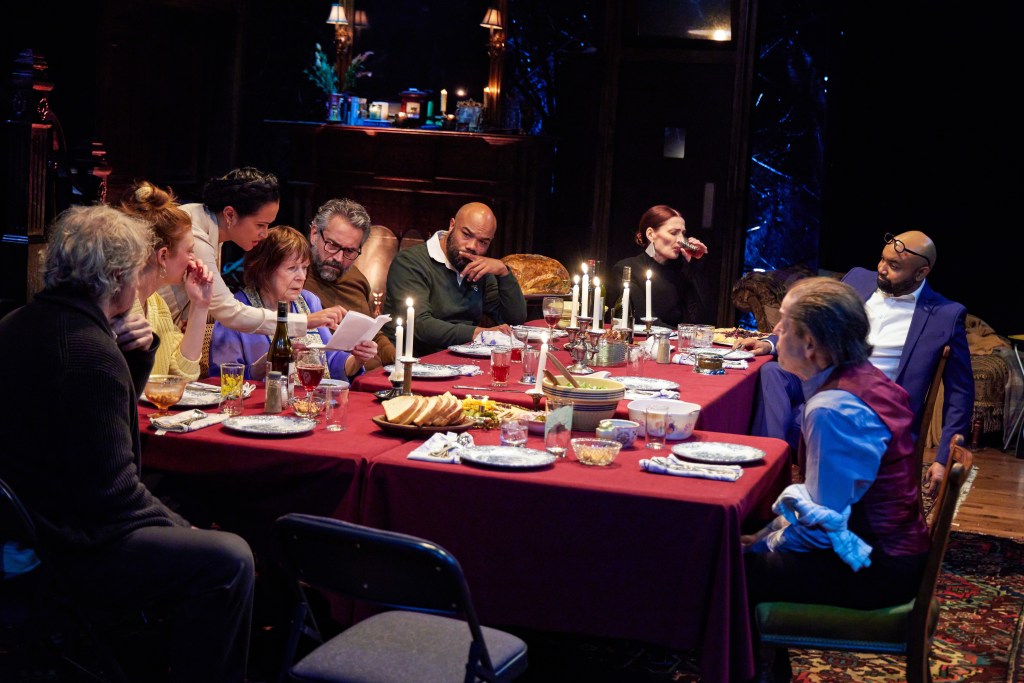
The festivities that Morkan planned, whose order has been sent in an attachment to her friends that no one read, happen with the quirky turn of her mind. As she tries to remember them, she informs the guests that remembering is becoming harder because of her lack of focus. Nevertheless, she takes charge and this lovely evening among individuals not initially friends who become friends unfolds with beauty and poignancy encouraged by Morkan’s generous hospitality, openness and humanity (in divinity).
Watkins via director Rafaeli’s vision, cleverly, ironically misleads us throughout, beginning with the early fanfare to expect “greatness.” However, Watkins sidelines our anticipation for “the momentous” with the humorous interactions of the guests. We listen to Morkan’s prating about why she must confiscate their cell phones to everyone’s horror. To move the “epiphany celebration” along, she suggests they sing the related song. No one knows it.
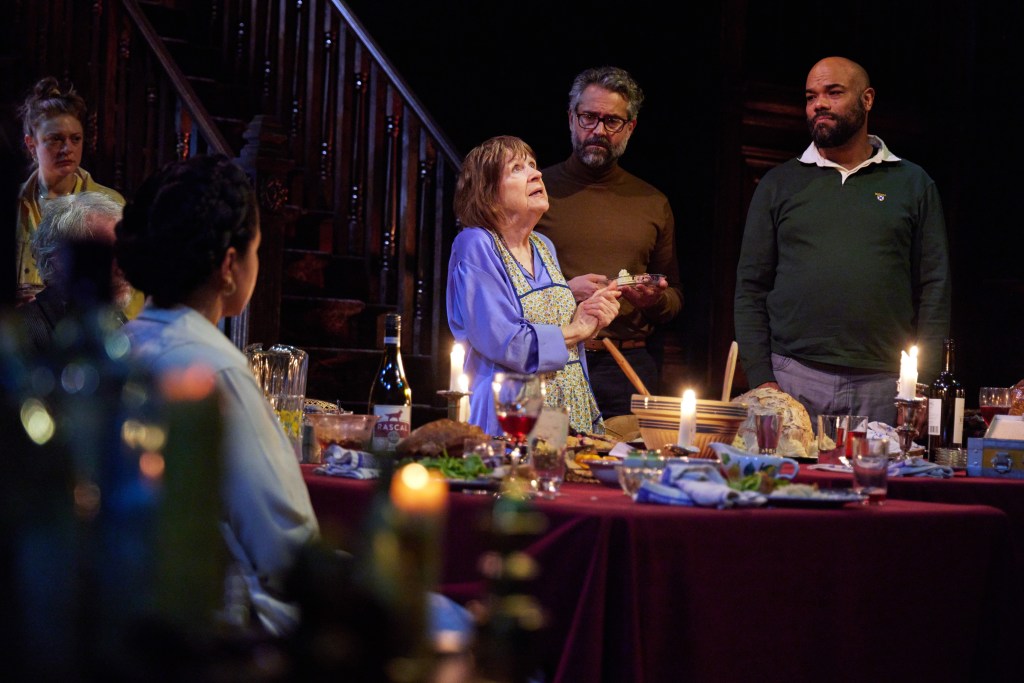
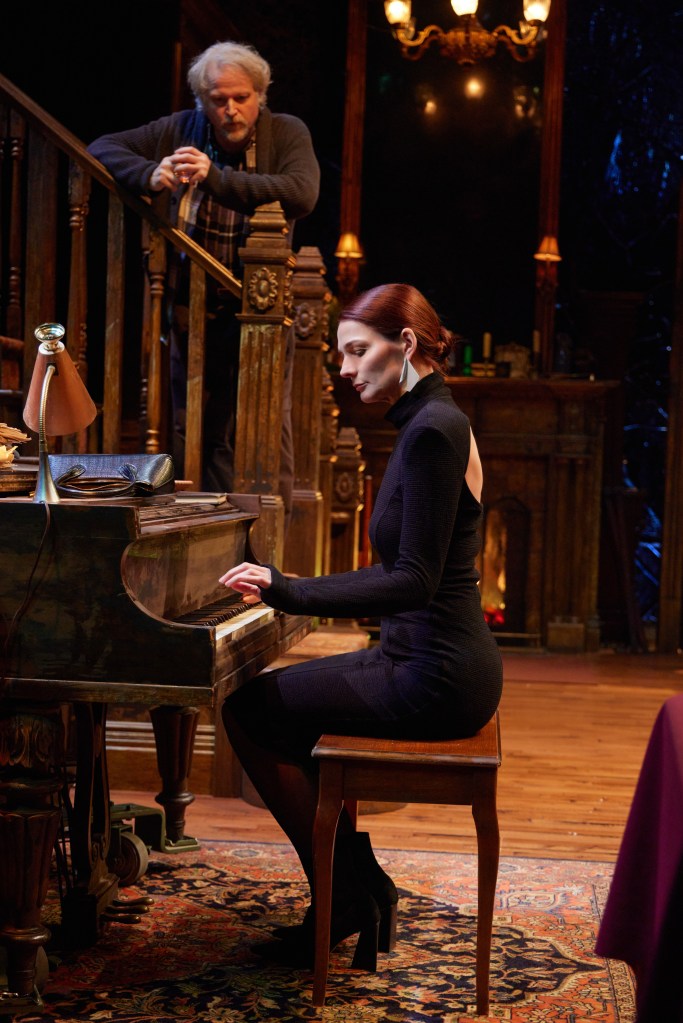
We relax into the off handed conversational comments as guests help themselves to alcohol. We watch the very visual piano interpretation of a piece by Kelly (Heather Burns) which is a hysterically cacophonous substitute for the song of epiphany that no one learned. And to honor the celebration, Sam (Omar Metwally) brings out a galette des rois he has prepared, explaining someone must go under the table to call out who gets the first slice. Additionally, Sam shares that all must look for the surprise inside which if they find it, means they are the King or Queen of the celebration. Ames volunteers to go under the table and call out a name. And then we forget about him when Sam and Aran discuss the finer points of empiricism and the ineffable which are relational to the miracle of the epiphany.
And just when we think the play is about to take a really profound turn, Morkan shuffles up the cards and calls out “Who wants a slice of the galette.?” What occurs is the comical high point point of the production, seamlessly directed by Rafaeli and enacted by Jonathan Hadary’s Ames, Marylouise Burke’s Morkan and the others, like Loren (Colby Minifie) who stem the bleeding and help quell the chaos.
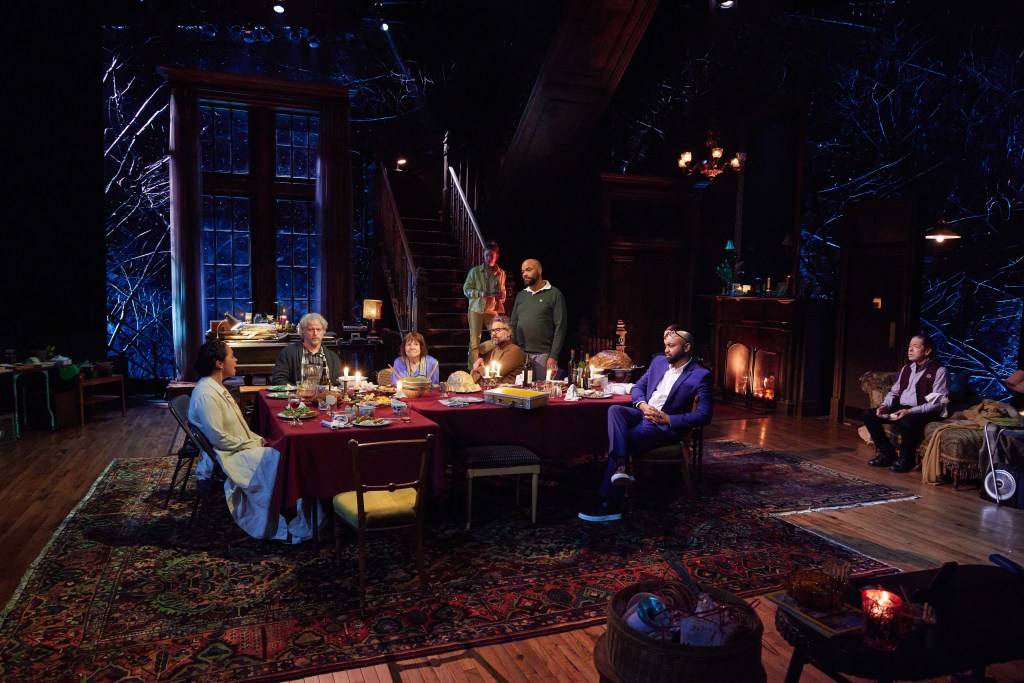
By the time the food arrives on the table, we understand that something fascinating is going on. The shining moments of meaning that signify joy that the tradition encourages should happen happen. Indeed, much happens in the apparent little insignificances. Individuals listen and respond to each other and enjoy each other. The moments move serendipitously during the evening of this diverse, wacky group of individuals who have been divorced from their phones by Morkan so they can relate to each other in a live, spontaneous interactive dynamic. That alone is miraculous for her to insist upon, and of course, grandly funny.
As the food is passed around and they comment the goose is dark, toward the end of the meal the subject turns into the years one has yet to live. And as Ames recalls a humorous story, at the end of it Morkan’s revelations about her sister abruptly emerge. They are still a shock to her and they are a shock to her friends who begin to understand Morkan’s comments about lack of focus and her need for company during the darkest time of the year.
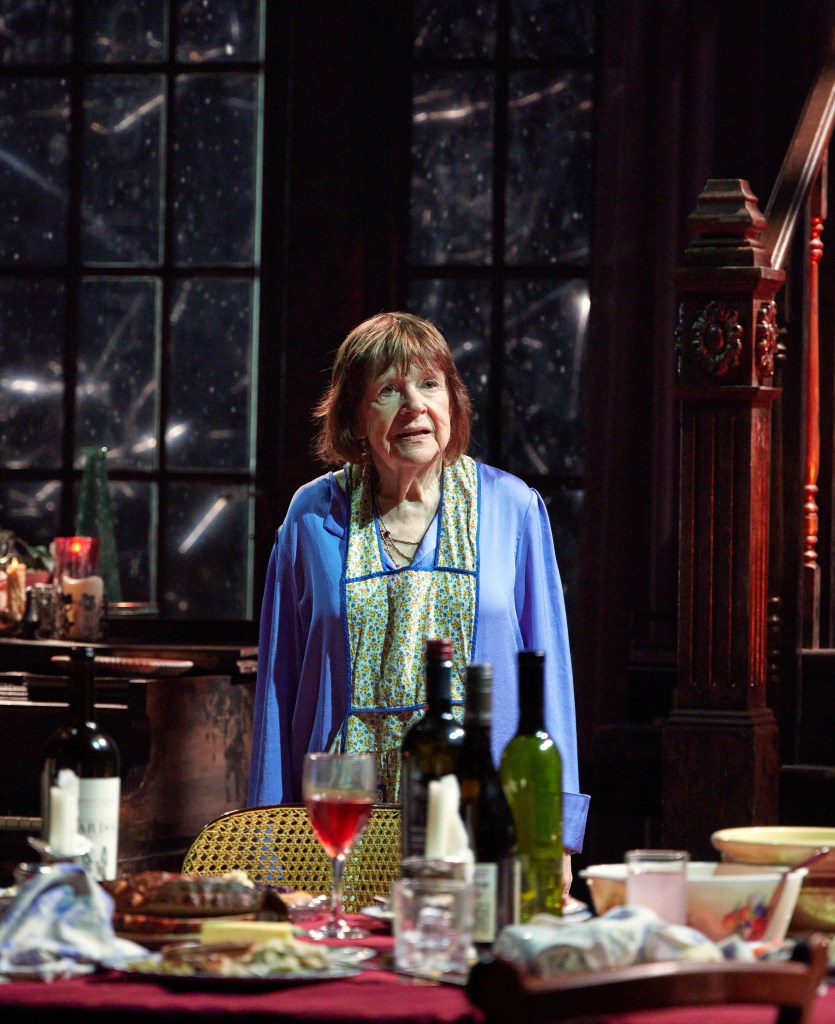
Nevertheless, continuing the celebratory spirit, Morkan, ever the thoughtful hostess brings out the dessert which she insists they eat. And it is during the dessert, she explains the devastation she has been feeling, the need of forgiving herself and the importance of forgiveness in her life, in everyone’s lives. These feelings which she shares are made all the more real for herself and her friends in their public revelation. Her deeply intimate confession touches their hearts and is codified by Aran as an “epiphany.” The theme of revelation coalesces into the symbolism of the miraculous that Morkan seeks. And the recognition of her friends to celebrate the Epiphany the following year as a tradition indicates that they seek that divine in humanity in the sharing of community. The last moments are particularly heart wrenching.
This is one to see for the terrific ensemble work and smart, smooth direction by Rafaeli, the sets, humorous moments and atmospheric tone poetry suggested by the lighting among other elements. Kudos to Beatty for his sets, Montana Levi Blanco for costumes, Isabella Byrd for lighting, Daniel Kluger for original music and sound. Epiphany runs with no intermission and ends July 23rd. Don’t miss it. For tickets and times go to their website: https://www.lct.org/shows/epiphany/
‘Chains,’ an Exceptional American Premiere by Mint Theater Company

The Mint Theater Company resurrects worthy playwrights that haven’t been produced in decades. Before COVID-19 upended their plans the company scheduled two productions of Elizabeth Baker’s works (Chains, Partnership) for the summer of 2020. After the dust settled the company revised their plans for the summer of 2022 and decided to first present Chains in its American Premiere. Later, the Mint Theater Company will present Partnership. At some point they will offer the three Baker plays The Price of Thomas Scott (produced in 2019) Chains and Partnership in an online Streaming Festival so that global audiences might become familiar with the exceptional, profound playwright who was certainly a maverick ahead of her time.
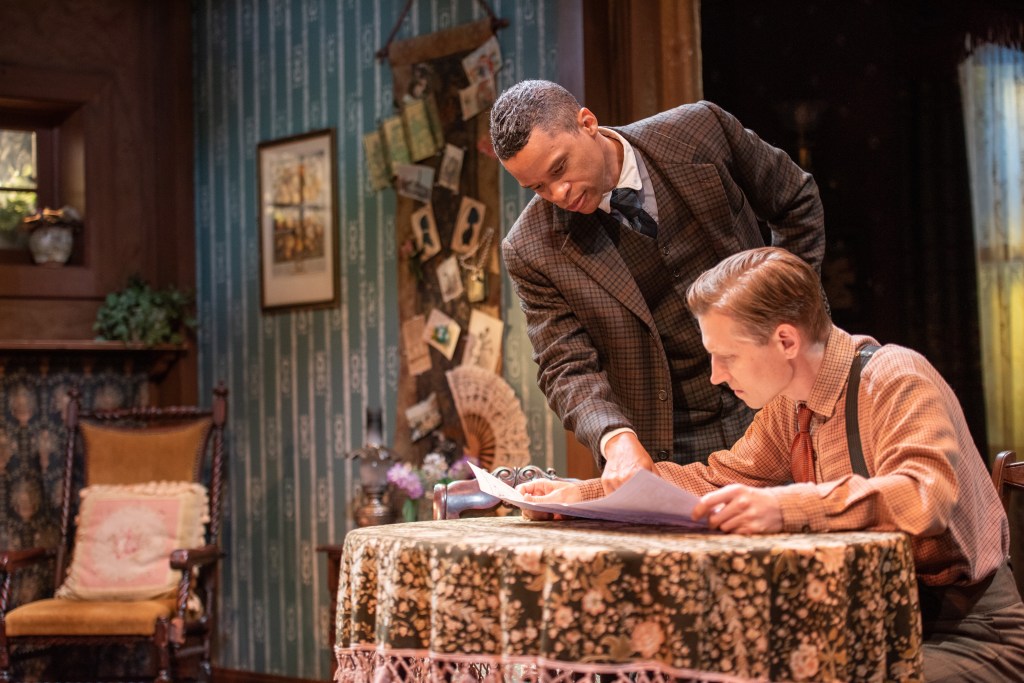
Elizabeth Baker (1876-1962) wrote Chains in the early 20th century, though the themes and issues Baker has her characters confront are current and identifiable with our time. Running at Theatre Row until 23rd of July, the Mint’s production of Chains must not be missed for its acute attention to details of setting, as well as the superb direction by Jenn Thompson (award nominated for Women Without Men, 2016) who has teased out striking performances from her cast. Their ensemble work is authentic and forceful.
Baker’s play focuses on the problems of London’s working classes (clerks, shop girls, etc.), their aspirations pitted against the trials of insecurity, workplace competition and the doldrums of career immobility. In its centrality Baker highlights not only issues of class, but those of gender, economic inequality, immigration and the difficulties of economic upward mobility. Subtly, Baker alludes to the strains between workers and employers. Though the word “union” is not mentioned, the “S” word, “socialism” is referred to once or twice jokingly by the characters as a negative. Nevertheless, the dull, work atmosphere, oppression and owner hostage taking that some characters refer to would be mitigated by unions to equalize the power dynamic with owners.

Using the backdrop of married couple Lily and Charley Wilson (Laakan McHardy, Jeremy Beck) and their extended family, the conflict initiates when the couple’s border and Charley’s work colleague Fred Tennant (Peterson Townsend) announces his plans to leave the boredom of his clerk position and take off to Australia for a change of scene and career. This simple announcement upends Charley’s perspective about his own life and brings to the surface his dissatisfaction with the drudgery of his career and the constraints of his married life.

Additionally, it encourages and inspires Maggie Massey (Olivia Gilliatt) Lily’s sister, to rethink her own plans for her life with her future husband, as she yearns to have the independence that men have to travel and pick up roots and settle wherever they like. Though fiance Walter Foster (Ned Noyes) is a generous and well-off partner who would give her independence with his money if they married, Maggie is unsure that marriage with Walter is right for her.
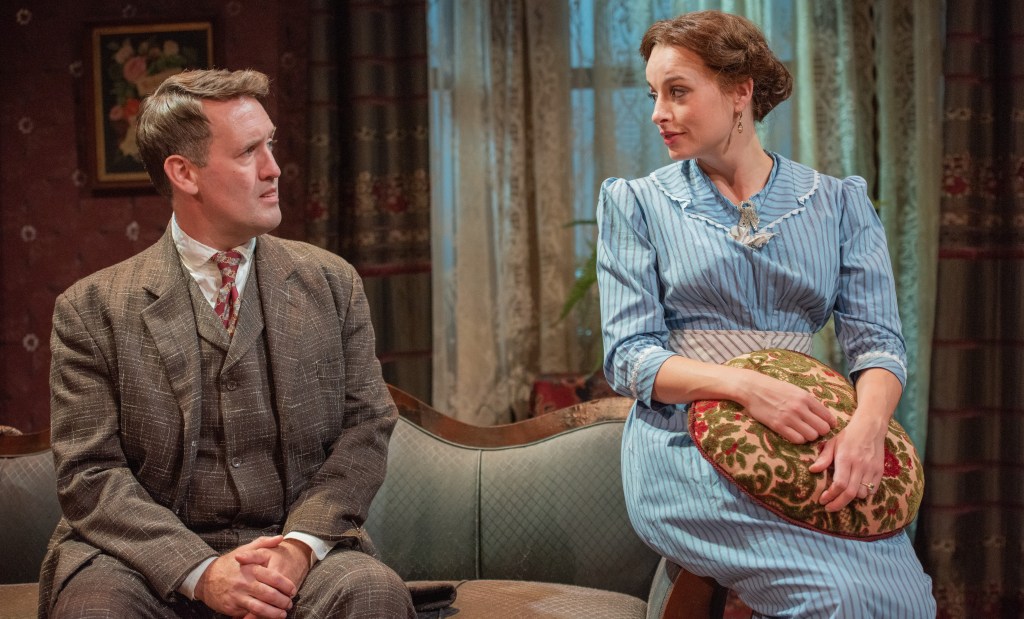
This is extremely novel for her generation and gender. Folkways stipulated that women marry well-off men, be provided for, keep house, raise children and be contented to shut up, not make waves and not be ambitious or creative. Maggie views Lily’s and her mother’s lives and questions if she “loves” Walter enough to be bound to him forever, when she may be happier on her own, expressing her talents. Or perhaps she may find and love another.

Thus, Baker cleverly explores the themes of security and safety for both the men and women (then and now) who have chosen either to take risks or remain stuck in a life of mediocrity and misery, whether single or married. As Charley’s neighbor Morton Leslie (Brian Owen) suggests, leaving behind one’s secure boring position and comfortable, familiar life holds tremendous risks for Tennant, for anyone.

Against the romanticism of leaving, various characters throughout the arc of the play’s development pose questions about Tennant’s choice which appears to upset them because it is particular and uniquely not their experience. They ask the following. Will he be able to get a position to support himself easily in Australia, when there are so many thousands looking for employment? What if he fails? What if he proves to be an embarrassment to himself and has to return home to be closed out of his career prospects?

Indeed, Morton Leslie ridicules Tennant’s ambitions and ideas to his face. He insists jokingly, though he is very serious, that Tennant is going to fail. Eventually, this is echoed by others in Charlie’s sphere of influence, including his in-laws (Anthony Cochrane, Amelia White). Lily expresses her upset at Tennant’s leaving because they need his rent. So Tennant’s decision proves economically trying for them, adding instability to their lifestyle. Meanwhile, Lily’s brother Percy (Avery Whitted) at a young age plans to marry Sybil Frost (Claire Saunders) following in the footsteps of what is expected for a young man. This is even after Charley warns him to wait and consider the future because he is too young. In an interesting turning point, Charley tells Percy that he married too young.

On the other side of the argument about why it’s good to take risks, Tennant explains his rationale to Charley. Unlike Charley and the others, Tennant is not married with the burden of having to take care of a wife and children. He is independent, young, makes his own decisions and has no family ties or responsibilities. He has friends, but can make friends anywhere, as he is sociable. So fear of uncertainty has been overcome. He is more afraid of remaining stuck in a miserable position at his job that has little upward mobility.
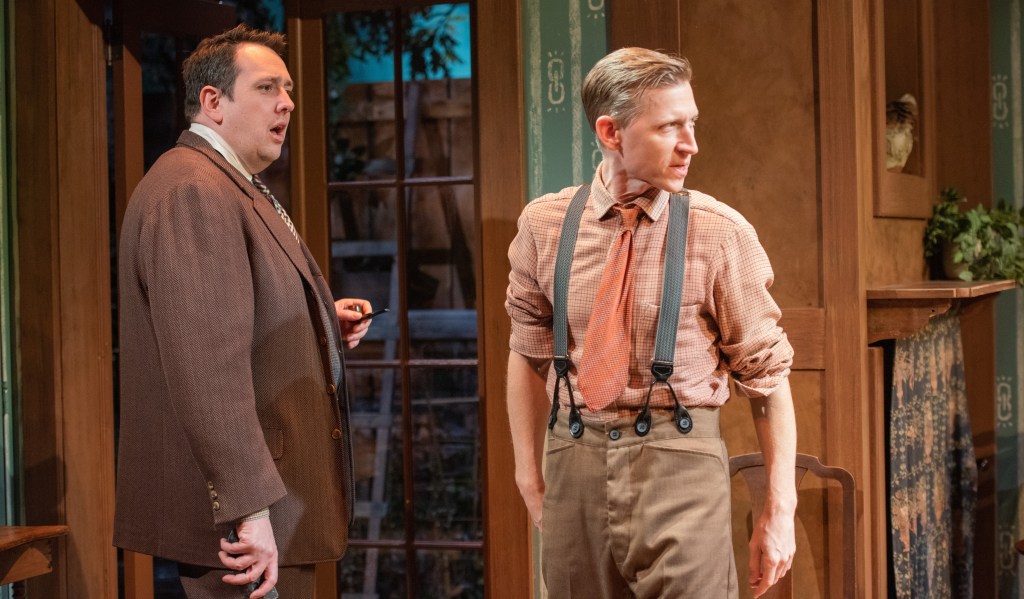
Thus, if he leaves England, he leaves the class system, the varied oppressions by owners, the stultifying atmosphere of the workplace and the lack of challenges. For him, anything will be possible and only he will stand in the way of that. Leaving, he will learn to redefine himself and seek out a different identity. His excuses and blaming others for his condition will fall away; he will evolve stretching his talents and abilities. The incredible power and courage of Tennant’s decision amazes because he is ending a nullifying pattern before it becomes too entrenched in his soul to escape it. He recognizes and appreciates this knowledge; the others fear it or are blind to it. We empathize with his situation of wanting to seek a better life in another country. It is historic and symbolize the longing of the spirit to evolve from stasis.

Charley has the self-knowledge to understand what is at stake beyond material, pragmatic considerations as does Maggie. They credit Tennant’s decision. The irony is clear. The more the others question and challenge Tennant’s fool-heartiness, the more we realize their fear, their mediocrity, their acceptance of their condition which may be tantamount to a form of slavery. The theme is metaphorical and profound, and Baker nails how difficult behavior change can be when one keeps adding daily to the links in the chain of sameness in one’s life.
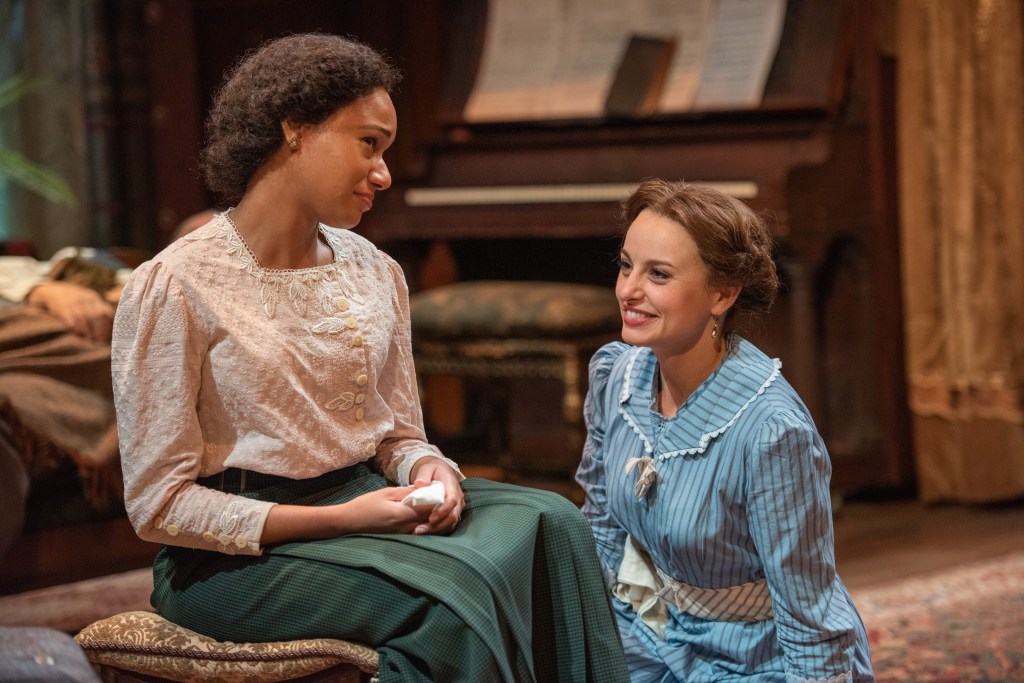
When Charley gradually discloses that he agrees with Tennant’s desire for a more fascinating life, the conflict between him and Lily and her family grows. Herein lies the main theme of the metaphor of chains. On the one hand, a secure position chains individuals from falling into the abyss of dissolution and bondages. These include fear of uncertainty: of confronting treacherous risks; of failing and never recovering from poverty and its ills. On the negative side, security deadens one to being adventurous and the chains of miserable dullness hold individuals to a bondage of their own making. Soon they believe they can’t take risks or it is too late to be an adventurer when one is older. Thus, severing the chains of security that bind the inner adventurer to the hackneyed, uninteresting, uncreative, unchallenging existence becomes impossible.

As an example of the terror of atrophying at work Baker introduces the character of Mr. Fenwick (Christopher Gerson) an older employee at the firm where Charley and Tennant clerk. Fenwick visits Charley and affirms Tennant’s decision is a wise one that he, at his age, could never take. And when he announces that there is some question about receiving their bonuses for the year, all the arguments about the benefits of time off (three weeks, a day on the weekend) go out the window.

Indeed, the employees are at the mercy of their employers/owners who can do as they please. There is no guarantee about work conditions and salaries. The propaganda against socialism was rife during Baker’s time as Morton Leslie suggests mocking “socialism.” Baker subtly reveals that such propaganda picked up by louts like Leslie keeps the society in line to produce workers who are “well-oiled,” uncomplaining machines. As for those like Tennant, who would challenge their work conditions? The social culture discourages their ambition or desire to want something better or to break free and move into a more productive, satisfying life. Meanwhile, Maggie’s situation is more complicated with heavier strictures on what opportunities are available to her.

Director Jenn Thompson shepherds her actors to highlight the conflicts, issues and themes in this extraordinary play which resonates for us today in a myriad of ways, politically and socially. Specifically, the actors portray without stereotyping the individuals they inhabit. These characters divide into two camps; those who agree with Tennant (Charley, Maggie) and those who do not.
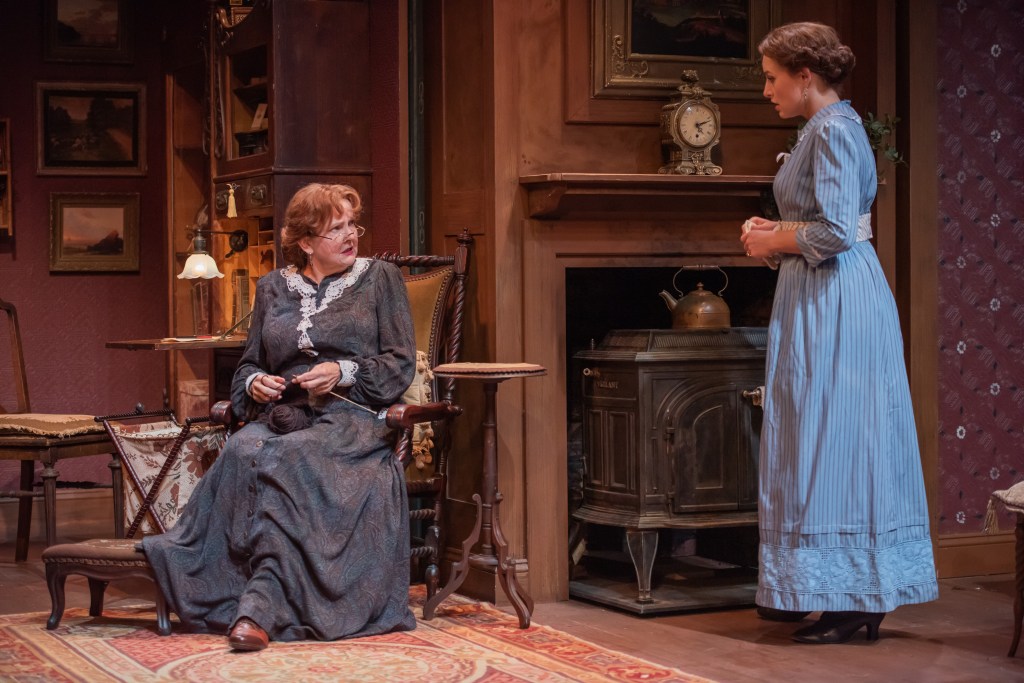
Townsend’s Tennant seduces Beck’s Charley with his immigration plans, so that Charley can think of nothing else. Jeremy Beck imbues Charley with concern, confusion and distraction with increasing intensity until he reveals his plans to leave for Australia which upend Lily. We know it is coming and we wish him to be successful. And we believe what Lily does not, that he will make a way for her and send for her, after he has made his way in Australia. All she can do is weep; she is devastated.
The tensions that Thompson strives to create with Beck’s superb acting and McHardy’s heartfelt response and sense of doom raise the stakes and bring us to a confluence of feeling. The ending may be controversial, depending upon the audience viewer. Indeed, Thompson has helped to strengthen the brilliance of Baker’s work and reveal her to be a playwright worth revisiting again and again.
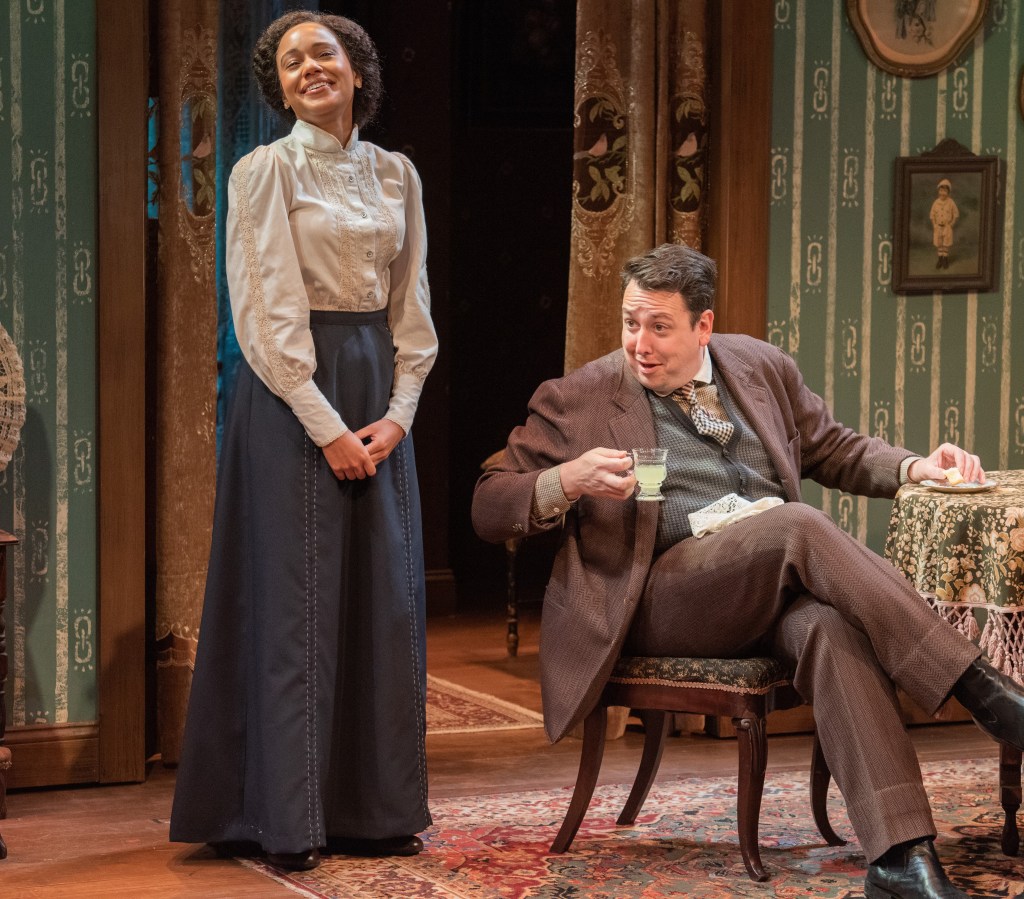
The production succeeds from start to finish thanks to the creative team. I particularly enjoyed the actors helping morph the set from the Wilson’s home in Hammersmith to the Massey’s house in Chiswick and then back again. Incorporated into the theatrical experience of the production, it was seamless. Just terrific! Kudos to the following creatives: John McDermott (sets) David Toser (costumes) Paul Miller (lights) M. Florian Staab (sound) and the others that made Thompson’s vision for Baker’s work to come alive.
I cannot praise this presentation enough. COVID-19 was a devastation we have yet to overcome and deal with emotionally and psychically, perhaps. On the other hand this production was worth the wait, well chosen for our time. Go see it. For tickets and availability to Chains that plays with one intermission go to: https://minttheater.org/production/chains/
‘Corsicana,’ Will Arbery Tackles a Kinder, Gentler Texas

Will Arbery’s Corsicana directed by Sam Gold in its world premiere is more an evocation and memorial to these representative characters of the heart’s universal weirdness, who try to find comfort and make their own space in the world. Unfettered with glamor and starlight, Arbery’s portrait of humanity in all its endearing strangeness is one we can easily identify with.
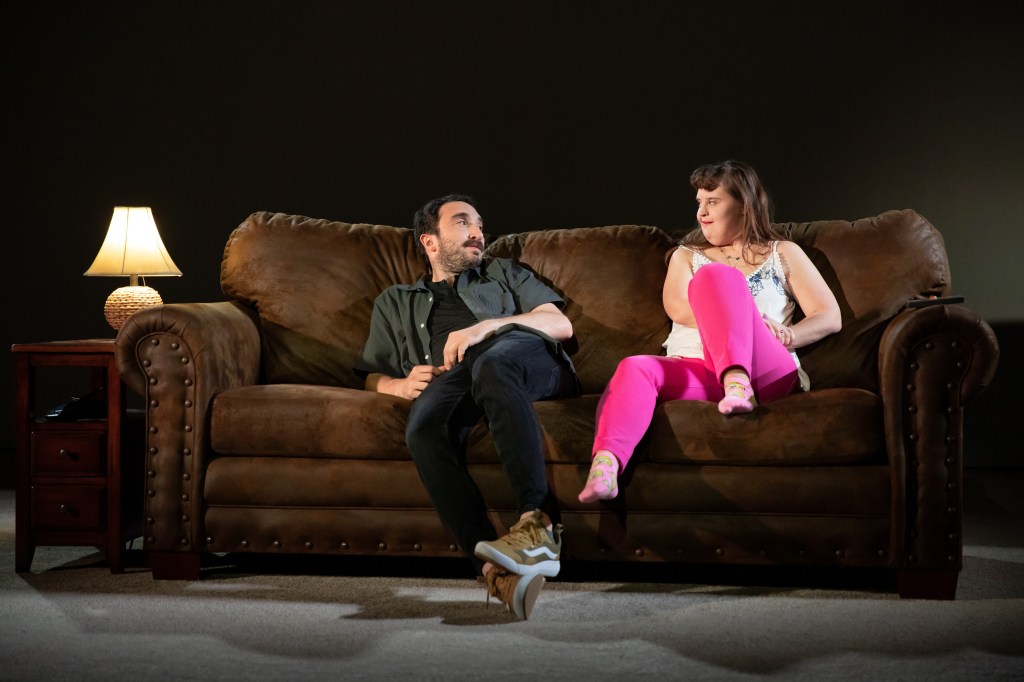
The play’s progression moves slowly by degrees of the stage turn table fitted with two couches. This revolves when the time/space continuum shifts and scenes change. The large couches and a small table and chairs downstage are the only furniture in a white-walled warehouse of a structure that represents the house where the two siblings Ginny (Jamie Brewer) and Christopher (Will Dagger) live and where neighbor and friend Justice (Deirdre O’Connell) visits. With a plexiglass framed roof that the characters slide forward, Lot’s (Harold Surratt) barn emerges as the lights upstage dim and the characters step downstage in the light, signifying Lot’s property when they visit him.

The actors do a phenomenal job revealing the inner and outer emotional filaments, quirkiness and complications their characters experience during their interactions with one another. Arbery’s central focus of Corsicana, finely directed by Gold, is on Christopher and Ginny, aged one year apart. They have recently lost their mother. Feeling adrift in their mourning, they awkwardly reposition their identities and relationship with each other, haphazardly shuffling toward a new respect, love and understanding without their mother’s buffer of love.
Will Dagger’s Christopher is humorously chided by his sister Ginny (Brewer) a smart, sharp-witted thirty-four year old woman with Down Syndrome, as they sit and plan the rest of their lives turning over Christopher’s initial question about Ginny’s unsettled unease. As they discuss the state of themselves in their loss, we understand how much their mother meant to their sense of purpose and being. Living in the house she left them, they are in stasis, not engaging in their previous lives with work and friends. Ginny can’t find interest in taking up her hobbies, choir or her job. Mourning is a tricky business. When does one return to one’s life? Can one return? Should there be new engagement immediately afterward?

They are displaced in a limbo between losing an old life and negotiating a new one, their hearts glazed over in non-feeling.. It rather seems they are plopped down together for our own good pleasure to understand how siblings close in age in adulthood (Christopher is thirty-three) might get along, when one of them is not living in a group home, but is being “taken care of” by family and a close friend. However, when Ginny asks Christopher’s help in finding something for her to become engaged in, he understands that it must be something novel. All of her previous pursuits don’t satisfy. And she affirms that she is proud, so asking for his help is the last thing she wants to do, but desperately must do.
From their discussion and Ginny’s listing of wants and wishes, we discover that Ginny did many things with her mother. And when family friend of their mother. Justice (Deirdre O’Connell) drops over with groceries and a chat from time to time, we note that she is willing to stay with Ginny, baby-sit her, though Ginny bristles at the reference and loudly affirms she is an adult. Of course she is, but there are boundaries that she crosses unwittingly as we see with her attempt at friendship with Lot. Thus, clearly, Ginny relates differently, from a unique frame of reference, perspective and response to others that is uniquely her own.

Indeed, Jamie Brewer’s Ginny seems extremely adept and mature enough to take care of herself which is where her relationship with her brother may end up, in separate houses, lives, spaces. Steps must be taken, so of course, Christopher tries to help. The conflict of “how to help Ginny find something to do” blooms in full force when Christopher visits Lot, an artist that Justice recommends because she knows him and has even collected some of his work that might be exhibited, if the situation pans out. In the interim Lot works on a project he won’t let anyone see that thematically manifests as “a one-way street to God.” Clearly, he is secretive and religious and private, and shares those similarities with Ginny who believes in God and is so secretive she refuses to allow anyone into her room because she values her privacy.

In the hope that Lot might help Ginny express her musical talent and come out of her current doldrums with a sense of purpose and collaboration, Christopher visits the artist and after some humorous repartee which Arbery is a master of, Lot agrees, but she must come to his place. Lot’s demeanor is straightforward and no nonsense, revealing a brilliance and wisdom. Arbery also plants seeds of Lot’s story in his upset to hear that Ginny is “special needs.” He questions if Christopher thinks he is that way, too. His question is out of left field, but intimates the story which he unfolds in the conclusion of the play, a story whose revelation to Justice reveals he is ready to take their relationship into something more than friends.

Christopher’s cajoling and friendship with Justice (we never find the symbolism of her name, though she is the balancing force among the characters) peaks Lot’s kind approval. He refuses money, but would like a gift as payment, throwing in a philosophical comment about materialism and waste which he and Justice eschew. What the gift is remains a mystery, but as God bestows talents, Lot indicates an acceptable gift would be an expression of someone’s talent at the appropriate time. Turns out, he receives his gift at the play’s conclusion when all contribute their gifts in a song which, as it turns out, has been written by the characters responses, feelings and issues throughout the play. Indeed, the play is the theme song of their humanity that they sing at the end followed by audience applause.

Lot’s appreciation and closeness to Justice is revealed when she visits and they banter, again with Arbery’s talent for pointed, humorous dialogue whose sub rosa content shines through. She tells him “shut up,” and not stop her relating a fascinating, symbolic dream about a dead man who haunts her. And he tells her repeatedly she’s “weird.” But they are birds of a feather, though Lot is noncommittal at this point.
When Ginny visits, Lot attempts to find something interesting to sing about and collaborate on. As Lot tries we note his cleverness and creativity with an amusing story that includes dinosaur ghosts. However, though most “children” and individuals would be interested, Ginny isn’t. Eventually, she expresses her interest in pop music and singers who Lot is unfamiliar with. Their discussion comes upon a dead end until Ginny expresses something which is untoward to Lot and something which she doesn’t realize is a trigger for him. What she expresses upsets Lot who affirms he can’t work with her and who dismisses her. She is perplexed.
In the next segments of the Second Act the revelations of why Lot reacts as he does come to the fore. The unsettled issues of Ginny’s “untoward” response to Lot, her unwitting comments to him about Christopher, and Justice’s feelings about Lot are resolved in Arbery’s exotic dialogue that is out there and ethereal but grounded in undecipherable, spiritual human consciousness and experience. Christopher, Justice and Lot have exceptional monologues beautifully delivered by Will Dagger, Deirdre O’Connell and Harold Surratt. That the audience was breathless and silent and the annoying barking seal in front of me was mesmerized through all of them, indicates the depth of authenticity the actors effected to make such profound moments “take our breath away.”

Arbery’s Corsicana is not like his other plays. That is a good thing. It is humanity, unadorned, quixotic, exotic in its peculiarity with these amazing characters warmly, lovingly inhabited by the ensemble whose teamwork is right-on. Gold’s direction infuses the characterizations with haunting absences of time and space reflected in the set design (Laura Jellinek, Cate McCrea) and efficient, suggestive lighting design by Isabella Byrd. Sound (Justin Ellington) was at times in and out perhaps because of the acoustics in the theater or the actors not projecting when their backs were turned to the audience. Not every word was sounded in clarity, whether a fault of the hearer or the structure of the theater, projection or something else. However, the monologues, because of their importance, were bell clarity sensational. The repartee and quips sometimes were thrown away into deep space heard by elves.
Finally, a note about the music which was characteristic of the characters’ souls thanks to Joanna Sternberg and Ilene Reid music director. The song at the end, the gift that Lot receives, is endearing, humorous and fun. Sung in collaboration, the unity and community that the characters achieve is poignant. Of course that they all have faith in God, not a specific political faith. But spiritual understanding threads throughout the song, which is in sum, the play. That their type of deep spiritual faith is refreshing Arbery notes with complexity. That their faith is essential to how the moments that looked like they were going downward, instead reversed and moved to a contented and hopeful resolution, makes sense.
Corsicana is at Playwrights Horizons on 42nd Street with one intermission. For tickets and times go to their website: https://www.playwrightshorizons.org/shows/plays/corsicana/
‘Fat Ham’ at The Public Theater, LOL Genius
Pulitzer Prize winning Fat Ham a hybrid genre “tragedy,” “comedy” take-off on William Shakespeare’s Hamlet ingeniously tweaks the concept of the revenge play while upending with quips and double entendres every stereotypic trope and meme of the majestic language of the Bard. James Ijames’ facile and seamless adaptation of the familiar and unfamiliar in one of Shakespeare’s most performed plays reveals his exceptional wit, and gobsmacking sensitivity that is at once a send up of age-old themes, yet a profound exploration of current issues in black culture. Now in its extended NYC premiere at The Public Theater, Fat Ham is a co-production with the National Black Theatre.

Directing with pace and timing to incorporate joy, wackiness, and profound, spellbinding, cutting hurts of father/son, nephew/uncle animus, Saheem Ali knows the inside of Ijames’ book and incorporates the selected cultural music with an appropriate meld in the backyard celebration of Rev and Tedra’s wedding celebration. Immediately, we fall in love with plump Juicy portrayed by Marcel Spears whose every cell is tuned up to inhabit the perspicacious, loving, forbearing and wise, gay, college-age kid who is made dizzy in having to confront the cultural confusion of what it is to be black and gay in the American South, something both his deceased father Pap and Uncle Rev (played exceptionally by the edgy Billy Eugene Jones) find repulsive.
As Juicy and his friend and cousin Tio (the marvelously irreverent Chris Herbie Holland) set up for the party, we discover the backstory as Ijames primes the fountain of humor with one liners, quips and jokes between Juicy who’s decorating and Tio who’s watching porn on his phone. Tio doesn’t skip a beat lusting after Juicy’s hot MILF mama Tedra (the exquisite and outrageous Nikki Crawford) when she comes into the backyard.
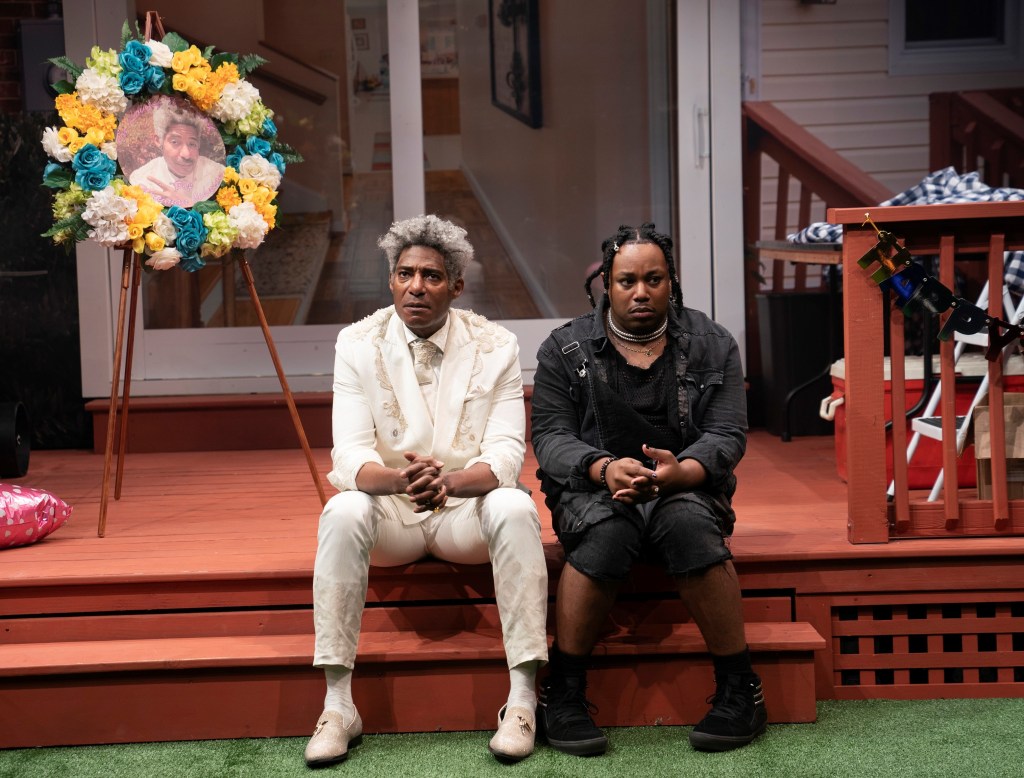
Crawford’s Tendra makes her showy, striking, drop-dead, dancer body entrance to ask Juicy for his opinion about which sexy outfit to wear. Clearly, she gets off looking young and attention grabbing and Juicy, her baby, flatters her with what she needs. Obviously, they are close and adore one another; hence the subtle and not-so-subtle Oedipal references to mother/son relationship which Ali further references with Juicy’s change up into a black T-shirt with pink sequined lettered “Mama’s Boy” on the front.
Around this time as Juicy and Tio set up balloons in the backyard of Tedra’s house (superbly detailed with a smoker grill, screen doors to view inside rooms of the house, Astroturf, expansive, wooden deck, etc. designed by Maruti Evans), something weird happens. A red and white checkered tablecloth flies from one end of the yard to the other. Initially, it appears that someone threw the tablecloth, except it is not a projectile, it streams and flutters, zipping speedily and covering enough ground to spook Tio, who recognizes it as a ghost.

Subsequently, under a brown and white table cloth, Juicy’s father Pap speaks out unghostlike, as he throws off the tablecloth humorously and makes his dynamic entrance in a sequined white suit, sporting striking white hair (thanks to Dominique Fawn Hill’s sensational costume design and Earon Chew Healey’s hair and wig design). As ghostly presences go, his is hilarious. Occasionally, the steam from his betwixt and between state of limbo wisps up from his collar, proving his ghostly being is supernatural and otherworldly. The ghostly effects by Skylar Fox’s illusion design are coolly delivered, and sufficient enough to make us believe that Pap is not from the land of the living.
Having a hard time negotiating Pap’s return and his supernatural condition, Juicy quips about his being deceased and surprising as ghosts go, but Pap isn’t having any jokes. He’s furious. He upbraids his son for being “soft,” referencing his disapproval with Juicy’s gay lifestyle in a typical macho Dad infusion of homophobia. Then, Juicy indicts Pap for not liking him or ever being the loving, mature guide a father should be. Indeed, Ijames’ characterizations credit Juicy for shunning his father’s lifestyle and sticking to one that is more wholesome and life affirming, though culturally, not acceptable.

However, as Pap relates why he has returned, the reveal of Pap’s characterization turns on a dime that he is proud of his machismo. We learn that he is an ancestral criminal whose family provoked a crime spree over generations. His ancestors have passed down this legacy of their criminality all the way back to the days of slavery. And having been abused and abusing, in the course of running his barbecue restaurant, Pap murdered and ended up in prison where he, too, was murdered.

Interestingly, the parallel is drawn. If one doesn’t choose criminality to establish one’s identity and manhood as a black man, what choice does one have? Clearly, Pap’s disgust with Juicy’s choice also goes to what he wants Juicy to do for him. Get revenge on his “sainted” brother who had him killed in prison, then move into his bed and life. The only way for Pap to gain revenge is murder. Pap doesn’t see his way clear to changing up the tradition of criminality with his son which would be a greater form of revenge on the culture of racism by not following the stereotypes the racist culture promulgates. But for the cruel and infamous Pap, the sweetest pay back would never be through redemption or ending the cycle of self-destruction prompted by racism. Pap wants an eye for an eye and to reestablish his respect and manhood through his son.

Unfortunately, for Pap, Juicy isn’t a criminal. His hopes and dreams and his identity journeys in a different direction. Thus, Pap’s need for his revenge may be aborted. Juicy must decide what he wants for himself. And part of the first conflict is whether or not Juicy will go through with Pap’s plans or resist them. After all, Pap may not be who he presents himself to be. He may be a devil tempting Juicy to repeat the same old nullifying actions his ancestors have enacted, living lives of misery and gaining an early death. In a fun recapturing of part of the speech Hamlet (Juicy) delivers to Horatio (Tio), Juicy suggests he will test the ghost to divine the truth.
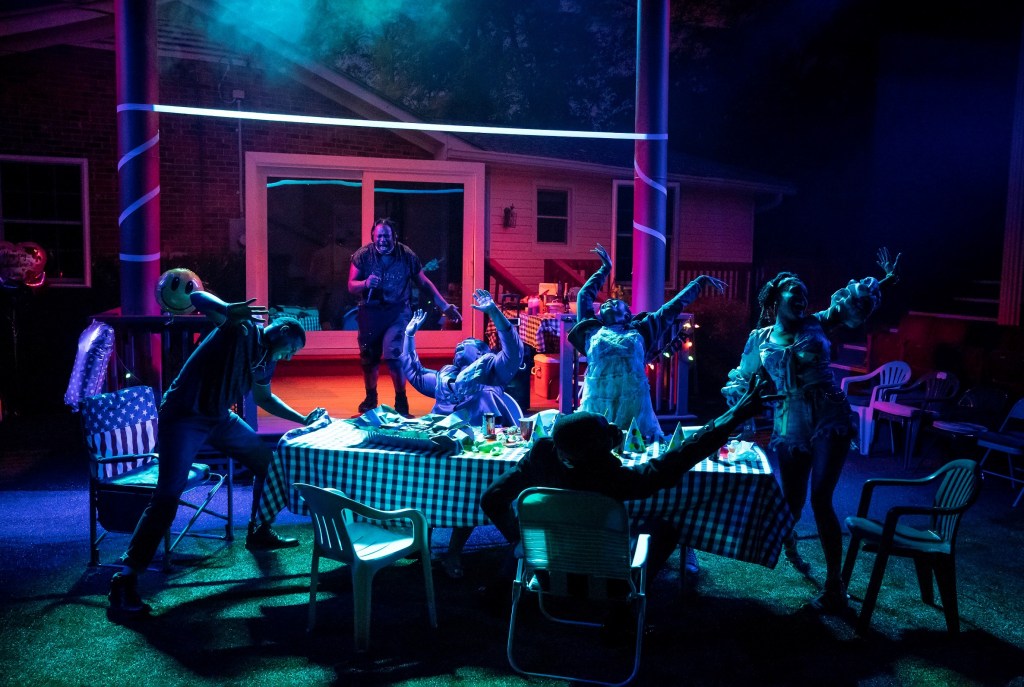
Though it is never mentioned or suggested, in Fat Ham racism is the elephant in the room. Because of it, Pap’s attitudes about Juicy being gay and not being manly close out other choices for his son in Pap’s estimation. The choice for a black man is to be a macho criminal. And only a macho criminal can get a proper revenge and most importantly respect. That Juicy is bucking the stereotype of black men as criminals doesn’t appeal to Pap. That racism has closed off options for Pap so that he would never consider going to college like Juicy is understated. However, as the play progresses, Juicy has choices and will not be held down by Pap’s definitions of manhood, identity and success. Yet, hating his uncle and missing Pap, even though he was mean and cruel, he has to get justice for Pap’s murder. How he does that is the linchpin of this wonderful production.

The beauty of Fat Ham is like Juicy says, sometimes tragedies don’t have to end like tragedies where everyone dies. Ijames jumps back to Shakespearean prose in crucial aspects of the play, including soliloquies about catching the conscience of Rev with a game of charades during the entertainment portion of the down-home celebration. Also, Juicy breaks the fourth wall and confides in the audience. He effectively gestures, rolls his eyes and with superb pacing and timing flicks his fingers in response to silly comments by one or the other of the characters.
Like the other actors, Juicy’s pauses are weighted for a laugh which he and they always get. The innate timing is a function of brilliant performance technique as well as practice and precise shepherding by the director. The laughs come because the actors are authentic and spot-on. I could have stayed and watched another one half hour. I felt engaged and was having such fun with the machinations and carryings on of the characters.

In breaking the fourth wall with direct-address commentary, Marcel Spears is masterful. At the point where he ruminates about how he will trip up Rev and watch for his reactions, at the beginning of the soliloquy, Spears looked at the audience confidentially and said “The Supreme Court is ghetto.” This was Friday evening after a day’s news of the Supreme Court’s decision against Roe. Spears received two full minutes of applause. He waited, then seamlessly segued into his plan to catch Rev. Wonderful at creating a relationship with the audience, by the conclusion we could have gone up and hugged him.
Charismatic, alive his performance was cleverly unassuming. His interactions with his fellow actors’ characters were completely natural and endearing. Considering that he had the most stage time, the pressure was on him to carry the show. There were a few breaks here and there when the spotlight was on others. For example, Chris Herbie Holland’s stoned rhapsody on why you should live to enjoy your life and stop being negative as an out of his mind riff is wonderful. Marvelous, too, is Larry’s transformation from soldier to what he’s wanted to do perhaps his entire life. His friendship with the free-wheeling Juicy allows him to reveal what he is capable of. Calvin Leon Smith knocks his concluding performance out of the park. It makes sense the production ends with him.
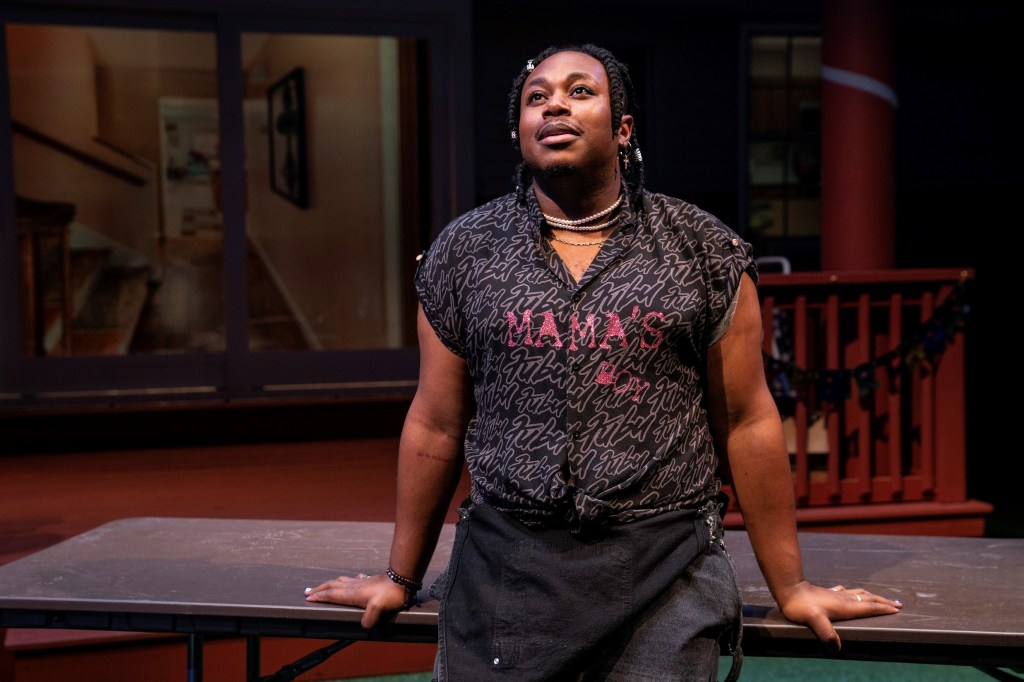
Joining the celebration mid way and present for Juicy’s confrontation with his murderer uncle are friends Rabby (Benja Kay Thomas in a wonderful send-up of the religious, strict, black Mama), her daughter Opal (Adrianna Mitchell’s bored, obedient-disobedient Lesbian), and son Larry (Calvin Leon Smith). Their interactions pair up perfectly with Juicy as they discuss their personal lives and break free from parental strictures and manifest their chosen identity. Their interactions provide grist and humor as they unravel their specific characterizations. What is incredibly upbeat about Fat Ham is the roller coaster ride into humor and fun with just enough Shakespeare to make it interesting and memorable.
The second half of the play with the entertainment portion, i.e. Tendra’s searing hot grinding Kareoke, Juicy’s soulful wailing that Rev characteristically puts down and the charades they play that lead to the reveal, all work beautifully and keep the vibrance climbing to the plays explosive climax. How the actors chow down on their barbecue and integrate the song portions into their partying is realized perfectly thanks to their prodigious talent and Ali keeping it as real as possible. Even the corn looked delicious. Importantly, Juicy confronts Rev ‘s murder of his father. What happens after that certainly is karma stepping up to the plate and hitting back.

The themes about truth and honesty being necessary to fight cultural folkways that destroy are the strongest. The performances are riotous, loving and spot-on. The ensemble work is some of the best I’ve seen this year. I can’t recommend Fat Ham enough as one of the finest productions of the season. It has moved from other venues and may go to Broadway. However , if the venue is a smaller house, that might be the best. This play’s greatness is its intimacy that Juicy achieves with the audience as his confidante. It may be lost in a too large venue.
Kudos to the creative team. Not mentioned are Stacey Derosier purposeful lighting (the surreal blue was excellent for enhancing the Ali’s wild staging and character poses. The sound by Mikaal Sulaiman was uniform in each of the songs sung and the supernatural musical elements were eerie. Lisa Kopitsky’s fight direction was realistic. Marcel Spears fall was dramatic and there were gasps from the audience believing Juicy was hurt. Finally, Darrell Grand Moultrie’s choreography was exuberant and for the concluding number hysterical.
Fat Ham is extended to 17th of July. For tickets and times for this must-see production, go to their website. https://publictheater.org/productions/season/2122/fat-ham/ I just loved it!
 CAROLE DI TOSTI