‘Pure Grit’ an Athena Film Festival Review

Pure Grit, written and directed by Kim Bartley focuses on the relationship between Sharmaine Weed and Savannah Martinez who “love each other,” but cannot “live with each other.” It is also about Sharmaine’s definition of herself as a winning bareback horse racer. Bareback horse racing is one of the most dangerous sports on the planet.
Bartley’s interest in these two indigenous women and their relationship reveals the concern and love they have for each other. Indeed, Savannah joins Sharmaine around the time that Sharmaine takes a year off her winning streak bareback riding to care for her sister who was severely injured following a catastrophic accident during a horse race. The love of the entire family to become champion bareback riders is in their bones. It is an inherent love bred in their DNA. Part of the love includes the knowledge of the risk that they take riding bareback. Sharmaine’s sister took the risk and badly injured herself.
So in a matter-of-fact way Sharmaine describes the accident and her sister’s paralysis on one side of her body. With Savannah, Sharmaine takes care of her sister’s children and with the help and support of other family, they make a life for each other. The sister must go through a lengthy rehabilitation process. Her paralysis impacts her ability to ride. But Sharmaine has the goal for her sister to become healed enough so she can get up on a horse again without fear.
Because Sharmaine takes a year off from racing to take care of her sister, she has become rusty and needs to practice racing again. She is in a position of greater danger than ever because she hasn’t ridden bareback on a horse and has been redirected helping her sister and smoothing over her relationship with Savannah. When she realizes the racing championships are coming in months, Sharmaine pushes herself to get ready and refocuses. But first she must earn money to purchase the right horse to help her return to her greatness as a winner.
Bartley uses her camera from the perspective of a friend and engages Sharmaine’s family members comfortably. She informally interviews her mother and her younger brother Kashe and her older brother Brandon. With abundant voice overs and portraits of the family’s activities, we learn about their lives. Additionally, each family member shares their impressions of their lives, the reservation and their commitment to bareback horse racing.
Brandon has taught Sharmaine a lot of what she knows and gives her pointers about getting back into her riding. Kashe has returned, having been caught up with friends in drugs and alcohol. Because family members have established a comfortable and trusting relationship with Bartley, the film approaches an ethnography. We become a part of the setting and identify with the family and enjoy learning about them.

Though Savannah loves Wyoming Wind River Reservation where it is beautiful and peaceful, all is not heavenly there and the stresses of daily living encumber them. Thus, both women decide to go to Denver, Colorado where Savannah lives. On the one hand, the fighting atmosphere on the Reservation becomes toxic, but they will still be together in Denver. However, there, they calculate the change of scene will improve their spirits. Sharmaine will more easily find a job since there are no jobs on the reservation. With the money she earns, she will buy a horse to use in the upcoming races.
Denver brings freedom and opportunity. However, there are many distractions and these become a strain on their fledgling relationship. When racing season starts up, Sharmaine and Savannah hit the road and embrace the risks. With a new horse from her city earnings, Sharmaine sees the potential for a fresh start. She is determined to be a champion and she practices hard and wins a few preliminary races. However, she emotionally feels she is not prepared because in order to make up for a year off her racing, she must train and there never seems to be enough time.
Furthermore, Savannah is insecure about Sharmaine’s love for her. There is an age difference and though Sharmaine feels she is expressive enough, Savannah is needy. She requires constant reassurance about Sharmaine’s feelings. The strain between them grows, perhaps driven by Sharmaine’s overriding concern that the training with the new horse she purchases isn’t yielding the results she wants.
Kim Bartley presents these individuals in all their humanity and their desires. As a result they become family and we are devastated when Sharmaine, who tries her best to win the race for the first time, after a year, doesn’t make it. Additionally, the once close Sharmaine and Savannah split. They do agree that they love each other but fight too much to live with each other happily.
Bartley reveals that life goes on for them. And the title indicates that life isn’t always about winning, it isn’t always about getting along with someone you love. And sometimes, family leaves and there is nothing that can be done. These themes of struggle and the grit it takes to continue in spite of pain and loss are the life lessons that Bartley highlights in this beautifully shot, well edited film that has no beginning or ending. We are assured, like this family, the struggle in life goes on. And we are glad to be a part of it because to be a part of it is to be alive to take risks.
To see this fascinating film, look for it on VOD channels or check IMBD for updates.
‘Strong Female Lead’ an Athena Film Festival Review

One in three Australian women experience discrimination in the workplace. Julia Gillard, Australia’s first and last female Prime Minister ran the gauntlet of misogyny, discrimination, chauvinism and sexism from her own party members, members of the opposition and the media. What she endured, no woman should have to suffer in the workplace. Sadly, not much has changed since she served for three years as the 27th Prime Minister of Australia. Filmmaker Tosca Looby’s Strong Female Lead sets the record straight chronicling Gillard’s war years bravely standing up to men assiduously devoted to destroying her career and her resolve.
The documentary that screened at Athena Film Festival makes a leap in the right direction of supporting and denouncing the attacks and vilification of Gillard, a representative of women in political leadership. The film reveals that their brilliance and personal power frightened men unable to deal with their own personal issues with women. Clips of these craven, which Looby culls from mounds of archived film, TV and radio clips disgrace and humiliate themselves. They slander and excoriate Gillard instead of supporting her governance and properly upholding the rule of law with the integrity and grace due the offices they hold for the sake of Australians.

In her superb, difficult to watch film Looby cobbles together a record of film and TV clips, statements, film clips of protests, radio commentary and quotes in her exhaustive documentary. What she unfortunately reveals is the egregious, childish behavior of the males in their smear campaign to oust Julia Gillard almost from the moment she takes office in 2010. Indeed, she reveals how they worked prodigiously day and night to divide her party so she would be ousted in 2013. That Gillard’s brave leadership as PM got many programs accomplished despite the attacks is to her credit. One wonders how much more she would have accomplished if she had more support from the media.
Unbelievably, the opposition under the leadership of Tony Abbot at the time preferred to abuse her daily, mentoring hatred for the daughters and wives of Australian ministers and citizens. Abbott, a conservative (think anti LGBTQ, same-sex marriage, anti women’s rights) had no problem slamming Gillard’s personal life. Bloodletting was his purpose, not governance. His shameful acts and comments in parliament are recorded historically in Looby’s documentary, for all time, behaviors and comments seen cumulatively in Looby’s film provide a visceral and raw record of behavior antithetical to human decency required of a member of parliament and possibly a future Prime Minister.

Thus, Lobby’s film Strong Female Lead enumerates the level and extent of hatred and insult Gillard withstood in parliament and the media. Brave is not the word to describe her. Anointed, Godly, spirited is more the behavior she demonstrated. If anyone deserved to be PM, it was she. Sadly, the citizens have cretins and blowhards to govern them, a complete joke which rivals the United States insurrectionist blowhards in the Republican Party, one whose own brother and family denounced him, stating he belonged in a mental institution and should be removed from office.
However, the parliament and Abbott were not implying Gillard was a witch alone. They were helped by right wing conservative media who whipped up crowds and protests that Tony Abbott self-righteously appeared before as the savior of Australia, while milking the empaths with statements about helping Indigenous populations in various parts of the country. When there was a spotlight shining on Abbott, he puffed up like a red rooster.

In her commentary before the film Looby apologizes for including the misogyny and hate-filled clips. However, she mentions that out of the resources at her disposal, all archived on television and radio, she selected the ones that were the least offensive. That is amazing. So the signs flashed on TV that Abbott stood next to that read, “Ditch the Witch” and “Bob Brown’s Bitch” were tame. Ironically, this leaves us wondering, what didn’t she include? Additionally, Looby’s extensive coverage of vile Alan Jones of 2GB radio, now, a former host whose contract has not been renewed by Sky News and who has been repeatedly sued for defamation, is particularly loathsome.

For direct hate-filled sexism and misogyny, Jones rivals the most monstrous. During Gillard’s tenure as PM, her father died. Jones takes a salt mine of vitriol rubs it in Gillard’s grieving wounds claiming her father “died of shame” because of her behavior. Mind you, what horrific things did she do? Disagree with his right-wing, conservative politics? Later, Looby includes his apology which of course rings so insincerely the next time he launches out and spews more venom at her. Indeed, he was Tony Abbott’s good little puppy. That was a deal made in the abyss.
However, one of the most uplifting clips Looby makes sure to include is Gillard’s queenly speech, filled with integrity and grace that answers all of what Abbott attempts to smear her party member (sexism and misogyny). The speech went viral and Gillard will forever be remembered for the power and brilliance with which she spoke.
Looby makes an incredible case for Gillard’s abuse at the hands of the opposition, Abbott, the right-wing media and other’s sexism. She seamlessly edits the pre-existing materials, visual and audio, sourced predominantly from television and radio. Interestingly, the indictment falls not only on these guilty of their bravado of sexism. She makes a clear, defining statement about the inappropriate misogynistic media.
Since Gillard retired from politics and her party lost, Abbott became Prime Minister for two years and then was also ousted from the opposition party. Critics and experts agree that he is one of the worst Prime Ministers in Australia’s history. Meanwhile, Gillard has gone on to remain active. In April 2021, Gillard was appointed chair of the board of Governors at Wellcome Trust, a charitable trust which supports research and innovation in medicine, public health, mental health and climate change. Additionally, Gillard was recently honored by the award of the Grand Cordon of the Order of the Rising Sun from the Government of Japan. This was formally presented to her by the Ambassador of Japan to Australia. Gillard is the 8th Australian prime minister to receive the award.

Looby uplifts Gillard’s courage to be who she chooses to be. If it rocks the status quo in conservative circles, so be it. She once stated that she could never run for a political position in the U.S. with her lifestyle. She is an atheist, childless and has lived with her partner Tim Mathieson since 2006. They are not married. During her tenure as PM, Looby includes clips by the media during which she receives incredible pressure about her lifestyle and her relationship with Tim and his career. Gillard’s responses were humorous and clever. Of course Jones and Abbott piled on the heat and abused her with her unhousewifely behaviors, choice of partner, not having children and having a career in politics. In her speech credited and included above, she answers Abbott’s sexism.
This is a film to see if you need the courage of convictions in presenting your choices. Gillard’s strength in being proud and standing up for herself by calling out misogyny is an imperative all should follow. Look for Strong Female Lead on VOD and updates on IMBD.
‘Ida Lupino: Gentlemen & Miss Lupino,’ an Athena Film Festival Review

Actress, filmmaker, director Ida Lupino was a force for her time (1940s-1960s). When no other woman in Hollywood was able to get around the discrimination against females in leadership positions Ida Lupino was there! Ida Lupino: Gentlemen & Miss Lupino, a documentary which screened at Athena Film Festival reveals the extraordinary work of this actress/writer/director/producer. In their documentary Julia and Clare Kuperberg cobble together interviews, film clips, quotes from Lupino’s autobiography, commentary by Lupino experts, current directors and more to tell Lupino’s story. Their film is a fabulous reminder of how women can forge ahead despite the overwhelming odds against them.

In the creation of the studio system, actors became the chattel of studio bosses. Their dictatorial control siphoned off creative energy and channeled it in one direction, a narrow commercialism based on the proclivities of the bosses. Thus, walls of paternalism and misogyny were thrown up by these weak-willed, desperate and selfish power hungry, who after the 1920s took over Hollywood. Jealous of their power, intent on exploiting and using women, to not compete with them, they prevented and excluded women from being producers, directors, managers in leadership positions in the studio system. The tool of sanctioning and oppression kept women in line so that they wouldn’t consider moving “above” their submission.

Studio bosses perpetuated some of the most damning feminine myths. These psychically abused women actresses highlighting them as sex objects or villainous vamps. Such myths also damned male/female reactions to each other and mentored psychologically warped relationships for decades. Sadly, as housewives and mothers, women characters remained in the background. Only in comedy and musicals did women shine.
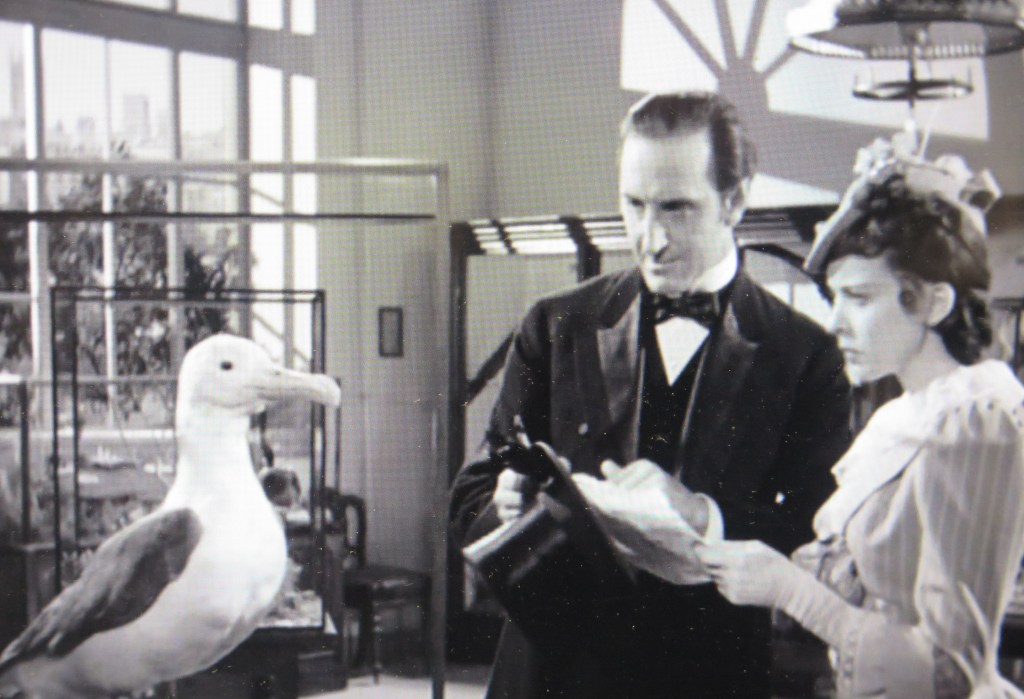
As an actress Ida Lupino entered this system and “caging the joint,” she brilliantly decided she had enough of women’s stereotypical roles. She wanted to step out of her “designated” lowly position and direct the types of films that authentically related to women. Thus, looking at Ida Lupino’s films one notes a glorious reality that rounds out the lives of women with authenticity. A maverick, she proved that women’s films could be profitable and popular.

In highlighting that Lupino started as an actress and branched out from there as perhaps the first to establish the genre of Film Noir, the Kuperbergs interview Julie Grossman who penned Ida Lupino Director: Her Art and Resilience in Times of Transition and film historian Tony Maietta. With prodigious examples in their interviews, the Kuperbergs reinforce Lupino’s own comments and reveal her revolutionary approaches to creating films.
Importantly, the Kuperbergs use Lupino’s own biography and film interviews she gave to fashion their entertaining and insightful documentary Ida Lupino: Gentlemen & Miss Lupino. With quotes, film clips and commentary by Ida Lupino and quotes from her biography, we learn how this creative genius withstood the discrimination to direct important films related to women’s issues. Cleverly, she navigated the all male technical crews by referring to herself as “Mother,” a benign characterization which engendered a nurturing spirit among the men.

Related to this persona which Lupino wore with pride, the Kuperberg’s also indicate how Lupino learned from working as an actress in the studio system surrounded by men in positions of power behind the camera. With humor Lupino suggests that men hate to be bossed and ordered around. She implies that in getting male cooperation, there’s nothing worse for fragmenting unity than a “controlling” woman. Hence, her mother image worked every time.

Vitally, when the 1300 men in the entertainment industry were predominately concerned with objectifying women and selling them as whores, prostitutes and sex objects, Lupino created films that dealt with women’s issues like abortion, rape, pregnancy and bigamy. And she did this with empathy and depth moving beyond stereotypes and cardboard cut-outs of female and male villains and heroes. As a director, she emphasized the humanity of both the men and women in the revelation of real-life issues. It is no wonder that her films were popular successes.
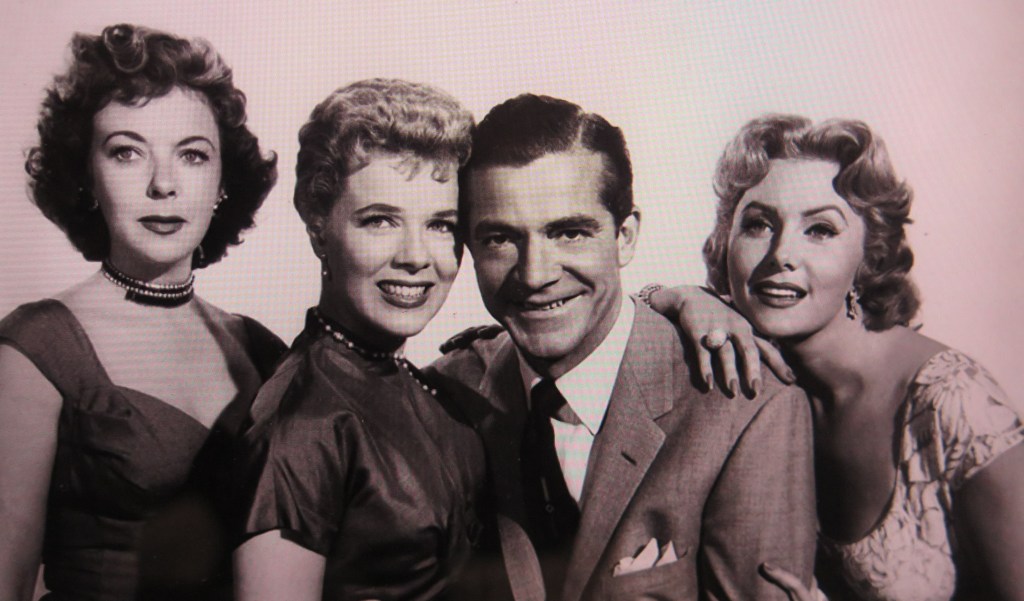
The only woman with a serious career as a director in the 1950s and 1960s, she headed up her own production company with her husband actor Collier Young. Together they created The Filmmakers Inc. As a Democrat and a Catholic, Lupino’s cinema took on sociological and criminal subjects that male directors either feared dealing with or ignored because men engendered the subject matter (i.e. rape).
Lupino’s film about rape (Outrage-1950) is decades ahead of its time in the way she reveals how the victim suffers PTSD afterward in nightmares and reactions to simple sounds. Also, the cinematography is incredible with tall shadows representing the terror and fear as the rapist stalks his victim. Indeed, this and other Lupino films are superb examples of Film Noir before Lupino’s counterparts dealt adequately with the genre.
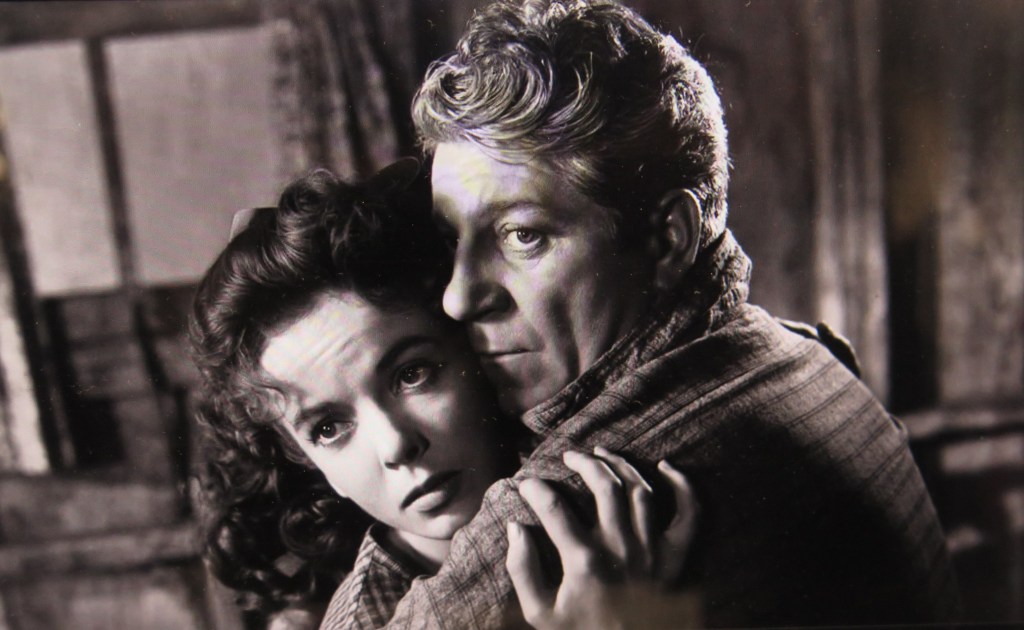
In another clip the Kuperbergs interview Martin Scorsese who discusses how Lupino’s cinematography influenced him. Identifying Not Wanted, a film about an unwanted pregnancy, Scorsese comments about the film’s documentary feel and power as a unique and pioneering work. The film shot on location deals with trauma, and the instability of a young woman having a baby with no husband. In dealing with the idea of teenage pregnancy which was against the happy family myths Hollywood perpetuated, again Lupino was a maverick presciently ahead of her time.
Finally, Lupino confronted another taboo related to illness and disease, the one ravaging children at the time: polio. She chronicles how polio sufferers were rejected and treated like lepers. Approaching this subject like no one else did before, Lupino creates empathy and humanity for those who suffered polio and other illness.
Interestingly, Lupino was the brains behind Filmmakers Inc. When Young wanted to go into distribution in addition to production, Lupino disagreed. She attempted to convince him that they knew little about the workings of distribution. Not listening to Lupino, Young tried and failed. They had to shutter Filmmakers Inc. However, Lupino persisted with her directing career after their divorce. Television was burgeoning so she moved to the small screen and directed over 100 works. She contributed her directing efforts to various episodes on “The Twilight Zone,” “Alfred Hitchcock Presents” and many other series. Lupino remains as the most prolific global female director of all time.

No wonder why men have attempted to stomp her from memory. But mother Lupino knows best. The Kuperbergs have resurrected her extraordinary contributions because perhaps the culture is ripe to recognize the genius independent producer-writer-director and learn from her.
Lupino has been out of the Hollywood loop historically. Nevertheless, her films remain timeless treasures where the mass produced typical commercial Hollywood fare have fallen into the garbage heap. Appreciating her brilliance and noting that she was one of the most complete and politically responsible filmmakers of all time, the Kuperberg’s Ida Lupino: Gentlemen & Miss Lupino, presents a long overdue focus on her career, themes and achievements. This is a must-see for filmmakers, writers, cinematographers and cinefiles. Check IMBD or your favorite VOD channels for screenings.
‘Master,’ a Thriller With Twists, Athena Film Festival
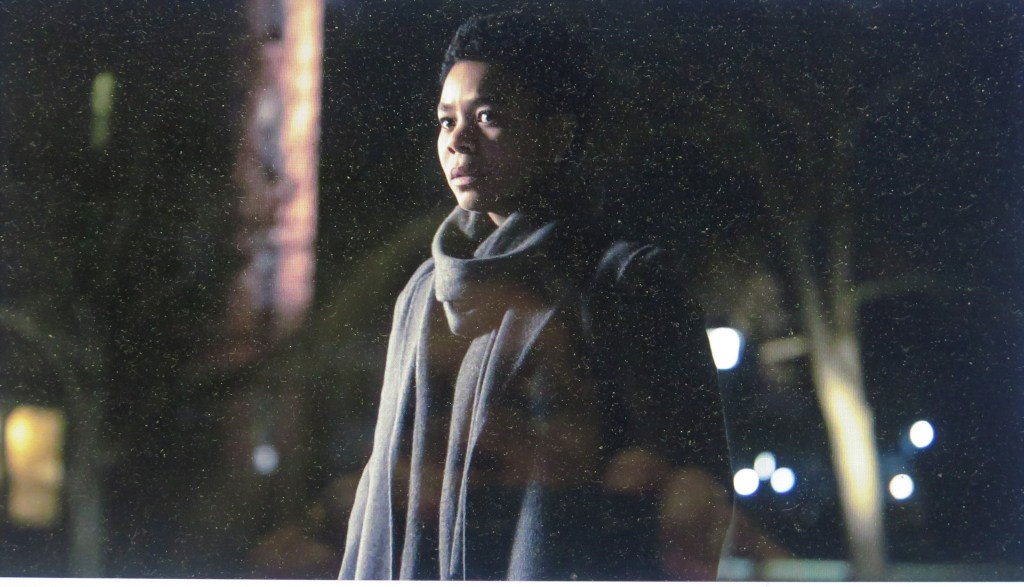
In Master written and directed by Mariama Diallo, the horrors of the past combine with present-day horror to gyrate into a memorable thriller with twists. The film screened at Athena Film Festival and SXSW.
Starring Regina Hall as Professor Gail Bishop, Zoe Renee as Freshman Jasmine Moore and Amber Gray as Professor Liv Beckman, Diallo presents three women of color. Each must find her own way to success at an elite New England university. Only one of the three succeeds. The reason why is disclosed by the conclusion.
Three Women of Color at an Elite University
Diallo opens with Jasmine who arrives at the campus welcomed by a student who intimates that she got “the room.” Later Jasmine discovers the legend about a woman hanged for being a witch. Part of the legend’s spin is that the university site is a Salem era gallows hill.
In macabre fashion, the “witch” picture hangs with other white Puritan ancestors/donors of the university. For whatever reason, the university perhaps views the woman as a martyr and eschews her dark and violent end. But the legend abides on the campus and underclassmen are tantalized by it as upperclassmen share the story abundantly so every student knows it.
Jasmine remains submerged in the legend and the hanging. Increasingly, she feels uncomfortable. Spooked by discussion that the witch forced a girl to jump to her death, Jasmine begins having nightmares. Her roommate and friends remain coolly distant and provide no help to make her feel accepted or comfortable.
The Dean Discovers a History of Racism on the Campus
Meanwhile, Gail Bishop enjoys the privilege of her position as “Master,” the dean of students. Though warmly welcomed by colleagues and students, she too must confront a terror which is in her beautiful but darkly lit residence. When Gail attempts to clean out some of the storage areas, she discovers the history of servitude and slavery in pictures left in shoe boxes.
Though her exalted position as a black woman makes her proud of her achievement to be appointed dean, in the artifacts she finds the unpleasantness of racism and servile abuse that existed in the house decades before. This is the site the official board of the university gave her to adopt as her home, but no one thought to clean out the storage areas. Is there an underlying message they are relaying? The pictures and weird, creaking noises stoke her fears. She visits her colleague Liv Beckman for comfort.
Meanwhile, something curious is happening with Jasmine in her classes. Though she achieved As in Tacoma, Washington and graduated as the Valedictorian, on the issue of critical race theory, she disagrees with Professor Liv Beckman. Beckman suggests that The Scarlett Letter has great racial bias and claims that the novel may be used to understand the racism in the setting and characters. Jasmine opposes that in open discussion. After she writes a paper expressing her views, she receives an F. Asking other students their grades, Jasmine determines that Beckman targeted her, so she files a complaint letter suggesting Beckman lacks competence.

The Women of Color are on Campus to Represent “Inclusion”
Ironically, Beckman represents as a black woman who college officials hired to show they support “inclusion.” Jasmine and Gail are all there for the same reason, to reveal how open and accepting the university is toward women of color. Thus, Jasmine’s accusation against Beckman appears contradictory and weird as does Beckman singling out a “sister.” Instead of unity between two black women, division overshadows them. What is the spirit that causes this?
The complexity deepens when the professors challenge Beckman’s receiving tenure because she hasn’t published. Caught between supporting her “sister” and being objective, Gail brings up the letter of complaint Jasmine filed against Beckman. It appears that Liv will have to leave. The unity that should exist among all three women has been shattered. To appear objective and just, Gail feels forced to tell her colleagues who will vote on Liv’s tenure about Jasmine’s letter of complaint.
Master’s Terror Shifts From Legends to Realities
Diallo then ratchets up the revelations of racial bias on the campus among the student body. Terrifying events occur that seem strange on a New England campus that appears to support diversity. However, the university had a vile history of a racism even in the 1960s which Jasmine uncovers doing research in the library. The perpetrators were never found in the lynching of a black woman student. Was this the work of the witch or a ghoul? Or did the murderer or murderers have white faces?
Using lighting, camera angels, pacing and interesting cinematography, Diallo creates mystery and suspense tying in the legends of the witch with a cult that meets in the woods and the lynching of the black woman student. After Jasmine discovers the hate crime, something becomes unleashed. Her discovery becomes the turning point. Racism on the campus becomes overt. Jasmine and Gail are targeted. Beckman, Jasmine and Gail attempt to help each other. However, sadly, the help never makes a difference.
The lines blur between imagination and truth
In the last half of the film Diallo stuns with unexpected twists. At one point, I thought the film to be sophomoric because Diallo cleverly misdirects her audience. Manipulating our understanding, she blurs the lines between the characters’ imaginations, nightmares and reality without clear delineation. And then she slowly reveals what we anticipate is the truth, but it isn’t. She keeps us guessing. Indeed, the opaqueness remains vital to the mystery, horror and shocking events that occur by the conclusion.
When brutality arrives, it devastates. The victim and the viewers who identify experience the fullness of the traumatic events.
Thematically, Diallo’s work clearly focuses on empathy. Allowing others to experience the shock of trauma puts the audience in the shoes of those abused, of those who experience racism’s terror on a visceral level.

When Terror Comes There is no Going Back
Once the characters sustain that terror, there is no going back. Certainly, political discrimination, white privilege and historical racism are undercurrents which Gail finally realizes permeate the university. And institutional racism floats everywhere and terrorizes like a ghost ubiquitously. It’s on the campus. It’s in the nation. Diallo proves that Gail has nowhere to run or hide from danger as a black woman, certainly not at this university. Like a flash of lightening the full import of title comes to us as ironic and diabolical. Finally, what Liv achieves when she receives tenure is a well planned outcome that is a travesty of justice built on lies.
Diallo’s twists create a greater horror than ghosts and legends in Master. But the elite university still remains. And that may be the greatest horror of all.
Master is screening on Amazon. Don’t miss it.
‘English’ a Seminal Play by Sanaz Toossi

Born into our parents’ culture and country, we learn how to communicate with them easily and take our language for granted without thinking about it. Delving deeper, language defines us, defines our thoughts, our ways. Our name in our native language has meaning from its history. It describes who we are and how we perceive ourselves. Many change their names as a result, knowing the change means a different self. Considering the import of the language we speak and our identification with it, how does learning a new language impact the way we understand ourselves? How might learning another language affect our being?

English, the insightful and powerful work by Sanaz Toossi, presents these questions and answers them poignantly through the voices of five individuals from Iran, who grapple with learning English. Starring an all-Iranian cast, the play enjoyed an extended run at The Atlantic Theater Company and most probably will be a favorite to be staged globally. Directed by Knud Adams, the play remains an original that unfortunately, couldn’t have had a longer run.
The setting is Karaj, Iran in 2008 before and during a confluence of events taking place between Iran, the United States and other English speaking countries. At the time immigration is fairly easy and Iranians on the move want to study abroad, do business and travel for extended stays to English-speaking countries to which their families emigrated.

Marjan (Marjan Neshat portrays the instructor), teaches for the TOEFL, the Test of English as a Foreign Language. The standardized, timed test measures the English language ability of non-native speakers, who wish to study in English-speaking universities. The test is accepted by more than 11,000 universities and other institutions in over 190 countries. The selective test guarantees that the students have an excellent working knowledge of the language to insure their success, not only in their classes, but also in navigating the culture and society.
As Neshat’s Marjan teaches, she realizes as we do that in every class there is a dynamic. Personalities emerge. Though she attempts to be objective, she finds herself aligning with students who demonstrate like-minded abilities and cognition. As her students reveal themselves in their response to her and the language, we find their observations humorous, their interactions fascinating. And the conflict arises when the struggling and often embarrassed students relate her to the onerous time they have with learning a completely different mode and thought process of communication. Neshat is authentic in her portrayal as Marjan, revealing the inner emotional struggle she has especially with Elham (the feisty, assertive Tala Ashe).
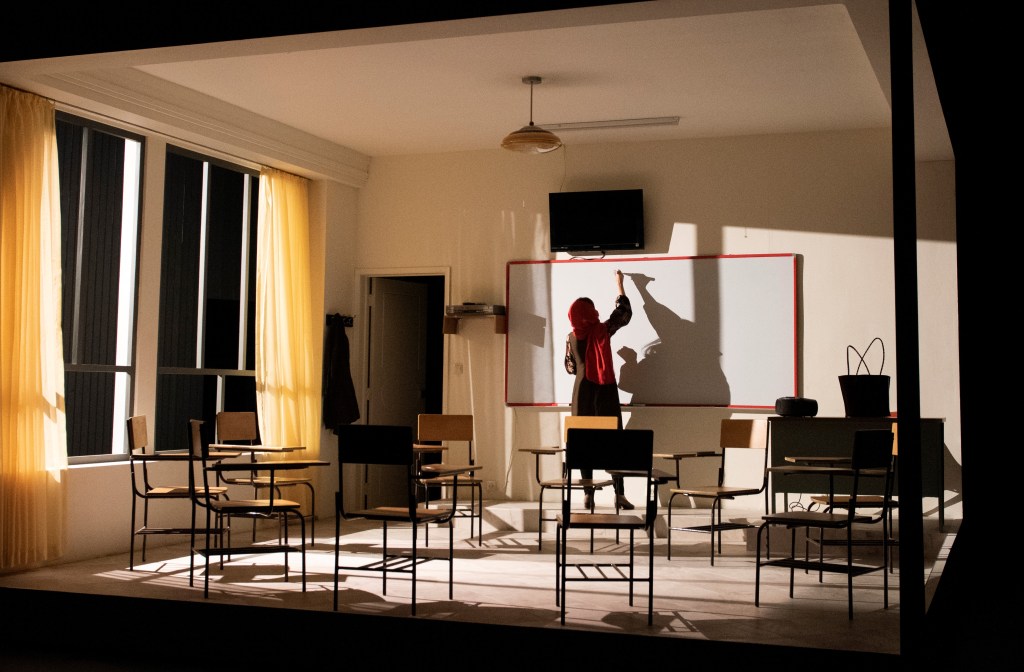
Humor evolves organically from the students’ perceptions, struggles and slippage into their native tongue Farsi in the first weeks of the class. An excellent teacher, Marjan attempts to gradually curb their fear and angst holding their feet to the fire by speaking only English and giving them a demerit if they fall back into Farsi. Her skills are effective. We watch these individuals speak halting English. When they rip off sentences quickly (in English), that designates they speak Farsi.
At the outset Neshat’s Marjan reveals equanimity despite the competitive confrontations of Elham (the excellent Tala Ashe), the shy, halting behavior of Goli (the sweet Ava Lalezarzadeh), and the lackluster, removed Roya (the heartfelt Pooya Mohseni). Eventually, it becomes apparent that Omid (the attractive, confident Hadi Tabbal), the only male in the class, whose English is nearly unaccented and spot-on, is the one that Marjan connects with cognitively and perhaps, as Elham suggests, on a more personal level. Neshat and Tabbal effect an intriguing bond that flows with undercurrents between their characters.

We enjoy Marjan’s activities with the class which reinforce recognition of English nouns through games that emphasize speed. She keeps in mind the TOEFL is a timed test. However, eventually, the language begins to wear down the teacher and the students after Neshat’s Marjan encourages them to undertake the most difficult part of learning a language; they must only speak in English.
Thus, they must converse in sentences, and in effect begin to approach thinking as a native English speaker. All of them chafe at this and break into Farsi which Neshat’s Marjan “censures” by noting it on the chalkboard. The only one who doesn’t find this difficult is Tabbal’s Omid.

As Marjan attempts to have each of the students integrate themselves more personally with English, the conflicts explode. We discover Mohseni’s Roya only wants to learn because her son wants his mother to speak to her Canadian granddaughter in her native tongue which is not Farsi. This devastates Roya, who in a show and tell explains the two languages as she hears their differences. When she discusses her son’s email in Farsi and a voice mail he leaves in English, she uplifts the beauty of Farsi. She emphasizes the softness of her son’s intent in Farsi. Then she notes in his English voice mail, his speech. The sounds he makes are harsh, removed, cold. She asks the class, “Who is mom? I am Maman.” There, in one word the history of Persia is eradicated. The audience was completely silent during Mohseni’s plaintive discussion of loss; her son and granddaughter disappearing her culture before her eyes. This powerful moment is beautifully rendered by Mohseni and insightfully directed by Knud Adams.
The distinction Toossi suggests is profound and thought-provoking. Roya’s relationship to her son has been separated by the nature of the language, and we see her heart is broken because of it. As he lives in Canada over the years, the separation will become impossible. The geographical difference matters little. It is his adoption of this new way of being in English. Even if she stays with him in Canada, she will be forced to learn this harsh, cold speech and ways of thinking to attempt to form a relationship with her granddaughter. But a culture, a way of being, a way of life and history has been disintegrated in the next generation. Mohseni’s Roya defines this as a death. As a result of her incredible performance, we believe and buy into Roya’s grief. Her granddaughter will never know the softness and poetic beauty of Farsi, the language of poets, of Omar Khayyam.

When Marjan has all of her students speak their English names, Roya rebels. It is her last stand. She never returns to class. We anticipate that the cost is too great for her to be reborn into a culture that reshapes her identity with an ugly name and being. As Roya leaves the class, Marjan’s response is invisible, absent. When a student asks what happened to Roya, Marjan dismisses the question. We are left to think that Roya failed to even desire to evolve, and Marjan failed Roya. Marjan, normally empathetic, moves on to “save” the others. However, Neshat’s Marjan too swiftly dismisses Roya. The undercurrent of her own feelings screams out with her silent dismissal, as harsh as the sounds of English to Roya’s intellect.
Toossi makes an important choice for our understanding of the complicated Marjan who puzzles us. Why didn’t she use Roya’s difficulty as a teachable moment? Why didn’t she encourage the others or explore for a few minutes a path to enhance their connection with her? We don’t know if she deeply empathizes and understands Roya’s rebellion or if she is annoyed she failed her. The question Toosi raises about Marjan’s character, she never answers because it is a developing characterization steeped in a confluence of emotions and feelings. Clearly Neshat’s Marjan is thrown by this event. Her becoming an English teacher has impacted her. There is gain, and there is loss and there is the price she pays for the trade-off.

Pooya Mohseni’s portrait of Roya is eloquently delivered, touching and emotionally driven. In every line we feel Roya’s pain in having to deal with this untenable situation. Mohseni knocks it out of the ballpark. Through her character most of all, we understand what it means to be a native speaker. We empathize with the loss of dignity, honor and person-hood Roya feels being forced into speaking English by Neshat’s Marjan. We get how Marjan’s restrictions not to communicate and make herself understood in the beauty of Farsi is anathema. Of course, she feels English is like putting on a cloak of stupidity, ugliness, ungainliness. If her granddaughter never learns Farsi (something Omid suggests her son should have his daughter do), she will never know who her grandmother really is. Roya’s loss, historical, cultural, personal is beyond calculation.
Toossi’s strongest moments present themes of loss of the old identity, yet the incomplete adoption in fluid grace with a new one. For each of the characters, we empathize that it is like being birthed again, torn from one’s natural lush habitat and plopped down in a desert left to die of thirst every moment, as they yearn to feel the cool balm of speaking in one’s mother tongue. English shines when the pronounced conflicts increase.

For example, Elham’s ambitious nature and brilliance force her to try to be the best in the class to achieve a high grade on the TOEFL in her pursuit to be a doctor. Ashe nails Elham’s frustration in achieving a high score on the MCAT and fearing a low score on the TOEFL. The TOEFL is a mountainous hurdle, so she hates English and by extension is oppressed by Neshat’s Marjan. Nevertheless, her competitive nature compels Elham to provoke Marjan in the stress and strain of being challenged. Speaking Farsi, yearning to be close, she manipulatively accuses Marjan of disliking her.
Ashe’s exceptional portrayal is revealed in her character’s suppressed anger. Thus, Elham proclaims to Ava Lalezarzadeh’s Goli that Marjan “loves” Omid. The sweet, shy Goli avers. But Elham insisits that because Marjan invites Omid to watch English films with her there is a “bond.” Indeed, in their moments together Tabbal’s attractive Omid is suggestive and in his scenes with Neshat’s Marjan there is a connection. However, it is not as Ashe suggests; it is based in understanding English fluidly. Indeed, Marjan invites Elham and Goli, but they don’t want to spend the time with Marjan and Omid watching films like Room With a View. These conflicts are vital to the play’s forward movement. Perhaps they might have been established earlier.
Toossi’s uses her characterizations to organically develop her themes. These strengthen our engagement and pull at our empathetic heart strings. Thus, when Omid’s mystery is revealed or when Elham comes back to discuss how she performed on the TOEFL, we identify. Most of all Toossi has accomplished a milestone by indicating the importance for native speakers to stand in the shoes of immigrants who are even attempting to learn English. To learn a different language is a courageous, heroic feat, as Toossi suggests. It is a willingness to expand to another identity, another thought process. Ultimately, the nature of the language, its formation and structure changes the individual emotionally, mentally, indeed psychologically. This must not be underestimated. All of the actors’ portrayals vitally heighten Toossi’s themes and bring us closer to the importance of empathy. Ashe’s development of her character Elham is exceptional and we thrill for Elham as she shocks us with her success which was in her all along.

Toossi also reveals why there are those who don’t wish to learn English, even though they’ve lived in an English speaking country for years. These individuals remain in their own communities, never learn the language and never venture out to immerse themselves in new experiences. The risk of embarrassment is too great. They will not live in humiliation as their new persona, feel like an idiot and be quiet and uncommunicative, not understanding the too rapid speech bursts around them.
Finally, Toossi implies that by leaving behind the old self and adopting a new one, the individual wipes out the favored history of their beloved country, identity, relationships, being. Of course, if there is no direct imperative for business or education, they will not even try. Additionally, in the United States, their accent will be so thick it will be tantamount to a “war crime,” especially in the rural South and West as Ashe’s Elham ironically and humorously suggests.

This is one of the great lines in Toossi’s superb play. Understandably, non-native speakers do not wish to brave the looks of disgust, horror and puzzlement on the faces of native English speakers when they try to ask, “When will the waiting room open?” (Ws without an accent are particularly hard for non-native English speakers). Toossi covers a great deal of ground in her touching play which ends on a high note. We finally hear the actors speak in Farsi.
The production has ended. A few points about when I saw it the last day of its extended run.
Some of the actors couldn’t be heard, even by those sitting in the second row. Friends sitting there told me they barely heard certain thin-voiced actors. Also, sitting up close they became annoyed because the chairs blocked their view at times and they had to lean to the left or right. I was in row F and I thought it was just me when I missed some of the dialogue. I wasn’t the only one.

Problematic was the set construction, a lovely box set classroom which kept in the sound and echoed it. A wonderful idea for the set shouldn’t obstruct the audience’s enjoyment of the production with occluded sight lines and muffled sound. The idea of the classroom, revolving on a turntable platform is symbolic. But unless the audience hears each line of the actors and sees all areas of the stage without obstruction, the symbolism is impaired. This is too wonderful a work for it not to be technically spot-on.
Look for the marvelous Toossi’s work. She is a treasure and English is a vibrant, important and current play that begs to be performed again.
‘A Touch of the Poet’ The Irish Rep’s Brilliant Revival Exceeds Its Wonderful Online Performance. Eugene O’Neill’s ‘Poet’ is Amazing Glorious Theater!

From the moment Cornelius “Con” Melody (Robert Cuccioli) appears, shaking as he holds onto the stair railing of the beautifully wrought set by Charlie Corcoran, we are riveted. Indeed, we stay mesmerized throughout to the explosive conclusion of the Irish Repertory Theatre’s A Touch of the Poet by Eugene O’Neill. Compelled by Cuccioli’s smashing performance of Con, we are invested in this blowhard’s presentiments, pretenses and self-betrayal, as he unconsciously wars against his Irish heritage. Con is an iconic representative of the human condition in conflict between soul delusion and soul truth.

What will Con’s self-hatred render and will he take down wife Nora and daughter Sara (the inimitable pairing of Kate Forbes and Belle Aykroyd), in his great, internal classicist struggle? Will Con finally acknowledge and accept the beauty and enjoyment of being an Irishman with freedom and hope? Or will he continue to move toward insanity, encased in the sarcophagus image of a proper English gentleman? This is the identity he bravely fashioned as Major Cornelius Melody to destroy any smatch of Irish in himself. O’Neill’s answers in this truly great production of Poet are unequivocal, yet intriguing.
The conflict manifests in the repercussions of the drinking Con takes on with relish. So as Cuccioli’s Con attempts to gain his composure and stiffly make it over to a table in the dining room of the shabby inn he owns, the morning after a night of carousing, we recognize that this is the wreck of a man physically, emotionally, psychically. His shaking frame soothed by drink, which wife Nora (Kate Forbes), brings to him in servile slavishness, is the only companion he wants, for in its necessity as the weapon of destruction, it hastens Con’s demise. The beloved drink stirs up his bluster and former stature of greatness that he has lost forever as a failed Englishman and even bigger failure as comfortable landed gentry in 1828 Yankee country near Boston.

Director Ciarán O’Reilly and the cast heighten our full attention toward Con’s conflict with the romantic ideal of himself and the present reality that will eventually drive him to a mental asylum or a hellish reconciliation with truth. All of the character interactions drive toward this apotheosis. The actors are tuned beautifully in their portrayals to magnify the vitality of this revelation.

Nora (Forbes is authentic and likeable), is the handmaiden to Con’s process of dissolution. In order to fulfill her own glorified self-reflection and identity in loving this once admirable gentleman, she coddles him. Riding on the coattails of her exalted image of Con, she maintains beauty in her self-love. She loves him in his past glory, for after all, he chose to be with her. So Nora must abide in his every word and deed to maintain her loyal happiness, taking whatever few, kind crumbs he leaves for her under the table of their marriage. As a result, she would never chide or browbeat Con to quit the poison that is killing him.

The good whiskey he proudly provides for himself and friends like Jamie Cregan (the excellent Andy Murray), to help maintain the proper stature of a gentleman, steadies his mind. The whiskey also makes him feel in control of his schizoid personas. He clearly is not in control and never will be, unless he undergoes an exorcism. The audience perversely finds O’Neill’s duality of characterizations in Con and the others amusing if not surprising.
Cuccoli’s Con at vital moments rejects the painfully failed present by peering into his mirrored reflection to quote Lord Byron in one or the other of two mirrors positioned strategically on the mantel piece and a wall. There, fueled by the alcohol, he re-imagines the glorious military man of the Dragoons as he stokes his pride. Yet, with each digression into the past, he torments his inner soul for reveling in his failed delusion.

Likewise, each insult he lashes against Nora, who guilty agrees with him for being a low Irish woman, both lifts him and harms him. It is the image of the Major ridiculing Nora because of the stink of onions in her hair one moment, and in self-recrimination, apologizing moments after for his abusiveness. In his behavior is his attempt to recall and capture his once courageous, successful British martial identity, while rejecting the Irish humanity and decency in the deep composition of his inner self.

Always that true self comes through as he recognizes his cruelty. He behaves similarly with Sara, bellicose in one breath, apologetic in the next, fearful of her accusatory glance. In this production Con’s struggle, Nora’s love throughout and Sara’s resistance and war with herself and her father is incredibly realized and prodigiously memorable. O’Reilly and the cast have such an understanding of the characters and the arc of their development, it electrified the audience the night I saw it. We didn’t know whether to laugh (the humor originated organically as the character struggles intensified), or cry for the tragedy of it. So we did both.

Con’s self-recrimination and self-hatred is apparent to Nora whose love is miraculously bestowed. His self-loathing is inconsequential to Sara, who torments him with an Irish brogue, lacerating him about his heritage and hers, which the “Major” despises, yet is his salvation, for it grounds him in decency. Sara and Nora are the bane of his existence and likewise they are his redemption. If only he could embrace his heritage which the “scum” friends who populate his bar would appreciate. If only he could destroy the ghost of the man he once was, Major Cornelius Melody, who had a valiant and philandering past, serving under the eventually exalted Duke of Wellington.
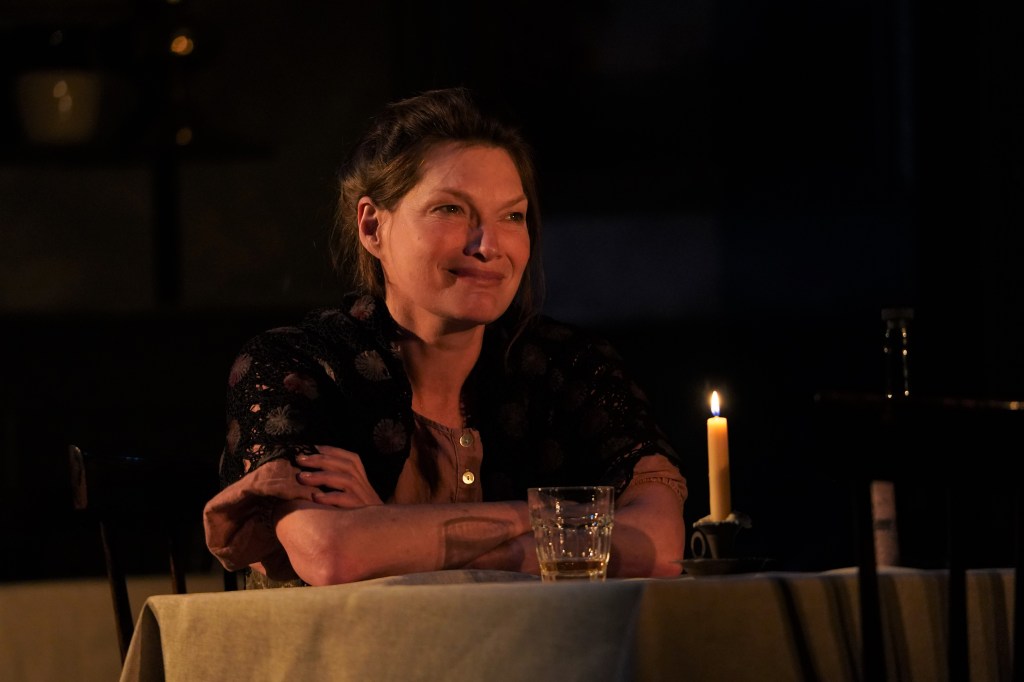
Through the discussions of Jamie Cregan with Mick Maloy (James Russell), we learn that the “Major identity” caused Con to be thrown out of the British military and forced him to avoid disgrace by settling in America with Nora and Sara. We see it causes his decline into alcoholism, destroys his resolve and purpose in life, and dissipates him mentally. It is the image of pretension that caused the bad judgment to be swindled by the Yankee liar who sold him the unproductive Inn. Sadly, that image is the force encouraging the insulting, emotional monster that abuses his wife and daughter. And it is a negative example for Sara who treats him as a blowhard, tyrant fool to vengefully ridicule and excoriate about his class chauvinism, preening airs and economic excesses (he keeps a mare to look grand while riding). It is the Major’s persona which brings them to the brink of poverty.
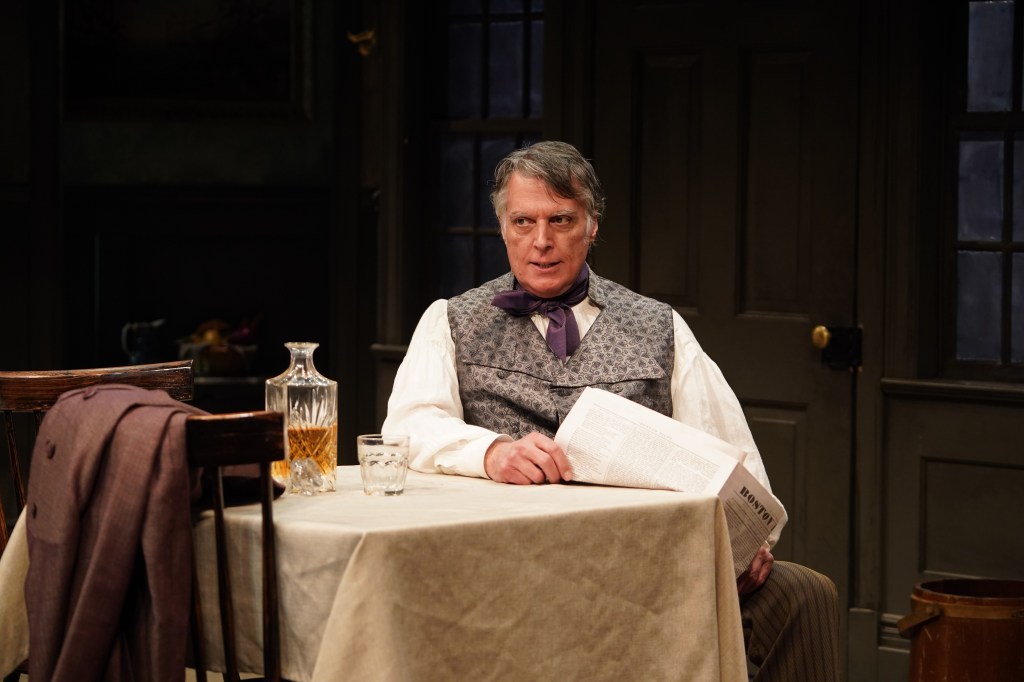
The turning point that pushes Con over the edge comes in the form of a woman he believes he can steal a kiss from, Deborah Hartford, the same woman whose intentions are against Sara and her son Simon Hartford falling in love. Without considering who this visiting woman might be, Con assumes the Major’s pretenses and we see first hand how Con “operates” with the ladies. His romanticism awkwardly emerges, left over from his philandering days with women who fell like dominoes under his charms. He is forward with Hartford who visits to survey the disaster her son Simon has befallen, under the spell of Sara’s charms, behavior not unlike Con’s. The scene is both comical and foreboding. From this point on, the events move with increasing risk to the climactic, fireworks of the ending.

As Deborah Hartford, Mary McCann pulls out all the stops in a performance which is grandly comical and real, with moment to moment specificity and detail. When Con attempts to thrust his kiss upon her, there were gasps from the audience because she is a prim Yankee woman of the upper classes who would find Con’s behavior low class and demeaning. That he “misses” the signs of who she is further proves his bad judgment. Sara is appalled and Nora, not jealous, makes excuses for him satisfying herself. The scene is beautifully handled by the actors with pauses and pacing to maximum effect.
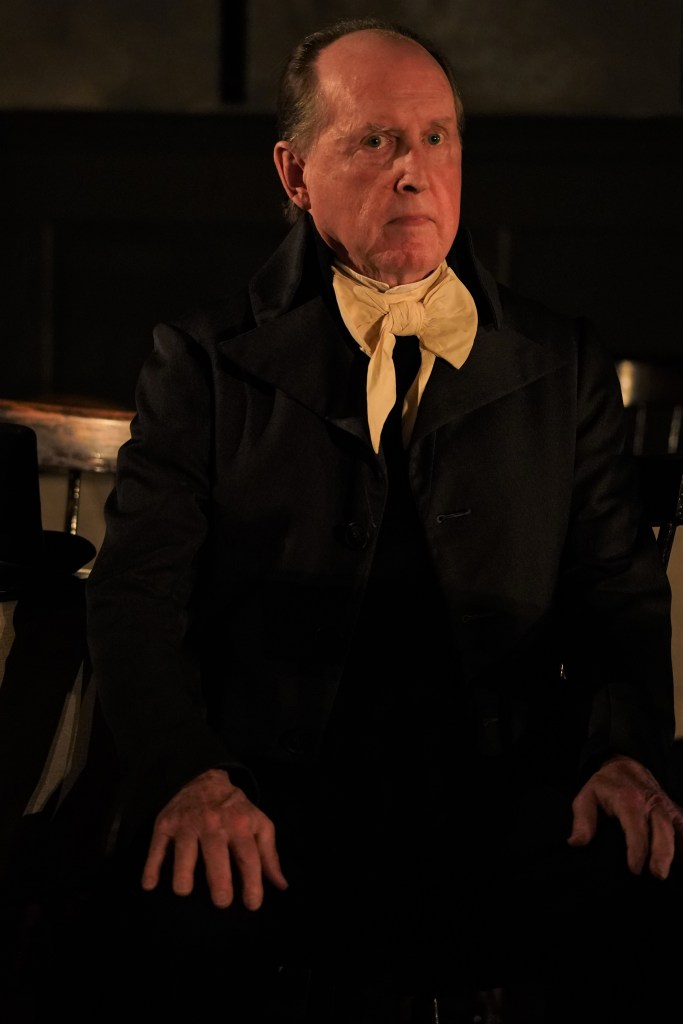
McCann’s interaction with Aykroyd’s Sara is especially ironic. Deborah Hartford’s speech about the Hartford family male ideals of freedom and lazy liberty that forced the Hartford women to embrace their husbands’ notions by taking up the slave trade is hysterical. As she mildly ridicules Simon’s dreams to be a poet and write a book about freedom from oppressive, nullifying social values, she warns Sara against him. It is humorous that Sara doesn’t understand what she implies. Obviously, Deborah Hartford suspects Sara is a gold digger so she is laying tracks to run her own train over any match Sara and her son would attempt to make. After discovering the economically challenged, demeaned Melody family, Hartford informs her husband who sends in his man to settle with the Melodys.
Together McCann and Aykroyd provide the dynamic that sets up the disastrous events to follow. Clearly, Sara is more determined than ever to marry Simon and as the night progresses, she seals their love relationship with Nora’s blessing, until Nora understands that her daughter walks in her own footsteps in the same direction that she went with Con. Unlike Nora, however, Sara is not ashamed of her actions.

O’Neill’s superb play explores Con’s past and its arc to the present, revealing a dissipated character at the end of his rope. Wallowing in the Major’s ghostly image, Con vows to answer Mr. Hartford’s insult of sending Nicholas Gadsby (John C. Vennema looks and acts every inch the part), to buy off Sara’s love for Simon and prevent their marriage. After having his friends throw out the loudly protesting Gadsby, Con and Jamie Cregan go to the Hartfords to uphold the Major’s honor in a duel. Nora waits and fears for him and in a touching scene when Sara and Nora share their intimacies of love, Nora explains that her love brings her self-love and self-affirmation. Sara agrees with her mother over what she has found with Simon. The actors are marvelous in this intimate, revelatory scene.
The last fifteen minutes of the production represent acting highpoints by Cuccioli, Forbes, Aykroyd and Murray. When Con returns alive but beaten and vanquished, we acknowledge the Major’s identity smashed, as Con sardonically laughs at himself, a finality. With the Major’s death comes the hope of a renewal. Finally, Con shows an appreciation of his Irish heritage as he kisses Nora, a redemptive, affirming action.

O’Neill satisfies in this marvelous production. The playwright’s ironic twists and Con’s ultimate affirmation of the foundations of his soul is as uplifting as it is cathartic and beautiful. Nora’s love for Con has finally blossomed with the expiation of the Irishman. It is Sara who must adjust to this new reality to redefine her relationship with her father and reevaluate her expectation of their lives together. The road she has chosen, like her mother’s, is hard and treacherous with only her estimation of love to propel her onward.
From Con’s entrance to the conclusion of Irish Repertory Theatre’s shining revival of Eugene O’Neill’s A Touch of the Poet, presented online during the pandemic and now live in its mesmerizing glory, we commit to these characters’ fall and rise. Ciarán O’Reilly has shepherded the sterling actors to inhabit the characters’ passion with breathtaking moment, made all the more compelling live with audience response and feeling. The production was superbly wrought on film in October of 2020. See my review https://caroleditosti.com/2020/10/30/a-touch-of-the-poet-the-irish-repertory-theatres-superb-revival-of-eugene-oneills-revelation-of-class-in-america/
Now, in its peak form, it is award worthy. Clearly, this O’Neill version is incomparable, and O’Reilly and the actors have exceeded expectations of this play which has been described as not one of O’Neill’s best. However, the production turns that description on its head. If you enjoy O’Neill and especially if you aren’t a fan of this most American and profound of playwrights, you must see the Irish Rep presentation. It is not only accessible, vibrant and engaging, it deftly explores the playwright’s acute themes and conflicts. Indeed, in Poet we see that 1)classism creates personal trauma; 2)disassociation from one’s true identity fosters the incapacity to maintain economic well being. And in one of the themes O’Neill revisits in his all of his works, we recognize the inner soul struggles that manifest in self-recrimination which must be confronted and resolved.
Kudos to the creative team for their superb efforts: Charlie Corcoran (scenic design), Alejo Vietti & Gail Baldoni (costume design), Michael Gottlieb (lighting design), M. Florian Staab (sound design), Ryan Rumery (original music), Brandy Hoang Collier (properties), Robert-Charles Vallance (hair & wig design).
For tickets and times to the Irish Repertory Company’s A Touch of the Poet, go to their website: https://irishrep.org/show/2021-2022-season/a-touch-of-the-poet-3/
‘Intimate Apparel’ a New Opera, a Must-See at Lincoln Center Theater

Lynn Nottage’s superb play Intimate Apparel won an Outer Critic’s Circle Award and New York Drama Critic’s Circle Award. It is a play about women circa the turn of the century, the parallels and disparities between race and class, black and white, wealthy and struggling. For the women, gender is the equalizer. This is especially so in Intimate Apparel the opera presented at Lincoln Center’s Mitzi E. Newhouse until the 6th of March. As such this new work is dramatic, taut with undercurrents and themes propelled by Ricky Ian Gordon’s thrilling music and Nottage’s memorable libretto.
Nottage has streamlined her poetic work for Gordon whose music is stylized and hybrid, born out of Nottage’s characterizations to elucidate profound themes that resonate with the audience. Gordon and Nottage are a pairing made in heaven. The production, well thought out by director Bartlett Sher, is all that one might want in raw emotional grace, generated by Gordon’s luscious notes, conveyed by the beautiful, heartfelt voices of the leads and their chorus counterparts.
Sher’s staging features stylized economy and nuance, unencumbered by the extraneous to allow the themes and characterizations to strike with impact. The action takes place on Michael Yeargan’s revolving turntable stage as the world of these characters is circular. The props are efficiently rolled out. Highly specific to the story, they are inconsequential once their purpose has been fulfilled and they dissipate into memory, supplanted by another scene and other props. All reflects an impermanence and hint of symbolic meaning, the tip of the iceberg, like the photographs that appear at the end of each act that Nottage has moved from play to libretto. It is a smashing touch that adheres thematically when we see the floor to ceiling size pictures of the characters “unidentified,” though we have been privileged to have their lives unfold during the opera.
The characters, like us, are subject to their time and place and though they appear to move forward, they remain static, even going backward psychically (George Armstrong, Mayme, Mrs. Van Buran). Forward movement and progress is an illusion, especially for unmarried Negro seamstress, Esther (Kearstin Piper Brown). Nottage effectively draws her arc of development so that Esther is fated to return back to the same setting by the opera’s conclusion. It is in the boarding house of Mrs. Dickson (the superb Adrienne Danrich), when we first meet Brown’s unhappy Esther.
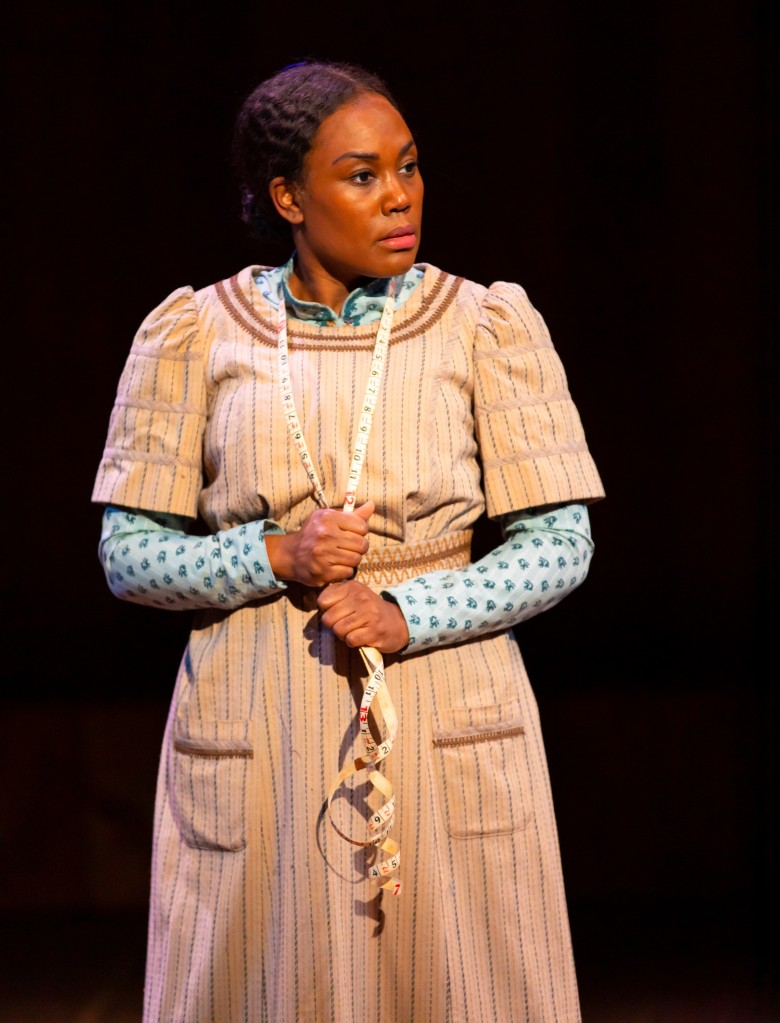
Nottage’s message is clear. Throughout Esther has been through an emotional cataclysm as many black women experienced at the time, marching without notice through history, bearing up against what the society dealt out. Yet, Esther comes through it. And though she ends up in the same place, she is strengthened, stoic, heroic, independent and dignified. Indeed, Esther lands on her feet, perhaps wearily, but she will continue. And it is this delineation of character that Nottage, Sher and Gordon understand in their bones, so that they translate her characterization magnificently into this heartfelt operatic presentation.
From the outset we recognize that Esther is unlike the other women in the boarding house where Corinna Mae’s wedding ceremony is being held. Esther supports herself and is alone, working continually to make her way, not distracted by friends or entertainments which she cannot afford. Thus, she isn’t tempted by the ragtime music that we hear “downstairs.” Throughout, she avoids Mrs. Dickson’s encouragement to meet with one man or another to settle down. Ironically, when she should take Mrs. Dickson’s advice, she doesn’t and pays the price for it.
As the opera opens Esther, annoyed and jealous at Corinna Mae’s marriage, admits to Mrs. Dickson she doesn’t feel she will be loved. Nottage’s libretto melds with Gordon’s party ragtime, as it flows into refrains, “I hate her laughter,” “I hate her happiness.” The libretto throughout is lyrical and grounded in emotional realism as Gordon’s recitative rises to meet the character’s desires and feelings. In this case, Esther yearns to be loved, but feels it is hopeless. But by the end of the scene, she receives a letter given to her from Mrs. Dickson. Perhaps, it will satisfy her longings. Brown’s voice and acting targets our emotions and draws us in to her hopes and concerns. She is wonderful.
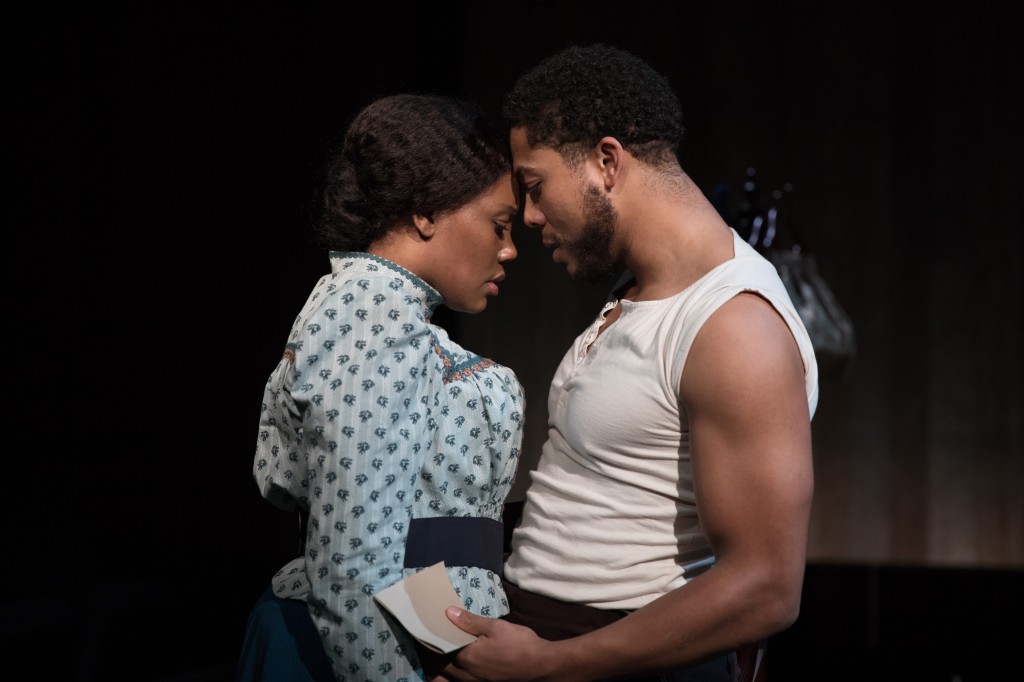
The letter is from laborer George Armstrong (Jorell Williams on Sunday matinee when I saw it). From Barbados, working on the Panama Canal, George Armstrong is an acquaintance friend of someone she knows in her church. The letter becomes the driving force of the action in the opera as it is in Nottage’s titular play. Esther, who can’t read or write, solicits help from two of her clients who are literate. Both women, opposite sides of the same coin, make their living from men, unlike Esther. One is the white elite society woman, the wealthy Mrs. Van Buren (the fine Naomi Louisa O’Connell), whose husband supports her in style but who is disassociated from his life emotionally, psychically and physically. The other is Mayme (Tesia Kwarteng on Sunday matinee when I saw it), who sells her sexual favors and takes beatings from the men who pay her for her services, one of which is to abuse her. She, too, is removed from the men to whom she plies her trade in an incredible irony of intimacy.
As Esther sews the same beautifully made “intimate apparel” (calling forth what true intimacy might mean), so they can attract the males in their lives, both help her write the letters to George. Mrs. Van Buren supplies the technical expertise and Mayme supplies the romantic allurements and sugar. During the process Esther becomes their confidante and she becomes theirs. The relationships are enlightening and Nottage reveals the parallels among the women, who the men dominate and abuse emotionally, psychically and physically. Thus, there is no difference between Mrs. Van Buren or Mayme; though the disparities in economic and financial well-being and respect based on race and class are galaxies apart. The women’s scenes with Brown’s Esther and her clients portrayed by O’Connell and Kwarteng are well drawn and ironic, as they move the action forward.
Both “kept women” ply their sexual trade, and though there is the appearance of a vast difference, certainly prompted by women elitists, the women, who are representative of their classes are oppressed. Esther is less so because of her independence and dominant attitude not to embrace the values that keep women enslaved to men. However, Esther, too falls from that grace, and the opera is an affirmation that she must learn that what she has achieved is indomitable and superior to the other women at this time and place.
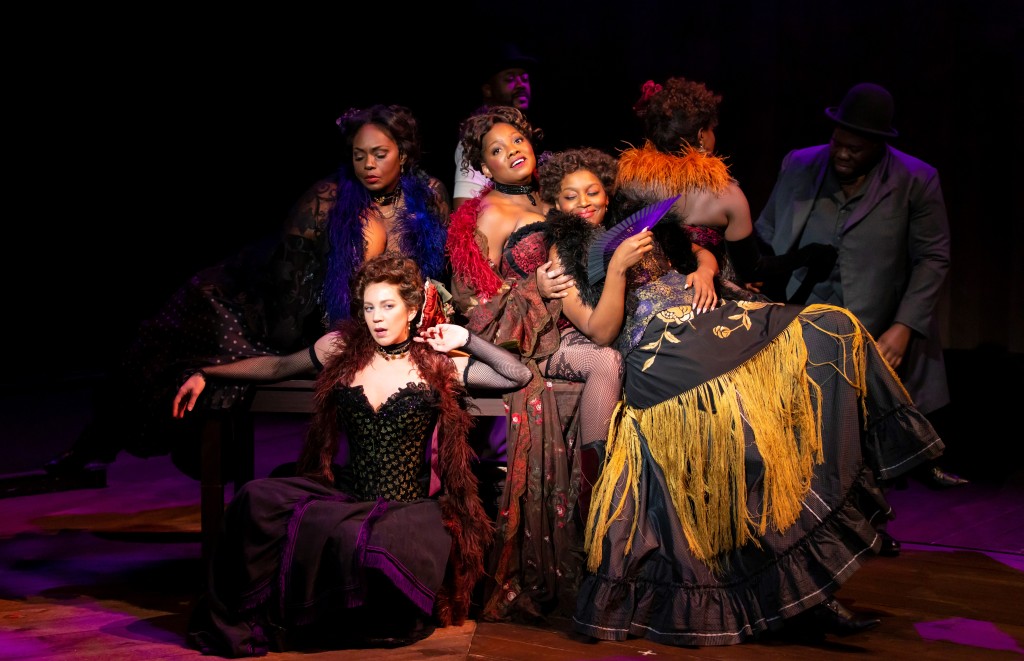
Ironically, Mrs. Van Buren asks Esther if she is a suffragette when she makes a remark that sounds like women’s empowerment. Esther, in spite of herself, encourages Mrs. Van Buren not to “let him do you that way.” For her part Mrs. Van Buren is stuck in the psyche of her “feminine” class stature. She must fit into the stereotypical cut-outs of elite women. She will be the last to realize the vitality of empowering gender identity and women’s rights. She is her husband’s chattel, dependent on him for support, choosing not to work or seek out a skill which is beneath her. Mayme, like Mrs. Van Buren, is oppressed by the men who pay her. Without a skill to support themselves, Mayme and Mrs. Van Buren are sisters born of the same mother of servitude, soul demeaned without independence.
Esther’s scenes with O’Connell’s Mrs. Van Buren and Kwarteng’s Mayme resonate powerfully. During these scenes especially we understand how the women lure Brown’s Esther (though she has asked for it). Stirred by Mrs. Dickson’s values of a woman’s world defined by a man who keeps her, she and Mayme encourage Esther to “fall in love” with George who is a figment of all their imaginations. This is rendered beautifully in the aria when Mayme and Esther sing about the discovered George who has been with both women. It is then Esther tells Mayme not to let him in the door (symbolizing the door of her heart). “Let him go. He’s an unanswered letter, a feather on the wind, you’ll be chasing him forever.” Brown’s emotional highs and lows tear at our hearts; Nottage’s libretto is poetically striking.
To Mrs. Van Buren Esther represents a freedom and openness she craves in her life. However, the three women sing “I fear I love someone,” a melodic song signifying the love is a symbolic, forbidden creation of their hears and minds. For Esther her forbidden love is Mr. Marks (the wonderfully authentic Arnold Livingston Geis). Marks is the orthodox fabric seller on Orchard Street with whom Brown’s Esther forms a spiritual attachment. For Mrs. Van Buren it is the allure of the forbidden (spoiler alert), Esther who makes her feel accepted and loved for herself. For Mayme it is George’s razzle dazzle manly male, who flashes his money (actually Esther’s money), so they can enjoy themselves. His manipulations have convinced Mayme that he is her “Songbird,” though he is married to Esther.
The love Esther, Mrs. Van Buren and Mayme sing of cannot be purchased; it remains outside of their reach. They are confined by folkways and unable to cross those lines in 1905. Love remains that which is a financial and business arrangement pragmatically as Mrs. Dickson suggests happened in her life. Or it is a fantasy that little girls are taught to dream of to anticipate marriage, which in reality is a bondage, they cannot easily escape after marriage.
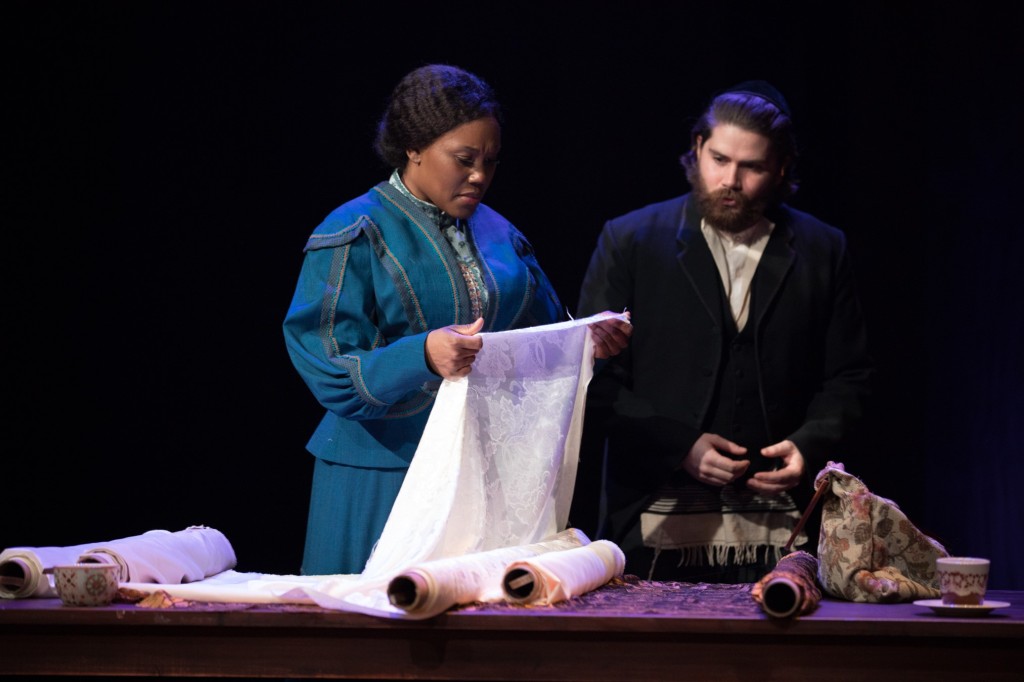
Esther’s relationship with Mr. Marks is vibrantly drawn by Nottage’s libretto and sonorously, poignantly brought to life by Brown and Geis. Sensitively, the actors delineate their mystical union, which is limited by folkways. The fabrics Mr. Marks saves for her carry great meaning and sensuality. Their closeness is beyond professional as their glances and smiles reveal they yearn for each other. Just a casual touch is significant. After Esther is married she tells Mr. Marks she can’t see him anymore and her answer when he asks, “Why not?” carries the weight of the world, “I think you know why.”
However, their last meeting occurs when Brown’s Esther gives Geis’ Mr. Marks the smoking jacket that she gave to George, that George gave to Mayme and that Esther took back from Mayme. It is then that we know the value of “intimate apparel,” and how the symbol has final closure. Intimacy isn’t necessarily in a physical acquaintance, it is soulful and spiritual. Esther, who made the jacket on his recommendation tells him, “It was made for you.” His wearing it will have symbolic meaning for him and for her of a love that was never consummated, but a transcendent love that prospers, regardless of nullifying strictures, prejudices and folkways. What a poignant, memorable satisfying moment, superlatively performed by Brown and Geis. Just smashing!
The finely wrought and beautifully designed costumes by Catherine Zuber are characters unto themselves, measuring out the symbolism, conflicts and themes of class, gender and relationships. From lighting (Jennifer Tipton), to sound (Marc Salzberg), to projections (59 Productions), the technical effects are right on, enhancing this exceptional production. Placing the pianos on platforms above the playing area is enlightened, as the music and musicians are integral to the action, driving it, supporting it. Their visibility is dynamic. Kudos to Steven Osgood’s music direction and Dianne McIntyre’s choreography.
Intimate Apparel closes on March 6th unless it is extended which it should be. Though the audience was packed, more individuals need to see this production which hits it out of the ballpark. For tickets and times go to their website https://www.lct.org/shows/intimate-apparel/
‘Jeff Leatham’s Kaleidoscope’: Orchid Show 2022, New York Botanical Garden’s Spectacular Horticultural Theater
Jeff Leatham’s Kaleidoscope Runs February 26 – May 1, 2022

Lifestyle icon and floral designer to the stars (Oprah Winfrey, Cher, Dolly Parton, etc.), has returned for an encore presentation to the New York Botanical Garden after the show which he created in 2020 had to be curtailed because of the COVID-19 pandemic safety procedures and quarantine throughout the nation. But Leathem has reimagined the imagery of Kaleidoscope and once again the Enid A. Haupt Conservatory and its various galleries are shimmering in a pageantry of color-rich orchids of every shape, size and variety. If you love orchids, this is a show to see for its gorgeous delights.



Lifestyle icon and floral designer to the stars (Oprah Winfrey, Cher, etc.), has returned for an encore presentation to the New York Botanical Garden after the show which he created in 2020 had to be curtailed because of the COVID-19 pandemic safety procedures and quarantine throughout the nation. But Leathem has reimagined the imagery of Kaleidoscope and once again the Enid A. Haupt Conservatory and its various galleries are shimmering in a pageantry of color-rich orchids of every shape, size and variety.

Jeff Leatham said, “I am thrilled to bring Kaleidoscope back to the New York Botanical Garden in 2022. Much like when you look into a Kaleidoscope, the view is never the same.”





Kaleidoscopic, with rich, multi-various hues, orchids compose the largest family of plants in the world. They number from 28,000-30,000 natural species and from 150,000 hybrids. Botanists and horticulturalists are constantly coming up with new derivations inspired to craft hybrids. And these they sometimes name them for individuals and celebrities. Jeff Leatham has a hybrid Vanda named after him and Awkwafina (comedic rapper and award winning actress) has her own orchid named after her zaniness. These orchids were featured in previous orchid shows at NYBG in 2019 and 2020.





Orchids were assembled from the finest growers in the world in January and early February as the NYBG beds were graded and prepared for the 2022 Orchid Show. Leatham worked with horticulturalists from NYBG and Marc Hachadourian, the Senior Curator of Orchids who advised what orchids would last longest for various displays and what could be replaced to keep the displays looking fresh until May 1st when the show closes. The plantings and design took two weeks.

Jeff Leatham’s work is a meld of his love for flowers and his passion for design. His displays are dramatic, vibrant and memorable. He integrates his arrangements seamlessly with his settings. Jeff has produced striking displays in Paris for two decades. In 2014 he was knighted with the Ordre des Arts et des Lettres, the highest honor for artists and others who have made a significant contribution to French culture.

On select Fridays and Saturdays in March and April, adults 21 and over can experience the exhibition at night with music, cash bars and food available for purchase ORCHID EVENINGS WILL TAKE PLACE: MARCH 26, APRIL 2, 9, 16, 22, AND 23, 2022; 7-10 p.m.




At NYBG Shop, Orchid Show visitors can purchase Jeff Leatham’s publications: Flowers by Jeff Leatham, Flowers by Design, and Jeff Leatham: Visionary Floral Art and Design. These are best-selling design books globally.
For more information about the 19th Annual Orchid Show: Jeff Leatham’s Kaleidoscope visit https://www.nybg.org/event/the-orchid-show/
‘The Daughter-in-Law,’ by D.H. Lawrence is Superb! Theater Review

D.H. Lawrence is rarely known for his plays. However, British critics have noted that he was a master playwright, and if discovered as such earlier in his life, he would have been appreciated for his dramas, however maverick and forward-thinking. One such incredibly rich play is being presented by the always excellent Mint Theater Company, who enjoys bringing to life rare jewels in drama that have often been overlooked. The Daughter-in-Law is one of these gems.

Directed by Martin Platt The Daughter in Law presents an amazing portrait of an independent woman, Minnie (Amy Blackman), a former governess married to a collier (coal miner), Luther Gascoyne (Tom Coiner). The couple live in a mining town near his mother’s (Mrs.Gascoyne-Sandra Shipley) home where his brother Joe (Ciaran Bowling), also a collier, works with him in East Midlands England.

The setting is autobiographical and akin to where D.H. Lawrence’s father worked and where he and his siblings lived with their mother (reminiscent of Minnie), who had cultural aspirations for Lawrence, and who inspired him in his studies. Lawrence’s play evolves into conflicts among the characters. These are rich in thematic evolution that comes to some resolution by the end of the play after the colliers riot against scab workers during a strike. Interestingly, the themes involve gender roles, class, economic inequity and familial love. Also, Freudian tropes between mothers and sons, an issue that Lawrence often investigated, receives a hearing in this realistic and beautifully acted production that Platt has tautly directed, so it remains provocatively, emotionally, tense throughout.
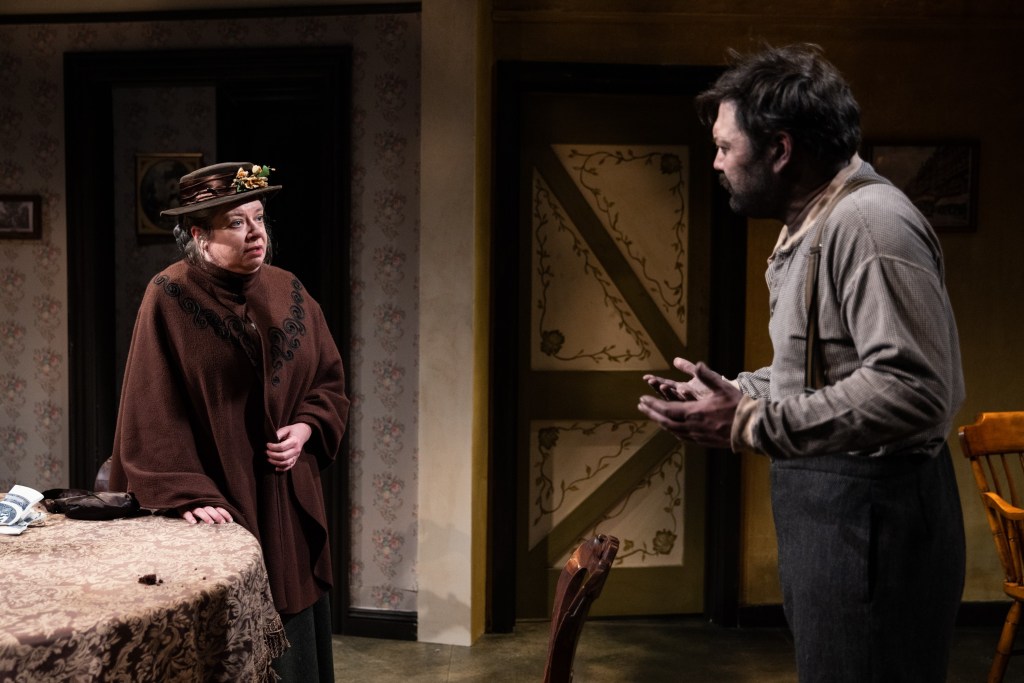
To a fault, the actors have been schooled in the Midlands accent which provides realism and creates the audiences’ attentive stir to understand all that the characters communicate. At times, this takes getting used to. However, the actors portray the characters’ emotional feeling sincerely and authentically, so that one understands, even though one may not be able to translate word for word what the characters say.

Nevertheless, when Joe (the vibrant Ciaran Bowling), enters sporting an arm in a sling and his mom (the dynamic and authentic Sandra Shipley), fusses over him with his dinner and probes what happened with receiving a disability check, we understand their close relationship, and we also understand that mother and son mutually care for each other, living under the same roof, watching out for each other, while other family have gone on to make their own lives.

The hard conditions of the mines remind us of the corporate structure which Lawrence reveals has changed little over one hundred years later. The owners receive all the benefits, and the workers are given low wages and are subcontracted out to keep them hungry and off-balance, so they are unsure of where they stand in the company’s graces. Joe and his brother, like their father before them, were at the mercy of the owners; and their father died as a result of an accident we find out later in the play. This undercurrent of workers vs. owners is the driving undercurrent and reveals that the misery of need and want is what impacts the families who live and depend on coal mining for their survival.
During lively dinner conversation, Joe tells his mother that his attempt to receive a check for his broken arm has been rejected. His manager tells his version of “the acceptable truth” of what happened to Joe, so that it is Joe’s fault that he was injured, because he was “fooling around.” It was not that he was injured on the job because of some dereliction of another worker or the mine. Lawrence strikes at the inequality of the haves and have nots and the managers who make sure to protect their employers. Thus, we feel for Joe and his mother, who are not destitute, but who struggle economically. If any stress comes to either of them, they are a few steps away from the equivalent of the poorhouse. Such is their economic and class level.

Into the background of this economic insecurity and potential working class impoverishment comes Mrs. Purdy (the convincing and excellent Polly McKie), a neighbor who brings disturbing news. Her daughter, who she describes as rather a simple girl, is pregnant. And after avoiding the direct truth until Mrs. Gascoyne drags it out of her, Mrs. Purdy lays the blame at the feet of Luther, who married Minnie seven weeks before. Mrs. Gascoyne pushes Mrs. Purdy cleverly off on Luther and Minnie, especially Minnie since she has brought some money into the marriage and can afford to pay Mrs. Purdy and her daughter off for their silence and for Bertha’s upkeep with the baby. This suggestion is made after Joe and Mrs. Purdy verify that Luther was seeing Bertha Purdy, something that Mrs. Gascoyne didn’t realize because Luther kept it under the radar and wasn’t serious with her.
Assurances are made to Mrs. Purdy that she must see Luther and Minnie at their house, since Minnie has received an inheritance that Mrs. Gascoyne insists should be used to pay off Mrs. Purdy. This malevolent and resentful suggestion is disputed by Joe whose empathy for his brother and Minnie is greater than his mother’s. As Mrs. Gascoyne discusses Luther’s marriage to Minnie in demeaning terms, it is obvious that she resents the “high and mighty” Minnie ending up with her son. She tells Mrs. Purdy that it’s because he is the only one she could get.
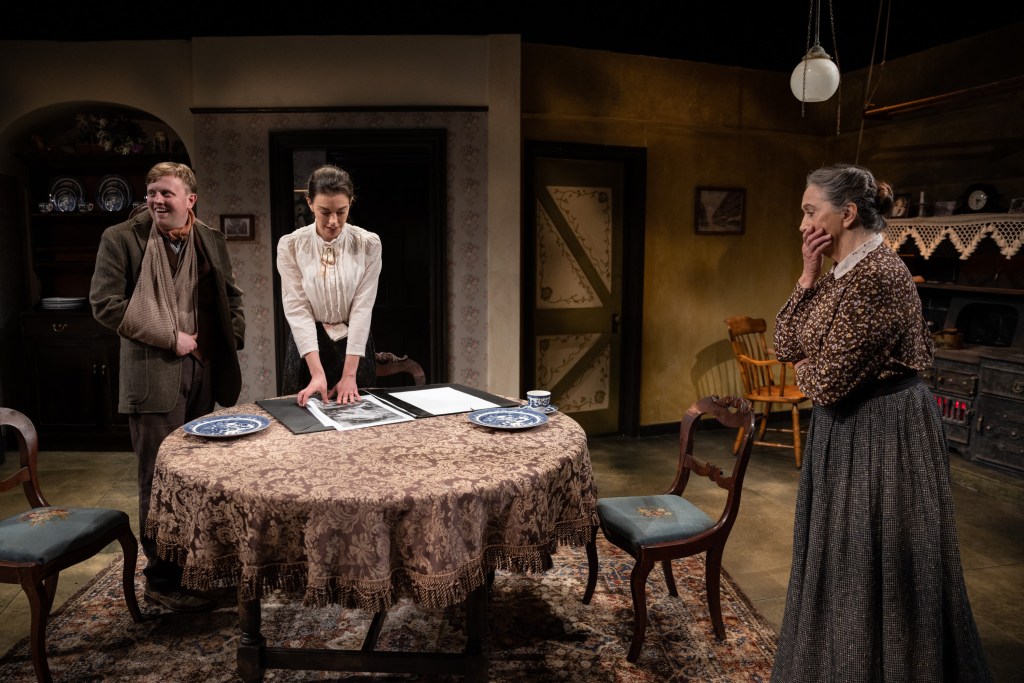
At this point not meeting Minnie, we wonder who this snotty woman is and side with Mrs. Gascoyne because we have gotten to know this nurturing, motherly type who obviously cares about her children. Based on Lawrence’s brilliant dialogue characterizing Minnie through the eyes of Mrs. Gascoyne, we believe that this snobby woman who thinks she’s “better” than the colliers and their families is pretentious. Also, we believe that she is so desperate, she doesn’t love Luther, but she just wants not to be an old maid.
Interestingly, Lawrence allows this portrait of Minnie to remain, until we see her relationship with the two brothers unfold. Gradually, her characterization is revealed and her strength, power, indomitable wisdom and love for Luther becomes apparent but with twists and turns, ups and downs by the the end of the play. But first, she must stand up and upend her mother-in-law’s presumptive discriminatory attitude against her, and then wait for the right moment to forgive her so that the two of them become closer.

Platt’s direction in keeping us wondering how Minnie will react when she discovers Luther has a child on the way is subtle and yet eventful, as Lawrence provides surprises and unusual events which keep us enthralled. Mrs. Purdy tells Luther about the child, but Joe manages to drive Minnie out of the house so that she leaves before Mrs. Purdy confronts her with the “truth.”
In an ironic twist it is Luther, who returns much later drunk, guilty and ready to be rejected. He picks a terrible fight with Minnie, then in humiliation covered over with bravado, he reveals that he has gotten Bertha with child. Interestingly, Minnie remains calm and collected, non judgmental and rational, presenting the idea that the child may not be Luther’s, but another man’s. Nevertheless, Luther becomes churlish and obnoxious, which prompts her to call him out for his meanness, especially when he suggests that Bertha was nicer to him than Minnie.
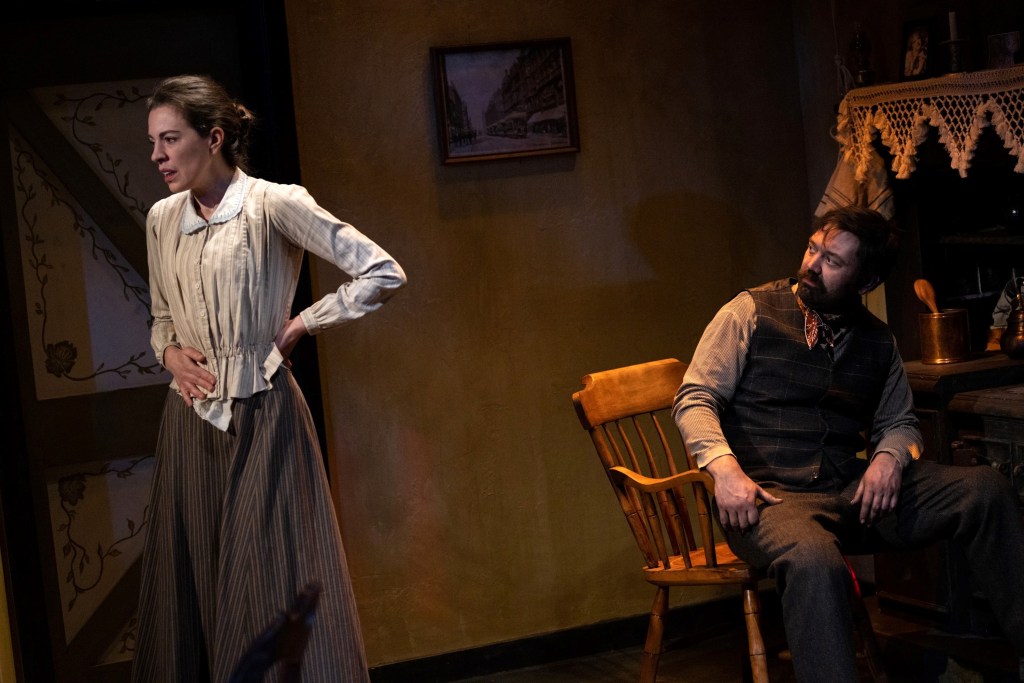
The actors do an exceptional job in raising the stakes and increasing the argument and tension between Minnie and Luther, so that we don’t know whether or not they will break up, Minnie will leave, whether Luther will have to return to his mother or both of them will end up bloodied and bruised as they come to blows. In Lawrence’s characterizations of Minnie and Luther, their relationship becomes explosive and we aren’t sure whether it’s because of class differences, economic differences (she came from a bit more money than he and he may resent it) gender role assumptions (Minnie has worked for herself and made her own money) or something else. Interestingly, we don’t consider that they may love one another, feel hurt and pain that they might lose each other, or are emotionally trying to settle out their own feelings.
The actors are just exceptional in revealing this marvelous nuance and the director has shepherded them so that we are off balance in attempting to figure out how they really feel about each other. One of the high points of the play comes when Minnie confronts her mother-in-law and indicates that she has not allowed either of her sons to become men. Minnie points out that she has babied them so that they remain shells and are forced to rely on her emotionally and psychically which has destroyed them and made them weak. Interestingly, Joe agrees with Minnie. And he indicates this situation emotionally has debilitated him and at times has left him suicidal. Ciaran Bowling, Sandra Shipley and Amy Blackman are wonderful in this confrontation scene.

Amy Blackman as Minnie gives an amazing and powerful performance. She is stalwart and strong as she stands up to Sandra Shipley’s mother-in-law who manages to be infuriating and yet very human and poignant as a woman who is needy and relies on the ties amongst her and her sons. Tom Coiner as Luther is frightening and brutal as well as weak and sheep-like when he finally admits his love and dependence on Minnie.
Lawrence concludes the play surprisingly by revealing what has been at stake all along. It is a complicated and intricate conundrum that he presents and then the revelation clearly indicates that there was no mystery. This is how a couple is settling into themselves and separating from every other family member to cling to each other as they define themselves in the most important relationship of their lives.

This wonderful production should be seen for many reasons, principally because D.H. Lawrence has written a great play with nuanced characters in striking relationships that are unfamiliar to us that the Mint Theater Company has presented in this superb revival. The intricate details of setting, the props, the coal stove that is the hearth, the set design, down to the food and plates that show Minnie’s aspirations to being middle class, manifest a reality that makes us identify with these individuals. Kudos to the tremendous effort on the part of Bill Clarke (sets), Holly Poe Durbin (costumes), Joshua Larrinaga-Yocom (props), Jeff Nellis (lights), Original Music & Sound (Lindsay Jones).
The Daughter-in-Law comes in at two and one-half hours and is at New York City Center, Stage II. For tickets and times go to their website: https://www.nycitycenter.org/pdps/2021-2022/the-daughter-in-law/
‘Prayer for the French Republic,’ Haunting, Current, Universal

Shifting in flashback between (2016-2017) and (1944-1946) set in two different Parisian apartments, Prayer for the French Republic (currently at Manhattan Theatre Club) by Joshua Harmon (Bad Jews), directed by David Cromer (The Band’s Visit), focuses on a Jewish family’s concerns about identity, safety and security in a country that they’ve called home for five generations. The backdrop of their apprehensions then and now is an uncertain world where humanity’s fears and needs turn increasingly predatorial. Capitalizing on such fears, political actors mine the unbalanced, raw emotions of deranged citizens, to create scapegoats which help grow their power and popularity. Whether left or right politically, oftentimes the scapegoats are religiously or ethnically engineered.
Such was the case in France during Hitler’s fascist occupation and the Vichy government’s cooperation with the roundup of French Jews that were murdered or sent off to concentration camps. Such is the case in France in recent years where attacks against Jewish citizens have multiplied, stirred up by opportunistic, right-wing, fascistic politicos ravenous for power.
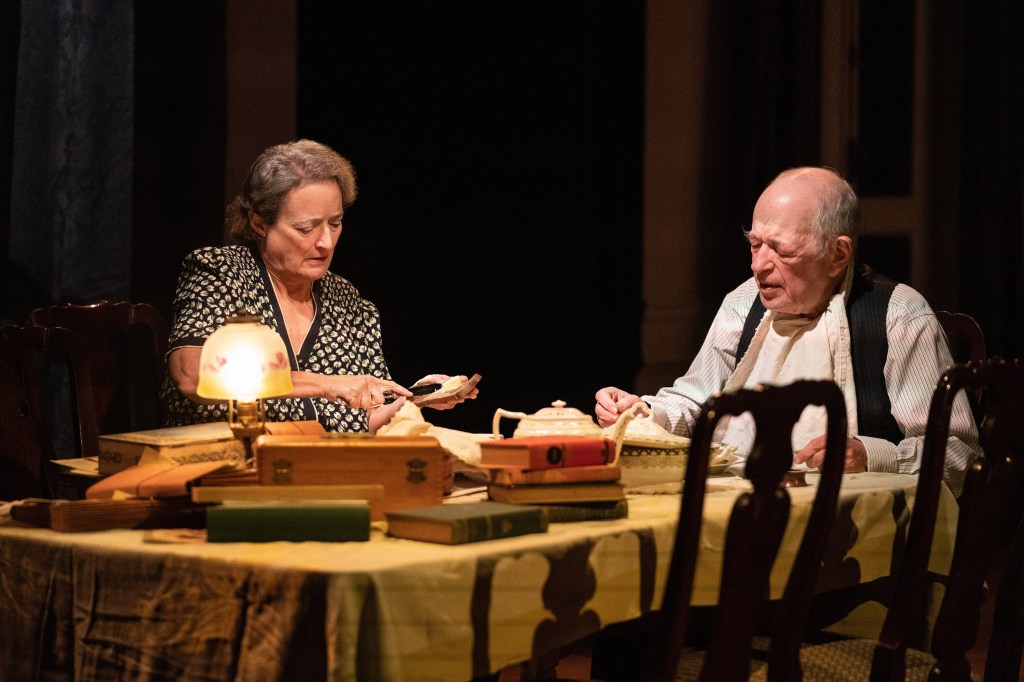
As an overseer, Patrick Salomon (Richard Topol), connects the ancestral ghosts from the past, his great grand parents, Irma and Adolph Salomon, grandfather Lucien and his father Pierre, still living, as a bridge from the past to the present. In the present are Patrick, his sister Marcelle Salomon Benhamon, husband Charles and their adult children, Daniel and Elodie. The play is Patrick’s meditation on five generations of family. Patrick redefines what being a Jew in France means, as he narrates the saga of their Parisian Jewish identity and magnifies it in light of the age-old conundrum Jews historically confront throughout the ages. To survive do they assimilate, or do they risk the danger of standing apart as they embrace their religious beliefs?
As the play progresses, these questions expand and complicate against the current global crises (climate, socio-political, economic). What do Jews do in response to severe persecution? Do they embrace their identity, suffer and die valiantly resisting? In the name of living do they become invisible, marry out of their religion to avoid the turmoil, danger and abuse that comes with the trajectory of uncertain social unrest that Jews inevitably find themselves in the midst of? Do they emigrate to “certain” safety?
Interestingly, before the last generation of the Salomon family makes any final decisions, they confront their father Pierre and present him with their conundrum. Would he go with them, for example, to a safer place with other Jews in Israel? Who better than their father, a survivor of the atrocities of Auschwitz, can ,advise them about their future? Indeed, he made his decision years ago, married a Christian woman and didn’t keep up Jewish tradition, intentionally. He remained safely in Paris raising Marcelle and Patrick without keeping ancient Jewish traditions. And until Marcelle married an Algerian Jewish emigre, they didn’t keep them either.

Patrick (the superb Richard, Topol whose easy, relaxed persona is confidently relatable and empathetic), introduces the Salomon family to the audience and discusses their business operating a store where they attempt to sell beautiful pianos that are no longer viable in modern society. Patrick brings us into 2016 to view his closest relatives, sister Marcelle (Betsy Aidem), brother-in-law, Charles (Jeff Seymour), their bi-polar daughter Elodie (Francis Benhamou), and son Daniel (Yair Ben-Dor). The cross-section of their lives begins as Marcelle (Betsy Aidem in a fine, layered performance), becomes acquainted with her guest, Molly (the clear-eyed, authentic Molly Ranson), a non-practicing Jewish, distant cousin from NYC.
Their humorous exchange ends when Daniel comes in bleeding and an uproar begins in the household. He has been attacked in a hate crime where the young men who assaulted him yell out epithets because he has obviously distinguished his religious identity with a kippah. The arguments ensue and we discover that neither Marcelle nor Charles make an obvious show of their Judaism and that Daniel is the only Orthodox one in the family. Molly watches the scene unfold and learns as we do about family dynamics.
Daniel recently became Orthodox. He doesn’t even want to go to the police to identify his beating as a hate crime. Though Marcelle insists, Daniel makes excuses that he didn’t see his attackers and the police won’t do anything about it. All land on the fact that it will only exacerbate matters in the society and spread more fear. The discussion is closed when Daniel insists Marcelle light Shabbat candles.
The scene deftly shits to the past, as we note that ancestry (the ghosts of time past), runs concurrently and influences the Salomons in the present. The spirits of their forebears come to life, and we watch the characters in their small Parisian apartment in 1944, having a conversation about their children and other family who escaped France rather than stay, which other family did. As Irma (Nancy Robinette), and Adolphe (Kenneth Tigar), wait safely in their apartment, away from the horrific persecution of Jews throughout the Third Reich occupied countries, of which France is one, they pray that Lucien and Young Pierre are safe in the mountains. This is what Adolphe encourages Irma to believe. As they pray that Lucien and Pierre will come home to their apartment in Paris, hope sustains them.
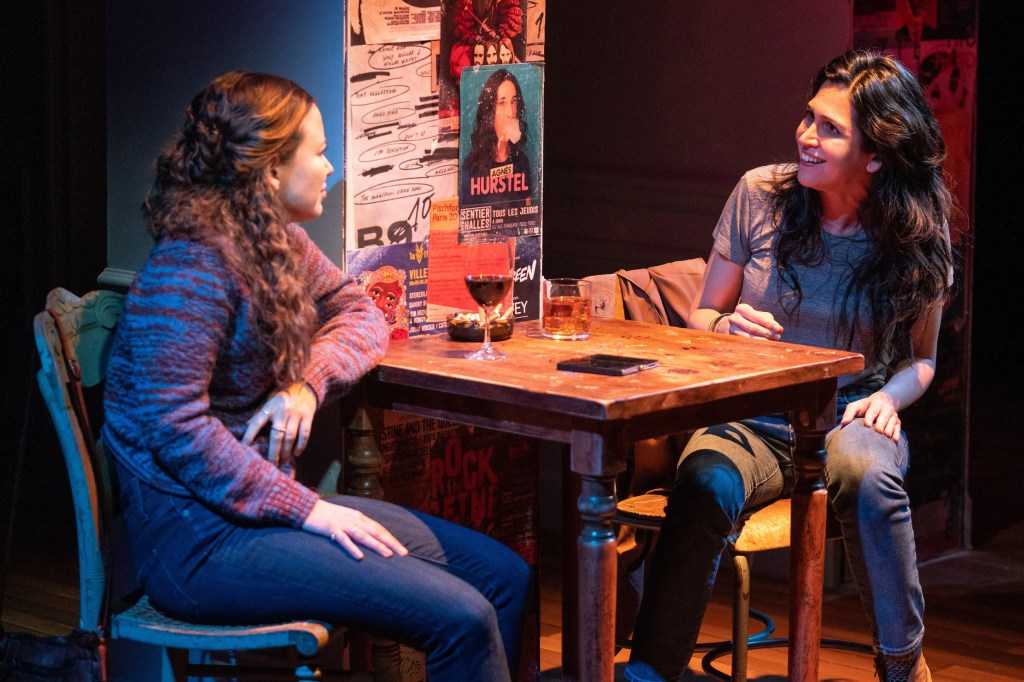
Patrick connects present and past during these moments. He ruminates about what his great grandparents, grandparents and father went through, touching upon the conversations they may have had and the rationing they went through. Furthermore, he reveals the family’s penchant for argument and debate before decisions are made. Adolphe humorously suggests that at the reunion when family is together, after ten minutes of peace there will be arguing and fighting and crying. We marvel that Irma and Adolphe can sit there and imagine what it will be like after liberation. We discover later that most of the family who didn’t escape to Cuba or elsewhere died. Adolphe’s fantasy is a manifestation of hope to uplift Irma. Their safety in Paris affords them this luxury of hope; meanwhile, Jews died in the millions.
How are they alive? Patrick relates that the superintendent of the building didn’t give Adolphe and Irma up to the Gestapo during a roundup. Thus, both escaped in that rarest of occasions; they were protected by other French people. However, at this point, they don’t know the fate of their son Lucien (Ari Brand) and their grandson Pierre (Peyton Lusk) who may have fallen into the hands of the Nazis and ended up gassed in a concentration camp. But Adolphe and Irma live in faith securely, waiting their return.
In the segue back to the present Molly and Daniel form an attachment. Daniel explains why he has become Orthodox when the family never was. He discusses the attacks at the newspaper Charlie Hebdo and the killing of four Jews at the Kosher Supermarket in Paris as proof that the hate crimes against Jews are increasing. On a hopeful note, he tells Molly that the peace marches against the violent attacks were massive, and Prime Minister Manuel Valls stood with the Jews against Benjamin Netanyahu, who told them to leave France and come to Israel. Valls encouraged belief in the French Republic stating, “If 100,000 Jews left, there would be no more France; the Republic of France would be a failure. Daniel points out that Jews left, but only a tiny fraction; the rest stayed. He affirms that always it is a matter of choice. Jews stay in France because they love their nation and have faith in the French people.

It is this concept of choice that carries through the rest of the play in the decision whether to escape persecution and hate crimes or stay and fight with courage and resistance. But slowly, this family because of the past losses, attenuates their faith in the French Republic.
First, it is Charles who rebels against staying in France after we hear the prayer for the French Republic spoken in a voice over in French and English when Charles and Daniel go to the synagogue. The Jews loyally support the French Republic, though some, like Charles, feel it is a waste of time. As father and son walk home, Charles notices the stares of disdain and anger at Daniel’s assertion of his religion. Charles insists, “I can’t take it any more.”
Once again the family is up in arms presenting arguments. Marcelle refuses to leave, decrying the beauty of their life in France. Fed up Charles wants to go to Israel. He remembers the persecution he experienced in Algeria where everyone got along when he was a child, but later socio-political forces disrupted the social fabric. Indeed, he has no allegiance to France. He doesn’t have the history, as Patrick puts it, that Jews have been in France for over 1000 years and have made a way for themselves there.
The discussion and wrangling back and forth between Aidem’s Marcelle and Jeff Seymour’s Charles is powerful and strident. We are riveted by the danger in Charles’ tone, of hidden subtext that is palpable and his fervor to believe there is safety in Israel, though that isn’t necessarily a rational conclusion because of the terrorism there as well.

The argument carries over when Molly and Elodie go to a Dive Bar. Francis Benhamou’s Elodie rant against Molly Ranson’s Molly is humorous and as powerfully strident as Charles’ argument with Marcelle. Elodie gives forth, illustrating Molly’s hypocrisy when she argues against Israel’s Palestinian settlements. Elodie’s point drives deeper to human nature. There are the power-hungry and the occupiers; how does one resist not becoming power-hungry as a matter of security? Molly’s criticism belies historic U.S. colonization and oppression of everyone but white males. Elodie indicates that finger pointing is useless.
Eventually, both manage to reach common ground on a personal, familial level. Humanity takes precedence in their discussion when Elodie explains that Daniel became Orthodox because of a girl. Revelation of his vulnerability opens the door to Molly’s and Daniel’s relationship. It also opens the door to Marcelle’s fury because she believes that Molly has taken advantage of her son’s vulnerability.
Nothing is resolved even after Charles and Daniel return from a trip to Israel to look at living arrangements and social culture. Charles gives in; he affirms wherever Marcelle is, he will stay with her. Daniel proclaims that he didn’t want to go to Israel, but just accompanied his distraught father to help him. The playwright indicates the confusion and the stress that accompanies the hassle of confronting danger in one’s daily life, as this family feels they are under siege since Daniel paraded his Jewishness. But it is understandable because the family has a history of loss and death at the hands of French fascism. Furthermore, fascists like Marine Le Pen (Deputy of the French National Assembly), and her right-wing conservative political group don’t readily disavow fascism.
As the scene shifts to the past, Lucien and Young Pierre return from the camps bringing the horrific information that family was lost. Lucien is overcome in the telling of it. Ari Brand’s performance is appropriately drained, inwardly devastated but holding it together as best he can. It is Young Pierre who eventually expresses how his father’s hope saved him. Peyton Lusk gives an incredible portrayal of the PTSD of a young person returning from an unspeakable experience. But as Lusk explains how he survived, once again comes the affirmation that hope is how people survived the persecution, attacks and killing, as community and family helped family. For Lucien always told Young Pierre that they would make it.
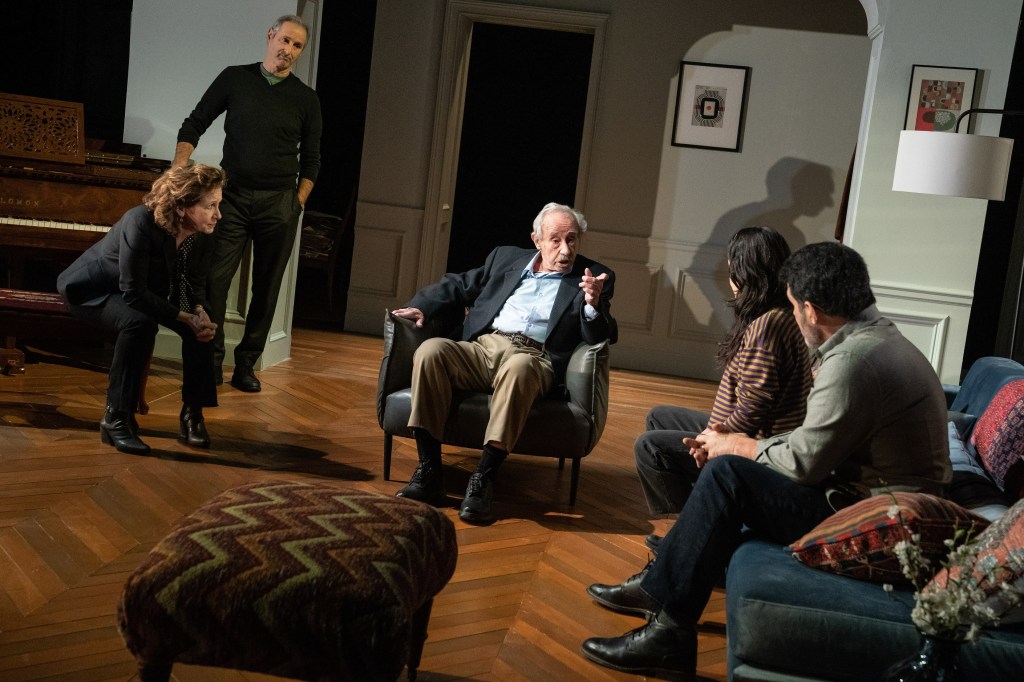
But it is in the final act when the dam bursts with a traumatic episode for Marcelle, who by degrees has given up on her beloved Paris. It occurs at the symbolic Passover Seder, a remembrance of when God wrought miracles to help the Israelites escape slavery in Egypt. At the celebration, when they arrive at the “opening of the door to let the angel in,” Marcelle becomes hysterical like Charles did weeks before. She, too, has a “can’t take it any more” moment and refuses to open the door, terrorized that a Marine Le Pen engineered terrorist will enter and kill them.
The scene is shocking. Betsy Aidem’s performance is riveting as are the other actors. Harmon establishes centuries old horror of death at the hands of haters. Though the idea seems ridiculous, recently a woman was burned alive in her apartment in Paris.
That Harmon has conjoined Marcelle’s terror with the symbolic traditional night commemorating their escape from persecution and oppression is an apotheosis. In an irony of twisted emotion, Marcelle gives in to the terrorists who want Jews gone from “their” country, the most grievous insult of all. It is an incredible message because Marcelle’s fear destroys her ability to believe in God’s protection, a basic fact of her religion. She believes in God’s protection only if she flees, like the Jews of ancient history. The hatred of others intellectually and representationally in various select acts of violence has overwhelmed Marcelle’s ability to feel secure in her own religion, her own apartment, her own country, her own identity. She must leave.
Of course it is a sardonic fact that her family’s escape will be to one of the most dangerous countries on the planet. Patrick raises the issue about the security question in Israel. Indeed, physical security must have as its precursor intellectual and philosophical security in the Golden Rule of “do unto others,” democratic values, an ideal that France attempts to follow and does with exceptions, better than other countries. Certainly, in Israel’s West Bank, the Golden Rule does not abide for Palestinians who are treated as “the other” and are oppressed and have no rights under Netanyahu’s ultra right wing, increasingly anti-democratic government.
Harmon’s play is filled with thesis/antithesis arguments, and this is a family that generationally loves a worthy argument with well supported logic and details. Patrick takes the position that the Republic of France will stand by its ideals and that there is nowhere safe globally, moment to moment; not Israel, not the United States, not Europe, the Middle East, Asia, etc. Human hearts are not safe.
To counter his sister he correctly asserts that the fascistic government of Marine Le Pen will be voted down and the Republic will persist. Harmon’s point is well taken. There are those across the globe who value equanimity in greater numbers than those whose megalomania and craven hate seeks the death of others for power. However, his commentary falls on deaf hears; Marcelle has made up her mind to go to Israel where their Jewish identity may be expressed freely with little fear of reprisal by crazies. For her France has nullified her existence as a Jew.

Whether she will feel safe in Israel relies on hope and sacrifice. In Israel they have to start all over again. They will have sacrificed their careers, friends, culture, language, everything for the hope of a safety and security that is never guaranteed. If they are on a bus that terrorists decide to blow up in Tel Aviv, there is no way to stop that. But Marcelle is convinced, turning 180 degrees from her position at the play’s beginning. Fear possesses her soul and she makes decisions based on it.
In the final segment of the play the argument takes further flight with elderly father Pierre (Pierre Epstein is eloquent in this last speech to the family). If they leave, it is their choice, but he will not go with them. Having the freedom to choose and not be compelled is vital to his identity. Ironically, by giving into their fear, they have compelled and oppressed themselves. Pierre who has seen the worst of the camps and survived, knows the difference of experiencing the worst. His children and grandchildren have not and they don’t want to. That is why Marcelle compels them to leave, though such an event happening again is a probability off the charts. But no one dares speak that to her, not even her own brother.
The performances are sterling and sensitive, at times funny, and always compelling. The canny direction by Cromer to “get it all down” and thrill the audience with ideas and concepts is just great. I particularly enjoyed the Set Design by Takeshi Kata that designated the differences between present and past efficiently and seamlessly. The Lighting Design by Amith Chandrashaker provided the ephemeral, soft, wistful tone of the past and stark contrast with bright light that magnifies the present. Kudos to the other creatives, Sound Design by Lee Kinney & Daniel Kluger, Original Music by Daniel Kluger.
Prayer for the French Republic is revelatory and insightful in questioning our arrogance to believe we, who are transient beings on this planet, have an identity and home, knowing mortality comes to all of us physically. He also twits our assumptions about safety and security, the difference between life’s enjoyments and living an existence permeated by psychological fear. Above all he designates in a Republic, there is the right to choose one’s destiny, free from personal harm because, if applied, the rule of law secures it. But if it is not exercised, then what? Harmon asks the questions through lives, relationships and situations that embody them in seeing the Salomon family live in the past and present. If one delves deeply enough and contemplates like Topol’s Patrick does, one sees the answers can only be individual and personal. No one can answer for someone else.
This is a wonderful play dramatically rendered. It should be seen, especially if you enjoy thought-provoking plays that move swiftly on emotional power. For tickets and times go to their website https://www.manhattantheatreclub.com/shows/2021-22-season/prayer-for-the-french-republic/
Prayer for the French Republic has transferred to Broadway and will run until February 18th at the Samuel J. Friedman Theatre. Look for my review of the Broadway production on Blogcritics.org.
 CAROLE DI TOSTI


.jpg)