‘The Blood Quilt,’ Threading an Ancestral Masterpiece of Hope
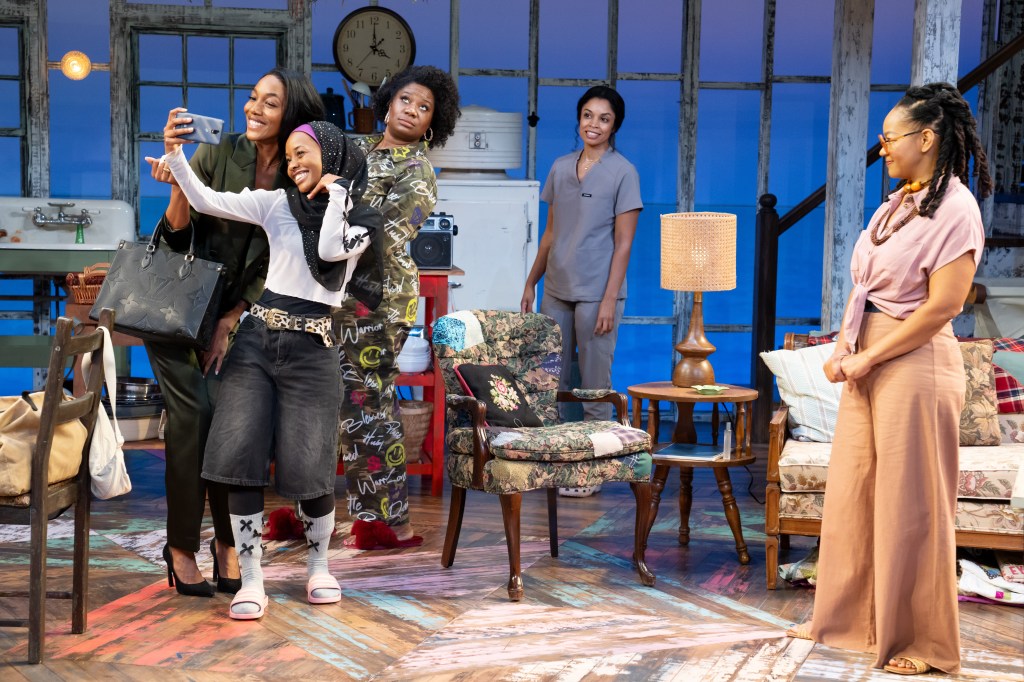
The Blood Quilt
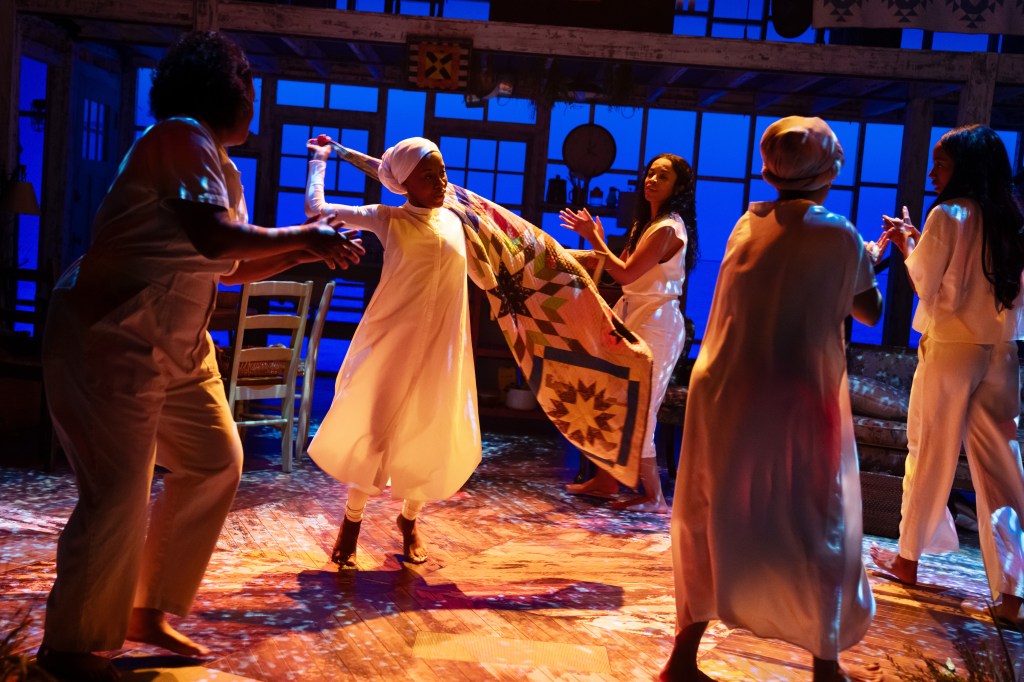
In her ambitious layering of the story of four half-sisters who gather to finally lay to rest their recently deceased mother, Katori Hall, with astute direction by Lileana Blain-Cruz, focuses on complex family dynamics, jealousies, misunderstandings and secrets. The confluence of emotions roil the souls of each sister and a teenage niece, paralleling the stormy seas which crash waves onto the setting, Kwemera Island, Georgia. The culmination of fiery anger, pain and sadness releases in the rituals of quilting and the soul healing of family connections in mysticism, dance and song.
By the conclusion of the two-act drama, currently at LCT’s Mitzie E. Newhouse until December 29, we know the fabric of each of the sister’s lives. As a result we thrill with them when they are able to reconcile their inner wounds and cast them into the sea. It is in the waters fronting the small country cabin they call home, where ancestors have been buried in a symbolic tradition that the eldest sister Clementine speaks of with power, “We all came from the water and we all must return.”
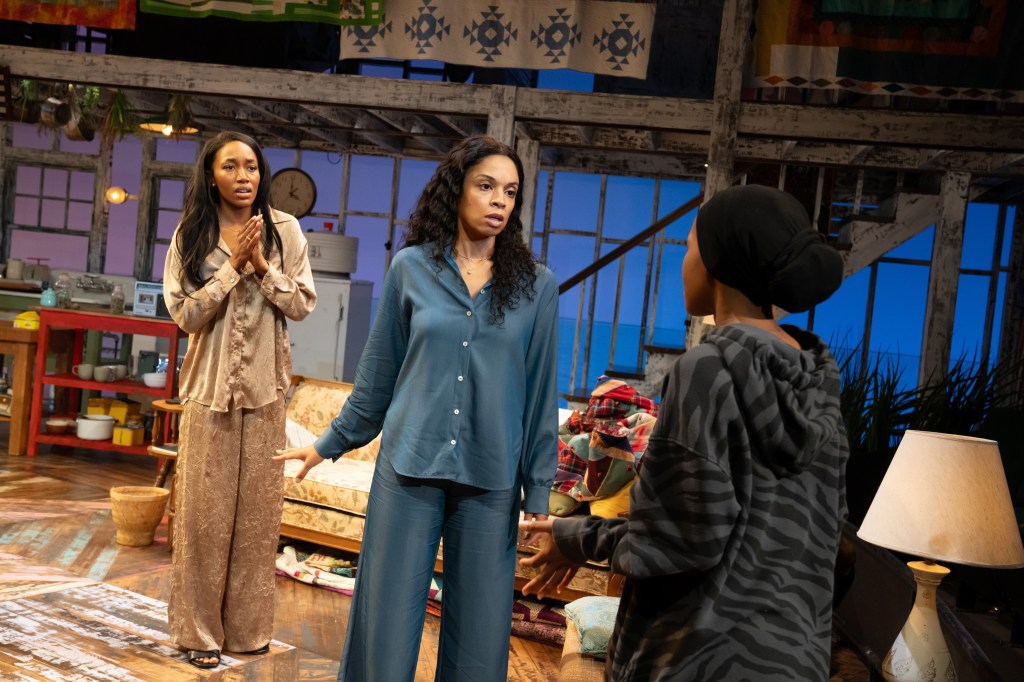
The characters are the patchworks that make up the family masterpiece
Much of the beauty of Hall’s drama, laced with comedic elements, comes from her precise characterizations of the disparate sisters who share the same mother but have different fathers. They are the patchworks that make up the last quilted masterpiece that their mother designed and they gather to finish.
Clementine, Gio, Amber
Clementine (Crystal Dickinson), is the eldest, who lives in the incredible ancestral home. Adam Rigg’s set design hums with authenticity, warmth and life. The cabin is decorated with generational family quilts that cover walls and the balcony railing, each colorful, individual, symbolic. Family ownership of the “chic” cabin with the sea in its front yard is in jeopardy because of unpaid taxes which their mother ignored, while keeping her delinquency a secret from her children.
Clementine, who lives there and became caretaker of their dying mother, best knows the rituals of their Jernigan ancestors. A root worker of potions and spells, she speaks Geechee (from their Gullah Geechee heritage), and emotionally archives their legacy, back to the first slave ancestors that lived and worked on the plantations in the area. She is a master of the rituals and celebration of their heritage through quilting which they practice yearly under her direction. This summer when the play opens, the sisters and their niece Zambia (Mirirai), gather together to complete the last quilt their dying mother/grandmother designed, as they symbolically release her to another plane of existence.
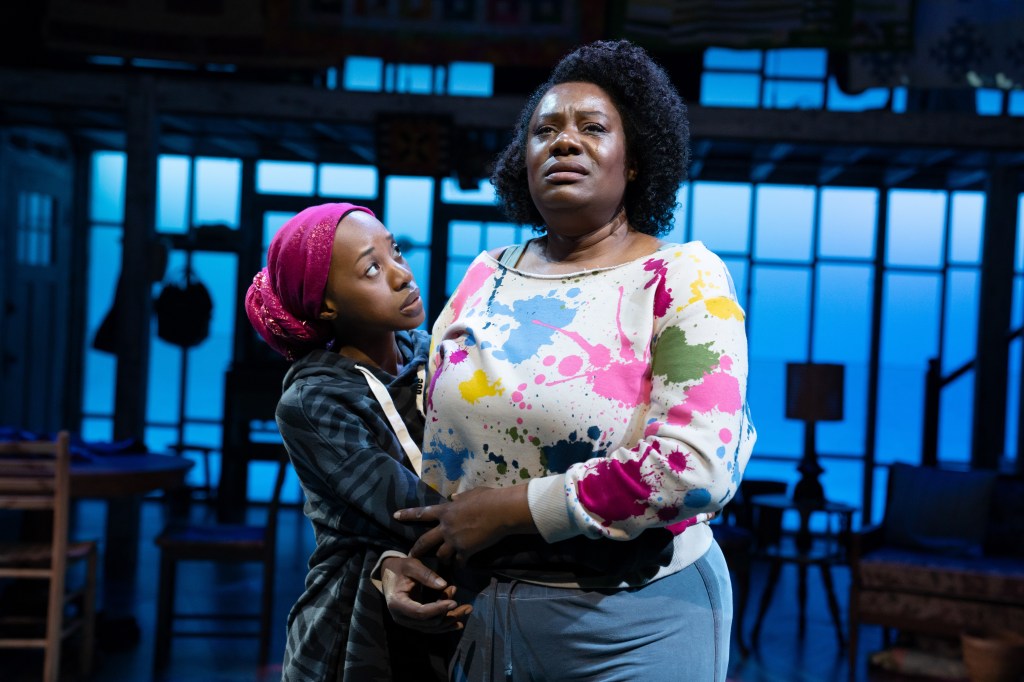
Gio (Adrienne C. Moore), is the second oldest, a roughly hewn, hard drinking, Mississippi cop, who is resentful and jealous of her youngest sister Amber (Lauren E. Banks). Gio’s rancor runs deep because of a traumatic, covert incident unbeknownst to Amber but related to Amber’s father that happened when Gio was a teenager. Sensitive to her own misery, burying hurts from her divisive relationship with their mother who abused her, Gio’s moods, aided by alcohol, swing widely as she peppers them with spicey swearing and insults directed mostly at youngest sister Amber.
Amber is the beauty and reputed favorite of their mother because of her accomplishments. She went to an Ivy league college and eventually becomes an entertainment lawyer of means. Because she missed the last three summers of their quilting ritual, and their mother’s funeral service, her estrangement from her sisters and the difference between her lifestyle and theirs is apparent.

Despite Gio and Clementine’s “guilting” her for not coming to the funeral, we discover Amber was emotionally the closest to her mother. She paid for her cancer treatments, phoned her often and even assisted the family after she left the homestead for California. In spite of their geographical and emotional separation, she paid for her sisters’ needs when they asked her, and especially pays for niece Zambia’s tuition in a private school.
Zambia and Cassan
It is Zambia who is the linchpin of the wayward, patchwork family that hangs together by a slender thread as each sister expels her angst and self-recrimination to each other. However, Hall uses Zambia and her mother, the quiet nurse Cassan (Susan Kelechi Watson), who is the closest to Amber, to round out the backstory with Zambia’s questions. Zambia and peacemaker Clementine move along the arc of development which settles upon two issues. How will they pay off the tax liens against the house, and who inherits the quilts, (pricey relics which are cultural artifacts of a rich historical past), the property and the cabin contents?
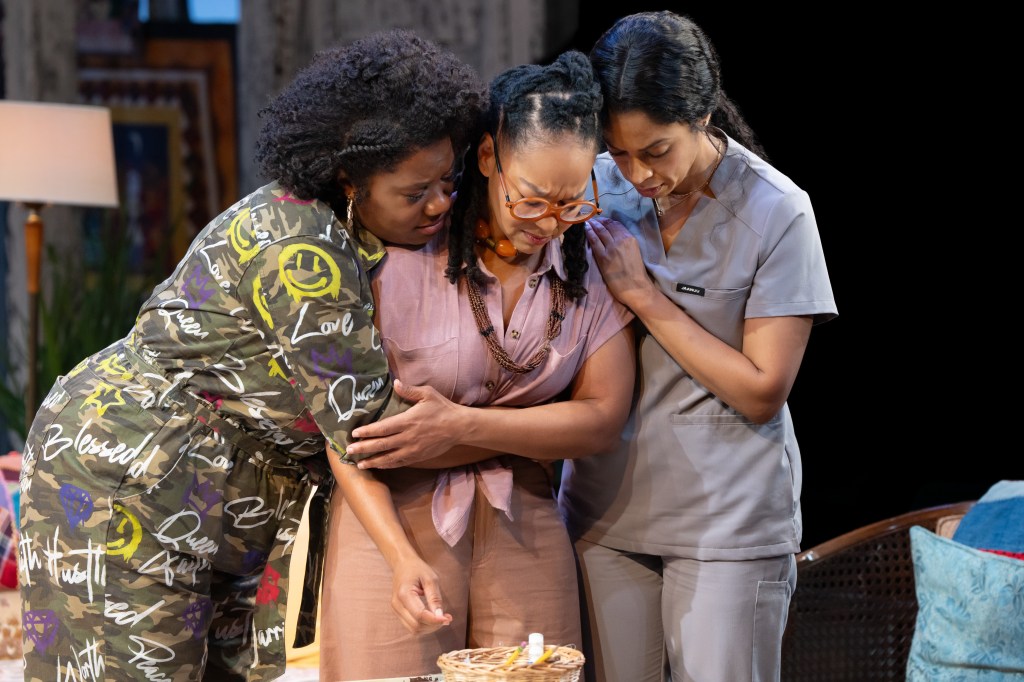
These questions are answered as Hall unspools each sister’s interior wounds via their relationships, revealing their individual portrait of their complicated, intriguing mother. All clarifies and we are brought to the edge of unresolved personal traumas that threaten to further destroy their lives emotionally, physically, spiritually. However, it is the act of quilting together that we view the whole with the sisters contributing to the corners of the ancestral masterpiece that unifies them with a familial love and redemption from past harm effected by their mother, each other and most importantly themselves.
Mystical elements
Hall’s first act languishes in exposition until the conflicts among the sisters erupt. The details of the quilting process fascinate and are well integrated into the dialogue. The symbolism and metaphor of the stormy souls aligned with the threatening hurricane’s thunder and lightening effected by Jiyoun Chang (lighting design), Palmer Hefferan (sound design), and Jeanette Oi-Suk Yew (projections), mirror how the natural world, material world and spiritual world often collide until there is a movement toward establishing peace and reconciliation.
Blain-Cruz does a smashing job referencing the impact the spiritual plane of existence has upon the material life of the sisters which is sensationally wrought in Act 2 toward the conclusion when they attempt to place the finished quilt on their mother’s bed and a mystical experience occurs. It is then when Zambia becomes the channel between the past spiritual legacy and the present and the pathway toward healing is realized.

The costumes by Montana Lvi Blanco pointedly imbue each of the sisters and Zambia’s changing “trends,” enhancing Hall and Blain-Cruz’s vision of this family to precisely tie in their characters culturally and psychically. Importantly, the ensemble works together to create a family drama with which we can identify and empathize. Their acting is superb. Perhaps the Geechee deserves a translation either in the program or elsewhere. I was benefited by a copy of the script. Vitally, the different language serves to remind the audience of the African diaspora that beleaguered the Jernigan ancestors-slaves, and unified them as they prospered in a hostile, alien world.
The Blood Quilt
See The Blood Quilt, which runs two hours forty-five minutes with one intermission at LCT, the Mitzi E. Newhouse, until December 29th.
,
Ashland Independent FF, ‘The Long Long Night,’and Panel with Bruce Campbell on Indie Films
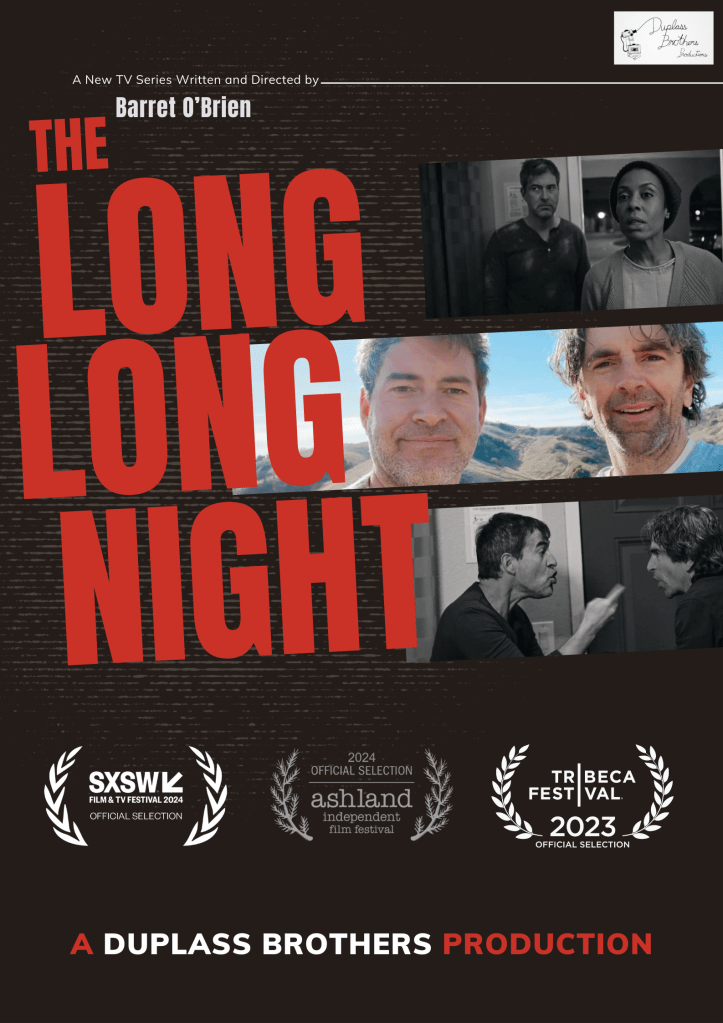
Revisiting The Long Long Night at Ashland Independent FF
I reviewed The Long Long Night when it premiered at Tribeca Film Festival in 2023, which you can read at this link, Tribeca Film Festival Review: ‘The Long Long Night’ With Mark Duplass and Barret O’Brien. I thought the indie series slated for TV, was superbly acted by New Orleans’ natives, the inimitable, Emmy award-winning Mark Duplass, and writer/director Barret O’Brien, who wrote and directed the clever, humorous episodic.

The six episodes of The Long Long Night coalesce around issues of our time in a send up of “white bros” attempting to negotiate a fine balance between screaming into the void of “political correctness,” living an “intentioned” life, and hammering macho male toxicity that uplifts Joe Rogan’s “all that” ethos. In a brilliant and sardonic twist to the “shining white maleness,” Emmy-nominated actor, Karen Pittman, guest stars in a hilarious episode. Her contribution is a counterpoint of “female, Black intention” that is not to be missed.
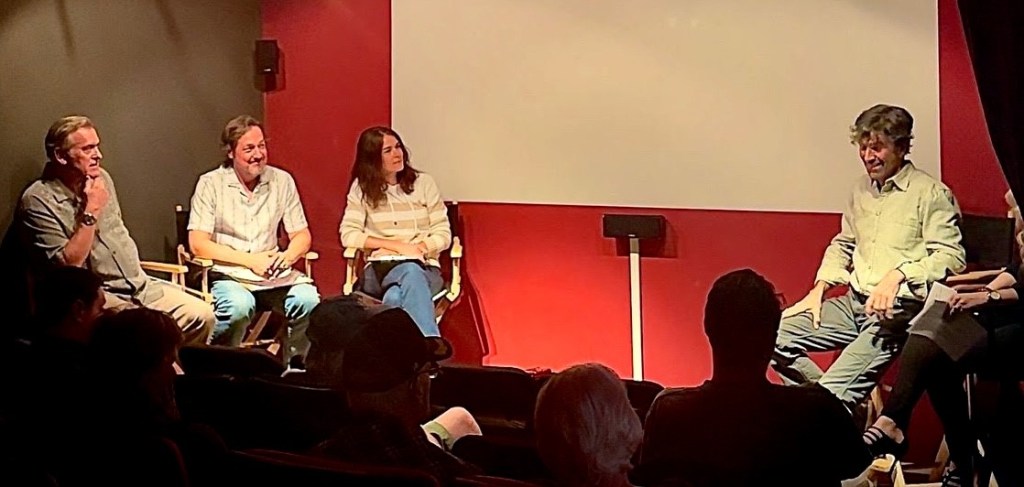
“Future of Indie Filmmaking” (Rory O’Neill Schmitt)
After the 2023 Tribeca premiere, the Duplass Brothers Productions series screened in 2024 at Ashland Independent Film Festival October 2024. Before the screening a panel discussion on the
“Future of Indie Filmmaking” was held. Present at the discussion were actor and writer Barret O’Brien and Rory O’Neill Schmitt, producer of The Long Long Night. Joining her were director, Gary Lundgren, as well as Oregon-based producer Annie Lundgren (Above the Trees).
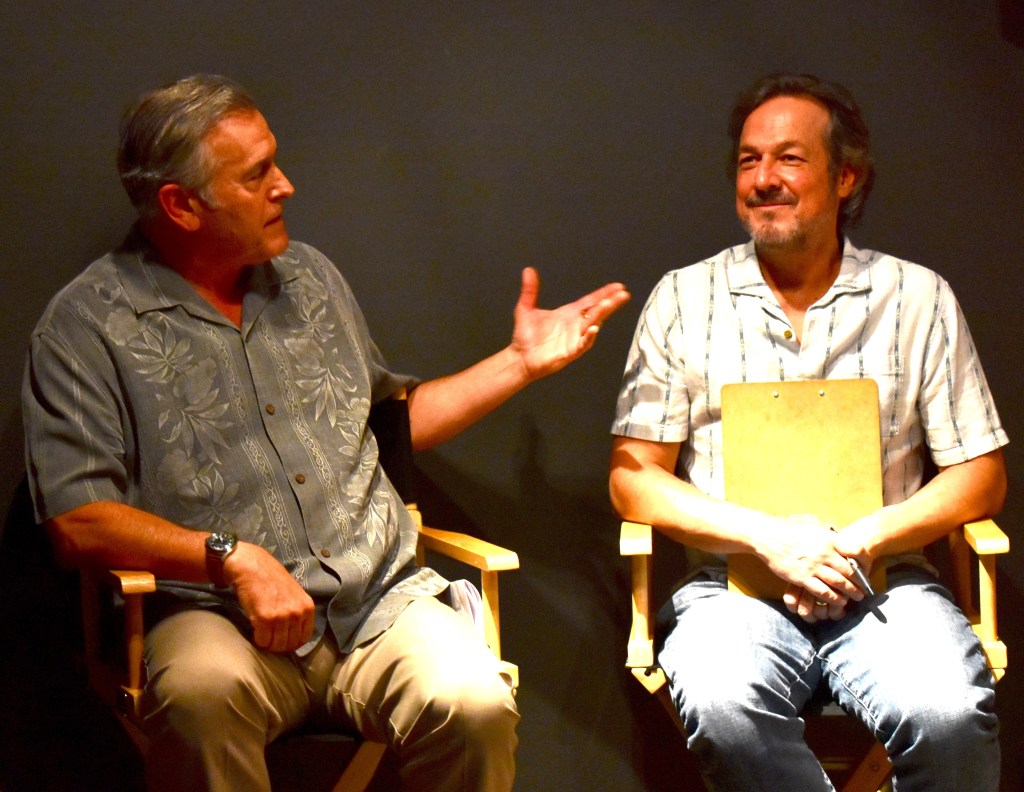
Bruce Campbell
Adding his knowledge, experience and expertise was special guest actor, producer, screenwriter and director Bruce Campbell. Bruce is most widely recognized for originating the role of protagonist Ash Williams in the cult classic, supernatural horror film The Evil Dead (1981). The film has been cited as among the greatest horror films of all time, and Ash Williams has become a cultural icon. From its success, subsequent films blossomed into a media franchise including a TV series, video games and comic books. Campbell, appeared in the films and is also noted for other work including USA Network series, Burn Notice (2007–2013). For the gift that keeps on giving, Campbell reprised his role as Ash for the Starz series Ash vs. Evil Dead (2015-2018). Campbell is currently finalizing his latest film, Ernie and Emma, which was filmed in Oregon.

During the panel filmmakers discussed how to create a successful indie film project, making vital creative choices despite limited resources. Panelists also discussed the importance of using maverick approaches to independent film production and distribution.

Follow-up interview between Rory Schmitt and Bruce Campbell
In a follow-up discussion Rory O’Neill Schmitt honed in on specific questions for Bruce Campbell about the future of independent film. His advice for up-and-coming filmmakers was based on his experiences, including those working with Evil Dead writer/director Sam Rami. Campbell was with Rami at the outset in 1978 working on Within the Woods, the short film which became the Evil Dead. Campbell contributed his creativity and efforts in subsequent films and the TV series in the franchise.
Rory Schmitt (RS): What do you think is the future of indie film?
Bruce Campbell (BC): The future is bright, as long as filmmakers are willing to work outside the studio box and often finance their own work. Independent movies have never been easier because of technology and the amount of platforms to exhibit the finished product.
Rory Schmitt (RS): What continues to draw you to making independent films? What do you feel audiences like about independent films?
Bruce Campbell (BC): I am drawn to independent films because they are the closest to being a single view, a single vision, whereas studio flicks are often driven by popularity. Stories can be more daring and original with indies because studio films feel the need to appeal to a wider audience, so the stories have to be more bland and “appealing.” Indie films can be way more daring.

Rory Schmitt (RS): Can you tell us about your upcoming feature film, Ernie and Emma (shot in Oregon)?
Bruce Campbell (BC): Ernie and Emma is a bittersweet tale of pear salesman Ernie Tyler who is entrusted with his wife’s ashes after she passes. As an executive secretary of a sawmill for 25 years, she has very specific ideas of what to do with her remains – not all of it warm and fuzzy nostalgia. I describe it as “Hallmark with swearing,” a sunrise story where ultimately Ernie learns to move on – with a little help from his wife.
Rory Schmitt (RS): Do you have any advice for emerging filmmakers?
Bruce Campbell (BC): If you avoid the following three systems, you will come out ahead in life: the legal system, the medical system, and the studio system. As a filmmaker, the only freedom you’ll have is owning/controlling your negative. Also, don’t be ignorant about business – learn the ins and outs of contracts, partnerships and financing, domestic and international. Educate yourself!
Look for The Long Long Night, Ernie and Emma and Hysteria (another project with Bruce Campbell on Peacock).
‘Shit. Meet. Fan.’ Neil Patrick Harris, Debra Messing, Jane Krakowski in a Scatalogical Romp Through Coupledom

Shit. Meet. Fan.
It’s an intriguing title. Stepping into the audience seating area of the MCC Theater, what’s not to like? Clint Ramos’ scenic design sparkles as the audience gazes upon Eve (Jane Krakowski), and Rodger’s (Neil Patrick Harris), upscale condo in Dumbo, NYC, a shimmering spectacle of Manhattan lights twinkling in the distance, visible through windows on the second floor which includes a “must-have” telescope on an “elegant” terrace.
From the title Shit. Meet. Fan. to the conclusion, the production screams with sardonic hilarity. Thematically, playwright Robert O’Hara presents characters who exude the allure of security, prosperity, white privilege and “happiness,” conditions to be envied. Perhaps. However, as the evening unspools on this party night when three couples and odd-Black-man-out, Logan, (Tramell Tillman), gather and have their vicious fun, we note that prosperity without contentment, truth or happiness is anything but “all that.”

The shoe drops at the outset
The shoe drops immediately, as promised in the title, and we are startled into recognition that in the opening scene, “it” is hitting the fan, as mother Eve (Jane Krakowski), confronts daughter, Sam (Genevieve Hannelius), about a box of condoms she found that Sam glibly professes isn’t hers. Though the scene concludes with Mom’s peaceful concession and return of the box to her daughter, the screaming match which paves the daughter’s way to success, is revelatory. In their heated interaction, O’Hara, who also directs, discloses a “hip,” ribald mother and daughter, whose frank rants about having sex are “no big deal,” though mom appears to protest too much for 17 year-old-Sam’s liking.
From then on as the guests arrive, “it” grows more plentiful. The characters fan the room, drink, do cocaine and spray their increasingly toxic, chaotic, mind games and patter to the back row of the audience. By the conclusion the audience is “covered.” It is funny, but not necessarily what we’ve wished for during the 105 minute romp through a tragic waste of humanity. However, O’Hara wishes us to laugh at ourselves as much as at the characters. Their hypocrisy, toxic masculinity, feminine one-up-woman-ship, and misery may be ironically recognizable to those able to afford a ticket to this Off Broadway production.

O’Hara based Shit. Meet. Fan. on the popular 2016 Italian film Perfect Strangers
Based on the 2016 Italian film Perfect Strangers, by Paolo Genovese, in the similar development, Rodger and Eve have invited their couple friends to celebrate the eclipse. The bonds of friendship were formed in college when the four men were in the same fraternity and consider themselves “bros.” They are a hotbed of toxic masculinity, fitting all the stereotypes one loves to despise when they are “under the influence” of drugs and alcohol. The men are TV celebrity heavyweights. Besides Neil Patrick Harris, who is always spot-on in whatever role he acts, the superb actors include Brett (Garret Dillahunt), Frank (Michael Oberholtzer), and the aforementioned Tramell Tillman as Logan.
On the other hand the women are close, but ancillary to the key relationships in this comedy that has a number of thematic twists, especially in O’Hara’s version. Joining Jane Krakowski’s Eve and Genevieve Hannelius as Sam, there are Brett’s wife, Claire (Debra Messing) and Frank’s wife, Hannah (Constance Wu). All reveal comedic perfection. The women circle the wagons when attacked, questioned or prodded by their spouses whose vulgar, women-demeaning, objectifying tales and shared secrets, divide the party among gender lines.

As the eclipse presumably occurs the characters get wild and wooly
As the party progresses and the eclipse occurs, which is more symbolic than visualized since no one really watches, the teeth and nails sharpened for this occasion extend for the vicious “fun,” prompted by Eve. She suggests that they play a “game of phones,” and willfully violate each other’s privacy for each other’s amusement, by publicly reading or putting on speaker every phone text, email or call received for an hour during the evening. For one hour there are no secrets; all the dirty laundry is aired. As each unwillingly gives up their phones because no one protests, they put the “black boxes” that record their lives on a centrally located table ready for exposure and humiliation. After that, the drama and comedy intensifies.
The first to suffer the slings and arrows of shame in front of his “bros” is Frank when Rodger calls him from their unknown landline and breathes heavily into the phone. Hannah, newly married to Frank in the heat of their first year together, is ready to knife out his eye. But Rodger comes down the steps heavily breathing into the phone in a classically delivered, brilliantly funny, Neil Patrick Harris, dead pan moment. It is priceless and one of the biggest laughs in the first half of the production.
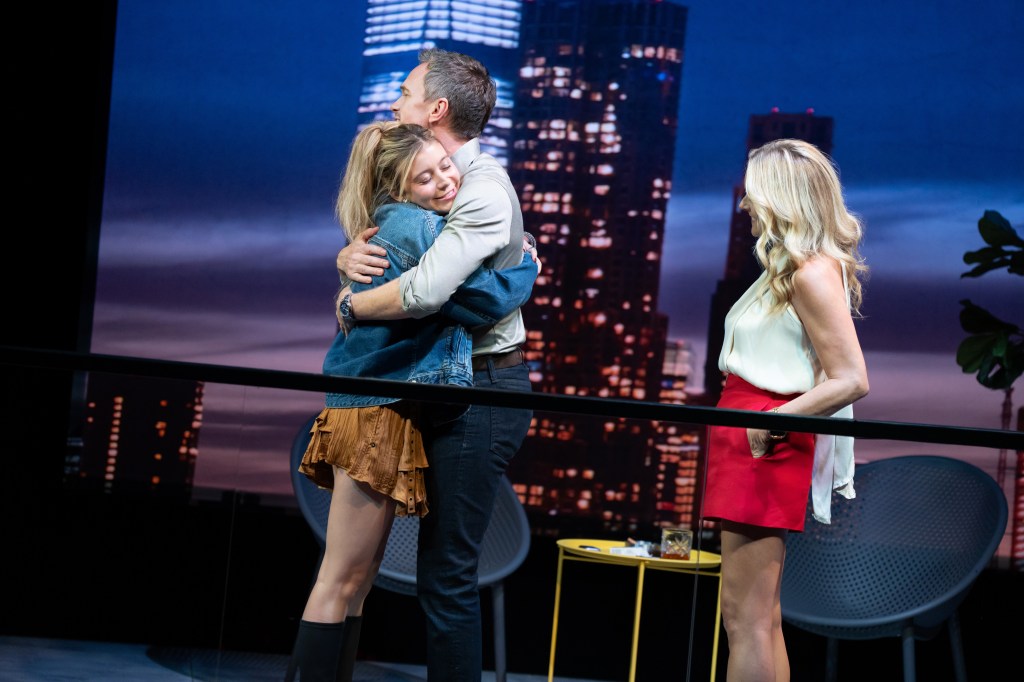
The “free-for-all” occurs after Logan receives a call
After that it becomes a free-for-all. Logan receives a phone call from his sister who insists humorously that he take her off speaker so those “white b%$ches” don’t hear “her business.” Censorship and political correctness cloaks are off; it’s expose time. Since there is no spoiler, you’ll just have to see the production to witness how each “bro” is delivered a blow and each spouse is found out to be doing numerous things other than being the sweet, loyal “wifey.”
Here are some clues. There are folks on the down low, alternate sexual preferences, affairs referenced by jewelry purchases, a proposal to throw mama in a nursing home behind sonny-boy’s back and more. O’Hara has pegged the jabbing one liners and jokes trippingly to the rapid-fire comedic rhythms which begin casually at an even pace, then pick up and race into the territory of high farce. Then, when the eclipse ends, all settles into normalcy as if nothing untoward, raw and menacing happened. Such is upscale life among the white privileged and two token persons of color. Oblivion after emergences of poisonous, festering wounds.
Meanwhile, we have the opportunity to peek into the illusions, lies and self-gaslighting of these peculiar and infantile minds that may not evolve beyond what we note as entertained watchers.
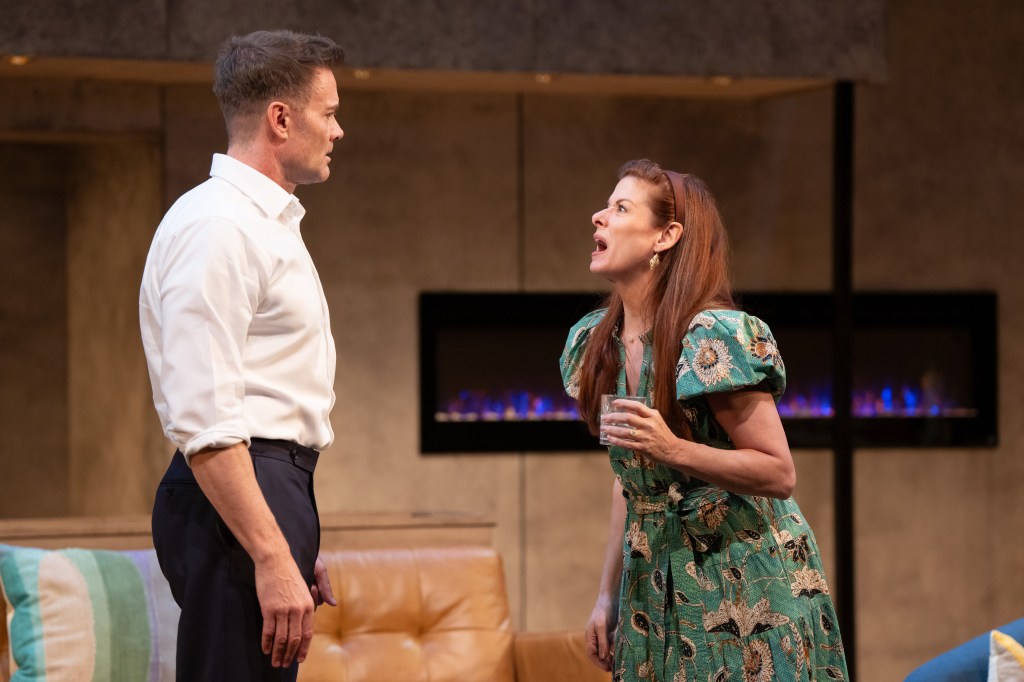
O’Hara portrays boorish, unlikable characters
Clearly, O’Hara finds these individuals boorish and craven, especially the white, toxic stereotypical males who make everywhere their preferred locker room, especially out of their wives earshot. The women are the fairer but not gentler sex. Together, we allow that this night of frolicking fun doesn’t happen often. If it did, there would be three divorces on the horizon except for one, perhaps, though Rodger loves his wife Eve, even if he dislikes who she is as they both contemplate divorce. Thematically, O’Hara proves that individuals choose the friends they deserve as they periodically are tortured and tormented by them under the guise of “fun and games” which are anything but.
O’Hara’s creative team in addition to Clint Ramos’ scenic design, includes Sarafina Bush’s costume design, Alex Jainchill’s lighting design, Palmer Hefferan’s sound design, and Cookie Jordan’s hair design. Each of these creatives assists O’Hara’s sardonic vision of these upper brow professionals in their one night of infantilism and terrorism of each other which is perhaps more well deserved than we know.
Shit. Meet. Fan. runs 1 hour forty-five minutes with no intermission at MCC Theater (511 West 52nd Street between 11th and 10th Avenue), until December 15th. See it for the celebrities who are glorious, as O’Hara intentionally tries the audience’s patience with their characters’ crass and vapid immaturity.
‘Tammy Faye,’ Starring Olivier-winner Katie Brayben in a Thematically Charged Musical

Tammy Faye
Tammy Faye, with music by Elton John, lyrics by Jake Shears and book by James Graham stars theater heavyweights Katie Brayben, Christian Borle and Michael Cerveris. All of them are letter perfect in the roles of Tammy Faye Bakker, Jim Bakker and Jerry Falwell. Considering that the show is about the rise and fall of the hugely successful PTL Christian network headed up by televangelists Tammy Faye Bakker and Jim Bakker, the production’s chronicle of a complex period in America’s sociopolitical and religious history is ambitious. Currently at the newly renovated Palace Theatre, Tammy Faye runs until December 8th.
For some, the production is hard to swallow. This is unfortunate because its themes are vitally connected to our country. Also, it is a satiric, entertaining new musical whose theatricality coheres in director Rupert Goold’s vision shepherding a fine ensemble and creative technical team. Because I have a familiarity with the Christian evangelical church and, in fact, went to the same church that Jessica Hahn went to during the PTL scandal, and knew and spoke to her, I have a different perspective. Arguably, I may be biased in favor of the musical. That must be considered when reading this review.
With choreography by Lynne Page and Tom Deering’s music supervision, arrangements and additional music, Tammy Faye presents a fascinating picture of individuals who currently are not held in high esteem. Only one comes out on top as James Graham’s book characterizes her and as the phenomenal voice and acting chops of Katie Brayben performs her. Singing from a core of emotion and heart, illustrating Tammy Faye’s trials of faith, Brayben belts out numbers that overshadow the real Tammy Faye’s voice. These high-points in Tammy Faye’s emotional journey include “Empty Hands,” “In My Prime Time,” and “If You Came to See Me Cry.”
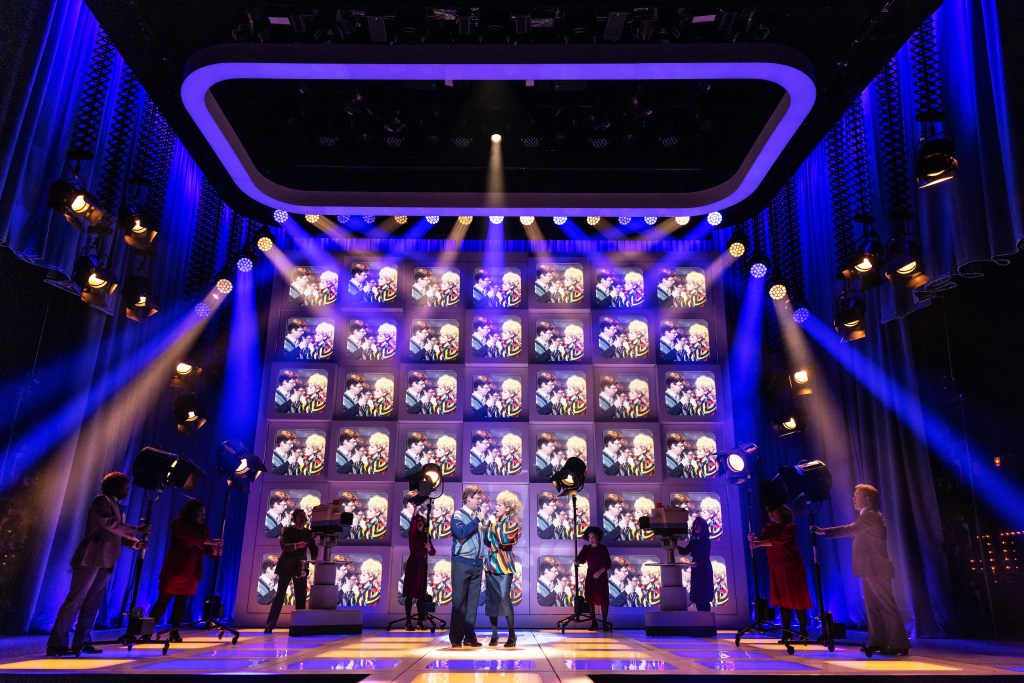
Katie Brayben gives a bravura performance
During these dynamic and compelling songs, Brayben’s Tammy Faye reveals the depth and impact of her betrayal by husband Jim Bakker, as she attempts to find a way forward for and by herself. Not to be underestimated, Tammy Faye is a maverick among the Christian women of the church, a portrayal that we see time and again as she speaks out, despite Christian pastors trying to shut her up. Sharing her opinion at a conference with Billy Graham (Mark Evans), in a beginning flashback of “how it all began,” we note her courage at a time when women took a back seat to any form of leadership. Billy Graham encourages her as the new generation of spiritual warriors in front of a patriarchal, oppressive, conservative group of pastors.
From then on we see her emerge despite being dismissed by the pastors who become the hypocritical villains of Tammy Faye and who sadly lead the way for the massive hypocrisy present in the white supremacist leaning evangelical church today. The Falwell types and white supremacist pastors turn a blind eye to the bullying hatreds and criminality of the MAGA movement they undergird in supporting Donald Trump. Trump’s controversial presidency is in his violating the tenets of Christianity and patriotism. Indeed, he is an alleged pedophile consorting with friend Jeffrey Epstein. He is Putin’s asset who has undermined our election processes twice, and most probably cheated and defrauded the American voter to elicit a “win,” in 2024 (see the Mark Thompson Show on YouTube). He adheres to Putin’s guidance regarding NATO, and on a personal note to emphasize his “godliness,” he’s a lying adulterer and admitted sexual predator (the Hollywood access tape), many times over, in cover ups much worse than Jim Bakker ever committed.
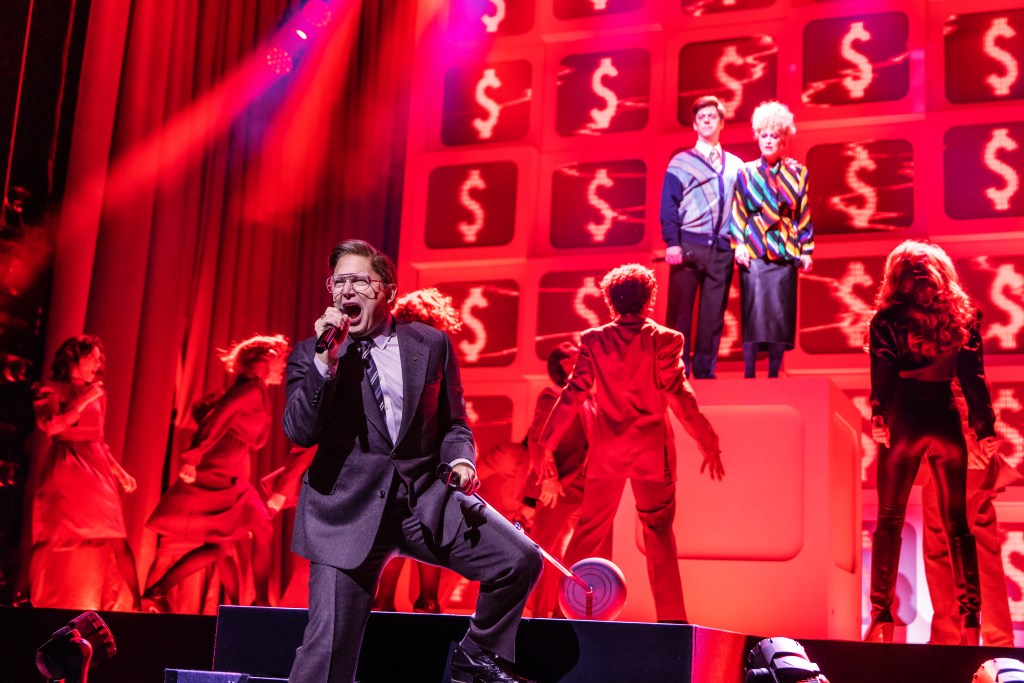
Tammy Faye reveals how we got to the current politics of evangelism
Importantly, for those who would understand how the US “got here” with the rise of evangelism and a brand of political Christianity that belies the true tenets of Jesus Christ’s sermon on the mount, and “Love thy neighbor as thyself,” Tammy Faye gives a crash course in hypocritical Christianity that is right out of St. Paul’s letters to the hypocritical church in Corinthians I and II. It’s interesting to note that over two thousand years later, nothing changes much. Judgment, criticism and condemnation are alive in the human heart and in venues that are supposed to be uplifting the opposite and preaching Christ’s message of love.
Goold stages the production with scenic designer Bunny Christie’s “Hollywood Square” back screen and other projections (video design by Finn Ross), to emphasize the importance of TV to the rise of global evangelism in the 1970s to the present. When the PTL live program is not being taped with dancers and singers, other scenes reflect the importance of satellite TV in the square/screen motif in which appear the various players. Always present as a backdrop are the TV screens reflected in the grid of boxes strikingly lit by Neil Austin that represent what obsesses the actions of the preachers, the Bakkers and their employees (“Satellite of God”). The electric church was televised globally via satellite and its reach was and is expansive, though the screens became smaller on phones after streaming WiFi.
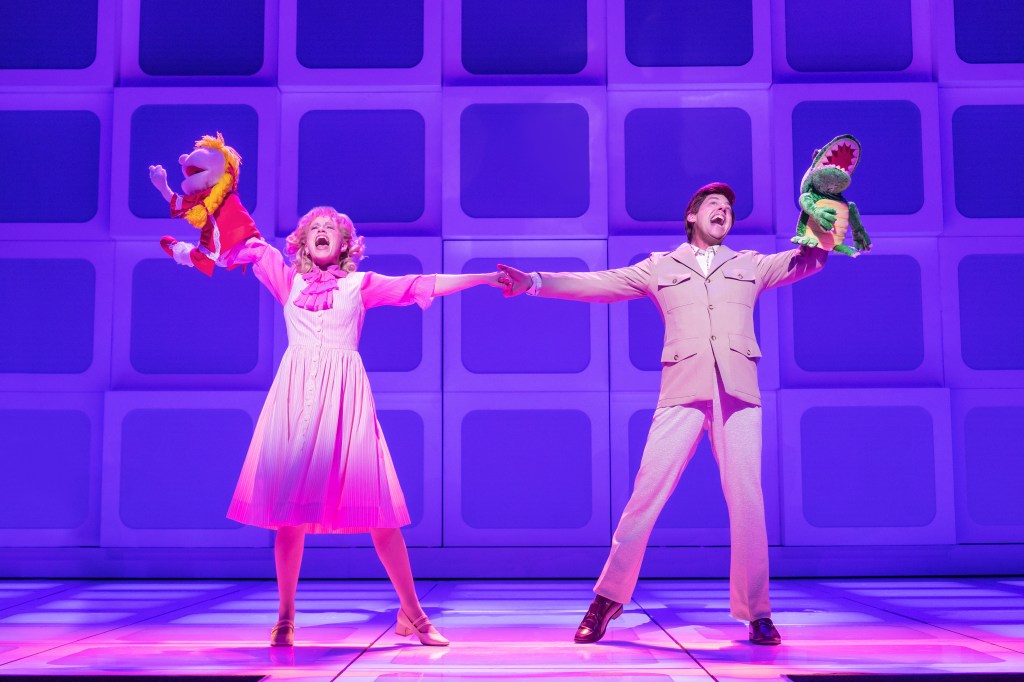
In its symbolism and its wayward themes of church leaders and politicians making damaging and unconstitutional bedfellows, Tammy Faye does its job perfectly, thanks to its creatives. And for that it has received its due misplaced disgust at a time in our nation when Americans have no more patience for hypocrites, scammers and thieves, especially those who profess “Christianity” and lie, cheat, steal, condemn, oppress, restrict, torment and insult as their brand of fun and sanctimony. Hello, Speaker Mike Johnson, Jim Jordan and JD Vance. Nevertheless, Tammy Faye is a vital musical of the time and should be seen for Elton John’s striking music, its irony in how the hypocrites dance around their own lies, and its themes which are more current than ever.
Graham’s book elucidates a version of PTL worthy of note
Book writer James Graham elucidates a version of what happened with PTL that is worthy of note. Laying the blame on the inability of the Christian Church to be united under the first two commandments that Christ preached (love God, love your neighbor as yourself), Graham reveals how Tammy Faye tried to bring disparate groups together with love, but failed. Additionally, to that point, if Tammy Faye had been part of the back room financial arrangements, the fraudulent situation with Heritage Village might not have gotten completely out of hand (“God’s House/Heritage USA”). Indeed, Heritage Village was Jim Bakker’s idea, and clearly, its idea development was mishandled and mismanaged.
Finally, we note that Jim Bakker, whose feckless leadership causes their collapse when he relinquishes PTL and the TV network to Jerry Falwell. With smiling duplicity and treachery, Falwell promises to help the Bakkers get on their feet again and pay their expenses. Tammy Faye warns Jim not to listen to Falwell whom she has always distrusted and deemed a self-serving, condemnatory, hypocritical preacher of hate. Tammy Faye’s unheeded warning proves correct. With his lies, misinformation and mischaracterizations, Falwell upends any goodness the Bakkers accomplish, defames them publicly, and kicks them out of the Christian fellowship for the “good” of the conservative church and himself.
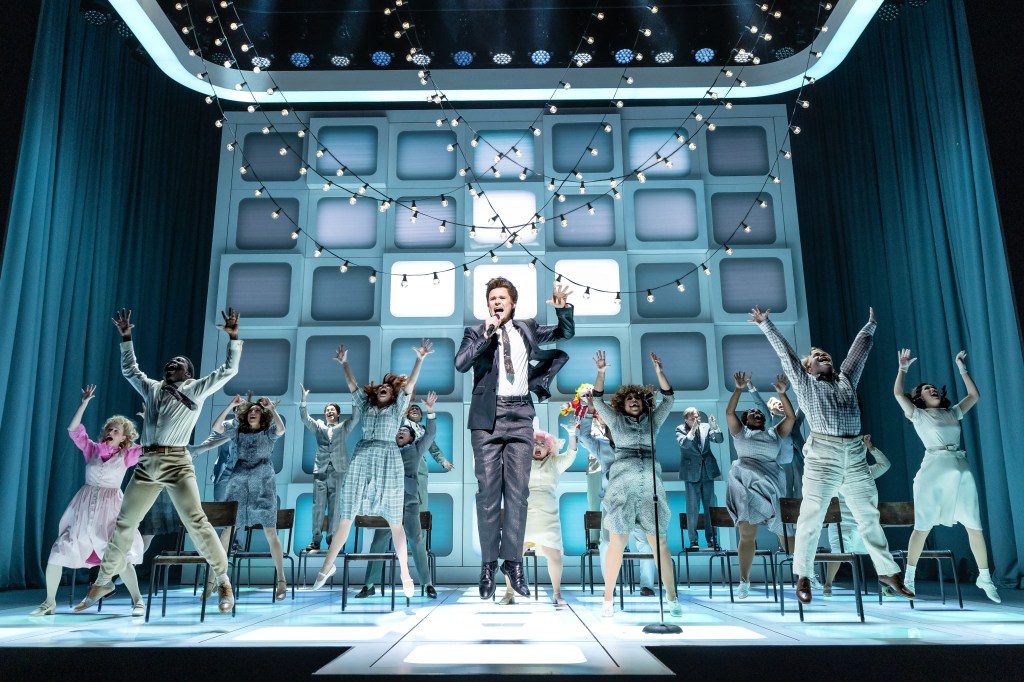
The difference between preachers and preachers
The book underscores the difference between Tammy Faye and Jim, and the other preachers from conservative churches. Falwell (a dynamic Cerveris), Jimmy Swaggart (Ian Lassiter), Pat Robertson (Andy Taylor) and Marvin Gorman (Max Gordon Moore), demean Tammy Faye and Jim Bakker’s way of bringing people to the Gospel. They tolerate them, believing they will fail and are surprised and shocked at their success. Falwell’s massive ego can’t bear to see another preacher in his sphere of influence doing better than he. Not only does Falwell compete for viewership, he goes on their program and insults them attempting to send a message to church goers that they are not of God.
The turning point comes at the prodding of Ted Turner (Andy Taylor), who is concerned about PTL’s finances plummeting because of overspending. Part of the reason Turner suggests the program needs an uplift is because the love and charisma in Tammy and Jim’s relationship has cooled and viewers sense something is wrong. Even friends Paul Crouch (Nick Bailey) and Jan Crouch (Allison Guinn) warn them. At this point in time Tammy has learned of Jim’s infidelity with Jessica Hahn (Alana Pollard), and though he repeatedly asks for forgiveness, Tammy finds it difficult. Increasingly, she relies on prescription pain medicine to anesthetize herself which staff preacher, John Fletcher (Raymond J. Lee), sometimes gives her.
When Tammy strikes out on her own without Jim to carry a show, she draws greater audience viewership which Ted Turner praises. In a heartfelt satellite interview, she speaks with gay pastor Steve Pieters (Charl Brown), about having AIDS. Her public action is courageous. She hugs Steve and accepts him with love into Christ’s fellowship, an anathema to conservative Christianity which condemns gays and believes AIDS is God’s punishment for their sinful homosexuality.
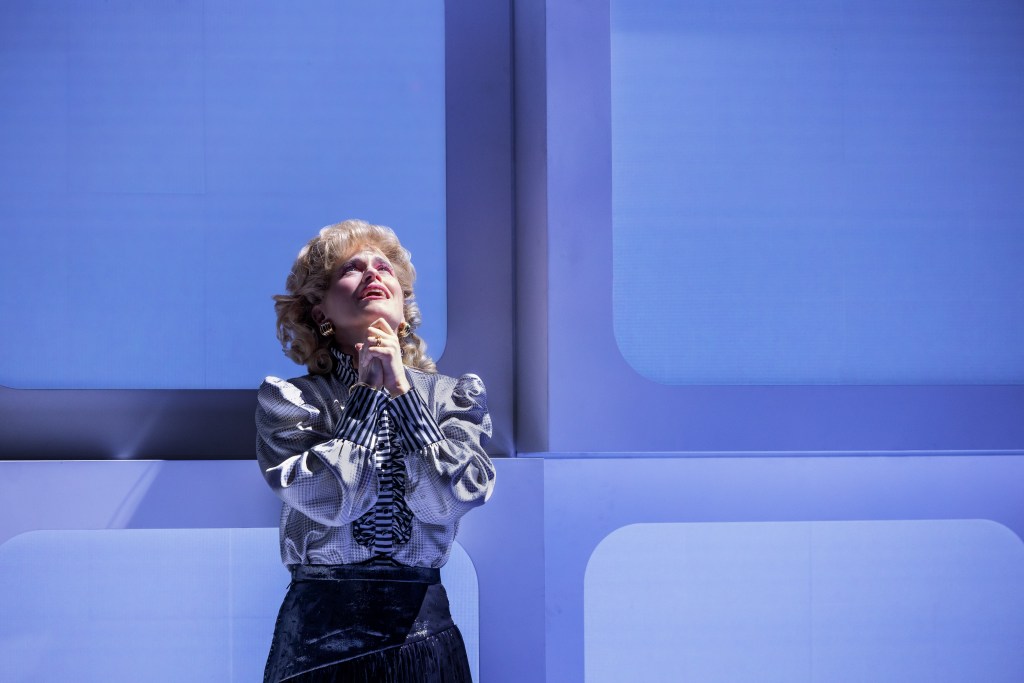
A meeting sealing the fate of PTL
Falwell and the other ministers have a confidential meeting and Falwell even phones President Ronald Reagan (Ian Lassiter), who never acknowledged or worked to stem the AIDS crisis, despite having a gay son and working with gays when he was an actor. Of course, Reagan’s hypocrisy and need for the evangelical church to endorse him is why he speaks to Falwell. In another inflection point, we see the division between church and state morph into an unholy matrimony of religious politicos washing each other’s hands despite the historically traditional separation between church and state.
Thus, Reagan’s public uplifting of the evangelical community via Falwell and others provokes a sea change in the sociopolitical and cultural direction of the nation. The growing intrusion of religion into politics becomes the foundation of constitutional human rights’ reversals seen today, which are particularly uplifted in MAGA states.
Reagan and conservative evangelism, for the voting block-merging church and state
With Reagan in their corner, conservative religious leadership agrees that PTL is moving in an unGodly direction. Falwell and the other preachers see the Bakkers are headed for disaster and they give them a push when the opportunity arises. For example, they get prominent PTL member John Fletcher to turn on Bakker. He sets up Bakker with Hahn, then leaks information when Falwell threatens to expose him of his “infidelities” with gay men if he doesn’t play ball. Falwell also tips off the Charlotte Observer whose reporter Charles Shepard (Mark Evans), investigates the financial arrangements of PTL and finds them to be indebted and insolvent. The situation boils over in “Don’t Let There Be Light.” Tammy, Jim and Jerry recognize their shameful actions and pray that they will not be exposed.
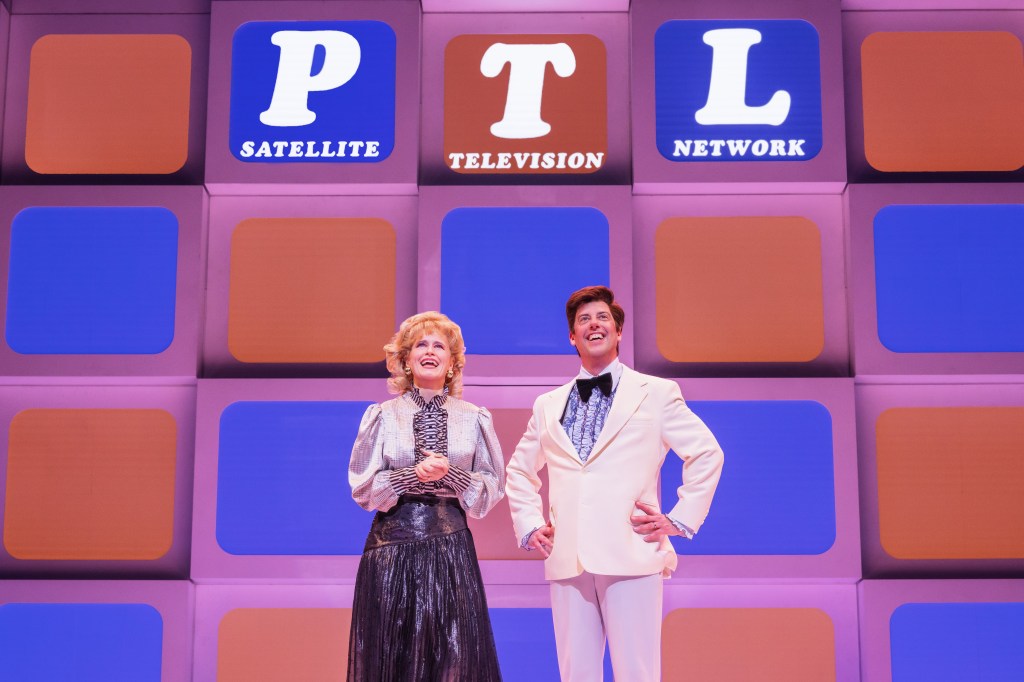
Of course, they are all exposed and vilified by the press and other church leaders. One humorous scene involves Pope John Paul II (Andy Taylor), Mormon leader (Thomas S. Monson), and Archbishop of Canterbury (Ian Lassiter), staged in window squares raised to a higher level above the stage ironically. From their lofty positions, they comment on the troubles of the “electric church” and the Bakkers. Meanwhile, elements of the same unloving hypocrisy are present in their congregations. The pederasty, pedophilia and horrific abuse of the Catholic church is yet to be revealed by the Boston Globe and is still being revealed in the Irish Madeline Laundries and Mother and Baby Homes. Certainly, the church memberships fall off in the Mormon Church and the Church of England. Congregants loathe the leaderships’ hypocrisy.
Acting hate not love
Falwell, Robertson, et. al., end up backbiting each other with hate and jealously. A desperate Bakker, beyond Tammy’s counsel, gives the PTL reigns to Falwell after Tammy learns Jim paid hush money to Jessica Hahn. The scandal widens the more the Bakkers give interviews to defend their positions. In Falwell’s hands, PTL goes bankrupt and is closed down. Tammy divorces Jim and other pastors’ infidelities are exposed as Bakker ends up in jail (“Look How Far We’ve Fallen”). The biased judge ridiculously throws the book at Bakker when murderers are even given lighter sentences.
Eventually, the conservative hypocritical Falwell and Pat Robertson follow in Reagan’s footsteps and run for the presidency. Indeed, their great piety is a sham as they attempt to vault their notoriety to the White House and reap untold rewards, but fail. Unlike Donald Trump who has defrauded his way there again with the treasonous help of various conservative think tanks, True the Vote’s voter challenges in Georgia, voter suppression in swing states, Elon Musk and Putin, Falwell and Robertson’s reputations preceded them and they were rejected as candidates.
Nevertheless, the evangelical Christian movement had an established foothold in politics. The country then wasn’t ready for a conservative, religious president. Now, the MAGAS, building on white supremacists and overturning Reagan’s legacy, have evolved to the point that with Putin’s foreign interference paying influencers to promote misinformation, Trump has become their acceptable, religious MAGA god/autocrat. Despite what Trump/MAGAS/Putin and a complicit press would have voters and the world believe that Trump received “great” voting support, over half the voting public of both parties doesn’t agree with MAGA/Trump’s religious, conservative, oppressive and autocratically unconstitutional mandates. Most probably, if there had been a recount, the results would have revealed otherwise. Better to let sleeping MAGAS, Trump, Putin and others lie.
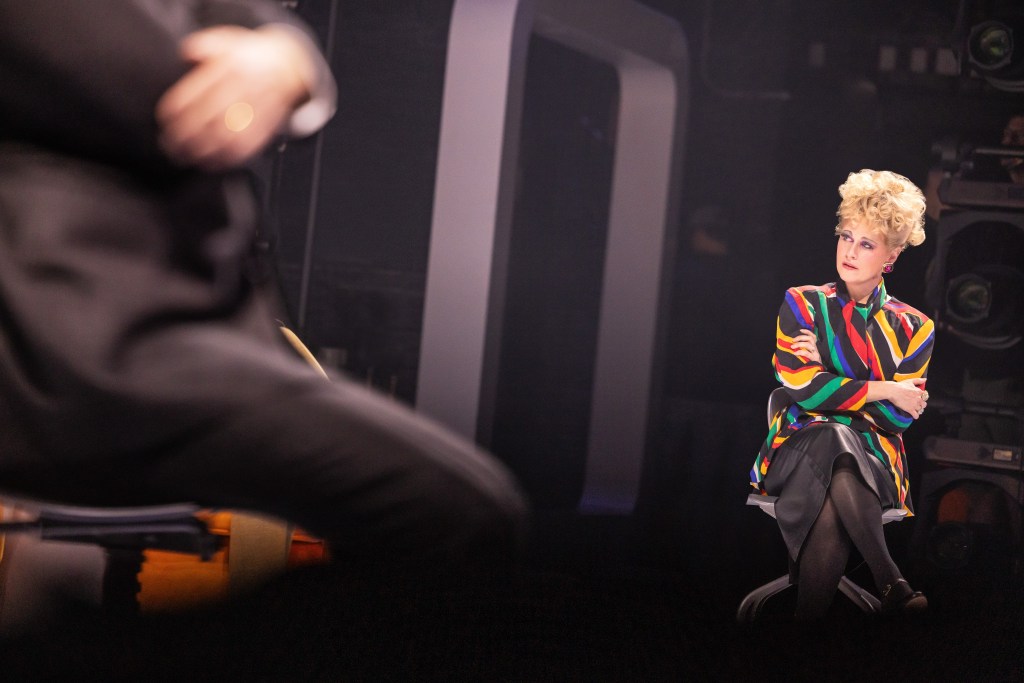
Favorable reviews in London, bad timing in Manhattan
The show, which originated two years ago at the Almeida Theater in London, received favorable reviews. Opening here at the time it did proved unfortunate because of its subject, a conservative evangelical church, now associated with Donald Trump: a twice impeached, three times indicted, one time convicted criminal, who attempted to overthrow the 2020 election with some of their help via militias and the support of Clarence Thomas’ wife Ginni Thomas.
From Reagan and Falwell and PTL televangelism to the racist, xenophobic, misogynist, MAGA Christianity of today, the conservative brand of evangelicalism has blossomed into “acceptable” white supremacy, oppression, hellfire condemnation and tyranny toward other religions and people of color. Is there any wonder that Tammy Faye, opening around the 2024 election, is a brutal and noisome reminder of what lies, misinformation and money do for those in power, who stir up hate, work unconstitutionally and divide even their own believers from patriotism and the love of God?
Important takeaways
Positive takeaways are the show’s performances which are sterling, especially the leads. The technical team under Goold’s guidance manifests his vision for the production. The book glosses over a complicated series of events (one of which never shows the other side of Jessica Hahn’s professed “virginal innocence,” nor the role her Long Island pastor played in strong-arming the PTL board to pay her hush money).
However, the production does manage to portray one individual, regardless of her psychic flaws, who preached love instead of messages of hate and condemnation (“See you in Heaven”). Tammy Faye did this at a time when standing up for individuals with AIDS was anathema to the general public, let alone Christians. Hers was a courageous, heartfelt stance as an independent Christian church woman. who, alone, went out on a limb to mirror God’s love and show how Christians were supposed to support and help one another.
I heartily recommend this production, especially for those who are interested to understand how evangelism became involved with our politics, despite the supposed separation of church and state. Tammy Faye runs at the Palace Theatre with one intermission until December 8th. https://tammyfayebway.com/?gad_source=1 It’s a shame it is closing so soon.
The Marvelous New York Botanical Garden ‘Holiday Train Show®’
All Aboard!



Now in it’s 33rd year, the magical NYBG Holiday Train Show® has arrived. This most thrilling and fun experience for families and friends runs from Saturday, November 16, 2024 through Monday, January 20, 2025.
Enid A. Haupt Conservatory exhibits
NYC favorite the Holiday Train Show® boasts G-scaele model trains zipping, racing and rollicking through galleries of the Enid Haupt Conservatory amidst gorgeous, rainbow hued plantings set to complement New York landmarks in miniature from NYC’s five boroughs to historic places in the beautiful Hudson Valley.


These replicas (i.e. Poe Cottage, the Park Avenue Armory, LuEsther T. Mertz Library, Cooper Union) are wonders in themselves because Applied Imagination’s creative team constructs them entirely of plant parts.
Practically every train type is represented from1880s American steam engines to modern freight and passenger trains with diesel engines, to trolleys and whimsical cars.


Woodland outdoor display
The woodland outdoor display created last year is an enchantment for all.


Trains chug around whimsical mountain structures on the ground and high above on trestles so that high visitors may walk under the bridges. The landscape is filled with forest animals and creatures, winter-interest plants and marvelous fungi.

All these and more enchantments unfold on the conservatory Lawn begging to be seen, like the owl perched above looking down on laughing children and smiling adults.


Events
NYBG and Tea Around Town
This year NYBG has partnered with Tea Around Town, a sightseeing tour bus that serves afternoon tea and brings the excitement and delight of the season from Manhattan to NYBG. First, join Tea Around Town’s festive journey to NYBG’s Holiday Train Show®. On the bus you will enjoy special teas, delicious treats and merriment served by elves aboard a beautifully decorated bus that celebrates the season. Disembarking from the bus, you will walk through the Holiday Train Show exhibits appreciating the craftsmanship and skill of Applied Imagination’s ingenious team and the clever botanical designs of the NYBG staff.

The Tea Around Town bus will run Tuesdays in November and December, and Thursdays and Sundays from November 19th through January 20th. The bus departs from Central Park South at 11 a.m. and leaves NYBG at 3 p.m. to return to Manhattan. Also, in November and December, Tuesdays and Thursdays, 1-2:30 p.m., Santa and an elf will be on-site in NYBG’s Leon Levy Visitor Center for photo opportunities with visitors.
Holiday Train Nights
Everyone enjoys another favorite event of the NYBG Holiday Train Show® at Holiday Train Nights. There is nothing more mysterious and beautiful as the glowing colored lights in the evenings where another atmosphere takes over the Garden landscape and inside the Enid A. Haupt Conservatory. Viewing the replicas twinkling with lighting from within and without. Enjoy listening or bopping along with holiday classics and Christmas pop favorites sung by performers in the Locomotive Lounge of the Visitor Center. Enjoy sweet and savory bites, spiked cider cocktails and mocktails, and hands-on gingerbread decorating your own for purchase.

Holiday Train Nights take place on 16 select evenings. Ten of them are for adults only from 7 to 10 p.m. Six of the evenings are for all ages from 6 to 9 p.m. Holiday Train Nights are ticketed through NYBG’s presenting partner Fever.

For adults
During adult Holiday Train Nights adults age 21 and older will be able to view the Train Show under an entirely different evening aura. There is also festive food and curated cocktails available for purchase. The dates are as follows: Saturday, Novembr 21; Friday, November 29; Saturday, November 30; Saturday, December 7; Friday, December 13; Saturday, December 14; Saturday, Decembr 28; Saturday, January 4; Saturday, January 11; and Saturday, January 18.
For families
All ages can enjoy Holiday Train Nights with hands-on activities on the following dates: Friday, December 20; Saturday, December 21′ Sunday, December 22; Monday, December 23; Thursday, December 26; and Friday, December 27.
More coverage will appear on this blog about NYBG Holiday Train Show. For additional information visit https://www.nybg.org/
‘Sunset Blvd.’ A Thrilling, Edgy, Mega Spectacle, Starring Nicole Scherzinger

If you have seen A Doll’s House with Jessica Chastain, Cyrano de Bergerac with James McAvoy or Betrayal with Tom Hiddleston, you know that director Jamie Lloyd’s dramatic approach reimagining the classics is to present an unencumbered stage and few or no props. The reason is paramount. He focuses his vision on the actors’ characters, and their steely, maverick interpretation of the playwright’s dialogue. The actors and dialogue are the theatricality of the drama. Why include extraneous distractions? Using this elusively spare almost spiritual approach which is archetypal and happens in what appears to be pure, electrified consciousness, Lloyd is a throwback to ancient Greek theater, which used few if any sets. As such Lloyd’s reimagining of the magnificently performed, uncluttered, cinematically live spectacle, Sunset Blvd., currently at the St. James Theatre in its second Broadway revival, is a marvel to behold.
The original production, with music by Andrew Lloyd Webber and book and lyrics by Don Black and Christoper Hampton, opened in 1993. Lloyd’s reimagining configures the musical on a predominately black “box” stage that appears cavernous. Soutra Gilmour’s black costumes (with white accessories, belts, Joe’s T-shirt), are carried through to the black backdrop whose projection, at times, is white light against which the actors/dancers gyrate and dance as shadow figures. The white mists and clouds of fog ethereally appear white in contrast to the background. There is one stark exception of blinding color (no spoiler, sorry), toward the last scene of the musical.

As a result, David Cullen and Andrew Lloyd Webber’s orchestrations under Alan Williams’ music supervision/direction sonorously played by the 19 piece orchestra are a standout. The gorgeous, memorable music is a character in itself, one of the points of Lloyd’s stunning production. From the overture to the heightened conclusion, the music carries tragedy lushly, operatically in a fascinating accompaniment/contrast to Lloyd’s spare, highly stylized rendering. On stage there are just the actors, their figures, voices and looming faces, which shine or spook shadows, sinister in the dim light. The immense faces of the main four characters in black and white, like the silent film stars, gleam or horrify. The surreal, hallucinatory effect even abides when the actors/dancers stand in the spotlights, or the towers of LED lights, or huddle in a dance circle as the cinematographer films close-ups thanks to Nathan Amzi & Joe Ransom.
The symbolism of the staging and selection of colors is open to many interpretations, including a ghostly haunting of the of the Hollywood era, which still impacts us today, persisting with some of the most duplicitous values, memes, behaviors and abuses. These are connected to the billion dollar weight loss industry, the medical (surgery and big pharma) industry, the fashion and cosmetics industry, and more. The noxious values referenced include ageism, appearance fascism (unreal concepts of beauty and fashion for women that promote pain, chemical dependence and prejudice), voracious, self-annihilating ambitions, sexual youth exploitation, sexual predation and much more. Lloyd’s stark and austere iteration of Sunset Blvd. promotes such themes that the dazzling full bore set design, etc., drains of meaning via distraction and misdirection.
The narrative is the same. Down and out studio writer Joe Gillis (the exceptional, winsome, authentic Tom Francis), to avoid goons sent to repossess his car, escapes onto the grounds of a dilapidated mansion on the famed Sunset Boulevard in Hollywood. In the driveway, manservant Max (an incredible David Thaxton), mistakes him for someone else and invites him inside. There, Joe meets Norma Desmond (the divine hellion Nicole Scherzinger), a faded icon of the silent screen era in the throes of mania. Norma is “lovingly,” stoked by Max into the delusion that thousands of fans want her to return to her glory days in a new film.
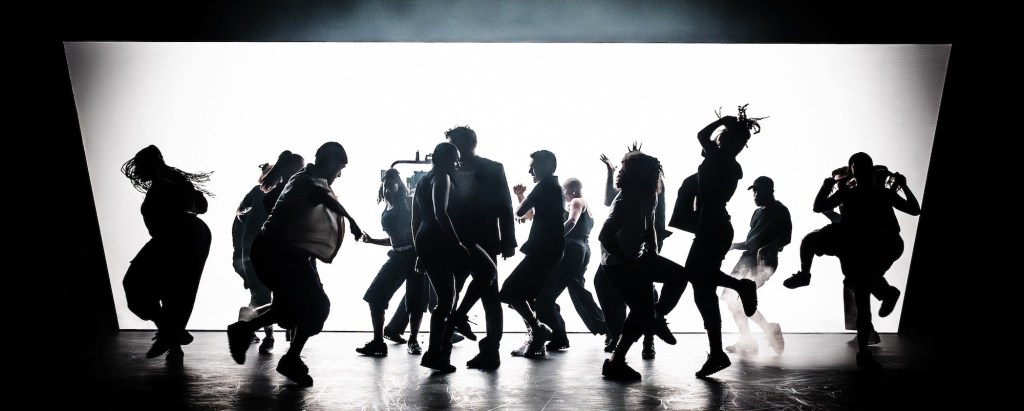
When Norma hears Joe is a screenwriter, like a spider with a fly, she traps him to finish her “come-back” film (she wrote the screenplay). Thus, for champagne, caviar and the thrill of it, he stays, lured by the promise of money, the glamour of old Hollywood and the avoidance of debt collectors. As Norma grows dependent on Joe as her gigolo, he ends up falling for the lovely, unadulterated Betty (the fine, sweet, Grace Hodgett Young). Behind Norma’s back, Joe and Betty collaborate on a script and fall in love. The lies and romance end with the tragic truth.
The seemingly empty stage, tower of lights, spotlights for Norma and live streaming camera closeups projected on the back wall screen, Lloyd is the antithesis of the average director, whose vision focuses on lustrous set design and elaborate costumes and props. In Lloyd’s consciousness-raising universe such gaudy commercialism gaslights away from revealing anything novel or intriguing in the meat of this play’s themes or characterizations, which ultimately excoriate the culture with social commentary.
Soutra Gilmour’s set design and related costumes unmistakenly lay bare the narcissism and twisted values the entertainment industry promotes so that we see the destructive results in the interplay between Max, the indulged Norma and the hapless victim Joe, who tries a scam of his own which fails. Ultimately, all is psychosis, illusions and broken dreams turned into black hallucinations. For a parallel, current example, think of an indulged politician who wears bad make-up that under hot lights makes his face melt like Silly Putty. Again, hallucinations, psychosis, narcissism, egotism that is dangerous and ravenous and never satisfied. Such is the stuff insufferable divas are made of.

In the portrayal of the former Hollywood icon who has faded from the public spotlight and become a recluse, in scene three, when Lloyd presents Gillis meeting Desmond, she is the schizoid goddess and Gorgon radiating her own sunlight via Jack Knowles’ powerful, gleaming spotlights and shimmering lighting design, the only “being” worth looking at against the black background. Throughout, Norma possesses the cavernous space of the stage in surround-view black with white mists jetting out from stage left or right, forming symbolic clouds and fog representing her imagined “divinity” and her confused, fogged-over, abject psychotic hallucinations.
Whenever she “brings forth” from her consciousness “on high,” and empowers her fantasies in song, Lloyd has Knowles bathe her lovingly in a vibrant spotlight. When she emerges from the depths of her bleak mansion of sorrows to sing, “Surrender,” “With One Look,” and later, “As if We Never Said Goodbye,” she brings down the house with a standing ovation. Indeed, Norma Desmond is an immortal. She worships her imagined self at her alter of tribute. Her mammoth consciousness and ethos which Max (Thaxton’s incredible, equally magnificent, hollow-eyed, ghoulish, former husband and current director/keeper of her flaming divinity), perpetuates is key in the tragedy that is her life.
Importantly, Lloyd’s maverick, spare, stripped down approach gives the actors free reign to dig out the core of their characters and materialize their truth. In this musical, the black “empty” stage allows Scherzinger’s Norma to be the primal, raging diva who “will not surrender” to oblivion and death. She is a a god. Like the Gorgon Medusa, she will kill you as soon as look at you. And don’t anyone tell her the truth that she is a “has been.”
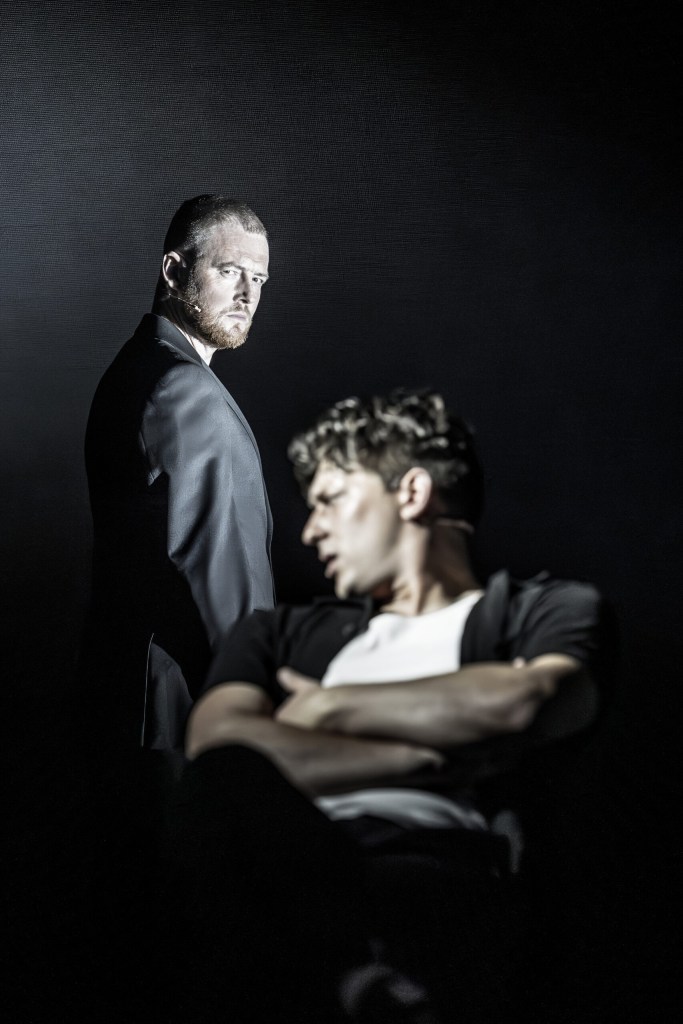
Of course, Joe does this out of a kindness that she refuses to accept. Without the black and white design, and cinematic streaming, a nod to the silent screen, which allows us to focus on faces, performances, magnified gestures and looks, the meanings become unremarkable. The theme-those who speak the truth must die/be killed because the deluded psychotic can’t hear truth-gains preeminence and Lloyd’s archetypal production gives witness to its timelessness. In her most unnuanced form, Norma is a dictator who must be obeyed and worshiped. Such narcissistic sociopaths must be pampered with lies.
Thus, in the last scene, Scherzinger’s Norma stands in bloody regalia as the spiritual devourer who has just annihilated reality and punished Joe. She is permissively allowed to do so by Max, who like a director, encourages her to star in her own tragedy, as he destroys her and himself. As Joe narrates in the flashback from beyond the grave, he expiates his soul’s mistakes with his cleansing confession, as he emphasizes a timeless object lesson.
From a theatrical perspective, the dramatic tension and forward momentum lies with Lloyd’s astute, profound shepherding of the actors in an illusory space. This becomes a fluid field which can shift flexibly each night, revealed when Joe, et. al run in circles and criss-cross the stage wildly. Expressionistic haunting, the foggy mists, the surrounding black stage walls, black costumes, the barefoot diva-hungrily filling up the spotlight-the shadowy figures, all suggest floating cultural nightmares. These the brainwashing “entertainment” industry for decades forces upon its fans to consume their waking moments with fear, the fear of aging, fear of failure, fear of destitution, fear of not being loved, fear of being alone. Many of these fears are conveyed in the songs, and dance numbers in Fabian Aloise’s choreography.

And yet, when the protagonist takes control of the black space of the stage around her, we understand how this happens. She is mesmerizing, hypnotic. Seduced by what we perceive is gorgeousness, we don’t see the terror, panic and mania beneath the shining surface. Instead, we are drawn as if she indomitably, courageously stands at the edge of the universe and asserts her being. In all of her growing insanity, we admire her persistence in driving toward her desire to be remembered and worshiped. Though it may not be in the medium she wishes, her provocations and Max’s love and loyalty help her achieve this dream, albeit, an infamous one, by the conclusion, as gory and macabre as Lloyd ironically makes it. Indeed, by the end her hallucination devours her.
Sunset Blvd is a sardonic send up of old Hollywood’s pernicious cruelty and savagery in how it ground up its employees (“Let’s Have Lunch,” Aloise’s brilliant factory town, conveyor belt choreography, referencing the cynical deadening of Joe’s dreams), and how it made its movie star icons into caricatures that bound their souls in cages of time and youth. Also, it is a drop down into tropes of cinema today in its penchant for horror, psychosis and the macabre, represented by Lloyd’s phenomenal creative team which elucidates this in the color scheme, mists, and starkly hyper-drive, electric atmosphere and movement.

Finally, in one of the most engaging, and exuberantly ironic segments filmed live, right before Act II, when Joe sings Sunset Blvd. with wry, humorous majesty, Tom Francis merges the character with himself as a Broadway/entertainment industry actor. During a live-recorded journey unveiling backstage “reality,” Francis/Joe moves downstairs, inside the bowels of the theater and in the actors’ spaces, so we see the actors’ view, from the stairwell to dressing rooms. Then Francis moves out onto 44th Street, joined by the chorus to eventually move back inside the theater and on stage where they finish singing “Sunset Blvd,” in a thematic parallel of Broadway and Hollywood. Broadway with its wicked inclination to sacrifice art for dollars, truth for commercialism with insane ticket prices, is the same if not worse than Hollywood, until now with AI fueling Amazon, Apple, Google, etc.
However, Broadway came first and spawned the movie industry, which poached actors from “the great white way.” Lloyd clearly makes the connection that the self-destructive dangers of the entertainment industry are the same, whether stage, screen, TV or Tik Tok. The competing themes are fascinating and the lightening strike into the “reality of backstage theater,” refreshes with funny split-second vignettes. For example, Francis peeks into Thaxton’s dressing room. Humorously merging with his character Max, Thaxton ogles a photo of the Pussycat Dolls taped to his mirror. Scherzinger was a former member of the global, best-selling music group (The Pussycat Dolls).

As Lloyd’s most expressionistic pared down, superbly technical extravaganza to date, every thrilling moment holds dynamic feeling, sharply illustrated for maximum impact. As an apotheosis of rage when her gigolo lover speaks the truth that dare not be spoken, Scherzinger’s Desmond becomes primal, a banshee, a Gorgon, a Medea who “refuses to surrender” to the idea that Hollywood, a treasured lover, like Jason, abandoned her for new goddesses.
With cosmic rage Scherzinger releases every, living, fiery nerve of vengeance to destroy the who and what that she can never believe. Meanwhile, Max, her evil twin, with clever prestidigitation, in one final act of loyalty to protect her febrile, mad, entangled imagination, has her get ready for the cameras and close-up, despite Joe’s tell-tale gore on her “black slip,” face and hands, which the media can feed off of like flies. No matter, she sucks up all the spotlight hungrily, clueless she will share a solitary room in a padded sell with no one in a prison for the mentally insane. Perhaps.
This revival should not be missed. Sunset Blvd. with one intermission, two hours 35 minutes is at the St. James Theatre until March 22, 2025 https://sunsetblvdbroadway.com/?gad_source=1
‘McNeal’ Robert Downey Jr. a Bravura Performance in a Complex Play
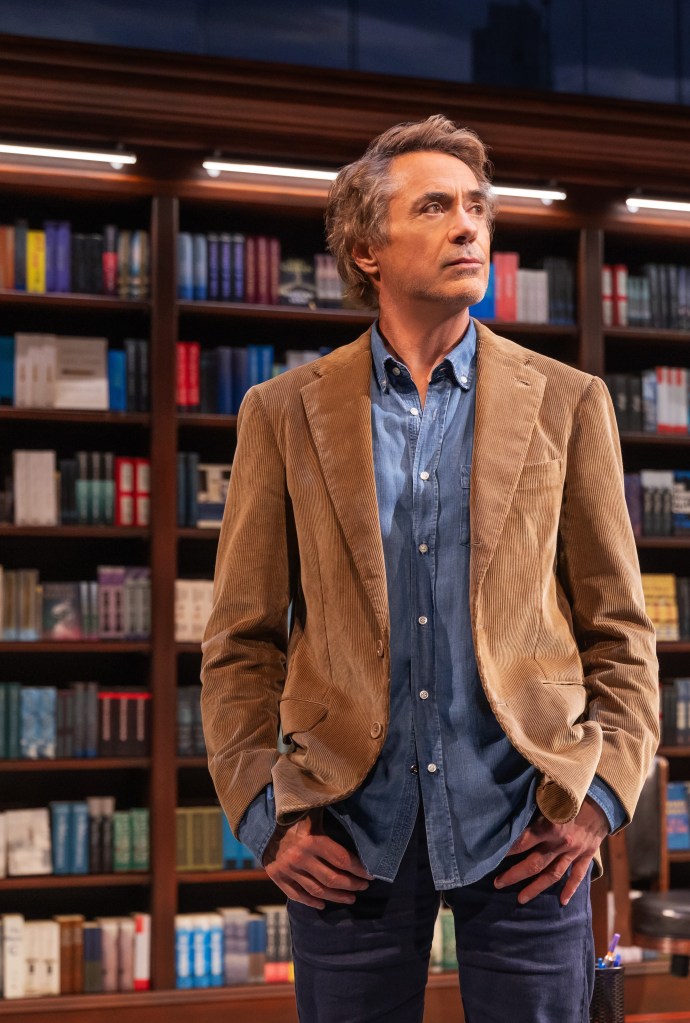
McNeal, starring Robert Downey, Jr., is currently at Lincoln Center’s Vivian Beaumont. The drama by Ayad Akhtar (Disgraced), directed by Bartlett Sher, has sardonic/comedic elements. Akhtar’s work examines the successful writer Jacob McNeal under extreme duress at the pinnacle and nadir of his career and life.
As the play opens in McNeal’s doctor’s office, Doctor Sahra Grewal (Ruthie Ann Miles), reminds McNeal his relapse into drinking is killing him. From this point on, we follow the principal character on his downward journey into the abyss, after he wins the Nobel Prize for Literature. Throughout, McNeal literally and symbolically dies piece by piece, brain cell by brain cell, deep fake digital projection by deep fake digital projection. Thanks to the technical team, the digital designs and projections pop phenomenally. Indeed, they place us in the bubble unreality of Jacob McNeal’s imagination, where emotional grist rarely resonates.
Ironically, the discipline it takes McNeal to win the Nobel Prize for literature, doesn’t apply when he attempts to control his alcoholism. Indeed, a conundrum of side effects from a drug slated to help him stop drinking himself to death makes his life untenable. Addicted, he continues to drink bringing on side effects which include hallucinations, pain and thoughts of suicide. As McNeal bounces between self-loathing and overweening pride, we follow him deep into the bowels of AI assisted writing. Ironically, this hazard removes him further from himself and serves as the last straw which figuratively breaks his back.
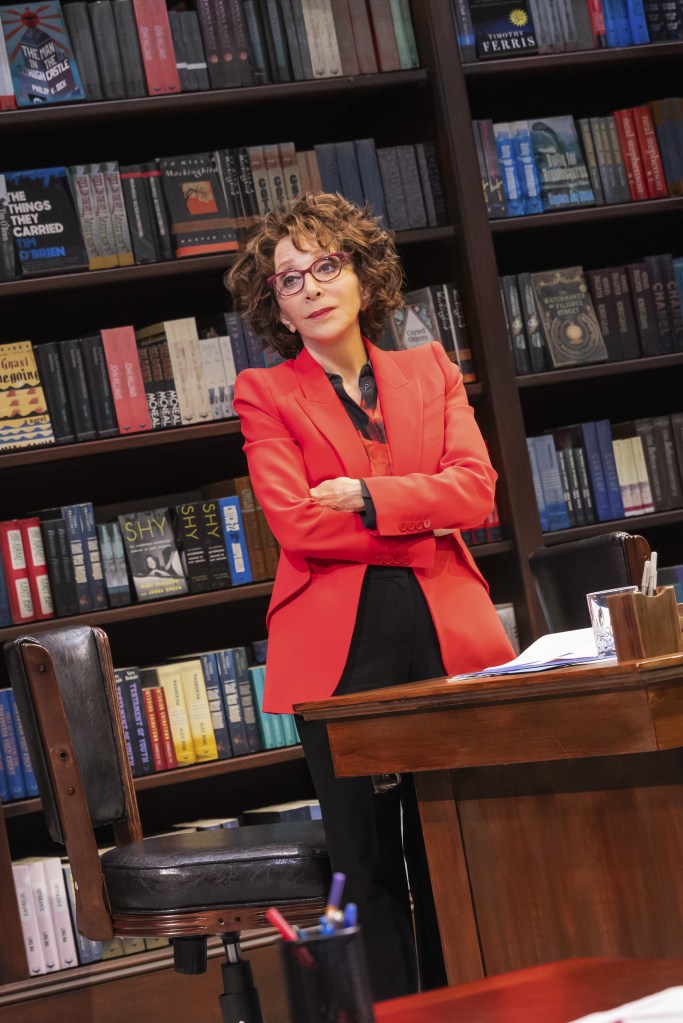
Akhtar/Sher present the glorious image of McNeal as prizewinner giving his speech at Stockholm City Hall using video, then having McNeal step forward in his tuxedo to speak to us, the Nobel audience. After this climax in his life comes the downhill crash. The playwright removes the soul of the prizewinner’s art and exposes the ugliness. Elucidated by the technical team’s sets and projections, McNeal’s mind-bending journey strikes us with wonder, thanks to Michael Yeargan, Jake Barton and AGBO. Finally, Downey Jr.’s keenly woven, provocative interactions with women enlighten us to McNeal’s deep-seated toxic masculinity and admitted feelings of inferiority.
Throughout Akhtar’s interesting work, we experience McNeal’s calm, ironic self-annihilation. Numbly, we watch his digital-symbolic, self-destruction in front of witnesses/characters who don’t understand his destructive journey as they do battle with him. These include his son Harlan (Rafi Gavron), New York Times reporter, Natasha Brathwaite (Brittany Bellizeare), and his former mistress, Francine Blake (Melora Hardin). These are shadows of individuals without definition which McNeal, in a brain fog, uses to pick ax his soul. Will anything be left of him after he finishes?
With sardonic, arrogant aplomb, McNeal rationalizes and accepts himself as a fraud. During each of his interactions, he charmingly employs his antic self-loathing to dismantle himself and drive through to his core truth. Through Robert Downey, Jr.’s fine performance we understand McNeal’s disgust, his masochism and self-betrayal, masked by ego, charm and pride. McNeal may have fooled the world to give him a prestigious prize, but he knows better. He cannot fool himself. And what he seeks he eventually attains by the conclusion.
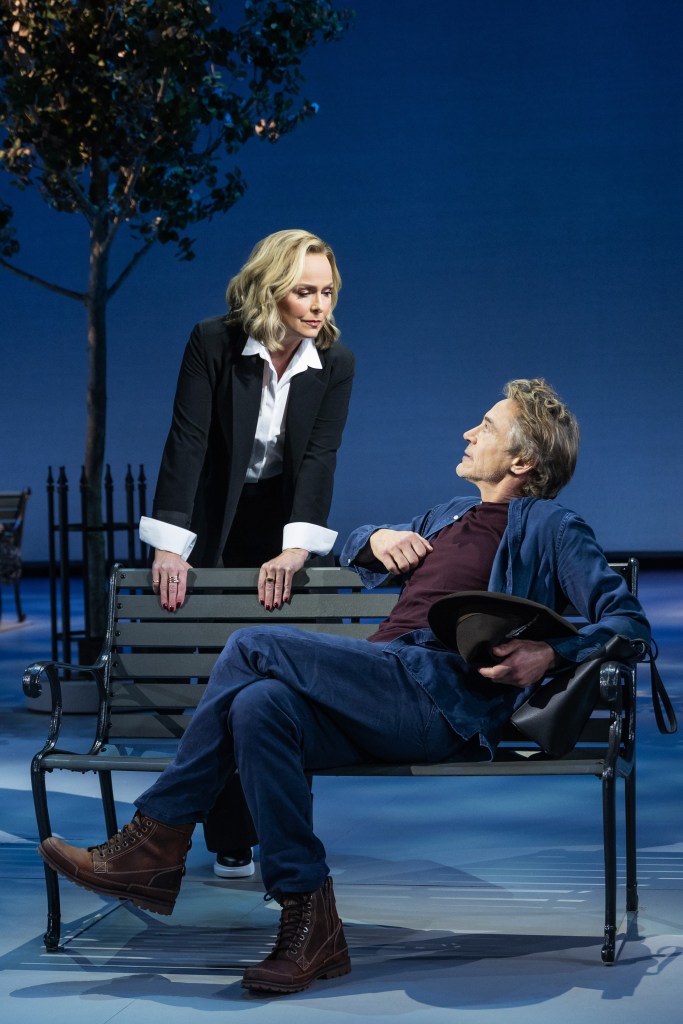
On top of McNeal’s neurotic struggle to “set things straight,” we learn in horror (the writers in the audience, anyway), about his penchant for writerly duplicity. Like a kleptomaniac (a writer’s klepto), addicted to theft, we learn through his confrontations that McNeal engaged self-destructively in plagiarism to achieve his success.
However, plagiarism increases his feelings of inferiority. And it promotes a twisted cycle of repetition. We learn through Harlan’s and Blake’s attacks that McNeal stole from his son’s friend, his wife’s bad novel, Francine Blake’s life, etc.). With these he creates his successful but basely unoriginal works. All of this occurs not without consequence. For he turns from his successes and belittles his creative talent. Ironically, the plagiarism reaches an apotheosis of fraud when he employs the inferior AI program CHAT GPT. Combined with his self-immolating interactions and the drug’s side effects, his use of the program pushes him over the edge. Jake Barton’s projections fantastically convey this as he vomits up stolen words projected on the stage floor.
Interestingly, we see how he employs CHAT GPT in an earlier sequence. Inputting literary works from Shakespeare, Ibsen, Kafka, Sophocles, Flaubert, etc., he examines concepts to explore. Then employs the program to convert these inputs to the style of Jacob McNeal. Each use of GHAT GPT increases his soul sickness.
Sadly, with the exception of his doctor and his agent Stephie Banc, the always wonderful Andrea Martin, no one knows he’s dying. In a strange self-satisfaction he is comforted that the other characters, especially his son, find him as loathsome as he finds himself. Thus, they can offer little comfort which he wouldn’t accept anyway.
In the last scene, McNeal confides in his audience eloquently after striking layers of his fraudulent self against the sharp criticisms of his son, the reporter and Blake. Only then does he attempt to speak in his true voice. But once more, he applies AI, this last time inspired by Prospero in Shakespeare’s The Tempest. How can we trust his narrative? Does anyone reliably, truthfully relate their own story? Robert Downey, Jr. makes a convincing case for our straddling the fence of incredulity, then leaping into the last artifice with him.
Bartlett Sher’s integration of the digital imagery and projections to illuminate McNeal’s imagination and world is spot-on. Likewise, the ensemble, integral players in McNeal’s journey through self-torment, charges the play’s energy. Robert Downey Jr.’s sustained performance gives one pause and intrigues as Akhtar’s confounding character, McNeal.
Though the playwright uses AI as an object lesson and/or bête noire, more importantly, he reveals the kinds of writers who might employ it and why. Lastly, the tragedy becomes that McNeal separated himself from himself in alienation. AI also becomes a symbol or instrument of death, the death of creativity and originality, despite McNeal’s clever justifications for using it.
McNeal runs one hour forty minutes with no intermission at the Vivian Beaumont. It’s a pleasure to see Robert Downey Jr.’s superb performance. https://www.lct.org/shows/mcneal/
‘Our Town’ Starring Jim Parsons, Katie Holmes, Richard Thomas in a Superb, Highly Current Revival

Part of the magic of Thornton Wilder’s Our Town is its great simplicity. In Jim Parsons’ (Stage Manager), facile, relaxed, direct addresses to the audience lie the profound themes and templates of our lives. The revival of Our Town directed by Kenny Leon with a glittering cast of renowned film, TV and stage actors, reinforces the currency and vitality of Wilder’s focus on human lives, and the seconds, minutes, hours and days human beings strike fire then are extinguished forever, eventually forgotten as the universe spins away from itself. A play about the cosmic journey of stars and their particle parts in human form in a small representational town on earth, Our Town is iconic. Leon’s iteration of this must see production runs at the Ethel Barrymore Theater until January 19th.
The three act play is in its fifth Broadway revival since the play premiered in the 1930s. This most quintessential of American plays appeared on Broadway when the United States was in the tail end of the Depression during a period of isolationism, and concepts about Eugenics from American researchers had been adopted by the Third Reich to effect their legal platform for genocide. At a curious turning point in American history before a conflict to come, Wilder’s work about life and death in small town Grovers Corners in the fiercely independent state of New Hampshire represented a symbolic microcosm of life everywhere. Perhaps, the play’s themes, especially in the third act were a harbinger, and a warning. In its theme, “we must appreciate life with every breath,” was prescient because WWII was coming to remove millions in a devastation that was incalculable, noted by many as the “deadliest conflict in human history.”

Despite its stark ending and in your face “memento mori,” Wilder’s play found and finds an appreciative audience because of its universality and unabashed assertions about our mortality, walking unconsciousness, and refusal to remain “awake” to the preciousness of our lives.
Indeed, the play has continued to be widely read and performed globally in commercial theater, as well as educational institutions. Leon’s production is no less riveting than other revivals and is even more elucidating and vital in its stylistic dramatic urgency. This is especially so at this point in time, at the eve of a crucial period in our body politic, when we are deciding between two pathways. Do we want to continue to uphold the inexorable verities expressed in Wilder’s themes about living with as much equanimity as possible in a democratic nation that respects the peaceful transfer of power as Grovers Corners symbolizes in Leon’s production? Or do we jettison the rule of law, and the peaceful transfer of power in the US Constitution for a dictatorship in which not all lives are equal or valuable but one life must be bowed down to unequivocally?
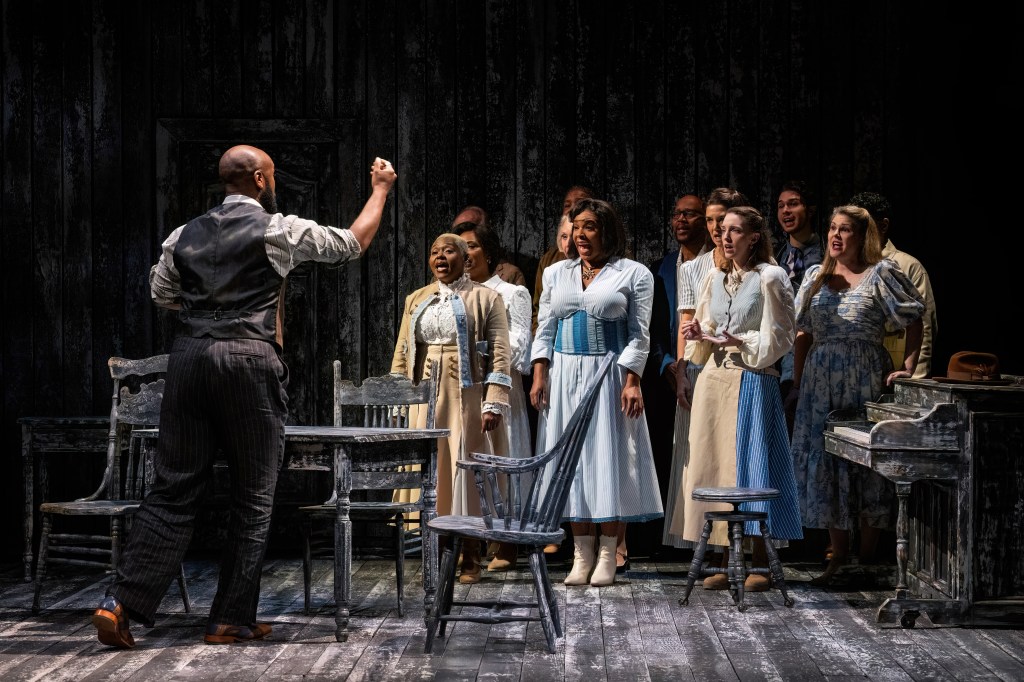
Leon’s direction stands in with the former, primarily in the production’s inclusiveness of a diverse group of actors representing Grover’s Corner’s accepting, and non judgmental townsfolk as they go about their business. The business of being human, Wilder divides into three segments (Daily Life, Love and Marriage, Death). Through the omnipotent Stage Manager, which Jim Parsons portrays with a low-key, pleasant avuncular and philosophical style, we quiver at his ironic, pointed rendering of life on this planet.
At the top of the play, the brisk, time-conscious stage manager, after detailing the ancient geological foundation of Grovers Corners, introduces us to the two families which Wilder highlights throughout the play to note their arc of development. Doc Gibbs (Billy Eugene Jones), the local physician, and Mr. Webb (Richard Thomas), the editor of the Sentinel are neighbors. At the turn of the century their wives, like most married women of the time, stay at home, do the housework and prepare meals, none of which is relieved by modern mechanical devices. We learn Mrs. Gibbs (MIchelle Wilson), and Mrs. Webb (Katie Holmes), “vote indirect,” which is to say women are considered incapable of making a rational voting decision.

However, the Stage Manager’s two words hold more weight than he seemingly intends to give them. Instead, he glides by the import of sociopolitical trends because it is unrelated to the cosmic picture alluded to by Rebecca Gibbs (Safiya Kaijya Harris), at the end of Act I. Indeed, the universal themes Wilder drives at do not focus on specific political details. Wisely, Leon takes his cues from the script having Parson’s Manager speak about the titles of the acts as dispassionately and unnuanced as possible. Importantly, Leon “gets” that the functioning of the town, symbolically rendered and opaquely stylized is how Wilder achieves the ultimate impact of the powerful conclusion about appreciating life each day we live it, as insignificant and boring as it may seem at times.
After we meet the children at a breakfast prepared by Mrs. Gibbs and Mrs. Webb via pantomime, the Stage Manager provides the locations of key places like the Post Office, the newspaper office, etc., and reminds us of the town routines, i.e. the train’s arrival and departure, milk and paper deliveries, etc. In the another part of the act, we meet the children who get hooked up in Act II, George Gibbs (Ephraim Sykes), and Emily Webb (Zoey Deutch).
Also, clarified is the town “problem,” Simon Stimpson (Donald Webber, Jr.), who we meet as the play opens when Simon Stimpson conducts the choir in a lovely song. Stimpson becomes the subject of gossip because choir members know he drinks and is drunk a good deal of the time. Mrs. Soames (Julie Halston) gossips about Stimpson and is hushed up by Mrs Gibbs, who tells a little white lie that Stimpson is getting better, then later tells her husband he is getting worse. Webber, Jr. is masterful in the small part. Clues are given about Stimpson’s future, as the character is referred by townspeople in Act I, with some questioning and not knowing “how that’ll end.” Eventually, the Stage Manager shows us how it “ends,” in Act III with Stimpson commenting about life and Mrs. Gibbs responding to him. Whose view should we accept? It, like this production, is open to interpretation.

Three years pass between Act I and Act II, and Parson’s Manager officiates at the marriage between Emily Webb and George Webb, after showing the event which reveals that these two individuals are special and their relationship which is “interesting” is grounded in being truthful to one another. The marriage scene which has been a bit tweaked and slimmed down from the original play, does include the Stage Manager philosophically discussing marriage and particularly George and Emily’s marriage when he says, in part, that he has married over two hundred couples and continues, “Do I believe in it? I don’t know. Once in a thousand times it’s interesting.” Again, we realize the profound comment and question what “interesting,” means.
In the last act which the production speeds to with no intermission as it clocks in at a spare one hour and forty-five minutes, Wilder’s vaguely spiritual metaphors are touching and poignant, despite the production’s bare bones lack of sentimentality. Warning, here is the spoiler, so don’t read the rest of the review if you are unfamiliar with Our Town.
Wilder’s third act resonates with symbols of death, as “the Dead” sit together on chairs as Parson’s unemotional Stage Manager describes the hillside cemetery. Importantly, the lack of Parsons’ emotion stirs the audience deeply. And in Leon’s production, the stylization in the previous acts makes the power of Emily’s return to see and live through her 12th birthday even more potent. Newly dead in childbirth, the Stage Manager gives Emily the privilege, which he says all the dead have, to return to a day in her life to relive it. The morning of her birthday, Emily watches herself, symbolically live without the realization that she will be dead in less than two decades later.

After commenting at how young her parents look and recognizing their love and affection, her pain at her obliviousness to life’s beauty overcomes her and she wants to leave to go back to the cemetery, a lovely spot where her brother Wally, Mrs. Gibbs, Simon Stimpson and Mrs. Soames wait for “something to come out clear.”
Emily’s dialogue is breathtaking and Deutch gets through it with less emotion and passion than is probably required for the audience to feel the reality of her words. “So all that was going on, and we never noticed.” And perhaps more emotion is needed as Emily asks the Stage Manager, “Do any human beings ever realize life while they live it? – every, every minute?” The audience in shock silently answers for itself as the Stage Manager responds.
This is the cruel and truthful heart of the play, especially experiencing it through the character of Emily and the Stage Manager’s comforting but remote words which somehow fall ironically when Parsons says, “No. The saints and poets,maybe – they do some.” However, only in death does Emily realize the suffering pain of not appreciating and being grateful for every fabulous, wondrous moment of life.
Certainly, Wilder needs to hit his audience over the head, and they walk out silently receiving the message, then days later forget it. However, for the moments when Leon, Parsons, the cast and the superb and lovely lighting and staging hold us, we “get it.” And we are grateful for teachable moments received through the actors’ fine efforts, the creative team’s craft and Leon’s minimalist stylization. And we appreciate the rich fullness of each gesture, word and grace delivered to make us get in touch with ourselves in our own Grovers Corners’ life.
Kudos to all involved in this magical production. Thornton Wilder’s Our Town runs one hour forty-five minutes without an intermission at the Ethel Barrymore Theatre (243 West 47th Street). https://www.ourtownbroadway.com/?gad_source=1&gclsrc=ds
‘From Here,’ Poignant, Uplifting Musical, Theater Review

From Here, the musical by Donald Rupe, with arrangements and orchestrations by Jason M. Bailey, is a framed story told by the delightful narrator, Daniel (Blake Aburn), a gay man in Orlando, Florida. Daniel journeys us through his relationships with his selected family of friends and lovers, as he confronts his estrangement from his single mother.
From Here is a revelation of love and hope, as the musical’s events beginning in January of 2016 hurtle us toward June 12th, the date of the Pulse Night Club shooting, the largest mass shooting in the United States up to that point in time. Currently, the musical is running with no intermission at the Alice Griffin Jewel Box Theatre, at the Pershing square Signature Center until August 11tth.
The musical opens with Daniel’s introduction of himself, his problems and his friends who help him relate his angst at this time in his life. Blake Aburn’s Daniel focuses on his mother whose love he craves as he calls her every day, though she refuses to pick up. Though the reasons for their alienation are not revealed initially, in the tuneful song “Where do I go?” which begins “Hey Ma,” we learn the backstory of his love for his mother, her ambivalence toward him and his life questions about his future. Then, as this introductory song continues, we meet his partner Michael (Julien Aponte), and they go clubbing.

At the club, their friends pick up the refrains of the song which concludes the first scene. Thus, we have a picture of Daniel and his friends who are the players whose lives will be impacted by the shooting in June. Importantly, we note that Michael and Daniel’s relationship appears comfortable and warm. We learn it has burned brightly for seven years then blow”s up in the next scene when Michael dumps Daniel, who admits Michael’s reasons for their split are right-on. After they split, they decide to remain friends.
Another key figure in Daniel’s and his friends lives is Jordan (Michelle Coben), a petite but mighty powerhouse of a club singer who invites Daniel to her performance and also invites his mom to bring them together and smooth over their separation. As his mom, Becca Southworth spills her emotions about her failed marriage and her alcoholic husband who blamed Daniel’s homosexuality for leaving. Unable to assuage the guilt she feels, she carries her wounds around with her, and like Daniel, is forced to reconcile a situation which neither she nor Daniel are responsible for, but is dumped upon them by an emotionally damaged and sick man.
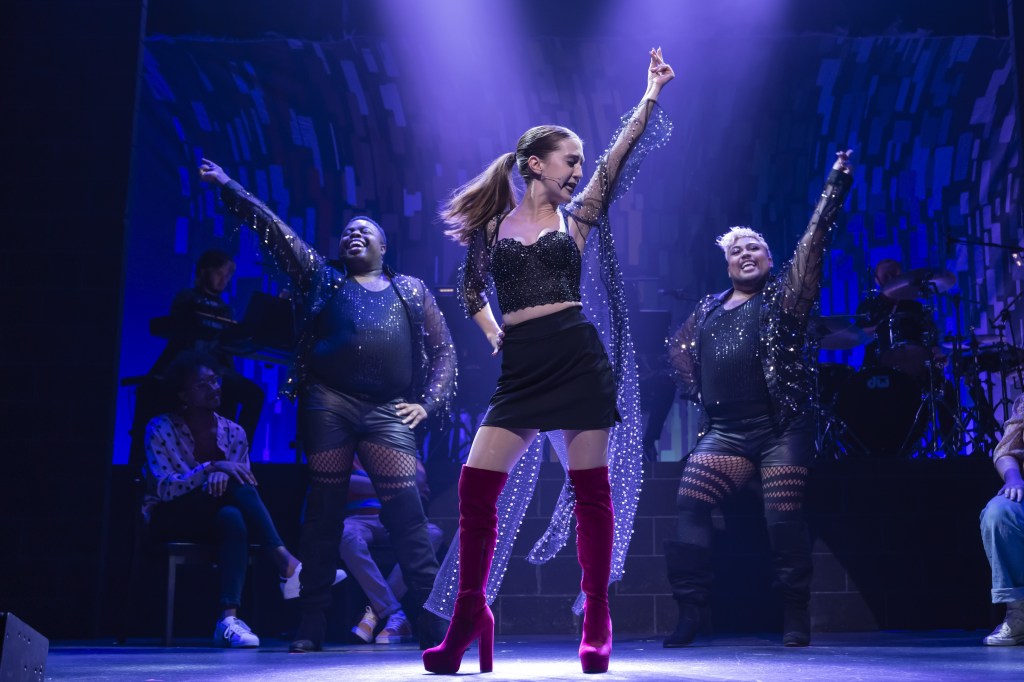
After his breakup with Michael, Daniel meets Ricky and forms an attachment which is binding by the end of From Here. Shy, awkward and sweet, Omar Cardona, as Ricky is embraced by Daniel and his family of friends. Cardon’s Ricky has an incredible voice and a deep heart. As the friends gather for togetherness and comforting, whether for fun, for a birthday party of just to hang out, we note how these gays and Jordan who is straight but who enjoys the warmth and non-judgmental attitude of these friends/family, remain uplifted despite whatever happens. This is especially so after they learn of the shooting in a scene of shared humanity, love and feeling as one after the other they confess their weaknesses and gain strength from their truthfulness to each other.
As the narrator who guides us from beginning to end with a variety of songs, monologues, beautiful philosophical bits of poetry (I.e. “Hand in hand, Time and her lover, Regret, dance circles around us, their loyal subjects.”), Daniel’s pointed self-reflection as a gay man strikes us as we note he hopes to evolve to a place where he is comfortable. The monologues and various bits are authentic and well-written by Rupe. Blake Aburn also grows upon the audience with his familiarity and confessional tone, winks and endearing expressions which he uses as Daniel twits himself and lets the audience in on his humorous self-deprecation.

Though he doesn’t take himself seriously for the most part, Daniel does take his relationship with his mother very seriously. When she doesn’t receive a call from him the night of the shooting, the only day he did not call, she is beside herself. He is sorrowful for causing her suffering. It is then he realizes the great love, perhaps unacknowledged before, between them. Their reunion is touching and leads to the last scenes of the play where the family of friends gathers together to uplift each other and speak a memorial to those who lost their lives in a senseless needless killing spree of hate.
By the conclusion, the musical’s themes are apparent. Without the friendships and love of community, we are lost. It is the lack of the friendship and love of community that caused a killer to wreck a vengeance of hate to answer the misery of his failed life. Without collective bonding and sharing of love, whatever one’s sexual preference, humanity can face little safely, and the darkness overwhelms. But the light of love and friendship sustains as friends go “from here,” to spread to others, what they’ve found with each other.

Importantly, Daniel concludes with the aftermath which establishes the goodness of people despite the horror of one night. Daniel remarks that Orlando has changed.
“For months after Pulse, each night the skyline would light up in Rainbow lights. Murals dedicated to angels appear when you least expect them to. There’s more art now. People stare less.” (at the gay-ness expressed). Daniel also reflects about the “quiet monument where Pulse once stood. It’s a rare time that you drive past and there isn’t someone sitting, quietly paying their respects.”

Rupe’s contemporary score succeeds lyrically because of its pop-ballad simplicity and repeated refrains of melody that are memorable, especially in the opening song. For example, the vital and effective “I love you/I miss you/I’m sorry” theme is resonant and a foreshadowing of the musical’s finale when we imagine that those words were said to those who were killed. Though the four piece band (bass, guitar, keyboard, and drums) accompanying the performers is excellent, the sound system (Matt Craig), needed adjusting the evening I saw the performance. Sometimes, the lyrics in the group numbers were unclear. However, that is not only in this show. Annunciation is a dying art in theater, oftentimes.

Rupe, who also directed, keeps the staging and scenic design spare and minimalist thanks to Philip Lupo. That simplicity serves to emphasize the dialogue and songs well, without any unrelated extravagant numbers distracting. All coheres in unity. Choreography is by Adonus Mabry and costume design is by J. Marie Bailey.
As a unique regional theater production, presented by Renaissance Theatre Company, which has transferred to New York’s Off Broadway, From Here succeeds largely because it doesn’t focus luridly on the Pulse mass shooting, but allows it to hover in the background. Indeed, Daniel’s narrative in songs with good will and humor presented to an interested audience occurs as a retrospective, a flashback of events leading up to that horrific night. And seen in light of the wisdom that memento mori, Daniel is chastened, and grateful for all he has, especially his community who are unique and wonderful.
From Here runs with no intermission for 1 hour 40 minutes. For tickets go to the box office at Pershing Square Signature Center or online at https://fromhere.com/
‘Here There Are Blueberries,’ No Evil. Just Ordinary, Enjoyable Routines.

Here There Are Blueberries, now in its third extension at New York Theatre Workshop, is a many-layered, superb production running until June 30. Stylized and theatricalized as a quasi-documentary that travels back and forth from present to past to present by enlivening characters in various settings, the play unravels the mysteries centered around an album of 116 photographs taken at Auschwitz. Though the album has no photographs of the victims to be memorialized, it eventually is donated to archivists at the US Holocaust Memorial Museum, by a retired U.S. Lieutenant Colonel.
Based on real events, interviews, extensive research and photographs rarely seen of the infamous concentration camp from another perspective, the play follows archivists who shepherded the photographic artifacts toward a greater understanding of the political attitudes and the daily routines of the people who ran the camp. Written by Moises Kaufman and Amanda Gronich, and directed by Moises Kaufman, Here There Are Blueberries is a salient, profound work that has great currency for our time.
With expert projection design by David Bengali, Derek McLane’s scenic design, which suggests the archivists’ workplace, and Kaufman’s minimalism, characters/historical individuals step forward to bear witness, like a Greek chorus, to speak from the ethereal realms of history. The play which has some Foley sound effects for purposes of interest, dramatizes scenes which hover around a concept. All of the fine artistic techniques by Dede Ayite (costume design), David Lander (lighting design), Bobby McElver (sound design), further the plays probing themes which examine questions the researchers ask about those who murdered and why they murdered. As the drama poses questions to its audience and itself, some, the play answers. Others, the audience must answer for themselves.

At the outset, a narrator explains the importance of the Leica camera for the people of Germany in the 1930s, when the society was at a crossroads after economic depression and the reformation of Hitler’s new government. Perched on a stand center stage is the camera in the spotlight, while projections of black and white photos scroll in the background, exemplifying the subjects taken by people using it. Some are of German people enjoying family events, as we note the narrator’s comment that in Germany, amateur photographers took up the activity as a national pastime and became “history’s most willing recorders.”
As the photos scroll showing stills of children and young adults giving the Hitler salute, the narrator suggests that “each frozen moment tells the world this is our shared history.” Her tone is ironic and the Hitler salute, as terrible as it is, physicalized by the bodies of children, indicates an alignment with Hitler’s politics, attitudes and way of life. Additional photos of children and adults enjoying outings, show Nazi flags; the narrator continues, the “apparent ordinariness of these images does not detract from their political relevance.” Indeed, she states, “On the contrary: asserting ordinariness in the face of the extraordinary is in itself, an immensely political act.”

In photographs and videos of Hitler’s marches by soldiers of the Third Reich (shown in the Nazi propagandist films of Leni Riefenstahl, etc.), we note Nazi militarization and might, which after a while are easily relegated to “the past.” Photographs throughout the play’s album note the Nazi flag, Hitler salute and SS uniform as a common fact of life lived at that time. Indeed, Hitler’s politics became the breath of life itself and all aspects of the German people’s existence and happiness were intertwined with Nazism, Hitler’s “great” leadership, his conquests, economic prosperity, and the ready identification with all of this by the average German. This was so until things went terribly sour and German war losses multiplied.
However, the Third Reich’s asserting ordinariness and commonality, when in fact it was anything but, is one of the concepts the archivists deal with throughout their journey to organize the photographs, categorize them and analyze what they are looking at in the photo album of the SS’ lives at Auschwitz.
The playwrights introduce us to the archivists in the second scene. It is then Rebecca Erbelding (Elizabeth Stahlmann), first reads the letter from the Lieutenant Colonel notifying the museum that an album with photographs from Auschwitz that he possesses might be of import. From that juncture on, we become engrossed in the archival journey as the researchers, experts and others delve into the album and attempt to understand it. Curiously, there are no photos of the victims and prisoners of Auschwitz.
As they take on the difficult task and uncover details through trial and error, eventually, researchers bring together the puzzle pieces which explain the photographs and identify the SS officials and the various workers up through the hierarchy, who helped Auschwitz seamlessly function. Clearly, Auschwitz was a huge endeavor that contained an industrial complex and barracks for laborers, housing for guards and administrators alike, and a killing machine and ersatz assembly line of death.

After pinpointing the owner of the album as Karl Höcker, who moved his way up to become the administrative assistant to the head of Auschwitz., the archivists (who also bring to life Karl Höcker and others via dramatization), gradually explore the lifestyle of those in the photographs. These include the SS guards, top brass, doctors, various secretaries (Helferinnen, who were in communications, etc., and held jobs at the camp), staff and others having meals, relaxing at a nearby resort and more daily activities.
None of the photos show the functions of Auschwitz, the prisoners, victims or crematoria. All is pleasant and reflective of the wonderful world that Hitler spoke about bringing to mankind after the “vermin” were removed. That the Helferinnen were photographed surprised a number of researchers who wondered if the young women knew about the gas chambers in the camp or smelled the acrid air of burning flesh in the crematoriums. After denials and relatives probing and finding innocence, what the women knew is later answered by one of the secretaries who was at Auschwitz. She was questioned after the war. Charlotte Schunzel stated she and the other women recorded how many were sent to hard labor and how many were sent to SB, “special treatment,” a euphemism for the gas chambers.
The archivists pin down the identity of the SS officers and high command in the photographs, one of whom was the notorious “Angel of Death,” Dr. Menegele. Another is the commandant who set up Auschwitz-Birkenau, Rudolph Höss. The researchers determine that the photos are like selfies that reveal the happy life of Karl Höcker (Scott Barrow), who would have been a “nobody” if he had not joined the Nazi party in 1937 and arrived at the camp in 1944, just in time to help “process” the thousands of Jewish Hungarians (350,000), who rode in trains three days, only to be murdered in gas chambers after they arrived.

Kaufman and Gronich seize our interest especially when actors take on historical personages, relatives of the SS, survivors, researchers, historians and others. in view of the audience, actors create Foley sound effects to usher in events and accompany Erbelding, Judy Cohen (Kathleen Chalfant), Charlotte Schunzel (Nemuna Ceesay), Tilman Taube (Jonathan Ravlv), Melita Maschmann (Erika Rose), Rainer Höss (Charlie Thurston), Peter Wirths (Grant James Varjas), and others as they uncover bits of information and puzzle together what is happening in each photograph.
The global attention the album receives (revealed by projections of headlines), brings new interest and revelations, some by grandchildren of the SS who are horrified to see uncovered aspects of their relatives they didn’t want to imagine. These aspects have been kept hidden from families out of shame and especially to avoid accountability. Perpetrators of murder and the accomplices to murder are still being located and held to account, even as recently as the last two years. Murderers and the complicit and culpable had a great need for covering up their crimes, as long as they were alive.
Another revelation comes from Holocaust survivor Lili Jacobs, who contacts archivists, as a result of the press reports. She had been holding on to an album she uncannily found of 193 photographs of the Hungarians arriving on the trains, all of whom were “processed” by the SS and high command in the photos. After she donates her album (it contains pictures of herself and family taken by the SS in the camp the day she arrived from Hungary), the researchers are able to solve the dates of the mystery of one photo which shows all the SS, high command and workers celebrating at Solahütte (a resort), where Karl Höcker occasionally rewarded the SS guards, workers, Helferinnen etc., when they did something special.
One example is given when guards prevented an escape by killing four prisoners. Administrator Höcker rewarded them for their “courage” by sending them to Solahütte for a few days.
Previously, the archivists couldn’t understand what and why the large group of camp officials, workers, drivers, Auschwitz staff, referred to by one archivist as the “Chorus of Criminals,” were photographed celebrating. However, through interviews with experts, and piecing together the facts, they divine why the entire group of Auschwitz Nazis standing and smiling, were enjoying the accordion music in one, fine, inclusive photograph, from the top brass in the front, to the lowly staff standing on a hill in the back.
With the evidence of the two albums together, archivists complete the full story of murderers and victims. The victims in Jacobs’ album were those who arrived in train transports from Hungary. The photographs included photographs of Lili and her family and her rabbi, right before they were separated into the lines for labor camp and gas chambers. In Höcker’s album, the administrator assembled and photographed the “Chorus of Criminals'” photograph for a vital reason. The murderers celebrating at Solahütte were congratulating themselves. They had successfully finished a job well done, the massive operation, processing Hungarians, dividing and selecting, so that 350,000 could be exterminated, among them Lili’s parents and two younger brothers.

Through their research, archivists discovered that Lili arrived one day after Höcker arrived at Auschwitz. He most probably received a career bump up to administer the massive “Hungarian Project.” In light of Lili’s discovery and sharing it with the archivists at the museum, she and they “get the full picture.” She sees the identity of the men who murdered her family. Finding the album of herself in the tie in with the album of the SS who ran the camp is an extraordinary sequence of events that is beyond coincidence. For her, the discovery is mystical and divinely spiritual.
Ironically, in Here There Are Blueberries, the victims that the Holocaust Memorial Museum has been so diligent about uplifting and respecting are not the only ones to be considered in studying and understanding the Holocaust. The innocent victims, indeed, were the extraordinary ones in Hitler’s politics that had infiltrated into the bones of the German people, but not the bones of the innocent ones ravaged by acts of the brutal tragedy delivered for the “good of the nation” in its lust for domination. The victims’ impossibly painful stories of survival or loss, escape, surrender, the trauma, and the horror, shock, astound and enrage.
That the ones who perpetrated murder and genocide were able to do it day in and day out as a matter of routine, a job to be done, exemplifies the normalization and internalization of a monstrous political attitude. That attitude that the SS, many Germans and surrounding cultures (i.e. Austria) adopted as right and true, a way of being, a way to live one’s life, which necessitated that others bleed and die for it as a general social good, is evidenced throughout Hocker’s album of photographs of the SS’s smiling faces as they perform daily activities.
It is this above all that Kaufman and Gronich bring to the table and highlight like no other work, with the exception of Martin Amis’ novel Zone of Interest, about the life of Auschwitz commandant Rudolf Höss, which was recently made into a film, directed by Jonathan Glazer. However, unlike Zone of Interest, Kaufman and Gronich don’t include responsive photos to the crematoria. All photos of camp function and purpose are missing. Only in Lili Jacobs’ companion album do we note the horror of the transports and the photos of her rabbi, her parents and siblings who died.
The photos of those accountable for all of the activities at Auschwitz, their reason for being there-to kill, oppress, subjugate and promote the war effort-is implicit. Their very images in the photographs stink with the noisome odor of the gas chambers. The absence of the victims and any evidence of the killing machine, a final realization of the archivists who investigate the album, if anything, incriminates all of the SS officers even more in their guilt. If they were innocent and in the right, why did Höcker need to edit out the buildings of the killing machine, the prisoners and torturing that happened in the labor complex? Why did he need to present his album of “happy days are here again?” when obviously the smoke of the burning had to be hidden?
In the archivists’ explorations they learned the backgrounds of the SS running the camp were ordinary-former clerks, bank tellers, confectioners, teenage girls. We are prompted to ask what separates these murderers and accomplices to murder from the rest of us? Stating the Nazis were monsters allows us the luxury to say “we are not like them.” It dupes us to think we would never be caught up as these were, convinced in the rightness of their actions. This is a dangerous attitude. Indeed, playwright Kaufman reflects the overriding theme of Here There Are Blueberries when he states that “the Nazis were not monsters-they were normal people who did monstrous things.”
How are political cults convinced of their rightness convinced to murder for the right? How did the January 6th insurrection fomented by a sore loser with revenge on his mind to punish his VP because he didn’t do what “was right” happen? Are there any elements that might be compared? This amazing play is filled with parallels to our time, as it raises profound questions about our humanity. For that reason, as well as the fine dialogue and overall presentation and ensemble work, one should see this play.
Here There Are Blueberries runs 90 minutes with no intermission at NYTW on 4th St. between 2nd and the Bowery. Don’t miss it.
 CAROLE DI TOSTI