Blog Archives
‘Our Town’ Starring Jim Parsons, Katie Holmes, Richard Thomas in a Superb, Highly Current Revival

Part of the magic of Thornton Wilder’s Our Town is its great simplicity. In Jim Parsons’ (Stage Manager), facile, relaxed, direct addresses to the audience lie the profound themes and templates of our lives. The revival of Our Town directed by Kenny Leon with a glittering cast of renowned film, TV and stage actors, reinforces the currency and vitality of Wilder’s focus on human lives, and the seconds, minutes, hours and days human beings strike fire then are extinguished forever, eventually forgotten as the universe spins away from itself. A play about the cosmic journey of stars and their particle parts in human form in a small representational town on earth, Our Town is iconic. Leon’s iteration of this must see production runs at the Ethel Barrymore Theater until January 19th.
The three act play is in its fifth Broadway revival since the play premiered in the 1930s. This most quintessential of American plays appeared on Broadway when the United States was in the tail end of the Depression during a period of isolationism, and concepts about Eugenics from American researchers had been adopted by the Third Reich to effect their legal platform for genocide. At a curious turning point in American history before a conflict to come, Wilder’s work about life and death in small town Grovers Corners in the fiercely independent state of New Hampshire represented a symbolic microcosm of life everywhere. Perhaps, the play’s themes, especially in the third act were a harbinger, and a warning. In its theme, “we must appreciate life with every breath,” was prescient because WWII was coming to remove millions in a devastation that was incalculable, noted by many as the “deadliest conflict in human history.”

Despite its stark ending and in your face “memento mori,” Wilder’s play found and finds an appreciative audience because of its universality and unabashed assertions about our mortality, walking unconsciousness, and refusal to remain “awake” to the preciousness of our lives.
Indeed, the play has continued to be widely read and performed globally in commercial theater, as well as educational institutions. Leon’s production is no less riveting than other revivals and is even more elucidating and vital in its stylistic dramatic urgency. This is especially so at this point in time, at the eve of a crucial period in our body politic, when we are deciding between two pathways. Do we want to continue to uphold the inexorable verities expressed in Wilder’s themes about living with as much equanimity as possible in a democratic nation that respects the peaceful transfer of power as Grovers Corners symbolizes in Leon’s production? Or do we jettison the rule of law, and the peaceful transfer of power in the US Constitution for a dictatorship in which not all lives are equal or valuable but one life must be bowed down to unequivocally?
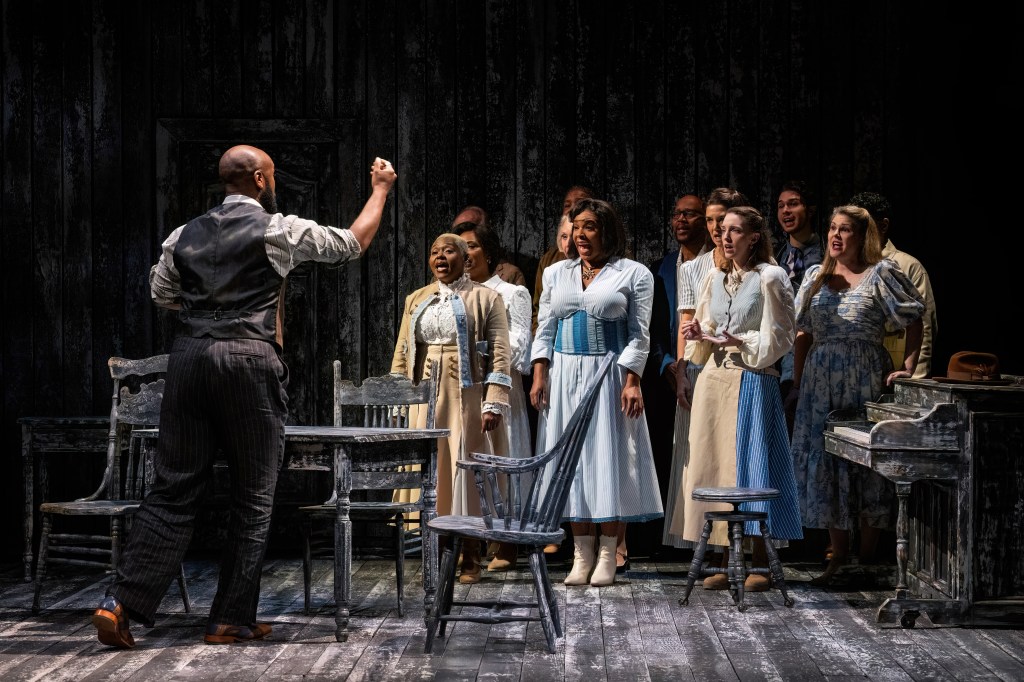
Leon’s direction stands in with the former, primarily in the production’s inclusiveness of a diverse group of actors representing Grover’s Corner’s accepting, and non judgmental townsfolk as they go about their business. The business of being human, Wilder divides into three segments (Daily Life, Love and Marriage, Death). Through the omnipotent Stage Manager, which Jim Parsons portrays with a low-key, pleasant avuncular and philosophical style, we quiver at his ironic, pointed rendering of life on this planet.
At the top of the play, the brisk, time-conscious stage manager, after detailing the ancient geological foundation of Grovers Corners, introduces us to the two families which Wilder highlights throughout the play to note their arc of development. Doc Gibbs (Billy Eugene Jones), the local physician, and Mr. Webb (Richard Thomas), the editor of the Sentinel are neighbors. At the turn of the century their wives, like most married women of the time, stay at home, do the housework and prepare meals, none of which is relieved by modern mechanical devices. We learn Mrs. Gibbs (MIchelle Wilson), and Mrs. Webb (Katie Holmes), “vote indirect,” which is to say women are considered incapable of making a rational voting decision.

However, the Stage Manager’s two words hold more weight than he seemingly intends to give them. Instead, he glides by the import of sociopolitical trends because it is unrelated to the cosmic picture alluded to by Rebecca Gibbs (Safiya Kaijya Harris), at the end of Act I. Indeed, the universal themes Wilder drives at do not focus on specific political details. Wisely, Leon takes his cues from the script having Parson’s Manager speak about the titles of the acts as dispassionately and unnuanced as possible. Importantly, Leon “gets” that the functioning of the town, symbolically rendered and opaquely stylized is how Wilder achieves the ultimate impact of the powerful conclusion about appreciating life each day we live it, as insignificant and boring as it may seem at times.
After we meet the children at a breakfast prepared by Mrs. Gibbs and Mrs. Webb via pantomime, the Stage Manager provides the locations of key places like the Post Office, the newspaper office, etc., and reminds us of the town routines, i.e. the train’s arrival and departure, milk and paper deliveries, etc. In the another part of the act, we meet the children who get hooked up in Act II, George Gibbs (Ephraim Sykes), and Emily Webb (Zoey Deutch).
Also, clarified is the town “problem,” Simon Stimpson (Donald Webber, Jr.), who we meet as the play opens when Simon Stimpson conducts the choir in a lovely song. Stimpson becomes the subject of gossip because choir members know he drinks and is drunk a good deal of the time. Mrs. Soames (Julie Halston) gossips about Stimpson and is hushed up by Mrs Gibbs, who tells a little white lie that Stimpson is getting better, then later tells her husband he is getting worse. Webber, Jr. is masterful in the small part. Clues are given about Stimpson’s future, as the character is referred by townspeople in Act I, with some questioning and not knowing “how that’ll end.” Eventually, the Stage Manager shows us how it “ends,” in Act III with Stimpson commenting about life and Mrs. Gibbs responding to him. Whose view should we accept? It, like this production, is open to interpretation.

Three years pass between Act I and Act II, and Parson’s Manager officiates at the marriage between Emily Webb and George Webb, after showing the event which reveals that these two individuals are special and their relationship which is “interesting” is grounded in being truthful to one another. The marriage scene which has been a bit tweaked and slimmed down from the original play, does include the Stage Manager philosophically discussing marriage and particularly George and Emily’s marriage when he says, in part, that he has married over two hundred couples and continues, “Do I believe in it? I don’t know. Once in a thousand times it’s interesting.” Again, we realize the profound comment and question what “interesting,” means.
In the last act which the production speeds to with no intermission as it clocks in at a spare one hour and forty-five minutes, Wilder’s vaguely spiritual metaphors are touching and poignant, despite the production’s bare bones lack of sentimentality. Warning, here is the spoiler, so don’t read the rest of the review if you are unfamiliar with Our Town.
Wilder’s third act resonates with symbols of death, as “the Dead” sit together on chairs as Parson’s unemotional Stage Manager describes the hillside cemetery. Importantly, the lack of Parsons’ emotion stirs the audience deeply. And in Leon’s production, the stylization in the previous acts makes the power of Emily’s return to see and live through her 12th birthday even more potent. Newly dead in childbirth, the Stage Manager gives Emily the privilege, which he says all the dead have, to return to a day in her life to relive it. The morning of her birthday, Emily watches herself, symbolically live without the realization that she will be dead in less than two decades later.

After commenting at how young her parents look and recognizing their love and affection, her pain at her obliviousness to life’s beauty overcomes her and she wants to leave to go back to the cemetery, a lovely spot where her brother Wally, Mrs. Gibbs, Simon Stimpson and Mrs. Soames wait for “something to come out clear.”
Emily’s dialogue is breathtaking and Deutch gets through it with less emotion and passion than is probably required for the audience to feel the reality of her words. “So all that was going on, and we never noticed.” And perhaps more emotion is needed as Emily asks the Stage Manager, “Do any human beings ever realize life while they live it? – every, every minute?” The audience in shock silently answers for itself as the Stage Manager responds.
This is the cruel and truthful heart of the play, especially experiencing it through the character of Emily and the Stage Manager’s comforting but remote words which somehow fall ironically when Parsons says, “No. The saints and poets,maybe – they do some.” However, only in death does Emily realize the suffering pain of not appreciating and being grateful for every fabulous, wondrous moment of life.
Certainly, Wilder needs to hit his audience over the head, and they walk out silently receiving the message, then days later forget it. However, for the moments when Leon, Parsons, the cast and the superb and lovely lighting and staging hold us, we “get it.” And we are grateful for teachable moments received through the actors’ fine efforts, the creative team’s craft and Leon’s minimalist stylization. And we appreciate the rich fullness of each gesture, word and grace delivered to make us get in touch with ourselves in our own Grovers Corners’ life.
Kudos to all involved in this magical production. Thornton Wilder’s Our Town runs one hour forty-five minutes without an intermission at the Ethel Barrymore Theatre (243 West 47th Street). https://www.ourtownbroadway.com/?gad_source=1&gclsrc=ds
‘Purlie Victorious,’ a Riotous Look in the Backward Mirror of 1960s Southern Racism

White power structures die hard. However, they do fall apart when the younger generation helps to topple them.
This is particularly true in Purlie Victorious, a Non-Confederate Romp Through the Cotton Patch, currently in revival on Broadway at The Music Box. It is the next generation that overwhelms the cement-like apparatus of noxious, white paternalism in Ossie Davis’ trenchantly funny play. Thus, we cheer on the pluck, humor, audacity and cleverness of the young reverend Purlie Victorious Judson, exquisitely inhabited by the unparalleled Leslie Odom, Jr. of Hamilton fame. Odom, Jr. leads the cast with his kinetic and superb performance.
The premise for the play that initiates the action is steeped in hope and youthfulness-the righting of a an ancestral wrong symbolically-the despotic terrorism of slavery’s oppressive violence. With mythic actions and intentions Purlie returns home to the Georgia plantation where he was raised, to claim his inheritance and take back the honor which racist owner Ol’ Cap’n Cotchipee siphoned off from his family through peonage (servitude indebtedness).
How Purlie does this involves a fantastic and hysterical scheme, eliciting the help of the adorable Lutiebelle Gussie Mae Jenkins (the riotous Kara Young). Purlie, who met Lutiebelle in his travels, intends to pass her off as his Cousin Bee, who will charm Ol’ Cap’n (the perfect foil, Jay O. Sanders), into giving her the $500 cash that was bequeathed to their aunt by her wealthy lady boss. After succeeding in the scheme to dupe Ol’ Cap’n, Lutiebelle will give Purlie the cash. With cash in hand, Purlie will purchase and restore the Old Bethel Church, so he can preach uplifting freedom to the sharecroppers, who are enslaved by peonage to Ol’ Cap’n.

As Purlie relates his scheme to family, Missy Judson (the fine Heather Alicia Simms), and Gitlow Judson (the riotous Billy Eugene Jones), they avow it won’t work. At first, Gitlow refuses to take any part because he is one of Ol’ Cap’n’s favorite “darkies.” Gitlow has risen to success through his amazing cotton picking labors. Ol’ Cap’n bestows upon him the anointed status of chief oppressor of the “colored folk” working for Ol’Cap’n. He keeps them nose to the grindstone at their backbreaking work.
However, when Purlie introduces his relatives to Lutiebelle, and unleashes his persuasive and inspiring preaching talents on his kin, they give the scheme a whirl. What unfolds is a joyous, sardonic expose of all the techniques that Black people used when dealing with the egregious, horrific, white supremacists of the South, represented by Ol’ Cap’n, The Sheriff (Bill Timoney), and The Deputy (Noah Pyzik).
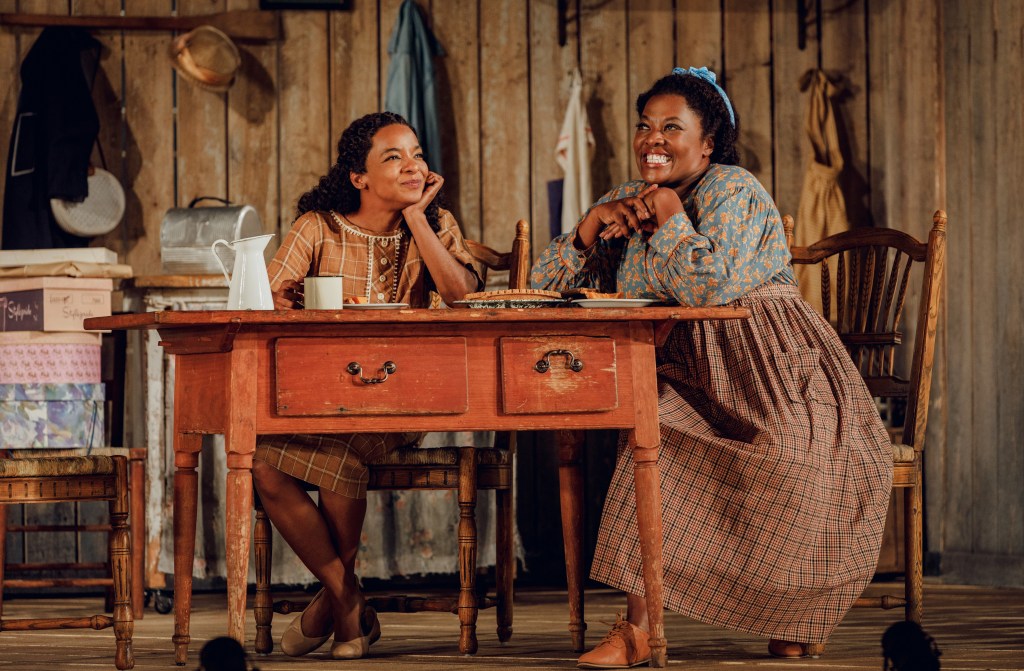
The irony, double entendres and reverse psychology Purlie and family use when confronting Ol’ Cap’n are sharp, comedic, and of moment. Though Ol’ Cap’n owns the place and exploits the sharecroppers using indebtedness, on the other hand, we note that Gitlow is able to manipulate Ol’ Cap’n with his “bowing and scrapping” which, as we are in on the joke, is brilliantly humorous.
It is in these moments of dramatic irony when Ossie Davis’ arc of development reveals how the characters work on a sub rosa level, that the play is most striking and fabulous. The enjoyment comes in being a part of knowing that Purlie and the others are able to “get over,” while Ol’ Cap’n is unable to see he is “being had.” Additionally, with the assistance of Ol’ Cap’n’s clever, forward-thinking son, Charlie (the wonderful Noah Robbins), Ol’Cap’n is completely flummoxed, having missed all the undercurrents which indicate he is being duped.

The actors, beautifully shepherded by director Kenny Leon, effect this incredible comedy, which also has at its heart a deadly, serious message.
Black activist, writer, actor, director Ossie Davis wrote Purlie Victorious, which premiered on Broadway in 1961 at a time when Martin Luther King, Jr. had strengthened the Civil Rights Movement and celebrities were taking a stand with Black activists. In fact, Martin Lurther King, Jr. saw the production and was pictured with the cast, Ossie Davis and Ruby Dee, his wife, who portrayed Lutiebelle.

Particularly in the final speech that Purlie delivers, we can identify with the important themes of a unified human family being together on an equal plane. It is a message that is particularly poignant today, considering the political divisiveness of the white nationalists, a throwback to the Southern racists of the 1960s, like Ol’ Cap’n, who Jay O. Sanders makes as human as possible to allow his racial terrorism to leak through with humor. Because of Sanders’ balanced portrayal, Ol’ Cap’n is an individual who has become his own hysterically funny caricature and stereotype, precisely because he is so obtuse in his self-satisfied mien as their “great white father.”
In the play Davis’ themes about the cruelties of peonage resonate today in the corporate structures which have kept wages low while giving CEOs 500 times what their average workers make. Indeed, the play resonates with the idea of servitude and keeping the labor force however indebted (with student loans, loans, mortgages, credit card debts), so that individuals must work long hours to keep one step ahead of financial ruin. We note the parallels between then and now. The inequities then are in many ways reflective of current economic disparities between the classes, allowing for very little upward mobility from one generation to the next.

It is this that Purlie attacks and preaches against throughout the play. It is this inequity and enslavement indebtedness that Purlie intends to educate Black people about, so that they become free and whole. It is for this reason Purlie wants to purchase and renovate Bethel Church, where he will preach his message of freedom. As we listen, we also realize that the message resonates with everyone, regardless of race, except, of course, the white oppressors, who stand to lose their power, lifestyle and privilege.
This material loss, which would be their spiritual gain, is unthinkable to them. Davis’ indirect message is that this is the oppressors’ greatest sin. They don’t see that by internalizing the defrauding and inhumane values of white supremacy, they are the truly hellish, loathsome monsters, the “other,” they seek to destroy. The destruction only happens to them, while the strengthening happens to those they oppress.
Kenny Leon’s direction expertly guides his actors, moving them with perfectly timed pacing and comedic rhythm. The play develops from broad farce and hi jinks and moves to an ever-expanding roller coaster ride of frenetic humor and excitement. We note Purlie’s desperation and frustration with Ol’ Cap’n’s arrogance and presumptions about Black inferiority, which Purlie will not scrape to. Of course, Idella Landy (the wonderful Vanessa Bell Calloway), who has been a mother to Charlie, with love, influences him to override his father’s brutal attitude toward their family. Indeed, Charlie adopts the Judsons as the family he chooses to be with, rather than his arrogant, ignorant, abusive father.

Leon manages to seamlessly work the staging and find the right balance so the irony and true comedy never becomes bogged down in the seriousness of the message. Because of the lightheartedness and good will, we are better able to see what is at stake, and why Charlie comes to the rescue of his Black family, against his own father, who is an inhumane obstructionist past his prime.
The set design by Derek McLane allows the action to remain fluid and shape shifts so that we move from the Judson family home, to Idella Landy’s kitchen, to the Bethel Church at the conclusion. With Emilio Sosa’s costume design, Adam Honore’s lighting design, Peter Fitzgerald’s sound design and J. Jared Janas hair, wig and makeup design, the creatives have manifested Leon’s vision for the play. Additional praise goes to Guy Davis’ original music, and Thomas Schall’s fight direction.

This revival of Purlie Victorious is a wonderful comedic entertainment that also has great MAGA meaning for us today. For tickets to this must-see production that runs without an intermission, go to their Box Office on 239 West 45th Street or their website https://purlievictorious.com/tickets/
 CAROLE DI TOSTI