Blog Archives
Bobby Cannavale, James Corden, Neil Patrick Harris Are LOL in ‘Art’
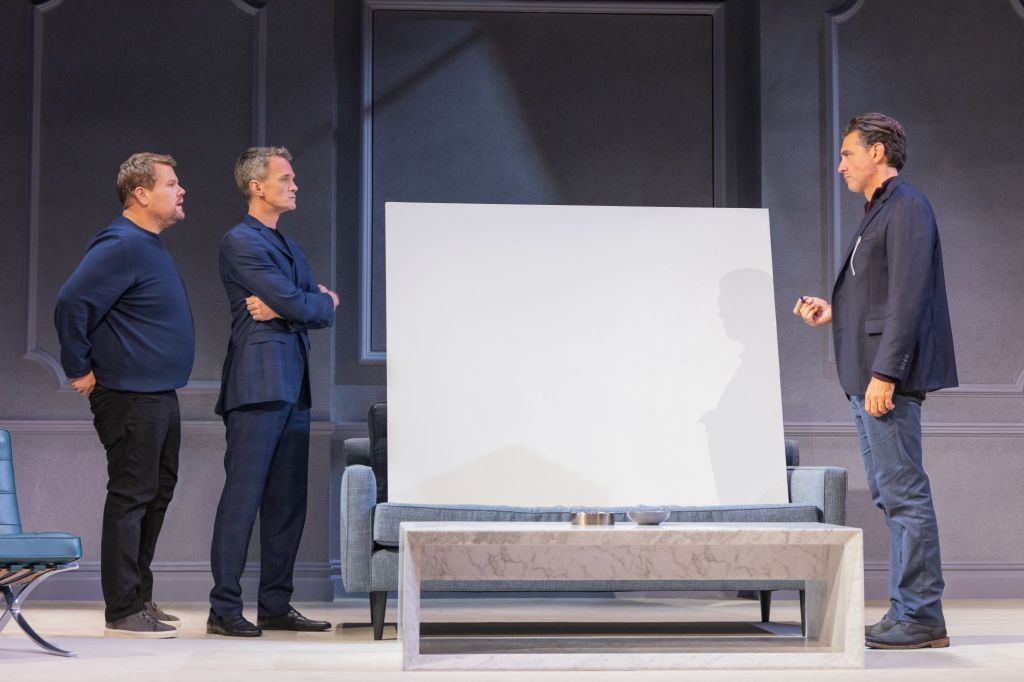
Superb acting and humorous, dynamic interplay bring the first revival of Yasmina Reza’s Tony-award winning play Art into renewed focus. The play, translated from the French by Christopher Hampton, is about male friendship, male dominance and affirming self-worth. Directed by Scott Ellis, the comedy with profound philosophical questions about how we ascribe value and importance to items considered “art” as a way of bestowing meaning on our own lives resonates more than ever. Art runs until December 21st at the Music Box Theatre with no intermission.
When Marc (Bobby Cannavale) visits his friend Serge (Neil Patrick Harris) and discovers Serge recently spent $300,000 dollars on a white, modernist painting without discussing it with him, Marc can’t believe it. Though the painting by a known artist in the art world can be resold for more money, Marc labels the work “shit,” not holding back to placate his friend’s ego. The opening salvo has begun and the painting becomes the catalyst for three friends of twenty-five years to reevaluate their identity, meaning and bond with each other.
As a means to reveal each character’s inner thoughts, Reza has them address the audience. Initially Marc introduces the situation about Serge’s painting. After Marc insults Serge’s taste and probity, Serge quietly listens, makes the audience, his confidante and expresses to them what he can’t tell Marc. In fact Serge categorizes Marc’s opinion saying, “He’s one of those new-style intellectuals, who are not only enemies of modernism, but seem to take some sort of incomprehensible pride in running it down.” As Serge attempts to pin down Marc reinforcing Marc’s lack of expertise or knowledge about modern art, he questions what standards Marc uses to ascribe his valuable painting as “this shit.”
At that juncture Reza emphasizes her theme about the arbitrary conditions around assigning value to objects, people, anything. Without consensus related to standards, only experts can judge the worth of art and artifacts. Obviously, Marc doesn’t accept modernist experts or this painter’s work. He asserts his opinion through the force of his personality and friendship with Serge. However, his insult throws their friendship into unknown territory and capsizes the equilibrium they once enjoyed. The power between them clearly shifts. The white canvass has gotten in the way.
During the first thrust and parry between Marc and Serge in their humorous battle of egos, the men resolve little. In fact we learn through their discussions with their mutual friend Yvan (James Corden), they think that each has lost their sense of humor. The purchase of the painting clearly means something monumental in their relationship. But what? And how does Yvan fit into this testing of their friendship?

Marc’s annoyance that Serge purch,ased the painting without his input, becomes obsessive and he seeks out Yvan for validation. First he warns the audience about Yvan’s tolerant, milquetoast nature, a sign to Marc that Yvan doesn’t care about much of anything if he won’t take a position on it. During his visit with Yvan, Marc vents about Serge’s pretensions to be a collector. Though he knows he can’t really manipulate Yvan about Serge because Yvan remains in the middle of every argument, he still tries to influence Yvan against the painting.
Marc believes if Yvan tolerates Serge’s purchase of “shit” for $300,000, then he doesn’t care about Serge. Tying himself in knots, Marc considers what kind of friend wouldn’t concern himself with his friend getting scammed $300,000 for a shit panting? If Yvan isn’t a good friend to Serge, at least Marc shows he cares by telling Serge the painting is “shit.” Without stating it, Marc implies that Serge has been duped to buy a white canvass with invisible color in it he doesn’t see based on BS, modernist clap trap.
In the next humorous scene between Yvan and Serge, knowing what to expect, Yvan sets up Serge, who excitedly shows him the painting. True to Marc’s description of him, Yvan stays on the fence about Serge’s purchase not to offend him. However, when Yvan reports back to Marc about the visit, he disputes Marc’s impression that Serge lost his sense of humor. In that we note that Yvan has no problem upsetting Marc when he says that he and Serge laughed about the painting. However, when Marc tries to get Yvan to criticize Serge’s purchase, Yvan tells him he didn’t “love the painting, but he didn’t hate it either.”
In presenting this absurd situation Reza explores the weaknesses in each of the men, and their ridiculous behavior which centers around whose perception is superior or valid. Additionally, she reveals the balance inherent in friendships which depend upon routine expectations and regularity. In this instance Serge has done the unexpected, which surprises and destabilizes Marc, who then becomes upset that Yvan doesn’t see the import behind Serge’s extreme behavior.
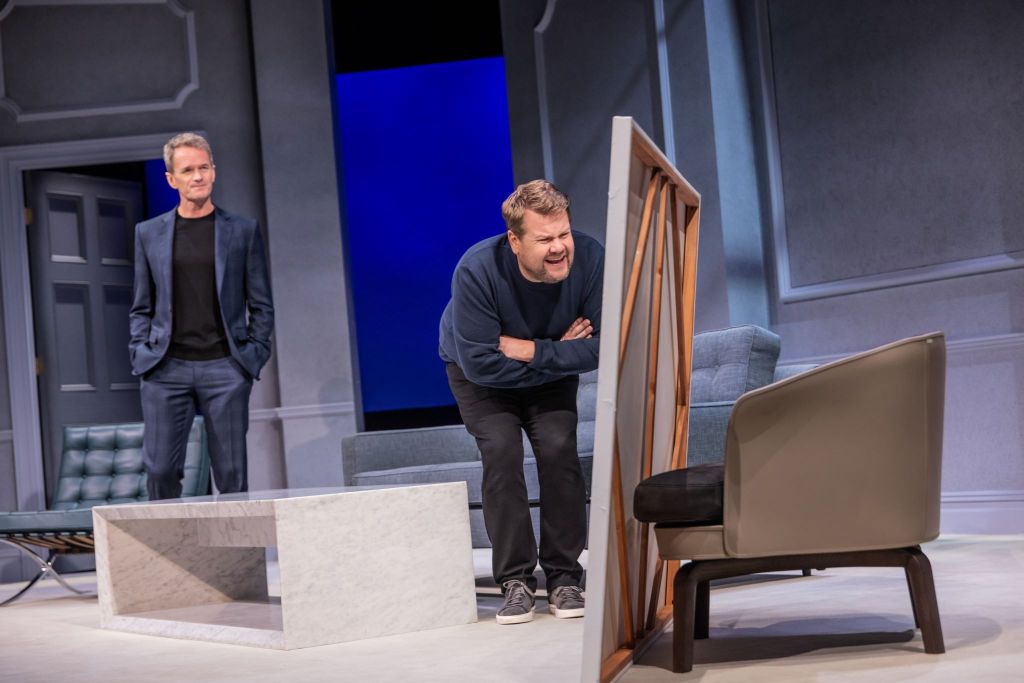
Teasing the audience by incremental degrees prompting LOL audience reactions, Reza brings each of the men to a boiling point and catharsis. Will their friendship survive their extreme reactions (even Yvan’s noncommittal reaction is extreme) and differences of opinion? Will Serge allow Marc to deface what he believes to be “shit” for the sake of their friendship? In what way are these middle-aged men asserting their “place” in the universe with each other, knowing that that place will soon evanesce when Death knocks on their doors?
The humorous dialogue shines with wit and irony. Even more exceptional are the actors who energetically stomp around in the skins of these flawed characters that do remind us of ourselves during times when passion overtakes rationality. Each of the actors holds their own and superbly counteracts the others, or the play would seem lopsided and not land. It mostly does with Ellis’ finely paced direction, ironic tone, and grey walled set design (David Rockwell), that uniformly portrays the similarity among each of the characters’ apartments (with the exception of a different painting in each one).
Reza’s characters become foils for each other when Marc, Serge and Yvan attempt to assert their dominance. Ironically, Yvan establishes his power in victimhood.
Arriving late for their dinner plans, Corden’s Yvan bursts upon the scene expressing his character in full, harried bloom. His frenzied monologue explodes like a pressure cooker and when he finishes, he stops the show. The evening I saw the production, the audience applauded and cheered for almost a minute after watching Corden, his Yvan in histrionics about his two fighting step-mothers, fiance, and father who hold him hostage about parental names on his and his fiance’s wedding invitations. Corden delivers Yvan’s lament at a fever pitch with lightening pacing. Just mind-blowing.
The versatile Neil Patrick Harris portrays Serge’s dermatologist as a reserved, erudite, true friend who “knows when to hold ’em and knows when to fold ’em.” Cannavale portrays Marc’s assertive personality and insidiously sardonic barrel laugh with authenticity. Underneath the macho mask slinks inferiority and neediness. Together this threesome reveals men at the worst of their game, their personal power waning, as they dodge verbal blows and make preemptive strikes that hide a multitude of issues the playwright implies. They are especially unwinning at successful relationships with women.
Reza’s play appears more current than one might imagine. As culture mavens and influencers revel in promoting and buying brands as a sign of cache, the pretensions of superiority owning, for example, a Birkin bag, bring questions about what an item’s true worth is and what that “worth” means in the eye of the beholder. Commercialism is about creating envy and lust and the illusion of value. To what extent do we all fall for being duped? Does Marc truly care that his friend may have fallen for more hype than value? Conclusively, Yvan has his own problems to contend with. How can he move beyond, “I don’t like it, I don’t hate it.”
As for its own value, Art is worthwhile theater to see the performances of these celebrated actors who have fine tuned their portrayals to a perfect pitch. Art runs 1 hour 35 minutes with no intermission through Dec. 21 at the Music Box Theater. artonbroadway.com.
‘The Lifespan of a Fact,’ Starring Daniel Radcliffe, Cherry Jones, Bobby Cannavale

(L to R): Daniel Radcliffe, Cherry Jones, Bobby Cannavale in ‘The Lifespan of a Fact,’ directed by Leigh Silverman (Peter Cunningham)
What are facts? What is truth? Can you state truth without a factual basis? These questions debated for centuries have been redefined in every age. Playwrights Jeremy Kareken, David Murrell and Gordon Farrell refine the debate in an intriguing and humorous go-around between a fact-checker and his essayist in The Lifespan of a Fact. The play incisively directed by Leigh Silverman is comically paced for its light side. And its darker side leads to questions about how information, “facts” may be misused in the wrong hands. The production suits in our time of “alternative facts,” and truths skewed to make a larger point about the human condition.
Based on the titular book/essay written by John D’Agata and Jim Fingal, the “true” story tells what happened when Jim Fingal fact-checked John D’Agata’s poignant essay about a teen’s suicide at a Las Vegas resort. The play explores their individual perspectives about the importance of writing for impact despite the inaccuracy of ancillary background details. But more importantly, it explores personality types and the very funny heightened alerts that sound when an obsessive compulsive, detail-driven nerdy researcher clashes with a loosey-goosey, poetic, symbolic, “going meta” writer with panache.
The conflict generates when Emily Penrose accomplished, saavy editor of a magazine chooses John D’Agata’s piece because of its social import. In hoping to get the article turned around for publication in less than five days, Emily appoints Jim Fingal. As the fact-checker he will ground the details of D’Agata’s piece for consonance and coherence to reality.
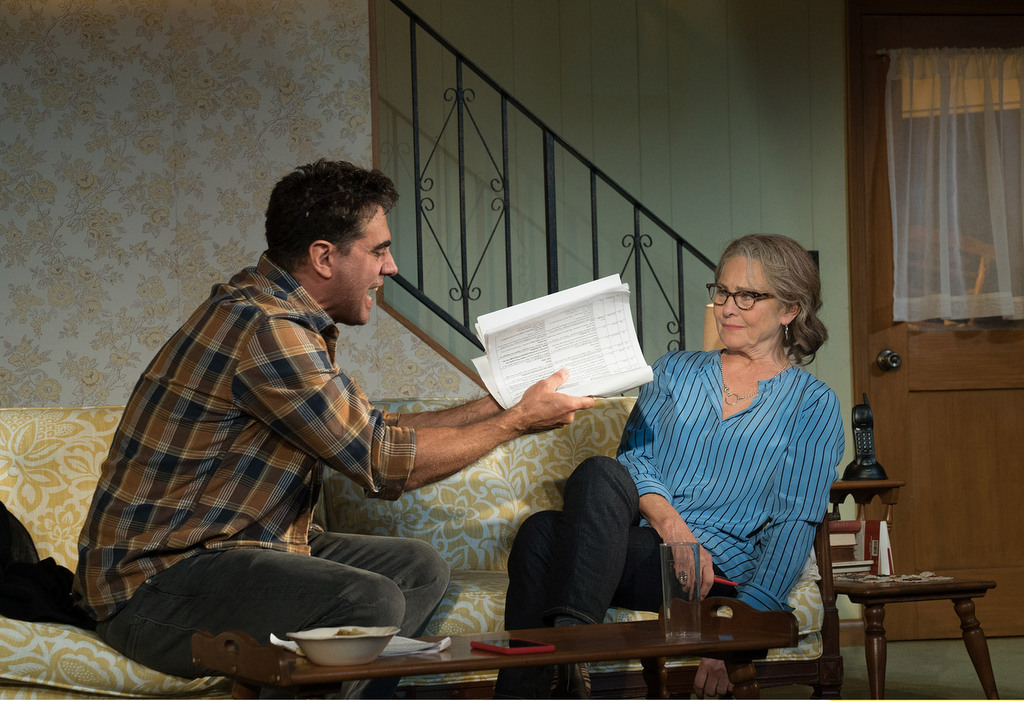
Bobby Cannavale, Cherry Jones, ‘The Lifespan of a Fact,’ directed by Leigh Silverman (Peter Cunningham)
Cherry Jones portrays editor Emily Penrose with humor, good will, yet stern determination. Strong-willed and no nonsense, yet measured, she selects her new hire, Jim, quickly assessing him and asking all the right questions. Happy with his reasonable answers, she sets him spinning off on his journey. Indeed, her expectation rides on Jim’s assurances that he will make the deadline. Ironically, the opposite occurs. Not because the fact-checker is incompetent. But because his magnificent competence strains the credulity of time and patience.
As Jim, Daniel Radliffe reveals his gifts for timing. He employs the right amount of deadpan edginess. And his ironic delivery isn’t quite over the top, but appears organic with his researcher ethos. Though he exasperates Emily, he does so out of ego pride of meticulousness. Indeed, she does not fault him for doing a fine job. And despite Radcliffe’s history with owls and wands, we appreciate his portrayal of Jim’s excellence, however a tad outrageous. When you see this too good to miss production, consider the traffic map which Jim uses to prove John’s inaccuracy on the day of the teen’s suicide.
Bobby Cannavale stands on the opposite continuum of Radcliffe’s Jim and pushes back with parries, jibes and wordy counter punches. Cannavale’s portrayal has John D’Agata’s indignation finely tuned. And we respond with riotous laughter. His initial attitude toward the fact-checking assaulter of his exquisite prose reveals a huge ego. Despite all the word talk, these male egos can barely be in the room together. What a pleasure to watch Radcliffe and Cannavale go head to head.
Indeed, after the two meet, we note their reactions pair beautifully with their physical types. Jim, fits the researcher twerp type, diminutive in stature and voice but a giant in intellect and research skills. By comparison John D’Agata’s muscular presence and bruising confident carriage signals macho. The irony that he is a romantic and goes for the meta sources the humor between them. However, the fact-checker holds sway. And D’Agata becomes affronted by the miscalculations Jim tells Emily that John has made. How dare this guy attempt to restrain and retrain his ineffable, high-minded prose?

Daniel Radcliffe in ‘The Lifespan of a Fact,’ directed by Leigh Silverman (Peter Cunningham)
Of course the humor explodes every time Jim attempts to toggle John. And the exceptional Bobby Cannavale’s bite challenges worse than his roar. Indeed, only Emily can straighten out the warfare between the two. How this evolves and resolves remains as the meat of the play. Indeed, she exquisitely maneuvers the two male egos, forces them to recede and calls upon “their better angels” to emerge.
This ensemble piece moves quickly. It arrives at its non resolution resolution with delectable, sometimes rolling in the aisles comedy. The philosophical arguments hold worthwhile import. Emily as the arbiter explains why responsibility for accuracy must be taken with extreme seriousness for publications. And yet, the vitality of striking the readers’ emotions with well-written prose that sings also must be taken seriously. Thus, the two perspectives must combine with equanimity. One must not submerge the other. Indeed, John’s intimation at truth is not enough. Facts secure it and make our feelings about an essay indelible and irrevocable.
Silverman’s direction and staging works well. The emails written among Emily, John and Jim provide the opening salvos of humor. Through screen projections we get to read and appreciate the writing styles of both the researcher and the essayist. Of course, the humor and explosions escalate during their live interactions as the notorious Jim investigates the scene of the suicide and visits the uber frustrated John. How Emily arrives at the scene to stem these two embattled paces with LMAO humor.
You will enjoy the superb cast who Silverman has brimming with fast-paced quips that slide down easily. Their finest scenes take place in John’s Las Vegas home when each faces off against the other. How they negotiate their own ire, frustration, and need to harangue mentors us with the silence of their inner thoughts and the power of their words. With intellect, logic and rationality they persuade. How refreshing!
Kudos go to Mimi Lien for Scenic Design, Linda Cho for Costume Design and Jen Schriever for Lighting Design. For Original Music and Sound Design we have Palmer Hefferan and for Projection Design, Lucy MacKinnon. For Hair and Wig Design, kudos to Charles G. Lapointe.
The Lifespan of a Fact currently runs at Studio 54 (254 W 54th) with no intermission until 13 January. You can purchase tickets at their website.
 CAROLE DI TOSTI