Blog Archives
Keanu Reeves, Alex Winter carry Ted and Bill into the adventure of ‘Waiting for Godot’
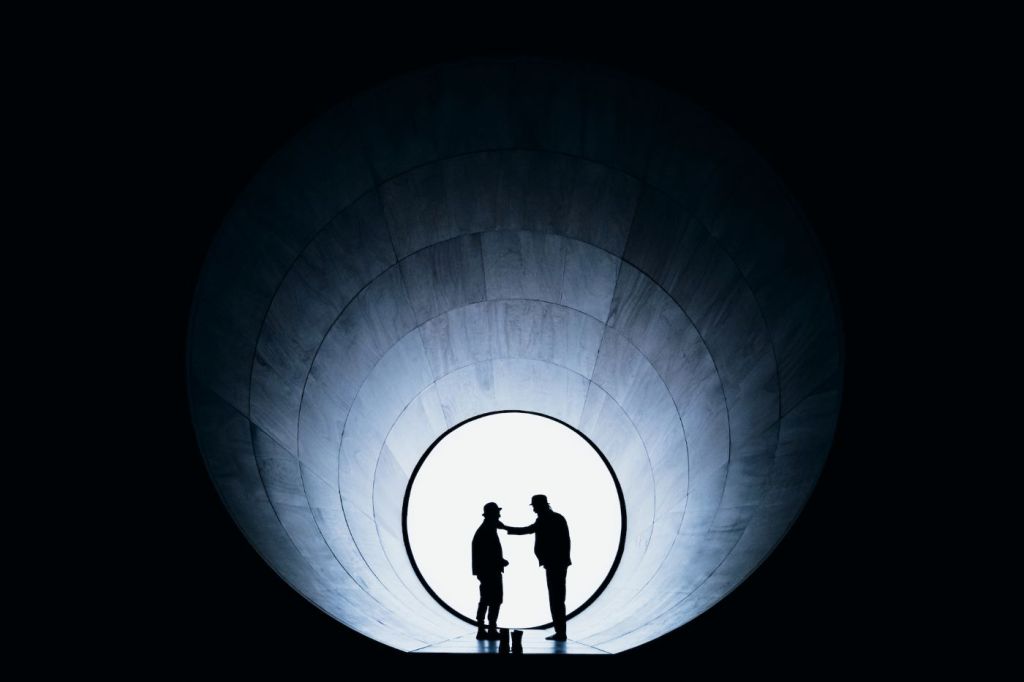
Referencing the past with Bill and Ted’s Excellent Adventure movie series, something has happened. Bill (Alex Winter) and Ted (Keanu Reeves), who long dropped their younger selves and reached maturity in Bill and Ted Face the Music (2020), have accomplished the extraordinary. They’ve fast forwarded to a place they’ve never been before in any of their adventures. An existential oblivion of uncertainty, Samuel Beckett’s Waiting for Godot.
There, they cavort and wallow in a hollowed out, megaphone-shaped, wind-tunnel (Soutra Gilmore’s clever set design). The gaping maw is starkly, thematically lighted by Jon Clark. Ben & Max Ringham’s sound design resonates the emptiness of the hollow which Winter’s Valdimir and Reeves Estragon fill up to the brim with their presence. And, among other things, Estragon loudly snacks on invisible turnips and carrots, and some chicken bones.
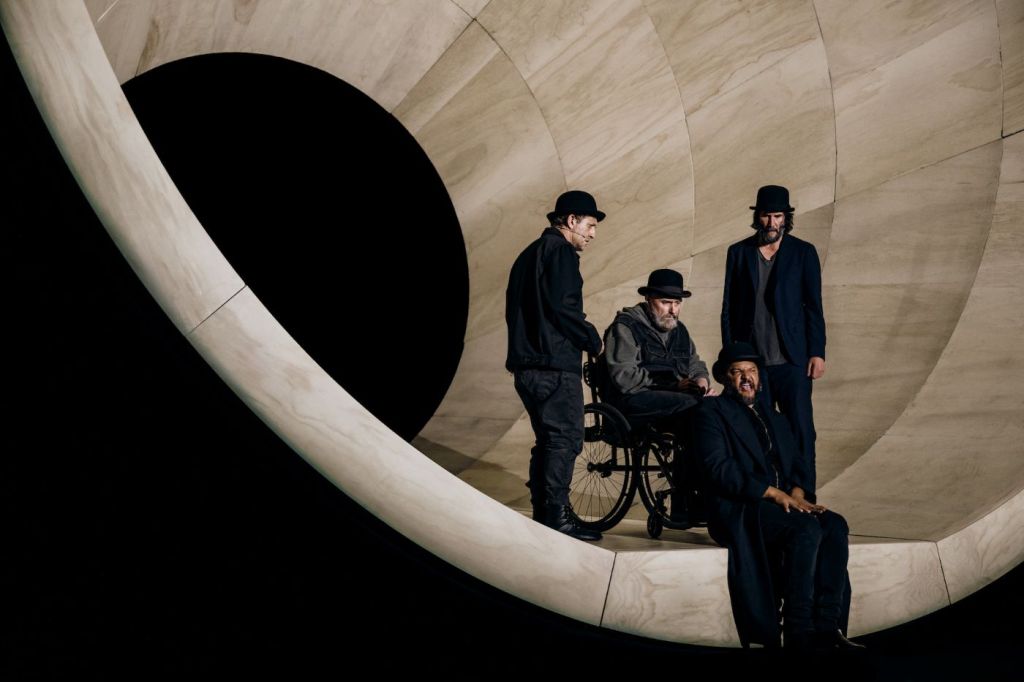
Oh, and a few others careen into their empty hellscape. One is a pompous, bullish, land-owning oligarch with a sometime southern accent, whose name, Pozzo, means oil well in Italian (a superb Brandon J. Dirden in a sardonic casting choice). And then there is his slave, for all oligarchs must have slaves to lord over, mustn’t they? Pozzo’s DEI slave in a wheelchair, seems misnamed Lucky (the fine Michael Patrick Thornton).
However, before these former likenesses of their former selves show up and startle the down-on-their luck Vladimir and Estragon, the two stars of oblivion wait for something, anything to happen. Maybe the dude Godot, who they have an arrangement with, will show up on stage at the Hudson Theatre. Maybe not. At the end of Act I he sends an angelic looking Boy to tell them he will be there tomorrow. A silent echo perhaps rings in the stillness of the oblivion where the hapless tramps abide.
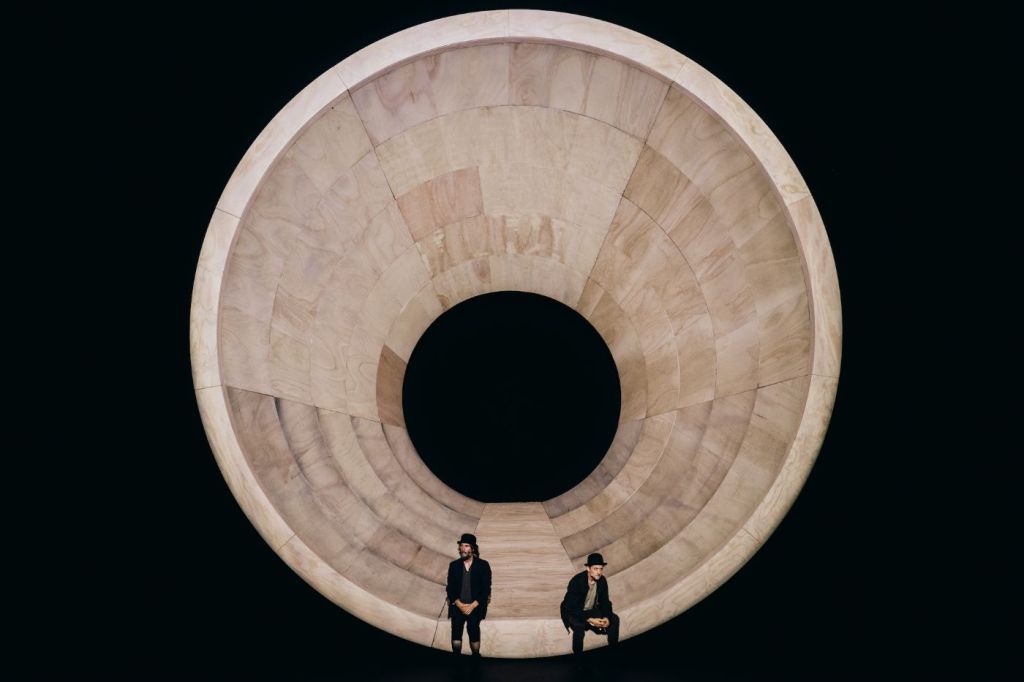
Despite the strangeness of it all, one thing is certain. Bill and Ted are together again for another adventure that promises to be like no other. First, they’ve landed on Broadway, dressed as hobos in bowler hats playing clowns for us, who happily watch and wait for Godot with them. And it doesn’t matter whether they tear it up or tear it down. The excellent novelty of these two appearing live as Didi (Vladimir) and Gogo (Estragon), another dimension of Bill and Ted, illuminates Beckett.
Keanu Reeves’ idea to have another version of their beloved characters confront Samuel Beckett’s tragicomical questions in Waiting for Godot seems an anointed choice. It is the next step for these bros to “party on,” albeit with unsure results. However, they do well fumfering around in this hollowed out world, a setting with no material objects. The director has removed the tree, the whip, or any props. Thus, we concentrate on their words. Between their riffs of despair, melancholy, hopelessness and trauma, they have playful fun, considering the existential value of life. Like all of us, if they knew what circumstances meant in the overall arc of their lives, they wouldn’t be so lost.
Director Jamie Lloyd, unlike previous outings (A Doll’s House, Sunset Boulevard), keeps Beckett’s script without alteration. Why not? Rhythmic, poetic, terse, seemingly repetitive and excessively opaque, in their own right, the spoken words ring out, regardless of who speaks them. That the characters of Bill and Ted are subsumed by Beckett’s Didi and Gogo makes complete sense.
What would they or anyone do if there was no intervention or salvation as occurs fancifully in the Bill and Ted adventure series? They’d be waiting for salvation, foiled and hopeless about the emptiness and uselessness of existence without definition. Indeed, politically isn’t that what some in a nation of unwitting, passively oppressed do? Hope for salvation by a greater “someone,” when the only possibility is self-defined, self-salvation? How long does it take to realize no one is coming to help? Maybe if they help themselves, Godot will join in the work of helping them find their own way out of oblivion. But just like the politically passive who do nothing, the same situation occurs here. Godot is delayed. Didi and Gogo do nothing but play a waiting game.
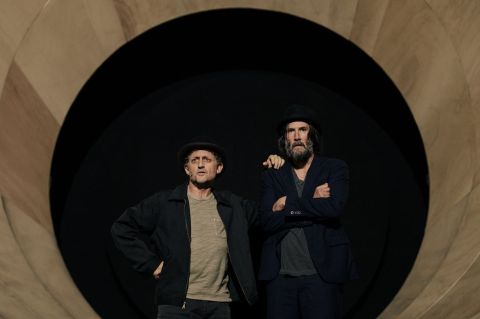
From another perspective eventually unlike political passives they compel themselves to act. And these acts they accomplish with excellent abandon. They have fun.
And so do we watching, listening, wondering and waiting with them. Their feelings within a humorous dynamic unfold in no particular direction with a wide breadth of expression. Sometimes they want to hang themselves to end the frustration. Sometimes, bored, they engage in swordplay with words. Sometimes they rage. Through it all they have each other. And despite wanting to separate and go their own ways, they do find each other comforting. After all, that’s what friends are for in Jamie Lloyd’s anything is probable Waiting for Godot.
In Act I they are tentative, searching their memories for where they are and if they are. Continually, they circle the truth, considering where the one is who said they were coming. However, the situation differs in Act II because the Boy gave them the message about Godot.
In Act II they cut loose: chest bump, run up and down their circular environs like gyrating skateboarders seamlessly navigating curvilinear walls. By then, the oblivion becomes familiar ground. They relax because they can relax, accustomed to the territory. And we spirits out there in the dark, who watch them, become their familiar counterparts, too. Maybe it’s good that Godot isn’t coming, yet. They may as well while away the time. Air guitar anyone? Yes, please. Reality is what we make it. Above all, we shouldn’t take ourselves too seriously. In the second act they don’t. After all, they could turn out like Pozzo and Lucky. So they do have fun while the sun shines, until they don’t and return right back to square one: they wait.
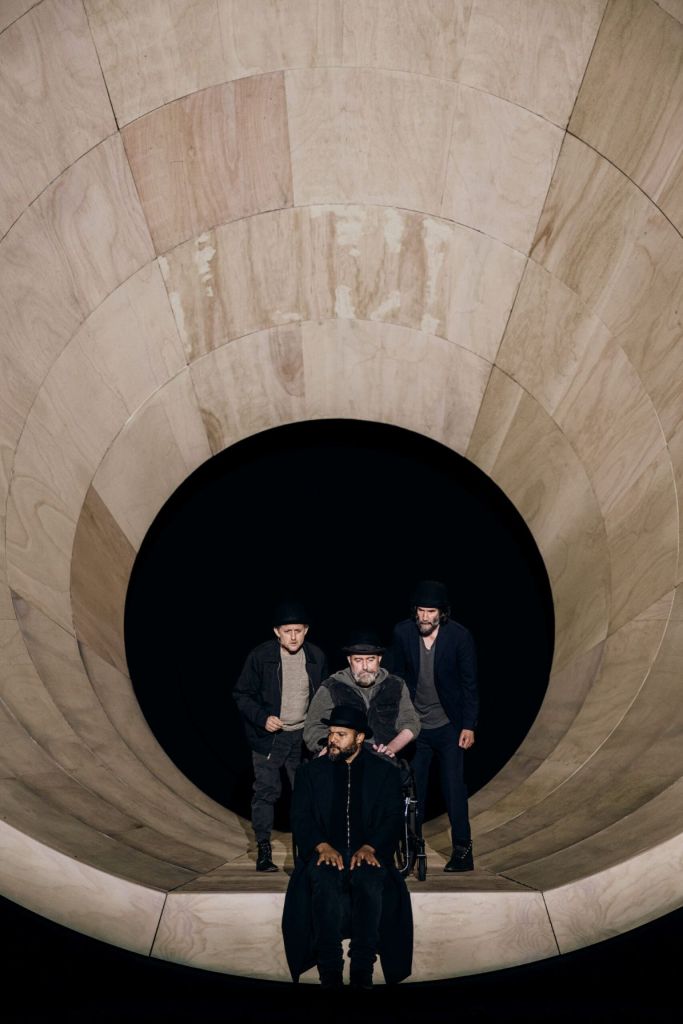
As for Pozzo and Lucky a further decline happens. In Act I Lucky gave a long, unintelligible speech that sounded full of meaning. In Act II Lucky is mute. Pozzo, becomes blind and halt, dependent upon Lucky to move. He reveals his spiritual and physical misery and haplessness by crying out for help. On the one hand, the oppressor caves in on himself via the oppression of his own flesh. On the other hand, he still exploits Lucky whom he leads, however awkwardly. The last shreds of his bellicosity and enslavement of Lucky hang by a thread.
Pozzo has become only a bit less debilitated than Lucky, whereas before, his identity commanded. Fortunately for Pozzo Lucky doesn’t revolt and leave him or stop obeying him. Instead, he takes the role of the passive one, while Pozzo still acts the aggressor, as enfeebled as he is. The condition happened in the twinkling of an eye with no explanation. Ironically, his circumstances have blown most of the bully out of him and reduced him to a pitiable wretch.
Nevertheless, Didi and Gogo acknowledge Pozzo and Lucky’s changes with little more than offhanded comments. What them worry? Their life-giving miracle happened. They have each other. It’s a congenial, permanent arrangement. After that, when the Boy shows up to tell them the “bad” news, that Godot has been delayed, yet again, and maybe will be there tomorrow, it’s OK. There’s no “sound and fury” as there is in Macbeth’s speech about “tomorrows.” We and they know that they will persist and deliver themselves and each other into their next clown show, tomorrow and tomorrow and tomorrow.
If one rejects the comparison of this version of Waiting for Godot with others they may have seen, that wisdom will yield results. To my thinking comparing versions takes the delight out of the work. The genius of Beckett is that his words/dialogue and characters stand on their own, made alive by the personalities of the actors and their choices. I’ve enjoyed actors take up this great work and turn themselves upside down into clown princes. Reeves and Winter have an affinity and humility for this uptake. And Lloyd lets them play, as he damn well should.
In the enjoyment and appreciation of their antics, the themes arrive. I’ve seen greater and lesser lights in these roles. Unfortunately, I allowed their personalities and their gravitas to distract me and take up too much space, crowding out my delight. In allowing Waiting for Godot to settle into fantastic farce, Lloyd and the exceptional cast tease out greater truths. These include the indomitably of friendship; the importance of fun; the tediousness of not being able to get out of one’s own way; the uselessness of self-victimizing complaint; the vitality and empowerment of self-deliverance, and the frustration of certain uncertainty.
Waiting for Godot runs approximately two hours five minutes with one intermission, through Jan. 4 at the Hudson Theatre. godotbroadway.com.
Phylicia Rashad, Brandon J. Dirden in ‘Skeleton Crew,’ Workers vs. Corporates, a Worthy Fight at Manhattan Theatre Club
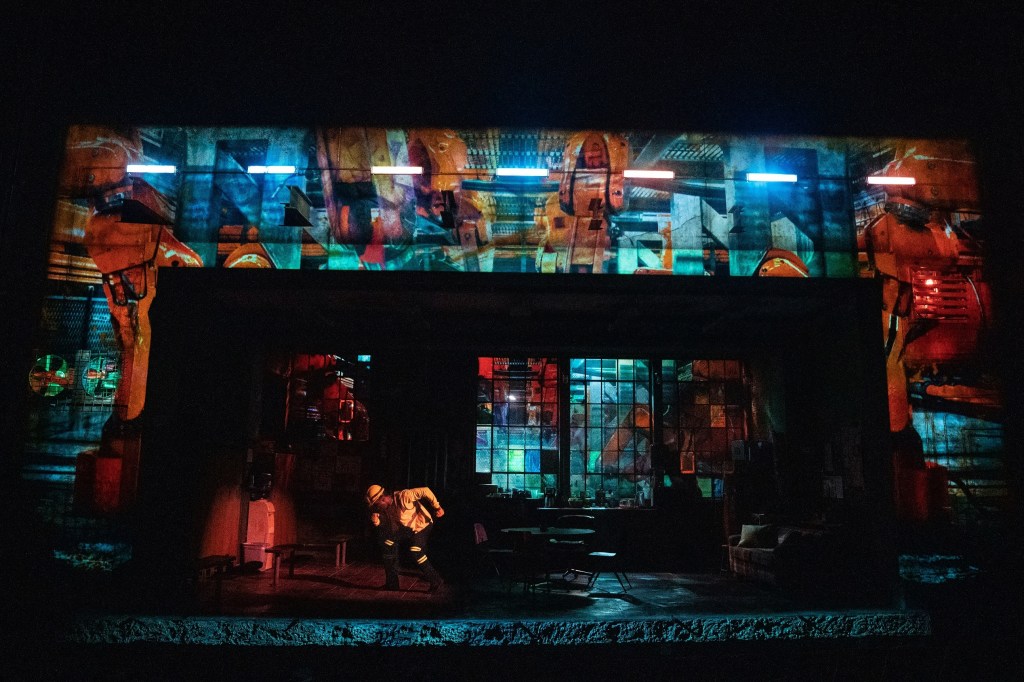
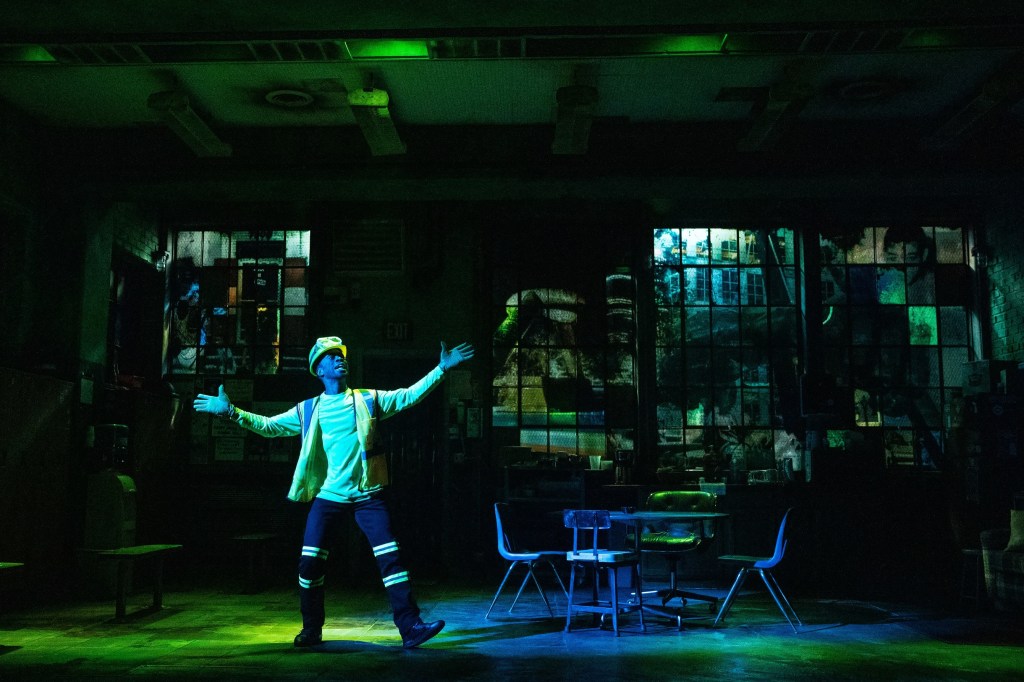
From the symbolic and representative opening salvos of gyrating piston Adesola Osakalumi, whose break dancing suggests the automation which is rendering the human scaling at the auto-stamping factory obsolete, to the well-hewn set by Michael Carnahan (the dusty, run-down, cold, shabby staff room where employees enjoy down-time) we understand that the four person skeleton crew in the Detroit plant will be ghosted as soon as budgetary financial reckonings are made by upper management. This is 2008 Detroit, US during the economic mortgage mess when investment bank Bear Stearns collapses and is bought over by JPMorgan Chase and Lehman’s a 150-year old booming institution goes belly up. People are losing their homes and living in their cars and cheesy motels in Florida. And, it is worse in Detroit whose booming success of the 1960s is a bust by the 1990s and there’s one plant left that is barely churning out product.
Skeleton Crew directed by the superb Tony Award® winner Ruben Santiago-Hudson, currently in revival at Manhattan Theatre Club after its intimate presentation Off Broadway at the Atlantic six years ago, hints at the tour de force Dominique Morisseau meant the last segment of her Detroit Project to be. The trilogy (The Detroit Project) is about Detroit’s life and times before and after the Reagan outsourcing debacle toppled the city from its glory as the country’s industrial fountain of youth. It includes Detroit-’67, Paradise Blue and Skeleton Crew.
The play has been given a glossy uplift using video projections of the robotic machinery of the assembly line etc. (excellent design by Nicholas Hussong). Coupled with the music (Rob Kaplowitz’s original music & sound design, and Jimmy Keys’ original music & lyrics) at the beginning and between salient scenes, we note the encroaching modernized doom that hammers the employee work force into unrecognizable bits, hyper-downsized from its greatness when Detroit was in its manufacturing heyday. The digital video projections supplant proscenium curtains which would normally frame the stage. As such, the plant’s relentless, driving automation is the outer frame of the stage and encapsulates the action and interactions in the staff room where workers take their breaks from the repetitive and monotonous production line.
The contrast Morisseau’s dualism creates is trenchantly thematic. The defined “wasted, decrepit humans” are pitted against inevitable “progress” which especially grinds down the people whose loyalty and dedication to the industry have been turned against them. These management diminished unfortunates, like Faye (Tony Award® winner Phylicia Rashad) whose once magnificent efforts are discounted as “unprofitable,” didn’t see the “handwriting on the wall” to prepare for another career after working for the company 29 years in the hope of getting a “great” retirement package. Faye and others trusted the corporates to have their best interests and welfare at heart.
As Morisseau indicates in her characterization of Faye, stand-up employees projected their worthiness, values and integrity on their slimy directors and CEOs, mistakenly assuming they would be rewarded for hard work and effort. Ironically, it is the elite corporates who are the unworthy, lazy, greedy, un-Americans who made America “un-great” through Reagan’s tax laws that allowed them to outsource profits by closing plants and establishing factories anywhere but the United States.
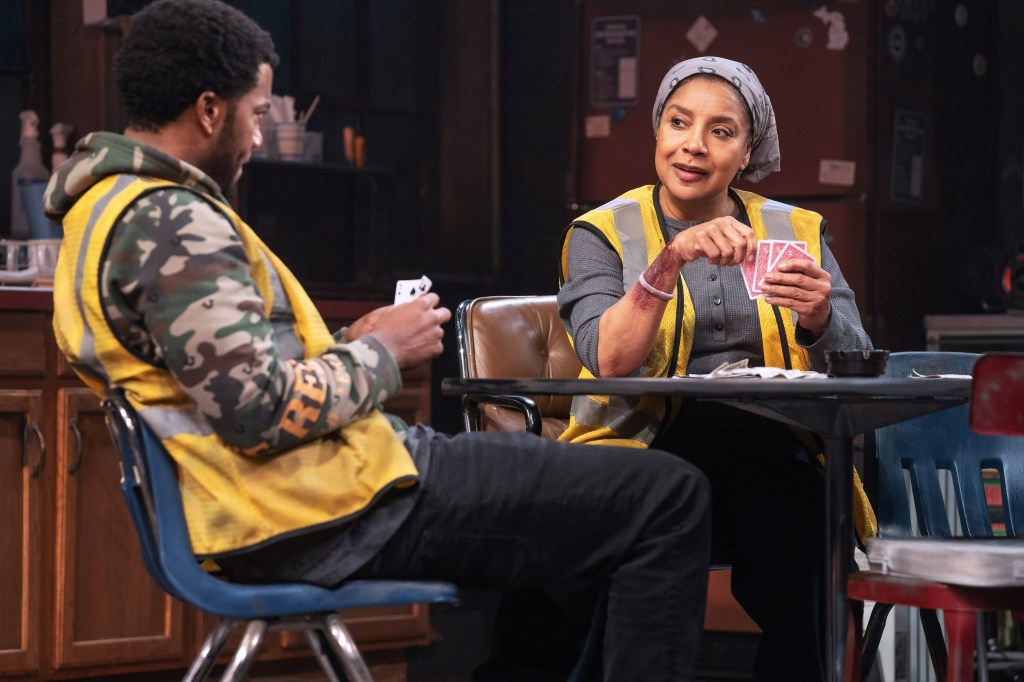
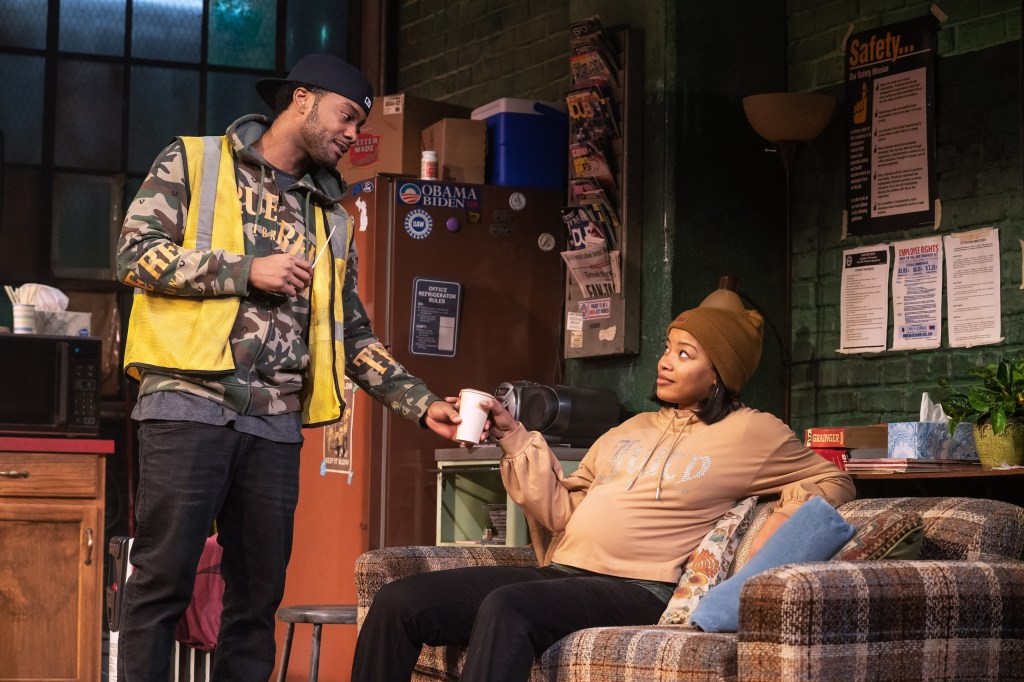
In view of the current debacle with supply chain issues, inflation and absence or overpricing of medical product needed to fight the ongoing health disaster (COVID-2022) which incompetent, do-nothing Republicans have fueled as a political stratagem, Skeleton Crew‘s themes are profound and incredibly current. The problems fourteen years later from the setting (2008, Detroit) are even worse with expanding economic inequality, oppression of the workforce, whether white or blue-collar, by oligarchic elites herding the intellectually infirm white supremacists with misdirection against the democratic institutions that could save them. The seeds of the current destructive forces are evidenced in Morisseau’s setting with the ghosting of Detroit’s last automotive plant where supervisor Reggie (the wonderful Brandon J. Dirden) Union Representative Faye (Phylicia Rashad) the energetic Dez (Joshua Boone) and the pregnant Shanita (the excellent Chanté Adams) work and stress out with each other in unity.
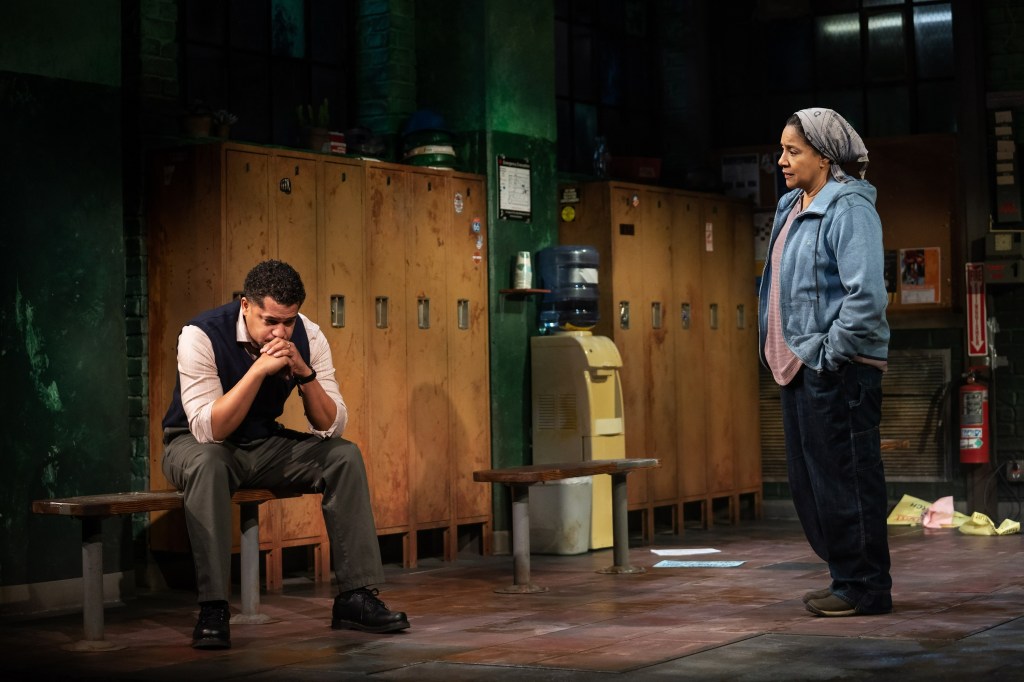
Within this framework we follow the devolution and evolution of these four who signify Morisseau’s special individuals who are the backbone of the nation. It is these who the elites would erase. Their ability to hope and thrive is sorely tested against the annihilating backdrop of demeaning corporate abuse which demands personal strength and communal support to over-leap it. With Morisseau it’s the people vs. “the corporate machine,” and as Morisseau spins the conflicts caused by the plant closure, personal self-destruction or revitalization are the direction for Faye, Dez, Shanita and Reggie, who prove to be likeable working class heroes with huge cracks and flaws that we recognize in ourselves.
Reggie who has been practically raised by Faye as family-she got him the position where he rose to management-is pressured and strained. He’s forced to walk a fine line, knowing what his bosses plan to do. Yet he must not tip their hand which would panic the workforce to strike or leave before the current contracted work is completed. Oppressed to enforce nit-picking rules, Reggie argues with Dez who may or may not be stealing and who sees him as a cold-hearted puppet of corporate.
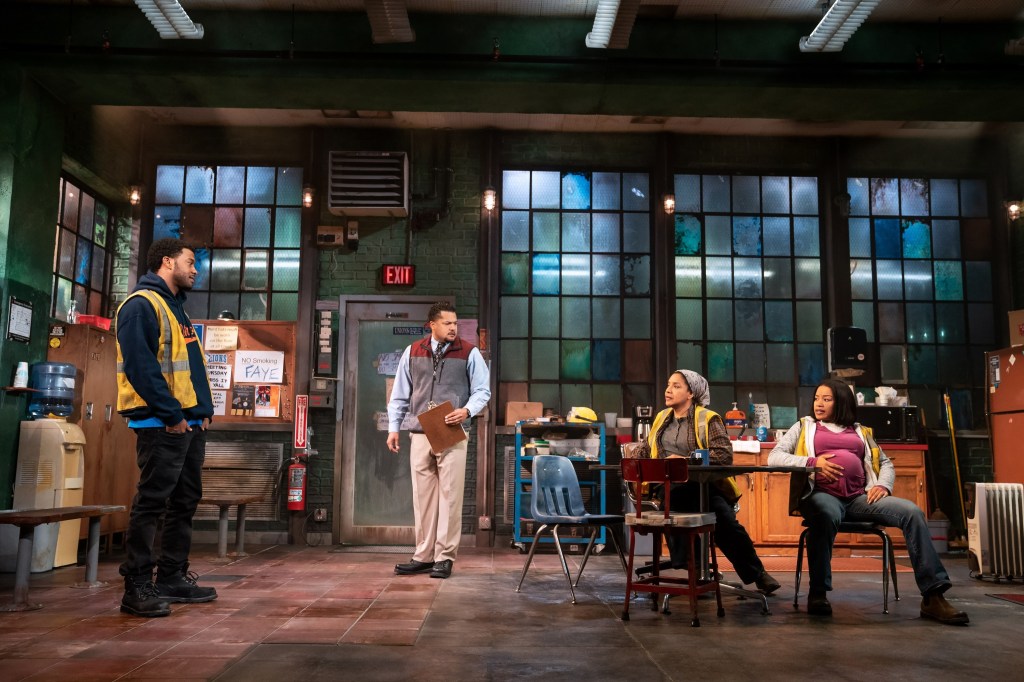
Likewise Reggie emotionally wrestles with Faye who must protect her union workers and herself deciding whether to retire early, which would mean an income loss after retirement. Shanita is pressured emotionally after she is dumped by her baby’s father. She faces being the sole support of her child. She enjoys working at the plant, though she’s a cog in the wheel, but she feels proud for her contribution to making product. Nevertheless, she is strained working and bearing up with her pregnancy, making doctor’s appointments and saving up money before and after she takes time off from the job she loves.
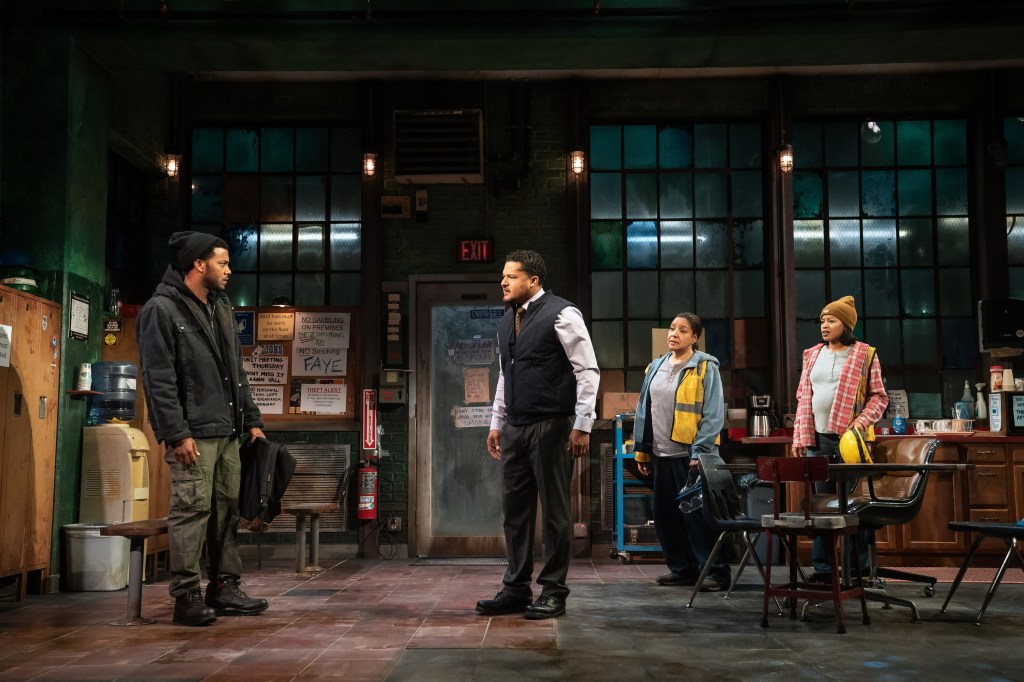
Morisseau excavates each of their struggles with authentic dialogue that is at times humorous, and powerful/poetic as the characters present their positions. Importantly, the playwright extends the reality of what it is to hold a decent job with benefits that is being pulled out from under the worker because the owners’ obscene profits aren’t big enough and government isn’t holding them to account. Thus, as the play progresses and we understand each of the characters’ dreams, we credit Dez for attempting to start his own business with friends, and we hope for Shanita’s child, in light of the nightmares she’s having over the uncertainty of her future. Additionally, we understand Reggie’s position though we expect him to stop his haranguing of the others and stand up to his bosses. We are thrilled when he finally does.
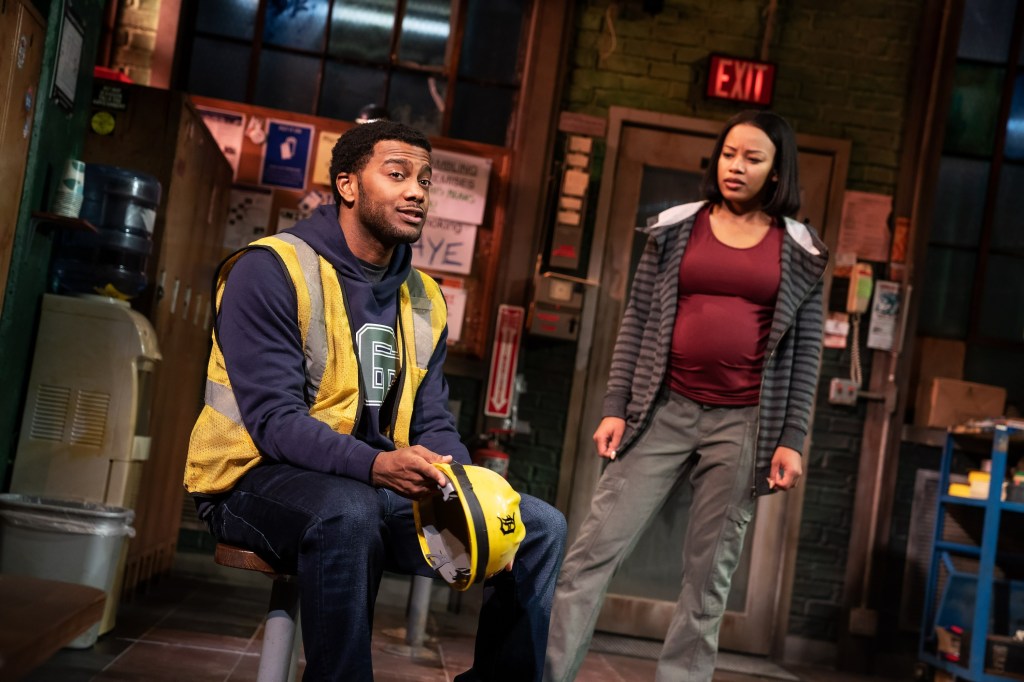
Interestingly, Faye, who appears to be the most solid and reliable is confronting her own devastation in addition to the cancer remission she is going through. Morisseau gradually unfolds each of the characters’ issues and at the end of Act I brings Dez and Reggie’s relationship to a turning point where Dez is about to be fired. When Faye steps in and counsels Reggie to stand up for Dez and the other workers, we question whether Reggie has the guts to or whether he will be a sell-out. The irony is Faye is great at negotiating and encouraging others, but she is lousy at taking care of herself. The revelation of this is poignant, and Morisseau opts to make every audience member put themselves in Faye’s shoes as she, too, “walks the line” between wanting to live or just throw in the towel and give up.
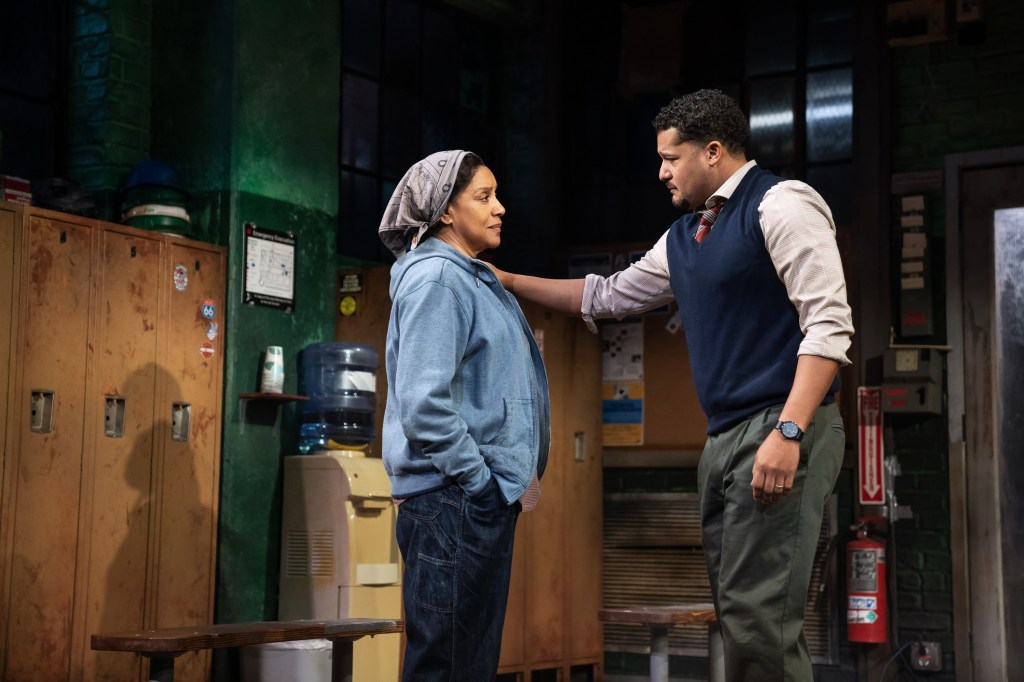
This is a strong ensemble piece and the acting is finely wrought. Unfortunately, some of the humor was lost on me because the actors weren’t always projecting in the cavernous space of the theater. Please actors, project and enunciate! Nevertheless, the passion and presence of Phylicia Rashad along with her counterpoint Brandon J. Dirden was heartfelt. The relationship they create reveals bonds that run deep into love and sacrifice. And the surprising relationship that blossoms between Boone’s Dez and Adams Shanita is beautifully effected by their graded, nuanced performances.
Ruben Santiago-Hudson understands Morisseau’s themes down to his soul’s bone marrow. The play’s visual elements represent the most vital of her themes and the characters are ourselves. We cannot help but be concerned for the conflicts the play presents which seem everpresent and unchanging. The current administration’s hope to “Build Back Better” during this time would appear to rectify the external circumstances of such characters who jump off the stage at us and populate our society. But the same corporate structure that Reggie fights is so entrenched, that soul progress is for the little people, these who are Morisseau’s besties. Perhaps that is the consolation. As for the corporate elites? As Reggie and Dez intimate, they are they’re own soul destruction. And that too is its own tragic consolation.
Kudos to the technical team mentioned above and Emilio Sosa’s costume design, Rui Rita’s lighting design, Adesola Osakalumi’s choreography and Cookie Jordan’s hair and wig design.
Morisseau’s play is dynamite in the hands of Hudson the artistic/technical team and these superb actors. This is a must-see. For tickets and times go to their website: https://www.manhattantheatreclub.com/shows/2021-22-season/skeleton-crew/
‘The Tragedy of Julius Caesar,’ a Thrilling Re-imagining of Shakespeare’s History/Tragedy
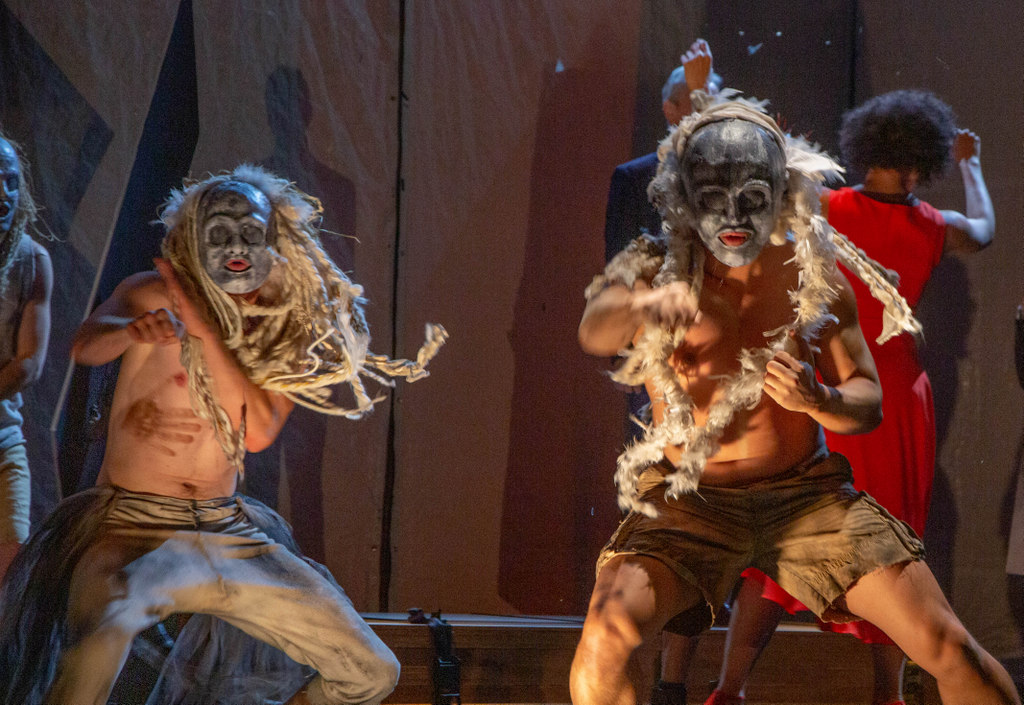
The Company of ‘The Tragedy of Julius Caesar,’ directed by Shana Cooper (Henry Grossman)
A few years ago the Public Theatre did a sardonic version of Julius Caesar using directed ridicule to lay bare some parallels between Caesar’s power grab with that of the new Trump administration. In that iteration blonde, pompous Caesar wore a dark suit and long, red tie and Calpurnia flounced around in designer clothing. The allusions were clear as were the themes. Overweening power unchecked in a representative government leads to civil strife, chaos and future oppression. Though Theatre for a New Audience’s rendition of Julius Caesar offers no such national twists, the production’s finely tuned staging, set design, incisive acting by the principals and superb use of the ensemble ratchet the themes of political intrigue and civil strife to a much more nuanced and foreboding level.
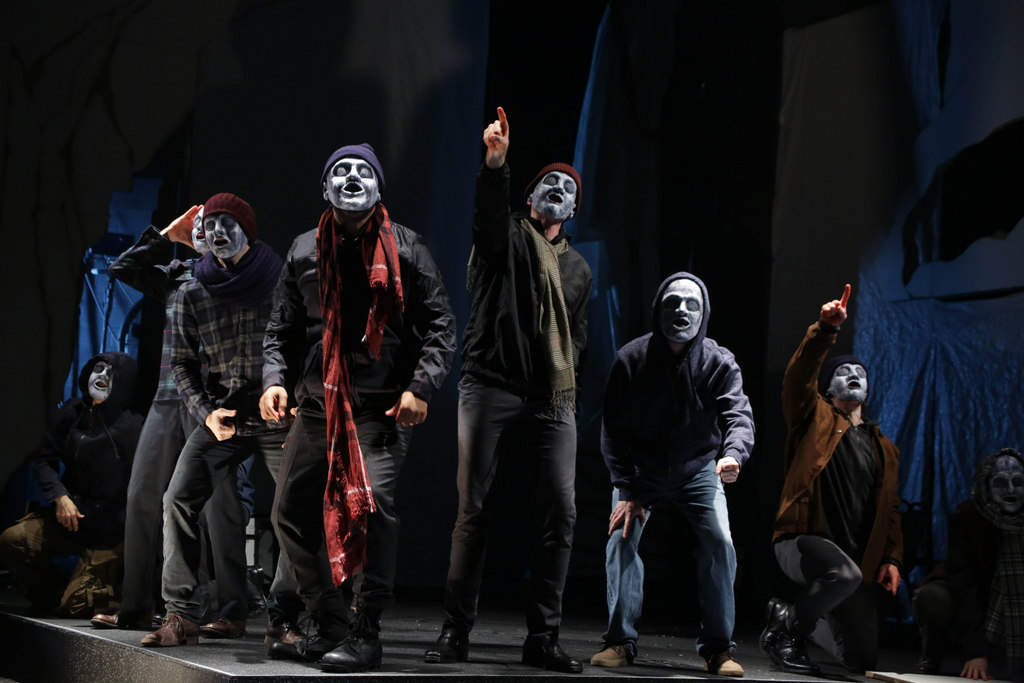
Ensemble of ‘The Tragedy of Julius Caesar,’ directed by Shana Cooper, Theatre for a New Audience (Gerry Goodstein)
This version is novel in costume design, sound design and scenic design with sterling efforts by Raquel Barreto (costumes) Sibyl Wickersheimer (set) Paul James Prendergast (sound). Though the costumes are predominately in modern dress, the impact of the characters’ roles is inherent in their design. The masks and wigs headgear of the ensemble are dramatic and eye-catching in the opening scene with the crowds celebrating the Feast of Lupercal. The same occurs later during Brutus’ and Mark Antony’s funeral orations.
The director Shana Cooper brilliantly employs the ensemble during the mob scenes and crowd scenes in Act I and Act III and then in the battle scenes in the last acts. The staging is riveting and in the first half of the play, the ensemble enacts the lower class plebeians with acute meaning and power. The mob action is a vital aspect not only of the arc of development in the action of Julius Caesar, but also as emblematic of Shakespeare’s themes about governance, leadership and control of the public will.
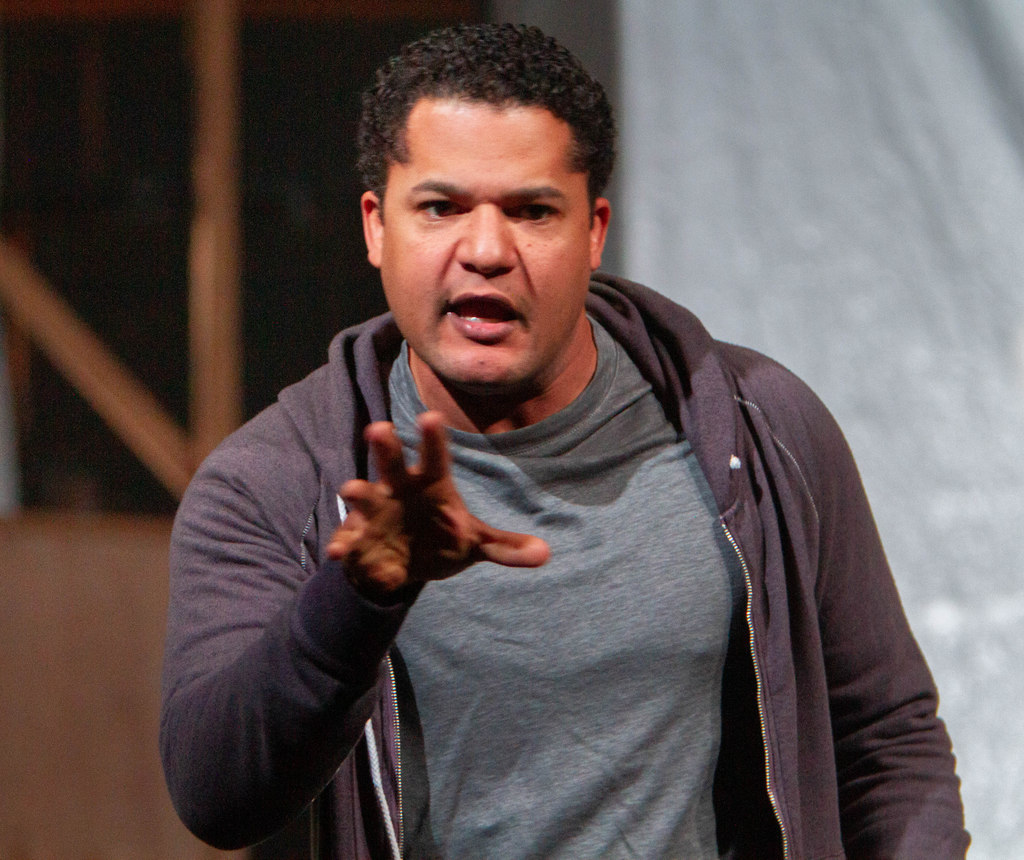
Brandon J. Dirden as Brutus in ‘The Tragedy of Julius Caesar,’ Theatre for a New Audience, directed by Shana Cooper (Henry Grossman)
For example Caesar (an appropriately arrogant Rocco Sisto) is a master manipulator of the crowd which he plays upon like “the actors in the theater” according to the humorous Caska (the ironic, churlish Stephen Michael Spencer). Of course their will is Caesar’s command and it is how and why he will be “crowned” by the senators who understand the extent to which Caesar has gained the people’s trust and love. Shana Cooper conveys this theme of crowd manipulation trenchantly. For the first time in the numerous productions I have seen of Caesar, she most coherently understands Shakespeare’s portrayal of the crowd as a preeminent character.
How the crowd/rag-tag people are manipulated by Caesar, Brutus and Antony recalls how every charismatic leader gains and maintains power: he/she infuses the will of the people with the direction of his/her own desires, neatly disguised. Though Brutus (Brandon J. Dirden is superb as the high-minded, conflicted betrayer of his friend), launches himself into the pulpit at Caesar’s funeral, his honesty doesn’t allow him to use the clever, ironic rhetorical strategies of Mark Antony (Jordan Barbour is super as the passionate rogue who stirs the emotions of the mob). Antony’s duplicity as he turns the crowd away from praising the “honorable” Brutus to damning him is a masterwork of leadership genius.
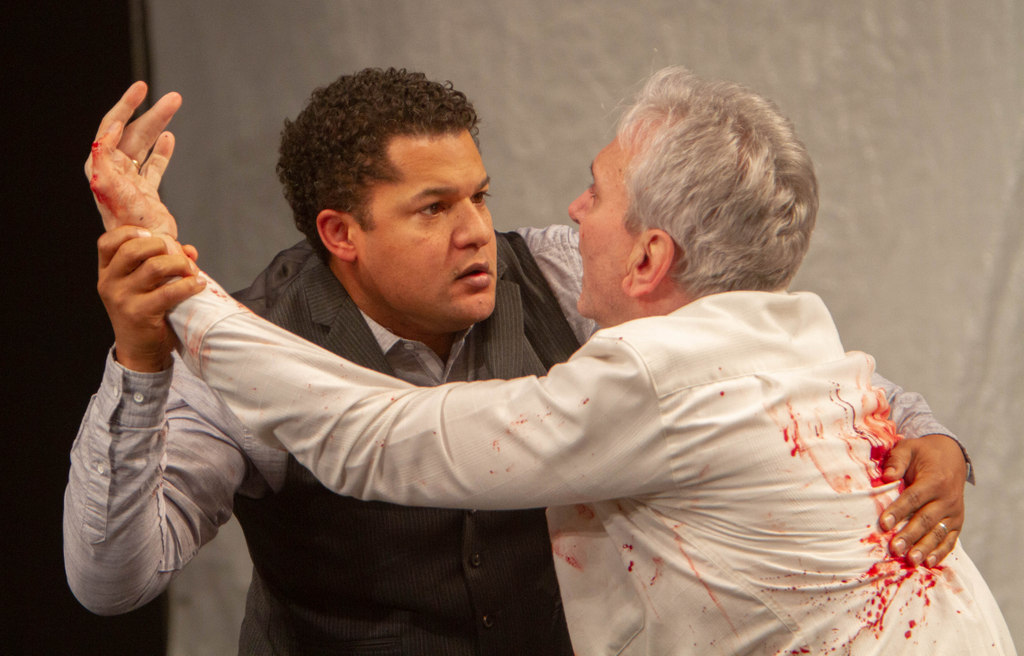
Brandon J. Dirden, Rocco Sisto in ‘The Tragedy of Julius Caesar,’ Theatre for a New Audience (Henry Grossman)
Mark Antony enrages the crowd into seething, blind violence for his self-dealing purposes. The speech is one of Shakespeare’s greats and Barbour does it justice. As counterpoints to each other in this Act III climax of Caesar’s funeral, Dirden’s Brutus and Barbour’s Antony reveal exceptional talents in voice and in their living moment-to-moment in the skins of these admirable and incredible Romans, whom we come to appreciate as leaders of that time, far occluding current politicians of our time.
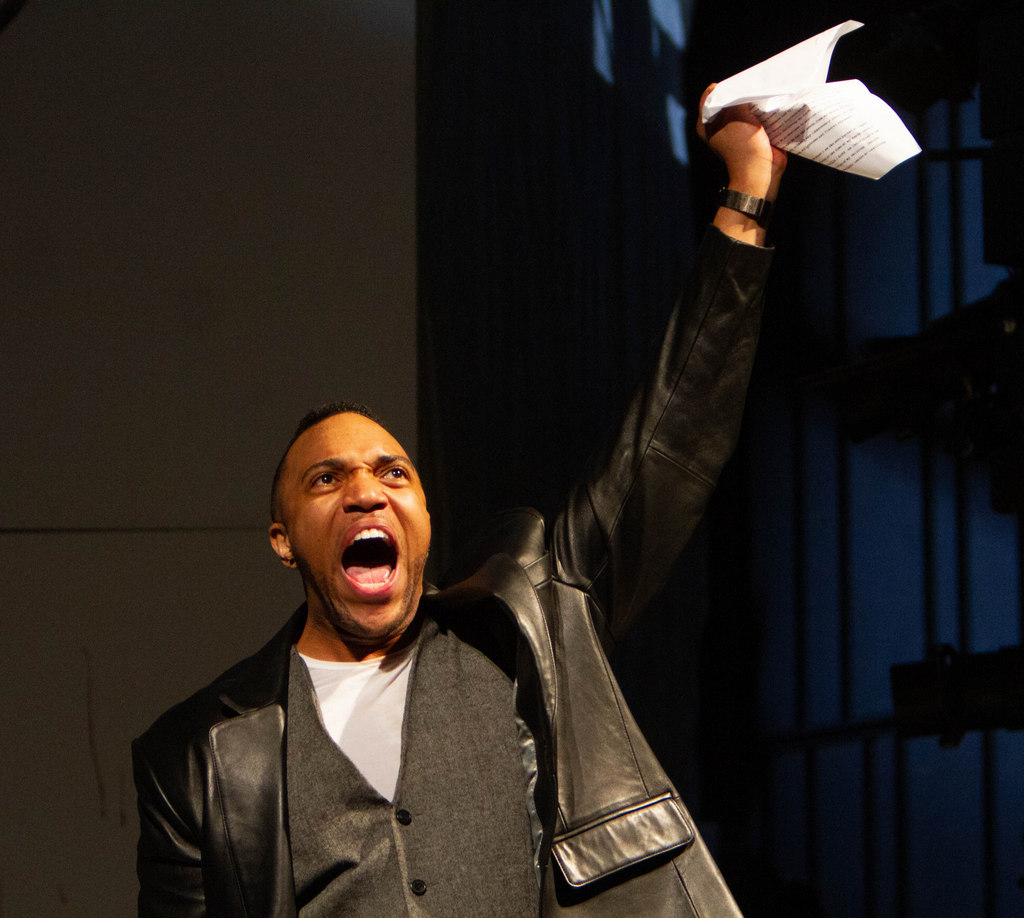
Jordan Barbour, ‘The Tragedy of Julius Caesar,’ Theatre for a New Audience, directed by Shana Cooper (Henry Grossman)
The contrasting scenes which feature the wives of the leaders, Calphurnia (Tiffany Rachelle Stewart) and Portia (Merritt Janson) indicate the human side of Caesar and Brutus away from their roles as leaders of the people. In their importuning their husbands, both Stewart and Janson are sensitive and heartfelt.
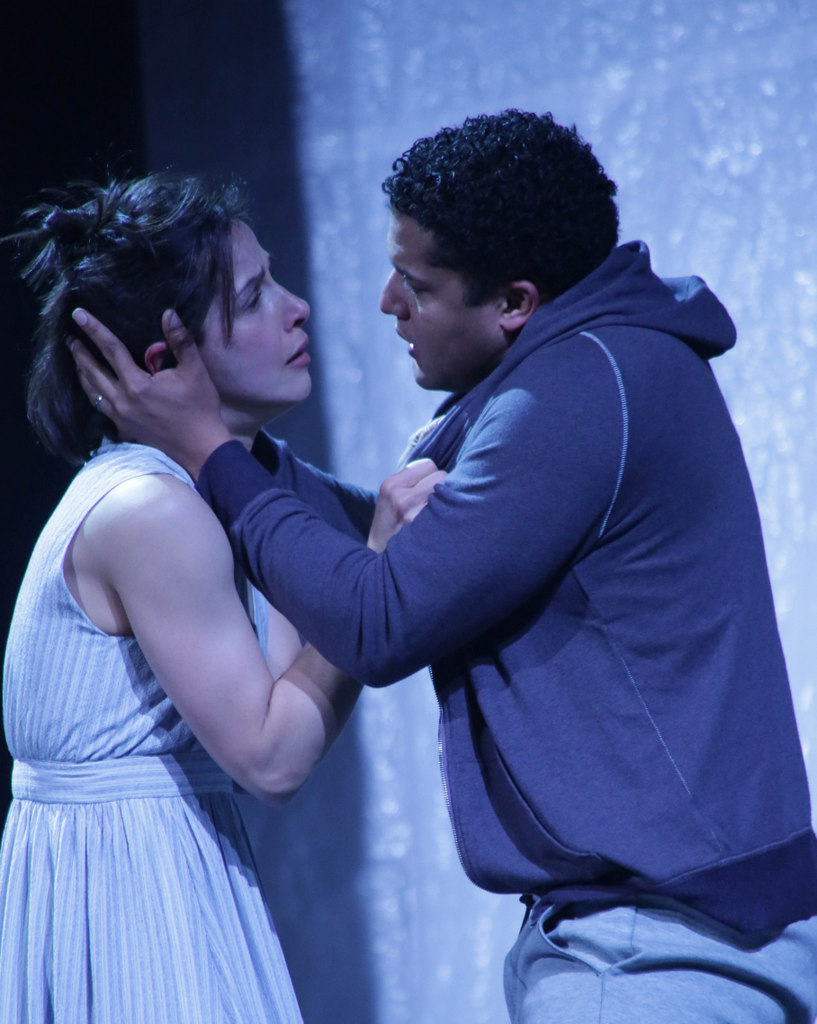
Merritt Janson, Brandon J. Dirden in ‘The Tragedy of Julius Caesar,’ directed by Shana Cooper, Theatre for a New Audience (Gerry Goodstein)
The power and beauty of Portia’s pleas to get Brutus to tell her his secrets lest she only be his “harlet” and not his “true wife” is a standout. Cooper’s astute direction of Portia who reaches behind Brutus to take his knife and give herself the wound which convinces him to “tell all,” is cogent and precise. Merritt Janson and Brandon J. Dirden rock the house in this poignant, well-wrought scene which reveals their love and concern for each other and which also gives credence to why Portia kills herself violently after Brutus flees Rome.
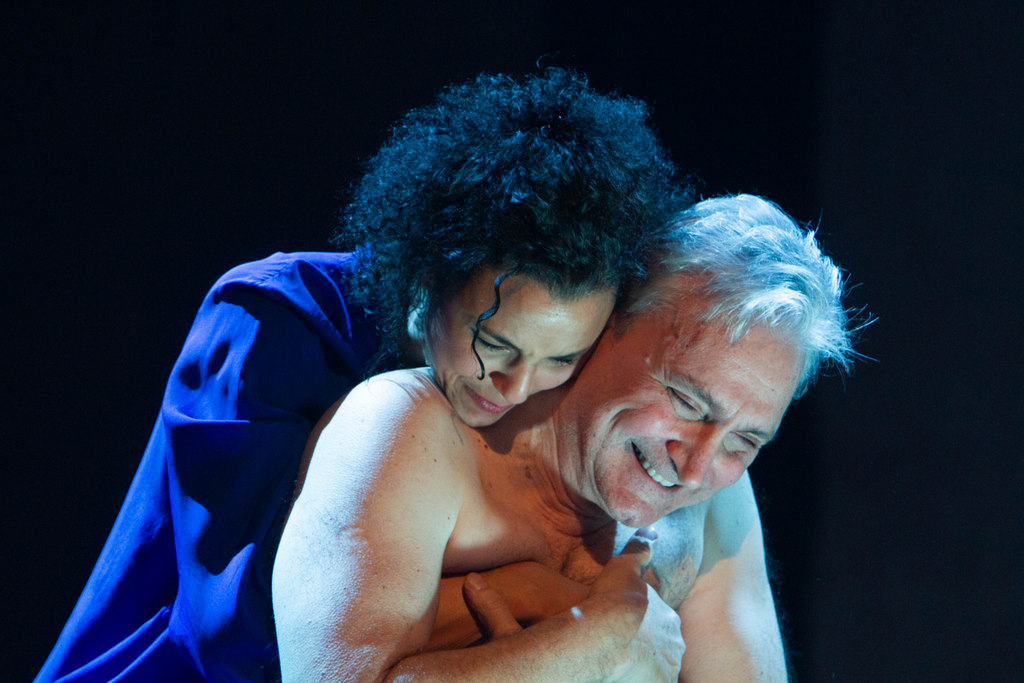
Tiffany Rachelle Stewart, Rocco Sisto in ‘The Tragedy of Julius Caesar,’ directed by Shana Cooper (Henry Grossman)
Likewise, the love and concern expressed in the bath scene between Calphurnia and Caesar is well thought out and delivered. We are heartened that Calphurnia has discovered a “face-saving” way to convince Caesar not to go to the senate. But all ends in the exchange between proud Caesar and Calphurnia after she is foiled by the clever Decius (an exceptional Barret O’Brien who is on point throughout this high energy scene as well as before and after the assassination). She wilts like a dead flower as Caesar chides her for his caving in to her fears; and at that moment, Caesar is a dead man unless he accepts the truth of warnings of the Soothsayer and Artemidorus.
Calphurnia’s angry cry after Caesar’s death in waving the bloody scarf at her husband’s corpse is the perfect acting choice. Indeed, how many times do wives correctly advise their husbands who ignore them only to be proven right after it is too late? If Caesar had only listened to her, she would not be staring down at his mangled body, mourning him.
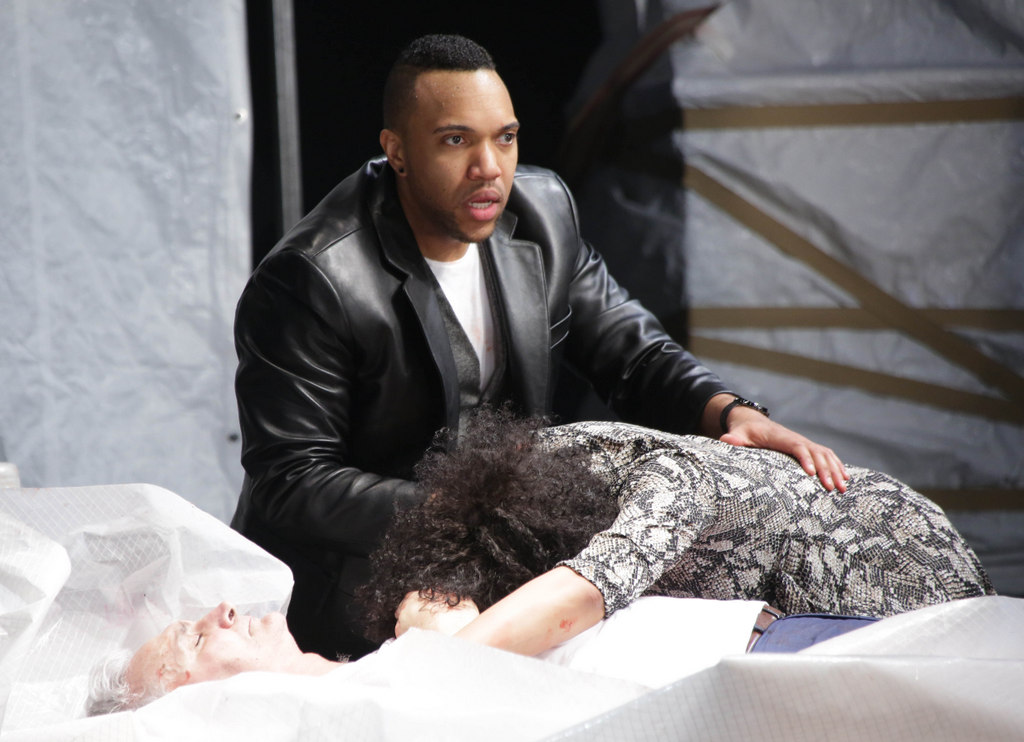
Jordan Barbour, Tiffany Rachelle Stewart, Rocco Sisto, ‘Tragedy of Julius Caesar,’ directed by Shana Cooper, Theatre for a New Audience (Gerry Goodstein)
Cooper’s staging of the conspirators around Caesar before and during the assassination is enlightened and sizzles with power. A brilliant touch which may rankle traditionalists is that Antony brings Calphurnia to Caesar’s funeral so she may respond, with anger, remorse and tears. It is the epitome of logic that reveals Antony’s character and foreshadows the future. She is one more prop that Antony uses to manipulate the crowd to such mutiny that in the next scene they beat to death a poor innocent poet (Armando McClain) in an amazingly choreographed scene.
The direction of the ensemble and principals throughout the first part of the play creates tension and engagement with great purpose in elucidating themes. For example as Antony works his mischief to stir the crowd to bloodshed so “mothers will but smile when they see their sons quartered…” Cooper has Caesar rise with the help of Calphurnia and walk off. This is prodigious direction/staging. Symbolically, we understand that Caesar’s spirit has been evoked/resurrected by Antony to roam the land seeking vengeance in the capture or death of the conspirators and all those in concert with them. This ghost of Caesar threads through to the final Acts and foreshadows Caesar’s haunting Brutus at various times and finally when he appears in Brutus’ tent and embraces him before the disastrous battle of Philippi.
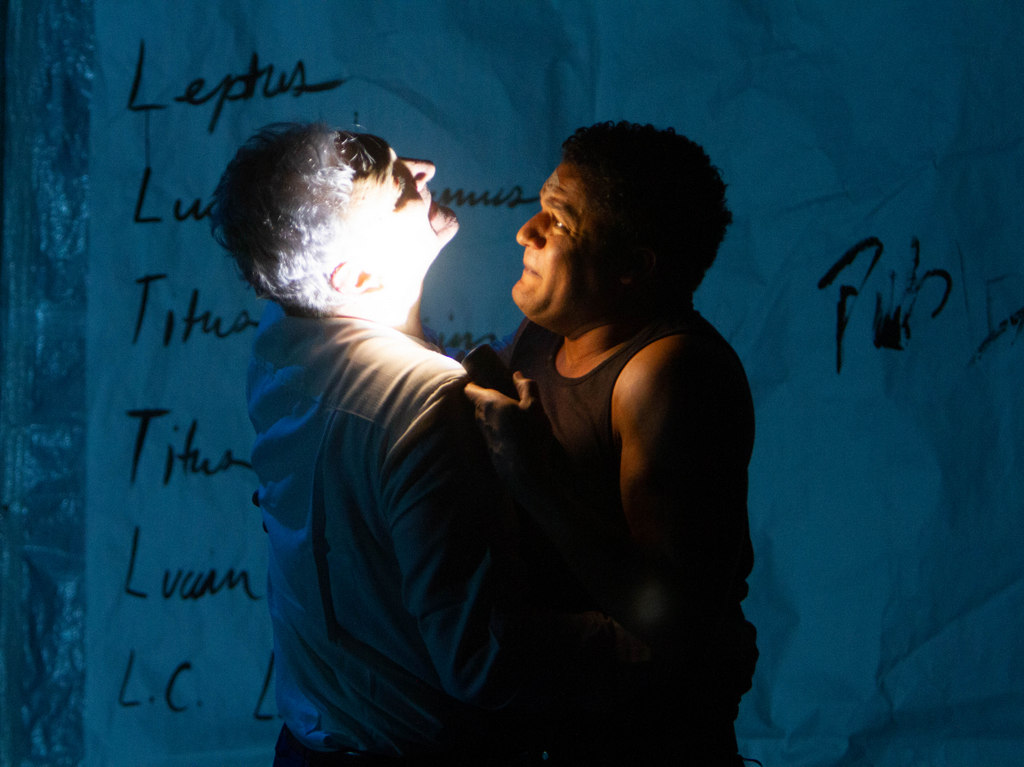
Rocco Sisto, Brandon J. Dirden in ‘The Tragedy of Julius Caear,’ Theatre for a New Audience (Henry Grossman)
The last acts of Julius Caesar have been characterized as throw-away. Not so in this production which has streamlined and strengthened them. The argument between Brutus and his once close friend now “enemy” Cassius, Matthew Amendt (Cassius) and Dirden (Brutus) deliver with power. As Cassius, Matthew Amendt’s portrayal is spot-on, though at times I felt he could project more. This is not the conniving Cassius we witnessed in the first act. Amendt’s Cassius is hurting, disturbed, humanized. On the other hand, Brutus has become a bellicose emotional lightening rod. As the two quarrel, we empathize with Cassius and then we discover why brutish Brutus is attacking his former close friend, now fellow soldier.
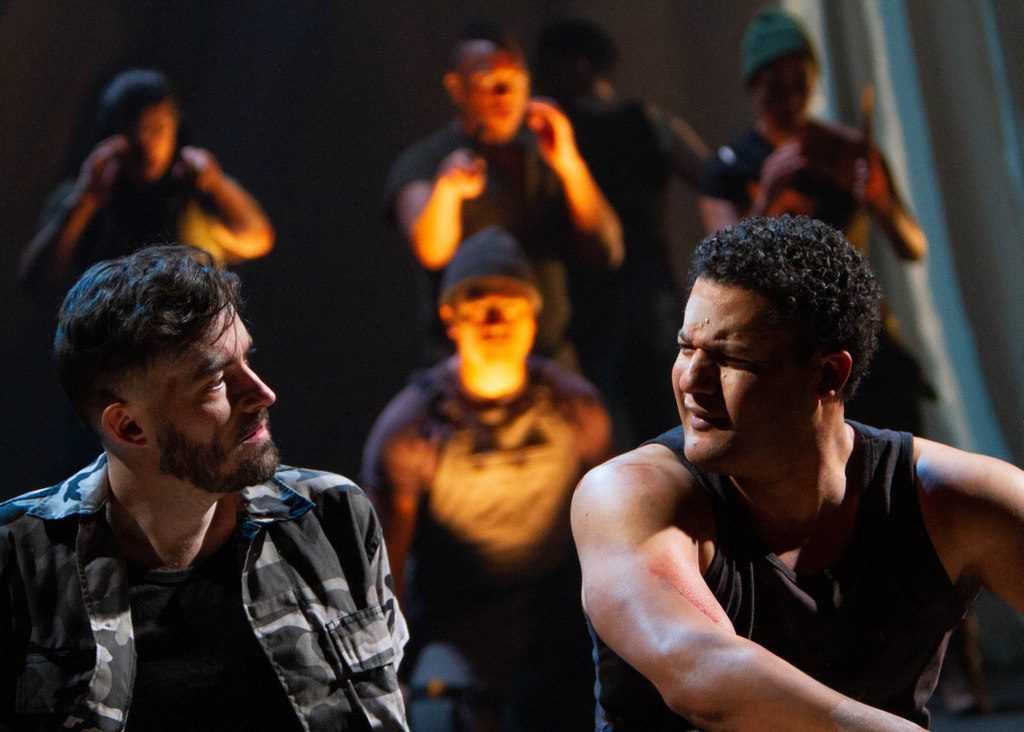
(L to R): Matthew Amendt, Brandon J. Dirden, ‘The Tragedy of Julius Caesar,’ Theatre for a New Audience (Henry Grossman)
Cooper avoids the problems with the last acts also by consolidating characters to keep the character list leaner than the original play. She also exemplifies and symbolizes how the spirit of vengeance and war range against each other in stylized battle scenes which are exceptionally choreographed by Erika Chong Shuch with the ensemble in modern army camouflage and make-up.
These scenes especially heighten the excitement, tension and energy. Also, they manifest and represent the sheer adrenaline expended during wartime. The fact that Cooper uses no blood or physical violence is symbolic more of the spirit of war that seems eternally present in every era. In their actions the ensemble steps in unison, in their arm, hand, leg movements and gestures in military fashion without weapons.
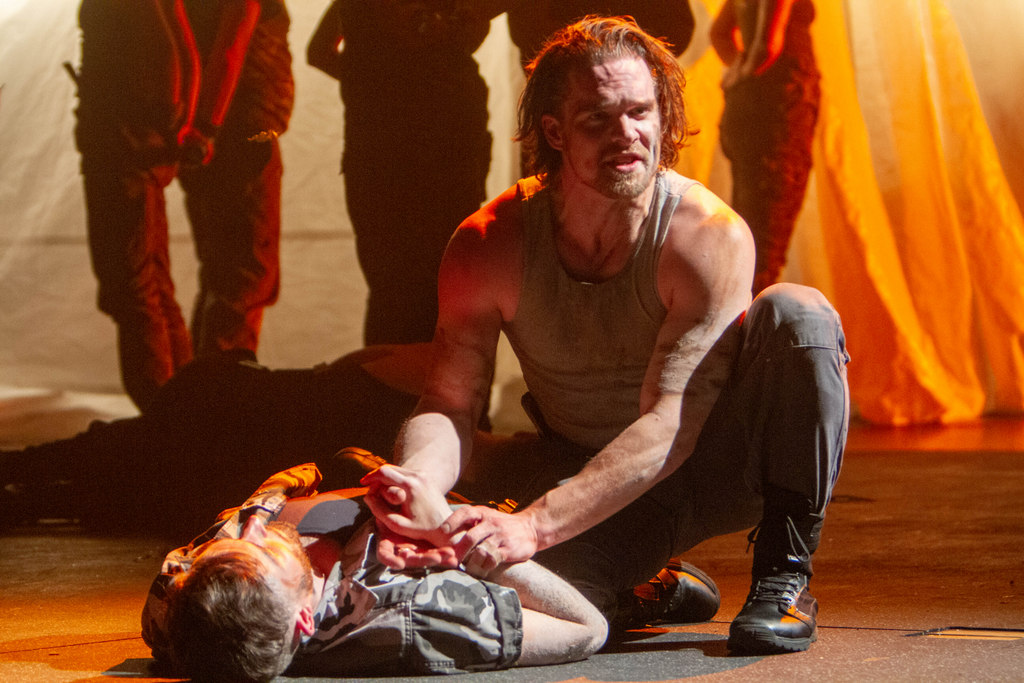
Stephen Michael Spencer, Matthew Amendt (prone) in The Tragedy of Julius Caesar,’ (Henry Grossman)
The overall effect is frightening in what it suggests, the fierce will and hot determination to war against one’s countrymen who were once brothers/colleagues. The lighting effects are exceptional thanks to Christopher Akerlind especially in these scenes. The music and sound are portentous.
The bloody assassination scene is contrasted with the stylized battle scenes which have no direct physical contact or blood. The pivotal character is Caesar, a god. Stabbed thirty-three times, he bleeds; no other character does. Symbolic parallels are drawn between animals sacrificed to predict the future, or gain favor with the gods or heal a nation. The contrasts and irony emphasized in this Tragedy of Julius Caesar are dire; the republic is not healed, but destroyed with his bloodletting. And the bloodless fighting of the ensemble indicates that the spirit of power domination, and war as an effective tool of “dominion” is integral to human society and must be checked through wise governance.
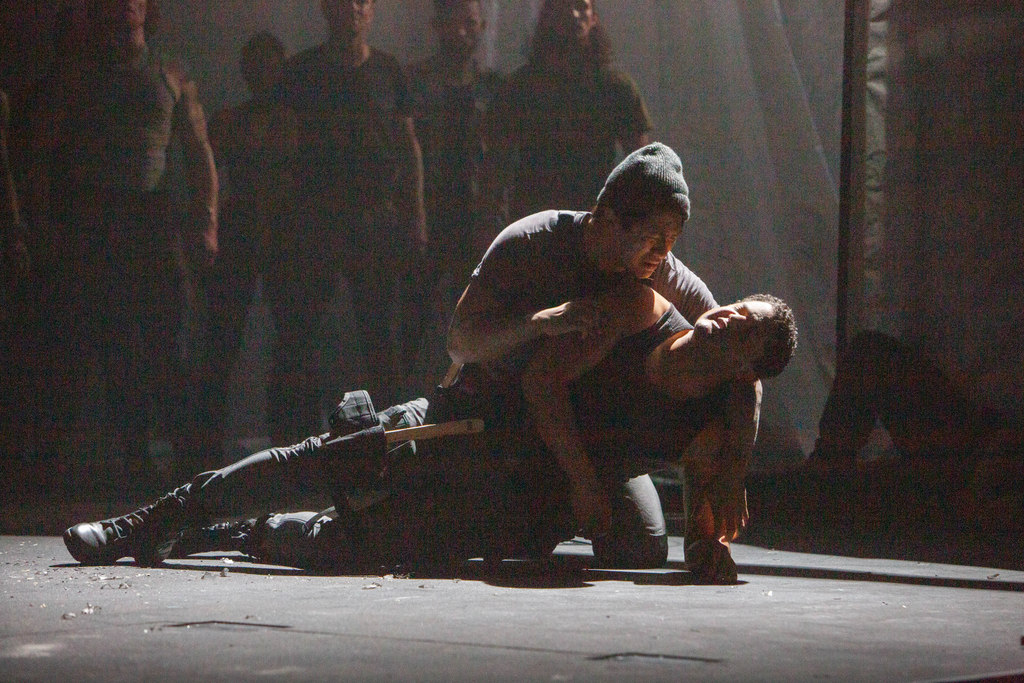
Julian Remulla, Brandon J. Dirden in ‘The Tragedy of Julius Caesar,’ Theatre for a New Audience (Henry Grossman)
Caesar is the sacrifice. By the time his spirit of vengeance has consumed all who would stand in the way of peace, 100 senators are dead, even the most rational and erudite Cicero. And his vengeance won’t be finished until Octavius (the martial Benjamin Bonenfant) purges his enemies and becomes Caesar Augustus. (Emperor Augustus decreed August 15 should be celebrated as his festival Ferragosto. From that time to this, all Italy closes down to celebrate.)
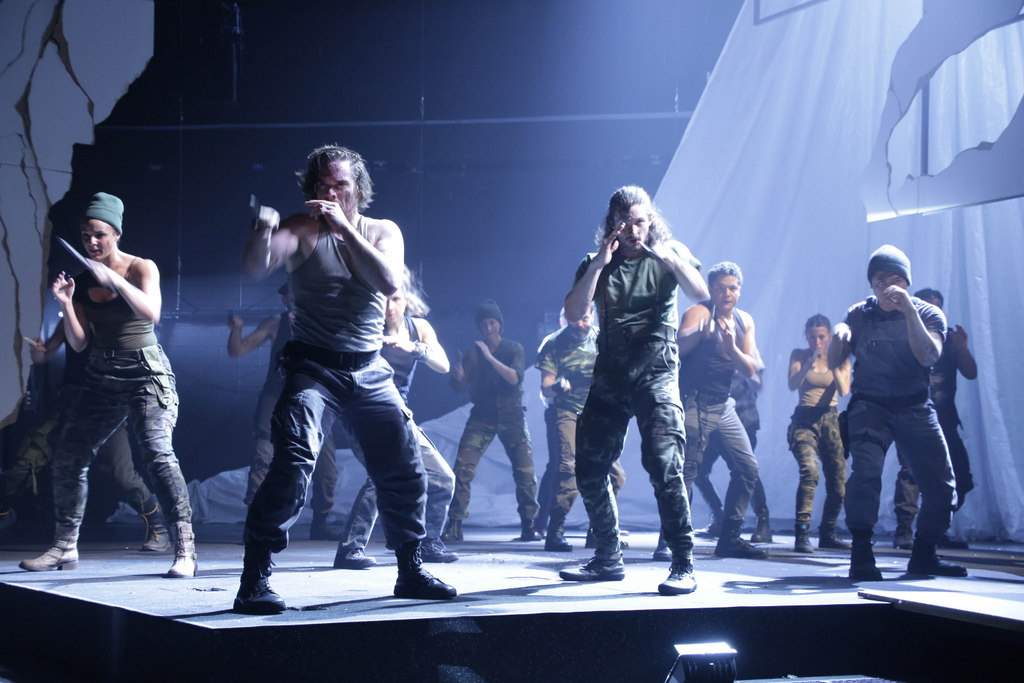
The company of ‘The Tragedy of Julius Caesar’ (Gerry Goodstein)
The production concludes with the stylized choreography and the comments that Brutus killed for the good of Rome. But Cooper’s staging makes clear that the killing will continue. Thematically, we acknowledge that the spirit of war, political intrigue and vengeance will carry through Augustus’ reign and beyond.
Cooper’s production best highlights Shakespeare’s inherent prophecy that war and assassination as political exigencies are perhaps inevitable. The show which runs until April 28th is a must-see for its daring risks that shake tradition, elucidate new concepts and provide exciting, vibrant theater. You can purchase tickets to The Tragedy of Julius Caesar which runs with one intermission at the Polonsky Shakespeare Center (Ashland Place Brooklyn, NY) by CLICKING HERE.
 CAROLE DI TOSTI