Blog Archives
August Wilson’s ‘Joe Turner’s Come and Gone,’ an Exquisite Revival of a Magnificent Play
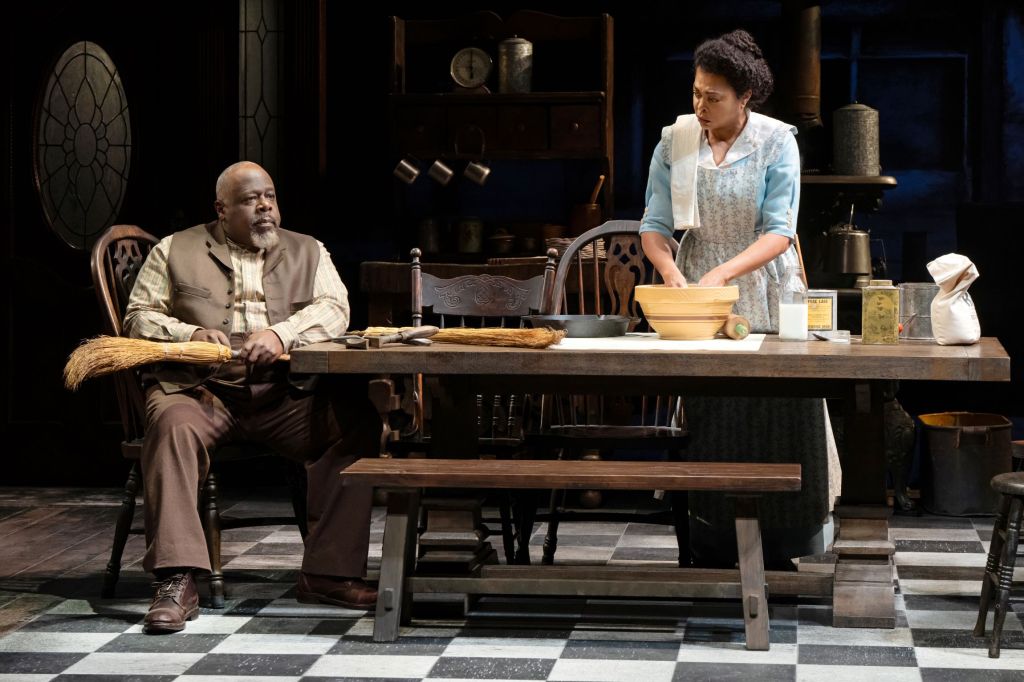
The souls of Black folk hover over the land of the prosperous free in the North, and the oppressed, Black, peonage-dependent, economically impoverished of the South in August Wilson’s Joe Turner’s Come and Gone, currently at the Ethel Barrymore Theatre through July 26, 2026. The revival of Wilson’s second play in his 10-play Pittsburgh Cycle that highlights the Black American experience across each decade of the 20th century is superbly directed by Debbie Allen. The monumental drama stars acting heavyweights Cedric The Entertainer and Taraji P. Henson. Additionally, Wilson scholar, director, playwright and actor, Ruben Santiago-Hudson, takes a bravura acting turn as Bynum Walker, the root worker, spiritual divine and linchpin upon which the play’s action turns. The production is a rare treat striking up powerful emotional resonances as the actors bring home Wilson’s characters in all their heartfelt glory and revelation.
The play’s setting is 1911, Pittsburgh’s Hill District, where the lively, humorous, ersatz, social critic of Black southerners, Seth Holly (Cedric the Entertainer), and his nurturing, “keep-Seth-in-line” wife Bertha (Taraji P. Henson), get along and prosper as best as they can. The solid, 25-year-married couple run a boardinghouse, taking in folks who find their way north from the civil rights negating Jim Crow South. The wanderers include Molly Cunningham (Maya Boyd), Jeremy Furlow (Tripp Taylor), Mattie Campbell (Nimene Sierra Wureh), Herald Loomis (Joshua Boone) and his daughter Zonia (Savannah Commodore the evening I saw the play). The unstated assumption (if you know your history) is that they are compelled by oppression and circumstance to migrate north toward hope and employment opportunity which has been denied them by southern states’ race laws that stripped their rights and returned them to various forms of bondage, especially after Plessy v Ferguson (1896).
Allen’s vision for the play encompasses a stylized reality for the well appointed kitchen and parlor of the large boardinghouse first floor with a long wooden-finished staircase going up to the second floor. Stylized in the background are symbols of bustling industrialization and progress (bridges, buildings, industries) surrounding the Hill district (David Gallow’s set design ) over-shadowing the Holly’s dwelling as reminders of opportunity in the expanding city. With Stacey Derosier’s accompanying lighting design, at times with a sun-setting, many-hued sky, there is a meld of backlit darkening skyline that contrasts with the homely, secure, house interior that provides shelter, comfort and meals to those passing through to another destination.
Wilson familiarizes us with the cultural history of Back Americans with his representative character types who strike out looking to settle into a new form of freedom, seeking to bind their personal progress with the building boom happening in northern cities like Pittsburgh. These wayfarers only alight for a time at the Holly’s, leaving by the play’s conclusion. The exception is Santiago-Hudson’s Bynum Walker, who remains as a long-time boarder and quasi friend of Seth and Bertha, though Seth doesn’t like Bynum’s root working. Seth’s focus on prosperity and getting ahead in life is the antithesis of Bynum’s spiritual perspective. The humorous interplay between the two men represents the tension between the material and spiritual worlds and stirs the forward momentum in the play’s development as we meet Black characters who need physical sustenance and spiritual guidance and wisdom.
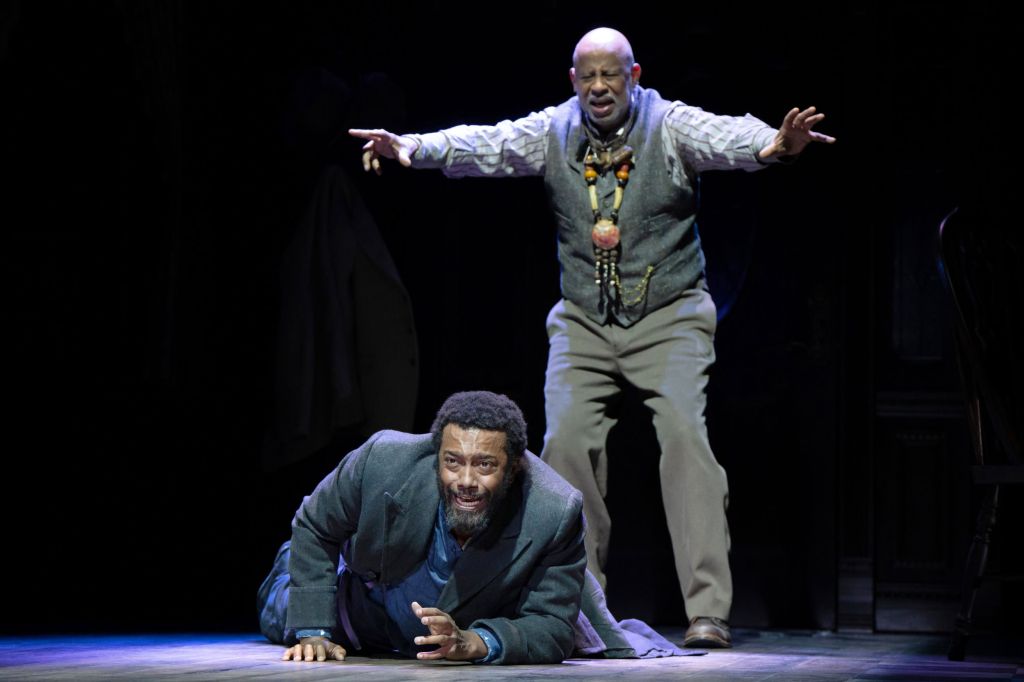
Wilson introduces Bynum’s spiritual import when he shares a story about “finding his song” (his purpose in life), directed to it by a “shiny man” who radiated light and opened Bynum’s understanding about life. Bynum experiences a visitation with his father who had passed, and receives divine wisdom from him. Because of this epiphany, Bynum redefines himself as a “conjure man” who binds people to their “song,” (purpose). Bynum, too, is looking for a new form of freedom, but unlike the others he acutely straddles the material and spiritual worlds and seeks spiritual freedom. He wants to find the “shiny man” again from whom he will receive another revelation. It is Bynum’s ability to perceive the things of the spirit, to negotiate the gap between the physical and spiritual realms, between life and death, that helps a few of the characters on their journey to a new identity in the North.
For each of the characters, the Holly’s is a way station, a symbol of impermanence and financial instability until they can stand on their own. For example, Wureh’s sweet Mattie Campbell seeks help from Santiago-Hudson’s Bynum. He works the roots to help her find her man who dumped her, giving her wise counsel that she may be better off without him. Like a charm she ends up with guitar playing, road construction worker Jeremy, but it doesn’t last when Boyd’s fashionably dressed, elegant Molly shows up, stays a week, and entices Jeremy away from Mattie. The forlorn Mattie can’t stop Jeremy flirting with Molly as Bertha looks on disapprovingly. Eventually, Jeremy dumps Mattie for the haughty Molly, who will probably dump Jeremy for another fellow with more money who can keep her in better style. It seems everyone who stays for a time at the Holly’s is searching, but none more determined than Joshua Boone’s Herald Loomis.
Boone’s sinister, quiet Loomis pays money to the Hollys for room and board for himself and his daughter Zonia. He hopes to find his wife Martha (Abigail Onwunali) who he believes may be in the area. Seth takes his money with suspicion and Bertha treats him and Zonia kindly, but Cedric The Entertainer’s Seth criticizes Loomis behind his back. He wants him to leave as soon as his week is up because he fears trouble. Seth suspects Loomis did some crime and is dangerous. It doesn’t help that the mysterious Loomis says little about himself and doesn’t mingle with the others, though 11-year-old Zonia and young neighbor Reuben Scott (Jackson Edward Davis) become friendly, and she expresses love and faith in her father’s goodness.
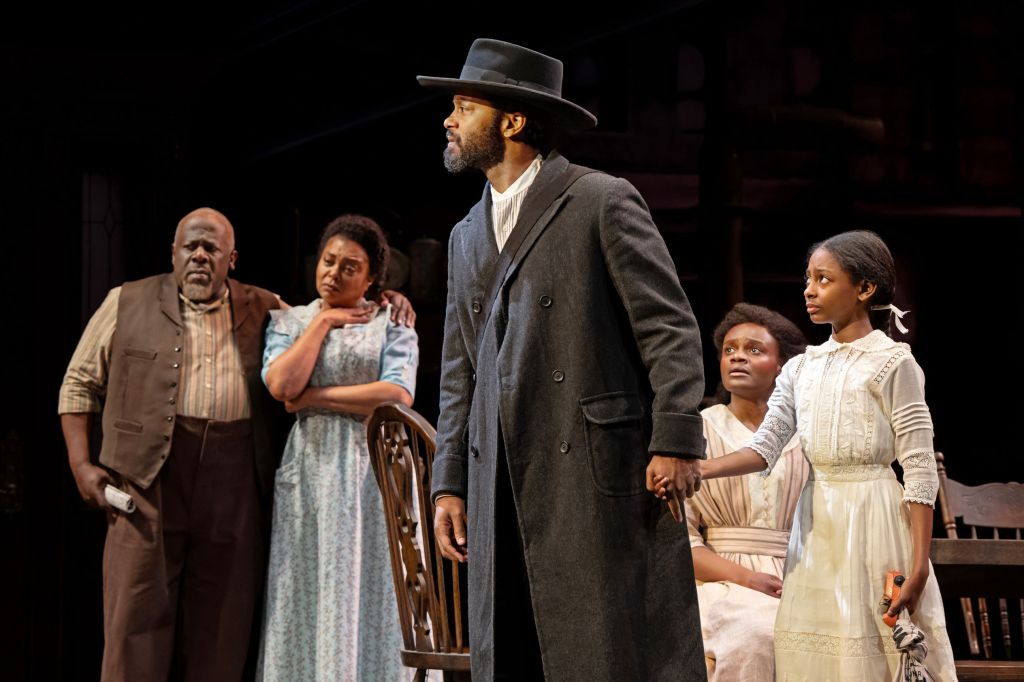
However, the few times Loomis gathers with the others prove to be stressful for him. At the conclusion of Act I, he becomes enraged at the group dancing and chides them about calling the Holy Spirit. As he goes to leave, he has a spiritual revelation that takes him violently as he speaks in tongues. Bynum guides Loomis through his vision. He speaks a metaphoric prophesy about Blacks coming up out of the water in a mighty wave as they receive the breath of new life and stand on their own and walk away on various roads. However, Loomis struggles to get up and is unable to stand and join the others as the lights dim ending the act.
Allen’s mesmerizing scene is dynamic and moving. The dramatic portrayals by Santiago-Hudson and Boone keep one spellbound, drawn to Loomis’ prophecy as the scene ends at a high point of revelation. Loomis sees the impact of the Black migration as a wave that covers the land, but he is unable to join it. His legs are too paralyzed to get up and walk. Why?
In Act II Seth questions Loomis’ claims to be a church deacon, convinced he’s “not right.” When he tries to get Loomis to leave, Loomis reminds Seth of the money he paid for the second week. Loomis must wait for Rutherford Selig (Bradley Stryker) a people finder, who will bring him word of his wife Martha. Seth, who is frightened and annoyed about Loomis’ spiritual “carrying on” intends to throw him out. Only Bertha can calm him down. Meanwhile, Loomis’ prophecy unfolds as Molly and Jeremy take off and Loomis shows an interest in Mattie.
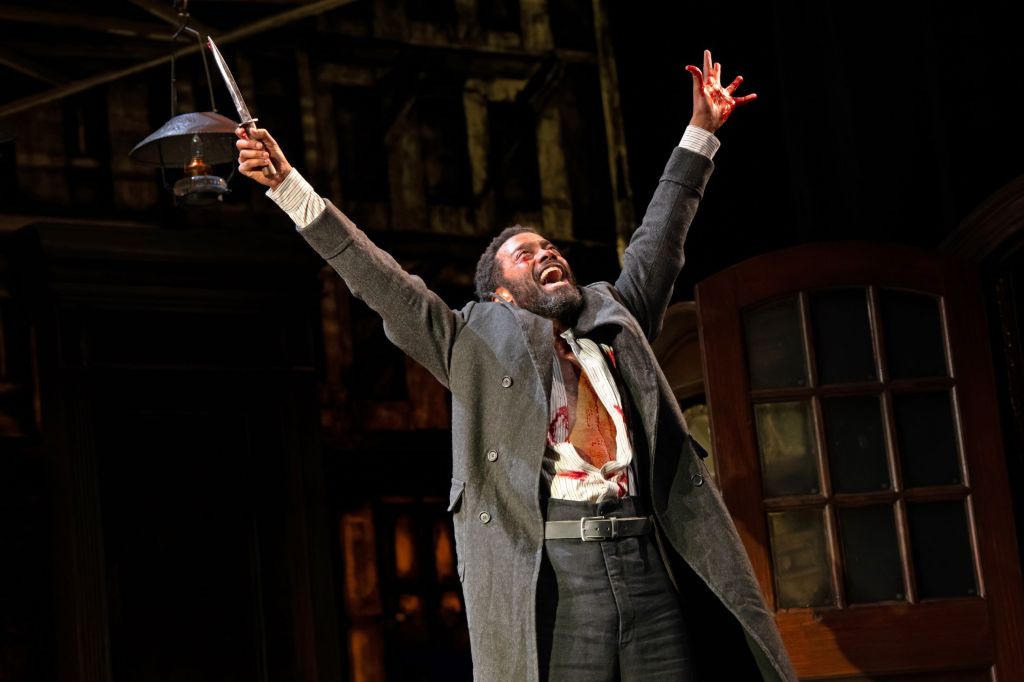
By degrees Wilson converges Seth’s truth that something isn’t right about Loomis with Bynum’s spiritual sensitivity about the former deacon. When Loomis flips out hearing Bynum sing “Joe Turner’s Come and Gone,”Bynum confronts Loomis about being “one of Joe Turner’s ni$$ers.” The lyrics relate to the disappearance of Black men kidnapped for the peonage system (which was supposedly illegal, but whose law was not enforced until the 1940s). When they didn’t return home, family or friends would say, “Joe Turner’s come and gone.”
Bynum’s sensitivity and second sight is spot on. Boone’s Loomis reveals the story about himself, Zonia and Martha. We learn that Loomis was snatched up off the streets (kidnapped illegally) by Joe Turner, the Tennessee governor’s greedy brother who had Black men charged for any pretext (walking on the wrong side of the street) to force them onto a chain gang without due process to pay off their “crime/debts.” Most probably Joe Turner gets kick backs for his Black labor supply, who do not resist or do so at their own peril. Loomis was in bondage/slavery for seven years, while his baby daughter grew up with his mother until he was freed to go to her.
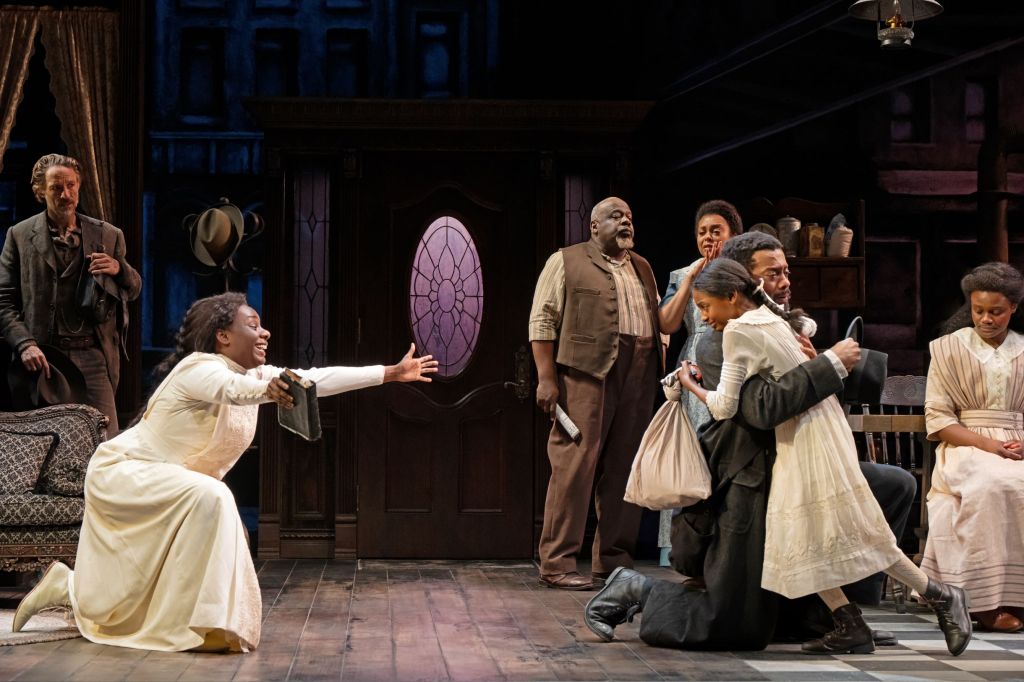
Loomis’ story is tragic. He not only loses his wife, position in the church and happy family life, he loses his dignity, humanity, freedom and person-hood. Worse, he is robbed by Joe Turner of his self-love and peace. However, Bynum tells him that there is something the racist could never rob him of, which plants a seed of hope that comes in handy when Looms meets Onwunali’s Martha.
What emerges is beautifully acted by Boone, Santiago-Hudson, Onwuali and the ensemble in a final scene. It is the play’s central theme about the trauma of racial hatred, the brutality and inhumanity of Jim Crow’s hell and the soul damage it causes. Is one able to recover, stand up and walk away from that physical, emotional and spiritual torment, or is one paralyzed by the hatred and abuse for life? Will Loomis be an angel or a devil, as he confronts Martha which he does in the last scene, suspended between heaven and hell, bondage and freedom, life and death?
Joe Turner’s Come and Gone runs 2 hours 20 minutes through July 26, 2026 at the Barrymore Theater, Manhattan; joeturnerbway.com..
Phylicia Rashad, Brandon J. Dirden in ‘Skeleton Crew,’ Workers vs. Corporates, a Worthy Fight at Manhattan Theatre Club

From the symbolic and representative opening salvos of gyrating piston Adesola Osakalumi, whose break dancing suggests the automation which is rendering the human scaling at the auto-stamping factory obsolete, to the well-hewn set by Michael Carnahan (the dusty, run-down, cold, shabby staff room where employees enjoy down-time) we understand that the four person skeleton crew in the Detroit plant will be ghosted as soon as budgetary financial reckonings are made by upper management. This is 2008 Detroit, US during the economic mortgage mess when investment bank Bear Stearns collapses and is bought over by JPMorgan Chase and Lehman’s a 150-year old booming institution goes belly up. People are losing their homes and living in their cars and cheesy motels in Florida. And, it is worse in Detroit whose booming success of the 1960s is a bust by the 1990s and there’s one plant left that is barely churning out product.
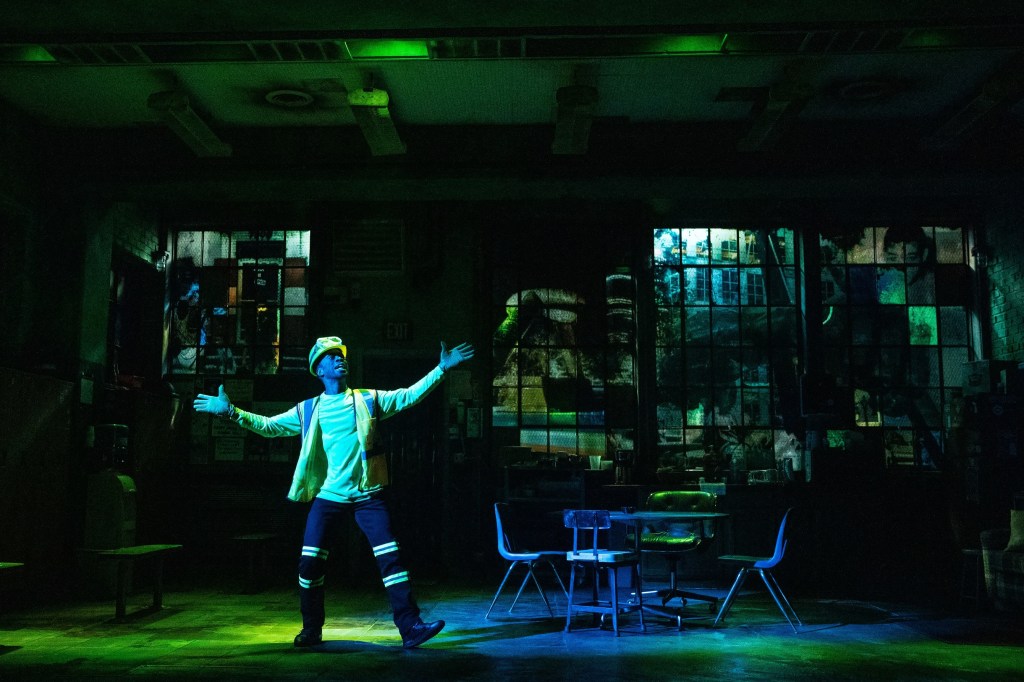
Skeleton Crew directed by the superb Tony Award® winner Ruben Santiago-Hudson, currently in revival at Manhattan Theatre Club after its intimate presentation Off Broadway at the Atlantic six years ago, hints at the tour de force Dominique Morisseau meant the last segment of her Detroit Project to be. The trilogy (The Detroit Project) is about Detroit’s life and times before and after the Reagan outsourcing debacle toppled the city from its glory as the country’s industrial fountain of youth. It includes Detroit-’67, Paradise Blue and Skeleton Crew.
The play has been given a glossy uplift using video projections of the robotic machinery of the assembly line etc. (excellent design by Nicholas Hussong). Coupled with the music (Rob Kaplowitz’s original music & sound design, and Jimmy Keys’ original music & lyrics) at the beginning and between salient scenes, we note the encroaching modernized doom that hammers the employee work force into unrecognizable bits, hyper-downsized from its greatness when Detroit was in its manufacturing heyday. The digital video projections supplant proscenium curtains which would normally frame the stage. As such, the plant’s relentless, driving automation is the outer frame of the stage and encapsulates the action and interactions in the staff room where workers take their breaks from the repetitive and monotonous production line.

The contrast Morisseau’s dualism creates is trenchantly thematic. The defined “wasted, decrepit humans” are pitted against inevitable “progress” which especially grinds down the people whose loyalty and dedication to the industry have been turned against them. These management diminished unfortunates, like Faye (Tony Award® winner Phylicia Rashad) whose once magnificent efforts are discounted as “unprofitable,” didn’t see the “handwriting on the wall” to prepare for another career after working for the company 29 years in the hope of getting a “great” retirement package. Faye and others trusted the corporates to have their best interests and welfare at heart.
As Morisseau indicates in her characterization of Faye, stand-up employees projected their worthiness, values and integrity on their slimy directors and CEOs, mistakenly assuming they would be rewarded for hard work and effort. Ironically, it is the elite corporates who are the unworthy, lazy, greedy, un-Americans who made America “un-great” through Reagan’s tax laws that allowed them to outsource profits by closing plants and establishing factories anywhere but the United States.

In view of the current debacle with supply chain issues, inflation and absence or overpricing of medical product needed to fight the ongoing health disaster (COVID-2022) which incompetent, do-nothing Republicans have fueled as a political stratagem, Skeleton Crew‘s themes are profound and incredibly current. The problems fourteen years later from the setting (2008, Detroit) are even worse with expanding economic inequality, oppression of the workforce, whether white or blue-collar, by oligarchic elites herding the intellectually infirm white supremacists with misdirection against the democratic institutions that could save them. The seeds of the current destructive forces are evidenced in Morisseau’s setting with the ghosting of Detroit’s last automotive plant where supervisor Reggie (the wonderful Brandon J. Dirden) Union Representative Faye (Phylicia Rashad) the energetic Dez (Joshua Boone) and the pregnant Shanita (the excellent Chanté Adams) work and stress out with each other in unity.
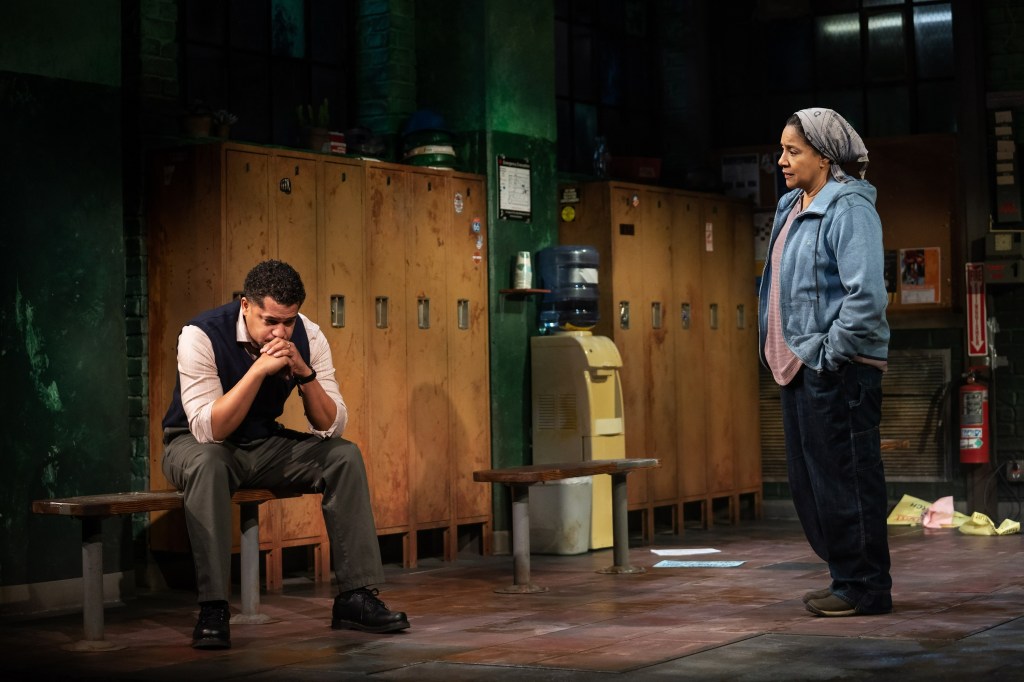
Within this framework we follow the devolution and evolution of these four who signify Morisseau’s special individuals who are the backbone of the nation. It is these who the elites would erase. Their ability to hope and thrive is sorely tested against the annihilating backdrop of demeaning corporate abuse which demands personal strength and communal support to over-leap it. With Morisseau it’s the people vs. “the corporate machine,” and as Morisseau spins the conflicts caused by the plant closure, personal self-destruction or revitalization are the direction for Faye, Dez, Shanita and Reggie, who prove to be likeable working class heroes with huge cracks and flaws that we recognize in ourselves.
Reggie who has been practically raised by Faye as family-she got him the position where he rose to management-is pressured and strained. He’s forced to walk a fine line, knowing what his bosses plan to do. Yet he must not tip their hand which would panic the workforce to strike or leave before the current contracted work is completed. Oppressed to enforce nit-picking rules, Reggie argues with Dez who may or may not be stealing and who sees him as a cold-hearted puppet of corporate.
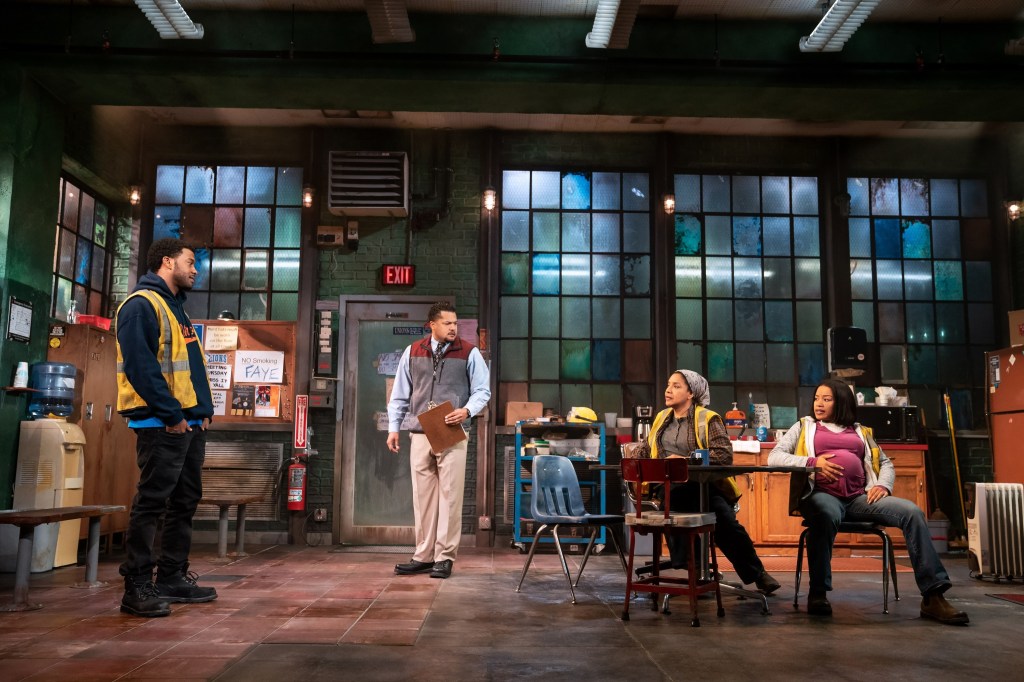
Likewise Reggie emotionally wrestles with Faye who must protect her union workers and herself deciding whether to retire early, which would mean an income loss after retirement. Shanita is pressured emotionally after she is dumped by her baby’s father. She faces being the sole support of her child. She enjoys working at the plant, though she’s a cog in the wheel, but she feels proud for her contribution to making product. Nevertheless, she is strained working and bearing up with her pregnancy, making doctor’s appointments and saving up money before and after she takes time off from the job she loves.
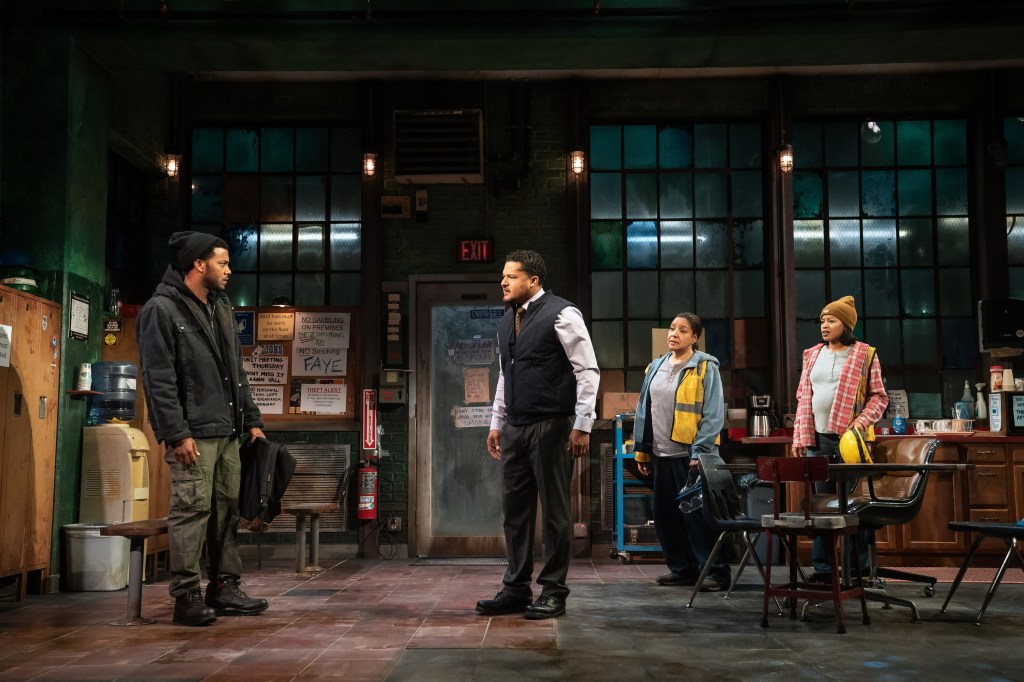
Morisseau excavates each of their struggles with authentic dialogue that is at times humorous, and powerful/poetic as the characters present their positions. Importantly, the playwright extends the reality of what it is to hold a decent job with benefits that is being pulled out from under the worker because the owners’ obscene profits aren’t big enough and government isn’t holding them to account. Thus, as the play progresses and we understand each of the characters’ dreams, we credit Dez for attempting to start his own business with friends, and we hope for Shanita’s child, in light of the nightmares she’s having over the uncertainty of her future. Additionally, we understand Reggie’s position though we expect him to stop his haranguing of the others and stand up to his bosses. We are thrilled when he finally does.

Interestingly, Faye, who appears to be the most solid and reliable is confronting her own devastation in addition to the cancer remission she is going through. Morisseau gradually unfolds each of the characters’ issues and at the end of Act I brings Dez and Reggie’s relationship to a turning point where Dez is about to be fired. When Faye steps in and counsels Reggie to stand up for Dez and the other workers, we question whether Reggie has the guts to or whether he will be a sell-out. The irony is Faye is great at negotiating and encouraging others, but she is lousy at taking care of herself. The revelation of this is poignant, and Morisseau opts to make every audience member put themselves in Faye’s shoes as she, too, “walks the line” between wanting to live or just throw in the towel and give up.

This is a strong ensemble piece and the acting is finely wrought. Unfortunately, some of the humor was lost on me because the actors weren’t always projecting in the cavernous space of the theater. Please actors, project and enunciate! Nevertheless, the passion and presence of Phylicia Rashad along with her counterpoint Brandon J. Dirden was heartfelt. The relationship they create reveals bonds that run deep into love and sacrifice. And the surprising relationship that blossoms between Boone’s Dez and Adams Shanita is beautifully effected by their graded, nuanced performances.
Ruben Santiago-Hudson understands Morisseau’s themes down to his soul’s bone marrow. The play’s visual elements represent the most vital of her themes and the characters are ourselves. We cannot help but be concerned for the conflicts the play presents which seem everpresent and unchanging. The current administration’s hope to “Build Back Better” during this time would appear to rectify the external circumstances of such characters who jump off the stage at us and populate our society. But the same corporate structure that Reggie fights is so entrenched, that soul progress is for the little people, these who are Morisseau’s besties. Perhaps that is the consolation. As for the corporate elites? As Reggie and Dez intimate, they are they’re own soul destruction. And that too is its own tragic consolation.
Kudos to the technical team mentioned above and Emilio Sosa’s costume design, Rui Rita’s lighting design, Adesola Osakalumi’s choreography and Cookie Jordan’s hair and wig design.
Morisseau’s play is dynamite in the hands of Hudson the artistic/technical team and these superb actors. This is a must-see. For tickets and times go to their website: https://www.manhattantheatreclub.com/shows/2021-22-season/skeleton-crew/

