Blog Archives
‘Irishtown,’ a Rip-Roaring Farce Starring Kate Burton

Irishtown
In the hilarious, briskly paced Irishtown, written by Ciara Elizabeth Smyth, and directed for maximum laughs by Nicola Murphy Dubey, the audience is treated to the antics of the successful Dublin-based theatre company, Irishtown Plasyers, as they prepare for their upcoming Broadway opening. According to director Nicola Murphy Dubey, the play “deals with the commodification of culture, consent and the growing pains that come with change.”
Irishhtown is also a send up of theatre-making and how “political correctness” constrains it, as it satirizes the sexual relationships that occur without restraint, in spite of it. This LOL production twits itself and raises some vital questions about theater processes. Presented as a world premiere at Irish Repertory Theatre, Irishtown runs until May 25, 2025. Because it is that good, and a must-see, it should receive an extension.
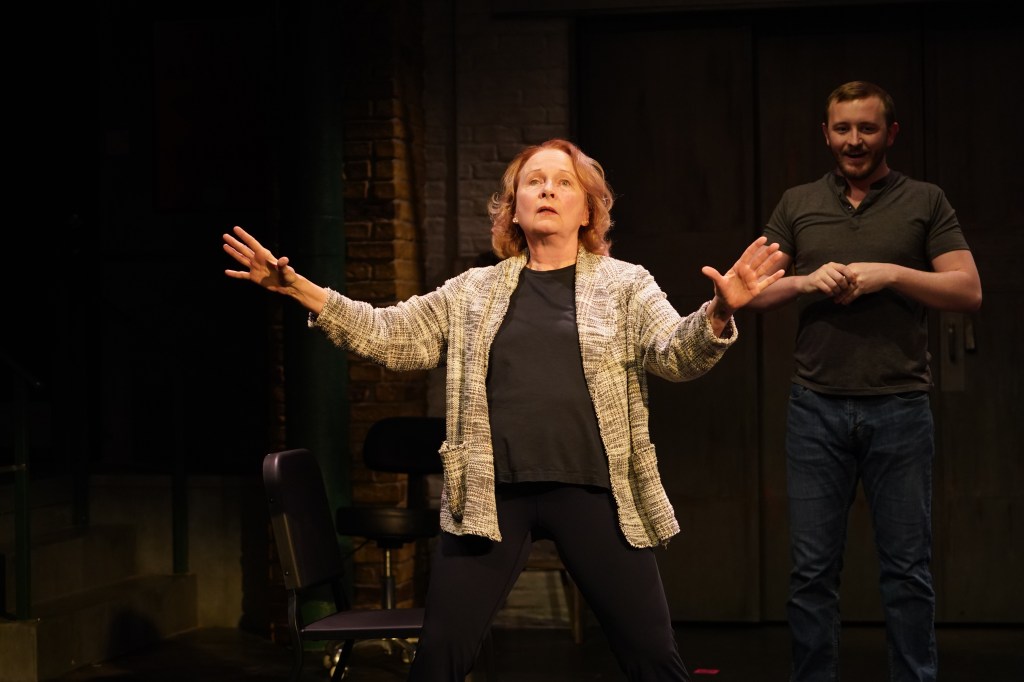
The luminous Kate Burton heads up the cast
Tony and Emmy-nominated Kate Burton heads up the cast as Constance. Burton is luminous and funny as the understated diva, who has years of experience and knows the inside gossip about the play’s director, Poppy (the excellent Angela Reed). Apparently, Poppy was banned from the Royal Shakespeare Company for untoward sexual behavior with actors. Burton, who is smashing throughout, has some of the funniest lines which she delivers in a spot-on, authentic, full throttle performance. She is particularly riotous when Constance takes umbrage with Poppy, who in one instance, addresses the cast as “lads,” trying to corral her actors to “be quiet” and return to the business of writing a play.
What? Since when do actors write their own play days before their New York City debut? Since they have no choice but to soldier on and just do it.

The Irishtown Players become upended by roiling undercurrents among the cast, the playwright, and director. Sexual liaisons have formed. Political correctness didn’t stop the nervous, stressed-out playwright Aisling (the versatile Brenda Meaney), from sexually partnering up with beautiful lead actress Síofra (the excellent Saoirse-Monica Jackson). We learn about this intrigue when Síofra guiltily defends her relationship with the playwright, bragging to Constance about her acting chops. As the actor with the most experience about how these “things” work in the industry, Constance ironically assures Síofra that she obviously is a good actress and was selected for that reason alone and not for her willingness to have an affair with Aisling.
Eventually, the truth clarifies and the situation worsens
Eventually, the whole truth clarifies. The rehearsals become prickly as the actors discuss whether Aisling’s play needs rewrites, something which Quin (the fine Kevin Oliver Lynch), encourages, especially after Aisling says the play’s setting is Hertfordshire. As the tensions increase between Quinn and Aisling over the incongruities of how an Irish play can take place in England, Constance stumbles upon another sexual intrigue when no one is supposed to be in the rehearsal room. Constance witnesses Síofra’s “acting chops,” as she lustily makes out with Poppy. This unwanted complication of Síofra cheating on Aisling eventually explodes into an imbroglio. To save face from Síofra’s betrayal and remove herself from the cast’s issues with the play’s questionable “Irishness,” Aisling quits.
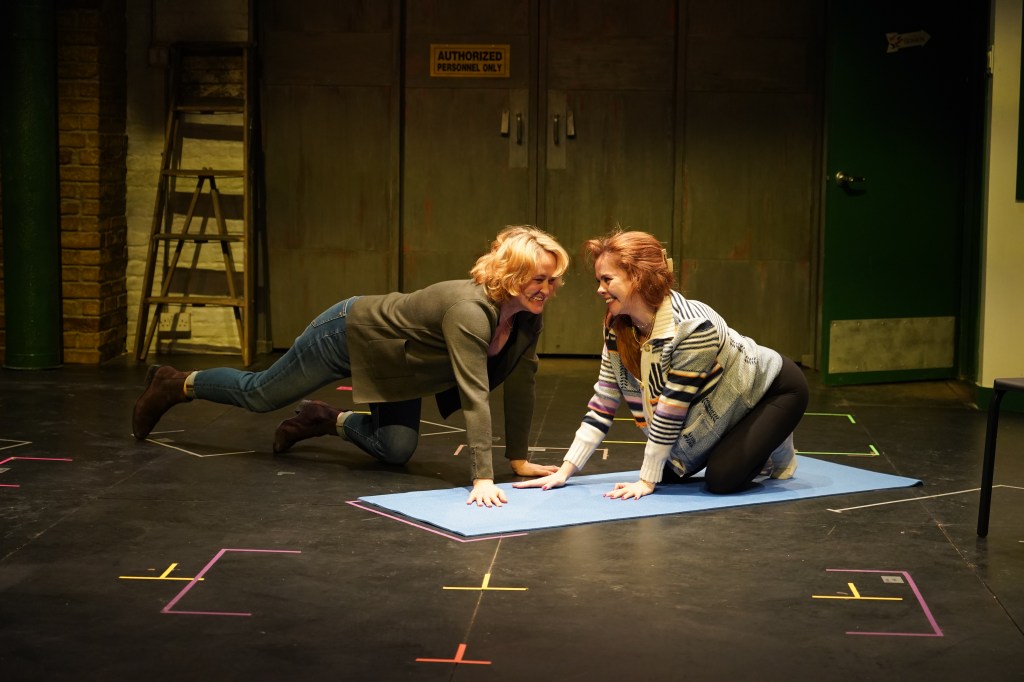
Enraged, the playwright tells Síofra to find other living arrangements. Then, she tells the cast and director she is pulling the play from the performance schedule. This is an acute problem because the producers expect the play to go on in two weeks. The company’s hotel accommodation has been arranged, and they are scheduled to leave on their flight to New York City in one week. They’re screwed. Aisling is not receptive to apologies.
What is in a typical Irish play: dead babies? incest? ghosts?
Ingeniously, the actors try to solve the problem of performing no play by writing their own. Meanwhile, Poppy answers phone calls from American producer McCabe (voice over by Roger Clark). Poppy cheerily strings along McCabe, affirming that Aisling’s play rehearsals are going well. Play? With “stream of consciousness” discussions and a white board to write down their ideas, they attempt to create a play to substitute for Aisling’s, a pure, Irish play, based on all the elements found in Irish plays from time immemorial to the present. As a playwright twitting herself about her own play, Smyth’s concept is riotous.
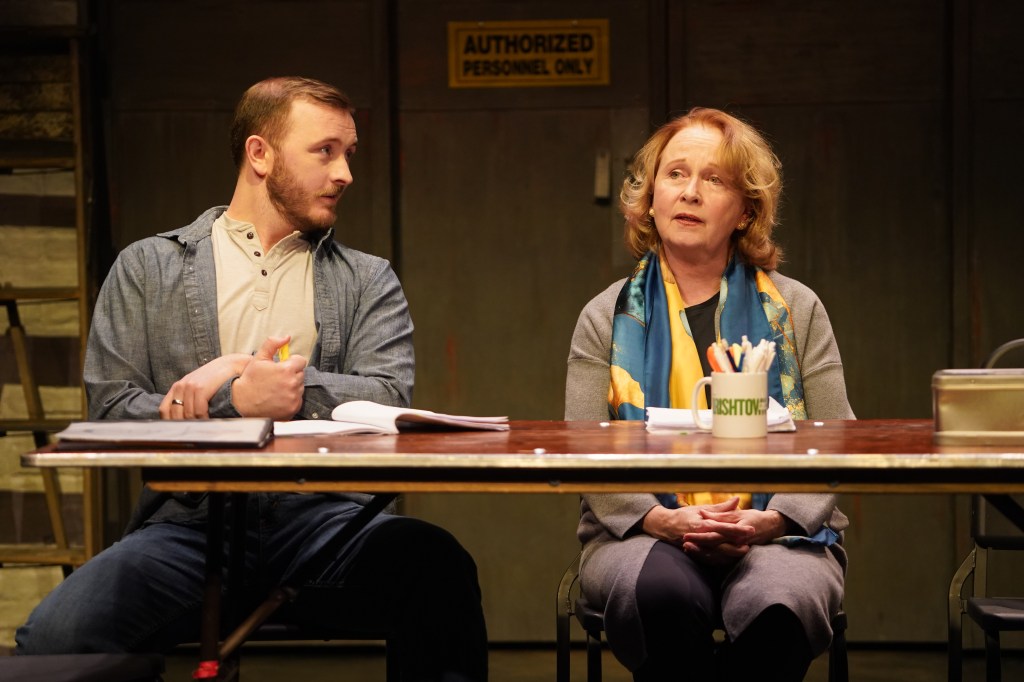
The actors discover writing an Irish play is easier said than done. They are not playwrights. Regardless of how exceptional a playwright may be, it’s impossible to write a winning play in two days. And there’s another conundrum. Typical Irish plays have no happy endings. Unfortunately, the producers like Aisling’s play because it has a happy ending. What to do?
Perfect Irish storylines
In some of the most hilarious dialogue and direction of the play, we enjoy how Constance, Síofra and Quin devise their “perfect Irish storylines,” beginning with initial stock characters and dialogue, adding costumes and props taken from the back room. Their three attempts allude to other plays they’ve done. One hysterical attempt uses the flour scene from Dancing at Lughnasa. Each attempt turns into funny scenes that are near parodies of moments in the plays referenced. However, they fail because in one particular aspect, their plots touch upon the subject of Aisling’s play. This could result in an accusation of plagiarism. But without a play, they will have to renege on the contract they signed, leaving them liable to refund the advance of $250,000.

As their problems augment, the wild-eyed Aisling returns to attempt violence and revenge. During the chaotic upheaval, a mystery becomes exposed that explains the antipathy and rivalry between Quin and Aisling. The revelation is ironic, and surprising with an exceptional twist.
Irishtown is not to be missed
Irishtown is a breath of fresh air with laughs galore. It reveals the other side of theater, and shows how producing original, new work is “darn difficult,” especially when commercial risks must be borne with a grin and a grimace. As director Nicola Murphy Dubey suggests, “Creative processes can be fragile spaces.” With humor the playwright champions this concept throughout her funny, dark, ironic comedy that also is profound.
Kudos to the cracker-jack ensemble work of the actors. Praise goes to the creatives Colm McNally (scenic & lighting design), Orla Long (costume design), Caroline Eng (sound design).
Irishtown runs 90 minutes with no intermission at Irish Repertory Theatre, 132 West 22nd St. It closes May 25, 2025. https://irishrep.org/tickets/
‘Little Gem’ Starring Marsha Mason at the Irish Repertory Theatre

Marsha Mason in ‘Little Gem,’ directed by Marc Atkinson Borrull, written y Elaine Murphy at the Irish Repertory (Carol Rosegg)
Little Gem starring the wonderful Marsha Mason at the Irish Repertory Theatre is a poignant and comedic look at three generations of women from North Inner City Dublin. We follow along as the grandmother, daughter and granddaughter share their experiences, responses and perspectives at major turning points in their lives. Each tells their tale in six separate segments precipitated by a visit to the doctor’s office. In the final segment, the women, having gone through their own personal cataclysms, rally around the comfort of each other and sleep in the same bed, reunited in love and understanding.
The play written by Elaine Murphy premiered at the Dublin Fringe Festival in 2008, where it won the Fishamble New Writing Award before transferring to the Edinburgh Fringe Festival. This production directed by Marc Atkinson Borrull is essentially a solo tour de force for each character/actor. The only interaction among the characters occurs in the last segment. Only then do we see grandmother Kay (Marsha Mason is powerful, heartfelt and funny) daughter Lorraine (Brenda Meaney is ironic and nuanced) and Lauren O’Leary as the wise-cracking, sharp-tonged Amber relate to each other directly.
During the production, we listen to the narration of each woman separately. We revisit how each is at a different stage in her life (symbolic of women in general at different ages in their lives). We understand how she experiences the physical and emotional desires of needing and wanting to be in a relationship with someone who will care for her. And we note how each negotiates the wheel and woe of their personal relationships.

Lauren O’Leary, ‘Little Gem,’ by Elaine Murphy, directed by Marc Atkinson Borrull (Carol Rosegg)
The women relate their stories in flashback in direct addresses to the audience. Initially, we discover the superficial reasons why they are in a doctor’s office. Amber has indigestion and throws up frequently in the mornings. Lorraine is emotionally mottled with stress and needs medications to calm her and resettle her life. Kay has a “personal itch down there.”
As the production unfolds the women by degrees go into their reveals during their story-telling turns with the youngest generation first, simulating the arc of life’s beginning. The forty-something Lorraine represents the middle stage of life and the sixty-something Kay represents the senior years. As they each address the audience, we understand the depth of their angst as they relate how their situations become the touchstones of their growth and realizations. The progression is an interesting one and thematically reminds us of the innocence and naiveté of youth (the fecund period) the transformation into recognizing deeper values in life and the winding down into menopause, and the increased sexual libido that often occurs for older women long after they’ve thrown off the aftereffects of child rearing.

Brenda Meaney, ‘Little Gem,’ by Elaine Murphy, directed by Marc Atkinson Borrull (Carol Rosegg)
In six segments Amber discusses the events with Paul which brought her to the doctor to help her during her pregnancy and afterward as she takes care of baby Jamie and he is accepted into the family. We discover how Lorraine’s stress precipitated by her lack of communication with Amber and worry centered around Amber’s sometimes wild behavior (like mother, like daughter) is somewhat mitigated when she follows her therapist’s suggestions to “get out of herself” and her miseries and goes dancing. After she meets someone, with Amber’s encouragement she goes on a date with him in what becomes a developing relationship.
At the doctor’s office Kay receives “the ok” to have sex without Little Gem who is too debilitated and ill to continue their fabulous sex life. She will do this via the help of a vibrator. Indeed, the scene when Mason effects this is one of the funniest in the play. And as Little Gem fades from this life and moves into the next, at the grave she grieves her husband and in the last scene of the play seeks the comfort of her daughter and granddaughter.
Elaine Murphy’s work is strongest in the concept of revelation and self-recognition and growth that occurs in each of the women’s lives. However, the playwright decides to keep the play largely expositional. This dissipates the drama that occurs in the family dynamic. We note the underlying levels of action, however they are reported; an example of this occurs when Lorraine discusses that she doesn’t communicate with her daughter. However, we never see the characters Lorraine and Amber demonstrate how or when this occurs actively. Likewise, the characters may talk about a family member who stands next to them, but there is no active dialogue or exchange between and among each of the characters until the end. The strongest exchange occurs only then when they get into bed after Little Gem dies and they comfort Kay to reveal they unite as a family.

(L to R): Marsha Mason, Lauren Oleary, Brenda Meaney, ‘Little Gem,’ by Elaine Murphy, directed by Marc Atkinson Borrull (Carol Rosegg)
For me any related emotional power and inherent possibility of empathy falls short with the playwright’s selection of this expositional structure predominately. Would the play have worked more dramatically and humorously with different staging and lighting as each woman takes a darkened stage stepping into the spotlight and sharing the import of her story? Somehow, the office setting was a banal distraction. Or was this the point since the women are vibrant and we are transfixed at various times during their revelations?
The actors stand out because through them, their characters’ stories are exposed. They remind all of us that we have a story to tell and it is representational and unique for our time and place. Meaney, O’Leary and Mason engage and keep us launched into remembering what has occurred previously. We must figure out how related events have bled into the current segments of their narration as they detail the specifics: Lorraine’s difficulties with her daughter, Amber’s difficulties with Paul after he discovers she’s pregnant, Little Gem’s sickness and dying. We become the catch-basin for all of their humorous/poignant story events. These are peaked with the tragicomedy of Amber’s, Lorraine’s and Kay’s feminine perspectives of their middle class lives which include the prickly narrative of their relationships: Amber’s reports of sometime boyfriend Paul, Lorraine’s report of a poignant conversation with junkie ex-husband Ray, and Kay’s explanation of her role as caretaker during Little Gem’s frustrating illness and heartbreaking death.
Little Gem is a portrait of women during crisis and the ways they look for the humor and uplift during the rough patches of life. The audience partners with them as we listen to their troubles like a good friend or neighbor. And in the telling of their stories there is the release, growth and hope that in the family all will be well as the next generation adds to the flavor of their future. And so it goes for us as well.
Little Gem is in a revival in New York from a run in 2010 and is in a limited engagement through 1 September. For tickets and times at the Irish Rep website CLICK HERE.
 CAROLE DI TOSTI