Blog Archives
Casey Likes, Lorna Courtney are Terrific in ‘Heathers The Musical’
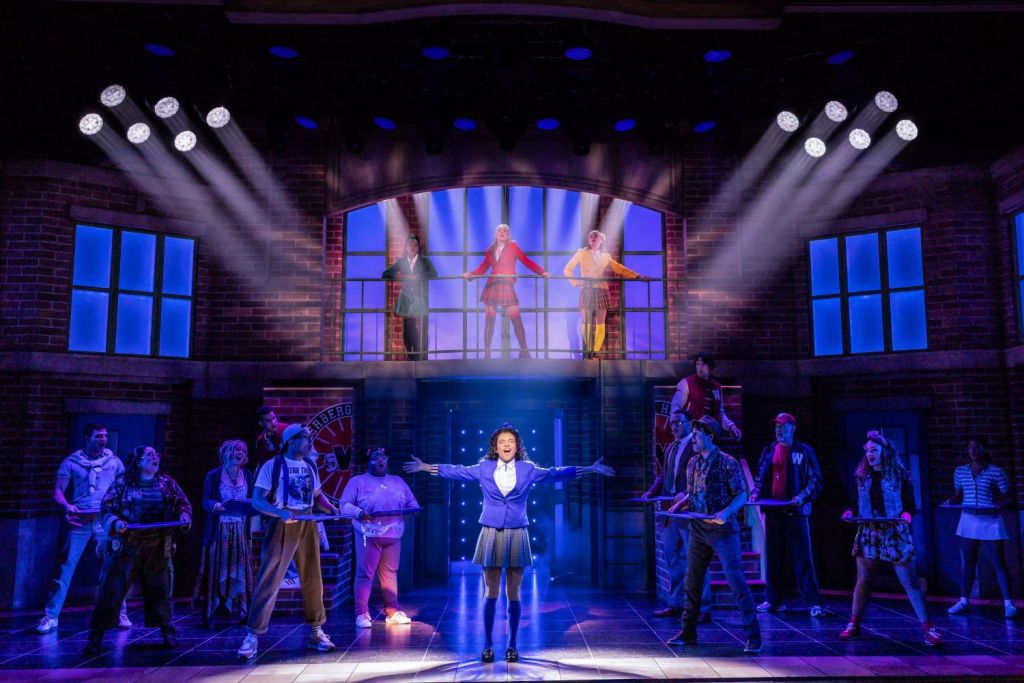
Heathers the Musical
Currently in revival, Heathers The Musial, based on the cult classic film Heathers (1988), written by Daniel Waters, has rocketed onto New World Stages with fans screaming in delight. The production with book, music and lyrics by Kevin Murphy and Laurence O’Keefe first opened at the same Off-Broadway venue in 2014 with Andy Fickman directing. However, O’Keefe and Murphy continually reworked the production honing it to a fine brilliance during the last decade. Most recently in a limited engagement in the West End, it finally transferred to New World Stages. There, it has been extended until January 25, 2026 for good reason.
The 2025 version incorporates changes, including new songs, created in the intervening decade. The concept and subject matter appeals because the sardonic musical comedy satirizes the cruel power dynamics prevalent in high schools across America. Unless one is a part of the ruling elite and finds popularity and favor, the typical high school social machine grinds you up as trash. Admittedly, each high school has its own peculiar “selektion process” of those who “matter,” and those who “don’t.”
How do communities fight this? In a backlash, one character’s notion to purge the toxicity is to “burn everything down.” However, exchanging one form of hatred, nihilism and supremacy for another can create a never-ending cycle of retribution as the musical indicates. Can anything be done?
In its latest version this terrific, complex production asks and answers these questions. Additionally the top notch performances, music (Will Joy), choreography, (Gary Lloyd, Stephanie Klemons), Andy Fickman’s direction and the design elements cohere with near perfect unity to present an overall message. Despite the darkness present in all of us, our humanity has a softer side. We have only to manifest it with courage in the face of bigotry.
The musical opens as narrator/diarist Veronica Sawyer (the amazing Lorna Courtney) considers the negative transformations her classmates have gone through since kindergarten (“Beautiful”). Brainy, misfit Veronica is a senior at Westerberg High in1989, Ohio. Though Veronica believes herself to be a good person (she befriended uncool Martha Dunnstock {Erin Morton}), she must navigate around her classmates who welcome each other with the insults, “FREAK! SLUT! LOSER! SHORT BUS! BULL-DYKE! STUCK-UP! HUNCHBACK!”
Though Veronica blames this toxicity on their growing up and losing their innocence, we wonder if anyone in authority can rein in the students’ brutality toward each other? Therein lies one conflict. Of course the power dynamic is sub rosa. Because students maintain its secrecy, clueless parents and teachers like Ms. Fleming (Kerry Butler), don’t satisfactorily deal with the horrible social culture. Thus, nothing changes.
It is precisely because those in authority can’t influence the students that the three “Heathers” (McKenzie Kurtz, Kiara Lee covered for Oliva Hardy when I saw the show, and Elizabeth Teeter) rule with ferocity (“Candy Store”). In order to lift up their own status, the Heathers make everyone else feel worthless. Ironically, the students electrify the Heathers’ power grid because they fear their wrath and retribution. What would happen if they didn’t bow to Queen Heather Chandler?
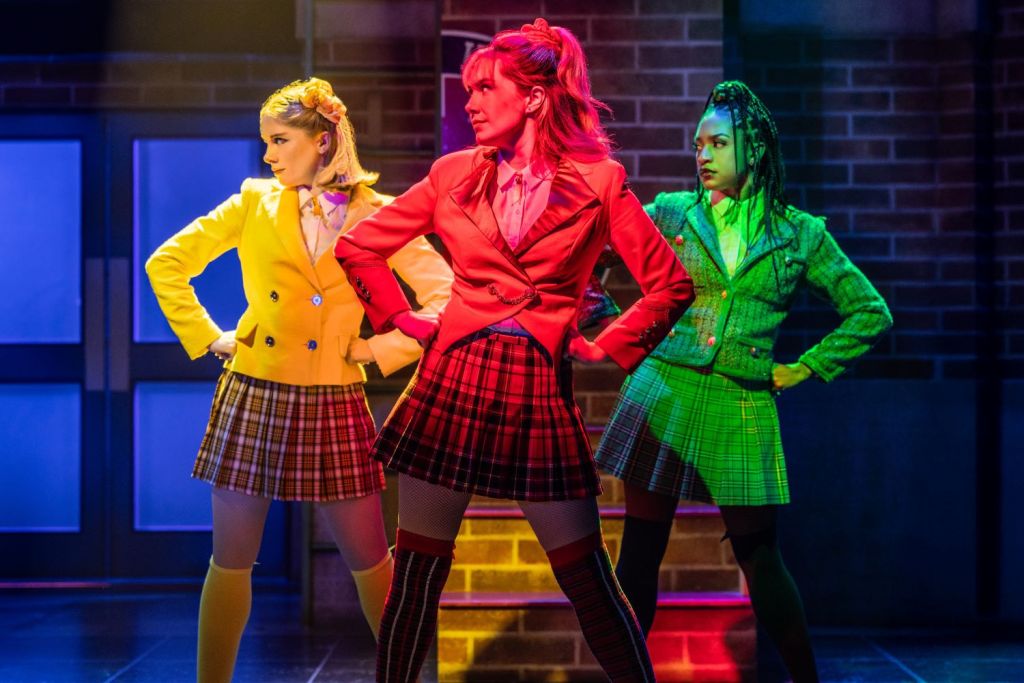
The situation looks up for Veronica when she uses her talent for forgery to save the Heathers from detention. As a result they take her under their wing, give her a make-over and lift her status to “beautiful.” However, she must set up her friend Martha for a grand humiliation at an upcoming party (“Big Fun”) to maintain her popularity.
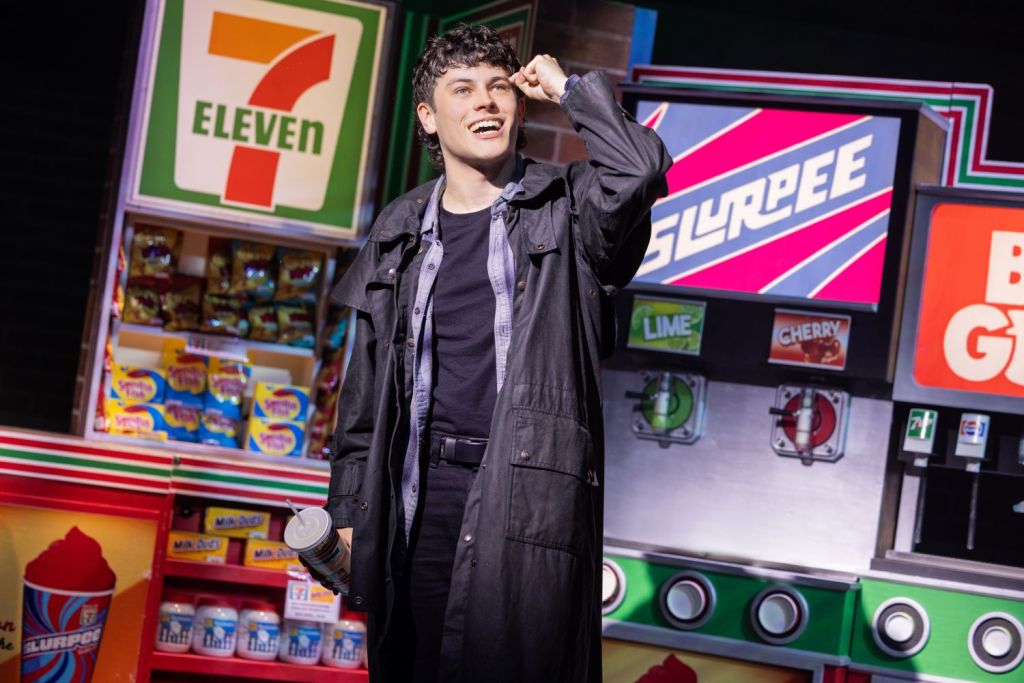
In a counter punch to stop the Heathers’ obnoxious reign of terror, the new student J.D. (the superb Casey Likes) provides another perspective. He criticizes Veronica for selling out Martha to the, “Swatch-dogs and Diet-Cokeheads.” Likes’ JD, dressed in a trench coat and dripping charisma and courage dazzles, a rebel against the stifling social order.
Because JD, stands up to popular jocks, Ram Sweeney (Xavier McKinnon) and Kurt Kelly (Code Ostermeyer), Veronica becomes interested in him (“Fight For Me”). They form an attachment (“Freeze Your Brain”), and J.D. helps Veronica avoid becoming the “laughing stock” of the school (“Dead Girl Walking”). However, Veronica’s innocent plan to apologize to Heather Chandler for throwing up on her outfit backfires. Mistakenly, Veronica gives Heather the wrong cup filled with drain cleaner (JD’s instigation), instead of the cup with her usual prairie oyster hangover cure.
This unexpected twist brings Veronica and JD closer. But their love relationship fueled by a conspiratorial cover-up of Heather’s death leads to more diabolical behavior. With JD’s help Veronica forges a suicide note imitating Heather’s handwriting. The clever, ironic lyrics to dead Heather’s suicide note, in “The Me Inside of Me,” resonate hysterically. (“No one thinks a pretty girl has substance. I am more than just a source of handjobs. No one sees the me inside of me.”) Easily duped, despite Chandler’s horrible nature, the school community believes in her vulnerability and unhappiness.
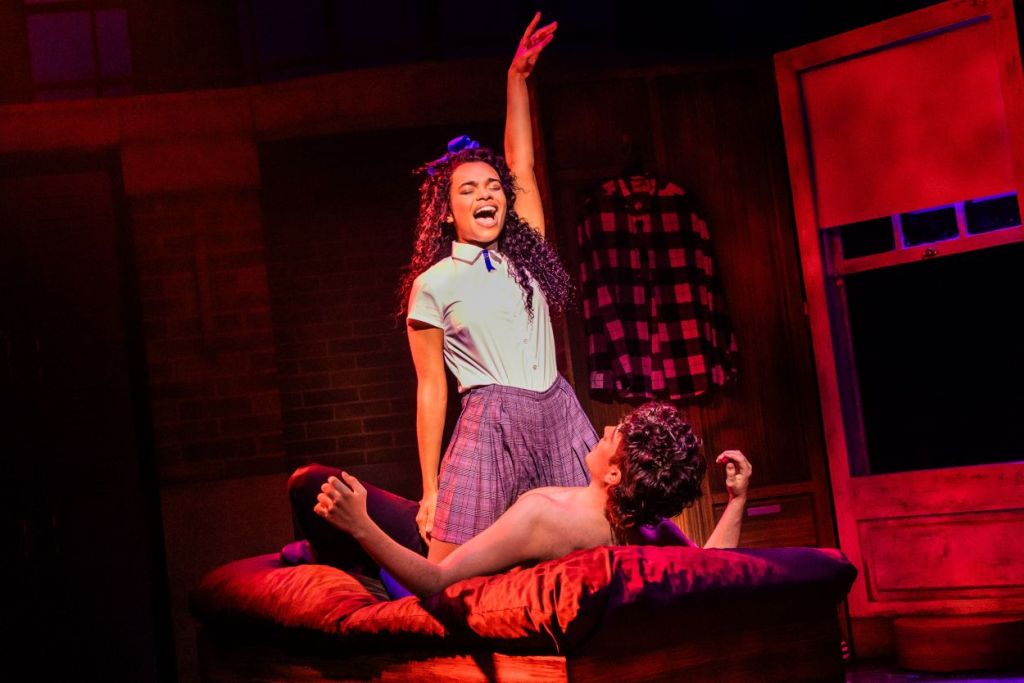
The suicide note elevates Heather to even greater status as a flawed, lonely teenager like everyone else. Meanwhile, the ghost of dead Heather haunts Veronica and cryptically comments while Heather Duke takes Chandler’s place as “Queen.” In a downward spiral Heather Duke’s reign turns out to be worse than Chandler’s. Duke sets up Veronica to be sexually attacked by Ram and Kurt. Though Veronica foils the rape, she and JD plot revenge. Once again the vengeance which begins innocently in Veronica’s misguided mind turns deadly in JD’s hands.
After Veronica and JD tally up two more “accidental” murders, they write believable suicide notes that Ram and Kurt were gay. Neatly, they’ve cleansed the school of three of the most brutal kids in the social hierarchy. In Act I’s closing number (“Our Love is God”), they affirm their love and righteous acts of “justice” with the mind-blowing lyrics: “We can start and finish wars. We’re what killed the dinosaurs. We’re the asteroid that’s overdue.” As JD tells Veronica he’d give his life for her, Veronica cannot resist his love and allure. Energized by her and their new found form of justice, JD’s nihilism continues in Act II. Only Veronica can stop him.
With Andy Fickman’s superior staging and humorous, well-paced timing, the production flies by at two hours and 30 minutes. The ensemble’s exuberance, voices and dancing are cracker-jack, the arrangements super. Memorable throughout, Lorna Courtney sustains her portrayal of Veronica’s transformation from “good person” to JD’s unwitting accomplice to murder, and back again. As JD Casey Likes is Courtney’s match pitting his phenomenal voice against hers with every song. As a couple they shine, reminding us that evil can be seductive.
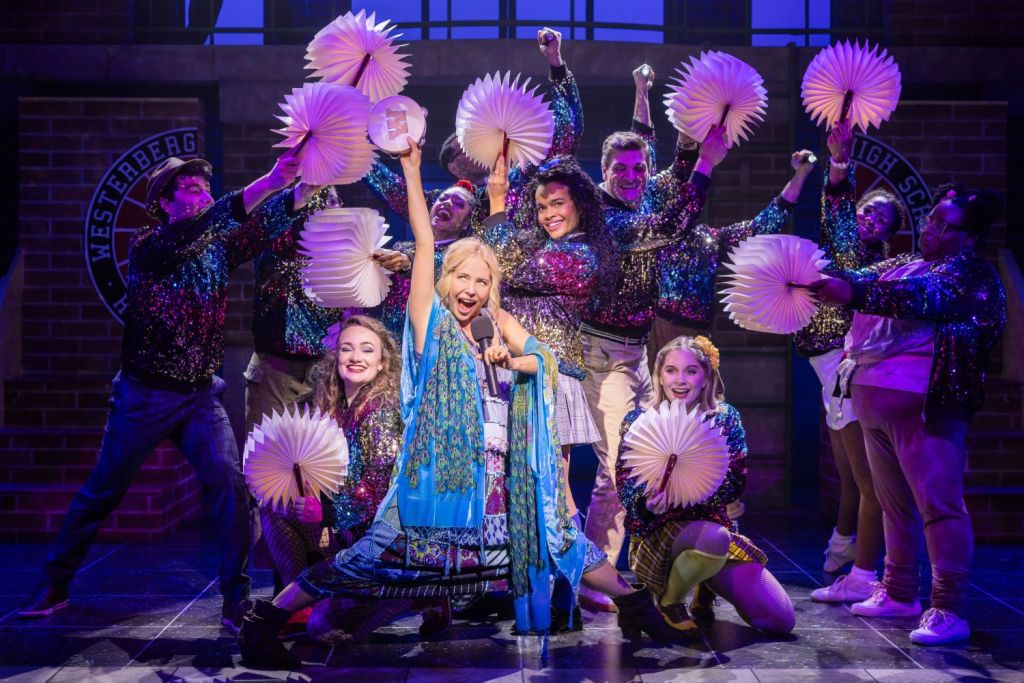
Finally, McKenzie Kurtz lifts the ironic character of Heather Chandler in death with fine pacing and great humor. She aligns in a perfect contrast with Erin Morton’s kind-hearted, loving Martha Dunnstock, who would be everyone’s friend if they they opened their eyes to her goodness. Standout numbers “My Dead Gay Son,” (Ben Davis, Cameron Loyal are hysterical) and “Shine a Light” (the funny Kerry Butler) are LOL. “Kindergarten Boyfriend” (Erin Morton is spot-on authentic) resonates with pathos.
Thematically, Water’s film and the Heathers musical (2014) were harbingers of today’s cultural divisions. With prescience they exposed the danger of allowing high school communities to be breeding grounds of hate and discrimination, fostered by a school’s particular “master race” clique. If high schools reflect the larger culture, then social media exponentially spreads their poison. Is it any wonder that insults, hate and bigotry are embraced by “seleckt” political groups to gain votes? Spawned in community settings and reinforced by boards of education in their curriculums, hate and discrimination become normalized.
Heathers the Musical reveals the social construct which accepted a “president” who uses insults, bullying tactics and death threats to get what he wants. It also reveals a better answer than JD’s nihilism in the concluding song. It’s up to us to “make it beautiful.”
Heathers The Musical runs 2 hours 30 minutes with one intermission at New World Stages. https://heathersthemusical.com/new-york/about-ny/
‘Back to the Future’ Roars Onto Broadway, Review
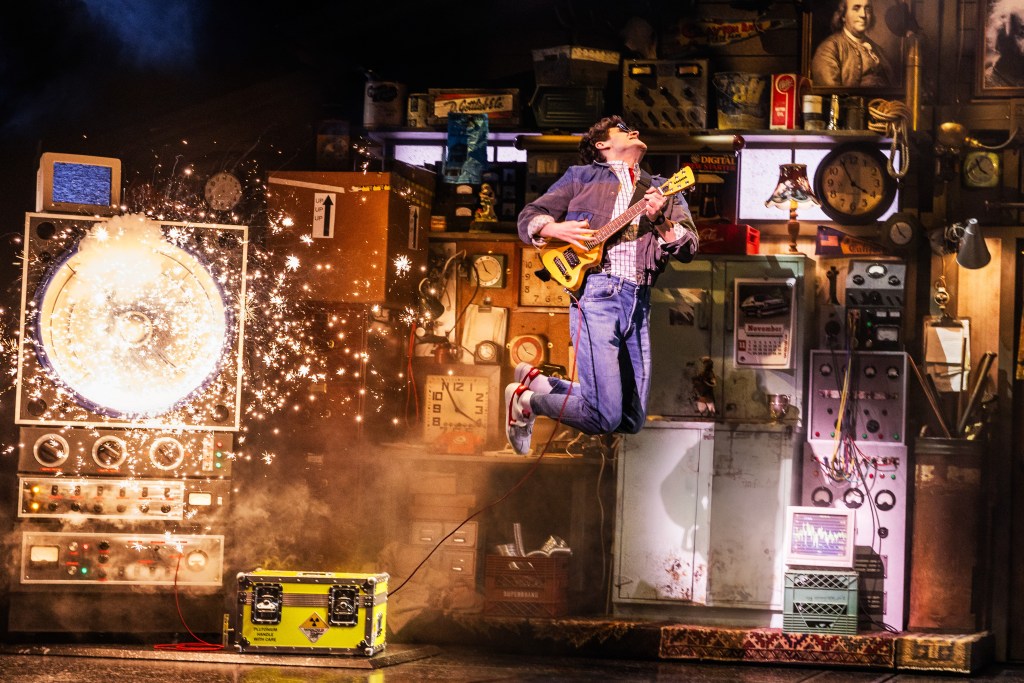
The charm and humor of the musical Back to the Future with book by Bob Gale and music and lyrics by Alan Silvestri and Glen Ballard is that the story flashes into the past minding 1955’s tropes and trends i.e. cigarette smoking is healthy, leaded gas provides a clean environment, DDT gets rid of the mosquitos and bugs with no deleterious effects, asbestos for home insulation keeps you warm. As in the titular film (written by Bob Zemeckis and Bob Gale), the Broadway musical, directed by John Rando, presents a similar plot with the same characters and allows us to reflect upon two decades in history thirty years apart.
Currently at the Winter Garden, kicking up a storm with fantastical asides, fourth wall-breaking irony and other slapstick, the show is a high powered delight.
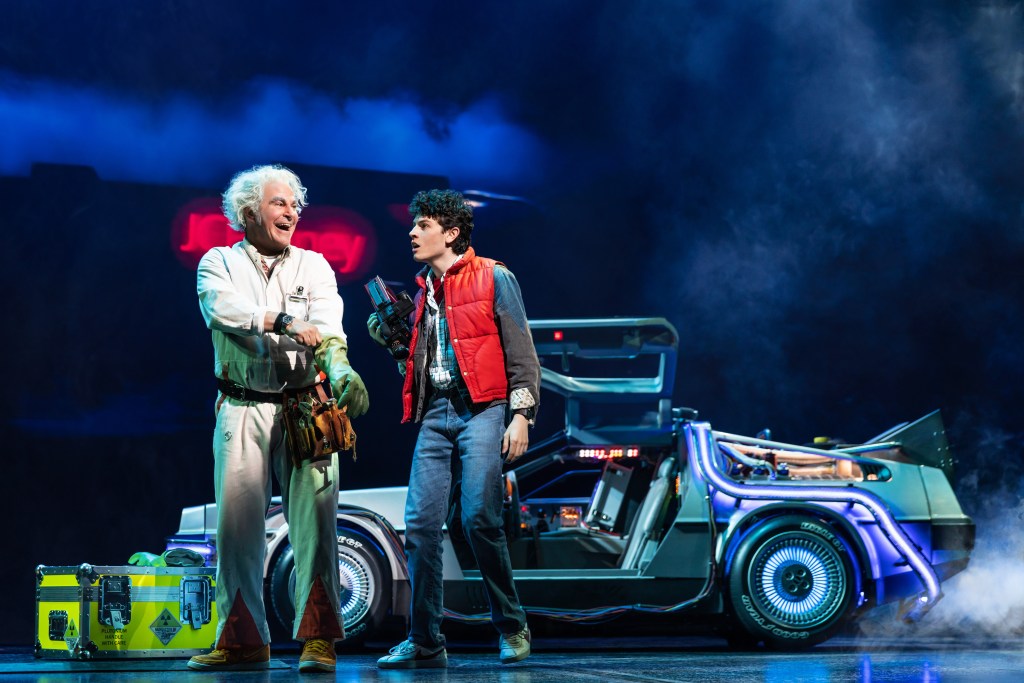
Rando’s production of the book by the film’s co-creator Bob Gale speeds by with thirteen songs in Act I and thirteen songs in Act II, all of them popping with zest and excitement. The velocity never lets up, though one might wish it, but that’s the beauty of such a production whose protagonist races against time so he doesn’t obliterate himself with the physics of time travel that doesn’t quite make sense but certainly adds to the tension, excitement and horror when he nearly doesn’t make it “back to the future.”
The audience remains engrossed with the dynamic, lovable Marty McFly (the superb Casey Likes of Almost Famous), who visits friend Doc Brown’s lab, where he creates mayhem with an over-amped ukulele. Revved up, the scene shifts to right before his audition for a talent contest in the town square (“It’s Only a Matter of Time”). McFly and Goldie Wilson (the vibrant Jelani Remy), who is running for mayor, affirm they are winners, not losers. However, Principal Strickland shuts McFly down quicker than a Broadway audition. In a very public, obnoxious dressing down, Strickland (Merritt David Janes) shreds McFly’s dignity and proclaims him and his family slackers and losers.
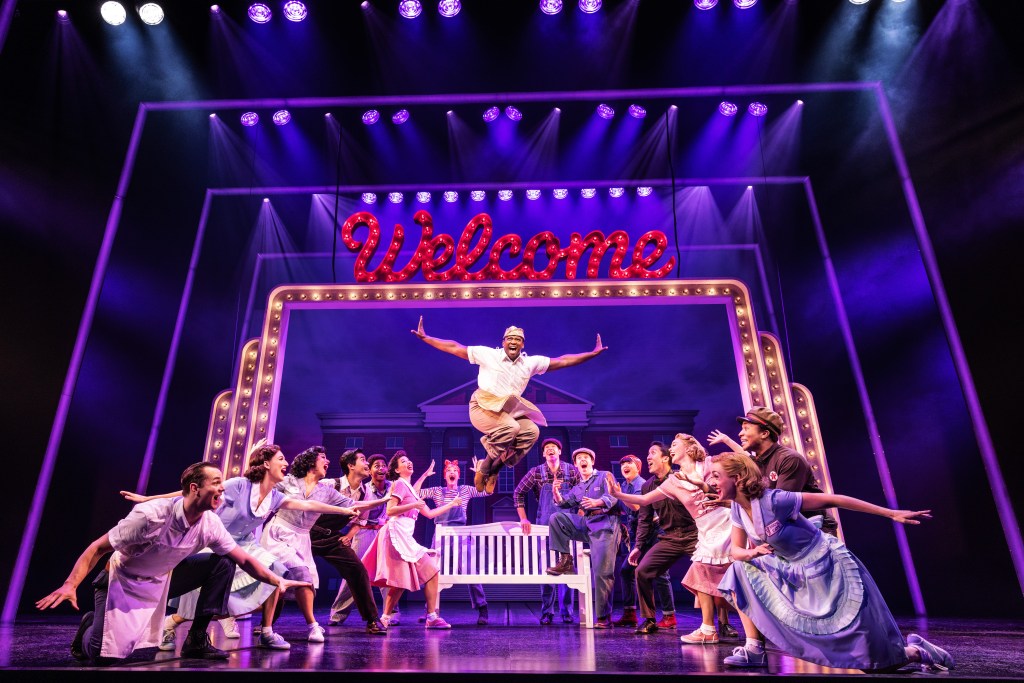
Marty crashes emotionally for a moment, allowing Strickland to define him. He realizes that he will be like his slacker parents and sings the pop-rock “Got No Future,” thus establishing the conflict McFly must overcome. How will he be able to reshape his loser self and prove he is someone to reckon with?
It’s quite elementary and accidental. In a physics sleight of hand, he jumps into Doc’s DeLorian’s time machine and goes back to 1955 to save Doc (Roger Bart originated the role), from radiation poisoning. There, he becomes the rocker success he knows himself to be. However, before his time travel, Marty receives the courage to forge on despite Strickland’s pronouncements by hanging with his girlfriend, Jennifer (Mikaela Secada in her Broadway debut). They sing “Wherever We’re Going,” and once more he is uplifted to his dreams with her love and support.

But McFly is brought low again when we follow him home to see his loser family: George (Hugh Coles originated the role), Lorraine (Llana Hunt-Newsies), Linda (Amber Ardolino), Dave (Daryl Tofa). If they are an example of his genetic inclination to loserdom, he definitely has no future. Indeed, if he goes to 1955, most probably since he is always late, he won’t make it back in time and he will be in a space time continuum paradox. He he will be wiped from the map of existence. This is the key set up, spurring the momentum forward at two times faster than the speed of light.
Introducing each of his family members, the song (“Hello-Is Anybody Home?”) features snippets of how his father, mother and siblings can’t get arrested on Broadway. Rando’s direction allows each actor to go “over the top,” especially Dad George McFly, whose antics are enforced for laughs and sometimes don’t appear to rise organically.
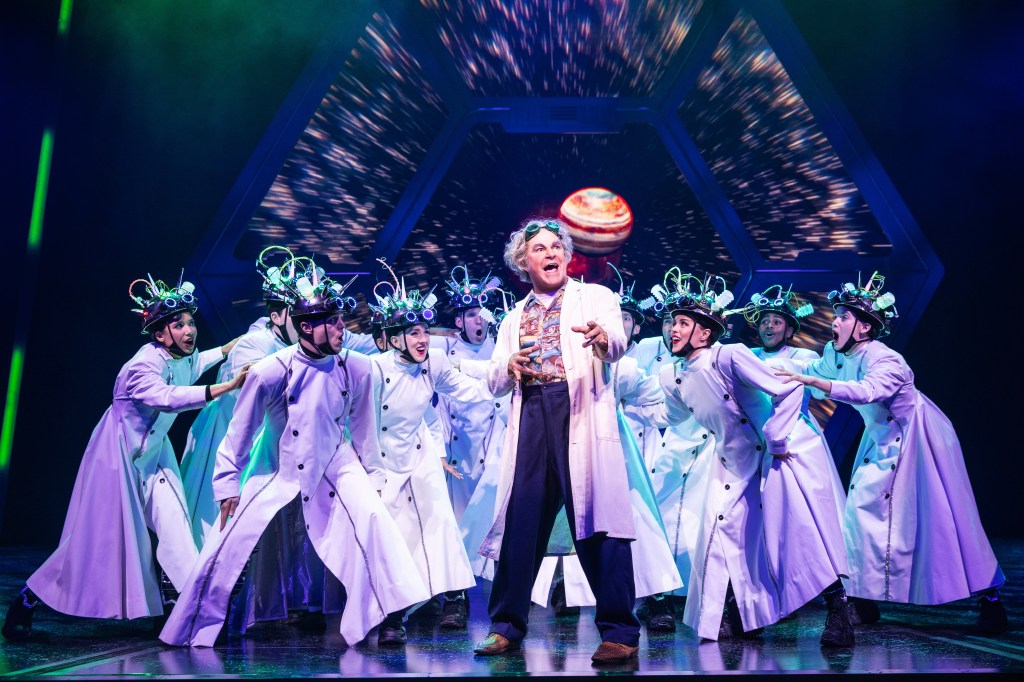
However, Back to the Future The Musical is Sci-Fi fantasy. If George’s movements are angular and extreme schtick and he’s pushing for laughs, he’ll get them. The men especially will identify with his personality weaknesses that make him quake in his boots when he tries to avoid confronting the wicked bully of the show, Biff Tannen (Nathaniel Hackmann). Of course, Marty’s attempts to counsel his Dad in 1955 (before Marty was born), are ironic and the theme resonates that “a little child shall lead them.” Oftentimes, kids are sharper than their parents and adults, who should listen to their kids’ wisdom but who often, like Strickland, shut them down.
The only adult who doesn’t shut down Marty is Bart’s Doc Brown. When Marty meets Doc in a field where the DeLorean lands with an explosive, gyrating flourish, it is obvious the two have a powerful bond. Through a series of mishaps Marty ends up traveling to 1955 where Doc has set the machine and we watch as some incredible projections show Marty’s time/space travel imaginatively, going twice the speed of light.

Back in 1955 complications arise. Marty becomes tangled in a love triangle with his mother that includes some of the biggest laughs of the show. With the exception of some minor changes the musical keeps the humorous conceit of time travel with all of its paradoxes which are never explained. Neil DeGrasse Tyson, the astrophysicist, would enjoy the show because it is sheer entertainment. However, it defies explanation and logic. That is the point.
One must not think too much about how in the twinkling of an eye George moves from bumbling idiot to savvy book author, his body ticks straightened out. And how do his mother and sister lose weight and become gorgeous in a week’s time? Inquiring celebrities want to know if it’s Ozempic®. Oh, wait, that’s an anachronism. It’s clear that Marty does something in the past to shift the present from his former perception. However, the songs crash into each other, with such verve, that one cannot breathe for the intricacies of the story. It’s typical Sci-Fi prestidigitation. Whatever happens happens, and we are enjoying the ride.

The scenes shift to different sets. The songs have flashy backing dancers with color coordinated costumes. The assumption is that audience members are familiar with the film which is both a plus and minus. On the one hand, the jokes relate from the film and the audience notes them with pleasure. On the other hand the pace is frenetic. A quiet moment is necessary for the audience to take a breath. Perhaps, the DeLorean scenes would pop even more. They are such fun.
The DeLorean is the highpoint of the show, thanks to Chris Fisher’s illusions which are absolutely gobsmacking. Of course, he has an assist from Gareth Owen’s sound design, Tim Lutkin & Hugh Vanstone’s lighting design and Finn Ross’ video design. The DeLorean moving from present to past and back is a memorable feat.
Also, the clock tower scene set in the lighting storm is equally thrilling. Will Marty make it back in time, moving forward? The jokes and memes on time are exhausted by the conclusion of the show.

Importantly, audiences are going because they want to see how the production effects the time traveling DeLorean and they enjoy hearing tunes from the past whose hits always strike a congenial nerve (“Earth Angel,” “The Power of Love,” “Johnny B. Goode”). One new song which Doc sings resonates well with the themes and is reprised a few times in Act II, “For the Dreamers.” Doc is thrilled that for the first time, something that he has created “works.” The theme suggests that one must persist, keep on dreaming, and never give up. This is sage advice in any era, any decade, any age.

Act II deepens the relationships we’ve seen laid out in Act I. “Put Your Mind to It” which Marty and George sing together unites them with a similar purpose. Marty is encouraging his father to stand up for himself, be confident and “go for” Lorraine. The actors work the song but more organically.
Casey Likes is always spot on authentic as is Roger Bart. In their loser iterations George, Lorraine, David and Linda play for the stereotype. In this type of production it works. The laughs might have been greater if they were no so intentionally “loserish. However, they shine after their son returns with the “goods.”
Kudos to Tim Hatley (designer), Chris Bailey (choreographer), Campbell Young Associates (wigs, hair and make-up), Nick Finlow (musical supervisor, vocal and music arrangements), Ted Arthur (music director), Ethan Popp and Bryan Crook (orchestrations) David Chase (dance arrangements).
This is one to see especially if you are a fan of the films and enjoy seeing live theater with amazing stagecraft and technical designs that are phenomenal.
For tickets and times go to their website https://www.backtothefuturemusical.com/new-york/
‘Almost Famous’ The Broadway Musical Gives a Shimmering Nod to 1970s Rock ‘n’ Roll

From the response of the audience’s standing ovation and cheering, the snarky comparison by critics to the lead actors of Almost Famous and Dear Evan Hansen and other criticisms didn’t seem to matter. That is because Almost Famous delivers. This is especially so if one has seen the titular film (2000). If you appreciate a nod to what Howard Stern refers to as the best music of the past (better than the 1960s), and take that love or fandom to The Bernard B. Jacobs Theatre, you will be happy you went to see this enjoyable production of Almost Famous directed by Jeremy Herrin.
Written by Cameron Crowe (book and lyrics), and Tom Kitt (music and lyrics), based on the Paramount Pictures and Columbia Pictures film written by Cameron Crowe, the show spreads its uplift and hope during a holiday season that is bringing crowds to Manhattan. Tourists, rockers and Broadway fans up for an entertaining night out will be pleased at the sterling voices, the humor, the energy of the performers and the music which connects the familiar story-line to the historical 70s music scene with nostalgia and poignance.
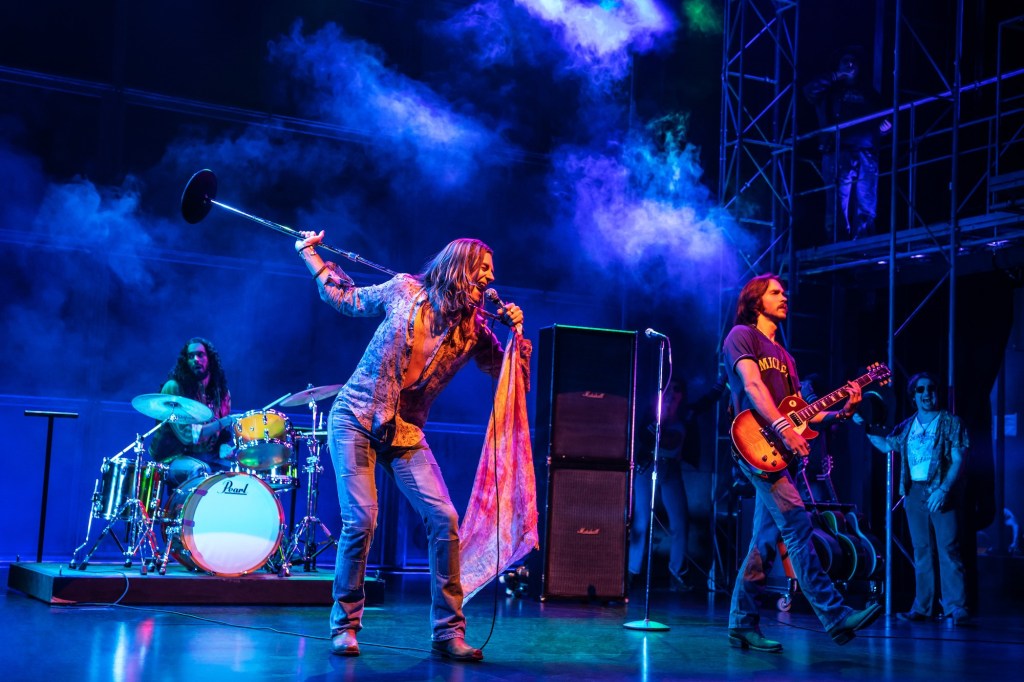
The classic rock covers (i.e. Deep Purple, the Allman Brothers), sustain us while Kitt’s original music is interesting with memorable songs like “Morocco,” “The Night Sky’s Got Nothing on You,” and “Everybody’s Coming Together.” The new melodies (a combination of rock and pop), convey the heart of the characters who are subtly drawn.
Fandom is the key to frequent successful film to stage transference. It may or may not apply here. The creators have taken a leap into the Broadway musical genre. They’ve created original songs for live performance and they have slipped in songs from the period (Led Zeppelin, Joni Mitchell, Cat Stevens, Lynard Skinner, Stevie Wonder, David Bowie and Elton John) into the musical’s action but not in the same way as in the film, whose background was replete with rock ‘n’ roll songs from start to finish. That doesn’t happen with this musical that has 18 newly-written songs. Included are four reprises from Tom Kitt (music) and Cameron Crowe (lyrics). The songs move the action as the characters express their conflicts, issues, desires and feelings and get tangled up in each others’ agendas.

Staged cleverly with Sarah O’Gleby’s movement, director Jeremy Herrin and the creative team eschew traditional choreography and keep the sets simple and minimalist to suit roadies on tour with the exception of William’s and Elaine’s home. This is in the service of suggesting the free form movement of the 1970s. The concept of great rock was fading into new musical trends like Rap then moved in the 1980s to MTV domination. Ultimately, the musical is a nod to 1970s rock ‘n’ roll and its ethos before commercialization and digital technology skewed it into something else.

Though the action is condensed with the added musical numbers, the arc of plot development, based on Crowe’s real-life journey as a teenage rock writer, follows the film. Wisely, the humorous lines in the production are lifted from Crowe’s writing, which won an Oscar for best original screenplay (2001).
One of the most important themes of the musical reveals an ambience of the 1970s, that was culturally strained between liberalism and conservatism. This is partly suggested by the opening number “1973,” when William Miller (the excellent Casey Likes), confesses to rock ‘n’ roll critic Lester Bangs (a manic, funny Rob Colletti). William sings about his conflicts with his mom. She stands in the way of his discovering “who he is.” In a state of flux, his mother Elaine (the humorous Anika Larsen), a teacher fearful of “drugs, sex and rock ‘n’ roll,”controls William and his sister Anita to the point where Anita (Emily Schultheis), rebels and leaves home.

However, Elaine can’t quite figure out who she is either. She adopts a healthy vegetarian/vegan lifestyle, clearly a liberal cultural influence. Yet, conservatively, she disagrees with subversive music (the rock ‘n’ roll Anita loves), and its cultural aftereffects (sex, drugs, wild partying). The pull of conservatism and liberalism is one William faces in his conflict with Elaine, but he’s leaning toward the underground and subversive, reinforced when his sister gives him all her rock ‘n’ roll albums to be “cool.” These inspire him to write for his school newspaper with the hope of a possible career as a writer or future music critic.
One element of his confusion, unbeknownst to him. is that his mother had him skip grades and lied about his age. Meanwhile, he is embarrassed because he has no pubes, is alone, uncool and alienated by classmates who humiliate him. Naturally, when he receives a response from Lester Bangs, the finest rock critic in Christendom, who accepts and encourages him, he jumps at the chance to write for Bangs’ Creem Magazine. On the road to being a bone fide critic, he lands an assignment from Rolling Stone to profile a rising band called Stillwater.

William manages to obtain Elaine’s permission by swearing he will remain pure and stay away from drugs and sex. Elaine relents because she dimly thinks it is better to connect with him and “keep him near,” (which fails), rather than lose him like she lost Anita. Ironically, she loses him in a different way. The rock band “kidnaps her son,” a funny and wonderful refrain in “Elaine’s Lecture” which is a lament that carries her angst about what is happening to William. He goes on the road with the band to get an interview, for which Ben Fong-Torres (Matthew C. Yee), will pay him handsomely. It’s an opportunity too good to pass up.
Likes’ William enjoys the excitement of “getting down” with beautiful young women who assist bands in their mission to be great. These groupies, cheering the praises of their leader Penny Lane (Solea Pfeiffer), have re-branded themselves as The Band-Aids. They are rock ‘n’ roll muses and their mission is “all about the music.” Indeed, Penny Lane has so fulfilled her role, that musicians have written 14 songs about her, and “all of them good,” affirms Estrella (Julia Cassandra).

With such a build-up of excitement Likes’ William is smitten with Penny (Solea Pfeiffer), and her Band-Aides who, along with Estrella, include Sapphire (Katie Ladner) and Polexia (Jana Djenne Jackson). Solea Pfeiffer is an “all that” Penny Lane who doesn’t quite convince us that she is about the music and so “cool” and scintillating to musicians, that she is their fount of inspiration. But then she is not supposed to. The Band-Aids, Penny and Stillwater’s Russel Hammond (Chris Wood), Jeff Bebe (wild, rocking Drew Gehling), Larry Fellows (Matt Bittner), and Silent Ed (Brandon Contreras) are “hype.” The actors (the Band-Aids and Stillwater), do a superb job of managing their characters’ “cool” with enough awkwardness for us to know that they are “almost famous,” but not there yet. And as a result, they will never really achieve super stardom because they get in each other’s way and are totally “uncool.”
The Band-Aides and Stillwater must walk the tightrope of not believing their own image to avoid falling into a destructive abyss which threatens throughout. This conflict and tension abates after the moment of truth on the airplane, especially when Woods’ Hammond and Gehling’s Jeff Bebe reveal their deepest secrets because they fear the plane will crash. This scene is technically delivered to surprising effect. Humorously, the tiny jet “flying” on a chord from one side of the stage to the other was so “over-the-top,” it worked in the service of farce.
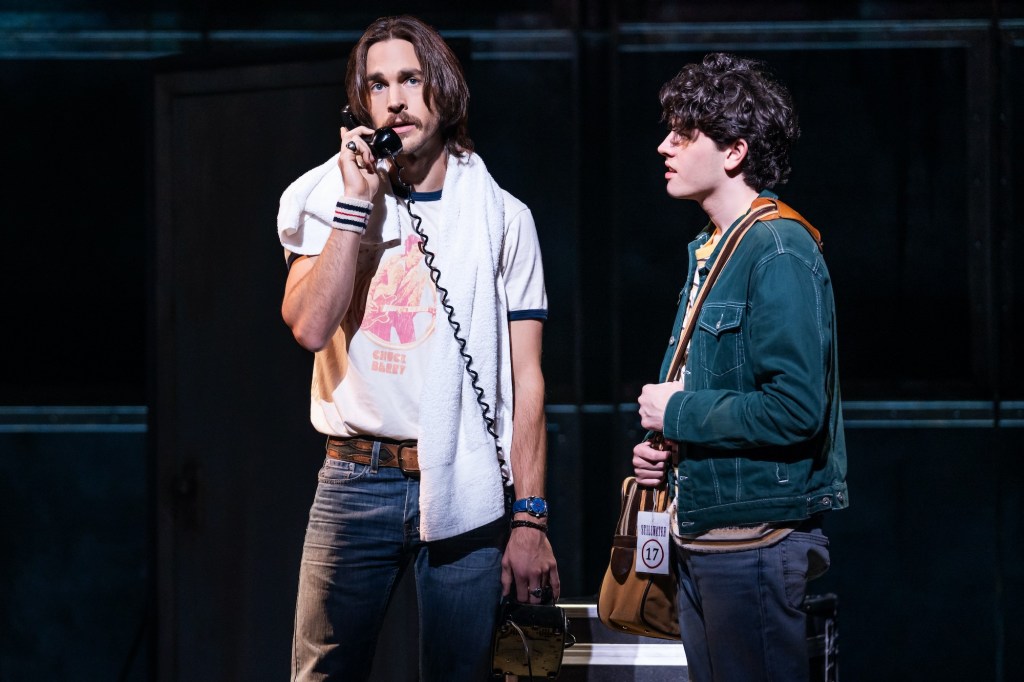
The actors did a great job with the scene to convey just enough humor and fear to “spill the beans” and further wreck Stillwater’s “togetherness.” Believing their own hype brought them to facing this catastrophe on the plane. If they continued to take their humble tour bus, they would have been safer. The real dose of reality that Hammond says he wants is a pose only revealed when he thinks he’s going to die. Thanks to Derek McLane (scenic & video design), Natasha Katz (lighting design), Peter Hylenski (sound design), and the actors’ authenticity, the scene embodies their magical thinking vs. truth, a key conflict and theme of the musical.

Williams’ adventures initially captured in his journey through the songs, “Who Are You With?,” “Ramble On,” “Penny and William,” “Fever Dog,” and “Morocco,” evidence the pitfalls of being a rock ‘n’ roll critic who is always a “watcher” of the action, not a creator of it. Colletti’s Bangs humorously warns William to be “honest and unmerciful.” When William gets a taste of the band culture, its groupies and the challenge to be accepted, he tries not to be overwhelmed or lose his “objectivity.” Yet, he succumbs to their manipulations. First, there’s the rejection of him as a critic (called “The Enemy” by Stillwater’s Jeff Bebe). This wears him down and makes him want to “fit-in.” Though he resists and manipulates band members with flattery, he never adheres to Lester Bangs’s sage advice. Gradually, William is sucked in because Stillwater’s Bebe, Hammond and Penny Lane are good at “the game.” William is clever, but he’s a neophyte.
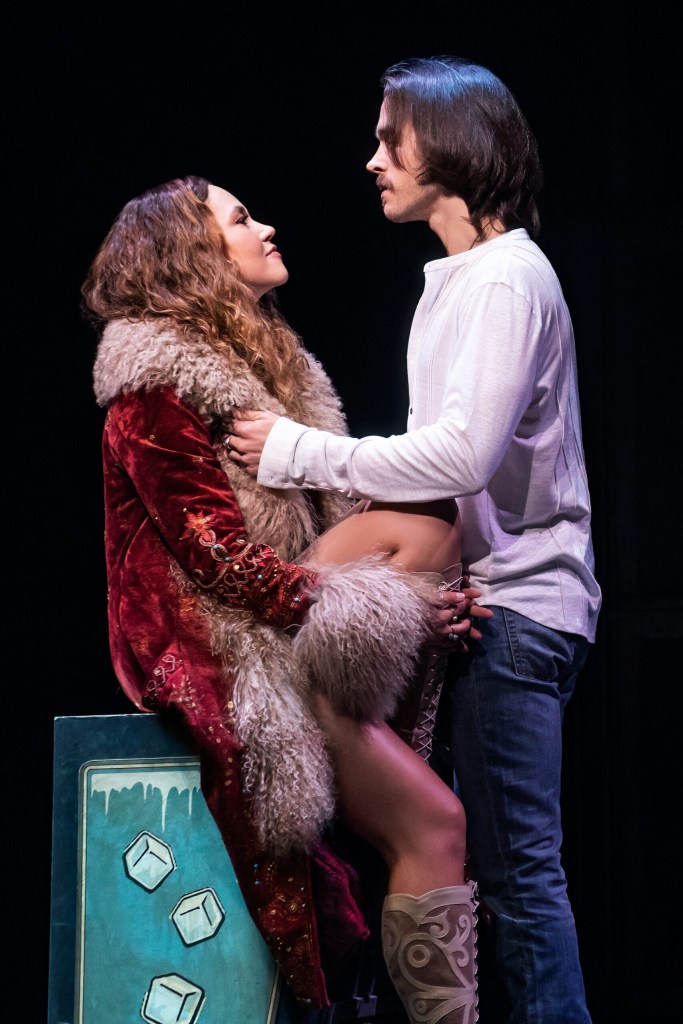
This “congenial” conflict between William, the band and Penny Lane disappears when he believes he is a friend, (“Something Real,” “No Friends,” the healing of divisions with “Tiny Dancer,” “Lost in New York City, Pt. 1” and “River/Lost in New York City Pt. 2”). But this “friendship” is a blind and his presumed love with Penny Lane eventually clarifies for him when she leaves him to the Band-Aids and joins Hammond (“It Ain’t Easy”). He is discouraged, but hangs on and writes a piece for Rolling Stone. However, it is rejected by fact-checker Allison (Emily Schultheis), and he is accused of writing a puff piece that Stillwater encouraged him to write. Only until Wood’s Hammond finally verifies William’s honest and “unmerciful” article to Rolling Stone, is the “magical fake world” of the band blown apart. However, this is beneficial for it allows the band and groupies to begin a new day.
Through lines in characterization are consistently effected. The conflict between son and mother abides from start to finish and provides much of the humor. Anika Larsen deftly balances Elaine as a typical loving parent, whose concern, knowledge and control are acceptable to the audience. She is never acerbic or preachy in the songs “He Knows Too Little (And I Know Too Much),” “Elaine’s Lecture,” and “Listen to Me.” Resolutions occur by the conclusion, when Anita has found herself and the full company sings the reprise of “Everybody’s Coming Together,” a rousing standout.
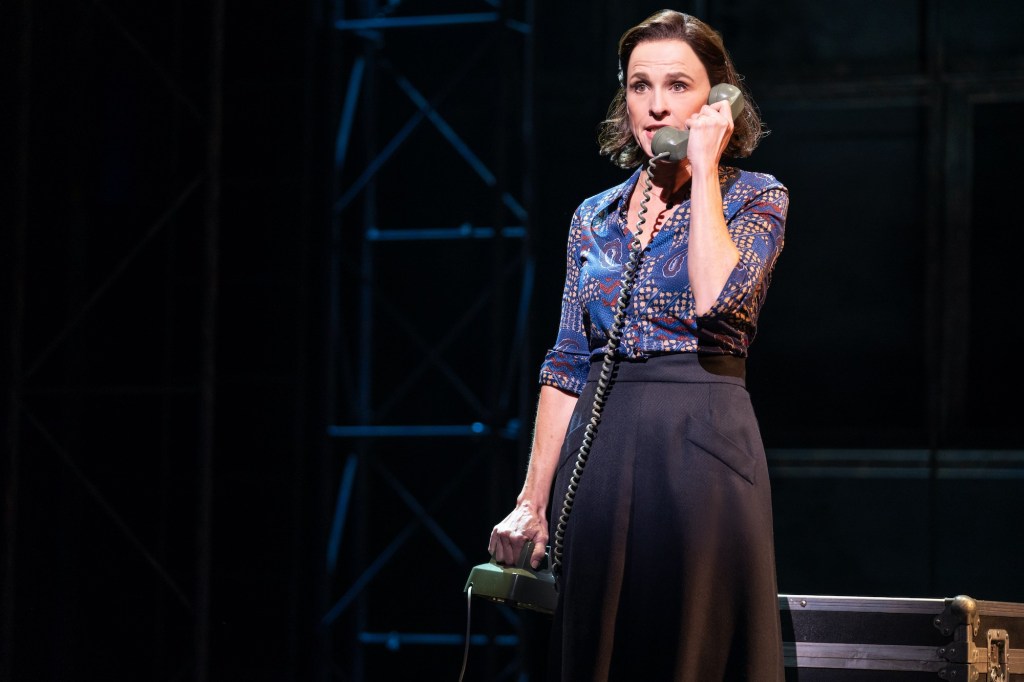
The actors, shepherded by Jeremy Herrin, do an excellent job of precluding who will end up on the floor of their own demise. This is strongest when we note the rifts between Bebe and Hammond, beginning when the T-shirts are distributed, then moving to the partial healing of their divisions on the bus with the singing of “Tiny Dancer,” another knockout scene and high-point at the conclusion of Act I. Though manager Dick Roswell (Gerard Canonico), has brought them together for a while, the conflicts among band members continue. They encompass Penny Lane and Russell’s relationship. Penny Lane is sold out in a bet that William witnesses during the Poker game scene. Pfeiffer’s Penny Lane and Likes’ William are excellent together with resonating lyricism and power when he saves her life after she overdoses on Quaaludes.
Most of the new songs work. Additional strong scenes/songs include Penny and William’s “The Real World,” Russell and Penny Lane’s “The Night-Time Sky’s Got Nothing on You” and “Something Real” when Woods’ Hammond falls apart at a fan’s house. At this point before the end of Act I, William attempts to keep Russell away from acid and fails. Woods and Likes do an excellent job revealing the negative pressure on their characters from the hype that Wood’s Hammond attempts to escape. It is an irony that he can’t because he is as needy and “uncool” as Penny Lane, Jeff Bebe and the others. However, he just hides it better.
Interestingly, in his immersion with the band, the only time they all come out of their “image” is when Likes’ blows it up with the final Rolling Stone piece about them, something that Wood’s Hammond encourages and has yearned for. Then, even Penny Lane is able to gain the strength to go to Morocco, leading to a satisfactory conclusion with “Fever Dog Bows,” which the entire company sings as a tribute to 1970s rock ‘n’ roll.
Kudos to the creative team already mentioned with special praise for Bryan Perri’s music supervision and direction, and Lorenzo Pisoni as physical movement coordinator. This is one to see for the shimmering performances, rousing music and nostalgia for a time we will never see again in its wacky innocence and silly “hedonism,” which seems quaint viewed through our current perspective. For tickets and times go to their website: https://almostfamousthemusical.com/
 CAROLE DI TOSTI