Blog Archives
‘Appropriate,’ Exceptionally Acted, Scorching, Complex, Revelatory

Appropriate’s theme
The truth is the truth, no matter how hard one betrays oneself into believing otherwise. Currently, segments of the American population have difficulty with the nation’s history of bigotry and murder and would mitigate it, not through reparations and reconciliation, but through dismissal and nihilism. As long as such masking occurs, the violence will continue in a legacy that can only be expiated and ended by confronting the deplorable aftereffects of racism head on. Such is the basic theme of Appropriate, Branden Jacobs-Jenkins harrowing, humorous, profound family drama about loss, self-betrayal, torment, fear and generational psychic damage, that is currently unraveling great performances at 2nd Stage’s Helen Hayes Theater. The drama with sardonic humor is in its Broadway premiere and has now been extended.
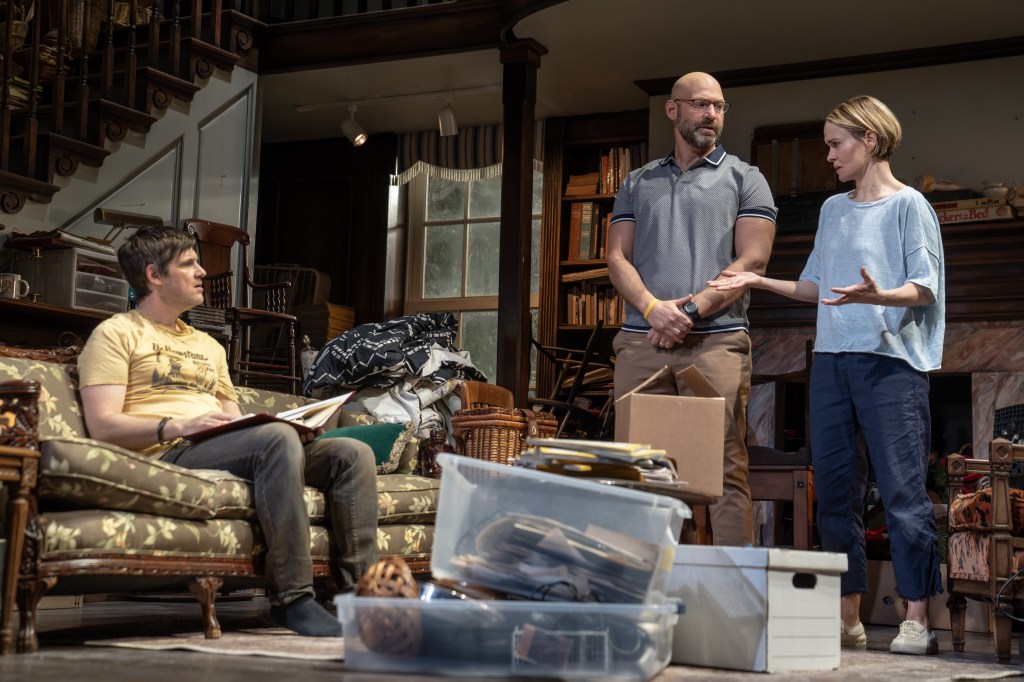
Before the curtain lifts onto the 7th generation Arkansas plantation home of the Lafayette family, the theater is plunged into the darkness of nighttime. Then, Bray Poor and Will Pickens let loose the prolonged, screeching sound of Cicadas, a sound repeated between acts and scenes. When Jacobs-Jenkins determines we’ve “had enough,” the lights dimly come up on a once stately mansion interior- living room, foyer, and stairs-leading up to the balcony landing and off to unseen bedrooms, where Toni (Sarah Paulson,Talley’s Folly), Bo (Corey Stoll, Macbeth), and Frans (Michael Esper, The Last Ship), slept during their childhood.
The mansion, in complete disarray, filled with hoarder’s junk-furniture, ceramics, glassware, clothing and more-still has remnants of beauty amidst its dilapidation and tawdry dressings of curtains and outdated furniture, thanks to dots’ prodigious scenic design. Symbolic of the once “glorious” South, with its penchant for ritual and gentility delivered by Black enslavement, servitude, Jim Crow peonage, bigotry and prejudice, the mansion, we come to discover, hides remnants of brutality, sadism and murder, a legacy of the Layafettes, which has not been recognized or confronted by the present generation, especially Toni.
The Backstory
In the backstory, we learn that Toni, Bo and their families are at the plantation for the auction of the estate interior, house and extensive property which includes two cemeteries, one for seven generations of Lafayette ancestors, and the other a slave cemetery isolated near the algae-ridden pond. Bo and Toni have kept in touch and were together for their father’s funeral six months prior, when they discussed raising money to pay off the loans of the estate’s indebtedness. Though they try to contact Franz, who has been AWOL for 10 years, they have been unable to tell him of their father’s death and the disposal of the estate.
It is no small irony that Franz, at the top of the play, comes in through the window with his girlfriend like a thief in the night, in the early morning hours, the day the liquidators are supposed to catalogue and price the estate’s valuables. When Paulson’s Toni makes a dramatic entrance from the 2nd floor balustrade, shining a flashlight on Franz, ranting at his presence and interrupting his reunion with her son, his nephew, Rhys (Graham Campbell), we question what is going on. From this incident of conflict, Jacobs-Jenkins unspools the mystery about the family, its members, their dead father and their ancestors. Throughout the play by agonizing and strategic degrees, the playwright reveals the Lafayette’s tragic family portrait, and explores many themes, key among them ancestral accountability for the past sins, which if not addressed or confronted, will be a curse on future generations.

As the play progresses and the siblings deal with the estate, we note that Toni, as executrix, makes unilateral decisions and controls everything to the point of “spur-of-the-moment” irrationality (though her explanations to herself are rational). This foments more chaos than is necessary in a situation fraught with turmoil, divisiveness and alienation among the siblings.
Pressures and conflicts in the Lafayette family
Pressures of the father’s illness and death, the disparate circumstances in each sibling’s family, Toni’s divorce and difficulties with her son Rhys (Graham Campbell), exacerbate the tensions of the stressful time, as the siblings attempt to create order out of chaos and obtain the most money to pay off the debts. Handling the estate and settling the inheritance would upend the most sanguine, peace-loving and close siblings. However, for the tormented Lafayettes, settling the estate is apocalyptic. The brokenness of each family member and their significant others raises the temperature of the non air-conditioned mansion to an explosive boiling point by the end of the play.
The first roiling incident begins with Franz, renamed from Frank by his California-dreaming, tendentious, sweetie, River (Elle Fanning is brilliant as the peace-keeping, pompous, shaman-loving spiritualist). The moment Paulson’s acerbic, sniping Toni sees Franz, she launches into strident questions, as he soft peddles his replies and defends himself against her accusations that he only showed up to greedily collect “his share.” When she threatens to “call the cops” on him, he ignores her and goes upstairs with River to sleep off their long trip from Oregon, where he had been hiding out for a decade.

Why she responds toward her youngest brother this way is revealed in the last act cataclysm. However, her bile-frothing attitude, while humorous and sardonic, frightens. Though she seeks hugs from her son Rhys and tells him she loves him, we question her volcanic response to Franz and fiery tirade answering Bo’s comments about shelling out money to maintain the estate through the last years of their father’s illness. Apparently, Bo paid for the aide who ministered to their father almost 24/7, and paid for all the house expenses. According to Bo, he took that “hit,” and hopes to recoup some of that loss from the proceeds of the auction and estate sale.
Questions about the kids’ discoveries
Toni dismisses him saying that it was “their father” who was ill. The implication is that he is heartless and should have opened his bank account willingly with no thought of recompense. We are curious about this “selflessness” she demands of others, while equating her time with her father and drives to Arkansas from Atlanta as more than the equivalent of the money Bo paid. Meanwhile, why wasn’t the father’s grand estate enough to pay for its upkeep? As a DC district justice (in line for becoming a Supreme Court Justice), didn’t the father have the acumen to financially manage it? Why didn’t Toni contribute monetarily, and why are there heavy loans against the property? And why did the father keep quiet about his precarious financial circumstances? Eventually, we learn the answers about this family which is so dysfunctional, it is caving in on itself by the weight of its violent legacy which they refuse to confront.
Little of what her siblings say Toni takes in giving any weight to their position or logic. She is quick to retort and uplift her own situation and attack theirs with seething anger. Whether this is a function of her age (the oldest), and her position as executrix, one concludes that it is mostly due to Jacob-Jenkins’ stylized characterizations in the service of elucidating his themes. A key theme is that karma is a bitch. Unless you break the cycle of abuse of others (slavery, murder) and acknowledge and reverse it, it comes to haunt you with its own particular brand of sickness and blight in the human heart. By the end of the play, we note how each sibling is crippled with agony, divided and isolated from each other without any possibility of reconciliation or redemption.
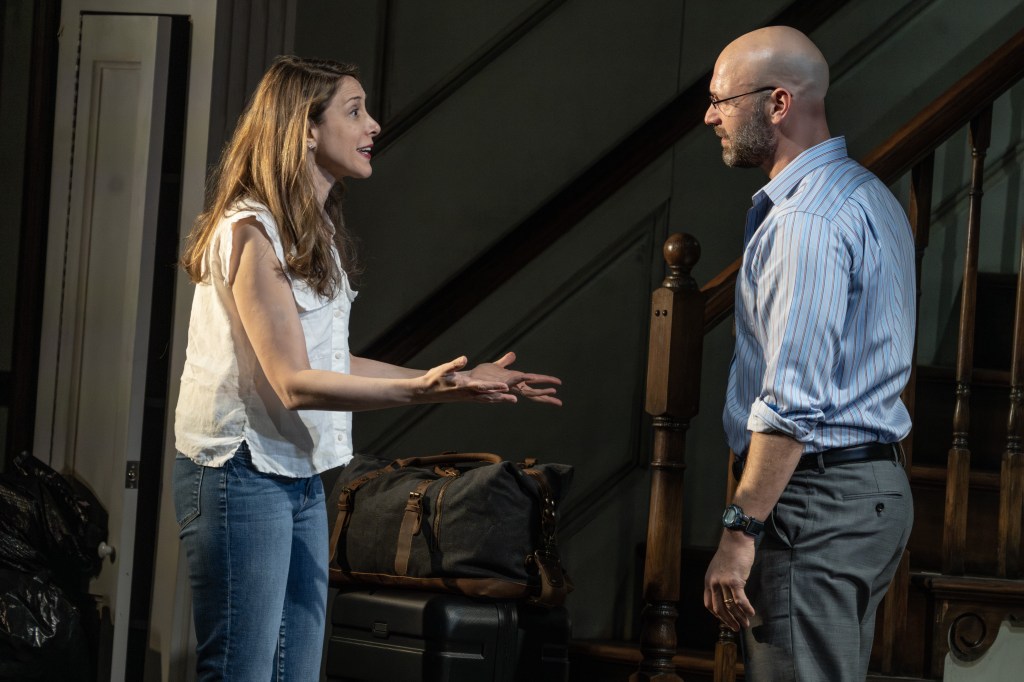
That this may be the result of what their ancestors had wrought upon the land they “appropriated,” and the slaves they abused, and the Black people they may have seen or had lynched, generational accountability is the last thing these present day Layafettes consider. However, adding other clues (i.e. River feeling the presence of spirits), it is a sub rosa theme of the play. Bo, Toni and even Franz hurt, lash out and move to disinherit themselves from each other, the estate valuables and the plantation which they leave to the elements, abandoning it.
Who would question their behavior? Who would want their legacy which involves lynchings (they find photographs of Blacks lynched), glass jars filled with noses, fingers, ears and penises of Black people carved out of the lynched bodies, and a Klan hood that was their father’s. Clearly, the race hatred permeated their childhood, but they didn’t realize it, having spent most of their lives in Washington, DC and some summers at the Arkansas plantation. Besides, around them, their father never mentioned the “N” word, though Bo remembers in college the judge refused to look at “in the eye,” or “shake the hand” of a Black dorm-mate.
The mystery revealed: spoiler alert.
The siblings and apparently, the father and mother, didn’t deal with their ancestry, but like so many others in the south, received the benefits of “free labor” and reaped the rewards of servitude and Black social oppression through the generations without considering the possibility of karmic reparations exacted on their being, emotionally, spiritually and psychically. Jacobs-Jenkins gives clues of the cruelty of their ancestors toward the Black population throughout, via the collector’s items and junk their father and his relatives hoarded.
That this sale of the estate represents the family’s apotheosis of failure and self-destruction, Jacobs-Jenkins uncovers by the conclusion. Bo has lost his cushy job. Toni has been fired from her teaching position when her son distributed her meds to classmates, for which he was kicked out of high school. She is finalizing her divorce and Rhys doesn’t want to stay with her but is going with his father because she is not a good mother.
We discover that Franz is only interested in collecting “his share,” after befriending Bo’s daughter Cassidy (Alyssa Emily Marvin), who broadcast family events to him via her Facebook pictures. Franz had been receiving checks from his father to pay for his upkeep after his jail sentence as a pederast (he got a teenager pregnant). During Toni’s harangues, we discover, though Franz is presently “clean,” Toni suffered with “worry” through his hospitalizations, rehabilitations and addictions to drugs and alcohol. Meanwhile, Franz blames his “bi-polar,” psychically-broken father who fell apart after his wife’s loss to cancer, as he attempted to raise Franz by indulging him. Franz also blames his siblings’ abandonment of him to his father’s questionably abusive care. Of course Toni counters Franz “defense” as lies.

The Lafayettes are an emotionally debilitated family on steroids
Jacobs-Jenkins clarifies that this is a emotionally debilitated family on steroids. Maybe the only member with any rationality is Bo, but only because of his wife. When discussing their father’s racism and prejudices, which Toni denies, Rachel mentions she overheard their father slur her when he referred to her on the phone with a crony, as Bo’s “Jew wife.” Toni dismisses her and the race hatred artifacts. She is “put-out” by Rachel’s alarm that the children have seen the photo album of Black lynchings and incensed that Rachel implies her father is anti-semitic and racist, she ends up provoking Rachel to provoke Toni to slur her. Toni does with ironic abandon, then claims she was joking.
Interestingly, Bo, who lives in the North has put a great distance between himself and his heritage, which is another form of dismissiveness. However, he has taken his racist attitudes with him. He attempts to recoup money from the estate by arranging to sell the photographs of the lynchings of Blacks, which apparently are valuable on a covert white nationalist market of sadistic memorabilia of the “good ole” Southern “glory days”
Bo is so numbed to his legacy, he doesn’t see the egregious amorality of making money off others’ victimization and death. This is a corrupt continuation of the “benefits” the South receives from its Jim Crow policies of racism and murder, heightened by the fact that there is a market for these “valuable collector’s items.” Though each revelation of the father’s racist hoardings is achieved through the kids’ innocent, sardonic, humorous discovery, as the adults try to cover up the shocking “in-your-face” racism, the audience’s real shock is at the macabre, psychotic nature of keeping such items. We ask, why would the father, a judge, “get off” on photos of Black lynchings and jars of Black body parts from the lynchings?
Who does the photo album belong to or the glass jars of body parts?
Toni, Bo and Franz don’t find this loathsome about their father, and try to pretend it belongs to someone else.

Jacobs-Jenkins clarifies the craven, broken psyche of Bo, Toni and Franz, who don’t see anything wrong with selling these items to recoup the estate’s losses. On the other hand, Rachel is outraged her children have been the ones to discover the photo album and jars of body parts. And at some point, she intends to discuss what they mean with her kids to work through the psychological shock of seeing such horrors. Indeed, she is the only one who seems to understand the brutality and violence such artifacts signify. It is her morality that stirs the morality of the others to try to protect the kids from further exposure. But Cassidy is interested because it is verboten, so she continues to look, seduced to the grotesque, cruel voyeurism that this American past was normal for the South..
The playwright speaks volumes through what is absent in the siblings’ conversation. They don’t deal with why the father hoarded such items and didn’t find a better place for them in the Smithsonian African-American History Museum, Arkansas African-American History Museum, or other educational institutions or museums. Why has he kept the photos in a shelf in the foyer, and the Klan hood and the body parts in his bedroom? They weren’t secreted away in a hiding place in the attic or elsewhere, but were out in the open. Obviously, there are two sides to the retired judge’s character. One part of him justifies lawless lynching via white domestic terrorist racism, while the other lives peaceably as a justice. Perhaps Franz has a better handle on his father’s “bi-polar” nature than Toni, who disbelieves all of the “incongruities” Bo, Rachel and Franz have pointed out about him.
The final coup de grâce

Jacob-Jenkins cannot resist the final coup de grâce on this tragic, racist, family legacy that is blowing up in their faces with regard to recouping money. Bo states the land cannot even be sold without dealing with the two cemeteries, so the property isn’t worth much. Secondly, Franz,, to “cleanse himself and get in good with his family,” throws himself and the photos into the pond by the slave cemetery before he knows they might be valuable. The photos are destroyed; the money up in smoke. This family can’t win for losing. Have the spirits of the dead effectively prevented any benefit to a family with its violent legacy of slavery and lynchings, as karma takes its recompense and the estate goes into receivership?
River, who has from the start been wary of the spirits on the place and has sensed “a presence” in the mansion, is used by Jacobs-Jenkins to validate this possibility that the spirits of lynched, enslaved African-Americans exact their karmic retribution. Additionally, the playwright and director’s vision reveal that such spirits may seek vengeance until the family expiates the bloodshed and torment their forebears have wreaked on the Black population on their lands. Thus far the current generation hasn’t and the siblings are a wreck.
The tragedy of blindness is on everyone in this family, who ignores the significance of those murdered, lynched, abused and oppressed. The lives of those in the slave cemetery and those in the photo album are like the lives of Blacks across the South, who were and are still being appropriated for money on the covert market of “lynching” items that white, terrorist racists find “quaint,” “cool” and “prize-worthy” for trading. It is an unacceptable criminal abomination that must not be normalized. It still is at what cost?
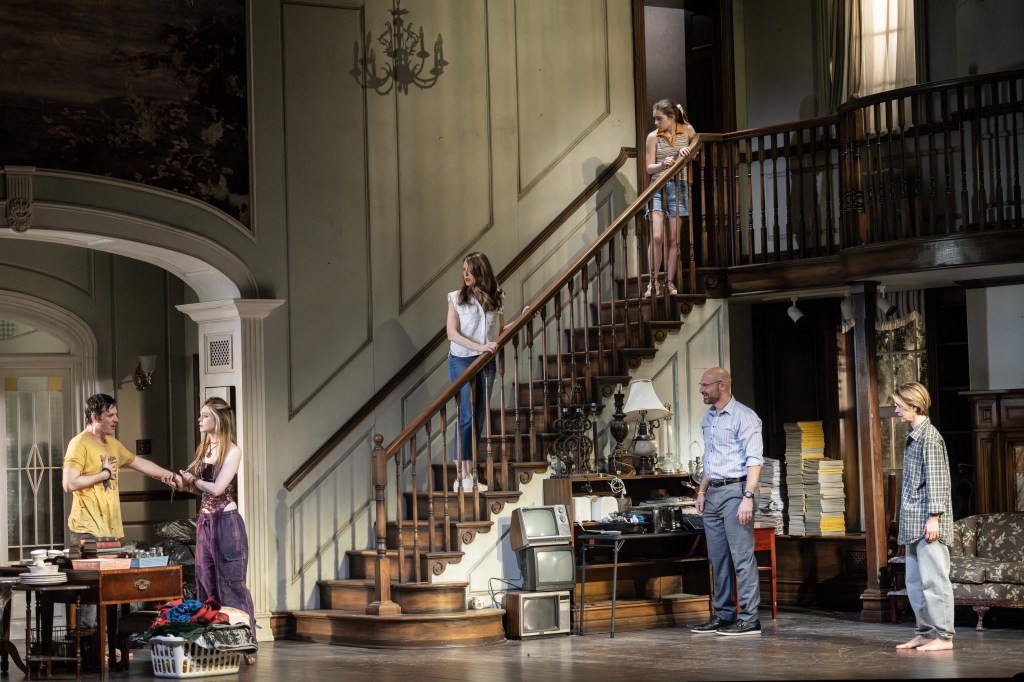
The siblings abandon the mansion and its contents which nature takes over and destroys through the decades as it collapses and a final haunting symbol emerges in the mansion center stage. It is a huge tree open to interpretation. It is representative of the lynchings in the photograph album which must be accounted for.
An amazing conclusion
The conclusion after the blighted family members have left, never to see each other again, is an amazing scenic feat. A tree rises from the mansion floor effected by the amazing scenic designers, dots. Neugebauer’s vision with dots’ execution of the house symbolically shattering as the tree rises up from the foundation of racial hatred, brings together Jacobs-Jenkins’ themes. They warn that despite assuming all is well, recompense will continue to be exacted for historic racial bloodshed and murder. As this family has a legacy of it and refuses to confront it, a bill for the bloodshed will be delivered on them and future generations, via psychosis, financial ruin, addiction etc. Karma is a bitch.
The play is exceptional in its themes and important in its significance about recognizing and not normalizing racial murder and lawlessness as the family tends to do when their father’s hidden life uplifts it. The characterizations serve the themes; the themes don’t arise from the characters. At times the dialogue is contrived to be humorous, especially as the playwright has stylized these individuals as types. Toni’s character is drawn as sardonic, insulting, shrewish and one-note.

The reason why the production gets away with the contrivances is because the director’s staging is perfection, the technical creative team is superbly coherent in conveying her vision. Most importantly, the actors are incredible, individually and as an ensemble. They flesh out and inhabit these unlikable individuals and make them watchable and horridly humorous. Paulson brings her own star quality and beauty to the role so we dismiss Toni’s obnoxiousness, until as with all of them, their faults gradually clarify and deaden them. Then, we reach the point of no return.
By the end we could care less that Toni declares herself dead to the others as they are dead to her. We watch as Bo weeps and questions why he cries. We assume that Franz will continue in his lost state with River directing him until she gets fed up. And Toni sums up what each of the siblings is thinking. She affirms this is who she is with them, implying they “make her” this way and she doesn’t like herself as a result. It is the same for Bo and Franz, who aren’t particularly happy with themselves. Neither do we empathize with any of them because they don’t acknowledge their legacy, they dismiss it or run from it. As their ancestors “threw away” Black generations, so these individuals in self-torment, “throw away” themselves…a tragedy.
This family is the problem and not the solution which is hard won. And as the themes imply, there must be recognition of the horrors of murder and reparations must be attempted. Karma is taking its toll. The sooner the crimes and injustice are recognized, the better for all who have a legacy of violence as this family does. Regardless of how disconnected they think they are from it, they are suffering and will suffer until the injustice is made right.
Kudos to the creative team not identified above. These include Dede Ayite (costume design) and Jane Cox (lighting design). This is not one to miss in its profound themes about the South, about normalizing crimes, and dismissing their historical significance and impact on us today.
Appropriate, two hours thirty minutes with one intermission at the Helen Hayes Theater, 240 W 44th St. between 7th and 8th. https://cart.2st.com/events/?view=calendar&startDate=2024-1
‘Macbeth,’ by William Shakespeare, Starring Corey Stoll, Nadia Bowers at CSC

Nadia Bowers, Corey Stoll in Shakespeare’s ‘Macbeth’ directed by John Doyle at CSC (Joan Marcus)
Macbeth directed by John Doyle currently runs at Classic Stage Company. The production is minimalistic. It is stylized toward removing any extraneous feature that would slow down the race toward the conclusion of one of the most performed of Shakespeare’s plays. The production clocks in at a slim 90 minutes with no intermission, few props, the barest scenic design, no bulky Byzantine elements or interpretations. It eschews the spectacle, sturm und drang of previous maverick, heavy-handed iterations of Macbeth that have come to New York- Broadway, Lincoln Center or Off Broadway stages in recent years or have been presented at the Armory. Only the costumes whisper Scotland with each of the actors sporting a plaid tartan shawl and appropriate dress.
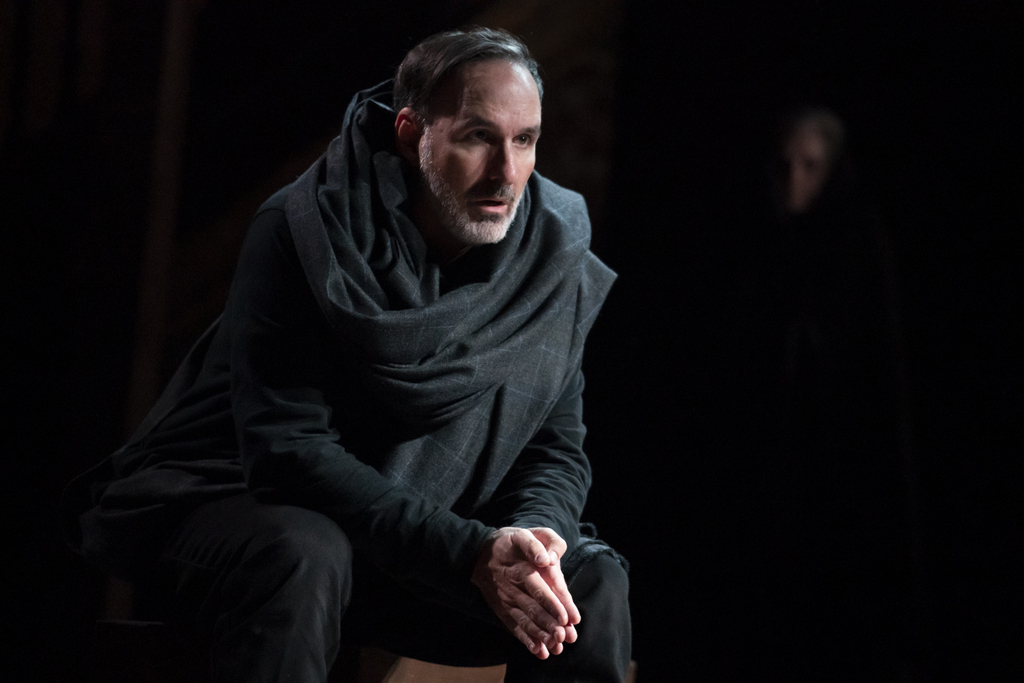
For those very familiar with the “Scottish Play,” this spare production will be fascinating. Its emphasis resides in the fine performances of Corey Stoll as Macbeth, his partner Nadia Bowers as Lady Macbeth, Eric Lochtefeld as Banquo and the adroit ensemble. For those unfamiliar with Macbeth who are looking to become more acquainted with the play, that has superstitious actors refusing to speak the title anywhere near a theater stage, this is not the production to see. Better to see a film version to get a handle on the plot, characterizations and themes before you stop in to see the CSC production. Then you will be able to understand and appreciate Doyle’s direction that concentrates on the grist of Shakespeare’s arc of development and characterizations, especially of Macbeth and Lady Macbeth.

Mary Beth Peil in ‘Macbeth’ by William Shakespeare directed by John Doyle, CSC (Joan Marcus)
There are many fine films of Macbeth; one directed by and starring Orsen Welles (1948); Roman Polanski’s Macbeth (1971), and most recently an incredibly visual and cinematic Macbeth starring Michael Fassbender directed by Justin Kurzel (2015). There is even a sardonic, comedic take-off on Macbeth (Scotland, PA, a film-2001), and the Off Broadway comedic musical adapted from the 2001 film currently running at the Laura Pels Theatre, Harold and Miriam Steinberg Center for Theatre.
Knowing the play as well as I do, I had little difficulty in appreciating the singularity of the performances and the rapid pacing of the events which fall in on themselves from scene to scene like dominoes. The pacing is important thematically and reveals much as an expression which manifests characterization. We, like Macbeth, are often hurled into a whirlwind of rapidly cascading events that occur around us, forged by those in power. Indeed, we barely have time to consider what is happening to take stock of circumstances. Instead, we must make quick deliberations and because of the speed, often make bad choices. This conceptualization pertains to this pared down production in the characters of Lady Macbeth and Macbeth.
Erik Lochtefeld in ‘Macbeth’ by William Shakespeare, directed by John Doyle, CSC (Joan Marcus)
In Doyle’s version we note Macbeth, a Scottish general who is driven on a course of loyalty to king Duncan to be valorous in battle. Stirred up by the voices of the culture (represented by a chorus of players who recite the dialogue of the three witches), to extend his ambitions in competition with Banquo, both generals receive a prophecy. Each encourages the other to believe what the chorus of witches speaks in their incantations. The prophecy concerns Macbeth becoming king and Banquo’s heirs becoming kings and ruling the kingdom for generations. Banquo’s and Macbeth’s imaginations ripen without prayer or meditation to become obsessed with their futures. Macbeth, rather than to consider that the chorus of witches may be evil, shares the “news” with Lady Macbeth who leaps to the assassination plot of killing Duncan who will stay at their castle.
The events pick up speed, unhindered by Macbeth’s doubt or unsettled nervousness because Lady Macbeth moves without delay to influence him to kill Duncan and murder the guards in retribution, laying blame on Duncan’s sons who flee. Macbeth assumes the throne without question, then with growing fear and paranoia betrays his friend Banquo and has him killed. When Macbeth attempts to be a proper statesman and ruler holding a banquet for his Lords to ingratiate himself to them, Banquo’s ghost appears upending Macbeth’s peace of mind, rest and attempted diplomacy. Afterward, confusion and mania escalates into psychotic paranoia and guilt. Macbeth’s seemingly unstoppable reign of tyranny and civil war grows in ferocity and wickedness toward an inevitable and swift conclusion.
Indeed, Doyle reveals an aspect of Macbeth not typically focused upon. Events unfold like a storm for which no preparation can be made. Macbeth and Lady Macbeth are largely transactional. Their motivations overwhelm them without thoughtful consideration. These upend them so quickly they leave no time to check themselves and consider what the consequences of their dishonorable actions will foment. Rationality leaks into insanity. It is as if Macbeth has allowed himself to be submerged underwater and is drowning in his own bloody imagination and frenzied blood-letting. This happens so rapidly and so smothers him and Lady Macbeth in guilt, he cannot breathe or rest easily once they’ve murdered their king and usurped his power. After the regicide, they are incapable of ruling wisely or well. They are consumed with maintaining the power they don’t understand and cannot keep because they are illegitimate and unfit.

Nadia Bowers, Corey Stoll in ‘Macbeth’ by William Shakespeare, directed by John Doyle, CSC (Joan Marcus)
Regicide drives Macbeth and Lady Macbeth to devastating guilt. But they are incapable of seeking redemption from an ocean of blood that stains their minds and hearts and propels them toward masochistic betrayals of themselves and each other in infamous deaths. For Lady Macbeth it is suicide which Macbeth does not have the time to mourn. For Macbeth it is arrogance that leads to his downfall in not making the proper alignments to keep the throne or recognize that he is not immortal as the chorus of witches have duped him to believing. The vortex does not stop spinning until Macbeth comes up for air, as it were, and dies. He is killed by Macduff who was “untimely ripped from his mother’s womb” a fulfillment of the prophecy that Macbeth will be killed by one “not born of woman.”
The pared down version eliminates various characters and scenes, some comedic, some ironic and foreshadowing. The platform stage acting area allows for the audience to sit on three sides. Toward the back of the playing area is the focal point of the production, the throne and seat of power. The rustic, wooden throne’s placement at the end of the platform allows for a “theater in the round” effect.”

Corey Stoll in ‘Macbeth’ by William Shakespeare, CSC, directed by John Doyle (Joan Marcus)
The audience becomes immediately engaged with the heightened action of Macbeth’s obsession with the throne and what that means for himself and the country. The only way to gain the modest-looking, oversized wooden chair is by usurping power illegitimately through regicide. That is easy. But to maintain his illegitimacy, he must use the weapons of tyranny, brutality, murderous betrayal of Banquo and destruction of his country. His guilt knowing he is not a true king makes his paranoia and psychosis all the more explosive. Thus, against the country he wishes to govern, ironically, he instigates civil war to protect what he never deserved and was never truly his, the throne of Scotland. What Macbeth and many leaders who lust for power never understand is that powerful men serve others first. Power means acute responsibility to govern over all the people, not just the sycophants and toadies. To be powerful, one must be, like Duncan revealed beneficent and just. Macbeth proves what a king isn’t. His lust for the throne is a tragedy.
One of the themes of the minimalistic design and vibrant staging is that whomever sits in the throne chair takes the power of the position. Whether they realize it or not, it is assumed they understand power. Initially, we see Duncan (Mary Beth Peil) resting easily in this power as the King gives commands and bestows honors with legitimate authority and probity. It is a dangerous “game for the throne” which Macbeth initiates stirred by the cultural “witchy” voices of the time that emphasize ambition and position without achievement, without grace and without ethics and honor to perform the hard work to deservedly wait for the possibility of becoming king through divine means. Macbeth cannot wait. Lady Macbeth will not wait. They lift their will above Scotland and God and reap the requisite fate.

Raffi Barsoumian in ‘Macbeth’ by William Shakespeare, directed by John Doyle, CSC (Joan Marcus)
Duncan’s success in war indicates his wisdom. When the treasonous Thane of Cawdor, (the title position Duncan awards Macbeth for his valor) repents his treachery to Duncan and is forgiven, but must suffer the consequences, we understand Duncan’s worthiness and justice as a beneficent ruler. Macbeth’s hasty leap to steal what he can never fulfill is all the more wicked and horrifying for Scotland. Sadly, Macbeth, instead of learning from the Thane of Cawdor’s behavior and repentance, thinks nothing of it. Too much the transactional man of action, imbalanced and not given to thoughtful consideration, his end is manifest the moment he takes on the mantle of Thane of Cawdor. Unlike the Thane, Macbeth never humbly repents and admits what he has done.
This production is revelatory and acute. The performances by Stoll, Bowers, Lochtefeld and Peil are resonant. They and Doyle’s direction elucidate important themes for our times about power, leadership, justice, illegitimacy, unfitness, accountability. The ensemble work is seasoned. Macbeth runs at CSC (East 13th Street between 3rd and Madison) until 15th December. For tickets and times CLICK HERE.
2018 Tribeca Film Festival Review: Chekhov’s ‘The Seagull’ Starring Annette Bening, Corey Stoll, Saoirse Ronan, Elisabeth Moss, Mare Winningham

Annette Bening, Jon Tenney in ‘The Seagull,’ 2018 Tribeca Film Festival World Premiere, (photo from the film)

Annette Bening, 2018 Tribeca FF World Premiere, Anton Chekhov’s ‘The Seagull,’ directed by Michael Mayer (Carole Di Tosti)
Michael Mayer’s valiant attempt to bring a freshness to The Seagull with a script based on Anton Chekhov’s titular work by Stephen Karam (Tony winner of The Humans-2016) shines for a myriad of reasons. Yes, many critics dunned it or found that it fell short of its monumental task to bring Anton Chekhov’s four act, three hour play to the screen. Indeed, Chekhov is not easy and the script has been paired to emphasize the humor and highlight the salient speeches and actions, leaving the more unwieldy dialogue behind.
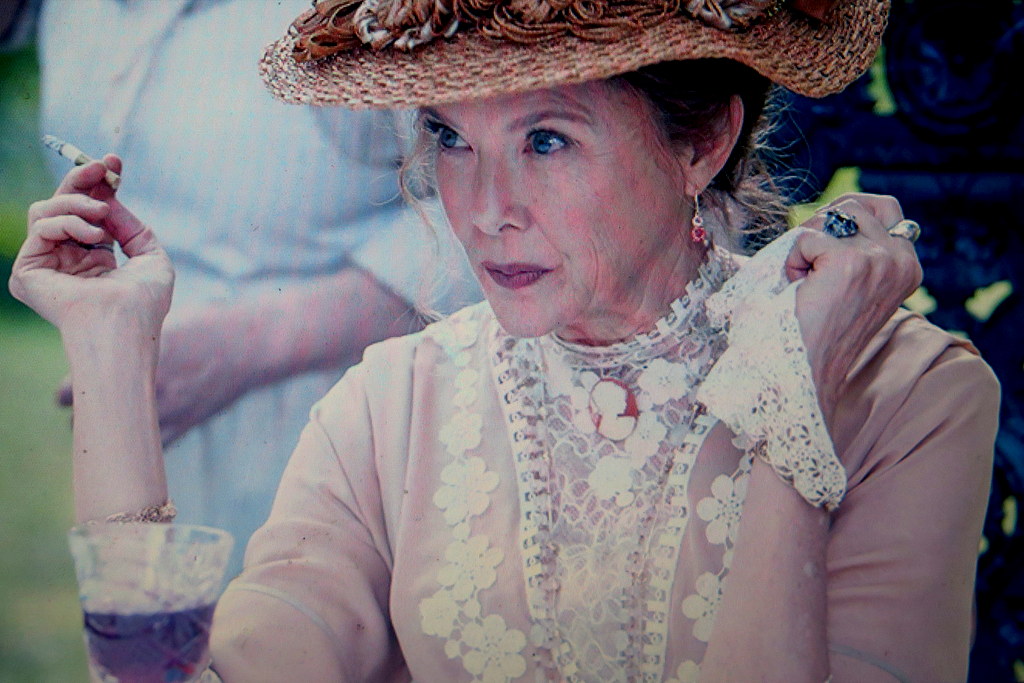
Annette Bening in Anton Checkhov’s ‘The Seagull,’ directed by Michael Mayer, adapted by Stephen Karam, 2018 Tribeca FF World Premiere, (photo courtesy of the film.
At its first time out in 1895, The Seagull flopped. The play requires superb acting and directing so that the ponderous tones are submerged and the comedy comes to the fore. I have seen a number of productions that left me with a yawn and a nod. Not so for this film. Forgive me fellow sojourners with a critical eye. My pen is blunted from razor sharp barbs directed to slice into this fine feature which made its World Premiere at the 2018 Tribeca Film Festival.

Saoirse Ronan, Corey Stoll, ‘The Seagull, 2018 Tribeca Film Festival World Premiere (photo courtesy of the film)
Mayer brings the action into the breathtaking settings of the lake and environs of the estate. He carries this striking beauty into his grand and lush interiors signifying the wealth and class status of the Pjotr Nikolayevich Sorin estate. Sorin (Brian Dennehy) is Irina’s (Annette Bening) brother. Interior and exterior settings are visually stunning. Against this gorgeousness Mayer unleashes the characters foibles and tragedies. The irony that luxury and the exquisite beauty of things has little power over emotions thematically resonates throughout. The principals’ (Irina-Bening, Trigorin-Corey Stoll, Nina-Saoirse Ronan, Masha-Elisabeth Moss, Konstantin-Billy Howle) interactions form the meat of the drama which ends in tragedy. None of the characters appear to be self-aware (Trigorin excepted with caveats) to the point where they can make decisions which are life-affirming. Chekhov and Mayer’s iteration of his version of The Seagull places the human condition in its humor and sadness front and center. To his credit Mayer’s understanding and perception continually serve his fine cinematic intuitions, skills and efforts.

Saoirse Ronan, 2018 Tribeca Film Festival World Premiere Screening and Q & A (Carole Di Tosti)
The vitality of the settings that move back and forth from outdoors to interiors ground us in the landed wealth and social order of the Sorin family who also boasts a celebrity, the actress Irina who visits her brother Sorin and her son Konstantin each summer. The settings, always a subtle reminder of the time and place in Russia before the revolution (twenty years or so later) seem a particular irony. The upper class social elites and celebrities (Irina, Trigorin, etc.) whose physical needs are answered by the serving class, remain surreptitiously unhappy and in a constant state of displacement by the major facts of life: love-loss, aging and death. Their sturm und drang, whimsies, self-absorption and discontents are the luxuries of their class which harbor the seeds of tragedy because their cavernous, selfish desires blind them to the encroaching realities. Unless they self-correct, they will face tragedy and loss after tragedy and destruction, muting their soul’s enrichment until little of worth is left.. Inevitably, this class in the coming decades will lose all they take for granted.

Annette Bening, Billy Howle in Anton Chekhov’s ‘The Seagull’, 2018 Tribeca FF World Premiere and Q & A, (Carole Di Tosti)
Irina (Bening is authentic and stunning as the aging diva racing one step ahead of oblivion, and the end of celebrity and youth) brings the successful novelist Trigorin (Stoll in a superbly realistic performance) into the summer festivities of the family on their estate. Trigorin’s presence is the catalyst that puts the human dominoes in motion and sends them careening off a cliff with humor and irrevocably pathos. Konstantin, a passionate, unconventional writer is devastated after his mother Irina and the others find his play, performed by his unrequited love Nina, to be laughable and esoteric. Too self-absorbed with their own greatness Irina and Trigorin dismiss his yearning for success and recognition. His need for his mother’s love and acceptance has fallen at the shores of his depressive state for years. Almost in a revenge against his plight and in a self-curse of not achieving success, he shoots a delightful, beautiful seagull in a wanton act to release his anger. He gives the seagull to Nina who rejects it. It is a symbolic act, as if as refuses to acknowledge that her unrequited love wounds him. This act reverberates and symbolizes additional themes. One is that human being’s selfish desires and passions loosed upon the natural world and others, if not moderated, harm and destroy.
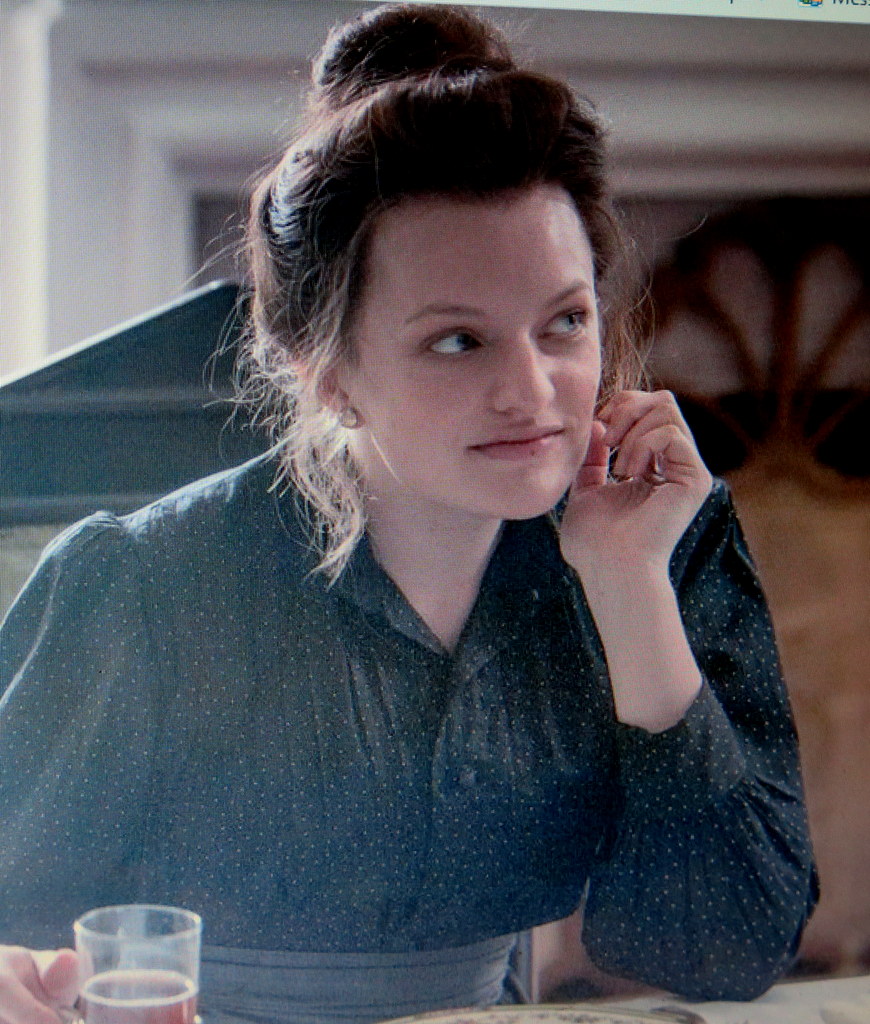
Elisabeth Moss in Anton Chekhov’s ‘The Seagull,’ written by Stephen Karam, 2018 Tribeca FF World Premiere, directed by Michael Mayer (photo from the film)
For her part Nina (who lives on a neighboring estate) is entranced by Trigorin and dismissive of Konstantin’s love. She seeks fame as an actress and wants Trigorin’s love which he finds flattering for his ego is wounded in his relationship with Irina and the encroaching years of waning masculinity. Nina may be his last, greatest passion, and if not that, a distracting plaything to notch on his belt and then discard. When he notes the dead seagull, he shares that he may use it as a symbol in a work he will write. These poetic notions seduce Nina with the enticement that she may be his seagull. Nina is blind to the danger of what he says, innocently trusting him with her love and being.
Stoll as Trigorin is convincing especially in his self-justification of why he must take Nina’s love, if even for a season, when she offers it quoting from a passage in a work of his. This speech in particular is superbly delivered by Stoll. And even if it is not graceful, we empathize with his fear of aging and the limitations of his mortality with which we all can identify. Neither money, nor success nor celebrity can answer death. However, being pursued by two women a beautiful younger one and a celebrated actress who is a drama queen will suffice in the meantime, though it requires the humility and wisdom to negotiate their war against each other to “get” him. Trigorin’s pride and fear do not allow him to balance the two women so that they don’t care about his concern for the other in competing jealousies. They do care and they compete for him.
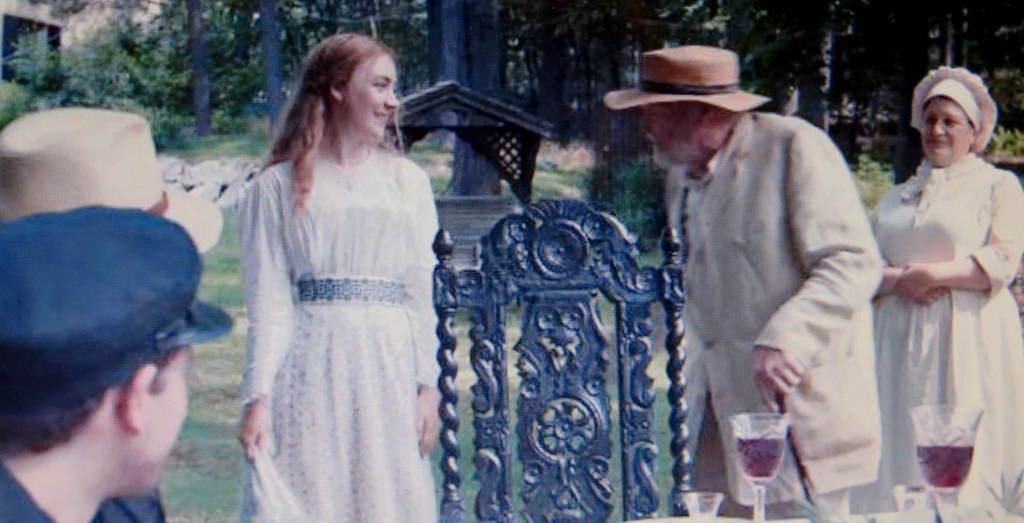
Saoirse Ronan, Brian Dennehy, Anton Chekhov’s ‘The Seagull,’ adapted by Stephen Karam, 2018 Tribeca FF World Premiere (photo from the film)
Irinia discovers Nina’s hopeless infatuation and must then approach Trigorin with clever wiles to get him to return with her to Moscow. If they stay at the estate, in front of her he will fulfill his lustful passion for Nina, for Nina is relentless. Irina refuses this humiliation.Though Trigorin and Irina leave together, in the short term she knows she must let him go.
Bening’s and Stoll’s interplay is smashing. In their portrayals, they reveal that neither character loves the other, but the passion for keeping their successful images by using each other’s status is familiar territory. Ultimately that will bind them together, despite any interfering love by encroaching inferiors like Nina or even Irina’s son Konstantin.

Corey Stoll, Red Carpet, 2018 Tribeca FF World Premiere, Anton Chekhov’s ‘The Seagull,’ directed by Michael Mayer, adapted by Stephen Karam (Carole Di Tosti)
These intricate matters of the heart are further complicated by the unrequited love of Konstantin for Nina whom he adores, and Masha’s (the daughter of Sorin’s baliff) unrequited love of Konstantin. The only stable one appears to be Doctor Dorn (Jon Tenney) who sees the value in Konstantin’s symbolistic, maverick play. However, he is having an affair with Polina behind her husband’s back, not embarrassed to cuckhold an inferior. Thus, with this selfish and wanton weakness, he fits the ethos of the other disturbed, dismantling characters.
What of the irascible and reflexive Sorin (Dennehy) who allows the visitors to descend on the estate each summer with aplomb and takes care of his nephew Konstantin while his sister indulges her passions for the dramatic life? He appears to be the most balanced, but he has two sick feet on a banana peel, and if he moves too suddenly, he appears ready to slip out of life. Only the servants/peasants whose needs we cannot see remain solid even heroic as they attend to their sometimes “infantile” charges and judge their actions accordingly.
The beauty of the film is its muscularity. The director focuses on the performances in the highly charged scenes between Bening’s Irina and Stoll’s Trigorin and between Trigorin and Saoirse Ronan’s Nina and between Nina and Howle’s Konstantin.

Saoirse Ronan in Anton Chekhov’s ‘The Seagull,’ directed by Michael Meyer, adapted by Stephen Karam, 2018 Tribeca FF (photo from film)
The succinct script entices us toward believability. We know these individuals and are fascinated by their rationale for behaving as they do. Though not very admirable or honorable, they are like us as they “hang themselves and each other out to dry.” When Nina returns in her dishevelment and dislocation of self and presents what she “is” to Konstantin, he sees her identity ravished and torn by Trigorin and the vicissitudes of her mediocre acting career. From his love for her and out of his own depths of despair, he willfully kills himself ending his misery and torment.
The ending is particularly poignant. Saoirse Ronan, appears like a ghost to revisit and haunt the scene as if transferring her great wounds to Konstantin who again kills a seagull in his empathy with it. This time it is himself. Representatively, symbolically his act shows that though Nina’s physical life continues, for all intents and purposes, her beauty and innocence are dead. Both have allowed themselves to be consumed by others whose great, dark abyss of self-torment seems limitless in its rapacity to devour all who attempt to love them.
See the film for the performances: all are wonderful, and kudos to Elisabeth Moss who manages always to be funny in her despair and angst. Mare Winningham, Jon Tenney and Brian Dennehy relay solid performances.
Mayer has found an approach to putting difficult classics onscreen. Perhaps he will continue this trend; fine directors should work with the classics to acquaint the current generation with great playwrights and authors. Actors surely will jump at the opportunity, to portray humorous and profound characterizations like the ones Chekhov has delineated in The Seagull.
 CAROLE DI TOSTI