Blog Archives
The Fine June Squibb Heads up the Stellar Cast of ‘Marjorie Prime’

When Marjorie Prime by Jordan Harrison opened Off Broadway in 2015, starring Lois Smith, it appealed as science fiction. Since then the use of various forms of artificial intelligence to support human behavior have become ubiquitous.
Reinforcing this new reality the playwright and director Anne Kauffman dusted off the prescient family drama and shined it up for its Broadway premiere with few changes to the script. Maintaining the prior production values, director Anne Kauffman works with set designer Lee Jellinek, sound designer Daniel Kluger and Ben Stanton’s lighting design to create the almost surreal and static atmosphere where AI takes over the lives of a family and exists for itself in the last scene.
The production runs at the Helen Hayes Theater with the superb cast of June Squibb, Cynthia Nixon, Danny Burstein and Christopher Lowell through February 15. They are the reason to see the revival.
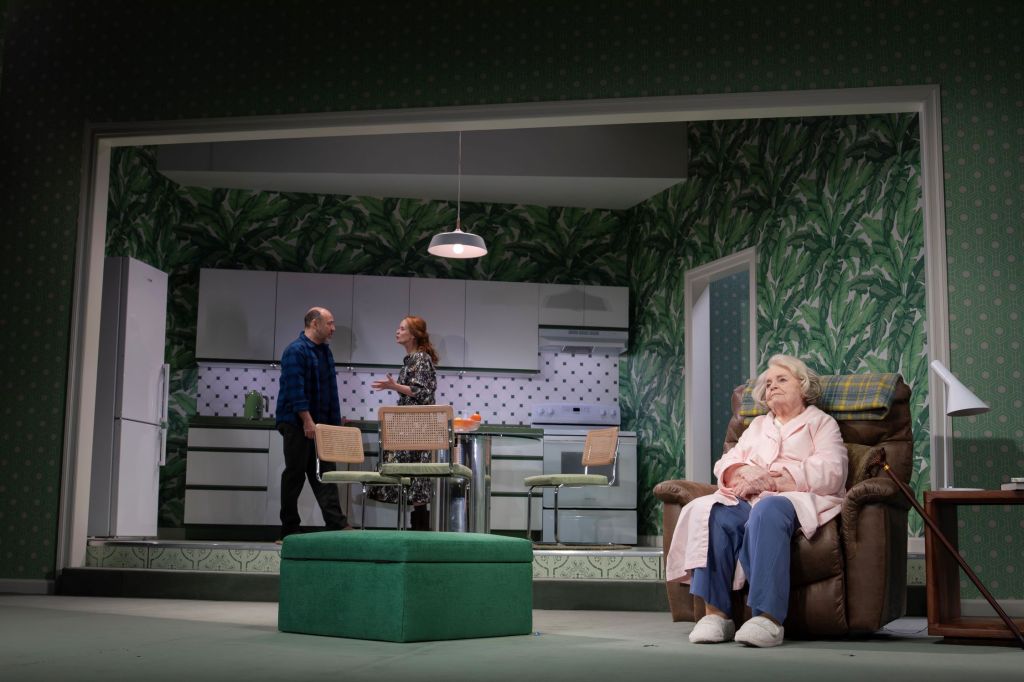
On one level the excellent performances outshine the themes of Marjorie Prime which deal with death, identity, the grieving process, artificial intelligence and more. The science fiction aspect of the play, so striking before, has diminished.
Yet, Harrison’s conceit that AI holograms might be used to reconcile the death and loss of a loved one still fascinates a decade later. Our culture fights death and aging with its emphasis on ageless appearance, looking 25-years-old at the chronological age of 90-years-old. Some other cultures have a healthier approach, viewing the acceptance of death and aging as a normal part of life cycles. However, with technological advancements, regardless of the culture or country, AI will have its uses in the battle against disease, dying, death and mourning.
The “Primes,” in Marjorie Prime are the spitting image of loved ones at a particular time in their lives. Created by the company Senior Serenity to help the bereaved get through inconsolable grief, Marjorie’s family believes a holographic duplicate of husband Walter will help her adjust to his death. The replica keeps her engaged, sentient and interactive, unlike passively watching TV.
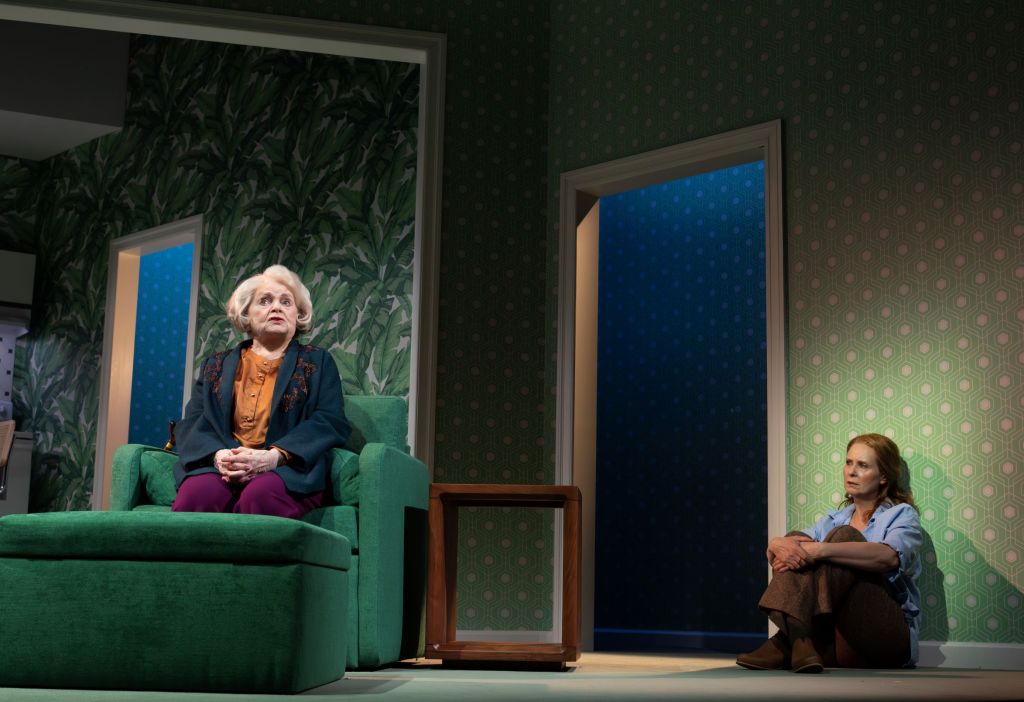
Walter Prime (Christopher Lowell) duplicates the younger, good-looking Walter in his thirties. Happily, he reminds her of the distant past, not the more recent, sick and dying Walter. The hologram’s programming and presence also help stir Marjorie’s memory, complicated with dementia. A work in progress, Walter Prime evolves based on the information that 85-year-old Marjorie (June Squibb), her daughter Tess (Cynthia Nixon), and son-in-law Jon (Danny Burstein), give him about Walter and Marjorie’s life together.
Thus, at the top of the play Walter Prime and Marjorie discuss movies they went to, for example, My Best Friend’s Wedding, which Marjorie has forgotten until Walter tells her the synopsis. The spry 96-year old Squibb, who made her Broadway debut playing one of the strippers in Gypsy (1959), portrays the spicy, funny, confused, chronologically younger woman with a failing memory, an irony that amused me to no end. Squibb is just terrific.
As Marjorie’s identity and memory dim, Walter Prime builds up the identity of Walter with her help. However, Harrison’s play raises questions about this process and never answers them. For example, how much information has Walter Prime been fed prior to his engagement with Marjorie, Jon and Tess? How can Marjorie be expected to keep track of information from before their marriage into their elderly years with her failing memory? Won’t she feed him incorrect details?
Indeed, facts and details shift and Marjorie confuses the truth. An imagined past becomes easier to accept with one’s husband “Prime” fed information by others. This problem never resolves. Neither does Tess’s incomplete acceptance of Walter’s function to stimulate Marjorie, the supposed benefit that Senior Serenity, the company that made him, affirms. The impatient, edgy Tess doubts Walter’s usefulness, but the upbeat Jon thinks that he helps improve Marjorie’s engagement and memory.
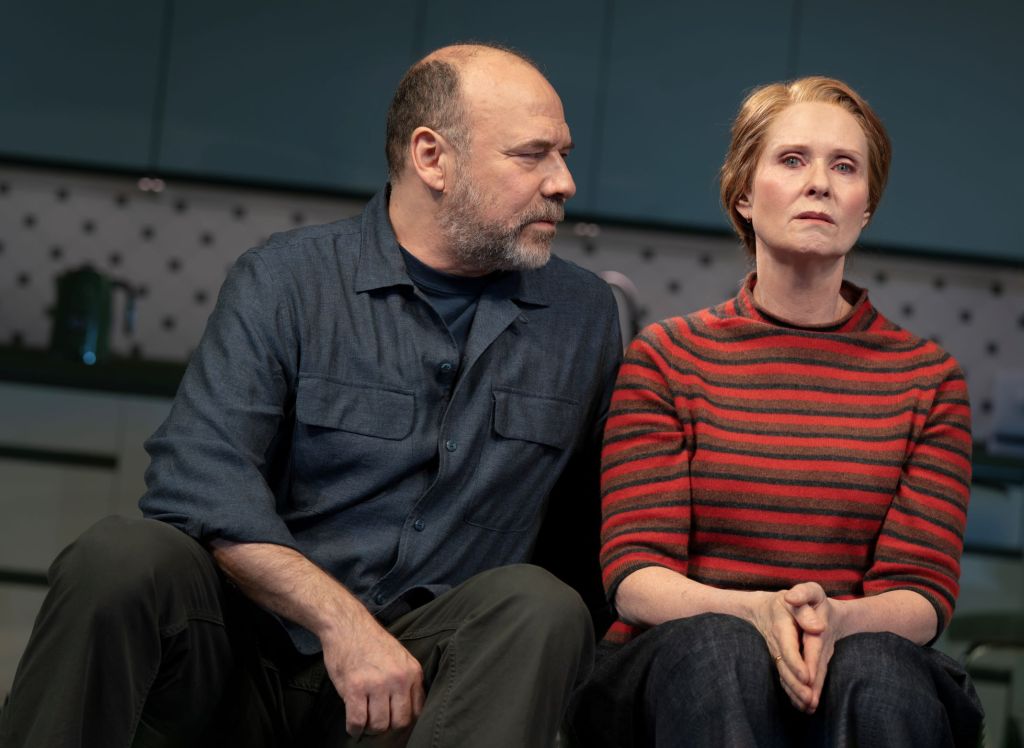
When Walter Prime’s presence annoys Tess, Jon accuses her of jealousy. Does Marjorie prefer Walter over Tess, who must nag her mother to eat and “obey” her in the reversal of mother/daughter, parent/child roles? Losing her autonomy Marjorie must rely on Tess and Jon in her living arrangements and personal care needs.
As Jon, Marjorie and Tess converse in Jellick’s minimalist, living room-kitchen combination that lacks futuristic style, Walter Prime sits on a sofa in the living room. He waits in a “listening mode” ready to interact when needed.
For his part Jon is positive about Walter’s impact on Marjorie. As the scene progresses, Tess mentions after an interval that her mother surprisingly recalls a situation long buried in pain. We learn the specifics of this later in the play. Some of the action referred to happens off stage. (i.e. Tess and Jon take Marjorie to the hospital after a fall).
Guided by the “Primes,” who Harrison sequences to move the action forward, time jumps. Marjorie has died and Jon and Tess engage Marjorie Prime to help console Tess and move her through her bleak depression and grief at her mom’s passing. After that we learn through Jon’s conversation with Tess Prime what transpired with Tess. In the various scenes Nixon’s Tess gives a heartbreaking speech about her mother, memory and imagination which sets up the rest of the play. Burstein’s Jon listens and responds with an uncanny authenticity. Both are superb.
Since the “Primes” “live” forever in holographic form until someone decommissions them, they occupy the home in the last scene. Jon is elsewhere, so Walter, Tess and Marjorie converse among themselves having been given life from their human counterparts as an ideal, evolved “being.” Eerie perfection.
Marjorie Prime runs 1 hour 15 minutes with no intermission at the Helen Hayes Theater on 44th Street until the 15 of February. 2st.com.
‘Pictures From Home,’ Strong, Humorous, Heartfelt Performances Bring Depth and Nuance to Must-See Theater

How does one negotiate one’s upbringing as an adult, when one’s parents still keep them under their charge and supervision as a comforting mainstay of their relationship? How does one one respond, if the parents in their relationships with adult children default to roles of superior authority figure vs. inferior minor? The superb Pictures From Home raises and answers these questions.
Pictures From Home in its premiere at Studio 54, currently runs until April 30. Written by Sharr White (The Other Place), and directed by Bartlett Sher (To Kill a Mockingbird) it sports a tremendous all-star cast who inhabit the characters to the cellular level. The play, which encapsulates photographer Larry Sultan’s decades-long project, exploring his relationship with his parents through pictures, is a knockout. Based on Sultan’s titular photographic memoir (1992), White’s work unfolds as an intimate portrait of a family that challenges the audience to think about how we reconcile issues with our own parents that we know may never be resolved.
White’s depiction of Larry (portrayed with great sensitivity and aplomb by the marvelously versatile Danny Burstein) and his parents, as a memory play is largely thematic. The son, Burstein’s Larry perseveres in his project initially to learn about his life and relationship with his parents through the post-war pictures taken before and after they moved to Southern California. Of course his initial intentions change with the passing years he gets to know his parents from a different viewpoint.

In his quest to understand levels beyond surface identities, Larry chronicles the culture against the backdrop of family photos, videos. discussions and interviews during weekend visits (twice a month) from 1982-1992. Importantly, Burstein’s Larry discovers that the process of “information gathering” itself is wondrous, life-affirming and loving. He learns to live with the uncertainty that the truth about his and his family’s past and present is always shifting. Eventually, he realizes that this is an acceptable revelation that occurs despite his creating frustrations and annoyances for his parents and himself. Complications arise, as he explores other perspectives about them through what he hopes will become a “more objective” lens.
However, throughout the humorous and at times rancorous give and take sessions among son Larry, Dad Irving and Mom Jean (the inimitable Nathan Lane and Zoë Wanamaker) there is the inevitable acknowledgement that this is “their” family. For good or ill they have navigated the emotional and psychological shark infested waters and stuck by each other protected by an abiding, scratchy, blanket of love. Who is anyone to judge them? There’s a quote about glass houses and throwing stones somewhere in this production which White, the actors and director take out and shake up with chiding humor to “not point the finger too readily or heartily.” Judgment doesn’t apply, regarding this intimate enlivened portrait; in fact, it is disingenuous.

Indeed, we cannot look back in hindsight and determine accurately, Sharr White suggests as one of the themes of this clever production which sneaks up on you, if you allow it the grace to do so. At it strongest moments the presentation of the family dynamic, becomes like watching our own family dysfunctioning in real time. Larry’s motivations and intentions as he seeks out Irving’s and Jean’s approbation, insights and perspectives, and weathers his father’s criticism during the unfolding of the project, are right out of our own home movies. Not only are the interactions hysterical and funny, they are heartbreaking and identifiable, and at times searing.
If one is fortunate to have family, it is what all adult children (if they are honest) cannot really grasp in the fullness of its significance and meaning to their lives. We can’t even securely attribute our successes or failures to them because there is the ineffable mysterious that cannot be pinned down. And if one does attempt to acutely define what is undefinable and cover it with blame or calculation, it will be incomplete, misaligned and skewed by one’s own biases. Family relationships in all their warts, impurities and embarrassments are beautiful because they are attempts to get it right, Sharr White teases out of Larry Sultan’s photo memoir. The heartbreak of Larry, Irving and Jean is that with every imperfect interaction, they don’t quite hit the mark. That is the pain and that is the glory. At least they tried.
And just as Burstein’s Larry concludes by the end of the play (and project) and we concur as an audience watching the intimacies of what the photos reveal, family relationships, individual and combined, are infinitely complex. In that complexity, if grace is attempted, there is mirth in the clown car of family gatherings. You have to laugh. If you don’t find the humor, you weep, and of course in the humor, there has been much weeping and pain to allow it to rise to the levity of wit and wisdom.

As Larry explores and unravels each home movie or picture, discussing it with Jean and Irving, he chooses to accept and love as his parents have and still love, despite the sorrows and pains. Underneath there are happinesses. And this is a treasure worth more than the profits that Larry gains when he publishes his photo memoir which receives wide acclaim and Irving’s praise and the relief that his son’s visits have accomplished “something worthwhile.” The time spent with his parents and their generosity in allowing him to needle and prod them could never be fashioned any other way. The bond they form holds no regrets because in due season, as Wanamaker’s Jean underscores in the poignant scene with Burstein’s Larry, she can’t live forever, though in his child-like heart he wishes she could.
Of course we “get” her question to him, “Why would I want to?” That one of the reasons why Larry might be doing this project, to redeem the time with his parents, turns out to be his finest reason for its accomplishment. Wanamaker and Burstein render every nuance and feeling out of their scene together which is lovely and outright smashing.
Thomas Wolf proclaimed in You Can’t Go Home Again, that you can’t return to the past, for time’s momentum dissolves what was into inaccurate memory. Likewise, there is something greatly tragic in viewing photographs to jar one’s memories and find meaning which can never be fully realized. For the faded photographs often capture a brand, a statement to cover over truths with impressions. However, as a photographer whose life is made full attempting to capture timeless compositions, Burstein’s Larry eschews Wolf’s adjuration and tries to discover meaning and substance from the impressions. And he doesn’t quite succeed to his liking, yet it is magnificent that he tries.

Time and again he visits Jean and Irving, flying from his professorship, wife and children to his old homestead in Southern California (neatly effected by Michael Yeargan’s set design). As he interviews his parents and reviews again and again various photos from his childhood to capture the cultural zeitgeist and look for new interpretations of his life and parents beyond his memories from a child’s perspective, he concludes points, then argues with his father who disagrees with him. Ingeniously, he examines and reflects upon their poses, facial expressions, gestures, activities, captured in the still point, directing his parents toward a new interpretation. It is a humorous fact that the photos Larry selects for his book are precisely the ones that his parents and particularly his father dislike because they are not posed to perfection or portray a flattering image.
In the dialogue centering on the photos,White has given the actors the grist to take off into the amazing territory of nuance to bring out sub rosa emotions, defense mechanisms and disclosures from each family member. That Jean is not as forthcoming as her husband, but is nurturing and supportive of her son speaks volumes. She is wary and deeply loves and understands her husband’s weaknesses and defensiveness, though she gets fed up with him at times. He counts on her understanding and is the one to affirm his love for her toward the conclusion.
Through each of their interactions that represent the many visits from Larry, White creates vignettes that are thematic. In one when Lane’s Irving hysterically hobbles about with an injury we never learn how he received, the scene moves to an unexpected and poignant end-stop about aging. Lane’s Irving effects the emotional arc of the scene with incredible moment and a cry from the heart that is tremendously moving.

In another interaction Jean’s growing dementia is subtly revealed in her panic about where she put various items. From the beginning of the play to the conclusion, Wanamaker subtly reveals Jean’s worsening condition. If one is not focusing, one might miss this incredible aspect of her performance. Wannamaker reveals Jean’s memory decline, nervous fidgeting and sometime irascibility, which Lane’s Irving discounts in the latter scenes that represent the end of the decade. We understand why Irving prefers not to note this as we look at the photo projections of them dressed to the nine’s decades earlier. Though we laugh, we get the undertones when Irving asks why Larry can’t use this photo where Jean is just stunning and Irving is certainly her inferior in the looks department.
The photos and videos blown up and projected on the set’s back wall become the backdrop upon which the actors acutely portray these individuals so that we become acquainted with them as archetypes with whom we identify. Thanks to 59 Productions these are integral to the themes in the vignettes. And they make all the more vital and poignant the last lines of the play when we discover that Jean dies after they move to Palm Springs (something which Larry disapproved of more for himself than for his parents). And as Burstein’s Larry proclaims his father’s illness and his death, his last lines fade and a visual of the photographer Larry Sultan is projected. Larry and Irving died in the same year, 2009. One cannot help but be stirred looking at his beautiful picture as a crystallization of his ancestry and his honest tribute to his parents in text and photos and this play’s messages of love, family, “seizing the day” and “memento mori.”
Kudos to Jennifer Moeller (costume design) Jennifer Tipton (lighting design) Scott Lehrer and Peter John Still (sound design) and Tommy Kurzman (wig/hair and makeup design) and of course 59 Productions projection design for bringing to life with the actors’ prodigious efforts the director’s stunning vision..
Pictures From Home is a must-see for the performances, the themes, the direction, the complexity and nuance of the play itself. For tickets go to their website, https://picturesfromhomebroadway.com/
‘Moulin Rouge! The Musical’ Celebrates the Seductive Delights of the Iconic Venue in a Sumptuous Feast for the Senses

(L-R): Jacqueline B. Arnold, Robyn Hurder, Holly James, Jeigh Madjus in Moulin Rouge! The Musical, book by John Logan, Music Supervision, Orchestrations, Arrangements & Additional Lyrics by Justin Levine directed by Alex Timbers (Matthew Murphy)
The moment you enter the Al Hirshfeld Theatre, a paradise of sensuality embraces your soul and immerses you in the suggestion of hedonistic pleasure. Immediately, you are “eyes wide open,” moving along a course where anything is possible, even an after hours engagement with one of the male, female or transgender perfections of beauty, scantily but tastefully adorned, who saunter on the catwalks and peer out at you from the stage. Undulating rhythms and sensual music in this Bohemian, Paris, Left Bank cabaret/theater/dance hall soothe and allure. The luxurious red and gold appointments, the deep cherry and red velvet variegated stage curtains, the banquets, chandeliers, gleaming brass, the golden cherubim all whisper romance, sex, excitement and a whirlwind of indulgence. Whoever you are, you will be encouraged to understand that you can achieve your vision of an exalted life, a life where freedom, truth, beauty and love raise you above a bruising and squalid reality out there on the dark streets.

Danny Burstein in Moulin Rouge! The Musical, directed by Alex Timbers (Matthew Murphy)
This is the Moulin Rouge Club at Moulin Rouge! The Musical. Expect the finest in fantasy and escapism. If your intellect and imagination are ripe to receive, you will never be the same again! As you sense this revelation La Chocolat (Jacqueline B. Arnold), Nini (Robyn Hurder), Arabia (Holly James), Baby Doll (Jeigh Madjus), parade their “stuff” and throatily grind to the beats as they torch out “Lady Marmalade,” in an unforgettable opening number joined by the ensemble. This full throttle ignition is brilliantly conceived with grand style and prodigious effort by the creative team. My God, what a triumph!
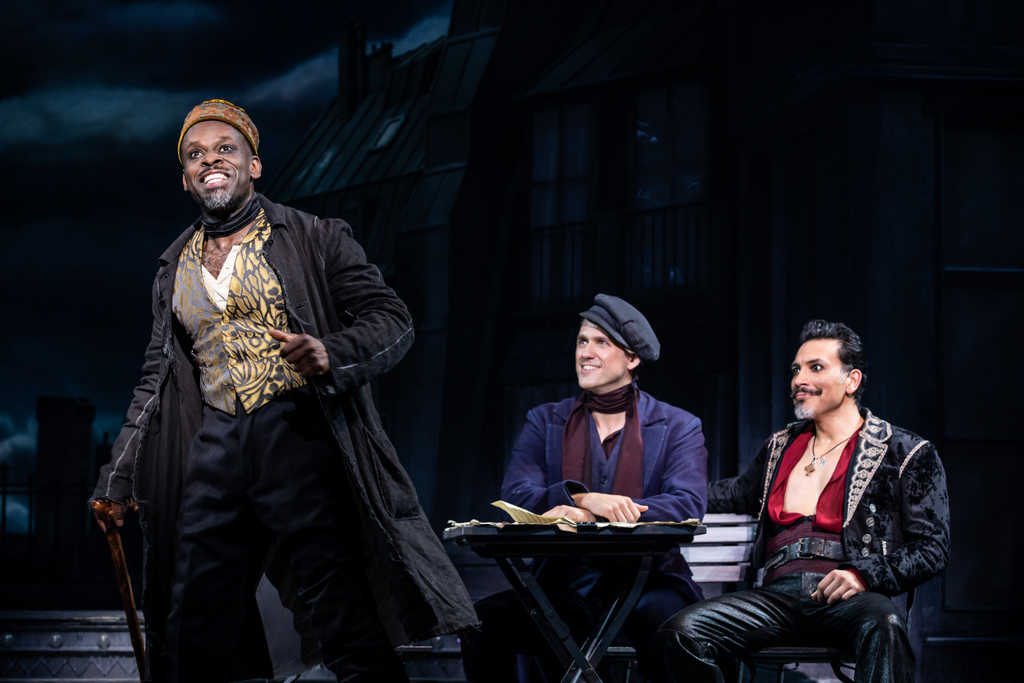
(L to R): Sahr Ngaujah, Aaron Tveit, Ricky Rojas in Moulin Rouge! The Musical, directed by Alex Timbers (Matthew Murphy)
The production directed by the illimitable Alex Timbers, with a clever book by John Logan (based on the 2001 Twentieth Century Fox Motion Picture written by Baz Luhrmann and Craig Pearce, directed by Baz Luhrmann), with “to-die-for” music supervision, orchestrations and arrangements by Justin Levine is a towering majestical remembrance of what never was but might have been during La Belle Époque in Paris and specifically at the fin de siè·cle. From the on-point luxurious, sexy, ravishing costumes by Catherine Zuber to the energetic, aggressive, dance numbers choreographed by Sonya Tayeh, this musical is a non stop festival. “Bad Romance” is especially gravitating as a thrilling, energetic, “lemme consume your lips,” head to head, face-off with couples gyrating to the hot Lady Gaga song which thematically epitomizes the romance among the principal couples: The Duke of Monroth (Tam Mutu), Satine (Karen Olivo), Christian (Aaron Tveit), and the lesser lights: Santiago (Ricky Rojas), and Nini (Robyn Hurder), all of whom are sensational in voice, and character portrayals.
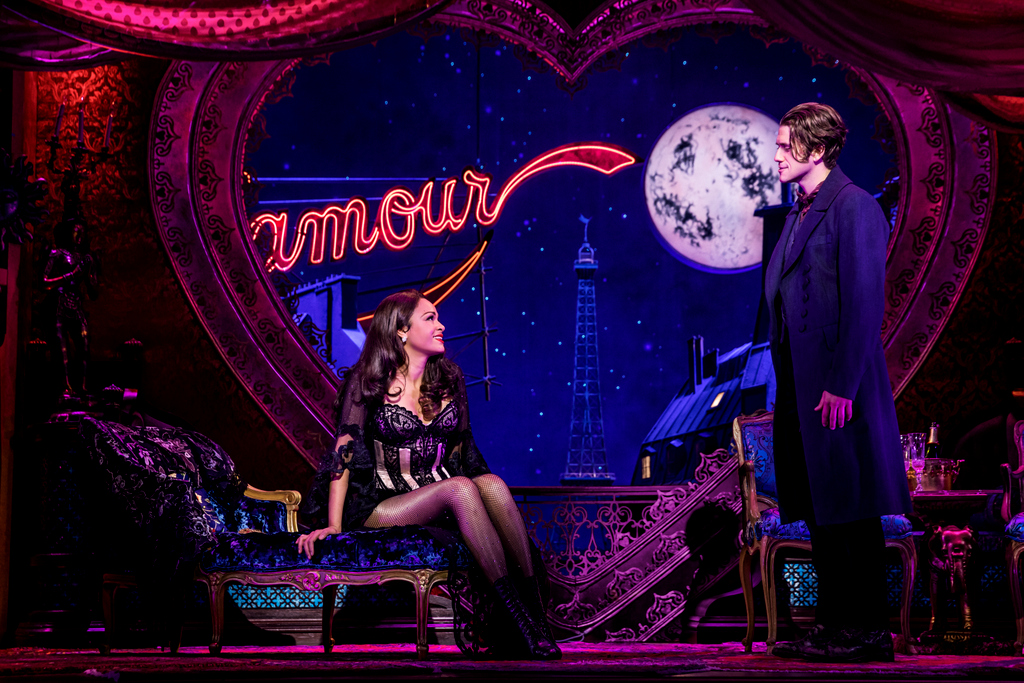
Karen Olivo Aaron Tveit in Moulin Rouge! The Musical, directed by Alex Timbers (Matthew Murphy)
Baz Luhrmann and Catherine Martin provided their creative services to the production which is an update of their ground-breaking, award-winning film Moulin Rouge (2001). And indeed, the basic arc of development inspired by a meld of characters and plots from Giuseppe Verdi’s opera La Traviata and Giacomo Puccini’s La Boheme remains with added tweaks of humor, phantasm and fun, delivered by incredible performances, perhaps the most preeminent charismatic, chameleon of of them all being the gobsmacking Danny Burstein.
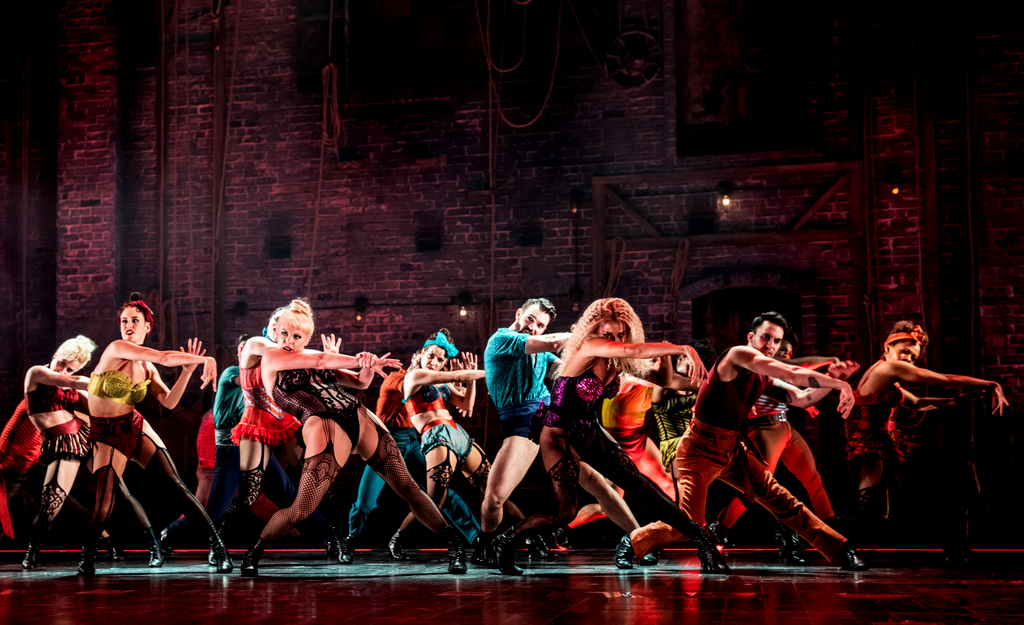
The Company, Moulin Rouge! The Musical, directed by Alex Timbers (Matthew Murphy)
Burstein is a mesmerizing scene stealer. Amidst the splendiferous sets (Derek McLane), and shimmering, vibrantly lit (Justin Townsend), festivities, Burstein, as the club’s artistic owner/showman Harold Zidler, is the “God-like” host of confabulation. And he is damn good at it, in fact so adorable that we understand how and why Harold has kept his “chickens” together through thick and the current financially thin stage of the Moulin Rouge Club’s history. As Burstein’s Harold winningly controls our imaginations and guides the glory and spectacle, we willingly follow him believing he has our best interests at heart because to him there is no sin, no judgment. Within this space and for this night, we are free to be our fantasies.

Tam Mutu in Moulin Rouge! The Musical, directed by Alex Timbers (Matthew Murphy)
What this production does exceedingly well is reveal that the Moulin Rouge Club into which Zidler has put his heart, soul and every red hot cent he owes is an artistic production down to the lavish sets and well-heeled orchestra. And he and the ensemble live for this art. Thus, Burstein’s performance is a revelatory genius of Zidler’s dedication and desperation. Motivated by his craft and concern for his artistic family, his character’s steely sweetness is genuine, his charm and love is pure without oily ingratitude or predatory insidiousness. Above all he makes clear in the behind the scenes discussions with Olivo’s Satine, that his desire is to supply his patrons’ complete enjoyment so his company will survive and remain off the streets and away from the impoverished hellishness they all came from.
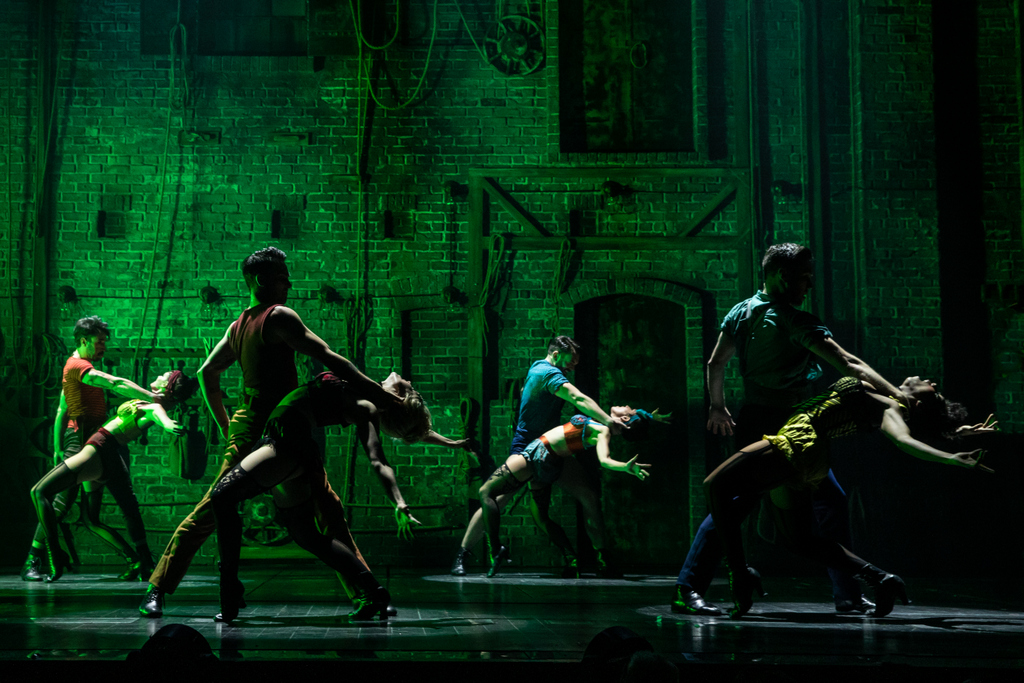
Moulin Rouge! The Musical, The Company, directed by Alex Timbers (Matthew Murphy)
Likewise, Satine’s love for Zidler and her company of friends and compatriots, one of whom is the great painter Toulouse-Lautrec (the very fine, grounded Sahr Ngaujah), reveals they understand the club’s liquidity is their life and happiness. Thus, Satine’s characterization is profound. She is the “read deal:” she is their salvation, their mother, their friend, their life-blood, their sacrifice. The sense of love and community among the ensemble is palpable so we believe Burstein’s Harold when he insists that Satine should “go to hospital,” as her friends insist as well. Without her, they are lost.
Karen Olivo’s Satine is a sensual, hot, earth-mother and high-class courtesan, experienced, wise, unmoved. She is not an ethereal beauty, but dominant, solid in will, though failing in flesh. She is a perfect symbol to represent what Harold’s artistic creation stands for, a lotus risen from the mud into full flower which will fade quickly. Olivo’s fullness of voice soars during her duets with Tveit’s Christian who is her equal in range, power and sensitivity. “The Elephant Medley” (the love song riff mash-up they sing in her boudoir as a “come-on” and “let-down”), that has been enhanced with additional numbers is just smashing.
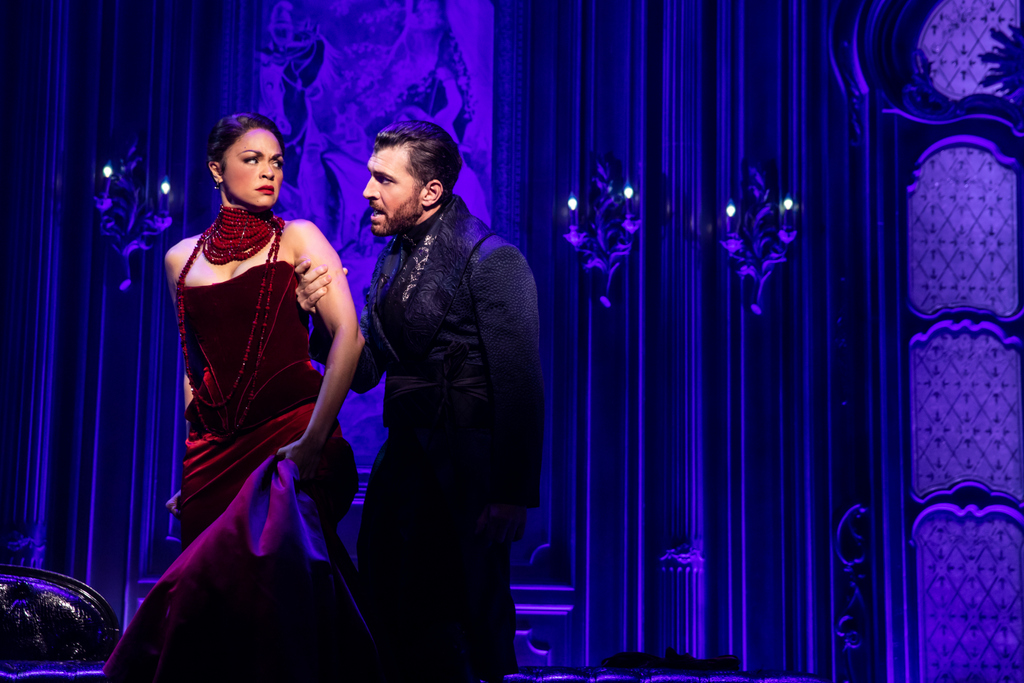
Karen Olivo, Tam Mutu, Moulin Rouge! The Musical, directed by Alex Timbers (Matthew Murphy)
Her introduction by Zidler as the “jewel” of the Moulin Rouge Club as she descends on a trapeze singing the “Diamond Medley” symbolizes her ethos and the club’s centrality as a necessity in the hearts of a society at that time and perhaps for all time. Escapism is in; it always was and always will be. The more authentic the fantasy, the better. And Satine, like Zidler, are exceptional conveyors. Their importance is an equivalent to their patrons’ happiness. Thus, she is fitting as a timeless symbol of the club; their interwoven stories will always resonate and instruct with wisdom, which like a diamond shines but cuts.
Obviously, Logan’s book adapted from Luhrmann’s and Craig Pearce’s film, reflects depth in its simple story of artists attempting to survive in a carnivorous world, as they use their charms and love inducements to glean wealthy backers. And all goes well, until the artists are hoisted on their own petard of humanity, and they fall fatally in love, and others fall fatally in lust with them. As cultural icons, artists cannot be owned or even possessed. (a not so subtle message to philistines everywhere). Satine and Zidler belong to their art, themselves and the world, as Ngaujah’s Toulouse-Lautrec affirms despite The Duke of Monroth’s insistence that Monroth owns the club and all its performers. This is another intriguing theme. When art is put in the hands of philistine owners, it crumbles for they lack the talent, will and spirit to create. Instead, they should uplift the brilliance of creators like Zidler. He knows how to draw the crowds but lacks the finances to sustain the Moulin Rouge Club.
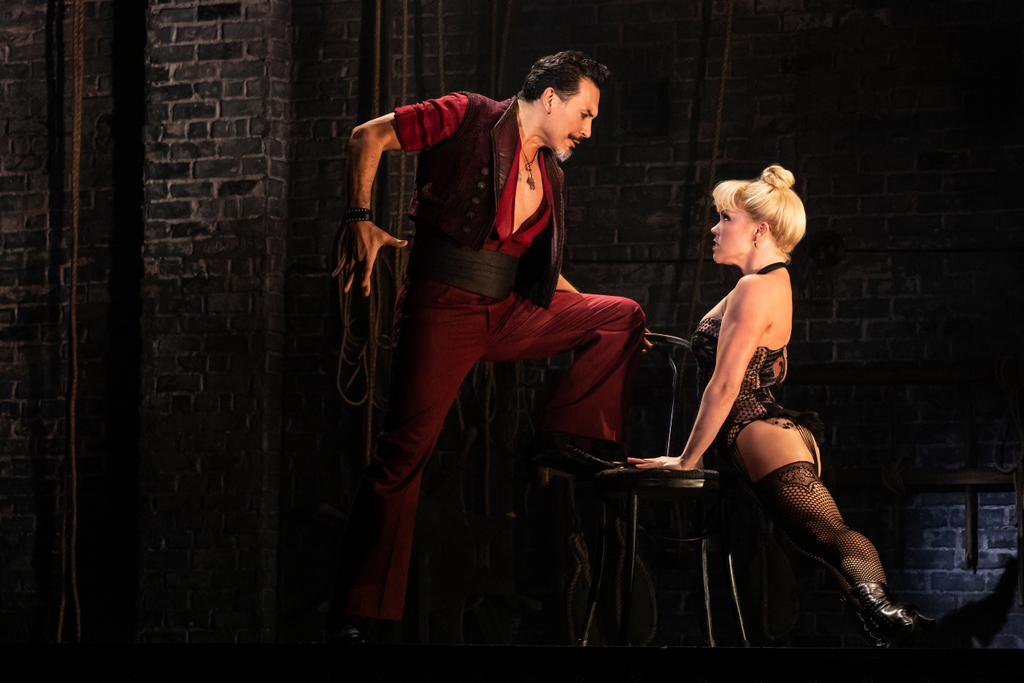
Ricky Rojas, Robyn Hurder, Moulin Rouge! The Musical, directed Alex Timbers (Matthew Murphy)
The scenes when Lautrec and the company rehearse and Mutu’s Duke attempts to assist are particularly to the point and humorous. Monroth’s ego gets in the way after he senses he has lost Satine to Christian. Yet, he is willing to keep her despite her lack of affection for him. And his jealousy rises to spoil the show, as Christian’s jealousy rises to provoke the Duke. Yet, the show must go on, but how? Satine, once more must “save the day,” but she is not immortal.
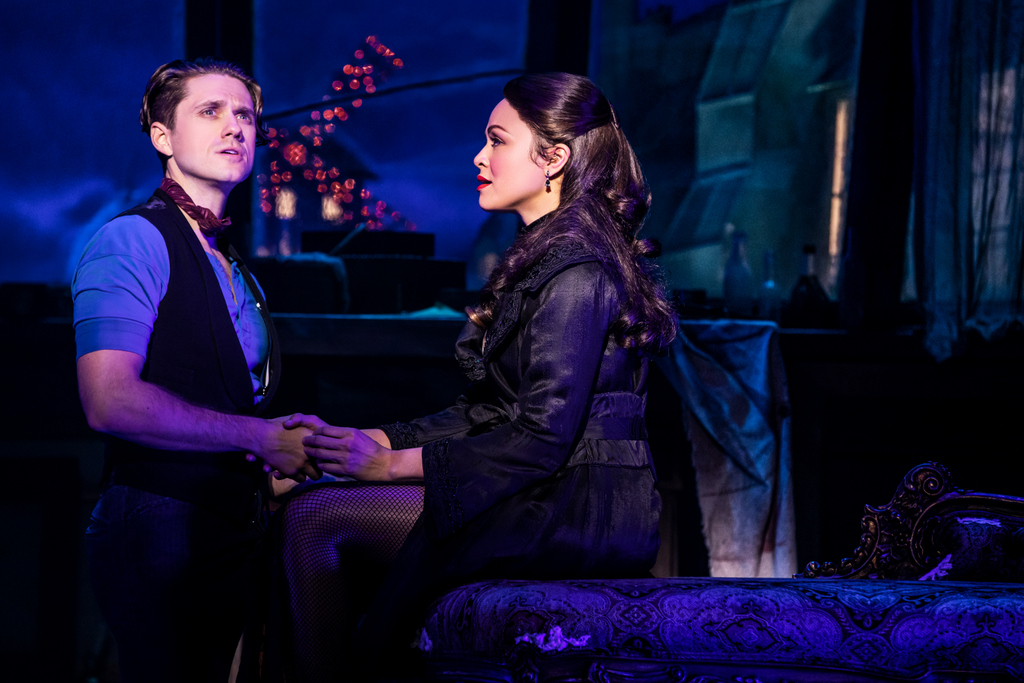
Aaron Tveit, Karen Olivo, Moulin Rouge! The Musical, directed by Alex Timbers (Matthew Murphy)
As rivals for her love and lust Tveit’s Christian and Mutu’s Duke are worthy. The intricacies of plot which involve Satine’s eventual love for the innocent and consumed Christian, and sexual enticement of the Duke are woven adroitly. Particularly delightful are Mutu’s mash-up of Mick Jagger’s songs (his “Sympathy for the Devil” could have gone on longer). And the conversion of lyrics to a male orientation for Rihanna’s “Only Girl” are hilarious. Mutu manages to be wicked but sexy and seductive. His intentions are insidious but he retains the exceptionalism of aristocracy that assumes privilege from generational wealth that goes back centuries. Importantly, it is the humor in Mutu’s depiction that keeps him interesting and edgy and not loathsome, which is in keeping with the comedic tone of the production.
As a keen and successful rival, Tveit expertly tweaks the humor related to Christian’s, creating his compositions in the funny scene when he first befriends Lautrec and Santiago. He does this with expert timing and together the three render their exchange into pure farce. His “Ohio” demeanor evolves by the conclusion from a “lad” to a man who “comes into his own.” He is every inch the authentic lover. His duets with Satine in which they both feed song refrains to each other are happily playful, suggestive and grounded. And in the delivery of his last songs, Tveit is amazing, heartfelt, sonorous. As a couple in a loving affair that grows into something more, Tveit and Olivo strike powerful resonances.
Nothing more can be lauded about Mouline Rouge! The Musical except that the sound design by Peter Hylenski was on point, balanced, targeted. I heard words from well known songs that I never “got” before, for example Katy Perry’s “Firework,” which Olivo sends into the heavens as a PURE WOW! Thus, I could greater appreciate the character development, the themes, symbols, the ironies, the true riches of this mythic production because the song mash-ups and medleys were crystal clear.
This is a Broadway show in the true spirit of New York City’s greatness. To see these performers, you should get tickets immediately and order another set to revisit a month or two out. I guarantee that seeing it again, you will note many other elements that you missed the first time around as you peel back layers. If you can’t see it again, some of the music is on YouTube. Check for updates.
The show runs with one intermission at the Al Hirschfeld Theatre on West 45th street. For tickets and times CLICK HERE.
The cast album is currently available for streaming at https://smarturl.it/MRtheMusical
 CAROLE DI TOSTI