Blog Archives
‘Buena Vista Social Club™’ is Phenomenal, Theater Review

If you are a world music lover, you don’t need any introduction to the “Buena Vista Social Club,” a group of Cuban musicians that Cuban producer and musician Juan De Marcos González, brought together in a recording studio in Cuba to eventually release an album in 1997. González is to be credited for his passion to capture the striking beauty and spirit of traditional Afro-Cuban music of the Buena Vista Social Club, while some of the members were still alive and able to perform and record in 1996.
Surprising everyone, the Buena Vista Social Club musicians, who had been a hit in the 1950s and disappeared after the Cuban Revolution, created a smoking hot album in 1997 that won a Grammy in 1998. Subsequently, they were the subject of the documentary initiated by musician/songwriter Ry Cooder and filmed by Wim Wenders, that rocked the BVSC into the stratosphere of global fame by 2000, when the documentary was nominated for an Academy Award.
The Atlantic Theater Company’s musical, Buena Vista Social Club™ is based on the titular documentary with references to Buena Vista Social Club: Adios, a second documentary filmed in 2016. The superb musical, directed by Saheem Ali (Fat Ham), has as its creative consultant David Yazbek (The Band’s Visit). With book by Marco Ramirez and music by the Grammy Award winners known as the Buena Vista Social Club, the production currently runs with the ebullient magnificence of songs, brilliant tonal hues, dances and movements at the Linda Gross Theater with one intermission until 21st of January. The Buena Vista Social Club™ is a touch of paradise with Afro-Cuban rhythms and sonority that are unforgettable.
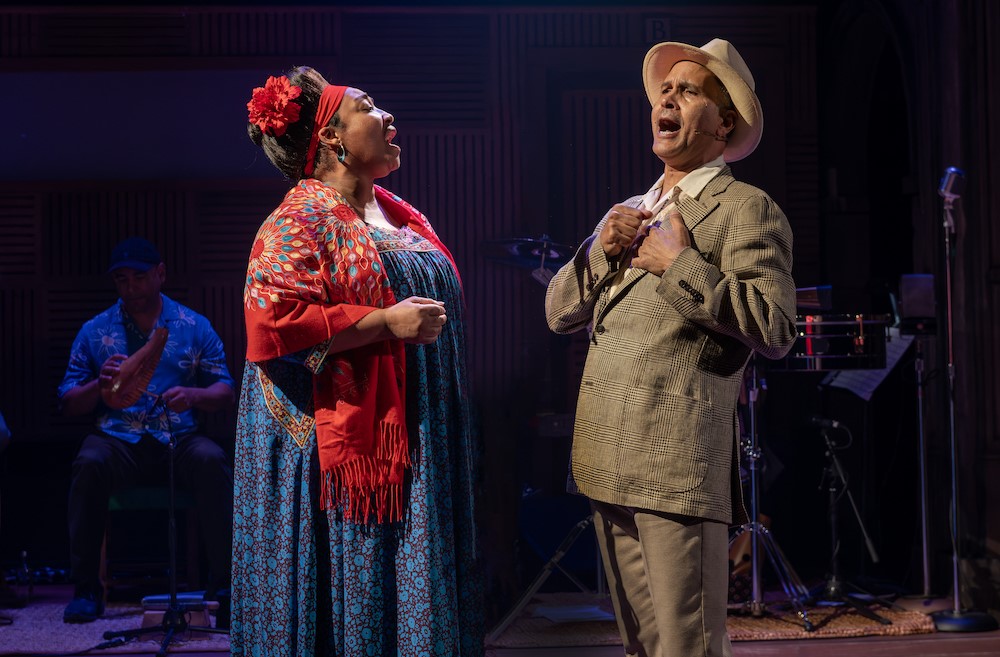
When you see it, and you must, you will not be able to sit still. The music fills you with its joyous power and heartfelt beauty. The production which extends beyond the crass label of “jukebox musicals” gives a reverential bow to the album, the documentaries and importantly, the magnificent musicians and singers who were vaulted to a success they had never known when they started out.
The production, loosely narrated by Juan De Marcos (Luis Vega), boasts a song list that is steeped in the incredible social club’s rhythms and cadences that spiritually manifest the history and diversity of the Cuban people. At the opening, De Marcos, who stands in Egrem Studios-the Old Havana music studio where musicians in the 1990s still record states, “A sound like this, it tends to travel.” His prophetic remarks reference how Buena Vista Social Club’s songs resonated and still resonate throughout the world today, even though most of the original members of the BVSC have passed. Only Omara Portuondo, the National treasure of Cuba, still sings and tours.
The key to opening the lock on the social club that dissolved with all the social clubs that Castro disbanded to end discrimination in Cuban society is Omara Portuondo. As the musical indicates, her notoriety and fame in Cuba allows her to serve as the bridge between the traditional musicians no longer heard and herself who is very much in the Cuban music scene in the 1990s and today.
Thus, the musical focuses on Omara and flashes back and forth from the past to the present in recounting her history with the BVSC, as well as introducing the members, and revealing how they were a part of the popular social club in a Cuba whose segregated clubs prevented various groups from singing and dancing together. The musical’s arc of development unspools as De Marcos attempts to interest Omara in making a recording of the musicians from long ago, who are still alive to keep the torch of Cuban folk music vibrating and lighting the way for musicians and fans of a younger generation.
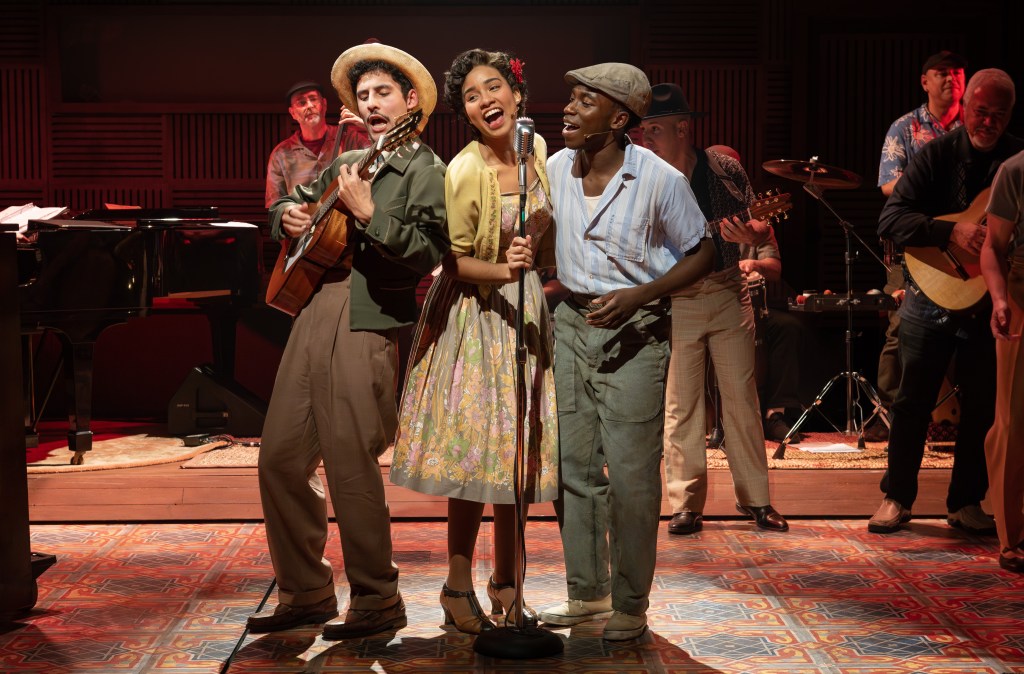
Initially, when Vega’s, De Marcos approaches her, Omara (Natalie Venetia Belcon), is not interested because she doesn’t sing with a live band anymore. Her attitude is cold, aloof and proud, but later, we discover this hard shell fronts for deep pain underneath, concerning her alienation from her sister and niece because of the Revolution and the US embargo barring any exchange of visitors between the two countries. Recording the album would bring up tenuous memories. However, her dismissal of De Marcos on the surface appears to be because she is famous and he is an unknown, who intends to exploit her beloved renown for his own purposes.
Cleverly, De Marcos plays one of her old recordings with the BVSC. Only then, reflecting back to the past, does she relent and give her stipulations for the recording. First, she must be the voice that’s front and center, as De Marcos writes the arrangements. Second, she must be in control to select the singers and musicians. Thus begins the process, conveyed with humor and pathos, that Omara and De Marcos use to bring back the members of the BVSC, so that they are able to record together and reestablish the vitality, importance and universality of Afro-Cuban music, making them a global phenomenon.
The musical is an important tribute to revitalizing how the BVSC Afro-Cuban stars were incredible singers and musicians. It also intimates in the flashbacks and lovely balletic dances featuring the Young Omara (Kenya Browne), and her sister Haydee (Danaya Esperanza), the historical, social schemata of a diversely segregated Cuba, referencing its importance in the Slave Trade, the divisions between the rich and the poor, as well as Castro’s plan to bring equality to the country that backfired and instead created a hell and misery for the Cuban people. This was especially so after the revolution and the flight of wealthy Cubans and middle class off the island.

As is pointed out as a major theme, which indicates the segregation still is manifest concerning Cuba, the division became forever known as “the ones who stayed” and braved out the situation in their mother country, and the “ones who left” and went to various parts of the United States and elsewhere.
Crucially, Omara is an important symbol of transition and the voice and the bridge between the rich and the poor, the socially upscale strata of Cuban society, and the segregated, representing the traditional Cuba with which all Cubans can identify, if they put their prejudices away. Indeed, in this musical, the character of Omara magnifies the best of Cuban culture. She recalls the past and weds it to the present, in the tears and pain of the loss of family and her sister Haydee, who died before she was ever able to see her again. Because Omara was already famous, she was able to negotiate travel as she employed her talents on tour. This mobility was not possible for the other BVSC musicians who were not as famous, and lived under the oppression of segregation and poverty before and ironically, after, in Castro’s Cuba.
Obviously, the ones like Omara who had mobility or the thousands of others who left, had some money to establish themselves elsewhere, even though they lost their lands and businesses to Castro’s “communistic” usurpation. It is a wealth Castro didn’t share with the Cubans who stayed, reminiscent of Vladimir Putin’s behavior toward the Russian people in today’s Russia. Like a predominance of the Russian society, the Cubans who stayed were impoverished and the musical references that during the “Special Period” when the dissolved U.S.S.R. split up, there was no longer any “communistic” aid to Cuba. Thus, the people starved.
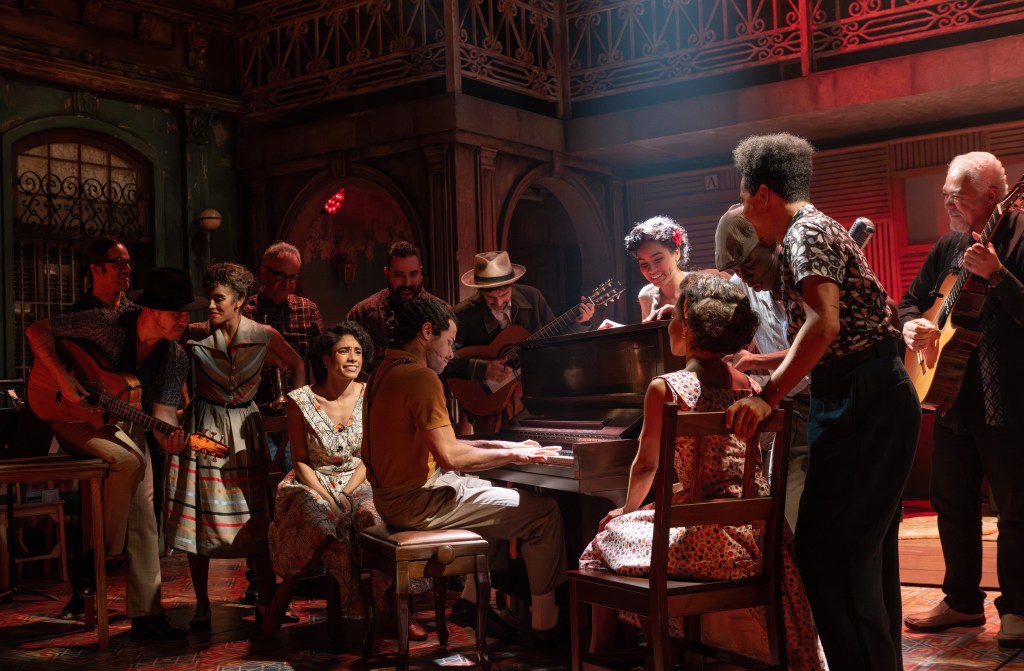
The hope of recording an album with BVSC members was to earn a bit of money, as many of the musicians and singers we meet and learn about in their relationships to Omara and the club were barely scraping by from day to day. During the production we meet the incredible individuals who Omara was close to and sang with in the 1950s when they were young and in 1996 during the recording. These include the charming, funny Compay (Julio Monge), the sweet, loving Ibrahim (Mel Seme), the wonderful pianist Ruben (Jaindardo Batista Sterling) and Eliades (Renesito Avich).
The seminal moments of the production however, meld the present to the past, revealing how Omara connected with each of the BVSC members in the flashbacks with the Young Omara and the Young Haydee. The musicians/singers include the Young Compay (Jared Machado), the Young Ibrahim (Olly Sholotan), and the Young Ruben (Leonardo Reyna).
The balletic sequences with dancers portraying the Young Omara and Young Haydee, choreographed by Patricia Delgado and Justin Peck, developed and directed by Saheem Ali. These sequences seamlessly and stylistically reveal the differences in opinions between the sisters, regarding the BVSC which Haydee feels is beneath her. Also revealed in these flashback dance sequences, is Omara’s sadness in losing her sister and family forever because of the Revolution and US Embargo. As Belcon’s Omara sings of her feelings, the poignance of her expressiveness resonates with all Cubans and punctuates the cruel punishment visited upon the people by both governments, revealing the malevolence of political machinations. However, it is in the power of the songs that the Cuban people thrive and with dignity transcend the brutality.
The BVSC playlist is sung in the native tongue of the BVSC, and on one level doesn’t need translation because the music “speaks” for itself. However, the musical’s closed captions in Spanish, should also have had an English counterpart. In English, the lyrics can relate the historical culture of the Cuban people which is referenced throughout in the English dialogue and storyline. English closed caption lyrics, as well as Spanish, would convey the complete picture of the BVSC and its tremendous importance socially, politically (their democratic diversity should not be diminished), and spiritually.
The BVSC’s immutable human values conveyed in their incredibly poignant rhythms and music is what resonates and draws in fans globally in an egalitarian message that makes sense and that most human beings yearn for. Politics and the power hungry divide to conquer. The music of the people soars, uplifts, transcends hardship and unifies. This production’s value is priceless and the ensemble of musicians and singers are fabulous in memorializing the Buena Vista Social Club for all time.
The creative team brings the director’s vision together in a beautifully stylized way that breathes life into the real musicians and singers who made up the BVSC (1950s, 1996). These creatives include Arnulfo Maldonado (sets), Dede Ayite (costumes), Tyler Micoleau (lighting), Jonathan Deans (sound), J. Jared Janas (hair, wigs & makeup), Dean Sharenow (music supervisor), Marco Paguia (music director, orchestrations & arrangements), Javier Diaz, David Oquendo (additional arrangements), the swings and band.
The company of Buena Vista Social Club™, Atlantic Theater Company, 20th Street between 8th and 9th. https://atlantictheater.org/production/buena-vista-social-club/
‘Tootsie’ is an Indescribably Delicious SMASH HIT

Santino Fontana and Company in ‘Tootsie,’ directed by Scott Ellis, Music and Lyrics by David Yazbek, Book by Robert Horn (Matthew Murphy)
Tootsie, the 1982 film based on the story by Don McGuire and Larry Gelbart and the Columbia Pictures motion picture produced by Punch Productions, starring Dustin Hoffman, is a multi-award winner which is sanctified for its time. The Broadway musical comedy with Music and Lyrics by David Yazbek and Book by Robert Horn has been a long time coming and the wait has been well worth it.
The production starring the likeable and prodigiously talented Santino Fontana is a wondrous addition to this amazing Broadway season. Fontana’s voice is incredible, his dead pan timing bar none, his negotiation of the complexity of this titular role could not be more spectacular. Director Scott Ellis shepherds Fontana and the cast with acuity and grace.

Lilli Cooper and Company in ‘Tootsie,’ directed by Scott Ellis, Music and Lyrics by David Yazbek, Book by Robert Horn (Matthew Murphy)
The Tootsie characterization has been cleverly updated to include superb jokes related to the #Metoo movement. Indeed, what was a maverick fluke in the 1980s film version about gender roles and sexual predation, certainly fits like a glove for our time. Its ridicule of various themes connected with political correctness about gender is cleverly managed. Regardless of left or right we scream with laughter about the self-righteousness of both positions. Tootsie balances on a median between extremes. This is a good thing.
For me, it is a welcome novelty after the mainstream media and social media have become the playland of political, click bait trolls, looking to garner hits and stir controversy. Tootsie is too adroitly written by Robert Horn for that. The only tweets and Instagram hits it will be receiving are for the sustained hilarity and classic comedic situations which bloom like roses in a never-ending summer of delight. I mention roses because the principals will be receiving bouquets for their virtuosity and excellence. Their stellar performances assisted by the equally adroit song and dance talents of the ensemble will run the gauntlet of award season flying high.
Generally, the plot is similar to the film with the major transformation that Michael/Dorothy is an excellent actor who primarily looks for theater work. As in the Michael of the film he is arrogant about his talent, and the conflict’s arc of development sparks when Michael interrupts director Ron Carlisle (Reg Rogers) during the rehearsal of a lousy play. Reg Rogers’ portrayal of the smarmy, oily potential predator who is a Bob Fosse-type without the talent is wonderfully funny.

Reg Rogers and Company in ‘Tootsie,’ directed by Scott Ellis, Book by Robert Horn, Music and Lyrics David Yazbek (Matthew Murphy)
Michael attempts to ingratiate himself with the director Ron Carlisle about his role in the ensemble. Ironically, Dorsey’s narcissism manifests in a twitting of the actors’ dictum: “There are no small parts, only small actors.” Michael suggests there is some confusion about his character’s backstory. When Carlisle tells him he is just in the ensemble and doesn’t require a backstory, Michael is the narcissist in his response.
The director’s outrage is spot-on hysterical and we feel little empathy for Michael who is fired outright. His arrogance and superiority have pushed him over the line as his agent (Michael McGrath) substantiates by firing him in a blow that is a touché! Michael knows he’s a mess, but lacks the power or wisdom to understand what to do about his external crisis, not realizing it’s best solved by changing internally.

Sarah Stiles in ‘Tootsie,’ directed by Scott Ellis, Book by Robert Horn, Music and Lyrics by David Yazbek (Matthew Murphy)
Santino Fontana sings “Whaddya Do” attempting to negotiate his angst at being unemployable. We are unimpressed by his fledgling sign of despair in this song which doesn’t go to the root cause. He must learn much more about himself; he is not there yet. A crucial moment occurs when Sandy visits and informs him about a job she plans to audition for, then has a “slight” breakdown discussing it (“What’s Gonna Happen”). Michael gets the idea to morph into Dorothy Michaels (“Whaddya Do reprise) and audition for the job, having to suppress his male ego in a “female” body to disguise his loathsome face.
To get the role which seems highly unlikely, he’ll be Nurse Juliet in the ridiculous sequel to Romeo and Juliet entitled Julie’s Curse, an outlandish dog of a play that will most probably close opening night. As Michael auditions with “Won’t Let You Down,” Santino Fontana’s voice soars in triumph and realization. During the song, he gives birth to his female ethos and rounds out the personality of Dorothy Michaels housed in a “truck driver’s” body.

(background): Julie Halston, Reg Rogers (foreground): Santino Fontana in ‘Tootsie,’ directed by Scott Ellis, Book by Robert Horn, Music and Lyrics by David Yazbek (Matthew Murphy)
The production never returns to a moderate balance after this, though it has been set-up by a rollicking warm up with Sarah Stiles’ amazing work (more about that below). One reason why the show is a winner is that it glides into the heavens with the organic characterizations, the plot twists, turning points and two love stories (the second one is a ripping hoot thanks to the adorable John Behlmann as naively obtuse Max Van Horn who falls in love with Dorothy/Michael.
The actors’ pacing has been timed with precision to deliver the superbly engineered and crafted one-liners arising from the action and characterizations. The audience never recovers from these, swept up in the hysteria and barely catching their breaths for the next joke. The play is well-structured, building toward the two climaxes, one at the end of Act I and the other near the conclusion of Act II.
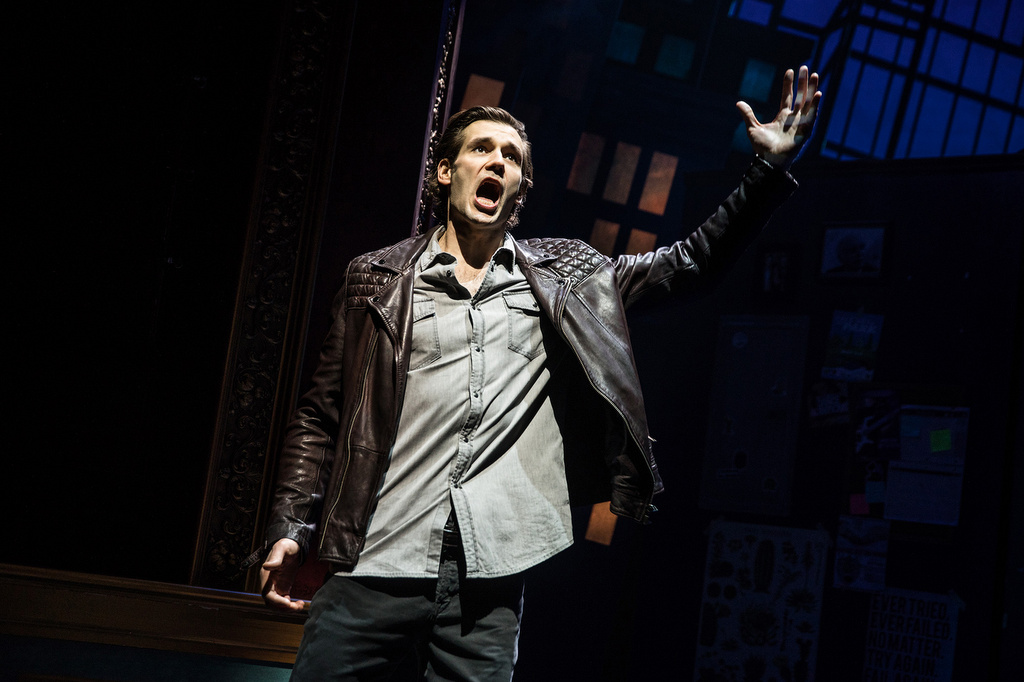
John Behlmann in ‘Tootsie,’ directed by Scott Ellis (Matthew Murphy)
The principle theme, that Michael Dorsey has grown as a human being with the help of releasing his feminine side is winsomely revealed as a “la, la, la,” in the film, downplayed for its vitality and power. Santino Fontana does a phenomenal job in bringing this theme to the fore in his solos with his rich sonorous voice. The music strengthens this theme and others. We are reminded that males are ashamed to acknowledge emotions in the company of other males. Today’s retrograde social currents about the bullying “macho male” in the White House who is “cool male” in his indecency makes Tootsie an important show for our time.
A lot of the humor arises with the gender switching. The songs reveal softer scenes as Dorothy must negotiate “his” love for Julie Nichols (Lilli Cooper). The two actors have some wonderful moments as budding BFFs. Their conversations ring true for us today and Julie’s characterization has also been rounded out with profound depth in the writing and in Cooper’s winning portrayal. Julie is a modern, wise woman who does not cave in to the director who attempts to smooze her with his position. She remains steadfast to her career and does not marry.

Andy Grotelueschen in ‘Tootsie,’ directed by Scott Ellis (Matthew Murphy)
The only “feminine woman attitude” the show allows is Michael/Dorothy’s Southern accent and this is an ironic blind. Supported by wealthy producer Rita Marshall (the excellent Julie Halston who pulls out all the stops) Michael/Dorothy takes a stand with the help of the ensemble and Julie. Dorothy Michaels reconfigures the show into one that is a going to be a shining hit (don’t ask how). The producer, Julie and the other actors appreciate Dorothy, though the director is angrily flummoxed. But Carlisle is masking chauvinism in his heart which we infer by his actions toward Julie. However, Carlisle’s producer is a woman who supports Dorothy’s “female” intuition about the play and her gumption to suggest revisions.
Michael’s acting talent and suggestions are given a hearing and used. Juliet’s Curse is transformed into a hit. By the end of Act I, “everything’s coming up roses” and Fontana’s Dorothy pridefully encourages himself by crowing out “Unstoppable.”
The song is a brilliant, humorous irony. Actors through experience, learn not to make presumptions about their future, out of sane superstition. (Sandy takes this to the reverse extreme.) Michael is headed for a fall. Like all of us do at one point or another, he does something to destroy his own success. As he attempts to recover, he digs a deeper hole for himself.
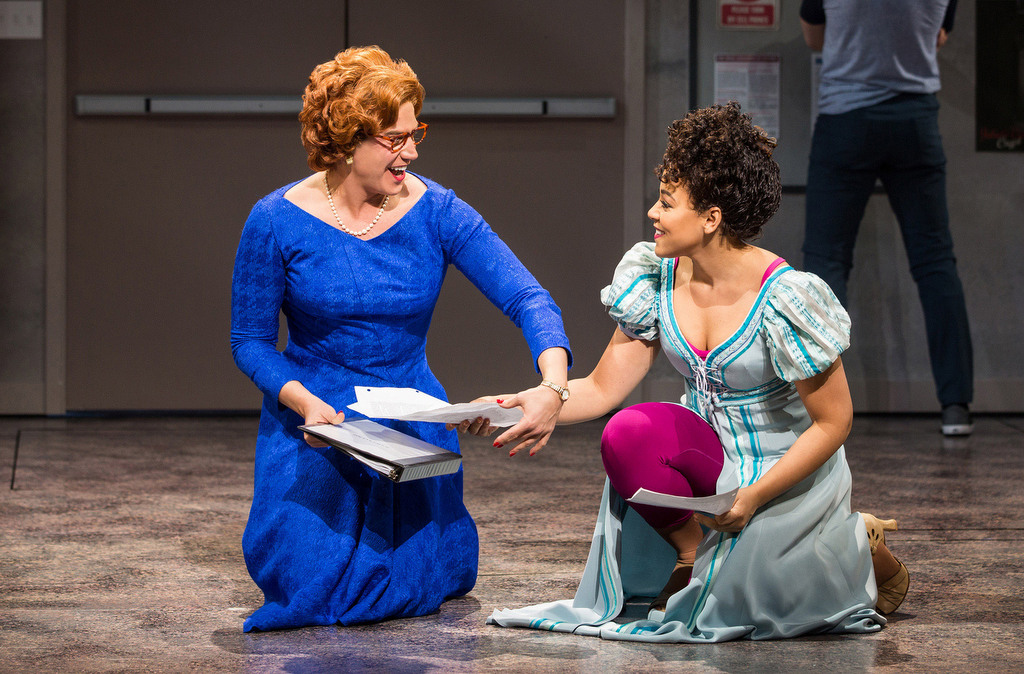
Santino Fontana, Lilli Cooper, ‘Tootsie,’ directed by Scott Ellis (Matthew Murphy)
Roommate Jeff (Andy Grotelueschen) who has been waiting for him to choke, gleefully beats him over the head with his stupidity in the second funniest song of the production, “Jeff Sums it Up” at the top of Act II. Grotelueschen’s performance in this scene (with Fontana as the straight man) is THE MAX! Grotelueschen’s portrayal as the “frustrated” friend Jeff is visceral. His timing is 100%. The effect generates our sidesplitting, roaring laughter. We are down with both Jeff and Michael.
As Michael crashes and burns Greek comedy style., we intuit that the worst is coming. It is only a matter of time before Dorothy’s drag act will be exposed.
I didn’t expect to be so impressed, by this clever reworking of Tootsie, especially with regard to the music. However the songs are damned funny and the music doesn’t draw attention to itself as some composers are wont to do. Indeed, the music serves the story; the lyrics and music meld like white on rice.

Santino Fontana and Company, Tootsie, directed by Scott Ellis (Michael Murphy)
I examined hawk-like whether any songs appeared to just take up space because “after all it’s a musical comedy” and “a song is needed,” etc. NO! Indeed, all the best moments spring from the characters and portrayals. These spur the conflict and create riotous fun. I am hard pressed to critique any of the musical numbers as ancillary or humor killing. A few are extraordinary and a few are memorable pop songs with a beginning, middle and end that doesn’t wander into nothingness.
The two songs you won’t remember (because you’ll be rolling in the aisles) are sung by Michael Dorsey’s friends, his roommate Jeff (Andy Grotelueschen) in the second act and his actress friend Sandy Lester (Sarah Stiles) in the first act. Both songs are organically based in the characterizations. They concern human emotions that are so identifiable that the specifics don’t matter.

Andy Grotelueschen, Sarah Stiles in ‘Tootsie,’ directed by Scott Ellis, Book by Robert Horn, Music and Lyrics by David Yazbek (Matthew Murphy)
For example, in the song “What’s Gonna Happen!” Sandy takes off into a rant about her life as an actress, a state she apparently goes through before auditions. Her imagination terrorizes her into believing in a future and events that don’t yet exist. As she escalates her “crazy,” she explodes. She spews clouds of fear in a musical mixtape of strung together happenings that reach a level of frenzy that is beyond any drug to cure it.
Sarah Stiles is drop dead fabulous. Gobsmacking! We get it! We have been our own terrorists like Sandy, whipping our anxieties to an inner insanity of fear predicting our own nonexistent events. It is our brilliant healing that we find it uproarious to see and hear someone dare to express their delusions ALOUD in a rant more wacko than ours. The song and music are perfect; Stiles’ portrayal is 100 percent. Scott Ellis’ direction and staging elicit this exceptional moment, one of many in this humorously glorious production that kills it again and again.
I have not deeply belly-laughed this much during a Broadway show, except for British productions where the timing is as perfect as it gets. Never during a musical. I have nothing more to say, except you will regret not seeing Santino Fontana, Lilli Cooper, Sarah Stiles, John Behlmann, Andy Grotelueschen, Julie Halston, Michael McGrath and Reg Rogers, every one of them a gem and together, miraculous.
Kudos to Brian Ronan’s Sound Design-I heard every word which is vital for the clever lyrics. Mentions go to David Rockwell (Scenic Design) William Ivey Long (Costume Design) Donald Holder (Lighting Design) Paul Huntley (Hair and Wig Design) Angelina Avallone (Make-Up Design) David Chase (Dance Arrangement for their coherent artistry.
Tootsie runs at the Marquis Theatre with one intermission. For times and tickets, go to their website by CLICKING HERE.
 CAROLE DI TOSTI