Blog Archives
‘Late Fame’ Starring Willem Dafoe, 63rd NYFF
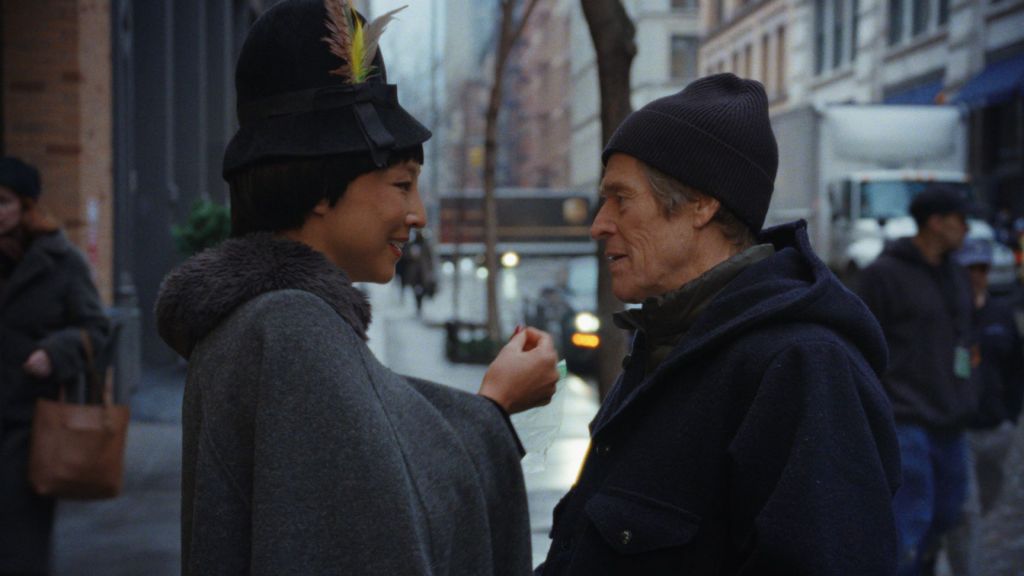
Adapted from the Arthur Schnitzler novella Late Fame, screenwriter Samy Burch (May/December) and director Kent Jones (Diana) shine a light on the West Village and Soho (circa 1970s) and Soho now at the height of its commercialization and development. With the incredible backdrop of factory buildings and West Village apartment buildings turned into fashionista haunts, and cobblestone streets still creating their unique atmosphere, a superb Willem Dafoe portrays the sensitive, once lauded poet Ed Saxburger. The craggy young man who had the world at his feet with the publication of his poetry book Way Past Go eventually gave up his typewriter to earn a modest living with a secure pension as a postal worker.
What happens to the passionate fire required to write poetry that gets published during a time when poetry was the lingua franca of the Village artist milieu, and Soho was the coolest place to be? If old soldiers fade away, does the same happen to promising poets whose work is well regarded but little read, then forgotten?
Late Fame investigates this phenomenon with atmosphere, nuance, irony and heart. It is Jones’ love letter to downtown Manhattan, vastly changed with remnants of its old beauty and undeveloped glory which made a comfortable home to artists of all stripes in the 1970s. Then, Dafoe’s character Ed Saxburger came East, spurred by the thought of fitting in with the artist colonies in Manhattan at that time.
The film which is in the Main Slate section at New York Film Festival is buoyed up by sterling performances from those assisting Dafoe, as he negotiates his empathetic protagonist who is stoic, reserved and charming, and a bit lost as he welcomes yet questions with open eyes his acceptance by a group of well-heeled twenty-somethings, who turn out to be poseur artists. Their mission is to recapture the ethos of Gregory Corso, Allen Ginsberg and others, but they are sorely out of their depth and lack the talent, grist and life wounds to do so.
The film unspools with Saxburger’s rediscovery by this exotic group of young would-be writers and philosophers branding themselves “the Enthusiasm Society.” An effete, wealthy Wilson Meyers (the excellent Edmund Donovan), leads the group of retrograde misogynists and artistes. When Saxburger asks where he found his book, with wide-eyed irony and pride, Meyers tells Saxburger he bought it at “Foyle’s on Charing Cross Road.” Indeed, Meyers uses Saxburger’s book as the equivalent to a museum piece around which Meyer centers his exploitation and cause célèbre.
On further discussion to introduce himself Meyers cavalierly asserts his and the Enthusiasm Society’s purpose to “stand against negativity” and the monetization of everything,” a mission that unravels when Saxburger gets to know him. Key to who they are, is that they distance themselves from lower lights, “the influencer culture, cellphone obsessed and technology maniacs.” These they excoriate, all the while imbibing the same waters because no one is paying attention. However, Saxburger is.
For example Meyers’ stunning, unhip apartment in the village, funded by his parents, is technologically outfitted to the max. The other members are equally flush, supported by their parents, a far cry from the struggling, self-made artists that they emulate. However, their hypocrisy and unawareness of self that Saxburger notes quietly, he puts aside momentarily. He is drawn in by their allurement as they gush over him.
Their earnestness could be worse. At least they aspire to be like legends of the past, so Saxubrger allows himself to be caught up in their artificial world, until the revelations come fast and furious after a poetic recital where various members read at a venue Myers procures. The actors portray these fellows as more of an Oxford-like clique of wannabe creatives who are callow, literary sophisticates. In their aspirations they will never achieve what Saxburger did as he struggled and was celebrated in reviews, even if for a bright moment that he himself extinguished by moving on.
Though these individuals are largely focused on the masculine, they allow the actress and singer Gloria (a fine Greta Lee) to float among them as the girlfriend of one or more of the members. When Ed finally joins the Enthusiasm Society live and they introduce Gloria, her flamboyance and mystery is a treat for Ed. She is more akin to him as an older, wiser, financially strapped actress who, like Ed, knows what it is to struggle for her craft. Unlike Ed, she may hold on longer because she is an opportunist who knows how to play the game. In his authenticity and truth, Saxburger probably said, “It’s enough. I’ve got to eat and support myself.”
Cleverly, Jones features Gloria front and center during a performance of Kurt Weill and Bertolt Brecht’s “Surabaya Johnny.” A chanteuse, Sally Bowles “divine decadence” type, Gloria lures Ed who finds her attractive, opaque and mysterious, unlike the others. During a brief scene they do drugs together and frolic down the streets, a nostalgic nod to the past.
Greta who is supposed to read poetry during the recital appears to be too overwrought to be able to credibly do it. Part of her act, however, she pulls through at the last minute stunning the audience. Finally, Saxburger reads his own work beautifully, though an audience member references his age, albeit tucked into a compliment. The shout out reminds him of where he was and now is with this ersatz glitterati. It’s a desultory in between.
Though Saxburger has a family back home and a brother dying, he stays in New York and doesn’t return to visit. That ground is never covered by Jones or the screenwriter. However, it substantiates that when Saxburger left his family and made a new life for himself in Manhattan.
In the present that life includes a culturally rich apartment with bookcases filled with books that he’s read, a nice touch by the set designer. Also, his group of working class friends that he plays pool with who don’t know his poetic past or his literary interests, have helped distract him from what was. We do see when he can’t write a new poem for the recital that his artistry has been put on indefinite hold. But it’s OK. Beyond these elements, this is a film about brief moments in time where the light shines and then dims only to shine once more before it goes out.
Jones’ work is noteworthy for the stellar performances. Dafoe who inhabits the role perfectly is sensational, and Lee and the others provide the foundation from which Dafoe easily and seamlessly establishes this intriguing and heartfelt character.
Tickets are still available at https://www.filmlinc.org/nyff2025/films/late-fame/
‘Greater Clements,’ by Samuel D. Hunter at Lincoln Center Theater

(L to R): Nina Hellman, Judith Ivey, Ken Narasaki, Edmund Donovan,, Andrew Garman in ‘Greater Clements,’ by Samuel D. Hunter, directed by Davis McCallum (T. Charles Erickson)
Greater Clements, by Samuel D. Hunter, directed by Davis McCallum spotlights a dying town whose end comes “not with a bang, but with a whimper,” especially for those who have invested their sweat in its history to make a life there, however, insignificant and invisible. The production stars Judith Ivey as stalwart Maggie, whose emotional range is delivered with power and grist. The superb Edmund Donovan is her outlier son who is doomed to confront his psychological illness without the tools to manage himself successfully. Greater Clements reveals lives lived in quiet desperation before they fizzle out or implode in despair, while looking for for an exit from soul pain which never comes.
The play opens in darkness, thousands of feet below ground as a miner (we discover this is Joe-Edmund Donovan-who once gave mine tours) in his gear with one bright headlamp speaks about the Dodson Mine and a mining catastrophe in 1972. It was then his grandfather burned alive and a total of 81 men lost their lives. Immediately, in the darkness, we have a sense of foreboding, of a doomsday trajectory of the town and its people.
The scene shifts from the mine shaft to the bi-level set (Dane Laffrey’s creation) via an elevator that rises and falls to expose Maggie’s museum and mining tour office and bedroom in a later act. The elevator set is a neat contrivance, but it is view obstructing and unwieldy, notwithstanding the symbolism conveyed of the oppressive, confining and dangerous conditions the townspeople and miners lived with all of their lives.
Clements, a defunct mining center of Idaho whose largest mine closed 12 years before the setting of 2017, represents an every-town of the once booming industrial west before Reagan’s outsourcing, recent automation and current energy technologies siphoned off jobs, factories and hope. With no inspiration to transfer its prosperity toward tourism, or developing other resources, Clements has been “decommissioned” as a functioning town.

Haley Sakamoto, Edmund Donovan in ‘Greater Clements,’ by Samuel D. Hunter, directed by Davis McCallum (T. Charles Erickson)
Ironically, in a sort of self-immolation memorial, to keep away wealthy elites from other states who might take over and bring back the rosy bloom in its cheeks, town officials have voted to unincorporate Clements and remove all municipal services. The thought comes off as follows. “If we can’t make a go of it, we’ll do everything in our power to prevent you from trying. You want to try? Start from scratch!” The last indignity has been to deliver the town to the darkness from whence it came, as they turn off the juice to power the street lights and one, lone stoplight that once allowed a bustling downtown crowd to cross the street in safety.
The concept of removing Clements from the historical record, exemplifies a number of Hunter’s themes about such mid-west devastation since Reaganomics, which has been exacerbated with tax cuts to the wealthy, moving right up to today, while leaving places like Clements in the dust. The town, like many other areas in Red States, became mired in the past and never got out from under its own debris to prepare for a viable future. Rather than to be forward thinking, even after the mine shut downs, town fathers chose oblivion masochistically, like the places that sprung up during the gold rush, then dissolved into ghost towns, when the rich veins of ore dried up.
Maggie, who has kept the town’s history alive with her museum and her mine tours, has been forced to close down, in effect, removing Clements from historical significance and obviating its residents’ lives from remembrance. The retrenchment and immaturity of the attitudes of the town fathers, reflected by their choice to unincorporate, reveals the same rage, powerlessness and victimization that propels one into self-damaging choices.
Hunter subtly references the self-destructive attitudes of the Red States’ populace, like those in this Idaho town, that most probably put someone like Trump in power, believing he would keep his promise, perhaps to add “industrial” jobs to the economy; a canard. It is one of the ironies that Hunter slips in quietly that pervades throughout, as we watch the disintegration of the town and the lives that once made it a community and held it together. Clements has blown itself off the map rather than to persist. This of course leaves residents like Maggie no choice but to escape to restore their dignity to “make it to the next day.” We learn later of Maggie’s abyss of despair for she, too, voted with the town fathers in vengeance, almost as an unthinking afterthought.

Judith Ivey in’Greater Clements,’ written by Samuel D. Hunter and directed by Davis McCallum (T. Charles Erickson)
The idea of being disconnected (unincorporated) from the future and each other is a theme which plays out in the relationships between and among the characters. Maggie, the sheriff (Andrew Garman) and her nosy neighbor Olivia (Megan Bartle) are among the individuals remaining who keep up an acquaintanceship, but do not go beyond the surface to discuss, at depth, issues related to the town’s death or their own aching problems. Maggie refuses to discuss much with Olivia, and when she is backed in a corner about her resentment about wealthy people buying up property, she finally reveals she hates the mine that killed her father and paid him low wages. That she is conflicted is an under statement. Her mine tours and “keeper of the flame” museum has put bread on her table. Indeed, her inner conflicts and regrets are many, and her lack of introspection about herself is the flaw which causes the final destruction for the family.
As the foil and main driver of the action, Joe, Maggie’s twenty-seven-year-old son is the one who will inherit Maggie’s and the town’s legacy. Maggie has brought him back to stay with her because she cannot let go. She feels alone and responsible for his well-being, since he ran off and was barely caring for himself in another state. Years before, when the mine closed, Maggie’s husband left her to run off with a gay man. She was forced to raise Joe alone which has been a tremendous burden that Joe reminds her of cannily and apologetically at various points throughout the play.
Joe has psychological debilities. He socially functions as a 15 year old, and in the past often got into trouble. As Joe attempts to communicate with his mother and reach some sort of settlement upon his return, we note their sturm and drang. It is apparent in Act III, during a heart to heart between them, that Joe has taken stock of himself and his situation with his mother, and indeed, is more knowledgeable than she. As the “fall guy” prodded by the sheriff, Olivia and his mother, and manipulated by Kel (Haley Sakamoto) who, herself, is a psychological mess, one can see the consequences of the impact of their own small-town behaviors which lead him on an unstoppable crash course toward an end zone for the opposite team.
Their mother/son relationship is the most gripping element of Greater Clements. Developing their character’s stresses and their attempt to communicate, despite their inner depression and hopelessness, becomes the linchpin of the drama and a tour de force between Ivey and Donovan. They are magnificent in these roles. Their emotional authenticity is spot-on. Maggie’s abject blindness about herself, and Joe’s self-awareness are heart-wrenching as we hope for them, yet know they do not really hope for themselves or each other. This is reflected throughout the play in its symbols (i.e. Joe’s grandfather’s watch which Joe prizes). The watch was pulled off the grandfather’s incinerated body after the mine catastrophe. The watch makes it through the Pacific Theater WW II and the mine’s fiery flames, but its crystal cracks when Maggie knocks it from its place on a shelf, out of nervous carelessness.
As Maggie is one of the last to leave Clements, she reaches out to a far light at the end of the tunnel for Joe and herself. She contacts a high school love, Billy (Ken Narasaki) with whom she tangentially maintained a relationship for the past fifty years. Billy and Kel, his granddaughter stay with Maggie and Joe. Problems develop which we intuit, but which Maggie in her rush to reformulate her relationship with Billy ignores until too late. An explanation for her fervor is revealed. Their love was banned by her father because of Billy’s ethnicity (Japanese American) and her father’s sensitivity to fighting the Japanese during WW II. Though Billy has cancer, he remains hopeful having conquered the disease the first time. Maggie remains nonplussed, and believes his well-meaning, cheerfulness. She is anxious to have some happiness in life which Billy will give her.

Judith Ivey, Ken Narasaki in ‘Greater Clements,’ by Samuel D. Hunter, directed by Davis McCallum (T. Charles Erickson)
Hunter and Ivey again highlight Maggie’s underlying flaws. Disconnected with herself and perhaps not fully working through despair at never really living life for herself, but living to nurse others, once again, Maggie appears to be doubling the load, not only having to care for Joe, but for Billy as well. This, despite Billy’s claims that he cares for her and doesn’t need a nurse. Regardless, because Maggie appears addicted to hardship, the likelihood that she will be involved in Billy’s care and troubles with Patrick, his alcoholic son, is great.
Ironically, it is Joe who questions her motive why she brought him back to a dead-end situation. Is Maggie like many women of her age and economic status, too afraid to strike out on her own, freely, to take care only of herself? Or is she comforted to feeling the only true purpose of her life is that of a nurturer who takes care of others, and when trouble comes, makes a botch of it? Hunter’s characterizations of Maggie and Joe are richly drawn, fueled by the fine performances. Billy and Kel serve as doorstops which open and close varying events. Joe’s developing closeness with Kel which ends in a backfire when she importunes him to take her down the mine shaft where they shouldn’t be, and then he later keeps secret her walk by herself, ends in further conflict and recrimination. Joe is picked on by the sheriff, Billy, Olivia and Maggie like a flock of chickens pecking at a bloodspot. He can’t please them, thus, he can’t please himself. All he can do is agree with them and apologize.
Billy and Maggie’s alone-time discussions reveal the red-neck prejudice of the area with residues still present against “the other.” Nearby is the Japanese-American internment camp which once housed Japanese Americans during WWII. In another irony of the play, now, Minidoka War Relocation Center is a National Historic Site accepting numerous visitors each year. Clements, once the largest mine center in the country, with a grand historic past, no longer exists except in its abandonment.
Hunter’s tone throughout portends disaster. The flaws of Maggie’s blindness plummet the characters into the rather long play’s tragic end. The rising and falling set that recedes into the darkness of the mine, and Maggie’s attempts to retrieve a former love that will most probably end in her despair, nursing him to his death, is a reality that she is shocked into realizing. Indeed, nothing can prosper in this place, which has willfully refused to enter the 21st century. Maggie should have left long ago. But that would require self-knowledge, the desire to free herself from her own enslavement and to hope for a better future. Hunter capstones the characters and rural America as he sees them and indeed, he points to the self-destruction and hopelessness that infuses them. It’s a warning we in the cities should not take lightly and which resonates at the conclusion, that all will not be “fine.”
Noted are Kaye Voyce (costumes) Yi Zhao (lighting) Fitz Patton (original music and sound). Greater Clements fills the heart and mind with its richness. It runs two hours, 55 minutes with two intermissions at The Mitzi E. Newhouse at Lincoln Center until 19th January. For tickets and times CLICK HERE.
 CAROLE DI TOSTI