Blog Archives
‘The Dreamed Adventure,’ NYFF 2026

In its U.S. premiere in the Main Slate section of the 64th NYFF, Valeska Grisebach’s Cannes Jury Prize-winning film turns from an initial easy set up to a thriller with chilling moments of suspense. Full of twists and turns, Griebach defies narrative stereotypes and allows the authenticity of the local townspeople she uses to create tension, suspense and surprise.
Interestingly, The Dreamed Adventure begins like a Spaghetti Western (without Ennio Morricone’s music) in a setting lost to the modern age and peopled with gristled, thuggish looking types. There, a stranger drives into a scruffy town in a small car without air conditioning to do business. Initially, Grisebach features a middle-aged, craggy-looking, Said (Syuleyman Alilov Letifov) as the protagonist. The filmmaker follows this rugged mystery man’s actions in Svilengrad, a Bulgarian border town at the crossroads of Turkey and Greece. With a slow unraveling of action Griebach keeps us questioning the why and what of the set up with Said.
First, the filmmaker reverses the “hero” trope. When Said attempts to settle business with someone in the town, staying overnight to wait for him, an unknown thug steals his car. Though malevolent forces victimize him and make him helpless, he remains poker-faced and unemotional. Perhaps, the cronies of the man he waits for game him.
Then, the fates step in and he sees middle-aged Veska, an old flame (the sterling Yana Radva). An archeologist Veska currently works at a site in Matochina. After hearing about the theft, she suggests he help her on her dig. On the journey to the ancient site they reacquaint themselves. However, he reveals little information. With natural pauses and looks, we realize they had been together years before and may still have a bond. Said (a Muslim) references his life under Soviet era repression. In a peek beyond the veil, when he explains his parents changed his name to fit in and make it Bulgarian”acceptable” we note his ironic annoyance. Perhaps, this and later information we overhear about his possibly “disappearing” a bullying young man explain why he left the area.
As an omen of good luck, Said fixes Veska’s metal detector. This enables her to find a valuable artifact. Though we expect them to stay together, the filmmaker shifts the narrative’s direction.
In a surprising twerk, Said lopes off with another younger woman he meets in a bar after Veska drops him off. Swapping out Said, Grisebach turns the homespun, sharp-eyed, prescient Veska into the film’s protagonist. When Said disappears, we presume he carries on with the woman he met. However, we never find out what happens afterward. When he doesn’t show up for the dig the following morning, an upset Veska searches for him unobtrusively. Perhaps he faces danger.
Thus, in a relaxed way, she visits with the townspeople, in the cafe, the bar and in after-dinner get-togethers with women and men at their homes to find out what happened to Said. The groups connect with one another over smokes, drinks and conversation. In a fascinating contrast between the women’s and men’s groups, the cast (some locals with un-Hollywood-like faces) reveal the culture of this non-thriving border town.
The women discuss disappearances, and we understand how the town’s ripe position on the border promotes human trafficking. The men flirt with Veska and apologize for being “raunchy,” as she teases them and flirts back. Gradually, she discovers the criminal network’s theft of diesel, a payment needing to be made and the conflict between two criminal leaders vying for each other’s turf. Certainly, the patriarchy rules the town, but Veska rises above it cannily to search for Said, alive or dead.

As Veska continues on her journey, we realize she understands and manipulates the groups and can do this because fundamentally she participates in some way. As an observant anti-hero, she keeps a compromised morality and avoids sanctimonious self-righteousness to survive. Rather than to take the moral high ground, she blends in and gets along. If necessary, regarding the men in her past, apparently she used them sexually and allowed them to use her. In fact romantically she hooked up with one of the mafia locals. However, when another, younger group of men warn her to stop nosing around, she “plays it close to the vest” and leaves.
With each encounter, Grisebach ratchets up the tension. Hearing about about a package mentioned in conversation, Veska cleverly follows up and finds a gun and stashes it in her car. It comes in handy when a drunk young woman, followed by a group of young men after they leave a party, gets into a dicey situation. Veska safeguards her, a protector figure, challenging our impressions of her.
Toward the conclusion of Veska’s journey digging up the crime syndicate, our expectations twist once more toward surprise. Indeed, to help Said’s financial situation, she gives herself over to an unlikely, unappealing crony of the criminal network. Grisebach turns the idea of a romantic, sexual encounter Hollywood style on its head. Instead, she crafts the situation between Veska and the crony, both older adults, not typically visited by filmmakers, into a realistic encounter. The scenes are refreshing, unexpected. Somehow Veska seems all the more attractive in comparison to her sexual partner. Memorable irony.
By the conclusion we discover Veska literally and figuratively “comes out on top.” After an adventurous time, she finds her man, Said, and their exchange ends in the next encounter they have with each other, which we never get to see. Grisebach concludes in Svilengrad as if nothing really happened. Everything stays covered up with lives on the border who struggle to survive.
Grisebach gives an amazing portrait of a time place and characters which are more real than most films could ever achieve. For the write up at NYFF 2026 go to their website https://www.filmlinc.org/nyff2026/films/the-dreamed-adventure/ Look for it on streaming online platforms.
‘Celebrity Autobiography’ Stars a Rollicking, Rotating Cast

The premise of Celebrity Autobiography, created by Eugene Pack, is an interesting one. The revue where actors dramatically read excerpts from various stars’ memoirs or samples of their poetry emphasizes the comedic, however unintentional on the part of the authors. The theme is that celebrities are often ridiculous when they are dead serious and attempting to be revelatory. What makes various celebrities ridiculousness particularly noteworthy is their self-importance and need for self-aggrandizement.
The rotating cast of actors who read from the unwittingly funny memoirs are noted for their comedic grist and natural funny bones. They keep the pot boiling each night at the Shubert Theatre where the show currently runs through September 6, 2026. In order to see favorite actors performing, the website lists scheduled performances. Though some celebrities like Tony Shaloub, Matthew Broderick, Brooke Adams, Danny Burstein and others rotate in and out, others like Mario Cantone, who can’t resist impersonations, appear for more days of the run.
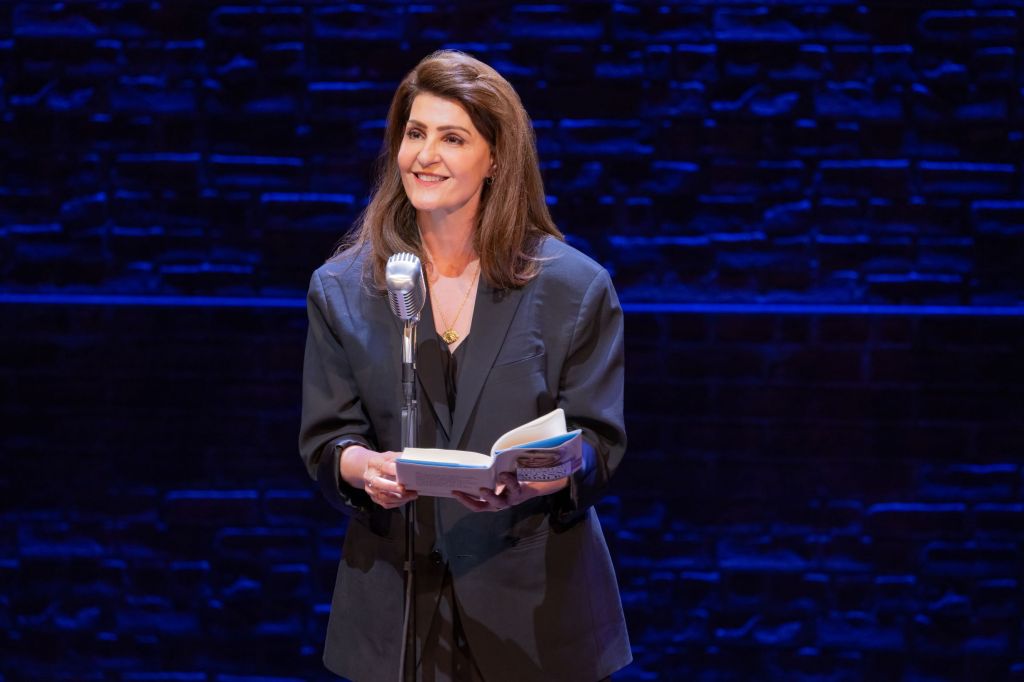
The chosen celebrities given an appropriate send up are so inherently self-satisfied, it is as if their agents who wanted to add to their own bottom line suggested that their clients’ “words of wisdom” be written for the ages. After all, who doesn’t want to read or listen to the illuminated thoughts that Ryan Seacrest or Vanna White feel compelled to share? Indeed! The beauty of the production is that often the celebrities sage comments are anything but. In fact many celebrity quotes are pegged for belly laughs. Of course when they were written, the actor, or singer, or TV game show star, or TV host, or sports star wrote them in all seriousness. Hence the quote advertising the production, “You can’t make this stuff up.”
First premiering in New York in 2008, the following year it won the Drama Desk Award for Unique Theatrical Experience. Celebrity Autobiography was revisited in London’s West End and at the Sydney Opera House in Australia to name a few. Problematically, some of the show received an update, but not the entire production. Clearly, Broadway and movie aficionados will be familiar with Ethel Merman, Richard Burton, Elizabeth Taylor and Carol Channing. A younger crowd may not. Nevertheless, the portrayals as caricatures work, and the night I saw the production, Mario Cantone as Carol Channing and Liza brought down the house.
Obviously, the various actors, most of them with live theatrical experience, make the show unforgettable, though the numerous laugh lines specifically are head-shakingly unmemorable. Creators avoided any political updates which might have been appropriate since the pure folly of politicos has risen to grandiose heights that might have had the audience rolling in the aisles. Instead, the celebrity politicians were avoided and the echoing absence was an opportunity missed. Some of the most LOL humor might be the most current, and certainly we are familiar with key players being hit over the head with them daily. Strangely, that opportunity was lost.
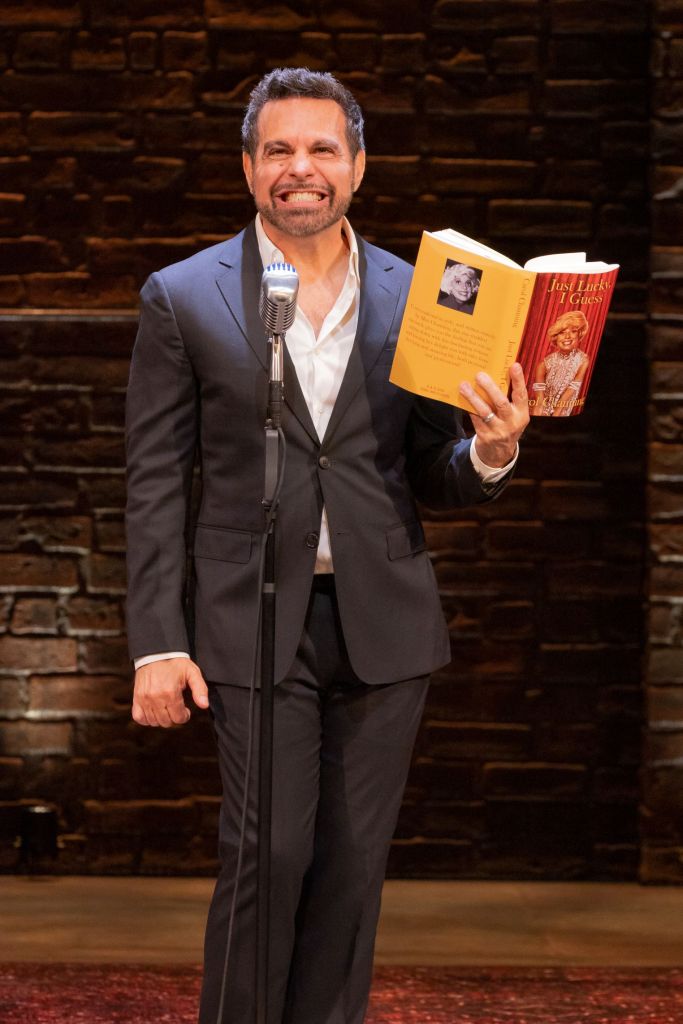
Other than missed opportunities in the sphere of political celebrities, the mash-ups related to topics worked well. For example in the poetry corner, Suzanne Somers and Matthew McConaughey’s very tacky love poetry floated down to the audience, who responded with guffaws and gales of laughter. The Matthew McConaughey drawl put it over the top.
In one of the foody sections, Oprah, Neil Sedaka and Dolly Parton related their habits and diets. Dolly’s self-deprecation about her body was intentionally LOL. Other mash-ups involved music legends-Celine, Buble, Miley, Beyonce, Cher and sports figures-Tiger Woods, Arnold Schwarzenegger and Sly Stallone which actors honed with impressions that rocked. In “Broadway Babies” among Carol Channing grousing about Barbra Streisand in the film version of “Channing’s show Hello Dolly” and Ethel Merman (I missed Andrea Martin the night I saw it), Sandy (Jeff Hiller), the dog from Annie shows up. Sandy gets multiple laughs sharing the list of who petted him from Lauren Bacall to Andy Warhol taking his picture. A line ringer that the audience appreciated was when Sandy boasted, “Once I even growled and showed my teeth to Muhammad Ali, and the heavyweight champion of the world backed down!”
It is arguable whether or not the larger stage venue where actors appear in line facing off to the audience with just microphones and no sets worked. Certainly, reading and pacing comedy to sense the audience’s interaction is much easier in a more intimate venue as was done in the past. However, the risk in the large venue with more exalted prices is tenable. People will pay for the much needed laughs in this trying time. And maybe not including politicos to ridicule after they are ubiquitously annoying everywhere is a good thing after all.
Celebrity Autobiography runs 90 minutes with no intermission at the Shubert Theatre on 44th St. between 7th and 8th Avenues. https://celebrityautobiography.com/?gad_source=1&gad_campaignid=23821737322
‘Miss Representation: Rise Up’ at Tribeca Festival
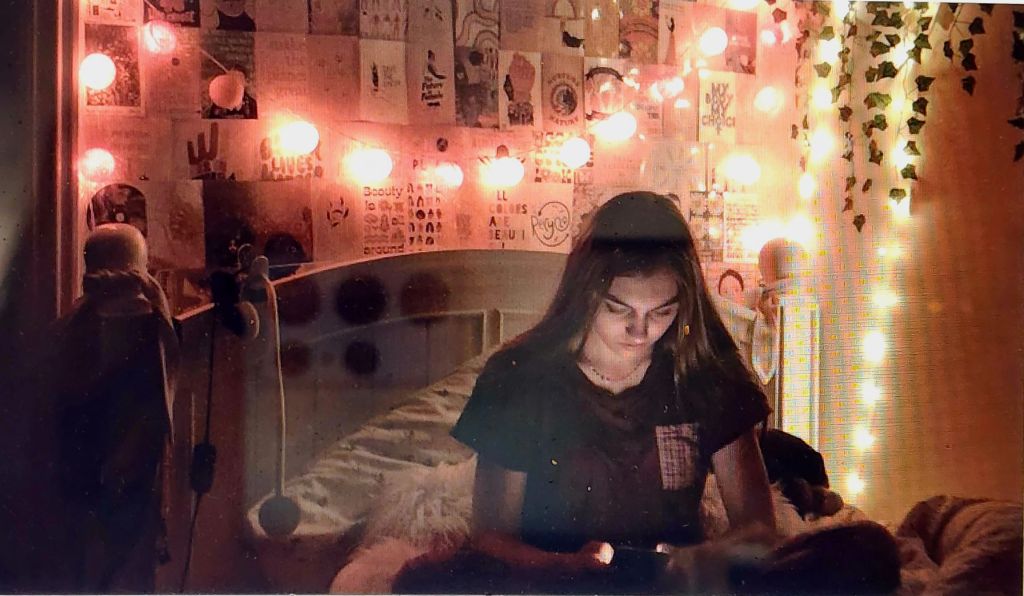
Miss Representation: Rise Up
Jennifer Siebel Newsom’s expanded message for women in Miss Representation: Rise Up is crucial viewing. Her second documentary about women under attack presents the untenable problems women face as the tech industry attempts control via AI, co-opting resistance and empowerment. In the spotlight category the film had its world premiere at Tribeca Festival. It hosted special guests after the screening who appeared in the film.
Newsom’s first film Miss Representation began the conversation
Newsom’s first film, Miss Representation (2011), delved into the normalization of unrealstic body images by all forms of media to manipulate and disempower women emotionally. The images of perfection and beauty perpetuated in the music, fashion, advertising, entertainment industry, etc., negatively impacted teen girls and women who felt they could never measure up. Stoking shame and guilt the related industries encouraged them to buy products to change their appearance and be prettier, thinner, “better.”

Newsom includes statistics of the percentages of women and teen girls suffering from depression, body dysmorphia, feelings of unworthiness and dis-empowerrment. Oftentimes, depression and body dysmorphia would lead to cutting and other forms of self-harm including suicide. In her acute depictions Newsom revealed an important story about our culture and society that rang alarm bells, but offered no real prescriptions for change. The relentless assault against girls and women has been unstoppable.
Newsom’s Miss Representation: Rise Up shows the situation has worsened
Miss Representation: Rise Up proves that the situation has worsened exponentially through Social Media’s algorithmic engagement. Male and female influencers via Instagram, Tik Tok and other platforms whether through soft power (body perfection) or toxic masculinity hate on women 24/7. Parallel with the demand for women’s perfected beauty we note the rise of the fascist, toxic, male “ugly,” who looks like Joe Rogan and demeans like the conservative MAGA Nick Fuentes.
The Trump administration has exacerbated the misogyny and objectification of women with the intent of removing them as an effective power block.Trump’s response to a female reporter whose question unsettled him, “Quiet piggy,” sums it up. In the fifteen years, strategic political pressure via media (images, toxic talking heads) inevitably moved to reverse women’s rights in the Dobbs decision. Spreading domination and hopelessness, these malign actors politically work to silence women’s voices because of the power they threaten.
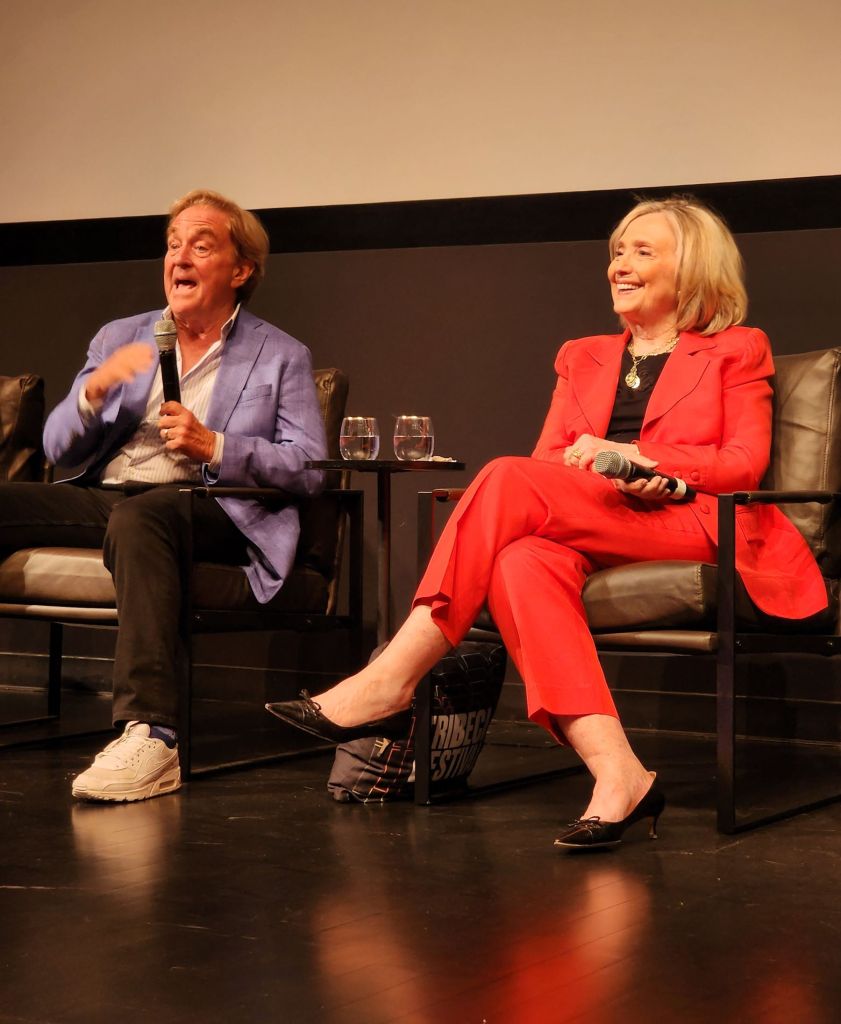
Newsom interviews key spokespersons, i.e. Frances Haugen (Facebook whistleblower), Jim Steyer (CEO Common Sense Media), Secretary Hillary Rodham Clinton, Amy Klobuchar and more. Using their commentary she explores the backlash against women’s progress. Also, Newsom uses powerful firsthand accounts of young women across the country. She highlights their experiences and gives them a platform to voice their concerns. Giving specific examples the documentarian reveals how political influencers on the radical right have created a hostile online ecosystem with ChatGPT, Grok and other AI tools. Following the Trump administration’s MO, they weaponize these to harass, stalk, threaten and ultimately, make women do what they want. In other words they metaphorically disappear them and take their voices and power.
Because everyone has a phone, the toxic messaging can be seen every hour on the hour. Unlike the analog assault of fifteen yeas ago, influencers personalize their digital warfare on others. Often AI Bots are set to monitor and comment on every powerful young woman’s social media account. Insulting comments and memes can erode girls’ and women’s self-esteem, mental health, and public engagement. The more these insidious technologies emotionally engage, the more money is made. Abuse and verbal beatings mean dollars. Young women navigate the currents of abuse with pain. Instead of pushing through, eventually they refuse to take on leadership roles and positions of political power.
Congress must step in to regulate tech companies
Congress has attempted to hold CEOs of companies like Facebook accountable for allowing toxic messaging to get through. With the MAGA administration threatened by women, they try to prevent regulation of tech companies to engage them in their misogyny. In avoiding regulation for big tech and data centers, the companies have made payoff donations to campaigns. However, Newsom shows he resilience of young women who fight back and carve out their own power. Their voices now and in the future sound a reckoning. Increasingly, with awareness the public fights against data centers and wins.
Miss Representation: Rise Up reminds us that all of us must remain engaged in our life’s processes, politics and our votes make a difference. Finally, by empowering women through agency, and maintaining hope, no one’s rights can be diminished.
Look for Miss Represenation: Rise Up on streaming platforms. See the synopsis on the Tribeca Festival website.
https://tribecafilm.com/films/miss-representation-rise-up-2026
‘Titus Andronicus’ Patrick Page is Mesmerizing, Heartbreaking, Over-the-top
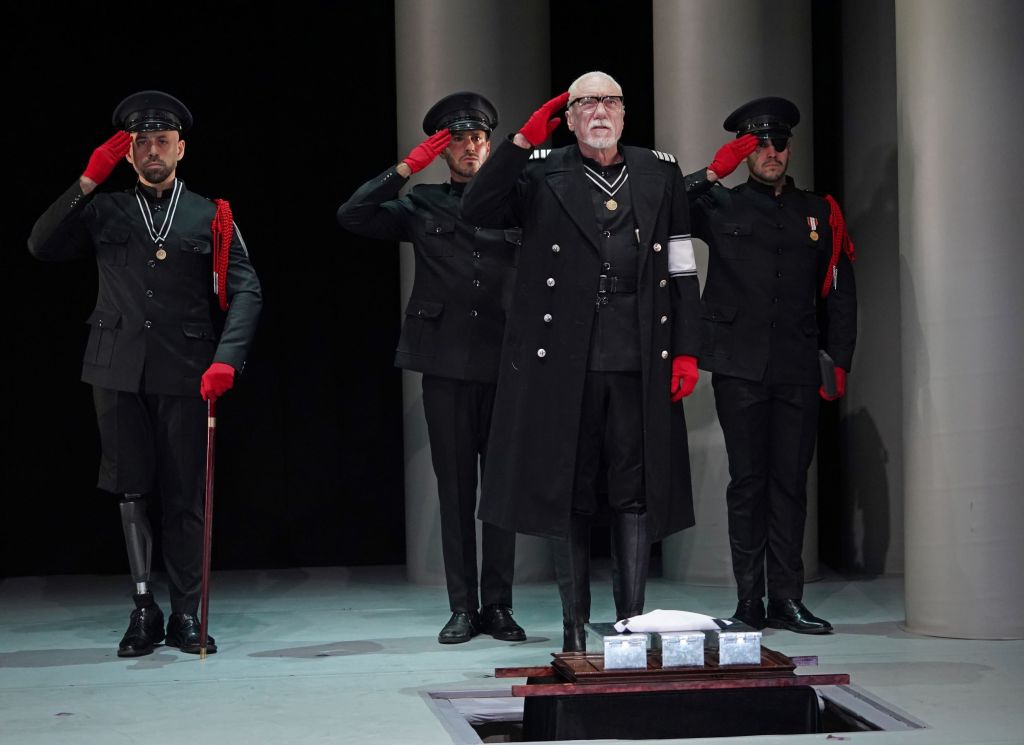
William Shakespeare’s Titus Andronicus comes with a warning label about the bloodshed and violence in this profound, incredibly acted Off-Broadway production at Pershing Square Signature Center. As I was watching the visceral, gut-wrenching performances of Patrick Page’s Titus Andronicus and Olivia Reis’ portrayal as Lavinia, Andronicus’ treacherously abused daughter, I thought of the brutal, unjustifiable bombing of women and children in Gaza, Israel. However, the difference of watching reports via screens from the safety of one’s sofa versus watching fictional live-action bloodshed onstage seems moot. One requires imagination to understand what is happening that media doesn’t show: the eviscerated bodies, the scattered arms and legs of blown up children. That horror compared to immersing oneself in stage acting with the well timed bursting of fake blood capsules during a fight or murder scene? Violence and murder are inhumane. Blood and gore in fictional drama loudly points to the heinous, triggering realities of war going on today.
Thus, the themes of William Shakespeare’s goriest tragedy are impactful. But one must understand that the result of Titus Andronicus‘ gore is tragic. Murder, treason, blood-lust, vengeance all turn the warriors’ swords against their own entrails. This is especially so when the ones maimed and brutalized are offspring the enemies leverage to emotionally annihilate their parents. There’s nothing like watching one’s future inheritance and legacy wiped out and being unable to find peace afterward. That is the ultimate tragedy in the magnificent Titus Andronicus produced by Red Bull Theater at the Alice Griffin Jewel Box Theatre. Titus Andronicus has been extended through May 3, 2026.
At the top of the play victorious, intrepid Roman general Titus Andronicus returns from the wars in triumph, but having paid a stiff price. During the battles he sacrificed three of his sons for Rome. However, he did succeed in bringing Rome the spoils of his win. Titus presents these captives to Rome: Tamora (Francesca Faridany) the Queen of Goths, her ambitious warrior/lover Aaron the Moor (McKinley Beelcher III), and her three sons played by Jesse Aaronson, Blair Baker, Adam Langdon. Their captivity in chains gives more light to shine Rome’s mighty, justified conquests.
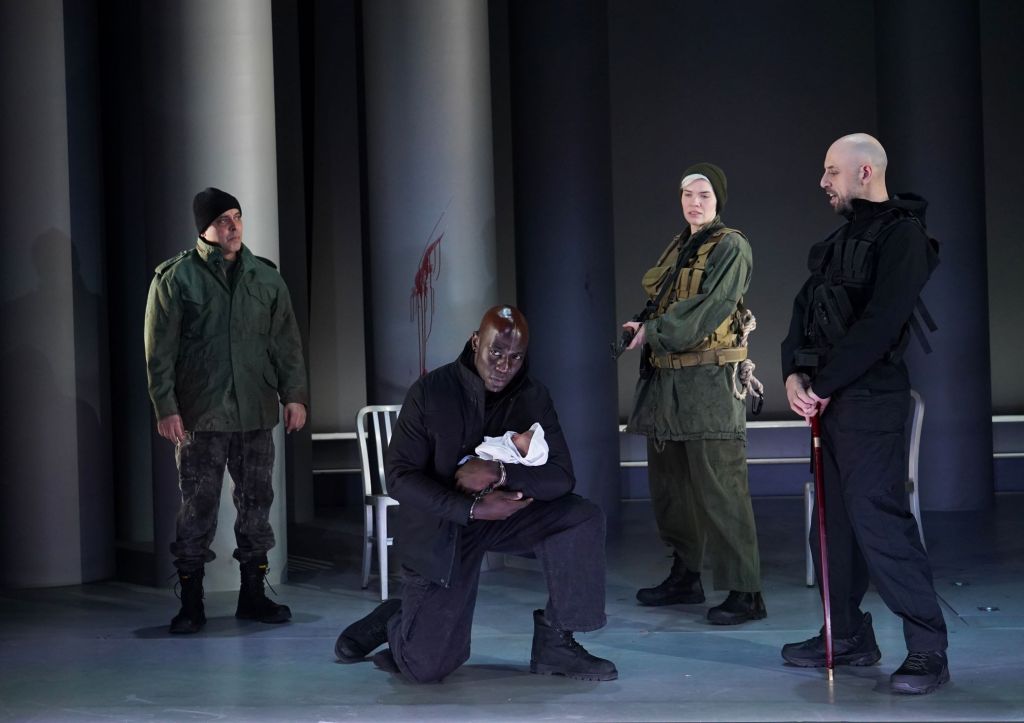
During the Andronici family reunion which includes Titus, Titus’ Tribune sister Marcia (Enid Graham), his daughter Lavinia and his three living sons, played by Anthony Michal Martinez, Zack Lopez Roa and Anthony Michael Lopez, they perform burial rites. Additionally, a ritual of recompense is made of Goth blood for Andronici blood. Lucius (Anthony Michal Lopez) states, “Give us the proudest prisoner of the foe, that we may hew his limbs and sacrifice his flesh to these our fallen brothers.” It is an act to appease the deceased son’s spirits who were killed in the war with the Queen of the Goths, and to stop any “prodigies” from being visited upon the Andronici.
If bloodletting is ever fair, the balance is that three were lost and the blood of one is the equivalent of three. This is a ritual always performed on the battlefield and to Tamora’s pleadings, Titus asks her to pardon him. His sons perform the ritual killing of Alarbus without rage, but as a tradition. One could argue this duty is more than fair, a viewpoint Titus holds, but Tamora does not.
In truth, Titus should have killed all those he captured, instead of just Tamora’s oldest, her firstborn son. Dismissive of Roman tradition, the Goth Queen sees this act as a gruesome provocation-killing her son in front of her. She is a Goth; she doesn’t “get” Roman traditions or values. She dispenses with the mercy Titus bestows on her, the Moor, and her sons by letting them live and roam free to do damage to Titus and his family. Titus’ mercy is a brutality from Tamora’s perspective. And Titus doesn’t remind her of the fact that she and the others live by his grace. In tragic blindness she refuses to acknowledge or see his act as just and a Roman tradition (I read the script’s stage directions about killing her son as ritual.). And Titus is completely blind to her ferocity and the possibility that she will get vengeance on him and his entire family when the opportunity arises. She has chosen not the way of life bestowed by Titus’s grace, but of vengeance, bloodshed and death. Tragically, blindly Titus lets down his guard and opens the door to Tamora’s hell with fate’s help.
In their blindness lies their downfall.
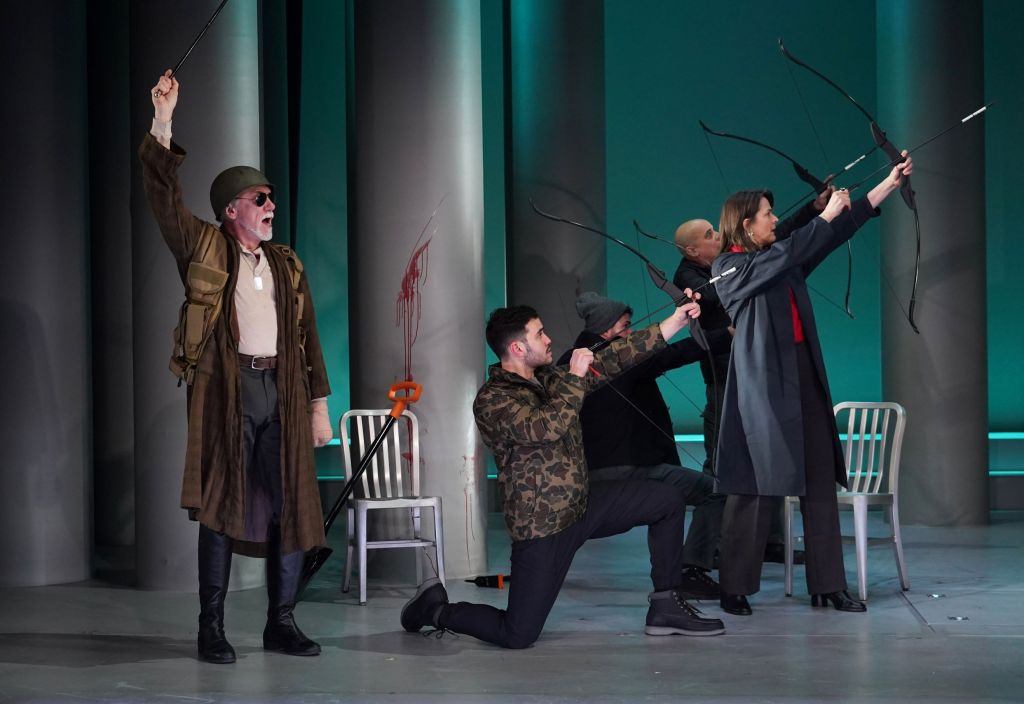
Most probably if Tamora had won, Titus and his sons would have been killed. We note in her future actions and those of Aaron, her lover, what she would have done. Humiliated, a captive in chains, a loser, she chooses to feel provoked by her eldest son’s sacrifice, not acknowledging the lives his blood saves. As they take her and the captives off, she rants, beats her breast and waits for a time of revenge saying, “I’ll find a day to massacre them all.”
Unfortunately, that day comes sooner than later. It is hastened by Titus’ choice not to be the Emperor of Rome, though the people want him, and though Lavinia’s betrothed Bassianus (Howard W. Overshown), Saturninus younger brother, supports him with his troops and followers. Why? Romans are not idiots. Saturninus, the late emperor’s eldest son is unlikable, silly, pompous and incompetent. They want Titus, but Saurninus, the child, protests, not caring about Rome, but caring about himself. In fact Titus would make the better leader proven by his track record of service, leadership competence and popularity. (The parallels with the US are staggering)
Titus makes his ultimate mistake not taking the emperor-ship, stating he is too old and that he wants to enjoy peace after forty years of wars. Titus persuades the people to accept Saturninus as the head of Rome. Under his rule, all hell breaks loose and chaos and violence are unleashed by this terrible decision. Mathew Amendt portrays Saturninus as an infantile, asinine, petulant fool easily duped by one who ends up with a ruling partner as unfit as he, but worse-the bloodthirsty Tamora. Not able to have Lavinia, though Titus suggests it to her, then relents when she says she is betrothed to Bassianus, Saturninus elevates the bloodthirsty Tamora to the throne as his queen. There, she is all about peace and unity. Titus doesn’t see her coming. Nor does he see coming her instrument of vengeance, the gleeful, sneaky Aaron who suggests rape, mutilation and torture for Lavinia to Tamora’s slothful sons. He also suggests a means of impunity so she will never confess the crimes nor bring about her own healing.
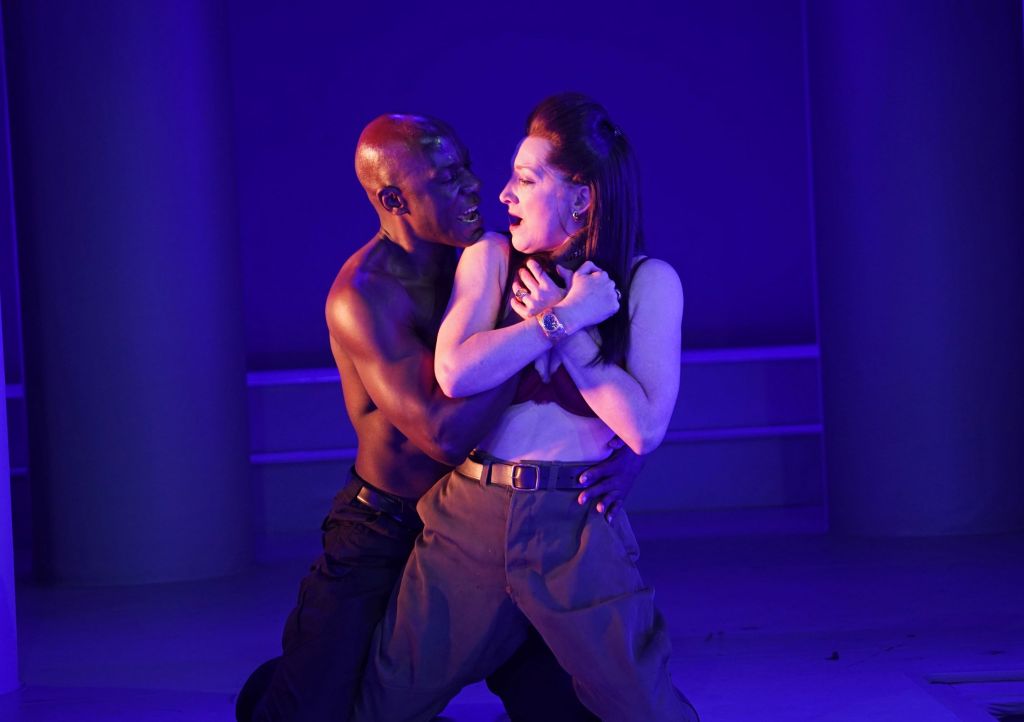
Jesse Berger’s staging works, though the tone of the tragedy shifts off its axis in Act II from sorrowful horror to an outrageous, sometimes weirdly comedic tone. In the last scene of Act I Page’s Titus experiences the full effects of Tamora’s trickery and the loss of two of his sons. When Page’s Andronicus beholds what the spirit of vengeance and hate have done to Lavinia, he is broken. With breathtaking, magnificent, touching grief, he cannot absorb what an anonymous “they” have done to his daughter. Reis’ pitiable cries at the heinous treatment during her violent struggle with the heartless Aaronson’s Chiron and Langdon’s Demetrius (both excellent) are symbolically representative. She is the archetype of women’s soul murder and it is clear why men use rape and mutilation as the defining weapon of war. In the scene Reis conveys what every woman in that position feels. Beyond words.
Page and Reis are incredible together. Page’s Titus slides into madness with laughter and screaming, the extreme emotions of a father unable to protect his daughter or help her. As the destroyed Lavinia, Reis’ cries in echoing response to stage father Page are shattering. One cannot help but weep for empathy at their loss of identity, beauty and valor.
Of course Act II is almost anticlimactic as we wait for the coming revenge on one who chooses vengeance and death rather than life and peace when she vows to “massacre them all.” In that, too, Tamora fails for Lucius lives to become emperor welcomed by both Romans and Goths alike with Tribune Marcia serving his mission of peace, ending the cycle of revenge. Belcher III is superb. As Aaron he speaks passionately to save the son birthed by Tamora who in humiliation gives up the Black child to be killed to hide her shame. The speech softens Aaron’s Iago-like wickedness as the engineer of Tamora’s revenge. His humanity extends to his innocent son, whom he forgives, as he wallows in despair and condemnation.
When Page’s Titus sits his guests down to dinner dressed in a chef’s hat and outfit grinning from ear to ear, he holds Tamora’s sons flesh pie. The laughter from the audience is a confusion of emotions: gladness that he is holding Tamora accountable with a just revenge; empathy that anyone would be driven to this. In fact laughter at serving up Tamora’s sons in a meat pie is all that is left of his sanity.
By this juncture Titus has released all his grief and sorrow. Life has become absurd. What’s left when nothing’s left? Page who worked on the script and did a masterful job sluicing it to crystal clarity reveals the descent of a noble individual who was better at fighting wars, than living in peace. His act of killing Lavinia is an act of mercy. If she could do it herself, she would. But the sons have chopped off her hands so she can’t reveal her abusers. Titus knows her yearning for death like he knows his own soul. He lovingly kills her ending her torment, which she will never get over in life, stripped of her identity and empowerment of words and actions, which end any opportunity for her to heal.
Titus Andronicus runs a swift 2 hours through May 3, 2026 at the Pershing Square Signature Center.
redbulltheater.com.
‘The Baker’s Wife,’ Lovely, Poignant, Profound
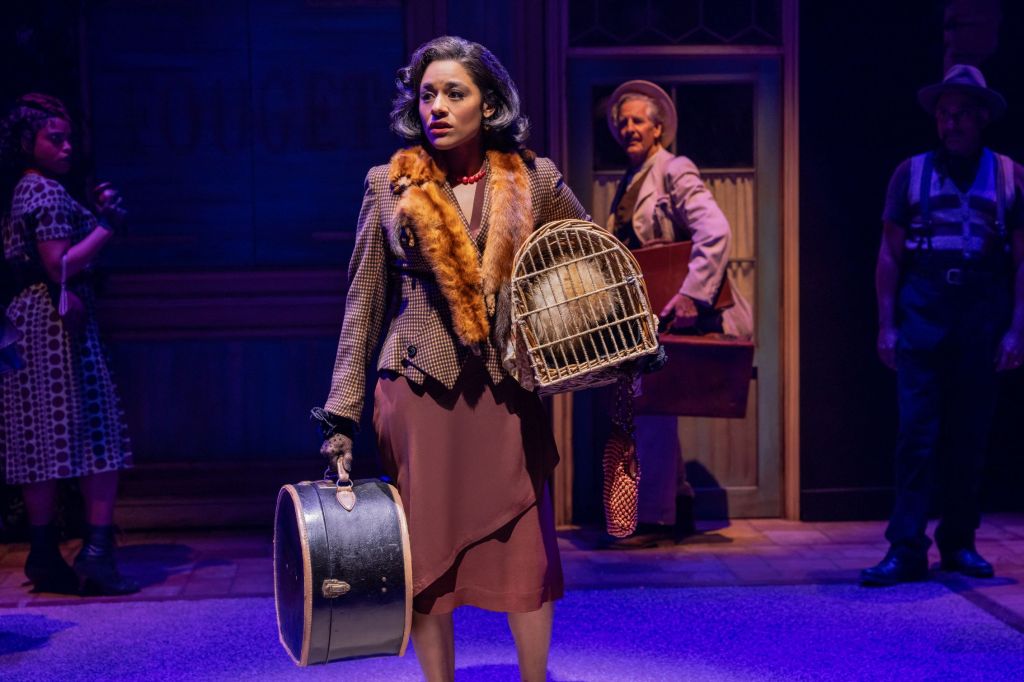
It is easy to understand why the musical by Stephen Schwartz (music, lyrics) and Joseph Stein (book) after numerous reworkings and many performances since its premiere in 1976 has continued to gain a cult following. Despite never making it to Broadway, The Baker’s Wife has its growing fan club. This profound, beautiful and heartfelt production at Classic Stage Company directed by Gordon Greenberg will surely add to the fan club numbers after it closes its limited run on 21 December.
Based on the film, “La Femme du Boulanger” by Marcel Pagnol (1938), which adapted Jean Giono’s novella“Jean le Bleu,” The Baker’s Wife is set in a tiny Provençal village during the mid-1930s. The story follows the newly hired baker, Aimable (Scott Bakula), and his much younger wife, Geneviève (Oscar winner, Ariana De Bose). The townspeople who have been without a baker and fresh bread, croissants or pastries for months, hail the new couple with love when they finally arrive in rural Concorde. Ironically, bread and what it symbolically refers to is the only item upon which they readily agree.
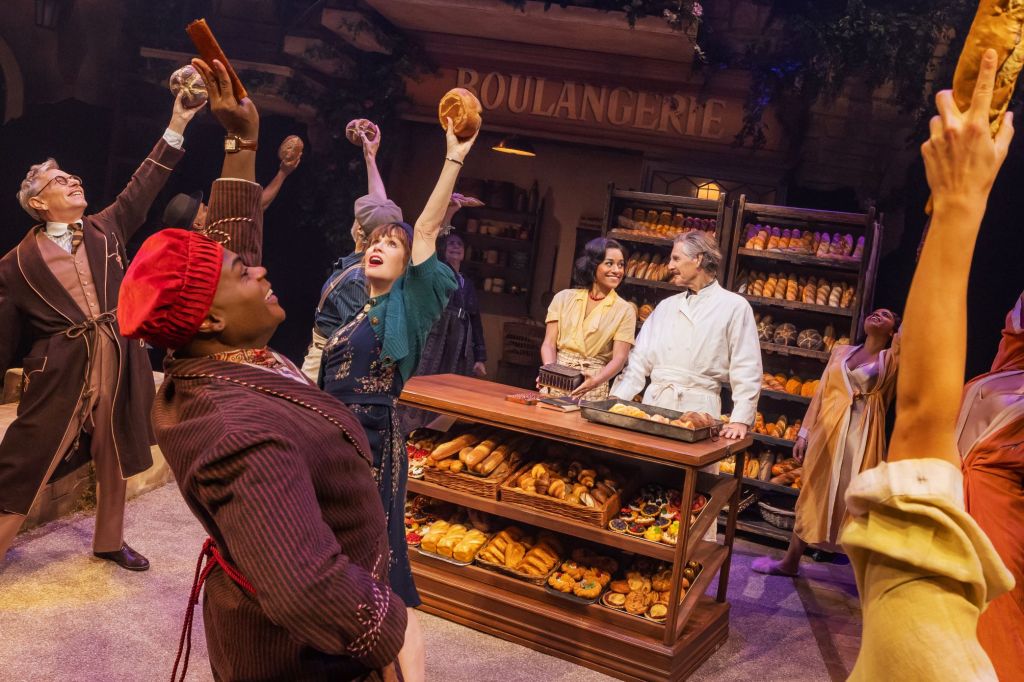
If you have not been to France, you may not “get” the community’s orgasmic and funny ravings about Aimable’s fresh, luscious bread in the song “Bread.” A noteworthy fact is that French breads are free from preservatives, dyes, chemicals which the French ban, so you can taste the incredible difference. The importance of this superlative baker and his bread become the conceit upon which the musical tuns.
Schwartz’s gorgeously lyrical music and the parable-like simplicity of Stein’s book reaffirm the values of forgiveness, humility, community and graciousness as they relate to the story of Geneviève. She abandons her loving husband Aimable and runs away to have adventures with handsome, wild, young Dominique (Kevin William Paul), the Marquis’ chauffeur. When the devastated Aimable starts drinking and stops making bread, the townspeople agree they cannot allow Aimable to fall down on his job. The Marquis (Nathan Lee Graham), is more upset about losing Aimable’s bread than the car Domnique stole.
Casting off long held feuds and disagreements, they unite together and send out a search party to return Geneviève without judgment to Aimable, who has resolved to be alone. Meanwhile, Geneviève decides to leave Dominique who is hot-blooded but cold-hearted. In a serendipitous moment three of the villagers come upon Geneviève waiting to catch a bus to Marseilles. They gently encourage her to return to Concorde, affirming the town will not judge her.
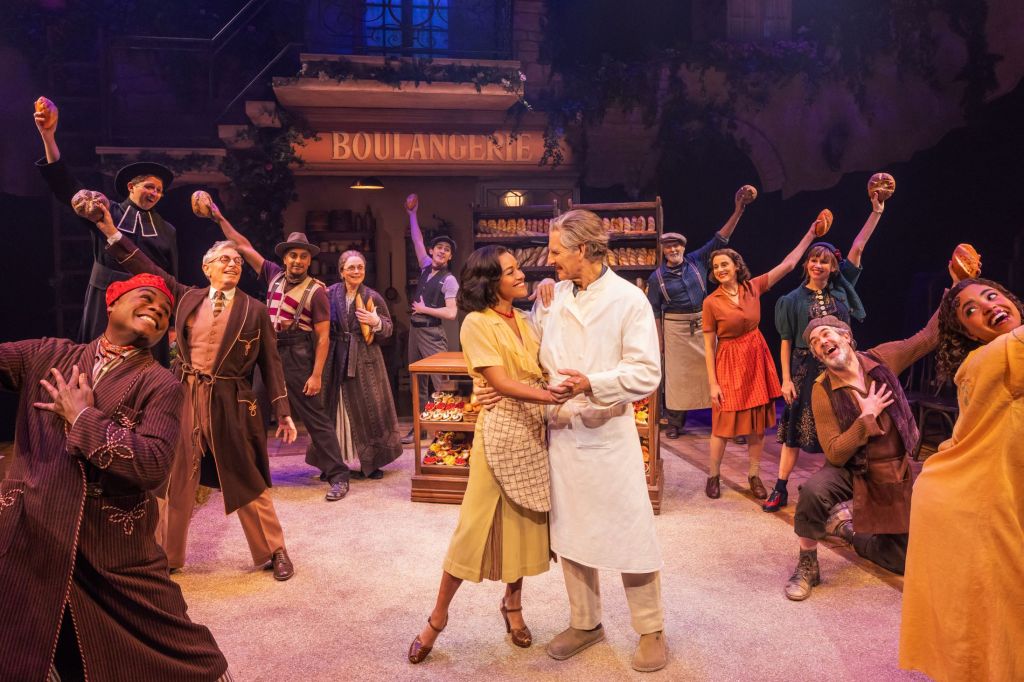
She realizes she has nowhere to go and acknowledges her wrong-headed ways, acting like Pompom her cat who also ran off. Geneviève returns to Aimable for security, comfort and stability, and Pompom returns because she is hungry. Aimable feeds both, but scolds the cat for running after a stray tom cat in the moonlight. When he asks Pompom if she will run away again, DeBose quietly, meaningfully tells Bakula’s Aimable, she will not leave again. The understanding and connection returns metaphorically between them.
Director Gordon Greenberg’s dynamically staged and beautifully designed revival succeeds because of the exceptional Scott Bakula and perfect Ariana DeBose, who also dances balletically (choreography by Stephanie Klemons). DeBose’s singing is beyond gorgeous and Bakula’s Aimable resonates with pride and poignancy The superb ensemble evokes the community of the village which swirls its life around the central couple.
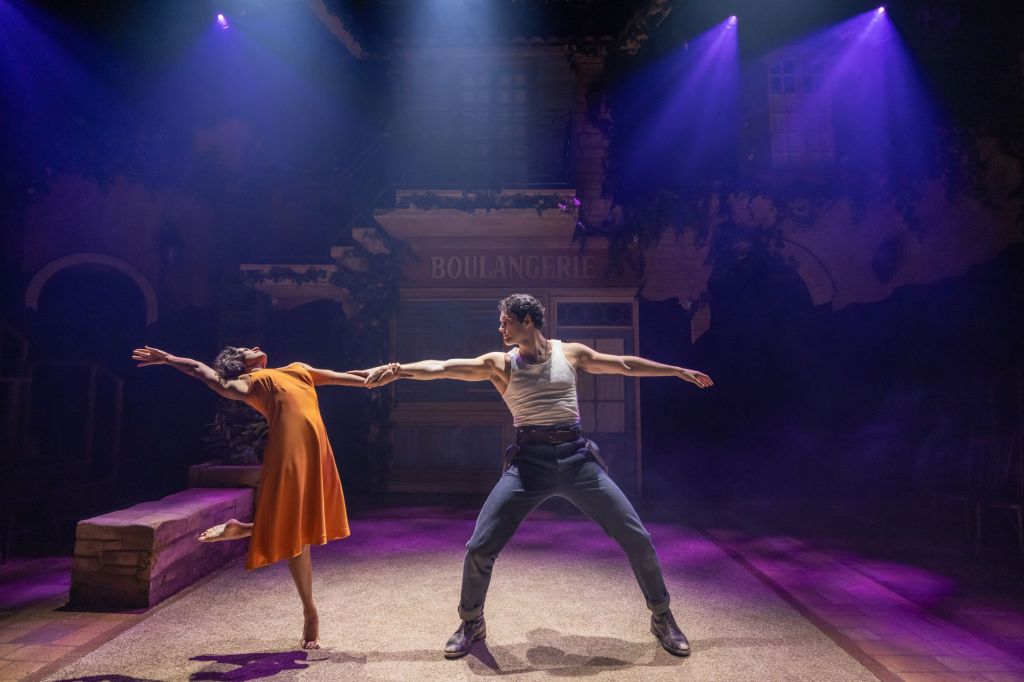
Greenberg’s acute, well-paced direction reveals an obvious appreciation and familiarity with The Baker’s Wife. Having directed two previous runs, one in New Jersey (2005), the other at The Menier Chocolate Factory in London (2024), Greenberg fashions this winning, immersive production with the cafe square spilling out into the CSC’s central space with the audience on three sides. The production offers the unique experience of cafe seating for audience members.
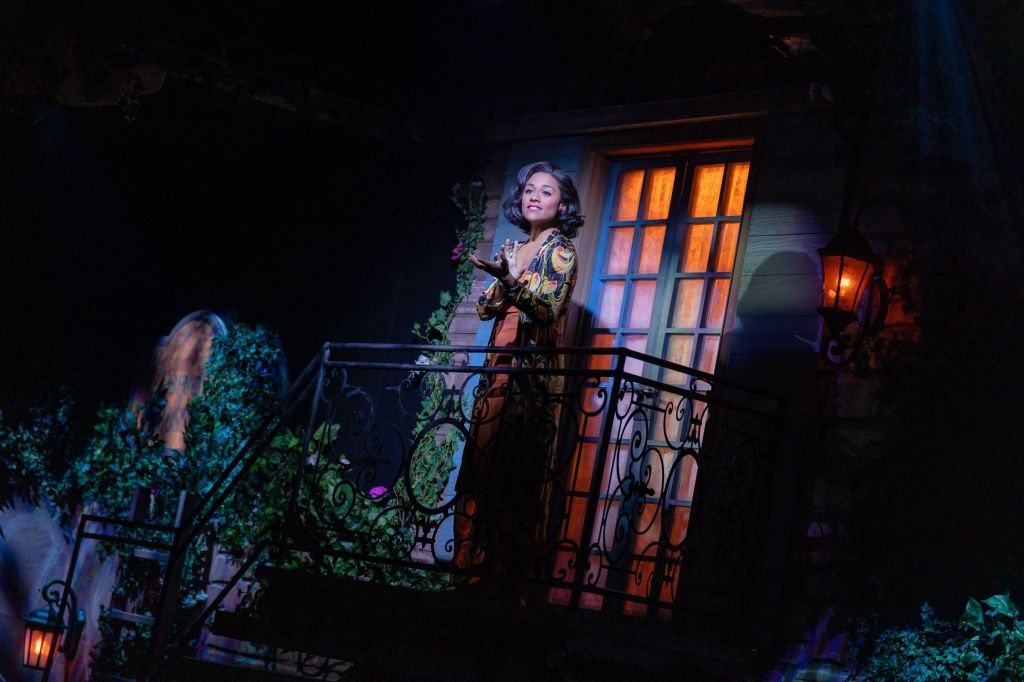
Jason Sherwood’s scenic design creates the atmosphere of the small village of Concorde with ivy draping the faux walls, suggesting the village’s quaint buildings. The baker’s boulanger on the ground floor at the back of the theater is in a two-story building with the second floor bedroom hidden by curtains with the ivy covered “Romeo and Juliet” balcony in front. The balcony features prominently as a device of romance, escape or union. From there DeBoise’s Geneviève stands dramatically while Kevin William Paul’s Dominique serenades her, pretending it is the baker’s talents he praises. From there DeBoise exquisitely sings “Meadowlark.”
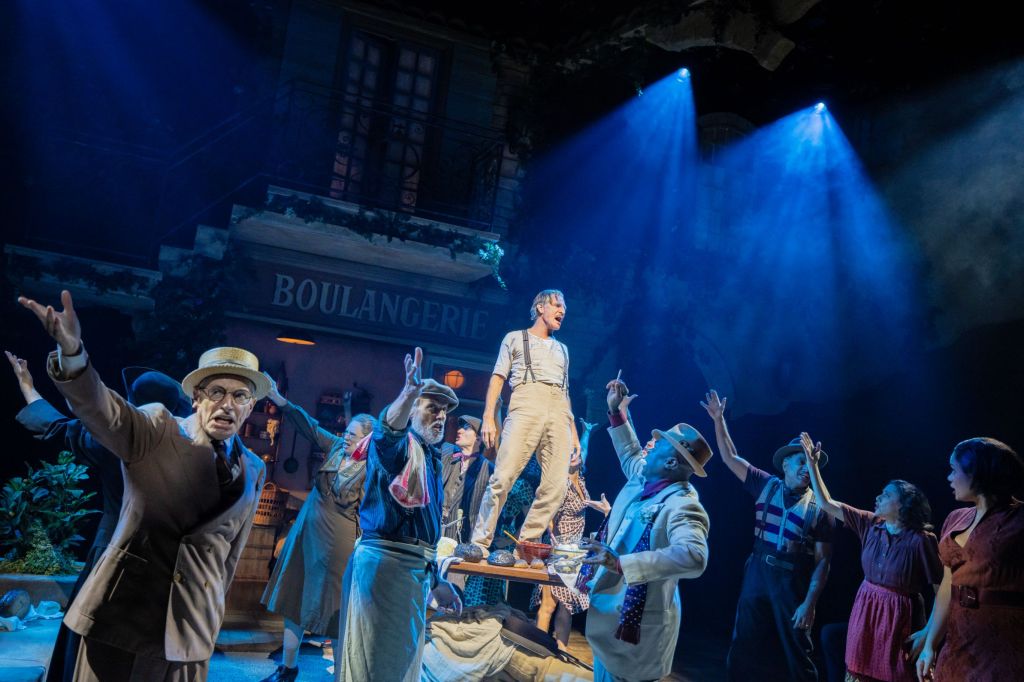
Greenberg’s vision for the musical, the sterling leads and the excellent ensemble overcome the show’s flaws. The actors breathe life into the dated script and misogynistic jokes by integrating these as cultural aspects of the small French community of Concorde in the time before WW II. The community composed of idiosyncratic members show they can be disagreeable and divisive with each other. However, they come together when they attempt to find Geneviève and return her to Aimable to restore balance to their collective, with bread for their emotional and physical sustenance.
All of the wonderful work by ensemble members keep the musical pinging. Robert Cuccioli plays ironic husband Claude with Judy Kuhn as his wife Denise. They are the cafe owning, long married couple, who serve as the foils for the newly married Aimable and Geneviève. They provide humor with wise cracks about each other as the other townspeople chime in with their jokes and songs about annoying neighbors.
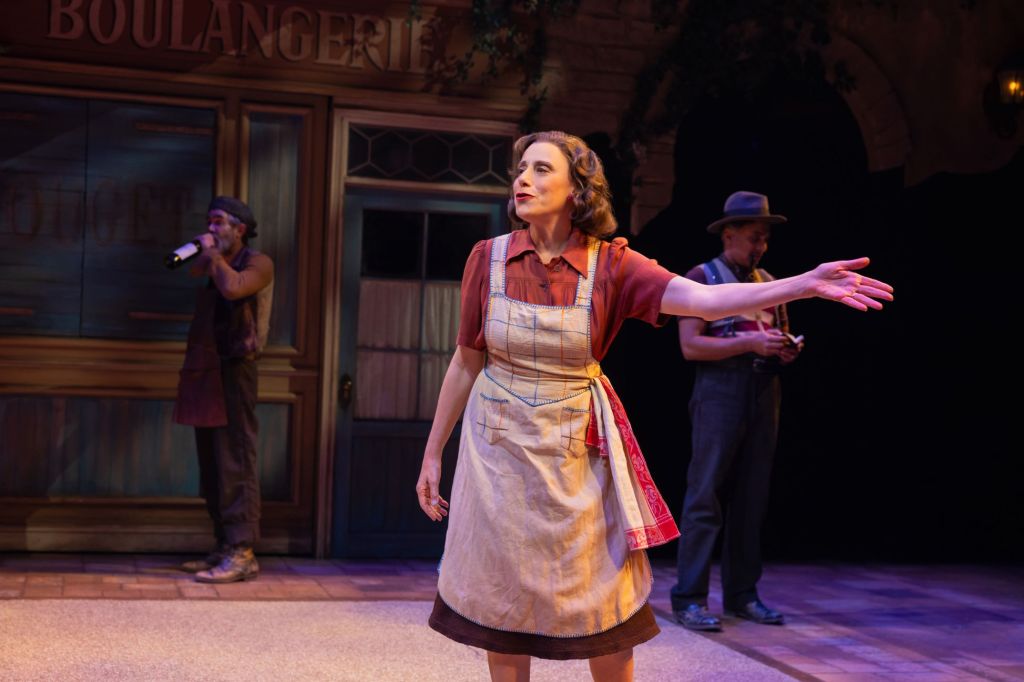
Like the other townspeople, who watch the events with the baker and his wife and learn about themselves, Claude and Denise realize the lust of their youth has morphed into love and great appreciation for each other in their middle age. Kuhn’s Denise opens and closes the production singing about the life and people of the village who gain a new perspective in the memorable signature song, “Chanson.”
The event with the baker and his wife stirs the townspeople to re-evaluate their former outlooks and biased attitudes. The women especially receive a boon from Geneviève’s actions. They toast to her while the men have gone on their search, leaving the women “without their instruction.” And for the first time Hortense (Sally Murphy), stands up to her dictatorial husband Barnaby (Manu Narayan) and leaves to visit a relative. She may never return. Clearly, the townspeople inch their way forward in getting along with each other, to “break bread” congenially as a result of an experience with “the baker and his wife,” that they will never forget.
The Baker’s Wife runs 2 hours 30 minutes with one intermission at Classic Stage Company through Dec. 21st; classicstage.org.
‘Late Fame’ Starring Willem Dafoe, 63rd NYFF
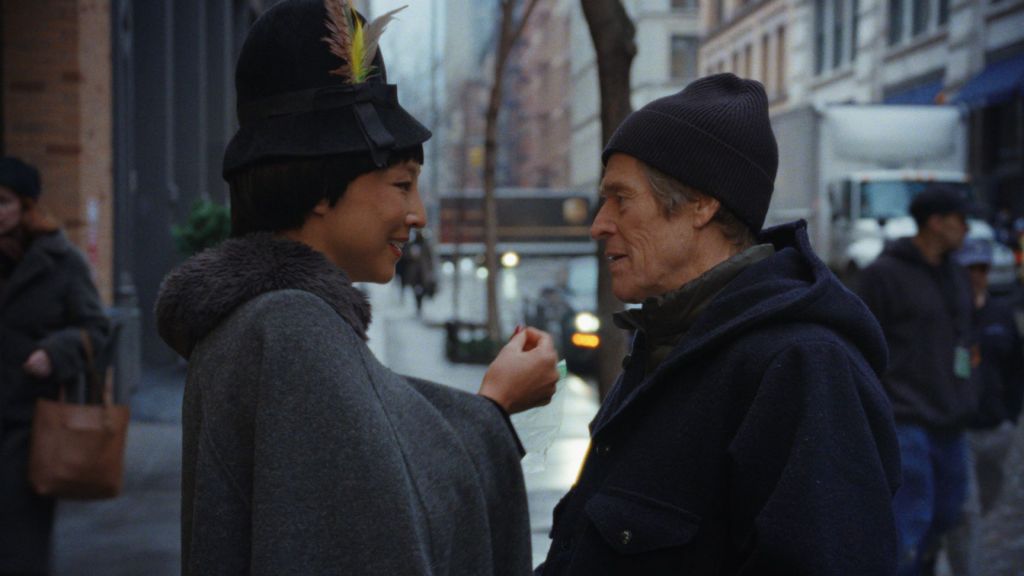
Adapted from the Arthur Schnitzler novella Late Fame, screenwriter Samy Burch (May/December) and director Kent Jones (Diana) shine a light on the West Village and Soho (circa 1970s) and Soho now at the height of its commercialization and development. With the incredible backdrop of factory buildings and West Village apartment buildings turned into fashionista haunts, and cobblestone streets still creating their unique atmosphere, a superb Willem Dafoe portrays the sensitive, once lauded poet Ed Saxburger. The craggy young man who had the world at his feet with the publication of his poetry book Way Past Go eventually gave up his typewriter to earn a modest living with a secure pension as a postal worker.
What happens to the passionate fire required to write poetry that gets published during a time when poetry was the lingua franca of the Village artist milieu, and Soho was the coolest place to be? If old soldiers fade away, does the same happen to promising poets whose work is well regarded but little read, then forgotten?
Late Fame investigates this phenomenon with atmosphere, nuance, irony and heart. It is Jones’ love letter to downtown Manhattan, vastly changed with remnants of its old beauty and undeveloped glory which made a comfortable home to artists of all stripes in the 1970s. Then, Dafoe’s character Ed Saxburger came East, spurred by the thought of fitting in with the artist colonies in Manhattan at that time.
The film which is in the Main Slate section at New York Film Festival is buoyed up by sterling performances from those assisting Dafoe, as he negotiates his empathetic protagonist who is stoic, reserved and charming, and a bit lost as he welcomes yet questions with open eyes his acceptance by a group of well-heeled twenty-somethings, who turn out to be poseur artists. Their mission is to recapture the ethos of Gregory Corso, Allen Ginsberg and others, but they are sorely out of their depth and lack the talent, grist and life wounds to do so.
The film unspools with Saxburger’s rediscovery by this exotic group of young would-be writers and philosophers branding themselves “the Enthusiasm Society.” An effete, wealthy Wilson Meyers (the excellent Edmund Donovan), leads the group of retrograde misogynists and artistes. When Saxburger asks where he found his book, with wide-eyed irony and pride, Meyers tells Saxburger he bought it at “Foyle’s on Charing Cross Road.” Indeed, Meyers uses Saxburger’s book as the equivalent to a museum piece around which Meyer centers his exploitation and cause célèbre.
On further discussion to introduce himself Meyers cavalierly asserts his and the Enthusiasm Society’s purpose to “stand against negativity” and the monetization of everything,” a mission that unravels when Saxburger gets to know him. Key to who they are, is that they distance themselves from lower lights, “the influencer culture, cellphone obsessed and technology maniacs.” These they excoriate, all the while imbibing the same waters because no one is paying attention. However, Saxburger is.
For example Meyers’ stunning, unhip apartment in the village, funded by his parents, is technologically outfitted to the max. The other members are equally flush, supported by their parents, a far cry from the struggling, self-made artists that they emulate. However, their hypocrisy and unawareness of self that Saxburger notes quietly, he puts aside momentarily. He is drawn in by their allurement as they gush over him.
Their earnestness could be worse. At least they aspire to be like legends of the past, so Saxubrger allows himself to be caught up in their artificial world, until the revelations come fast and furious after a poetic recital where various members read at a venue Myers procures. The actors portray these fellows as more of an Oxford-like clique of wannabe creatives who are callow, literary sophisticates. In their aspirations they will never achieve what Saxburger did as he struggled and was celebrated in reviews, even if for a bright moment that he himself extinguished by moving on.
Though these individuals are largely focused on the masculine, they allow the actress and singer Gloria (a fine Greta Lee) to float among them as the girlfriend of one or more of the members. When Ed finally joins the Enthusiasm Society live and they introduce Gloria, her flamboyance and mystery is a treat for Ed. She is more akin to him as an older, wiser, financially strapped actress who, like Ed, knows what it is to struggle for her craft. Unlike Ed, she may hold on longer because she is an opportunist who knows how to play the game. In his authenticity and truth, Saxburger probably said, “It’s enough. I’ve got to eat and support myself.”
Cleverly, Jones features Gloria front and center during a performance of Kurt Weill and Bertolt Brecht’s “Surabaya Johnny.” A chanteuse, Sally Bowles “divine decadence” type, Gloria lures Ed who finds her attractive, opaque and mysterious, unlike the others. During a brief scene they do drugs together and frolic down the streets, a nostalgic nod to the past.
Greta who is supposed to read poetry during the recital appears to be too overwrought to be able to credibly do it. Part of her act, however, she pulls through at the last minute stunning the audience. Finally, Saxburger reads his own work beautifully, though an audience member references his age, albeit tucked into a compliment. The shout out reminds him of where he was and now is with this ersatz glitterati. It’s a desultory in between.
Though Saxburger has a family back home and a brother dying, he stays in New York and doesn’t return to visit. That ground is never covered by Jones or the screenwriter. However, it substantiates that when Saxburger left his family and made a new life for himself in Manhattan.
In the present that life includes a culturally rich apartment with bookcases filled with books that he’s read, a nice touch by the set designer. Also, his group of working class friends that he plays pool with who don’t know his poetic past or his literary interests, have helped distract him from what was. We do see when he can’t write a new poem for the recital that his artistry has been put on indefinite hold. But it’s OK. Beyond these elements, this is a film about brief moments in time where the light shines and then dims only to shine once more before it goes out.
Jones’ work is noteworthy for the stellar performances. Dafoe who inhabits the role perfectly is sensational, and Lee and the others provide the foundation from which Dafoe easily and seamlessly establishes this intriguing and heartfelt character.
Tickets are still available at https://www.filmlinc.org/nyff2025/films/late-fame/
Writers! Regardless of Where You Stand in the Publishing Game, Enhance Your Social Media Presence.
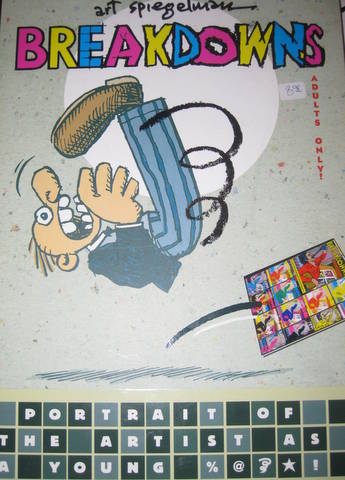
A Spiegelman fan,I purchased this copy at a used bookstore.
Brilliant best selling graphic artist and Pulitzer prizewinner Art Spiegelman of Maus I and Maus II fame struggled to get his work out there in the early 1970s. It was a process and there was even rejection of his incredible, iconic work. (Words cannot describe the graphic artistry and meaning of what he has done with Maus I and Maus II. You just have to check it out for yourself or not.) When he was attempting to get his book Breakdowns published (before he created Maus I) it didn’t go swimmingly. Decades later, after his many awards, global recognition and other publications, his editor at Pantheon was all for re-issuing Breakdowns and this time, Spiegelman was surprised and hesitant. But things had changed by 2007. You mean publishing and the cultu1re had galactically shifted from the days that Art Spiegelman was first establishing his career? Duh!
In those days, for Spiegelman, getting published was not unimportant. To many today, it is golden. It is the dream of established writers who may have faced writer’s block after years of success. It is the dream of those who have fallen off the charts and out of the hearts of former readers. It is the dream of the published whose first, second and third books have middling sales that tapered to .001% so that literary agents and editors won’t go near them. (Low percentages? Nil profit margins? Are you insane? How can the media CEOs sustain tremendous salaries and bonuses with such schlocky sales numbers?) It is the dream of the working writer who has written and published one book and is working on another in the hope of changing publishers/ agents and getting a better deal, though the first book sales were abysmal. The variables of situation are endless, unless of course, one is a hot name with an extensive platform, i.e. Bill O’Reilly (in which case the greatness of the work is immaterial, as long as there is name recognition and a ready mega platform).
The irony has been that for the last century, concepts and particular literati who have been favored by elites, the wealthy or politicos have been highly publicized. This creates an inherent censorship. The gatekeepers, the literary agents, the large presses have kept it that way to fuel ideas that elitists wanted the public to believe and be bound in by. So traditional media has worked in concert with the very wealthy. (Perhaps it is why Spiegelman was rejected for publication until he found an intelligent, prescient SMALL publisher who took a chance on him.) In many instances the middle class and general public’s reading tastes have been tailored to what elites have deemed, “great,” though their standards are merely opinions and predominately skewed to their agendas. Their concepts of great craft, writing and artistry often beggar the imagination.

Salman Rushdie tweets with his fans on Twitter and actually did battle last year with Facebook, winning with his great humor, irony and wit. Social media is one of the best ways to connect and keep in touch with your readers.
Needless to say, European publishers, more intellectual, knowledgeable in breadth and scope, courageous and less censoring, have allowed titles in that NEVER WOULD HAVE BEEN ACCEPTED IN THE US. And yet, we think we are a free and open democracy? (We are told that by traditional media hirelings though many medical books and controversial political content find publishing friends overseas or in Canada.) Well…traditional publishing has relied on TV to gather its stable of often un-meritorious but profitable properties. Writers, unfortunately, have been at the mercy of these “experts” in the field who often consider the art and craft of a work last, and consider the saleability first.

Apple was one of the companies sued by the DOJ for price collusion.
This former “state of the art” for the industrial media complex has been upended by Google. It has been overturned by Amazon, undercut by Facebook and thwarted by Twitter and other social media platforms and growing spheres like Storylane. How? Subtly and not so surreptitiously. When traditional media realized it had lost its edge and destroyed the bee hives producing their honey, their fear and greed and inability to ADAPT or wrap their brains around what was happening spurred them into old paradigm interventions that worked before: lobbying and price collusion.
Mistake. They’ve been held accountable and have been sued by the DOJ and a few have had to settle while others collude with the government for the best deal which may not be forthcoming since their profitability is much lower than Google’s and Amazon’s. You see traditional media became so comfy with their century long oligolopoly that they were caught up short without a chamber pot when Amazon undersold them. That’s all they could come up with to compete? While they were riding out the waves of the past, their navigation misdirected by the old paradigm, the innovators, like a huge roller, a mammoth tidal wave, a mega tsunami, capsized their hopes and dreams of profits. Now, they are paddling slowly while growing social media networks and companies like Google continue their innovations, investing money in R & D to create better product and to entice readers, writers and developers to improve.
Bottom line? Google is swamping the media that was! I will not refer to the traditional publishers by name. Unless they begin to accept mid-list and beginning writers, offering them credible crumbs, the writing community will eschew them completely in favor of working with e-publishers, small publishers, Createspace, et. al, and those in the online publishing paradigm. I give these censoring publishers who will have to spend more and more on costly promotions and PR campaigns less than 20 years. Unless they begin to innovate to create the “next best thing,” or unless they merge with Amazon or Google (Why would those companies want to merge with inefficient, ineffective, archaic and intractable platforms?) they will have disappeared, become a ghost memory, a ridiculous faux nightmares of elitism from which we have awakened. What was the name of that book seller that went bankrupt because its innovations were too little too late? Innovate or perish. Big name publishers are slowly writhing in the mud as their hand maidens, the agents, the PR personnel, the editors struggle, sucked downward with them, sinking further into the shifting, miry clay soon to be swallowed up in a sinkhole of their own making.
The diminishing present trend is that,unless you are President Obama or a politico or a faux or worthy celebrity, a salable commodity, a publishing company will not market you. You have to market yourself. Even if you are President Obama, you have to market yourself, appearing on old media, TV, etc. Wasn’t it Michelle Obama I saw ripping open the envelope for the Best Picture Oscar last night, via a feed from the White House? Folks, the President is savvy enough to have his social media hordes and teams busy marketing him online. It’s why the Republicans have been doing unmentionables in the dark. They can’t get into the light of Twitter/ Facebook, et. al. and sound rational.

Kristen Lamb, author, blogger and a member of the online writing community who inspires and nudges writers to get on with the craft and be persistent in achieving their goals.
So, writers, if it’s good enough for the Prez, it should be good enough for you. Kristen Lamb, social media maven and author, in a recent blog post discussed the hard work it takes to position yourself on social media platforms to establish a working, interactive community from which you can promote and sell your books. If you think it will take too much time, then hire a team to help you. Using hashtags, and signings and promotions and launches, you will be able to promote yourself on social media and continue to do so, long after a traditional publishing company has left you to ROT.
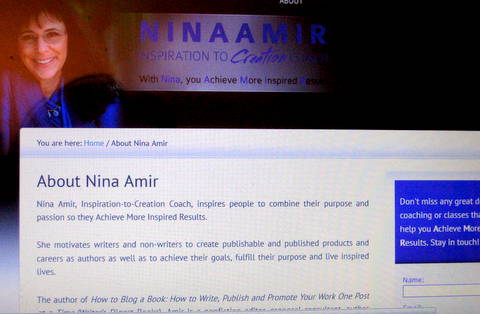
Nina Amir is a motivational coach who helps writers and non writers achieve their goals and live inspired lives.
How do you do this if you have been out of the loop for some time and find Facebook, Twitter, Tumblr, Youtube and Reddit loathsome? GET OVER YOURSELF! SNAP OUT OF IT! Swallow, take a deep breath and sign on for social media classes online. If you are a woman writer, then check into WOW Women on Writing. If you prefer live and hands on, there are many Continuing Ed. courses at various universities or colleges near you. Hopefully, you are not in this dire condition.
To help yourself and your writing career regardless of where you are…pick up the bullet at your current situation:
- Read about social media and take classes to learn how to post and interact on the most powerful sites (Twitter, Facebook, Reddit, Tumblr, Instagram, Pinterest, etc.)
- Start a few blogs and blog about subjects related to your writing, making sure to increase your readership and followership daily. Read other blogs faithfully and post comments on them, inviting them to guest on your blog.
- Be willing to spend at least 3-4 hours a day on social media and the same on your writing. Alternate this according to a schedule you make for yourself if you can’t spend the time.
- Once you’ve created a viable interacting platform and joined writers’ groups including those on Linked In and elsewhere, create your book pages and invite your followers.
- Somewhere in between all of this, you are writing your book, editing it or sending it out to be edited or working with an editor or an agent you get along with; one who is a friend and one you can trust.
- If you have done all of the above years ago and are in a slump, change it up and do something different. Shut down all online interaction for a day or a number of hours. Then review what seems to be working and what isn’t and jettison both for another day or period of hours. Go back and reassess and research. The change up will spur you on and revitalize you. If it doesn’t, seek a coach or someone to help you get out of the funk or open this up to your online writing community. Share, ask for comments and advice. Eventually the watershed moment will come. (Skip below as needed and move to the last paragraph.)
This is the beginning of a beautiful relationship with your online writing community and your team of writing friends who are intelligent, creative wordsmiths. You will keep many; you will lose many, but the journey is amazing, and eventually what was the hard work, when you look back after a year of doing this, will not appear to be so arduous after all.

The following 2 sources might be helpful for those who are beginning, or those who have taken a hiatus and need to get back into it especially if you feel overwhelmed. I apologize for not including many more, but these should whet your appetite and they are easy.
Online writing source with classes: WOW Women on Writing. (Men can take these classes as well. They are not maternalistic.) I took classes with WOW and found them to be what I needed. I also had to put in the time to learn by trial and error. I have writing friends who refuse to do this and their many publications languish, but they are trying to use other venues to get going. (traditional media venues)
Helpful Books: How to Blog a Book by Nina Amir
We are Not Alone: The Writer’s Guide to Social Media by Kristen Lamb
Your successful publishing career can take years, but so can publishing via the traditional way, which may never come to pass as the industry is reeling in a downward spiral toward doom. I have a friend who self-published because he said he was getting old and he wanted to see his books in print. That was his dream. What is yours? Are you using your social media presence to achieve it?

