Blog Archives
‘The Dinosaurs’ at Playwrights Horizons
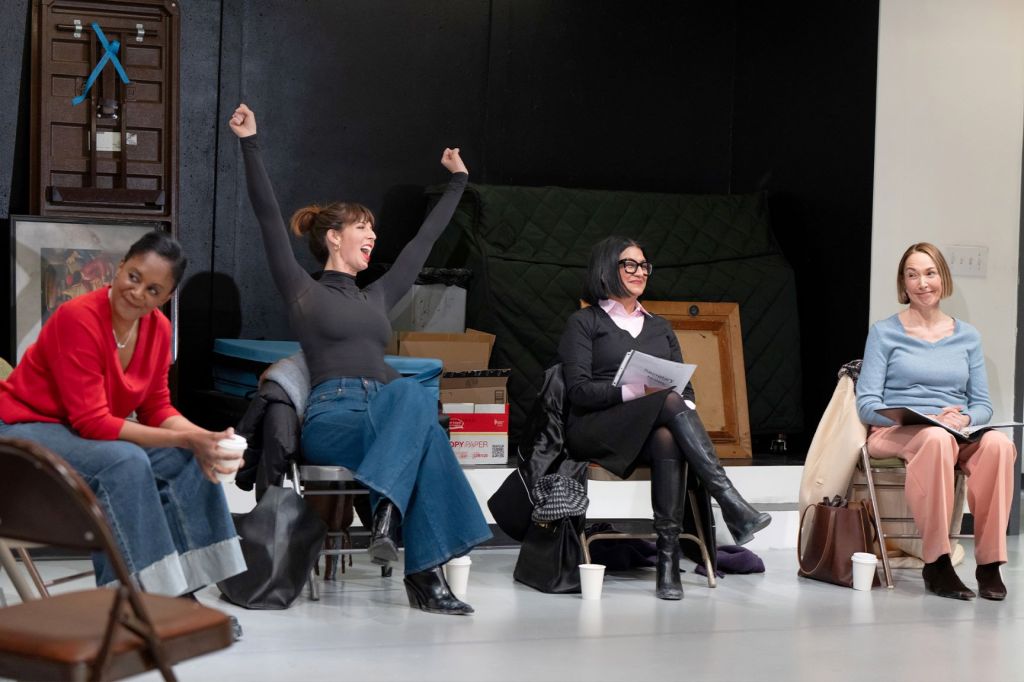
In The Dinosaurs written by Jacob Perkins and directed by Les Waters, time stands still yet moves in leaps that are hard to figure out. It takes place in a room where women who are alcoholics meet, form community and establish friendships helping each other through the years. With strong performances that require solo monologues, the characters share experiences and perspectives and enumerate their days of continuing sobriety. The Dinosaurs currently runs at Playwrights Horizons until March 8, 2026.
As the characters set up the neutral unadorned room (scenic design by dots), where they meet, wait for participants to show up and reaffirm the rules of their sessions, we understand this is a female inclusive community. April Matthis as Jane is first to arrive to begin setting up chairs, followed by nervous Buddy (Keilly McQuail), who after a humorous exchange with nonjudgmental Jane, decides she can’t stay. She does show up during the meditation and the end only making a connection with Jane in a layering that makes the time structure hard to divine.
Next, Elizabeth Marvel as Joan enters with the coffee and helps Jane set up. She is followed by Kathleen Chalfant’s Jolly as the longest, oldest member of the group, who brings positivity and warmth with the donuts and scones. Newer member Joane (Maria Elena Ramirez), arrives with gossip about a female teacher. Finally, Janet (Mallory Portnoy)–the appointed time keeper–arrives late and is the first one to share on the topic “coming back,” after their group meditation.
The playwright avoids heavy emotional content related to grief, sorrow, regrets, abuse or violence. Indeed, he avoids in the moment conflict in the plot and character development, with the exception of Joan, Jane and Joane who disagree about feeling empathy for a “lonely” female teacher who has sex with a teen who is “of age.” Jolly provides the down-to-earth humorous perspective as the argument persists then ends once Janet arrives. Interestingly, one would think these are average women of various ages who live regular lives, but for their momentous pronouncement later, during their time to share, that they are alcoholics.
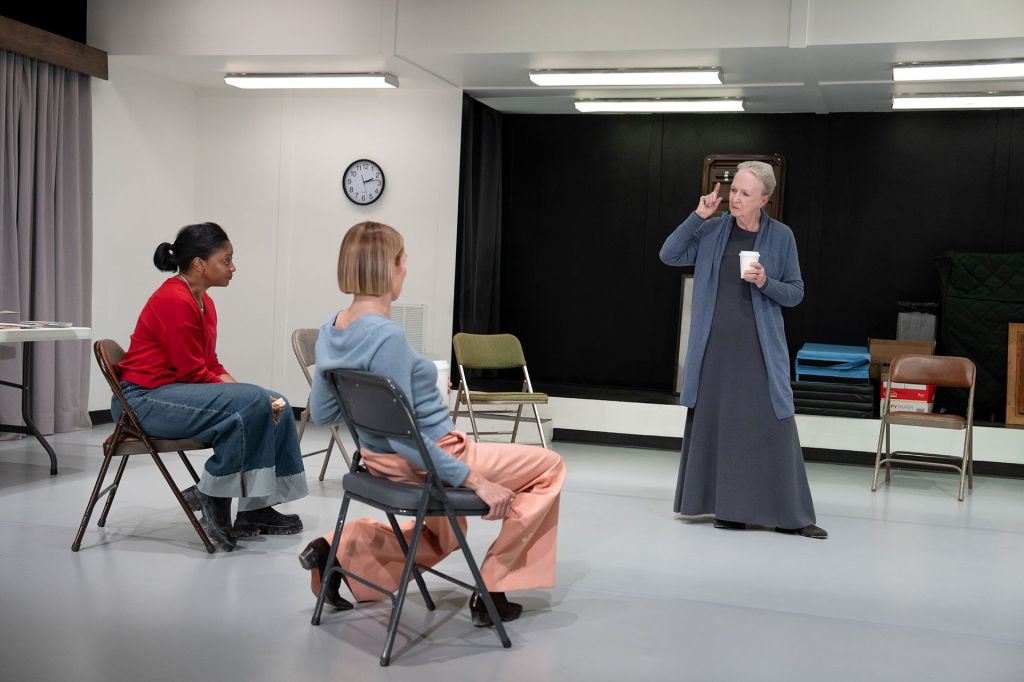
The production spends a good deal of time having Joan, Jane and Jolly set up the room making small talk. Chalfant’s portrayal as Jolly mesmerizes with substance, authenticity and humor, which she clearly infuses with backstory and meaning. In comparison with the other women, Jolly’s character is the most delineated because of Chalfant’s superb, specific performance, as is Marvel’s Joan who reveals why she is an alcoholic toward the end of the play. Otherwise, the characters divulge little else about themselves. This forces the audience to imagine who these women are and why they chose alcohol as their drug and not opiates, barbiturates, food or other addictive elements to anesthetize themselves and escape from life’s “slings and arrows of outrageous fortune;” if indeed, that is why they are alcoholics.
Janet’s metaphoric experience about being driven by a chauffeur she hates and who tells her to throw out the body of a man instead of carrying it around, seems to express her situation of carrying baggage which she eventually throws away in her awake dream state. However, we don’t understand to what she refers and she doesn’t connect the dots. Likewise, the others say little hard evidence about their situations. This adds to a general tiresome opaqueness.
All important personal details are absent, perhaps playwright censored to indicate his characters’ self-censorship. No explanation is given by the playwright, which leaves a huge gap in the ethos of the play. Nevertheless, a picture forms of these characters and the process of their recovery from a disease. However, its horrific effects in their personal lives as they share with their community is never identified. Indeed, the recovery process seems deadening as the women avoid discussing even the difficulty of fighting the urge to taste a drop of their favorite alcoholic beverage.
The characters also avoid discussing the severity of their alcoholism. If the blood never boils with emotion, then not feeling alive removes any impulse to drink. Perhaps keeping a steady deadened state is their key to recovery. How fortunate that they have found other individuals who allow this type of emotional void to be shared. Their tell-tale meditation at the beginning of their meeting indicates what substitutes for feeling and the connection with their feelings.
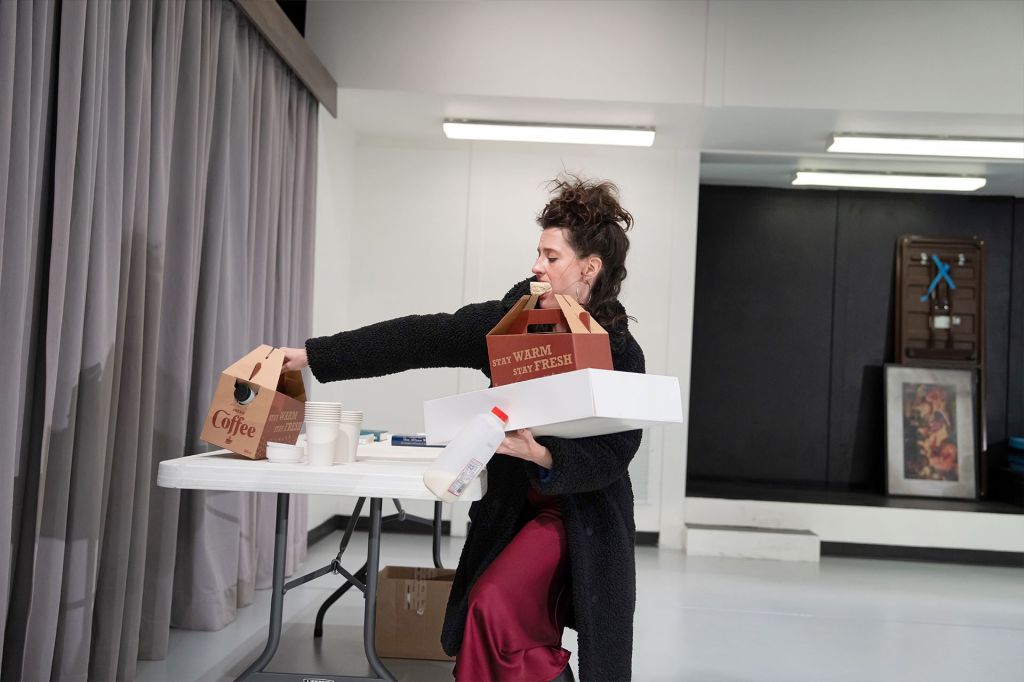
Notable examples of a separation perhaps disassociation from feelings happen with a few of the characters. Joane’s discussion of finding her son pleasuring an older man in their house seems devoid of an emotional reaction on her part in relation to her drinking. The assumption is that her discovery caused the rift between herself and her son that she describes and perhaps this led to her alcoholism. She and her son never discussed or dealt with her seeing her son with the older man. Did this lead to the dire circumstances that happened later in their lives? Ramirez’ Joane recalls it with dispassion though she takes a moment to breathe revealing the confession is difficult. Her admission that she is revealing it for the first time is groundbreaking.
That her son at fifteen was under the apparent influence of an older man reflective of the current pedophilia reports in the Epstein files is passed over without judgment by Joan or any of the other women. Is this what it takes to recover from alcoholism, this passive, non-reactive state of mind while others are there to just listen?
Joan’s time lapse discussion of the days of her recovery to sixteen years emerges with vitality. A matter-of-fact statement of her number of years without a drink that has seen her in this room with various community members of alcoholics hearing her make comments becomes her milestone. And apparently, during that sixteen year period she had to say goodbye to Jolly who dies and whom she misses. Thus, Jolly’s influence on her own recovery is reduced to less than a minute of time, though counting the years of struggle to maintain sobriety must have seemed an eternity. Unfortunately, there is a grand absence of information. Perkins revels in being opaque. More is needed.
Thankfully, the actors do a yeowoman’s job of leaping over the play’s lack of detail by providing as much of their interior substance as possible. Nevertheless, the lifeblood of theatricality and living onstage is hindered by the playwright’s lack of clarity. Nor is the play’s incoherence at times clarified by Waters’ direction.
Perhaps Rainer Maria Rilke’s quote from Book of Hours which Perkins uses to head up his script might have been spoken aloud by one of the characters in a prelude to The Dinosaurs. The lines of poetry present a lens though which to view each of the characters’ journeys, lifting them to a spiritual plane and revealing the irrelevance of time.
I live my life in widening circles that reach out across the world. I may not complete this last one but I give myself to it. I circle around God, around the primordial tower. I’ve been circling for thousands of years and I still don’t know: am I a falcon, a storm, or a great song. –Rainer Maria Rilke from Book of Hours
The Dinosaurs runs 1 hour 15 minutes at Playwrights Horizons until March 8, 2026. playwrightshorizons.org.
‘King Lear’ Starring Glenda Jackson, a Royal Performance at the Cort Theatre

John Douglas Thompson and Glenda Jackson in ‘King Lear,’ directed by Sam Gold (Brigitte Lacombe)
William Shakespeare’s King Lear directed by Sam Gold is a must-see for its principal performances and its particular, stylized artistic design (scenic, sound, costume) which cleverly emphasizes the themes, symbolism and metaphors of the play. Above all, you should not miss Glenda Jackson who is a gobsmacking dynamo as the king who throws off the shackles of corruption and confronts his mortality to gain the wisdom of foolishness.
Jackson fits the titular role like it is made of her own flesh. This is a “once upon a lifetime” production that is astute, profound, if sometimes opaquely realized with regard to integrating Philip Glass’ music. Nevertheless, the director’s vision and design suggests overarching themes about appearance vs. reality, lies vs. truth, duplicity vs. authenticity, wisdom in madness and madness in wisdom.
Throughout, Jackson is a magnificent, who always rises to perform with sentience and power. Her Tony award winning portrayals in Edward Albee’s Three Tall Women last year were unforgettable. Likewise, her performance in King Lear follows with equal ferocity and fervor.

Pedro Pascal, Jayne Houdyshell in ‘King Lear,’ directed by Sam Gold (Brigitte Lacombe)
Shakespeare’s characterization of the foolish king is among the most searing, poignant and challenging of roles. Only someone with the breadth, knowledge, sensitivity and prodigious talent like Ms. Jackson’s should attempt it. And that is why, from a woman’s perspective, her performance of this man who is a king and a fool is almost counterintuitive. It is no ready coincidence that Jackson’s Lear exemplifies a startling emotional grist that moves the king’s ethos from corruption to madness to wisdom with breathtaking logic and moment-to-moment life.
In her every action, every breath and movement, every grimace and expression of inner torment and fury, we search out Lear’s evolving humanity as we feel his pain and empathize with him. Shakespeare’s characterization of Lear engineers the development of the play.

(L to R): Ruth Wilson, Glenda Jackson, John Douglas Thompson in ‘King Lear’ (Brigitte Lacombe)
It is Lear who creates the self-destructive vortex and whirls violently in it during the arc of his soul journey, buffeted by its abuse, yet buoyed up by a stalwart inner core of moral outrage and self-righteous fury. It is the recognition of his own corrupted judgment and the expose of his daughters’ wickedness that keeps him from drowning in complete madness. He is kept from this abyss by the Earl of Kent (the exquisite john Douglas Thompson) his Fool (Ruth Wilson in a humorous turn) the supportive Earl of Gloucester (the poignant and superb Jayne Houdyshell) and Gloucester’s son Edgar (Sean Carvajal) in a beautifully rendered performance) who becomes like the Biblical lunatic to escape the wrath of the court.

Sean Carvajal in ‘King Lear,’ directed by Sam Gold (Brigitte Lacombe)
After Lear spurns his third daughter Cordelia (Ruth Wilson) his daughter Goneril (the excellent Elizabeth Marvel) and daughter Regan (the equally fine Aisling O’Sullivan) presumptuously usurp his authority. They command that he heel to their authority, despite his generous bestowal of wealth and lands upon them. Rather than accept his retinue that follows him to his daughters’ castles, they provoke their father’s wrath to pursue their own agendas.
Maintaining his nobility and identity, Jackson’s Lear refuses to “live” under their terms. Homeless, he braves the stormy abyss of his own soul damnation reflected in the harsh elements with the help of his Fool and the Earl of Kent, disguised as a servant. Ruth Wilson’s Fool comforts Lear, chides him and peppers his rages at Goneril’s and Regan’s ignominous treatment with humorous jibes and quips which strip Lear of his courtly pretensions. Indeed, the Fool guides him toward humility and brings this lofty king into an endearment with his own “base” but noble humanity.

Pedro Pascal, Jayne Houdyshell in ‘King Lear’ (Brigitte Lacombe)
Gold’s version of Lear stylizes the trope that Cordelia and the Fool are similar by having Wilson expertly play both parts. If this is, in Lear’s mind, an unconscious projection of remorse, self-flagellation and wish fulfillment to forgive his loving Cordelia and keep her near, the doubling of roles is sensible. Certainly, Cordelia is the only daughter who loves him. Thus, it is appropriate that Cordelia-the Fool leads the foolish old man into wisdom to help perfect his soul and expurgate the corruptions he has internalized, surrounded by treacherous courtiers and family in a lifestyle that has caved in his better person.
During Lear’s journey into the dark storms of mental uncertainty deranged by a gilded, false life in the gaudy kingdom that he must leave behind (mentally) to grow, he stumbles upon his real self. Centered in truths he never experienced before in his court, Lear strives to maintain his autonomy and identity. He eventually comes to realize what is important in his life-his humanity/mortality/liability to err in judgment which he is able to forgive as he presents himself as “a foolish old man.”

(L to R): John Douglas Thompson, Russell Harvard, Michael Arden, in ‘King Lear’ (Brigitte Lacombe)
Gold’s decision (Miriam Bljether’s Senic Design) to regale the court in pretentious splendor hints at a surface gloss and artificiality/artfulness that distracts from confronting the underlying wickedness and greed in Lear’s court and kingdom. They are “dressing to impress” to cover up the incompetence, nihilism and emptiness within themselves. All that glitters is fool’s gold; it lacks value and worth in an inherently weak kingdom whose underlying principles (if there are any) do not guard against self-destruction and annihilation. Thus, in the stylization the director reveals the seeds of corruption and foreshadows the devolution of the kingdom that will follow hard and fast.
In this setting of “fool’s gold” we meet the commanding Lear and his three daughters at a celebration during which the string quartet stuffed into a corner plays the gorgeous music (original music by Philip Glass) which the courtiers and family neither acknowledge nor appreciate but treat as background noise to be ignored as they raise their voices over it. The family’s general lack of appreciation for their lavish lifestyle and their dismissal of the importance of the depth of their royal duties is reflected in their reaction to all the court accoutrements including a most civil tea service later in the play, held at an incongruent and ridiculous time and place. They are the arrogant, the privileged. Only Cordelia differs.
Thus, when Cordelia reminds the court of her loyalty to her father invested in her role as his daughter, we take this to heart. Do the others, after receiving their inheritance realize the obligations their father’s gift entails?
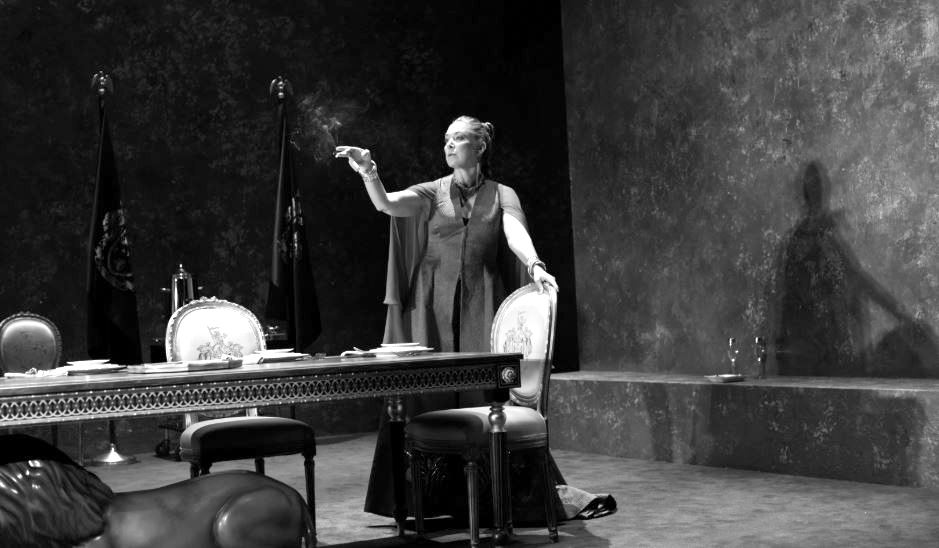
Elizabeth Marvel in ‘King Lear’ (Brigitte Lacombe)
Hardly. Regan and Goneril from the outset are principally concerned with “getting all they can” through false pretense. They could care less about the rights and duties invested in their father’s gift of an early inheritance. It is no small wonder that Goneril and Regan rail about Lear’s visits with his soldiers. They want the inheritance with no strings attached, wishing to be free of their father forever. Rather than pay homage and give extended hospitality to a vibrant, authoritative king, they take advantage of his public punishment of Cordelia and suggest that he is off balance. It follows that they will provoke his wrath and become his enemies, so that their unconscious desire that he dies sooner rather than later becomes a reality.
An overarching metaphor the director emphasizes throughout the play, is the irony of incongruence-in the court’s lack of probity and unseemly excessiveness. Incongruence is everywhere represented by the “out-of-place” music at the celebration and elsewhere, music which never quite melds throughout the arc of the play’s development. The “over-the-top,” ostentatious, meretricious faux “gold” walls and the formal outfits (Ann Roth-Costume Design) exchanged for less formal ones as the kingdom devolves and the characters’ wicked selves are exposed, also appear incongruous as they are presented. So do the huge ceramic dog and lion.

Russell Harvard, Aisling O’Sullivan in ‘King Lear’ (Brigitte Lacombe)
The gilt walls are present throughout the play with a similarly hued curtain that characters stand before during various scenes (a further emphasis of the themes of incongruity and fool’s gold or an idea that Shakespeare often uses that appears in The Merchant of Venice: “all that glitters is not gold”). The “fool’s gold” walls and audience curtain are the ironic, anomalous backdrop against which the characters are measured and either found wanting in that they exemplify the trope or are antithetical to it.
These artistic elements reflect the malfeasant influence his daughters and husbands have over Lear, an influence which is shaken out of him on his stormy journey coming to the end of himself.

(L to R): Jayne Houdyshell, Glenda Jackson in ‘King Lear,’ directed by Sam Gold (Brigitte Lacombe)
As the daughters and their husbands abuse the kingdom for their own nefarious ends all becomes rubble, wrecked by the familial divisions and war. The walls are the only remnants of the former “glory” of the court perhaps suggesting a universal concept. This kingdom is finished, but the spirit of duplicity (faux gold) of leaders’ pretense which they use to control their minions is present in every age. Eventually, by the conclusion the back gold wall takes on a different hue changed by shifts in lighting. Interpret this as you will, the hue doesn’t gleam, but suggests small points of light (starlight?) amidst characters comments (i.e. Kent: ‘The stars above us govern our condition”).
In the fateful universe of Shakespeare’s play, the arrogant, self-centered human beings are thwarted in the pursuit of their own wicked desires which are founded upon worthless principles (“fool’s gold”) and lies. This development is evident in the characterizations of Goneril, Edmund, Regan, the Duke of Cornwall. The other characters (Edgar, the Duke of Albany) who do not follow their lust for power rise to triumph. As object lessons, Cordelia, Kent, Gloucester, Lear are caught up in the hazard, subjects of poignant tragedy.

Glenda Jackson in ‘King Lear,’ directed by Sam Gold (Brigitte Lacombe)
And it all begins in the “golden” court, when Lear pronounces his inheritance to his inherently wicked daughters enticing them to flatter him in a misaligned quid pro quo as if to prove his greatness and their fealty to him. Goneril and Regan oblige him; Cordelia does not. In that fell act, treason and wickedness are exposed. The wrong daughters receive the bulk of the inheritance, the right daughter is disinherited. The world is in chaos, turned upside down as duplicity usurps love and order.
Lear makes a public show of Cordelia’s punishment sealing his misaligned judgment which the others see may be further abused. Indeed, Lear’s malignity is revealed in a court which embraces and exploits it. And this evil sets in motion the parallel plot with the Earl of Gloucester and his treacherous, conniving son Edmund (the wonderful, insidious Pedro Pascal) who usurps brother Edgar’s inheritance and place in his father’s affections and legal authority.

Glenda Jackson in ‘King Lear,’ directed by Sam Gold (Brigitte Lacombe)
In this secondary plot the illegitimate Edmund, who despises the goodness of his father, lies on his brother Edgar who is forced to escape with his life and go into hiding disguised as the madman beggar “poor Tom.” It is only when Lear, Kent and the Fool meet up with Edgar and take shelter in a hovel does Lear begin to understand his condition in light of poor Tom who is much worse off. In this beggar lunatic, he sees his true ethos without the vanities of the world and his court.
Lear journeys through his “madness” gaining wisdom and gradually throws off the misaligned corruptions of the “courtly mind,” represented by the “fool’s gold” set design. Lear becomes the humble, kingly fool. These scenes among Lear, the Fool, Kent and Edgar are particularly wonderful. The scenes between Carvajal’s Edgar and Houdyshell’s Earl of Gloucester when the blind Earl seeks his death are magnificently rendered by Houdyshell and Carvajal and incredibly touching and poignant.

Ruth Wilson in ‘King Lear,’ directed by Sam Gold (Brigitte Lacomb)
Thus, the deeper evils of this court once hidden in the hearts of Goneril and Regan and her husband and Edmund, feed on themselves and grow as the villains wreck everything to gain the advantage, an advantage which is never sustained with the good sense and order to keep it. The director correctly has the nihilistic Goneril, Regan, The Duke of Cornwall and Edmund contribute to demolishing all order in the kingdom symbolized by the ripped up set interiors as the court is rocked from within and without by war. Considering that they annihilate their inheritance and the goodness of Lear’s gift to them, portraying their father as their enemy, that evil which was hidden by glamour and civility explodes full bore by the play’s conclusion.
Goneril’s mocking lasciviousness expresses her unrestrained wildness “going over to the dark side.” Marvel’s development of characterization is superb. Likewise O’Sullivan’s Regan as the raging, screaming shrew (evolving from the sweeter sister at the outset) appears even more “off the beam” crazy than her father, Lear. And so does her husband the Duke of Cornwall (Russell Harvard’s signing is emotionally powerful) whose rage is at times inarticulate and can only be expressed with frantic signing and frustrated slamming.
By the end, the court reaches its true level of craven wantonness. The debased Goneril and Edmund have sordid sex on the floor reveling in the chaos and rubble. Regan and Edmund plot against Goneril in the disordered wreckage which no one bothers to clear out. Cornwall is stabbed as the actors pick their way around the debris of the once “glorious” court, followed by Regan’s poisoning by Goneril for Edmund’s love. The director again reinforces the theme that wicked amorality has no tenability nor the substance to sustain order. As those who deserve to rule, Edgar and the Duke of Albany (Dion Johnstone) prove themselves wise and just in restoring a kingdom ruined by greed, lies, usurpation, corruption and treachery.

Glenda Jackson in ‘King Lear’ (Brigitte Lacombe)
In his humbled, state after the madness of wisdom shines a truth he has learned, Lear states a key theme about his royal court: “robes and furr’d gowns hide all.” In another quote he states: “plate sin with gold, and the strong lance of justice hurtless breaks.” To “plate” sin with gold (as he had allowed) makes justice weak and breaks it.
By the end Lear gains the revelations of foolish wisdom for he has humbled himself with self-recriminations of his pride at discounting Cordelia’s goodness. We are uplifted by his reconciliation with Cordelia. We rejoice with him as she forgives him, and sorrow with him at her death which he follows with his own. In all of these emotional modulations of this iconic human being that is the recovered foolish king, Ms. Jackson just wipes out the audience.
Ms. Jackson accomplishes this because from the first scene to the last she assumes the mantle of the salty, unhoused, unbridled, tragic Lear and never strays in her focus and determination. As Ms. Jackson’s Lear comes to the end of himself, he manifests the truth that he is, as all men (and women) are great and small, a fool. In this human portrayal, we recognize we too are the kingly fools of our own universe. And we stink of our own mortal desires, mistakes, frailties. And perhaps that is in itself our royalty of revelation. It doesn’t get any better than that!
King Lear runs with one twenty minute intermission, three and one-half hours at the Cort Theatre (48th St.) You may find tickets and times at the website by CLICKING HERE.
 CAROLE DI TOSTI