Blog Archives
‘Uncle Vanya,’ Steve Carell in a Superb Update of Timeless Chekhov

A favorite of Anton Chekhov fans is Uncle Vanya because it combines organic comedy and tragedy emerging from mundane, static situations, intricate, suppressed characters and their off-balanced, mired-down relationships. Playwright Heidi Schreck (What the Constitution Means to Me), has modernized Vanya enhancing the elements that make Chekhov’s immutable work relevant for us today. Lila Neugebauer’s direction stages Schreck’s Chekhov update with nuance and singularity to make for a stunning premiere of this classic at Lincoln Center’s Vivian Beaumont in a limited run until June 16th.
With a celebrated cast and beautifully shepherded ensemble by the director, we watch as the events unfold and move nowhere, except within the souls of each of the characters who climb mountains of elation, fury, depression and despair by the conclusion of this two act tragicomedy.
Schreck has threaded Chekhov’s genius characterizations with dialogue updates that are streamlined for clarity, yet allow for the ironies and sarcasm to penetrate. At the top of the play Steve Carell’s Vanya is hysterical as he expresses his emotional doldrums at the bottom of a whirlpool of chaos which has arrived in the form of his brother-in-law, Professor Alexander (the pompous, self-important Alfred Molina in a spot-on portrayal), and Alexander’s beautiful, self-absorbed, younger-by-decades wife Elena (Anika Noni Rose). Also present is the vibrant, ironic, self-deprecating, overworked Dr. Astrov (William Jackson Harper), a friend who visits often and owns a neighboring estate.

During the course of the first act, we are witness to the interior feelings and emotions of all the characters who in one way or another are bored, depressed, miserable and disgusted with themselves. Vanya is enraged that he has taken care of Alexander’s lifestyle, even after his sister died in deference to his mother, Maria (Jayne Houdyshell). He is particularly enraged that he believed with is mother that Alexander was a “brilliant” art critic who deserved to be feted, petted and over credited with praise when he lived in the city.
Having clunked past his prime as an old man, Alexander has been fired because no one wants to read his work. He and Elena have run out of money and are forced to stay in the family’s country estate with Vanya and Sonia, Alexander’s daughter (the poignant, heartfelt Alison PIll), away from the limelight which shines on Alexander no more. Seeing Alexander in this new belittlement, though he orders around everyone in the family, who must wait on him hand and foot, Vanya is humiliated with his own self-betrayal. He didn’t realize that Alexander was a blowhard who duped and enslaved him to labor on the farm to supporting his high life, while he pursued his “important” writing. Vanya and Sonia labor diligently to make sure the farm is able to support the family, though it has been a difficult task that recently Vanya has grown to regret. He questions why he wasted his years on a man unworthy of his time and effort, a fraud who knows little about art.

Likewise, Astrov questions his own position as a doctor, admitting to Marina (Mia Katigbak), that he feels responsible for not being able to help a young man killed in an accident. To round out the “les miserables,” Alexander is upset that he is an old man who is growing more decrepit by the minute as he endures believing his young, beautiful wife despises him. Despite his upset, Alexander expects to be waited on by his brother-in-law, mother-in-law and in short, everyone on the estate, which he has come to think is his, by virtue of his wanting it. Though the estate has been bequeathed to his daughter Sonia by Vanya’s sister, his first wife, Alexander and Elena find the quiet life in the country unbearable.
As they take up space and upturn the normal routine of the farm, Elena has been the rarefied creature who has disturbed the molecules of complacency in the lives of Vanya, Sonia and Astrov. Her beauty is shattering. Sonia hates her stepmother, and both Vanya and Astrov fall in love and lust with her. As a result, their former activities bore them; they cannot function with satisfaction, and have fallen distract with want, craving the impossible, Elena’s love. Alexander fears losing her, but realizes if he plays the victim and harps on his own weaknesses of old age, as distasteful as he is, Elena is moral enough to attend to him, though she is bored and loathes him in the process.

The situation is fraught with problems, hatreds, regrets, upsets and soul turmoil, which Schreck has stirred following Chekhov’s dynamic. Thus, Carell’s Vanya and Harper’s Astrov are humorous in their self-loathing as is the arrogant Alexander and vapid Elena who Sonia suggests can end her boredom by helping them on the farm. Of course, work is not something Elena does, which answers why she has married Alexander and both have been the parasites who have sucked the lifeblood of Vanya and Sonia, as they labor for their “betters,” who are actually inferior, ignoble and selfish.
To complicate the situation, Sonia is desperately in love with Astrov, who can only see Elena who is attracted to him. However, Elena is afraid to carry out the possibility of their affair. Instead, she destroys any notion that Sonia has of being with Astrov by ferreting out Astrov’s feelings for Sonia which tumble out as feelings for Elena and a forbidden, hypocritical kiss which Vanya sees and adds to his rage at Elena’s self-righteousness and martyred morality. When Elena tells Sonia that Astrov doesn’t love her, Sonia is heartbroken. It is Pill’s shining moment and everyone who has experienced unrequited love empathizes with her devastation.
When Alexander expresses his plans to sell the estate and take the proceeds to live in the city in a greater comfort and elegance, Carell’s Vanya excoriates Alexander and speaks truth to power. He finally clarifies his disgust for the craven and selfish Alexander, despite Maria’s belief that Alexander is a great man, not the fraud Vanya says he is.

It is a gonzo moment and Carell draws our empathy for Vanya who attempts to expiate his rage, not through understanding how he is responsible for being a dishrag to Alexander, but through manslaughter. The scene is brilliantly staged by Neugebauer and is both humorous and tragic. The denouement happens quickly afterward, as each of the characters turns to their own isolated troubles with no clear resolution of peace or reconciliation with each other.
The ensemble are terrific and the actors are able to tease out the authenticity of their characters so that each is distinct, identifiable and memorable. Naturally, Carell’s Vanya is sympathetic as is Pill’s heartsick Sonia, for they nobly uphold the ethic that work is a kind of redemption in itself, if dreams can never come true. We appreciate Harper’s Astrov in his love of growing forests and his understanding of the extent to which the forests that he plants will bring sustenance to the planet, if even to mitigate only somewhat the society’s encroaching destructiveness. Even Katigbak’s Marina and Sonia’s godfather Waffles (the excellent Jonathan Hadary), are admirable in their ironic stoicism and ability to attempt to lighten the load of the others and not complain.

Finally, as the foils Molina’s Alexander and Noni Rose’s Elena are unredeemable. It is fitting that they leave and perhaps will never return again. The chaos, misery, dislocation and confusion they leave in their wake (including the somewhat adoring fog of Houdyshell’s Maria), are swallowed up by the beautiful countryside and the passion to keep the estate functioning which Sonia and Vanya hope to achieve in peace. Vanya, for now, has thwarted Alexander, by terrorizing Alexander into obeying him in a language (threatening his life), he understands. For this we applaud Vanya.
When Alexander and Elena leave, the disruption has ended and they take their drama and chaos with them. It is as if they were never there. As Vanya and Sonia handle the estate’s paperwork, which they’ve neglected having to answer Alexander’s every need, the verities of truth, honor, nobility and sacrifice are uplifted while they work in silence, and peace is restored to the estate, though they must suffer in not achieving the desires of their lives.
Neugebauer and Schreck have collaborated to create a fine version of Chekhov’s Uncle Vanya that will remain in our hearts because of the simplicity and clarity with which this update has been rendered. Thanks go to the creative team. Mimi Lien’s set design functions expansively to suggest the various rooms of the estate, the garden and hovering forest in the background. A decorative sliding divider which separates the house from the forest and allows us to look out onto the forest and woods beyond (a projection), symbolizes the division between the natural and the artificial worlds which influence and symbolize the characters and what they value.

Vanya and the immediate family take their comforts from the earth and nature as does Astrov. Alexander and Elena have forgotten it, finding no solace in the beautiful surroundings and quiet, rural lifestyle which they find boring because they prefer chaos and the frenetic atmosphere of society. Essentially they are soul damaged and need the distractions they’ve become used to when Alexander was famous and the life of the party before he got tiresome and old and disgusting in the eyes of Elena and those who fired him..
The projection of trees that expands entirely across the stage in the first act is a superb representation of what is immutable and must be preserved as Astrov works to preserve. The forest of trees which is the backdrop of the garden, sometimes sway in the wind. The rustling leaves foreshadow the thunder storm which throws rain into the garden/onstage. The storm symbolizes the storm brewing in Uncle Vanya about Alexander, and emotionally manifests when Alexander suggests they sell the estate to fulfill his personal agenda.
During the intermission every puddle and water droplet is sopped up by the tech crew. Kudos to Lap Chi Chu & Elizabeth Harper for their lighting design and Mikhail Fiksel & Beth Lake for their sound design which bring the symbolism and reality of the storm home.
The modern costumes by Kaye Voyce are character defining. Elena’s extremely tight knit, brightly colored, clingy dresses are eye candy for her admirers as she intends them to be to attract their attention, then pretend she doesn’t want it. Of course she is the leisurely swan while Sonia is the ugly duckling in work clothing, Grandmother Maria dresses like the “hippie radical feminist” that she is, and Marina is in a schmatta as the servant who cooks and cleans. Here, it is easy for Elena to shine; there is no competition.
Vanya looks frumpy and uncaring of himself. This reflects his depression and lack of confidence, while Molina’s Alexander is dressed in the heat like a peacock with a scarf, cane and hat and cream-colored suit when we first see him. Astrov is in his doctor’s uniform, utilitarian, purposeful, then changes to more relaxed clothing. The costumes are one more example of the perfection of Neugebauer’s vision and direction of her team.
Uncle Vanya is an incredible play and this update does Chekhov justice. It is a must-see for Schreck’s script clarity, the actors seamless interactions and the creative teamwork which elevates Chekhov’s view of humanity with hope, sorrow and love in his characterizations, especially of Vanya.
Uncle Vanya runs two hours twenty-five minutes including one intermission, Lincoln Center Theater at the Vivian Beaumont. https://www.lct.org/shows/uncle-vanya/whos-who/
‘What the Constitution Means to Me,’ Heidi Schreck in a Vibrant and Revelatory Evening on Broadway

Heidi Schreck (writer, performer) ‘What the Constitution Means to Me,’ directed by Oliver Butler (Joan Marcus)
Heidi Schreck workshopped What the Constitution Means to Me over a number of years. Her efforts and overwhelming audience responses have taken the production from Off Broadway to Broadway’s The Helen Hayes Theater. Presented by The Clubbed Thumb, True Love Productions and New York Theatre Workshop, What the Constitution Means to Me, written/performed by Schreck, directed by Oliver Butler, offers a striking look at a document we should be familiar with since it governs and compels our every waking moment.
What audience members will discover during the presentation is that the devil is in the details, the interpretation of laws in the amendments and laws decided by the Supreme Court: the crucial ones related to Schreck’s personal life, she reviews.
As Schreck affirms, Supreme Court interpretations shift despite public opinion, depending upon the power brokers who control the narrative…a trend in the decades since Regan. We have seen the court move the values of this country from the decency and humanity of the 1960s liberalism to restrictive Federalist society conservatism led by Antonin Scalia and Clarence Thomas, and to what today may only be described as retrograde rightist extremism. Just a few days ago, the court made a decision in Bucklew v. Precythe that a torturous death was OK during capital punishment, setting a horrific precedent.
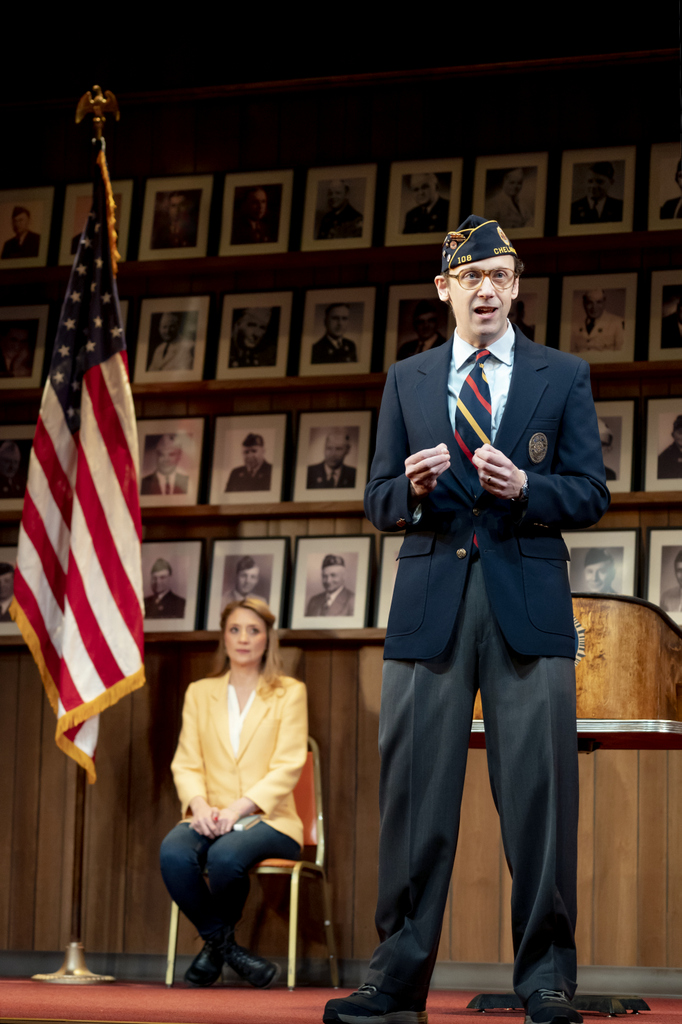
Mike Iveson, Heidi Schreck in ‘What the Constitution Means to Me,’ directed by Oliver Butler (Joan Marcus)
Schreck offers a riveting opportunity to revisit vital segments of the document which has established our rights as citizens at a time when these very rights are under threat by an administration which demonstrates little respect for it or the rule of law. Nor does the current administration or president abide by the oath of office which is to uphold the constitution whose amendments he has no qualms about challenging in the courts or in the press.
Clearly, because of the chaos and divisiveness in our culture (which Schreck references a number of times with great humor) seeing this production is a civic and moral imperative which should be made mandatory for high school students. Not only are Schreck and the other cast members Rosdely Ciprian (a 15-year-old) and Mike Iveson humorous and exuberant, the material is highly entertaining and extremely informative. It is a fabulous and exciting way to learn about our constitution. Indeed, the president, vice-president and cabinet should see the production.
Schreck introduces us to many facets of our diamond document by organizing the development of the production in an intriguing way. She refers to the time when her mother, a debate coach, encouraged her to compete in speech contests at American Legion Halls across the nation on the topic of “how the constitution related to her personal life.” Reconstructing her speeches which she gave as a teenager to collect money for college, Schreck turns back time to her fifteen-year-old self. She converts the audience to white, older, male legionnaires and fires away with the help of legionnaire Mike Iveson who times segments of her speech and times her discussions of a selected amendment.
All of these she relates to her own life and thus the lives of women impacted by the constitution for over two centuries. Indeed, women, Native Americans, free blacks, slaves weren’t even recognized as citizens from its creation by white property owners. Schreck follows the arc of development in the progress of women as non citizens under the constitution to the non-passage of the ERA (Equal Rights Amendment) today.

Rosdely Ciprian in ‘What the Constitution Means to Me,’ directed by Oliver Butler (Joan Marcus)
She touches upon the injustices toward all except the white, male, property owners, and the later revisions in the amendments, particularly the 14th amendment. She revisits the Dred Scott Decision and its reversal in the Emancipation Proclamation and the reasons why Lincoln had writers solidify the 13th amendment with the 14th amendment. She references the Chinese Exclusion Act and how it related to the 14th amendment’s clauses on immigration (shades of our present). And all of this she accomplishes with humor and good will.
During Schreck’s discussions she emphasizes seminal information related to women’s rights, the Equal Rights Amendment, what amendments engendered Roe v. Wade, the ironic and humorous stories related to the legalization of birth control and staggering statistics which reveal that men’s violence against women is alive and brutalizing the “fairer sex.” For example three women are murdered each day by a male partner in this country. One in three women are sexually assaulted during their lifetimes and one in four are raped during their lifetimes.
It doesn’t mentor sterling male behavior that the president has been accused of raping minors (see Jeffrey Epstein). One whistlebloewer who was going to go public about her experiences with Epstein and Trump withdrew because she was threatened with death. Nor does it help that Supreme Court Justice Kavanaugh faced tremendous controversy at his nomination hearing from women who accused him of sexual abuse and even rape. Oh well, “Boys will be boys.” (sardonic irony) He was given a pass.
Schreck also discusses the details of Castle Rock v. Gonzales…again in the service of paralleling what happened in her family, to her mother and grandmother. In Castle Rock v. Gonzales, the Supreme Court ruled that the 14th amendment no longer protects women against a violent male partner if the police feel they don’t want to intervene between a wife and husband who has sworn he will kill her and her children.

Heidi Schreck, ‘What the Constitution Means to Me,’ directed by Oliver Butler (Joan Marcus)
Later in the production Schreck discusses how her grandmother who survived an abusive, pederastic second husband via “Covert Resistance,” finally had the courage to run after him when he kidnapped Schreck’s mom and her other siblings to kill them. But it was Schreck’s mom who called the police on him. This was before Castle Rock v. Gonzales. Today, would the police respond as they did then?
One number Schreck states I had not heard before. More American women have been killed by a violent partner in the last century than men who have died in wars including 9/11. She makes it a point to affirm “killed by a male partner,” not just “killed.” That today, the law/government does not protect women against a partner’s violence, staggers one’s being.

(L to R): Rosdely Ciprian, Mike Iveson, Heidi Schreck, ‘What the Constitution Means to Me’ (Joan Marcus)
All of this information is presented in the service of personalizing the importance of the constitution to Schreck’s life and thus, to our lives. It is mind-blowing! Always fascinating she discusses how her maternal ancestors bowed down under the oppressions of the rule of law which didn’t cotton to women’s rights and as a result, women at the time sustained violence and abuse. For example her great great grandmother who was a bride purchased from “Matrimonial Times,” for $75.00, at 37-years-old died in a mental institution. On the death certificate, the cause was “melancholia.” Schreck infers she most probably ended up shattered by a relationship with her abusive logger husband.
In the last segment of the show Schreck and Rosdely Ciprian go head-to-head in a debate about whether we should abolish our “negative rights constitution” (it prevents the government from encroaching on our liberties) and perhaps establish a “positive rights constitution” (one that guarantees human rights to all for healthcare, equal economic opportunity, etc. like the constitutions of Germany and South Africa). How they debate (guided by Mike Iveson who times them) is just plain fun. Iveson encourages loud audience participation and cheering. And Rosdely Ciprian is an absolute spitfire.
What the Constitution Means to Me is a peppery, unique and delightful evening out. It is also slap-in-your-face get “woke” time in what Schreck reveals to us about who we are and where we’ve come from. The dense material is lightly driven by Schreck so that you remember the salient points. And all of this is presented with great good will in the hope that we become civic-minded. We must not allow the current crop of old, white, male, rich prototypes like those who created the document to perpetrate another act of violence against women. Men and women must prevent them from turning us out among the denizens of the deep without protection into a retrograde past. As women go, so go their men and families; men will suffer even more than women.
With the latest turn of the Supreme Court to rightest extremism, this is not just fantasy. But to consolidate power, it is in the best interests of the Federalist Society (that Antonin Scalia championed) and the extremist right to push the Supreme Court to such ultra right positions on cases and denude the majority of citizens of their human rights.
Sadly, to overturn Roe v. Wade and other laws that have empowered women will be active tyranny against lower class women. Schreck points out that wealthy women, (politicians’ mistresses, celebrities, etc.) always got abortions and always will regardless of legality. Money places them above the law. However, to cruelly nullify women’s souls and minds from making decisions about their own bodies is an evangelical act against God. Only He has power over all people’s minds and souls. That white men would usurp that power is tantamount to exercising a power which is the opposite of His love and mercy.
Kudos to all the creatives like Rachel Hauck (Scenic Design), Michael Krass (Costume Design) Jen Schriever (Lighting Design) Sinan Refik Zafar (Sound Design) who helped to make this a wonderful, must-see production that is an imperative for old and young alike. What the Constitution Means to Me runs without an intermission in an extension until 24 August. It is at The Helen Hayes Theater (44th Street, between 7th and 8th). For tickets go to the website by clicking HERE.
Theater Review (NYC): ‘What The Constitution Means to Me’ Starring Heidi Schreck

(L to R): Rosdely Ciprain, Heidi Schreck-playwright, Thursday Williams, Mike Iveson, ‘What The Constitution Means to Me,’ NYTW, (Joan Marcus)
Depending upon how you view the months since the 2016 election, playwright, actress Heidi Schreck’s timely What the Constitution Means to Me casts a long shadow and provides trenchant perspectives. Of course one may view it simply as a pleasurable, informative romp through a document most remain clueless about. Or perhaps one may identify that her humorous, vibrant writing more profoundly remains a siren call to “get woke!”
Indeed, the production staged and set in an American Legion Hall, directed by Oliver Butler, stars award winning actress and writer Heidi Schreck. And it took years in the making. With assistance by fellow actor Mike Iveson and debater Rosdely Ciprain, the result sparkles. Schreck’s crisp, sharp, ironic writing encapsulates American themes and pivotal, historical moments that changed our laws. Abundantly, these perplex. For they concern the constitution’s long-range evolution toward greatness. But Schreck also includes how the people have stretched the document over the chasm of far reaching human miseries. At any time it may break, and our society plummet into the abyss. Her work and its cattle-prod intent remain a fascinating, thought-provoking must-see.
Indeed, humorous and enthusiastic throughout, Schreck’s “light-hearted” approach belies the seriousness of the subject in today’s light/dark atmospheres. For she presents profound and disquieting principles and facts about our lives that we cannot dismiss. And she accomplishes what the news media at times does not. She presents with succinct, factual details and logical arguments that clarify. Importantly, she makes one think beyond memes and spurious arguments, troll epithets, and misinterpretations!

Rosdely Ciprain, Heidi Schreck, Mike Iveson, Clubbed Thumb in partnership with True Love Productions, ‘What The Constitution Means to Me,’ (Joan Marcus)
This alone remains worth the price of the ticket. In fact her production should be opened to area schools. Sitting just 10 minutes into the first half of the performance solidifies why. With a facile, funny, and vitally spontaneously delivery, Schreck becomes our vibrant teacher and historian. Notably, she proves the past abides in the present through her debates about the amendments. These concern those (9th, 4th), not typically familiar. Nevertheless, she proves why we should know them as crucial to our rights and well being.
During the production, Schreck reveals her personal veneration of our country’s democratic principles particularly outlined in the laws written after the Civil War. The quotes from distinguished justices and presidents alike illuminate. Assuredly, most amendments guarantee equity for every citizen and the rights of due process for all. And she notes the pitfalls where such principles and laws wobbled and continue to shake. Subtly, she infers that we must continually apprise ourselves of our constitution’s ever flexible nature.

Heidi Schreck, actress, playwright, ‘What The Constitution Means to Me,’ directed by Oliver Butler, NYTW (Joan Marcus)
Evolution and devolution include the same letters save one. In other words we are a letter away from the collapse of the bedrock laws of equity. If pernicious, power-usurping partisans undo just applications for the great majority to benefit the proportionately few wealthy, contentment, and prosperity wanes for most citizens. Exemplified, though not mentioned in Schreck’s work would be Citizens United which favors corporate donors giving multi-millions to politicians’ PACS thereby owning them.
Additionally, her discussion relating the constitution’s impact on women in her own family acknowledges strides. But it also portends fissures and potential earthquakes setting “women’s rights” back decades. This discussion Schreck attends to in the second segment of her production
Winningly, in the first half Schreck recalls her teenage years and how she employed her reading, writing and research skills to earn needed college scholarship money. As a teenager she competed in debates for various prizes from the American Legion. Indeed, these competitions challenged her thinking and debate skills. Of course her presentation centered around “what the constitution meant to her” at that age. Thus, she uses this presentation format which she delivers to white military legionnaires (we, her audience, become them), at the American Legion Hall in the state of Washington. And returning to her teenage self, she argues the constitution’s relevance to her, evoking these debates. In the fast forward to now, we compare notes and assess our progress in the current times.
This clever vehicle allows Schreck and Mike Iveson (as a Legionnaire and himself), to set up her detailed and fascinating account of women in her family and how the constitution might have and then did impact them. As she discusses the lies promulgated to bring women to settle Washington state (one woman for every nine men), she enumerates the suicides and death rates of wives at the hands of their husbands. For example, her great, great-grandmother, a mail-order bride, ended up in an asylum and died of melancholia in her thirties. Schreck ruminates about the possible back story of what happened to her. Dismissively, we may think, “times have changed.”
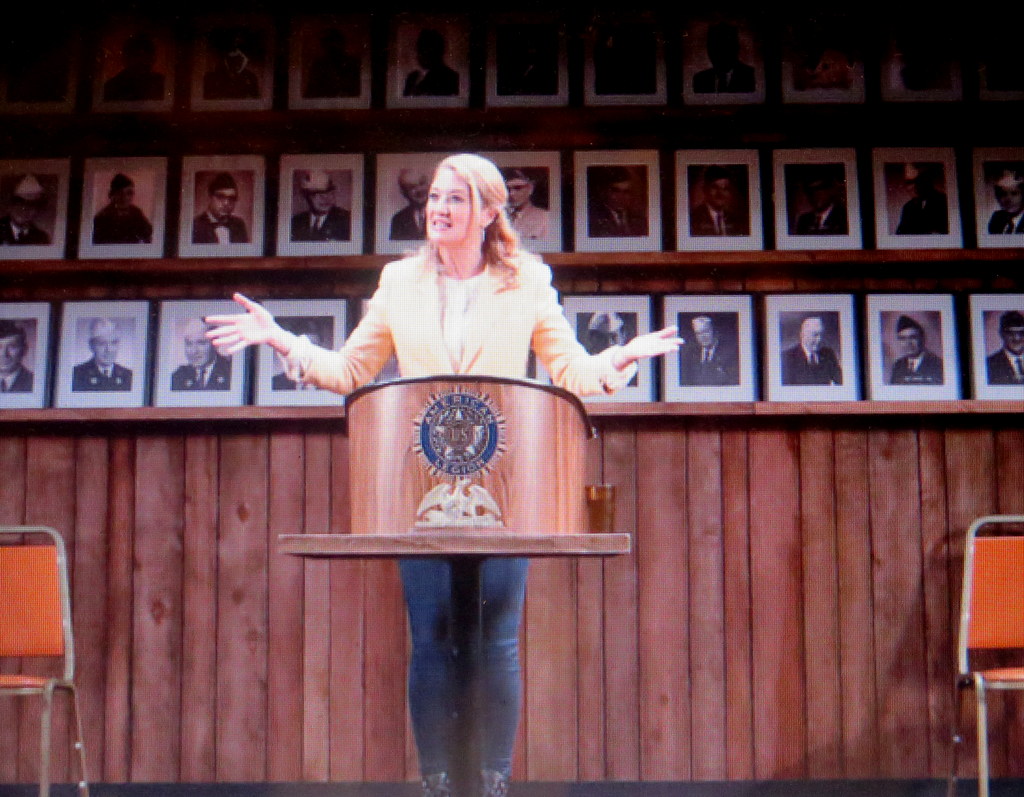
Heidi Schreck, actress, playwright, ‘What The Constitution Means to Me,’ directed by Oliver Butler, NYTW (Joan Marcus)
Then, she reveals today’s statistics. One in three women will be abused by male partners. One in four women are raped by men. And half of women killed die at the hands of their partners. However, women, no longer chattel (property), may seek justice. At one point in our history husbands could kill their wives with impunity. Yet, with lawsuits against Roger Ailes, Bill O’Reilly, Harvey Weinstein, and others, the #MeToo movement is a vital necessity. But will it negatively impact the constitution with the recent justice appointment?
In the third segment Schreck goes head-to-head with a student debater about whether we should keep or abolish the current constitution and create a new one. The evening I saw the production, Rosdely Ciprain revealed her feisty, funny debating chops and bested Schreck. However, Schreck’s spot-on argument about creating a positive rights constitution like those found in many European countries rang with sound truth.
What are negative vs. positive rights? Our negative rights constitution insures what the government cannot do to its citizens. On the other hand a positive rights constitution indicates what the government must provide: safety, security, healthcare, a living wage. After WWII FDR intended to institute a Second Bill of Rights which would have shifted the direction of our rights to positive ones. Of course, this became anathema to conservative corporates. And they held sway over our government and still do today.
Ours is a negative rights constitution. Hence, the government does not guarantee affordable healthcare, a decent living wage, human rights over corporate rights, mandates limiting excessive CEO pay, a proportionate equitable tax structure, etc. And it may rescind a “woman’s right to choose” what she might do with her own body.” Certainly, our congress has yet to pass an Equal Rights Amendment.

Preamble to the Constitution, Heidi Schreck, ‘What The Constitution Means to Me,’ NYTW, directed by Oliver Butler, (photo courtesy of the site)
Throughout, this superb production keeps one enthralled and laughing. But Schreck’s points run far and wide as she encourages our active participation in civics to understand our current historical reckoning. Thematically, she infers much. I divine from her work that like watchful sentinels, we must support the ACLU and other advocacy groups. And with them we must hold accountable our politicians to prevent thinning the constitutional threads so that they never break. Indeed, we must prevent the political think tanks and lobbyists who control our legislators from overriding through the courts the will of the majority of U.S. taxpayers/citizens. In the current tide of the Supreme Court Justice Kavanaugh times, this “must” appears more problematic than ever.
However, Schreck evokes a hopeful image her mother, a feminist, suggested to uplift her. First, picture a woman walking along a beach with a dog which darts back and forth, in the tide and waves. The dog races forward then races behind her and backtracks from whence it came. Then it moves forward, then backward. However, the woman walks forward, forward, steadily, slowly, undeterred, forward. This metaphor encourages us to hope. Not only to hope for women, but to hope for men, and LBGT communities who support equitable, positive rights for all born in this nation. And along with hope must come the energy to debate and persuade with reason and logic how undergirding the vulnerable and weak strengthens the strong.
The production currently at New York Theatre Workshop (83 E 4th Street) until 28 October, runs with no intermission. With scenic design by Rachel Hauck, costume design by Michael Krass, lighting design by Jen Schriever, and sound design by Sinan Zafar, this humorous masterwork should be extended. Hopefully, it will attend at another venue at some point in the near future. For tickets and times go to nytw.org.
 CAROLE DI TOSTI