Blog Archives
Anika Noni Rose in ‘The Balusters’ a Funny, Brilliant Take-down of the Upwardly Mobile
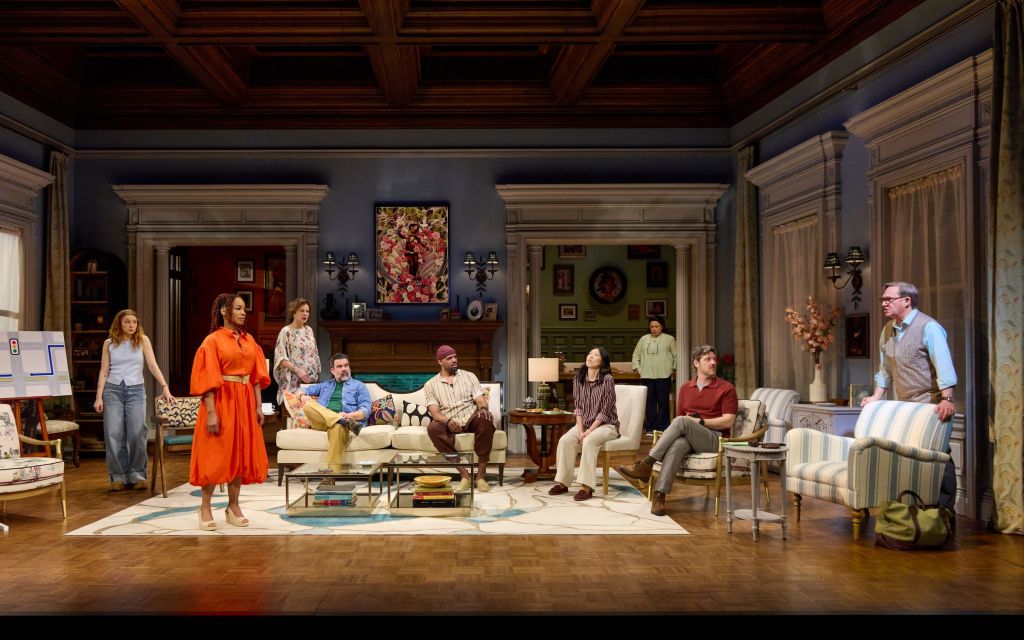
If every accusation is a projection and people’s duplicity comes out under pressure, David Lindsay-Abaire constructs characters that wear “their truth” on their unwashed sleeves, as they unite together to protect their exclusive, land marked section of town which is a protected island that abuts the housing projects nearby. The LOL world premiere comedy The Balusters, directed expertly by Kenny Leon sports a title that refers to an upright vertical, molded form which provides foundational support in architectural features. This comedy with several points about our history and culture and the hypocrisy that keeps it bolstered runs at the Manhattan Theatre Club through May 24, 2026.
Initially, the topic of balusters is brought up by President Elliot Emerson (the superb Richard Thomas), during the Vernon Point Neighborhood Association Board meeting when he shares that a neighbor is using inferior balusters not up to the grade to maintain the historic look of their land-marked community.
Microcosms of political manipulation are everywhere USA. They are perhaps nowhere more evident than in school boards and neighborhood associations. And they are as plain as day in The Balusters for our delight, as Lindsay-Abaire sets us up to laugh at ourselves. The setting is in Vernon Point, a community whose land-marked homes on the esplanade are gorgeous Queen Annes and other Victorians. The historic styles landscaped with trees, lawns and acreages that are pricey, must abide by the architectural features, materials and design of the period of their first construction. Additionally, like many communities in the US which support institutional racism via redlining and zoning laws, Vernon Point most probably has a zoning acreage limit whose pricier real estate keeps out the “riff raff.”
In other words, purchasing a home in this enclave upholds housing discrimination, one of the most egregious forms of discrimination, regardless of the handful of diverse individuals who may live there. To live there especially if one is DEI is particularly, problematically hypocritical. But doesn’t everyone want to achieve the American Dream, especially if it vaults one into upper class heights? The dream is as flawed as the 9 individuals of the neighborhood association who live there to keep it in place. How can anyone move ahead contentedly, if most have been left behind?
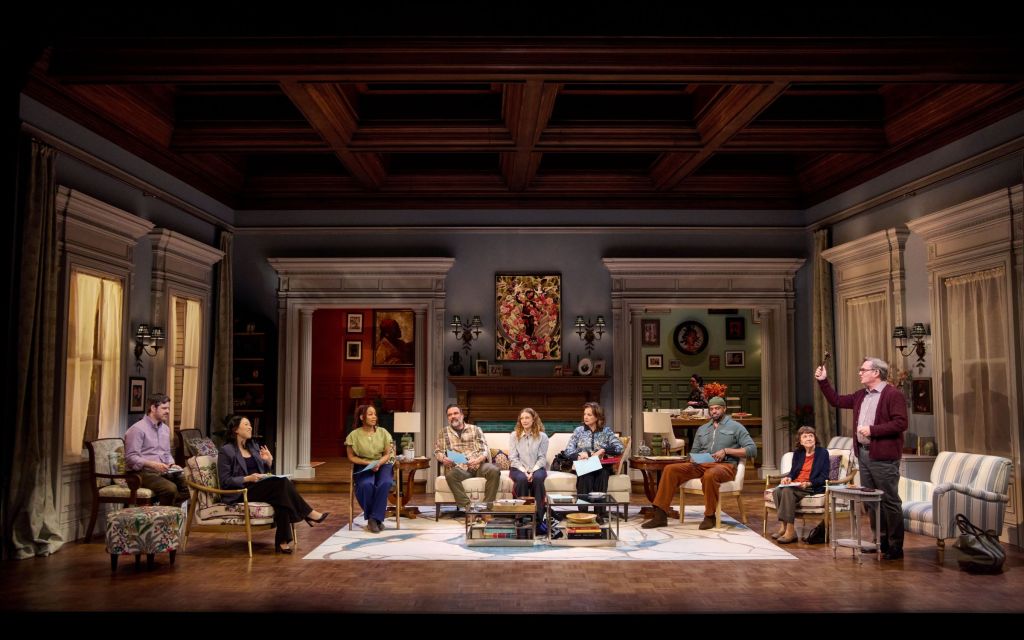
Issues are nuanced at the top of he play as the Venon Point Neighborhood Association Board meeting gets underway, gaveled in by Thomas’ Elliot, the patriarch and gatekeeper of community sanctity. A master of portraying the “hail fellow well met” poseur, Thomas’ folksy, warm, congenial, open-hearted mien belies the negatives we discover about him later in the play. Elliot is assiduous about the esplanade homes’ historic preservation. As the group settles in he discusses his ire at the previous owner of Kyra Marshall’s house which is where the VPNAB meeting is held. Kyra (the wonderful Anika Noni Rose) volunteers to host the meeting, she tells Luz her housekeeper, to establish herself and fit in. As Elliot goes on about Dr. Klein, the previous owner who put ugly aluminum siding on the exterior two months before the homes were land-marked forty-years prior, we realize he is obviously glad that Kyra had it pulled down, restoring the house’s former glory.
Like the community she wishes to fit into, Noni Rose’s Kyra, favors the old styles like Elliot Emerson. Her assiduous attention to living well is evident in her gorgeously appointed, color-coordinated living room and adjoining foyer and dining room, whose table is perennially set with fine china and stemware as most upper middle class owners often do. Derek McLane’s scenic design speaks volumes and symbolizes the director’s thematic vision for The Balusters, as does Emilio Sosa’s costume design which dresses Kyra in attire that is tasteful, appropriate and colorful, and the others in relaxed casual wear. Interestingly, the lighting during scene changes gyrates to mesmerize the audience to focus on the painting of a Black woman surrounded by flowers that turns garish under the striking lighting (Allen Lee Hughes). And Dan Moses Schreier original music and playlist loudly proclaims the themes as a stark warning. Are we listening; are we seeing the nuances?
The restored shingles may have been the sub rosa reason why real estate broker Elliot sold Kyra (a forty-something Black woman with a family), the house which she can easily afford. However Melissa (Jenna Yi), an Asian friend of Kyra’s lives there, and Kyra mentions that along with safety and beauty, the diversity of the community is why she chose Vernon Point. The VPNAB represents a picture-perfect model of diversity that is laughable with most genders and most races represented. In effect this community has achieved a type of admirable perfection on the surface, but as Margaret Colin’s edgy, raw mouthed and sardonic Ruth Ackerman suggests, it is far from perfect. And during the course of the play through various meetings, we find out how imperfect Vernon Point and its inhabitants of houses, as land-marked as the Victorians, don’t want to budge from their positions to change things.
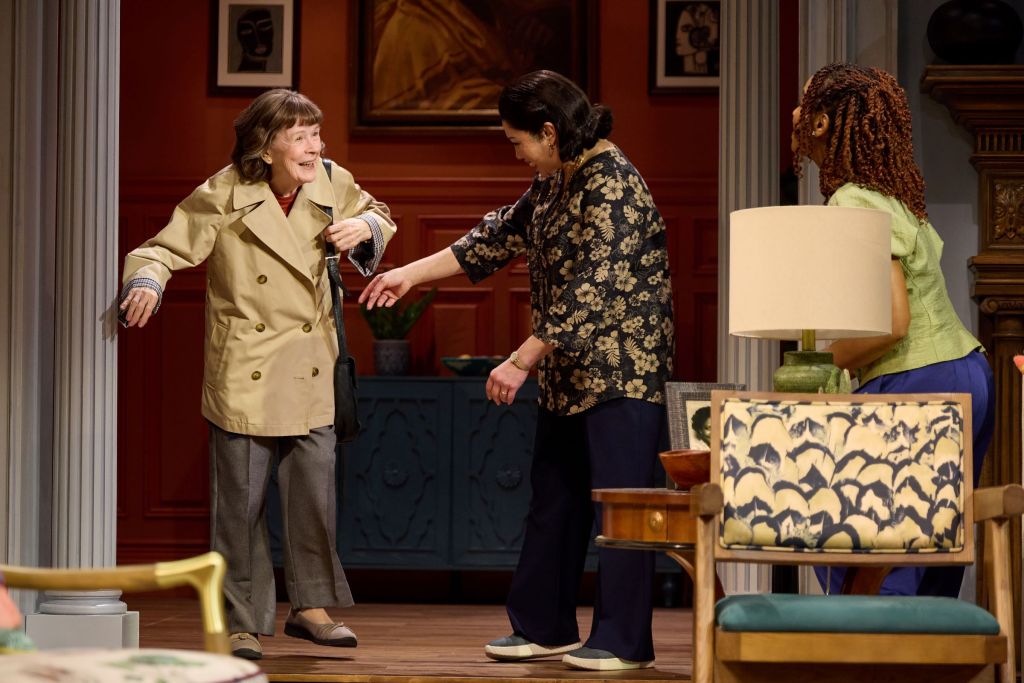
Newbe Kyra isn’t like the others in some aspects. But in other aspects she is just like them and even becomes their “queen.”
The familiar friends, neighbors, and board members push each other’s buttons as they tussle over items which arise concerning safety vs. maintaining the integrity of the historic preservation which of course keeps housing prices higher. Kyra raises a key safety issue about putting up a stop sign because cars speed past a corner and crash into each other at least once a week. This becomes the conflict that moves the play forward creating tension between Elliot and Kyra which gathers momentum as members take sides, research is done and facts are presented to support Kyra’s imperative. Yet, Thomas’ Elliot is eloquent in his arguments against putting up signs which will ruin the picturesque and beautiful esplanade which is becoming a “one-of-a-kind” setting as modernization and commercialization reconfigure the culture of the country, and not in a good way.
The disparity of who the members present themselves to be, and who they are, clarifies by the conclusion with great humor. Nuanced funny insults are swapped as a means of leveraging arguments. Clearly, some egos are obvious like Isaac Rosario (Ricardo Chavira), who protects his construction workers but only to jawbone that they don’t steal packages or do shoddy work, while he pays them less than what they are worth. Mark Esper’s Alan Kirby feels put upon and interrupted by LGBTQ Willow (Kayli Carter). Willow’s PETA stance and ethos rankle both him and Colin’s Ackerman who intentionally flaunts her rabbit coat to Willow to provoke a comment. Brooks Duncan (Carl Clemons-Hopkins) drums the race card in a subtle way while bestowing nuanced racial animus toward a Muslim business owner. Lindsay-Abaire turns this on its head and has someone reveal what is really going on related to Duncan’s male partner. The result is riotous.
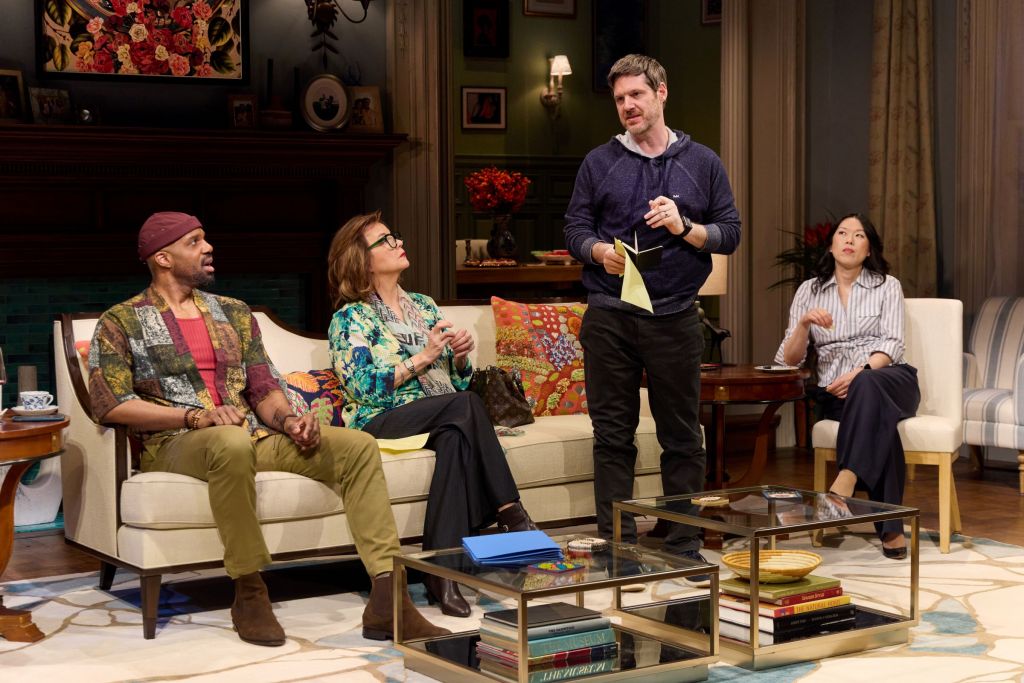
When one in the group is injured in a “crash” as Kyra predicted, the stakes go through the roof and we are shocked at the results which occur at an explosive meeting. Once more events turn the characters upside down in their reveals, especially the clever Elliot and the subtle Kyra caught, like the others, in their own hypocrisies and conflicts of interest.
The one-offs and jokes are plentiful. And Marylouise Burke, as always is a shining light with superb timing and adorableness. When she speaks for decency later in the play, the theme rings loudly and clearly through her, as it does through Maria-Christina Oliveras’ Luz whose spilling the beans on Elliot is only topped by her quiet, underplayed comment about Kyra.
At the conclusion we realize that the playwright also selected the title as a symbol to call out foundational institutions, thought patterns and stereotypes which support a way of life that is entrenched in inequality. This is so, despite each of the characters’ assumptions that adhering to political correctness ends stereotypes and indecent behavior that attacks individuals for elements they have no control over (ethnicity, race, gender, age). Whether used or ridiculed, PC is a blind that deflects from dealing with institutional inequities. Cleverly, Lindsay-Abaire takes swipes at everything, especially cultural hypocrisy and human fallibility at not recognizing it. He reveals that decency can’t be shamed or forced upon others, and the use of political correctness as a weapon and ready bludgeon to defend oneself, also is used to deflect and cover a multitude of secret agendas to gain power and influence unjustly and inequitably. Regardless of political party, regardless of using it to act like an example of correctness, it is meaningless because the true intent behind its facade is real, dangerous and corrupt.
The Balusters runs 1 hour 50 minutes with no intermission at the Friedman Theater through May 24. manhattantheatreclub.com.
‘Uncle Vanya,’ Steve Carell in a Superb Update of Timeless Chekhov

A favorite of Anton Chekhov fans is Uncle Vanya because it combines organic comedy and tragedy emerging from mundane, static situations, intricate, suppressed characters and their off-balanced, mired-down relationships. Playwright Heidi Schreck (What the Constitution Means to Me), has modernized Vanya enhancing the elements that make Chekhov’s immutable work relevant for us today. Lila Neugebauer’s direction stages Schreck’s Chekhov update with nuance and singularity to make for a stunning premiere of this classic at Lincoln Center’s Vivian Beaumont in a limited run until June 16th.
With a celebrated cast and beautifully shepherded ensemble by the director, we watch as the events unfold and move nowhere, except within the souls of each of the characters who climb mountains of elation, fury, depression and despair by the conclusion of this two act tragicomedy.
Schreck has threaded Chekhov’s genius characterizations with dialogue updates that are streamlined for clarity, yet allow for the ironies and sarcasm to penetrate. At the top of the play Steve Carell’s Vanya is hysterical as he expresses his emotional doldrums at the bottom of a whirlpool of chaos which has arrived in the form of his brother-in-law, Professor Alexander (the pompous, self-important Alfred Molina in a spot-on portrayal), and Alexander’s beautiful, self-absorbed, younger-by-decades wife Elena (Anika Noni Rose). Also present is the vibrant, ironic, self-deprecating, overworked Dr. Astrov (William Jackson Harper), a friend who visits often and owns a neighboring estate.

During the course of the first act, we are witness to the interior feelings and emotions of all the characters who in one way or another are bored, depressed, miserable and disgusted with themselves. Vanya is enraged that he has taken care of Alexander’s lifestyle, even after his sister died in deference to his mother, Maria (Jayne Houdyshell). He is particularly enraged that he believed with is mother that Alexander was a “brilliant” art critic who deserved to be feted, petted and over credited with praise when he lived in the city.
Having clunked past his prime as an old man, Alexander has been fired because no one wants to read his work. He and Elena have run out of money and are forced to stay in the family’s country estate with Vanya and Sonia, Alexander’s daughter (the poignant, heartfelt Alison PIll), away from the limelight which shines on Alexander no more. Seeing Alexander in this new belittlement, though he orders around everyone in the family, who must wait on him hand and foot, Vanya is humiliated with his own self-betrayal. He didn’t realize that Alexander was a blowhard who duped and enslaved him to labor on the farm to supporting his high life, while he pursued his “important” writing. Vanya and Sonia labor diligently to make sure the farm is able to support the family, though it has been a difficult task that recently Vanya has grown to regret. He questions why he wasted his years on a man unworthy of his time and effort, a fraud who knows little about art.

Likewise, Astrov questions his own position as a doctor, admitting to Marina (Mia Katigbak), that he feels responsible for not being able to help a young man killed in an accident. To round out the “les miserables,” Alexander is upset that he is an old man who is growing more decrepit by the minute as he endures believing his young, beautiful wife despises him. Despite his upset, Alexander expects to be waited on by his brother-in-law, mother-in-law and in short, everyone on the estate, which he has come to think is his, by virtue of his wanting it. Though the estate has been bequeathed to his daughter Sonia by Vanya’s sister, his first wife, Alexander and Elena find the quiet life in the country unbearable.
As they take up space and upturn the normal routine of the farm, Elena has been the rarefied creature who has disturbed the molecules of complacency in the lives of Vanya, Sonia and Astrov. Her beauty is shattering. Sonia hates her stepmother, and both Vanya and Astrov fall in love and lust with her. As a result, their former activities bore them; they cannot function with satisfaction, and have fallen distract with want, craving the impossible, Elena’s love. Alexander fears losing her, but realizes if he plays the victim and harps on his own weaknesses of old age, as distasteful as he is, Elena is moral enough to attend to him, though she is bored and loathes him in the process.

The situation is fraught with problems, hatreds, regrets, upsets and soul turmoil, which Schreck has stirred following Chekhov’s dynamic. Thus, Carell’s Vanya and Harper’s Astrov are humorous in their self-loathing as is the arrogant Alexander and vapid Elena who Sonia suggests can end her boredom by helping them on the farm. Of course, work is not something Elena does, which answers why she has married Alexander and both have been the parasites who have sucked the lifeblood of Vanya and Sonia, as they labor for their “betters,” who are actually inferior, ignoble and selfish.
To complicate the situation, Sonia is desperately in love with Astrov, who can only see Elena who is attracted to him. However, Elena is afraid to carry out the possibility of their affair. Instead, she destroys any notion that Sonia has of being with Astrov by ferreting out Astrov’s feelings for Sonia which tumble out as feelings for Elena and a forbidden, hypocritical kiss which Vanya sees and adds to his rage at Elena’s self-righteousness and martyred morality. When Elena tells Sonia that Astrov doesn’t love her, Sonia is heartbroken. It is Pill’s shining moment and everyone who has experienced unrequited love empathizes with her devastation.
When Alexander expresses his plans to sell the estate and take the proceeds to live in the city in a greater comfort and elegance, Carell’s Vanya excoriates Alexander and speaks truth to power. He finally clarifies his disgust for the craven and selfish Alexander, despite Maria’s belief that Alexander is a great man, not the fraud Vanya says he is.

It is a gonzo moment and Carell draws our empathy for Vanya who attempts to expiate his rage, not through understanding how he is responsible for being a dishrag to Alexander, but through manslaughter. The scene is brilliantly staged by Neugebauer and is both humorous and tragic. The denouement happens quickly afterward, as each of the characters turns to their own isolated troubles with no clear resolution of peace or reconciliation with each other.
The ensemble are terrific and the actors are able to tease out the authenticity of their characters so that each is distinct, identifiable and memorable. Naturally, Carell’s Vanya is sympathetic as is Pill’s heartsick Sonia, for they nobly uphold the ethic that work is a kind of redemption in itself, if dreams can never come true. We appreciate Harper’s Astrov in his love of growing forests and his understanding of the extent to which the forests that he plants will bring sustenance to the planet, if even to mitigate only somewhat the society’s encroaching destructiveness. Even Katigbak’s Marina and Sonia’s godfather Waffles (the excellent Jonathan Hadary), are admirable in their ironic stoicism and ability to attempt to lighten the load of the others and not complain.

Finally, as the foils Molina’s Alexander and Noni Rose’s Elena are unredeemable. It is fitting that they leave and perhaps will never return again. The chaos, misery, dislocation and confusion they leave in their wake (including the somewhat adoring fog of Houdyshell’s Maria), are swallowed up by the beautiful countryside and the passion to keep the estate functioning which Sonia and Vanya hope to achieve in peace. Vanya, for now, has thwarted Alexander, by terrorizing Alexander into obeying him in a language (threatening his life), he understands. For this we applaud Vanya.
When Alexander and Elena leave, the disruption has ended and they take their drama and chaos with them. It is as if they were never there. As Vanya and Sonia handle the estate’s paperwork, which they’ve neglected having to answer Alexander’s every need, the verities of truth, honor, nobility and sacrifice are uplifted while they work in silence, and peace is restored to the estate, though they must suffer in not achieving the desires of their lives.
Neugebauer and Schreck have collaborated to create a fine version of Chekhov’s Uncle Vanya that will remain in our hearts because of the simplicity and clarity with which this update has been rendered. Thanks go to the creative team. Mimi Lien’s set design functions expansively to suggest the various rooms of the estate, the garden and hovering forest in the background. A decorative sliding divider which separates the house from the forest and allows us to look out onto the forest and woods beyond (a projection), symbolizes the division between the natural and the artificial worlds which influence and symbolize the characters and what they value.

Vanya and the immediate family take their comforts from the earth and nature as does Astrov. Alexander and Elena have forgotten it, finding no solace in the beautiful surroundings and quiet, rural lifestyle which they find boring because they prefer chaos and the frenetic atmosphere of society. Essentially they are soul damaged and need the distractions they’ve become used to when Alexander was famous and the life of the party before he got tiresome and old and disgusting in the eyes of Elena and those who fired him..
The projection of trees that expands entirely across the stage in the first act is a superb representation of what is immutable and must be preserved as Astrov works to preserve. The forest of trees which is the backdrop of the garden, sometimes sway in the wind. The rustling leaves foreshadow the thunder storm which throws rain into the garden/onstage. The storm symbolizes the storm brewing in Uncle Vanya about Alexander, and emotionally manifests when Alexander suggests they sell the estate to fulfill his personal agenda.
During the intermission every puddle and water droplet is sopped up by the tech crew. Kudos to Lap Chi Chu & Elizabeth Harper for their lighting design and Mikhail Fiksel & Beth Lake for their sound design which bring the symbolism and reality of the storm home.
The modern costumes by Kaye Voyce are character defining. Elena’s extremely tight knit, brightly colored, clingy dresses are eye candy for her admirers as she intends them to be to attract their attention, then pretend she doesn’t want it. Of course she is the leisurely swan while Sonia is the ugly duckling in work clothing, Grandmother Maria dresses like the “hippie radical feminist” that she is, and Marina is in a schmatta as the servant who cooks and cleans. Here, it is easy for Elena to shine; there is no competition.
Vanya looks frumpy and uncaring of himself. This reflects his depression and lack of confidence, while Molina’s Alexander is dressed in the heat like a peacock with a scarf, cane and hat and cream-colored suit when we first see him. Astrov is in his doctor’s uniform, utilitarian, purposeful, then changes to more relaxed clothing. The costumes are one more example of the perfection of Neugebauer’s vision and direction of her team.
Uncle Vanya is an incredible play and this update does Chekhov justice. It is a must-see for Schreck’s script clarity, the actors seamless interactions and the creative teamwork which elevates Chekhov’s view of humanity with hope, sorrow and love in his characterizations, especially of Vanya.
Uncle Vanya runs two hours twenty-five minutes including one intermission, Lincoln Center Theater at the Vivian Beaumont. https://www.lct.org/shows/uncle-vanya/whos-who/
 CAROLE DI TOSTI