Blog Archives
‘Purlie Victorious,’ a Riotous Look in the Backward Mirror of 1960s Southern Racism

White power structures die hard. However, they do fall apart when the younger generation helps to topple them.
This is particularly true in Purlie Victorious, a Non-Confederate Romp Through the Cotton Patch, currently in revival on Broadway at The Music Box. It is the next generation that overwhelms the cement-like apparatus of noxious, white paternalism in Ossie Davis’ trenchantly funny play. Thus, we cheer on the pluck, humor, audacity and cleverness of the young reverend Purlie Victorious Judson, exquisitely inhabited by the unparalleled Leslie Odom, Jr. of Hamilton fame. Odom, Jr. leads the cast with his kinetic and superb performance.
The premise for the play that initiates the action is steeped in hope and youthfulness-the righting of a an ancestral wrong symbolically-the despotic terrorism of slavery’s oppressive violence. With mythic actions and intentions Purlie returns home to the Georgia plantation where he was raised, to claim his inheritance and take back the honor which racist owner Ol’ Cap’n Cotchipee siphoned off from his family through peonage (servitude indebtedness).
How Purlie does this involves a fantastic and hysterical scheme, eliciting the help of the adorable Lutiebelle Gussie Mae Jenkins (the riotous Kara Young). Purlie, who met Lutiebelle in his travels, intends to pass her off as his Cousin Bee, who will charm Ol’ Cap’n (the perfect foil, Jay O. Sanders), into giving her the $500 cash that was bequeathed to their aunt by her wealthy lady boss. After succeeding in the scheme to dupe Ol’ Cap’n, Lutiebelle will give Purlie the cash. With cash in hand, Purlie will purchase and restore the Old Bethel Church, so he can preach uplifting freedom to the sharecroppers, who are enslaved by peonage to Ol’ Cap’n.

As Purlie relates his scheme to family, Missy Judson (the fine Heather Alicia Simms), and Gitlow Judson (the riotous Billy Eugene Jones), they avow it won’t work. At first, Gitlow refuses to take any part because he is one of Ol’ Cap’n’s favorite “darkies.” Gitlow has risen to success through his amazing cotton picking labors. Ol’ Cap’n bestows upon him the anointed status of chief oppressor of the “colored folk” working for Ol’Cap’n. He keeps them nose to the grindstone at their backbreaking work.
However, when Purlie introduces his relatives to Lutiebelle, and unleashes his persuasive and inspiring preaching talents on his kin, they give the scheme a whirl. What unfolds is a joyous, sardonic expose of all the techniques that Black people used when dealing with the egregious, horrific, white supremacists of the South, represented by Ol’ Cap’n, The Sheriff (Bill Timoney), and The Deputy (Noah Pyzik).
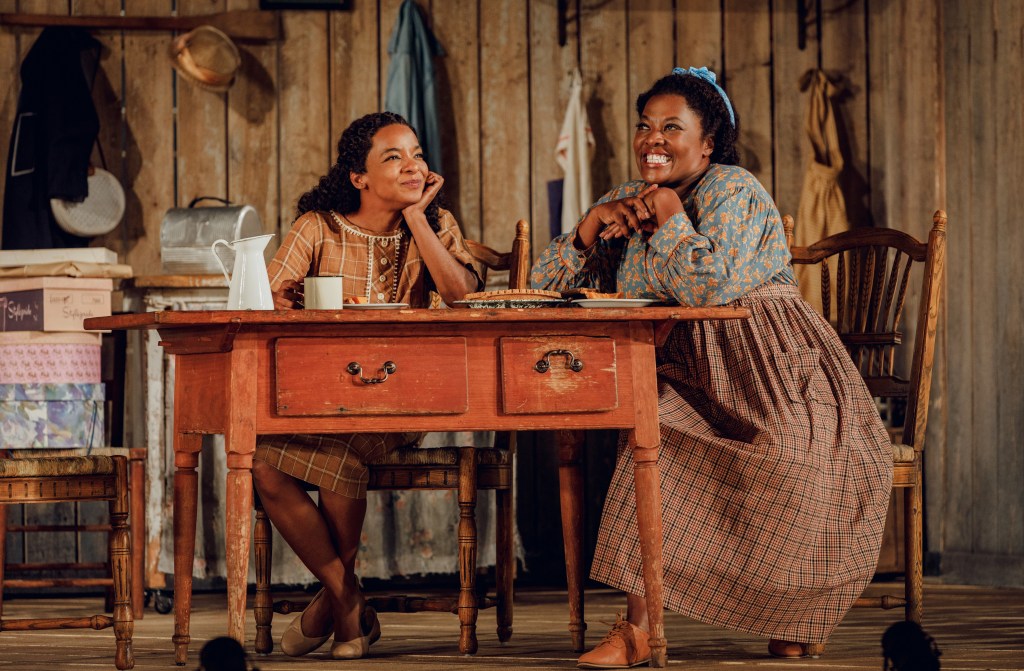
The irony, double entendres and reverse psychology Purlie and family use when confronting Ol’ Cap’n are sharp, comedic, and of moment. Though Ol’ Cap’n owns the place and exploits the sharecroppers using indebtedness, on the other hand, we note that Gitlow is able to manipulate Ol’ Cap’n with his “bowing and scrapping” which, as we are in on the joke, is brilliantly humorous.
It is in these moments of dramatic irony when Ossie Davis’ arc of development reveals how the characters work on a sub rosa level, that the play is most striking and fabulous. The enjoyment comes in being a part of knowing that Purlie and the others are able to “get over,” while Ol’ Cap’n is unable to see he is “being had.” Additionally, with the assistance of Ol’ Cap’n’s clever, forward-thinking son, Charlie (the wonderful Noah Robbins), Ol’Cap’n is completely flummoxed, having missed all the undercurrents which indicate he is being duped.

The actors, beautifully shepherded by director Kenny Leon, effect this incredible comedy, which also has at its heart a deadly, serious message.
Black activist, writer, actor, director Ossie Davis wrote Purlie Victorious, which premiered on Broadway in 1961 at a time when Martin Luther King, Jr. had strengthened the Civil Rights Movement and celebrities were taking a stand with Black activists. In fact, Martin Lurther King, Jr. saw the production and was pictured with the cast, Ossie Davis and Ruby Dee, his wife, who portrayed Lutiebelle.

Particularly in the final speech that Purlie delivers, we can identify with the important themes of a unified human family being together on an equal plane. It is a message that is particularly poignant today, considering the political divisiveness of the white nationalists, a throwback to the Southern racists of the 1960s, like Ol’ Cap’n, who Jay O. Sanders makes as human as possible to allow his racial terrorism to leak through with humor. Because of Sanders’ balanced portrayal, Ol’ Cap’n is an individual who has become his own hysterically funny caricature and stereotype, precisely because he is so obtuse in his self-satisfied mien as their “great white father.”
In the play Davis’ themes about the cruelties of peonage resonate today in the corporate structures which have kept wages low while giving CEOs 500 times what their average workers make. Indeed, the play resonates with the idea of servitude and keeping the labor force however indebted (with student loans, loans, mortgages, credit card debts), so that individuals must work long hours to keep one step ahead of financial ruin. We note the parallels between then and now. The inequities then are in many ways reflective of current economic disparities between the classes, allowing for very little upward mobility from one generation to the next.

It is this that Purlie attacks and preaches against throughout the play. It is this inequity and enslavement indebtedness that Purlie intends to educate Black people about, so that they become free and whole. It is for this reason Purlie wants to purchase and renovate Bethel Church, where he will preach his message of freedom. As we listen, we also realize that the message resonates with everyone, regardless of race, except, of course, the white oppressors, who stand to lose their power, lifestyle and privilege.
This material loss, which would be their spiritual gain, is unthinkable to them. Davis’ indirect message is that this is the oppressors’ greatest sin. They don’t see that by internalizing the defrauding and inhumane values of white supremacy, they are the truly hellish, loathsome monsters, the “other,” they seek to destroy. The destruction only happens to them, while the strengthening happens to those they oppress.
Kenny Leon’s direction expertly guides his actors, moving them with perfectly timed pacing and comedic rhythm. The play develops from broad farce and hi jinks and moves to an ever-expanding roller coaster ride of frenetic humor and excitement. We note Purlie’s desperation and frustration with Ol’ Cap’n’s arrogance and presumptions about Black inferiority, which Purlie will not scrape to. Of course, Idella Landy (the wonderful Vanessa Bell Calloway), who has been a mother to Charlie, with love, influences him to override his father’s brutal attitude toward their family. Indeed, Charlie adopts the Judsons as the family he chooses to be with, rather than his arrogant, ignorant, abusive father.

Leon manages to seamlessly work the staging and find the right balance so the irony and true comedy never becomes bogged down in the seriousness of the message. Because of the lightheartedness and good will, we are better able to see what is at stake, and why Charlie comes to the rescue of his Black family, against his own father, who is an inhumane obstructionist past his prime.
The set design by Derek McLane allows the action to remain fluid and shape shifts so that we move from the Judson family home, to Idella Landy’s kitchen, to the Bethel Church at the conclusion. With Emilio Sosa’s costume design, Adam Honore’s lighting design, Peter Fitzgerald’s sound design and J. Jared Janas hair, wig and makeup design, the creatives have manifested Leon’s vision for the play. Additional praise goes to Guy Davis’ original music, and Thomas Schall’s fight direction.

This revival of Purlie Victorious is a wonderful comedic entertainment that also has great MAGA meaning for us today. For tickets to this must-see production that runs without an intermission, go to their Box Office on 239 West 45th Street or their website https://purlievictorious.com/tickets/
‘Primary Trust,’ the Hope of Friendship Through The Trauma of Being Alone

Small town life can be incredibly boring and static. However, for those who experienced unaccountable pain and trauma, the peace and quiet may be precisely what is needed to achieve a balanced state. In Eboni Booth’s sensitive, profound drama Primary Trust, currently at Roundabout Theatre Company until July 2nd, the playwright investigates humans in their ability to heal from trauma.
For some, getting beyond the pain of emotional loss requires a particular kind of remedy. Kenneth (William Jackson Harper), a resident of Rochester suburb, Cranberry, New York, has found the ability to withstand loss through his mind and will’s resilience to nurture itself with hope and friendship.
Kenneth addresses the audience directly relating a sweetness and shy vulnerability that is immensely likable. He introduces the town and his friend Bert to the audience with ease and authenticity. When there is a segue in thought and feeling, a bell rings as an accompaniment by musician Luke Wygodny who also plays the cello and other instruments before the play begins and during salient turning points.

Harper’s Kenneth takes his time to gather his thoughts as he confesses to us. His need to share his story resonates. Clearly, his story is momentous and universal. Praise goes to William Jackson Harper who engages us with his humanity. Additionally, Eboni Booth’s simple word craft in structuring likable, recognizable, human characters in this small town is amazing. With fine direction by Knud Adams, who shepherds Harper’s Kenneth and the supporting actors, we become captivated and empathize with Kenneth though we may have little in common with him.
Kenneth shares his experiences about “what happened” to him at a turning point in his life when he is thirty-eight years old. He gives us background and reviews his daily routine in Cranberry, New York focusing on the high point of his day after work, when he spends the evening at Wally’s, a typical tiki bar/restaurant. There, he joins his BFF Bert (Eric Berryman) and they drink Mai Tais and share jokes and stories. Their affection and warmth is genuine as they reminisce about past experiences in the joyful atmosphere of booze and camaraderie.

However, apart from their bonding daily at Wally’s and their race, the men are very different. Kenneth works at a bookstore and has been invaluable to his boss, Sam (the on-point Jay O. Sanders) doing bookkeeping, clerking and various chores. Bert on the other hand has an office job, a wife and children, whom he leaves to be with Kenneth in the evenings. It is around about this time that reality fuses with the ethereal, and logic is throw out the window. How the playwright, director and Harper’s portrayal of Kenneth massage us to accept this maverick dramatic element is a testament to their talent and genius.
Kenneth explains that his friend Bert is invisible, imaginary. In other words his BFF can only be seen by him (and of course us). Thus, we become intimates. In confiding to us, Kenneth trusts us to share his secret, in the hope we will not judge him and “turn off” because he’s “wacky.”

Sam is aware that Bert is Kenneth’s imaginary friend. When he tells Kenneth he is selling the store and relocating for health reasons, he makes it a point to reference Bert. He suggests when Kenneth looks for another job, he shouldn’t allow Bert to intrude on the interview. Nor should he share with prospective employers that Bert is his imaginary friend. The implication is that they will think Kenneth is deranged. That we accept Bert as imaginary and go along for the ride is creditable to the playwright, director and actors.
Sam’s news about closing his store is an earthquake. Kenneth discusses the impact on his life with Bert and a new Wally’s waitress Corrina (April Matthis). Though Sam’s move shakes Kenneth, it is an opportunity. He is forced to end the nullifying status quo must. Change occurs in Kenneth’s discussions with Bert and Corrina, who suggests the bank Primary Trust is looking to hire tellers. When Kenneth applies for a job and speaks with Clay who is the branch manager (Jay O. Sanders), all goes well. Humorously, Bert accompanies him to the interview and prompts Kenneth’s winning responses which seal the deal. Clay hires him and he becomes one of the best employees of the bank.

However, Kenneth must confront a transition moving in his soul. The stirrings begin when he and Corrina as friends move beyond Wally’s to a lovely French restaurant. In a humorous turn Jay O. Sanders is the French waiter who serves them. It is in this new expansive world with Corrina that possibilities open up for Kenneth. For the first time, Kenneth doesn’t meet Bert at Wally’s It is another earthquake that rocks him off the status quo of his insular life. There is no spoiler alert. You’ll just have to see this heartfelt production to discover what happens next.
William Jackson Harper is absolutely terrific in a role which is elegantly written for the quiet corners of our minds. The supporting cast are authentic and vital in filling out the life that Kenneth has made for himself to help him emerge out of his cocoon and begin to fly. The playwright’s courage to present an extraordinary friendship which serves Kenneth to bring him to a point of sustenance until he launches into success is beautifully, subtly conveyed. Thanks to the ensemble, who make the unbelievable real, Kenneth’s “small life” in its human drama is important to us.

Thus, when Kenneth explains his upbringing to Corrina toward the end of the play, his revelation stuns. The clues coalesce and we “get” who he is, understanding his brilliance, his tenacity and perseverance. It brings to mind the character of Jane Eyre (in the titular novel), whose dying friend tells her, “You are never alone. You have yourself. ” The playwright takes this notion further to suggest, when you feel you can’t trust yourself, primarily, you can always elicit an imaginary friend who is closer than a brother or sister, until it is time for them to leave. It is through this “primary trust” one survives through heartbreak, trauma, isolation and death.
Primary Trust‘s fantastic qualities enliven the themes and remind us of the importance of doing no harm as we negotiate aloneness in our own soul consciousness. Kenneth chose his friend wisely. He relates how this occurs to Corrina who listens, the active ingredient of his budding friendship with her.
Kudos to the set designer Marsha Ginsberg,Isabella Byrd’s lighting design, Mikaal Sulaiman’s sound design, Qween Jean’s costume design, Niklya Mathis’ hair & wig design and Like Wygodny’s original music which to tonally balance the production. The mock up of the town square offered a metaphoric quaint suburb at a time before the technological explosion and cell phones when people listened to each other live and as Kenneth does created conversations with ethereal friends. The set design and music created the atmosphere so that we readily accept Kenneth’s and Bert’s friendship and its significance with wonder and surprise.
For tickets and times to see Primary Trust, go to their website https://www.roundabouttheatre.org/get-tickets/2022-2023-season/primary-trust/performances
‘Girl From The North Country’ by Conor McPherson, With Music and Lyrics by Bob Dylan

The cast of ‘Girl From The North Country,’ written and directed by Conor McPherson, music & lyrics by Bob Dylan (Matt Murphy)
Life is a whistle stop away from dissolution and death in the soulful, atmospheric, other-worldly Girl From The North Country by Conor McPherson (Shining City, The Seafarer) with music and lyrics by Bob Dylan. The production had an extended run off Broadway at The Public Theatre. With a few cast changes and a bit of slimming down, the McPherson/Dylan collaboration is an enlightened one as Dylan’s songs have found an amazing home threaded from decade to decade with McPherson’s canny naturalistic and spiritual characterizations

Robert Joy in ‘Girl From The North Country,’ written and directed by Conor McPherson, music & lyrics by Bob Dylan (Matt Murphy)
Dr. Walker (the fine Robert Joy) provides the frame of reference (like the narrator in Thorton Wilder’s Our Town) revealing the depression-era setting and introducing the lead characters. Interestingly, all of the characters by the end of the production must confront the state of their lives during the dire times during 1934 in Duluth, Minnesota. McPherson’s expert sense of story-telling and familiarity with the Depression-era literature of the time has enabled him to cobble together the John Steinbeck-like (Of Mice and Men, Grapes of Wrath) characters and storylines. These have been reinforced and inspired by Bob Dylan’s music from various decades. Together, theirs is a marvelous depiction of unity in desperation, longing in torment and hope in uncertainty. Finally, the musical’s theme of timelessness wafts like a beaming streak of gold throughout this must-see production.
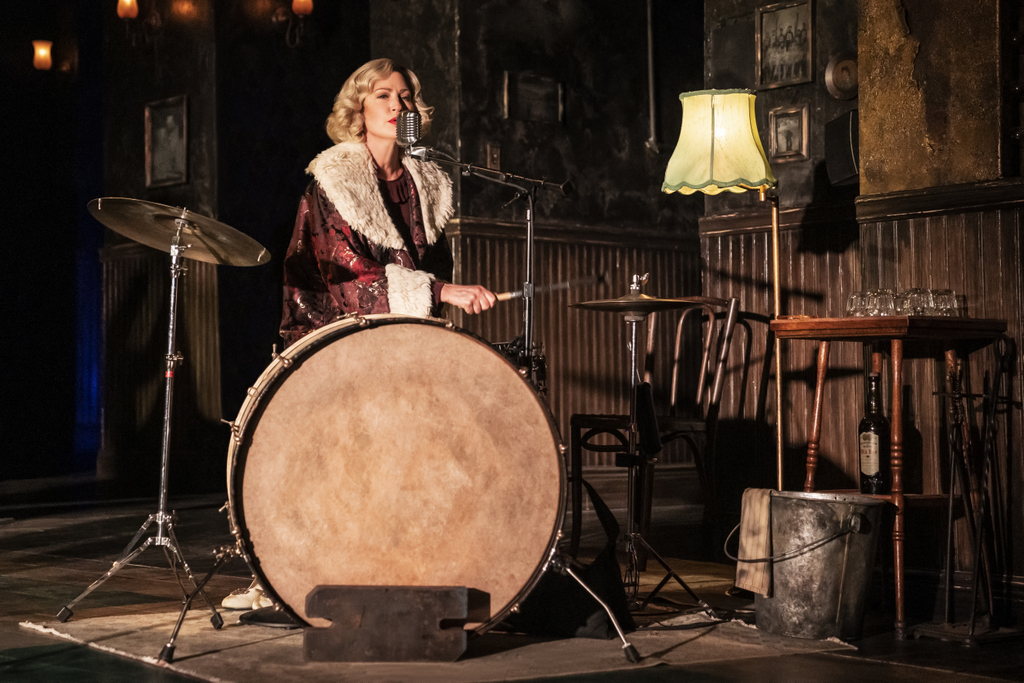
Luba Mason in ‘Girl From The North Country,’ written and directed by Conor McPherson, music & lyrics by Bob Dylan (Matt Murphy)
A number of the actors double as musicians and Dylan’s song selection ranges in a combination of pop, country, folk and blues. All the songs are recognizable and illustrative of the mood and tone of this stirring piece about characters who yearn for a brighter tomorrow but know that the result will be a more challenging ever-presence of sorrows. Nevertheless, the characters snatch from the mouth of woe bits of humor, song and dance which create shining moments that move them to give solace to one another to help get them to the next day.
Chief among these every-day-heroes is boarding house owner, the stalwart, self-immolating Nick Laine (the fine Jay O. Sanders) who keeps a brood of homeless, down-and-outers together for a time, until they must all move on because Nick is broke and losing his home to the banks. The reference to Steinbeck’s Joad family in The Grapes of Wrath after they lose their house and prepare to leave for the “promised-land” of California is unmistakable.
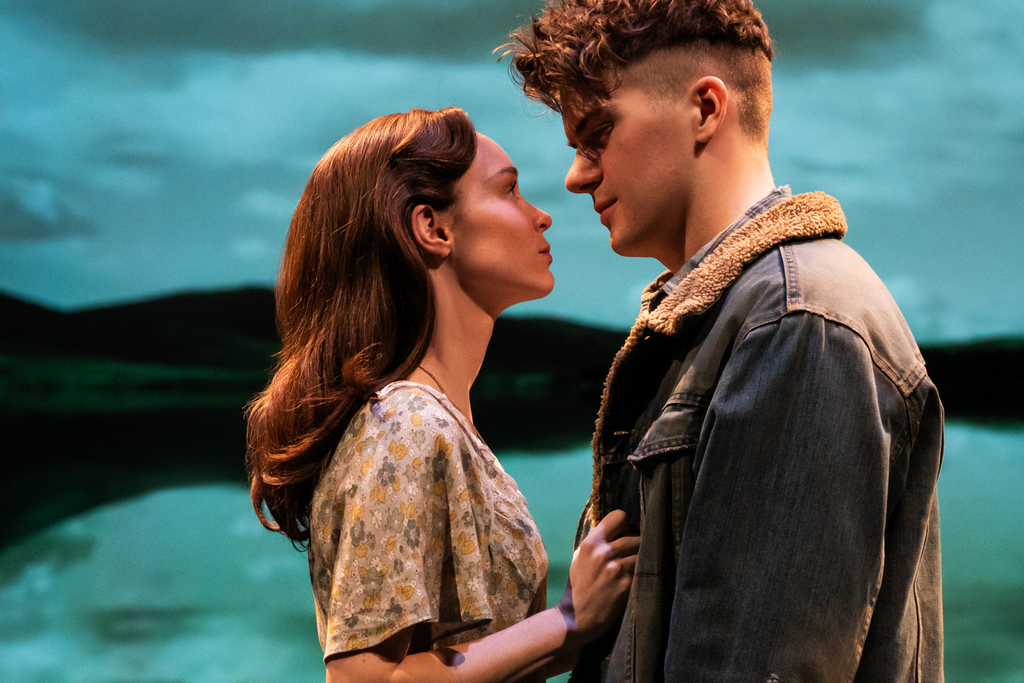
(L to R): Caitlin Houlahan, Colton Ryan, ‘Girl From The North Country,’ written/directed by Conor McPherson, music & lyrics by Bob Dylan (Matt Murphy)
Nick must negotiate his wife Elizabeth (the incredible Mare Winningham in a sterling performance). Elizabeth has dementia and ironically serves as Nick’s conscience, seamlessly moving in and out of sentience selecting a time when she can most effectively jab at Nick’s soul about his sister whose death he negligently caused and his mistress Mrs. Neilsen (the excellent Jeannette Bay Ardelle).
Mrs. Neilsen and Nick receive a respite from misery in each other’s arms as she rents a room and helps out with Elizabeth during the time she stays in Nick’s boarding house. Mrs. Neilsen lures Nick with her deceased husband’s scheduled inheritance which she dangles in front of him as bait to fulfill their dream of running away together. Ardelle easily slides into Dylan’s songs with full-throated abandon that is rich and lustrous.
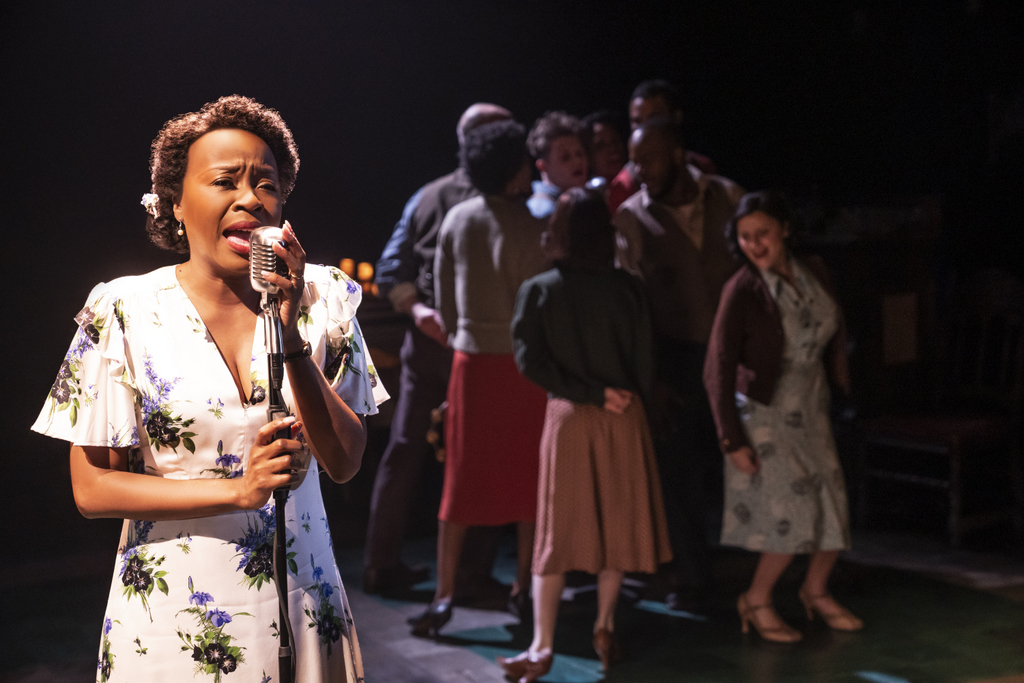
Jeannette Bayardelle and The Cast of ‘Girl From The North Country,’ written/directed by Conor McPherson, music & lyrics by Bob Dylan (Matt Murphy)
Winningham’s Elizabeth is willful, prescient and edgily funny. She brings down the house with her rendition of “How Does It Feel,” as a foreboding reminder that fate comes for all of us and especially Nick and the various borders who are skulking away from life and the law in this temporary haven from both. She nails Mr. Perry for his sexually predatory abuse of her when she was a child. And she questions Nick why he would pimp off their adopted daughter Marianne Laine ( the wonderful Kimber Elayne Sprawl) to old Mr. Perry in a quid pro quo exchange of Marianne for the payments on their mortgage. Elizabeth to a large extent discourages the deal to Nick, Mr. Perry and her daughter, and though she will miss her, she doesn’t discourage Marianne from running off with boxer Joe Scott (Austin Scott) who blows in one desolate night looking for shelter at Nick’s place with his companion Reverend Marlowe (Matt McGrath).
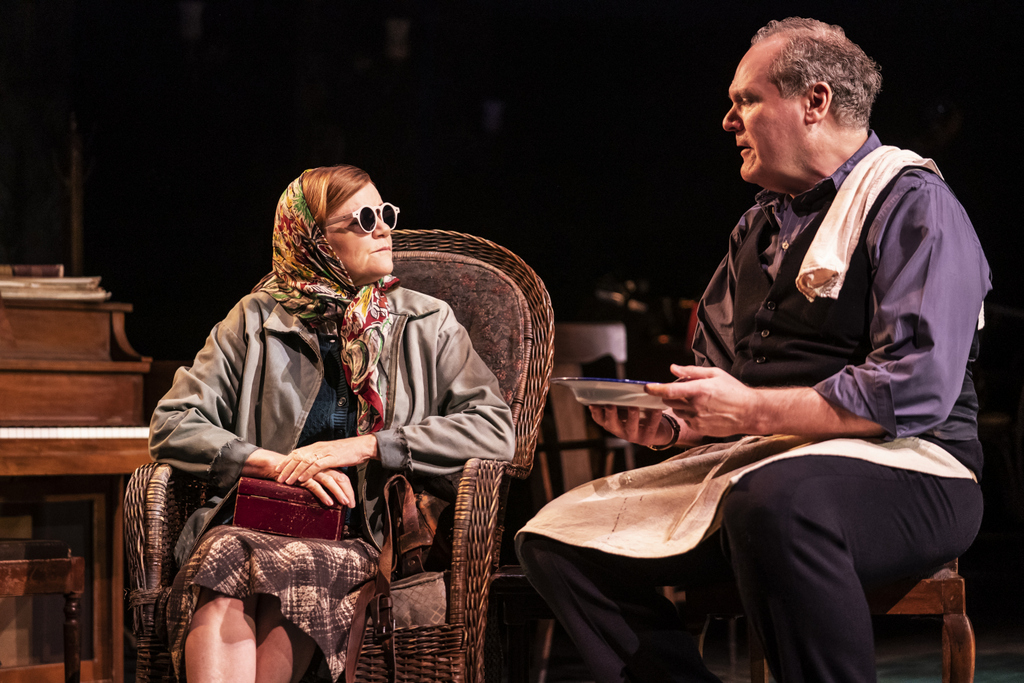
Mare Winningham, Jay O. Sanders in ‘Girl From The North Country,’ written/directed by Conor McPherson, music & lyrics by Bob Dylan (Matt Murphy)
Thankfully, Nick’s boarding house provides “a welcome for lost souls.” There, Nick feeds them, they celebrate Thanksgiving, they dance. However, Mrs. Burke (the fine Luba Mason), Mr. Burke ( the superb Marc Kudisch), and Elias Burke (the wonderful Todd Almond) hide secrets. So do the slippery Reverend Marlowe and accomplished boxer Joe Scott. Each of the characters is “on the run!” They carry the baggage of their fears, failures and hidden torments to Nick’s guesthouse where eventually their inner hell is exposed to the light and we feel and understand their suffering with empathy in a kind of redemptive soul evolution and hope.
Perhaps the most poignant of fears concerns the Burkes, whose strong, powerfully built son Elias manifests the mind of a three-year-old. Like the character Lennie in Steinbeck’s Of Mice and Men, he understands little of his world around him and stumbles into heartbreaking trouble.
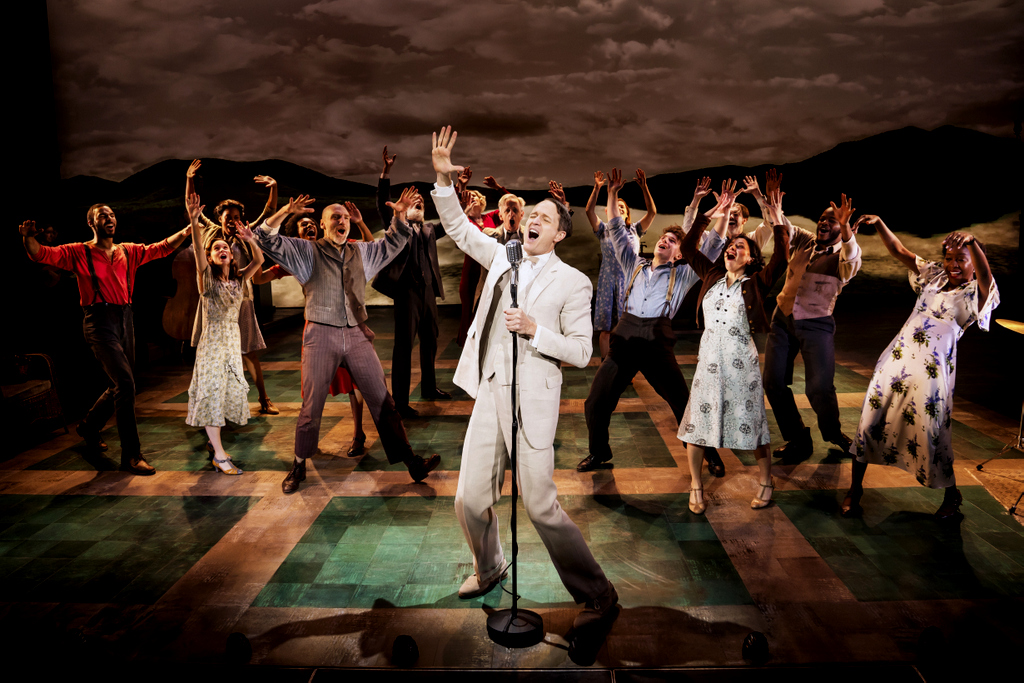
Todd Almond, the cast of ‘Girl From The North Country,’ written/directed by Conor McPherson, music & lyrics by Bob Dylan (Matt Murphy)
The poignance of his demise is uplifted when Todd Almond as Elias magnificently sings “Duquesne Whistle.” As a spirit he has gone to the afterlife. No more materialistic pain and suffering shackles his mind and heart in darkness. Dressed in a white suit, free of his mental challenges, he and the chorus celebrate that other dimension McPherson beautifully presents (a theme in many of his works). It is a full-on, gospel “coming home” ceremony. Elias (like his name-variant prophet Elijah), “makes it to the other side” of the Light in a wonderful capstone to Almond’s complex and nuanced portrayal.

(L to R): Mare Winningham, Kimber Elayne Sprawl in ‘Girl From The North Country,’ written/directed by Conor McPherson, music & lyrics by Bob Dylan (Matt Murphy)
Thanksgiving as an ironic celebration of a country that has not stood by any of them, initially is filled with song that follows fast with grim realities. At this juncture after the toasts come the tragic truths that explode all of their yearnings that are pipe dreams (in a reference to Eugene O’Neill’s The Iceman Cometh). Though Marianne escapes with Joe Scott who airily convinces her he will protect her and her child in Chicago, it is one more grabbing at a brass ring on the merry-go-round of life that has stopped spinning and has lost its glory in a break down that will never be repaired.
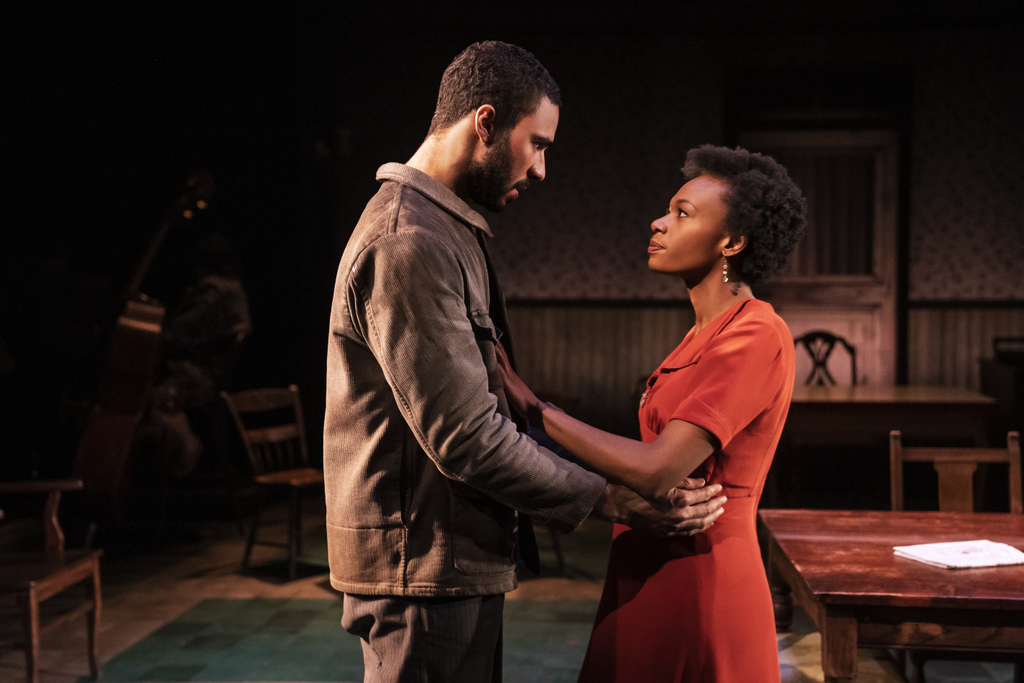
Austin Scott, Kimber Elaybe Sprawl, ‘Girl From The North Country,’ written/directed by Conor McPherson, music & lyrics by Bob Dylan (Matt Murphy)
Nick’s hopes shatter as his daughter Marianne runs off, leaving Mr. Perry without a wife and Nick without house payments. And the final blow is delivered by son Gene (Colton Ryan) whose alcoholism allows him to tell his father at the celebration that he lost the railroad job his father moved heaven and earth for him to get. Gene’s girlfriend Kate (Caitlin Houlahan) leaves him and he is left relying on his father when Nick has nothing more to give him and feels an abject failure at his inability to raise his children to help support the family which is now bereft. No wonder Nick considers suicide (Dr. Walker implies this) but is too dependent on Elizabeth needing him to take it beyond contemplation.
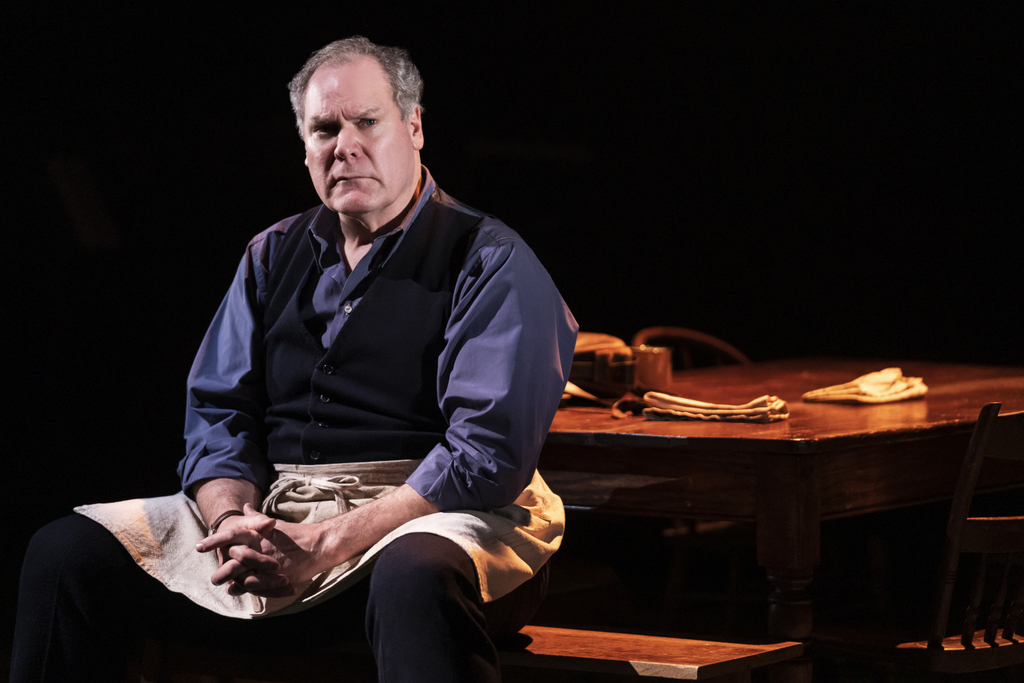
Jay O. Sanders in ‘Girl From The North Country, written/directed by Conor McPherson, music & lyrics by Bob Dylan (Matt Murphy)
Only Elizabeth, after her marvelous speech about love and her marriage to Nick, afterward singing “Forever Young,” remains serene in her sentience and canny distraction. Indeed, with Nick’s help she has mastered the art of balance even in her dementia.
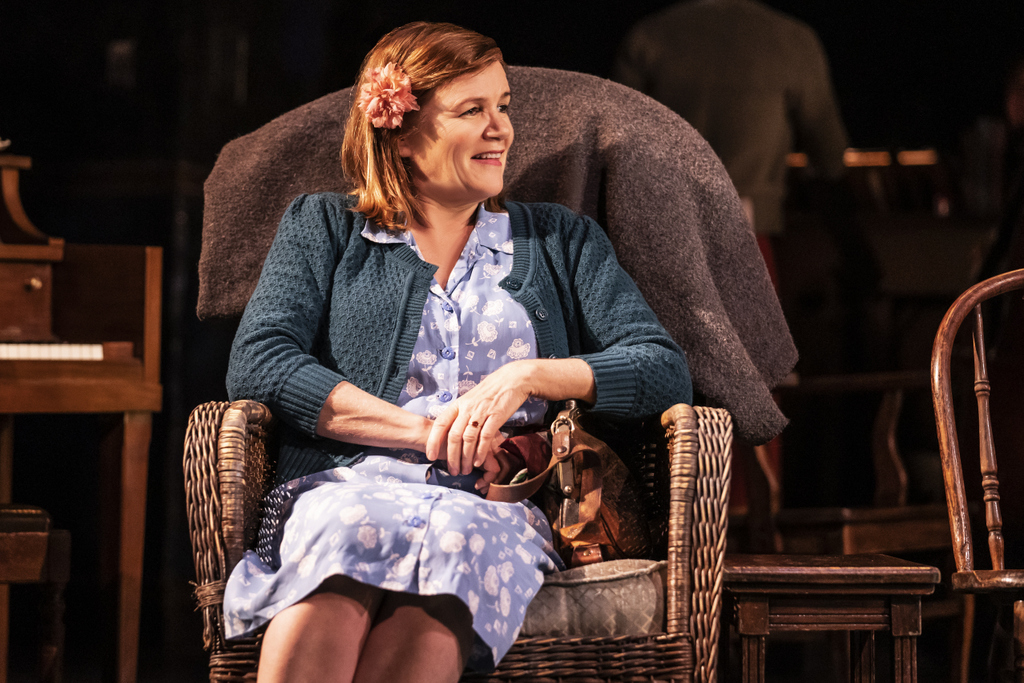
Mare Winningham in ‘Girl From The North Country,’ written/directed by Conor McPherson, music & lyrics by Bob Dylan (Matt Murphy)
With finality, we look in the background at their last Thanksgiving together in tableau, as Dr. Walker narrates what he knows of the characters’ futures, again reminiscent of the narrator in Thornton Wilder’s Our Town. And as McPherson is wont to do and does believably, Dr. Walker (Robert Joy) shares his passing to “the other side” in Christmas of 1934. We realize then that he has been speaking to us as a spirit, sharing with us his fond memories of the Laines, the guests, and that time.
What more can be said about this marvelous must-see Broadway premiere that has been directed by Conor McPherson and shepherded with care and love from The Old Vic, to The Public Theater, to the Belasco Theatre? The chorus/ensemble (Matthew Frederick Harris, Jennifer Blood, LawTerrell Dunford, Ben Mayne, Tom Nelis, Chiara Trentalange, Bob Walton, John Schiappa, Rachel Stern, Chelsea Lee Williams), are exceptional in voice and movement. Kudos to Rae Smith (scenic & costume design), Mark Henderson (lighting design), and Simon Baker (sound design). Simon Hale’s orchestrations and arrangements of Dylan’s music are exceptional. Additionally, without Dean Sharenow (music coordinator) Marco Paguia (music director) Lucy Hind (movement director) the actors who played in the band (Todd Almond, Marc Kudisch, Luba Mason), and musicians Martha McDonnell, Mary Ann McSweeney, and others, the full impact of the production would be lessened.
This review was written in light of the suspension of Girl From The North Country until the 12th of April. For UPDATES ON THE SUSPENSION CLICK HERE.
 CAROLE DI TOSTI